Presented by
K-9 Emergency Response Teams
 Course Intent:
◦ To provide the Emergency Responder with the ability
to properly identify uncommon, dangerous, and
difficult rescue situations.
◦ To provide direction for the Emergency Responder to
initiate a proper response to these situations.
◦ To serve as prerequisite training for basic
certifications in the various Technical Rescue
disciplines.
 Overall Objective:
◦ This part of course is not intended to provide rescue level
training.
◦ The overall objective of this presentation is to provide
the student with the knowledge to recognize
situations in which advanced training is required, and
to provide direction in initiating a proper response.
 To maintain rescuer safety
 To provide the best care for the victim
 The same techniques used in a search and or rescue
operation(s) shall be considered equally useful for
training, body recovery, evidence search, and other
operations with a level of urgency commensurate
with the risk/benefit analysis.
 General Concepts of Technical Rescues.
 Specific Concepts of the Following Technical
Rescue Disciplines:
◦ Structural Collapse Rescue
◦ Rope Rescue
◦ Confined Space Rescue
◦ Vehicle & Machinery Rescue
◦ Water Rescue
◦ Wilderness Search and Rescue
◦ Trench/Excavation Rescue
 NFPA 1670 Recognizes Three Levels of Training
◦ 1670 Rescue Training
 Awareness
 Operations
 Technician
◦ Awareness Level
 Personnel who may be 1st on the scene
 Recognition of hazards and need for resources
 Initial scene stabilization
 Initial request for additional resources
 Little or no actual rescue
◦ Operations
 Basic rescue techniques
 Identify hazards
 More advanced scene stabilization
 Support for technician-level rescue operations
◦ Technician
 Advanced rescue techniques
 May require certification in multiple disciplines
 Coordinate, perform, and supervise technical search
and rescue incidents.
 Regulations:
◦ NFPA 1670: Operations and Training for Technical
Rescue Incidents
◦ NFPA 1006: Rescue Technician Professional
Qualifications
◦ Other regulations as required by each discipline
 Status of Wisconsin and OSHA:
◦ Wisconsin does not have its own OSHA standard, and
therefore follows federal OSHA laws
 Applies to Federal and Private employees
◦ Local government (all municipal fire departments and
some volunteer departments) are governed by
Wisconsin State Statues, SPS 330 and SPS 332
 Responsibilities of the Authority Having
Jurisdiction (AHJ):
◦ Identify potential risks for Technical Rescue incident
in their jurisdiction
 Most AHJ’s will have the potential for each type of
Technical Rescue incidents
◦ Make all personnel aware of known hazards
 The goal of the hazard identification and risk
assessment is to increase the awareness of the
AHJ and to provide a focus toward conditions
and factors associated with potential technical
rescue responses.
 The hazard identification and risk assessment
determines "what" can occur, "when" (how
often) it is likely to occur, and "how bad" the
effects could be.
 Pre-planning:
◦ Identify possible Technical Rescue hazards
 Industrial / agricultural operations
 Terrain hazards
 Cliffs
 Rivers / lakes
 Forests
 Caves
 Recreational activities
 Climbing / hiking / caving
 Swimming / boating / scuba diving
◦ Identify possible Technical Rescue hazards
 Natural occurrences
 Tornadoes
 Earthquakes
 Floods
◦ Preplans should consider alternatives for large-scale
damage
 Roads blocked or damaged
 Bridges out
 AHJ resources damaged
◦ Assess their Technical Rescue capabilities
 Ability to train and maintain training of an adequate
number of personnel in each discipline
◦ Identify available sources of assistance
 Professional services
 Industrial teams
 Contractors
 Mutual-aid resources
 Great opportunity for regionalization
 State or Federal resources
 FEMA teams
 Military / Coast Guard
 Park Service
 Hazards Associated with Technical Rescues:
◦ Unrecognized or hidden hazards are common
 Training is required to recognize these hazards
 Emergency Responders are action-oriented which is
often an asset, but may be the greatest hazard at a
technical rescue incident
 As high as 65% of all casualties are would-be rescuers
◦ Understanding the potential hazards will allow
rescuers to react using proper assessment and
control
 Reduces emotional response to an event
◦ The Hazard and Risk Assessment later helps to
formalize the Rescue plan through written SOP’s,
SOG’s, etc.
 Establish Command
 Activating resources
 Command procedures
 Dispatch procedures
 MABAS cards
 Methods for contacting additional resources
 Initial scene operations
 Preparation for rescue
 Rescue operations if incident will be handled by
department personnel
 Personal Protective Equipment (PPE):
◦ Proper equipment must be provided to all personnel
operating at the scene
◦ Protective equipment should be appropriate to the
tasks that are expected to be performed during
technical search and rescue incidents and training
exercises
◦ In many cases this equipment will be extremely
sophisticated and will be brought to the scene by
trained rescue personnel
 Personnel Accountability System (PAS):
◦ Established by the AHJ
◦ Must track all personnel operating at the scene at
all times
 Evacuation Procedures and Notification:
◦ Evacuation signal
◦ Evacuation procedures
 Termination / abandonment of equipment and tasks
◦ Evacuation routes
 On Scene Hazard and Risk Assessment (Size-
up):
◦ Initial size-up
◦ Continuous size-up
 Situations change rapidly
◦ The situation may be localized, or spread out over
a wide area
 Large incidents may overwhelm rescue resources
 May require multiple commands within the same
jurisdiction
◦ May involve multiple hazards
 Location and Number of Victims:
◦ Estimated by initial size-up
◦ Re-evaluated with continuing size-up
◦ Factors to consider:
 Time of day
 Type of occupancy / situation
 Available warning
 Ability to self-rescue
 Environmental Factors:
◦ Victim survivability will be affected by extreme heat
or cold
◦ Scene stability may be affected by
 Wind
 Rain
 Snow
◦ Identify methods of reducing these effects
 Patient Contact:
◦ Establish contact as soon as possible by any safe
manner
 Verbally
 Hand signals
 Radio / hard-line communications
◦ Important for patient assessment and psychological
well-being
◦ Control who talks to the patient
 Maintain consistency & honesty
 Don’t lie, but withhold frightening info.
◦ When safe, establish medical contact
 Risk / Benefit Analysis:
◦ Will the end result justify the means?
◦ What is an acceptable level of risk to rescuers?
◦ How long has the victim been trapped or stranded?
◦ Is this a rescue or a recovery?
◦ Can the patient be reached by another method?
◦ Are the required resources needed for multiple
rescues?
 If so, triage needs to occur
 Greatest good for the Greatest number
 Availability of Necessary Resources:
◦ AHJ resources
 Rescue personnel
 Contractors – Construction Companies- Construction Supplies
 Rental / equipment companies
◦ Mutual-aid resources
◦ Other Operations Level or Technician Level teams
◦ Multi-jurisdictional resources
 Regional / State / Federal
◦ Professional resources
 Engineers
 Industrial / commercial personnel
 Food Service Companies
 The incident management system (IMS) utilized
at all technical search and rescue incidents
should be structured to address the unique
groups, divisions, or branches that can be
necessary to effectively manage the specific
type of incident
 Incident Management / Command System:
◦ Established by the AHJ
◦ Minimum Sectors:
 Command
 Rescue
 Safety
◦ Incident Command
 Has overall responsibility for the entire incident
 Need not be trained to the level of the incident
 Must assign appropriately trained personnel and
resources to perform the actual rescue
 Has the authority to halt the incident
◦ Technical Safety Officer
 If the designated department Safety Officer is not
trained to the level of the incident, a Technical Safety
Officer who is trained to the level of the incident should
also be assigned.
◦ Rescue Sector Officer
 Must be trained to level of incident
 Reports to the incident commander
 May designate rescue sub-sectors
 Establish an Incident Action Plan and or rescue plan
 Inform all sectors of plan
 Insure the plan is carried out
◦ Optional Sectors
 Logistics
 Public Information
 EMS
 Staging
 Rehab
 Other sectors as required
 Scene Control:
◦ Establish control zones as soon as possible
 Use physical boundaries when available
 Use banner tape or rope to cordon off areas
 Control should be for both civilian and fire / rescue personnel –
limit access
 Control/limit traffic and sources of vibration in the area
 Utilize police assistance
 Identifying hazards and removing and/or reducing their impact
 Conduct Witness Interviews:
◦ Interview all witnesses
 Determine where they were at the time
 Determine what they were doing at the time
 Determine what they saw / heard / felt
◦ Document the interviews
◦ Consider mapping their locations to help pinpoint
victim location
 Triangulation
WITNESS
#1
WITNESS
#2
 Bystander Interaction:
◦ Use control zones
◦ Segregate family of victim
 Assign someone to keep them updated
◦ Provide accurate, timely updates
 Prevents rumors
 Maintains control
 Creates allies
◦ Public Information Officer
 Should be able to explain complexities of rescue
 May defer to a trained rescuer to explain
 Police Assistance:
◦ May be useful in creating and monitoring control
zones
◦ Keep them informed as you would the press
 Provides level of understanding
 Reduces rumors
◦ Keep them informed of scene safety issues such as
evacuation procedures
 Machinery / Vehicles:
◦ Use vehicles, not personnel to stop traffic
◦ If heavy machinery must be used at scene:
 Find expert operators
 Operators should not be associated with victim or
incident
 Should be a pre-plan item
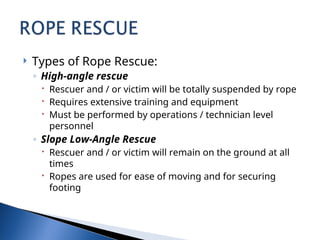
 Utilities:
◦ Notify proper utilities
◦ Do not attempt to manipulate their equipment unless
you have received proper training
◦ Have emergency numbers available for all utilities
The Incident Action Plan
 A plan for successfully resolving the search
or rescue.
-- must be dynamic (flexible).
-- must be updated for each operational
period.
-- must be only one plan for the operational
period.
 The role of the Incident Action Plan in
operations is extremely important to the
overall search and or rescue effort.
 It should provide the Operations function with the
following:
1. Defined operational periods.
2. Written operational objectives reflecting the policy
and needs of all jurisdictions.
3. Divisional assignment lists (tactical assignments).
4. Organizational chart.
5. Maps, or blue prints delineating assignment areas.
6. Communications plan.
7. Resource status and availability.
8. Mission situation/status reports.
9. Weather information.
10. Situation predictions.
11. Medical plan.
12. Transportation plan.
13. Subject profile.
14. Safety considerations for weather,
hazards, etc.
 Accounting for all personnel.
 Returning all gear to staging area.
 Debriefing.
 Considering CISD.
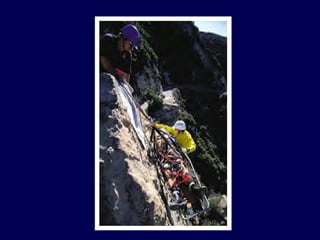
 Rope Rescue:
◦ Rescues where the use of rope is necessary for victim
access or removal
◦ Rope rescue equipment and techniques are a major
element of many Technical Rescue Operations
 Additional Regulations:
◦ Equipment standard:
 NFPA 1983: Fire Service Life Safety Rope and System
Components
 Established when it became apparent that the fire
service was not advancing in their rope techniques as
equipment improved
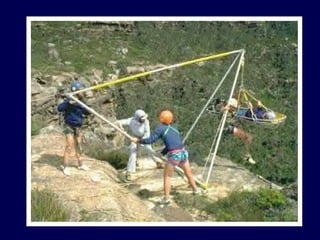
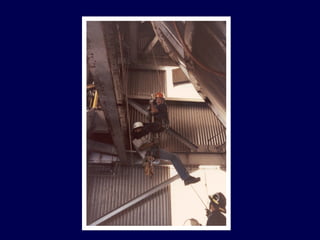
 Types of Rope Rescue:
◦ High-angle rescue
 Rescuer and / or victim will be totally suspended by rope
 Requires extensive training and equipment
 Must be performed by operations / technician level
personnel
◦ Slope Low-Angle Rescue
 Rescuer and / or victim will remain on the ground at all
times
 Ropes are used for ease of moving and for securing
footing
 Authority Having Jurisdiction (AHJ):
◦ All AHJ’s have the potential for rope rescue incidents
 Water towers
 Window washers
 Kids in trees
 Power company workers
◦ The AHJ should identify and pre-plan all elevated
structures and natural sites
 Length and number of ropes required to perform a
rescue
 The AHJ should provide unusually long ropes if required
 Authority Having Jurisdiction (AHJ):
◦ Any responder with a chance of falling must be
secured per AHJ policy
 Rope Rescue Hazards:
◦ Falling (most common hazard)
 Working an edge
 Rope / equipment failure
 Shock-loading
 Technical error
◦ Impact injuries from falling equipment
◦ Utility hazards
 Working above ground may place rescuers near or over
power lines
◦ Unrecognized additional hazards
 A rope rescue in an excavation / confined space
 Rope Rescue Equipment:
◦ Ropes (lifelines)
 Should only be used for rescue / training of people
 Lines for hauling of equipment or searching should be
separate
◦ Elements of a good knot
 Easy to tie
 Easy to recognize
 Easy to untie
 Retains much of the rope strength
 Tensionless hitch (no knot) 100%
 Figure 8 (dressed properly) 75%-80%
 Double Fisherman 65%-70%
 Water knot 60%-70%
 Square knot 43%-47%
 Butterfly knot 20%
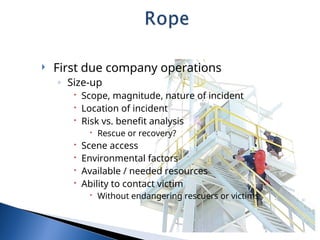
 First due company operations
◦ Size-up
 Scope, magnitude, nature of incident
 Location of incident
 Risk vs. benefit analysis
 Rescue or recovery?
 Scene access
 Environmental factors
 Available / needed resources
 Ability to contact victim
 Without endangering rescuers or victims
 First due company operations
◦ Secure the general area
 300’ area or more
◦ Make area safe for rescuers
 Control / limit traffic
 Control / limit access
 Identify all hazards
 Reduce or remove them
◦ Notify qualified rescue team per SOG’s / SOP’s
 Recognize the need for a Water Search and
Rescue
 Implement the assessment phase
 Identify resources necessary to conduct safe
and effective water operations
 Implement the emergency response system for
a Water incidents
 Initiate site control and scene management
 Recognize the general hazards associated with
Water incidents and how to mitigate those
hazards
 Determine rescue vs. body recovery
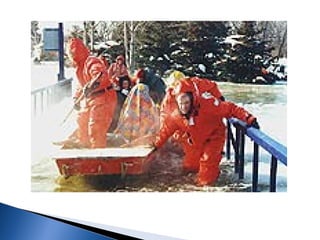
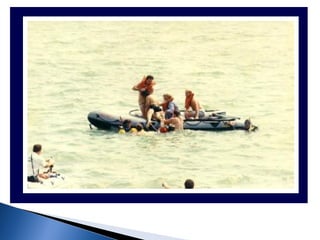
 Water Rescues:
◦ Rescues in which the victim is in the water or where
water must be traversed to access the victim
◦ There is a chance to save a life
◦ Immediate witnessed
◦ Can be a longer period of time in colder water
Types of water events that can lead to rescues or
recoveries
• Swimming accidents
• Boating accidents
• Fishing accidents
• Snowmobile accidents
• Car accidents
• Plane crashes
• Suicides
• Homicide concealment's
 Types of Water Rescues:
◦ Surface rescues (awareness level)
 Victim is at the surface in relatively smooth water
 Throw / reach rescues
 Rescues where the victim can be reached from shore or a
boat without rescuer entry
 Go rescues
 Rescues of surface victims which requires rescuer entry
◦ Dive rescues (operations / technician)
 Victim is below the surface in warm water with little or
no current
◦ Ice rescues (operations / technician)
 Victim is at the surface in cold water with ice
 Victim is below the surface or under the ice in cold
water with ice
◦ Surf rescues (operations / technician)
 Victim is at the surface in conditions where there are
waves and undertows
◦ Swift water rescues (operations / technician)
 Victim is in water with significant current
 Victim is trapped by a low-head dam
 Victim usually in water
 Victim in water more then an hour – summer
 Operations are at slow deliberate pace
 Authority Having Jurisdiction (AHJ):
◦ Almost all AHJ’s have the potential for some type of
water rescue
◦ The AHJ should identify and pre-plan any bodies of
water in their area and determine the type of rescue
potential and available resources to perform those
rescues
◦ AHJ’s with any type of river or creek should not
exclude the possible of a swift water incident in the
case of severe flooding.
 General Water Rescue Hazards:
◦ Drowning hazards
 Slips & falls sending firefighters into water wearing
inappropriate gear
 Banks may be extremely slippery – May need rope rescue
◦ Hypothermia
 Can impair rescuer’s mental and physical abilities
 Body heat is lost 25 times faster in water than in air of same
temperature
 Victim hypothermia can extend viability window
 Overcome by proper equipment
◦ Heat stress
 Divers in gear waiting out of water
◦ Weather hazards
 Snow and rain can increase rescuer hypothermia
requiring frequent rehab
 High winds can produce wave conditions that can shut
down water operations
 Fog can reduce ability to locate victim
◦ Aquatic hazards
 Animal / insect life
 Biting injuries and distractions
 Allergic reactions
 Plant life
 Reduces visibility
 Entanglement
◦ Other hazards
 Hazardous materials
 Fuels and other chemicals
 Sewage and contaminated water
 Some aquatic environments also contain harmful
bacterial or viral biohazards
 Some contain heavy sediment or slit can result in zero
visibility
 Requires special PPE
 Power lines
 Storms that cause flooding can also cause wind damage
 Dive Rescue Hazards:
◦ Drowning hazards
 Panic
 Loss of air
 Entrapment / Entanglement
◦ Pressure injuries
 Decompression sickness
 Air embolism
 Nitrogen narcosis
◦ Exhaustion
 Reduced by receiving help getting in and out of water
 Ice Rescue Hazards:
◦ Emotion responses / poor rescue decisions
 Visible victims will prompt ill-equipped rescue attempts
 Frequently results in additional victims
 “Go” rescuers must have proper PPE
 Thermal protection
 Buoyancy
 Attached rope
◦ Victim and rescuer hypothermia
◦ Equipment freeze-up
 Ice divers have a difficult time keeping regulators
functioning
 Surf Rescue Hazards:
◦ Occurs in Wisconsin
 Lake Michigan
 Other fairly large lakes
◦ Large waves
 Will capsize boats
 Reduces victim visibility
 Can create crush forces against shore and other objects
◦ Undertows / currents / storm surge
 Will pull victim and rescuers down
 Lake Michigan is notorious for this
 Swift Water Rescue Hazards:
◦ Underestimation of forces
 Constant / awesome / relentless power
 Inadequately trained & equipped rescue attempts
◦ Suddenness of occurrence
 Can result quickly during flood conditions
 Can come from invisible sources upstream
◦ Impact / Entrapment injuries
 Will often result in drowning
 Try to remain floating on back and work to side
 Do not attempt to stand-up
 Will likely cause entrapment and drowning
◦ Strainers
 Allows water to pass, but not larger objects such as
people
 Downed trees are common strainers
◦ Vehicle entrapment
 Vehicles that get swept away may require extrication
techniques in addition to swift water
 Low-Head Dam Rescue Hazards:
◦ A uniform barrier across entire width of moving wa
 Water drops uniformly across entire surface
 Low height of drop
 Difficult to see from upstream
 Don’t look dangerous
◦ Underestimation of forces
 Constant / awesome / relentless power
 Creates a vertical whirlpool
 “Drowning/Killing machines”
 Will pull boats down
 Personal Protective Equipment:
◦ Personal Floatation Devices (PFD)
 Required for all personnel working on or near water.
Should have a light stick.
 Turn-out gear and FF boots not proper for swimming
◦ Thermal protective suits
 “Gumby” suits for surface rescue
 Thermal survival suits if working at great distances from
shore in cold water
 Lake Michigan
 Dry and wet suits for divers
◦ Taglines, life lines, helmets, gloves
 Cold Water Near Drownings:
◦ Will extend window of survivability
 As much as an hour or more
 Cold, clear water provides best chance
 Younger victims have better chance
 Healthy victims have better chance
◦ Cold water defined as 70 degrees F or less
 Even on warm days, victim will likely sink below
thermocline and be below 70 degrees
◦ Stay in rescue mode for 90 minutes
 Treat recovered victims during this time aggressively
 “Not dead until they’re warm and dead”
 Specific Initial Company Tasks:
◦ Identify and size-up scene
 Type of water rescue situation
 Location and number of victims
 Above or below the surface
 Is this a Rescue or Recovery
 Approximate distance from shore
 Need for special team response
•How to access the scene?
•Evaluate the environmental factors
Remember water levels and current can be
changing drastically (flooding)
• Remove all untrained rescuers from the water and
edge
• Establish Work Zones (hot, warm, cold as
appropriate) May need to clear debris from hot zone
or access to it
• Use police to help establish scene security if
necessary
◦ Initiate reach or throw rescue attempts if
appropriate
 Call for technician level response immediately in case
these attempts are unsuccessful
◦ Perform and document witness interviews
 Capturing witnesses is paramount
 Interview witnesses as soon as possible
 Witness last-scene points are best chance of pinpointing
victim location
 Triangulation
 Interview witnesses separately
 Document statements and diagram location of witness
and last scene points
 Keep witnesses at scene as long as possible
◦ Preserve last-seen evidence
 A hole through the ice may be the best indicator of victim
location…don’t destroy it.
◦ Evaluate other evidence for clues
 Shoes, clothes, drifting boat, fishing equipment
 Statements of victim’s intended travel
 Wanted to swim to raft
 Wanted to fish near the dam
 Statements of victim’s normal patterns
 He always swims across the lake
 Set-up for rescue and possible search
operations
 Determine access point for boats and divers
 Have EMS standing by
 Contact a qualified Water Search K-9 Unit
 One unit for each victim
 One more for diver support
 Set-up rehab / shelter for divers and rescuers
 Consider need for lighting
 Drag lines for later recovery efforts
 Flash flooding may result in drastic changes
 Call for ice divers consult with dive team
 If using K-9. Drill holes all the way through
ice every ten feet from point last seen.
Consult handler
 Accounting for all personnel and resources
 Accounting for equipment
 Cleaning all equipment
 Debriefing
 Considering Psychological First Aid (PFA).
Technical Rescue Awarenes Rope and Water

  • 1.
  • 2.
     Course Intent: ◦To provide the Emergency Responder with the ability to properly identify uncommon, dangerous, and difficult rescue situations. ◦ To provide direction for the Emergency Responder to initiate a proper response to these situations. ◦ To serve as prerequisite training for basic certifications in the various Technical Rescue disciplines.
  • 3.
     Overall Objective: ◦This part of course is not intended to provide rescue level training. ◦ The overall objective of this presentation is to provide the student with the knowledge to recognize situations in which advanced training is required, and to provide direction in initiating a proper response.  To maintain rescuer safety  To provide the best care for the victim
  • 4.
     The sametechniques used in a search and or rescue operation(s) shall be considered equally useful for training, body recovery, evidence search, and other operations with a level of urgency commensurate with the risk/benefit analysis.
  • 5.
     General Conceptsof Technical Rescues.  Specific Concepts of the Following Technical Rescue Disciplines: ◦ Structural Collapse Rescue ◦ Rope Rescue ◦ Confined Space Rescue ◦ Vehicle & Machinery Rescue ◦ Water Rescue ◦ Wilderness Search and Rescue ◦ Trench/Excavation Rescue
  • 6.
     NFPA 1670Recognizes Three Levels of Training ◦ 1670 Rescue Training  Awareness  Operations  Technician ◦ Awareness Level  Personnel who may be 1st on the scene  Recognition of hazards and need for resources  Initial scene stabilization  Initial request for additional resources  Little or no actual rescue
  • 7.
    ◦ Operations  Basicrescue techniques  Identify hazards  More advanced scene stabilization  Support for technician-level rescue operations ◦ Technician  Advanced rescue techniques  May require certification in multiple disciplines  Coordinate, perform, and supervise technical search and rescue incidents.
  • 8.
     Regulations: ◦ NFPA1670: Operations and Training for Technical Rescue Incidents ◦ NFPA 1006: Rescue Technician Professional Qualifications ◦ Other regulations as required by each discipline
  • 9.
     Status ofWisconsin and OSHA: ◦ Wisconsin does not have its own OSHA standard, and therefore follows federal OSHA laws  Applies to Federal and Private employees ◦ Local government (all municipal fire departments and some volunteer departments) are governed by Wisconsin State Statues, SPS 330 and SPS 332
  • 10.
     Responsibilities ofthe Authority Having Jurisdiction (AHJ): ◦ Identify potential risks for Technical Rescue incident in their jurisdiction  Most AHJ’s will have the potential for each type of Technical Rescue incidents ◦ Make all personnel aware of known hazards
  • 11.
     The goalof the hazard identification and risk assessment is to increase the awareness of the AHJ and to provide a focus toward conditions and factors associated with potential technical rescue responses.
  • 12.
     The hazardidentification and risk assessment determines "what" can occur, "when" (how often) it is likely to occur, and "how bad" the effects could be.
  • 13.
     Pre-planning: ◦ Identifypossible Technical Rescue hazards  Industrial / agricultural operations  Terrain hazards  Cliffs  Rivers / lakes  Forests  Caves  Recreational activities  Climbing / hiking / caving  Swimming / boating / scuba diving
  • 14.
    ◦ Identify possibleTechnical Rescue hazards  Natural occurrences  Tornadoes  Earthquakes  Floods ◦ Preplans should consider alternatives for large-scale damage  Roads blocked or damaged  Bridges out  AHJ resources damaged
  • 15.
    ◦ Assess theirTechnical Rescue capabilities  Ability to train and maintain training of an adequate number of personnel in each discipline ◦ Identify available sources of assistance  Professional services  Industrial teams  Contractors  Mutual-aid resources  Great opportunity for regionalization  State or Federal resources  FEMA teams  Military / Coast Guard  Park Service
  • 16.
     Hazards Associatedwith Technical Rescues: ◦ Unrecognized or hidden hazards are common  Training is required to recognize these hazards  Emergency Responders are action-oriented which is often an asset, but may be the greatest hazard at a technical rescue incident  As high as 65% of all casualties are would-be rescuers ◦ Understanding the potential hazards will allow rescuers to react using proper assessment and control  Reduces emotional response to an event
  • 17.
    ◦ The Hazardand Risk Assessment later helps to formalize the Rescue plan through written SOP’s, SOG’s, etc.  Establish Command  Activating resources  Command procedures  Dispatch procedures  MABAS cards  Methods for contacting additional resources  Initial scene operations  Preparation for rescue  Rescue operations if incident will be handled by department personnel
  • 18.
     Personal ProtectiveEquipment (PPE): ◦ Proper equipment must be provided to all personnel operating at the scene ◦ Protective equipment should be appropriate to the tasks that are expected to be performed during technical search and rescue incidents and training exercises ◦ In many cases this equipment will be extremely sophisticated and will be brought to the scene by trained rescue personnel
  • 19.
     Personnel AccountabilitySystem (PAS): ◦ Established by the AHJ ◦ Must track all personnel operating at the scene at all times  Evacuation Procedures and Notification: ◦ Evacuation signal ◦ Evacuation procedures  Termination / abandonment of equipment and tasks ◦ Evacuation routes
  • 20.
     On SceneHazard and Risk Assessment (Size- up): ◦ Initial size-up ◦ Continuous size-up  Situations change rapidly ◦ The situation may be localized, or spread out over a wide area  Large incidents may overwhelm rescue resources  May require multiple commands within the same jurisdiction ◦ May involve multiple hazards
  • 21.
     Location andNumber of Victims: ◦ Estimated by initial size-up ◦ Re-evaluated with continuing size-up ◦ Factors to consider:  Time of day  Type of occupancy / situation  Available warning  Ability to self-rescue
  • 22.
     Environmental Factors: ◦Victim survivability will be affected by extreme heat or cold ◦ Scene stability may be affected by  Wind  Rain  Snow ◦ Identify methods of reducing these effects
  • 23.
     Patient Contact: ◦Establish contact as soon as possible by any safe manner  Verbally  Hand signals  Radio / hard-line communications ◦ Important for patient assessment and psychological well-being ◦ Control who talks to the patient  Maintain consistency & honesty  Don’t lie, but withhold frightening info. ◦ When safe, establish medical contact
  • 24.
     Risk /Benefit Analysis: ◦ Will the end result justify the means? ◦ What is an acceptable level of risk to rescuers? ◦ How long has the victim been trapped or stranded? ◦ Is this a rescue or a recovery? ◦ Can the patient be reached by another method? ◦ Are the required resources needed for multiple rescues?  If so, triage needs to occur  Greatest good for the Greatest number
  • 25.
     Availability ofNecessary Resources: ◦ AHJ resources  Rescue personnel  Contractors – Construction Companies- Construction Supplies  Rental / equipment companies ◦ Mutual-aid resources ◦ Other Operations Level or Technician Level teams ◦ Multi-jurisdictional resources  Regional / State / Federal ◦ Professional resources  Engineers  Industrial / commercial personnel  Food Service Companies
  • 26.
     The incidentmanagement system (IMS) utilized at all technical search and rescue incidents should be structured to address the unique groups, divisions, or branches that can be necessary to effectively manage the specific type of incident
  • 27.
     Incident Management/ Command System: ◦ Established by the AHJ ◦ Minimum Sectors:  Command  Rescue  Safety ◦ Incident Command  Has overall responsibility for the entire incident  Need not be trained to the level of the incident  Must assign appropriately trained personnel and resources to perform the actual rescue  Has the authority to halt the incident
  • 28.
    ◦ Technical SafetyOfficer  If the designated department Safety Officer is not trained to the level of the incident, a Technical Safety Officer who is trained to the level of the incident should also be assigned. ◦ Rescue Sector Officer  Must be trained to level of incident  Reports to the incident commander  May designate rescue sub-sectors  Establish an Incident Action Plan and or rescue plan  Inform all sectors of plan  Insure the plan is carried out
  • 29.
    ◦ Optional Sectors Logistics  Public Information  EMS  Staging  Rehab  Other sectors as required
  • 30.
     Scene Control: ◦Establish control zones as soon as possible  Use physical boundaries when available  Use banner tape or rope to cordon off areas  Control should be for both civilian and fire / rescue personnel – limit access  Control/limit traffic and sources of vibration in the area  Utilize police assistance  Identifying hazards and removing and/or reducing their impact
  • 32.
     Conduct WitnessInterviews: ◦ Interview all witnesses  Determine where they were at the time  Determine what they were doing at the time  Determine what they saw / heard / felt ◦ Document the interviews ◦ Consider mapping their locations to help pinpoint victim location  Triangulation
  • 33.
  • 34.
     Bystander Interaction: ◦Use control zones ◦ Segregate family of victim  Assign someone to keep them updated ◦ Provide accurate, timely updates  Prevents rumors  Maintains control  Creates allies ◦ Public Information Officer  Should be able to explain complexities of rescue  May defer to a trained rescuer to explain
  • 35.
     Police Assistance: ◦May be useful in creating and monitoring control zones ◦ Keep them informed as you would the press  Provides level of understanding  Reduces rumors ◦ Keep them informed of scene safety issues such as evacuation procedures
  • 36.
     Machinery /Vehicles: ◦ Use vehicles, not personnel to stop traffic ◦ If heavy machinery must be used at scene:  Find expert operators  Operators should not be associated with victim or incident  Should be a pre-plan item
  • 37.
     Utilities: ◦ Notifyproper utilities ◦ Do not attempt to manipulate their equipment unless you have received proper training ◦ Have emergency numbers available for all utilities
  • 38.
    The Incident ActionPlan  A plan for successfully resolving the search or rescue. -- must be dynamic (flexible). -- must be updated for each operational period. -- must be only one plan for the operational period.  The role of the Incident Action Plan in operations is extremely important to the overall search and or rescue effort.
  • 39.
     It shouldprovide the Operations function with the following: 1. Defined operational periods. 2. Written operational objectives reflecting the policy and needs of all jurisdictions. 3. Divisional assignment lists (tactical assignments). 4. Organizational chart. 5. Maps, or blue prints delineating assignment areas. 6. Communications plan. 7. Resource status and availability. 8. Mission situation/status reports.
  • 40.
    9. Weather information. 10.Situation predictions. 11. Medical plan. 12. Transportation plan. 13. Subject profile. 14. Safety considerations for weather, hazards, etc.
  • 41.
     Accounting forall personnel.  Returning all gear to staging area.  Debriefing.  Considering CISD.
  • 42.
     Rope Rescue: ◦Rescues where the use of rope is necessary for victim access or removal ◦ Rope rescue equipment and techniques are a major element of many Technical Rescue Operations  Additional Regulations: ◦ Equipment standard:  NFPA 1983: Fire Service Life Safety Rope and System Components  Established when it became apparent that the fire service was not advancing in their rope techniques as equipment improved
  • 44.
     Types ofRope Rescue: ◦ High-angle rescue  Rescuer and / or victim will be totally suspended by rope  Requires extensive training and equipment  Must be performed by operations / technician level personnel ◦ Slope Low-Angle Rescue  Rescuer and / or victim will remain on the ground at all times  Ropes are used for ease of moving and for securing footing
  • 48.
     Authority HavingJurisdiction (AHJ): ◦ All AHJ’s have the potential for rope rescue incidents  Water towers  Window washers  Kids in trees  Power company workers ◦ The AHJ should identify and pre-plan all elevated structures and natural sites  Length and number of ropes required to perform a rescue  The AHJ should provide unusually long ropes if required
  • 51.
     Authority HavingJurisdiction (AHJ): ◦ Any responder with a chance of falling must be secured per AHJ policy
  • 52.
     Rope RescueHazards: ◦ Falling (most common hazard)  Working an edge  Rope / equipment failure  Shock-loading  Technical error ◦ Impact injuries from falling equipment ◦ Utility hazards  Working above ground may place rescuers near or over power lines ◦ Unrecognized additional hazards  A rope rescue in an excavation / confined space
  • 53.
     Rope RescueEquipment: ◦ Ropes (lifelines)  Should only be used for rescue / training of people  Lines for hauling of equipment or searching should be separate
  • 54.
    ◦ Elements ofa good knot  Easy to tie  Easy to recognize  Easy to untie  Retains much of the rope strength  Tensionless hitch (no knot) 100%  Figure 8 (dressed properly) 75%-80%  Double Fisherman 65%-70%  Water knot 60%-70%  Square knot 43%-47%  Butterfly knot 20%
  • 55.
     First duecompany operations
  • 56.
     First duecompany operations ◦ Size-up  Scope, magnitude, nature of incident  Location of incident  Risk vs. benefit analysis  Rescue or recovery?  Scene access  Environmental factors  Available / needed resources  Ability to contact victim  Without endangering rescuers or victims
  • 57.
     First duecompany operations ◦ Secure the general area  300’ area or more ◦ Make area safe for rescuers  Control / limit traffic  Control / limit access  Identify all hazards  Reduce or remove them ◦ Notify qualified rescue team per SOG’s / SOP’s
  • 58.
     Recognize theneed for a Water Search and Rescue  Implement the assessment phase  Identify resources necessary to conduct safe and effective water operations  Implement the emergency response system for a Water incidents  Initiate site control and scene management  Recognize the general hazards associated with Water incidents and how to mitigate those hazards  Determine rescue vs. body recovery
  • 59.
     Water Rescues: ◦Rescues in which the victim is in the water or where water must be traversed to access the victim ◦ There is a chance to save a life ◦ Immediate witnessed ◦ Can be a longer period of time in colder water Types of water events that can lead to rescues or recoveries
  • 60.
    • Swimming accidents •Boating accidents • Fishing accidents • Snowmobile accidents • Car accidents • Plane crashes • Suicides • Homicide concealment's
  • 61.
     Types ofWater Rescues: ◦ Surface rescues (awareness level)  Victim is at the surface in relatively smooth water  Throw / reach rescues  Rescues where the victim can be reached from shore or a boat without rescuer entry  Go rescues  Rescues of surface victims which requires rescuer entry
  • 62.
    ◦ Dive rescues(operations / technician)  Victim is below the surface in warm water with little or no current ◦ Ice rescues (operations / technician)  Victim is at the surface in cold water with ice  Victim is below the surface or under the ice in cold water with ice ◦ Surf rescues (operations / technician)  Victim is at the surface in conditions where there are waves and undertows ◦ Swift water rescues (operations / technician)  Victim is in water with significant current  Victim is trapped by a low-head dam
  • 67.
     Victim usuallyin water  Victim in water more then an hour – summer  Operations are at slow deliberate pace
  • 68.
     Authority HavingJurisdiction (AHJ): ◦ Almost all AHJ’s have the potential for some type of water rescue ◦ The AHJ should identify and pre-plan any bodies of water in their area and determine the type of rescue potential and available resources to perform those rescues ◦ AHJ’s with any type of river or creek should not exclude the possible of a swift water incident in the case of severe flooding.
  • 69.
     General WaterRescue Hazards: ◦ Drowning hazards  Slips & falls sending firefighters into water wearing inappropriate gear  Banks may be extremely slippery – May need rope rescue ◦ Hypothermia  Can impair rescuer’s mental and physical abilities  Body heat is lost 25 times faster in water than in air of same temperature  Victim hypothermia can extend viability window  Overcome by proper equipment ◦ Heat stress  Divers in gear waiting out of water
  • 70.
    ◦ Weather hazards Snow and rain can increase rescuer hypothermia requiring frequent rehab  High winds can produce wave conditions that can shut down water operations  Fog can reduce ability to locate victim ◦ Aquatic hazards  Animal / insect life  Biting injuries and distractions  Allergic reactions  Plant life  Reduces visibility  Entanglement
  • 71.
    ◦ Other hazards Hazardous materials  Fuels and other chemicals  Sewage and contaminated water  Some aquatic environments also contain harmful bacterial or viral biohazards  Some contain heavy sediment or slit can result in zero visibility  Requires special PPE  Power lines  Storms that cause flooding can also cause wind damage
  • 72.
     Dive RescueHazards: ◦ Drowning hazards  Panic  Loss of air  Entrapment / Entanglement ◦ Pressure injuries  Decompression sickness  Air embolism  Nitrogen narcosis ◦ Exhaustion  Reduced by receiving help getting in and out of water
  • 73.
     Ice RescueHazards: ◦ Emotion responses / poor rescue decisions  Visible victims will prompt ill-equipped rescue attempts  Frequently results in additional victims  “Go” rescuers must have proper PPE  Thermal protection  Buoyancy  Attached rope ◦ Victim and rescuer hypothermia ◦ Equipment freeze-up  Ice divers have a difficult time keeping regulators functioning
  • 74.
     Surf RescueHazards: ◦ Occurs in Wisconsin  Lake Michigan  Other fairly large lakes ◦ Large waves  Will capsize boats  Reduces victim visibility  Can create crush forces against shore and other objects ◦ Undertows / currents / storm surge  Will pull victim and rescuers down  Lake Michigan is notorious for this
  • 75.
     Swift WaterRescue Hazards: ◦ Underestimation of forces  Constant / awesome / relentless power  Inadequately trained & equipped rescue attempts ◦ Suddenness of occurrence  Can result quickly during flood conditions  Can come from invisible sources upstream ◦ Impact / Entrapment injuries  Will often result in drowning  Try to remain floating on back and work to side  Do not attempt to stand-up  Will likely cause entrapment and drowning
  • 76.
    ◦ Strainers  Allowswater to pass, but not larger objects such as people  Downed trees are common strainers ◦ Vehicle entrapment  Vehicles that get swept away may require extrication techniques in addition to swift water
  • 77.
     Low-Head DamRescue Hazards: ◦ A uniform barrier across entire width of moving wa  Water drops uniformly across entire surface  Low height of drop  Difficult to see from upstream  Don’t look dangerous ◦ Underestimation of forces  Constant / awesome / relentless power  Creates a vertical whirlpool  “Drowning/Killing machines”  Will pull boats down
  • 78.
     Personal ProtectiveEquipment: ◦ Personal Floatation Devices (PFD)  Required for all personnel working on or near water. Should have a light stick.  Turn-out gear and FF boots not proper for swimming ◦ Thermal protective suits  “Gumby” suits for surface rescue  Thermal survival suits if working at great distances from shore in cold water  Lake Michigan  Dry and wet suits for divers ◦ Taglines, life lines, helmets, gloves
  • 79.
     Cold WaterNear Drownings: ◦ Will extend window of survivability  As much as an hour or more  Cold, clear water provides best chance  Younger victims have better chance  Healthy victims have better chance ◦ Cold water defined as 70 degrees F or less  Even on warm days, victim will likely sink below thermocline and be below 70 degrees ◦ Stay in rescue mode for 90 minutes  Treat recovered victims during this time aggressively  “Not dead until they’re warm and dead”
  • 80.
     Specific InitialCompany Tasks: ◦ Identify and size-up scene  Type of water rescue situation  Location and number of victims  Above or below the surface  Is this a Rescue or Recovery  Approximate distance from shore  Need for special team response
  • 81.
    •How to accessthe scene? •Evaluate the environmental factors Remember water levels and current can be changing drastically (flooding)
  • 82.
    • Remove alluntrained rescuers from the water and edge • Establish Work Zones (hot, warm, cold as appropriate) May need to clear debris from hot zone or access to it • Use police to help establish scene security if necessary ◦ Initiate reach or throw rescue attempts if appropriate  Call for technician level response immediately in case these attempts are unsuccessful
  • 83.
    ◦ Perform anddocument witness interviews  Capturing witnesses is paramount  Interview witnesses as soon as possible  Witness last-scene points are best chance of pinpointing victim location  Triangulation  Interview witnesses separately  Document statements and diagram location of witness and last scene points  Keep witnesses at scene as long as possible ◦ Preserve last-seen evidence  A hole through the ice may be the best indicator of victim location…don’t destroy it.
  • 84.
    ◦ Evaluate otherevidence for clues  Shoes, clothes, drifting boat, fishing equipment  Statements of victim’s intended travel  Wanted to swim to raft  Wanted to fish near the dam  Statements of victim’s normal patterns  He always swims across the lake
  • 85.
     Set-up forrescue and possible search operations  Determine access point for boats and divers  Have EMS standing by  Contact a qualified Water Search K-9 Unit  One unit for each victim  One more for diver support  Set-up rehab / shelter for divers and rescuers  Consider need for lighting  Drag lines for later recovery efforts  Flash flooding may result in drastic changes
  • 86.
     Call forice divers consult with dive team  If using K-9. Drill holes all the way through ice every ten feet from point last seen. Consult handler
  • 87.
     Accounting forall personnel and resources  Accounting for equipment  Cleaning all equipment  Debriefing  Considering Psychological First Aid (PFA).