TM
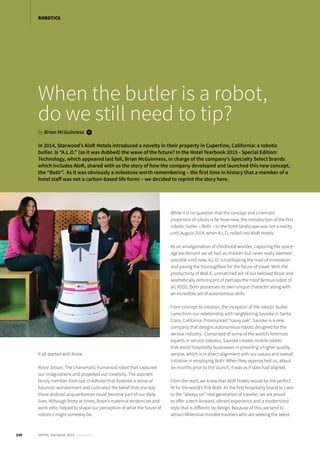
Experts on next year’s trends,
and the even bigger picture:
our world in 2025
Vivek Badrinath discusses Accor’s
new digital strategy
50 exclusive mini country reports,
provided by Horwath HTL
The changing hotel investment
landscape in 2015 and beyond
Dubai: back from the brink
and roaring ahead
High tech? High touch?
Here come the robots
2015HOTELYearbook
FORESIGHT AND INNOVATION IN THE GLOBAL HOTEL INDUSTRY
www.hotel-yearbook.com
This e-publication may be ordered online
€ 19.50
| Advertisement |
www.horwathhtl.com
The world’s number one hospitality consulting
network, Horwath HTL is the industry choice; a
global network offering complete solutions
across all markets.
Horwath HTL has become synonymous with
quality, service, impartial advice and expertise.
We are known for always providing the highest
level of service to our clients.
With over 50 offices across 39 countries - whatever
your requirements, large or small, national or
global, Horwath HTL can help you succeed.
In 2015, we will celebrate 100 years
professional involvement in the hospitality
industy. Over the years, we have gained
extensive market knowledge through
involvement in thousands of projects:
• Market and Feasilbility Studies
• Planning and Development
• Asset Management
• Tourism and Leisure
• Valuations
• Spa, Health and Wellness
© 2015 Crowe Horwath International. All rights reserved. Horwath refers to Horwath International Association,
Welcome to Horwath HTL
Hotel, Tourism and Leisure
TM
Global leader in hospitality consulting
www.horwathhtl.com
The world’s number one hospitality consulting
network, Horwath HTL is the industry choice; a
global network offering complete solutions
across all markets.
Horwath HTL has become synonymous with
quality, service, impartial advice and expertise.
We are known for always providing the highest
level of service to our clients.
With over 50 offices across 39 countries - whatever
your requirements, large or small, national or
global, Horwath HTL can help you succeed.
In 2015, we will celebrate 100 years
professional involvement in the hospitality
industy. Over the years, we have gained
extensive market knowledge through
involvement in thousands of projects:
• Market and Feasilbility Studies
• Planning and Development
• Asset Management
• Tourism and Leisure
• Valuations
• Spa, Health and Wellness
© 2015 Crowe Horwath International. All rights reserved. Horwath refers to Horwath International Association,
a SwissVerein. Each member of the association is a separate and independent legal entity.
Welcome to Horwath HTL
Hotel, Tourism and Leisure
TM
Global leader in hospitality consulting
HorwathHTL HIFI 2013 AD AW:Layout 1 13/11/13 09:19 Page 1
The Hotel Yearbook 2015 –
Annual Edition
© 2015 WADE & COMPANY SA
www.hotel-yearbook.com
ISBN 978-2-9700896-4-3
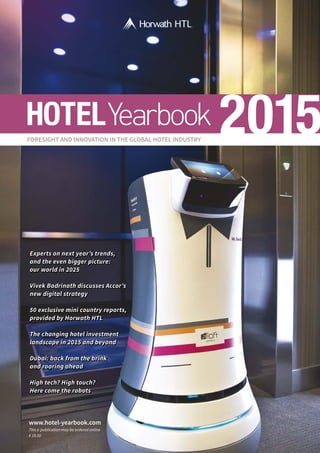
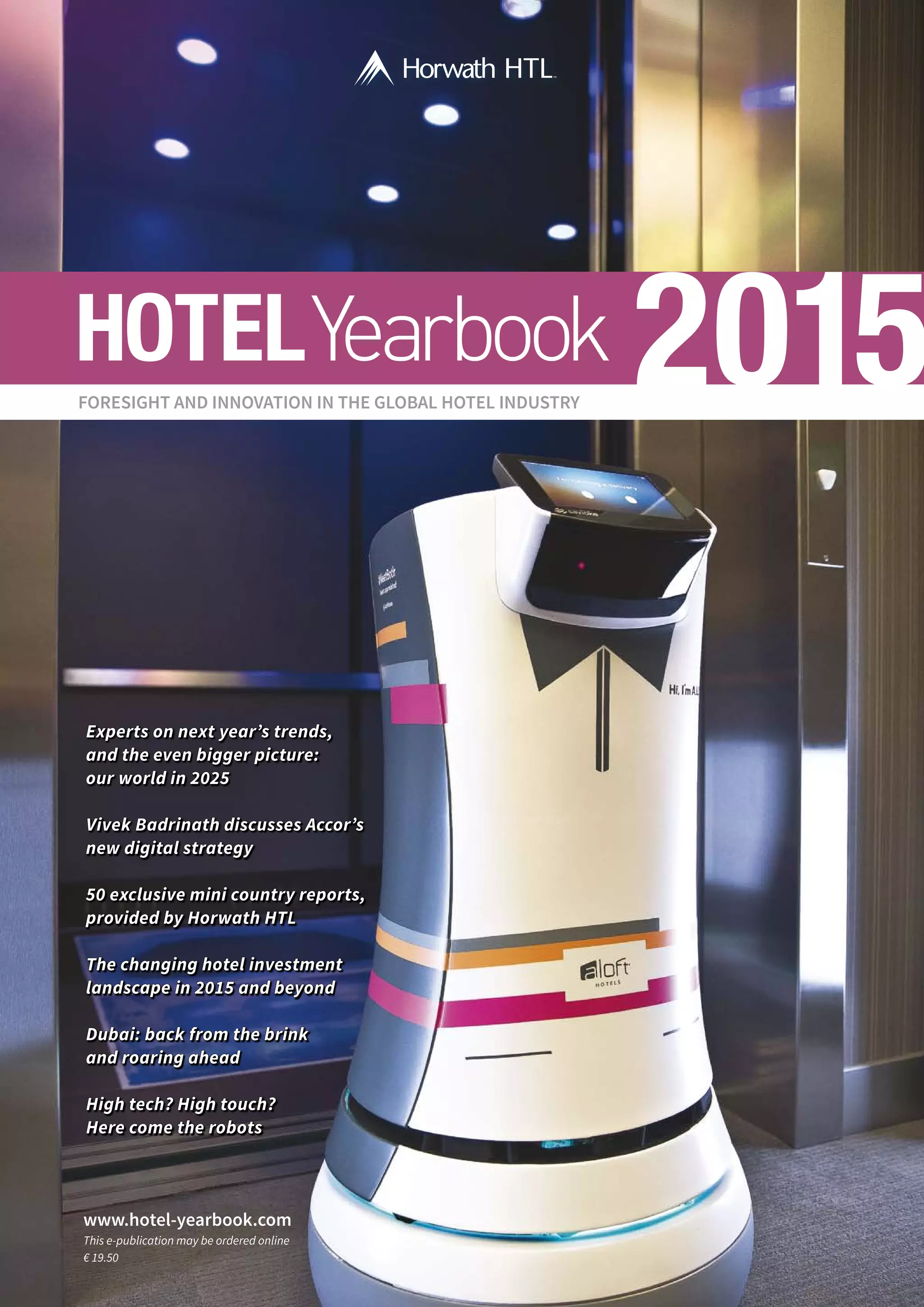
Cover Photo: A.L.O. the Botlr at Aloft Cupertino,
image courtesy of Aloft Hotels.
CO-PUBLISHER and EDITOR-IN-CHIEF
Woody Wade,
Wade & Company SA
Grandvaux, Switzerland
E-mail: wade@11changes.com
www.11changes.com
CO-PUBLISHER and MANAGING EDITOR
Henri Roelings,
Hsyndicate
Maastricht, The Netherlands
E-mail: henri@hsyndicate.org
www.hsyndicate.org
PUBLICATION PARTNER
Horwath HTL, The Hotel, Tourism
and Leisure Specialists
www.horwathhtl.com
DESIGN AND ART DIRECTION
Guus Vrencken,
extralarge | visual communication,
www.extralarge.nl
ORDERS
Copies of this publication may be ordered
online at www.hotel-yearbook.com
€ 19.50
MULTI-USER LICENSES
For companies and educational institutions,
inexpensive multi-user licenses are available to
allow everyone in your organization to receive a
personal copy of this publication. (We can also
customize the cover.) For more information,
please contact info@hotel-yearbook.com.
Reproduction of excerpts from this publication
is permitted under the condition that both the
author’s name and “The Hotel Yearbook 2015”
are cited.
The views and opinions expressed in this
publication are those of the individual authors
and not necessarily those of the publisher or
publication partners.
© 2015 Wade & Company SA
TM
Experts on next year’s trends,
and the even bigger picture:
our world in 2025
Vivek Badrinath discusses Accor’s
new digital strategy
50 exclusive mini country reports,
provided by Horwath HTL
The changing hotel investment
landscape in 2015 and beyond
Dubai: back from the brink
and roaring ahead
2015HOTELYearbook
FORESIGHT AND INNOVATION IN THE GLOBAL HOTEL INDUSTRY
www.hotel-yearbook.com
This e-publication may be ordered online
€ 19.50
WELCOME
fl
Dear readers,
Welcome to The Hotel Yearbook 2015. This annual, forward-looking publication –
celebrating its 9th edition this year – aims to provide you with expert opinion and
privileged insights on what lies ahead for the hotel industry.
This year, we’re proud to have assembled for you another great crew of editorial
contributors, consisting of some 70 senior executives, seasoned observers and
experts, and industry insiders. The picture they paint of the hotel industry’s future
is both visionary and provocative, and should stimulate us all to think about the
scenarios ahead and how to prepare for them.
We’d like to thank all these authors for sharing their insightful observations and
ideas from all over the world. In particular, We’d like to thank the sharp-eyed
team of hospitality experts and consultants at Horwath HTL for providing four
dozen mini-country reports for 2015, covering the outlook for markets as diverse
as China and Brazil, Montenegro and Myanmar. As in past years, Horwath HTL
produces these reports exclusively for the Hotel Yearbook, and anyone wanting
a quick snapshot and reliable outlook for the state of the hotel industry in any of
these markets will be well-served by starting with the Horwath take on things.
Hsyndicate is the Hotel Yearbook’s indispensible partner for providing an effective
platform for reaching you and the industry’s thousands of other decision makers,
and we’d like to thank their fantastic team for their hard work and enthusiasm.
Getting all this great content into your hands could not be done without
Hsyndicate’s know-how and network.
So without further ado, we wish you a thought-provoking read – and a prosperous
and successful 2015!
All the best,
Woody Wade | Publisher					 Henri Roelings | Publisher
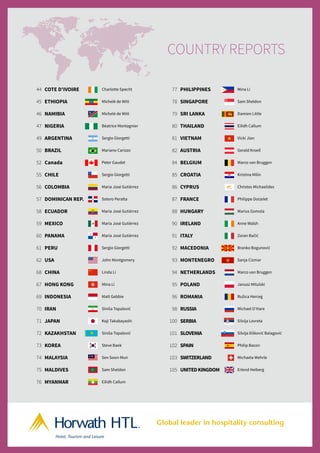
Table of contents
TRENDS
ROHIT VERMA &
GLENN WITHIAM 6 Hospitality trends for 2015: blending order and chaos
FUTURE
CUSTOMERS
IAN YEOMAN 8 The guest of the future
LONG-TERM
FUTURE
ROHIT TALWAR 10 Never mind 2015 – what about 2025?
TOURISM
DEMIAN HODARI &
ADRIAN RUCH 12 Tourism today and tomorrow – a billion opportunities
INTERVIEW
VIVEK BADRINATH
interviewed by
PETER O'CONNOR
14 Accor’s new digital strategy: the unanswered
questions
INTERVIEW
SAAR SHARON
interviewed by
DEMIAN HODARI
18 “The asset light approach has been exhausted”
INTERVIEW
NICHOLAS CLAYTON
interviewed by
CARROLL & JANSEN
22 Ten questions hospitality students wouldn’t normally
ask a CEO
CAPITAL GISLE SARHEIM 24 Coming soon to a city near you: Hotel capital flows on
the move
MARKET REPORT
SARAH SONNE LARSEN
& DEMIAN HODARI 26 Bullish in Scandinavia
AFRICA TREVOR WARD 30 Africa: moving beyond the handshake
MARKET REPORT ANDREAS ROMAN 32 Hotel investment in the Swiss Alps: reinventing a
long-standing tradition
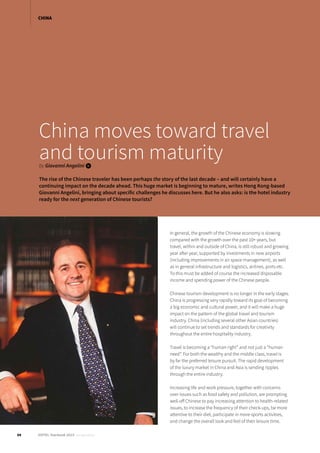
CHINA GIOVANNI ANGELINI 34 China moves toward travel and tourism maturity
MARKET REPORT
ANGELA ANTHONISZ
& JOHN FONG 36 EXPO2020 Dubai: 5 years to go; 5 challenges to meet
MARKET REPORT CLAIRE HARVEY 40 Dubai: back from the brink, roaring ahead
COUNTRY REPORTS 42 by Horwath HTL
M&A NICOLAS GRAF 106 2015: Still bigger, but bigger better
DISTRIBUTION MACY MARVEL 108 Hotel distribution realities
WELLNESS
INGO SCHWEDER &
MATTHEW BRENNAN 110 Wellness tourism and wellness real estate: new
paradigms
HOTEL
CLASSIFICATION
HANS E. KOCH 116 The challenge of a unified standard across Europe
MARKETING
TRENDS
ROBERT A. GILBERT 118 Hotel marketers: watch these five areas in 2015
ROBOTICS BRIAN MCGUINNESS 120 When the butler is a robot, do we still need to tip?
TM
Experts on next year’s trends,
and the even bigger picture:
our world in 2025
Vivek Badrinath discusses Accor’s
new digital strategy
50 exclusive mini country reports,
provided by Horwath HTL
The changing hotel investment
landscape in 2015 and beyond
Dubai: back from the brink
and roaring ahead
2015HOTELYearbook
FORESIGHT AND INNOVATION IN THE GLOBAL HOTEL INDUSTRY
www.hotel-yearbook.com
This e-publication may be ordered online
€ 19.50
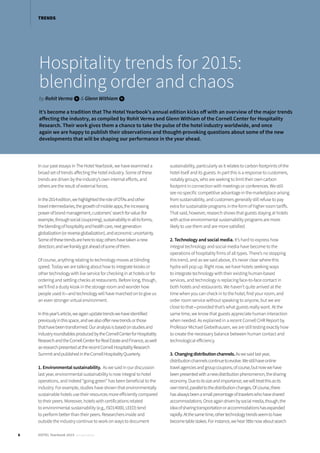
44 COTE D'IVOIRE Charlotte Specht
45 ETHIOPIA Michelè de Witt
46 NAMIBIA Michelè de Witt
47 NIGERIA Béatrice Montagnier
49 ARGENTINA Sergio Giorgetti
50 BRAZIL Mariano Carizzo
52 Canada Peter Gaudet
55 CHILE Sergio Giorgetti
56 COLOMBIA Maria José Gutiérrez
57 DOMINICAN REP. Sotero Peralta
58 ECUADOR Maria José Gutiérrez
59 MEXICO Maria José Gutiérrez
60 PANAMA Maria José Gutiérrez
61 PERU Sergio Giorgetti
62 USA John Montgomery
68 CHINA Linda Li
67 HONG KONG Mina Li
69 INDONESIA Matt Gebbie
70 IRAN Siniša Topalović
71 JAPAN Koji Takabayashi
72 KAZAKHSTAN Siniša Topalović
73 KOREA Steve Baek
74 MALAYSIA Sen Soon-Mun
75 MALDIVES Sam Sheldon
76 MYANMAR Eilidh Callum
77 PHILIPPINES Mina Li
78 SINGAPORE Sam Sheldon
79 SRI LANKA Damien Little
80 THAILAND Eilidh Callum
81 VIETNAM Vicki Jian
82 AUSTRIA Gerald Kroell
84 BELGIUM Marco van Bruggen
85 CROATIA Kristina Milin
86 CYPRUS Christos Michaelides
87 FRANCE Philippe Doizelet
88 HUNGARY Marius Gomola
90 IRELAND Anne Walsh
91 ITALY Zoran Bačić
92 MACEDONIA Branko Bogunović
93 MONTENEGRO Sanja Cizmar
94 NETHERLANDS Marco van Bruggen
95 POLAND Janusz Mitulski
96 ROMANIA Ružica Herceg
98 RUSSIA Michael O’Hare
100 SERBIA Silvija Lovreta
101 SLOVENIA Silvija Ilišković Balagović
102 SPAIN Philip Bacon
103 SWITZERLAND Michaela Wehrle
105 UNITEDKINGDOM Erlend Heiberg
Hotel, Tourism and Leisure
TM
Global leader in hospitality consulting
orwathHTL HIFI 2013 AD AW:Layout 1 13/11/13 09:19 Page 1
COUNTRY REPORTS
Hospitality trends for 2015:
blending order and chaos
by Rohit Verma i& Glenn Withiam i
It’s become a tradition that The Hotel Yearbook’s annual edition kicks off with an overview of the major trends
affecting the industry, as compiled by Rohit Verma and Glenn Withiam of the Cornell Center for Hospitality
Research. Their work gives them a chance to take the pulse of the hotel industry worldwide, and once
again we are happy to publish their observations and thought-provoking questions about some of the new
developments that will be shaping our performance in the year ahead.
In our past essays in The Hotel Yearbook, we have examined a
broad set of trends affecting the hotel industry. Some of these
trends are driven by the industry’s own internal efforts, and
others are the result of external forces.
Inthe2014edition,wehighlightedtheroleofOTAsandother
travelintermediaries,thegrowthofmobileapps,theincreasing
powerofbrandmanagement,customers’searchforvalue(for
example,throughsocialcouponing),sustainabilityinallitsforms,
theblendingofhospitalityandhealthcare,nextgeneration
globalization(orreverseglobalization),andeconomicuncertainty.
Someofthesetrendsareheretostay;othershavetakenanew
direction;andwefranklygotaheadofsomeofthem.
Of course, anything relating to technology moves at blinding
speed. Today we are talking about how to integrate kiosks or
other technology with live service for checking in at hotels or for
ordering and settling checks at restaurants. Before long, though,
we’ll find a dusty kiosk in the storage room and wonder how
people used it—and technology will have marched on to give us
an even stronger virtual environment.
Inthisyear’sarticle,weagainupdatetrendswehaveidentified
previouslyinthisspace,andwealsooffernewtrendsorthose
thathavebeentransformed.Ouranalysisisbasedonstudiesand
industryroundtablesproducedbytheCornellCenterforHospitality
ResearchandtheCornellCenterforRealEstateandFinance,aswell
asresearchpresentedattherecentCornellHospitalityResearch
SummitandpublishedintheCornellHospitalityQuarterly.
1.	Environmental sustainability. As we said in our discussion
last year, environmental sustainability is now integral to hotel
operations, and indeed “going green” has been beneficial to the
industry. For example, studies have shown that environmentally
sustainable hotels use their resources more efficiently compared
to their peers. Moreover, hotels with certifications related
to environmental sustainability (e.g., ISO14000, LEED) tend
to perform better than their peers. Researchers inside and
outside the industry continue to work on ways to document
sustainability, particularly as it relates to carbon footprints of the
hotel itself and its guests. In part this is a response to customers,
notably groups, who are seeking to limit their own carbon
footprint in connection with meetings or conferences. We still
see no specific competitive advantage in the marketplace arising
from sustainability, and customers generally still refuse to pay
extra for sustainable programs in the form of higher room tariffs.
That said, however, research shows that guests staying at hotels
with active environmental sustainability programs are more
likely to use them and are more satisfied.
2.	Technology and social media. It’s hard to express how
integral technology and social media have become to the
operations of hospitality firms of all types. There’s no stopping
this trend, and as we said above, it’s never clear where this
hydra will pop up. Right now, we have hotels seeking ways
to integrate technology with their existing human-based
services, and technology is replacing face-to-face contact in
both hotels and restaurants. We haven’t quite arrived at the
time when you can check in to the hotel, find your room, and
order room service without speaking to anyone, but we are
close to that—provided that’s what guests really want. At the
same time, we know that guests appreciate human interaction
when needed. As explained in a recent Cornell CHR Report by
Professor Michael Giebelhausen, we are still testing exactly how
to create the necessary balance between human contact and
technological efficiency.
3.	Changingdistributionchannels.Aswesaidlastyear,
distributionchannelscontinuetoevolve.Westillhaveonline
travelagenciesandgroupcoupons,ofcourse,butnowwehave
beenpresentedwithanewdistributionphenomenon,thesharing
economy.Duetoitssizeandimportance,wewilltreatthisasits
owntrend,paralleltothedistributionchanges.Ofcourse,there
hasalwaysbeenasmallpercentageoftravelerswhohaveshared
accommodations.Onceagaindrivenbysocialmedia,though,the
ideaofsharingtransportationoraccommodationshasexpanded
rapidly.Atthesametime,othertechnologytrendsseemtohave
becometablestakes.Forinstance,wehearlittlenowaboutsearch
6 HOTEL Yearbook 2015 annual edition
TRENDS
engineoptimization,probablybecauseSEOhasbecomestandard
practiceamonghotelchains.
4.	The sharing economy. It seems clear that the world’s
hospitality industry will continue to see the growth of
shared services, whether that means AirBnB, Warmshowers,
Couchsurfing, or other clearinghouses for shared services.
Regardless of whether Uber survives the negative publicity, it’s
clear that the idea of sharing facilities has caught on. Since this
trend is driven by younger market segments, we see this as a
long-running trend.
5.	The HR challenge. The world’s service industries have
always faced challenges in the area of human resources, given
the constant turnover in most industry outlets. In last year’s
essay, we talked about the “new worker,” and we thought that
some workers might have hit plateaus because of technology,
while others inherently grasp technological solutions. With that
technical ability, many people are leaving their job at the first
chance they get. Thus, the situation seems to be increasingly
critical, because we have observed that the staffing issue has
permeated all levels of the industry. Not only is it hard to find
well trained people, but if you do hire good staff members, they
will soon be poached by other firms. The industry’s continual
technology upgrades make this trend more urgent. While
technology leaves some employees behind, it also makes
technologically adept employees even more valuable.
6.	Primetimefordataandtextanalytics.Thismaysound
strange,butwearegettingclosertobeingabletoreadpeople’s
mindsthroughtheiractions.EveryonehasheardofBigData,and
it’struethatthefirmswhichcollectandcrunchthosedataare
gettingsteadilymoreeffective.Wehavelongbeenabletofollow
theclickstreamaspeoplesearchoutandpurchaseservices,and
thatgivesusvaluablecluestowhat’simportanttothem.However,
futureanalysiswillgobeyondclickstreamrecordstosomething
calledeyetracking.Eyetrackingdocumentswhereapersonlooks
andhowlongtheylookatit.Thisisnotanewconcept,butthe
technologyhasbeenimprovedtothepointthatwecannowgeta
clearviewofwhatcapturespotentialguests’attention.Additionally,
newsophisticatedtext-analytictechniquesarebeingdeveloped
toharnessoftheinformationcontainedwithinthefeedback
andcommentsprovidedbyhotelguestsatvarioussocialmedia
channelssuchasTripAdvisorandYelp.
7.	Theintegrationofhealthcare,hospitality,andseniorliving.
Wementionedthistrendacoupleofyearsago,butlastyearwe
hadtoacknowledgethatthisintegrationhasbeenoccurringmore
slowlythanexpected.Nevertheless,westillseeacross-pollination
betweentheseindustries,whichhavesomanyaspectsincommon.
We’veaddedseniorlivingtothistrendbecauseit’sclearthat
seniorlivingfacilitiesaredrawingonhospitalityindustryprinciples
formanyoftheiroperatingprocedures.Meantime,healthcare
operationsandhospitalityfirmscontinuetoassesswhichaspects
oftheotherbusinessareappropriatetoadopt.Certainly,many
healthcareprovidershaveadoptedafocusonpatient(guest)
satisfactionasoneoftheiroperatingcriteria,althoughproper
medicalprotocolsstillhavetheoverridingpriority.Hospitalityfirms
havebeenslowertodrawfromtheamazingcontrolthathealthcare
firmsmaintainovertheiroperations,butweseehospitalityfirmsas
benefitingfromsuchoversight.
Otherpasttrendshavenotdisappeared,buttheyhaveperhaps
droppedfrompublicattention.Socialcouponing,forinstance,is
nolongerfreshandremarkable,asithasbecomeoneofmany
salestoolsforsomefirms.Withregardtotheworld’seconomy,we
hadonceagainhopedtobeabletosaythatwe’refinallyoutof
thewoodsafterfiveyearsofunevenrecovery.AlthoughtheUnited
Stateshasseenaslowbutsteadyrecoveryinmostsectors,many
EuropeanandAsiannationsarestilllookingforeconomicand
currencystability.Meantime,theoutcomeoftherecentturbulence
inworldenergymarketsremainsunclear.Someobserverssee
reducedoilpricesasaplus,sinceconsumerswillhavemoreto
spend.Otherslookatthesupplysideandseeachallengefor
producerswhonolongercanselltheirproductatapremiumprice.
Withregardtothetourismindustry,wewillgainmoreclarityonthe
effectofenergypricechangesas2015unfolds.
■
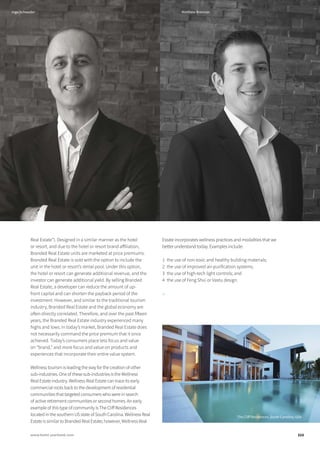
Rohit Verma (L) is Singapore Tourism Board Distinguished
Professor at the Cornell School of Hotel Administration.
Glenn Withiam (R) is executive editor for the Center for
Hospitality Research and the Center for Real Estate and Finance
at the Cornell School of Hotel Administration.
7www.hotel-yearbook.com
In the past, there have been two main ways for meeting attendees to book their hotel stays for an event:
Either by making their own reservations directly with the hotel (hence “on-own”), or by providing their
information to the event’s meeting planner, who then assembles everyone’s hotel booking information into an
excel spreadsheet and sends it to the hotel (hence “rooming list”).
The guest of the future
by Ian Yeoman i
Tomorrow’s hotel guest will be demanding, still aspirational, technologically aware and financially savvy,
writes Dr. Ian Yeoman, a well-known tourism futurist at Victoria University of Wellington in New Zealand. How
will these traits shape the way the hospitality industry serves them? He posits four future outcomes for The
Hotel Yearbook.
Hospitality is the relationship between the guest and the
host, or the act or practice of being hospitable, so what will
be the trends that will shape the future of hospitality?
Today, we are seeing mobile devices get smarter – with
the deepening penetration of the mobile Internet and
the increasing technological sophistication of handsets
allowing consumers to undertake more and more activities
while on-the-go. No longer is the consumer ever bored, as
an idle moment is turned into engaging with the world via
Facebook. It seems we don’t talk to each other any more, but
would rather update our social status, or tweet our selfie.
Tomorrow, Google Glass will allow the consumer to always
be on, never forgetting a friend thanks to its facial recognition
software. Never be lost, as GPS will always know where you
are and point you in the right direction.
Even further into the future, all the features that can be
found on today’s smart phone will be found on a contact
lens. Scientists at the University of Washington have been
developing a contact lens containing built-in LED’s, powered
wirelessly with radio frequency waves. All of this reminds
me of Lee Majors and Six Million Dollar Man or Arnold
Schwarzenegger in Terminator.
If you were born today, there is a one in four chance you will
live to till you are one hundred. One of the major structural
factors influencing current and future developments in global
markets is the changing age structure of the population, a
result of rising longevity and a downward trend in birth rates.
Consequently, one of the key issues for hotels will be
accessible tourism catering for the disabled and infirm. This
ageing population will also be a highly educated generation
of Baby Boomers (those born 1946-1964), in better health
and with more disposable income than previous older
generations, who will exit the workforce en masse during
the next decade (although for many, working beyond formal
retirement will be a reality).
Rising income has been the driving agent of modern society
and is responsible for creating the demanding, sophisticated
and well-informed consumer we recognize today. The world
might be richer, but they will be price-sensitive. And using
technology, they will invest considerable time and effort in
locating the offer which suits them best.
To summarize, tomorrow’s consumer will be demanding,
still aspirational, technologically aware and financially savvy.
There can be little doubt that the next decade will see greater
use of intelligent automated systems that render decision-
making processes effortless by optimizing our choices for us.
Customer service via smart devices will enable consumers
to gain support in real-time on a wherever, whenever-you-
wish basis. However, there is still room for local knowledge,
as deep down we would rather talk to a real person than an
automated computer. All of this information – Big Data – will
allow hotels to achieve precision-personalization in the
delivery of their services in the future. Basically, the future
is knowing everything about the consumer and anticipating
service. If you remember Minority Report, we will now know
everything about you and anticipate your thoughts.
8 HOTEL Yearbook 2015 annual edition
FUTURE CUSTOMERS
Herewith four ideas about what will be in store for us in the
future:
1. Personality without people
“Hello I am Polly, your virtual butler.” Artificial Intelligence (AI)
is becoming a part of the everyday relationships between
consumers and business. Many supermarkets, airlines, hotels
and banks already make use of automated chatbots, voice-
recognition software or self-checkout technology. Today these
technologies do little to convey the personality of a hotel brand
behind them. However, in the future they will operate as true
ambassadors with artificial personalities. Why? Consumers are
demanding better results, more quickly, from more information.
But consumers are also desperate to avoid being treated like
parts on a production line and are likely to resist unrestricted
use of their data. Hotels will witness data-capable proto-human
personalities addressing these conflicting needs.
2. The new self-service
The self-service kiosk – once limited in scope and heavily
biased towards low-end convenience products (in particular,
fast foods and drinks) – is currently being boosted by a
steady stream of creative innovations that are elevating
its image to that of status-enhancer and curator of luxury
experiences. This, in turn, is altering consumers’ perceptions
and expectations of the format.
3. Surprise me
Today, Amazon knows what books you read and
recommends what you should read. It sounds boring.
Many global consumers are starting to bristle against the
over-programmed life. They in fact want the opposite, the
unexpected – and something outside their comfort zone.
4. Man, not machine
The Internet is a cold machine; you cannot make love to
it. My desire is for a real person, a heightened sense of the
spiritual as opposed to the functional, a taste for glorious
transience in our performative lives. We need social contact,
not click-and-go.
■
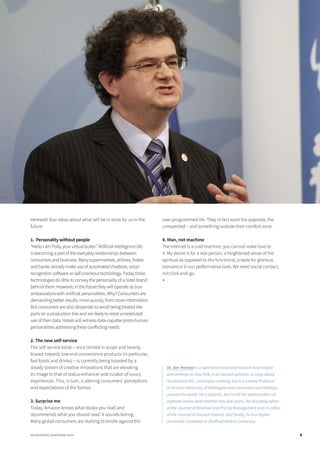
Dr. Ian Yeoman is a specialist travel and tourism futurologist
who believes in Star Trek, is an eternal optimist, is crazy about
Sunderland AFC, and enjoys cooking. Ian is a trainee Professor
at Victoria University of Wellington who commutes and holidays
around the world. He is dyslexic, but is still the author/editor of
eighteen books (with another two due soon), the founding editor
of the Journal of Revenue and Pricing Management and co-editor
of the Journal of Tourism Futures. And finally, he is a Higher
Doctorate candidate at Sheffield Hallam University.
9www.hotel-yearbook.com
Never mind 2015 –
what about 2025?by Rohit Talwar i
Leading futurist Rohit Talwar, CEO of London-based Fast Future, shares with The Hotel Yearbook some of his
ideas for bigger-picture developments that could shape our world in the year 2025. How could these higher-
order trends affect travel and tourism? What would be their impact on your company? These ten ideas open up
an array of mind-blowing possibilities.
Our world is being transformed by rapid advances in sciences
and technology that are touching every aspect of our lives. So
what changes could these developments bring about for life
as we know it? We only have to look around us to see just how
much can change in a relatively short space of time.
Our lives have been shaped by developments which most
of us couldn’t have imagined a decade ago. For example,
handheld devices such as smartphones and tablets now allow
us to have live video conversations with our friends, translate
instantaneously between multiple languages, watch full length
videos and monitor diverse aspects of our health, from blood
pressure to oxygen flow and stress levels. 3D printing is now
available in every home and is being used to create everything
from blood cells to entire houses, while new aircraft such as the
A380 can carry over 800 passengers on a single flight.
As we look ahead, the decade could be shaped by advances
in nanotechnology, information technology, vertical farming,
artificial intelligence, robotics, 4D printing, super-smart
materials, neuroscience, the biological sciences and genetics.
Below, we take a brief look at ten scenarios exploring how
some of these developments could come together and impact
different aspects of our world.
1.	Human 2.0 - Human augmentation will accelerate in the next
decade. By 2025 we will be witnessing a new breed of human 2.0
and 3.0 who have “hacked” their own bodies. Mind-enhancing
drugs are already a reality, and we can now have super-smart
prosthetic limb replacements that have greater functionality
than the ones we were born with. Both fields will continue
to progress, and we will see genetic treatments to eliminate
conditions such as rage and obesity.
All of these enhancements will be monitored and managed
24/7 by a variety of wearable technologies and devices
implanted into our bodies. These will help us track every vital
sign and link directly to both our own handheld devices and to
monitoring services provided by our healthcare providers. 3D
printing already allows us to create replacement body parts.
The evolution to 4D printing will enable the manufacture of
body parts that can self-assemble and adapt their shape and
properties over time – giving us limbs that could reinforce
themselves as we age.
2.	National sovereignty - The map of the globe will change,
driven by economic forces. Many smaller and poorer
countries may find it impossible to cope on their own with
the accelerating pace of change and the cost of keeping up
to speed with a globally connected planet. By 2025 we could
see 20-25 country mergers as “at risk” nations seek to come
together to create the critical economic strength and attract
the investment required to serve their populations and
compete in the hyper-connected era.
3.	Corporate giants – Fifty percent of the Fortune 500 index
of the largest publicly listed companies in 2025 will come from
firms that were not even born in 2014. We will see an ever-
increasing number of so called “exponential companies” that
achieve rapid rates of growth by using science and technology to
disrupt old industries and create new ones. For example, the taxi
app Uber didn’t even exist in 2008 and is now valued at over US$
40 billion, while a number of new technology-based businesses
such as AirBnB and Snapchat are already valued at over US$ 10
billion. Many more mega-growth players will emerge in sectors
such as driverless cars, 3D and 4D printing, genetics and web-
based applications and services that we can’t even imagine
today. Some argue that the notion of public stock markets will
have been transformed by more efficient online crowdfunding
platforms and the widespread use of digital currencies that
effectively create a single global monetary system.
10 HOTEL Yearbook 2015 annual edition
LONG-TERM FUTURE
4.	Financial services - By 2025 the financial services landscape
will have been transformed by digital currencies like Bitcoin,
open markets and a wave of new providers offering crowd-
based solutions for everything from insurance to equity
investment and commercial financing. These community
platforms will let us lend to and invest in each other – bypassing
the existing providers of saving, business investment, loans and
personal insurance.
5.	Brain uploading - By 2025 we will have mapped how
the human brain works, and technology companies will be
competing to host the “backup” of our brains online. Three
major projects in Europe, the USA and China are currently
involved in major research activities to understand how the
brain stores information and memories. This will ultimately
allow us to create memory backups, with the information stored
remotely via an online service provider in exactly the same way
as many of us already do with the data on our computers and
mobile devices.
6.	Immersivity - By 2025 technology advances will give rise to
new immersive live and virtual leisure experiences. For example,
we will be able to become participants in live action adventures
games from Roman battles to re-running the Olympic 100-meter
final, with robots performing the roles of the other contestants.
7.	Mixed reality living - The boundaries between virtual and
physical worlds will have disappeared by 2025, as we overlay
multiple layers of digital sensory augmentation over our
physical environment. Augmented and virtual reality will have
advanced to the point where we can stimulate all our senses
over the Internet and via our handheld devices. So, for example,
when booking a hotel, these developments would enable us to
feel the bed linens, taste the food in the restaurant and smell the
bath products – all from a device in the palm of our hands.
8.	Robotics - The replacement of humans by robots in
manufacturing has been taking place for two decades. It is now
spreading to a wide range of other sectors, such elder care, crop
spraying and warehouse management. By 2025 robots will have
entered every aspect of human life and will be commonplace,
performing functions as diverse as nursing, complex surgery,
policing and security, through to construction, retail and hotel
service roles. All of the major vehicle manufacturers are working
on autonomous or driverless cars – a form of robot that we will
see coming to market in the next few years.
9.	Artificial intelligence - Breakthroughs in artificial intelligence
(AI) are accelerating – with the development of computer
software that has the capacity to mimic humans’ ability to learn
and adapt over time to changing circumstances. AI is already
in widespread use in applications such as satnav systems,
aeroplane autopilots, assessing credit and loan applications
in financial services, automated call centers and healthcare
diagnoses. Advances in AI will gather pace in the next decade.
For example, by 2025 the interfaces to all our devices, from
phones to computers, cars and home appliances, will be highly
intelligent and adaptive - learning from our behaviors and
choices and anticipating our needs.
10. Internet of Life - In the next decade, upwards of 100 billion
objects from smartphones to streetlamps and cars will be
connected together via a vast “Internet of everything”. This will
impact every aspect of our lives. For example, it could transform
the criminal justice system. By 2025 evidence in a court case
will include data taken from body-worn cameras as well as
microphones and sensors in everyday objects such as clothing,
furniture and even our coffee cups – proving exactly what
happened and who was present at the scene of a crime.
■
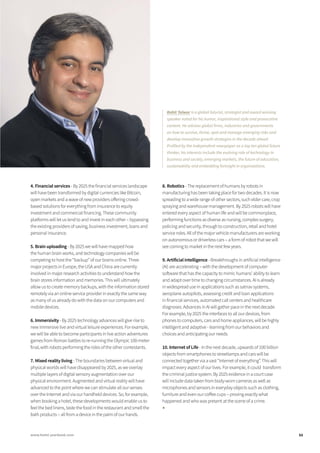
Rohit Talwar is a global futurist, strategist and award winning
speaker noted for his humor, inspirational style and provocative
content. He advises global firms, industries and governments
on how to survive, thrive, spot and manage emerging risks and
develop innovative growth strategies in the decade ahead.
Profiled by the Independent newspaper as a top ten global future
thinker, his interests include the evolving role of technology in
business and society, emerging markets, the future of education,
sustainability and embedding foresight in organizations.
11www.hotel-yearbook.com
Tourism today and tomorrow –
a billion opportunities
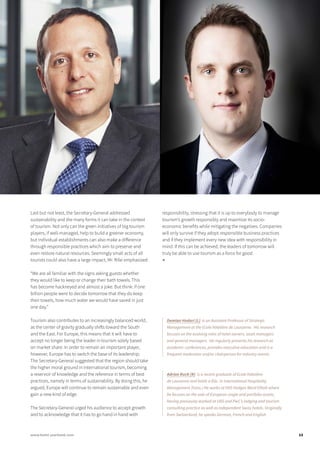
by Demian Hodari i& Adrian Ruch i
As one of the world’s largest and fastest-developing economic sectors, would it not be better – in the name of
sustainability – if the tourism industry would hit the brakes and slow its rapid, resource-consuming growth?
This idea was addressed by Taleb Rifai, Secretary-General of the World Tourism Organization (UNWTO),
in a recent speech to students at the Ecole hôtelière de Lausanne. Demian Hodari, Professor of Strategic
Management at the school, and Adrian Ruch of HVS Hodges Ward Elliott report on Mr. Rifai’s interesting
response.
Last February, the Ecole hôtelière de Lausanne (EHL)
welcomed Mr. Taleb Rifai, Secretary-General of the World
Tourism Organization (UNWTO), the United Nations
Specialized Agency for Tourism, to speak at the 5th annual
Young Hoteliers Summit (YHS). The UNWTO’s mandate
is to promote responsible, sustainable and universally
accessible tourism across the globe. During his day at EHL,
the Secretary-General met with different groups of students
before giving a keynote address to over 200 attendees at
the YHS distinguished keynote presentation. The objective
throughout his day at EHL was to raise awareness about the
challenges and opportunities of the international tourism
sector among the leaders of tomorrow.
Mr. Rifai began by presenting some recent data about the
world’s tourism. With over 1.1 billion international and more
than 5.5 billion domestic tourists, he noted, global tourism
has reached unparalleled dimensions. It is the 3rd largest
sector in the world today and, as he put it, has evolved from
the privilege of an elite few to what is essentially a human
right. This growth has brought people closer together,
spurred change and progress in the developing world, and
has contributed to a fairer distribution of wealth and benefits.
Yet the rapid and far-reaching growth of tourism has created
social, economic and environmental challenges as well.
In its most spiteful form, tourism can inflict damage on
people, especially young ones. Some of the most important
challenges the sector is facing relate to human trafficking,
child abuse, and the exploitation of natural resources, he
said. In the face of these problems, one might be inclined
to question whether this sector ought to develop further, or
even demand a slowdown in its growth. According to the
Secretary-General, however, this would be unwise:
“A billion people travelling internationally is a billion
opportunities or a billion disasters,” he said. “The choice
is ours. So how do we make sure that we are heading in
the right direction? I’ll tell you what we should not do: we
should not blame our problems on growth and progress and
investment. Growth is part of human history. Growth is not
going to stop, and should not stop. What we should advance
is our ability to manage growth and use it as a force for good
to achieve a new direction of sustainability.” He illustrated
the main positive impacts of tourism with three examples:
employment, economy and sustainability.
Tourism leads the world in employment growth.
Furthermore, for the workforce in the developing world,
being employed in the tourism sector also means receiving
much sought-after training and often also allows people to
work where they live, without having to leave their families
behind and move to larger cities.
From an economic point of view, international tourism has
proven to be extraordinarily resilient. The past 10 years have
shown this as, while the sector was very sensitive to short-term
international setbacks – for example, brought about by SARS or
avian flu – it recovered fast and continued its overall growth rate.
Whereas only 60 years ago, most of the world’s population lived
their entire lives within a 100 km radius, today over one billion
people cross borders for tourism every year. Looking ahead,
the number of international tourists is expected to grow by 3.3
percent yearly and reach 1.8 billion by the year 2030.
12 HOTEL Yearbook 2015 annual edition
TOURISM
Last but not least, the Secretary-General addressed
sustainability and the many forms it can take in the context
of tourism. Not only can the green initiatives of big tourism
players, if well-managed, help to build a greener economy,
but individual establishments can also make a difference
through responsible practices which aim to preserve and
even restore natural resources. Seemingly small acts of all
tourists could also have a large impact, Mr. Rifai emphasized:
“We are all familiar with the signs asking guests whether
they would like to keep or change their bath towels. This
has become hackneyed and almost a joke. But think: if one
billion people were to decide tomorrow that they do keep
their towels, how much water we would have saved in just
one day.”
Tourism also contributes to an increasingly balanced world,
as the center of gravity gradually shifts toward the South
and the East. For Europe, this means that it will have to
accept no longer being the leader in tourism solely based
on market share. In order to remain an important player,
however, Europe has to switch the base of its leadership.
The Secretary-General suggested that the region should take
the higher moral ground in international tourism, becoming
a reservoir of knowledge and the reference in terms of best
practices, namely in terms of sustainability. By doing this, he
argued, Europe will continue to remain sustainable and even
gain a new kind of edge.
The Secretary-General urged his audience to accept growth
and to acknowledge that it has to go hand in hand with
responsibility, stressing that it is up to everybody to manage
tourism’s growth responsibly and maximize its socio-
economic benefits while mitigating the negatives. Companies
will only survive if they adopt responsible business practices
and if they implement every new idea with responsibility in
mind. If this can be achieved, the leaders of tomorrow will
truly be able to use tourism as a force for good.
■
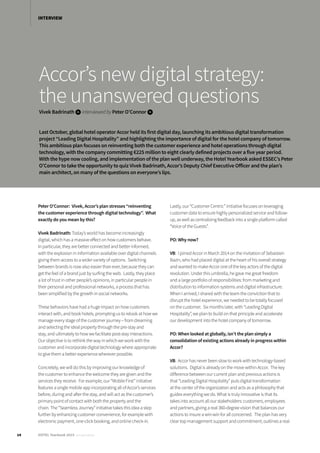
Demian Hodari (L) is an Assistant Professor of Strategic
Management at the Ecole hôtelière de Lausanne. His research
focuses on the evolving roles of hotel owners, asset managers
and general managers. He regularly presents his research at
academic conferences, provides executive education and is a
frequent moderator and/or chairperson for industry events.
Adrian Ruch (R) is a recent graduate of Ecole hôtelière
de Lausanne and holds a BSc. in International Hospitality
Management (hons.) He works at HVS Hodges Ward Elliott where
he focuses on the sale of European single and portfolio assets,
having previously worked at UBS and PwC’s lodging and tourism
consulting practice as well as independent Swiss hotels. Originally
from Switzerland, he speaks German, French and English.
13www.hotel-yearbook.com
Accor’s new digital strategy:
the unanswered questions
Vivek Badrinath iinterviewedbyPeter O’Connor i
Last October, global hotel operator Accor held its first digital day, launching its ambitious digital transformation
project “Leading Digital Hospitality” and highlighting the importance of digital for the hotel company of tomorrow.
This ambitious plan focuses on reinventing both the customer experience and hotel operations through digital
technology, with the company committing €225 million to eight clearly defined projects over a five year period.
With the hype now cooling, and implementation of the plan well underway, the Hotel Yearbook asked ESSEC’s Peter
O’Connor to take the opportunity to quiz Vivek Badrinath, Accor’s Deputy Chief Executive Officer and the plan’s
main architect, on many of the questions on everyone’s lips.
Peter O’Connor: Vivek, Accor’s plan stresses “reinventing
the customer experience through digital technology”. What
exactly do you mean by this?
Vivek Badrinath: Today’s world has become increasingly
digital, which has a massive effect on how customers behave.
In particular, they are better connected and better informed,
with the explosion in information available over digital channels
giving them access to a wider variety of options. Switching
between brands is now also easier than ever, because they can
get the feel of a brand just by surfing the web. Lastly, they place
a lot of trust in other people’s opinions, in particular people in
their personal and professional networks, a process that has
been simplified by the growth in social networks.
These behaviors have had a huge impact on how customers
interact with, and book hotels, prompting us to relook at how we
manage every stage of the customer journey – from dreaming
and selecting the ideal property through the pre-stay and
stay, and ultimately to how we facilitate post-stay interactions.
Our objective is to rethink the way in which we work with the
customer and incorporate digital technology where appropriate
to give them a better experience wherever possible.
Concretely, we will do this by improving our knowledge of
the customer to enhance the welcome they are given and the
services they receive. For example, our “Mobile First” initiative
features a single mobile app incorporating all of Accor’s services
before, during and after the stay, and will act as the customer’s
primary point of contact with both the property and the
chain. The “Seamless Journey” initiative takes this idea a step
further by enhancing customer convenience, for example with
electronic payment, one-click booking, and online check-in.
Lastly, our “Customer Centric” initiative focuses on leveraging
customer data to ensure highly personalized service and follow-
up, as well as centralizing feedback into a single platform called
“Voice of the Guests”.
PO: Why now?
VB: I joined Accor in March 2014 on the invitation of Sebastien
Bazin, who had placed digital at the heart of his overall strategy
and wanted to make Accor one of the key actors of the digital
revolution. Under this umbrella, he gave me great freedom
and a large portfolio of responsibilities: from marketing and
distribution to information systems and digital infrastructure.
When I arrived, I shared with the team the conviction that to
disrupt the hotel experience, we needed to be totally focused
on the customer. Six months later, with “Leading Digital
Hospitality”, we plan to build on that principle and accelerate
our development into the hotel company of tomorrow.
PO: When looked at globally, isn’t the plan simply a
consolidation of existing actions already in progress within
Accor?
VB: Accor has never been slow to work with technology-based
solutions. Digital is already on the move within Accor. The key
difference between our current plan and previous actions is
that “Leading Digital Hospitality” puts digital transformation
at the center of the organization and acts as a philosophy that
guides everything we do. What is truly innovative is that its
takes into account all our stakeholders: customers, employees
and partners, giving a real 360-degree vision that balances our
actions to insure a win-win for all concerned. The plan has very
clear top management support and commitment; outlines a real
14 HOTEL Yearbook 2015 annual edition
INTERVIEW
roadmap with very clear quantifiable objectives to be achieved
within a specific timeframe; and also has clear governance with
named individuals responsible for making it all happen.
PO: With “Leading Digital Hospitality” you are clearly
focused on the future. Concretely, what changes are we
likely to see in the short run?
VB: I disagree. For example, “Mobile First” is not about the
future. It will go live in 2015 and is thus firmly in the present!
Everyone acknowledges how mobile is impacting our business.
Accor is already at 12% mobile contribution to web sales, a
figure that is increasing very quickly. Most of this is happening
through apps rather than through mobile websites. While
the latter are still relevant and need to be part of our overall
distribution system, it is the app that opens up the possibility
of deepening our relationship with the customer. In contrast
to providing just booking services, an app can act as a
comprehensive companion for the customer – before, during
and after their stay – allowing them to browse and dream about
our properties; to book efficiently; enjoy digital services within
the hotel; as well as give meaningful feedback and manage their
loyalty program. In short, our “Mobile First” app will become the
central point of contact for interactions with Accor, both at the
company and at the property level.
Although it is not the sole reason, this partly explains our
acquisition of ecommerce company Wipolo. This currently runs
an app that manages travel bookings in such a way that when
you are travelling you get information about what’s the next step
of your trip. The company’s small team brings talent as well as
a solid understanding of the complexities of travel technology
to Accor, and will help us to enhance and strengthen the
performance of our “Mobile First” app so that it is highly relevant
for the customer from the moment they leave home to the
moment they return. Wipolo also has strength in social, having
been a Facebook partner for many years. That’s very good
technology for us to be able to use to strengthen our sharing
dimension.
PO: A lot of emphasis has been placed on the “Welcome by
Le Club Accorhotels” initiative. What has been the reaction
from customers?
VB: “Welcome by le Club Accorhotels” is a broad-ranging
program, starting with online check-in and ending with a fast
checkout for participants. Its purpose is to remove paperwork,
reduce formalities, and make sure that the customer gets a
personalized welcome. Such actions are really at the heart of
what we want to do to enrich our customer experience.
By the end of the year, the program will be deployed in more
than 1,000 hotels all over the world, and we plan to have 2,700
hotels on board by the end of 2015. Customer reactions so far
has been very enthusiastic, as 93% of guests who have tried the
welcome service want to use it again.
↓
PO: Accorhasalreadymadetremendousprogressingrowing
onlinedistribution. “LeadingDigitalHospitality”againstresses
theimportanceofdistribution. Realistically,howhighdoyou
thinkyoucango?
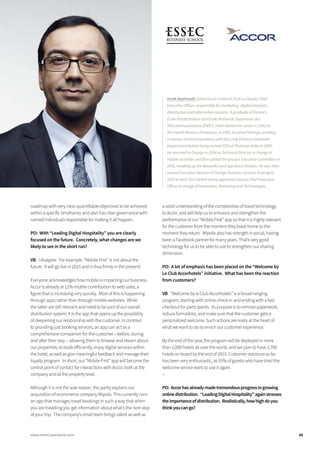
Vivek Badrinath joined Accor in March 2014 as Deputy Chief
Executive Officer, responsible for marketing, digital solutions,
distribution and information systems. A graduate of France’s
École Polytechnique and École Nationale Supérieure des
Télécommunications (ENST), Vivek started his career in 1992 at
the French Ministry of Industry. In 1996, he joined Orange, working
in various technical positions with the Long Distance Networks
Department before being named CEO of Thomson India in 2000.
He returned to Orange in 2004 as Technical Director in charge of
mobile activities and then joined the group’s Executive Committee in
2009, heading up the Networks and Operators Division. He was then
named Executive Director of Orange Business Services from April
2010 to April 2012 before being appointed Deputy Chief Executive
Officer in charge of Innovation, Marketing and Technologies.
15www.hotel-yearbook.com
VB: The foundation of Accor’s distribution is TARS (The Accor
Reservation System), which drove 59% of total sales in 2014.
This system is constantly being enhanced, and our plan is that
it will represent 70% of our total sales in the medium term. In
terms of pure web distribution, over 35% of our sales were
made online during 2014, and we plan to increase this to over
50% in the medium term. This will be driven not only by the
general trend towards digitalization in the market, but also by
our investment in our own state of the art tools, in particular our
multi-brand portal Accorhotels.com.
Currently this is already available in 32 local versions and 16
languages (with 18 planned by 2015), in effect localizing the
experience in every market in which it operates, resulting in
an average of 45,000 reservations per day. But even with this
level of success, we never stand still. For example, one of its
recent enhancements has been the incorporation of a new
trip planning service (My Trip Planner) that enables customers
to prepare their stays in 70 destinations around the world,
enriching the preparation step of the customer journey.
PO: Mr. Bazin has been quoted as saying “OTAs are our
friends”. Many of your planned actions could be interpreted
as anti-OTA. What’s Accor’s latest take on supplier-OTA
relationships?
VB: We have a special and privileged relationship with the OTAs,
with all hotels in TARS benefiting from this partnership. They
help us to tap into new customer bases in certain parts of the
world where we don’t have such a prominent presence. The
cost of their services is quite high, and we tend to use them for
new customer acquisition, after which we then try to keep them
within the Accor ecosystem for subsequent bookings. As you
can imagine, many of the initiatives that we have discussed help
achieve this goal.
The volume of business that some OTAs deliver sometimes
allows them to put pressure on hotels to cooperate, especially
independent hotels. We are promoting the idea that it is the
hotelier that mandates the OTAs to sell on their behalf, and that
the hotelier must keep control of both the price and the volume
of rooms that they make available for sale on each channel.
PO: Given such ambitious plans, is a budget of EUR 225
million enough?
VB: We spent a lot already over the last 20 years. For example,
as I mentioned earlier, TARS has been designed in such a way as
to be both flexible and highly scalable. It has already supported
huge growth in terms of information requests, transactions
and web visits, and has lots of spare capacity left. So in terms
of size, in terms of efficiency, we don’t have to reinvent the
wheel. However, we do need to strengthen our infrastructure
and develop new features in order to improve our distribution
performance, our qualified guest database, and the customer
value that we drive.
When necessary, Accor will dedicate additional resources to
innovation, through open innovation platforms and tactical
acquisitions that strengthen our expertise and technology,
exactly as we have done with Wipolo. Having an opportunistic
strategy, we are constantly scanning for new opportunities
and new sources of knowledge. For example, we are partners
with the Paris-based Innovation Factory, a platform that brings
together students and professionals. Here we do “hackathons”
on weekends, focusing on a business problem that we are trying
to solve and getting smart people in the room to think out of
the box and get things done. Such initiatives confront us with
a young, digital-native population, which is also a source of
insights.
PO: What will be the quick wins?
VB: Our “Mobile First” initiative – a single app gathering all Accor
services before, during and after the stay – will be launched in
2015 and is expected to have a very rapid effect. In the initial
versions, we plan to incorporate payment, with a virtual wallet
that safely stores payment information relevant to the customer;
book and check-in in one click, as well as virtualizing the Le
ClubAccorhotels card and using it as a key to open up services in
the Seamless Journey program.
Similarly,wearealreadyrollingoutour“VoiceoftheGuest”
initiative,whichwillaggregatealltheflowsfromguestsatisfaction
surveys,onlinereputationanduserreviewsiteswhichwillallowour
propertiestogetacomprehensiveviewofwhatcustomersthink
abouttheirexperienceintheirhotel.ThiswillbelinkedintotheCRM
databaseandwillhelpustodeliverthekindofpersonalizedservice
thatweneedtoachievequickly.
PO: Vivek, it all sounds very interesting! Thanks for taking
the time to share your thoughts with us. ■
Peter O’Connor PhD is Professor of Information Systems at ESSEC Business School France, where he also serves
as Dean of Academic Programs. His research, teaching and consulting interests focus on technology, distribution,
e-commerce and electronic marketing, particularly applied to the hospitality sector. He has previously held a visiting
position at the Cornell Hotel School and worked in a variety of positions within hospitality, in sectors as diverse as
luxury hotels and contract food services.
16 HOTEL Yearbook 2015 annual edition
INTERVIEW
CHALLENGING PROGRAMS FOR EXECUTIVE STUDENTS
• #1 hospitality MBA in France 10 years in a row (ranked by SMBG) • More than 30 years
of expertise • 1,500 alumni in more than 55 countries • Engaging the world’s foremost industry
professionals and professors • Internationally recognized • Exclusively in English.
IMHI CENTRE OF EXCELLENCE IN
HOSPITALITY, FOOD AND TRAVEL
“My 2 year journey at the ESSEC MBA in Hospitality Management (IMHI) inculcated
in me the ability to think “out of the box” and find solutions. ESSEC Hospitality
helped me build upon a solid foundation that I had acquired… both theoretically
and practically.”
Puneet CHHATWAL (Class of 1991), CEO Steigenberger Hotel Group.
One program, two tracks
The one-year, post-experience hospitality track is tailored
towards more experienced professionals wishing to build
their competencies, enhance their career prospects, or
begin a career in the hospitality industry.
The two-year, hospitality track is designed for young
graduates with a hotel school, university or business school
degree seeking to build and refine their knowledge through
graduate studies.
At the ESSEC MBA in Hospitality Management (IMHI), our
focus is on practical and industry engagement as well as
expert academic knowledge.
Choose from five areas of concentration: luxury services
management, e-commerce, real estate and development,
entrepreneurship, and general management.
A final field project will demand that you set down your
textbooks and put your new knowledge to the test in a real life
consulting situation.
Refresh your skill set or obtain new knowledge
- Designed for operational/Corporate mid senior-level
managers.
- Concentrated 2.5 day modules held at ESSEC Executive
Education in Paris’ La Défense.
- Courses can be taken individually, or combined into
packages leading to an ESSEC Certification.
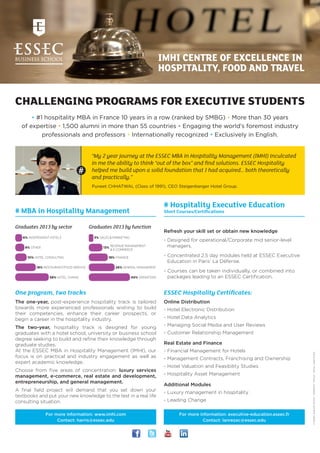
Graduates 2013 by sector
6% INDEPENDENT HOTELS
8% OTHER
10% HOTEL CONSULTING
18% RESTAURANT/FOOD SERVICE
58% HOTEL CHAINS
For more information: www.imhi.com
Contact: harris@essec.edu
For more information: executive-education.essec.fr
Contact: lanrezac@essec.edu
Graduates 2013 by function
3% SALES & MARKETING
13%
REVENUE MANAGEMENT
18% FINANCE
26% GENERAL MANAGEMENT
40% OPERATIONS
& E-COMMERCE
# MBA in Hospitality Management
ESSEC Hospitality Certificates:
Online Distribution
- Hotel Electronic Distribution
- Hotel Data Analytics
- Managing Social Media and User Reviews
- Customer Relationship Management
Real Estate and Finance
- Financial Management for Hotels
- Management Contracts, Franchising and Ownership
- Hotel Valuation and Feasibility Studies
- Hospitality Asset Management
Additional Modules
- Luxury management in hospitality
- Leading Change
©ESSECBusinessSchool-355150115-Photos:iStock,UrbanRuths.
# Hospitality Executive Education
Short Courses/Certifications
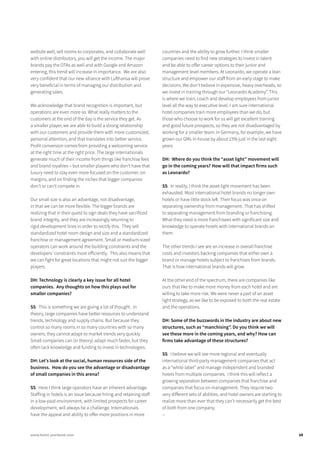
Demian Hodari: Saar, you are now in charge of a
relatively small, regional hotel company. How do you
think firms like yours can best compete with the larger,
more established multi-national hotel companies in the
years ahead?
Saar Sharon: I actually think small and medium size
companies have never had a better opportunity to compete
with the large internationals than they do in this day and age,
and that will be the case in the coming years as well.
Small companies need to be particularly adept at paying
attention to market trends and competitors’ strategic
decisions in order to best understand their own potential
competitive advantages. Smaller companies are likely more
nimble and have a better chance to react to important
changes affecting their business. For example, the main
influences I see today are the Internet, consumers’ increasing
concern for value, a focus on operations, and product design.
These all have a major impact on the value and power of
brands, and we are trying to proactively compete on these in
a few key ways.
DH: How so?
SS: Leonardo Hotels took a strategic decision to develop
its own brand and distribution and revenue management
systems. If you own your distribution system, manage your
“The asset light approach
has been exhausted”Saar Sharon iinterviewed by Demian Hodari i
Saar Sharon is the newly appointed CEO of Leonardo Hotels in the UK, where his brief is to lead the company’s
expansion through asset acquisition, joint ventures and leasing across the UK. As an alumnus of the Ecole
hôtelière de Lausanne, we thought it fitting to ask one of Saar’s old professors to interview him on behalf of
The Hotel Yearbook. Demian Hodari, the school’s expert on hotel ownership and management structures,
rose to the occasion. Their conversation touched on the advantages of being small and emerging trends in
ownership structure.
HOTEL Yearbook 2015 annual edition
INTERVIEW
website well, sell rooms to corporates, and collaborate well
with online distributors, you will get the income. The major
brands pay the OTAs as well and with Google and Amazon
entering, this trend will increase in importance. We are also
very confident that our new alliance with Lufthansa will prove
very beneficial in terms of managing our distribution and
generating sales.
We acknowledge that brand recognition is important, but
operations are even more so. What really matters to the
customers at the end of the day is the service they get. As
a smaller player, we are able to build a strong relationship
with our customers and provide them with more customized,
personal attention, and that translates into better service.
Profit conversion comes from providing a welcoming service
at the right time at the right price. The large internationals
generate much of their income from things like franchise fees
and brand royalties – but smaller players who don’t have that
luxury need to stay even more focused on the customer, on
margins, and on finding the niches that bigger companies
don’t or can’t compete in.
Our small size is also an advantage, not disadvantage,
in that we can be more flexible. The bigger brands are
realizing that in their quest to sign deals they have sacrificed
brand integrity, and they are increasingly returning to
rigid development lines in order to rectify this. They sell
standardized hotel room design and size and a standardized
franchise or management agreement. Small or medium-sized
operators can work around the building constraints and the
developers’ constraints more efficiently. This also means that
we can fight for great locations that might not suit the bigger
players.
DH: Technology is clearly a key issue for all hotel
companies. Any thoughts on how this plays out for
smaller companies?
SS: This is something we are giving a lot of thought. In
theory, large companies have better resources to understand
trends, technology and supply chains. But because they
control so many rooms in so many countries with so many
owners, they cannot adapt to market trends very quickly.
Small companies can (in theory) adapt much faster, but they
often lack knowledge and funding to invest in technologies.
DH: Let’s look at the social, human resources side of the
business. How do you see the advantage or disadvantage
of small companies in this arena?
SS: Here I think large operators have an inherent advantage.
Staffing in hotels is an issue because hiring and retaining staff
in a low-paid environment, with limited prospects for career
development, will always be a challenge. Internationals
have the appeal and ability to offer more positions in more
countries and the ability to grow further. I think smaller
companies need to find new strategies to invest in talent
and be able to offer career options to their junior and
management level members. At Leonardo, we operate a lean
structure and empower our staff from an early stage to make
decisions. We don’t believe in expensive, heavy overheads, so
we invest in training through our “Leonardo Academy”. This
is where we train, coach and develop employees from junior
level all the way to executive level. I am sure international
hotel companies train more employees than we do, but
those who choose to work for us will get excellent training
and good future prospects, so they are not disadvantaged by
working for a smaller team. In Germany, for example, we have
grown our GMs in-house by about 15% just in the last eight
years.
DH: Where do you think the “asset light” movement will
go in the coming years? How will that impact firms such
as Leonardo?
SS: In reality, I think the asset light movement has been
exhausted. Most international hotel brands no longer own
hotels or have little stock left. Their focus was once on
separating ownership from management. That has shifted
to separating management from branding or franchising.
What they need is more franchisees with significant size and
knowledge to operate hotels with international brands on
them.
The other trends I see are an increase in overall franchise
costs and investors backing companies that either own a
brand or manage hotels subject to franchises from brands.
That is how international brands will grow.
At the other end of the spectrum, there are companies like
ours that like to make more money from each hotel and are
willing to take more risk. We were never a part of an asset
light strategy, as we like to be exposed to both the real estate
and the operations.
DH: Some of the buzzwords in the industry are about new
structures, such as “manchising”. Do you think we will
see these more in the coming years, and why? How can
firms take advantage of these structures?
SS: I believe we will see more regional and eventually
international third-party management companies that act
as a “white label” and manage independent and branded
hotels from multiple companies. I think this will reflect a
growing separation between companies that franchise and
companies that focus on management. They require two
very different sets of abilities, and hotel owners are starting to
realize more than ever that they can’t necessarily get the best
of both from one company.
↓
19www.hotel-yearbook.com
DH: Let’s talk about leases. Its largely a forbidden word
in the USA, but here in Europe it still has its proponents.
What are your thoughts about the future of leases?
SS: Leases are widely used in Germany, France and the UK.
I think that as the population continues to grow – and as
pension funds’ investment continues to grow along with it –
we will also see a growing trend in leasing hotels. Institutional
money needs the certainty of income from a lease and
cannot be exposed to employees. I therefore see a trend in
growing tenant companies like Leonardo across Europe. We
are now moving into the UK, and my understanding is that
Premier Inn – which is one of the European leaders in leasing
hotels – is now moving into Germany.
Regardless of leases, there will be growth through white label
management companies, and I think this is an opportunity
to consolidate into a larger, more efficient regional structure.
Interstate and BDL Redfine in the Netherlands and UK are
examples of such companies. It is also an opportunity to take
a leasing model across Europe.
DH: You have worked with numerous types of owners
during your career. Can you explain how you think
ownership of hotels will change over the coming years?
Not only who will own hotels, but how different owners
will involve themselves (or not) at the property level? Do
you see more involvement by owners, or less?
SS: This is an important trend. The first issue is that
there are many regional differences in owner types and
preferences. For example, if you segment owners based on
their willingness to get involved with the property, then I
see a growing trend of owners not wanting anything to do
with hotel exposure who would therefore go for a lease, or
at least get some income guarantees or reduce exposure to
employees. If there is a management contract, they would
use asset managers.
On the other hand, I see a continuation and even a
reinforcement of private equity investment in hotel
management companies that own and operate hotels.
Take Starwood Capital, for example, or Goldman Sachs or
Patron Capital. These companies will be very involved at the
property level, and they often back up management teams
that own and operate hotels.
There will always be trophy owners for trophy assets.
However, I think more owners will seek to reduce exposure
to the operations through a lease. So we will see less of the
traditional structure of an owner owning, and a management
company managing, with a brand distributing, and an
owner’s representative (i.e. an asset manager) in the mix
acting as an intermediary.
DH: Thanks, Saar, for sharing your views on these
fascinating changes. ■
Recently appointed, Saar Sharon leads Leonardo Hotels’ expansion and management in the UK. The group’s intention is to
develop the UK business through asset acquisition, joint ventures and leasing across the United Kingdom, including Scotland
through growing Leonardo’s family of brands.
Saar has a diverse background with over 16 years of global investment, development and hotel asset management.
Prior to managing Leonardo Hotels in the UK, Saar was responsible for driving the management of PPHE Hotel Group (Park
Plaza Hotel Europe) real estate, including capital expenditure, acquisition strategies and asset utilization optimization.
Specifically, Saar focused on identifying asset strategies across all branded hotels within a hotel portfolio with over 5,500
bedrooms. Recently, Saar led the acquisition of Hercules House in Waterloo, London to be developed into a 490-bedroom upscale hotel with an
investment in excess of £100 million.
Prior to PPHE, Saar held senior investment positions at Jones Lang LaSalle Hotels and advised on disposals and acquisitions to a value in excess of €4
billion across western and eastern Europe to clients like Starwood Capital, Goldman Sachs, Blackstone, Invesco, Deka and many others.
Saar holds an LLB from the University of Sussex (Hons), an LLM from the Hebrew University and an MBA in International Hospitality Management
from the Ecole hôtelière de Lausanne.
Demian Hodari is an Assistant Professor of Strategic Management at the Ecole hôtelière de Lausanne. His research
focuses on the evolving roles of hotel owners, asset managers and general managers. He regularly presents his research
at academic conferences, provides executive education and is a frequent moderator and/or chairperson for industry
events.
20 HOTEL Yearbook 2015 annual edition
INTERVIEW
H O T E L S
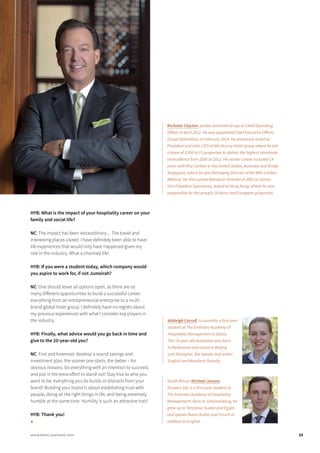
Hi, I am A.L.O.,
your Botlr at Aloft Cupertino
Read about me on page 120
Ten questions hospitality
students wouldn’t normally
ask a CEO
Nicholas Clayton interviewed by Ashleigh Carroll iand Michael Jansen i
The title says it all: what are some unconventional things we might ask the CEO of a hotel group? Questions
that might make a chief executive squirm a little. Not wanting to put our own necks on the line, The Hotel
Yearbook farmed this article concept out to Ashleigh Carroll and Michael Jansen, two students at the Emirates
Academy of Hospitality Management in Dubai. They contacted Nicholas Clayton, the Chief Executive Officer,
Group Operations, of the Jumeirah Group, who gamely answered their ten questions as follows.
Hotel Yearbook: Do you feel that Dubai and its eccentric
ways have influenced you and your work life in any
capacity? If so, how?
Nicholas Clayton: Dubai is extraordinary on so many fronts.
The pace that flows with the season and the wonderful
city-wide events such as the World Cup, Dubai International
Film Festival, Art Dubai and The Dubai Rugby Sevens, just to
name a few. Dubai is an important brand on the world stage.
However, from a population standpoint, it’s a relatively small
town. Networking and developing meaningful personal and
professional relationships is relatively easy – and essential for
success. My wife Liz and I have really been able to branch out
here and connect with so many interesting people from very
diverse backgrounds.
HYB: What was your biggest failure and what did you
learn from it?
NC: Biggest lesson learned in life: listen to your intuition.
Initial instincts are usually correct, and you should pay
attention and not ignore the signs. When you hold on
too long to what might be, you will on most occasions be
disappointed.
HYB: Do you have any strong beliefs that people find
unusual?
NC: I have a strong belief that everyone is responsible for
the culture and work environment of our company. Senior
leadership have the ultimate responsibility to “walk the talk”
of the company’s philosophy.
HYB: What keeps you awake at night?
NC: Initiatives that are not on track, or issues in the business
which are extremely complex and require a win-win outcome
for all stakeholders.
HYB: If you had to leave Jumeirah for a year and the only
communication before you left your colleagues was a
single paragraph, what would you write?
NC: Dearest Jumeirah colleagues, please know that you are
creating extraordinary experiences for our loyal guests. You
have been part of building a luxury brand that is only 17 years
young…. What an accomplishment! Be proud, be confident,
and continue to excel in the Jumeirah Hallmarks. You have a
very bright future indeed.
HYB: If you were the CEO of a major competitor, what
would you do to beat Jumeirah?
NC: I would develop a strategy around the strengths of the
company, no matter my role – with Jumeirah or a competitor.
It is critical to understand your competition, however, in a
crowded luxury hotel space and hence you must play to your
unique strengths. Focus on your unique selling features and
leverage them for success.
HYB: At the end of the day, what tangible “trophy” would
you want on your mantlepiece?
NC: “Husband and Father of the Year”… I think I still have a lot
of work to do to achieve this recognition.
22 HOTEL Yearbook 2015 annual edition
INTERVIEW
HYB: What is the impact of your hospitality career on your
family and social life?
NC: The impact has been extraordinary.... The travel and
interesting places visited. I have definitely been able to have
life experiences that would only have happened given my
role in the industry. What a charmed life!
HYB: If you were a student today, which company would
you aspire to work for, if not Jumeirah?
NC: One should leave all options open, as there are so
many different opportunities to build a successful career:
everything from an entrepreneurial enterprise to a multi-
brand global hotel group. I definitely have no regrets about
my previous experiences with what I consider top players in
the industry.
HYB: Finally, what advice would you go back in time and
give to the 20-year-old you?
NC: First and foremost: develop a sound savings and
investment plan, the sooner one starts, the better – for
obvious reasons. Do everything with an intention to succeed,
and put in the extra effort to stand out! Stay true to who you
want to be: everything you do builds or distracts from your
brand! Building your brand is about establishing trust with
people, doing all the right things in life, and being extremely
humble at the same time. Humility is such an attractive trait!
HYB: Thank you!	
■
Nicholas Clayton joined Jumeirah Group as Chief Operating
Officer in April 2012. He was appointed Chief Executive Officer,
Group Operations, in February 2014. He previously acted as
President and later CEO of the Viceroy Hotel Group where he led
a team of 3,500 in 15 properties to deliver the highest standards
of excellence from 2006 to 2012. His earlier career included 14
years with Ritz-Carlton in the United States, Australia and finally
Singapore, where he was Managing Director of the Ritz-Carlton
Millenia. He then joined Mandarin Oriental in 2001 as Senior
Vice President Operations, based in Hong Kong, where he was
responsible for the group’s 18 Asian and European properties.
South African Michael Jansen,
20 years old, is a first-year student at
The Emirates Academy of Hospitality
Management. Born in Johannesburg, he
grew up in Tanzania, Sudan and Egypt,
and speaks fluent Arabic and French in
addition to English.
Ashleigh Carroll is currently a first-year
student at The Emirates Academy of
Hospitality Management in Dubai.
The 18-year-old Australian was born
in Melbourne and raised in Beijing
and Shanghai. She speaks and writes
English and Mandarin fluently.
23www.hotel-yearbook.com
Life used to be relatively easy in the hotel investment space.
The players were well known, and there would always be a
certain predictability as to who would be the likely buyers for
a hotel asset put up for sale. Similarly, capital didn’t travel
much. In a transparent and well organized market such as the
USA, major hotels would generally pass from one domestic
player to another. Perhaps this relates to the fact that hotels
were an unusual asset class. Buyers would acquire an
operating business, not a passive real estate investment,
whereby one awaits collecting rent. With an operating
business comes cash flow volatility, and specialist knowledge
is required to optimize return on investment. Perhaps not
everyone’s cup of tea, and thus naturally limiting the number
of participants, as well as the attractiveness of overseas
investments due to the many additional pitfalls (local market
knowledge, tax and legal considerations, restrictions on
foreign ownership, repatriating capital, and so forth).
There are always exceptions of course, such as the Japanese
splurge in Hawaii in the 1980s, or the trophy asset race by
Middle Eastern capital some 20-odd years later. There were
also the sovereign wealth funds with their undisclosed
overseas purchases. Hotel companies nonetheless have
crossed borders frequently, commencing as early as the
1950s, although over the past 10 to 15 years, they have
predominantly been net sellers.
Fast forward to 2014/15. The picture has morphed into
something resembling a work by Jackson Pollock. Capital is
flowing freely between continents and countries, and more
often than not, the identity of a successful buyer remains
something of a mystery until bids are due. Not only assets
are traded, but also hotel companies, on the premise of
everlasting growth opportunities.
The hotel industry is growing ever more rapidly, it seems.
More people travel, and to destinations further afield.
However, the growing middle class in emerging markets is
the real temptation. With China alone accounting for some
200 million outbound travelers by the year 2020, the future
of hotels globally has become big business, and accepted as
a mainstream investment. Perhaps it comes as no surprise
then that hotel assets, and companies, have become objects
of global desire.
This is great news for the industry, but perhaps not so great news
for companies having made a living from hotel investments. Not
only is it challenging to invest across continents, but increasingly
also in investors’ own back yard. Investors from China, Hong
Kong, Singapore, Malaysia, and even Korea and Japan are
quickly emerging on the global hotel scene. These investors
keep a tight grip on their home markets, making foreign
investment difficult, but also pay significant premiums for assets
both at home and around the world.
Coming soon to a city
near you: Hotel capital
flows on the moveby Gisle Sarheim i
Life (or at least business) is all about supply and demand. Over time, supply and demand may both change –
as well as the way supply beats a path to the place where it is in demand. The same goes for capital, one of the
most basic “supplies” in the hotel industry. In the future, how will the supply of capital change, and how will
it find its way to the hotel projects where it is required? Gisle Sarheim of Hilton Worldwide has identified five
trends that are affecting the flow of this very fundamental stuff.
24 HOTEL Yearbook 2015 annual edition
CAPITAL
Companies such as Anbang, Sunshine, Bright Ruby, Fosun,
Dalian Wanda, UOL, Fu Wah and so forth may not have been
well known outside of their home countries – but they are
making their mark with transactions ranging in size from
100 million to nearly 2 billion dollars. With these purchases
comes a shift in investment philosophy – that of long-term
holding of assets, and an inherent belief that well located
assets will become scarcer, and thus increase in value.
So looking at 2015 and beyond, what does the future
hold? The following five trends are likely to shape the hotel
investment landscape in the near future:
1. Global capital flows: here to stay
Capital will see fewer boundaries going forward, and investor
interest in premium foreign assets will likely increase,
particularly from Asia. This will result in tighter yields across
many gateway markets.
2. The death of cap rates
Cap rates, a valuation metric that examines the ratio between
net operating income produced by an asset and its capital
cost (cost to acquire), are likely to become more and more
meaningless. Cap rates are generally applied to the first year
of income for the investment, and thus they primarily validate
price versus short-term income generation. With longer-term
investment horizons, and asset redevelopment scenarios,
this metric may prove less valuable in the future.
3. The rise of the advisors
With cross-border capital comes an increased need for
advisory services such as market analysis, investment
management, asset management, and tax and legal services.
These advisors will bring further transparency to the global
market place.
4. Transaction underwriting under fire
Transaction underwriting will be increasingly challenged
in producing winning bids for prime opportunities. Short-
term strategies of buy/hold/sell (i.e. playing the cycles), or
opportunistic strategies of buy/fix/sell may not win against
the emerging strategy of buy/hold/hold.
5. From Asset Light to Asset Right
Hotel operators, faced with new competition from well-
capitalized entrants to the hotel company jungle, may decide
to deploy capital to secure management of prime assets or
strategic growth opportunities. M&A activity will likely be here
to stay, as hotel management companies battle for growth.
■
Gisle Sarheim is Senior Director, FIA | Real Estate & Asset
Management, Middle East & Asia Pacific at Hilton Worldwide,
based in Singapore. With his previous roles, based in London and
New York, he has covered most of the world’s hotel investment
markets around the globe, as well as emerging hotel markets
across Africa, Middle East and the Asia Pacific region. Gisle also
serves on the Board of Directors of the Hospitality Asset Managers
Association (HAMA) Asia Pacific.
25www.hotel-yearbook.com
If the results of the recent HotCop survey are any indicator,
the Scandinavian hotel industry’s key players are bullish
on the region’s outlook. More surprising, perhaps, is the
fact that the respondents suggest that this new supply
will be dominated by midscale properties. Key challenges
will continue to revolve around financing and the strong
preference for leases, which may prohibit a corresponding
growth from international chains.
Strong development activity in the Nordics
The conference survey’s results revealed substantial
optimism and initiative across all key stakeholder groups.
While a very positive 72% of operators responded that they
were likely/very likely to open a hotel in the next 5 years, this
same view was held by more than 86% of the developers
responding. As for lenders, all those surveyed held a similar
opinion about the likelihood that they would finance a
new project within the next five years. This strong industry-
wide view bodes well for future growth projections, as the
necessary stakeholders all appear to be on board for future
hotel development in the region.
A renewal of the midscale segment
Survey participants hold a particularly strong interest in
developing hotels for the midscale segment. This, at first,
appears to be a peculiar choice, as Scandinavia’s hotel
Bullish in Scandinaviaby Sarah Sonne Larsen iby Demian Hodari i
A recent survey of the delegates at the 4th annual HotCop Hotel Investment Conference, representing the
Scandinavian hotel industry’s major players, found that hotel owners, developers, investors, lenders and
operators are all optimistic about the region’s growth and profit potential, and intend to actively develop and
finance new projects in the coming years, write Sarah Sonne Larsen of Nordic Hotel Consulting and Demian
Hodari, Professor of Strategic Management at the Ecole hôtelière de Lausanne.
HOTEL Yearbook 2015 annual edition
MARKET REPORT
market is traditionally dominated by midscale properties. It
is only in the past decade or two that the regional industry
has seen noteworthy diversification with the opening of more
hotels in other segments. However, the midscale segment
has experienced the least investment and innovation in
recent years, making it an attractive candidate for additional
properties and new branding opportunities.
The budget sector has seen substantial investment and
operational improvement during this period, largely due
to the opportunities for physical property improvement
here, as most properties were considered tired and stale.
Furthermore, there were simply too few budget hotels to
accommodate the demand. Substantial renovations, new
buildings and innovative concepts shook up the segment
and produced a plethora of fresh and trendy limited service
properties, including both independent and branded units.
As a result, these hotels have inspired many traditional
midscale travelers to switch to “affordable luxury” properties.
This segment has resonated with Scandinavian travelers who
appreciate the unique offer of a trendy but no-fuss hotel stay
at a reasonable rate. The volume of budget hotels has grown
fast in recent years, especially in Denmark, as the table below
illustrates. Oslo and Stockholm are both less developed on
the budget side than Copenhagen, as attention has been
given to exciting upscale design hotels.
At the other end of the spectrum, the upscale segment has
seen the lion’s share of investment, which has transformed
many of the classical and traditional upscale palace-type
hotels, replete with chandeliers, white linen, French-styled
table service, and 24-hour room service. Today, most
Scandinavian upscale hotels are liberated from such
formalities. Instead, it is design, innovative service offerings,
experimental F&B, a relaxed atmosphere, and boutique
elements that characterize these properties. Examples
include NIMB, SP34, Axel Guldsmeden and Hotel Alexandra in
Copenhagen; Miss Clara by Nobis, Ett Hem and Lydmar Hotel
in Stockholm; and The Thief, First Hotel Grims Grenka and
Lysebu in Oslo.
The somewhat outdated midscale hotels, as a result of
pressures from both upscale and budget hotels, experience
the lowest revenue growth rates of all segments in the
Scandinavian capitals (except Copenhagen), according to
recent figures. This makes the sector ripe for investment,
not only with regard to improved design, but according to
HotCop delegates, for more streamlined operations and
lower operational cost structures, which are necessary
due to the sector’s higher employee counts – a factor
which has placed it at a disadvantage vis-à-vis the region’s
more efficient and lower priced budget hotels. Thus,
stakeholder sentiment about the midscale segment is not
so surprising after all, and may result in a renewed and more
contemporary midscale supply in Scandinavia.
Different strokes for different folks
While operators, investors, developers and lenders have all
acknowledged the large potential for new investment in the
region’s midscale hotel segment, the study’s results suggest
that the similarity stops there, as there is a relatively diverse
set of interests across these groups. For example, developers
noted a particularly keen interest in extended stay properties,
which could be a result of VAT advantages on construction
and tax deductions on inventory and buildings, as well
as high flexibility due to easy conversion opportunities.
Lenders, meanwhile, noted their strong preference for limited
service properties, due to their reduced sensitivity to market
fluctuations. Operators, on the other hand, suggested that
the lifestyle segment was ripe for investment, given the
region’s strong focus on design and trend setting. ↓
NEW BUDGETHOTEL SUPPLY IN COPENHAGEN SINCE 2009
Hotel Opened Rooms Comments
Cabinn Metro 2009 708 Expanding with another 206 rooms
Wakeup (Carsten Niebuhrs Gade) 2009 510
Omena Copenhagen 2010 223 Soon to be turned into an upscale hostel ‘Urban House’
Generator Hostel 2011 175 Design youth hostel with many twin and double rooms
Wakeup (Borgergade) 2014 498
Total 2114 Source: NHC Data
REVENUE CHANGE FROM 2012 TO 2013			
Revenue Oslo Copenhagen Stockholm
Budget +16.8% +10.9% +6.1%
Midscale +8.1% +5.9% +0.5%
Upscale +9.0% +4.1% +7.8%
Source: Benchmarking Alliance
27www.hotel-yearbook.com
Primary challenges
The study’s respondents were asked to identify what they
consider to be the primary challenges in the Scandinavian
hotel market. Given the region’s historical preference for lease
contracts and lack of many risk share agreements, the issue
of “contract imbalance” received the highest score with 36%.
This issue explains the continued lack of international brands
in the region, and indicates a likelihood that regional chains
such as Scandic, First and Choice will continue to dominate
the market, because they are inclined to sign leases.
According to the survey, the second most significant
challenge (24% of respondents) for hotel development in the
region, is the lack of financing for hotel projects. Interestingly,
respondents also suggest that they believe this will begin
to change now, as banks and other lending institutions are
more optimistic about the industry’s future in the region.
The third largest challenge (20%) is a lack of conceptual
development in the Nordics. At present, local and regional
chains, with a limited supply of different brands and
concepts, dominate the market. While these chains also
renew their brands and include a growing number of
collection-style individual hotels into their portfolios, there is
room for a wider offer of fresh and innovative concepts. This
again relates to the incompatible interests concerning choice
of contract, which limits the inflow of new international
concepts.
In sum…
The limited supply of international brands in Scandinavia is a
result of local market penetration challenges – in particular,
the divergent contract expectations between the Nordic
owners and the international chains. It is important to note
that European and international chains are highly interested
in expanding into Denmark, Sweden and Norway. This
was very clear at the HotCop Conference, which included
participants from numerous chains that are not yet present
in Scandinavia. Following the developments in the coming
years will be highly interesting. We can certainly expect an
increase in midscale properties, hopefully with innovative
and contemporary concepts. Furthermore, the supply
in the capital cities and airport locations is expected to
grow. Whether the new developments will be dominated
by established regional giants, new local operators or the
international chains, is yet to be seen.
Sarah Sonne Larsen is a Hotel Consultant & Senior Business Analyst with Nordic Hotel Consulting (NHC). Sarah is based
in the Copenhagen office and has been with the company since 2007. Within NHC, she is specialised in consulting on
new hotel projects including everything from feasibility studies, and operator search to GM recruitment. Furthermore,
she carries out numerous operations optimization assignments, and has recently begun to specialise in the hotel spa
segment.
Her educational background includes a Bachelor Degree in English & International Marketing from Copenhagen
Business School (CBS) with a semester studying hospitality at Central Michigan University. Most recently, she finished her
Master’s Degree in Service Management from CBS, specializing in hotels. Sarah also has operational hotel experience,
which she obtained while studying.
Demian Hodari is an Assistant Professor of Strategic Management at the Ecole hôtelière de Lausanne. His research
focuses on the evolving roles of hotel owners, asset managers and general managers. He regularly presents his research
at academic conferences, provides executive education and is a frequent moderator and/or chairperson for industry
events.
Primary Challenges in the Scandinavian Hotel Market
35%
30%
25%
20%
15%
10%
5%
0%
Educated /
Skilled Labour
Financing
/ Capital
Undstanding
of Segment
Political
Goodwil
Concept
Development
Contract
Imbalance
28 HOTEL Yearbook 2015 annual edition
SCANDINAVIA
ONE INDUSTRY,
ONE NETWORK
Supported and aggregated by leading industry players and associations in the international hospitality industry,
Hsyndicate operates an industry-specific content and intelligence database which centralizes and redistributes filtered
B2B information from and to industry professionals/organizations within the global hospitality industry.
www.hsyndicate.org
ONE INDUSTRY,
ONE NETWORK
Supported and aggregated by leading industry players and associations in the international hospitality industry,
Hsyndicate operates an industry-specific content and intelligence database which centralizes and redistributes filtered
B2B information from and to industry professionals/organizations within the global hospitality industry.
www.hsyndicate.org
| Advertisement |
Africa: Moving beyond
the handshake
by Trevor Ward i
The African continent is awash with hotel development opportunities… and to some extent, the major players
are indeed moving in, signing deals and getting projects underway. But as Trevor Ward, Managing Director at
Lagos-based W Hospitality Group, explains, many of these ambitious plans have stalled. Why? And what is to
be done?
Africa. It’s big, is Africa. Fifty-four countries at the last count.
That’s more than Europe (however you count the latter!)
Fifty-four different legal systems. Four major languages, and
thousands of others – every country, every tribe, every village
with its own. So why do we keep generalizing about the
opportunities in Africa, and the challenges of the continent?
There’s divergence and convergence at the same time.
Every country is different, with different resources,
different economic drivers, different opportunities for hotel
development. Developing a new hotel in Lagos will have a
different rationale to developing one in Abidjan, or in Cape
Town. But there is convergence too, particularly in East
Africa, where the East African Community (EAC) is enabling
trade between the five countries there, and there is a
common visa regime now between four of them. A common
currency may not be far behind. In southern Africa, SADC
is increasingly bringing countries together, and Zambia
and Zimbabwe have just announced a single visa regime.
ECOWAS, in West Africa, is less effective, but there are hopes
for the future.
But however much they converge, they will remain different
nations – I don’t see Gadhafi’s “United States of Africa”
becoming a reality just yet!
Challenges abound, and the hotel industry in some countries
has been particularly hard hit by the Ebola crisis in 2014.
Confined mainly to three small countries in West Africa,
namely Guinea, Sierra Leone and Liberia, it also had a serious
impact on most other countries in the region, including
Nigeria and Ghana, as borders were closed, flight schedules
suspended, and severe restrictions placed on travel. But my
goodness, did people generalize about Africa when it came
to their travel plans! Trips from Asia to Tanzania’s Northern
Circuit were cancelled at the last minute due to Ebola, with
no reported incidents of the virus within 5,000 km of the area.
Cape Town (7,000 km away), Nairobi, Kampala – all were
affected. Get the map out: would you cancel a trip to the UK
because of an epidemic in Italy?
It has been a difficult year all round in Africa, with terrorist
attacks and threats in many countries including Nigeria, Mali,
Uganda and Kenya, currency devaluation in Nigeria and Ghana,
civil unrest in Mali, the Central African Republic, Mozambique
and much of North Africa. But those of us who live and work
in Africa can look beyond these problems, and know that the
opportunities will not diminish because of them.
The international hotel chains are increasingly devoting
resources to sub-Saharan Africa – Carlson Rezidor,
Hilton, Marriott, Starwood, Taj, Accor and Hyatt all have
development offices in the region.
There are still 11 countries in Africa, 20% of the total, where
there are no internationally-branded hotels – Angola,
Burundi, Central African Republic, Comoros, Eritrea, Liberia,
Mauritania, Niger, Republic of Congo, Somalia and South
Sudan. Those are all opportunities. Granted, not the
multi-location opportunities in the likes of Nigeria, but
30 HOTEL Yearbook 2015 annual edition
AFRICA
opportunities all the same. There are two international
hotels planned in Juba, the capital of South Sudan, and two
also in Nouakchott (Mauritania). The unlikeliest of places,
perhaps, but five years ago who would have thought that
there would today be seven hotels, most under construction,
in Libya?
But while deals are being signed, they are not finding it that
easy to get the hotels open – of the 142 hotels in 33 countries
tracked by us in our Chain Hotels Pipeline Survey 2014, only
just over 50% of the 23,300 rooms are on-site. OK, so that
means there are several new deals in the pipeline, but the
figures also include several hotels, particularly in West Africa,
where construction has stalled, in some cases for several
years. IHG, reported to be the largest hotel company in the
world, opened just two hotels in sub-Saharan Africa in the
last two years, and Accor, the second largest hotel group in
the continent, only one. Marriott (the brand) has currently no
presence in sub-Saharan Africa.
Ambitious development programs are being somewhat
stifled. What should the hotel chains do about this? Three
things:
1	 Choose their owners more carefully. Easier said than done, I
know, but many deals are just not coming to fruition because
of the inability of the owner to perform. And I know of several
deals that are being cancelled by the chains for that reason,
with several years lost on both sides.
2	 Use their balance sheets, or mobilise others’. Asset-light
doesn’t seem to be working too well in Africa. Without a
financial involvement, the chains have little leverage to get
things moving, and to get them moving in the right way.
Carlson Rezidor and Accor are already dipping their toes
into this scenario….
3	 Be far more pro-active in the development stages, not just
providing technical assistance, but also acting as “shadow
project managers”, again to get, and keep, things moving.
I have lived and worked in Africa for 12 years now. It is
no longer “the dark continent”, except when irrational
generalizations are applied, and people show their ignorance.
At times it is frustratingly slow getting anything done, and in
some countries – but by no means all – there does seem to
be a tendency to take one step forward in the morning and
one step backwards in the afternoon.
But the GDP growth in many countries is world-beating, the
demographic dividend is there to be exploited, air travel
is growing faster in the region than anywhere else in the
world except for the Middle East – but I’m repeating what
we all know about Africa: the opportunities are there, and
will always be there. Just treat every country, every city as
different – just like you would anywhere else in the world.
■
Trevor Ward is a specialist consultant in the hospitality, leisure
and real estate industries. He is the Principal of the Lagos-
based W Hospitality Group, and Chairman of Hotel Partners
Africa. His experience includes advising clients on hotel and
tourism development in over 80 countries across the globe. With
a special focus on sub-Saharan Africa, he works with many of
the international hotel groups seeking a presence there. He
is regarded as the foremost expert on the hotel industry in
sub-Saharan Africa, and is engaged primarily in development
consultancy, ranging from investment appraisals to operator
selection, asset management, valuations, financing, development
management, procurement and agency.
31www.hotel-yearbook.com
Hotel investment in the
Swiss Alps: reinventing a
long-standing tradition
by Andreas Roman i
A new law in Switzerland caps the number of second homes allowed in – for example – ski resorts, where for
years, many chalets and apartments have only been occupied for a few weeks a year. When first passed, this
law resulted in a reluctance to invest in any new building projects. However, as KPMG’s Andreas Roman writes,
serviced residences won’t be counted in the quota, so an opportunity exists for the hotel industry to develop
properties around this concept.
The roots of Swiss Alpine tourism date back to the 19th
century, when adventurous mountaineers (most of them
British) started climbing the country’s highest peaks. As more
and more people joined in, hotel resorts began to spring up
across the region to cater for the increasing influx of tourists.
Since then, many of these hotels, for example Badrutt’s
Palace in St. Moritz, have become legendary, and haven’t lost
their luster to this day.
Nowadays, tourism is a major value creator for the Swiss
economy, generating revenues of roughly CHF 35 billion per
year, or 5% of the country’s GDP. The Swiss hotel market
presents a somewhat fragmented landscape, with a high
percentage of independent, often family-owned hotels. Three
and four-star hotels constitute 55% of all guest nights, and
many hotels struggle to generate a profit. This is especially
true for hotels in the mountain regions, which suffer from
seasonality and the sensitivity of leisure travellers to currency
fluctuations.
In recent years, a new genre of Swiss luxury resorts has
emerged, such as The Chedi in Andermatt, creating a major
media buzz. All of these new developments encompass
luxury residences, cross-financing the pricy new builds.
Restrictions on second homes
In 2012, Swiss voters backed an initiative restricting the
percentage of second homes to 20% in every municipality.
Needless to say, most municipalities of popular Swiss Alpine
communes exceed this threshold. However, this law, the
so-called “Lex Weber”, has led to uncertainty and reluctance
to invest in new projects, especially as it is still under
consultation. The general view is that the sale of residential
properties as an additional and crucial income stream is at
stake.
It appears now that the situation is not as bad as it first
seemed. Even though the detailed regulation will only be
finalized next year at the earliest, the draft version released in
the first half of 2014 clearly indicates that serviced residences
connected to a lodging facility will be allowed. However, this
requires that developers present sustainable concepts that
not only meet legal requirements but also offer attractive
options to both local and international tourists.
Not just a Swiss issue
Regardless of whether one is in favor of this new law or not,
it nevertheless represents a wake-up call to start thinking
about reinventing the traditional mountain resort model.
The main reason why the majority of Swiss voters supported
this initiative in the first place was their concern about over-
developed villages in certain Alpine regions that more often
than not resemble ghost towns during off-season. In this
regard, it is interesting to note that certain regions in Austria
already implemented even stricter regulations on second
homes many years ago to counteract the aforementioned
situation. Therefore, it would not come as a great surprise
to see similar restrictions being imposed in other Alpine
destinations.
32 HOTEL Yearbook 2015 annual edition
MARKET REPORT
While new restrictions are not greeted with open arms in the
investment community, this development might actually
blend quite well with the travel habits of Generation Y and
the concept of an increasingly popular “shared economy”.
The trend clearly leans towards more flexibility and less
commitment. Gen Y prefers to go skiing in Gstaad one year,
and escaping to a beach in Bali the next, for example: the
concept of always visiting the same place appears quite
outdated to them.
While it may be comfortable to have one’s very own holiday
home, this luxury makes little economic sense when the
supplementary pied-à-terre is occupied for only three
weeks of the year. Ideally, it should rather be turned into an
annual income-generating investment. The massive success
of holiday rental websites such as AirBnB or Housetrip
clearly underscore the need to share existing resources and
monetize them.
Sustainable concepts for the future
So how can we tackle all these new challenges? One sure fact
is that Switzerland requires a highly customized approach.
Local tourists with particular habits and preferences generate
approximately half the guest nights. Unique examples can be
found within the Helvetic borders.
Recently completed luxury projects include The Chedi in
Andermatt, the W Hotel in Verbier and the Intercontinental
in Davos. Except for the smaller-scale W Residence, most
of these high-end projects are not necessarily high flyers.
This indicates a certain saturation in the segment. Thus,
developers need to consider mid-scale and affordable luxury
segments, too. Also, in most regions there is an obvious lack
of family-oriented and sport-themed resorts.
One example of a success story is the Rocksresort in Laax. With
a “buy to use and let” concept, the residences are part of a hotel
operation, filling up cold beds also outside the peak season.
With a pooling-model, owners generate income with their
investment. There will be plenty of further variations for smart,
hybrid resort options in 2015 and beyond which will help to
reinvent the former pioneers of modern winter tourism.
■
About KPMG Real Estate:
KPMG is a global network of professional firms providing
Audit, Tax and Advisory services. Switzerland’s Real Estate
Advisory team is a market leader in its field providing an all-
encompassing selection of services in the hospitality sector,
including hotel-related valuations, feasibility studies as well
as transaction support.
Andreas Roman is a Senior Consultant at KPMG’s Real Estate
Advisory in Zurich. After his graduation from Ecole hôtelière de
Lausanne in 2010, he first joined Aareal Bank’s hotel property
financing team in Germany before returning home to Switzerland.
Andreas’ multidisciplinary expertise ranges across the various stages
of the hotel investment process.
33www.hotel-yearbook.com
China moves toward travel
and tourism maturityby Giovanni Angelini i
The rise of the Chinese traveler has been perhaps the story of the last decade – and will certainly have a
continuing impact on the decade ahead. This huge market is beginning to mature, writes Hong Kong-based
Giovanni Angelini, bringing about specific challenges he discusses here. But he also asks: is the hotel industry
ready for the next generation of Chinese tourists?
In general, the growth of the Chinese economy is slowing
compared with the growth over the past 10+ years, but
travel, within and outside of China, is still robust and growing
year after year, supported by investments in new airports
(including improvements in air space management), as well
as in general infrastructure and logistics, airlines, ports etc.
To this must be added of course the increased disposable
income and spending power of the Chinese people.
Chinese tourism development is no longer in the early stages.
China is progressing very rapidly toward its goal of becoming
a big economic and cultural power, and it will make a huge
impact on the pattern of the global travel and tourism
industry. China (including several other Asian countries)
will continue to set trends and standards for creativity
throughout the entire hospitality industry.
Travel is becoming a “human right” and not just a “human
need”. For both the wealthy and the middle class, travel is
by far the preferred leisure pursuit. The rapid development
of the luxury market in China and Asia is sending ripples
through the entire industry.
Increasing life and work pressure, together with concerns
over issues such as food safety and pollution, are prompting
well-off Chinese to pay increasing attention to health-related
issues, to increase the frequency of their check-ups, be more
attentive to their diet, participate in more sports activities,
and change the overall look and feel of their leisure time.
34 HOTEL Yearbook 2015 annual edition
CHINA
When talking about China, we are talking about huge
numbers – close to 100 million outbound tourists in 2014 (a
number that is expected to grow to 200 million by the year
2020). It is also important to understand the saving habits
– indeed, the savings “culture” – of the Chinese population,
and of the wealth there that is reported and that which is
“hidden”.
From the Hurun report, the top preferred destinations for
leisure travelers within and out of China are the following:
•	 Regional destinations - Hainan, Hong Kong, Macao, Tibet,
Yunnam, Hangzhou, Xinjang, Beijing
•	 International destinations: Australia, France, Dubai,
Switzerland, Maldives, South Korea, USA, Thailand, Japan,
Singapore, Germany, UK
Group travelers primarily still have two things on their mind:
sightseeing and shopping. However, for an ever increasing
number of people, gambling (in Macao, Singapore, Nevada
and other locations) has been, and will remain, one of the key
reason to travel outside of China.
As concerns wealthy travelers, “challenging” tourist destinations
with more prominent features are becoming a new trend
among Chinese super-tourists, like the Arctic and Antarctic,
Kenya, selected cruises, and similar tours. In 2013, the so-called
super-tourists travelled abroad on average four times, totaling
36 days away from home, with more than 60% of this time spent
on leisure travel. What’s more, this category of traveler spent,
on average, well over US$ 100 thousand per person per year:
attractive statistics to many in the hospitality business! Other
very fast-growing trends are the “real estate buying” holiday and
“education/schooling” tours, both mainly aiming at destinations
in the West, in particular Australia, the USA, and the UK, with
other destinations on the rise, too.
Gifting remains very important for Chinese travelers, with
jewelry topping the list of preferred items, followed by
branded luxury fashion items, expensive red wines & spirits,
watches, health care products, and electronic or other gift
items either not produced or not available in China. To be
noted that in a few key destinations like Hong Kong, Macao,
Singapore and others, there has been a drop in spending
by Chinese tourists compared to previous years. One of the
reasons for this is that Chinese are now travelling to more
destinations and have become smart shoppers when it
comes to price and value.
Online social media remains the most popular source of
information for potential leisure travelers out of China,
followed by TV and newspaper news, and “word of mouth”
which is becoming very important.
What impact are the Chinese having on the hotel industry?
In most part of the world, luxury hotels have recovered from
the global recession far more quickly than other economic
sectors. Most of this is attributed to the new sources of
business from the developing nations, with China clearly
leading the way. Research shows that when choosing a hotel,
Chinese travelers give top consideration to location, followed
by brand, then price. Nota bene: price comes 3rd.
As for the situation of the hotel industry within China,
the country is experiencing an oversupply of top-of-the-
line 5-star deluxe hotels in most areas. This is a result of
developers wanting more quality hotels/brands combined
with the many new multi-purpose developments, bringing
about low occupancies and very competitive rates in markets
challenged by an oversupply of upmarket properties. With
the fast growth of the middle class, demand is currently more
for mid market/mid price hotels that can be developed at
lower cost and which can generate better ROI. Also to be
noted is the fact that the government, which has been was
one of the best customers of top-of-the-line hotels, has made
dramatic cutbacks on entertainment spending, and this is
impacting most of the 5-star hotels in the country.
It is a fact that more than half of the luxury hotels being
developed by the world’s most recognized groups are in the
Asia-Pacific region, and most of that area’s new projects are
in China. The hotel industry, including in China as well as the
rest of Asia, is facing a problem that they have not yet dome
much to address: namely, how must the industry respond
to the likes, dislikes, and expectations of the future travelers
from the fast developing economies? This includes a wealthy
clientele, with China at the forefront, which will be better
traveled than their predecessors and much harder to please.
In particular, the younger generation represents a challenge
as they will start traveling differently. So there is a bit of work
to be done by the industry…. ■
Giovanni Angelini has over 50 years’ experience acquired in 3
continents, Asia in particular. Former CEO of the Shangri-La Hotels
andResortsGroupforover19years,hewasalsoSeniorVicePresident
Asia-Pacific of Westin Hotels and Resorts, in addition to executive
posts with several prestigious hotels in North & Central America,
Europe, and his home country, Italy. In 2010 he founded Angelini
Hospitality, a travel & tourism consultancy based in Hong Kong.
35www.hotel-yearbook.com
EXPO2020 Dubai:
5 years to go;
5 challenges to meet
by Angela Anthonisz i& John Fong i
Dubai will be hosting the World Exposition in 2020. With just five years to go before this seminal event throws
open its doors, what are the key priorities from the point of view of the hotel industry? Angela Anthonisz,
Senior Lecturer at the Dubai-based Emirates Academy of Hospitality Management, and John Fong, Associate
Professor there, look at the plans and preparations under way.
Dubai is back.
“Dubai Property Boom Halts as Prices Fall, Jobs Go.” One
would recall the doomsday headlines and that Dubai was
hovering on sovereign default in 2009. Towers were left
unfinished and expats abandoned their Ferraris at Dubai
Airport in order to get out of the country so as to avoid
bankruptcy. Since then, the cranes have returned (together
with the traffic jams) and there is a sense that the good old
days are back. That said, Dubai has grown older and wiser.
With a much more prudent fiscal policy coupled with a
federal bank that now puts new ceilings on mortgages, there
are signs that Dubai has learned its lesson.
We witnessed Dubai winning the bid for EXPO2020, and that
has fuelled much of the optimism in recent times. There is a
sense of momentum on the consumer and commercial side,
as confirmed in Merrill Lynch’s projections that EXPO2020 will
boost Dubai’s economy by US$ 23 billion. EXPO2020 is also
forecast to create 277,000 new jobs – of which 40% will be in
the hospitality sector.
With just five years to go, is Dubai ready? We outline 5
challenges that it has to meet to realize those expectations
for EXPO2020:
Challenge 1:
Infrastructure – the hardware
The location of Dubai has always been a strategic advantage.
Located within a seven-hour flight of three quarters of the
world’s population, it is no surprise that 70% of the expected
25 million visitors to EXPO2020 will come from outside the
region. Over 60 million passengers now pass through Dubai
International Airport (DXB) yearly and by 2018, passenger
traffic is expected to reach 90 million. The second airport,
Al Maktoum International Airport (AMIA) began operations
recently and once fully functional, will be the world’s largest
airport with an annual capacity of 160 million passengers.
This exponential increase in passenger traffic would only
create further pressure on the already high occupancy
rates of the hotels in Dubai. Average occupancy was 86% in
2014. Catering to the demand of EXPO2020 will require an
additional 45,000 hotel rooms. Planning is in place to build
these extra rooms, but the dilemma is in what to build. 60%
of the current hotel rooms are in the 5-star category, but with
the global market demanding a more balanced portfolio
offer, this has to be reflected in the build provision. Whether
it is a more astute, price-sensitive guest or lifestyle traveller,
there will be a demand for reconfigured and repositioned 3
and 4-star hotel segments within the market.
Will we be able to build fast enough? Will we get the mix
correct? Will our future guests like what we are building?
Challenge 2:
Benchmarking changes – the knock-on effect…
From the infrastructure challenge, the next question could be
“Is 3-star the new 5-star?”
With the increase in hotels and a range of new brands
entering the Dubai market, there will be an inevitable
diversification of the industry and an increased pressure on
hotels to think about their value proposition in order to retain
market share. Dubai has recently redesigned the existing
5-star category to include a new 5-star “Gold” and 5-star
“Platinum” classification based on room size and quality of
finishing. There is logic for the industry to maintain the Dubai
brand of excellence (60% in the 5-star category) within the
hotel provision, but this up-scaling of room specifications
must surely have a knock-on effect on the new 2 and 3-star
brands coming into the market. The industry needs to ensure
36 HOTEL Yearbook 2015 annual edition
MARKET REPORT
that these also retain the same brand excellence, which must
include a redefinition of the product to benchmark those
changes, and then to introduce the product to the market.
How will hoteliers choose to develop their brand portfolio?
Can Dubai maintain its reputation for brand excellence in 2
and 3-star operations?
Challenge 3:
People – the software
Out of the 277,000 new jobs created for EXPO2020, 111,000
will be for the hospitality sector. To fill these positions, we
will have to overcome the stigma of the hospitality industry
paying low wages and requiring long working hours.
Conditions in Dubai have improved in recent times, as
evidenced by the increasing number of students undertaking
their Bachelors and Masters in hospitality management –
our own institution being a prime example. However, even
though staff is recruited, training and retention are key
components as well.
Increased expectations from guests linked to the star-
ratings and branding will confirm the demand for
consistent, excellent service. A demand-for-excellence
spiral is inevitable, and training (and continuous training)
is absolutely key to the success and viability of a hospitality
operation. For Dubai’s tight labor market, where employees
wouldn’t think twice when switching employers for a mere
$100 a month, how do we create staff loyalty?
We need to be creative when incentivizing staff: engaging
them from day one, and encouraging them to become
“owners” of the business. Performance bonuses, lock-step
salary options, and commissions based on percentage of
sales are now common – what about pushing the envelope
and letting staff have a share of the profit (and loss) of
the business? What about allowing staff to tailor their
compensation package and create benefits that resonate
with the employee? What about immediate recognition
of staff via mobile apps? And what about giving instant
incentives via social media platforms that recognize staff and
informs their social network simultaneously?
Challenge 4:
Investment – the money’s here…where should it go?
The United Arab Emirates (UAE) is ranked 11th globally in
the Foreign Direct Investment Confidence Index (FDICI),
ahead of countries such as Switzerland, Sweden, Japan and
Denmark. Foreign Direct Investment has tripled in recent
times, exceeding US$ 14 billion in 2014 (a year-on-year
increase of 20%). The UAE is positioned 8th in the world for
competitiveness, and the government is one of the most
efficient, with the strongest decision-making and lightest
bureaucracy.
The statistics are impressive – and the money is obviously
available – but are we be able to spend it wisely? In
preparation for EXPO2020, it is estimated that 12,000 rooms
are in need of renovation, and the expenses could be
between US$ 80,000 and US$ 150,000 per room. The 45,000
additional rooms needed for EXPO2020 is estimated to cost
more than US$ 7 billion.
The choice of where to locate and where to invest presents a
particular challenge for many operators. Those who operate
older properties will need to decide whether to renovate, refit
and refresh in order to remain competitive. Will operators
choose to take a short-term view and cut corners? Or will a
long-term “post-EXPO” perspective need to be considered?
Wise investment choices need to be made. ↓
37www.hotel-yearbook.com
Challenge 5:
Sustainability
As a sub theme of the EXPO2020, sustainability will inevitably
be on the agenda, particularly in terms of the growth in visitor
numbers and the expected economic benefits associated
with increased levels of investment in the city. Dubai’s model
of sustainability to date is “build it and they will come”, but
with a per capita ecological footprint larger than the USA
and concerns raised by the Emirati population relating
to preservation of local values and culture, the issue of
unsustainability is likely to move up the agenda, as both the
resident population and tourist numbers double over the
next 5 years.
While the emphasis on economic growth is an important part
of the sustainable agenda, the ability to maintain investor
confidence will be key to remaining competitive in the long
term. Ultimately, this can only be achieved by moving past
the economic view of sustainability and acknowledging the
complexities of what makes the destination attractive in the
first place.
Is Dubai sustainable? Is it enough to just focus on economic
growth? What needs to be done in order to address
environmental and social concerns for the city?
Conclusion
While there are many issues to be considered as Dubai
goes about preparing for EXPO2020, we feel that these 5
challenges will be critical for the hotel industry to meet in
the next 5 years. Where operators choose to locate, what
they choose to invest in, and how they choose to diversify
will impact on their long-term competitive advantage and
sustainability post-EXPO.
In a follow up article, we will explore the options available
for Dubai in the post-EXPO era. Typically, after hosting a
major event, it is not uncommon for the economy to slow
down. Dubai has to plan for the slow down now and put
in mechanisms to ensure that the tourism and hospitality
industry continues to be the driver of economic growth for
many years to come.
■
AngelaAnthoniszisaSeniorLecturerattheEmiratesAcademyofHospitalityManagement.Sheiscurrentlyundertaking
her PhD with the University of Derby in the UK, focusing on the impact of mega-events on the sustainability of the hotel
industry. Angela previously held positions as Course Leader and Academic Program Manager for Hospitality and Events
Management Degree and Masters Programs in both the UK and Switzerland.
Dr. John Fong is the Director of Marketing & International Relations and an Associate Professor in The Emirates
Academy of Hospitality Management (EAHM). Assisted by a team of talented individuals, he oversees all marketing
related activities such as advertising, branding, corporate communications, online/offline media, together with
international relations and student recruitment for EAHM.

He is also an Associate Professor of Marketing at both the
undergraduate and postgraduate levels, a published author, an academic reviewer for journals and textbooks and a
sought after speaker; having conducted numerous seminars in Asia, Australia, the Americas, Europe and the Middle
East. His background is in project management, specializing in international marketing and strategic planning.
38 HOTEL Yearbook 2015 annual edition
MARKET REPORT
Study
Hospitality Business
Management in
DubaiScholarships available
— Ask us how!
Internationally Accredited and Recognised Programmes:
Earn your degree and start your career
in the world's fastest growing industry!
• Master of Business Administration in
International Hospitality Management [MBA] (1 year)
• Bachelor of Business Administration (Hons.) in
International Hospitality Management [BBA] (3 years)
• Associate of Business Administration in
International Hospitality Management [ABA] (18 months)
• English as a Foreign Language Programme
(Basic/Intermediate)(3monthsperlevel)
• Study Abroad Programme
(3 months + optional internship component)
www.emiratesacademy.edu info@emiratesacademy.edu
The Emirates Academy of Hospitality Management
+971 4 315 5555
@EmiratesAcademy
| Advertisement |
Dubai: back from the
brink, roaring ahead
by Claire Harvey i
What are the factors that will play the biggest role in Dubai’s chances for sustained hotel growth? The
Jumeirah Group’s Claire Harvey analyzes the uncertainties.
I have recently moved to Dubai from Europe, inspired by a
wish to change environment, experience something new
and explore the excitement associated with the emirate
internationally. Back in 2009, Dubai went through a well-
documented real-estate correction, just when the rest of
the world came to a halt. Fast-forward a few years, and I can
confidently say that Dubai has recovered and the pace of
growth is again reaching peak levels. But what is driving the
pace? And where do I foresee the key risks and opportunities
for Dubai over the coming years?
Dubai 2020
The Dubai Department of Tourism and Commerce Marketing
(DTCM) developed a strategy to attract 20 million visitors by
2020, up from 11 million in 2013. This strategy is underpinned
by the UAE being awarded the right to host the World
Expo 2020 in Dubai. The outcome of the strategy and Expo
is that Dubai needs to develop a high volume of hotel
accommodation to support this growth.
Dubai currently offers around 350 hotels, representing around
80,000 bedrooms, and the target is to grow this to 160,000
rooms by 2020. According to a recent Deloitte report, there are
currently 86 hotels under construction in Dubai, accounting for
approximately 25,000 keys. That indicates that in excess of 30
additional hotel openings are necessary each year until 2020 to
reach the target. To put this into context, Deloitte highlights that
in the peak year of 2011, a total of 26 hotels opened in Dubai,
versus the 30+ now required annually.
As a result, the high volume of additional rooms required
for Expo 2020 may be provided in part by privately owned
residential accommodation, which will alleviate two
pressures: the pressure to deliver an adequate number of
rooms by 2020, but also the risk of oversupply after 2020.
Currently the market absorbs new supply relatively easily;
however, this is on the back of a few years of reduced activity.
Profitability
Profitability levels of hotels in Dubai are comparatively high.
The anticipated additional supply will put pressure on GOP
conversions, underpinned by ADR dilutions and high fixed
cost bases. This will force existing hotels to become more
creative in their offers to maintain high conversion levels.
The profitability issue is also driven by labor cost. Dubai
needs high volumes of skilled hospitality workers in a very
short time span. There will tough competition to recruit from
a limited pool of talent, which is likely to result in higher
salary and training costs to the hotels.
If the targeted volumes of additional hotels are achieved
and sustained, then the risk is that overall performance of
hotels in the city may drop. The cost structure will therefore
need to be reviewed carefully, and if service levels are to be
maintained, the mindsets of investors, lenders and hotel
operators will need to shift.
40 HOTEL Yearbook 2015 annual edition
MARKET REPORT
Diversification
Dubai also has the high density of five-star hotels. The
government is pushing for the development of additional
non-5-star hotels; however, the high development costs
present a challenge to developers. As a result, there is a lack
of mid-market hotels on beach locations, for example.
The government has launched an initiative to help mid-market
hotels with development costs by waiving the municipality fee
(10% of occupied room rate). This seems to have generated
some pipeline; however, in Dubai there are some challenges to
making four-star hotels as profitable as five-star hotels, due to
the high fixed cost base and high ADRs in the luxury segment.
Two other trends in Dubai are the emergence of mixed-use
complexes that include one or more hotels, and serviced
apartments/branded residences; and the demand for lifestyle
hotels.
Regulation
Hotel development growth levels are of course linked to
other asset classes and a healthy real estate industry. The
government is taking some steps to reduce risk and is trying
to regulate some aspects of the real estate industry to avoid
another bubble and bust cycle.
According to Jones Lang Lasalle (JLL), the number of
residential units is forecast to grow by 6.6% in 2014, up from
approximately 3% in 2012 and 2013. The acceleration is
underpinned by an increase of inward investment stimulated
by growing confidence in Dubai as a safe haven, capital
inflows from China, and concerns about economic stability
and high tax rates in Europe.
The government has recently introduced some precautionary
measures to ease inflationary pressure by introducing
taxes on property transactions at 4% of transaction
price. Increasing regulation is helping long-term investor
confidence. While this may not avert another crisis, it
highlights that the government is focused on avoiding the
creation of another bubble.
There is no doubt that the hotel landscape in Dubai will
change substantially over the coming years. While risks
naturally remain, Dubai has sharpened its pencil, and the
dynamism and energy underpinning the emirate will allow
it to continually evolve and thrive regardless of pressures
elsewhere.
■
Claire Harvey is currently a Development Director for the
Jumeirah Group, based in Dubai. She is a graduate of the Ecole
hôtelière de Lausanne, and spent her early career working in
hotel operations. She then joined TRI Hospitality Consulting in
the UK, focusing on feasibility studies within the hotel sector. She
subsequently joined Vision Asset Management, to advise hotel
investors, before moving to the Middle East.
41www.hotel-yearbook.com
COUNTRY
REPORTS
2015
At Horwath HTL, we focus one hundred percent on hotels, tourism and leisure. With over two hundred and fifty
professionals world wide, our network can draw on a tremendous amount of international experience and local
knowledge that gives us, and our clients, a unique advantage.
We offer a broad range of advisory solutions that covers the whole cycle of the hotel product, starting with planning
and development, on to asset management and operational advice, to transactional and financial restructuring. At any
stage, Horwath HTL will add value to your project and ensure that you receive the very best support every step of the
way.
www.horwathhtl.com
TM
Hotel, Tourism and Leisure
CÔTE D’IVOIRE by Charlotte Specht i
2014 SNAPSHOT
•	 Despite a slowdown in business due to the Ebola outbreak
affecting neighboring countries, GDP growth rate remained
stable in 2014 and should stabilize around 8%, above
Sub-Saharan Africa’s average. This is strongly supported by
institutional reforms and public investment programs.
•	 Abidjan, the economic capital of the country, concentrates
most of Ivory Coast’s activities, mainly related to the port
and the financial market.
•	 Abidjan’s major role in West Africa has also been asserted
through increasing MICE activity, with the organization
of significant international events, for example the
International Forum of Investments in Ivory Coast 2014.
•	 After a rapid recovery after the end of crisis, the country is
currently positioned as WAEMU’s leading economic power
and the third largest within ECOWAS. Political stability has
been confirmed in 2014 through an increased dialogue
with the opposition and was not affected by military
demonstrations in November.
•	 Overall, the hotel supply in Ivory Coast remains poorly
developed with the exception of Abidjan, which counts
less than 2,500 rated rooms. 60% belong to branded
or large independent hotels. In Abidjan, the Plateau
district (CBD) concentrates 75% of the branded supply,
and performances achieved by Abidjan quality hotels –
occupancy rate of 65% and an ADR of 110 Euros in 2013 –
reflect the dynamism and the resilience of the market.
•	 Provincial hotel spots include Yamoussoukro, the political
capital, the second hotel market. This is exclusively made
up of independent supply and suffers from poor quality.
•	 Minor leisure oriented supply has been developed along
the coast around Grand Bassam and Sassandra.
BUSINESS SCENARIOS FOR 2015 AND BEYOND
In this context of re-established stability, we are of the
opinion that the upcoming presidential elections in 2015
should run smoothly and the hotel market won’t be affected,
even if it must still remain vigilant.
The Ivory Coast’s tourism sector will continue to perform as
well as the national economy. We forecast that foreign tourist
arrivals in Ivory Coast in 2015 will register continued growth
of 7-8%, largely due to the expected increase in regional and
international business exchanges.
Hotel development is strongly linked to Abidjan urban trends:
•	 The Plateau district will retain its main role as the central
business district and concentrate most of the hotel
projects (Teylium and Mövenpick in 2017),
•	 Marcory will be strengthened by the opening of the third
bridge to Cocody and a 4-star Azalaï unit (200 rooms).
•	 After the successful opening of Onomo in 2012, the airport
zone will benefit from the Aérocité project through the
opening of a Radisson Blu hotel (252 rooms) in 2015.
This additional supply is expected to impact hotel
performances, especially market occupancy rate. However
it should rapidly recover considering the dynamism of the
market and investor confidence.
We anticipate a market structure centering on hotels with
international quality standards, particularly in the mid- and
upscale segments, marginalizing local and spontaneous
supply.
Abidjan is currently a hot spot for hotel investors and
represents a strategic hub in French-speaking Africa for
international operators in their brand development.
COUNTRYREPORTS
AFRICA
Charlotte Specht joined Horwath HTL in 2013 after graduating
from Rouen Business School (France) with a specialization in
entrepreneurship. She works mainly on hotel market and feasibility
studies in France and French-speaking Africa, especially for urban
or resort projects. She has also developed advanced knowledge of
sustainable tourism.
44 HOTEL Yearbook 2015 annual edition
ETHIOPIA by Michelè de Witt i
2014 SNAPSHOT
•	 Ethiopian Airlines added a number of new destinations
to its schedule in 2014, including Shanghai, Madrid, and
Doha. Ethiopian is the fastest growing airline in Africa.
•	 The National Tourism Transformation Council, chaired
by the Prime Minister, was launched, which indicates a
change in the government’s perception of the sector’s
potential to contribute to the national economy.
•	 In September, the Prime Minister told a United Nations
Climate Summit in New York that the Ethiopian
government was targeting double-digit economic growth
so it could become a medium-income country by 2025.
•	 For the full year 2014, the hotel market in Addis Abeba is
likely to register an annual occupancy of almost 60% with
ADR achieved likely to be approximately US$ 235.
BUSINESS SCENARIOS FOR 2015 AND BEYOND
Ethiopia is among the world’s top ten fastest growing
economies, expected to register an annual average GDP
growth of approximately 8.1% between 2011 and 2015,
according to The Economist. And yet, the travel and tourism
sector is only expected to expand by approximately 4.0% per
annum over the coming ten year period.
Compared to the size of the country, the size of the Ethiopian
economy and the range of attractions, including national
parks, the Ethiopian travel and tourism sector has been
rather neglected until recently, apart from conferences being
held in Addis Abeba courtesy of this being the seat of the
African Union.
The launch of the new tourism policy, signalling a change
of direction by the government of Ethiopia, bodes well for
tourism, as it is anticipated to open up one of the last great
frontiers and make it more widely available for tourists to
come and visit – and not just use Ethiopian Airlines to fly
via Addis Abeba to other destinations on the continent for a
holiday.
For the Ethiopian hotel market, we would expect little
change in the current performance levels until such time
as the new tourism policy has been fully articulated and
meaningful initiatives and activities targeting the growth
and diversification of tourism in Ethiopia have been
implemented.
Country reports are brought to you by Horwath HTL
COUNTRYREPORTS
Michelè de Witt has more than 20 years experience in the tourism and hospitality industry. Her experience covers a wide range of activities enabling
her to provide a spectrum of services from market analyses, concept development, financial feasibility studies and operator selection to trouble-
shooting for existing operations, and developing and implementing operating standards, policies and procedures to support organizational
objectives. Over the past decade, Michelè has specialized in Africa-based projects and has project experience in the following countries: South Africa;
Algeria; Botswana; Ghana; Kenya; Maldives; Mali; Mauritius; Morocco; Mozambique; Namibia; Republic of Tanzania; Reunion; Rwanda; Seychelles;
Uganda; Union of Comoros; Zambia; and Zimbabwe.
45www.hotel-yearbook.com
NAMIBIA by Michelè de Witt i
2014 SNAPSHOT
•	 Namibia is better known for its uranium reserves; however,
its offshore is increasingly becoming an area of interest
for oil and gas explorers. In February, Shell announced it
would drill for oil in Namibian waters after acquiring the
exploration rights for two blocks situated in the Orange
Basin from Signet Petroleum.
•	 In mid-September, the Namibia Ports Authority announced
work on a new port specifically designed to cater to
commodity exporters and fuel importers located in
southern African states will start in 2015, one year earlier
than initially planned. The harbor will be built 5 kilometers
north of Walvis Bay.
•	 Namibians went to the polls in late November. Sixteen
political parties and nine presidential candidates
contested the election with Dr. Hage Geingob, nominated
by the SWAPO Party, registering the highest support ever
in presidential elections in Namibia. The new National
Assembly and President will be inaugurated on March 21st,
2015.
•	 The first eight months of 2014 registered an uptick in
tourist arrivals in Namibia following two years of difficult
trading conditions.
•	 Namibia’s travel and tourism sector suffered a setback at
the start of the high season in 2014, when the international
airport, Hosea Kutako International Airport, was
downgraded by the ICAO.
•	 Nevertheless, the hotel market in Windhoek, the country’s
capital city, is estimated to register an annual occupancy
of approximately 65% at an average daily rate of
approximately US$ 325, according to STR Global, in 2014.
BUSINESS SCENARIOS FOR 2015 AND BEYOND
The SWAPO (political) Party has been in power since
independence from South Africa and therefore we do not
expect major policy changes during the course of 2015.
Whilst the country’s economy is anticipated to maintain
the current growth trend of approximately 4.3%, downside
risks associated with the global and South African economic
outlook will remain high.
We anticipate the Namibian tourism sector will perform
marginally better than the national economy. We forecast
foreign tourist arrivals in Namibia in 2015 will register
continued growth of between 5.0% and 7.0% although this
may be negatively affected by economic conditions in Europe
and South Africa.
With reference to the hotel market, the supply of formal
accommodation establishments in the country is relatively
stable with new additional branded hotels. With a buoyant
domestic market supported by business and conference-
related travel characterizing the demand recorded in primary
cities, we expect the Namibian hotel market will maintain
the current status quo – a moderate increase in room night
demand coupled with stronger growth in average room rate.
COUNTRYREPORTS
Michelè de Witt has more than 20 years experience in the tourism and hospitality industry. Her experience covers a wide range of activities enabling
her to provide a spectrum of services from market analyses, concept development, financial feasibility studies and operator selection to trouble-
shooting for existing operations, and developing and implementing operating standards, policies and procedures to support organizational
objectives. Over the past decade, Michelè has specialized in Africa-based projects and has project experience in the following countries: South Africa;
Algeria; Botswana; Ghana; Kenya; Maldives; Mali; Mauritius; Morocco; Mozambique; Namibia; Republic of Tanzania; Reunion; Rwanda; Seychelles;
Uganda; Union of Comoros; Zambia; and Zimbabwe.
46 HOTEL Yearbook 2015 annual edition
NIGERIA by Béatrice Montagnier i
2014 SNAPSHOT
•	 Nigeria has become Africa’s biggest economy, after
rebasing its GDP earlier this year, overtaking South Africa.
•	 Despite a drop in oil prices, the Nigerian economy has
shown resilience, benefiting from a domestic market of
more than 172 million inhabitants, the largest in Africa.
•	 The security situation in northern Nigeria remains
unpredictable. In May, the state of emergency in the
northeast was extended for another 6 months. A ceasefire
agreement with Boko Haram was announced in October;
however, attacks and clashes continue.
•	 The country successfully contained an Ebola outbreak
and was officially declared Ebola-free by the WHO in
October. However, following the outbreak in July, Nigeria
experienced a slowdown in business.
•	 Overall, the hotel supply in Nigeria remains poorly
developed with the exception of Lagos, the federal capital
Abuja, and to a much lesser extent, selected regional cities.
•	 As the country’s major economic, commercial and
financial center, Lagos is the leading city in Nigeria with
10,000 rooms, 40% of which belong to branded or large
independent hotels.
-	 In Lagos, the supply concentrates on two main areas:
Southern Lagos (Victoria Island, Ikoyi, Lekki) and the
airport area (including Ikeja).
-	 As per STR Global data, in September 2014 (YTD) the ADR
was US$ 258 (-5.4% vs. 2013) with an occupancy of 54%
(-11.9% vs. 2013)
•	 Abuja is the second-largest market and has not undergone
any major structural changes over the last 5 years. Hotel
capacity remains limited and clustered in the central
business district. The average market occupancy remains
lower than in Lagos.
•	 Regional cities have started to attract investors’ interest
and are progressively structuring (Port Harcourt, Benin
City, Abeokuta, Ibadan)
•	 The country’s appeal to hotel investors and international
brands has generated a fast growth in supply, especially in
Lagos which is one of the hotspots in West Africa.
BUSINESS SCENARIOS FOR 2015 BEYOND
Economic prospects for 2014 and 2015 are favorable. The IMF
has forecasted a GDP growth of respectively 7% and 7.3%,
well above the average for Sub-Saharan Africa.
National elections will take place in February 2015 and
should bring a surge of political instability that might affect
demand temporarily.
Hotel demand is expected to increase further, especially in
Lagos and Abuja, which both benefit from the economic
growth and where most of the development projects are
located.
Nigeria currently has the largest pipeline of hotel projects in
Africa. Most of the projects are concentrated in the southern
part of the country, for economic and safety reasons, and in
Abuja due to its central political role.
According to our data, some 3,500 branded rooms are
expected to open in Nigeria by 2016.
Lagos represents almost half of this supply and should
develop significantly, especially around Ikeja. Abuja will also
undergo gradual improvement, with the introduction of new
international hotel brands as from 2015.
Existing hotels in Nigeria are somehow protected from
new entrants. Only a few parts of the projects materialize
effectively, because of high development costs combined
with long construction periods.
Country reports are brought to you by Horwath HTL
COUNTRYREPORTS
Béatrice Montagnier worked as head of mission for Nouvelles Frontières and then as a consultant for nearly 5 years at Détente Consultants,
a tourism & leisure consulting company before joining Horwath HTL in 2006. She specialized in market and programming studies and hotel
strategies, especially for urban or resort projects. Based half-time in Dakar, she is in charge of Horwath HTL development in Central and West
Africa. Her international experience includes the Maghreb region, the Mediterranean region and Sub-Saharan Africa.
47www.hotel-yearbook.com
COUNTRYREPORTS
48
ARGENTINA by Sergio Giorgetti i
2014 SNAPSHOT
•	 Argentina has approximately 14,000 lodging facilities and
640,000 hotels and other types of lodging facilities.
•	 The country’s hotel demand was boosted, on the one
hand, by a better performance of incoming tourism.
During the first half of 2014, 1,171,000 tourists arrived in
the country, representing 16.7% growth over the first half
of 2013. On the other hand, domestic travel, leveraged by
the promotion of domestic tourism (e.g. long weekends
due to various holidays), has also had a positive impact on
the demand for lodging facilities oriented mainly to leisure
tourism.
•	 Since 2003, incoming tourism has mainly originated in
Argentina’s neighboring countries, currently accounting for
a 68.9% share of the total. Chile holds the same position
as Brazil, as a tourist source country, although Brazil
generates a much higher average daily spend per tourist.
•	 Incoming tourism in Argentina is growing more slowly
than in the rest of Latin America, mostly due to Brazil’s
economic slowdown.
•	 The country is the No. 2 South American destination,
superseded by Brazil.
•	 2014 continued to offer a complex hotel offering scenario
when lookin at the corporate segment. This was due to
persistent macroeconomic distortions, which affected the
hotel offer by reducing both demand (economic retraction)
and operating margins (high inflation rates).
•	 From the point of view of earnings, distortions resulting
from multiple exchange rates had an impact on the foreign
exchange earnings generated from tourism, with no
significant changes for both incoming tourism and hotel
offering.
•	 According to the information published periodically
by STR Americas, the average occupation rate (AOR) in
Argentina increased by 1% compared to the same period
in 2013 (January-September). The average rate (ADR) has
increased by 43.1% for the same period in local currency
(pesos), but was reduced by -6.3% in dollars. Again, this
distortion arises from the strong devaluation suffered by
the local currency in Argentina at the beginning of the year.
BUSINESS SCENARIOS FOR 2015 AND BEYOND
The lack of clear guidelines and the expectations arising from
a possible government change after next year’s presidential
elections are partially holding back investment decisions,
including those linked to the real estate, tourism and hotel
industries.
However, expectations over the medium to long term
are positive, and based on the permanent growth of the
domestic tourism market. This level of domestic tourism,
which is no longer dependent on the holiday periods, is
having a positive impact, as it improves the diversification of
destinations. It is expected that in 2015, the number of local
tourists traveling within the country will continue to increase.
Furthermore, MICE demand (Meeting, Incentives, Conferences
and Exhibitions) is also introducingh prospects for sustained
growth. Argentina ranked 17th in ICCA’s last ranking
(International Congress and Convention Association), based
on more than 220 international events held in the country.
With this trend to support it, and the positioning of various
cities within Argentina as destinations boasting the proper
infrastructure for event tourism (e.g. Buenos Aires, Córdoba,
Mendoza, and San Juan, among others) – and subject to low
costs in dollar terms – this segment could be emphasized in
the short and medium terms.
Country reports are brought to you by Horwath HTL
COUNTRYREPORTS
Sergio Giorgetti is currently a Fieldwork Director at the Argentina’s
office of Horwath HTL. He has led the fieldwork done in several
projects in Argentina, Brazil, Chile, Ecuador, Mexico and Colombia,
and has also participated in the development of strategies to define
competitive mixed-use projects attractive to the market in terms of
product, finance and economic performance.
AMERICAS
49www.hotel-yearbook.com
2014 SNAPSHOT
•	 The Brazilian economy is projected to present extremely
limited growth (less than 1%) after a first poor semester
(+0.5% growth). Inflation is also another issue that the
government is seeking to control, with changes in the
National Economy management team following President
Dilma Rousseff’s re-election in October 2014. The 2013
inflation rate reached over 5.9% p.a., while 2014 YTD (as of
October 2014) it was 4.4%.
•	 Despite the poor performance of the national economy, the
tourism sector presented limited, but still, sustained growth.
The 2014 FIFA World Cup had a direct impact on the tourism
and hotel demand dynamics, mostly during the trimester that
included the month before, during and after the event (May,
June and July).
•	 As expected, the World Cup had a positive impact in most of
the host cities, driving high occupancy rates and ADRs during
match days. However, the impact in each city was different
regarding the profile of each destination (business, leisure
or MICE). The destinations that present a higher incidence
of leisure tourism made the most of the synergy generated
by the high international and the domestic tourist inflows,
and the possibility to access highly valued tourist attractions
(mostly sun and beach destinations).
•	 On the other hand, for cities with a touristic tradition more
oriented to the business segment, the impact was limited.
Moreover, in smaller cities where hotel demand is generated
by people travelling for work (and which were not host cities),
the impact was practically nonexistent.
•	 This is reflected in the national AOR (Average Occupancy Rate)
which maintained similar levels during the period of the World
Cup (June-July) compared to the same period in 2013.
•	 As recorded by STR, the AOR for the year up to October 2014
showed a slight drop-off (-0.7%) compared to the same period
in 2013, and a slight growth in ADR in USD terms (+1.1%).
Again, was the case for many other countries in the region,
the local currency depreciation had a negative impact on ADR
growth expressed in USD. The ADR for Brazil in the above-
mentioned period and in LCU grew over +8.3%.
•	 The second half of 2014 is expected to improve the overall
performance of the year, mostly in business and MICE
destinations after a lighter first semester.
•	 The hotel sector is also facing a new stage in terms of
development and market conditions.
•	 In market terms, new supply is entering into the market after
a high number of projects developed in the recent pipeline.
New brands are being introduced, mainly in the economy
and lower midscale segments, and the already existing ones
are being expanded fast. International brands such as the Ibis
family, Mercure, Adagio (Accor), Tulip Inn (managed by the
local company BHG) and Holiday Inn Express (IHG) are some
good example of international brands facing great expansion
in Brazil through different models (franchise, management,
local partners, etc.)
•	 Also the national hotel chains have assumed a leadership
role, developing and expanding brands created especially
to compete within the lower tier of the market: Go Inn
(Atlântica Hotels), Soft Inn (BHG), Bristol Easy (Alliá Hotels)
and Travel Inn (Travel Inn Hotels) are also good examples of
Brazilian hotel industry development. Also new players and
partnerships such as Zii Hotels (a management company
created by a Brazilian fund to develop a hotel chain that is
developing different projects and has already bought a local
small hotel chain to gain start-up volume) and InterCity +
YOO (InterCity, one of the largest Brazilian hotel chains, will
develop the yoo2 hotel brand within Brazil) are transforming
the landscape for brands and management companies.
•	 In development terms, as the Brazilian branded market gains
volume and competitiveness, new development strategies
are seen (institutional investors entering into the market,
buying small chains for start-up processes), and a new set of
transactional market opportunities is starting to arise (mostly
in the two gateway cities, Rio de Janeiro and São Paulo).
BRAZIL by Mariano Carrizo i
COUNTRYREPORTS
AMERICAS
50 HOTEL Yearbook 2015 annual edition
BUSINESS SCENARIOS FOR 2015 AND BEYOND
After its re-election, the National Government set a new
group of economic goals, including fiscal, exchange and
investment policies.
Brazil has developed solid macroeconomic variables over the
last years and if the necessary corrections and improvement in
national policies are applied as projected, the negative recession
scenario faced throughout 2014 might be overcome.
For the tourism industry, 2015 will also be a changeling year
that will be able to confirm if the sustained growth presented
over the last few years can be confirmed. Specifically for the
hotel industry, the upcoming year will present the chance to
see how the market reacts to the new supply developed and
in soft opening stage in many cities around Brazil.
Additionally the next year(s) represent a challenge for the
development of the hotel industry. There is still a long way to
go in development terms, and in many different aspects:
•	 geography (small and medium-sized cities that still do not
have an adequate branded hotel supply),
•	 product (niche markets, modern and functional, inserted in
mixed use projects, etc.),
•	 market (international exposure through the World Cup
and necessity to improve and develop tourism and leisure
complexes in destinations), and
•	 policies (government’s strategic planning for tourism, joint
ventures at different levels: local, regional, and national).
Country reports are brought to you by Horwath HTL
COUNTRYREPORTS
Mariano Carrizo is head of Horwath HTL’s Brazil office. He has led
market research studies in Brazil, Argentina, Uruguay, Chile, Peru
and Colombia, focusing on the development of strategies to define
competitive mixed-use projects that could be interesting for the
market in terms of product, finance attractiveness and economic
performance.
51www.hotel-yearbook.com
2014 SNAPSHOT
•	 Canada’s diversified economy, broad resource base,
and stable banking environment allowed the country to
take the lead among the G7, with an average economic
growth rate of 1.0% between 2008 and 2011. Since 2012,
Canada remains among the top three G7 performers,
with anticipated economic growth of 2.2% and 2.4%,
respectively, in 2014 and 2015.
•	 Canada has the world’s eleventh largest economy, the
third largest proven reserves of oil, and is the fourth largest
producer of natural gas.
•	 Moody’s ranks Canada’s banking system one of the best
in the world for financial strength. For several years now,
the World Economic Forum has rated Canada’s banking
system as one of the world’s safest.
•	 The Global Competitiveness Report 2013-2014, prepared
by the World Economic Forum, ranks Canada 14th in
global competitiveness. The report states that Canada
continues to benefit from highly efficient markets (goods,
labor and financial markets are ranked 17th, 7th and 12th,
respectively), well functioning and transparent institutions
(14th), and excellent infrastructure (12th),
•	 According to the 2014 Foreign Direct Investment
Confidence Index published by A.T. Kearny, Canada ranks
3rd in the world as a preferred destination for foreign direct
investment (less than two one hundredths of a decimal
point behind China), and also has the third strongest
investor outlook among the 25 countries ranked.
•	 Canada’s economy is on track to expand at the second-
fastest pace among G7 countries in 2014. The IMF is
forecasting Canada’s economy will grow by 2.2%, down
marginally from its April forecast of 2.3%. It held its 2015
outlook for Canada steady at 2.4%. Despite this trim,
Canada’s economy will be outpaced this year among the
G7 nations only by Britain, at 3.2%. In 2015, according
to the forecast, both Britain and the United States will
outstrip Canada, at 2.7% and 3%, respectively.
•	 Vancouver is rated first among North American cities in the
2014 Mercer Quality of Living rankings, followed by Ottawa,
Toronto and Montreal in second, third and fourth places,
respectively. On a global basis, Vancouver clinches fifth
place, followed by Ottawa in 14th, then Toronto (15th) and
Montreal (23rd).
•	 The Economist Intelligence Unit considers Canada the
best country within the G7 in which to do business, for the
coming five year-period.
•	 The Canadian economy has expanded steadily since the
2009 recession, and the country now has the lowest net
debt-to-GDP ratio in the G7, and is anticipating a return to
budget surplus as of 2014-2015.
•	 In 2012 Canada’s tourism industry was worth $26.4 billion
and employed more than 600,000 people.
•	 With an estimated 16.3 million international tourist arrivals,
Canada ranked 16th in the world in 2012.
•	 Canada hosted an estimated 16.6 million international
overnight visitors in 2013, up 1.5% over 2012.
•	 American tourists represented 72.4% of all travel to
Canada, while tourists originating from key overseas
markets represented 16.8% of all tourist arrivals.
CANADA
QC 2003 2004 2005 2006 2007 2008 2009 2010 2011 2012 2013 2014F
%
D'OCC
QC 50,4% 51,2% 51,2% 51,1% 51,2% 51,3% 48,4% 50,3% 51,3% 52,5% 52,9%
%
D'OCC
CAN 59,0% 61,0% 63,0% 65,0% 65,0% 63,0% 58,0% 60,0% 61,0% 62,0% 63,0% 65
55%
57%
59%
61%
63%
65%
67%
2003 2004 2005 2006 2007 2008 2009 2010 2011 2012 2013
Canadian hotel occupancy - 2003-2013
%
D'OCC
CAN
 Linear(%
D'OCC
CAN)

by Peter Gaudet i
COUNTRYREPORTS
AMERICAS
52 HOTEL Yearbook 2015 annual edition
HOTEL INDUSTRY PERFORMANCE
•	 The Canadian hotel industry performance peaked in
2006 and 2007, reaching an estimated 65% occupancy
nationwide.
•	 In part as a result of the 2009 recession, occupancy
reached an all-time low estimated at 58%.
•	 The strength of the Canadian marketplace and an
improvement in the North American economy have
allowed hoteliers to increase their occupancy levels
annually resulting in an occupancy of 63% by year-end
2013, just two points shy of the previous high.
•	 With hotel projects at an all-time low between 2009
and 2011, the marketplace is just beginning to see a
resurgence, and this as a result of strong demand growth
in recent years.
•	 As a result of very limited supply growth and strong
increases in demand, the Canadian marketplace is
expected to match the previous high occupancy of 2006
and 2007 by year-end 2014, and this with a estimated 3.5%
growth in average daily rate ($138).
•	 The cities of Toronto, Montreal, Vancouver, Ottawa and
Calgary are among the top performing major destinations
in the country.
HOTEL TRANSACTIONS
•	 According to Colliers International, hotel transactions in
Canada peaked in 2006 in terms of number of transactions
(131 hotels sold – excluding strategic sales) and in 2012,
at close to $1.2 billion, in total volume of transactions.
At year-end 2013, Canada registered approximately 110
trades with a total volume of $1.13 billion, whereas of
the third quarter of 2014, the country has registered an
estimated 91 transactions worth $826 million.
BUSINESS SCENARIOS FOR 2015 AND BEYOND
Both hotel development and acquisition remain attractive
investment vehicles, with most markets within the country
performing well. As such, development activity is active
across the country, with an estimated 45 hotel projects
representing close to 7,400 new rooms planned between
2014 and 2019. There is a particular emphasis in the natural
resource markets of western Canada, with the greater Calgary
area alone having 22 hotel projects (3,460 rooms).
The limited, select-service, and extended-stay products will
remain the primary development drivers, with such hotel
chains as Marriott International, InterContinental Hotels
Group, Starwood Hotels & Resorts, Hilton Worldwide, and
Canadian based Delta Hotels, the primary brands driving the
growth nationwide.
OCCUPANCY AVERAGE DAILY RATE
TOP FIVE CITIES: 2012 2013 2014F* 2012 2013 2014F*
Toronto 67% 69% 72% $137 $139 $146
Montreal 64% 66% 69% $135 $139 $147
Vancouver 67% 68% 71% $138 $141 $148
Ottawa 70% 69% 70% $140 $138 $143
Calgary 71% 73% 70% $156 $162 $166
CANADA 62% 63% 65% $130 $133 $138
*: Forecast. | Source: Smith Travel Research Inc.
Country reports are brought to you by Horwath HTL
COUNTRYREPORTS
Peter Gaudet, Senior Associate, has been consulting within the Canadian hospitality industry for more than 20 years, having completed a wide
variety of tourism related mandates ranging from market studies for hotels, health clubs, banquet halls, spas and convention centers, to asset
valuation and appraisals of hotel properties, and interim asset management. He has been involved in numerous studies for a wide range of
clients within the lodging, restaurant and leisure related industries, throughout Canada, Mexico, Costa Rica, France, and French Polynesia.
53www.hotel-yearbook.com
COUNTRYREPORTS
54
2014 SNAPSHOT
•	 Chile has approximately 5,500 lodging facilities and
200,000 hotels and other types of lodging facilities.
•	 Foreign exchange earnings, including expenses incurred
by visitors plus earnings from international transportation,
amounted to US$ 1.321 billion for the first half of 2014,
which resulted in a downturn of -2.4%, in comparison with
the same period in the previous year.
•	 The three main tourist source markets were Argentina,
Bolivia and Brazil, which represented 58.5% of the total
arrivals. The average stay for tourists was 9.4 nights and
their daily average expenses were US$ 69.
•	 A total amount of US$ 158 million was allocated for tourism
projects and others, with the former representing the category
with the biggest amount of investment. Within this category,
the lodging segment continued to lead tourism investments,
amounting to 55.4% of the total in June 2014, followed by the
real estate group for tourism purposes, which amounted to
42.1% of the total. The remaining 2.6% was distributed among
casinos and other tourism projects, which include convention
centers, parks and roads.
•	 Real estate tourism investment is concentrated in
Valparaíso and the Metropolitan region, which represented
34.9% and 29.1% of the total, respectively, as at June 2014.
•	 Through August 2014, over 2.375 million arrivals of foreign
tourists were registered, representing a 0.6% accumulated
increase compared to the same period in the previous
year. This performance derives mainly from the recovery
of markets from Europe, Peru and USA. On the other hand,
a decrease was registered in the arrival of tourists from
Argentina (-4.6%), the main tourist source market towards
Chile, as well as arrivals from Brazil (-0.9%).
•	 In accordance with the rest of the countries in the region,
Chile has suffered a slight decline in hotel occupation rates
(-3.1%) in the period between January and September,
2014, in comparison with the same period in 2013.
•	 Daily room rates in dollars have also shrunk (-3.2%), mainly
due to local currency devaluation in most countries of the
region (average rates in local currency grew by 11.4% for
the same period) and more commercial competitiveness,
subject to the entrance of new hotels to the market, from
both national and international hotel chains.
BUSINESS SCENARIOS FOR 2015 AND BEYOND
For 2015, investment of US$ 121 million is expected in the
lodging segment.
Hilton intends to carry out various developments, and
aims to have five hotels within the country in 2015. One of
the locations chosen for expansion purposes is Iquique,
with a Garden Inn of 150 rooms. Hilton will be in charge
of the transaction, with a local partner providing the land.
Meanwhile, the international chain plans to launch a hotel
of 200 rooms marketed under Hilton or Double Tree brands,
in Santiago de Chile. Copiapó and Antofagasta are other
regions in which Chile’s most active international hotel chain
is interested.
There are also other hotel chains analyzing investments
or entering into agreements with local partners in order to
develop their brands in the country, like Wyndham, Marriot,
Hyatt, NH Hoteles and Accor, among others.
As regards the number of tourists expected for 2015, it is
considered that the depreciation of the peso chileno will
boost both incoming tourism, due to exchange rates, and
domestic tourism, due to expensive trips abroad.
CHILE by Sergio Giorgetti i
Sergio Giorgetti is currently a Fieldwork Director at the Argentina’s
office of Horwath HTL. He has led the fieldwork done in several
projects in Argentina, Brazil, Chile, Ecuador, Mexico and Colombia,
and has also participated in the development of strategies to define
competitive mixed-use projects attractive to the market in terms of
product, finance and economic performance.
Country reports are brought to you by Horwath HTL
COUNTRYREPORTS
55www.hotel-yearbook.com
COLOMBIA by Maria José Gutiérrez i
2014 SNAPSHOT
•	 During the first five months of 2014, 1,126,500 arrivals from
non-resident travelers were registered, that is to say 7.8%
more than for the same period in 2013. Those tourists
mainly came from the United States, followed by the
European Union. Mercosur member countries are the third
source of foreign travelers to Colombia.
•	 For the first quarter of 2014, the Colombian economy
grew by 6.4%, with the construction industry leading the
way. The commercial, hotel and restaurant segment grew
by 5.6% with the hotel, restaurant, and bar sub-segment
growing by 4.5% compared to the same period in 2013.
•	 Hotel occupancy was placed at 58.1%, that is to say 1.7%
below the amount registered during the same period
(January-September) in 2013.
•	 As a share of total direct foreign investment flow, the
commercial, hotel and restaurant segment decreased from
14% during the first quarter of 2013 to 5.9% during the first
quarter of 2014.
•	 During the first five months of 2014, the amount of building
area approved for hotel purposes grew by 24.3% growth over
the same period in 2013. Bolívar, Bogotá and Antioquia are
the departments with the greatest approved areas.
•	 Some of the factors that are boosting the growth of the
hotel offer in Colombia include:
•	 the improvements in safety indicators,
•	 legal and political stability,
•	 economic growth,
•	 young workforce,
•	 an increase in the number of foreign visitors (mainly
	 business travelers), and above all:
•	 the 30 years’ income tax exemption for lodging services
	 rendered in new, renovated, or enlarged hotels, before
	 December 31st, 2017.
•	 These benefits have also generated, in some markets,
a prospective oversupply scenario, subject to hotel
infrastructure, which developed more quickly than the
ability to absorb the demand. Such a scenario was not only
evidenced in the shrinkage of occupancy rates, but also in
the average room rates that have shown almost no local
currency variations during the last year (+0.1%) and that
have presented a sharp drop in dollar terms (-4%).
BUSINESS SCENARIOS FOR 2015 AND BEYOND
2014 represented the fifth consecutive year of growth for the
tourism segment, and this trend is expected to continue in
2015.
Thanks to joint work with different tourism members and the
government, it was possible to place the destination as one
of the most attractive countries for hotel investment in Latin
America. One of the key elements that made a hotel boom
possible in Colombia is the 30 years’ income tax exemption.
It is estimated that some RevPAR shrinkage scenarios will be
evidenced in the short term, subject to the biggest quantity
and quality of the available hotel offer.
In 2015, it is expected that 12 hotels will be launched, among
which it is possible to highlight lodging facilities from the
Hilton, Best Western, Wyndham, NH Hoteles and Accor hotel
chains.
On the other hand, it is important to mention the significant
increase of tourism demand, initiated several years ago in
the country, highlighting corporate tourism as one of the
main drivers of this growth. As a consequence, Colombia will
be the venue for a number of events in 2015, including the
Worldwide Tourism Organization General Meeting.
COUNTRYREPORTS
Maria José Gutiérrez is the International Director in Horwath HTL
LatAm and Managing Director in Horwath HTL from Mexico and
Colombia. She specializes in ski resorts, residential tourism, thermal
tourism, hotels and resorts conceptualization, golf courses, marinas
and tourism standards and quality. Recently, she created the
Colombian Tourism Thermal Project for the country’s government;
in addition, she conducted a research study of the potential hotel
development in the eight most important cities in the country.
AMERICAS
56 HOTEL Yearbook 2015 annual edition
Country reports are brought to you by Horwath HTL
COUNTRYREPORTS
DOMINICAN REPUBLIC by Sotero Peralta i
2014 SNAPSHOT
•	 The Dominican Republic recorded an increase of tourist
arrivals of over 10%, the highest of the last decade.
•	 With over 6% projected GDP growth rate for 2014, the
Dominican Republic remains the fastest growing economy
among the Caribbean countries and the second fastest
in Latin America. The contribution of tourism to GDP is
estimated to be 15%.
•	 Total income generated from hotels, bars and restaurants
is around US$ 6 billion, an increase of over 11.5%. The
tourism sector also accounts for about 30% of the
country’s total foreign currency inflow.
•	 The average hotel occupancy rate went up from 74.6% in
2013 to 78.6% in 2014. The biggest tourism region, Punta
Cana, recorded an increase from 82.1% to 86.1%, as well
as other important regions such as Bayahibe/La Romana
(6.9%), Santo Domingo (9%), Boca Chica/Juan Dolio (5.3%),
and Puerto Plata (3.1%).
•	 US visitors accounted for over 40% of total foreign visitors,
and the number of arrivals from the USA increased by an
estimated 12.5% in 2014. Europe accounted for around
22% and Canada for over 15% of total visitors during the
same period.
•	 Concurrently with the extensive renovation of the
UNESCO World Heritage Colonial Zone and new cruise
ship terminals in the capital, Santo Domingo, three new
branded hotels recently opened. Embassy All Suites by
Hilton opened a 150-room property, JW Marriott opened a
121-room suites hotel, and the renovated and rebranded
255-room Sheraton recently opened its doors as well. An
Intercontinental Hotel is currently under construction with
opening programmed for 2015.
BUSINESS SCENARIOS FOR 2015 AND BEYOND
The Dominican Republic’s hotel room supply comprises
around 70,000 hotel rooms, which represents more than
20% of the total Caribbean hotel room supply. The country
enjoys a favorable and overall investment-friendly climate.
Major hotel construction projects were recently inaugurated
or are underway, especially in the capital, Santo Domingo,
and in Punta Cana, La Romana, and Bayahibe. With the
extension of existing incentive tax laws for tourism projects,
the government is aiming to attract further investment and
facilitate further tourism development in different regions
of the country, which are currently underdeveloped tourism
regions.
The highest concentration of hotel guests is still in the FIT
segment, accounting for 93.5% of all guests, notwithstanding
there are increasing numbers of luxury hotels specializing in
MICE and groups. Hotel projects in construction and planning
stages are explicitly emphasizing the MICE, group segment
and business travelers.
With 52% of total passenger arrivals, the International Punta
Cana Airport welcomed by far the highest number of visitors
in 2014, an increase of nearly 14% compared to 2013. Las
Americas Airport near the capital Santo Domingo follows,
with 27% of the country’s total air arrivals, representing an
increase of nearly 4%. The country’s government is aware
of the crucial importance of availability of direct flights
and airway traffic and is adjusting the country’s airport
capacities to adapt to the increasing arrival numbers. With
the inauguration of a new terminal on November 1, 2014,
the International Punta Cana Airport facilities offer two
independent terminals and the most complete airport
infrastructure in the Caribbean.
In 2015, the USA will remain the most important market
source for the Dominican Republic, notwithstanding the fact
that arrivals from Russia as an emerging outbound market
for the Dominican Republic continue to grow. Additionally,
growth in arrivals from Central American and Caribbean
countries is being recorded, while the highest arrival
increases are currently from South America.
Sotero Peralta, Executive Director of Horwath HTL, Dominican
Republic, has over 30 years consulting practice experience, working
in the planning and development of tourism and related real estate
projects in the Caribbean and Central America. He was responsible
for the coordination and publication of the annual Worldwide Hotel
Industry Study
57www.hotel-yearbook.com
ECUADOR
2014 SNAPSHOT
•	 Tourism represents 5.3% of the Gross Domestic Product
(GDP) of the country.
•	 Foreign tourist arrivals have grown constantly since 2009.
In the period from January to October, 2014, an increase of
14.2% was registered, in comparison with the same period
last year. The biggest percentage of tourists comes from
Colombia, the USA and Peru.
•	 Main tourist destinations are Quito, Guayaquil, Cuenca and
Manta.
•	 Foreign exchange income from tourism had an increase of
22% (US$ 711 million) in the first half of 2014. By the end of
the year, it is expected to reach US$ 1.5 billion.
•	 Hotel occupancy was 69.2% during the January-
September period, which represented a 3.2% drop when
compared to the same period in 2013.
•	 Tourism is regarded as one of the key industries to
develop the economy of the country. Various policies
and investments aim to sustain the growth of tourism in
Ecuador. The government projects investing more than
US$ 600 million in the next four years to improve the
country’s tourism infrastructure and services.
•	 Private investment in the hotel and tourism sector
accounted for more than US$ 200 million in 2014. Some of
the most relevant projects are: Karibao (US$ 80 million),
Las Olas (US$ 50 million), Best Western Sail Plaza Manta
(US$ 20 million), Montecristo Golf Club & Villas (US$ 20
million), and Wyndham Gran Condor (US$ 17 million),
among others.
•	 According to different projections, private tourist
entrepreneurs plan to invest more than US$ 2.16 billion in
hotel infrastructure in the 2014-2020 period.
BUSINESS SCENARIOS FOR 2015 AND BEYOND
Ecuador projects to reach a 20% increase in the total number
of foreign tourists visiting the country between 2014 and
2015. These projections are based on the improvement in air
connections (more flights and frequencies) and the launch of
new marketing initiatives such as the campaign “All you need
is Ecuador”.
In addition to this, the campaign “Viaja Primero Ecuador”
(Travel First to Ecuador) aims to increase domestic tourism.
Ecuador is exploring and working on some specific tourism
segments, such as adventure and nature tourism.
The country foresees a favorable outlook for investment in
the tourism sector and improving conditions for investment
in the short term; major hotel chains such as Accor, Hilton,
Wyndham, and Intercontinental estimate to allocate US$ 700
million in tourist projects in Quito and Guayaquil over the
next two years.
by Maria José Gutiérrez i
COUNTRYREPORTS
AMERICAS
58 HOTEL Yearbook 2015 annual edition
MEXICO by Maria José Gutiérrez i
2014 SNAPSHOT
•	 The accumulated average hotel occupancy percentage
as of October 2014 is 58.4%, which represents an
improvement of +5.6%, over the same period in 2013.
•	 Local-currency ADR increased by 2.7%, as opposed to ADR
in US$ terms, which dropped by -05% compared to 2013.
•	 The regions which served as Mexico’s main sources of
tourists in 2014 were North America – United States and
Canada – followed by Europe and Latin America. In Latin
America, the countries with the greatest tourist flow into
Mexico were Colombia, Brazil and Argentina.
•	 The number of foreign tourists entering Mexico exceeded
16.8 million for the first seven months of 2014, which
represents a new historic high.
•	 Foreign exchange income generated by foreign visitors to
Mexico during the first eight months of 2014 also registered
a historic high, reaching US$ 11.131 billion.
•	 The average spending from foreign visitors increased by
14.5% during the January-July period in 2014.
•	 Tourism generated almost 9% of the GDP in Mexico,
and ranks third in generating foreign currency receipts,
after oil and remittances. In addition, it provides direct
employment for 2.5 million people.
•	 The luxury segment was considered as the market niche
dominating confirmed hotel investments in Mexico in the
medium term. The locations experiencing a major boost
were Coatzacoalcos, Ciudad del Carmen, Villahermosa,
Reynosa and Matamoros.
BUSINESS SCENARIOS FOR 2015 AND BEYOND
In 2014, expectations for the tourism segment were exceeded,
mainly as a result of an enhancement in the North American
economy, which represents the main tourist source market
for Mexico.
As regards future hotel investment, 65% of the offer is
estimated to be located in intermediate cities and the Federal
District, and the remaining 35% in three different beach
destinations: Riviera Maya, Riviera Nayarita and Los Cabos.
Among several projects for the next few years, the IHG
development plan stands out. It aims to reach a total of 23
hotels between 2014 and 2015, 9 of which will be marketed
under the Holiday Inn Express brand.
Between 2014 and 2016, the Hilton Worldwide Hotels &
Resorts plans to launch 20 hotels in Mexico, which will be
located in cities in the Gulf of Mexico and Bajío regions, due
to the growth in both the automotive and energy industries
located there.
On the other hand, Grupo Posadas plans to launch 21 “One”
hotels, between 2014 and 2016.
Starwood has also confirmed its intention to enlarge
its presence in Mexico, through the opening of Aloft
Guadalajara, making a total of 26 hotels. The hotel group
also communicated the opening of The Westin Cozumel,
their eighth hotel in the country under this flag; the 156-room
hotel will be launched during the summer of 2016. With
this hotel, Starwood increases their projects list in Mexico
to seven hotels, representing a 30% increase of their total
presence in the country.
Country reports are brought to you by Horwath HTL
COUNTRYREPORTS
Maria José Gutiérrez is the International Director in Horwath HTL
LatAm and Managing Director in Horwath HTL from Mexico and
Colombia. She specializes in ski resorts, residential tourism, thermal
tourism, hotels and resorts conceptualization, golf courses, marinas
and tourism standards and quality. Recently, she created the
Colombian Tourism Thermal Project for the country’s government;
in addition, she conducted a research study of the potential hotel
development in the eight most important cities in the country.
59www.hotel-yearbook.com
2014 SNAPSHOT
•	 Arrivals of foreign visitors have grown steadily since 2012.
More than 2 million visitors were expected in the country
by the end of 2014. An increase of 2.4% was observed
during the first half of 2014 over 2013. The highest
percentage of tourists comes from the USA, Colombia and
Venezuela.
•	 Tourism is considered as the first source of foreign
exchange income in 2013. An increase of 6.7% during the
first half of 2014 was recorded over the previous year.
•	 The offering of available rooms keeps growing. It grew by
2.7% from January to June 2014. The provinces with larger
hotel offering are Panama and Chiquiri.
•	 Occupancy rates have registered a negative trend during
the last three years. In the first half of 2014, OCC of 57.2%
was registered, 3.6% less than previous year.
•	 Investment in the lodging sector amounted to US$ 102.8
million, which represents more than twice (114%) the
amount during the same period in the previous year.
•	 The Tourism Gross Domestic Product (TGDP) has
historically provided between 8% and 10% of the country’s
total GDP. The GDP from the hotel and restaurant sector
decreased by 1.4%, during the first half of 2014, in
comparison with the same period in the previous year.
•	 There are investment opportunities in several sectors of
tourism such as business, international events, adventure,
medical and eco-tourism.
BUSINESS SCENARIOS FOR 2015 AND BEYOND
In order to increase tourist arrivals and economic benefits,
the Tourism Authority of Panama (ATP in Spanish) intends
to consolidate the US and South American market, as part
of a strategy for 2015, taking into account the estimates in
the economic growth of those source markets. In addition to
this, the ATP seeks to develop domestic tourism through the
promotion of packages and competitive products, therefore
optimal results are projected.
Better projections for hotel occupancy are expected,
because of the series of strategies that the Tourism Authority
of Panama and tourism associations of the country are
conducting, to promote convention and congress tourism;
shopping tourism through incentives; promotion of tourist
places at the national level; counter the proliferation of illegal
lodges; and reinforcement of the security system for tourists.
PANAMA by Maria José Gutiérrez i
Maria José Gutiérrez is the International Director in Horwath HTL
LatAm and Managing Director in Horwath HTL from Mexico and
Colombia. She specializes in ski resorts, residential tourism, thermal
tourism, hotels and resorts conceptualization, golf courses, marinas
and tourism standards and quality. Recently, she created the
Colombian Tourism Thermal Project for the country’s government;
in addition, she conducted a research study of the potential hotel
development in the eight most important cities in the country.
COUNTRYREPORTS
AMERICAS
60 HOTEL Yearbook 2015 annual edition
2014 SNAPSHOT
•	 Peru´s lodging offer as of 2014 is composed of 17,095
facilities, both classified and not classified, which add up
to a total of 228,500 rooms and 397,500 available hotel
rooms. They are mainly located in the cities of Lima, Cuzco
and Arequipa and they are mostly two and three stars
hotels.
•	 Accumulated results as of September 2014 show that Peru
received 1,338,000 foreign tourists, declining by 0.4% in
comparison with the same period in 2013. Tourists came
mainly from Chile and the USA.
•	 The average daily spending per tourist is of US$ 99 and the
average length of stay 10 nights.
•	 During the January – August 2014 period, the hotels and
restaurants sector grew 5.05% due to an increase of 1.22%
in lodging activity.
•	 This sustained growth in the tourism sector during the last
few years has ranked this activity in second place regarding
the generation of foreign currency among non-traditional
exports, only exceeded by agro exportation.
•	 This year´s second quarter presented a fall in the number
of foreign tourists that visited the country, especially Latin
American tourists, due to the 2014 World Cup in Brazil. This
was expected to improve by the end of 2014, as a result of
events that will take place in the country.
BUSINESS SCENARIOS FOR 2015 AND BEYOND
In order to boost investment, the creation of the Ventanilla
Unica de Turismo has been established, which will simplify
all processes related to the processes necessary to obtain
licenses, permits and authorizations for the development
of tourism enterprises. This will allow the development of
projects and activities to proceed faster and at lower costs.
Peru is also trying to reinforce the image of the city of Lima as
a corporate tourism destination. To that end, they will seek to
improve the infrastructure of facilities, which will host some
of the events confirmed to date, such as the Panamerican
Games of 2019.
In connection with new projects, a hotel investment of
around US$ 1.76 billion is expected, of which 40% will be
directed to the central area of Peru, more specifically Lima
and Huaraz, while the northern area will receive 32% of this
investment and the southern area 28%.
Peru is also expected to present fast tourism growth by
the year 2015, boosted by a higher flow of tourists, mainly
coming from Bolivia, due to the economic growth that that
country is experiencing, an increase in flight connections, and
promotional activities.
PERU by Sergio Giorgetti i
Sergio Giorgetti is currently a Fieldwork Director at the Argentina’s
office of Horwath HTL. He has led the fieldwork done in several
projects in Argentina, Brazil, Chile, Ecuador, Mexico and Colombia,
and has also participated in the development of strategies to define
competitive mixed-use projects attractive to the market in terms of
product, finance and economic performance.
Country reports are brought to you by Horwath HTL
COUNTRYREPORTS
61www.hotel-yearbook.com
2014 snapshot
•	 The US lodging industry was considered robust in 2014
and 2015 is expected to be as strong.
•	 The US lodging industry is anticipated to finish 2014 at
approximately 64.5%.
•	 Significant recovery in demand has been experienced in
90% of the major markets.
•	 The average room rate was expected to increase in 2014
by approximately 4.5% and is expected to increase by
approximately 5.5% in 2015.
•	 2014 RevPAR increases are anticipated to approach 9%.
•	 The 2014 increase in rooms supply should be less than 1%.
•	 2015 anticipated increases are 1 to 2% in occupancy, 5
to 6% in average room rate and approximately 6 to 7% in
RevPAR.
•	 The growth in demand (in all sectors) is fueling the increase
in annual occupancies.
•	 The growth in rooms supply continues to be less than 1.5%.
•	 Rooms supply growth is evident in all parts of the United
States (both urban and suburban areas).
Business scenarios for 2015 and beyond
Atlanta
Metro Atlanta’s lodging market has seen a strong 2014
thus far, its ADR, RevPAR and occupancy increases carried
primarily by its suburban submarkets. The city’s lodging
industry has added 9,400 jobs over the past year, and has
accommodated over 22 million annual visitors.
Midscale and upper midscale Atlanta properties have seen
strong occupancy and demand growth, and both classes’ room
supply levels should begin rising to meet demand as most
pipeline development lies in the mid-to-upper midscale range.
The city, overall, is expected to end 2014 with 5.5% ADR
growth and 9.2% RevPAR growth, a fitting end to a strong
year, which has included an 8.2% occupancy increase to
date, a 3% ADR increase to date, and a strong 11.5% RevPAR
increase to-date.
Submarkets - Metro Atlanta is broken into seven submarkets:
Downtown, Midtown, Buckhead, Airport, Cobb Galleria,
Chamblee/Norcross and Perimeter Center/Roswell.
The most significant occupancy, ADR and RevPAR growth is
taking place in Atlanta’s suburban markets thanks to their
increasing walkability. Chamblee-Norcross is leading the
way with 20% RevPAR growth, followed by Cobb Galleria
with 17.6% RevPAR growth. The airport submarket should
continue to grow as pipeline developments are in place
following the recent introduction of the Choice Gateway
properties.
Property Classes - Atlanta’s overall growth in demand across
all property classes is highlighted by particularly strong
midscale and upper midscale segments, which have seen the
highest occupancy rates of all property classes this year.
Pipeline - There are currently 2,247 rooms under construction
in the Atlanta market, and over 9,000 in the planning or final
planning stages. Of those rooms in construction or planning
stages, nearly 4,000 are midscale. Atlanta’s supply growth is
expected to grow by 1% in 2015.
United States
Country reports
americas
62 HOTEL Yearbook 2015 annual edition
Conclusion - Atlanta is expected to end its strong 2014 on
the upswing, hitting near 10% RevPAR growth and over 5%
ADR growth. Its mid-and-upper midscale lodging properties,
particularly in suburban markets, should continue to prove
promising as the city becomes increasingly walkable.
Despite a strong 2014 and a healthy pipeline, numbers are
expected to dip slightly in 2015, as both ADR and RevPAR growth
should slow somewhat.  Forecasts past 2015 anticipate a
moderately strong 2016 followed by a strong 2017.
Chicago
The Chicago market is in the midst of a hotel building boom
with over a 20% increase in room supply coming on line
in the next three years based on the lodging properties in
the pipeline. We are forecasting a decline in occupancy of
about one% for each of the next two years, dropping from
the current 75% to 73% by 2016.  While about 20% of the
proposed rooms may be dropped as the market becomes
more competitive, most of the proposals are put forth by
qualified and experienced developers.  The neighborhood
areas outside of the traditional Loop, River North and North
Michigan Avenue are also seeing development activity, with
five projects in the west Loop area, one in Wicker Park, and
a couple in Wrigleyville (the neighborhood surrounding the
home of the Chicago Cubs).  Additional focus on McCormick
Place (Chicago’s Convention Center) to provide a second
headquarters hotel to support convention sales is underway,
supplemented by plans to add a sports arena and a third, but
smaller hotel to an expanding south side market.
The suburban development picture has picked up, with
projects underway in several markets, Schaumburg, Mokena,
Lake Forest, Arlington Heights and Naperville.  Suburban
markets are expected to pick up a few (5 to 7) occupancy
points this year with some strong rate growth (4-5%).
A series of alternative products are also entering the market
with two hostel operations and a couple of economy-priced
smaller hotel projects (in terms of the number of rooms).  
Much of the downtown activity is in repurposed structures,
taking such space as the Chicago Automobile Club building,
the Chicago Athletic Club and four office/bank structures
from class C office to upscale hotel offerings.  The Virgin is
probably the most prominent of those in the works.  
MPEA (Metropolitan Pier and Exposition Authority) continues
its redevelopment of Navy Pier, the busiest tourist attraction in
the market area, with a proposal for a hotel development on
the east end of the mile-long pier.   The intense competition for
conventions has slowed the growth in that market sector but it
is replaced with a new emphasis on tourism that is paying off
in strong growth in both domestic and international tourism
activity.  However, conventions remain the number one source
of business in the central business district, accounting for 50% of
the room nights annually.
Dallas
As with the rest of the country, the Dallas market area has
significantly recovered from the economic recession that
reportedly bottomed-out in 2008/2009.  This recovery has
resulted in rising employment, increasing home sales and
building permits, increasing growth in the sales prices of
homes, an increase in retail sales growth, higher rents and a
decrease in vacancy in all commercial market sectors. Dallas’
economy and commercial real estate market are considered
well-positioned from a long-term economic perspective
given its economic engines.  
Recent reports published by Moody’s Economy.com states
that the Dallas recovery has continued to strengthen and is
on the verge of significant expansion. Its strengths include
a stable demand for professional services generated by the
high concentration of corporate headquarters, as well as
being well-positioned as a distribution hub for international
trade coming to the southwest. Moody’s predicts
construction will lead growth throughout the area in the
coming year, which is further substantiated by Forbes’ June
2013 list of metro areas with the most construction, placing
Dallas/Fort Worth in the No. 2 spot, behind New York.
Along with the vastly improving economic climate, the
lodging industry has strengthened significantly over the last
4-5 years.  Overall visitation including convention activity has
been a positive to this overall economic rebound.
by John Montgomery i
John Montgomery is the Managing Director of the Horwath HTL office in the Rocky Mountain Region (based in Denver, Colorado). He has been
involved with hundreds of hotel and conference-oriented projects in over 25 states in the last ten years.
This country report was prepared by John Montgomery (Denver and Dallas), with the collaboration of Paul Breslin (Horwath HTL – Atlanta) and
Ted Mandigo (Horwath HTL – Chicago).
Country reports are brought to you by Horwath HTL
Country reports
63www.hotel-yearbook.com
Overall visitation - An estimated 13.1 million visitors come
to Dallas/Fort Worth annually, spending approximately $9.2
billion, with a direct economic impact exceeding $14 billion.
Convention activity - The Kay Bailey Hutchinson Convention
Center/the Dallas Convention Center, is located in downtown
Dallas and is one of the largest in the nation.  This center,
originally built in 1957, underwent a $125 million expansion
and renovation in 2002, with an additional expansion
proposed for the coming years.  Currently, this center has
over one million square feet of exhibit space and features
the largest singular column-free exhibit hall in the world.  In
addition, the 1,001-room Omni Dallas Convention Center
Hotel opened adjacent to the convention center in November
2011.
According to the Dallas Convention & Visitors Bureau, since
the 2008-09 fiscal year, the number of conventions and
meetings booked to be held in Dallas has grown almost by
50%, from 471 to 693.  During the same period, the number
of citywide conventions, which fill up most of the hotels
in downtown, has gone up by 55% from 20 in 2008/09 to
31 in 2012/13.  The development of the Omni Convention
Center Hotel has significantly contributed to the increased
desirability of the Downtown Dallas area as a convention
destination as is evidenced by the statistics.
Lodging activity – Lodging activity in the Dallas area is
dispersed into several market areas.  Some of the strongest
market areas are the Dallas Merchandise market area and the
Dallas Central Business District.
Focusing on the core of Dallas – the Central Business District
– presents a “picture” of the strength of the marketplace and
the direction of the overall market.  City leaders have placed a
high priority on Downtown Dallas (CBD) redevelopment with
significant success.  
•	 8,600 new/renovated housing units (with hundreds more
proposed or under-construction);
•	 4,300 new hotel rooms (with hundreds more proposed or
under-construction); and
•	 approximately $3 billion in total investment.
Major accomplishments through redevelopment include:
•	 The $500 million development of the 1,001-room Omni
Dallas Convention Center Hotel which opened in late 2011;
•	 The $125 million expansion of the Kay Bailey Hutchinson
Convention Center (with an additional significant
expansion proposed);
•	 $50 million investment in the renovation of the Hyatt
Regency Dallas; and
•	 the Dallas Area Rapid Transit light rail connection to Dallas/
Fort Worth International Airport.	
The results of all of this development activity have been
a significant impact on the downtown Dallas (CBD)
lodging industry.  In 2010, the downtown lodging market
contained approximately 5,740 hotel rooms and operated
at approximately 55% with an average room rate of
approximately $126.00.  In 2013, the downtown lodging
market contained approximately 6,850 hotel rooms and
operated at approximately 60.5% with an average room rate
of $148.00.
As far as future CBD lodging development, eight lodging
projects are in the under-construction and/or planning
stages. Another 4-6 lodging projects in the CBD are in the pre-
planning stages.
United States
americas
Country reports
64 HOTEL Yearbook 2015 annual edition
Denver
The hospitality industry in Metro Denver is continuing to
experience a significant market “turn-around” from what was
experienced in 2009/2010.  As a point of reference, the 2009
Metro Denver occupancy was 60.6% with an average room
rate of $113.63.  The 2013 Metro Denver lodging occupancy
level was 71.0% with an average room rate of $126.87. The
year-to-date October 2014 occupancy was 78.4% compared
to 73.6% for the same period in 2013.  The average room rate
through October 2014 was $138.66.
While there are lodging projects under construction in several
sectors in Metro Denver, the brightest spot in the overall
Denver lodging market continues to be the downtown market
area.  Downtown Denver achieved one of the highest annual
occupancy levels and the highest average room rates of any
of the market sectors in Metro Denver.  Downtown Denver
achieved a 72.2% occupancy level in 2013 and 78.9% in 2014
(through October 2014) compared to 74.3% for the same time
period in 2013.  The average room rate through October 2014
was $173.84.
Significant reasons for downtown Denver’s continued
positive performance are the following:
•	 overall positive image of downtown Denver;
•	 Metro Denver based events and attractions;
•	 the major convention/group activity at the Colorado
Convention Center;
•	 new hotels in the downtown area; the continued impact of
“Lo-Do” and the “lower Platte Valley” (sports, restaurants,
lodging and nightlife);
•	 the revitalization taking place on 14th and 15th Streets
(restaurants, lodging and residential); and
•	 continued new retail and residential projects in other parts
of the “larger” downtown and mid-town areas.
As an indication of the strength of this downtown market, two
hotel properties opened in downtown Denver in 2014.  They
were the Crawford Hotel (in the renovated Union Station)
and the Renaissance Hotel (in the renovated Colorado
National Bank building).  In addition, there are four hotel
properties under construction in downtown today (Hyatt
Place, Hyatt House, the Art Hotel and an aloft).  In addition,
there are some half dozen lodging projects in various stages
of planning in the downtown market.  In addition to the
anticipated growth in lodging supply in downtown Denver,
there are another 10 to 15 hotels either under construction or
being discussed in various parts of Metro Denver.  When (and
if) these proposed hotels will come to fruition will depend
on the continued improvement in the overall economic
environment as well as the availability of capital funding for
these lodging projects.
Other significant lodging projects that could have a positive
impact on Denver’s lodging market are as follows:
1.	The 517-room Westin – Denver International Airport which
is under construction.  The Westin Hotel project is expect
to open in 2016 and is physically connected to the Denver
International Airport Terminal Building.  
2.	A second project of significance is the proposed 1,500-
room Gaylord Hotel.  This project, which is in the planning
stages, is located in eastern Metro Denver and within 10-15
minutes of Denver International Airport.  The entire project
sits on 85 acres and is expected to cost $750 - $850 million.
	
This country report was prepared by John Montgomery (Denver
and Dallas), with the collaboration of Paul Breslin (Horwath
HTL – Atlanta) and Ted Mandigo (Horwath HTL – Chicago).
by John Montgomery i
Country reports are brought to you by Horwath HTL
Country reports
65www.hotel-yearbook.com
CHINA by Linda Li i
2014 SNAPSHOT
•	 China’s GDP growth slowed in 2014 to a 5-year low,
impacted by lower property investment, dwindling credit
growth and weakening industrial production. However,
the ongoing structural transformation indicates more
sustainable and healthy economic growth.
•	 It has been a bit gloomy in terms of China inbound travel
in 2014. YTD November figures indicate a 1.1% YoY drop in
foreign visitor arrivals, and a 0.8% decline in international
tourism receipts. Major factors responsible for the inbound
travel drop include the appreciation of the Yuan (RMB),
poor air quality in major cities, and strict visa regulations.
•	 The China hotel market continues to struggle with
excessive supply growth, especially in secondary and
tertiary cities. Major international hotel management
companies opened 125 hotels in China for the first three
quarters of 2014, representing 29,800 rooms, up 51% and
44% YoY respectively.
•	 STR Global data (YTD November 2014) records: China’s
hotel market performance is relatively stable with 66.2%
occupancy, up 2.0% YoY and ADR of US$ 92.5, down
2.2% YoY. The slowdown of China’s economy and large
supply increase reflect unfavorably against hotel market
performance.
•	 Shanghai leads the Chinese market, with occupancy
up 8.7% YoY to 71.8% and ADR up 1.7% YoY to US$ 99.3.
However, Beijing hotel performance continues to be
challenged by the “Eight Disciplines” implemented by the
CPC, which restrains government-related hotel demand.
Thus, ADR is down 2.6% YoY to US$ 92.8 and occupancy is
up slightly, 1.2% YoY to 72.3%.
BUSINESS SCENARIOS FOR 2015 AND BEYOND
Moving forward, China’s growth will continue to moderate
over the medium term, and the structural shifts will become
more evident. The improved economic structure is expected
to lead to a promising outlook for China’s economy.
Many factors support an optimistic outlook of China’s
leisure and travel market, including increasing disposable
income, the emerging middle class, the promotion paid
annual leaves, and government stimulation of tourism
developments. Resort developments are expected to
continue to boom in China, ranging from amusement parks
and ski destinations to historical sites and natural scenic
zones.
The proliferation of mid-tier hotels is set to continue in
China, driven by strong market demand. The recent ground-
breaking alliances between Accor and Huazhu, Hilton’s
Hampton and Plateno will accelerate the expansion of
international mid-tier brands in China.
A large influx of hotel rooms is forecasted for 2015 and
beyond, with some secondary and tertiary cities expected
to feel the most growing pains, and primary cities hoping to
retain – or improve – performance status quo.
Some of the new hotel projects are believed to be pending or
cancelled due to the recent sluggish hotel market and lower
real estate investment. The number of new hotel deals signed
by hotel management companies, particularly the upscale
and above hotel sector, will suffer a decline in 2015.
China’s oversea investment in the hotel and tourism sector
will further expand with a focus on global gateway cities.
Outward investment is spurred by pursuing a global footprint
and improving brand awareness.
ASIA-PACIFIC
COUNTRYREPORTS
Linda Li is the project director of Horwath HTL based in Beijing. She
has worked with Horwath for more than 8 years and participated
in over 100 hotel and tourism projects in the region, covering the
fields of master planning for aggregated resort destination, market
and financial feasibility studies, hotel valuations, repositionings
and renovations, as well as hotel management company selection
and negotiation. Linda is also the associate editor of the annual
publication, China Hotel Industry Study.
66 HOTEL Yearbook 2015 annual edition
HONG KONG by Mina Li i
2014 SNAPSHOT
•	 As of October 2014, Hong Kong had total visitor arrivals
of almost 50 million, of which 23 million were overnight
visitors, accounting for 12% and 9% increases over the
same period in 2013. The growth rate was at a similar pace
when comparing to full-year 2013 over 2012 arrivals.
•	 In the last quarter of 2014, political protests over China’s
restrictions on the level of democracy in Hong Kong led to
a drop of Chinese tour groups and weakened retail sales
growth. Based on HKTB data, although the overnight
visitors from Mainland China experienced relatively less
vigorous growth than previous years, it still had a double-
digit 12% increase. Furthermore, both the hotel ADR and
occupancy saw a slight increase of about 1% and 2% over
the same period in 2013.
•	 Available rooms for the first 3 quarters grew about 4% over
the same period in 2013. It was quickly absorbed by the
increase in overnight arrivals and maintained year-round
occupancy of 89%.
•	 Being a premier convention and exhibition center in Asia,
Hong Kong’s overnight MICE arrivals for the first 3 quarters
had a significant 14% year-on-year growth. Mainland
China accounted for the largest share at about 48%, which
also represented a 25% increase and was higher than the
growth in 2013.
BUSINESS SCENARIOS FOR 2015 AND BEYOND
Looking forward, China’s slower economic expansion, the
slight tightening on Macau visa restrictions for mainlanders
and the highly volatile political protests in Hong Kong may
somehow affect certain industry sectors, such as tour groups
and retail sales.
However, Hong Kong’s export trade business entered a
recovery in the second half of 2014 with stronger sales to
ASEAN, the EU, and Korea, which also helped to boost the
business demand for hotels. Renowned as an international
finance center with a sound regulatory framework, we believe
the economy as a whole will continue its steady growth
across most trades and industries in Hong Kong.
Key enhancement of infrastructure and tourism attractions
should further facilitate tourism growth in Hong Kong.
Major projects include the opening of West Hong Kong
Island Subway line in 2015, the master redevelopment plan
of Ocean Park with an all-weather indoor-cum-outdoor
waterpark and two hotels, and the expansion of a new
themed area with a hotel in Hong Kong Disneyland, based on
Marvel’s Iron Man franchise by late 2016.
According to HKTB, the estimated hotel inventory is likely to
have a compound average annual growth of 2% until 2019,
which implies that there will not be an excess of supply
comparing to many other Asian cities.
While traditional commercial areas are foreseen to have more
conversion projects from industrial and heritage buildings
to small-scaled hotels, most new built developments are in
relatively remote districts, such as the airport area and New
Territories. Apart from this, the government also endeavors to
explore the feasibility of gradually releasing six sites within a
“hotel belt” of the Kai Tak Runway Precinct from 2015.
In all, we remain positive in relation to the future
business environment. 2015 should continue to welcome
developments and events that will facilitate the tourism
growth in Hong Kong.
Country reports are brought to you by Horwath HTL
COUNTRYREPORTS
Mina Li is a senior consultant in Horwath HTL’s Hong Kong office.
She has more than 4 years of experience in hospitality and aviation
consulting. Her areas of specialty in HHTL include hotel market
and financial feasibility studies, large-scale tourism destination
development and strategic planning, along with undertakings
for management contract negotiation, operation review and
performance benchmarking for hotels in China and South East Asia.
67www.hotel-yearbook.com
COUNTRYREPORTS
68 HOTEL Yearbook 2015 annual edition
2014 SNAPSHOT
•	 GDP growth was at its slowest in 5 years, Q3 2014 at 5.01%
YoY, with predictions of finishing 2014 at 5.2%.
•	 In 2014, minimum wages were up by an average of 17%
(Jakarta up 11%, Bali up 31%), and electricity costs were
up by roughly 35%, further hitting hoteliers’ bottom line.
•	 The Indonesian rupiah (IDR) exchange rate rollercoaster
continued, as it depreciated a further 16% YoY Oct 2014,
reaching its lowest point since June/July 1998, mid-Asian
financial and local political & social crises.
•	 Good news: the airport tax will be included in air ticket
prices from 2015; and from January 1, 2015 visa-free
entrance has been authorized for residents of Australia,
China, Japan, South Korea & Russia.
•	 Foreign direct arrivals (YTD September 2014) grew 8% YoY.
Domestic “trips” were expected to top 250 million for the
first time by year-end 2014.
•	 Indonesia-wide data from STR Global (YTD September
2014) shows: occupancy is down 1.6% to 65%, ADR is down
5.5% to US$ 95, and RevPAR is down 7% to US$ 65 (RevPAR
in IDR is up, however). Happy days in Bali, with occupancy
up 4.7% YoY, IDR ADR up 7.9% and RevPAR up 13% (in
US$, though, ADR is down 6.2% and RevPAR down 1.8%).
Jakarta’s occupancy is down 8% YoY, with IDR ADR up 2%
YoY and US$ ADR down 3% YoY. This has dragged RevPAR
down in both IDR and US$.
•	 TripIndex Cities 2014 by TripAdvisor ranked Jakarta as
the 2nd best value destination globally after Hanoi (up
19 places on 2013, thanks to the weakening rupiah), and
Jakarta hotels are ranked as the 2nd cheapest in the world,
after Bangkok.
BUSINESS SCENARIOS FOR 2015 AND BEYOND
The government plans to scrap balance of payments-
crippling fuel subsidies and reallocate the money to
infrastructure development by the end of 2014. A large
disclaimer on most estimates of GDP growth in 2015
surround the inevitable fuel price hikes. It is understood that
subsequent inflationary and purchasing power effects will
hurt GDP growth figures in the short term.
The new Jokowi government is pitching maritime
development as its focus for the next five years, a component
of which will boost maritime tourism across the country
thanks to the construction of new port facilities and the
reduction of visa red tape.
In August 2014, the former government pledged IDR 6.8
trillion (US$ 582.3 million) in 2015 for the construction of
several new airports and improvements to existing airports in
a number of cities nationwide.
Indonesia has a new Tourism Minister, Arief Yahya, former
President Director of Telkom and celebrated marketeer. Not
surprisingly, the ministry’s initial focus will be on developing
IT and communications infrastructure to enhance the
ministry’s marketing tools. Its aim is to hit the target of 20
million tourists by 2019, or double in five years.
There could be a hit to the all-important government MICE
business in 2015 with a ban on government bodies booking
hotel MICE facilities for groups of less than 100 participants.
The ASEAN Economic Community (AEC) will be formalized
in 2015, the ultimate goal being to make the 10 countries
a single community. There will be broad-reaching effects
on the free flow of goods, services, skilled labor and capital
around the region – although the transition won’t be easy.
INDONESIA by Matt Gebbie i
Country reports are brought to you by Horwath HTL
COUNTRYREPORTS
Matt Gebbie is Director, Pacific Asia (Indonesia), transferring to Horwath HTL’s Jakarta office in October 2013 from the Singapore office where
he began work in September 2004. While at Horwath HTL, Matt has been involved in many projects including market and financial feasibility
studies for hotels, resorts, serviced apartments and golf courses across Asia; including Indonesia, China, Thailand, Vietnam, Malaysia,
Philippines, Maldives, South Korea and Singapore. Matt has also represented hotel owners in the management company selection process;
carried out hotel valuations; and undertaken hotel operations’ reviews.
69www.hotel-yearbook.com
IRAN by Siniša Topalović i
2014 SNAPSHOT
•	 The year 2014 was challenging for the whole Middle East
region, with rising global political, economic and peace
questions. Nevertheless, Iran continued its opening
towards the global tourism market and played a crucial
stabilization role. Moreover, President Hassan Rouhani
welcomed an increasing number of foreign tourists,
emphasizing the importance of tourism development due
to its favorable impacts on the national economy.
•	 According to official statistics, Iran saw 200% growth in the
number of foreign tourists from European markets (March
– September 2014) compared to same period last year.
•	 For the first time in several decades, Iran recorded more
travellers visiting Iran than Iranians travelling abroad.
During the summer months of 2014, 1.47 million foreigners
visited Iran, while 1.42 million Iranians travelled abroad.
•	 As the Iranian calendar year finished in March, results for
the previous year (March 2013-March 2014) show that the
total income of the tourism sector amounted US$ 6 billion.
•	 Still, the majority of foreign visitors are driven by religious
motives (estimated at around 80% of the total) and come
from the neighboring countries.
•	 The first luxury train tour reached Tehran on a
transcontinental journey from Budapest to Tehran,
bringing in European, American and Australian travellers.
The plan of Golden Eagle Luxury Trains is to operate this
itinerary 8 times, starting at GBP 9,000 per perzson.
•	 Some of the positive shifts that occurred during 2014 are
reflected in the announcements of Saudi Arabia’s Rotana
Group to open luxury hotels in Tehran and Mashhad,
Austrian Airlines’ reactivation of direct flights between
Vienna and Tehran, negotiations with other airlines on
intensifying the current flight frequency, and the fact that
several national delegations visited Iran with the aim of
identifying the investment potential of the tourism and
hospitality industry there.
BUSINESS SCENARIOS FOR 2015 AND BEYOND
As the future of Iranian tourism is closely linked to global
political trends, the pace of tourism development will heavily
depend on the timing of the lifting of sanctions. Namely,
stronger tourism development will require a change in the
international status of the country, primarily in terms of
the existing sanctions, but also a greater openness towards
international investments and international hospitality
brands. Today, foreign visitors to Iran are affected by
sanctions as well – foreign credit/debit cards are useless,
there are no globally branded hotels, poor accessibility by
air, etc. With sanctions lifted, inconveniences will evaporate,
allowing a more pleasant visitor experience.
Being the cradle of civilizations, Iran has numerous attributes
to be turned into global attractions, among them 17 UNESCO
World Heritage sites, a rich culture, ancient cities, delicious
gastronomy, and stunning handicrafts. These are only a
fraction of what would be eventually become global tourism
products of Iran.
From the investment perspective, heavy investments would
be needed in new accommodation facilities (predominantly
in upscale, upper upscale and luxury properties) and
renovations of already existing properties throughout the
country due to their worn-out condition. Despite the scale
and strength of the local economy, foreign investments
would be sought after. In the short to mid-term, the
introduction of a number of international hotel brands is
expected – again depending on sanctions being lifted. Other
than hotels, substantial investments will focus on transport
infrastructure and visitor facilities (interpretation centers, new
museums, preservation and presentation of historic sites)
that would need to cater for a growing number of visitors.
There is no doubt that Iran is becoming the “New Big Thing”
on the global tourism market – however, reaching its full
potential will largely be driven by the evolution of current
political circumstances and the long-term policies of Iranian
government.
COUNTRYREPORTS
Siniša Topalović is the Project Manager of Horwath HTL Croatia.
Since joining Horwath HTL 5 year ago, Siniša has been involved
in various projects within the hospitality, tourism and leisure
industries. He manages international tourism projects and is
in charge of various international initiatives of Horwath HTL.
He performed numerous tourism master planning projects
on the national, regional and destination level in Croatia and
internationally.
ASIA-PACIFIC
70 HOTEL Yearbook 2015 annual edition
JAPAN by Koji Takabayashi i
2014 SNAPSHOT
•	 2014 was a good year for hotels in Japan along with the
overall favorable market condition. One of the major
supporting factors was the increasing international visitor
arrivals. After the remarkable year of 2013, receiving more
than 10.3 million foreign visitors for the first time, Japan has
continued to attract international visitors. At YTD October
2014, international visitor arrivals already exceeded the
annual arrivals in 2013 by recording 11.0 million with YoY
growth of 27.1%. It is expected that the number of inbound
tourists will renew the record in 2014 by reaching 13.0 million.
•	 Continued from the previous year, hotel transactions
were lively in 2014. The Bank of Japan has maintained its
historically low interest rate policy throughout the year, and
we have observed that high credit developers/investors have
secured loans at below 150 bp. On the other hand, investment
opportunities are relatively limited compared to 2013. As a
result, the number of transactions in 2014 will mostly likely be
less than in 2013. Likewise, the size of each transaction was
smaller in 2014, compared to 2013. Other than Tokyo, major
cities such as Osaka, Kobe, Fukuoka, and Sapporo are also
attracting interests from local and international investors.
•	 Hotel market performance has continued to improve
nationwide every year since 2012. Market performance in
2014 stood out by the fact that RevPAR growth was being
driven by the increase of ADR rather than occupancy. At YTD
September 2014, nationwide RevPAR increased by 8.5%
from the same period in the previous year, led by ADR growth
of 7.7% while occupancy only marginally grew (0.8%). The
market improvement was most obvious in Osaka, where
RevPAR increased by 19.3% at YTD September 2014 over
the previous year, with strong ADR growth of 16.7%. The
remarkably strong performance for hotels in Osaka is partly
due to increased attractiveness of the city’s tourist attractions,
such as Universal Studio Japan, which has just opened “The
Wizarding World of Harry Potter” in July 2014.
BUSINESS SCENARIOS FOR 2015 AND BEYOND
For 2015 and beyond, it is expected that international
visitor arrivals, especially in the leisure segment, will remain
important for hotels in Japan. The depreciation of the Yen
was a strong force for the rapid increase in international
visitor arrivals in 2014. Also, the relaxation of visa issuance
requirements for tourists from Southeast Asian countries
has contributed to the increase in arrivals from that region.
As a result, foreign visitor arrivals with a leisure purpose
increased by 31.8% while visitors with a business purpose
marginally grew by 1.5%, YTD September 2014. In order to
achieve the official target of 20 million foreign arrivals for
2020, the government will further enhance infrastructures in
the hospitality and tourism sectors.
Due to the favorable overall market environment and low
interest rate, we believe that the investor’s appetite for hotel
assets will remain strong for another couple of years. On the
other hand, the investment opportunities may be limited,
since hotel owners are in general in no hurry and tend to hold
their asset, expecting this positive market environment to
continue at least in the short term.
The leading role of the new hotel development in Tokyo
towards 2020 will most likely be the estate developers who
already own the land. There are several large scale re-
development projects by those major real estate developers
underway in Tokyo. These re-development projects are
typically a mixed-use development including a hotel for a
couple of reasons: first, a hotel component usually acts as a
value-added factor for the mixed-use development. Second,
the government provides special provisions of the building
restrictions for developers if a hotel is included in the mixed-
use development project.
Both domestic and international hotel management
companies are showing great interest in new business
opportunities in Tokyo. As domestic hotel owners tend to
prefer master lease agreements to management contracts
in order to secure stable income, even global operators are
ready to be flexible and even secure a lease contract for
projects with excellent locations in central Tokyo.
As for hotel market performance in 2015, it is expected that
ADR growth will continue to support RevPAR in the short
term, encouraged by the increasing international visitor
arrivals and recovery of the domestic economy.
Country reports are brought to you by Horwath HTL
COUNTRYREPORTS
Koji Takabayashi has served as Managing Director at Horwath HTL
- Japan since 2010. Previously, he worked for PwC Consulting and
Mitsubishi Corporation. He is a CPA (Illinois, USA) and a member of
the Hospitality Asset Managers Association (HAMA). He received an
MMH degree from Cornell University and an MBA from Hitotsubashi
University.
71www.hotel-yearbook.com
2014 SNAPSHOT
•	 2014 was a challenging year for the Kazakh economy.
Various negative effects, including the Ukraine crisis,
economic sanctions against Russia, as well as the decrease
of oil prices, caused an erosion of expected GDP growth.
Consequently, Kazakhstan was coping with high inflation
pressures (January-September: 6.5%) and depreciation
of its domestic currency against the US dollar (-14.6%)
and Euro (-8.2%). In that sense, the Kazakh government
is considering the budget for 2015 to be more socially
oriented due to expected further uncertainty related to the
economic sector – mainly relying on oil and gas exports.
•	 In 2014, an official tourism development concept was
introduced, based on the Tourism Master Plan prepared by
Horwath HTL. Key pillars for future tourism development,
as approved by the government include improving the
legal framework, improving the infrastructure, active
marketing and cluster development with the support of
significant investment projects.
•	 In 2014, the number of tourist overnights was not expected
to surpass the results of 2013, when 7.1 million overnights
were recorded. Room occupancy is expected to be slightly
above 30% on the national level, while selected flagship
hotels achieve far better occupancy rates – above 60% on a
yearly basis.
•	 Several new hotel properties opened in Kazakhstan during
2014, including Hilton Garden Inn in Astana (248 rooms),
the first property of Hilton Worldwide in Kazakhstan, and
the Marriott Astana (271 rooms).
•	 Hotel ADR’s on yearly basis for the cities of Almaty
and Astana range between US$ 160 and 200, with
internationally branded hotels performing approximately
50% above the average ADR’s.
BUSINESS SCENARIOS FOR 2015 AND BEYOND
After the first Ritz Carlton hotel opened in Almaty in 2013,
Kazakhstan will see additional luxury properties opened by
2017, including the Ritz Carlton Astana and St. Regis Astana.
In addition, a substantial pool of new hotel capacities is
about to hit the market due to EXPO 2017 being held in
Astana.
Due to high prices, we expect number of midscale
hotels (including internationally branded hotels such
as Ibis) to enter the market in order to provide favorable
accommodation prices. It is expected that after EXPO 2017,
part of the newly introduced hotels will exit the market due
to low demand and underdeveloped market. Kazakhstan will
continue to see steady growth in accommodation supply,
surpassing a 5-year average of 10.6%.
Further development of hotel capacities, other than in the
cities of Astana and Almaty, is expected in the regions of
Burabay and South Kazakhstan. At least one new ski resort
will be developed in the years to follow, in the mountainous
Almaty region.
The government will continue to foster tourism development
with specific actions in the direction of investment incentives,
stronger marketing (especially through tourism fairs) and
investments in infrastructure. A visa-free regime has been
announced for citizens of 10 countries and an e-visa system
is expected to be launched by the end of 2015.
A new law on Special Tourist Zones is also expected to be
announced in 2015, creating more attractive conditions for
new touristic development.
In terms of market, Kazakhstan will continue to primarily
target neighboring countries, while stronger international
penetration is expected in the medium term, once
the country’s tourism infrastructure will have reached
international competitive standards.
KAZAKHSTAN by Siniša Topalović i
Siniša Topalović is the Project Manager of Horwath HTL Croatia.
Since joining Horwath HTL 5 year ago, Siniša has been involved
in various projects within the hospitality, tourism and leisure
industries. He manages international tourism projects and is
in charge of various international initiatives of Horwath HTL.
He performed numerous tourism master planning projects
on the national, regional and destination level in Croatia and
internationally.
ASIA-PACIFIC
COUNTRYREPORTS
72 HOTEL Yearbook 2015 annual edition
2014 SNAPSHOT
•	 The appreciation of the Korean Won against the Japanese
Yen since the end of 2012 has redirected Japanese
travellers, Korea’s primary visitor source market, to cheaper
destinations. Political disputes between the two countries
have also accelerated such a trend. As a result, the Japanese
inbound market, which previously accounted for 39% of total
visitor arrivals to Korea, shrank to 23% by the end of 2013, and
even further to 16.3% as of YTD September 2014. This trend is
expected to continue over the near term.
•	 During the same period, however, the country has achieved
positive growth mainly due to a huge increase in visitor
arrivals from China. The China market has grown more
dramatically recently, mainly supported by a strong Yuan as
well as new policies implemented by the Korean government,
such as an eased visa application process for Chinese
travellers. As a result, the Chinese share of total visitor arrivals
surged from 7.4% in 2009 to 33.6% as of YTD September 2014.
•	 Due to the slower Japanese inbound market, Seoul’s top-tier
market occupancy slid 7.7 percentage points to 70%, while
the average daily room rate dropped by 4% YoY in 2013. The
growing number of Chinese travellers has not yet made a
significant contribution to the upper and top-tier segments
of the market, as Chinese travellers tend to be relatively price
sensitive. Chinese guests currently comprise only 5% of the
demand in the top-tier market. While both occupancy and
ADR grew slightly on in the first half of 2014, Seoul’s top-tier
market performance has not recovered to the level of 2012,
when the market was enjoying strong Japanese demand.
BUSINESS SCENARIOS FOR 2015 AND BEYOND
A large quantity of new supply (particularly in the mid and
upper-tier segments) is expected to enter the Seoul market
and other markets in Korea over the next two to three years,
mainly stimulated by government incentive packages for
encouraging new hotel development, including increased
floor area ratios. However, current market performance is
anticipated to discourage some developers, and thus not all
of the proposed hotel projects are likely to materialize.
After all the splendid years, the Seoul hotel market, as well as
the rest of Korea, is facing a real challenge over next several
years, due to slower demand growth and the large pipeline
of new hotels. More competition is expected in the mid/
upper-tier segments of the market in the short term due to
heavy influx of new supply. As a result, an increasing number
of properties are expected to be up for sale or rebranded
over the next two to three years. After such restructuring, the
mid and upper-tier segments are expected to experience
recovery, mainly supported by the growing Chinese inbound
market.
KOREA
Occupancy ADR RevPar
2012 77,6 248.609,60 192.885
2013 69,9 238.669,09 166.896
2014 71,2 239.061,59 170.205
64
66
68
70
72
74
76
78
80
0
50.000
100.000
150.000
200.000
250.000
300.000
2012
 2013
 2014

occupancy%
ADR(KRW)
Historical performance, Seoul's top-tier market,
2012-2014 YTD June (Source: STR Global)
ADR
 RevPar
 Occupancy

by Steve Baek i
Country reports are brought to you by Horwath HTL
COUNTRYREPORTS
Steve Baek joined the Horwath HTL Singapore office in 2005 as a Senior Consultant. He has worked for many hotel and resort development
projects in major gate cities in China, Thailand, South Korea and other Southeast Asian countries, focusing on market and financial feasibility
studies, hotel valuations and strategic planning. Prior to joining Horwath HTL, he worked at Walkerhill and Ambassador Hotel Group in Seoul
Korea, focusing on asset management and development. Steve also had spent three years in advertising and PR industry in Korea working with
several clients from airline and hotel industries.
73www.hotel-yearbook.com
2014 SNAPSHOT
•	 Kuala Lumpur continues to attract international brands,
the latest being the Kempinski, which joins Four Seasons,
Fairmont, Banyan Tree, W, St. Regis, Alila, Ibis and Mercure.
These hotels will commence operation over the next 3 to 5
years.
•	 Malacca, too, is seeing numerous international brands
opening over the next 3 to 5 years: Indigo, Express by
Holiday Inn, Double Tree by Hilton, Novotel and Courtyard
by Marriott.
•	 The Kuala Lumpur citywide average occupancy level (AOL)
for 2013 was approximately 70%, compared to 69% in
2012. Malacca on the other hand registered 62% in both
2012 and 2013.
•	 Tourist arrivals, YTD August 2014, grew by 10.3% over
the same period in 2013 to 18.4 million. Despite overall
growth, arrivals from China saw a 12% drop following the
disappearance of Malaysian Airlines flight MH 370 in early
March 2014. This and the shooting down of MH 17 over
Ukraine in July are not expected to impact the growth of
total tourist arrivals to Malaysia for 2014.
•	 In an effort to target more high-spending tourists, the
government approved, under the 2012 budget, an
Investment Tax Allowance and Pioneer Status for new
hotels with 4- and 5-star ratings. Hotels which are 100%
foreign-owned also qualify for these tax incentives. This
is in addition to the MYR 1.2 billion allocated in 2013
and 2014 for operating and development expenditure to
promote Malaysia.
BUSINESS SCENARIOS FOR 2015 AND BEYOND
“VMY 2014” was the 4th Visit Malaysia Year. In order to
maintain Malaysia’s position as a major destination in Asia,
the government announced 2015 as Year of Festivals (MyFest
2015). Themed “Endless Celebrations”, MyFest 2015 will
focus on promoting the country’s diverse cultures, heritage,
festivals and attractions.
2015 could be a challenging year for Malaysia with the
restructuring of Malaysia Airlines, the crash of Air Asia
Indonesia (QZ 8501), whose connection to Air Asia Malaysia is
unavoidable, and the expected slowing down of the economy
and increase in cost of living following the introduction of the
6% Goods Services Tax (GST) in April.
The AOL for the country is expected to register within the
range of 62-64%, largely unchanged from 2014. The AOL for
the overall hotel market in Kuala Lumpur is still expected
to be the highest in the country, within the 70-72% range.
But the projected healthy demand may not necessary entail
significant average room rate (ADR) growth until after 2016,
when the St. Regis, W and Banyan Tree have opened for
business. For 2015, the ADR in Kuala Lumpur is expected to
grow between 3 and 6% across the board, with the top-tier
expected to register in the higher range. In the mid- and
low-tier category, the ADRs are projected to register MYR 370
to MYR 390 and MYR 250 to MYR 270, respectively, while the
top-tier category is expected in the range between MYR 480
and MYR 520.
Come 2016, Resorts World Genting will open its doors to the
much anticipated 20th Century Fox World outdoor theme
park, the first such facility to be developed by Genting.
The theme park will feature characters, rides and activities
centerd around 20th Century Fox’s movies, from Epic and Rio
to Planet of the Apes and Alien vs. Predator.
In Langkawi, the MYR 4 billion Perdana Quay development
has commenced construction. The development spans over
10 years on a 105-hectare land at Pantai Kok - Burau Bay and
will feature a luxury resort, The Burau. The Burau, which is
expected to be completed by end-2017, will offer guestrooms
and villas, including 26 ultra-luxurious villas on an adjoining
island. The Burau will join the St Regis (2015), Ritz Carlton
(2016) and the Parkroyal (2017) in further expanding the
inventory of international standard guestrooms on the island
and raise its awareness by another notch.
MALAYSIA by Sen Soon-Mun i
COUNTRYREPORTS
Sen Soon-Mun is the director of Horwath HTL, Kuala Lumpur. joined the Kuala Lumpur office of Horwath HTL in 2002. Since that time, Sen has
been involved in many hotel market and financial feasibility studies across Asia; including China, Thailand, Sri Lanka and Malaysia. Malaysia
has been his main focus since 2004. He has also undertaken management company selection process, hotel valuations and hotel operations’
reviews. Prior to joining Horwath HTL, Sen spent almost 2 years with Mandarin Oriental Hotel Group in Business Development. Before that,
Sen was with PKF Consulting Ltd / PriceWaterhouseCoopers Consultants Ltd for 4 years. Sen started his hospitality career in 1994 with Shangri-
La International Management as an Internal Auditor. He is a qualified professional accountant with the Chartered Association of Certified
Accountants (UK) - ACCA.
74 HOTEL Yearbook 2015 annual edition
MALDIVES by Sam Sheldon i
2014 SNAPSHOT
•	 Foreign tourist arrivals have been growing since 2009,
often by double digits. Between January and September,
2014, arrivals were up 10% year-on-year. Chinese tourists
accounted for over 31% of all international arrivals in 2014,
the largest single nationality segment.
•	 YTD September 2014 occupancy is down 2.6% to 69.3%
from 71.2% in the same period last year. Despite
continued demand growth, occupancy performance has
been changeable since 2011 as a result of fluctuating
demand growth. By year end 2014, supply growth is
expected to have outpaced demand.
•	 Rates in the Maldives have continued to grow, year-on-
year. According to STR Global, the market-wide average
rate is up 13.8% for YTD September, 2014. Rates have
rebounded strongly since the economic downturn in 2008
and are expected to continue doing so. Although some
fear a rate ceiling is approaching, hoteliers seem optimistic
about continued growth.
•	 The pace of development remained steady in 2014 when
compared to 2013. STR Global recorded a 3.9% growth
in supply for the first three quarters of 2014; however,
multiple projects are at various stages in the pipeline,
including new properties to be managed by Park Hyatt,
Mandarin Oriental, Ritz-Carlton, Carlson, Per-Aquum and
others.
BUSINESS SCENARIOS FOR 2015 AND BEYOND
After a period of political turmoil centered on the presidential
elections, the Maldives has been stable for most of the year.
Despite riots in the capital, Malé, business continued as
usual, for the most part, at the hotels on outlying islands.
Stability is expected to last in the near to medium term and
the hotel industry is expected to continue growing.
Financial and legal issues have plagued various
developments in the Maldives. Such hold-ups threaten the
pace of industry growth. However, demand in the market
is strong and rates are continuing to grow, encouraging
developers to continue moving ahead and begin new
projects, despite delays. Currently, the maximum lease
period for an island is 50 years; however, there have been
discussions around extending the maximum lease period for
resort development to 99 years. Extended lease terms could
further encourage foreign investment and development.
China represents a massive source of demand for the Maldives.
These visitors are quickly filling the gap in Maldivian tourism left
by the declining number of European travellers. To date, the
top-tier hotels have not experienced the shift in nationalities
as drastically, attracting a majority of their guests from the
traditional western markets. However, as tourists from China
and other quickly-developing Asian nations become increasingly
well-travelled and have more disposable income, they are
expected to fill rooms across all hotels.
New local airports continue to be developed on outlying
islands through the Maldives. These airports accommodate
wheeled aircraft and can operate after dark, when sea
planes are unable to fly. It is hoped that the increased air
connectivity between Malé and the outlying atolls will help
to spur resort development and the local economy outside
central Maldives. There are currently 10 operating airports,
including Ibrahim Nasser International Airport, and seven
more slated for development.
Country reports are brought to you by Horwath HTL
COUNTRYREPORTS
Sam Sheldon. After graduating from the Cornell School of Hotel
Administration in December of 2013, Sam joined Horwath HTL. His
work, thus far, has focused on financial feasibility studies for projects
across South East Asia, including Malaysia, Maldives, Sri Lanka and
Guam. Before attending hotel school, Sam trained and worked as a
chef.
75www.hotel-yearbook.com
2014 SNAPSHOT
•	 Myanmar’s tourist arrivals have witnessed unprecedented
levels of growth, with more than 2 million arrivals in 2013,
up 93% from the previous year and 158% from 2010. A
bit less than 820,000 travellers entered through Yangon, a
46.1% increase YoY. The Hotel and Tourism Ministry, has a
target of 3 million inbound travellers for 2014.
•	 The majority of travellers (38%) are FITs, followed by
business travellers (19%) and package tours (17%). Yangon
experienced significant (32.5%) growth in the number of
visitors arriving on business visas.
•	 Thailand (15.5%) and China (10.1%) continued as the
biggest feeder markets, while arrivals from countries
outside of Asia are dominated by visitors from America
and France, accounting for 5.9% and 3.9% of total arrivals,
respectively.
•	 Myanmar began allowing Philippine nationals to enter the
country visa-free for up to 14 days in 2014 and agreed to a
mutual visa waiver with Cambodia in December 2013.
•	 The number of hotels registered in Myanmar reached
923 by the end of 2013, up 17.3% over 2012. Yangon has
the highest concentration of hotels with 232 properties
comprising a total of 10,175 keys. Mid-year 2014
registration estimates from the Hotel and Tourism Ministry
indicate the 2014 supply is already exceeding 1,000
hotels, around a third (35%) of which are considered of an
international standard.
•	 Based on STR Global data, full year occupancy for 2013
reached 66.1%, a marginal 1% drop from the occupancy
achieved in 2012. YTD September 2014 occupancy stood
at 62.5%.
•	 Room rates continue to soar.  ADR increased from US$ 133
in 2012 to US$ 180 in 2013 with YTD September 2014 ADR
recorded as US$177, a 2.1% YoY increase.
BUSINESS SCENARIOS FOR 2015 AND BEYOND
Myanmar’s tourist arrivals are expected to continue to
increase over the short to medium term. This will be further
boosted by the expansion of Yangon’s airport capacity and
development of the new Hanthawady International Airport
expected to open between 2018 and 2020.
According to the Asian Development Bank, Improved fiscal
measures are opening the economy further and increasing
foreign investor confidence. However, for hotel investors
and international management companies, access to skilled
labor and poor domestic infrastructure are still major issues.
Investors from Singapore, Thailand and Japan remain the
largest investors in Myanmar’s hospitality sector.
With continuous increases in room rates, as well as
the expected opening of new upper tier hotels in the
development pipeline, occupancy rates are likely to dampen
and constrain ADR growth going forward.
Development and investment opportunities appear to be
greatest in the mid-scale segment of the hotel market, given
that the majority of the future supply pipeline is concentrated
in the upscale and luxury ends of the market.
With increasing foreign investment, expatriate demand for
international standard serviced apartments is increasing and
outpacing supply growth.
Myanmar’s near-term outlook remains positive. The main
obstacles and challenges to the hospitality and tourism
sectors will be unforeseen political issues or radical reform
agendas impacting investor and traveller confidence in the
run up to the general election towards the end of 2015.
MYANMAR by Eilidh Callum i
ASIA-PACIFIC
COUNTRYREPORTS
Eilidh Callum is a Consultant with Horwath HTL Singapore. She has 9
years of multidisciplinary consulting experience for public and private
sector clients across Asia and Europe. Her areas of specialism include
economic impact assessments/appraisals, option analysis, feasibility
studies, financial and economic modeling, demand assessments,
project and program evaluation and business planning.
76 HOTEL Yearbook 2015 annual edition
THE PHILIPPINES by Mina Li i
2014 SNAPSHOT
•	 The Philippines managed growth in arrivals of about
10% yearly from 2010 to 2013. However, in the first nine
months of 2014, visitor arrivals registered growth of only
2.5%. Among the source countries, Korea was the biggest
contributor in terms of international arrivals and visitor
receipts, followed by the United States.
•	 The territorial disputes with China this year led to a much
slower arrival growth. The number of Chinese tourists
visiting resort destinations such as Cebu, Boracay and
Palawan dropped significantly. Both Cebu Pacific and Air
Asia cancelled hundreds of direct flights to these resort
destinations in the last quarter of 2014.
•	 Yet the GDP growth of the country remained one of the
highest in Southeast Asia at over 7%, which contributed to
a steady growth of business hotel performances especially
in Metro Manila. According to STR Global data, YTD
September 2014, the Philippines saw occupancy increase
from 64% to 67%, and ADR grew by 2%.
•	 Key demand drivers remained to be manufacturing and
real estate, renting and business activities especially in
the business process and outsourcing (BPO) industry
(the country ranked the second most important BPO
destination in the world by Tholon’s survey in 2014).
BUSINESS SCENARIOS FOR 2015 AND BEYOND
There are many reasons to stay optimistic about the upcoming
future of the Philippines:
Several events will boost the hotel industry next year:
Looking into 2015, Pope Francis’s visit in January and the
hosting of the Asia-Pacific Economic Cooperation (APEC) in
November will largely help to generate demand in both business
and leisure sectors.
The expansion of airport terminals in Manila and increase of
direct flights to resort destinations: Except domestic airlines, five
major international airlines have transferred their operations
to NAIA Terminal 3. In addition, the budget terminal expansion
in the Clark Diosdado Macapagal Airport is expected to be
completed in 2016. The increase of international direct flights
to resort destinations will not only help to ease some domestic
traffic from the congested capital, but also help to boost the
country’s destination tourism.
Continued expansion of BPM in difference sectors: In recent
years, the rebranding of BPO into BPM (Business Process
Management) gives the country the identity of being a full-
service value provider rather than an outsourcing industry
that plays only in the lower-end of the services spectrum. This
is especially true in terms of IT-BPM, which not only involves
voice BPO sector, but also non-voice/KPO, health information
management outsourcing, engineering software outsourcing,
animation and even game development sectors, which will
support the corporate business demand of the hotel industries
in the long term.
Casino resorts to be the key additions to the country’s tourism
landscape: In the Philippines, Manila accounts for most of
the new additions with 6,800 rooms, of which about 53% are
casino resorts in Manila Bay and Pasay area. We believe these
integrated-casino resorts will generate different types of clientele
and induce new source of leisure demand which will transform
the tourism industry.
Country reports are brought to you by Horwath HTL
COUNTRYREPORTS
Mina Li is a senior consultant in Horwath HTL’s Hong Kong office.
She has more than 4 years of experience in hospitality and aviation
consulting. Her areas of specialty in HHTL include hotel market
and financial feasibility studies, large-scale tourism destination
development and strategic planning, along with undertakings
for management contract negotiation, operation review and
performance benchmarking for hotels in China and South East Asia.
77www.hotel-yearbook.com
SINGAPORE
2014 SNAPSHOT
•	 Hotels across the city have achieved an overall average
occupancy of 85.7% from January to September of 2014,
according to the Singapore Tourism Board (STB). Despite
a 3.3% drop in tourist arrivals when compared to the same
period in 2013, occupancy performance has only decrease
by 0.9%, year-on-year.
•	 Singapore’s largest source markets for the first three
quarters of 2014 were Indonesia, China and Australia,
representing approximately 40% of total arrivals. However,
the fastest growing markets in 2014 were Saudi Arabia,
Russia and Myanmar.
•	 In the first three quarters of 2014, Luxury and Economy
properties have grown rates by 7.8% and 8.3%,
respectively, while Upscale and Mid-Tier hotels have
seen rates decrease by 0.8% and 2.1%, respectively. This
averages out to market-wide rate growth of only 0.7%.
•	 Total room nights available from January to September
2014 grew by 8.4% to approximately 10.6 million by
September 2014. This supply growth was absorbed by a
5.2% year-on-year increase in visitor nights for the period.
BUSINESS SCENARIOS FOR 2015 AND BEYOND
Singapore’s hotel industry has seen continually strong
growth in the last five years, fuelled especially by the success
of the integrated resorts. Although year-on-year growth has
slowed somewhat in 2014, the industry remains healthy and
has its sights set on continued improvement.
The Singapore Hotel Association has taken active measures
to moderate the pace of hotel development to prevent a state
of oversupply, and they have been successful. Currently,
there are 10,481 rooms under construction and expected to
enter the market over the course of the next two to four years.
The Singapore Tourism Board continues to promote
Singapore actively, while the government and private sector
invest in the development of infrastructure and attractions
to keep Singapore a lively and attractive international city for
both leisure and business travellers.
The city seems poised to further develop as a world class
business and leisure destination:
•	 the newly completed Sports Hub is being utilized more and
more;
•	 the National Art Gallery opens in mid-2015;
•	 promotion of Singapore’s unique and world-class MICE
venues continues; and
•	 the International Cruise Centre will move a targeted 1.6
million passengers in 2015.
It is hoped that Singapore’s shift from manufacturing to high-
tech research and development will help to drive the demand
from high-end business travellers and increase the size and
frequency of regional and international MICE events.
Singapore’s growth will not be unhindered, however.
Staffing is an issue, with increasingly strict immigration
and employment laws and a trend of locals opting for
higher-paying jobs outside the service industry. Regional
competition for tourism is also likely to increase in coming
years, as other destinations offer increasingly improved
tourist experiences, international connectivity and value.
Prices for accommodation and entertainment in Singapore
continue to be some of the highest in the region.
by Sam Sheldon i
Sam Sheldon. After graduating from the Cornell School of Hotel
Administration in December of 2013, Sam joined Horwath HTL. His
work, thus far, has focused on financial feasibility studies for projects
across South East Asia, including Malaysia, Maldives, Sri Lanka and
Guam. Before attending hotel school, Sam trained and worked as a
chef.
ASIA-PACIFIC
COUNTRYREPORTS
78 HOTEL Yearbook 2015 annual edition
SRI LANKA by Damien Little i
2014 SNAPSHOT
•	 YTD October 2014, tourism arrivals increased by 22%,
to 1.28 million, already exceeding total tourism arrivals
recorded in 2013. By year-end, arrivals should exceed 1.5
million in 2014.
•	 Sri Lanka has a diverse range of source markets to
draw from. India is the largest at about 16%, followed
by the UK at 11%. Other large source markets include
Germany, Maldives, France, China, Australia and Russia all
accounting for between 4 and 7% of total arrivals.
•	 Year end 2013, there were about 16,200 graded hotel
rooms in Sri Lanka. The majority of hotel supply is located
in the South Coast region, representing about 36% of total
supply. This is followed by Colombo City at about 20%,
while Ancient Cities and Greater Colombo each represent
about 18%. Approximately 1,600 of these rooms entered
the market in 2012 and 2013, representing a 10% increase
over 2011.
•	 The current total supply pipeline for the country, as it
stands in 2014, is around 11,000, rooms with the majority
of rooms set to be developed in the South Coast region
(3,400) and Colombo City (3,000). Half of these are
expected to open by the end of 2016.
•	 Hotel occupancy levels across the country are recorded
at about 75% in 2013 according to the Sri Lankan Tourism
Bureau. This number is likely to drop in 2014 due to the
impact of new supply.
BUSINESS SCENARIOS FOR 2015 AND BEYOND
•	 Sri Lanka’s diverse range of environments, natural
attractions and wildlife, and its ancient and colonial
history, make it an appealing tourism destination that
should continue to experience robust tourism growth.
•	 Sri Lanka’s tourism market is dominated by wholesale
agents that direct the flow of tourism around the country.
This dominance is likely to continue in the short to
medium term. The wholesale nature of the market sets a
limit on room rate growth and average length of stay in
many markets across the country.
•	 Minimum room rate requirements by star rating set by the
government for Colombo have seen room rates increase
in recent years. However, the market remains very rate
sensitive and most hotels set their rate at the minimum
level. Many new hotels are choosing to remain unrated
giving them a pricing advantage. We do not see any room
rate growth for Colombo in the short term.
•	 Colombo hoteliers are concerned about the market
becoming oversupplied in the short term. However,
many of the hotel projects are behind schedule, which
is delaying the impact of openings. Recent openings of
note in 2014 include OZO and Cinnamon Red, two mid-tier
select service products that have been well accepted by
the market. The Sheraton and Hyatt projects are under
construction but most likely won’t open until 2016, while
Shangri-La is currently doing earth works and the ITC site is
still yet to become active. There remains some uncertainty
on the large casino-related hotel projects.
•	 Infrastructure improvements such as the Southern
Expressway linking Colombo to Matara and the airport at
Hambantota have improved the accessibility of the South
Coast region. The South Coast is and will continue to be
the premier leisure destination in Sri Lanka and it enjoys
the longest length of stay of all markets in the country and
the highest average room rates.
Country reports are brought to you by Horwath HTL
COUNTRYREPORTS
Damien Little is a Director of Horwath HTL in Asia. Now based in Singapore, he has previously been based in the company’s Beijing and Hong
Kong offices. Damien has several years of consulting experience and has been involved in more than 400 projects in 12 countries across the
Asia-Pacific region, including 5-star city hotels, golf resort properties, mid-scale regional hotels, budget hotels, backpacker accommodation,
restaurants and clubs. He has significant experience in the China market, having traveled to more than 70 cities across the country. Prior to
joining Horwath HTL in 2001, Damien worked for both Arthur Andersen and PricewaterhouseCoopers in Sydney.
79www.hotel-yearbook.com
2014 SNAPSHOT
•	 Following months of political agitation, a dissolved
parliament, martial law, country-wide curfews and a
military coup, it is unsurprising that Thailand’s economy
slowed and tourism has suffered.
•	 Thailand witnessed a total of 26,735,583 visitor arrivals in
2013, exceeding the 26.1 million target, and representing a
19.6% increase on 2012. However, the Ministry of Tourism
and Sports reported a decline of arrivals by 10.7% YoY at
YTD August 2014, equivalent to a drop of almost 2 million
visitors. China remained the key feeder market, followed by
Malaysia and Russia.
•	 At the end of August 2014, new rules made it possible for
tourists from 49 countries who enter Thailand under the
30-day visa exemption scheme to extend their stay for
another 30 days.
•	 Based on STR Global data, at YTD September 2014,
Thailand’s occupancy, ADR and RevPAR all dropped YoY by
-15.5%, -2.9% and -17.9%, respectively.
•	 With the numerous travel warnings to avoid areas of
conflict, the tourism sector was hit the hardest in Bangkok.
Resort destinations with direct flights from overseas
suffered to a lesser extent. Phuket saw YTD September
2014, occupancy, ADR and RevPar drop by -6.2%, -4.2%
and -10.2%, respectively while Bangkok’s performance
across the same measures fell -27.7%, -6.5% and -27.2,
respectively.
BUSINESS SCENARIOS FOR 2015 AND BEYOND
Thailand’s resilience to adversity is well documented, but 2015
will be a further test. Overall, the Thai economy is projected
to grow by 3.5% in 2015, while the tourist arrival outlook is
also positive for restored growth. However, recovery won’t be
without challenges.
For starters, the hotel market is facing further pressure from
new supply in the pipeline. As at September 2014, future
supply stood at 101 hotels comprising some 18,000 rooms. The
majority is concentrated in Bangkok (32%) and Phuket (22%),
with new supply growth also expected in Pattaya (15%) and Hua
Hin (7%).
Bangkok is a prime tourist destination and is expected to
continue as such, however, it may take another year of political
stability to fully restore business and tourist confidence. We do
not foresee price wars or rate slashing in an attempt to attract
tourists, nor do we foresee a notable change in ADR for 2015.
With the impending new supply due mostly from 2016 onwards,
occupancy is expected to recover somewhat in 2015, albeit
below the 70% level.
Hoteliers are cautious about Phuket’s 2015 performance. In
addition to the resilience and rebound issues faced by the whole
country, there are more than 1,500 new rooms expected to
open throughout 2015, challenging current supply. As well, the
market has become somewhat reliant on mass tourism from
China and Russia, and political issues in the Ukraine may have a
negative impact on Russian travel.
That being said, the airport expansion is underway, new
international flights are being added and the new government
has cleaned up many of the beaches. Overall, the outlook is one
of cautious optimism with positive growth expected, but at a
slower rate than enjoyed previously.
THAILAND
COUNTRYREPORTS
ASIA-PACIFIC
by Eilidh Callum i
Eilidh Callum is a Consultant with Horwath HTL Singapore. She has 9
years of multidisciplinary consulting experience for public and private
sector clients across Asia and Europe. Her areas of specialism include
economic impact assessments/appraisals, option analysis, feasibility
studies, financial and economic modeling, demand assessments,
project and program evaluation and business planning.
80 HOTEL Yearbook 2015 annual edition
2014 SNAPSHOT:
•	 Vietnam achieved a GDP growth of 5.6% YoY in the first nine
months of 2014, led by foreign investment flows into the
export manufacturing sector. However, foreign investment
in the hotel and tourism sector has been muted by the
continued high costs of local financing.
•	 International tourism arrivals up to September 2014 grew
by 10.4% over the same period in 2013, to 6.06 million.
Due to the ongoing territorial dispute between China and
Vietnam, tourism arrivals from China declined by 12.3% YoY
in September 2014. Despite this, other key source markets
registered notable growth, including Russia (up by 44.7%),
Hong Kong (up by 25.4%), and Spain (up by 22.9%). Overall,
Vietnam remains on track for a strong growth result in
2014.
•	 Based on STR Global data, YTD September 2014, the
country-wide hotel market ADR grew from US$ 123 to US$
126, but occupancy dropped by 3 percentage points to
61%, resulting in a slight decrease in YTD RevPAR of 1%. Ho
Chi Minh City (HCMC) saw a decline in both occupancy and
ADR by 2%. In Hanoi, market ADR increased by a marginal
0.4%, but occupancy dropped by 2%.
•	 Currently, there are 490+ hotels with 48,000+ rooms in
Vietnam. Supply grew by 3.5% YoY as of YTD September
2014. Luxury class supply grew significantly by 12.5% YTD
September. The Upper Upscale and Upscale supply grew
by 0.2% and 0.1%, respectively.
BUSINESS SCENARIOS FOR 2015 AND BEYOND
Vietnam’s 2014 GDP growth is forecast to be 5.4% by the
World Bank, with continued strength in manufacturing
output and investment. Domestic spending and confidence
for new investment is also on the rise, with inflation hovering
around 5% and a stabilization in the VND to USD exchange
rate. However, the business environment and productivity,
efficiency and competitiveness of the economy remain
subdued, creating some constraint on growth.
According to STR Global, the hotel supply pipeline for
Vietnam as of September 2014 stood at 35 hotels, totaling
approximately 7,537 rooms.
HCMC outlook
Between January and September, the occupancy and ADR
in HCMC showed YoY declines almost every month, with the
exception of February and May. This is due to the lack of
tourism infrastructure in Ho Chi Minh City, as well as the drop
in tourism arrivals from China. Since October, a few new air
routes have opened, including four weekly flights between
Brunei and HCMC, and two daily flights between HCMC and
Singapore. With more airlines flying to HCMC, and as the
primary business gateway to Vietnam, HCMC hotel market
performance is expected to pick up.
Hanoi outlook
The opening of international branded hotels, including
InterContinental, JW Marriott, and Hilton Garden Inn, has
increased the hotel market ADR marginally, but, as expected,
market occupancy has been affected negatively. This trend
will continue through 2015. However, with the completion of
Terminal 2 at the Noi Bai International Airport, with capacity
for handling 16 million passengers annually, incremental
demand growth is expected over the medium term to assist
with the absorption of the new hotel supply in the market.
VIETNAM by Vicky Jian i
Country reports are brought to you by Horwath HTL
COUNTRYREPORTS
Vicky Jian is a Consultant at Horwath HTL Singapore. She
is responsible for conducting feasibility studies involving
primary market research, competitive market analysis, facilities
recommendations, site analysis and financial projections for
potential hotel and resort developments in Asian countries.
81www.hotel-yearbook.com
AUSTRIA by Gerald Kroell i
2014 SNAPSHOT
•	 Austria’s GDP increased by 0.6% in the first half of 2014 vs.
2013, with the travel and tourism sector revenue index for
Q2 2014 increasing by 3.2% compared to last year’s results.
The country’s unemployment rate was 5.0% at the end of
Q3, the second “best” performer in the EU28. However, this
was a slight increase (0.2%) compared to 2013.
•	 Austria was ranked 6th in the Europe 2020 Competitiveness
Report 2014 by the World Economic Forum.
•	 Total arrivals YTD were 32.6 million, with a 1.8% increase
YoY, while a 0.8% decrease in overnights indicates shorter
stays, a trend which has consistently increased over the
last few years.
•	 YTD total decrease of -0.8% in overnights (-1% for
international guests, -0.4% for domestic guests).
•	 Especially the European inbound markets are showing a
trend towards a shorter length of stay compared to last
year, at an equal number of arrivals.
•	 City tourism is booming (Vienna +5.9%, Salzburg +3%).
•	 Positive OCC performance in comparison to Europe
(+3.29% YoY). Austria traditionally lags behind in ADR
and RevPAR. For example, ADR is behind Europe by EUR
15.60, even widening the gap by 1% YoY. RevPAR is behind
European averages by EUR 9.13.
•	 Winner of Horwath HTL Austria’s Investment Ranking 2014
was Motel One with an AAA rating. Steigenberger is seen as
preferred investment partner.
BUSINESS SCENARIOS FOR 2015 AND BEYOND
Niche segments like serviced apartments (aparthotels) will
play an increasing role. For example, Wienwert Serviced
Apartments Vienna is a concept offering places to stay in
traditional and historic buildings with an anonymous 24-hour
self-check-in and decent service.
The BRIC markets are developing at different paces: China
continues to grow (+17.95% YoY). On the other hand, in
the summer season Russia (one of Austria’s hope markets)
declined 11.3% in overnight stays YoY. Due to the positive
development of the US currency and economy, the USA may
be considered such a market in the near future. Increasing
numbers from Eastern European countries like Poland and
the Czech Republic show great potential. The main markets –
Germany, Netherlands and Italy – will decline slightly in 2015.
The impact of climate change will influence tourism in
Austria. Depending on weather conditions, for example, ski
areas cannot open on time, and temperatures are too high
for artificial snow production. There is growing demand for
activities and products that are independent of weather
conditions.
COUNTRYREPORTS
EUROPE
Snapshot Vienna Austria Europe
GDP per capita
(EUR) 2013
37,000 28,600
GDP growth 0.8% 0.8%
Unemployment rate 5.0% 11.6%
Fiscal deficit of GDP -2.8% -2.6%
Inflation 1.7% 1.4%
Occupancy* 71.50% 70.8% 69.55%
ADR (EUR)* 94.41 94.23 106.64
RevPAR (EUR)* 67.52 66.71 74.07
*KPI’s stated are YTD of Spt 2014 as provided by STR Global
82 HOTEL Yearbook 2015 annual edition
With 15% in total overnights, the health and wellness sector
is an important future market. The overall goal is to reach 140
million overnight stays through 2018. Demographic changes,
which means a more elderly, but also more agile population,
are drivers for demand.
The demand for investment opportunities in Austria’s
touristic regions increased tremendously in 2014. There
is growing interest from Asia, especially in the Viennese
hotel real estate market. Investors are looking for AAA
locations and properties, especially in Vienna, Innsbruck and
Salzburg. Hotel groups Will be riding this trend and looking
for locations in destinations with more than one million
overnight stays.
As an effect of the Sharing Economy, AirBnB and private
apartment homes /residences are challenging the traditional
hospitality
Country reports are brought to you by Horwath HTL
COUNTRYREPORTS
Gerald Kroell is Managing Director of Horwath HTL Austria. He
graduated from the University of Applied Sciences in Krems in the
program “Tourism Management & Leisure Industries”, upon which he
gained over 15 years’ experience in the national and international
hospitality industry, holding various positions up to General
Manager. Within Horwath, he is a specialist in the business lines
Hotel Asset Management, Valuation and Tourism Development.
Outlook Vienna Austria Europe
*KPI’s stated are YTD of
Spt 2014 as provided by
STR Global
37,000 28,600
GDP growth 0.8% 0.8%
Unemployment rate 5.0% 11.6%
Fiscal deficit of GDP -2.8% -2.6%
Inflation 1.7% 1.4%
Occupancy* 71.50% 70.8% 69.55%
ADR (EUR)* 94.41 94.23 106.64
**KPI’s stated are forecasts based on the Horwath HTL forecasting model
83www.hotel-yearbook.com
BELGIUM by Marco van Bruggen i
2014 SNAPSHOT
•	 The political situation in Belgium remains uneasy, with a
new center-right coalition taking office in October 2014,
dominated by Flemish parties.
•	 The economy in Belgium improved in 2014, with the
economic growth rate increasing from 0.2% in 2013 to 1.4%
in 2014. The Flanders region can be considered the main
engine for economic growth, posting a 1.5% increase.
•	 Paralleling the economic development, hotel occupancy
levels have increased by 2 percentage points in 2014. In the
capital city of Brussels, the average occupancies increased
by 2.5 percentage points.
•	 With increased occupancy, Belgian hotels were also able
to increase the average room rate by approximately 1%,
resulting in a 4% increase in RevPAR. In Brussels, the
increase in the average room rate was slightly lower at
0.5%, but due to the higher occupancies, the increase in
RevPAR also came in at 4%.
BUSINESS SCENARIOS FOR 2015 AND BEYOND
Following the improved economic growth of 2014, the
economy is projected to continue to increase, by 1.8% in
2015 and by an average of 1.6% per annum in the following
years.
The projected economic growth is expected to be visible in
the development of the demand for hotel rooms in Belgium
as well. As a result, both occupancies and average room rates
are expected to continue to increase, both in Brussels and in
the rest of the country.
New hotel developments continue in most of the main hotel
regions in Belgium, including Brussels, causing uncertainty
for the existing hotel market. Research by Horwath HTL
shows that more than half of the hoteliers in Belgium expect
the local hotel market to be impacted negatively by new
hotel developments. In Brussels, this is true for two thirds of
the hoteliers. Meanwhile, a positive impact is expected from
not only local economic growth, but also from local tourism
developments.
Occupancy, Average Room Rate and RevPAR 2008-2014
Source: Horwath HTL			 *) Preliminary figures
20
30
40
50
60
70
80
0

20

40

60

80

100

120

2008 2009 2010 2011 2012 2013 2014
Occupancyin%
ARRandRevPARin€
ARR RevPAR Occ %
COUNTRYREPORTS
As senior consultant with Horwath HTL, Marco van Bruggen
has carried out over 150 market analyses, feasibility studies and
valuations for stand-alone and mixed-use projects including
hotels, meeting centres, golf courses and leisure facilities in The
Netherlands, Belgium and Luxembourg, in addition to coordinating
the annual Hotel Statistics (HOSTA) for the Benelux.
EUROPE
84 HOTEL Yearbook 2015 annual edition
Croatia by Kristina Milin i
2014 snapshot
•	 In 2014, Croatia continued to record positive growth rates
of the physical indicators of tourism activity – growth
of arrivals amounted to around 5%, while overnights
recorded a 2.5% increase compared to year 2013.
•	 Unlike the tourism sector, Croatia’s economic sector
continued its further deterioration, with 2014 the sixth year
in a row to see a GDP decrease (YoY -0.6%). The year 2015 is
forecasted to be a year of positive shift where GDP should
rise a modest 0.2%.
•	 In April 2013, the Croatian Parliament adopted the Tourism
Development Strategy for 2020. The ultimate goal set by
the strategy is to enter the top 20 countries in tourism
competitiveness. Other strategic goals include improving
the accommodation structure (more hotels, less private
accommodation), 20,000 new jobs in the tourism sector,
EUR 7 billion in new investments and EUR 14.3 billion in
yearly income from tourism in 2020.  
•	 European Coastal Airlines (ECA) started operations in 2014
with seaplanes – the first in Europe to offer scheduled
service. Initial destinations include Split, Split Airport, Hvar,
Rab, Zagreb and Pula. Further plans include introduction
of new destinations, including Dubrovnik, Ancona, Zadar,
Korčula, Lastovo and Vis.
•	 Istraturist Hotel Company (9 hotels and 7 apartment
villages), holding assets in Umag, Istria, was sold to Luksic
Group. Previously, in 2011, Luksic Group purchased
Adriatic Luxury Hotels in Dubrovnik.
•	 Several new hotels were (re)introduced on market,
including the Valamar President in Dubrovnik, Hotel
Royal in Opatija, Hotel Bellevue in Lošinj and others.
Construction of the Sheraton Župa Dubrovačka was
launched in 2014. Construction of the nautical marina
Slano, near Dubrovnik, began in October 2014. The marina
will have a capacity of 200 berths for vessels ranging from
11 up to 25 meters.
•	 Value added tax on hospitality services, previously set at
10%, increased to 13% starting in January 2014, raising
concerns about price competitiveness of the Croatian
tourism sector.
Business scenarios for 2015 and beyond
Croatia is expected to present a new tourism communication
concept (“Big Idea”) that will become a focal communication
and marketing toolkit. In addition, a shoulder season
program (Croatia365) has been launched, aiming to attract
more business in the shoulder season period.  An initial list
of 22 destinations included in the program will be further
enlarged in 2015 – providing a rising number of destinations
with a full range of services and products available not only
within the main season, but also in the shoulder season
periods. The Croatian Tourism Board expects visible results
from the programme within a few years.  
Croatia still has numerous attractive tourism assets that
are currently out of use (due to war damage, unfinished
privatization, restructuring, etc.) The Croatian government is
expected to offer various assets to the private sector, whether
via selling them or through a concession model. Some of
the most interesting projects include Kupari, Plat and Brijuni
Islands.
There are several big development projects planned to be
intensified during 2015, including the Dubrovnik Golf Resort
and Cres Golf Resort. Several hotel projects will be also
opened in the following years, including a Sheraton near
Dubrovnik – becoming the biggest Sheraton hotel in the
region.
The growth of the Croatian tourism sector in 2015 is
forecasted between 3% and 5%, while the Croatia365 and
“Big Idea” efforts would probably generate more impact in
the mid-term.
Country reports are brought to you by Horwath HTL
Country reports
Kristina Milin (MA) is a consultant at Horwath HTL Croatia. She
finished her MA degree at the University of Zagreb in the Faculty of
Economics and Professional Development Program and the School
of Hotel Administration at Cornell. She joined Horwath HTL in 2012
and has been involved in over 30 hotel and tourism development
projects in SEE Europe. Her main areas of expertise are hotel
developments & concepts and market analysis.
85www.hotel-yearbook.com
CYPRUS by Christos Michaelides i
2014 SNAPSHOT
•	 Cyprus as a tourism destination attracted a satisfactory
number and increase of visitors compared to previous year.
•	 The island attracted 1.73 million visitors between
January and August 2014. Compared to 2013 figures for
the corresponding period, this amounted to an increase
of 5.9%; however, tourist arrivals for August 2014 alone
reached an increase of 5.6% and revenue generated from
the busy holiday month of July reached EUR 321.2 million.
•	 The British holidaymaker continues to play a vital role in
Cypriot tourism. However, only a slight increase of 1.5% in
tourist arrivals was recorded from the United Kingdom this
past year.
•	 A newly emerging Russian market, from which arrivals rose
17% on an annual basis, appears to be upholding Cypriot
tourism.
•	 The government completed the first phase of the
procedure for granting a license for a resort casino with
specifications of the same standards as those of the
biggest casinos around the world.
•	 Airlines from United Emirates offer daily flights to Cyprus,
liberalizing the air routes between the two countries,
while Cyprus Airlines is in the process of selecting strategic
partners.
BUSINESS SCENARIOS FOR 2015 AND BEYOND
Despite all the negative economic predictions, Cyprus insists
on not letting this crisis go to waste and is determined to
turn it into an opportunity to become a more competitive
international business center.
Investment in multipurpose developments such as casinos,
luxury marinas and theme parks are part of a wider project to
upgrade Cypriot tourism. There is a clear scope to extend the
tourist season beyond the popular summer months, focusing
on special interest areas such as environment, sports,
nautical and agriculture, conferences, and theme parks
developing alternative tourism.
A major luxury marina project is being developed in Cyprus’
coastal city of Limassol, with thousands of visitors this
season, and more marinas are planned for Paphos, Ayia Napa
and Larnaca, providing residential and retail investment
opportunities. The Cypriot government is also encouraging
the development of a Scientific Technological Park, and
the Ministry of Energy, Commerce, Industry and Tourism
has already put together a proposal for its construction and
operation. This strategy aims at decreasing seasonality, and
it is expected to contribute to the decrease of unemployment
during the winter period.
During the 2014-2020 period, Cyprus will be granted EUR
955 million from the Structural and Cohesion Funds in
the context of the EU Cohesion Policy. It is expected that
the tourism sector will benefit from this funding in order
to encourage actions for strengthening competitiveness,
supporting investments and encouraging synergies for
upgrading and promoting Cypriot tourism.
COUNTRYREPORTS
Christos Michaelides holds an MBA from Nuremberg University in Germany. He has 25 years in the fields of market research, strategic planning
and systems/operations, specializing in hotel tourism and leisure. He is honorary President of the Cyprus Institute of Marketing and the
Management Consultant Association, honorary President of the Industrialist and Employers Federation, Vice President of the Cyprus-Greek
Business Association, ex-member of the Board of the Cyprus Ports Authority, Member of the Board of the Limassol Chamber of Commerce and
ex-President at the Cyprus Opinion Poll Enterprises Association and honorary fellow.
86 HOTEL Yearbook 2015 annual edition
FRANCE by Philippe Doizelet i
2014 SNAPSHOT
•	 The economy of France has been at a standstill for a few
years now, and as analysts look back on 2014, the country
expects to have recorded a growth of its economy of less
than 0.5%, for the third year in a row.
•	 Still, tourism remains one of the bright spots of the French
economy. Tourism spending grew by 1.4% in 2013 and is
expected to grow by 2.2% in 2014 according to the WTTC. It
is observed that the drop in French domestic travel is offset
by the growth of high-spending foreign visitors. For hotels,
it means an overall stable climate, in which upscale and
luxury hotels in key tourist areas keep growing, whereas
the hotel climate is more challenging in the rest of the
country.
•	 As per STR Global data, French RevPAR growth as of YTD
September 2014 remains moderate at EUR 115 (or -1.3%)
versus 2013. Prospects for full-year 2014 confirm a RevPAR
decrease in the range of -0.5% to -1.5%. This performance
in RevPAR is driven mainly by a drop in ADR combined with
a slight decrease in occupancy.
•	 Paris is still one of the leading hotel markets in Europe,
as the shortage of supply and the continuing growth
in arrivals sustain high occupancy and RevPAR, most
perceptibly in the upscale and luxury market.
•	 Paris and key regional cities remains attractive for hotel
investors.
BUSINESS SCENARIOS FOR 2015 AND BEYOND
Historically, French RevPAR has been driven by the growth of
GDP and boosted by major events like the soccer World Cup
in 1998 or the rugby World Cup in 2007. Unfortunately, no
such major event is scheduled in France until the soccer Euro
in 2016 and the Ryder Cup in 2018. Consequently, the outlook
for 2015 is at par with 2014.
OECD forecasts a growth in French GDP of 0.9% in 2015,
comparing favorably with the 0.4% growth rate in 2014. In
this context, RevPAR growth for 2015 could be in the range
of 0% to 2%, depending on the price sensitivity of demand.
The current ADR and RevPAR growth in luxury hotels in Paris
will be further put to the test with the recent opening of the
Peninsula in August 2014 and the forthcoming re-opening
of two iconic properties, the Hôtel de Crillon under the
Rosewood flag in 2015 and the Ritz later that same year.
France’s economic and political environment should remain
stable in 2015. The need to improve the appeal of France
as a destination has been emphasized again by the current
Minister of Foreign Affairs. Nevertheless, labor costs remain
very high with a shortage of qualified hotel staff, and recently
increased taxes will further impact the profitability of
hotels. It is anticipated however that public reforms should
accelerate in 2015 and beyond.
In brief, France remains the number one tourist destination
in the world, and further growth is expected. French hotel
supply has remained stable in volume for several years now,
and a significant share of it is obsolete or ill-adapted. This
generates opportunities in the Paris area and key regional
markets where hotel investment remains most wanted
among real estate asset classes.
COUNTRYREPORTS
Philippe Doizelet is Managing Partner of Horwath HTL based in Paris. Before joining Horwath HTL, he was Corporate Head of Research at
Accor. Philippe’s business skills include market and feasibility studies, due diligence services, appraisals and hospitality strategy. Philippe held
positions as senior consultant with KPMG Leisure and Tourism and was Strategic Project Manager with Europcar International car rental, and
has over 25 years of international experience in the hospitality, tourism & leisure sector.
Country reports are brought to you by Horwath HTL 87www.hotel-yearbook.com
COUNTRYREPORTS
HUNGARY by Marius Gomola i
2014 SNAPSHOT
•	 2014 is going to be registered as the turning-point year,
although the tangible evidence to support this statement is
yet to demonstrate itself.
•	 In reality, the circumstances to push the economy to notable
and sustainable growth were not ideal, to say the least, with
the legislative environment giving rise to serious concerns,
the continued weakening of the local currency (HUF) against
the major currencies, and the serious political turmoil in
neighboring Ukraine all having posed unexpected challenges.
•	 Nevertheless, the economy has grown faster than in most EU
countries, and key economic indicators confirm a positive
direction.
•	 Even the pessimists concerned with business risks in Hungary
have remained interested as the years of inactivity in the real
estate market continue to present undeniable opportunities
at attractive pricing levels, despite the less than investment-
friendly general business climate.
•	 Investor interest is also supported by a clear turnaround of
the attitude of the banks, which are finally starting to provide
financing.
•	 For the average tourist, Hungary is equated with the ever-
increasing popularity of Budapest, a very attractive value-for-
money destination.
•	 Hotel occupancies kept climbing in the capital, and a select
few thermal spa destinations have continued to fare well
despite the still weak domestic market.
BUSINESS SCENARIOS FOR 2015 AND BEYOND
Despite the challenges caused by the sudden economic
slowdown in the key EU economies and the Russian crisis-
caused sanctions, the sheer fact that the banking sector has
the desire and the ability to lend under acceptable conditions is
allowing the real estate market to experience an upturn. While
real estate investment activity is still minimal and mostly driven
by local players, international investor presence is notably
expanding again.
The hotel sector is being viewed with selective and cautious
interest by banks. The lending parameters limit investor
extravagance and restrict development to the mid-market
sector, but that is hardly surprising as ADRs have only been
inching up at a snail’s pace despite healthy occupancies.
The completion of high-profile hotel and real estate transactions
slated for hotel developments by Middle Eastern investors
with deep pockets will likely result in the start of planning, and
possibly even construction activity. Nevertheless, any new
addition to the supply in the upscale and luxury tier will likely be
pushed to 2016 and beyond.
Greatly disappointing the tourism industry community is the
apparent delay or even possible cancellation of the promised
Budapest Convention Centre. The BCC would have served as the
single biggest facilitator of ancillary investment in the capital’s
tourism industry. The much anticipated ability to take MICE and
even corporate tourism to a different level in the two segments
– both of which have a long way to go to recovery – will have to
wait its turn.
In the absence of the ability to book citywide events throughout
the year now that the convention center is out the window,
the upscale hotel sector needs to fill rooms with leisure
groups. These are on the rise partially due to popular luxury
Danube river cruises which keep bringing volume to the capital
generating pre- and post-cruise stays. Such demand segments
actually hinder hotel price growth, though, and their economic
impact is laughable compared to city-wide MICE events.
Spa destinations will continue to show their resilience, as
demand is successfully fueled by a mix of international and
domestic markets in changing proportions, reflecting the local
consumers’ purchasing power – or lack thereof.
Expect to see exciting investments in the hotel real estate sector,
which will be the forerunners of a yet-to-be-pinpointed but
anticipated game-changing activity in Hungary’s hotel industry.
Country reports are brought to you by Horwath HTL
COUNTRYREPORTS
Marius Gomola is Managing Director, Horwath HTL Hungary &
Horwath HTL Russia. He built his hospitality industry management
and consulting experience in Canada with leading hospitality
companies, and has now been involved in over 1000 projects
including a wide range of feasibility assessments for hotels, resorts,
serviced apartments, youth hostels, golf courses, conference centers,
spas, and vacation ownership developments on four continents.
89www.hotel-yearbook.com
IRELAND by Anne Walsh i
2014 SNAPSHOT
•	 Ireland continues to see a twin-track recovery, with the Dublin
market out-performing regional hotels. RevPAR performance
in Dublin has experienced a 5th consecutive year of double-
digit growth in 2014, and industry observers predict Dublin’s
RevPAR growth will be among the highest year-on-year
RevPAR growth rates in Europe. This strong growth has been
driven by high demand, with occupancy levels in Dublin
hotels return to levels previously seen at pre-recessionary
times.
•	 Hotels across all other regions have also been experiencing
improved performance, with a recent survey reporting over
80% of hoteliers nationwide recording an increase in average
room rate in 2014.
•	 The general economic environment has stabilized, resulting
in an increase in business and consumer confidence and
discretionary spending.
•	 The retention of the 9% VAT rate (reduced from the rate of
13.5% in 2011) has had a positive impact across all hotels,
particularly regional properties. It is reported that the reduced
VAT rate has supported the creation of more than 33,000
jobs since it was introduced in 2011. The 9% VAT rate will be
retained for 2015.
•	 For the first time since 2008, overseas visitor numbers for 2014
are expected to exceed 7 million. There has been significant
growth from each of the key source markets (Great Britain,
North America, Germany and France), in particular Great
Britain and North America.
•	 In February 2014, Tourism Ireland and Fáilte Ireland launched
the Wild Atlantic Way, the world’s longest coastal driving route
stretching 2,500 km along the Irish west coast from Donegal to
West Cork. The Wild Atlantic Way has been a major boost for
tourism in the West, bringing new demand for hotels located
along the route.
•	 The Irish hotel transaction market has seen considerable
pace in 2014, with total hotel sales set to be close to EUR 1
billion for the year, making 2014 a record year for hotel sales.
This uplift has been driven by portfolio sales of hotel assets –
something that hasn’t been seen in the Irish market for over a
decade. Hotel values can vary greatly dependent on location,
with Dublin hotels achieving values upwards from EUR
150,000 per key, while hotels in regional secondary or tertiary
locations selling at prices of about EUR 20,000 to EUR 50,000
per key.
•	 Significant discounts to replacement costs mean international
investors are currently seeking to buy existing hotel properties
in Ireland. Prime properties sold this year include Doonbeg
Lodge and Golf Club, the Clarion Hotel Dublin Airport and
Clarion Hotel IFSC Dublin, Mount Juliet, Lough Erne Resort,
The Westin Hotel and Aghadoe Heights.
BUSINESS SCENARIOS FOR 2015 AND BEYOND
Hoteliers are optimistic for further growth in 2015.
It is estimated that visitor numbers to Ireland will reach 7.9
million in 2015, a 2.8% increase over 2014.
Aer Lingus and Ryanair have both launched new and increased
routes to the UK, mainland Europe and the USA.
In Dublin, visitor numbers are projected to increase by ca. 7%
a year, reaching 6.2 million visitors by 2020. A key concern is
that the Dublin market is now under-supplied in terms of hotel
bedrooms. In order to increase hotel capacity and maintain
competitive pricing, there is an estimated need for an additional
30 hotels / 5,000 bedrooms in Dublin City Centre. The Irish
regional market continues to be over-supplied, however, and
there is unlikely to be any significant additions outside of Dublin
or prime urban centers.
The conclusion of the capital gains tax relief at year-end 2014 will
lessen some of the urgency surrounding the hotel transaction
market in early 2015. However, the outlook for the year ahead
is that there will still be a steady pace of hotels being brought
to the open market, with an estimated 200 hotels still expected
to be sold. Banks will continue to consider portfolios of hotels
to achieve transactions of scale that will attract international
investors.
COUNTRYREPORTS
Anne Walsh is the Director of Horwath HTL, Dublin. She provides
a full range of services to the hotel and tourism sector, including
business owners, operators, developers, financial institutions and
government agencies. Anne specializes in the areas of business
planning, strategic reviews, asset management, cash-flow
management, property benchmarking and project finance.
EUROPE
90 HOTEL Yearbook 2015 annual edition
ITALY by Zoran Bačić i
2014 SNAPSHOT
•	 The crisis that hit Italian tourism in 2012-13, with declines
in overall demand, seems to be receding, with growth of
+1.2% in tourism flows in the first half of 2014 compared to
the first half of 2013.
•	 That decline chiefly originated in smaller domestic
numbers (-12.4% in 2013 versus 2011), whereas there
was an increase in international demand (+2%). In 2013,
international and domestic had the same weight (50-50).
•	 The process of upgrading of accommodation levels by
category within tourism flows continues: 42% of overnight
stays are registered in 5 and 4-star hotels (versus 26% in
2000), as a result of an increasingly international profile to
the Italian tourist industry.
•	 Italy has every chance to maintain its status as a “big star”
in the context of international tourism (in both outgoing
and incoming travellers):
-	 33,700 hotels and similar accommodation
establishments with 2,251,000 beds (the 3rd largest
in the world) with a further 2,500,000 beds in other
collective accommodation establishments;
-	 Revenues from international tourism: EUR 33 billion (5th
in the world);
-	 355 million overnight stays in all tourist accommodations,
which becomes 831 million, if we include second homes
and facilities not included in the survey.
•	 All key indicators (source: STR Global) registered growth as
of June 2014 YTD:
- Occupancy was exceeding 61.3% (58.7% in 2013);
- ADR had increased to EUR 124.69 (EUR 123.15 in 2013);
- RevPAR had increased from EUR 72.31 to EUR 76.40.
•	 Rome (source: STR Global), as with the major European
capitals such as Madrid and Paris, registered increases
in the OR (from 64.4% to 67.2%), at the expense of lower
ADR (from EUR 148.40 to EUR 146.55). RevPAR in Rome
increased from EUR 95.54 to EUR 98.50.
BUSINESS SCENARIOS FOR 2015 AND BEYOND
Forecasts for 2015 remain uncertain, due to international
economic difficulties, but with expectations of slightly
positive growth of the domestic market; the increases in car
registrations and real estate transactions in Italy suggest a
growth also in the tourism sector.
There will possibly be a slight slowdown from European
markets, primarily Russian, but also French and German,
compared to positive results expected from Middle Eastern
markets and those in the Far East and North America.
A significant impact is expected from Expo in Milan in 2015: 20
million visitors will boost hospitality in Milan, in its hinterland
of Lombardy, and also in other Italian cities preparing special
events.
Horwath HTL’s “Hotel Market Sentiment Survey 2014” on the
short-term expectations of Italian hoteliers underlined the
tendency in supporting OR at the expense of ADR.
The Italian transactions market is becoming more vibrant,
after two good years which saw the sale of the St. Regis Grand
Hotel Rome (161 keys) in 2014, and the sales of Hotel Eden in
Rome (121 keys), St. Regis San Clemente in Venice (200 keys)
and Bellevue in Cortina (66 keys), in 2013.
Further growth in the presence of hotel chains in Italy is
expected as well, totaling about 140,000 rooms, which is the
result of an improved willingness on the part of domestic
owners to employ specialized organizations that can assure
lower volatility in performance and profits.
Country reports are brought to you by Horwath HTL
COUNTRYREPORTS
Zoran Bačić is the Senior Partner and Managing Director of Horwath
HTL in Italy. Graduated in economics, he was team leader in
various development and research projects, the company founder
and Development VP for the Adriatic Club Yugoslavia, a business
development specialist in the infrastructure sector and business and
financial advisor in the investment banking sector.
91www.hotel-yearbook.com
MACEDONIA by Branko Bogunović i
2014 SNAPSHOT
•	 In the spring of 2014, the incumbent coalition led by VMRO-
DPMNE won the elections, ensuring another 4-year term of
political continuity (in power since 2006).
•	 Expected GDP growth in Macedonia in 2014 is 3.5%, while
the country records continuous improvement in overall
competitiveness.
•	 The number of tourist arrivals and overnights is on a stable
long-term increase and is expected to have reached 740,000
arrivals and 2.3 million overnights in 2014.
•	 Tourism has been recognized as one of the most attractive
development sectors; however, the current impact of tourism
on the overall economy is significantly below the global
average, making just a 1.5% direct contribution to total
GDP and accounting for 3% of direct employment (5% total
contribution to GDP and 6% to employment).
•	 Out of the approximately 70,000 beds available, only 25%
are in hotel accommodation (mostly concentrated in
Skopje), while the majority of those remaining are in private
accommodation.
•	 Current 4 and 5-star hotels in Skopje operate within an ADR
range of EUR 70-110, with average occupancy around 50%,
while hotels in other destinations have significantly lower
average quality and average ADR, not exceeding 40 EUR.
•	 In terms of global hotel brands, Ramada and Holiday Inn in
Skopje will be joined by a 165-room Marriott on Skopje’s main
square in Q1/2015.
BUSINESS SCENARIOS FOR 2015 AND BEYOND
Macedonia has achieved significant improvements in overall
competitiveness, but in a tourism sense it still isn’t recognized
as a global destination. The key issues are in product quality
(especially outside of Skopje) and tourism management, and
the marketing system of Macedonia isn’t set up in a way to be
able to put Macedonia on the global tourism map.
In that sense, the transformation of Macedonia into a global
tourism destination, with tourism having a much greater
impact on GDP and employment, needs an initial push by the
government in terms of initiating capital projects and improving
the management/marketing system.
Current governmental efforts are primarily concentrated on the
following:
•	 New tourism development of Popova Šapka mountain,
involving structuring a package that would be attractive for the
international investment market.
•	 Ohrid area (as the region with largest share in overnights),
through a number of project initiatives stemming from the
large public projects included in the Galičica Master plan. Here,
lakeside resort developments are mostly aiming to fill the
current gap in the area in the 4 and 5-star hotel segment.
To underpin these investments, the government is offering
attractive deals on publicly owned land through purchase or
long term lease (typically 1 Euro per sq.m.).
The introduction of Marriott (which will almost certainly gain
the position of Skopje’s market leader in terms of quality and
performance very quickly) will most likely cause some changes
in the market, especially for the smaller independent hotels in
the 4 and 5-star segment that have so far survived due to the
undersupply of internationally branded quality hotels.
ADRs and occupancies are more likely to see a substantial
increase in the next three years in other parts of Macedonia,
particularly the Ohrid area, since the introduction of each of the
resorts in the pipeline will have a significant effect on the current
performance average, which for the moment is very modest.
Branko Bogunović is a partner in the Zagreb office of Horwath HTL.
Branko gained his MBA degree from Staffordshire University (UK) in
2004 and has 10 years’ experience in project management. He joined
Horwath HTL in 2007 and has so far managed or been involved in
nearly 100 hotel and tourism development projects in SEE Europe.
His main areas of expertise are tourism development strategies,
growth models and destination management.
COUNTRYREPORTS
EUROPE
92 HOTEL Yearbook 2015 annual edition
MONTENEGRO by Sanja Cizmar i
2014 SNAPSHOT
•	 Montenegro is a small open economy highly dependent on
tourism. Total contribution of Travel and Tourism Industry
to country’s GDP is 20%.
•	 Over the past several years, the government has intensified
its efforts to improve competitiveness and deepen social
sector reforms. According to the World Bank’s Doing
Business 2015 Index, Montenegro is ranked 36th out of 189
economies, and has improved its position by 6 places from
the previous year. The main improvement has been made
in issuing construction permits, based on decreased utility
and other fees.
•	 Forecasted GDP growth for 2014 is 2.8%.  
•	 Despite a drop in the ruble value and Montenegro’s
support of sanctions against Russia, Russia remains the
country’s major generator of tourism demand with 28%
share of the overall tourism overnights. During 2014,
Russian overnights increased by 7% compared to last year,
double the average growth rate of total overnights. Efforts
are being made to open new markets, especially Central
and Northern European markets.
•	 The Montenegro hotel market predominantly consists of
non-branded midscale hotels.
•	 A number of upper upscale hotel and resort developments
on the coast are underway, introducing international
hotel brands to Montenegro. Aman Resort is operating St.
Stefan resort, and The Regent has been opened in Porto
Montenegro in Tivat, while Hilton, Kempinski, One&Only
and Four Seasons have been announced. After a few years’
setback following the global economic crisis, 2014 brought
a revival of investors’ interest in developing real estate in
Montenegro.
•	 EU accession negotiations are underway, while NATO
membership has been put on hold.
BUSINESS SCENARIOS FOR 2015 AND BEYOND
According to the WTTC, Montenegro is ranked as the 1st
country in the world in terms of short-term and long-term
tourism growth potential.
With completion of several high-end resort projects along the
coast in the near term future, the structure of the country’s
hotel supply will be improved, enabling Montenegro to
compete globally with a quality offering and branded hotels.
The government is making efforts to create an intelligent
business environment, aiming to further attract direct foreign
investment in tourism and ensure sustainable development.
The regulations for incentivizing hotel developments are
underway. They will include the land use plans completion
for the coastal region in order to optimize carrying capacity,
development of general and tourist infrastructure, as well
as product development strategy and tourism marketing
planning. Since a lot of real estate projects have been
developed in coastal region, the intention of the government
is to introduce new regulations in order to enable the
projects’ commercial viability though the implementation
of mixed-use business models such as sale and lease back,
fractional ownership and others. In order to improve the
business environment, the optimization of tax and land use
policies is expected.
Incentive measures for tourism development in the northern
mountainous region are in a preparation phase, aiming to
develop year-round tourism in this part of the country with its
abundant natural resources.
In the mid-term, in parallel with the process of Montenegro’s
accession to EU, a repositioning of Montenegro toward a
lifestyle destination is expected.
Air accessibility on a year-round basis should be resolved,
in parallel with the completion of several big high-end
destination projects along the coast.
Country reports are brought to you by Horwath HTL
COUNTRYREPORTS
Sanja Cizmar Ph.D. is a Senior Partner of Horwath HTL Croatia. Sanja has built her hospitality industry consulting experience in Southeast
Europe working on consulting projects with leading regional hospitality companies for over 25 years. She has been involved in 500+ projects
including a wide range of project development assignments, strategic planning and asset management, coaching of top management and
change management projects, valuations and management contracting projects.
93www.hotel-yearbook.com
THE NETHERLANDS
2014 SNAPSHOT
•	 The Dutch economy started a new recovery in 2014,
following a downturn in 2012 and 2013. The Gross
Domestic Product is estimated to have increased by 0.75%,
up from a negative growth of -0.7% in 2013.
•	 Following the economic upturn, the demand for hotel
rooms has also increased further. The number of overnight
stays in Dutch hotels increased by 6.9% in the first six
months, and continued to grow in the second half of the
year.
•	 The hotel supply in the Netherlands increased by 3.0%,
adding over 3,400 hotel rooms. Of these, some 1,200 were
added in Amsterdam, an increase of 4.7%.
•	 As the increase in demand was even greater than the
increase in supply, hotel occupancies in the Netherlands
increased in 2014. By September, the year-to-date
occupancy had increased by two full percentage points.
•	 As occupancies increased, so did the average room rates.
Compared to 2013, the average room rate in Dutch hotels
increased by approximately 2.5%. Combined with the
increased occupancies, this resulted in a RevPAR increase
of approximately 5%.
BUSINESS SCENARIOS FOR 2015 AND BEYOND
The economic recovery in the Netherlands is expected to
continue, with a projected economic growth of 1.5% for 2015.
Due to both a decrease of the Euro compared to the dollar
and a decrease in oil prices, both exports and consumer
spending are expected to improve.
As a result, the demand for hotel rooms in the Netherlands is
also expected to increase further, which will result in a further
increase in both occupancies and average room rates. A
potential exception is MICE demand, which has been slow to
recover, particularly outside the greater Amsterdam area.
The increase in the number of hotel rooms is also expected
to continue between 2015 and 2020, particularly in the larger
cities. In Amsterdam, another 4,000 new hotel rooms are
expected, in addition to 1,100 in Rotterdam, 1,300 in Utrecht
and 500 in The Hague. Of these cities, the most troublesome
would be Rotterdam, as the supply threatens to outgrow the
demand, potentially resulting in a new drop in occupancy
rates. The other cities have a more balanced outlook, where
new demand is expected to be absorbed by the market.
Occupancy, Average Room Rate and RevPAR 2008-2014
Source: Horwath HTL			 *) Preliminary figures
20
30
40
50
60
70
80
0

20

40

60

80

100

120

2008 2009 2010 2011 2012 2013 2014
Occupancyin%
ARRandRevPARin€
ARR RevPAR Occ %
by Marco van Bruggen i
As senior consultant with Horwath HTL, Marco van Bruggen
has carried out over 150 market analyses, feasibility studies and
valuations for stand-alone and mixed-use projects including
hotels, meeting centres, golf courses and leisure facilities in The
Netherlands, Belgium and Luxembourg, in addition to coordinating
the annual Hotel Statistics (HOSTA) for the Benelux.
COUNTRYREPORTS
EUROPE
94 HOTEL Yearbook 2015 annual edition
POLAND by Janusz Mitulski i
2014 SNAPSHOT
•	 At the end of 2014, the number of hotel facilities in Poland
amounted to 2,459 with over 120,000 hotel keys.
•	 With a stable economic situation, the occupancy in Polish
hotels in 2014 increased by 1 percentage point, to 65.9%,
according to STR Global. On the other hand, the average
ADR dropped by 1.5% to EUR 61.
•	 According to the Central Statistical Office, during the first
ten months of 2014, the number of tourists in the hotel
base saw a 10.7% increase comparing to the same period
in 2013. Growth was generated mainly by domestic traffic.
•	 The largest hotel transaction in 2014 comprised the
takeover of SPS Investment, the owner of the 350-key
Westin Hotel, by Skanska. The investment cost amounted
to EUR 80 million. Also, Orbis signed a preliminary
agreement to buy Accor hotels in CEE for over EUR 140
million.
•	 The second half of 2014 was characterized by a lower
number of tourists from the CIS countries, due to the
Ukraine conflict.
•	 The National Bank of Poland predicts an inflation rate up
to 0.2% and economic growth at the level of 3.1%.
•	 In November 2014, local elections took place in Poland.
The pro-European ruling party, Civic Platform, gained the
largest number of seats.
•	 In 2014, Poland was the host (and winner) of the Volleyball
Men’s World Championship.
BUSINESS SCENARIOS FOR 2015 AND BEYOND
It is expected that the Polish economy will benefit from
EU funds which will have a positive influence on the future
infrastructure development in the country.
The banking system in Poland is strong but is very
demanding when it comes to hotel investors meeting
the requirements for a loan. For some time to come, the
perspective of such an approach will result in a reduction of
unreasonable hotel investments.
Domestic guests account for approx. 70% of hotel rooms
sold. On one hand, investors perceive this as a stable base,
but on the other hand, this market segment is very price
sensitive. This, together with the rising number of hotels
(approx. 100 hotels per year), makes it more difficult to
increase incomes and profits.
The organization of the EURO 2012 had a huge influence
on the promotion of Poland as a tourist destination. The
number of foreign tourists increased significantly, which
should allow hoteliers to raise prices and increase incomes,
as well as generating increased domestic demand. Thanks
to the new sport arenas and congress centers, Cracow will be
the host of the World Hockey Championships for the Group
A, as well as the WEC congress in 2015. In 2016, Wroclaw will
become the European Capital of Culture and will be the host
of the World Games in 2017. All these major events will help
underscore the image of Poland as a tourist destination and
should have a positive influence on the number of foreigners
coming to our country.
Country reports are brought to you by Horwath HTL
COUNTRYREPORTS
Janusz Mitulski is a partner Horwath HTL in Poland and vice president
of the Chamber of Commerce of the Polish Hotel Industry. He has been
active in the hotel industry for over 10 years. In addition to consulting,
Janusz is the co-organizer and coach of the University of Hotelier
(Akademia Hotelarza), author of “Hotel Guidebook”, the only Polish
guide for hotel investors, co-organizer of Hotel Trends, the largest hotel
conference in Poland, and a speaker at many industry conferences.
95www.hotel-yearbook.com
2014 SNAPSHOT
•	 The Romanian economy continued a positive trend in
2014. Although the European Commission 2014 outlook
has been reduced to 2% real growth and only 2.4% for
2015, based on the reduction of public investment, the
national statistics office announced mid-November
surprising 2.8% September YTD growth results.
•	 In terms of GDP per capita, Romania has run to catch up
with Hungary and Croatia which are around EUR 3,500
ahead. The capital city, Bucharest, runs at EUR 15,650 /
capita, a similar level as Budapest and Zagreb.
•	 The main international airport in Bucharest (OTP) will
surpass 8 million passengers in 2014.
•	 With 1,595 officially classified hotels in Romania and
95,130 rooms, only 7% of those are branded (cf. 28% in the
Eurozone). At the same time, 42% of the hotel capacity in
Bucharest is affiliated to international hotel chains (153
officially classified hotels and 10,629 rooms).
•	 In terms of classification, the Romanian market is
dominated by 3-star hotels (38.5%) and 2-star hotels (35%).
This is due to the legacy 3-star capacities located on the
Black Sea shore and the 2-star capacities located in the old
bathing spa destinations, while Bucharest and secondary
cities are dominated by 4-star and 3-star hotels.
•	 Total foreign arrivals in Romania will pass 1.8 million and
domestic arrivals 6.5 million. Foreign arrivals are 60%
dominated by leisure, while EU is the key market (60%).
•	 In terms of current hotel performance, occupancy has
improved significantly, backed by the return of strong
demand, but ADR, after a stabilization period, has not yet
started to recover.
•	 In terms of development, the crisis years have brought
silence to the market, with a few exceptions like Doubletree
by Hilton’s entry in Oradea and Bucharest, Hampton by
Hilton’s entry in Cluj Napoca, and Ramada’s expansion
in Cluj Napoca and Pitesti. The only move in 2014 was
Mercure’s market entry in downtown Bucharest.
BUSINESS SCENARIOS FOR 2015 AND BEYOND
The political risk associated with the Nov 2014 presidential
elections has been eliminated; however, there is still a
regional, Ukraine-generated instability that will probably still
influence Romania’s attractiveness for investment, including
in the hotel and tourism sector.
Hotel supply growth in Bucharest will be driven by the
Q3 2014 news that 4 matches of the UEFA Euro 2020
championship will be played at the National Arena. The
committee assessing the candidature of Bucharest has
indicated insufficient hotel supply in the economy segment.
On the development side, in the mid-term we can expect
only timid moves, mainly focused on Bucharest and selected
secondary cities. 2015 will bring only one new mid-scale
brand on the Bucharest market. Branded investments in
selected leisure destinations will depend on the efforts of the
government to continue the strategic development path on a
similar foundation as the one laid in 2010-2011.
In terms of financing, we report that ever since 2012, banks
are competing for sound hospitality projects in key locations.
They are looking for projects backed up by strong missing
brands like Holiday Inn, Holiday Inn Express, Courtyard by
Marriott, Hilton Garden Inn, Hampton by Hilton, FourPoints
by Sheraton, Hyatt Place or even selected lifestyle brands.
Organic ADR growth is to be expected, while low ADR levels in
Bucharest could result in more leisure guests in 2015.
ROMANIA by Ružica Herceg i& Sorin Ionescu i
COUNTRYREPORTS
Sorin Ionescu is the founder and managing
director of Fivestar Hospitality tourism and leisure consulting, which
has been working in cooperation with Horwath HTL since 2008. He built
his expertise based on an education in engineering, followed by work
for leading strategy consulting companies, a post-graduate diploma
accredited by the Ecole hôtelière de Lausanne, and more than 10 years
of hospitality consulting projects covering all aspects of the hotel/
tourism asset life cycle: planning and development, operation openings,
valuations, transactions and finance.
Ružica Herceg joined Horwath Consulting Zagreb in 1998, after
a professional career in the banking sector, as well as in the first
Croatian management company, Croatian Hotels and Resorts.
She has been involved in major tourism development projects with
leading hospitality companies and investors in SEE Europe. Her
main areas of expertise include best use concepts, privatisations,
feasibility studies, portfolio management, restructuring.
96 HOTEL Yearbook 2015 annual edition
COUNTRYREPORTS
97
RUSSIA by Michael O’Hare i& Ekaterina Marchenko i
2014 SNAPSHOT
•	 For over a decade, Russia’s oil-producing economy and its
high consumer activity showed great results, with a slight
downturn in 2008-2009 due to the global financial crisis.
However, already at the beginning of 2014 the economy
continued to decline, which has been further compounded
by the Ukrainian conflict and the resultant economic
sanctions imposed by the EU. Now, with significant
reduction of oil prices resulting in a record low RUB/USD
exchange rate and an upsurge of consumer prices, an
increasing number of economists speak about a mid-term
recession period for Russia.
•	 This decline in the country’s economic performance
could not but have had a serious impact on the Russian
tourism and hotel market. Despite many controversial
issues discussed in international mass media, the Winter
Olympics held in Sochi in early 2014, attracting over
1.5 million visitors, is considered by all to have been a
resounding success. Leisure tourists coming to Russia for
the Winter Olympics took the chance to visit not only Sochi
as a final destination, but many travelled to Moscow and
St. Petersburg as well, thus increasing the level of hotel
occupancy in all three cities.
•	 Apart from leisure travellers, the growth of business
travellers was remarkable as many of them visited Russia
on a regular basis, being employees of large international
corporations as well as sportsmen and sports-related
functionaries in the process of preparing for the Winter
Olympics. Therefore, the results of Q1 2014 vs. Q1 2013
showed 6% growth in the number of international business
travellers and 5% growth for leisure travellers, according to
the Russian Agency for Tourism.
•	 For political and economic reasons, the results of Q3
2014 for Russia are far from optimistic. Only 4 million
foreigners visited the country (4.2 million in Q3 2013), and
while the number of leisure travellers fell by 1%, only the
reduction of business travellers – by a whopping 23% - had
a significant impact on both the country’s economy in
general and the hotel market in particular. According to
STR Global, occupancy for Q3 of 2014 was 53.4%, which
is 12% lower than the respective period in 2013 and the
lowest occupancy level among other European countries.
ADR and RevPAR declined by 2% and 4% respectively in
RUB, while in USD, due to the exchange rate, the reduction
equated to 19.5% for ADR and 29.2% for RevPAR.
•	 An immediate effect has been the contraction in the level
of interest from both domestic and international investors
in the development of new projects, acquisitions and
so on. Many hotel developments in the pipeline have
been frozen due to lack of funds, a situation that is likely
to remain so in the foreseeable future. A number of key
Western financial institutions will not consider funding in
Russia at this point in time.
COUNTRYREPORTS
Michael O’Hare is Managing Director, co-founder and partner
of Horwath HTL Hungary & Russia with over 25 years of UK and
international hotel sector experience. Since 1989, he has specialized
in CEE, Russia and CIS, and been involved in hotel projects in over
50 different cities in these markets. Michael graduated from the
Shannon College of Hotel Management in Ireland in 1982.
EUROPE
98 HOTEL Yearbook 2015 annual edition
BUSINESS SCENARIOS FOR 2015 AND BEYOND
With all of the above negatively impacting the Russian hotel and
tourist industry, the following trends and steps are being taken
to try and counteract current trends:
Megaeventsandinfrastructureprojects.
Asarule,arecessionperiodisthetimewheninfrastructureprojects
financedbythegovernmentgrowinnumber.Russiawillbehosting
theFIFAWorldCupin2018,and11citiesinvolvedintheeventare
nowatthestageofactivepreparation,includingtheincreaseof
lodgingsupply.Onemorelarge-scaleprojectannouncedisthat
Sochiwillbecomeagamblingcenterasanattempttoattractmore
peopletotheresort.Inadditiontothat,NorthCaucasusresortand
Altaimountainresortareinthepipelineaswell.
Finding new feeder markets.
With an almost 50% reduction in the number of Western
travellers, tourism authorities are now seriously considering
looking east. A no-visa regime for South Korean nationals
has already resulted in a 70% upsurge from the country. The
number of Chinese travellers is growing as well, with the majority
coming mostly for business, and the Russian government is
now considering easing the visa process for them, as well as
other business and leisure tourists coming from the Asia-Pacific
region.
Local-currency pricing policy at hotels.
In view of current dilution of foreign currency exchange
rates, certain steps will need to be taken by hotel owners and
operators to align their pricing policy to rubles. Consideration
will have to be given to switching from international to local
suppliers where possible in order to be able to buy locally in
rubles. The issue will be whether local suppliers can provide the
same quality, quantity and standard of product.
Increasing the number of budget and economy hotels.
Competition among hotel groups will definitely increase, and
in view of loan financing barriers becoming harder for investors
when making a decision to build a hotel, it is likely that greater
preference will be given to the development of budget and
economy type hotels operating under international brands.
No doubt, it is not the best time to make promising forecasts
for the Russian hotel and tourist market in 2015. All over the
hotel industry, the mood is clearly far from being optimistic,
however, it is a long way from panic as well. With well-agreed
steps to attract new feeder markets and a redefined marketing
strategy, hotels can and will manage to trade through this very
challenging period.
Russia still remains one of the most under-supplied hotel
markets and while the attraction of investing in Russia has been
stymied as a result of political and economic developments,
in the longer term the hotel and tourism sector in Russia will
revert to being a prime source of opportunity for domestic and
international investors alike.
Country reports are brought to you by Horwath HTL
COUNTRYREPORTS
Ekaterina Marchenko joined Horwath HTL Russia in March 2011 as a consultant. She graduated from the Moscow State Institute of International
Relations in 2011, majoring in international economics. Before joining Horwath HTL, Ekaterina spent six years in an audit and consulting
company, a member of Crowe Horwath International in Russia. She joined the team as an interpreter and in four years became the Deputy
Director for International Projects. During her years in the company she was in charge of project management for nearly all the international
engagements.
99www.hotel-yearbook.com
2014 SNAPSHOT
•	 Etihad Airways’ acquisition of a 49% stake in the newly
established national air carrier Air Serbia significantly
improved the country’s tourism development outlook;
•	 Serbia remains firmly dedicated to the EU integration
process – accession negotiations with the EU have started,
with the first chapters opening soon;
•	 International tourist overnights are steadily keeping on
the upward trend, achieving a notable 11% year-on-year
growth rate;
•	 The “Belgrade Waterfront” project has begun, converting
Belgrade’s waterfront to a modern, high-quality mixed-use
real estate open to investors market;
•	 The presence of global hotel brands in the capital city
increased considerably: the Crowne Plaza Belgrade opened
(Hotel Kontinental conversion) and the Metropol Palace
opened (Luxury Collection by Starwood; Hotel Metropol
conversion), in addition to the dynamic hotel development
pipeline in Belgrade (Radisson Blu, Courtyard by Marriott,
Hilton).
BUSINESS SCENARIOS FOR 2015 AND BEYOND
The vital event shaping the business environment in Serbia
is the Etihad Airways–Air Serbia strategic agreement. Going
through an extensive restructuring process and rebranding, the
national airline has already achieved remarkable results, with
a 32% passenger traffic growth rate YTD, as reported by ACI
Europe. Belgrade airport is the second fastest growing capital
city airport in Europe.
The “Belgrade Waterfront” project, developed by Eagle Hills
Abu Dhabi, a UAE-based private investment and real estate
development company, refers to the construction of 1.8 million
square meters of office, residential and commercial space,
including 2,200 new hotel rooms. The project is expected to give
Belgrade a new landmark and boost business, setting the stage
for a new image of the capital city to be built.
The momentum is here. Foreign hotel investors are showing
increased interest in Serbia, primarily for the capital city
and mountain resorts (Kopaonik and Stara Planina). Still,
Serbia has to set up a competitive business playground and
introduce extensive reforms to further strengthen investor
confidence, one of the fundamental ones being the reform of
real estate and construction legislation.
Crowne Plaza Belgrade and Metropol Palace, the Luxury
Collection by Starwood, with fresh product and competitive
pricing policies, have shaken the upscale hotel market
segment in Belgrade, resulting in the overall drop of ADRs in a
majority of upscale hotels in the range of 4-6% year-to-date.
Nevertheless, coupled with growing demand, occupancies
have grown considerably in the same period, resulting in
overall RevPAR growth in the range of 8-12% year-to-date.
A vibrant business environment and growing market are
giving Serbian hoteliers greater confidence. Belgrade hotels,
relying on higher yielding international business travellers,
are optimistically looking at their business plans for the
years to come. The Serbian capital city has a vast upside
potential to take hold of in the future, depending on the pace
of the overall economy recovery and the introduction of a
contemporary city marketing and management engine.
However, the potential for growth in Serbian regional hotel
markets remains undiscovered, with increasing disparity
in performance indicators compared to the Belgrade
hotel market. Primarily relying on declining domestic
leisure demand and suffering from the general lack of
destination management, hotels in the rest of Serbia still
need to undergo comprehensive product restructuring and
repositioning to succeed in today’s competitive market.
SERBIA by Silvija Lovreta i
COUNTRYREPORTS
Silvija Lovreta is a Managing Partner at the Belgrade office of
Horwath HTL, dedicated to unlocking the potential in the region
for HTL business growth. She has an affinity towards hotel finance
and dealing with the numbers to structure financially viable hotel
projects. Silvija is a member of the Cornell Hotel Society.
EUROPE
100 HOTEL Yearbook 2015 annual edition
2014 SNAPSHOT
•	 Slovenia continues to experience excessive macroeconomic
imbalances, with a major issue being the increase in
government as well as corporate debt. Nevertheless,
Slovenia’s recession weakened in 2014, with a positive
estimated GDP growth of 0.8%.
•	 After a period of political instability, in 2014 the new
government was formed, led by center-left political novice
Miro Cerar. His strong position could contribute to restoring
political stability after years of turbulence.
•	 The year 2013 was a record year for Slovenian tourism, with
3.4 million tourist arrivals (+2.6%) and 9.6 million overnights
stays (+0.7%). Modest growth in 2014 was generated, mainly
by international visitors. Hotel demand is stabilizing at around
2 million visitors and 5.8 million overnight stays.
•	 With regard to hotel market performance, in 2013 average
hotel ADR declined by 4.2% and RevPAR by 5.3%. However
2014 brought a slight recovery.
•	 The most dynamic hotel market is Ljubljana, the capital,
with 25% growth in room stock in the last 5 years. Its average
RevPAR ranges from EUR 50 to 60 (4 and 5-star properties).
•	 The renovated Hotel Mons (114 rooms) re-opened in 2014
under the Four Points by Sheraton flag, representing the first
global brand in the Slovenian capital city in more than ten
years.
•	 Sophos Hotels recently signed a management agreement for
a mountain resort in Kranjska Gora, including two Ramada
properties. Another highly ranked second-tier management
company entered the market – Hamilton Hotel Partners took
over the management of Rogaška hotels.
•	 Duringthelastquarter2014,twomajortransactionswere
announced:CroatianhotelcompanyLiburniaRivieraHotels
wasselectedashighestbidderforHotelsBernardininPortorož,
whileRussianGazpromwasinthefinalphaseofcompletingthe
acquisitionofTermeMariborandskicenterPohorje.
BUSINESS SCENARIOS FOR 2015 AND BEYOND
Tourism and hospitality is an important revenue and
employment generator for Slovenia, especially the segment
of health & spa tourism, which captures the majority of
business and is recognized as the main strategic direction for
the positioning of Slovenia tourism in the future.
Following a phase in the investment cycle where the hotel
supply reached significantly higher quality levels (and was
supported by EU funding), the market has been in stagnation
in terms of new investments. Lack of investment potential
by current major hotel companies is due to the large
proportion of state ownership (nearly 40% of the largest hotel
companies) and high level of non-performing loans.
The Slovenian hotel market has entered a restructuring
phase where the large hotel companies are disposing of
their assets, consolidating business and introducing new
management models. This is supposed to (re)activate
the hotel transaction market and bring regional as well
as international players into the game. Consequently, the
development of new products, an increase in supply and
more international hotel brands entering the market could
be expected.
Based on the historic stagnation of hotel key performance
indicators, it is expected that a continuation of the trend is
to be expected in 2015, unless there are major changes in
the current stakeholders’ strategies. Along with the recovery
of domestic tourism and the opening of the Slovenian
hospitality and tourism industry to the international market,
in 2015 Slovenia will get on track to further improve its
competitive position in the tourism and hospitality business.
SLOVENIA by Silvija Ilišković Balagović i
Country reports are brought to you by Horwath HTL
COUNTRYREPORTS
Silvija Ilišković Balagović has been a Project Manager at Horwath HTL
Croatia since 2011, bringing over 13 years of professional experience
in the tourism and hospitality industry consulting in Croatia and the
region. She is engaged in consulting activities within the areas of hotel
concept development, performance, feasibility and asset management
as well as valuation of hotel properties, marinas and other related
businesses. She is an active member of Cornell Hotel Society.
101www.hotel-yearbook.com
SPAIN by Philip Bacon i
2014 SNAPSHOT
•	 2014 was a record year for Spanish tourism, driven by the
international inbound segment.
•	 Political uncertainty in competing destinations is working in
Spain’s favor.
•	 Spain’s financial and real estate sectors continue to undergo
“Operation Clean Up”, which extends beyond the hospitality
industry into almost all walks of life and business.
•	 The banking sector is finally a major protagonist in hospitality
transactions.
•	 Large debt deals are now filtering through to the hotel sector.
•	 International brand interest in Spain remains high, still
focused on Madrid and Barcelona, Upscale and Luxury
segments.
•	 Investor yields are under pressure as seller price expectations
are still high.
•	 Outside major cities, the Balearic Islands (especially Ibiza) and
the Canary Islands are the investor hotspots.
•	 Secondary cities are still suffering from over-supply.
•	 Refurbishment and repositioning are the key drivers,
combined with re-negotiation of unrealistic fixed rent
contracts.
•	 Franchising is becoming increasingly popular, with the rise of
the independent management company.
•	 Asset Management remains a key priority to improve net
income performance in the face of slow RevPAR growth.
BUSINESS SCENARIOS FOR 2015 AND BEYOND
The great bank sell-off is expected to continue, including some
asset-based portfolio deals, provoking a flow-through into the
single asset transaction market as properties are subjected to
more focused asset management policies to support investor
exit strategies and required returns.
However, truly distressed assets that offer a significant upside
are far less numerous than the investor market believes. This
may force new development to be considered to gain market
penetration. Overall confidence in the hotel market has
improved, but finding bank debt is still a major challenge and
the journey remains tough and filled with pitfalls for product
that is not properly focused on the needs of an ever-changing
market. No amount of refurbishment will save an obsolete
product; if the underlying land has potential, demolition and
rebuilding may be the only option.
The power of the tour operators in vacation destinations such
as the Balearic Islands and the Canary Islands will continue to
dominate, but only high quality products will attract the best
contract terms.
The scarcity of viable properties in major cities will continue to
force innovation from developers in all segments, but especially
luxury/upscale boutique hotels and cutting-edge hostel/budget
concepts.
The Madrid and Barcelona luxury and upscale segments
will continue to be pursued by international brands, with
players such as Four Seasons and Mandarin Oriental driving
expectations of significant ADR increases in Madrid by finally
offering a choice of world class product to the market. The
political arena in Catalonia is forcing many to look to the capital
with new eyes. But Barcelona remains a global phenomenon in
terms of international tourism trends, both leisure and business.
All regions of Spain will be coming to terms with recent
legislation controlling serviced apartment products in the face of
increasing competition from the likes of AirBnB and the plethora
of private holiday lettings. This will also affect the potential of the
mixed-use sector, as developers attempt to realize value from
residential real estate to finance hotel development.
COUNTRYREPORTS
Philip Bacon has comprehensive experience over more than 30
years in all aspects of hotel and branded residential development
and operations, including 10 years’ hospitality consulting
experience in valuations, feasibility studies, operator search, asset
management and strategic business planning to owners, lenders
and operators across Europe, Africa, the Middle East and the
Caribbean.
EUROPE
102 HOTEL Yearbook 2014 annual edition
SWITZERLAND by Michaela Wehrle i
2014 SNAPSHOT:
•	 Arrivals recorded a marginal growth (+1.0%) while nights
are static (+0.1%). The increase in arrivals can mostly be
attributed to international travellers, who contributed 54%
of all arrivals and 56% of nights.
•	 The total number of registered accommodation
establishments is down by -1.9% at end of September
(room count: –0.8%) compared to year-end 2013.
•	 The overall average room occupancy rate was stable at
53.3%
•	 A survey conducted among 48,000 skiers and
snowboarders in 55 European ski resorts elected Zermatt
the “Best Ski Resort 2014”
•	 According to Bloomberg’s World Hotel Index, Geneva’s
room rates are the most expensive on the globe
•	 On February 9th, 2014 the Swiss electorate adopted the
“Initiative Against Mass Immigration”, thus undermining the
existing bilateral agreements with the EU, such as that on
the free movement of individuals.
•	 In 2012, 44% of all people employed in the tourism
industry in Switzerland were foreigners.
BUSINESS SCENARIOS FOR 2015 AND BEYOND
Horwath HTL wanted to get a notion of what Swiss hoteliers
expected would impact the market in 2015. They were asked
to rate three topics on whether the impact would diminish,
persist, or increase over 2014. The topics surveyed were the
Swiss Franc exchange rate, the Second Home Initiative, and
the Initiative Against Mass Immigration.
75% of all hoteliers interviewed fear most that the adoption
of the Initiative Against Mass Immigration will have an
increasingly negative impact, not only on recruiting staff.
The current situation stokes uncertainty throughout several
industries and has CEOs considering investing abroad.
The initiative foresees limiting immigration to a certain
number per annum, which contradicts Switzerland’s already
established bilateral agreement with the EU on the free
movement of people between the two. This agreement,
however, is only one of a whole package of agreements.
In the meantime, the Swiss Head of the Federal Department
of Justice and Police is in a real predicament. She is a
member of the initiating party and the constitution mandates
the realization of the Swiss vote. The EU, however, already
dismissed the request for negotiations.
In reality, there are only two options: either terminate the
whole package of bilateral agreements with the EU (which
by the way is Switzerland’s most important trading partner),
or send the initiative back to the people for another vote,
because it’s unfeasible.
Unfazed by the operational issues hoteliers face, on
the transaction side Horwath HTL sees the demand for
hotel properties in cities, especially Zurich and Geneva,
significantly exceeding supply. Profitability of the hotels is not
necessarily reflect in the prices paid, as investors speculate
with rising property values in these overheated markets.
New hotel projects compete against higher developer’s
profit margins in residential or office buildings and are often
dropped in favor of these.
Serious hotel investors are well advised to switch to
secondary cities, where – while still expensive – prices and
returns are more reasonable.
Country reports are brought to you by Horwath HTL
COUNTRYREPORTS
Michaela Wehrle has been a Partner & Project Manager in
Horwath HTL’s Swiss office since 2010, where she focuses on project
conceptualization and asset management in addition to being
closely involved with transaction work. She has more than 15 years
of international hospitality experience, having worked in various
management positions in Austria, Germany, Spain, Switzerland and
the USA.
103www.hotel-yearbook.com
COUNTRYREPORTS
104
2014 SNAPSHOT
•	 UK economic growth is forecast to be around 3% in 2014,
driven by the service sector. This compares to 1.8% in 2013,
which showed stronger figures in the first six months but a
slowdown in the second half of the year.
•	 After an uneven performance in 2013, the hotel market
in London has improved considerably this year, despite
a dip in performance in early summer, with year-to-date
occupancy remaining steady at 83.3%, but ADR up 2.5%,
at £140.56, resulting in RevPAR growth of 2.8% to £117.07
according to STR Global (the source for all performance
data here). Growth in midscale and budget segments has
been markedly stronger than in upscale and luxury.
•	 At the regional level, performance has strongly improved:
RevPAR grew by 10.4% year-to-date to October, reaching
£48.73, with outstanding results in Glasgow (up 23.9%)
and Cardiff (up 15.6%), greatly outperforming English cities
across the nation.
•	 Total transactions for the UK market are expected to top
£6 billion (over 50% above 2013) with regional volume
predicted to reach £4.5 billion by the end of the year,
more than 250% higher than was achieved last year in the
regions. As such 2014 is likely to record the second highest
level of UK-wide hotel transactions ever, beaten only by
2006 (£8.1 billion); it will also be the first year since the
peak period of 2005-2007 that regional transaction volume
exceeds that of London. Confidence in the regional
market is particularly strong, based on the continuing
(if less vigorous than predicted) economic growth, the
concomitant return of business travel to the regions,
and improved access to equity and debt. The London
investment market has experienced stock constraints and
ever increasing competition for available assets.
BUSINESS SCENARIOS FOR 2015 AND BEYOND
The outlook for 2015 is one of continued strong performance
for London and vigorous recovery in the provinces, with
ADR likely to rise to £144 in London and to above £67 in the
provinces. Occupancy is predicted to grow modestly, by 1.5%
in London and 1.6% in the regions, but enough to lift RevPAR
to record levels. RevPAR is expected to rise by 4% in London
and 6.3% in the regions, to £121.75 and £51.80 respectively.
Room supply in the regions is set to grow moderately at 1.7%
(9,000 rooms) while London is likely to increase by around
5.3% (7,200 rooms). As can be seen from the above figures,
demand is expected to outgrow the increase in supply.
Competition from new office and residential developments
may push up costs for investors looking into the London
market.
Transaction volume is expected to rise further, albeit at a
lower rate, in the regions as well as in London; though on
both fronts investment may be constrained by available
supply. We expect to see more small portfolios and single
asset transactions in the regions next year. We believe that
the continued RevPAR growth will fuel investor interest in
2015, particularly in key cities outside of London.
The overall sentiment is one of confidence, generally
anticipating a period of sustained, and possibly record,
growth. The unexpected slowdown of the economic
recovery and the uncertainties in the run-up to the May 2015
Parliamentary elections may result in slower growth in the
market, and risks – the ongoing crises in Ukraine, Russia and
the Middle East, as well as the possibility of a triple recession
in the Eurozone, among others – are causing uncertainty in
the market. Despite these factors, the sustained momentum
in the UK hotel industry, a buoyant global travel market and
the downwards revision of forecasts for GBP to USD and EUR
are all pointing to another strong year ahead for the UK hotel
sector.
UNITED KINGDOM by Erlend Heiberg i
Country reports are brought to you by Horwath HTL
COUNTRYREPORTS
Erlend Heiberg heads Horwath HTL’s UK office in London. He also
serves as the liaison with Horwath HTL’s international offices for
cross border assignments in Europe, Middle East and Africa. Erlend
is a member of the Royal Institution of Chartered Surveyors and a
Fellow of the British Association of Hotel Accountants.
105www.hotel-yearbook.com
2015: Still bigger, but
bigger better
by Nicolas Graf i
Just how important is size to a hotel company’s future competitiveness? Strategically, says Nicolas Graf,
Director of the IMHI Center of Excellence in Hospitality, Food & Travel at ESSEC Business School in Paris, size
will be of the essence: but not necessarily for all the conventional reasons. What matters more will be the
ability of a hotel chain to maintain a dense digital ecosystem, and given the level of investment this requires,
the only way to do this is to grow. Read his fascinating take below.
Did size matter?
Back in late 2012, I made a few predictions for the Hotel
Yearbook 2013. I titled the paper “Size matters” as I
envisioned the short-term future of hotel chains to be about
even more growth in order to regain some power in the
online distribution space. The three engines of growth I had
predicted then were these:
1	 new conversion-friendly brands and more development
	 through conversions in mature markets,
2	 an increase in M&A activities, and
3	 enabling independent hotels to utilize – for a fee –
	 hotel groups’ booking engines.
Reflecting on developments in the two years since then, it
appears that two of these engines of growth have warmed-
up – namely conversion-friendly brands and M&A. The
third – opening-up chains’ booking engine capabilities to
independents – remains however a prediction.
A brand and M&A story
In 2013 and 2014, conversion-friendly brands have been
created, such as Curio or even Canopy by Hilton, or BW
Premier Collection by Best Western, and existing conversion
brands have further developed. For instance, Marriott’s
Autograph collection has converted over 6,800 rooms in 2013,
more than the double the number of converted rooms in
2012.
M&A activities have also increased – albeit not as significantly
as predicted. A quite impressive number of small and
medium size acquisitions have taken place in the past two
years, including Protea’s acquisition by Marriott, Rica Hotels’
acquisition by Scandic, or Vantage’s acquisition of America’s
106 HOTEL Yearbook 2015 annual edition
M&A
Best Franchising group to name just a few. The recent
acquisition of Louvre Hotels Group by Jin Jiang International
Holdings represents the largest of those acquisition over the
period and propels the Chinese firm into the top-10 largest
hotel chains by room count.
So indeed, size appears to have mattered over the past years,
and 2015 will be no different.
Why more growth for 2015?
Together with investors’ imperative for growth, size will be
needed in 2015 and beyond for at least two intertwined
reasons: first, the need to offer a complete online ecosystem
for the travel journey, and second, the need to be able to
finance the development, maintenance and operation of this
ecosystem.
The control of the customer journey is thus the first reason
for more growth. As consumers travel and the “maintenance”
of that journey is increasingly moving online and onto mobile
devices, the entire journey – from destination selection to
post-trip review – needs to be streamlined. Thus, the control
of not only the booking, but also pre- and post-booking
activities become critical to increase direct sales and to lock
consumers into a single ecosystem.
What this means is that booking ecosystems will need
to evolve and to integrate parallel, up- and downstream
relevant content. The success of aggregators such as Trivago
is an indication of the need to streamline the online customer
journey. Similarly, Amazon’s choice to offer hotel bookings
in its portal (as does Alibaba), bundling hotel rooms with
retail products, is another indication of the potential value
of creating an online ecosystem covering more stages in the
travel journey.
Will hotel chains be capable of creating valuable ecosystems?
Well, it will depend on their size, and on the quality of their
geographical scope.
The second reason for more growth is essentially related
to the economic model of most hotel chains. As the largest
chains, for the most part, have fueled their growth through a
“capital light” development, their cash flows are mostly fee
dependent. Fee-based cash flows require significant size to
enable firms to generate budgets that are competitive in the
digital arena.
Look at Amazon again. Amazon’s annual capital expenditure
in 2013 was close to US$ 4 billion, with more than half that
amount spent on real estate (storage of goods and servers,
shipping facilities and offices). But more than half a billion
dollars were spent on website and software development.
Compare that to Accor’s announcement during its digital day
in London in October 2013: Amazon’s one-year expenditure
represents twice the amount that Accor is planning to spend
over four years – i.e. a whopping multiple of 8 for annual
spending on website and software.
While comparing Amazon to Accor may appear to be a
stretch, the convergence of firms from various sectors into the
travel digital space is evident. For hotel chains to be able to
compete in that space, significantly more cash will be needed
to develop, maintain and operate digital ecosystems. Growth
is the only means I can think of to meet such cash flow needs.
Growth, yes: but in controlled scope and for gaining from
network effects
While growth of room count will remain crucial for hotel
chains, their development strategies will need to strike
a good balance between pace and scope. A disciplined
approach to market selection will need to take priority over a
faster pace of growth.
In 2015 and beyond, growth will need to about densifying the
network and diversifying it through partnerships at the local
level, as much as it will be to increase the scope of markets.
These two dimensions – densification and diversification
– are required to increase the value of the ecosystem as a
whole, but also to increase the value of each participant
within the ecosystem. This is what is generally referred to as
network effects, or externalities.
In short, hotel chains will need to make more products and
services available to the ecosystem users at the local level
in order for the system to attract more users. As more users
join, then the value of the ecosystem increases for the hotel
units and for the local partners, thereby enticing more units
and partners to join. As an illustration, think of the value of
an online ecosystem to a user if that ecosystem offers only
a few hotels to choose from in a given location. The value
is low for the user and is low for local partners to join. This
phenomenon also applies to loyalty programs.
To sum up, 2015 will see more growth for hotel chains, but it
will be a growth focusing on densifying existing markets as
opposed to developing entirely new ones. ■
Nicolas Graf is Professor and Director of the IMHI Center of
Excellence in Hospitality, Food & Travel at ESSEC business
school in Paris. He received his Ph.D. from the Pamplin College
of Business of the Virginia Polytechnic Institute and State
University, with a concentration in corporate finance and strategic
management. He received his MBA degree from HEC Lausanne
and from the Ecole hôtelière de Lausanne in Switzerland.
His research focuses on strategy and real estate finance in the
hospitality industry. Prior to joining ESSEC, Nicolas was Professor
at the University of Houston, Professor at the Ecole hôtelière de
Lausanne and Visiting Professor at Reims Management School.
He has also delivered executive education courses for various
companies in Asia, North and South America and Europe, and
has conducted several consulting projects in the fields of asset
management, strategic planning and business development.
107www.hotel-yearbook.com
Hotel distribution
realitiesby Macy Marvel i
The last few years have seen a number of new players successfully sandwich themselves in the digital space
between hotels and travellers going online to reserve a room – and the fraternity of these “disruptors” in the
intermediary game looks like it will be getting bigger. But how much disruption is really going on? The hotel
industry looks upon these interlopers as a real threat, but Macy Marvel, a consultant with Opus Hospitality in
Geneva, takes a contrarian view.
OTAs, Metasearch, AirBnB, and now Amazon – it’s hard to
keep up with all the latest developments in hotel and lodging
distribution channels. Meanwhile, some basic long-standing
realities seem to be consistently ignored or forgotten.
Conveniently left out of the discussion, as well as from
most hotel school curricula, is the simple fact that the
predominant customer segment (60% to 70%), for the great
majority of hotels chains, are business travellers, or perhaps
more broadly put, people travelling for professional reasons.
This category extends all the way from navvies working
on a remote building site to independent consultants and
entrepreneurs, to Goldman Sachs investment bankers. Many
travellers in this segment in fact have no choice as to where
they will spend the night when they are on the road, as the
reservation will be made at the destination by a corporate
subsidiary, or at least in accordance with corporate travel
policy directives.
Note the fine print in the PhocusWright studies loudly
proclaiming the rise of OTA bookings, which states that
the statistics shown apply only to “leisure and unmanaged
business travellers”. Thus, the whole segment of managed
travel of large organizations, including civil servants in many
cases, is being ignored. The fact is that the GDS channel
(which according to pundits should already have died
out about a decade ago) is still growing and is about as
important in value terms to major chains as the OTAs.
Frequent business travellers fill hotels
In any case, the client segment that is really important and
crucial for chains is that of frequent business travellers who
are on the road for 50 nights a year or more. They are the
ones that have true “lifetime value” to a chain, not some
casual infrequent leisure travellers, who may have read a
positive review about a hotel on some social networking
platform. Now ask yourself: Do you think these time-pressed
road warriors have the time to look at – or care a hoot about
– what’s on a chain or hotel property’s Facebook page, or to
spend hours poring over TripAdvisor reviews? They mainly
want efficiency – quick check-in, Internet access, plumbing
that works, some “grab and go” nosh, and a quick checkout.
Loyalty schemes: a necessary evil?
So what about loyalty to a chain or a brand? Dream on!
Most frequent travellers will be members of at least several
frequent guest schemes and will use the properties of
whatever hotel chain are most conveniently located at any
given time. Location, location, location – the old saw still
rings true. Has it been forgotten in all the discussion about
brand loyalty and one-to-one marketing efforts that people
choose (or are obliged) to travel to destinations, not to
specific hotels? The choice of hotel, whether selected by the
travellers themselves or someone else, is always part of a
second-level decision process. Therefore, hotel chain loyalty
programs have been forced to enter into a vicious cycle of
one-upmanship, continually raising the ante in the hopes
that the rewards will entice more travellers to choose their
brand. In fact, IHG, which has the industry’s biggest program
108 HOTEL Yearbook 2015 annual edition
DISTRIBUTION
Macy Marvel has extensive professional experience in the
financial sector, and since March 2014 has been a consultant
with Opus Hospitality in Geneva. From 1995 to 2014, he served
as professor of finance and economics at the Ecole hôtelière
de Lausanne. Macy regularly publishes hospitality and tourism
industry reports for Mintel international in London, as well as
hospitalityinside.com, and is a frequent presenter and moderator
at international hospitality and tourism conferences.
with over 70 million members, allows points to be “burned”
on some 50 categories of consumer goods ranging from
webcams to golfing equipment, in addition to the regular
travel related options like car rental, hotel nights and air
flights.. Would hotel chain managements like to get rid of
these programs? You bet they would, as they cost money. But
they can’t, because that would leave a hotel group in a weak
competitive position if they could no longer “bribe” their
guests with the prospect of rewards.
From Big Data to Big Brother?
What about using all that wonderful data from frequent
guest schemes to deliver “tailored”, “personalized” service to
members – the Eldorado of “Big Data” analytics buffs? Now
think for a moment: Do you, as a hotel guest, really want all
your intimate habits to be traced and recorded in a hotel
chain’s database? Here we could be entering into the realm
of “Big Brother”, if present trends continue. And besides,
maybe you will change your mind from one day, or one trip,
to the next. Last Monday in London you had cappuccino for
breakfast, but now in Paris maybe you want Earl Grey tea.
Do we want travel to become a mechanical process with
every minute detail programmed in advance? What ever
happened to serendipity?
Is AirBnB a threat?
In an October 2014 press conference, Accor’s new CEO,
Sébastien Bazin, referred to such platforms as “disruptors”.
Admittedly, the challenge presented by the peer-to-peer
phenomenon in lodging should not be taken lightly.
Nevertheless, for the time being the threat seems largely
confined to the minority leisure segment of most chains.
Probably the apartment rental platforms are creating a new
market for travellers who would not have stayed in paid
accommodation previously – a bit like what occurred when
budget airlines first appeared on the scene. Now, however,
both Easyjet and Ryanair are making a bid for the legacy
carrier’s core business traveller market. Could this happen in
the lodging sector?
■
109www.hotel-yearbook.com
Wellness tourism and
wellness real estate:
new paradigmsby Ingo Schweder iby Matthew Brennan i
To be commercially viable, hospitality developments, real estate developments, and other lifestyle products
will increasingly have to incorporate wellness in their concepts, write Matthew Brennan and Ingo Schweder of
Horwath HTL Health and Wellness. An entirely new industry segment, wellness real estate, is upon us.
The intangible lines that historically separated where we work,
where we play, and where we rest are blurring. Started by
Gen X and further fueled by Millennials, global consumers, in
increasing numbers, are changing their value system, which
in turn is changing how they live. Previous generations place
higher importance on authority and work, whereas, Gen X and
Millennials place higher importance on individuality, personal
experiences, and work/life balance. Given these trends,
combined with the Baby Boom Generation’s desire to live longer
and healthier, industries that focus on health and wellness
(“Wellness industries”), such as wellness tourism (“Wellness
tourism”), continue to expand. Furthermore and in addition to
growth, these wellness industries are spearheading the path
for new industries or new sub-industries, such as wellness real
estate (“Wellness real estate”).
As of 2010, Stanford Research Institute valued the global
wellness tourism industry at US$ 106 billion. By 2014, the value
of the global wellness tourism industry reached US$ 494 billion,
representing an annual growth rate of 47% from the reported
2010 level. SRI forecasts that between 2014 and 2017, the global
wellness tourism industry will grow at an annual rate of 11.2%,
double the historical growth rate of the global tourism industry.
SRI expects the largest amount of growth to occur in North
America, the Asia-Pacific region (including China and India),
and parts of Europe (Germany, France, Austria, Switzerland).
In our opinion, wellness tourists are important and valuable
consumers for the overall tourism industry for these reasons:
1) They are loyal consumers, with a repeat visitation rate of
40% to 60%.
2) They tend to book directly with a wellness resort.
3) They are seasonality-proof; wellness tourists demonstrate
a higher propensity to visit during low- and shoulder-
season periods.
4) They book their wellness experiences per person rather
than per room, i.e. higher RevPAR.
5) They spend larger amounts of time on-property, i.e. higher
on-property spend.
6) They focus more on the overall experience, interactions
with team members, and results derived from wellness
treatments rather than the luxury level of the resort, i.e.
higher return on investment.
According to SRI, when traveling domestically, wellness tourists
spend approximately 150% more than traditional tourists,
and when traveling internationally, wellness tourists spend
approximately 105% more than traditional tourists. Wellness
tourists, if offered an experience that is commensurate with their
expectations, are high-yielding consumers.
Due to increased construction costs, increased land costs,
and increased difficulties in borrowing capital, developers are
in search of ways to make greenfield development financially
viable. One approach, which is growing in popularity in
established and emerging markets, is to develop a resort
combined with branded for-sale real estate units (“Branded
110 HOTEL Yearbook 2015 annual edition
WELLNESS
Real Estate”). Designed in a similar manner as the hotel
or resort, and due to the hotel or resort brand affiliation,
Branded Real Estate units are marketed at price premiums.
Branded Real Estate is sold with the option to include the
unit in the hotel or resort’s rental pool. Under this option,
the hotel or resort can generate additional revenue, and the
investor can generate additional yield. By selling Branded
Real Estate, a developer can reduce the amount of up-
front capital and can shorten the payback period of the
investment. However, and similar to the traditional tourism
industry, Branded Real Estate and the global economy are
often directly correlated. Therefore, and over the past fifteen
years, the Branded Real Estate industry experienced many
highs and lows. In today’s market, Branded Real Estate does
not necessarily command the price premium that it once
achieved. Today’s consumers place less focus and value
on “brand,” and more focus and value on products and
experiences that incorporate their entire value system.
Wellness tourism is leading the way for the creation of other
sub-industries. One of these sub-industries is the Wellness
Real Estate industry. Wellness Real Estate can trace its early
commercial roots back to the development of residential
communities that targeted consumers who were in search
of active retirement communities or second homes. An early
example of this type of community is The Cliff Residences
located in the southern US state of South Carolina. Wellness Real
Estate is similar to Branded Real Estate; however, Wellness Real
Estate incorporates wellness practices and modalities that we
better understand today. Examples include:
1	 the use of non-toxic and healthy building materials;
2	 the use of improved air-purification systems;
3	 the use of high-tech light controls; and
4	 the use of Feng Shui or Vastu design.
↓
The Cliff Residences, South Carolina, USA
Ingo Schweder Matthew Brennan
111www.hotel-yearbook.com
Examples of up-and-coming global Wellness Real Estate
developments include the following:
•	 IMC-Octave’s development in Suzhou, China, which was
conceptualized by GOCO Hospitality and includes a 69-
room wellness retreat, 8,500 square meter wellness center,
104 Wellness Real Estate units, 104 service apartments, and
a lifestyle center offering retail, meeting, and educational
facilities.
•	 Delos’s Wellness Residences located in the Meatpacking
District, New York City.
As multi-nationals enter the healthy and conscious living
space, such as Google (acquisition of Nest) or Apple
(development of the iWatch), Wellness Real Estate and
general healthy living will grow in popularity. Wellness Real
Estate combined with a wellness resort or lifestyle center is
a new development model, which is on-trend, and in our
opinion, less prone to economic risk than classical real estate
developments or classical hospitality developments.
It is clear that global consumers’ interest in wellness,
Wellness Tourism, and Wellness Real Estate will continue
to grow. Moving forward, Gen X, Millennials, and future
generations will place higher importance on healthy and
conscious living (the “Wellness Movement”) than previous
generations. Looking towards the future, to be commercially
viable and more importantly, consciously successful,
hospitality developments, real estate developments,
and other lifestyle products must incorporate wellness.
Developers and operators around the world should take a
step back and determine if their projects are in sync with the
global Wellness Movement.
■
Ingo Schweder is CEO and founder of GOCO Hospitality, and Managing Director of Horwath HTL Health & Wellness.
He brings more than 30 years of experience from the fields of spa and hospitality. Under his guidance, Ananda in the
Himalayas, the globally recognized destination spa, was established. From the ground up, he established 15 resorts on
four continents for the Mandarin Oriental Hotel Group, whose strong holistic roots are now credited to him. Previously,
he served as Group Director of Hotel Operations for Oberoi Hotels & Resorts and Managing Director for Rafael Group
Hoteliers, Southeast Asia.
Matthew Brennan is a Director of Horwath HTL Health and Wellness. He is responsible for the completion and delivery
of all market research and feasibility studies prepared for wellness resorts, bathhouses, and spas.
He has successfully executed consulting assignments on five continents including North America, Europe, Africa, Asia,
and Australia.
112 HOTEL Yearbook 2015 annual edition
WELLNESS
For more information visit
philips.com/hospitalitytv
SmartInfo lets you totally customise hotel information for
your guests. Inform your guests and generate additional
revenue by promoting your hotel brand & services. Delight
your guests with room service, restaurant menu and
touristic info via SmartInfo.
The right message,
at the right time
06305756_ADV_SMART_INFO_UK_216x279_4A.indd 1 30-09-14 09:42
| Advertisement |
News from HFTP
Our partner organization presents a roundup of new and interesting initiatives
relevant to hospitality professionals worldwide.
HFTP, or Hospitality Financial and Technology Professionals, is focused on serving as an important extension to individuals who
have dedicated their professional careers to hospitality finance and technology. To maintain its value to HFTP members and the
industry, the association continually evolves its services to meet current professional expectations. And to help extend the reach
of these services, HFTP is breaking down geographic barriers to seamlessly offer its benefits globally.
Over the past year, HFTP has put in play a number of initiatives that pushes the association forward, including updating its
certification programs, expanding its presence outside of the US, developing important professional resources, and offering new
outlets for information delivery. Here’s a look at where the association is putting its efforts.
Global expansion continues
HFTP aims to make its services available, no matter where
you live. To do this, the association expanded the hours of
its US-based global headquarters. The extended hours give
members in all time zones the opportunity to speak directly
with an HFTP staff member.
In addition, the ProLink webinars, which are free to HFTP
members, are now regularly scheduled at varied times. The
webinars cover numerous industry-related topics presented
by expert speakers, and the staggered scheduling allows
members outside the US the opportunity to participate in
sessions, which are interactive when one tunes in to a live
broadcast.
To service non-English speaking webinar participants,
the association has begun a program to provide written
translations of its webinars in multiple languages. For
example, it has a Cantonese translation of the recent,
“Highlights of the 11th Revised Edition of the Uniform System
of Accounts for the Lodging Industry (USALI).” The program is
new, and the HFTP education department is taking language
requests for translations.
The association is also taking root in new locales. This past
fall, HFTP opened a research office based at the the School
of Hotel and Tourism Management (SHTM) of The Hong Kong
Polytechnic University (PolyU). The new office will work on
projects designed to enhance the education and professional
development of hospitality practitioners in Asia.
CHAE and CHTP designations with impact
HFTP’s designations are changing with the industry with
a whole new bank of exam questions that reflect current
business practices. The updated exams for both the Certified
Hospitality Technology Professional (CHTP) and Certified
Hospitality Accountant Executive (CHAE) will hold weight
by testing applicants’ knowledge on today’s relevant topics
and continue to signify a professional’s dedication to the
hospitality industry. The CHTP exam has already integrated
new questions, and the CHAE exam will come next, with new
questions slated for 2015.
In order to continue to keep the hundreds of CHAE and
CHTP exam questions fresh and relevant, including the new
ones currently being added, HFTP has now developed HexQ
(Hospitality Exam Questions). This custom software traces
the history of an exam question: including when it was last
reviewed, flags it for review, marks it for revision and more.
Looking forward, this automated system, will help HFTP
maintain the value of both designations with an active
process for reviewing and updating the questions.
114 HOTEL Yearbook 2015 annual edition
HFTP
Offering the industry in-depth research and resources
HFTP works to provide the industry with research and resources
to help advance its practices. In alignment with this goal, it just
made available the Global Hospitality Accounting Common
Practices (GHACP) — a tool that uses cutting-edge technology
to provide users a way to compare global accounting practices.
Delivered as an interactive web site, the GHACP is a searchable
database of detailed operating financial reporting practices used
at lodging properties around the world, along with guidance on
industry standards, and commentary and analysis from industry
experts. The tool helps hotel executives learn and compare how
full service hotels around the world structure their management
accounts.
For 2015, HFTP has scheduled several feature articles
for publication that will showcase industry trends and
excellence. First, HFTP is working with two professors at
the Conrad N. Hilton School at the University of Houston to
conduct a study on mobile payment usage in the lodging
industry. Published in a series of articles for HFTP’s The
Bottomline magazine, starting with the Spring 2015 issue, the
study’s authors will provide insight on consumer engagement
with mobile devices in hotels, privacy in mobile commerce in
hotels and usage of mobile payment in the hotel industry.
In addition, the association honors industry excellence
with two features highlighting individuals who have made
an impact on the industry. In May 2015, The Bottomline
will publish the “Women of Hospitality Finance,” a feature
profiling these notable, high-level professionals. And in
June 2015, HFTP will revisit the inductees to the “HFTP
International Hospitality Technology Hall of Fame,” an annual
award given to individuals who have made a lasting impact
in the industry. The feature will be part of the HITEC 2015
Special Issue, released in conjunction with the Hospitality
Industry Technology Exposition and Conference (HITEC), to
be held June 15-18, 2015 in Austin, Texas, USA.
Find it at the new HFTP.org
All the details on these new initiatives can be located at
the new HFTP.org. In the works for a year, the new web site
serves as a central access point to HFTP, which can be read
in multiple languages thanks to the Google translator tool
integrated into the site.
All these efforts are obviously making an impact, because
since October 1, 2013, HFTP has gained over 1,000 new
members; and its overall membership includes stakeholders
from 55 countries. The association works hard to enhance its
members’ professional path and the industry as a whole, and
going forward will continue to evolve its services to reflect the
way we all do business.
■
115www.hotel-yearbook.com
www.hftp.org
The challenge of a unified
standard across Europeby Hans Koch i
Europe is moving toward a harmonized hotel classification and standards system. How will this benefit the
industry and the guest? Hans E. Koch, President of the European Hotel Managers Association (EHMA), shares
his thoughts.
We all know that today’s travellers are getting more
demanding, and that they know exactly what they can
expect from published rates and offers. People travel more
and more, and they are used to publishing their verdicts and
impressions via social media and review sites. The earlier
“word-of-mouth” exchange of information has shifted to
platforms like Tripadvisor, holidaycheck and co. It is through
such platforms that a hotel finds out how well or badly
received it is by its guests. Thanks to the Internet, travellers
can find out everything they need to know for their next hotel
booking with one click – instantly – via smart phone, tablet or
laptop, regardless where they are on this planet.
What can we do, to meet the ever-growing demands of
our guests on the one hand, while ensuring quality on
the other? One solution: standards. The Swiss industry
association hotelleriesuisse created and owns the Swiss
hotel classification system. In the meantime, this system has
become a model admired internationally. It has become an
important part of the concept of the European system of
Hotelstars Union.
Under the patronage of HOTREC, Hotelstars Union
was founded by hotel associations from Germany, the
Netherlands, Austria, Sweden, Switzerland, the Czech
Republic, and Hungary. Today, the national associations
from Estonia, Latvia, Lithuania, Luxemburg, Malta, Belgium,
Denmark and Greece are also involved.
The goal of Hotelstars Union, as a partner, is to offer a
harmonized hotel classification system with commonly
agreed criteria and guidelines. That very classification
system gives guests transparency of standards, confidence
and assurance when booking a hotel in one of the
member countries. After all, what travellers are looking for
today are reliable sources that make it easier to choose
accommodation or an event venue that will meet their
expectations.
As hoteliers, we have a vital interest in supporting a
harmonized hotel classification system in our own countries
and across Europe. We owe that to our guests. Its advantages
are critical to all of us:
•	 We can create transparency of standards and guest
confidence in our product.
•	 The hotel classification system is a valuable marketing
instrument for us hoteliers, supporting effective branding
of a product.
•	 The classification standards of Hotelstars Union are
internationally recognized and help promote our image.
•	 The further development of standards and their
implementation are ensured.
•	 Hotel classification encourages and, at the same time, sets
a benchmark for quality management.
•	 Finally, a stringent hotel classification system increases
profits among competitive hotel operators.
A consistent and sustainable classification system is
particularly important for us EHMA hoteliers. If we opt to
meet highest quality standards at our first class and luxury
hotels, we need to ensure that standards of excellence
HOTEL CLASSIFICATION
116 HOTEL Yearbook 2015 annual edition
are continuously adapted to an ever changing market
environment. It must be a hotelier’s priority to enforce and
abide to classification standards. Thanks to EHMA and
its members, a vast experience and know-how is coming
together across Europe! It is therefore up to us to help the
Hotelstars Union and all its members to build and maintain a
harmonized European hotel classification system.
Remember, a hotel classification system does not just bring
transparency to standards and quality assurance to our
guests. Our employees also benefit. Clear classification
criteria provide the foundation for internal and external
training. If our employees are confident and capable to meet
quality standards, their performance and satisfaction on the
job increases. That, in turn, directly impacts guest satisfaction
and ultimately ensures the future success of our hotels.
Clever formula for quality assurance and operational
success
Why support and promote a harmonized hotel classification
system at a European level? Today’s very competitive and
economically uncertain business environment gives us the
chance to come together and promote greater transparency
of standards and quality assurance to our guests. In other
words, to be successful in the future, our product needs to be
competitive, and we hoteliers need to be willing to compete
on the basis of a harmonized hotel classification system
across Europe.
■
Hans E. Koch is Swiss, hailing from Lucerne. He is currently the
President of the European Hotel Managers Association (EHMA)
and the official delegate for EHMA’s Swiss Chapter. Throughout
his 35-year career as a hotelier, he covered Switzerland, South
America, Asia and Africa, managing prestigious properties of
various kinds and sizes before returning to Switzerland becoming
the CEO of Lucerne’s “KKL” – the city’s high-profile Culture and
Congress Centre.
117www.hotel-yearbook.com
Hotel marketers:
watch these five areas
in 2015by Robert Gilbert i
Thanks mainly to the rapid technological leaps and bounds that are making it easier for guests to find and
book hotels, the sales and marketing functions in our industry have changed beyond recognition – and the
professionals in these fields face new challenges to master as each year goes by. Robert A. Gilbert, President
& CEO of HSMAI, focuses on five rapidly evolving developments that will have an impact on marketing in 2015.
Fasten your seat belts!
The discipline of hotel sales and marketing has seen many
changes in recent years, and the pace won’t slow down in
2015.
Consumer behavior continues to shift, and how the
consumer purchases and researches travel has accelerated at
an outstanding pace through the past 18 months. Travelers
are more sophisticated and more knowledgeable than ever
before, on and offline. The questions for hotel marketers in
2015 are, how do we get ahead of these fast-paced changes
and work within this new landscape where everything is an
influencer?
There is no silver bullet for hospitality marketers, but
following are five areas that can help them compete smarter
in today’s marketplace.
Big Data
We live in an algorithm society. What’s really going to make the
difference in Big Data is what data we work with as marketers,
and what we do with that data once it is collected. Keys:
•	 Determine what data is going to make the most difference
in our marketing plans. There’s a huge amount of data
being collected, but the 4.5 petrabytes of video being
uploaded onto YouTube may or may not be what’s most
important. We need to focus on the most valuable 5-10%.
•	 Look at how that data can support our business goals and our
marketing objectives. Where are the holes we need to fill?
•	 Once we’ve got the data, test it and measure it, just like
any other part of our marketing plan. This is also the time
when we can reevaluate the data we’re collecting for other
groups and determine how they’re using it. Are some
reports falling on deaf ears?
Integration
The silos of sales, marketing and revenue management don’t
work now – if they ever did. More and more, we are seeing
these disciplines converge. Keys:
•	 Think about what you are doing to drive contribution,
rates and value. Everything needs to be evaluated from a
profitability standpoint.
•	 Train strategic thinkers. Many marketers are finding that
skill levels no longer match the requirements needed for
this new integrated job description.
•	 Rethink how we sell and how our sales structures are set
up. The legacy structure for sales and marketing has not
changed that much, particularly with groups. How can
we rethink sales architecture to make it more effective in
today’s competitive marketplace?
•	 Develop a unifying strategy and brand voice for every
aspect of your organization. Everyone needs to be trained
and prepared to deliver the brand message.
MARKETING TRENDS
HOTEL Yearbook 2014 annual edition
Intermediation
With continued pressure on the cost of sales and customer
acquisition, there has been a focus on how the hospitality
industry can stay in closer contact with customers. Keys:
•	 Look at high-value customers, particularly in regard to
loyalty marketing. How do we get this group to book
direct?
•	 Differentiate on value, not just price. Focus on content
and providing the customer knowledge about who we are,
what we offer, and how we can help them make the best
decision.
•	 Partner with intermediaries. Identify which are most
valuable, who to align with, and what benefits to provide
those channels. Know which channels deliver incremental
customers. Know the cost per channel, and optimize your
channel contribution.
Flexibility
While not a new idea, marketers will need to continue to be
nimble and flexible in 2015. With new information coming in
all the time, one of the biggest keys to a successful marketing
program will be the ability to adapt to what is happening
culturally and make it work within the hospitality industry.
For example, you don’t have to look any further than the
Oreos tweet “You can still dip in the dark,” when the lights
went out during Super Bowl XLVII. The ability to make smart
decisions about marketing strategies based on real-world
information will continue to set the great marketers apart
from the rest.
Digital
No marketing trends piece would be complete without a
reference to digital and the changes coming via the mobile
wave. It goes without saying that a hospitality brand must
have a digital presence, and that digital presence must be
current. Keys:
•	 The evolution of mobile – mobile-friendly websites,
booking via a small screen, tracking and measuring mobile
better than ever before.
•	 More focus on reviews and content that are created
specifically for mobile. Think less 3-paragraph reviews and
more 140-character recommendations.
•	 Guest assistance via social. Social media will allow
marketers to provide more personalization and greater
quality control and response.
To continue to compete smart, in 2015 marketing and sales
will have to mine for opportunities where they can market to
guests and potential guests effectively, and where they can
truly meet the needs of their guests.
■
Robert A. Gilbert, CHME, CHBA, is President and CEO of the
Hospitality Sales & Marketing Association International (HSMAI).
HSMAI is committed to growing business for hotels and their
partners, and is the industry’s leading advocate for intelligent,
sustainable hotel revenue growth. The association provides hotel
professionals & their partners with tools, insights, and expertise
to fuel sales, inspire marketing, and optimize revenue through
programs.
119www.hotel-yearbook.com
120 HOTEL Yearbook 2015 annual edition
ROBOTICS
When the butler is a robot,
do we still need to tip?
by Brian McGuinness i
It all started with Rosie.
Rosie Jetson. The charismatic humanoid robot that captured
our imaginations and propelled our creativity. The aspirant
family member from our childhood that fostered a sense of
futuristic wonderment and cultivated the belief that one day
these android acquaintances could become part of our daily
lives. Although feisty at times, Rosie’s maternal tendencies and
work ethic helped to shape our perception of what the future of
robotics might someday be.
While it is no question that the concept and cinematic
projection of robots is far from new, the introduction of the first
robotic butler – Botlr – to the hotel landscape was not a reality
until August 2014, when A.L.O. rolled into Aloft Hotels.
As an amalgamation of childhood wonder, capturing the space-
age excitement we all had as children but never really deemed
possible until now, A.L.O. is trailblazing the road of innovation
and paving the thoroughfare for the future of travel. With the
productivity of Wall-E, unmatched wit of our beloved Rosie and
aesthetically reminiscent of perhaps the most famous robot of
all, R2D2, Botlr possesses its own unique character along with
an incredible set of autonomous skills.
From concept to creation, the inception of the robotic butler
came from our relationship with neighboring Savioke in Santa
Clara, California. Pronounced “savvy oak”, Savioke is a new
company that designs autonomous robots designed for the
service industry. Comprised of some of the world’s foremost
experts in service robotics, Savioke creates mobile robots
that assist hospitality businesses in providing a higher quality
service, which is in direct alignment with our values and overall
initiative in employing Botlr. When they approached us, about
six months prior to the launch, it was as if stars had aligned.
From the start, we knew that Aloft Hotels would be the perfect
fit for the world’s first Botlr. As the first hospitality brand to cater
to the “always on” next generation of traveler, we are proud
to offer a tech-forward, vibrant experience and a modernized
style that is different by design. Because of this, we tend to
attract Millennial-minded travelers who are seeking the latest
In 2014, Starwood’s Aloft Hotels introduced a novelty in their property in Cupertino, California: a robotic
butler. Is “A.L.O.” (as it was dubbed) the wave of the future? In the Hotel Yearbook 2015 - Special Edition:
Technology, which appeared last fall, Brian McGuinness, in charge of the company’s Specialty Select brands
which includes Aloft, shared with us the story of how the company developed and launched this new concept,
the “Botlr”. As it was obviously a milestone worth remembering – the first time in history that a member of a
hotel staff was not a carbon-based life form! – we decided to reprint the story here.
121www.hotel-yearbook.com
in hospitality trends and innovations. With our future-facing
experiences, it seemed a natural fit to pilot the Botlr program
at our Cupertino location, among the greatest minds and
intellectual pioneers in technology.
To elaborate more on A.L.O.’s technological attributes, the
robot is semi-autonomous and running on ROS, which is an
open source robot operation system. Using a combination
of strategically placed on-board sensors, Savioke designed
Botlr to politely avoid any guests or obstructions in its path
as it makes personalized guest deliveries. A.L.O. is stylishly
“dressed” in a shrink-wrapped, vinyl collared uniform
designed to fit its frame and bashfully accepts every rating
it receives as a tip with a small appreciation dance. Despite
being a “bot of few words”, this charming cyber colleague
communicates effortlessly with guests and various hotel
platforms, such as the elevator, through on-screen prompts
and efficiently navigates throughout the property with its
onboard navigational software.
As far as future evolutions in robotics are concerned, we
are working with Savioke on new features that we hope to
implement down the road. One in particular is the ability for
Aloft talent to directly connect with A.L.O. and not only be able
to see through the its 3D cameras, but also hear exactly what
it hears. Savioke is currently focusing on ensuring the current
basic delivery process is flawless, however this hardware is
available and would just need to perfect the software in order
to enable these interactions. Once we are able to, we hope to
implement to all existing robots.
For the hotel landscape, the appointment of Botlr was designed
to free up existing talent members’ time – particularly during
very busy periods like check-in and check-out – allowing them to
create a more personalized experience for our guests while Botlr
handles small tasks and deliveries. Such technological advances
are not designed to replace people, especially at a hospitality
company. People are the very core of our business and our talent
are the backbone of what we do. This new hire enables our hotel
associates to make more time for what they do best; provide
exceptional and personalized service.
Aiming to have our hotels perpetually ahead in the forefront
of innovations, the recent appointment of A.L.O. represents
yet another forward-looking milestone for Aloft Hotels, which
is already known for its industry-first smart check-in program,
“Cool Concierge” and piloting Apple TV in-room services.
So what does the future really hold for robotics and cutting-
edge technologies in the hotel landscape? Perhaps it’s time to
channel your childhood spirit and youthful ambitions to see if
those aspirations could one day be a reality – we certainly are.
■
Brian McGuinness is the Senior Vice President of Starwood’s
Specialty Select brands, including the Aloft, Element and Four
Points by Sheraton brands. He is responsible for development,
strategic and creative direction, and overall performance of each of
Starwood’s select-serve lifestyle brands.
Brian began his career with Starwood in 1997 and currently leads
an integrated team, charged with ensuring the successful global
launch of Starwood’s first new brand introduction, Aloft Hotels,
since the 1999 premiere of W Hotels; establishing Starwood’s new
green trailblazer, Element Hotels, as the extended-stay category
leader and Starwood’s green innovation lab; and re-launching the
newly reinvented Four Points by Sheraton brand.
PUBLISHER PUBLICATION PARTNERS
TM
TM
Experts on next year’s trends,
and the even bigger picture:
our world in 2025
Vivek Badrinath discusses Accor’s
new digital strategy
50 exclusive mini country reports,
provided by Horwath HTL
The changing hotel investment
landscape in 2015 and beyond
Dubai: back from the brink
and roaring ahead
2015HOTELYearbook
FORESIGHT AND INNOVATION IN THE GLOBAL HOTEL INDUSTRY
www.hotel-yearbook.com
This e-publication may be ordered online
€ 19.50
Upcoming editions in the Hotel Yearbook family
HYB Special Edition – Talent Development 2015
The Hotel Yearbook branches out again with a new Special Edition on talent within the global
hospitality industry – where and how it is found, nurtured, trained, and retained. Authors
include some of the industry’s best known thinkers and doers in human resources, hospitality
management education and senior management. More information on this special edition will be
made available very soon.
• This edition will be available from June 2015
HYB Special Edition – Technology 2016
Within the pages of this specially focused publication, CEOs and other senior executives
from companies both within the hotel industry and serving the hotel industry will share their
expectations for the tech trends shaping our future, changing our operations and improving our
bottom lines. More information on this special edition will be made available very soon.
• This edition will be available from October 2015
TECHNOLOGYSPECIAL
EDITION ON
SAAS
FORESIGHT AND INNOVATION IN THE GLOBAL HOTEL INDUSTRY
2016HOTELYearbook
www.hotel-yearbook.com
This e-publication may be ordered online | € 14.50 ISBN 978-2-9700896-3-6
THE FUTURE CIO
FUTUREOFTV
CHANNELMANAGEMENT
CLOUD3.0
HOWTOPITCH
CMS
ROBOTICS
TCO
PTT
DO HIGH-SPEEDINTERNET
SOCIALCAPABILITIES
BUSINESSINTELLIGENCE
KEYPERFORMANCEINDICATORS
SERVICE MANAGEMENT
SERVICEMANAGEMENT
TRENDSININTEGRATION
GUESTEXPERIENCE
UPSELLING
TECHROI
BYOD
GHACP
DON’T
WEARABLETECH
DISTRIBUTION
WIFI
TALENT DEVELOPMENTSPECIAL
EDITION ON
SAAS
FORESIGHT AND INNOVATION IN THE GLOBAL HOTEL INDUSTRY
2015HOTELYearbook
www.hotel-yearbook.com
This e-publication may be ordered online | € 14.50 ISBN 978-2-9700896-3-6
MANAGEMENTTRAINING
CLOUD3.0
HOWTOPITCH
COMPETENCY
RECRUITMENT
PTT
DO
THEWARFORTALENT
SUSTAINABLETALENTPOOL
EMPLOYEESELECTION
HUMANRESOURCES
HUMANCAPITAL
MOTIVATION
TALENTNURTURING
CORPORATEASSET
EMPLOYEETURNOVER
SERVICE MANAGEMENT
SERVICEMANAGEMENT
EMPLOYEESELECTION
GUESTEXPERIENCE
EMPLOYEEEXCHANGE MBA
DON’T
COMPENSATION
EDUCATION
WWW.HOTEL-YEARBOOK.COM

Hotel Yearbook 2015

  • 1.
    TM Experts on nextyear’s trends, and the even bigger picture: our world in 2025 Vivek Badrinath discusses Accor’s new digital strategy 50 exclusive mini country reports, provided by Horwath HTL The changing hotel investment landscape in 2015 and beyond Dubai: back from the brink and roaring ahead High tech? High touch? Here come the robots 2015HOTELYearbook FORESIGHT AND INNOVATION IN THE GLOBAL HOTEL INDUSTRY www.hotel-yearbook.com This e-publication may be ordered online € 19.50
  • 2.
    | Advertisement | www.horwathhtl.com Theworld’s number one hospitality consulting network, Horwath HTL is the industry choice; a global network offering complete solutions across all markets. Horwath HTL has become synonymous with quality, service, impartial advice and expertise. We are known for always providing the highest level of service to our clients. With over 50 offices across 39 countries - whatever your requirements, large or small, national or global, Horwath HTL can help you succeed. In 2015, we will celebrate 100 years professional involvement in the hospitality industy. Over the years, we have gained extensive market knowledge through involvement in thousands of projects: • Market and Feasilbility Studies • Planning and Development • Asset Management • Tourism and Leisure • Valuations • Spa, Health and Wellness © 2015 Crowe Horwath International. All rights reserved. Horwath refers to Horwath International Association, Welcome to Horwath HTL Hotel, Tourism and Leisure TM Global leader in hospitality consulting www.horwathhtl.com The world’s number one hospitality consulting network, Horwath HTL is the industry choice; a global network offering complete solutions across all markets. Horwath HTL has become synonymous with quality, service, impartial advice and expertise. We are known for always providing the highest level of service to our clients. With over 50 offices across 39 countries - whatever your requirements, large or small, national or global, Horwath HTL can help you succeed. In 2015, we will celebrate 100 years professional involvement in the hospitality industy. Over the years, we have gained extensive market knowledge through involvement in thousands of projects: • Market and Feasilbility Studies • Planning and Development • Asset Management • Tourism and Leisure • Valuations • Spa, Health and Wellness © 2015 Crowe Horwath International. All rights reserved. Horwath refers to Horwath International Association, a SwissVerein. Each member of the association is a separate and independent legal entity. Welcome to Horwath HTL Hotel, Tourism and Leisure TM Global leader in hospitality consulting HorwathHTL HIFI 2013 AD AW:Layout 1 13/11/13 09:19 Page 1
  • 3.
    The Hotel Yearbook2015 – Annual Edition © 2015 WADE & COMPANY SA www.hotel-yearbook.com ISBN 978-2-9700896-4-3 Cover Photo: A.L.O. the Botlr at Aloft Cupertino, image courtesy of Aloft Hotels. CO-PUBLISHER and EDITOR-IN-CHIEF Woody Wade, Wade & Company SA Grandvaux, Switzerland E-mail: wade@11changes.com www.11changes.com CO-PUBLISHER and MANAGING EDITOR Henri Roelings, Hsyndicate Maastricht, The Netherlands E-mail: henri@hsyndicate.org www.hsyndicate.org PUBLICATION PARTNER Horwath HTL, The Hotel, Tourism and Leisure Specialists www.horwathhtl.com DESIGN AND ART DIRECTION Guus Vrencken, extralarge | visual communication, www.extralarge.nl ORDERS Copies of this publication may be ordered online at www.hotel-yearbook.com € 19.50 MULTI-USER LICENSES For companies and educational institutions, inexpensive multi-user licenses are available to allow everyone in your organization to receive a personal copy of this publication. (We can also customize the cover.) For more information, please contact info@hotel-yearbook.com. Reproduction of excerpts from this publication is permitted under the condition that both the author’s name and “The Hotel Yearbook 2015” are cited. The views and opinions expressed in this publication are those of the individual authors and not necessarily those of the publisher or publication partners. © 2015 Wade & Company SA TM Experts on next year’s trends, and the even bigger picture: our world in 2025 Vivek Badrinath discusses Accor’s new digital strategy 50 exclusive mini country reports, provided by Horwath HTL The changing hotel investment landscape in 2015 and beyond Dubai: back from the brink and roaring ahead 2015HOTELYearbook FORESIGHT AND INNOVATION IN THE GLOBAL HOTEL INDUSTRY www.hotel-yearbook.com This e-publication may be ordered online € 19.50 WELCOME fl Dear readers, Welcome to The Hotel Yearbook 2015. This annual, forward-looking publication – celebrating its 9th edition this year – aims to provide you with expert opinion and privileged insights on what lies ahead for the hotel industry. This year, we’re proud to have assembled for you another great crew of editorial contributors, consisting of some 70 senior executives, seasoned observers and experts, and industry insiders. The picture they paint of the hotel industry’s future is both visionary and provocative, and should stimulate us all to think about the scenarios ahead and how to prepare for them. We’d like to thank all these authors for sharing their insightful observations and ideas from all over the world. In particular, We’d like to thank the sharp-eyed team of hospitality experts and consultants at Horwath HTL for providing four dozen mini-country reports for 2015, covering the outlook for markets as diverse as China and Brazil, Montenegro and Myanmar. As in past years, Horwath HTL produces these reports exclusively for the Hotel Yearbook, and anyone wanting a quick snapshot and reliable outlook for the state of the hotel industry in any of these markets will be well-served by starting with the Horwath take on things. Hsyndicate is the Hotel Yearbook’s indispensible partner for providing an effective platform for reaching you and the industry’s thousands of other decision makers, and we’d like to thank their fantastic team for their hard work and enthusiasm. Getting all this great content into your hands could not be done without Hsyndicate’s know-how and network. So without further ado, we wish you a thought-provoking read – and a prosperous and successful 2015! All the best, Woody Wade | Publisher Henri Roelings | Publisher
  • 4.
    Table of contents TRENDS ROHITVERMA & GLENN WITHIAM 6 Hospitality trends for 2015: blending order and chaos FUTURE CUSTOMERS IAN YEOMAN 8 The guest of the future LONG-TERM FUTURE ROHIT TALWAR 10 Never mind 2015 – what about 2025? TOURISM DEMIAN HODARI & ADRIAN RUCH 12 Tourism today and tomorrow – a billion opportunities INTERVIEW VIVEK BADRINATH interviewed by PETER O'CONNOR 14 Accor’s new digital strategy: the unanswered questions INTERVIEW SAAR SHARON interviewed by DEMIAN HODARI 18 “The asset light approach has been exhausted” INTERVIEW NICHOLAS CLAYTON interviewed by CARROLL & JANSEN 22 Ten questions hospitality students wouldn’t normally ask a CEO CAPITAL GISLE SARHEIM 24 Coming soon to a city near you: Hotel capital flows on the move MARKET REPORT SARAH SONNE LARSEN & DEMIAN HODARI 26 Bullish in Scandinavia AFRICA TREVOR WARD 30 Africa: moving beyond the handshake MARKET REPORT ANDREAS ROMAN 32 Hotel investment in the Swiss Alps: reinventing a long-standing tradition CHINA GIOVANNI ANGELINI 34 China moves toward travel and tourism maturity MARKET REPORT ANGELA ANTHONISZ & JOHN FONG 36 EXPO2020 Dubai: 5 years to go; 5 challenges to meet MARKET REPORT CLAIRE HARVEY 40 Dubai: back from the brink, roaring ahead COUNTRY REPORTS 42 by Horwath HTL M&A NICOLAS GRAF 106 2015: Still bigger, but bigger better DISTRIBUTION MACY MARVEL 108 Hotel distribution realities WELLNESS INGO SCHWEDER & MATTHEW BRENNAN 110 Wellness tourism and wellness real estate: new paradigms HOTEL CLASSIFICATION HANS E. KOCH 116 The challenge of a unified standard across Europe MARKETING TRENDS ROBERT A. GILBERT 118 Hotel marketers: watch these five areas in 2015 ROBOTICS BRIAN MCGUINNESS 120 When the butler is a robot, do we still need to tip? TM Experts on next year’s trends, and the even bigger picture: our world in 2025 Vivek Badrinath discusses Accor’s new digital strategy 50 exclusive mini country reports, provided by Horwath HTL The changing hotel investment landscape in 2015 and beyond Dubai: back from the brink and roaring ahead 2015HOTELYearbook FORESIGHT AND INNOVATION IN THE GLOBAL HOTEL INDUSTRY www.hotel-yearbook.com This e-publication may be ordered online € 19.50
  • 5.
    44 COTE D'IVOIRECharlotte Specht 45 ETHIOPIA Michelè de Witt 46 NAMIBIA Michelè de Witt 47 NIGERIA Béatrice Montagnier 49 ARGENTINA Sergio Giorgetti 50 BRAZIL Mariano Carizzo 52 Canada Peter Gaudet 55 CHILE Sergio Giorgetti 56 COLOMBIA Maria José Gutiérrez 57 DOMINICAN REP. Sotero Peralta 58 ECUADOR Maria José Gutiérrez 59 MEXICO Maria José Gutiérrez 60 PANAMA Maria José Gutiérrez 61 PERU Sergio Giorgetti 62 USA John Montgomery 68 CHINA Linda Li 67 HONG KONG Mina Li 69 INDONESIA Matt Gebbie 70 IRAN Siniša Topalović 71 JAPAN Koji Takabayashi 72 KAZAKHSTAN Siniša Topalović 73 KOREA Steve Baek 74 MALAYSIA Sen Soon-Mun 75 MALDIVES Sam Sheldon 76 MYANMAR Eilidh Callum 77 PHILIPPINES Mina Li 78 SINGAPORE Sam Sheldon 79 SRI LANKA Damien Little 80 THAILAND Eilidh Callum 81 VIETNAM Vicki Jian 82 AUSTRIA Gerald Kroell 84 BELGIUM Marco van Bruggen 85 CROATIA Kristina Milin 86 CYPRUS Christos Michaelides 87 FRANCE Philippe Doizelet 88 HUNGARY Marius Gomola 90 IRELAND Anne Walsh 91 ITALY Zoran Bačić 92 MACEDONIA Branko Bogunović 93 MONTENEGRO Sanja Cizmar 94 NETHERLANDS Marco van Bruggen 95 POLAND Janusz Mitulski 96 ROMANIA Ružica Herceg 98 RUSSIA Michael O’Hare 100 SERBIA Silvija Lovreta 101 SLOVENIA Silvija Ilišković Balagović 102 SPAIN Philip Bacon 103 SWITZERLAND Michaela Wehrle 105 UNITEDKINGDOM Erlend Heiberg Hotel, Tourism and Leisure TM Global leader in hospitality consulting orwathHTL HIFI 2013 AD AW:Layout 1 13/11/13 09:19 Page 1 COUNTRY REPORTS
  • 6.
    Hospitality trends for2015: blending order and chaos by Rohit Verma i& Glenn Withiam i It’s become a tradition that The Hotel Yearbook’s annual edition kicks off with an overview of the major trends affecting the industry, as compiled by Rohit Verma and Glenn Withiam of the Cornell Center for Hospitality Research. Their work gives them a chance to take the pulse of the hotel industry worldwide, and once again we are happy to publish their observations and thought-provoking questions about some of the new developments that will be shaping our performance in the year ahead. In our past essays in The Hotel Yearbook, we have examined a broad set of trends affecting the hotel industry. Some of these trends are driven by the industry’s own internal efforts, and others are the result of external forces. Inthe2014edition,wehighlightedtheroleofOTAsandother travelintermediaries,thegrowthofmobileapps,theincreasing powerofbrandmanagement,customers’searchforvalue(for example,throughsocialcouponing),sustainabilityinallitsforms, theblendingofhospitalityandhealthcare,nextgeneration globalization(orreverseglobalization),andeconomicuncertainty. Someofthesetrendsareheretostay;othershavetakenanew direction;andwefranklygotaheadofsomeofthem. Of course, anything relating to technology moves at blinding speed. Today we are talking about how to integrate kiosks or other technology with live service for checking in at hotels or for ordering and settling checks at restaurants. Before long, though, we’ll find a dusty kiosk in the storage room and wonder how people used it—and technology will have marched on to give us an even stronger virtual environment. Inthisyear’sarticle,weagainupdatetrendswehaveidentified previouslyinthisspace,andwealsooffernewtrendsorthose thathavebeentransformed.Ouranalysisisbasedonstudiesand industryroundtablesproducedbytheCornellCenterforHospitality ResearchandtheCornellCenterforRealEstateandFinance,aswell asresearchpresentedattherecentCornellHospitalityResearch SummitandpublishedintheCornellHospitalityQuarterly. 1. Environmental sustainability. As we said in our discussion last year, environmental sustainability is now integral to hotel operations, and indeed “going green” has been beneficial to the industry. For example, studies have shown that environmentally sustainable hotels use their resources more efficiently compared to their peers. Moreover, hotels with certifications related to environmental sustainability (e.g., ISO14000, LEED) tend to perform better than their peers. Researchers inside and outside the industry continue to work on ways to document sustainability, particularly as it relates to carbon footprints of the hotel itself and its guests. In part this is a response to customers, notably groups, who are seeking to limit their own carbon footprint in connection with meetings or conferences. We still see no specific competitive advantage in the marketplace arising from sustainability, and customers generally still refuse to pay extra for sustainable programs in the form of higher room tariffs. That said, however, research shows that guests staying at hotels with active environmental sustainability programs are more likely to use them and are more satisfied. 2. Technology and social media. It’s hard to express how integral technology and social media have become to the operations of hospitality firms of all types. There’s no stopping this trend, and as we said above, it’s never clear where this hydra will pop up. Right now, we have hotels seeking ways to integrate technology with their existing human-based services, and technology is replacing face-to-face contact in both hotels and restaurants. We haven’t quite arrived at the time when you can check in to the hotel, find your room, and order room service without speaking to anyone, but we are close to that—provided that’s what guests really want. At the same time, we know that guests appreciate human interaction when needed. As explained in a recent Cornell CHR Report by Professor Michael Giebelhausen, we are still testing exactly how to create the necessary balance between human contact and technological efficiency. 3. Changingdistributionchannels.Aswesaidlastyear, distributionchannelscontinuetoevolve.Westillhaveonline travelagenciesandgroupcoupons,ofcourse,butnowwehave beenpresentedwithanewdistributionphenomenon,thesharing economy.Duetoitssizeandimportance,wewilltreatthisasits owntrend,paralleltothedistributionchanges.Ofcourse,there hasalwaysbeenasmallpercentageoftravelerswhohaveshared accommodations.Onceagaindrivenbysocialmedia,though,the ideaofsharingtransportationoraccommodationshasexpanded rapidly.Atthesametime,othertechnologytrendsseemtohave becometablestakes.Forinstance,wehearlittlenowaboutsearch 6 HOTEL Yearbook 2015 annual edition TRENDS
  • 7.
    engineoptimization,probablybecauseSEOhasbecomestandard practiceamonghotelchains. 4. The sharing economy.It seems clear that the world’s hospitality industry will continue to see the growth of shared services, whether that means AirBnB, Warmshowers, Couchsurfing, or other clearinghouses for shared services. Regardless of whether Uber survives the negative publicity, it’s clear that the idea of sharing facilities has caught on. Since this trend is driven by younger market segments, we see this as a long-running trend. 5. The HR challenge. The world’s service industries have always faced challenges in the area of human resources, given the constant turnover in most industry outlets. In last year’s essay, we talked about the “new worker,” and we thought that some workers might have hit plateaus because of technology, while others inherently grasp technological solutions. With that technical ability, many people are leaving their job at the first chance they get. Thus, the situation seems to be increasingly critical, because we have observed that the staffing issue has permeated all levels of the industry. Not only is it hard to find well trained people, but if you do hire good staff members, they will soon be poached by other firms. The industry’s continual technology upgrades make this trend more urgent. While technology leaves some employees behind, it also makes technologically adept employees even more valuable. 6. Primetimefordataandtextanalytics.Thismaysound strange,butwearegettingclosertobeingabletoreadpeople’s mindsthroughtheiractions.EveryonehasheardofBigData,and it’struethatthefirmswhichcollectandcrunchthosedataare gettingsteadilymoreeffective.Wehavelongbeenabletofollow theclickstreamaspeoplesearchoutandpurchaseservices,and thatgivesusvaluablecluestowhat’simportanttothem.However, futureanalysiswillgobeyondclickstreamrecordstosomething calledeyetracking.Eyetrackingdocumentswhereapersonlooks andhowlongtheylookatit.Thisisnotanewconcept,butthe technologyhasbeenimprovedtothepointthatwecannowgeta clearviewofwhatcapturespotentialguests’attention.Additionally, newsophisticatedtext-analytictechniquesarebeingdeveloped toharnessoftheinformationcontainedwithinthefeedback andcommentsprovidedbyhotelguestsatvarioussocialmedia channelssuchasTripAdvisorandYelp. 7. Theintegrationofhealthcare,hospitality,andseniorliving. Wementionedthistrendacoupleofyearsago,butlastyearwe hadtoacknowledgethatthisintegrationhasbeenoccurringmore slowlythanexpected.Nevertheless,westillseeacross-pollination betweentheseindustries,whichhavesomanyaspectsincommon. We’veaddedseniorlivingtothistrendbecauseit’sclearthat seniorlivingfacilitiesaredrawingonhospitalityindustryprinciples formanyoftheiroperatingprocedures.Meantime,healthcare operationsandhospitalityfirmscontinuetoassesswhichaspects oftheotherbusinessareappropriatetoadopt.Certainly,many healthcareprovidershaveadoptedafocusonpatient(guest) satisfactionasoneoftheiroperatingcriteria,althoughproper medicalprotocolsstillhavetheoverridingpriority.Hospitalityfirms havebeenslowertodrawfromtheamazingcontrolthathealthcare firmsmaintainovertheiroperations,butweseehospitalityfirmsas benefitingfromsuchoversight. Otherpasttrendshavenotdisappeared,buttheyhaveperhaps droppedfrompublicattention.Socialcouponing,forinstance,is nolongerfreshandremarkable,asithasbecomeoneofmany salestoolsforsomefirms.Withregardtotheworld’seconomy,we hadonceagainhopedtobeabletosaythatwe’refinallyoutof thewoodsafterfiveyearsofunevenrecovery.AlthoughtheUnited Stateshasseenaslowbutsteadyrecoveryinmostsectors,many EuropeanandAsiannationsarestilllookingforeconomicand currencystability.Meantime,theoutcomeoftherecentturbulence inworldenergymarketsremainsunclear.Someobserverssee reducedoilpricesasaplus,sinceconsumerswillhavemoreto spend.Otherslookatthesupplysideandseeachallengefor producerswhonolongercanselltheirproductatapremiumprice. Withregardtothetourismindustry,wewillgainmoreclarityonthe effectofenergypricechangesas2015unfolds. ■ Rohit Verma (L) is Singapore Tourism Board Distinguished Professor at the Cornell School of Hotel Administration. Glenn Withiam (R) is executive editor for the Center for Hospitality Research and the Center for Real Estate and Finance at the Cornell School of Hotel Administration. 7www.hotel-yearbook.com
  • 8.
    In the past,there have been two main ways for meeting attendees to book their hotel stays for an event: Either by making their own reservations directly with the hotel (hence “on-own”), or by providing their information to the event’s meeting planner, who then assembles everyone’s hotel booking information into an excel spreadsheet and sends it to the hotel (hence “rooming list”). The guest of the future by Ian Yeoman i Tomorrow’s hotel guest will be demanding, still aspirational, technologically aware and financially savvy, writes Dr. Ian Yeoman, a well-known tourism futurist at Victoria University of Wellington in New Zealand. How will these traits shape the way the hospitality industry serves them? He posits four future outcomes for The Hotel Yearbook. Hospitality is the relationship between the guest and the host, or the act or practice of being hospitable, so what will be the trends that will shape the future of hospitality? Today, we are seeing mobile devices get smarter – with the deepening penetration of the mobile Internet and the increasing technological sophistication of handsets allowing consumers to undertake more and more activities while on-the-go. No longer is the consumer ever bored, as an idle moment is turned into engaging with the world via Facebook. It seems we don’t talk to each other any more, but would rather update our social status, or tweet our selfie. Tomorrow, Google Glass will allow the consumer to always be on, never forgetting a friend thanks to its facial recognition software. Never be lost, as GPS will always know where you are and point you in the right direction. Even further into the future, all the features that can be found on today’s smart phone will be found on a contact lens. Scientists at the University of Washington have been developing a contact lens containing built-in LED’s, powered wirelessly with radio frequency waves. All of this reminds me of Lee Majors and Six Million Dollar Man or Arnold Schwarzenegger in Terminator. If you were born today, there is a one in four chance you will live to till you are one hundred. One of the major structural factors influencing current and future developments in global markets is the changing age structure of the population, a result of rising longevity and a downward trend in birth rates. Consequently, one of the key issues for hotels will be accessible tourism catering for the disabled and infirm. This ageing population will also be a highly educated generation of Baby Boomers (those born 1946-1964), in better health and with more disposable income than previous older generations, who will exit the workforce en masse during the next decade (although for many, working beyond formal retirement will be a reality). Rising income has been the driving agent of modern society and is responsible for creating the demanding, sophisticated and well-informed consumer we recognize today. The world might be richer, but they will be price-sensitive. And using technology, they will invest considerable time and effort in locating the offer which suits them best. To summarize, tomorrow’s consumer will be demanding, still aspirational, technologically aware and financially savvy. There can be little doubt that the next decade will see greater use of intelligent automated systems that render decision- making processes effortless by optimizing our choices for us. Customer service via smart devices will enable consumers to gain support in real-time on a wherever, whenever-you- wish basis. However, there is still room for local knowledge, as deep down we would rather talk to a real person than an automated computer. All of this information – Big Data – will allow hotels to achieve precision-personalization in the delivery of their services in the future. Basically, the future is knowing everything about the consumer and anticipating service. If you remember Minority Report, we will now know everything about you and anticipate your thoughts. 8 HOTEL Yearbook 2015 annual edition FUTURE CUSTOMERS
  • 9.
    Herewith four ideasabout what will be in store for us in the future: 1. Personality without people “Hello I am Polly, your virtual butler.” Artificial Intelligence (AI) is becoming a part of the everyday relationships between consumers and business. Many supermarkets, airlines, hotels and banks already make use of automated chatbots, voice- recognition software or self-checkout technology. Today these technologies do little to convey the personality of a hotel brand behind them. However, in the future they will operate as true ambassadors with artificial personalities. Why? Consumers are demanding better results, more quickly, from more information. But consumers are also desperate to avoid being treated like parts on a production line and are likely to resist unrestricted use of their data. Hotels will witness data-capable proto-human personalities addressing these conflicting needs. 2. The new self-service The self-service kiosk – once limited in scope and heavily biased towards low-end convenience products (in particular, fast foods and drinks) – is currently being boosted by a steady stream of creative innovations that are elevating its image to that of status-enhancer and curator of luxury experiences. This, in turn, is altering consumers’ perceptions and expectations of the format. 3. Surprise me Today, Amazon knows what books you read and recommends what you should read. It sounds boring. Many global consumers are starting to bristle against the over-programmed life. They in fact want the opposite, the unexpected – and something outside their comfort zone. 4. Man, not machine The Internet is a cold machine; you cannot make love to it. My desire is for a real person, a heightened sense of the spiritual as opposed to the functional, a taste for glorious transience in our performative lives. We need social contact, not click-and-go. ■ Dr. Ian Yeoman is a specialist travel and tourism futurologist who believes in Star Trek, is an eternal optimist, is crazy about Sunderland AFC, and enjoys cooking. Ian is a trainee Professor at Victoria University of Wellington who commutes and holidays around the world. He is dyslexic, but is still the author/editor of eighteen books (with another two due soon), the founding editor of the Journal of Revenue and Pricing Management and co-editor of the Journal of Tourism Futures. And finally, he is a Higher Doctorate candidate at Sheffield Hallam University. 9www.hotel-yearbook.com
  • 10.
    Never mind 2015– what about 2025?by Rohit Talwar i Leading futurist Rohit Talwar, CEO of London-based Fast Future, shares with The Hotel Yearbook some of his ideas for bigger-picture developments that could shape our world in the year 2025. How could these higher- order trends affect travel and tourism? What would be their impact on your company? These ten ideas open up an array of mind-blowing possibilities. Our world is being transformed by rapid advances in sciences and technology that are touching every aspect of our lives. So what changes could these developments bring about for life as we know it? We only have to look around us to see just how much can change in a relatively short space of time. Our lives have been shaped by developments which most of us couldn’t have imagined a decade ago. For example, handheld devices such as smartphones and tablets now allow us to have live video conversations with our friends, translate instantaneously between multiple languages, watch full length videos and monitor diverse aspects of our health, from blood pressure to oxygen flow and stress levels. 3D printing is now available in every home and is being used to create everything from blood cells to entire houses, while new aircraft such as the A380 can carry over 800 passengers on a single flight. As we look ahead, the decade could be shaped by advances in nanotechnology, information technology, vertical farming, artificial intelligence, robotics, 4D printing, super-smart materials, neuroscience, the biological sciences and genetics. Below, we take a brief look at ten scenarios exploring how some of these developments could come together and impact different aspects of our world. 1. Human 2.0 - Human augmentation will accelerate in the next decade. By 2025 we will be witnessing a new breed of human 2.0 and 3.0 who have “hacked” their own bodies. Mind-enhancing drugs are already a reality, and we can now have super-smart prosthetic limb replacements that have greater functionality than the ones we were born with. Both fields will continue to progress, and we will see genetic treatments to eliminate conditions such as rage and obesity. All of these enhancements will be monitored and managed 24/7 by a variety of wearable technologies and devices implanted into our bodies. These will help us track every vital sign and link directly to both our own handheld devices and to monitoring services provided by our healthcare providers. 3D printing already allows us to create replacement body parts. The evolution to 4D printing will enable the manufacture of body parts that can self-assemble and adapt their shape and properties over time – giving us limbs that could reinforce themselves as we age. 2. National sovereignty - The map of the globe will change, driven by economic forces. Many smaller and poorer countries may find it impossible to cope on their own with the accelerating pace of change and the cost of keeping up to speed with a globally connected planet. By 2025 we could see 20-25 country mergers as “at risk” nations seek to come together to create the critical economic strength and attract the investment required to serve their populations and compete in the hyper-connected era. 3. Corporate giants – Fifty percent of the Fortune 500 index of the largest publicly listed companies in 2025 will come from firms that were not even born in 2014. We will see an ever- increasing number of so called “exponential companies” that achieve rapid rates of growth by using science and technology to disrupt old industries and create new ones. For example, the taxi app Uber didn’t even exist in 2008 and is now valued at over US$ 40 billion, while a number of new technology-based businesses such as AirBnB and Snapchat are already valued at over US$ 10 billion. Many more mega-growth players will emerge in sectors such as driverless cars, 3D and 4D printing, genetics and web- based applications and services that we can’t even imagine today. Some argue that the notion of public stock markets will have been transformed by more efficient online crowdfunding platforms and the widespread use of digital currencies that effectively create a single global monetary system. 10 HOTEL Yearbook 2015 annual edition LONG-TERM FUTURE
  • 11.
    4. Financial services -By 2025 the financial services landscape will have been transformed by digital currencies like Bitcoin, open markets and a wave of new providers offering crowd- based solutions for everything from insurance to equity investment and commercial financing. These community platforms will let us lend to and invest in each other – bypassing the existing providers of saving, business investment, loans and personal insurance. 5. Brain uploading - By 2025 we will have mapped how the human brain works, and technology companies will be competing to host the “backup” of our brains online. Three major projects in Europe, the USA and China are currently involved in major research activities to understand how the brain stores information and memories. This will ultimately allow us to create memory backups, with the information stored remotely via an online service provider in exactly the same way as many of us already do with the data on our computers and mobile devices. 6. Immersivity - By 2025 technology advances will give rise to new immersive live and virtual leisure experiences. For example, we will be able to become participants in live action adventures games from Roman battles to re-running the Olympic 100-meter final, with robots performing the roles of the other contestants. 7. Mixed reality living - The boundaries between virtual and physical worlds will have disappeared by 2025, as we overlay multiple layers of digital sensory augmentation over our physical environment. Augmented and virtual reality will have advanced to the point where we can stimulate all our senses over the Internet and via our handheld devices. So, for example, when booking a hotel, these developments would enable us to feel the bed linens, taste the food in the restaurant and smell the bath products – all from a device in the palm of our hands. 8. Robotics - The replacement of humans by robots in manufacturing has been taking place for two decades. It is now spreading to a wide range of other sectors, such elder care, crop spraying and warehouse management. By 2025 robots will have entered every aspect of human life and will be commonplace, performing functions as diverse as nursing, complex surgery, policing and security, through to construction, retail and hotel service roles. All of the major vehicle manufacturers are working on autonomous or driverless cars – a form of robot that we will see coming to market in the next few years. 9. Artificial intelligence - Breakthroughs in artificial intelligence (AI) are accelerating – with the development of computer software that has the capacity to mimic humans’ ability to learn and adapt over time to changing circumstances. AI is already in widespread use in applications such as satnav systems, aeroplane autopilots, assessing credit and loan applications in financial services, automated call centers and healthcare diagnoses. Advances in AI will gather pace in the next decade. For example, by 2025 the interfaces to all our devices, from phones to computers, cars and home appliances, will be highly intelligent and adaptive - learning from our behaviors and choices and anticipating our needs. 10. Internet of Life - In the next decade, upwards of 100 billion objects from smartphones to streetlamps and cars will be connected together via a vast “Internet of everything”. This will impact every aspect of our lives. For example, it could transform the criminal justice system. By 2025 evidence in a court case will include data taken from body-worn cameras as well as microphones and sensors in everyday objects such as clothing, furniture and even our coffee cups – proving exactly what happened and who was present at the scene of a crime. ■ Rohit Talwar is a global futurist, strategist and award winning speaker noted for his humor, inspirational style and provocative content. He advises global firms, industries and governments on how to survive, thrive, spot and manage emerging risks and develop innovative growth strategies in the decade ahead. Profiled by the Independent newspaper as a top ten global future thinker, his interests include the evolving role of technology in business and society, emerging markets, the future of education, sustainability and embedding foresight in organizations. 11www.hotel-yearbook.com
  • 12.
    Tourism today andtomorrow – a billion opportunities by Demian Hodari i& Adrian Ruch i As one of the world’s largest and fastest-developing economic sectors, would it not be better – in the name of sustainability – if the tourism industry would hit the brakes and slow its rapid, resource-consuming growth? This idea was addressed by Taleb Rifai, Secretary-General of the World Tourism Organization (UNWTO), in a recent speech to students at the Ecole hôtelière de Lausanne. Demian Hodari, Professor of Strategic Management at the school, and Adrian Ruch of HVS Hodges Ward Elliott report on Mr. Rifai’s interesting response. Last February, the Ecole hôtelière de Lausanne (EHL) welcomed Mr. Taleb Rifai, Secretary-General of the World Tourism Organization (UNWTO), the United Nations Specialized Agency for Tourism, to speak at the 5th annual Young Hoteliers Summit (YHS). The UNWTO’s mandate is to promote responsible, sustainable and universally accessible tourism across the globe. During his day at EHL, the Secretary-General met with different groups of students before giving a keynote address to over 200 attendees at the YHS distinguished keynote presentation. The objective throughout his day at EHL was to raise awareness about the challenges and opportunities of the international tourism sector among the leaders of tomorrow. Mr. Rifai began by presenting some recent data about the world’s tourism. With over 1.1 billion international and more than 5.5 billion domestic tourists, he noted, global tourism has reached unparalleled dimensions. It is the 3rd largest sector in the world today and, as he put it, has evolved from the privilege of an elite few to what is essentially a human right. This growth has brought people closer together, spurred change and progress in the developing world, and has contributed to a fairer distribution of wealth and benefits. Yet the rapid and far-reaching growth of tourism has created social, economic and environmental challenges as well. In its most spiteful form, tourism can inflict damage on people, especially young ones. Some of the most important challenges the sector is facing relate to human trafficking, child abuse, and the exploitation of natural resources, he said. In the face of these problems, one might be inclined to question whether this sector ought to develop further, or even demand a slowdown in its growth. According to the Secretary-General, however, this would be unwise: “A billion people travelling internationally is a billion opportunities or a billion disasters,” he said. “The choice is ours. So how do we make sure that we are heading in the right direction? I’ll tell you what we should not do: we should not blame our problems on growth and progress and investment. Growth is part of human history. Growth is not going to stop, and should not stop. What we should advance is our ability to manage growth and use it as a force for good to achieve a new direction of sustainability.” He illustrated the main positive impacts of tourism with three examples: employment, economy and sustainability. Tourism leads the world in employment growth. Furthermore, for the workforce in the developing world, being employed in the tourism sector also means receiving much sought-after training and often also allows people to work where they live, without having to leave their families behind and move to larger cities. From an economic point of view, international tourism has proven to be extraordinarily resilient. The past 10 years have shown this as, while the sector was very sensitive to short-term international setbacks – for example, brought about by SARS or avian flu – it recovered fast and continued its overall growth rate. Whereas only 60 years ago, most of the world’s population lived their entire lives within a 100 km radius, today over one billion people cross borders for tourism every year. Looking ahead, the number of international tourists is expected to grow by 3.3 percent yearly and reach 1.8 billion by the year 2030. 12 HOTEL Yearbook 2015 annual edition TOURISM
  • 13.
    Last but notleast, the Secretary-General addressed sustainability and the many forms it can take in the context of tourism. Not only can the green initiatives of big tourism players, if well-managed, help to build a greener economy, but individual establishments can also make a difference through responsible practices which aim to preserve and even restore natural resources. Seemingly small acts of all tourists could also have a large impact, Mr. Rifai emphasized: “We are all familiar with the signs asking guests whether they would like to keep or change their bath towels. This has become hackneyed and almost a joke. But think: if one billion people were to decide tomorrow that they do keep their towels, how much water we would have saved in just one day.” Tourism also contributes to an increasingly balanced world, as the center of gravity gradually shifts toward the South and the East. For Europe, this means that it will have to accept no longer being the leader in tourism solely based on market share. In order to remain an important player, however, Europe has to switch the base of its leadership. The Secretary-General suggested that the region should take the higher moral ground in international tourism, becoming a reservoir of knowledge and the reference in terms of best practices, namely in terms of sustainability. By doing this, he argued, Europe will continue to remain sustainable and even gain a new kind of edge. The Secretary-General urged his audience to accept growth and to acknowledge that it has to go hand in hand with responsibility, stressing that it is up to everybody to manage tourism’s growth responsibly and maximize its socio- economic benefits while mitigating the negatives. Companies will only survive if they adopt responsible business practices and if they implement every new idea with responsibility in mind. If this can be achieved, the leaders of tomorrow will truly be able to use tourism as a force for good. ■ Demian Hodari (L) is an Assistant Professor of Strategic Management at the Ecole hôtelière de Lausanne. His research focuses on the evolving roles of hotel owners, asset managers and general managers. He regularly presents his research at academic conferences, provides executive education and is a frequent moderator and/or chairperson for industry events. Adrian Ruch (R) is a recent graduate of Ecole hôtelière de Lausanne and holds a BSc. in International Hospitality Management (hons.) He works at HVS Hodges Ward Elliott where he focuses on the sale of European single and portfolio assets, having previously worked at UBS and PwC’s lodging and tourism consulting practice as well as independent Swiss hotels. Originally from Switzerland, he speaks German, French and English. 13www.hotel-yearbook.com
  • 14.
    Accor’s new digitalstrategy: the unanswered questions Vivek Badrinath iinterviewedbyPeter O’Connor i Last October, global hotel operator Accor held its first digital day, launching its ambitious digital transformation project “Leading Digital Hospitality” and highlighting the importance of digital for the hotel company of tomorrow. This ambitious plan focuses on reinventing both the customer experience and hotel operations through digital technology, with the company committing €225 million to eight clearly defined projects over a five year period. With the hype now cooling, and implementation of the plan well underway, the Hotel Yearbook asked ESSEC’s Peter O’Connor to take the opportunity to quiz Vivek Badrinath, Accor’s Deputy Chief Executive Officer and the plan’s main architect, on many of the questions on everyone’s lips. Peter O’Connor: Vivek, Accor’s plan stresses “reinventing the customer experience through digital technology”. What exactly do you mean by this? Vivek Badrinath: Today’s world has become increasingly digital, which has a massive effect on how customers behave. In particular, they are better connected and better informed, with the explosion in information available over digital channels giving them access to a wider variety of options. Switching between brands is now also easier than ever, because they can get the feel of a brand just by surfing the web. Lastly, they place a lot of trust in other people’s opinions, in particular people in their personal and professional networks, a process that has been simplified by the growth in social networks. These behaviors have had a huge impact on how customers interact with, and book hotels, prompting us to relook at how we manage every stage of the customer journey – from dreaming and selecting the ideal property through the pre-stay and stay, and ultimately to how we facilitate post-stay interactions. Our objective is to rethink the way in which we work with the customer and incorporate digital technology where appropriate to give them a better experience wherever possible. Concretely, we will do this by improving our knowledge of the customer to enhance the welcome they are given and the services they receive. For example, our “Mobile First” initiative features a single mobile app incorporating all of Accor’s services before, during and after the stay, and will act as the customer’s primary point of contact with both the property and the chain. The “Seamless Journey” initiative takes this idea a step further by enhancing customer convenience, for example with electronic payment, one-click booking, and online check-in. Lastly, our “Customer Centric” initiative focuses on leveraging customer data to ensure highly personalized service and follow- up, as well as centralizing feedback into a single platform called “Voice of the Guests”. PO: Why now? VB: I joined Accor in March 2014 on the invitation of Sebastien Bazin, who had placed digital at the heart of his overall strategy and wanted to make Accor one of the key actors of the digital revolution. Under this umbrella, he gave me great freedom and a large portfolio of responsibilities: from marketing and distribution to information systems and digital infrastructure. When I arrived, I shared with the team the conviction that to disrupt the hotel experience, we needed to be totally focused on the customer. Six months later, with “Leading Digital Hospitality”, we plan to build on that principle and accelerate our development into the hotel company of tomorrow. PO: When looked at globally, isn’t the plan simply a consolidation of existing actions already in progress within Accor? VB: Accor has never been slow to work with technology-based solutions. Digital is already on the move within Accor. The key difference between our current plan and previous actions is that “Leading Digital Hospitality” puts digital transformation at the center of the organization and acts as a philosophy that guides everything we do. What is truly innovative is that its takes into account all our stakeholders: customers, employees and partners, giving a real 360-degree vision that balances our actions to insure a win-win for all concerned. The plan has very clear top management support and commitment; outlines a real 14 HOTEL Yearbook 2015 annual edition INTERVIEW
  • 15.
    roadmap with veryclear quantifiable objectives to be achieved within a specific timeframe; and also has clear governance with named individuals responsible for making it all happen. PO: With “Leading Digital Hospitality” you are clearly focused on the future. Concretely, what changes are we likely to see in the short run? VB: I disagree. For example, “Mobile First” is not about the future. It will go live in 2015 and is thus firmly in the present! Everyone acknowledges how mobile is impacting our business. Accor is already at 12% mobile contribution to web sales, a figure that is increasing very quickly. Most of this is happening through apps rather than through mobile websites. While the latter are still relevant and need to be part of our overall distribution system, it is the app that opens up the possibility of deepening our relationship with the customer. In contrast to providing just booking services, an app can act as a comprehensive companion for the customer – before, during and after their stay – allowing them to browse and dream about our properties; to book efficiently; enjoy digital services within the hotel; as well as give meaningful feedback and manage their loyalty program. In short, our “Mobile First” app will become the central point of contact for interactions with Accor, both at the company and at the property level. Although it is not the sole reason, this partly explains our acquisition of ecommerce company Wipolo. This currently runs an app that manages travel bookings in such a way that when you are travelling you get information about what’s the next step of your trip. The company’s small team brings talent as well as a solid understanding of the complexities of travel technology to Accor, and will help us to enhance and strengthen the performance of our “Mobile First” app so that it is highly relevant for the customer from the moment they leave home to the moment they return. Wipolo also has strength in social, having been a Facebook partner for many years. That’s very good technology for us to be able to use to strengthen our sharing dimension. PO: A lot of emphasis has been placed on the “Welcome by Le Club Accorhotels” initiative. What has been the reaction from customers? VB: “Welcome by le Club Accorhotels” is a broad-ranging program, starting with online check-in and ending with a fast checkout for participants. Its purpose is to remove paperwork, reduce formalities, and make sure that the customer gets a personalized welcome. Such actions are really at the heart of what we want to do to enrich our customer experience. By the end of the year, the program will be deployed in more than 1,000 hotels all over the world, and we plan to have 2,700 hotels on board by the end of 2015. Customer reactions so far has been very enthusiastic, as 93% of guests who have tried the welcome service want to use it again. ↓ PO: Accorhasalreadymadetremendousprogressingrowing onlinedistribution. “LeadingDigitalHospitality”againstresses theimportanceofdistribution. Realistically,howhighdoyou thinkyoucango? Vivek Badrinath joined Accor in March 2014 as Deputy Chief Executive Officer, responsible for marketing, digital solutions, distribution and information systems. A graduate of France’s École Polytechnique and École Nationale Supérieure des Télécommunications (ENST), Vivek started his career in 1992 at the French Ministry of Industry. In 1996, he joined Orange, working in various technical positions with the Long Distance Networks Department before being named CEO of Thomson India in 2000. He returned to Orange in 2004 as Technical Director in charge of mobile activities and then joined the group’s Executive Committee in 2009, heading up the Networks and Operators Division. He was then named Executive Director of Orange Business Services from April 2010 to April 2012 before being appointed Deputy Chief Executive Officer in charge of Innovation, Marketing and Technologies. 15www.hotel-yearbook.com
  • 16.
    VB: The foundationof Accor’s distribution is TARS (The Accor Reservation System), which drove 59% of total sales in 2014. This system is constantly being enhanced, and our plan is that it will represent 70% of our total sales in the medium term. In terms of pure web distribution, over 35% of our sales were made online during 2014, and we plan to increase this to over 50% in the medium term. This will be driven not only by the general trend towards digitalization in the market, but also by our investment in our own state of the art tools, in particular our multi-brand portal Accorhotels.com. Currently this is already available in 32 local versions and 16 languages (with 18 planned by 2015), in effect localizing the experience in every market in which it operates, resulting in an average of 45,000 reservations per day. But even with this level of success, we never stand still. For example, one of its recent enhancements has been the incorporation of a new trip planning service (My Trip Planner) that enables customers to prepare their stays in 70 destinations around the world, enriching the preparation step of the customer journey. PO: Mr. Bazin has been quoted as saying “OTAs are our friends”. Many of your planned actions could be interpreted as anti-OTA. What’s Accor’s latest take on supplier-OTA relationships? VB: We have a special and privileged relationship with the OTAs, with all hotels in TARS benefiting from this partnership. They help us to tap into new customer bases in certain parts of the world where we don’t have such a prominent presence. The cost of their services is quite high, and we tend to use them for new customer acquisition, after which we then try to keep them within the Accor ecosystem for subsequent bookings. As you can imagine, many of the initiatives that we have discussed help achieve this goal. The volume of business that some OTAs deliver sometimes allows them to put pressure on hotels to cooperate, especially independent hotels. We are promoting the idea that it is the hotelier that mandates the OTAs to sell on their behalf, and that the hotelier must keep control of both the price and the volume of rooms that they make available for sale on each channel. PO: Given such ambitious plans, is a budget of EUR 225 million enough? VB: We spent a lot already over the last 20 years. For example, as I mentioned earlier, TARS has been designed in such a way as to be both flexible and highly scalable. It has already supported huge growth in terms of information requests, transactions and web visits, and has lots of spare capacity left. So in terms of size, in terms of efficiency, we don’t have to reinvent the wheel. However, we do need to strengthen our infrastructure and develop new features in order to improve our distribution performance, our qualified guest database, and the customer value that we drive. When necessary, Accor will dedicate additional resources to innovation, through open innovation platforms and tactical acquisitions that strengthen our expertise and technology, exactly as we have done with Wipolo. Having an opportunistic strategy, we are constantly scanning for new opportunities and new sources of knowledge. For example, we are partners with the Paris-based Innovation Factory, a platform that brings together students and professionals. Here we do “hackathons” on weekends, focusing on a business problem that we are trying to solve and getting smart people in the room to think out of the box and get things done. Such initiatives confront us with a young, digital-native population, which is also a source of insights. PO: What will be the quick wins? VB: Our “Mobile First” initiative – a single app gathering all Accor services before, during and after the stay – will be launched in 2015 and is expected to have a very rapid effect. In the initial versions, we plan to incorporate payment, with a virtual wallet that safely stores payment information relevant to the customer; book and check-in in one click, as well as virtualizing the Le ClubAccorhotels card and using it as a key to open up services in the Seamless Journey program. Similarly,wearealreadyrollingoutour“VoiceoftheGuest” initiative,whichwillaggregatealltheflowsfromguestsatisfaction surveys,onlinereputationanduserreviewsiteswhichwillallowour propertiestogetacomprehensiveviewofwhatcustomersthink abouttheirexperienceintheirhotel.ThiswillbelinkedintotheCRM databaseandwillhelpustodeliverthekindofpersonalizedservice thatweneedtoachievequickly. PO: Vivek, it all sounds very interesting! Thanks for taking the time to share your thoughts with us. ■ Peter O’Connor PhD is Professor of Information Systems at ESSEC Business School France, where he also serves as Dean of Academic Programs. His research, teaching and consulting interests focus on technology, distribution, e-commerce and electronic marketing, particularly applied to the hospitality sector. He has previously held a visiting position at the Cornell Hotel School and worked in a variety of positions within hospitality, in sectors as diverse as luxury hotels and contract food services. 16 HOTEL Yearbook 2015 annual edition INTERVIEW
  • 17.
    CHALLENGING PROGRAMS FOREXECUTIVE STUDENTS • #1 hospitality MBA in France 10 years in a row (ranked by SMBG) • More than 30 years of expertise • 1,500 alumni in more than 55 countries • Engaging the world’s foremost industry professionals and professors • Internationally recognized • Exclusively in English. IMHI CENTRE OF EXCELLENCE IN HOSPITALITY, FOOD AND TRAVEL “My 2 year journey at the ESSEC MBA in Hospitality Management (IMHI) inculcated in me the ability to think “out of the box” and find solutions. ESSEC Hospitality helped me build upon a solid foundation that I had acquired… both theoretically and practically.” Puneet CHHATWAL (Class of 1991), CEO Steigenberger Hotel Group. One program, two tracks The one-year, post-experience hospitality track is tailored towards more experienced professionals wishing to build their competencies, enhance their career prospects, or begin a career in the hospitality industry. The two-year, hospitality track is designed for young graduates with a hotel school, university or business school degree seeking to build and refine their knowledge through graduate studies. At the ESSEC MBA in Hospitality Management (IMHI), our focus is on practical and industry engagement as well as expert academic knowledge. Choose from five areas of concentration: luxury services management, e-commerce, real estate and development, entrepreneurship, and general management. A final field project will demand that you set down your textbooks and put your new knowledge to the test in a real life consulting situation. Refresh your skill set or obtain new knowledge - Designed for operational/Corporate mid senior-level managers. - Concentrated 2.5 day modules held at ESSEC Executive Education in Paris’ La Défense. - Courses can be taken individually, or combined into packages leading to an ESSEC Certification. Graduates 2013 by sector 6% INDEPENDENT HOTELS 8% OTHER 10% HOTEL CONSULTING 18% RESTAURANT/FOOD SERVICE 58% HOTEL CHAINS For more information: www.imhi.com Contact: harris@essec.edu For more information: executive-education.essec.fr Contact: lanrezac@essec.edu Graduates 2013 by function 3% SALES & MARKETING 13% REVENUE MANAGEMENT 18% FINANCE 26% GENERAL MANAGEMENT 40% OPERATIONS & E-COMMERCE # MBA in Hospitality Management ESSEC Hospitality Certificates: Online Distribution - Hotel Electronic Distribution - Hotel Data Analytics - Managing Social Media and User Reviews - Customer Relationship Management Real Estate and Finance - Financial Management for Hotels - Management Contracts, Franchising and Ownership - Hotel Valuation and Feasibility Studies - Hospitality Asset Management Additional Modules - Luxury management in hospitality - Leading Change ©ESSECBusinessSchool-355150115-Photos:iStock,UrbanRuths. # Hospitality Executive Education Short Courses/Certifications
  • 18.
    Demian Hodari: Saar,you are now in charge of a relatively small, regional hotel company. How do you think firms like yours can best compete with the larger, more established multi-national hotel companies in the years ahead? Saar Sharon: I actually think small and medium size companies have never had a better opportunity to compete with the large internationals than they do in this day and age, and that will be the case in the coming years as well. Small companies need to be particularly adept at paying attention to market trends and competitors’ strategic decisions in order to best understand their own potential competitive advantages. Smaller companies are likely more nimble and have a better chance to react to important changes affecting their business. For example, the main influences I see today are the Internet, consumers’ increasing concern for value, a focus on operations, and product design. These all have a major impact on the value and power of brands, and we are trying to proactively compete on these in a few key ways. DH: How so? SS: Leonardo Hotels took a strategic decision to develop its own brand and distribution and revenue management systems. If you own your distribution system, manage your “The asset light approach has been exhausted”Saar Sharon iinterviewed by Demian Hodari i Saar Sharon is the newly appointed CEO of Leonardo Hotels in the UK, where his brief is to lead the company’s expansion through asset acquisition, joint ventures and leasing across the UK. As an alumnus of the Ecole hôtelière de Lausanne, we thought it fitting to ask one of Saar’s old professors to interview him on behalf of The Hotel Yearbook. Demian Hodari, the school’s expert on hotel ownership and management structures, rose to the occasion. Their conversation touched on the advantages of being small and emerging trends in ownership structure. HOTEL Yearbook 2015 annual edition INTERVIEW
  • 19.
    website well, sellrooms to corporates, and collaborate well with online distributors, you will get the income. The major brands pay the OTAs as well and with Google and Amazon entering, this trend will increase in importance. We are also very confident that our new alliance with Lufthansa will prove very beneficial in terms of managing our distribution and generating sales. We acknowledge that brand recognition is important, but operations are even more so. What really matters to the customers at the end of the day is the service they get. As a smaller player, we are able to build a strong relationship with our customers and provide them with more customized, personal attention, and that translates into better service. Profit conversion comes from providing a welcoming service at the right time at the right price. The large internationals generate much of their income from things like franchise fees and brand royalties – but smaller players who don’t have that luxury need to stay even more focused on the customer, on margins, and on finding the niches that bigger companies don’t or can’t compete in. Our small size is also an advantage, not disadvantage, in that we can be more flexible. The bigger brands are realizing that in their quest to sign deals they have sacrificed brand integrity, and they are increasingly returning to rigid development lines in order to rectify this. They sell standardized hotel room design and size and a standardized franchise or management agreement. Small or medium-sized operators can work around the building constraints and the developers’ constraints more efficiently. This also means that we can fight for great locations that might not suit the bigger players. DH: Technology is clearly a key issue for all hotel companies. Any thoughts on how this plays out for smaller companies? SS: This is something we are giving a lot of thought. In theory, large companies have better resources to understand trends, technology and supply chains. But because they control so many rooms in so many countries with so many owners, they cannot adapt to market trends very quickly. Small companies can (in theory) adapt much faster, but they often lack knowledge and funding to invest in technologies. DH: Let’s look at the social, human resources side of the business. How do you see the advantage or disadvantage of small companies in this arena? SS: Here I think large operators have an inherent advantage. Staffing in hotels is an issue because hiring and retaining staff in a low-paid environment, with limited prospects for career development, will always be a challenge. Internationals have the appeal and ability to offer more positions in more countries and the ability to grow further. I think smaller companies need to find new strategies to invest in talent and be able to offer career options to their junior and management level members. At Leonardo, we operate a lean structure and empower our staff from an early stage to make decisions. We don’t believe in expensive, heavy overheads, so we invest in training through our “Leonardo Academy”. This is where we train, coach and develop employees from junior level all the way to executive level. I am sure international hotel companies train more employees than we do, but those who choose to work for us will get excellent training and good future prospects, so they are not disadvantaged by working for a smaller team. In Germany, for example, we have grown our GMs in-house by about 15% just in the last eight years. DH: Where do you think the “asset light” movement will go in the coming years? How will that impact firms such as Leonardo? SS: In reality, I think the asset light movement has been exhausted. Most international hotel brands no longer own hotels or have little stock left. Their focus was once on separating ownership from management. That has shifted to separating management from branding or franchising. What they need is more franchisees with significant size and knowledge to operate hotels with international brands on them. The other trends I see are an increase in overall franchise costs and investors backing companies that either own a brand or manage hotels subject to franchises from brands. That is how international brands will grow. At the other end of the spectrum, there are companies like ours that like to make more money from each hotel and are willing to take more risk. We were never a part of an asset light strategy, as we like to be exposed to both the real estate and the operations. DH: Some of the buzzwords in the industry are about new structures, such as “manchising”. Do you think we will see these more in the coming years, and why? How can firms take advantage of these structures? SS: I believe we will see more regional and eventually international third-party management companies that act as a “white label” and manage independent and branded hotels from multiple companies. I think this will reflect a growing separation between companies that franchise and companies that focus on management. They require two very different sets of abilities, and hotel owners are starting to realize more than ever that they can’t necessarily get the best of both from one company. ↓ 19www.hotel-yearbook.com
  • 20.
    DH: Let’s talkabout leases. Its largely a forbidden word in the USA, but here in Europe it still has its proponents. What are your thoughts about the future of leases? SS: Leases are widely used in Germany, France and the UK. I think that as the population continues to grow – and as pension funds’ investment continues to grow along with it – we will also see a growing trend in leasing hotels. Institutional money needs the certainty of income from a lease and cannot be exposed to employees. I therefore see a trend in growing tenant companies like Leonardo across Europe. We are now moving into the UK, and my understanding is that Premier Inn – which is one of the European leaders in leasing hotels – is now moving into Germany. Regardless of leases, there will be growth through white label management companies, and I think this is an opportunity to consolidate into a larger, more efficient regional structure. Interstate and BDL Redfine in the Netherlands and UK are examples of such companies. It is also an opportunity to take a leasing model across Europe. DH: You have worked with numerous types of owners during your career. Can you explain how you think ownership of hotels will change over the coming years? Not only who will own hotels, but how different owners will involve themselves (or not) at the property level? Do you see more involvement by owners, or less? SS: This is an important trend. The first issue is that there are many regional differences in owner types and preferences. For example, if you segment owners based on their willingness to get involved with the property, then I see a growing trend of owners not wanting anything to do with hotel exposure who would therefore go for a lease, or at least get some income guarantees or reduce exposure to employees. If there is a management contract, they would use asset managers. On the other hand, I see a continuation and even a reinforcement of private equity investment in hotel management companies that own and operate hotels. Take Starwood Capital, for example, or Goldman Sachs or Patron Capital. These companies will be very involved at the property level, and they often back up management teams that own and operate hotels. There will always be trophy owners for trophy assets. However, I think more owners will seek to reduce exposure to the operations through a lease. So we will see less of the traditional structure of an owner owning, and a management company managing, with a brand distributing, and an owner’s representative (i.e. an asset manager) in the mix acting as an intermediary. DH: Thanks, Saar, for sharing your views on these fascinating changes. ■ Recently appointed, Saar Sharon leads Leonardo Hotels’ expansion and management in the UK. The group’s intention is to develop the UK business through asset acquisition, joint ventures and leasing across the United Kingdom, including Scotland through growing Leonardo’s family of brands. Saar has a diverse background with over 16 years of global investment, development and hotel asset management. Prior to managing Leonardo Hotels in the UK, Saar was responsible for driving the management of PPHE Hotel Group (Park Plaza Hotel Europe) real estate, including capital expenditure, acquisition strategies and asset utilization optimization. Specifically, Saar focused on identifying asset strategies across all branded hotels within a hotel portfolio with over 5,500 bedrooms. Recently, Saar led the acquisition of Hercules House in Waterloo, London to be developed into a 490-bedroom upscale hotel with an investment in excess of £100 million. Prior to PPHE, Saar held senior investment positions at Jones Lang LaSalle Hotels and advised on disposals and acquisitions to a value in excess of €4 billion across western and eastern Europe to clients like Starwood Capital, Goldman Sachs, Blackstone, Invesco, Deka and many others. Saar holds an LLB from the University of Sussex (Hons), an LLM from the Hebrew University and an MBA in International Hospitality Management from the Ecole hôtelière de Lausanne. Demian Hodari is an Assistant Professor of Strategic Management at the Ecole hôtelière de Lausanne. His research focuses on the evolving roles of hotel owners, asset managers and general managers. He regularly presents his research at academic conferences, provides executive education and is a frequent moderator and/or chairperson for industry events. 20 HOTEL Yearbook 2015 annual edition INTERVIEW
  • 21.
    H O TE L S Hi, I am A.L.O., your Botlr at Aloft Cupertino Read about me on page 120
  • 22.
    Ten questions hospitality studentswouldn’t normally ask a CEO Nicholas Clayton interviewed by Ashleigh Carroll iand Michael Jansen i The title says it all: what are some unconventional things we might ask the CEO of a hotel group? Questions that might make a chief executive squirm a little. Not wanting to put our own necks on the line, The Hotel Yearbook farmed this article concept out to Ashleigh Carroll and Michael Jansen, two students at the Emirates Academy of Hospitality Management in Dubai. They contacted Nicholas Clayton, the Chief Executive Officer, Group Operations, of the Jumeirah Group, who gamely answered their ten questions as follows. Hotel Yearbook: Do you feel that Dubai and its eccentric ways have influenced you and your work life in any capacity? If so, how? Nicholas Clayton: Dubai is extraordinary on so many fronts. The pace that flows with the season and the wonderful city-wide events such as the World Cup, Dubai International Film Festival, Art Dubai and The Dubai Rugby Sevens, just to name a few. Dubai is an important brand on the world stage. However, from a population standpoint, it’s a relatively small town. Networking and developing meaningful personal and professional relationships is relatively easy – and essential for success. My wife Liz and I have really been able to branch out here and connect with so many interesting people from very diverse backgrounds. HYB: What was your biggest failure and what did you learn from it? NC: Biggest lesson learned in life: listen to your intuition. Initial instincts are usually correct, and you should pay attention and not ignore the signs. When you hold on too long to what might be, you will on most occasions be disappointed. HYB: Do you have any strong beliefs that people find unusual? NC: I have a strong belief that everyone is responsible for the culture and work environment of our company. Senior leadership have the ultimate responsibility to “walk the talk” of the company’s philosophy. HYB: What keeps you awake at night? NC: Initiatives that are not on track, or issues in the business which are extremely complex and require a win-win outcome for all stakeholders. HYB: If you had to leave Jumeirah for a year and the only communication before you left your colleagues was a single paragraph, what would you write? NC: Dearest Jumeirah colleagues, please know that you are creating extraordinary experiences for our loyal guests. You have been part of building a luxury brand that is only 17 years young…. What an accomplishment! Be proud, be confident, and continue to excel in the Jumeirah Hallmarks. You have a very bright future indeed. HYB: If you were the CEO of a major competitor, what would you do to beat Jumeirah? NC: I would develop a strategy around the strengths of the company, no matter my role – with Jumeirah or a competitor. It is critical to understand your competition, however, in a crowded luxury hotel space and hence you must play to your unique strengths. Focus on your unique selling features and leverage them for success. HYB: At the end of the day, what tangible “trophy” would you want on your mantlepiece? NC: “Husband and Father of the Year”… I think I still have a lot of work to do to achieve this recognition. 22 HOTEL Yearbook 2015 annual edition INTERVIEW
  • 23.
    HYB: What isthe impact of your hospitality career on your family and social life? NC: The impact has been extraordinary.... The travel and interesting places visited. I have definitely been able to have life experiences that would only have happened given my role in the industry. What a charmed life! HYB: If you were a student today, which company would you aspire to work for, if not Jumeirah? NC: One should leave all options open, as there are so many different opportunities to build a successful career: everything from an entrepreneurial enterprise to a multi- brand global hotel group. I definitely have no regrets about my previous experiences with what I consider top players in the industry. HYB: Finally, what advice would you go back in time and give to the 20-year-old you? NC: First and foremost: develop a sound savings and investment plan, the sooner one starts, the better – for obvious reasons. Do everything with an intention to succeed, and put in the extra effort to stand out! Stay true to who you want to be: everything you do builds or distracts from your brand! Building your brand is about establishing trust with people, doing all the right things in life, and being extremely humble at the same time. Humility is such an attractive trait! HYB: Thank you! ■ Nicholas Clayton joined Jumeirah Group as Chief Operating Officer in April 2012. He was appointed Chief Executive Officer, Group Operations, in February 2014. He previously acted as President and later CEO of the Viceroy Hotel Group where he led a team of 3,500 in 15 properties to deliver the highest standards of excellence from 2006 to 2012. His earlier career included 14 years with Ritz-Carlton in the United States, Australia and finally Singapore, where he was Managing Director of the Ritz-Carlton Millenia. He then joined Mandarin Oriental in 2001 as Senior Vice President Operations, based in Hong Kong, where he was responsible for the group’s 18 Asian and European properties. South African Michael Jansen, 20 years old, is a first-year student at The Emirates Academy of Hospitality Management. Born in Johannesburg, he grew up in Tanzania, Sudan and Egypt, and speaks fluent Arabic and French in addition to English. Ashleigh Carroll is currently a first-year student at The Emirates Academy of Hospitality Management in Dubai. The 18-year-old Australian was born in Melbourne and raised in Beijing and Shanghai. She speaks and writes English and Mandarin fluently. 23www.hotel-yearbook.com
  • 24.
    Life used tobe relatively easy in the hotel investment space. The players were well known, and there would always be a certain predictability as to who would be the likely buyers for a hotel asset put up for sale. Similarly, capital didn’t travel much. In a transparent and well organized market such as the USA, major hotels would generally pass from one domestic player to another. Perhaps this relates to the fact that hotels were an unusual asset class. Buyers would acquire an operating business, not a passive real estate investment, whereby one awaits collecting rent. With an operating business comes cash flow volatility, and specialist knowledge is required to optimize return on investment. Perhaps not everyone’s cup of tea, and thus naturally limiting the number of participants, as well as the attractiveness of overseas investments due to the many additional pitfalls (local market knowledge, tax and legal considerations, restrictions on foreign ownership, repatriating capital, and so forth). There are always exceptions of course, such as the Japanese splurge in Hawaii in the 1980s, or the trophy asset race by Middle Eastern capital some 20-odd years later. There were also the sovereign wealth funds with their undisclosed overseas purchases. Hotel companies nonetheless have crossed borders frequently, commencing as early as the 1950s, although over the past 10 to 15 years, they have predominantly been net sellers. Fast forward to 2014/15. The picture has morphed into something resembling a work by Jackson Pollock. Capital is flowing freely between continents and countries, and more often than not, the identity of a successful buyer remains something of a mystery until bids are due. Not only assets are traded, but also hotel companies, on the premise of everlasting growth opportunities. The hotel industry is growing ever more rapidly, it seems. More people travel, and to destinations further afield. However, the growing middle class in emerging markets is the real temptation. With China alone accounting for some 200 million outbound travelers by the year 2020, the future of hotels globally has become big business, and accepted as a mainstream investment. Perhaps it comes as no surprise then that hotel assets, and companies, have become objects of global desire. This is great news for the industry, but perhaps not so great news for companies having made a living from hotel investments. Not only is it challenging to invest across continents, but increasingly also in investors’ own back yard. Investors from China, Hong Kong, Singapore, Malaysia, and even Korea and Japan are quickly emerging on the global hotel scene. These investors keep a tight grip on their home markets, making foreign investment difficult, but also pay significant premiums for assets both at home and around the world. Coming soon to a city near you: Hotel capital flows on the moveby Gisle Sarheim i Life (or at least business) is all about supply and demand. Over time, supply and demand may both change – as well as the way supply beats a path to the place where it is in demand. The same goes for capital, one of the most basic “supplies” in the hotel industry. In the future, how will the supply of capital change, and how will it find its way to the hotel projects where it is required? Gisle Sarheim of Hilton Worldwide has identified five trends that are affecting the flow of this very fundamental stuff. 24 HOTEL Yearbook 2015 annual edition CAPITAL
  • 25.
    Companies such asAnbang, Sunshine, Bright Ruby, Fosun, Dalian Wanda, UOL, Fu Wah and so forth may not have been well known outside of their home countries – but they are making their mark with transactions ranging in size from 100 million to nearly 2 billion dollars. With these purchases comes a shift in investment philosophy – that of long-term holding of assets, and an inherent belief that well located assets will become scarcer, and thus increase in value. So looking at 2015 and beyond, what does the future hold? The following five trends are likely to shape the hotel investment landscape in the near future: 1. Global capital flows: here to stay Capital will see fewer boundaries going forward, and investor interest in premium foreign assets will likely increase, particularly from Asia. This will result in tighter yields across many gateway markets. 2. The death of cap rates Cap rates, a valuation metric that examines the ratio between net operating income produced by an asset and its capital cost (cost to acquire), are likely to become more and more meaningless. Cap rates are generally applied to the first year of income for the investment, and thus they primarily validate price versus short-term income generation. With longer-term investment horizons, and asset redevelopment scenarios, this metric may prove less valuable in the future. 3. The rise of the advisors With cross-border capital comes an increased need for advisory services such as market analysis, investment management, asset management, and tax and legal services. These advisors will bring further transparency to the global market place. 4. Transaction underwriting under fire Transaction underwriting will be increasingly challenged in producing winning bids for prime opportunities. Short- term strategies of buy/hold/sell (i.e. playing the cycles), or opportunistic strategies of buy/fix/sell may not win against the emerging strategy of buy/hold/hold. 5. From Asset Light to Asset Right Hotel operators, faced with new competition from well- capitalized entrants to the hotel company jungle, may decide to deploy capital to secure management of prime assets or strategic growth opportunities. M&A activity will likely be here to stay, as hotel management companies battle for growth. ■ Gisle Sarheim is Senior Director, FIA | Real Estate & Asset Management, Middle East & Asia Pacific at Hilton Worldwide, based in Singapore. With his previous roles, based in London and New York, he has covered most of the world’s hotel investment markets around the globe, as well as emerging hotel markets across Africa, Middle East and the Asia Pacific region. Gisle also serves on the Board of Directors of the Hospitality Asset Managers Association (HAMA) Asia Pacific. 25www.hotel-yearbook.com
  • 26.
    If the resultsof the recent HotCop survey are any indicator, the Scandinavian hotel industry’s key players are bullish on the region’s outlook. More surprising, perhaps, is the fact that the respondents suggest that this new supply will be dominated by midscale properties. Key challenges will continue to revolve around financing and the strong preference for leases, which may prohibit a corresponding growth from international chains. Strong development activity in the Nordics The conference survey’s results revealed substantial optimism and initiative across all key stakeholder groups. While a very positive 72% of operators responded that they were likely/very likely to open a hotel in the next 5 years, this same view was held by more than 86% of the developers responding. As for lenders, all those surveyed held a similar opinion about the likelihood that they would finance a new project within the next five years. This strong industry- wide view bodes well for future growth projections, as the necessary stakeholders all appear to be on board for future hotel development in the region. A renewal of the midscale segment Survey participants hold a particularly strong interest in developing hotels for the midscale segment. This, at first, appears to be a peculiar choice, as Scandinavia’s hotel Bullish in Scandinaviaby Sarah Sonne Larsen iby Demian Hodari i A recent survey of the delegates at the 4th annual HotCop Hotel Investment Conference, representing the Scandinavian hotel industry’s major players, found that hotel owners, developers, investors, lenders and operators are all optimistic about the region’s growth and profit potential, and intend to actively develop and finance new projects in the coming years, write Sarah Sonne Larsen of Nordic Hotel Consulting and Demian Hodari, Professor of Strategic Management at the Ecole hôtelière de Lausanne. HOTEL Yearbook 2015 annual edition MARKET REPORT
  • 27.
    market is traditionallydominated by midscale properties. It is only in the past decade or two that the regional industry has seen noteworthy diversification with the opening of more hotels in other segments. However, the midscale segment has experienced the least investment and innovation in recent years, making it an attractive candidate for additional properties and new branding opportunities. The budget sector has seen substantial investment and operational improvement during this period, largely due to the opportunities for physical property improvement here, as most properties were considered tired and stale. Furthermore, there were simply too few budget hotels to accommodate the demand. Substantial renovations, new buildings and innovative concepts shook up the segment and produced a plethora of fresh and trendy limited service properties, including both independent and branded units. As a result, these hotels have inspired many traditional midscale travelers to switch to “affordable luxury” properties. This segment has resonated with Scandinavian travelers who appreciate the unique offer of a trendy but no-fuss hotel stay at a reasonable rate. The volume of budget hotels has grown fast in recent years, especially in Denmark, as the table below illustrates. Oslo and Stockholm are both less developed on the budget side than Copenhagen, as attention has been given to exciting upscale design hotels. At the other end of the spectrum, the upscale segment has seen the lion’s share of investment, which has transformed many of the classical and traditional upscale palace-type hotels, replete with chandeliers, white linen, French-styled table service, and 24-hour room service. Today, most Scandinavian upscale hotels are liberated from such formalities. Instead, it is design, innovative service offerings, experimental F&B, a relaxed atmosphere, and boutique elements that characterize these properties. Examples include NIMB, SP34, Axel Guldsmeden and Hotel Alexandra in Copenhagen; Miss Clara by Nobis, Ett Hem and Lydmar Hotel in Stockholm; and The Thief, First Hotel Grims Grenka and Lysebu in Oslo. The somewhat outdated midscale hotels, as a result of pressures from both upscale and budget hotels, experience the lowest revenue growth rates of all segments in the Scandinavian capitals (except Copenhagen), according to recent figures. This makes the sector ripe for investment, not only with regard to improved design, but according to HotCop delegates, for more streamlined operations and lower operational cost structures, which are necessary due to the sector’s higher employee counts – a factor which has placed it at a disadvantage vis-à-vis the region’s more efficient and lower priced budget hotels. Thus, stakeholder sentiment about the midscale segment is not so surprising after all, and may result in a renewed and more contemporary midscale supply in Scandinavia. Different strokes for different folks While operators, investors, developers and lenders have all acknowledged the large potential for new investment in the region’s midscale hotel segment, the study’s results suggest that the similarity stops there, as there is a relatively diverse set of interests across these groups. For example, developers noted a particularly keen interest in extended stay properties, which could be a result of VAT advantages on construction and tax deductions on inventory and buildings, as well as high flexibility due to easy conversion opportunities. Lenders, meanwhile, noted their strong preference for limited service properties, due to their reduced sensitivity to market fluctuations. Operators, on the other hand, suggested that the lifestyle segment was ripe for investment, given the region’s strong focus on design and trend setting. ↓ NEW BUDGETHOTEL SUPPLY IN COPENHAGEN SINCE 2009 Hotel Opened Rooms Comments Cabinn Metro 2009 708 Expanding with another 206 rooms Wakeup (Carsten Niebuhrs Gade) 2009 510 Omena Copenhagen 2010 223 Soon to be turned into an upscale hostel ‘Urban House’ Generator Hostel 2011 175 Design youth hostel with many twin and double rooms Wakeup (Borgergade) 2014 498 Total 2114 Source: NHC Data REVENUE CHANGE FROM 2012 TO 2013 Revenue Oslo Copenhagen Stockholm Budget +16.8% +10.9% +6.1% Midscale +8.1% +5.9% +0.5% Upscale +9.0% +4.1% +7.8% Source: Benchmarking Alliance 27www.hotel-yearbook.com
  • 28.
    Primary challenges The study’srespondents were asked to identify what they consider to be the primary challenges in the Scandinavian hotel market. Given the region’s historical preference for lease contracts and lack of many risk share agreements, the issue of “contract imbalance” received the highest score with 36%. This issue explains the continued lack of international brands in the region, and indicates a likelihood that regional chains such as Scandic, First and Choice will continue to dominate the market, because they are inclined to sign leases. According to the survey, the second most significant challenge (24% of respondents) for hotel development in the region, is the lack of financing for hotel projects. Interestingly, respondents also suggest that they believe this will begin to change now, as banks and other lending institutions are more optimistic about the industry’s future in the region. The third largest challenge (20%) is a lack of conceptual development in the Nordics. At present, local and regional chains, with a limited supply of different brands and concepts, dominate the market. While these chains also renew their brands and include a growing number of collection-style individual hotels into their portfolios, there is room for a wider offer of fresh and innovative concepts. This again relates to the incompatible interests concerning choice of contract, which limits the inflow of new international concepts. In sum… The limited supply of international brands in Scandinavia is a result of local market penetration challenges – in particular, the divergent contract expectations between the Nordic owners and the international chains. It is important to note that European and international chains are highly interested in expanding into Denmark, Sweden and Norway. This was very clear at the HotCop Conference, which included participants from numerous chains that are not yet present in Scandinavia. Following the developments in the coming years will be highly interesting. We can certainly expect an increase in midscale properties, hopefully with innovative and contemporary concepts. Furthermore, the supply in the capital cities and airport locations is expected to grow. Whether the new developments will be dominated by established regional giants, new local operators or the international chains, is yet to be seen. Sarah Sonne Larsen is a Hotel Consultant & Senior Business Analyst with Nordic Hotel Consulting (NHC). Sarah is based in the Copenhagen office and has been with the company since 2007. Within NHC, she is specialised in consulting on new hotel projects including everything from feasibility studies, and operator search to GM recruitment. Furthermore, she carries out numerous operations optimization assignments, and has recently begun to specialise in the hotel spa segment. Her educational background includes a Bachelor Degree in English & International Marketing from Copenhagen Business School (CBS) with a semester studying hospitality at Central Michigan University. Most recently, she finished her Master’s Degree in Service Management from CBS, specializing in hotels. Sarah also has operational hotel experience, which she obtained while studying. Demian Hodari is an Assistant Professor of Strategic Management at the Ecole hôtelière de Lausanne. His research focuses on the evolving roles of hotel owners, asset managers and general managers. He regularly presents his research at academic conferences, provides executive education and is a frequent moderator and/or chairperson for industry events. Primary Challenges in the Scandinavian Hotel Market 35% 30% 25% 20% 15% 10% 5% 0% Educated / Skilled Labour Financing / Capital Undstanding of Segment Political Goodwil Concept Development Contract Imbalance 28 HOTEL Yearbook 2015 annual edition SCANDINAVIA
  • 29.
    ONE INDUSTRY, ONE NETWORK Supportedand aggregated by leading industry players and associations in the international hospitality industry, Hsyndicate operates an industry-specific content and intelligence database which centralizes and redistributes filtered B2B information from and to industry professionals/organizations within the global hospitality industry. www.hsyndicate.org ONE INDUSTRY, ONE NETWORK Supported and aggregated by leading industry players and associations in the international hospitality industry, Hsyndicate operates an industry-specific content and intelligence database which centralizes and redistributes filtered B2B information from and to industry professionals/organizations within the global hospitality industry. www.hsyndicate.org | Advertisement |
  • 30.
    Africa: Moving beyond thehandshake by Trevor Ward i The African continent is awash with hotel development opportunities… and to some extent, the major players are indeed moving in, signing deals and getting projects underway. But as Trevor Ward, Managing Director at Lagos-based W Hospitality Group, explains, many of these ambitious plans have stalled. Why? And what is to be done? Africa. It’s big, is Africa. Fifty-four countries at the last count. That’s more than Europe (however you count the latter!) Fifty-four different legal systems. Four major languages, and thousands of others – every country, every tribe, every village with its own. So why do we keep generalizing about the opportunities in Africa, and the challenges of the continent? There’s divergence and convergence at the same time. Every country is different, with different resources, different economic drivers, different opportunities for hotel development. Developing a new hotel in Lagos will have a different rationale to developing one in Abidjan, or in Cape Town. But there is convergence too, particularly in East Africa, where the East African Community (EAC) is enabling trade between the five countries there, and there is a common visa regime now between four of them. A common currency may not be far behind. In southern Africa, SADC is increasingly bringing countries together, and Zambia and Zimbabwe have just announced a single visa regime. ECOWAS, in West Africa, is less effective, but there are hopes for the future. But however much they converge, they will remain different nations – I don’t see Gadhafi’s “United States of Africa” becoming a reality just yet! Challenges abound, and the hotel industry in some countries has been particularly hard hit by the Ebola crisis in 2014. Confined mainly to three small countries in West Africa, namely Guinea, Sierra Leone and Liberia, it also had a serious impact on most other countries in the region, including Nigeria and Ghana, as borders were closed, flight schedules suspended, and severe restrictions placed on travel. But my goodness, did people generalize about Africa when it came to their travel plans! Trips from Asia to Tanzania’s Northern Circuit were cancelled at the last minute due to Ebola, with no reported incidents of the virus within 5,000 km of the area. Cape Town (7,000 km away), Nairobi, Kampala – all were affected. Get the map out: would you cancel a trip to the UK because of an epidemic in Italy? It has been a difficult year all round in Africa, with terrorist attacks and threats in many countries including Nigeria, Mali, Uganda and Kenya, currency devaluation in Nigeria and Ghana, civil unrest in Mali, the Central African Republic, Mozambique and much of North Africa. But those of us who live and work in Africa can look beyond these problems, and know that the opportunities will not diminish because of them. The international hotel chains are increasingly devoting resources to sub-Saharan Africa – Carlson Rezidor, Hilton, Marriott, Starwood, Taj, Accor and Hyatt all have development offices in the region. There are still 11 countries in Africa, 20% of the total, where there are no internationally-branded hotels – Angola, Burundi, Central African Republic, Comoros, Eritrea, Liberia, Mauritania, Niger, Republic of Congo, Somalia and South Sudan. Those are all opportunities. Granted, not the multi-location opportunities in the likes of Nigeria, but 30 HOTEL Yearbook 2015 annual edition AFRICA
  • 31.
    opportunities all thesame. There are two international hotels planned in Juba, the capital of South Sudan, and two also in Nouakchott (Mauritania). The unlikeliest of places, perhaps, but five years ago who would have thought that there would today be seven hotels, most under construction, in Libya? But while deals are being signed, they are not finding it that easy to get the hotels open – of the 142 hotels in 33 countries tracked by us in our Chain Hotels Pipeline Survey 2014, only just over 50% of the 23,300 rooms are on-site. OK, so that means there are several new deals in the pipeline, but the figures also include several hotels, particularly in West Africa, where construction has stalled, in some cases for several years. IHG, reported to be the largest hotel company in the world, opened just two hotels in sub-Saharan Africa in the last two years, and Accor, the second largest hotel group in the continent, only one. Marriott (the brand) has currently no presence in sub-Saharan Africa. Ambitious development programs are being somewhat stifled. What should the hotel chains do about this? Three things: 1 Choose their owners more carefully. Easier said than done, I know, but many deals are just not coming to fruition because of the inability of the owner to perform. And I know of several deals that are being cancelled by the chains for that reason, with several years lost on both sides. 2 Use their balance sheets, or mobilise others’. Asset-light doesn’t seem to be working too well in Africa. Without a financial involvement, the chains have little leverage to get things moving, and to get them moving in the right way. Carlson Rezidor and Accor are already dipping their toes into this scenario…. 3 Be far more pro-active in the development stages, not just providing technical assistance, but also acting as “shadow project managers”, again to get, and keep, things moving. I have lived and worked in Africa for 12 years now. It is no longer “the dark continent”, except when irrational generalizations are applied, and people show their ignorance. At times it is frustratingly slow getting anything done, and in some countries – but by no means all – there does seem to be a tendency to take one step forward in the morning and one step backwards in the afternoon. But the GDP growth in many countries is world-beating, the demographic dividend is there to be exploited, air travel is growing faster in the region than anywhere else in the world except for the Middle East – but I’m repeating what we all know about Africa: the opportunities are there, and will always be there. Just treat every country, every city as different – just like you would anywhere else in the world. ■ Trevor Ward is a specialist consultant in the hospitality, leisure and real estate industries. He is the Principal of the Lagos- based W Hospitality Group, and Chairman of Hotel Partners Africa. His experience includes advising clients on hotel and tourism development in over 80 countries across the globe. With a special focus on sub-Saharan Africa, he works with many of the international hotel groups seeking a presence there. He is regarded as the foremost expert on the hotel industry in sub-Saharan Africa, and is engaged primarily in development consultancy, ranging from investment appraisals to operator selection, asset management, valuations, financing, development management, procurement and agency. 31www.hotel-yearbook.com
  • 32.
    Hotel investment inthe Swiss Alps: reinventing a long-standing tradition by Andreas Roman i A new law in Switzerland caps the number of second homes allowed in – for example – ski resorts, where for years, many chalets and apartments have only been occupied for a few weeks a year. When first passed, this law resulted in a reluctance to invest in any new building projects. However, as KPMG’s Andreas Roman writes, serviced residences won’t be counted in the quota, so an opportunity exists for the hotel industry to develop properties around this concept. The roots of Swiss Alpine tourism date back to the 19th century, when adventurous mountaineers (most of them British) started climbing the country’s highest peaks. As more and more people joined in, hotel resorts began to spring up across the region to cater for the increasing influx of tourists. Since then, many of these hotels, for example Badrutt’s Palace in St. Moritz, have become legendary, and haven’t lost their luster to this day. Nowadays, tourism is a major value creator for the Swiss economy, generating revenues of roughly CHF 35 billion per year, or 5% of the country’s GDP. The Swiss hotel market presents a somewhat fragmented landscape, with a high percentage of independent, often family-owned hotels. Three and four-star hotels constitute 55% of all guest nights, and many hotels struggle to generate a profit. This is especially true for hotels in the mountain regions, which suffer from seasonality and the sensitivity of leisure travellers to currency fluctuations. In recent years, a new genre of Swiss luxury resorts has emerged, such as The Chedi in Andermatt, creating a major media buzz. All of these new developments encompass luxury residences, cross-financing the pricy new builds. Restrictions on second homes In 2012, Swiss voters backed an initiative restricting the percentage of second homes to 20% in every municipality. Needless to say, most municipalities of popular Swiss Alpine communes exceed this threshold. However, this law, the so-called “Lex Weber”, has led to uncertainty and reluctance to invest in new projects, especially as it is still under consultation. The general view is that the sale of residential properties as an additional and crucial income stream is at stake. It appears now that the situation is not as bad as it first seemed. Even though the detailed regulation will only be finalized next year at the earliest, the draft version released in the first half of 2014 clearly indicates that serviced residences connected to a lodging facility will be allowed. However, this requires that developers present sustainable concepts that not only meet legal requirements but also offer attractive options to both local and international tourists. Not just a Swiss issue Regardless of whether one is in favor of this new law or not, it nevertheless represents a wake-up call to start thinking about reinventing the traditional mountain resort model. The main reason why the majority of Swiss voters supported this initiative in the first place was their concern about over- developed villages in certain Alpine regions that more often than not resemble ghost towns during off-season. In this regard, it is interesting to note that certain regions in Austria already implemented even stricter regulations on second homes many years ago to counteract the aforementioned situation. Therefore, it would not come as a great surprise to see similar restrictions being imposed in other Alpine destinations. 32 HOTEL Yearbook 2015 annual edition MARKET REPORT
  • 33.
    While new restrictionsare not greeted with open arms in the investment community, this development might actually blend quite well with the travel habits of Generation Y and the concept of an increasingly popular “shared economy”. The trend clearly leans towards more flexibility and less commitment. Gen Y prefers to go skiing in Gstaad one year, and escaping to a beach in Bali the next, for example: the concept of always visiting the same place appears quite outdated to them. While it may be comfortable to have one’s very own holiday home, this luxury makes little economic sense when the supplementary pied-à-terre is occupied for only three weeks of the year. Ideally, it should rather be turned into an annual income-generating investment. The massive success of holiday rental websites such as AirBnB or Housetrip clearly underscore the need to share existing resources and monetize them. Sustainable concepts for the future So how can we tackle all these new challenges? One sure fact is that Switzerland requires a highly customized approach. Local tourists with particular habits and preferences generate approximately half the guest nights. Unique examples can be found within the Helvetic borders. Recently completed luxury projects include The Chedi in Andermatt, the W Hotel in Verbier and the Intercontinental in Davos. Except for the smaller-scale W Residence, most of these high-end projects are not necessarily high flyers. This indicates a certain saturation in the segment. Thus, developers need to consider mid-scale and affordable luxury segments, too. Also, in most regions there is an obvious lack of family-oriented and sport-themed resorts. One example of a success story is the Rocksresort in Laax. With a “buy to use and let” concept, the residences are part of a hotel operation, filling up cold beds also outside the peak season. With a pooling-model, owners generate income with their investment. There will be plenty of further variations for smart, hybrid resort options in 2015 and beyond which will help to reinvent the former pioneers of modern winter tourism. ■ About KPMG Real Estate: KPMG is a global network of professional firms providing Audit, Tax and Advisory services. Switzerland’s Real Estate Advisory team is a market leader in its field providing an all- encompassing selection of services in the hospitality sector, including hotel-related valuations, feasibility studies as well as transaction support. Andreas Roman is a Senior Consultant at KPMG’s Real Estate Advisory in Zurich. After his graduation from Ecole hôtelière de Lausanne in 2010, he first joined Aareal Bank’s hotel property financing team in Germany before returning home to Switzerland. Andreas’ multidisciplinary expertise ranges across the various stages of the hotel investment process. 33www.hotel-yearbook.com
  • 34.
    China moves towardtravel and tourism maturityby Giovanni Angelini i The rise of the Chinese traveler has been perhaps the story of the last decade – and will certainly have a continuing impact on the decade ahead. This huge market is beginning to mature, writes Hong Kong-based Giovanni Angelini, bringing about specific challenges he discusses here. But he also asks: is the hotel industry ready for the next generation of Chinese tourists? In general, the growth of the Chinese economy is slowing compared with the growth over the past 10+ years, but travel, within and outside of China, is still robust and growing year after year, supported by investments in new airports (including improvements in air space management), as well as in general infrastructure and logistics, airlines, ports etc. To this must be added of course the increased disposable income and spending power of the Chinese people. Chinese tourism development is no longer in the early stages. China is progressing very rapidly toward its goal of becoming a big economic and cultural power, and it will make a huge impact on the pattern of the global travel and tourism industry. China (including several other Asian countries) will continue to set trends and standards for creativity throughout the entire hospitality industry. Travel is becoming a “human right” and not just a “human need”. For both the wealthy and the middle class, travel is by far the preferred leisure pursuit. The rapid development of the luxury market in China and Asia is sending ripples through the entire industry. Increasing life and work pressure, together with concerns over issues such as food safety and pollution, are prompting well-off Chinese to pay increasing attention to health-related issues, to increase the frequency of their check-ups, be more attentive to their diet, participate in more sports activities, and change the overall look and feel of their leisure time. 34 HOTEL Yearbook 2015 annual edition CHINA
  • 35.
    When talking aboutChina, we are talking about huge numbers – close to 100 million outbound tourists in 2014 (a number that is expected to grow to 200 million by the year 2020). It is also important to understand the saving habits – indeed, the savings “culture” – of the Chinese population, and of the wealth there that is reported and that which is “hidden”. From the Hurun report, the top preferred destinations for leisure travelers within and out of China are the following: • Regional destinations - Hainan, Hong Kong, Macao, Tibet, Yunnam, Hangzhou, Xinjang, Beijing • International destinations: Australia, France, Dubai, Switzerland, Maldives, South Korea, USA, Thailand, Japan, Singapore, Germany, UK Group travelers primarily still have two things on their mind: sightseeing and shopping. However, for an ever increasing number of people, gambling (in Macao, Singapore, Nevada and other locations) has been, and will remain, one of the key reason to travel outside of China. As concerns wealthy travelers, “challenging” tourist destinations with more prominent features are becoming a new trend among Chinese super-tourists, like the Arctic and Antarctic, Kenya, selected cruises, and similar tours. In 2013, the so-called super-tourists travelled abroad on average four times, totaling 36 days away from home, with more than 60% of this time spent on leisure travel. What’s more, this category of traveler spent, on average, well over US$ 100 thousand per person per year: attractive statistics to many in the hospitality business! Other very fast-growing trends are the “real estate buying” holiday and “education/schooling” tours, both mainly aiming at destinations in the West, in particular Australia, the USA, and the UK, with other destinations on the rise, too. Gifting remains very important for Chinese travelers, with jewelry topping the list of preferred items, followed by branded luxury fashion items, expensive red wines & spirits, watches, health care products, and electronic or other gift items either not produced or not available in China. To be noted that in a few key destinations like Hong Kong, Macao, Singapore and others, there has been a drop in spending by Chinese tourists compared to previous years. One of the reasons for this is that Chinese are now travelling to more destinations and have become smart shoppers when it comes to price and value. Online social media remains the most popular source of information for potential leisure travelers out of China, followed by TV and newspaper news, and “word of mouth” which is becoming very important. What impact are the Chinese having on the hotel industry? In most part of the world, luxury hotels have recovered from the global recession far more quickly than other economic sectors. Most of this is attributed to the new sources of business from the developing nations, with China clearly leading the way. Research shows that when choosing a hotel, Chinese travelers give top consideration to location, followed by brand, then price. Nota bene: price comes 3rd. As for the situation of the hotel industry within China, the country is experiencing an oversupply of top-of-the- line 5-star deluxe hotels in most areas. This is a result of developers wanting more quality hotels/brands combined with the many new multi-purpose developments, bringing about low occupancies and very competitive rates in markets challenged by an oversupply of upmarket properties. With the fast growth of the middle class, demand is currently more for mid market/mid price hotels that can be developed at lower cost and which can generate better ROI. Also to be noted is the fact that the government, which has been was one of the best customers of top-of-the-line hotels, has made dramatic cutbacks on entertainment spending, and this is impacting most of the 5-star hotels in the country. It is a fact that more than half of the luxury hotels being developed by the world’s most recognized groups are in the Asia-Pacific region, and most of that area’s new projects are in China. The hotel industry, including in China as well as the rest of Asia, is facing a problem that they have not yet dome much to address: namely, how must the industry respond to the likes, dislikes, and expectations of the future travelers from the fast developing economies? This includes a wealthy clientele, with China at the forefront, which will be better traveled than their predecessors and much harder to please. In particular, the younger generation represents a challenge as they will start traveling differently. So there is a bit of work to be done by the industry…. ■ Giovanni Angelini has over 50 years’ experience acquired in 3 continents, Asia in particular. Former CEO of the Shangri-La Hotels andResortsGroupforover19years,hewasalsoSeniorVicePresident Asia-Pacific of Westin Hotels and Resorts, in addition to executive posts with several prestigious hotels in North & Central America, Europe, and his home country, Italy. In 2010 he founded Angelini Hospitality, a travel & tourism consultancy based in Hong Kong. 35www.hotel-yearbook.com
  • 36.
    EXPO2020 Dubai: 5 yearsto go; 5 challenges to meet by Angela Anthonisz i& John Fong i Dubai will be hosting the World Exposition in 2020. With just five years to go before this seminal event throws open its doors, what are the key priorities from the point of view of the hotel industry? Angela Anthonisz, Senior Lecturer at the Dubai-based Emirates Academy of Hospitality Management, and John Fong, Associate Professor there, look at the plans and preparations under way. Dubai is back. “Dubai Property Boom Halts as Prices Fall, Jobs Go.” One would recall the doomsday headlines and that Dubai was hovering on sovereign default in 2009. Towers were left unfinished and expats abandoned their Ferraris at Dubai Airport in order to get out of the country so as to avoid bankruptcy. Since then, the cranes have returned (together with the traffic jams) and there is a sense that the good old days are back. That said, Dubai has grown older and wiser. With a much more prudent fiscal policy coupled with a federal bank that now puts new ceilings on mortgages, there are signs that Dubai has learned its lesson. We witnessed Dubai winning the bid for EXPO2020, and that has fuelled much of the optimism in recent times. There is a sense of momentum on the consumer and commercial side, as confirmed in Merrill Lynch’s projections that EXPO2020 will boost Dubai’s economy by US$ 23 billion. EXPO2020 is also forecast to create 277,000 new jobs – of which 40% will be in the hospitality sector. With just five years to go, is Dubai ready? We outline 5 challenges that it has to meet to realize those expectations for EXPO2020: Challenge 1: Infrastructure – the hardware The location of Dubai has always been a strategic advantage. Located within a seven-hour flight of three quarters of the world’s population, it is no surprise that 70% of the expected 25 million visitors to EXPO2020 will come from outside the region. Over 60 million passengers now pass through Dubai International Airport (DXB) yearly and by 2018, passenger traffic is expected to reach 90 million. The second airport, Al Maktoum International Airport (AMIA) began operations recently and once fully functional, will be the world’s largest airport with an annual capacity of 160 million passengers. This exponential increase in passenger traffic would only create further pressure on the already high occupancy rates of the hotels in Dubai. Average occupancy was 86% in 2014. Catering to the demand of EXPO2020 will require an additional 45,000 hotel rooms. Planning is in place to build these extra rooms, but the dilemma is in what to build. 60% of the current hotel rooms are in the 5-star category, but with the global market demanding a more balanced portfolio offer, this has to be reflected in the build provision. Whether it is a more astute, price-sensitive guest or lifestyle traveller, there will be a demand for reconfigured and repositioned 3 and 4-star hotel segments within the market. Will we be able to build fast enough? Will we get the mix correct? Will our future guests like what we are building? Challenge 2: Benchmarking changes – the knock-on effect… From the infrastructure challenge, the next question could be “Is 3-star the new 5-star?” With the increase in hotels and a range of new brands entering the Dubai market, there will be an inevitable diversification of the industry and an increased pressure on hotels to think about their value proposition in order to retain market share. Dubai has recently redesigned the existing 5-star category to include a new 5-star “Gold” and 5-star “Platinum” classification based on room size and quality of finishing. There is logic for the industry to maintain the Dubai brand of excellence (60% in the 5-star category) within the hotel provision, but this up-scaling of room specifications must surely have a knock-on effect on the new 2 and 3-star brands coming into the market. The industry needs to ensure 36 HOTEL Yearbook 2015 annual edition MARKET REPORT
  • 37.
    that these alsoretain the same brand excellence, which must include a redefinition of the product to benchmark those changes, and then to introduce the product to the market. How will hoteliers choose to develop their brand portfolio? Can Dubai maintain its reputation for brand excellence in 2 and 3-star operations? Challenge 3: People – the software Out of the 277,000 new jobs created for EXPO2020, 111,000 will be for the hospitality sector. To fill these positions, we will have to overcome the stigma of the hospitality industry paying low wages and requiring long working hours. Conditions in Dubai have improved in recent times, as evidenced by the increasing number of students undertaking their Bachelors and Masters in hospitality management – our own institution being a prime example. However, even though staff is recruited, training and retention are key components as well. Increased expectations from guests linked to the star- ratings and branding will confirm the demand for consistent, excellent service. A demand-for-excellence spiral is inevitable, and training (and continuous training) is absolutely key to the success and viability of a hospitality operation. For Dubai’s tight labor market, where employees wouldn’t think twice when switching employers for a mere $100 a month, how do we create staff loyalty? We need to be creative when incentivizing staff: engaging them from day one, and encouraging them to become “owners” of the business. Performance bonuses, lock-step salary options, and commissions based on percentage of sales are now common – what about pushing the envelope and letting staff have a share of the profit (and loss) of the business? What about allowing staff to tailor their compensation package and create benefits that resonate with the employee? What about immediate recognition of staff via mobile apps? And what about giving instant incentives via social media platforms that recognize staff and informs their social network simultaneously? Challenge 4: Investment – the money’s here…where should it go? The United Arab Emirates (UAE) is ranked 11th globally in the Foreign Direct Investment Confidence Index (FDICI), ahead of countries such as Switzerland, Sweden, Japan and Denmark. Foreign Direct Investment has tripled in recent times, exceeding US$ 14 billion in 2014 (a year-on-year increase of 20%). The UAE is positioned 8th in the world for competitiveness, and the government is one of the most efficient, with the strongest decision-making and lightest bureaucracy. The statistics are impressive – and the money is obviously available – but are we be able to spend it wisely? In preparation for EXPO2020, it is estimated that 12,000 rooms are in need of renovation, and the expenses could be between US$ 80,000 and US$ 150,000 per room. The 45,000 additional rooms needed for EXPO2020 is estimated to cost more than US$ 7 billion. The choice of where to locate and where to invest presents a particular challenge for many operators. Those who operate older properties will need to decide whether to renovate, refit and refresh in order to remain competitive. Will operators choose to take a short-term view and cut corners? Or will a long-term “post-EXPO” perspective need to be considered? Wise investment choices need to be made. ↓ 37www.hotel-yearbook.com
  • 38.
    Challenge 5: Sustainability As asub theme of the EXPO2020, sustainability will inevitably be on the agenda, particularly in terms of the growth in visitor numbers and the expected economic benefits associated with increased levels of investment in the city. Dubai’s model of sustainability to date is “build it and they will come”, but with a per capita ecological footprint larger than the USA and concerns raised by the Emirati population relating to preservation of local values and culture, the issue of unsustainability is likely to move up the agenda, as both the resident population and tourist numbers double over the next 5 years. While the emphasis on economic growth is an important part of the sustainable agenda, the ability to maintain investor confidence will be key to remaining competitive in the long term. Ultimately, this can only be achieved by moving past the economic view of sustainability and acknowledging the complexities of what makes the destination attractive in the first place. Is Dubai sustainable? Is it enough to just focus on economic growth? What needs to be done in order to address environmental and social concerns for the city? Conclusion While there are many issues to be considered as Dubai goes about preparing for EXPO2020, we feel that these 5 challenges will be critical for the hotel industry to meet in the next 5 years. Where operators choose to locate, what they choose to invest in, and how they choose to diversify will impact on their long-term competitive advantage and sustainability post-EXPO. In a follow up article, we will explore the options available for Dubai in the post-EXPO era. Typically, after hosting a major event, it is not uncommon for the economy to slow down. Dubai has to plan for the slow down now and put in mechanisms to ensure that the tourism and hospitality industry continues to be the driver of economic growth for many years to come. ■ AngelaAnthoniszisaSeniorLecturerattheEmiratesAcademyofHospitalityManagement.Sheiscurrentlyundertaking her PhD with the University of Derby in the UK, focusing on the impact of mega-events on the sustainability of the hotel industry. Angela previously held positions as Course Leader and Academic Program Manager for Hospitality and Events Management Degree and Masters Programs in both the UK and Switzerland. Dr. John Fong is the Director of Marketing & International Relations and an Associate Professor in The Emirates Academy of Hospitality Management (EAHM). Assisted by a team of talented individuals, he oversees all marketing related activities such as advertising, branding, corporate communications, online/offline media, together with international relations and student recruitment for EAHM.
He is also an Associate Professor of Marketing at both the undergraduate and postgraduate levels, a published author, an academic reviewer for journals and textbooks and a sought after speaker; having conducted numerous seminars in Asia, Australia, the Americas, Europe and the Middle East. His background is in project management, specializing in international marketing and strategic planning. 38 HOTEL Yearbook 2015 annual edition MARKET REPORT
  • 39.
    Study Hospitality Business Management in DubaiScholarshipsavailable — Ask us how! Internationally Accredited and Recognised Programmes: Earn your degree and start your career in the world's fastest growing industry! • Master of Business Administration in International Hospitality Management [MBA] (1 year) • Bachelor of Business Administration (Hons.) in International Hospitality Management [BBA] (3 years) • Associate of Business Administration in International Hospitality Management [ABA] (18 months) • English as a Foreign Language Programme (Basic/Intermediate)(3monthsperlevel) • Study Abroad Programme (3 months + optional internship component) www.emiratesacademy.edu info@emiratesacademy.edu The Emirates Academy of Hospitality Management +971 4 315 5555 @EmiratesAcademy | Advertisement |
  • 40.
    Dubai: back fromthe brink, roaring ahead by Claire Harvey i What are the factors that will play the biggest role in Dubai’s chances for sustained hotel growth? The Jumeirah Group’s Claire Harvey analyzes the uncertainties. I have recently moved to Dubai from Europe, inspired by a wish to change environment, experience something new and explore the excitement associated with the emirate internationally. Back in 2009, Dubai went through a well- documented real-estate correction, just when the rest of the world came to a halt. Fast-forward a few years, and I can confidently say that Dubai has recovered and the pace of growth is again reaching peak levels. But what is driving the pace? And where do I foresee the key risks and opportunities for Dubai over the coming years? Dubai 2020 The Dubai Department of Tourism and Commerce Marketing (DTCM) developed a strategy to attract 20 million visitors by 2020, up from 11 million in 2013. This strategy is underpinned by the UAE being awarded the right to host the World Expo 2020 in Dubai. The outcome of the strategy and Expo is that Dubai needs to develop a high volume of hotel accommodation to support this growth. Dubai currently offers around 350 hotels, representing around 80,000 bedrooms, and the target is to grow this to 160,000 rooms by 2020. According to a recent Deloitte report, there are currently 86 hotels under construction in Dubai, accounting for approximately 25,000 keys. That indicates that in excess of 30 additional hotel openings are necessary each year until 2020 to reach the target. To put this into context, Deloitte highlights that in the peak year of 2011, a total of 26 hotels opened in Dubai, versus the 30+ now required annually. As a result, the high volume of additional rooms required for Expo 2020 may be provided in part by privately owned residential accommodation, which will alleviate two pressures: the pressure to deliver an adequate number of rooms by 2020, but also the risk of oversupply after 2020. Currently the market absorbs new supply relatively easily; however, this is on the back of a few years of reduced activity. Profitability Profitability levels of hotels in Dubai are comparatively high. The anticipated additional supply will put pressure on GOP conversions, underpinned by ADR dilutions and high fixed cost bases. This will force existing hotels to become more creative in their offers to maintain high conversion levels. The profitability issue is also driven by labor cost. Dubai needs high volumes of skilled hospitality workers in a very short time span. There will tough competition to recruit from a limited pool of talent, which is likely to result in higher salary and training costs to the hotels. If the targeted volumes of additional hotels are achieved and sustained, then the risk is that overall performance of hotels in the city may drop. The cost structure will therefore need to be reviewed carefully, and if service levels are to be maintained, the mindsets of investors, lenders and hotel operators will need to shift. 40 HOTEL Yearbook 2015 annual edition MARKET REPORT
  • 41.
    Diversification Dubai also hasthe high density of five-star hotels. The government is pushing for the development of additional non-5-star hotels; however, the high development costs present a challenge to developers. As a result, there is a lack of mid-market hotels on beach locations, for example. The government has launched an initiative to help mid-market hotels with development costs by waiving the municipality fee (10% of occupied room rate). This seems to have generated some pipeline; however, in Dubai there are some challenges to making four-star hotels as profitable as five-star hotels, due to the high fixed cost base and high ADRs in the luxury segment. Two other trends in Dubai are the emergence of mixed-use complexes that include one or more hotels, and serviced apartments/branded residences; and the demand for lifestyle hotels. Regulation Hotel development growth levels are of course linked to other asset classes and a healthy real estate industry. The government is taking some steps to reduce risk and is trying to regulate some aspects of the real estate industry to avoid another bubble and bust cycle. According to Jones Lang Lasalle (JLL), the number of residential units is forecast to grow by 6.6% in 2014, up from approximately 3% in 2012 and 2013. The acceleration is underpinned by an increase of inward investment stimulated by growing confidence in Dubai as a safe haven, capital inflows from China, and concerns about economic stability and high tax rates in Europe. The government has recently introduced some precautionary measures to ease inflationary pressure by introducing taxes on property transactions at 4% of transaction price. Increasing regulation is helping long-term investor confidence. While this may not avert another crisis, it highlights that the government is focused on avoiding the creation of another bubble. There is no doubt that the hotel landscape in Dubai will change substantially over the coming years. While risks naturally remain, Dubai has sharpened its pencil, and the dynamism and energy underpinning the emirate will allow it to continually evolve and thrive regardless of pressures elsewhere. ■ Claire Harvey is currently a Development Director for the Jumeirah Group, based in Dubai. She is a graduate of the Ecole hôtelière de Lausanne, and spent her early career working in hotel operations. She then joined TRI Hospitality Consulting in the UK, focusing on feasibility studies within the hotel sector. She subsequently joined Vision Asset Management, to advise hotel investors, before moving to the Middle East. 41www.hotel-yearbook.com
  • 42.
  • 43.
    At Horwath HTL,we focus one hundred percent on hotels, tourism and leisure. With over two hundred and fifty professionals world wide, our network can draw on a tremendous amount of international experience and local knowledge that gives us, and our clients, a unique advantage. We offer a broad range of advisory solutions that covers the whole cycle of the hotel product, starting with planning and development, on to asset management and operational advice, to transactional and financial restructuring. At any stage, Horwath HTL will add value to your project and ensure that you receive the very best support every step of the way. www.horwathhtl.com TM Hotel, Tourism and Leisure
  • 44.
    CÔTE D’IVOIRE byCharlotte Specht i 2014 SNAPSHOT • Despite a slowdown in business due to the Ebola outbreak affecting neighboring countries, GDP growth rate remained stable in 2014 and should stabilize around 8%, above Sub-Saharan Africa’s average. This is strongly supported by institutional reforms and public investment programs. • Abidjan, the economic capital of the country, concentrates most of Ivory Coast’s activities, mainly related to the port and the financial market. • Abidjan’s major role in West Africa has also been asserted through increasing MICE activity, with the organization of significant international events, for example the International Forum of Investments in Ivory Coast 2014. • After a rapid recovery after the end of crisis, the country is currently positioned as WAEMU’s leading economic power and the third largest within ECOWAS. Political stability has been confirmed in 2014 through an increased dialogue with the opposition and was not affected by military demonstrations in November. • Overall, the hotel supply in Ivory Coast remains poorly developed with the exception of Abidjan, which counts less than 2,500 rated rooms. 60% belong to branded or large independent hotels. In Abidjan, the Plateau district (CBD) concentrates 75% of the branded supply, and performances achieved by Abidjan quality hotels – occupancy rate of 65% and an ADR of 110 Euros in 2013 – reflect the dynamism and the resilience of the market. • Provincial hotel spots include Yamoussoukro, the political capital, the second hotel market. This is exclusively made up of independent supply and suffers from poor quality. • Minor leisure oriented supply has been developed along the coast around Grand Bassam and Sassandra. BUSINESS SCENARIOS FOR 2015 AND BEYOND In this context of re-established stability, we are of the opinion that the upcoming presidential elections in 2015 should run smoothly and the hotel market won’t be affected, even if it must still remain vigilant. The Ivory Coast’s tourism sector will continue to perform as well as the national economy. We forecast that foreign tourist arrivals in Ivory Coast in 2015 will register continued growth of 7-8%, largely due to the expected increase in regional and international business exchanges. Hotel development is strongly linked to Abidjan urban trends: • The Plateau district will retain its main role as the central business district and concentrate most of the hotel projects (Teylium and Mövenpick in 2017), • Marcory will be strengthened by the opening of the third bridge to Cocody and a 4-star Azalaï unit (200 rooms). • After the successful opening of Onomo in 2012, the airport zone will benefit from the Aérocité project through the opening of a Radisson Blu hotel (252 rooms) in 2015. This additional supply is expected to impact hotel performances, especially market occupancy rate. However it should rapidly recover considering the dynamism of the market and investor confidence. We anticipate a market structure centering on hotels with international quality standards, particularly in the mid- and upscale segments, marginalizing local and spontaneous supply. Abidjan is currently a hot spot for hotel investors and represents a strategic hub in French-speaking Africa for international operators in their brand development. COUNTRYREPORTS AFRICA Charlotte Specht joined Horwath HTL in 2013 after graduating from Rouen Business School (France) with a specialization in entrepreneurship. She works mainly on hotel market and feasibility studies in France and French-speaking Africa, especially for urban or resort projects. She has also developed advanced knowledge of sustainable tourism. 44 HOTEL Yearbook 2015 annual edition
  • 45.
    ETHIOPIA by Michelède Witt i 2014 SNAPSHOT • Ethiopian Airlines added a number of new destinations to its schedule in 2014, including Shanghai, Madrid, and Doha. Ethiopian is the fastest growing airline in Africa. • The National Tourism Transformation Council, chaired by the Prime Minister, was launched, which indicates a change in the government’s perception of the sector’s potential to contribute to the national economy. • In September, the Prime Minister told a United Nations Climate Summit in New York that the Ethiopian government was targeting double-digit economic growth so it could become a medium-income country by 2025. • For the full year 2014, the hotel market in Addis Abeba is likely to register an annual occupancy of almost 60% with ADR achieved likely to be approximately US$ 235. BUSINESS SCENARIOS FOR 2015 AND BEYOND Ethiopia is among the world’s top ten fastest growing economies, expected to register an annual average GDP growth of approximately 8.1% between 2011 and 2015, according to The Economist. And yet, the travel and tourism sector is only expected to expand by approximately 4.0% per annum over the coming ten year period. Compared to the size of the country, the size of the Ethiopian economy and the range of attractions, including national parks, the Ethiopian travel and tourism sector has been rather neglected until recently, apart from conferences being held in Addis Abeba courtesy of this being the seat of the African Union. The launch of the new tourism policy, signalling a change of direction by the government of Ethiopia, bodes well for tourism, as it is anticipated to open up one of the last great frontiers and make it more widely available for tourists to come and visit – and not just use Ethiopian Airlines to fly via Addis Abeba to other destinations on the continent for a holiday. For the Ethiopian hotel market, we would expect little change in the current performance levels until such time as the new tourism policy has been fully articulated and meaningful initiatives and activities targeting the growth and diversification of tourism in Ethiopia have been implemented. Country reports are brought to you by Horwath HTL COUNTRYREPORTS Michelè de Witt has more than 20 years experience in the tourism and hospitality industry. Her experience covers a wide range of activities enabling her to provide a spectrum of services from market analyses, concept development, financial feasibility studies and operator selection to trouble- shooting for existing operations, and developing and implementing operating standards, policies and procedures to support organizational objectives. Over the past decade, Michelè has specialized in Africa-based projects and has project experience in the following countries: South Africa; Algeria; Botswana; Ghana; Kenya; Maldives; Mali; Mauritius; Morocco; Mozambique; Namibia; Republic of Tanzania; Reunion; Rwanda; Seychelles; Uganda; Union of Comoros; Zambia; and Zimbabwe. 45www.hotel-yearbook.com
  • 46.
    NAMIBIA by Michelède Witt i 2014 SNAPSHOT • Namibia is better known for its uranium reserves; however, its offshore is increasingly becoming an area of interest for oil and gas explorers. In February, Shell announced it would drill for oil in Namibian waters after acquiring the exploration rights for two blocks situated in the Orange Basin from Signet Petroleum. • In mid-September, the Namibia Ports Authority announced work on a new port specifically designed to cater to commodity exporters and fuel importers located in southern African states will start in 2015, one year earlier than initially planned. The harbor will be built 5 kilometers north of Walvis Bay. • Namibians went to the polls in late November. Sixteen political parties and nine presidential candidates contested the election with Dr. Hage Geingob, nominated by the SWAPO Party, registering the highest support ever in presidential elections in Namibia. The new National Assembly and President will be inaugurated on March 21st, 2015. • The first eight months of 2014 registered an uptick in tourist arrivals in Namibia following two years of difficult trading conditions. • Namibia’s travel and tourism sector suffered a setback at the start of the high season in 2014, when the international airport, Hosea Kutako International Airport, was downgraded by the ICAO. • Nevertheless, the hotel market in Windhoek, the country’s capital city, is estimated to register an annual occupancy of approximately 65% at an average daily rate of approximately US$ 325, according to STR Global, in 2014. BUSINESS SCENARIOS FOR 2015 AND BEYOND The SWAPO (political) Party has been in power since independence from South Africa and therefore we do not expect major policy changes during the course of 2015. Whilst the country’s economy is anticipated to maintain the current growth trend of approximately 4.3%, downside risks associated with the global and South African economic outlook will remain high. We anticipate the Namibian tourism sector will perform marginally better than the national economy. We forecast foreign tourist arrivals in Namibia in 2015 will register continued growth of between 5.0% and 7.0% although this may be negatively affected by economic conditions in Europe and South Africa. With reference to the hotel market, the supply of formal accommodation establishments in the country is relatively stable with new additional branded hotels. With a buoyant domestic market supported by business and conference- related travel characterizing the demand recorded in primary cities, we expect the Namibian hotel market will maintain the current status quo – a moderate increase in room night demand coupled with stronger growth in average room rate. COUNTRYREPORTS Michelè de Witt has more than 20 years experience in the tourism and hospitality industry. Her experience covers a wide range of activities enabling her to provide a spectrum of services from market analyses, concept development, financial feasibility studies and operator selection to trouble- shooting for existing operations, and developing and implementing operating standards, policies and procedures to support organizational objectives. Over the past decade, Michelè has specialized in Africa-based projects and has project experience in the following countries: South Africa; Algeria; Botswana; Ghana; Kenya; Maldives; Mali; Mauritius; Morocco; Mozambique; Namibia; Republic of Tanzania; Reunion; Rwanda; Seychelles; Uganda; Union of Comoros; Zambia; and Zimbabwe. 46 HOTEL Yearbook 2015 annual edition
  • 47.
    NIGERIA by BéatriceMontagnier i 2014 SNAPSHOT • Nigeria has become Africa’s biggest economy, after rebasing its GDP earlier this year, overtaking South Africa. • Despite a drop in oil prices, the Nigerian economy has shown resilience, benefiting from a domestic market of more than 172 million inhabitants, the largest in Africa. • The security situation in northern Nigeria remains unpredictable. In May, the state of emergency in the northeast was extended for another 6 months. A ceasefire agreement with Boko Haram was announced in October; however, attacks and clashes continue. • The country successfully contained an Ebola outbreak and was officially declared Ebola-free by the WHO in October. However, following the outbreak in July, Nigeria experienced a slowdown in business. • Overall, the hotel supply in Nigeria remains poorly developed with the exception of Lagos, the federal capital Abuja, and to a much lesser extent, selected regional cities. • As the country’s major economic, commercial and financial center, Lagos is the leading city in Nigeria with 10,000 rooms, 40% of which belong to branded or large independent hotels. - In Lagos, the supply concentrates on two main areas: Southern Lagos (Victoria Island, Ikoyi, Lekki) and the airport area (including Ikeja). - As per STR Global data, in September 2014 (YTD) the ADR was US$ 258 (-5.4% vs. 2013) with an occupancy of 54% (-11.9% vs. 2013) • Abuja is the second-largest market and has not undergone any major structural changes over the last 5 years. Hotel capacity remains limited and clustered in the central business district. The average market occupancy remains lower than in Lagos. • Regional cities have started to attract investors’ interest and are progressively structuring (Port Harcourt, Benin City, Abeokuta, Ibadan) • The country’s appeal to hotel investors and international brands has generated a fast growth in supply, especially in Lagos which is one of the hotspots in West Africa. BUSINESS SCENARIOS FOR 2015 BEYOND Economic prospects for 2014 and 2015 are favorable. The IMF has forecasted a GDP growth of respectively 7% and 7.3%, well above the average for Sub-Saharan Africa. National elections will take place in February 2015 and should bring a surge of political instability that might affect demand temporarily. Hotel demand is expected to increase further, especially in Lagos and Abuja, which both benefit from the economic growth and where most of the development projects are located. Nigeria currently has the largest pipeline of hotel projects in Africa. Most of the projects are concentrated in the southern part of the country, for economic and safety reasons, and in Abuja due to its central political role. According to our data, some 3,500 branded rooms are expected to open in Nigeria by 2016. Lagos represents almost half of this supply and should develop significantly, especially around Ikeja. Abuja will also undergo gradual improvement, with the introduction of new international hotel brands as from 2015. Existing hotels in Nigeria are somehow protected from new entrants. Only a few parts of the projects materialize effectively, because of high development costs combined with long construction periods. Country reports are brought to you by Horwath HTL COUNTRYREPORTS Béatrice Montagnier worked as head of mission for Nouvelles Frontières and then as a consultant for nearly 5 years at Détente Consultants, a tourism & leisure consulting company before joining Horwath HTL in 2006. She specialized in market and programming studies and hotel strategies, especially for urban or resort projects. Based half-time in Dakar, she is in charge of Horwath HTL development in Central and West Africa. Her international experience includes the Maghreb region, the Mediterranean region and Sub-Saharan Africa. 47www.hotel-yearbook.com
  • 48.
  • 49.
    ARGENTINA by SergioGiorgetti i 2014 SNAPSHOT • Argentina has approximately 14,000 lodging facilities and 640,000 hotels and other types of lodging facilities. • The country’s hotel demand was boosted, on the one hand, by a better performance of incoming tourism. During the first half of 2014, 1,171,000 tourists arrived in the country, representing 16.7% growth over the first half of 2013. On the other hand, domestic travel, leveraged by the promotion of domestic tourism (e.g. long weekends due to various holidays), has also had a positive impact on the demand for lodging facilities oriented mainly to leisure tourism. • Since 2003, incoming tourism has mainly originated in Argentina’s neighboring countries, currently accounting for a 68.9% share of the total. Chile holds the same position as Brazil, as a tourist source country, although Brazil generates a much higher average daily spend per tourist. • Incoming tourism in Argentina is growing more slowly than in the rest of Latin America, mostly due to Brazil’s economic slowdown. • The country is the No. 2 South American destination, superseded by Brazil. • 2014 continued to offer a complex hotel offering scenario when lookin at the corporate segment. This was due to persistent macroeconomic distortions, which affected the hotel offer by reducing both demand (economic retraction) and operating margins (high inflation rates). • From the point of view of earnings, distortions resulting from multiple exchange rates had an impact on the foreign exchange earnings generated from tourism, with no significant changes for both incoming tourism and hotel offering. • According to the information published periodically by STR Americas, the average occupation rate (AOR) in Argentina increased by 1% compared to the same period in 2013 (January-September). The average rate (ADR) has increased by 43.1% for the same period in local currency (pesos), but was reduced by -6.3% in dollars. Again, this distortion arises from the strong devaluation suffered by the local currency in Argentina at the beginning of the year. BUSINESS SCENARIOS FOR 2015 AND BEYOND The lack of clear guidelines and the expectations arising from a possible government change after next year’s presidential elections are partially holding back investment decisions, including those linked to the real estate, tourism and hotel industries. However, expectations over the medium to long term are positive, and based on the permanent growth of the domestic tourism market. This level of domestic tourism, which is no longer dependent on the holiday periods, is having a positive impact, as it improves the diversification of destinations. It is expected that in 2015, the number of local tourists traveling within the country will continue to increase. Furthermore, MICE demand (Meeting, Incentives, Conferences and Exhibitions) is also introducingh prospects for sustained growth. Argentina ranked 17th in ICCA’s last ranking (International Congress and Convention Association), based on more than 220 international events held in the country. With this trend to support it, and the positioning of various cities within Argentina as destinations boasting the proper infrastructure for event tourism (e.g. Buenos Aires, Córdoba, Mendoza, and San Juan, among others) – and subject to low costs in dollar terms – this segment could be emphasized in the short and medium terms. Country reports are brought to you by Horwath HTL COUNTRYREPORTS Sergio Giorgetti is currently a Fieldwork Director at the Argentina’s office of Horwath HTL. He has led the fieldwork done in several projects in Argentina, Brazil, Chile, Ecuador, Mexico and Colombia, and has also participated in the development of strategies to define competitive mixed-use projects attractive to the market in terms of product, finance and economic performance. AMERICAS 49www.hotel-yearbook.com
  • 50.
    2014 SNAPSHOT • TheBrazilian economy is projected to present extremely limited growth (less than 1%) after a first poor semester (+0.5% growth). Inflation is also another issue that the government is seeking to control, with changes in the National Economy management team following President Dilma Rousseff’s re-election in October 2014. The 2013 inflation rate reached over 5.9% p.a., while 2014 YTD (as of October 2014) it was 4.4%. • Despite the poor performance of the national economy, the tourism sector presented limited, but still, sustained growth. The 2014 FIFA World Cup had a direct impact on the tourism and hotel demand dynamics, mostly during the trimester that included the month before, during and after the event (May, June and July). • As expected, the World Cup had a positive impact in most of the host cities, driving high occupancy rates and ADRs during match days. However, the impact in each city was different regarding the profile of each destination (business, leisure or MICE). The destinations that present a higher incidence of leisure tourism made the most of the synergy generated by the high international and the domestic tourist inflows, and the possibility to access highly valued tourist attractions (mostly sun and beach destinations). • On the other hand, for cities with a touristic tradition more oriented to the business segment, the impact was limited. Moreover, in smaller cities where hotel demand is generated by people travelling for work (and which were not host cities), the impact was practically nonexistent. • This is reflected in the national AOR (Average Occupancy Rate) which maintained similar levels during the period of the World Cup (June-July) compared to the same period in 2013. • As recorded by STR, the AOR for the year up to October 2014 showed a slight drop-off (-0.7%) compared to the same period in 2013, and a slight growth in ADR in USD terms (+1.1%). Again, was the case for many other countries in the region, the local currency depreciation had a negative impact on ADR growth expressed in USD. The ADR for Brazil in the above- mentioned period and in LCU grew over +8.3%. • The second half of 2014 is expected to improve the overall performance of the year, mostly in business and MICE destinations after a lighter first semester. • The hotel sector is also facing a new stage in terms of development and market conditions. • In market terms, new supply is entering into the market after a high number of projects developed in the recent pipeline. New brands are being introduced, mainly in the economy and lower midscale segments, and the already existing ones are being expanded fast. International brands such as the Ibis family, Mercure, Adagio (Accor), Tulip Inn (managed by the local company BHG) and Holiday Inn Express (IHG) are some good example of international brands facing great expansion in Brazil through different models (franchise, management, local partners, etc.) • Also the national hotel chains have assumed a leadership role, developing and expanding brands created especially to compete within the lower tier of the market: Go Inn (Atlântica Hotels), Soft Inn (BHG), Bristol Easy (Alliá Hotels) and Travel Inn (Travel Inn Hotels) are also good examples of Brazilian hotel industry development. Also new players and partnerships such as Zii Hotels (a management company created by a Brazilian fund to develop a hotel chain that is developing different projects and has already bought a local small hotel chain to gain start-up volume) and InterCity + YOO (InterCity, one of the largest Brazilian hotel chains, will develop the yoo2 hotel brand within Brazil) are transforming the landscape for brands and management companies. • In development terms, as the Brazilian branded market gains volume and competitiveness, new development strategies are seen (institutional investors entering into the market, buying small chains for start-up processes), and a new set of transactional market opportunities is starting to arise (mostly in the two gateway cities, Rio de Janeiro and São Paulo). BRAZIL by Mariano Carrizo i COUNTRYREPORTS AMERICAS 50 HOTEL Yearbook 2015 annual edition
  • 51.
    BUSINESS SCENARIOS FOR2015 AND BEYOND After its re-election, the National Government set a new group of economic goals, including fiscal, exchange and investment policies. Brazil has developed solid macroeconomic variables over the last years and if the necessary corrections and improvement in national policies are applied as projected, the negative recession scenario faced throughout 2014 might be overcome. For the tourism industry, 2015 will also be a changeling year that will be able to confirm if the sustained growth presented over the last few years can be confirmed. Specifically for the hotel industry, the upcoming year will present the chance to see how the market reacts to the new supply developed and in soft opening stage in many cities around Brazil. Additionally the next year(s) represent a challenge for the development of the hotel industry. There is still a long way to go in development terms, and in many different aspects: • geography (small and medium-sized cities that still do not have an adequate branded hotel supply), • product (niche markets, modern and functional, inserted in mixed use projects, etc.), • market (international exposure through the World Cup and necessity to improve and develop tourism and leisure complexes in destinations), and • policies (government’s strategic planning for tourism, joint ventures at different levels: local, regional, and national). Country reports are brought to you by Horwath HTL COUNTRYREPORTS Mariano Carrizo is head of Horwath HTL’s Brazil office. He has led market research studies in Brazil, Argentina, Uruguay, Chile, Peru and Colombia, focusing on the development of strategies to define competitive mixed-use projects that could be interesting for the market in terms of product, finance attractiveness and economic performance. 51www.hotel-yearbook.com
  • 52.
    2014 SNAPSHOT • Canada’sdiversified economy, broad resource base, and stable banking environment allowed the country to take the lead among the G7, with an average economic growth rate of 1.0% between 2008 and 2011. Since 2012, Canada remains among the top three G7 performers, with anticipated economic growth of 2.2% and 2.4%, respectively, in 2014 and 2015. • Canada has the world’s eleventh largest economy, the third largest proven reserves of oil, and is the fourth largest producer of natural gas. • Moody’s ranks Canada’s banking system one of the best in the world for financial strength. For several years now, the World Economic Forum has rated Canada’s banking system as one of the world’s safest. • The Global Competitiveness Report 2013-2014, prepared by the World Economic Forum, ranks Canada 14th in global competitiveness. The report states that Canada continues to benefit from highly efficient markets (goods, labor and financial markets are ranked 17th, 7th and 12th, respectively), well functioning and transparent institutions (14th), and excellent infrastructure (12th), • According to the 2014 Foreign Direct Investment Confidence Index published by A.T. Kearny, Canada ranks 3rd in the world as a preferred destination for foreign direct investment (less than two one hundredths of a decimal point behind China), and also has the third strongest investor outlook among the 25 countries ranked. • Canada’s economy is on track to expand at the second- fastest pace among G7 countries in 2014. The IMF is forecasting Canada’s economy will grow by 2.2%, down marginally from its April forecast of 2.3%. It held its 2015 outlook for Canada steady at 2.4%. Despite this trim, Canada’s economy will be outpaced this year among the G7 nations only by Britain, at 3.2%. In 2015, according to the forecast, both Britain and the United States will outstrip Canada, at 2.7% and 3%, respectively. • Vancouver is rated first among North American cities in the 2014 Mercer Quality of Living rankings, followed by Ottawa, Toronto and Montreal in second, third and fourth places, respectively. On a global basis, Vancouver clinches fifth place, followed by Ottawa in 14th, then Toronto (15th) and Montreal (23rd). • The Economist Intelligence Unit considers Canada the best country within the G7 in which to do business, for the coming five year-period. • The Canadian economy has expanded steadily since the 2009 recession, and the country now has the lowest net debt-to-GDP ratio in the G7, and is anticipating a return to budget surplus as of 2014-2015. • In 2012 Canada’s tourism industry was worth $26.4 billion and employed more than 600,000 people. • With an estimated 16.3 million international tourist arrivals, Canada ranked 16th in the world in 2012. • Canada hosted an estimated 16.6 million international overnight visitors in 2013, up 1.5% over 2012. • American tourists represented 72.4% of all travel to Canada, while tourists originating from key overseas markets represented 16.8% of all tourist arrivals. CANADA QC 2003 2004 2005 2006 2007 2008 2009 2010 2011 2012 2013 2014F %
D'OCC
QC 50,4% 51,2% 51,2% 51,1% 51,2% 51,3% 48,4% 50,3% 51,3% 52,5% 52,9% %
D'OCC
CAN 59,0% 61,0% 63,0% 65,0% 65,0% 63,0% 58,0% 60,0% 61,0% 62,0% 63,0% 65 55% 57% 59% 61% 63% 65% 67% 2003 2004 2005 2006 2007 2008 2009 2010 2011 2012 2013 Canadian hotel occupancy - 2003-2013 %
D'OCC
CAN
 Linear(%
D'OCC
CAN)
 by Peter Gaudet i COUNTRYREPORTS AMERICAS 52 HOTEL Yearbook 2015 annual edition
  • 53.
    HOTEL INDUSTRY PERFORMANCE • The Canadian hotel industry performance peaked in 2006 and 2007, reaching an estimated 65% occupancy nationwide. • In part as a result of the 2009 recession, occupancy reached an all-time low estimated at 58%. • The strength of the Canadian marketplace and an improvement in the North American economy have allowed hoteliers to increase their occupancy levels annually resulting in an occupancy of 63% by year-end 2013, just two points shy of the previous high. • With hotel projects at an all-time low between 2009 and 2011, the marketplace is just beginning to see a resurgence, and this as a result of strong demand growth in recent years. • As a result of very limited supply growth and strong increases in demand, the Canadian marketplace is expected to match the previous high occupancy of 2006 and 2007 by year-end 2014, and this with a estimated 3.5% growth in average daily rate ($138). • The cities of Toronto, Montreal, Vancouver, Ottawa and Calgary are among the top performing major destinations in the country. HOTEL TRANSACTIONS • According to Colliers International, hotel transactions in Canada peaked in 2006 in terms of number of transactions (131 hotels sold – excluding strategic sales) and in 2012, at close to $1.2 billion, in total volume of transactions. At year-end 2013, Canada registered approximately 110 trades with a total volume of $1.13 billion, whereas of the third quarter of 2014, the country has registered an estimated 91 transactions worth $826 million. BUSINESS SCENARIOS FOR 2015 AND BEYOND Both hotel development and acquisition remain attractive investment vehicles, with most markets within the country performing well. As such, development activity is active across the country, with an estimated 45 hotel projects representing close to 7,400 new rooms planned between 2014 and 2019. There is a particular emphasis in the natural resource markets of western Canada, with the greater Calgary area alone having 22 hotel projects (3,460 rooms). The limited, select-service, and extended-stay products will remain the primary development drivers, with such hotel chains as Marriott International, InterContinental Hotels Group, Starwood Hotels & Resorts, Hilton Worldwide, and Canadian based Delta Hotels, the primary brands driving the growth nationwide. OCCUPANCY AVERAGE DAILY RATE TOP FIVE CITIES: 2012 2013 2014F* 2012 2013 2014F* Toronto 67% 69% 72% $137 $139 $146 Montreal 64% 66% 69% $135 $139 $147 Vancouver 67% 68% 71% $138 $141 $148 Ottawa 70% 69% 70% $140 $138 $143 Calgary 71% 73% 70% $156 $162 $166 CANADA 62% 63% 65% $130 $133 $138 *: Forecast. | Source: Smith Travel Research Inc. Country reports are brought to you by Horwath HTL COUNTRYREPORTS Peter Gaudet, Senior Associate, has been consulting within the Canadian hospitality industry for more than 20 years, having completed a wide variety of tourism related mandates ranging from market studies for hotels, health clubs, banquet halls, spas and convention centers, to asset valuation and appraisals of hotel properties, and interim asset management. He has been involved in numerous studies for a wide range of clients within the lodging, restaurant and leisure related industries, throughout Canada, Mexico, Costa Rica, France, and French Polynesia. 53www.hotel-yearbook.com
  • 54.
  • 55.
    2014 SNAPSHOT • Chilehas approximately 5,500 lodging facilities and 200,000 hotels and other types of lodging facilities. • Foreign exchange earnings, including expenses incurred by visitors plus earnings from international transportation, amounted to US$ 1.321 billion for the first half of 2014, which resulted in a downturn of -2.4%, in comparison with the same period in the previous year. • The three main tourist source markets were Argentina, Bolivia and Brazil, which represented 58.5% of the total arrivals. The average stay for tourists was 9.4 nights and their daily average expenses were US$ 69. • A total amount of US$ 158 million was allocated for tourism projects and others, with the former representing the category with the biggest amount of investment. Within this category, the lodging segment continued to lead tourism investments, amounting to 55.4% of the total in June 2014, followed by the real estate group for tourism purposes, which amounted to 42.1% of the total. The remaining 2.6% was distributed among casinos and other tourism projects, which include convention centers, parks and roads. • Real estate tourism investment is concentrated in Valparaíso and the Metropolitan region, which represented 34.9% and 29.1% of the total, respectively, as at June 2014. • Through August 2014, over 2.375 million arrivals of foreign tourists were registered, representing a 0.6% accumulated increase compared to the same period in the previous year. This performance derives mainly from the recovery of markets from Europe, Peru and USA. On the other hand, a decrease was registered in the arrival of tourists from Argentina (-4.6%), the main tourist source market towards Chile, as well as arrivals from Brazil (-0.9%). • In accordance with the rest of the countries in the region, Chile has suffered a slight decline in hotel occupation rates (-3.1%) in the period between January and September, 2014, in comparison with the same period in 2013. • Daily room rates in dollars have also shrunk (-3.2%), mainly due to local currency devaluation in most countries of the region (average rates in local currency grew by 11.4% for the same period) and more commercial competitiveness, subject to the entrance of new hotels to the market, from both national and international hotel chains. BUSINESS SCENARIOS FOR 2015 AND BEYOND For 2015, investment of US$ 121 million is expected in the lodging segment. Hilton intends to carry out various developments, and aims to have five hotels within the country in 2015. One of the locations chosen for expansion purposes is Iquique, with a Garden Inn of 150 rooms. Hilton will be in charge of the transaction, with a local partner providing the land. Meanwhile, the international chain plans to launch a hotel of 200 rooms marketed under Hilton or Double Tree brands, in Santiago de Chile. Copiapó and Antofagasta are other regions in which Chile’s most active international hotel chain is interested. There are also other hotel chains analyzing investments or entering into agreements with local partners in order to develop their brands in the country, like Wyndham, Marriot, Hyatt, NH Hoteles and Accor, among others. As regards the number of tourists expected for 2015, it is considered that the depreciation of the peso chileno will boost both incoming tourism, due to exchange rates, and domestic tourism, due to expensive trips abroad. CHILE by Sergio Giorgetti i Sergio Giorgetti is currently a Fieldwork Director at the Argentina’s office of Horwath HTL. He has led the fieldwork done in several projects in Argentina, Brazil, Chile, Ecuador, Mexico and Colombia, and has also participated in the development of strategies to define competitive mixed-use projects attractive to the market in terms of product, finance and economic performance. Country reports are brought to you by Horwath HTL COUNTRYREPORTS 55www.hotel-yearbook.com
  • 56.
    COLOMBIA by MariaJosé Gutiérrez i 2014 SNAPSHOT • During the first five months of 2014, 1,126,500 arrivals from non-resident travelers were registered, that is to say 7.8% more than for the same period in 2013. Those tourists mainly came from the United States, followed by the European Union. Mercosur member countries are the third source of foreign travelers to Colombia. • For the first quarter of 2014, the Colombian economy grew by 6.4%, with the construction industry leading the way. The commercial, hotel and restaurant segment grew by 5.6% with the hotel, restaurant, and bar sub-segment growing by 4.5% compared to the same period in 2013. • Hotel occupancy was placed at 58.1%, that is to say 1.7% below the amount registered during the same period (January-September) in 2013. • As a share of total direct foreign investment flow, the commercial, hotel and restaurant segment decreased from 14% during the first quarter of 2013 to 5.9% during the first quarter of 2014. • During the first five months of 2014, the amount of building area approved for hotel purposes grew by 24.3% growth over the same period in 2013. Bolívar, Bogotá and Antioquia are the departments with the greatest approved areas. • Some of the factors that are boosting the growth of the hotel offer in Colombia include: • the improvements in safety indicators, • legal and political stability, • economic growth, • young workforce, • an increase in the number of foreign visitors (mainly business travelers), and above all: • the 30 years’ income tax exemption for lodging services rendered in new, renovated, or enlarged hotels, before December 31st, 2017. • These benefits have also generated, in some markets, a prospective oversupply scenario, subject to hotel infrastructure, which developed more quickly than the ability to absorb the demand. Such a scenario was not only evidenced in the shrinkage of occupancy rates, but also in the average room rates that have shown almost no local currency variations during the last year (+0.1%) and that have presented a sharp drop in dollar terms (-4%). BUSINESS SCENARIOS FOR 2015 AND BEYOND 2014 represented the fifth consecutive year of growth for the tourism segment, and this trend is expected to continue in 2015. Thanks to joint work with different tourism members and the government, it was possible to place the destination as one of the most attractive countries for hotel investment in Latin America. One of the key elements that made a hotel boom possible in Colombia is the 30 years’ income tax exemption. It is estimated that some RevPAR shrinkage scenarios will be evidenced in the short term, subject to the biggest quantity and quality of the available hotel offer. In 2015, it is expected that 12 hotels will be launched, among which it is possible to highlight lodging facilities from the Hilton, Best Western, Wyndham, NH Hoteles and Accor hotel chains. On the other hand, it is important to mention the significant increase of tourism demand, initiated several years ago in the country, highlighting corporate tourism as one of the main drivers of this growth. As a consequence, Colombia will be the venue for a number of events in 2015, including the Worldwide Tourism Organization General Meeting. COUNTRYREPORTS Maria José Gutiérrez is the International Director in Horwath HTL LatAm and Managing Director in Horwath HTL from Mexico and Colombia. She specializes in ski resorts, residential tourism, thermal tourism, hotels and resorts conceptualization, golf courses, marinas and tourism standards and quality. Recently, she created the Colombian Tourism Thermal Project for the country’s government; in addition, she conducted a research study of the potential hotel development in the eight most important cities in the country. AMERICAS 56 HOTEL Yearbook 2015 annual edition
  • 57.
    Country reports arebrought to you by Horwath HTL COUNTRYREPORTS DOMINICAN REPUBLIC by Sotero Peralta i 2014 SNAPSHOT • The Dominican Republic recorded an increase of tourist arrivals of over 10%, the highest of the last decade. • With over 6% projected GDP growth rate for 2014, the Dominican Republic remains the fastest growing economy among the Caribbean countries and the second fastest in Latin America. The contribution of tourism to GDP is estimated to be 15%. • Total income generated from hotels, bars and restaurants is around US$ 6 billion, an increase of over 11.5%. The tourism sector also accounts for about 30% of the country’s total foreign currency inflow. • The average hotel occupancy rate went up from 74.6% in 2013 to 78.6% in 2014. The biggest tourism region, Punta Cana, recorded an increase from 82.1% to 86.1%, as well as other important regions such as Bayahibe/La Romana (6.9%), Santo Domingo (9%), Boca Chica/Juan Dolio (5.3%), and Puerto Plata (3.1%). • US visitors accounted for over 40% of total foreign visitors, and the number of arrivals from the USA increased by an estimated 12.5% in 2014. Europe accounted for around 22% and Canada for over 15% of total visitors during the same period. • Concurrently with the extensive renovation of the UNESCO World Heritage Colonial Zone and new cruise ship terminals in the capital, Santo Domingo, three new branded hotels recently opened. Embassy All Suites by Hilton opened a 150-room property, JW Marriott opened a 121-room suites hotel, and the renovated and rebranded 255-room Sheraton recently opened its doors as well. An Intercontinental Hotel is currently under construction with opening programmed for 2015. BUSINESS SCENARIOS FOR 2015 AND BEYOND The Dominican Republic’s hotel room supply comprises around 70,000 hotel rooms, which represents more than 20% of the total Caribbean hotel room supply. The country enjoys a favorable and overall investment-friendly climate. Major hotel construction projects were recently inaugurated or are underway, especially in the capital, Santo Domingo, and in Punta Cana, La Romana, and Bayahibe. With the extension of existing incentive tax laws for tourism projects, the government is aiming to attract further investment and facilitate further tourism development in different regions of the country, which are currently underdeveloped tourism regions. The highest concentration of hotel guests is still in the FIT segment, accounting for 93.5% of all guests, notwithstanding there are increasing numbers of luxury hotels specializing in MICE and groups. Hotel projects in construction and planning stages are explicitly emphasizing the MICE, group segment and business travelers. With 52% of total passenger arrivals, the International Punta Cana Airport welcomed by far the highest number of visitors in 2014, an increase of nearly 14% compared to 2013. Las Americas Airport near the capital Santo Domingo follows, with 27% of the country’s total air arrivals, representing an increase of nearly 4%. The country’s government is aware of the crucial importance of availability of direct flights and airway traffic and is adjusting the country’s airport capacities to adapt to the increasing arrival numbers. With the inauguration of a new terminal on November 1, 2014, the International Punta Cana Airport facilities offer two independent terminals and the most complete airport infrastructure in the Caribbean. In 2015, the USA will remain the most important market source for the Dominican Republic, notwithstanding the fact that arrivals from Russia as an emerging outbound market for the Dominican Republic continue to grow. Additionally, growth in arrivals from Central American and Caribbean countries is being recorded, while the highest arrival increases are currently from South America. Sotero Peralta, Executive Director of Horwath HTL, Dominican Republic, has over 30 years consulting practice experience, working in the planning and development of tourism and related real estate projects in the Caribbean and Central America. He was responsible for the coordination and publication of the annual Worldwide Hotel Industry Study 57www.hotel-yearbook.com
  • 58.
    ECUADOR 2014 SNAPSHOT • Tourismrepresents 5.3% of the Gross Domestic Product (GDP) of the country. • Foreign tourist arrivals have grown constantly since 2009. In the period from January to October, 2014, an increase of 14.2% was registered, in comparison with the same period last year. The biggest percentage of tourists comes from Colombia, the USA and Peru. • Main tourist destinations are Quito, Guayaquil, Cuenca and Manta. • Foreign exchange income from tourism had an increase of 22% (US$ 711 million) in the first half of 2014. By the end of the year, it is expected to reach US$ 1.5 billion. • Hotel occupancy was 69.2% during the January- September period, which represented a 3.2% drop when compared to the same period in 2013. • Tourism is regarded as one of the key industries to develop the economy of the country. Various policies and investments aim to sustain the growth of tourism in Ecuador. The government projects investing more than US$ 600 million in the next four years to improve the country’s tourism infrastructure and services. • Private investment in the hotel and tourism sector accounted for more than US$ 200 million in 2014. Some of the most relevant projects are: Karibao (US$ 80 million), Las Olas (US$ 50 million), Best Western Sail Plaza Manta (US$ 20 million), Montecristo Golf Club & Villas (US$ 20 million), and Wyndham Gran Condor (US$ 17 million), among others. • According to different projections, private tourist entrepreneurs plan to invest more than US$ 2.16 billion in hotel infrastructure in the 2014-2020 period. BUSINESS SCENARIOS FOR 2015 AND BEYOND Ecuador projects to reach a 20% increase in the total number of foreign tourists visiting the country between 2014 and 2015. These projections are based on the improvement in air connections (more flights and frequencies) and the launch of new marketing initiatives such as the campaign “All you need is Ecuador”. In addition to this, the campaign “Viaja Primero Ecuador” (Travel First to Ecuador) aims to increase domestic tourism. Ecuador is exploring and working on some specific tourism segments, such as adventure and nature tourism. The country foresees a favorable outlook for investment in the tourism sector and improving conditions for investment in the short term; major hotel chains such as Accor, Hilton, Wyndham, and Intercontinental estimate to allocate US$ 700 million in tourist projects in Quito and Guayaquil over the next two years. by Maria José Gutiérrez i COUNTRYREPORTS AMERICAS 58 HOTEL Yearbook 2015 annual edition
  • 59.
    MEXICO by MariaJosé Gutiérrez i 2014 SNAPSHOT • The accumulated average hotel occupancy percentage as of October 2014 is 58.4%, which represents an improvement of +5.6%, over the same period in 2013. • Local-currency ADR increased by 2.7%, as opposed to ADR in US$ terms, which dropped by -05% compared to 2013. • The regions which served as Mexico’s main sources of tourists in 2014 were North America – United States and Canada – followed by Europe and Latin America. In Latin America, the countries with the greatest tourist flow into Mexico were Colombia, Brazil and Argentina. • The number of foreign tourists entering Mexico exceeded 16.8 million for the first seven months of 2014, which represents a new historic high. • Foreign exchange income generated by foreign visitors to Mexico during the first eight months of 2014 also registered a historic high, reaching US$ 11.131 billion. • The average spending from foreign visitors increased by 14.5% during the January-July period in 2014. • Tourism generated almost 9% of the GDP in Mexico, and ranks third in generating foreign currency receipts, after oil and remittances. In addition, it provides direct employment for 2.5 million people. • The luxury segment was considered as the market niche dominating confirmed hotel investments in Mexico in the medium term. The locations experiencing a major boost were Coatzacoalcos, Ciudad del Carmen, Villahermosa, Reynosa and Matamoros. BUSINESS SCENARIOS FOR 2015 AND BEYOND In 2014, expectations for the tourism segment were exceeded, mainly as a result of an enhancement in the North American economy, which represents the main tourist source market for Mexico. As regards future hotel investment, 65% of the offer is estimated to be located in intermediate cities and the Federal District, and the remaining 35% in three different beach destinations: Riviera Maya, Riviera Nayarita and Los Cabos. Among several projects for the next few years, the IHG development plan stands out. It aims to reach a total of 23 hotels between 2014 and 2015, 9 of which will be marketed under the Holiday Inn Express brand. Between 2014 and 2016, the Hilton Worldwide Hotels & Resorts plans to launch 20 hotels in Mexico, which will be located in cities in the Gulf of Mexico and Bajío regions, due to the growth in both the automotive and energy industries located there. On the other hand, Grupo Posadas plans to launch 21 “One” hotels, between 2014 and 2016. Starwood has also confirmed its intention to enlarge its presence in Mexico, through the opening of Aloft Guadalajara, making a total of 26 hotels. The hotel group also communicated the opening of The Westin Cozumel, their eighth hotel in the country under this flag; the 156-room hotel will be launched during the summer of 2016. With this hotel, Starwood increases their projects list in Mexico to seven hotels, representing a 30% increase of their total presence in the country. Country reports are brought to you by Horwath HTL COUNTRYREPORTS Maria José Gutiérrez is the International Director in Horwath HTL LatAm and Managing Director in Horwath HTL from Mexico and Colombia. She specializes in ski resorts, residential tourism, thermal tourism, hotels and resorts conceptualization, golf courses, marinas and tourism standards and quality. Recently, she created the Colombian Tourism Thermal Project for the country’s government; in addition, she conducted a research study of the potential hotel development in the eight most important cities in the country. 59www.hotel-yearbook.com
  • 60.
    2014 SNAPSHOT • Arrivalsof foreign visitors have grown steadily since 2012. More than 2 million visitors were expected in the country by the end of 2014. An increase of 2.4% was observed during the first half of 2014 over 2013. The highest percentage of tourists comes from the USA, Colombia and Venezuela. • Tourism is considered as the first source of foreign exchange income in 2013. An increase of 6.7% during the first half of 2014 was recorded over the previous year. • The offering of available rooms keeps growing. It grew by 2.7% from January to June 2014. The provinces with larger hotel offering are Panama and Chiquiri. • Occupancy rates have registered a negative trend during the last three years. In the first half of 2014, OCC of 57.2% was registered, 3.6% less than previous year. • Investment in the lodging sector amounted to US$ 102.8 million, which represents more than twice (114%) the amount during the same period in the previous year. • The Tourism Gross Domestic Product (TGDP) has historically provided between 8% and 10% of the country’s total GDP. The GDP from the hotel and restaurant sector decreased by 1.4%, during the first half of 2014, in comparison with the same period in the previous year. • There are investment opportunities in several sectors of tourism such as business, international events, adventure, medical and eco-tourism. BUSINESS SCENARIOS FOR 2015 AND BEYOND In order to increase tourist arrivals and economic benefits, the Tourism Authority of Panama (ATP in Spanish) intends to consolidate the US and South American market, as part of a strategy for 2015, taking into account the estimates in the economic growth of those source markets. In addition to this, the ATP seeks to develop domestic tourism through the promotion of packages and competitive products, therefore optimal results are projected. Better projections for hotel occupancy are expected, because of the series of strategies that the Tourism Authority of Panama and tourism associations of the country are conducting, to promote convention and congress tourism; shopping tourism through incentives; promotion of tourist places at the national level; counter the proliferation of illegal lodges; and reinforcement of the security system for tourists. PANAMA by Maria José Gutiérrez i Maria José Gutiérrez is the International Director in Horwath HTL LatAm and Managing Director in Horwath HTL from Mexico and Colombia. She specializes in ski resorts, residential tourism, thermal tourism, hotels and resorts conceptualization, golf courses, marinas and tourism standards and quality. Recently, she created the Colombian Tourism Thermal Project for the country’s government; in addition, she conducted a research study of the potential hotel development in the eight most important cities in the country. COUNTRYREPORTS AMERICAS 60 HOTEL Yearbook 2015 annual edition
  • 61.
    2014 SNAPSHOT • Peru´slodging offer as of 2014 is composed of 17,095 facilities, both classified and not classified, which add up to a total of 228,500 rooms and 397,500 available hotel rooms. They are mainly located in the cities of Lima, Cuzco and Arequipa and they are mostly two and three stars hotels. • Accumulated results as of September 2014 show that Peru received 1,338,000 foreign tourists, declining by 0.4% in comparison with the same period in 2013. Tourists came mainly from Chile and the USA. • The average daily spending per tourist is of US$ 99 and the average length of stay 10 nights. • During the January – August 2014 period, the hotels and restaurants sector grew 5.05% due to an increase of 1.22% in lodging activity. • This sustained growth in the tourism sector during the last few years has ranked this activity in second place regarding the generation of foreign currency among non-traditional exports, only exceeded by agro exportation. • This year´s second quarter presented a fall in the number of foreign tourists that visited the country, especially Latin American tourists, due to the 2014 World Cup in Brazil. This was expected to improve by the end of 2014, as a result of events that will take place in the country. BUSINESS SCENARIOS FOR 2015 AND BEYOND In order to boost investment, the creation of the Ventanilla Unica de Turismo has been established, which will simplify all processes related to the processes necessary to obtain licenses, permits and authorizations for the development of tourism enterprises. This will allow the development of projects and activities to proceed faster and at lower costs. Peru is also trying to reinforce the image of the city of Lima as a corporate tourism destination. To that end, they will seek to improve the infrastructure of facilities, which will host some of the events confirmed to date, such as the Panamerican Games of 2019. In connection with new projects, a hotel investment of around US$ 1.76 billion is expected, of which 40% will be directed to the central area of Peru, more specifically Lima and Huaraz, while the northern area will receive 32% of this investment and the southern area 28%. Peru is also expected to present fast tourism growth by the year 2015, boosted by a higher flow of tourists, mainly coming from Bolivia, due to the economic growth that that country is experiencing, an increase in flight connections, and promotional activities. PERU by Sergio Giorgetti i Sergio Giorgetti is currently a Fieldwork Director at the Argentina’s office of Horwath HTL. He has led the fieldwork done in several projects in Argentina, Brazil, Chile, Ecuador, Mexico and Colombia, and has also participated in the development of strategies to define competitive mixed-use projects attractive to the market in terms of product, finance and economic performance. Country reports are brought to you by Horwath HTL COUNTRYREPORTS 61www.hotel-yearbook.com
  • 62.
    2014 snapshot • TheUS lodging industry was considered robust in 2014 and 2015 is expected to be as strong. • The US lodging industry is anticipated to finish 2014 at approximately 64.5%. • Significant recovery in demand has been experienced in 90% of the major markets. • The average room rate was expected to increase in 2014 by approximately 4.5% and is expected to increase by approximately 5.5% in 2015. • 2014 RevPAR increases are anticipated to approach 9%. • The 2014 increase in rooms supply should be less than 1%. • 2015 anticipated increases are 1 to 2% in occupancy, 5 to 6% in average room rate and approximately 6 to 7% in RevPAR. • The growth in demand (in all sectors) is fueling the increase in annual occupancies. • The growth in rooms supply continues to be less than 1.5%. • Rooms supply growth is evident in all parts of the United States (both urban and suburban areas). Business scenarios for 2015 and beyond Atlanta Metro Atlanta’s lodging market has seen a strong 2014 thus far, its ADR, RevPAR and occupancy increases carried primarily by its suburban submarkets. The city’s lodging industry has added 9,400 jobs over the past year, and has accommodated over 22 million annual visitors. Midscale and upper midscale Atlanta properties have seen strong occupancy and demand growth, and both classes’ room supply levels should begin rising to meet demand as most pipeline development lies in the mid-to-upper midscale range. The city, overall, is expected to end 2014 with 5.5% ADR growth and 9.2% RevPAR growth, a fitting end to a strong year, which has included an 8.2% occupancy increase to date, a 3% ADR increase to date, and a strong 11.5% RevPAR increase to-date. Submarkets - Metro Atlanta is broken into seven submarkets: Downtown, Midtown, Buckhead, Airport, Cobb Galleria, Chamblee/Norcross and Perimeter Center/Roswell. The most significant occupancy, ADR and RevPAR growth is taking place in Atlanta’s suburban markets thanks to their increasing walkability. Chamblee-Norcross is leading the way with 20% RevPAR growth, followed by Cobb Galleria with 17.6% RevPAR growth. The airport submarket should continue to grow as pipeline developments are in place following the recent introduction of the Choice Gateway properties. Property Classes - Atlanta’s overall growth in demand across all property classes is highlighted by particularly strong midscale and upper midscale segments, which have seen the highest occupancy rates of all property classes this year. Pipeline - There are currently 2,247 rooms under construction in the Atlanta market, and over 9,000 in the planning or final planning stages. Of those rooms in construction or planning stages, nearly 4,000 are midscale. Atlanta’s supply growth is expected to grow by 1% in 2015. United States Country reports americas 62 HOTEL Yearbook 2015 annual edition
  • 63.
    Conclusion - Atlantais expected to end its strong 2014 on the upswing, hitting near 10% RevPAR growth and over 5% ADR growth. Its mid-and-upper midscale lodging properties, particularly in suburban markets, should continue to prove promising as the city becomes increasingly walkable. Despite a strong 2014 and a healthy pipeline, numbers are expected to dip slightly in 2015, as both ADR and RevPAR growth should slow somewhat. Forecasts past 2015 anticipate a moderately strong 2016 followed by a strong 2017. Chicago The Chicago market is in the midst of a hotel building boom with over a 20% increase in room supply coming on line in the next three years based on the lodging properties in the pipeline. We are forecasting a decline in occupancy of about one% for each of the next two years, dropping from the current 75% to 73% by 2016. While about 20% of the proposed rooms may be dropped as the market becomes more competitive, most of the proposals are put forth by qualified and experienced developers. The neighborhood areas outside of the traditional Loop, River North and North Michigan Avenue are also seeing development activity, with five projects in the west Loop area, one in Wicker Park, and a couple in Wrigleyville (the neighborhood surrounding the home of the Chicago Cubs). Additional focus on McCormick Place (Chicago’s Convention Center) to provide a second headquarters hotel to support convention sales is underway, supplemented by plans to add a sports arena and a third, but smaller hotel to an expanding south side market. The suburban development picture has picked up, with projects underway in several markets, Schaumburg, Mokena, Lake Forest, Arlington Heights and Naperville. Suburban markets are expected to pick up a few (5 to 7) occupancy points this year with some strong rate growth (4-5%). A series of alternative products are also entering the market with two hostel operations and a couple of economy-priced smaller hotel projects (in terms of the number of rooms). Much of the downtown activity is in repurposed structures, taking such space as the Chicago Automobile Club building, the Chicago Athletic Club and four office/bank structures from class C office to upscale hotel offerings. The Virgin is probably the most prominent of those in the works. MPEA (Metropolitan Pier and Exposition Authority) continues its redevelopment of Navy Pier, the busiest tourist attraction in the market area, with a proposal for a hotel development on the east end of the mile-long pier. The intense competition for conventions has slowed the growth in that market sector but it is replaced with a new emphasis on tourism that is paying off in strong growth in both domestic and international tourism activity. However, conventions remain the number one source of business in the central business district, accounting for 50% of the room nights annually. Dallas As with the rest of the country, the Dallas market area has significantly recovered from the economic recession that reportedly bottomed-out in 2008/2009. This recovery has resulted in rising employment, increasing home sales and building permits, increasing growth in the sales prices of homes, an increase in retail sales growth, higher rents and a decrease in vacancy in all commercial market sectors. Dallas’ economy and commercial real estate market are considered well-positioned from a long-term economic perspective given its economic engines. Recent reports published by Moody’s Economy.com states that the Dallas recovery has continued to strengthen and is on the verge of significant expansion. Its strengths include a stable demand for professional services generated by the high concentration of corporate headquarters, as well as being well-positioned as a distribution hub for international trade coming to the southwest. Moody’s predicts construction will lead growth throughout the area in the coming year, which is further substantiated by Forbes’ June 2013 list of metro areas with the most construction, placing Dallas/Fort Worth in the No. 2 spot, behind New York. Along with the vastly improving economic climate, the lodging industry has strengthened significantly over the last 4-5 years. Overall visitation including convention activity has been a positive to this overall economic rebound. by John Montgomery i John Montgomery is the Managing Director of the Horwath HTL office in the Rocky Mountain Region (based in Denver, Colorado). He has been involved with hundreds of hotel and conference-oriented projects in over 25 states in the last ten years. This country report was prepared by John Montgomery (Denver and Dallas), with the collaboration of Paul Breslin (Horwath HTL – Atlanta) and Ted Mandigo (Horwath HTL – Chicago). Country reports are brought to you by Horwath HTL Country reports 63www.hotel-yearbook.com
  • 64.
    Overall visitation -An estimated 13.1 million visitors come to Dallas/Fort Worth annually, spending approximately $9.2 billion, with a direct economic impact exceeding $14 billion. Convention activity - The Kay Bailey Hutchinson Convention Center/the Dallas Convention Center, is located in downtown Dallas and is one of the largest in the nation. This center, originally built in 1957, underwent a $125 million expansion and renovation in 2002, with an additional expansion proposed for the coming years. Currently, this center has over one million square feet of exhibit space and features the largest singular column-free exhibit hall in the world. In addition, the 1,001-room Omni Dallas Convention Center Hotel opened adjacent to the convention center in November 2011. According to the Dallas Convention & Visitors Bureau, since the 2008-09 fiscal year, the number of conventions and meetings booked to be held in Dallas has grown almost by 50%, from 471 to 693. During the same period, the number of citywide conventions, which fill up most of the hotels in downtown, has gone up by 55% from 20 in 2008/09 to 31 in 2012/13. The development of the Omni Convention Center Hotel has significantly contributed to the increased desirability of the Downtown Dallas area as a convention destination as is evidenced by the statistics. Lodging activity – Lodging activity in the Dallas area is dispersed into several market areas. Some of the strongest market areas are the Dallas Merchandise market area and the Dallas Central Business District. Focusing on the core of Dallas – the Central Business District – presents a “picture” of the strength of the marketplace and the direction of the overall market. City leaders have placed a high priority on Downtown Dallas (CBD) redevelopment with significant success. • 8,600 new/renovated housing units (with hundreds more proposed or under-construction); • 4,300 new hotel rooms (with hundreds more proposed or under-construction); and • approximately $3 billion in total investment. Major accomplishments through redevelopment include: • The $500 million development of the 1,001-room Omni Dallas Convention Center Hotel which opened in late 2011; • The $125 million expansion of the Kay Bailey Hutchinson Convention Center (with an additional significant expansion proposed); • $50 million investment in the renovation of the Hyatt Regency Dallas; and • the Dallas Area Rapid Transit light rail connection to Dallas/ Fort Worth International Airport. The results of all of this development activity have been a significant impact on the downtown Dallas (CBD) lodging industry. In 2010, the downtown lodging market contained approximately 5,740 hotel rooms and operated at approximately 55% with an average room rate of approximately $126.00. In 2013, the downtown lodging market contained approximately 6,850 hotel rooms and operated at approximately 60.5% with an average room rate of $148.00. As far as future CBD lodging development, eight lodging projects are in the under-construction and/or planning stages. Another 4-6 lodging projects in the CBD are in the pre- planning stages. United States americas Country reports 64 HOTEL Yearbook 2015 annual edition
  • 65.
    Denver The hospitality industryin Metro Denver is continuing to experience a significant market “turn-around” from what was experienced in 2009/2010. As a point of reference, the 2009 Metro Denver occupancy was 60.6% with an average room rate of $113.63. The 2013 Metro Denver lodging occupancy level was 71.0% with an average room rate of $126.87. The year-to-date October 2014 occupancy was 78.4% compared to 73.6% for the same period in 2013. The average room rate through October 2014 was $138.66. While there are lodging projects under construction in several sectors in Metro Denver, the brightest spot in the overall Denver lodging market continues to be the downtown market area. Downtown Denver achieved one of the highest annual occupancy levels and the highest average room rates of any of the market sectors in Metro Denver. Downtown Denver achieved a 72.2% occupancy level in 2013 and 78.9% in 2014 (through October 2014) compared to 74.3% for the same time period in 2013. The average room rate through October 2014 was $173.84. Significant reasons for downtown Denver’s continued positive performance are the following: • overall positive image of downtown Denver; • Metro Denver based events and attractions; • the major convention/group activity at the Colorado Convention Center; • new hotels in the downtown area; the continued impact of “Lo-Do” and the “lower Platte Valley” (sports, restaurants, lodging and nightlife); • the revitalization taking place on 14th and 15th Streets (restaurants, lodging and residential); and • continued new retail and residential projects in other parts of the “larger” downtown and mid-town areas. As an indication of the strength of this downtown market, two hotel properties opened in downtown Denver in 2014. They were the Crawford Hotel (in the renovated Union Station) and the Renaissance Hotel (in the renovated Colorado National Bank building). In addition, there are four hotel properties under construction in downtown today (Hyatt Place, Hyatt House, the Art Hotel and an aloft). In addition, there are some half dozen lodging projects in various stages of planning in the downtown market. In addition to the anticipated growth in lodging supply in downtown Denver, there are another 10 to 15 hotels either under construction or being discussed in various parts of Metro Denver. When (and if) these proposed hotels will come to fruition will depend on the continued improvement in the overall economic environment as well as the availability of capital funding for these lodging projects. Other significant lodging projects that could have a positive impact on Denver’s lodging market are as follows: 1. The 517-room Westin – Denver International Airport which is under construction. The Westin Hotel project is expect to open in 2016 and is physically connected to the Denver International Airport Terminal Building. 2. A second project of significance is the proposed 1,500- room Gaylord Hotel. This project, which is in the planning stages, is located in eastern Metro Denver and within 10-15 minutes of Denver International Airport. The entire project sits on 85 acres and is expected to cost $750 - $850 million. This country report was prepared by John Montgomery (Denver and Dallas), with the collaboration of Paul Breslin (Horwath HTL – Atlanta) and Ted Mandigo (Horwath HTL – Chicago). by John Montgomery i Country reports are brought to you by Horwath HTL Country reports 65www.hotel-yearbook.com
  • 66.
    CHINA by LindaLi i 2014 SNAPSHOT • China’s GDP growth slowed in 2014 to a 5-year low, impacted by lower property investment, dwindling credit growth and weakening industrial production. However, the ongoing structural transformation indicates more sustainable and healthy economic growth. • It has been a bit gloomy in terms of China inbound travel in 2014. YTD November figures indicate a 1.1% YoY drop in foreign visitor arrivals, and a 0.8% decline in international tourism receipts. Major factors responsible for the inbound travel drop include the appreciation of the Yuan (RMB), poor air quality in major cities, and strict visa regulations. • The China hotel market continues to struggle with excessive supply growth, especially in secondary and tertiary cities. Major international hotel management companies opened 125 hotels in China for the first three quarters of 2014, representing 29,800 rooms, up 51% and 44% YoY respectively. • STR Global data (YTD November 2014) records: China’s hotel market performance is relatively stable with 66.2% occupancy, up 2.0% YoY and ADR of US$ 92.5, down 2.2% YoY. The slowdown of China’s economy and large supply increase reflect unfavorably against hotel market performance. • Shanghai leads the Chinese market, with occupancy up 8.7% YoY to 71.8% and ADR up 1.7% YoY to US$ 99.3. However, Beijing hotel performance continues to be challenged by the “Eight Disciplines” implemented by the CPC, which restrains government-related hotel demand. Thus, ADR is down 2.6% YoY to US$ 92.8 and occupancy is up slightly, 1.2% YoY to 72.3%. BUSINESS SCENARIOS FOR 2015 AND BEYOND Moving forward, China’s growth will continue to moderate over the medium term, and the structural shifts will become more evident. The improved economic structure is expected to lead to a promising outlook for China’s economy. Many factors support an optimistic outlook of China’s leisure and travel market, including increasing disposable income, the emerging middle class, the promotion paid annual leaves, and government stimulation of tourism developments. Resort developments are expected to continue to boom in China, ranging from amusement parks and ski destinations to historical sites and natural scenic zones. The proliferation of mid-tier hotels is set to continue in China, driven by strong market demand. The recent ground- breaking alliances between Accor and Huazhu, Hilton’s Hampton and Plateno will accelerate the expansion of international mid-tier brands in China. A large influx of hotel rooms is forecasted for 2015 and beyond, with some secondary and tertiary cities expected to feel the most growing pains, and primary cities hoping to retain – or improve – performance status quo. Some of the new hotel projects are believed to be pending or cancelled due to the recent sluggish hotel market and lower real estate investment. The number of new hotel deals signed by hotel management companies, particularly the upscale and above hotel sector, will suffer a decline in 2015. China’s oversea investment in the hotel and tourism sector will further expand with a focus on global gateway cities. Outward investment is spurred by pursuing a global footprint and improving brand awareness. ASIA-PACIFIC COUNTRYREPORTS Linda Li is the project director of Horwath HTL based in Beijing. She has worked with Horwath for more than 8 years and participated in over 100 hotel and tourism projects in the region, covering the fields of master planning for aggregated resort destination, market and financial feasibility studies, hotel valuations, repositionings and renovations, as well as hotel management company selection and negotiation. Linda is also the associate editor of the annual publication, China Hotel Industry Study. 66 HOTEL Yearbook 2015 annual edition
  • 67.
    HONG KONG byMina Li i 2014 SNAPSHOT • As of October 2014, Hong Kong had total visitor arrivals of almost 50 million, of which 23 million were overnight visitors, accounting for 12% and 9% increases over the same period in 2013. The growth rate was at a similar pace when comparing to full-year 2013 over 2012 arrivals. • In the last quarter of 2014, political protests over China’s restrictions on the level of democracy in Hong Kong led to a drop of Chinese tour groups and weakened retail sales growth. Based on HKTB data, although the overnight visitors from Mainland China experienced relatively less vigorous growth than previous years, it still had a double- digit 12% increase. Furthermore, both the hotel ADR and occupancy saw a slight increase of about 1% and 2% over the same period in 2013. • Available rooms for the first 3 quarters grew about 4% over the same period in 2013. It was quickly absorbed by the increase in overnight arrivals and maintained year-round occupancy of 89%. • Being a premier convention and exhibition center in Asia, Hong Kong’s overnight MICE arrivals for the first 3 quarters had a significant 14% year-on-year growth. Mainland China accounted for the largest share at about 48%, which also represented a 25% increase and was higher than the growth in 2013. BUSINESS SCENARIOS FOR 2015 AND BEYOND Looking forward, China’s slower economic expansion, the slight tightening on Macau visa restrictions for mainlanders and the highly volatile political protests in Hong Kong may somehow affect certain industry sectors, such as tour groups and retail sales. However, Hong Kong’s export trade business entered a recovery in the second half of 2014 with stronger sales to ASEAN, the EU, and Korea, which also helped to boost the business demand for hotels. Renowned as an international finance center with a sound regulatory framework, we believe the economy as a whole will continue its steady growth across most trades and industries in Hong Kong. Key enhancement of infrastructure and tourism attractions should further facilitate tourism growth in Hong Kong. Major projects include the opening of West Hong Kong Island Subway line in 2015, the master redevelopment plan of Ocean Park with an all-weather indoor-cum-outdoor waterpark and two hotels, and the expansion of a new themed area with a hotel in Hong Kong Disneyland, based on Marvel’s Iron Man franchise by late 2016. According to HKTB, the estimated hotel inventory is likely to have a compound average annual growth of 2% until 2019, which implies that there will not be an excess of supply comparing to many other Asian cities. While traditional commercial areas are foreseen to have more conversion projects from industrial and heritage buildings to small-scaled hotels, most new built developments are in relatively remote districts, such as the airport area and New Territories. Apart from this, the government also endeavors to explore the feasibility of gradually releasing six sites within a “hotel belt” of the Kai Tak Runway Precinct from 2015. In all, we remain positive in relation to the future business environment. 2015 should continue to welcome developments and events that will facilitate the tourism growth in Hong Kong. Country reports are brought to you by Horwath HTL COUNTRYREPORTS Mina Li is a senior consultant in Horwath HTL’s Hong Kong office. She has more than 4 years of experience in hospitality and aviation consulting. Her areas of specialty in HHTL include hotel market and financial feasibility studies, large-scale tourism destination development and strategic planning, along with undertakings for management contract negotiation, operation review and performance benchmarking for hotels in China and South East Asia. 67www.hotel-yearbook.com
  • 68.
  • 69.
    2014 SNAPSHOT • GDPgrowth was at its slowest in 5 years, Q3 2014 at 5.01% YoY, with predictions of finishing 2014 at 5.2%. • In 2014, minimum wages were up by an average of 17% (Jakarta up 11%, Bali up 31%), and electricity costs were up by roughly 35%, further hitting hoteliers’ bottom line. • The Indonesian rupiah (IDR) exchange rate rollercoaster continued, as it depreciated a further 16% YoY Oct 2014, reaching its lowest point since June/July 1998, mid-Asian financial and local political & social crises. • Good news: the airport tax will be included in air ticket prices from 2015; and from January 1, 2015 visa-free entrance has been authorized for residents of Australia, China, Japan, South Korea & Russia. • Foreign direct arrivals (YTD September 2014) grew 8% YoY. Domestic “trips” were expected to top 250 million for the first time by year-end 2014. • Indonesia-wide data from STR Global (YTD September 2014) shows: occupancy is down 1.6% to 65%, ADR is down 5.5% to US$ 95, and RevPAR is down 7% to US$ 65 (RevPAR in IDR is up, however). Happy days in Bali, with occupancy up 4.7% YoY, IDR ADR up 7.9% and RevPAR up 13% (in US$, though, ADR is down 6.2% and RevPAR down 1.8%). Jakarta’s occupancy is down 8% YoY, with IDR ADR up 2% YoY and US$ ADR down 3% YoY. This has dragged RevPAR down in both IDR and US$. • TripIndex Cities 2014 by TripAdvisor ranked Jakarta as the 2nd best value destination globally after Hanoi (up 19 places on 2013, thanks to the weakening rupiah), and Jakarta hotels are ranked as the 2nd cheapest in the world, after Bangkok. BUSINESS SCENARIOS FOR 2015 AND BEYOND The government plans to scrap balance of payments- crippling fuel subsidies and reallocate the money to infrastructure development by the end of 2014. A large disclaimer on most estimates of GDP growth in 2015 surround the inevitable fuel price hikes. It is understood that subsequent inflationary and purchasing power effects will hurt GDP growth figures in the short term. The new Jokowi government is pitching maritime development as its focus for the next five years, a component of which will boost maritime tourism across the country thanks to the construction of new port facilities and the reduction of visa red tape. In August 2014, the former government pledged IDR 6.8 trillion (US$ 582.3 million) in 2015 for the construction of several new airports and improvements to existing airports in a number of cities nationwide. Indonesia has a new Tourism Minister, Arief Yahya, former President Director of Telkom and celebrated marketeer. Not surprisingly, the ministry’s initial focus will be on developing IT and communications infrastructure to enhance the ministry’s marketing tools. Its aim is to hit the target of 20 million tourists by 2019, or double in five years. There could be a hit to the all-important government MICE business in 2015 with a ban on government bodies booking hotel MICE facilities for groups of less than 100 participants. The ASEAN Economic Community (AEC) will be formalized in 2015, the ultimate goal being to make the 10 countries a single community. There will be broad-reaching effects on the free flow of goods, services, skilled labor and capital around the region – although the transition won’t be easy. INDONESIA by Matt Gebbie i Country reports are brought to you by Horwath HTL COUNTRYREPORTS Matt Gebbie is Director, Pacific Asia (Indonesia), transferring to Horwath HTL’s Jakarta office in October 2013 from the Singapore office where he began work in September 2004. While at Horwath HTL, Matt has been involved in many projects including market and financial feasibility studies for hotels, resorts, serviced apartments and golf courses across Asia; including Indonesia, China, Thailand, Vietnam, Malaysia, Philippines, Maldives, South Korea and Singapore. Matt has also represented hotel owners in the management company selection process; carried out hotel valuations; and undertaken hotel operations’ reviews. 69www.hotel-yearbook.com
  • 70.
    IRAN by SinišaTopalović i 2014 SNAPSHOT • The year 2014 was challenging for the whole Middle East region, with rising global political, economic and peace questions. Nevertheless, Iran continued its opening towards the global tourism market and played a crucial stabilization role. Moreover, President Hassan Rouhani welcomed an increasing number of foreign tourists, emphasizing the importance of tourism development due to its favorable impacts on the national economy. • According to official statistics, Iran saw 200% growth in the number of foreign tourists from European markets (March – September 2014) compared to same period last year. • For the first time in several decades, Iran recorded more travellers visiting Iran than Iranians travelling abroad. During the summer months of 2014, 1.47 million foreigners visited Iran, while 1.42 million Iranians travelled abroad. • As the Iranian calendar year finished in March, results for the previous year (March 2013-March 2014) show that the total income of the tourism sector amounted US$ 6 billion. • Still, the majority of foreign visitors are driven by religious motives (estimated at around 80% of the total) and come from the neighboring countries. • The first luxury train tour reached Tehran on a transcontinental journey from Budapest to Tehran, bringing in European, American and Australian travellers. The plan of Golden Eagle Luxury Trains is to operate this itinerary 8 times, starting at GBP 9,000 per perzson. • Some of the positive shifts that occurred during 2014 are reflected in the announcements of Saudi Arabia’s Rotana Group to open luxury hotels in Tehran and Mashhad, Austrian Airlines’ reactivation of direct flights between Vienna and Tehran, negotiations with other airlines on intensifying the current flight frequency, and the fact that several national delegations visited Iran with the aim of identifying the investment potential of the tourism and hospitality industry there. BUSINESS SCENARIOS FOR 2015 AND BEYOND As the future of Iranian tourism is closely linked to global political trends, the pace of tourism development will heavily depend on the timing of the lifting of sanctions. Namely, stronger tourism development will require a change in the international status of the country, primarily in terms of the existing sanctions, but also a greater openness towards international investments and international hospitality brands. Today, foreign visitors to Iran are affected by sanctions as well – foreign credit/debit cards are useless, there are no globally branded hotels, poor accessibility by air, etc. With sanctions lifted, inconveniences will evaporate, allowing a more pleasant visitor experience. Being the cradle of civilizations, Iran has numerous attributes to be turned into global attractions, among them 17 UNESCO World Heritage sites, a rich culture, ancient cities, delicious gastronomy, and stunning handicrafts. These are only a fraction of what would be eventually become global tourism products of Iran. From the investment perspective, heavy investments would be needed in new accommodation facilities (predominantly in upscale, upper upscale and luxury properties) and renovations of already existing properties throughout the country due to their worn-out condition. Despite the scale and strength of the local economy, foreign investments would be sought after. In the short to mid-term, the introduction of a number of international hotel brands is expected – again depending on sanctions being lifted. Other than hotels, substantial investments will focus on transport infrastructure and visitor facilities (interpretation centers, new museums, preservation and presentation of historic sites) that would need to cater for a growing number of visitors. There is no doubt that Iran is becoming the “New Big Thing” on the global tourism market – however, reaching its full potential will largely be driven by the evolution of current political circumstances and the long-term policies of Iranian government. COUNTRYREPORTS Siniša Topalović is the Project Manager of Horwath HTL Croatia. Since joining Horwath HTL 5 year ago, Siniša has been involved in various projects within the hospitality, tourism and leisure industries. He manages international tourism projects and is in charge of various international initiatives of Horwath HTL. He performed numerous tourism master planning projects on the national, regional and destination level in Croatia and internationally. ASIA-PACIFIC 70 HOTEL Yearbook 2015 annual edition
  • 71.
    JAPAN by KojiTakabayashi i 2014 SNAPSHOT • 2014 was a good year for hotels in Japan along with the overall favorable market condition. One of the major supporting factors was the increasing international visitor arrivals. After the remarkable year of 2013, receiving more than 10.3 million foreign visitors for the first time, Japan has continued to attract international visitors. At YTD October 2014, international visitor arrivals already exceeded the annual arrivals in 2013 by recording 11.0 million with YoY growth of 27.1%. It is expected that the number of inbound tourists will renew the record in 2014 by reaching 13.0 million. • Continued from the previous year, hotel transactions were lively in 2014. The Bank of Japan has maintained its historically low interest rate policy throughout the year, and we have observed that high credit developers/investors have secured loans at below 150 bp. On the other hand, investment opportunities are relatively limited compared to 2013. As a result, the number of transactions in 2014 will mostly likely be less than in 2013. Likewise, the size of each transaction was smaller in 2014, compared to 2013. Other than Tokyo, major cities such as Osaka, Kobe, Fukuoka, and Sapporo are also attracting interests from local and international investors. • Hotel market performance has continued to improve nationwide every year since 2012. Market performance in 2014 stood out by the fact that RevPAR growth was being driven by the increase of ADR rather than occupancy. At YTD September 2014, nationwide RevPAR increased by 8.5% from the same period in the previous year, led by ADR growth of 7.7% while occupancy only marginally grew (0.8%). The market improvement was most obvious in Osaka, where RevPAR increased by 19.3% at YTD September 2014 over the previous year, with strong ADR growth of 16.7%. The remarkably strong performance for hotels in Osaka is partly due to increased attractiveness of the city’s tourist attractions, such as Universal Studio Japan, which has just opened “The Wizarding World of Harry Potter” in July 2014. BUSINESS SCENARIOS FOR 2015 AND BEYOND For 2015 and beyond, it is expected that international visitor arrivals, especially in the leisure segment, will remain important for hotels in Japan. The depreciation of the Yen was a strong force for the rapid increase in international visitor arrivals in 2014. Also, the relaxation of visa issuance requirements for tourists from Southeast Asian countries has contributed to the increase in arrivals from that region. As a result, foreign visitor arrivals with a leisure purpose increased by 31.8% while visitors with a business purpose marginally grew by 1.5%, YTD September 2014. In order to achieve the official target of 20 million foreign arrivals for 2020, the government will further enhance infrastructures in the hospitality and tourism sectors. Due to the favorable overall market environment and low interest rate, we believe that the investor’s appetite for hotel assets will remain strong for another couple of years. On the other hand, the investment opportunities may be limited, since hotel owners are in general in no hurry and tend to hold their asset, expecting this positive market environment to continue at least in the short term. The leading role of the new hotel development in Tokyo towards 2020 will most likely be the estate developers who already own the land. There are several large scale re- development projects by those major real estate developers underway in Tokyo. These re-development projects are typically a mixed-use development including a hotel for a couple of reasons: first, a hotel component usually acts as a value-added factor for the mixed-use development. Second, the government provides special provisions of the building restrictions for developers if a hotel is included in the mixed- use development project. Both domestic and international hotel management companies are showing great interest in new business opportunities in Tokyo. As domestic hotel owners tend to prefer master lease agreements to management contracts in order to secure stable income, even global operators are ready to be flexible and even secure a lease contract for projects with excellent locations in central Tokyo. As for hotel market performance in 2015, it is expected that ADR growth will continue to support RevPAR in the short term, encouraged by the increasing international visitor arrivals and recovery of the domestic economy. Country reports are brought to you by Horwath HTL COUNTRYREPORTS Koji Takabayashi has served as Managing Director at Horwath HTL - Japan since 2010. Previously, he worked for PwC Consulting and Mitsubishi Corporation. He is a CPA (Illinois, USA) and a member of the Hospitality Asset Managers Association (HAMA). He received an MMH degree from Cornell University and an MBA from Hitotsubashi University. 71www.hotel-yearbook.com
  • 72.
    2014 SNAPSHOT • 2014was a challenging year for the Kazakh economy. Various negative effects, including the Ukraine crisis, economic sanctions against Russia, as well as the decrease of oil prices, caused an erosion of expected GDP growth. Consequently, Kazakhstan was coping with high inflation pressures (January-September: 6.5%) and depreciation of its domestic currency against the US dollar (-14.6%) and Euro (-8.2%). In that sense, the Kazakh government is considering the budget for 2015 to be more socially oriented due to expected further uncertainty related to the economic sector – mainly relying on oil and gas exports. • In 2014, an official tourism development concept was introduced, based on the Tourism Master Plan prepared by Horwath HTL. Key pillars for future tourism development, as approved by the government include improving the legal framework, improving the infrastructure, active marketing and cluster development with the support of significant investment projects. • In 2014, the number of tourist overnights was not expected to surpass the results of 2013, when 7.1 million overnights were recorded. Room occupancy is expected to be slightly above 30% on the national level, while selected flagship hotels achieve far better occupancy rates – above 60% on a yearly basis. • Several new hotel properties opened in Kazakhstan during 2014, including Hilton Garden Inn in Astana (248 rooms), the first property of Hilton Worldwide in Kazakhstan, and the Marriott Astana (271 rooms). • Hotel ADR’s on yearly basis for the cities of Almaty and Astana range between US$ 160 and 200, with internationally branded hotels performing approximately 50% above the average ADR’s. BUSINESS SCENARIOS FOR 2015 AND BEYOND After the first Ritz Carlton hotel opened in Almaty in 2013, Kazakhstan will see additional luxury properties opened by 2017, including the Ritz Carlton Astana and St. Regis Astana. In addition, a substantial pool of new hotel capacities is about to hit the market due to EXPO 2017 being held in Astana. Due to high prices, we expect number of midscale hotels (including internationally branded hotels such as Ibis) to enter the market in order to provide favorable accommodation prices. It is expected that after EXPO 2017, part of the newly introduced hotels will exit the market due to low demand and underdeveloped market. Kazakhstan will continue to see steady growth in accommodation supply, surpassing a 5-year average of 10.6%. Further development of hotel capacities, other than in the cities of Astana and Almaty, is expected in the regions of Burabay and South Kazakhstan. At least one new ski resort will be developed in the years to follow, in the mountainous Almaty region. The government will continue to foster tourism development with specific actions in the direction of investment incentives, stronger marketing (especially through tourism fairs) and investments in infrastructure. A visa-free regime has been announced for citizens of 10 countries and an e-visa system is expected to be launched by the end of 2015. A new law on Special Tourist Zones is also expected to be announced in 2015, creating more attractive conditions for new touristic development. In terms of market, Kazakhstan will continue to primarily target neighboring countries, while stronger international penetration is expected in the medium term, once the country’s tourism infrastructure will have reached international competitive standards. KAZAKHSTAN by Siniša Topalović i Siniša Topalović is the Project Manager of Horwath HTL Croatia. Since joining Horwath HTL 5 year ago, Siniša has been involved in various projects within the hospitality, tourism and leisure industries. He manages international tourism projects and is in charge of various international initiatives of Horwath HTL. He performed numerous tourism master planning projects on the national, regional and destination level in Croatia and internationally. ASIA-PACIFIC COUNTRYREPORTS 72 HOTEL Yearbook 2015 annual edition
  • 73.
    2014 SNAPSHOT • Theappreciation of the Korean Won against the Japanese Yen since the end of 2012 has redirected Japanese travellers, Korea’s primary visitor source market, to cheaper destinations. Political disputes between the two countries have also accelerated such a trend. As a result, the Japanese inbound market, which previously accounted for 39% of total visitor arrivals to Korea, shrank to 23% by the end of 2013, and even further to 16.3% as of YTD September 2014. This trend is expected to continue over the near term. • During the same period, however, the country has achieved positive growth mainly due to a huge increase in visitor arrivals from China. The China market has grown more dramatically recently, mainly supported by a strong Yuan as well as new policies implemented by the Korean government, such as an eased visa application process for Chinese travellers. As a result, the Chinese share of total visitor arrivals surged from 7.4% in 2009 to 33.6% as of YTD September 2014. • Due to the slower Japanese inbound market, Seoul’s top-tier market occupancy slid 7.7 percentage points to 70%, while the average daily room rate dropped by 4% YoY in 2013. The growing number of Chinese travellers has not yet made a significant contribution to the upper and top-tier segments of the market, as Chinese travellers tend to be relatively price sensitive. Chinese guests currently comprise only 5% of the demand in the top-tier market. While both occupancy and ADR grew slightly on in the first half of 2014, Seoul’s top-tier market performance has not recovered to the level of 2012, when the market was enjoying strong Japanese demand. BUSINESS SCENARIOS FOR 2015 AND BEYOND A large quantity of new supply (particularly in the mid and upper-tier segments) is expected to enter the Seoul market and other markets in Korea over the next two to three years, mainly stimulated by government incentive packages for encouraging new hotel development, including increased floor area ratios. However, current market performance is anticipated to discourage some developers, and thus not all of the proposed hotel projects are likely to materialize. After all the splendid years, the Seoul hotel market, as well as the rest of Korea, is facing a real challenge over next several years, due to slower demand growth and the large pipeline of new hotels. More competition is expected in the mid/ upper-tier segments of the market in the short term due to heavy influx of new supply. As a result, an increasing number of properties are expected to be up for sale or rebranded over the next two to three years. After such restructuring, the mid and upper-tier segments are expected to experience recovery, mainly supported by the growing Chinese inbound market. KOREA Occupancy ADR RevPar 2012 77,6 248.609,60 192.885 2013 69,9 238.669,09 166.896 2014 71,2 239.061,59 170.205 64 66 68 70 72 74 76 78 80 0 50.000 100.000 150.000 200.000 250.000 300.000 2012
 2013
 2014
 occupancy% ADR(KRW) Historical performance, Seoul's top-tier market, 2012-2014 YTD June (Source: STR Global) ADR
 RevPar
 Occupancy
 by Steve Baek i Country reports are brought to you by Horwath HTL COUNTRYREPORTS Steve Baek joined the Horwath HTL Singapore office in 2005 as a Senior Consultant. He has worked for many hotel and resort development projects in major gate cities in China, Thailand, South Korea and other Southeast Asian countries, focusing on market and financial feasibility studies, hotel valuations and strategic planning. Prior to joining Horwath HTL, he worked at Walkerhill and Ambassador Hotel Group in Seoul Korea, focusing on asset management and development. Steve also had spent three years in advertising and PR industry in Korea working with several clients from airline and hotel industries. 73www.hotel-yearbook.com
  • 74.
    2014 SNAPSHOT • KualaLumpur continues to attract international brands, the latest being the Kempinski, which joins Four Seasons, Fairmont, Banyan Tree, W, St. Regis, Alila, Ibis and Mercure. These hotels will commence operation over the next 3 to 5 years. • Malacca, too, is seeing numerous international brands opening over the next 3 to 5 years: Indigo, Express by Holiday Inn, Double Tree by Hilton, Novotel and Courtyard by Marriott. • The Kuala Lumpur citywide average occupancy level (AOL) for 2013 was approximately 70%, compared to 69% in 2012. Malacca on the other hand registered 62% in both 2012 and 2013. • Tourist arrivals, YTD August 2014, grew by 10.3% over the same period in 2013 to 18.4 million. Despite overall growth, arrivals from China saw a 12% drop following the disappearance of Malaysian Airlines flight MH 370 in early March 2014. This and the shooting down of MH 17 over Ukraine in July are not expected to impact the growth of total tourist arrivals to Malaysia for 2014. • In an effort to target more high-spending tourists, the government approved, under the 2012 budget, an Investment Tax Allowance and Pioneer Status for new hotels with 4- and 5-star ratings. Hotels which are 100% foreign-owned also qualify for these tax incentives. This is in addition to the MYR 1.2 billion allocated in 2013 and 2014 for operating and development expenditure to promote Malaysia. BUSINESS SCENARIOS FOR 2015 AND BEYOND “VMY 2014” was the 4th Visit Malaysia Year. In order to maintain Malaysia’s position as a major destination in Asia, the government announced 2015 as Year of Festivals (MyFest 2015). Themed “Endless Celebrations”, MyFest 2015 will focus on promoting the country’s diverse cultures, heritage, festivals and attractions. 2015 could be a challenging year for Malaysia with the restructuring of Malaysia Airlines, the crash of Air Asia Indonesia (QZ 8501), whose connection to Air Asia Malaysia is unavoidable, and the expected slowing down of the economy and increase in cost of living following the introduction of the 6% Goods Services Tax (GST) in April. The AOL for the country is expected to register within the range of 62-64%, largely unchanged from 2014. The AOL for the overall hotel market in Kuala Lumpur is still expected to be the highest in the country, within the 70-72% range. But the projected healthy demand may not necessary entail significant average room rate (ADR) growth until after 2016, when the St. Regis, W and Banyan Tree have opened for business. For 2015, the ADR in Kuala Lumpur is expected to grow between 3 and 6% across the board, with the top-tier expected to register in the higher range. In the mid- and low-tier category, the ADRs are projected to register MYR 370 to MYR 390 and MYR 250 to MYR 270, respectively, while the top-tier category is expected in the range between MYR 480 and MYR 520. Come 2016, Resorts World Genting will open its doors to the much anticipated 20th Century Fox World outdoor theme park, the first such facility to be developed by Genting. The theme park will feature characters, rides and activities centerd around 20th Century Fox’s movies, from Epic and Rio to Planet of the Apes and Alien vs. Predator. In Langkawi, the MYR 4 billion Perdana Quay development has commenced construction. The development spans over 10 years on a 105-hectare land at Pantai Kok - Burau Bay and will feature a luxury resort, The Burau. The Burau, which is expected to be completed by end-2017, will offer guestrooms and villas, including 26 ultra-luxurious villas on an adjoining island. The Burau will join the St Regis (2015), Ritz Carlton (2016) and the Parkroyal (2017) in further expanding the inventory of international standard guestrooms on the island and raise its awareness by another notch. MALAYSIA by Sen Soon-Mun i COUNTRYREPORTS Sen Soon-Mun is the director of Horwath HTL, Kuala Lumpur. joined the Kuala Lumpur office of Horwath HTL in 2002. Since that time, Sen has been involved in many hotel market and financial feasibility studies across Asia; including China, Thailand, Sri Lanka and Malaysia. Malaysia has been his main focus since 2004. He has also undertaken management company selection process, hotel valuations and hotel operations’ reviews. Prior to joining Horwath HTL, Sen spent almost 2 years with Mandarin Oriental Hotel Group in Business Development. Before that, Sen was with PKF Consulting Ltd / PriceWaterhouseCoopers Consultants Ltd for 4 years. Sen started his hospitality career in 1994 with Shangri- La International Management as an Internal Auditor. He is a qualified professional accountant with the Chartered Association of Certified Accountants (UK) - ACCA. 74 HOTEL Yearbook 2015 annual edition
  • 75.
    MALDIVES by SamSheldon i 2014 SNAPSHOT • Foreign tourist arrivals have been growing since 2009, often by double digits. Between January and September, 2014, arrivals were up 10% year-on-year. Chinese tourists accounted for over 31% of all international arrivals in 2014, the largest single nationality segment. • YTD September 2014 occupancy is down 2.6% to 69.3% from 71.2% in the same period last year. Despite continued demand growth, occupancy performance has been changeable since 2011 as a result of fluctuating demand growth. By year end 2014, supply growth is expected to have outpaced demand. • Rates in the Maldives have continued to grow, year-on- year. According to STR Global, the market-wide average rate is up 13.8% for YTD September, 2014. Rates have rebounded strongly since the economic downturn in 2008 and are expected to continue doing so. Although some fear a rate ceiling is approaching, hoteliers seem optimistic about continued growth. • The pace of development remained steady in 2014 when compared to 2013. STR Global recorded a 3.9% growth in supply for the first three quarters of 2014; however, multiple projects are at various stages in the pipeline, including new properties to be managed by Park Hyatt, Mandarin Oriental, Ritz-Carlton, Carlson, Per-Aquum and others. BUSINESS SCENARIOS FOR 2015 AND BEYOND After a period of political turmoil centered on the presidential elections, the Maldives has been stable for most of the year. Despite riots in the capital, Malé, business continued as usual, for the most part, at the hotels on outlying islands. Stability is expected to last in the near to medium term and the hotel industry is expected to continue growing. Financial and legal issues have plagued various developments in the Maldives. Such hold-ups threaten the pace of industry growth. However, demand in the market is strong and rates are continuing to grow, encouraging developers to continue moving ahead and begin new projects, despite delays. Currently, the maximum lease period for an island is 50 years; however, there have been discussions around extending the maximum lease period for resort development to 99 years. Extended lease terms could further encourage foreign investment and development. China represents a massive source of demand for the Maldives. These visitors are quickly filling the gap in Maldivian tourism left by the declining number of European travellers. To date, the top-tier hotels have not experienced the shift in nationalities as drastically, attracting a majority of their guests from the traditional western markets. However, as tourists from China and other quickly-developing Asian nations become increasingly well-travelled and have more disposable income, they are expected to fill rooms across all hotels. New local airports continue to be developed on outlying islands through the Maldives. These airports accommodate wheeled aircraft and can operate after dark, when sea planes are unable to fly. It is hoped that the increased air connectivity between Malé and the outlying atolls will help to spur resort development and the local economy outside central Maldives. There are currently 10 operating airports, including Ibrahim Nasser International Airport, and seven more slated for development. Country reports are brought to you by Horwath HTL COUNTRYREPORTS Sam Sheldon. After graduating from the Cornell School of Hotel Administration in December of 2013, Sam joined Horwath HTL. His work, thus far, has focused on financial feasibility studies for projects across South East Asia, including Malaysia, Maldives, Sri Lanka and Guam. Before attending hotel school, Sam trained and worked as a chef. 75www.hotel-yearbook.com
  • 76.
    2014 SNAPSHOT • Myanmar’stourist arrivals have witnessed unprecedented levels of growth, with more than 2 million arrivals in 2013, up 93% from the previous year and 158% from 2010. A bit less than 820,000 travellers entered through Yangon, a 46.1% increase YoY. The Hotel and Tourism Ministry, has a target of 3 million inbound travellers for 2014. • The majority of travellers (38%) are FITs, followed by business travellers (19%) and package tours (17%). Yangon experienced significant (32.5%) growth in the number of visitors arriving on business visas. • Thailand (15.5%) and China (10.1%) continued as the biggest feeder markets, while arrivals from countries outside of Asia are dominated by visitors from America and France, accounting for 5.9% and 3.9% of total arrivals, respectively. • Myanmar began allowing Philippine nationals to enter the country visa-free for up to 14 days in 2014 and agreed to a mutual visa waiver with Cambodia in December 2013. • The number of hotels registered in Myanmar reached 923 by the end of 2013, up 17.3% over 2012. Yangon has the highest concentration of hotels with 232 properties comprising a total of 10,175 keys. Mid-year 2014 registration estimates from the Hotel and Tourism Ministry indicate the 2014 supply is already exceeding 1,000 hotels, around a third (35%) of which are considered of an international standard. • Based on STR Global data, full year occupancy for 2013 reached 66.1%, a marginal 1% drop from the occupancy achieved in 2012. YTD September 2014 occupancy stood at 62.5%. • Room rates continue to soar. ADR increased from US$ 133 in 2012 to US$ 180 in 2013 with YTD September 2014 ADR recorded as US$177, a 2.1% YoY increase. BUSINESS SCENARIOS FOR 2015 AND BEYOND Myanmar’s tourist arrivals are expected to continue to increase over the short to medium term. This will be further boosted by the expansion of Yangon’s airport capacity and development of the new Hanthawady International Airport expected to open between 2018 and 2020. According to the Asian Development Bank, Improved fiscal measures are opening the economy further and increasing foreign investor confidence. However, for hotel investors and international management companies, access to skilled labor and poor domestic infrastructure are still major issues. Investors from Singapore, Thailand and Japan remain the largest investors in Myanmar’s hospitality sector. With continuous increases in room rates, as well as the expected opening of new upper tier hotels in the development pipeline, occupancy rates are likely to dampen and constrain ADR growth going forward. Development and investment opportunities appear to be greatest in the mid-scale segment of the hotel market, given that the majority of the future supply pipeline is concentrated in the upscale and luxury ends of the market. With increasing foreign investment, expatriate demand for international standard serviced apartments is increasing and outpacing supply growth. Myanmar’s near-term outlook remains positive. The main obstacles and challenges to the hospitality and tourism sectors will be unforeseen political issues or radical reform agendas impacting investor and traveller confidence in the run up to the general election towards the end of 2015. MYANMAR by Eilidh Callum i ASIA-PACIFIC COUNTRYREPORTS Eilidh Callum is a Consultant with Horwath HTL Singapore. She has 9 years of multidisciplinary consulting experience for public and private sector clients across Asia and Europe. Her areas of specialism include economic impact assessments/appraisals, option analysis, feasibility studies, financial and economic modeling, demand assessments, project and program evaluation and business planning. 76 HOTEL Yearbook 2015 annual edition
  • 77.
    THE PHILIPPINES byMina Li i 2014 SNAPSHOT • The Philippines managed growth in arrivals of about 10% yearly from 2010 to 2013. However, in the first nine months of 2014, visitor arrivals registered growth of only 2.5%. Among the source countries, Korea was the biggest contributor in terms of international arrivals and visitor receipts, followed by the United States. • The territorial disputes with China this year led to a much slower arrival growth. The number of Chinese tourists visiting resort destinations such as Cebu, Boracay and Palawan dropped significantly. Both Cebu Pacific and Air Asia cancelled hundreds of direct flights to these resort destinations in the last quarter of 2014. • Yet the GDP growth of the country remained one of the highest in Southeast Asia at over 7%, which contributed to a steady growth of business hotel performances especially in Metro Manila. According to STR Global data, YTD September 2014, the Philippines saw occupancy increase from 64% to 67%, and ADR grew by 2%. • Key demand drivers remained to be manufacturing and real estate, renting and business activities especially in the business process and outsourcing (BPO) industry (the country ranked the second most important BPO destination in the world by Tholon’s survey in 2014). BUSINESS SCENARIOS FOR 2015 AND BEYOND There are many reasons to stay optimistic about the upcoming future of the Philippines: Several events will boost the hotel industry next year: Looking into 2015, Pope Francis’s visit in January and the hosting of the Asia-Pacific Economic Cooperation (APEC) in November will largely help to generate demand in both business and leisure sectors. The expansion of airport terminals in Manila and increase of direct flights to resort destinations: Except domestic airlines, five major international airlines have transferred their operations to NAIA Terminal 3. In addition, the budget terminal expansion in the Clark Diosdado Macapagal Airport is expected to be completed in 2016. The increase of international direct flights to resort destinations will not only help to ease some domestic traffic from the congested capital, but also help to boost the country’s destination tourism. Continued expansion of BPM in difference sectors: In recent years, the rebranding of BPO into BPM (Business Process Management) gives the country the identity of being a full- service value provider rather than an outsourcing industry that plays only in the lower-end of the services spectrum. This is especially true in terms of IT-BPM, which not only involves voice BPO sector, but also non-voice/KPO, health information management outsourcing, engineering software outsourcing, animation and even game development sectors, which will support the corporate business demand of the hotel industries in the long term. Casino resorts to be the key additions to the country’s tourism landscape: In the Philippines, Manila accounts for most of the new additions with 6,800 rooms, of which about 53% are casino resorts in Manila Bay and Pasay area. We believe these integrated-casino resorts will generate different types of clientele and induce new source of leisure demand which will transform the tourism industry. Country reports are brought to you by Horwath HTL COUNTRYREPORTS Mina Li is a senior consultant in Horwath HTL’s Hong Kong office. She has more than 4 years of experience in hospitality and aviation consulting. Her areas of specialty in HHTL include hotel market and financial feasibility studies, large-scale tourism destination development and strategic planning, along with undertakings for management contract negotiation, operation review and performance benchmarking for hotels in China and South East Asia. 77www.hotel-yearbook.com
  • 78.
    SINGAPORE 2014 SNAPSHOT • Hotelsacross the city have achieved an overall average occupancy of 85.7% from January to September of 2014, according to the Singapore Tourism Board (STB). Despite a 3.3% drop in tourist arrivals when compared to the same period in 2013, occupancy performance has only decrease by 0.9%, year-on-year. • Singapore’s largest source markets for the first three quarters of 2014 were Indonesia, China and Australia, representing approximately 40% of total arrivals. However, the fastest growing markets in 2014 were Saudi Arabia, Russia and Myanmar. • In the first three quarters of 2014, Luxury and Economy properties have grown rates by 7.8% and 8.3%, respectively, while Upscale and Mid-Tier hotels have seen rates decrease by 0.8% and 2.1%, respectively. This averages out to market-wide rate growth of only 0.7%. • Total room nights available from January to September 2014 grew by 8.4% to approximately 10.6 million by September 2014. This supply growth was absorbed by a 5.2% year-on-year increase in visitor nights for the period. BUSINESS SCENARIOS FOR 2015 AND BEYOND Singapore’s hotel industry has seen continually strong growth in the last five years, fuelled especially by the success of the integrated resorts. Although year-on-year growth has slowed somewhat in 2014, the industry remains healthy and has its sights set on continued improvement. The Singapore Hotel Association has taken active measures to moderate the pace of hotel development to prevent a state of oversupply, and they have been successful. Currently, there are 10,481 rooms under construction and expected to enter the market over the course of the next two to four years. The Singapore Tourism Board continues to promote Singapore actively, while the government and private sector invest in the development of infrastructure and attractions to keep Singapore a lively and attractive international city for both leisure and business travellers. The city seems poised to further develop as a world class business and leisure destination: • the newly completed Sports Hub is being utilized more and more; • the National Art Gallery opens in mid-2015; • promotion of Singapore’s unique and world-class MICE venues continues; and • the International Cruise Centre will move a targeted 1.6 million passengers in 2015. It is hoped that Singapore’s shift from manufacturing to high- tech research and development will help to drive the demand from high-end business travellers and increase the size and frequency of regional and international MICE events. Singapore’s growth will not be unhindered, however. Staffing is an issue, with increasingly strict immigration and employment laws and a trend of locals opting for higher-paying jobs outside the service industry. Regional competition for tourism is also likely to increase in coming years, as other destinations offer increasingly improved tourist experiences, international connectivity and value. Prices for accommodation and entertainment in Singapore continue to be some of the highest in the region. by Sam Sheldon i Sam Sheldon. After graduating from the Cornell School of Hotel Administration in December of 2013, Sam joined Horwath HTL. His work, thus far, has focused on financial feasibility studies for projects across South East Asia, including Malaysia, Maldives, Sri Lanka and Guam. Before attending hotel school, Sam trained and worked as a chef. ASIA-PACIFIC COUNTRYREPORTS 78 HOTEL Yearbook 2015 annual edition
  • 79.
    SRI LANKA byDamien Little i 2014 SNAPSHOT • YTD October 2014, tourism arrivals increased by 22%, to 1.28 million, already exceeding total tourism arrivals recorded in 2013. By year-end, arrivals should exceed 1.5 million in 2014. • Sri Lanka has a diverse range of source markets to draw from. India is the largest at about 16%, followed by the UK at 11%. Other large source markets include Germany, Maldives, France, China, Australia and Russia all accounting for between 4 and 7% of total arrivals. • Year end 2013, there were about 16,200 graded hotel rooms in Sri Lanka. The majority of hotel supply is located in the South Coast region, representing about 36% of total supply. This is followed by Colombo City at about 20%, while Ancient Cities and Greater Colombo each represent about 18%. Approximately 1,600 of these rooms entered the market in 2012 and 2013, representing a 10% increase over 2011. • The current total supply pipeline for the country, as it stands in 2014, is around 11,000, rooms with the majority of rooms set to be developed in the South Coast region (3,400) and Colombo City (3,000). Half of these are expected to open by the end of 2016. • Hotel occupancy levels across the country are recorded at about 75% in 2013 according to the Sri Lankan Tourism Bureau. This number is likely to drop in 2014 due to the impact of new supply. BUSINESS SCENARIOS FOR 2015 AND BEYOND • Sri Lanka’s diverse range of environments, natural attractions and wildlife, and its ancient and colonial history, make it an appealing tourism destination that should continue to experience robust tourism growth. • Sri Lanka’s tourism market is dominated by wholesale agents that direct the flow of tourism around the country. This dominance is likely to continue in the short to medium term. The wholesale nature of the market sets a limit on room rate growth and average length of stay in many markets across the country. • Minimum room rate requirements by star rating set by the government for Colombo have seen room rates increase in recent years. However, the market remains very rate sensitive and most hotels set their rate at the minimum level. Many new hotels are choosing to remain unrated giving them a pricing advantage. We do not see any room rate growth for Colombo in the short term. • Colombo hoteliers are concerned about the market becoming oversupplied in the short term. However, many of the hotel projects are behind schedule, which is delaying the impact of openings. Recent openings of note in 2014 include OZO and Cinnamon Red, two mid-tier select service products that have been well accepted by the market. The Sheraton and Hyatt projects are under construction but most likely won’t open until 2016, while Shangri-La is currently doing earth works and the ITC site is still yet to become active. There remains some uncertainty on the large casino-related hotel projects. • Infrastructure improvements such as the Southern Expressway linking Colombo to Matara and the airport at Hambantota have improved the accessibility of the South Coast region. The South Coast is and will continue to be the premier leisure destination in Sri Lanka and it enjoys the longest length of stay of all markets in the country and the highest average room rates. Country reports are brought to you by Horwath HTL COUNTRYREPORTS Damien Little is a Director of Horwath HTL in Asia. Now based in Singapore, he has previously been based in the company’s Beijing and Hong Kong offices. Damien has several years of consulting experience and has been involved in more than 400 projects in 12 countries across the Asia-Pacific region, including 5-star city hotels, golf resort properties, mid-scale regional hotels, budget hotels, backpacker accommodation, restaurants and clubs. He has significant experience in the China market, having traveled to more than 70 cities across the country. Prior to joining Horwath HTL in 2001, Damien worked for both Arthur Andersen and PricewaterhouseCoopers in Sydney. 79www.hotel-yearbook.com
  • 80.
    2014 SNAPSHOT • Followingmonths of political agitation, a dissolved parliament, martial law, country-wide curfews and a military coup, it is unsurprising that Thailand’s economy slowed and tourism has suffered. • Thailand witnessed a total of 26,735,583 visitor arrivals in 2013, exceeding the 26.1 million target, and representing a 19.6% increase on 2012. However, the Ministry of Tourism and Sports reported a decline of arrivals by 10.7% YoY at YTD August 2014, equivalent to a drop of almost 2 million visitors. China remained the key feeder market, followed by Malaysia and Russia. • At the end of August 2014, new rules made it possible for tourists from 49 countries who enter Thailand under the 30-day visa exemption scheme to extend their stay for another 30 days. • Based on STR Global data, at YTD September 2014, Thailand’s occupancy, ADR and RevPAR all dropped YoY by -15.5%, -2.9% and -17.9%, respectively. • With the numerous travel warnings to avoid areas of conflict, the tourism sector was hit the hardest in Bangkok. Resort destinations with direct flights from overseas suffered to a lesser extent. Phuket saw YTD September 2014, occupancy, ADR and RevPar drop by -6.2%, -4.2% and -10.2%, respectively while Bangkok’s performance across the same measures fell -27.7%, -6.5% and -27.2, respectively. BUSINESS SCENARIOS FOR 2015 AND BEYOND Thailand’s resilience to adversity is well documented, but 2015 will be a further test. Overall, the Thai economy is projected to grow by 3.5% in 2015, while the tourist arrival outlook is also positive for restored growth. However, recovery won’t be without challenges. For starters, the hotel market is facing further pressure from new supply in the pipeline. As at September 2014, future supply stood at 101 hotels comprising some 18,000 rooms. The majority is concentrated in Bangkok (32%) and Phuket (22%), with new supply growth also expected in Pattaya (15%) and Hua Hin (7%). Bangkok is a prime tourist destination and is expected to continue as such, however, it may take another year of political stability to fully restore business and tourist confidence. We do not foresee price wars or rate slashing in an attempt to attract tourists, nor do we foresee a notable change in ADR for 2015. With the impending new supply due mostly from 2016 onwards, occupancy is expected to recover somewhat in 2015, albeit below the 70% level. Hoteliers are cautious about Phuket’s 2015 performance. In addition to the resilience and rebound issues faced by the whole country, there are more than 1,500 new rooms expected to open throughout 2015, challenging current supply. As well, the market has become somewhat reliant on mass tourism from China and Russia, and political issues in the Ukraine may have a negative impact on Russian travel. That being said, the airport expansion is underway, new international flights are being added and the new government has cleaned up many of the beaches. Overall, the outlook is one of cautious optimism with positive growth expected, but at a slower rate than enjoyed previously. THAILAND COUNTRYREPORTS ASIA-PACIFIC by Eilidh Callum i Eilidh Callum is a Consultant with Horwath HTL Singapore. She has 9 years of multidisciplinary consulting experience for public and private sector clients across Asia and Europe. Her areas of specialism include economic impact assessments/appraisals, option analysis, feasibility studies, financial and economic modeling, demand assessments, project and program evaluation and business planning. 80 HOTEL Yearbook 2015 annual edition
  • 81.
    2014 SNAPSHOT: • Vietnamachieved a GDP growth of 5.6% YoY in the first nine months of 2014, led by foreign investment flows into the export manufacturing sector. However, foreign investment in the hotel and tourism sector has been muted by the continued high costs of local financing. • International tourism arrivals up to September 2014 grew by 10.4% over the same period in 2013, to 6.06 million. Due to the ongoing territorial dispute between China and Vietnam, tourism arrivals from China declined by 12.3% YoY in September 2014. Despite this, other key source markets registered notable growth, including Russia (up by 44.7%), Hong Kong (up by 25.4%), and Spain (up by 22.9%). Overall, Vietnam remains on track for a strong growth result in 2014. • Based on STR Global data, YTD September 2014, the country-wide hotel market ADR grew from US$ 123 to US$ 126, but occupancy dropped by 3 percentage points to 61%, resulting in a slight decrease in YTD RevPAR of 1%. Ho Chi Minh City (HCMC) saw a decline in both occupancy and ADR by 2%. In Hanoi, market ADR increased by a marginal 0.4%, but occupancy dropped by 2%. • Currently, there are 490+ hotels with 48,000+ rooms in Vietnam. Supply grew by 3.5% YoY as of YTD September 2014. Luxury class supply grew significantly by 12.5% YTD September. The Upper Upscale and Upscale supply grew by 0.2% and 0.1%, respectively. BUSINESS SCENARIOS FOR 2015 AND BEYOND Vietnam’s 2014 GDP growth is forecast to be 5.4% by the World Bank, with continued strength in manufacturing output and investment. Domestic spending and confidence for new investment is also on the rise, with inflation hovering around 5% and a stabilization in the VND to USD exchange rate. However, the business environment and productivity, efficiency and competitiveness of the economy remain subdued, creating some constraint on growth. According to STR Global, the hotel supply pipeline for Vietnam as of September 2014 stood at 35 hotels, totaling approximately 7,537 rooms. HCMC outlook Between January and September, the occupancy and ADR in HCMC showed YoY declines almost every month, with the exception of February and May. This is due to the lack of tourism infrastructure in Ho Chi Minh City, as well as the drop in tourism arrivals from China. Since October, a few new air routes have opened, including four weekly flights between Brunei and HCMC, and two daily flights between HCMC and Singapore. With more airlines flying to HCMC, and as the primary business gateway to Vietnam, HCMC hotel market performance is expected to pick up. Hanoi outlook The opening of international branded hotels, including InterContinental, JW Marriott, and Hilton Garden Inn, has increased the hotel market ADR marginally, but, as expected, market occupancy has been affected negatively. This trend will continue through 2015. However, with the completion of Terminal 2 at the Noi Bai International Airport, with capacity for handling 16 million passengers annually, incremental demand growth is expected over the medium term to assist with the absorption of the new hotel supply in the market. VIETNAM by Vicky Jian i Country reports are brought to you by Horwath HTL COUNTRYREPORTS Vicky Jian is a Consultant at Horwath HTL Singapore. She is responsible for conducting feasibility studies involving primary market research, competitive market analysis, facilities recommendations, site analysis and financial projections for potential hotel and resort developments in Asian countries. 81www.hotel-yearbook.com
  • 82.
    AUSTRIA by GeraldKroell i 2014 SNAPSHOT • Austria’s GDP increased by 0.6% in the first half of 2014 vs. 2013, with the travel and tourism sector revenue index for Q2 2014 increasing by 3.2% compared to last year’s results. The country’s unemployment rate was 5.0% at the end of Q3, the second “best” performer in the EU28. However, this was a slight increase (0.2%) compared to 2013. • Austria was ranked 6th in the Europe 2020 Competitiveness Report 2014 by the World Economic Forum. • Total arrivals YTD were 32.6 million, with a 1.8% increase YoY, while a 0.8% decrease in overnights indicates shorter stays, a trend which has consistently increased over the last few years. • YTD total decrease of -0.8% in overnights (-1% for international guests, -0.4% for domestic guests). • Especially the European inbound markets are showing a trend towards a shorter length of stay compared to last year, at an equal number of arrivals. • City tourism is booming (Vienna +5.9%, Salzburg +3%). • Positive OCC performance in comparison to Europe (+3.29% YoY). Austria traditionally lags behind in ADR and RevPAR. For example, ADR is behind Europe by EUR 15.60, even widening the gap by 1% YoY. RevPAR is behind European averages by EUR 9.13. • Winner of Horwath HTL Austria’s Investment Ranking 2014 was Motel One with an AAA rating. Steigenberger is seen as preferred investment partner. BUSINESS SCENARIOS FOR 2015 AND BEYOND Niche segments like serviced apartments (aparthotels) will play an increasing role. For example, Wienwert Serviced Apartments Vienna is a concept offering places to stay in traditional and historic buildings with an anonymous 24-hour self-check-in and decent service. The BRIC markets are developing at different paces: China continues to grow (+17.95% YoY). On the other hand, in the summer season Russia (one of Austria’s hope markets) declined 11.3% in overnight stays YoY. Due to the positive development of the US currency and economy, the USA may be considered such a market in the near future. Increasing numbers from Eastern European countries like Poland and the Czech Republic show great potential. The main markets – Germany, Netherlands and Italy – will decline slightly in 2015. The impact of climate change will influence tourism in Austria. Depending on weather conditions, for example, ski areas cannot open on time, and temperatures are too high for artificial snow production. There is growing demand for activities and products that are independent of weather conditions. COUNTRYREPORTS EUROPE Snapshot Vienna Austria Europe GDP per capita (EUR) 2013 37,000 28,600 GDP growth 0.8% 0.8% Unemployment rate 5.0% 11.6% Fiscal deficit of GDP -2.8% -2.6% Inflation 1.7% 1.4% Occupancy* 71.50% 70.8% 69.55% ADR (EUR)* 94.41 94.23 106.64 RevPAR (EUR)* 67.52 66.71 74.07 *KPI’s stated are YTD of Spt 2014 as provided by STR Global 82 HOTEL Yearbook 2015 annual edition
  • 83.
    With 15% intotal overnights, the health and wellness sector is an important future market. The overall goal is to reach 140 million overnight stays through 2018. Demographic changes, which means a more elderly, but also more agile population, are drivers for demand. The demand for investment opportunities in Austria’s touristic regions increased tremendously in 2014. There is growing interest from Asia, especially in the Viennese hotel real estate market. Investors are looking for AAA locations and properties, especially in Vienna, Innsbruck and Salzburg. Hotel groups Will be riding this trend and looking for locations in destinations with more than one million overnight stays. As an effect of the Sharing Economy, AirBnB and private apartment homes /residences are challenging the traditional hospitality Country reports are brought to you by Horwath HTL COUNTRYREPORTS Gerald Kroell is Managing Director of Horwath HTL Austria. He graduated from the University of Applied Sciences in Krems in the program “Tourism Management & Leisure Industries”, upon which he gained over 15 years’ experience in the national and international hospitality industry, holding various positions up to General Manager. Within Horwath, he is a specialist in the business lines Hotel Asset Management, Valuation and Tourism Development. Outlook Vienna Austria Europe *KPI’s stated are YTD of Spt 2014 as provided by STR Global 37,000 28,600 GDP growth 0.8% 0.8% Unemployment rate 5.0% 11.6% Fiscal deficit of GDP -2.8% -2.6% Inflation 1.7% 1.4% Occupancy* 71.50% 70.8% 69.55% ADR (EUR)* 94.41 94.23 106.64 **KPI’s stated are forecasts based on the Horwath HTL forecasting model 83www.hotel-yearbook.com
  • 84.
    BELGIUM by Marcovan Bruggen i 2014 SNAPSHOT • The political situation in Belgium remains uneasy, with a new center-right coalition taking office in October 2014, dominated by Flemish parties. • The economy in Belgium improved in 2014, with the economic growth rate increasing from 0.2% in 2013 to 1.4% in 2014. The Flanders region can be considered the main engine for economic growth, posting a 1.5% increase. • Paralleling the economic development, hotel occupancy levels have increased by 2 percentage points in 2014. In the capital city of Brussels, the average occupancies increased by 2.5 percentage points. • With increased occupancy, Belgian hotels were also able to increase the average room rate by approximately 1%, resulting in a 4% increase in RevPAR. In Brussels, the increase in the average room rate was slightly lower at 0.5%, but due to the higher occupancies, the increase in RevPAR also came in at 4%. BUSINESS SCENARIOS FOR 2015 AND BEYOND Following the improved economic growth of 2014, the economy is projected to continue to increase, by 1.8% in 2015 and by an average of 1.6% per annum in the following years. The projected economic growth is expected to be visible in the development of the demand for hotel rooms in Belgium as well. As a result, both occupancies and average room rates are expected to continue to increase, both in Brussels and in the rest of the country. New hotel developments continue in most of the main hotel regions in Belgium, including Brussels, causing uncertainty for the existing hotel market. Research by Horwath HTL shows that more than half of the hoteliers in Belgium expect the local hotel market to be impacted negatively by new hotel developments. In Brussels, this is true for two thirds of the hoteliers. Meanwhile, a positive impact is expected from not only local economic growth, but also from local tourism developments. Occupancy, Average Room Rate and RevPAR 2008-2014 Source: Horwath HTL *) Preliminary figures 20 30 40 50 60 70 80 0
 20
 40
 60
 80
 100
 120
 2008 2009 2010 2011 2012 2013 2014 Occupancyin% ARRandRevPARin€ ARR RevPAR Occ % COUNTRYREPORTS As senior consultant with Horwath HTL, Marco van Bruggen has carried out over 150 market analyses, feasibility studies and valuations for stand-alone and mixed-use projects including hotels, meeting centres, golf courses and leisure facilities in The Netherlands, Belgium and Luxembourg, in addition to coordinating the annual Hotel Statistics (HOSTA) for the Benelux. EUROPE 84 HOTEL Yearbook 2015 annual edition
  • 85.
    Croatia by KristinaMilin i 2014 snapshot • In 2014, Croatia continued to record positive growth rates of the physical indicators of tourism activity – growth of arrivals amounted to around 5%, while overnights recorded a 2.5% increase compared to year 2013. • Unlike the tourism sector, Croatia’s economic sector continued its further deterioration, with 2014 the sixth year in a row to see a GDP decrease (YoY -0.6%). The year 2015 is forecasted to be a year of positive shift where GDP should rise a modest 0.2%. • In April 2013, the Croatian Parliament adopted the Tourism Development Strategy for 2020. The ultimate goal set by the strategy is to enter the top 20 countries in tourism competitiveness. Other strategic goals include improving the accommodation structure (more hotels, less private accommodation), 20,000 new jobs in the tourism sector, EUR 7 billion in new investments and EUR 14.3 billion in yearly income from tourism in 2020. • European Coastal Airlines (ECA) started operations in 2014 with seaplanes – the first in Europe to offer scheduled service. Initial destinations include Split, Split Airport, Hvar, Rab, Zagreb and Pula. Further plans include introduction of new destinations, including Dubrovnik, Ancona, Zadar, Korčula, Lastovo and Vis. • Istraturist Hotel Company (9 hotels and 7 apartment villages), holding assets in Umag, Istria, was sold to Luksic Group. Previously, in 2011, Luksic Group purchased Adriatic Luxury Hotels in Dubrovnik. • Several new hotels were (re)introduced on market, including the Valamar President in Dubrovnik, Hotel Royal in Opatija, Hotel Bellevue in Lošinj and others. Construction of the Sheraton Župa Dubrovačka was launched in 2014. Construction of the nautical marina Slano, near Dubrovnik, began in October 2014. The marina will have a capacity of 200 berths for vessels ranging from 11 up to 25 meters. • Value added tax on hospitality services, previously set at 10%, increased to 13% starting in January 2014, raising concerns about price competitiveness of the Croatian tourism sector. Business scenarios for 2015 and beyond Croatia is expected to present a new tourism communication concept (“Big Idea”) that will become a focal communication and marketing toolkit. In addition, a shoulder season program (Croatia365) has been launched, aiming to attract more business in the shoulder season period. An initial list of 22 destinations included in the program will be further enlarged in 2015 – providing a rising number of destinations with a full range of services and products available not only within the main season, but also in the shoulder season periods. The Croatian Tourism Board expects visible results from the programme within a few years. Croatia still has numerous attractive tourism assets that are currently out of use (due to war damage, unfinished privatization, restructuring, etc.) The Croatian government is expected to offer various assets to the private sector, whether via selling them or through a concession model. Some of the most interesting projects include Kupari, Plat and Brijuni Islands. There are several big development projects planned to be intensified during 2015, including the Dubrovnik Golf Resort and Cres Golf Resort. Several hotel projects will be also opened in the following years, including a Sheraton near Dubrovnik – becoming the biggest Sheraton hotel in the region. The growth of the Croatian tourism sector in 2015 is forecasted between 3% and 5%, while the Croatia365 and “Big Idea” efforts would probably generate more impact in the mid-term. Country reports are brought to you by Horwath HTL Country reports Kristina Milin (MA) is a consultant at Horwath HTL Croatia. She finished her MA degree at the University of Zagreb in the Faculty of Economics and Professional Development Program and the School of Hotel Administration at Cornell. She joined Horwath HTL in 2012 and has been involved in over 30 hotel and tourism development projects in SEE Europe. Her main areas of expertise are hotel developments & concepts and market analysis. 85www.hotel-yearbook.com
  • 86.
    CYPRUS by ChristosMichaelides i 2014 SNAPSHOT • Cyprus as a tourism destination attracted a satisfactory number and increase of visitors compared to previous year. • The island attracted 1.73 million visitors between January and August 2014. Compared to 2013 figures for the corresponding period, this amounted to an increase of 5.9%; however, tourist arrivals for August 2014 alone reached an increase of 5.6% and revenue generated from the busy holiday month of July reached EUR 321.2 million. • The British holidaymaker continues to play a vital role in Cypriot tourism. However, only a slight increase of 1.5% in tourist arrivals was recorded from the United Kingdom this past year. • A newly emerging Russian market, from which arrivals rose 17% on an annual basis, appears to be upholding Cypriot tourism. • The government completed the first phase of the procedure for granting a license for a resort casino with specifications of the same standards as those of the biggest casinos around the world. • Airlines from United Emirates offer daily flights to Cyprus, liberalizing the air routes between the two countries, while Cyprus Airlines is in the process of selecting strategic partners. BUSINESS SCENARIOS FOR 2015 AND BEYOND Despite all the negative economic predictions, Cyprus insists on not letting this crisis go to waste and is determined to turn it into an opportunity to become a more competitive international business center. Investment in multipurpose developments such as casinos, luxury marinas and theme parks are part of a wider project to upgrade Cypriot tourism. There is a clear scope to extend the tourist season beyond the popular summer months, focusing on special interest areas such as environment, sports, nautical and agriculture, conferences, and theme parks developing alternative tourism. A major luxury marina project is being developed in Cyprus’ coastal city of Limassol, with thousands of visitors this season, and more marinas are planned for Paphos, Ayia Napa and Larnaca, providing residential and retail investment opportunities. The Cypriot government is also encouraging the development of a Scientific Technological Park, and the Ministry of Energy, Commerce, Industry and Tourism has already put together a proposal for its construction and operation. This strategy aims at decreasing seasonality, and it is expected to contribute to the decrease of unemployment during the winter period. During the 2014-2020 period, Cyprus will be granted EUR 955 million from the Structural and Cohesion Funds in the context of the EU Cohesion Policy. It is expected that the tourism sector will benefit from this funding in order to encourage actions for strengthening competitiveness, supporting investments and encouraging synergies for upgrading and promoting Cypriot tourism. COUNTRYREPORTS Christos Michaelides holds an MBA from Nuremberg University in Germany. He has 25 years in the fields of market research, strategic planning and systems/operations, specializing in hotel tourism and leisure. He is honorary President of the Cyprus Institute of Marketing and the Management Consultant Association, honorary President of the Industrialist and Employers Federation, Vice President of the Cyprus-Greek Business Association, ex-member of the Board of the Cyprus Ports Authority, Member of the Board of the Limassol Chamber of Commerce and ex-President at the Cyprus Opinion Poll Enterprises Association and honorary fellow. 86 HOTEL Yearbook 2015 annual edition
  • 87.
    FRANCE by PhilippeDoizelet i 2014 SNAPSHOT • The economy of France has been at a standstill for a few years now, and as analysts look back on 2014, the country expects to have recorded a growth of its economy of less than 0.5%, for the third year in a row. • Still, tourism remains one of the bright spots of the French economy. Tourism spending grew by 1.4% in 2013 and is expected to grow by 2.2% in 2014 according to the WTTC. It is observed that the drop in French domestic travel is offset by the growth of high-spending foreign visitors. For hotels, it means an overall stable climate, in which upscale and luxury hotels in key tourist areas keep growing, whereas the hotel climate is more challenging in the rest of the country. • As per STR Global data, French RevPAR growth as of YTD September 2014 remains moderate at EUR 115 (or -1.3%) versus 2013. Prospects for full-year 2014 confirm a RevPAR decrease in the range of -0.5% to -1.5%. This performance in RevPAR is driven mainly by a drop in ADR combined with a slight decrease in occupancy. • Paris is still one of the leading hotel markets in Europe, as the shortage of supply and the continuing growth in arrivals sustain high occupancy and RevPAR, most perceptibly in the upscale and luxury market. • Paris and key regional cities remains attractive for hotel investors. BUSINESS SCENARIOS FOR 2015 AND BEYOND Historically, French RevPAR has been driven by the growth of GDP and boosted by major events like the soccer World Cup in 1998 or the rugby World Cup in 2007. Unfortunately, no such major event is scheduled in France until the soccer Euro in 2016 and the Ryder Cup in 2018. Consequently, the outlook for 2015 is at par with 2014. OECD forecasts a growth in French GDP of 0.9% in 2015, comparing favorably with the 0.4% growth rate in 2014. In this context, RevPAR growth for 2015 could be in the range of 0% to 2%, depending on the price sensitivity of demand. The current ADR and RevPAR growth in luxury hotels in Paris will be further put to the test with the recent opening of the Peninsula in August 2014 and the forthcoming re-opening of two iconic properties, the Hôtel de Crillon under the Rosewood flag in 2015 and the Ritz later that same year. France’s economic and political environment should remain stable in 2015. The need to improve the appeal of France as a destination has been emphasized again by the current Minister of Foreign Affairs. Nevertheless, labor costs remain very high with a shortage of qualified hotel staff, and recently increased taxes will further impact the profitability of hotels. It is anticipated however that public reforms should accelerate in 2015 and beyond. In brief, France remains the number one tourist destination in the world, and further growth is expected. French hotel supply has remained stable in volume for several years now, and a significant share of it is obsolete or ill-adapted. This generates opportunities in the Paris area and key regional markets where hotel investment remains most wanted among real estate asset classes. COUNTRYREPORTS Philippe Doizelet is Managing Partner of Horwath HTL based in Paris. Before joining Horwath HTL, he was Corporate Head of Research at Accor. Philippe’s business skills include market and feasibility studies, due diligence services, appraisals and hospitality strategy. Philippe held positions as senior consultant with KPMG Leisure and Tourism and was Strategic Project Manager with Europcar International car rental, and has over 25 years of international experience in the hospitality, tourism & leisure sector. Country reports are brought to you by Horwath HTL 87www.hotel-yearbook.com
  • 88.
  • 89.
    HUNGARY by MariusGomola i 2014 SNAPSHOT • 2014 is going to be registered as the turning-point year, although the tangible evidence to support this statement is yet to demonstrate itself. • In reality, the circumstances to push the economy to notable and sustainable growth were not ideal, to say the least, with the legislative environment giving rise to serious concerns, the continued weakening of the local currency (HUF) against the major currencies, and the serious political turmoil in neighboring Ukraine all having posed unexpected challenges. • Nevertheless, the economy has grown faster than in most EU countries, and key economic indicators confirm a positive direction. • Even the pessimists concerned with business risks in Hungary have remained interested as the years of inactivity in the real estate market continue to present undeniable opportunities at attractive pricing levels, despite the less than investment- friendly general business climate. • Investor interest is also supported by a clear turnaround of the attitude of the banks, which are finally starting to provide financing. • For the average tourist, Hungary is equated with the ever- increasing popularity of Budapest, a very attractive value-for- money destination. • Hotel occupancies kept climbing in the capital, and a select few thermal spa destinations have continued to fare well despite the still weak domestic market. BUSINESS SCENARIOS FOR 2015 AND BEYOND Despite the challenges caused by the sudden economic slowdown in the key EU economies and the Russian crisis- caused sanctions, the sheer fact that the banking sector has the desire and the ability to lend under acceptable conditions is allowing the real estate market to experience an upturn. While real estate investment activity is still minimal and mostly driven by local players, international investor presence is notably expanding again. The hotel sector is being viewed with selective and cautious interest by banks. The lending parameters limit investor extravagance and restrict development to the mid-market sector, but that is hardly surprising as ADRs have only been inching up at a snail’s pace despite healthy occupancies. The completion of high-profile hotel and real estate transactions slated for hotel developments by Middle Eastern investors with deep pockets will likely result in the start of planning, and possibly even construction activity. Nevertheless, any new addition to the supply in the upscale and luxury tier will likely be pushed to 2016 and beyond. Greatly disappointing the tourism industry community is the apparent delay or even possible cancellation of the promised Budapest Convention Centre. The BCC would have served as the single biggest facilitator of ancillary investment in the capital’s tourism industry. The much anticipated ability to take MICE and even corporate tourism to a different level in the two segments – both of which have a long way to go to recovery – will have to wait its turn. In the absence of the ability to book citywide events throughout the year now that the convention center is out the window, the upscale hotel sector needs to fill rooms with leisure groups. These are on the rise partially due to popular luxury Danube river cruises which keep bringing volume to the capital generating pre- and post-cruise stays. Such demand segments actually hinder hotel price growth, though, and their economic impact is laughable compared to city-wide MICE events. Spa destinations will continue to show their resilience, as demand is successfully fueled by a mix of international and domestic markets in changing proportions, reflecting the local consumers’ purchasing power – or lack thereof. Expect to see exciting investments in the hotel real estate sector, which will be the forerunners of a yet-to-be-pinpointed but anticipated game-changing activity in Hungary’s hotel industry. Country reports are brought to you by Horwath HTL COUNTRYREPORTS Marius Gomola is Managing Director, Horwath HTL Hungary & Horwath HTL Russia. He built his hospitality industry management and consulting experience in Canada with leading hospitality companies, and has now been involved in over 1000 projects including a wide range of feasibility assessments for hotels, resorts, serviced apartments, youth hostels, golf courses, conference centers, spas, and vacation ownership developments on four continents. 89www.hotel-yearbook.com
  • 90.
    IRELAND by AnneWalsh i 2014 SNAPSHOT • Ireland continues to see a twin-track recovery, with the Dublin market out-performing regional hotels. RevPAR performance in Dublin has experienced a 5th consecutive year of double- digit growth in 2014, and industry observers predict Dublin’s RevPAR growth will be among the highest year-on-year RevPAR growth rates in Europe. This strong growth has been driven by high demand, with occupancy levels in Dublin hotels return to levels previously seen at pre-recessionary times. • Hotels across all other regions have also been experiencing improved performance, with a recent survey reporting over 80% of hoteliers nationwide recording an increase in average room rate in 2014. • The general economic environment has stabilized, resulting in an increase in business and consumer confidence and discretionary spending. • The retention of the 9% VAT rate (reduced from the rate of 13.5% in 2011) has had a positive impact across all hotels, particularly regional properties. It is reported that the reduced VAT rate has supported the creation of more than 33,000 jobs since it was introduced in 2011. The 9% VAT rate will be retained for 2015. • For the first time since 2008, overseas visitor numbers for 2014 are expected to exceed 7 million. There has been significant growth from each of the key source markets (Great Britain, North America, Germany and France), in particular Great Britain and North America. • In February 2014, Tourism Ireland and Fáilte Ireland launched the Wild Atlantic Way, the world’s longest coastal driving route stretching 2,500 km along the Irish west coast from Donegal to West Cork. The Wild Atlantic Way has been a major boost for tourism in the West, bringing new demand for hotels located along the route. • The Irish hotel transaction market has seen considerable pace in 2014, with total hotel sales set to be close to EUR 1 billion for the year, making 2014 a record year for hotel sales. This uplift has been driven by portfolio sales of hotel assets – something that hasn’t been seen in the Irish market for over a decade. Hotel values can vary greatly dependent on location, with Dublin hotels achieving values upwards from EUR 150,000 per key, while hotels in regional secondary or tertiary locations selling at prices of about EUR 20,000 to EUR 50,000 per key. • Significant discounts to replacement costs mean international investors are currently seeking to buy existing hotel properties in Ireland. Prime properties sold this year include Doonbeg Lodge and Golf Club, the Clarion Hotel Dublin Airport and Clarion Hotel IFSC Dublin, Mount Juliet, Lough Erne Resort, The Westin Hotel and Aghadoe Heights. BUSINESS SCENARIOS FOR 2015 AND BEYOND Hoteliers are optimistic for further growth in 2015. It is estimated that visitor numbers to Ireland will reach 7.9 million in 2015, a 2.8% increase over 2014. Aer Lingus and Ryanair have both launched new and increased routes to the UK, mainland Europe and the USA. In Dublin, visitor numbers are projected to increase by ca. 7% a year, reaching 6.2 million visitors by 2020. A key concern is that the Dublin market is now under-supplied in terms of hotel bedrooms. In order to increase hotel capacity and maintain competitive pricing, there is an estimated need for an additional 30 hotels / 5,000 bedrooms in Dublin City Centre. The Irish regional market continues to be over-supplied, however, and there is unlikely to be any significant additions outside of Dublin or prime urban centers. The conclusion of the capital gains tax relief at year-end 2014 will lessen some of the urgency surrounding the hotel transaction market in early 2015. However, the outlook for the year ahead is that there will still be a steady pace of hotels being brought to the open market, with an estimated 200 hotels still expected to be sold. Banks will continue to consider portfolios of hotels to achieve transactions of scale that will attract international investors. COUNTRYREPORTS Anne Walsh is the Director of Horwath HTL, Dublin. She provides a full range of services to the hotel and tourism sector, including business owners, operators, developers, financial institutions and government agencies. Anne specializes in the areas of business planning, strategic reviews, asset management, cash-flow management, property benchmarking and project finance. EUROPE 90 HOTEL Yearbook 2015 annual edition
  • 91.
    ITALY by ZoranBačić i 2014 SNAPSHOT • The crisis that hit Italian tourism in 2012-13, with declines in overall demand, seems to be receding, with growth of +1.2% in tourism flows in the first half of 2014 compared to the first half of 2013. • That decline chiefly originated in smaller domestic numbers (-12.4% in 2013 versus 2011), whereas there was an increase in international demand (+2%). In 2013, international and domestic had the same weight (50-50). • The process of upgrading of accommodation levels by category within tourism flows continues: 42% of overnight stays are registered in 5 and 4-star hotels (versus 26% in 2000), as a result of an increasingly international profile to the Italian tourist industry. • Italy has every chance to maintain its status as a “big star” in the context of international tourism (in both outgoing and incoming travellers): - 33,700 hotels and similar accommodation establishments with 2,251,000 beds (the 3rd largest in the world) with a further 2,500,000 beds in other collective accommodation establishments; - Revenues from international tourism: EUR 33 billion (5th in the world); - 355 million overnight stays in all tourist accommodations, which becomes 831 million, if we include second homes and facilities not included in the survey. • All key indicators (source: STR Global) registered growth as of June 2014 YTD: - Occupancy was exceeding 61.3% (58.7% in 2013); - ADR had increased to EUR 124.69 (EUR 123.15 in 2013); - RevPAR had increased from EUR 72.31 to EUR 76.40. • Rome (source: STR Global), as with the major European capitals such as Madrid and Paris, registered increases in the OR (from 64.4% to 67.2%), at the expense of lower ADR (from EUR 148.40 to EUR 146.55). RevPAR in Rome increased from EUR 95.54 to EUR 98.50. BUSINESS SCENARIOS FOR 2015 AND BEYOND Forecasts for 2015 remain uncertain, due to international economic difficulties, but with expectations of slightly positive growth of the domestic market; the increases in car registrations and real estate transactions in Italy suggest a growth also in the tourism sector. There will possibly be a slight slowdown from European markets, primarily Russian, but also French and German, compared to positive results expected from Middle Eastern markets and those in the Far East and North America. A significant impact is expected from Expo in Milan in 2015: 20 million visitors will boost hospitality in Milan, in its hinterland of Lombardy, and also in other Italian cities preparing special events. Horwath HTL’s “Hotel Market Sentiment Survey 2014” on the short-term expectations of Italian hoteliers underlined the tendency in supporting OR at the expense of ADR. The Italian transactions market is becoming more vibrant, after two good years which saw the sale of the St. Regis Grand Hotel Rome (161 keys) in 2014, and the sales of Hotel Eden in Rome (121 keys), St. Regis San Clemente in Venice (200 keys) and Bellevue in Cortina (66 keys), in 2013. Further growth in the presence of hotel chains in Italy is expected as well, totaling about 140,000 rooms, which is the result of an improved willingness on the part of domestic owners to employ specialized organizations that can assure lower volatility in performance and profits. Country reports are brought to you by Horwath HTL COUNTRYREPORTS Zoran Bačić is the Senior Partner and Managing Director of Horwath HTL in Italy. Graduated in economics, he was team leader in various development and research projects, the company founder and Development VP for the Adriatic Club Yugoslavia, a business development specialist in the infrastructure sector and business and financial advisor in the investment banking sector. 91www.hotel-yearbook.com
  • 92.
    MACEDONIA by BrankoBogunović i 2014 SNAPSHOT • In the spring of 2014, the incumbent coalition led by VMRO- DPMNE won the elections, ensuring another 4-year term of political continuity (in power since 2006). • Expected GDP growth in Macedonia in 2014 is 3.5%, while the country records continuous improvement in overall competitiveness. • The number of tourist arrivals and overnights is on a stable long-term increase and is expected to have reached 740,000 arrivals and 2.3 million overnights in 2014. • Tourism has been recognized as one of the most attractive development sectors; however, the current impact of tourism on the overall economy is significantly below the global average, making just a 1.5% direct contribution to total GDP and accounting for 3% of direct employment (5% total contribution to GDP and 6% to employment). • Out of the approximately 70,000 beds available, only 25% are in hotel accommodation (mostly concentrated in Skopje), while the majority of those remaining are in private accommodation. • Current 4 and 5-star hotels in Skopje operate within an ADR range of EUR 70-110, with average occupancy around 50%, while hotels in other destinations have significantly lower average quality and average ADR, not exceeding 40 EUR. • In terms of global hotel brands, Ramada and Holiday Inn in Skopje will be joined by a 165-room Marriott on Skopje’s main square in Q1/2015. BUSINESS SCENARIOS FOR 2015 AND BEYOND Macedonia has achieved significant improvements in overall competitiveness, but in a tourism sense it still isn’t recognized as a global destination. The key issues are in product quality (especially outside of Skopje) and tourism management, and the marketing system of Macedonia isn’t set up in a way to be able to put Macedonia on the global tourism map. In that sense, the transformation of Macedonia into a global tourism destination, with tourism having a much greater impact on GDP and employment, needs an initial push by the government in terms of initiating capital projects and improving the management/marketing system. Current governmental efforts are primarily concentrated on the following: • New tourism development of Popova Šapka mountain, involving structuring a package that would be attractive for the international investment market. • Ohrid area (as the region with largest share in overnights), through a number of project initiatives stemming from the large public projects included in the Galičica Master plan. Here, lakeside resort developments are mostly aiming to fill the current gap in the area in the 4 and 5-star hotel segment. To underpin these investments, the government is offering attractive deals on publicly owned land through purchase or long term lease (typically 1 Euro per sq.m.). The introduction of Marriott (which will almost certainly gain the position of Skopje’s market leader in terms of quality and performance very quickly) will most likely cause some changes in the market, especially for the smaller independent hotels in the 4 and 5-star segment that have so far survived due to the undersupply of internationally branded quality hotels. ADRs and occupancies are more likely to see a substantial increase in the next three years in other parts of Macedonia, particularly the Ohrid area, since the introduction of each of the resorts in the pipeline will have a significant effect on the current performance average, which for the moment is very modest. Branko Bogunović is a partner in the Zagreb office of Horwath HTL. Branko gained his MBA degree from Staffordshire University (UK) in 2004 and has 10 years’ experience in project management. He joined Horwath HTL in 2007 and has so far managed or been involved in nearly 100 hotel and tourism development projects in SEE Europe. His main areas of expertise are tourism development strategies, growth models and destination management. COUNTRYREPORTS EUROPE 92 HOTEL Yearbook 2015 annual edition
  • 93.
    MONTENEGRO by SanjaCizmar i 2014 SNAPSHOT • Montenegro is a small open economy highly dependent on tourism. Total contribution of Travel and Tourism Industry to country’s GDP is 20%. • Over the past several years, the government has intensified its efforts to improve competitiveness and deepen social sector reforms. According to the World Bank’s Doing Business 2015 Index, Montenegro is ranked 36th out of 189 economies, and has improved its position by 6 places from the previous year. The main improvement has been made in issuing construction permits, based on decreased utility and other fees. • Forecasted GDP growth for 2014 is 2.8%. • Despite a drop in the ruble value and Montenegro’s support of sanctions against Russia, Russia remains the country’s major generator of tourism demand with 28% share of the overall tourism overnights. During 2014, Russian overnights increased by 7% compared to last year, double the average growth rate of total overnights. Efforts are being made to open new markets, especially Central and Northern European markets. • The Montenegro hotel market predominantly consists of non-branded midscale hotels. • A number of upper upscale hotel and resort developments on the coast are underway, introducing international hotel brands to Montenegro. Aman Resort is operating St. Stefan resort, and The Regent has been opened in Porto Montenegro in Tivat, while Hilton, Kempinski, One&Only and Four Seasons have been announced. After a few years’ setback following the global economic crisis, 2014 brought a revival of investors’ interest in developing real estate in Montenegro. • EU accession negotiations are underway, while NATO membership has been put on hold. BUSINESS SCENARIOS FOR 2015 AND BEYOND According to the WTTC, Montenegro is ranked as the 1st country in the world in terms of short-term and long-term tourism growth potential. With completion of several high-end resort projects along the coast in the near term future, the structure of the country’s hotel supply will be improved, enabling Montenegro to compete globally with a quality offering and branded hotels. The government is making efforts to create an intelligent business environment, aiming to further attract direct foreign investment in tourism and ensure sustainable development. The regulations for incentivizing hotel developments are underway. They will include the land use plans completion for the coastal region in order to optimize carrying capacity, development of general and tourist infrastructure, as well as product development strategy and tourism marketing planning. Since a lot of real estate projects have been developed in coastal region, the intention of the government is to introduce new regulations in order to enable the projects’ commercial viability though the implementation of mixed-use business models such as sale and lease back, fractional ownership and others. In order to improve the business environment, the optimization of tax and land use policies is expected. Incentive measures for tourism development in the northern mountainous region are in a preparation phase, aiming to develop year-round tourism in this part of the country with its abundant natural resources. In the mid-term, in parallel with the process of Montenegro’s accession to EU, a repositioning of Montenegro toward a lifestyle destination is expected. Air accessibility on a year-round basis should be resolved, in parallel with the completion of several big high-end destination projects along the coast. Country reports are brought to you by Horwath HTL COUNTRYREPORTS Sanja Cizmar Ph.D. is a Senior Partner of Horwath HTL Croatia. Sanja has built her hospitality industry consulting experience in Southeast Europe working on consulting projects with leading regional hospitality companies for over 25 years. She has been involved in 500+ projects including a wide range of project development assignments, strategic planning and asset management, coaching of top management and change management projects, valuations and management contracting projects. 93www.hotel-yearbook.com
  • 94.
    THE NETHERLANDS 2014 SNAPSHOT • The Dutch economy started a new recovery in 2014, following a downturn in 2012 and 2013. The Gross Domestic Product is estimated to have increased by 0.75%, up from a negative growth of -0.7% in 2013. • Following the economic upturn, the demand for hotel rooms has also increased further. The number of overnight stays in Dutch hotels increased by 6.9% in the first six months, and continued to grow in the second half of the year. • The hotel supply in the Netherlands increased by 3.0%, adding over 3,400 hotel rooms. Of these, some 1,200 were added in Amsterdam, an increase of 4.7%. • As the increase in demand was even greater than the increase in supply, hotel occupancies in the Netherlands increased in 2014. By September, the year-to-date occupancy had increased by two full percentage points. • As occupancies increased, so did the average room rates. Compared to 2013, the average room rate in Dutch hotels increased by approximately 2.5%. Combined with the increased occupancies, this resulted in a RevPAR increase of approximately 5%. BUSINESS SCENARIOS FOR 2015 AND BEYOND The economic recovery in the Netherlands is expected to continue, with a projected economic growth of 1.5% for 2015. Due to both a decrease of the Euro compared to the dollar and a decrease in oil prices, both exports and consumer spending are expected to improve. As a result, the demand for hotel rooms in the Netherlands is also expected to increase further, which will result in a further increase in both occupancies and average room rates. A potential exception is MICE demand, which has been slow to recover, particularly outside the greater Amsterdam area. The increase in the number of hotel rooms is also expected to continue between 2015 and 2020, particularly in the larger cities. In Amsterdam, another 4,000 new hotel rooms are expected, in addition to 1,100 in Rotterdam, 1,300 in Utrecht and 500 in The Hague. Of these cities, the most troublesome would be Rotterdam, as the supply threatens to outgrow the demand, potentially resulting in a new drop in occupancy rates. The other cities have a more balanced outlook, where new demand is expected to be absorbed by the market. Occupancy, Average Room Rate and RevPAR 2008-2014 Source: Horwath HTL *) Preliminary figures 20 30 40 50 60 70 80 0
 20
 40
 60
 80
 100
 120
 2008 2009 2010 2011 2012 2013 2014 Occupancyin% ARRandRevPARin€ ARR RevPAR Occ % by Marco van Bruggen i As senior consultant with Horwath HTL, Marco van Bruggen has carried out over 150 market analyses, feasibility studies and valuations for stand-alone and mixed-use projects including hotels, meeting centres, golf courses and leisure facilities in The Netherlands, Belgium and Luxembourg, in addition to coordinating the annual Hotel Statistics (HOSTA) for the Benelux. COUNTRYREPORTS EUROPE 94 HOTEL Yearbook 2015 annual edition
  • 95.
    POLAND by JanuszMitulski i 2014 SNAPSHOT • At the end of 2014, the number of hotel facilities in Poland amounted to 2,459 with over 120,000 hotel keys. • With a stable economic situation, the occupancy in Polish hotels in 2014 increased by 1 percentage point, to 65.9%, according to STR Global. On the other hand, the average ADR dropped by 1.5% to EUR 61. • According to the Central Statistical Office, during the first ten months of 2014, the number of tourists in the hotel base saw a 10.7% increase comparing to the same period in 2013. Growth was generated mainly by domestic traffic. • The largest hotel transaction in 2014 comprised the takeover of SPS Investment, the owner of the 350-key Westin Hotel, by Skanska. The investment cost amounted to EUR 80 million. Also, Orbis signed a preliminary agreement to buy Accor hotels in CEE for over EUR 140 million. • The second half of 2014 was characterized by a lower number of tourists from the CIS countries, due to the Ukraine conflict. • The National Bank of Poland predicts an inflation rate up to 0.2% and economic growth at the level of 3.1%. • In November 2014, local elections took place in Poland. The pro-European ruling party, Civic Platform, gained the largest number of seats. • In 2014, Poland was the host (and winner) of the Volleyball Men’s World Championship. BUSINESS SCENARIOS FOR 2015 AND BEYOND It is expected that the Polish economy will benefit from EU funds which will have a positive influence on the future infrastructure development in the country. The banking system in Poland is strong but is very demanding when it comes to hotel investors meeting the requirements for a loan. For some time to come, the perspective of such an approach will result in a reduction of unreasonable hotel investments. Domestic guests account for approx. 70% of hotel rooms sold. On one hand, investors perceive this as a stable base, but on the other hand, this market segment is very price sensitive. This, together with the rising number of hotels (approx. 100 hotels per year), makes it more difficult to increase incomes and profits. The organization of the EURO 2012 had a huge influence on the promotion of Poland as a tourist destination. The number of foreign tourists increased significantly, which should allow hoteliers to raise prices and increase incomes, as well as generating increased domestic demand. Thanks to the new sport arenas and congress centers, Cracow will be the host of the World Hockey Championships for the Group A, as well as the WEC congress in 2015. In 2016, Wroclaw will become the European Capital of Culture and will be the host of the World Games in 2017. All these major events will help underscore the image of Poland as a tourist destination and should have a positive influence on the number of foreigners coming to our country. Country reports are brought to you by Horwath HTL COUNTRYREPORTS Janusz Mitulski is a partner Horwath HTL in Poland and vice president of the Chamber of Commerce of the Polish Hotel Industry. He has been active in the hotel industry for over 10 years. In addition to consulting, Janusz is the co-organizer and coach of the University of Hotelier (Akademia Hotelarza), author of “Hotel Guidebook”, the only Polish guide for hotel investors, co-organizer of Hotel Trends, the largest hotel conference in Poland, and a speaker at many industry conferences. 95www.hotel-yearbook.com
  • 96.
    2014 SNAPSHOT • TheRomanian economy continued a positive trend in 2014. Although the European Commission 2014 outlook has been reduced to 2% real growth and only 2.4% for 2015, based on the reduction of public investment, the national statistics office announced mid-November surprising 2.8% September YTD growth results. • In terms of GDP per capita, Romania has run to catch up with Hungary and Croatia which are around EUR 3,500 ahead. The capital city, Bucharest, runs at EUR 15,650 / capita, a similar level as Budapest and Zagreb. • The main international airport in Bucharest (OTP) will surpass 8 million passengers in 2014. • With 1,595 officially classified hotels in Romania and 95,130 rooms, only 7% of those are branded (cf. 28% in the Eurozone). At the same time, 42% of the hotel capacity in Bucharest is affiliated to international hotel chains (153 officially classified hotels and 10,629 rooms). • In terms of classification, the Romanian market is dominated by 3-star hotels (38.5%) and 2-star hotels (35%). This is due to the legacy 3-star capacities located on the Black Sea shore and the 2-star capacities located in the old bathing spa destinations, while Bucharest and secondary cities are dominated by 4-star and 3-star hotels. • Total foreign arrivals in Romania will pass 1.8 million and domestic arrivals 6.5 million. Foreign arrivals are 60% dominated by leisure, while EU is the key market (60%). • In terms of current hotel performance, occupancy has improved significantly, backed by the return of strong demand, but ADR, after a stabilization period, has not yet started to recover. • In terms of development, the crisis years have brought silence to the market, with a few exceptions like Doubletree by Hilton’s entry in Oradea and Bucharest, Hampton by Hilton’s entry in Cluj Napoca, and Ramada’s expansion in Cluj Napoca and Pitesti. The only move in 2014 was Mercure’s market entry in downtown Bucharest. BUSINESS SCENARIOS FOR 2015 AND BEYOND The political risk associated with the Nov 2014 presidential elections has been eliminated; however, there is still a regional, Ukraine-generated instability that will probably still influence Romania’s attractiveness for investment, including in the hotel and tourism sector. Hotel supply growth in Bucharest will be driven by the Q3 2014 news that 4 matches of the UEFA Euro 2020 championship will be played at the National Arena. The committee assessing the candidature of Bucharest has indicated insufficient hotel supply in the economy segment. On the development side, in the mid-term we can expect only timid moves, mainly focused on Bucharest and selected secondary cities. 2015 will bring only one new mid-scale brand on the Bucharest market. Branded investments in selected leisure destinations will depend on the efforts of the government to continue the strategic development path on a similar foundation as the one laid in 2010-2011. In terms of financing, we report that ever since 2012, banks are competing for sound hospitality projects in key locations. They are looking for projects backed up by strong missing brands like Holiday Inn, Holiday Inn Express, Courtyard by Marriott, Hilton Garden Inn, Hampton by Hilton, FourPoints by Sheraton, Hyatt Place or even selected lifestyle brands. Organic ADR growth is to be expected, while low ADR levels in Bucharest could result in more leisure guests in 2015. ROMANIA by Ružica Herceg i& Sorin Ionescu i COUNTRYREPORTS Sorin Ionescu is the founder and managing director of Fivestar Hospitality tourism and leisure consulting, which has been working in cooperation with Horwath HTL since 2008. He built his expertise based on an education in engineering, followed by work for leading strategy consulting companies, a post-graduate diploma accredited by the Ecole hôtelière de Lausanne, and more than 10 years of hospitality consulting projects covering all aspects of the hotel/ tourism asset life cycle: planning and development, operation openings, valuations, transactions and finance. Ružica Herceg joined Horwath Consulting Zagreb in 1998, after a professional career in the banking sector, as well as in the first Croatian management company, Croatian Hotels and Resorts. She has been involved in major tourism development projects with leading hospitality companies and investors in SEE Europe. Her main areas of expertise include best use concepts, privatisations, feasibility studies, portfolio management, restructuring. 96 HOTEL Yearbook 2015 annual edition
  • 97.
  • 98.
    RUSSIA by MichaelO’Hare i& Ekaterina Marchenko i 2014 SNAPSHOT • For over a decade, Russia’s oil-producing economy and its high consumer activity showed great results, with a slight downturn in 2008-2009 due to the global financial crisis. However, already at the beginning of 2014 the economy continued to decline, which has been further compounded by the Ukrainian conflict and the resultant economic sanctions imposed by the EU. Now, with significant reduction of oil prices resulting in a record low RUB/USD exchange rate and an upsurge of consumer prices, an increasing number of economists speak about a mid-term recession period for Russia. • This decline in the country’s economic performance could not but have had a serious impact on the Russian tourism and hotel market. Despite many controversial issues discussed in international mass media, the Winter Olympics held in Sochi in early 2014, attracting over 1.5 million visitors, is considered by all to have been a resounding success. Leisure tourists coming to Russia for the Winter Olympics took the chance to visit not only Sochi as a final destination, but many travelled to Moscow and St. Petersburg as well, thus increasing the level of hotel occupancy in all three cities. • Apart from leisure travellers, the growth of business travellers was remarkable as many of them visited Russia on a regular basis, being employees of large international corporations as well as sportsmen and sports-related functionaries in the process of preparing for the Winter Olympics. Therefore, the results of Q1 2014 vs. Q1 2013 showed 6% growth in the number of international business travellers and 5% growth for leisure travellers, according to the Russian Agency for Tourism. • For political and economic reasons, the results of Q3 2014 for Russia are far from optimistic. Only 4 million foreigners visited the country (4.2 million in Q3 2013), and while the number of leisure travellers fell by 1%, only the reduction of business travellers – by a whopping 23% - had a significant impact on both the country’s economy in general and the hotel market in particular. According to STR Global, occupancy for Q3 of 2014 was 53.4%, which is 12% lower than the respective period in 2013 and the lowest occupancy level among other European countries. ADR and RevPAR declined by 2% and 4% respectively in RUB, while in USD, due to the exchange rate, the reduction equated to 19.5% for ADR and 29.2% for RevPAR. • An immediate effect has been the contraction in the level of interest from both domestic and international investors in the development of new projects, acquisitions and so on. Many hotel developments in the pipeline have been frozen due to lack of funds, a situation that is likely to remain so in the foreseeable future. A number of key Western financial institutions will not consider funding in Russia at this point in time. COUNTRYREPORTS Michael O’Hare is Managing Director, co-founder and partner of Horwath HTL Hungary & Russia with over 25 years of UK and international hotel sector experience. Since 1989, he has specialized in CEE, Russia and CIS, and been involved in hotel projects in over 50 different cities in these markets. Michael graduated from the Shannon College of Hotel Management in Ireland in 1982. EUROPE 98 HOTEL Yearbook 2015 annual edition
  • 99.
    BUSINESS SCENARIOS FOR2015 AND BEYOND With all of the above negatively impacting the Russian hotel and tourist industry, the following trends and steps are being taken to try and counteract current trends: Megaeventsandinfrastructureprojects. Asarule,arecessionperiodisthetimewheninfrastructureprojects financedbythegovernmentgrowinnumber.Russiawillbehosting theFIFAWorldCupin2018,and11citiesinvolvedintheeventare nowatthestageofactivepreparation,includingtheincreaseof lodgingsupply.Onemorelarge-scaleprojectannouncedisthat Sochiwillbecomeagamblingcenterasanattempttoattractmore peopletotheresort.Inadditiontothat,NorthCaucasusresortand Altaimountainresortareinthepipelineaswell. Finding new feeder markets. With an almost 50% reduction in the number of Western travellers, tourism authorities are now seriously considering looking east. A no-visa regime for South Korean nationals has already resulted in a 70% upsurge from the country. The number of Chinese travellers is growing as well, with the majority coming mostly for business, and the Russian government is now considering easing the visa process for them, as well as other business and leisure tourists coming from the Asia-Pacific region. Local-currency pricing policy at hotels. In view of current dilution of foreign currency exchange rates, certain steps will need to be taken by hotel owners and operators to align their pricing policy to rubles. Consideration will have to be given to switching from international to local suppliers where possible in order to be able to buy locally in rubles. The issue will be whether local suppliers can provide the same quality, quantity and standard of product. Increasing the number of budget and economy hotels. Competition among hotel groups will definitely increase, and in view of loan financing barriers becoming harder for investors when making a decision to build a hotel, it is likely that greater preference will be given to the development of budget and economy type hotels operating under international brands. No doubt, it is not the best time to make promising forecasts for the Russian hotel and tourist market in 2015. All over the hotel industry, the mood is clearly far from being optimistic, however, it is a long way from panic as well. With well-agreed steps to attract new feeder markets and a redefined marketing strategy, hotels can and will manage to trade through this very challenging period. Russia still remains one of the most under-supplied hotel markets and while the attraction of investing in Russia has been stymied as a result of political and economic developments, in the longer term the hotel and tourism sector in Russia will revert to being a prime source of opportunity for domestic and international investors alike. Country reports are brought to you by Horwath HTL COUNTRYREPORTS Ekaterina Marchenko joined Horwath HTL Russia in March 2011 as a consultant. She graduated from the Moscow State Institute of International Relations in 2011, majoring in international economics. Before joining Horwath HTL, Ekaterina spent six years in an audit and consulting company, a member of Crowe Horwath International in Russia. She joined the team as an interpreter and in four years became the Deputy Director for International Projects. During her years in the company she was in charge of project management for nearly all the international engagements. 99www.hotel-yearbook.com
  • 100.
    2014 SNAPSHOT • EtihadAirways’ acquisition of a 49% stake in the newly established national air carrier Air Serbia significantly improved the country’s tourism development outlook; • Serbia remains firmly dedicated to the EU integration process – accession negotiations with the EU have started, with the first chapters opening soon; • International tourist overnights are steadily keeping on the upward trend, achieving a notable 11% year-on-year growth rate; • The “Belgrade Waterfront” project has begun, converting Belgrade’s waterfront to a modern, high-quality mixed-use real estate open to investors market; • The presence of global hotel brands in the capital city increased considerably: the Crowne Plaza Belgrade opened (Hotel Kontinental conversion) and the Metropol Palace opened (Luxury Collection by Starwood; Hotel Metropol conversion), in addition to the dynamic hotel development pipeline in Belgrade (Radisson Blu, Courtyard by Marriott, Hilton). BUSINESS SCENARIOS FOR 2015 AND BEYOND The vital event shaping the business environment in Serbia is the Etihad Airways–Air Serbia strategic agreement. Going through an extensive restructuring process and rebranding, the national airline has already achieved remarkable results, with a 32% passenger traffic growth rate YTD, as reported by ACI Europe. Belgrade airport is the second fastest growing capital city airport in Europe. The “Belgrade Waterfront” project, developed by Eagle Hills Abu Dhabi, a UAE-based private investment and real estate development company, refers to the construction of 1.8 million square meters of office, residential and commercial space, including 2,200 new hotel rooms. The project is expected to give Belgrade a new landmark and boost business, setting the stage for a new image of the capital city to be built. The momentum is here. Foreign hotel investors are showing increased interest in Serbia, primarily for the capital city and mountain resorts (Kopaonik and Stara Planina). Still, Serbia has to set up a competitive business playground and introduce extensive reforms to further strengthen investor confidence, one of the fundamental ones being the reform of real estate and construction legislation. Crowne Plaza Belgrade and Metropol Palace, the Luxury Collection by Starwood, with fresh product and competitive pricing policies, have shaken the upscale hotel market segment in Belgrade, resulting in the overall drop of ADRs in a majority of upscale hotels in the range of 4-6% year-to-date. Nevertheless, coupled with growing demand, occupancies have grown considerably in the same period, resulting in overall RevPAR growth in the range of 8-12% year-to-date. A vibrant business environment and growing market are giving Serbian hoteliers greater confidence. Belgrade hotels, relying on higher yielding international business travellers, are optimistically looking at their business plans for the years to come. The Serbian capital city has a vast upside potential to take hold of in the future, depending on the pace of the overall economy recovery and the introduction of a contemporary city marketing and management engine. However, the potential for growth in Serbian regional hotel markets remains undiscovered, with increasing disparity in performance indicators compared to the Belgrade hotel market. Primarily relying on declining domestic leisure demand and suffering from the general lack of destination management, hotels in the rest of Serbia still need to undergo comprehensive product restructuring and repositioning to succeed in today’s competitive market. SERBIA by Silvija Lovreta i COUNTRYREPORTS Silvija Lovreta is a Managing Partner at the Belgrade office of Horwath HTL, dedicated to unlocking the potential in the region for HTL business growth. She has an affinity towards hotel finance and dealing with the numbers to structure financially viable hotel projects. Silvija is a member of the Cornell Hotel Society. EUROPE 100 HOTEL Yearbook 2015 annual edition
  • 101.
    2014 SNAPSHOT • Sloveniacontinues to experience excessive macroeconomic imbalances, with a major issue being the increase in government as well as corporate debt. Nevertheless, Slovenia’s recession weakened in 2014, with a positive estimated GDP growth of 0.8%. • After a period of political instability, in 2014 the new government was formed, led by center-left political novice Miro Cerar. His strong position could contribute to restoring political stability after years of turbulence. • The year 2013 was a record year for Slovenian tourism, with 3.4 million tourist arrivals (+2.6%) and 9.6 million overnights stays (+0.7%). Modest growth in 2014 was generated, mainly by international visitors. Hotel demand is stabilizing at around 2 million visitors and 5.8 million overnight stays. • With regard to hotel market performance, in 2013 average hotel ADR declined by 4.2% and RevPAR by 5.3%. However 2014 brought a slight recovery. • The most dynamic hotel market is Ljubljana, the capital, with 25% growth in room stock in the last 5 years. Its average RevPAR ranges from EUR 50 to 60 (4 and 5-star properties). • The renovated Hotel Mons (114 rooms) re-opened in 2014 under the Four Points by Sheraton flag, representing the first global brand in the Slovenian capital city in more than ten years. • Sophos Hotels recently signed a management agreement for a mountain resort in Kranjska Gora, including two Ramada properties. Another highly ranked second-tier management company entered the market – Hamilton Hotel Partners took over the management of Rogaška hotels. • Duringthelastquarter2014,twomajortransactionswere announced:CroatianhotelcompanyLiburniaRivieraHotels wasselectedashighestbidderforHotelsBernardininPortorož, whileRussianGazpromwasinthefinalphaseofcompletingthe acquisitionofTermeMariborandskicenterPohorje. BUSINESS SCENARIOS FOR 2015 AND BEYOND Tourism and hospitality is an important revenue and employment generator for Slovenia, especially the segment of health & spa tourism, which captures the majority of business and is recognized as the main strategic direction for the positioning of Slovenia tourism in the future. Following a phase in the investment cycle where the hotel supply reached significantly higher quality levels (and was supported by EU funding), the market has been in stagnation in terms of new investments. Lack of investment potential by current major hotel companies is due to the large proportion of state ownership (nearly 40% of the largest hotel companies) and high level of non-performing loans. The Slovenian hotel market has entered a restructuring phase where the large hotel companies are disposing of their assets, consolidating business and introducing new management models. This is supposed to (re)activate the hotel transaction market and bring regional as well as international players into the game. Consequently, the development of new products, an increase in supply and more international hotel brands entering the market could be expected. Based on the historic stagnation of hotel key performance indicators, it is expected that a continuation of the trend is to be expected in 2015, unless there are major changes in the current stakeholders’ strategies. Along with the recovery of domestic tourism and the opening of the Slovenian hospitality and tourism industry to the international market, in 2015 Slovenia will get on track to further improve its competitive position in the tourism and hospitality business. SLOVENIA by Silvija Ilišković Balagović i Country reports are brought to you by Horwath HTL COUNTRYREPORTS Silvija Ilišković Balagović has been a Project Manager at Horwath HTL Croatia since 2011, bringing over 13 years of professional experience in the tourism and hospitality industry consulting in Croatia and the region. She is engaged in consulting activities within the areas of hotel concept development, performance, feasibility and asset management as well as valuation of hotel properties, marinas and other related businesses. She is an active member of Cornell Hotel Society. 101www.hotel-yearbook.com
  • 102.
    SPAIN by PhilipBacon i 2014 SNAPSHOT • 2014 was a record year for Spanish tourism, driven by the international inbound segment. • Political uncertainty in competing destinations is working in Spain’s favor. • Spain’s financial and real estate sectors continue to undergo “Operation Clean Up”, which extends beyond the hospitality industry into almost all walks of life and business. • The banking sector is finally a major protagonist in hospitality transactions. • Large debt deals are now filtering through to the hotel sector. • International brand interest in Spain remains high, still focused on Madrid and Barcelona, Upscale and Luxury segments. • Investor yields are under pressure as seller price expectations are still high. • Outside major cities, the Balearic Islands (especially Ibiza) and the Canary Islands are the investor hotspots. • Secondary cities are still suffering from over-supply. • Refurbishment and repositioning are the key drivers, combined with re-negotiation of unrealistic fixed rent contracts. • Franchising is becoming increasingly popular, with the rise of the independent management company. • Asset Management remains a key priority to improve net income performance in the face of slow RevPAR growth. BUSINESS SCENARIOS FOR 2015 AND BEYOND The great bank sell-off is expected to continue, including some asset-based portfolio deals, provoking a flow-through into the single asset transaction market as properties are subjected to more focused asset management policies to support investor exit strategies and required returns. However, truly distressed assets that offer a significant upside are far less numerous than the investor market believes. This may force new development to be considered to gain market penetration. Overall confidence in the hotel market has improved, but finding bank debt is still a major challenge and the journey remains tough and filled with pitfalls for product that is not properly focused on the needs of an ever-changing market. No amount of refurbishment will save an obsolete product; if the underlying land has potential, demolition and rebuilding may be the only option. The power of the tour operators in vacation destinations such as the Balearic Islands and the Canary Islands will continue to dominate, but only high quality products will attract the best contract terms. The scarcity of viable properties in major cities will continue to force innovation from developers in all segments, but especially luxury/upscale boutique hotels and cutting-edge hostel/budget concepts. The Madrid and Barcelona luxury and upscale segments will continue to be pursued by international brands, with players such as Four Seasons and Mandarin Oriental driving expectations of significant ADR increases in Madrid by finally offering a choice of world class product to the market. The political arena in Catalonia is forcing many to look to the capital with new eyes. But Barcelona remains a global phenomenon in terms of international tourism trends, both leisure and business. All regions of Spain will be coming to terms with recent legislation controlling serviced apartment products in the face of increasing competition from the likes of AirBnB and the plethora of private holiday lettings. This will also affect the potential of the mixed-use sector, as developers attempt to realize value from residential real estate to finance hotel development. COUNTRYREPORTS Philip Bacon has comprehensive experience over more than 30 years in all aspects of hotel and branded residential development and operations, including 10 years’ hospitality consulting experience in valuations, feasibility studies, operator search, asset management and strategic business planning to owners, lenders and operators across Europe, Africa, the Middle East and the Caribbean. EUROPE 102 HOTEL Yearbook 2014 annual edition
  • 103.
    SWITZERLAND by MichaelaWehrle i 2014 SNAPSHOT: • Arrivals recorded a marginal growth (+1.0%) while nights are static (+0.1%). The increase in arrivals can mostly be attributed to international travellers, who contributed 54% of all arrivals and 56% of nights. • The total number of registered accommodation establishments is down by -1.9% at end of September (room count: –0.8%) compared to year-end 2013. • The overall average room occupancy rate was stable at 53.3% • A survey conducted among 48,000 skiers and snowboarders in 55 European ski resorts elected Zermatt the “Best Ski Resort 2014” • According to Bloomberg’s World Hotel Index, Geneva’s room rates are the most expensive on the globe • On February 9th, 2014 the Swiss electorate adopted the “Initiative Against Mass Immigration”, thus undermining the existing bilateral agreements with the EU, such as that on the free movement of individuals. • In 2012, 44% of all people employed in the tourism industry in Switzerland were foreigners. BUSINESS SCENARIOS FOR 2015 AND BEYOND Horwath HTL wanted to get a notion of what Swiss hoteliers expected would impact the market in 2015. They were asked to rate three topics on whether the impact would diminish, persist, or increase over 2014. The topics surveyed were the Swiss Franc exchange rate, the Second Home Initiative, and the Initiative Against Mass Immigration. 75% of all hoteliers interviewed fear most that the adoption of the Initiative Against Mass Immigration will have an increasingly negative impact, not only on recruiting staff. The current situation stokes uncertainty throughout several industries and has CEOs considering investing abroad. The initiative foresees limiting immigration to a certain number per annum, which contradicts Switzerland’s already established bilateral agreement with the EU on the free movement of people between the two. This agreement, however, is only one of a whole package of agreements. In the meantime, the Swiss Head of the Federal Department of Justice and Police is in a real predicament. She is a member of the initiating party and the constitution mandates the realization of the Swiss vote. The EU, however, already dismissed the request for negotiations. In reality, there are only two options: either terminate the whole package of bilateral agreements with the EU (which by the way is Switzerland’s most important trading partner), or send the initiative back to the people for another vote, because it’s unfeasible. Unfazed by the operational issues hoteliers face, on the transaction side Horwath HTL sees the demand for hotel properties in cities, especially Zurich and Geneva, significantly exceeding supply. Profitability of the hotels is not necessarily reflect in the prices paid, as investors speculate with rising property values in these overheated markets. New hotel projects compete against higher developer’s profit margins in residential or office buildings and are often dropped in favor of these. Serious hotel investors are well advised to switch to secondary cities, where – while still expensive – prices and returns are more reasonable. Country reports are brought to you by Horwath HTL COUNTRYREPORTS Michaela Wehrle has been a Partner & Project Manager in Horwath HTL’s Swiss office since 2010, where she focuses on project conceptualization and asset management in addition to being closely involved with transaction work. She has more than 15 years of international hospitality experience, having worked in various management positions in Austria, Germany, Spain, Switzerland and the USA. 103www.hotel-yearbook.com
  • 104.
  • 105.
    2014 SNAPSHOT • UKeconomic growth is forecast to be around 3% in 2014, driven by the service sector. This compares to 1.8% in 2013, which showed stronger figures in the first six months but a slowdown in the second half of the year. • After an uneven performance in 2013, the hotel market in London has improved considerably this year, despite a dip in performance in early summer, with year-to-date occupancy remaining steady at 83.3%, but ADR up 2.5%, at £140.56, resulting in RevPAR growth of 2.8% to £117.07 according to STR Global (the source for all performance data here). Growth in midscale and budget segments has been markedly stronger than in upscale and luxury. • At the regional level, performance has strongly improved: RevPAR grew by 10.4% year-to-date to October, reaching £48.73, with outstanding results in Glasgow (up 23.9%) and Cardiff (up 15.6%), greatly outperforming English cities across the nation. • Total transactions for the UK market are expected to top £6 billion (over 50% above 2013) with regional volume predicted to reach £4.5 billion by the end of the year, more than 250% higher than was achieved last year in the regions. As such 2014 is likely to record the second highest level of UK-wide hotel transactions ever, beaten only by 2006 (£8.1 billion); it will also be the first year since the peak period of 2005-2007 that regional transaction volume exceeds that of London. Confidence in the regional market is particularly strong, based on the continuing (if less vigorous than predicted) economic growth, the concomitant return of business travel to the regions, and improved access to equity and debt. The London investment market has experienced stock constraints and ever increasing competition for available assets. BUSINESS SCENARIOS FOR 2015 AND BEYOND The outlook for 2015 is one of continued strong performance for London and vigorous recovery in the provinces, with ADR likely to rise to £144 in London and to above £67 in the provinces. Occupancy is predicted to grow modestly, by 1.5% in London and 1.6% in the regions, but enough to lift RevPAR to record levels. RevPAR is expected to rise by 4% in London and 6.3% in the regions, to £121.75 and £51.80 respectively. Room supply in the regions is set to grow moderately at 1.7% (9,000 rooms) while London is likely to increase by around 5.3% (7,200 rooms). As can be seen from the above figures, demand is expected to outgrow the increase in supply. Competition from new office and residential developments may push up costs for investors looking into the London market. Transaction volume is expected to rise further, albeit at a lower rate, in the regions as well as in London; though on both fronts investment may be constrained by available supply. We expect to see more small portfolios and single asset transactions in the regions next year. We believe that the continued RevPAR growth will fuel investor interest in 2015, particularly in key cities outside of London. The overall sentiment is one of confidence, generally anticipating a period of sustained, and possibly record, growth. The unexpected slowdown of the economic recovery and the uncertainties in the run-up to the May 2015 Parliamentary elections may result in slower growth in the market, and risks – the ongoing crises in Ukraine, Russia and the Middle East, as well as the possibility of a triple recession in the Eurozone, among others – are causing uncertainty in the market. Despite these factors, the sustained momentum in the UK hotel industry, a buoyant global travel market and the downwards revision of forecasts for GBP to USD and EUR are all pointing to another strong year ahead for the UK hotel sector. UNITED KINGDOM by Erlend Heiberg i Country reports are brought to you by Horwath HTL COUNTRYREPORTS Erlend Heiberg heads Horwath HTL’s UK office in London. He also serves as the liaison with Horwath HTL’s international offices for cross border assignments in Europe, Middle East and Africa. Erlend is a member of the Royal Institution of Chartered Surveyors and a Fellow of the British Association of Hotel Accountants. 105www.hotel-yearbook.com
  • 106.
    2015: Still bigger,but bigger better by Nicolas Graf i Just how important is size to a hotel company’s future competitiveness? Strategically, says Nicolas Graf, Director of the IMHI Center of Excellence in Hospitality, Food & Travel at ESSEC Business School in Paris, size will be of the essence: but not necessarily for all the conventional reasons. What matters more will be the ability of a hotel chain to maintain a dense digital ecosystem, and given the level of investment this requires, the only way to do this is to grow. Read his fascinating take below. Did size matter? Back in late 2012, I made a few predictions for the Hotel Yearbook 2013. I titled the paper “Size matters” as I envisioned the short-term future of hotel chains to be about even more growth in order to regain some power in the online distribution space. The three engines of growth I had predicted then were these: 1 new conversion-friendly brands and more development through conversions in mature markets, 2 an increase in M&A activities, and 3 enabling independent hotels to utilize – for a fee – hotel groups’ booking engines. Reflecting on developments in the two years since then, it appears that two of these engines of growth have warmed- up – namely conversion-friendly brands and M&A. The third – opening-up chains’ booking engine capabilities to independents – remains however a prediction. A brand and M&A story In 2013 and 2014, conversion-friendly brands have been created, such as Curio or even Canopy by Hilton, or BW Premier Collection by Best Western, and existing conversion brands have further developed. For instance, Marriott’s Autograph collection has converted over 6,800 rooms in 2013, more than the double the number of converted rooms in 2012. M&A activities have also increased – albeit not as significantly as predicted. A quite impressive number of small and medium size acquisitions have taken place in the past two years, including Protea’s acquisition by Marriott, Rica Hotels’ acquisition by Scandic, or Vantage’s acquisition of America’s 106 HOTEL Yearbook 2015 annual edition M&A
  • 107.
    Best Franchising groupto name just a few. The recent acquisition of Louvre Hotels Group by Jin Jiang International Holdings represents the largest of those acquisition over the period and propels the Chinese firm into the top-10 largest hotel chains by room count. So indeed, size appears to have mattered over the past years, and 2015 will be no different. Why more growth for 2015? Together with investors’ imperative for growth, size will be needed in 2015 and beyond for at least two intertwined reasons: first, the need to offer a complete online ecosystem for the travel journey, and second, the need to be able to finance the development, maintenance and operation of this ecosystem. The control of the customer journey is thus the first reason for more growth. As consumers travel and the “maintenance” of that journey is increasingly moving online and onto mobile devices, the entire journey – from destination selection to post-trip review – needs to be streamlined. Thus, the control of not only the booking, but also pre- and post-booking activities become critical to increase direct sales and to lock consumers into a single ecosystem. What this means is that booking ecosystems will need to evolve and to integrate parallel, up- and downstream relevant content. The success of aggregators such as Trivago is an indication of the need to streamline the online customer journey. Similarly, Amazon’s choice to offer hotel bookings in its portal (as does Alibaba), bundling hotel rooms with retail products, is another indication of the potential value of creating an online ecosystem covering more stages in the travel journey. Will hotel chains be capable of creating valuable ecosystems? Well, it will depend on their size, and on the quality of their geographical scope. The second reason for more growth is essentially related to the economic model of most hotel chains. As the largest chains, for the most part, have fueled their growth through a “capital light” development, their cash flows are mostly fee dependent. Fee-based cash flows require significant size to enable firms to generate budgets that are competitive in the digital arena. Look at Amazon again. Amazon’s annual capital expenditure in 2013 was close to US$ 4 billion, with more than half that amount spent on real estate (storage of goods and servers, shipping facilities and offices). But more than half a billion dollars were spent on website and software development. Compare that to Accor’s announcement during its digital day in London in October 2013: Amazon’s one-year expenditure represents twice the amount that Accor is planning to spend over four years – i.e. a whopping multiple of 8 for annual spending on website and software. While comparing Amazon to Accor may appear to be a stretch, the convergence of firms from various sectors into the travel digital space is evident. For hotel chains to be able to compete in that space, significantly more cash will be needed to develop, maintain and operate digital ecosystems. Growth is the only means I can think of to meet such cash flow needs. Growth, yes: but in controlled scope and for gaining from network effects While growth of room count will remain crucial for hotel chains, their development strategies will need to strike a good balance between pace and scope. A disciplined approach to market selection will need to take priority over a faster pace of growth. In 2015 and beyond, growth will need to about densifying the network and diversifying it through partnerships at the local level, as much as it will be to increase the scope of markets. These two dimensions – densification and diversification – are required to increase the value of the ecosystem as a whole, but also to increase the value of each participant within the ecosystem. This is what is generally referred to as network effects, or externalities. In short, hotel chains will need to make more products and services available to the ecosystem users at the local level in order for the system to attract more users. As more users join, then the value of the ecosystem increases for the hotel units and for the local partners, thereby enticing more units and partners to join. As an illustration, think of the value of an online ecosystem to a user if that ecosystem offers only a few hotels to choose from in a given location. The value is low for the user and is low for local partners to join. This phenomenon also applies to loyalty programs. To sum up, 2015 will see more growth for hotel chains, but it will be a growth focusing on densifying existing markets as opposed to developing entirely new ones. ■ Nicolas Graf is Professor and Director of the IMHI Center of Excellence in Hospitality, Food & Travel at ESSEC business school in Paris. He received his Ph.D. from the Pamplin College of Business of the Virginia Polytechnic Institute and State University, with a concentration in corporate finance and strategic management. He received his MBA degree from HEC Lausanne and from the Ecole hôtelière de Lausanne in Switzerland. His research focuses on strategy and real estate finance in the hospitality industry. Prior to joining ESSEC, Nicolas was Professor at the University of Houston, Professor at the Ecole hôtelière de Lausanne and Visiting Professor at Reims Management School. He has also delivered executive education courses for various companies in Asia, North and South America and Europe, and has conducted several consulting projects in the fields of asset management, strategic planning and business development. 107www.hotel-yearbook.com
  • 108.
    Hotel distribution realitiesby MacyMarvel i The last few years have seen a number of new players successfully sandwich themselves in the digital space between hotels and travellers going online to reserve a room – and the fraternity of these “disruptors” in the intermediary game looks like it will be getting bigger. But how much disruption is really going on? The hotel industry looks upon these interlopers as a real threat, but Macy Marvel, a consultant with Opus Hospitality in Geneva, takes a contrarian view. OTAs, Metasearch, AirBnB, and now Amazon – it’s hard to keep up with all the latest developments in hotel and lodging distribution channels. Meanwhile, some basic long-standing realities seem to be consistently ignored or forgotten. Conveniently left out of the discussion, as well as from most hotel school curricula, is the simple fact that the predominant customer segment (60% to 70%), for the great majority of hotels chains, are business travellers, or perhaps more broadly put, people travelling for professional reasons. This category extends all the way from navvies working on a remote building site to independent consultants and entrepreneurs, to Goldman Sachs investment bankers. Many travellers in this segment in fact have no choice as to where they will spend the night when they are on the road, as the reservation will be made at the destination by a corporate subsidiary, or at least in accordance with corporate travel policy directives. Note the fine print in the PhocusWright studies loudly proclaiming the rise of OTA bookings, which states that the statistics shown apply only to “leisure and unmanaged business travellers”. Thus, the whole segment of managed travel of large organizations, including civil servants in many cases, is being ignored. The fact is that the GDS channel (which according to pundits should already have died out about a decade ago) is still growing and is about as important in value terms to major chains as the OTAs. Frequent business travellers fill hotels In any case, the client segment that is really important and crucial for chains is that of frequent business travellers who are on the road for 50 nights a year or more. They are the ones that have true “lifetime value” to a chain, not some casual infrequent leisure travellers, who may have read a positive review about a hotel on some social networking platform. Now ask yourself: Do you think these time-pressed road warriors have the time to look at – or care a hoot about – what’s on a chain or hotel property’s Facebook page, or to spend hours poring over TripAdvisor reviews? They mainly want efficiency – quick check-in, Internet access, plumbing that works, some “grab and go” nosh, and a quick checkout. Loyalty schemes: a necessary evil? So what about loyalty to a chain or a brand? Dream on! Most frequent travellers will be members of at least several frequent guest schemes and will use the properties of whatever hotel chain are most conveniently located at any given time. Location, location, location – the old saw still rings true. Has it been forgotten in all the discussion about brand loyalty and one-to-one marketing efforts that people choose (or are obliged) to travel to destinations, not to specific hotels? The choice of hotel, whether selected by the travellers themselves or someone else, is always part of a second-level decision process. Therefore, hotel chain loyalty programs have been forced to enter into a vicious cycle of one-upmanship, continually raising the ante in the hopes that the rewards will entice more travellers to choose their brand. In fact, IHG, which has the industry’s biggest program 108 HOTEL Yearbook 2015 annual edition DISTRIBUTION
  • 109.
    Macy Marvel hasextensive professional experience in the financial sector, and since March 2014 has been a consultant with Opus Hospitality in Geneva. From 1995 to 2014, he served as professor of finance and economics at the Ecole hôtelière de Lausanne. Macy regularly publishes hospitality and tourism industry reports for Mintel international in London, as well as hospitalityinside.com, and is a frequent presenter and moderator at international hospitality and tourism conferences. with over 70 million members, allows points to be “burned” on some 50 categories of consumer goods ranging from webcams to golfing equipment, in addition to the regular travel related options like car rental, hotel nights and air flights.. Would hotel chain managements like to get rid of these programs? You bet they would, as they cost money. But they can’t, because that would leave a hotel group in a weak competitive position if they could no longer “bribe” their guests with the prospect of rewards. From Big Data to Big Brother? What about using all that wonderful data from frequent guest schemes to deliver “tailored”, “personalized” service to members – the Eldorado of “Big Data” analytics buffs? Now think for a moment: Do you, as a hotel guest, really want all your intimate habits to be traced and recorded in a hotel chain’s database? Here we could be entering into the realm of “Big Brother”, if present trends continue. And besides, maybe you will change your mind from one day, or one trip, to the next. Last Monday in London you had cappuccino for breakfast, but now in Paris maybe you want Earl Grey tea. Do we want travel to become a mechanical process with every minute detail programmed in advance? What ever happened to serendipity? Is AirBnB a threat? In an October 2014 press conference, Accor’s new CEO, Sébastien Bazin, referred to such platforms as “disruptors”. Admittedly, the challenge presented by the peer-to-peer phenomenon in lodging should not be taken lightly. Nevertheless, for the time being the threat seems largely confined to the minority leisure segment of most chains. Probably the apartment rental platforms are creating a new market for travellers who would not have stayed in paid accommodation previously – a bit like what occurred when budget airlines first appeared on the scene. Now, however, both Easyjet and Ryanair are making a bid for the legacy carrier’s core business traveller market. Could this happen in the lodging sector? ■ 109www.hotel-yearbook.com
  • 110.
    Wellness tourism and wellnessreal estate: new paradigmsby Ingo Schweder iby Matthew Brennan i To be commercially viable, hospitality developments, real estate developments, and other lifestyle products will increasingly have to incorporate wellness in their concepts, write Matthew Brennan and Ingo Schweder of Horwath HTL Health and Wellness. An entirely new industry segment, wellness real estate, is upon us. The intangible lines that historically separated where we work, where we play, and where we rest are blurring. Started by Gen X and further fueled by Millennials, global consumers, in increasing numbers, are changing their value system, which in turn is changing how they live. Previous generations place higher importance on authority and work, whereas, Gen X and Millennials place higher importance on individuality, personal experiences, and work/life balance. Given these trends, combined with the Baby Boom Generation’s desire to live longer and healthier, industries that focus on health and wellness (“Wellness industries”), such as wellness tourism (“Wellness tourism”), continue to expand. Furthermore and in addition to growth, these wellness industries are spearheading the path for new industries or new sub-industries, such as wellness real estate (“Wellness real estate”). As of 2010, Stanford Research Institute valued the global wellness tourism industry at US$ 106 billion. By 2014, the value of the global wellness tourism industry reached US$ 494 billion, representing an annual growth rate of 47% from the reported 2010 level. SRI forecasts that between 2014 and 2017, the global wellness tourism industry will grow at an annual rate of 11.2%, double the historical growth rate of the global tourism industry. SRI expects the largest amount of growth to occur in North America, the Asia-Pacific region (including China and India), and parts of Europe (Germany, France, Austria, Switzerland). In our opinion, wellness tourists are important and valuable consumers for the overall tourism industry for these reasons: 1) They are loyal consumers, with a repeat visitation rate of 40% to 60%. 2) They tend to book directly with a wellness resort. 3) They are seasonality-proof; wellness tourists demonstrate a higher propensity to visit during low- and shoulder- season periods. 4) They book their wellness experiences per person rather than per room, i.e. higher RevPAR. 5) They spend larger amounts of time on-property, i.e. higher on-property spend. 6) They focus more on the overall experience, interactions with team members, and results derived from wellness treatments rather than the luxury level of the resort, i.e. higher return on investment. According to SRI, when traveling domestically, wellness tourists spend approximately 150% more than traditional tourists, and when traveling internationally, wellness tourists spend approximately 105% more than traditional tourists. Wellness tourists, if offered an experience that is commensurate with their expectations, are high-yielding consumers. Due to increased construction costs, increased land costs, and increased difficulties in borrowing capital, developers are in search of ways to make greenfield development financially viable. One approach, which is growing in popularity in established and emerging markets, is to develop a resort combined with branded for-sale real estate units (“Branded 110 HOTEL Yearbook 2015 annual edition WELLNESS
  • 111.
    Real Estate”). Designedin a similar manner as the hotel or resort, and due to the hotel or resort brand affiliation, Branded Real Estate units are marketed at price premiums. Branded Real Estate is sold with the option to include the unit in the hotel or resort’s rental pool. Under this option, the hotel or resort can generate additional revenue, and the investor can generate additional yield. By selling Branded Real Estate, a developer can reduce the amount of up- front capital and can shorten the payback period of the investment. However, and similar to the traditional tourism industry, Branded Real Estate and the global economy are often directly correlated. Therefore, and over the past fifteen years, the Branded Real Estate industry experienced many highs and lows. In today’s market, Branded Real Estate does not necessarily command the price premium that it once achieved. Today’s consumers place less focus and value on “brand,” and more focus and value on products and experiences that incorporate their entire value system. Wellness tourism is leading the way for the creation of other sub-industries. One of these sub-industries is the Wellness Real Estate industry. Wellness Real Estate can trace its early commercial roots back to the development of residential communities that targeted consumers who were in search of active retirement communities or second homes. An early example of this type of community is The Cliff Residences located in the southern US state of South Carolina. Wellness Real Estate is similar to Branded Real Estate; however, Wellness Real Estate incorporates wellness practices and modalities that we better understand today. Examples include: 1 the use of non-toxic and healthy building materials; 2 the use of improved air-purification systems; 3 the use of high-tech light controls; and 4 the use of Feng Shui or Vastu design. ↓ The Cliff Residences, South Carolina, USA Ingo Schweder Matthew Brennan 111www.hotel-yearbook.com
  • 112.
    Examples of up-and-comingglobal Wellness Real Estate developments include the following: • IMC-Octave’s development in Suzhou, China, which was conceptualized by GOCO Hospitality and includes a 69- room wellness retreat, 8,500 square meter wellness center, 104 Wellness Real Estate units, 104 service apartments, and a lifestyle center offering retail, meeting, and educational facilities. • Delos’s Wellness Residences located in the Meatpacking District, New York City. As multi-nationals enter the healthy and conscious living space, such as Google (acquisition of Nest) or Apple (development of the iWatch), Wellness Real Estate and general healthy living will grow in popularity. Wellness Real Estate combined with a wellness resort or lifestyle center is a new development model, which is on-trend, and in our opinion, less prone to economic risk than classical real estate developments or classical hospitality developments. It is clear that global consumers’ interest in wellness, Wellness Tourism, and Wellness Real Estate will continue to grow. Moving forward, Gen X, Millennials, and future generations will place higher importance on healthy and conscious living (the “Wellness Movement”) than previous generations. Looking towards the future, to be commercially viable and more importantly, consciously successful, hospitality developments, real estate developments, and other lifestyle products must incorporate wellness. Developers and operators around the world should take a step back and determine if their projects are in sync with the global Wellness Movement. ■ Ingo Schweder is CEO and founder of GOCO Hospitality, and Managing Director of Horwath HTL Health & Wellness. He brings more than 30 years of experience from the fields of spa and hospitality. Under his guidance, Ananda in the Himalayas, the globally recognized destination spa, was established. From the ground up, he established 15 resorts on four continents for the Mandarin Oriental Hotel Group, whose strong holistic roots are now credited to him. Previously, he served as Group Director of Hotel Operations for Oberoi Hotels & Resorts and Managing Director for Rafael Group Hoteliers, Southeast Asia. Matthew Brennan is a Director of Horwath HTL Health and Wellness. He is responsible for the completion and delivery of all market research and feasibility studies prepared for wellness resorts, bathhouses, and spas. He has successfully executed consulting assignments on five continents including North America, Europe, Africa, Asia, and Australia. 112 HOTEL Yearbook 2015 annual edition WELLNESS
  • 113.
    For more informationvisit philips.com/hospitalitytv SmartInfo lets you totally customise hotel information for your guests. Inform your guests and generate additional revenue by promoting your hotel brand & services. Delight your guests with room service, restaurant menu and touristic info via SmartInfo. The right message, at the right time 06305756_ADV_SMART_INFO_UK_216x279_4A.indd 1 30-09-14 09:42 | Advertisement |
  • 114.
    News from HFTP Ourpartner organization presents a roundup of new and interesting initiatives relevant to hospitality professionals worldwide. HFTP, or Hospitality Financial and Technology Professionals, is focused on serving as an important extension to individuals who have dedicated their professional careers to hospitality finance and technology. To maintain its value to HFTP members and the industry, the association continually evolves its services to meet current professional expectations. And to help extend the reach of these services, HFTP is breaking down geographic barriers to seamlessly offer its benefits globally. Over the past year, HFTP has put in play a number of initiatives that pushes the association forward, including updating its certification programs, expanding its presence outside of the US, developing important professional resources, and offering new outlets for information delivery. Here’s a look at where the association is putting its efforts. Global expansion continues HFTP aims to make its services available, no matter where you live. To do this, the association expanded the hours of its US-based global headquarters. The extended hours give members in all time zones the opportunity to speak directly with an HFTP staff member. In addition, the ProLink webinars, which are free to HFTP members, are now regularly scheduled at varied times. The webinars cover numerous industry-related topics presented by expert speakers, and the staggered scheduling allows members outside the US the opportunity to participate in sessions, which are interactive when one tunes in to a live broadcast. To service non-English speaking webinar participants, the association has begun a program to provide written translations of its webinars in multiple languages. For example, it has a Cantonese translation of the recent, “Highlights of the 11th Revised Edition of the Uniform System of Accounts for the Lodging Industry (USALI).” The program is new, and the HFTP education department is taking language requests for translations. The association is also taking root in new locales. This past fall, HFTP opened a research office based at the the School of Hotel and Tourism Management (SHTM) of The Hong Kong Polytechnic University (PolyU). The new office will work on projects designed to enhance the education and professional development of hospitality practitioners in Asia. CHAE and CHTP designations with impact HFTP’s designations are changing with the industry with a whole new bank of exam questions that reflect current business practices. The updated exams for both the Certified Hospitality Technology Professional (CHTP) and Certified Hospitality Accountant Executive (CHAE) will hold weight by testing applicants’ knowledge on today’s relevant topics and continue to signify a professional’s dedication to the hospitality industry. The CHTP exam has already integrated new questions, and the CHAE exam will come next, with new questions slated for 2015. In order to continue to keep the hundreds of CHAE and CHTP exam questions fresh and relevant, including the new ones currently being added, HFTP has now developed HexQ (Hospitality Exam Questions). This custom software traces the history of an exam question: including when it was last reviewed, flags it for review, marks it for revision and more. Looking forward, this automated system, will help HFTP maintain the value of both designations with an active process for reviewing and updating the questions. 114 HOTEL Yearbook 2015 annual edition HFTP
  • 115.
    Offering the industryin-depth research and resources HFTP works to provide the industry with research and resources to help advance its practices. In alignment with this goal, it just made available the Global Hospitality Accounting Common Practices (GHACP) — a tool that uses cutting-edge technology to provide users a way to compare global accounting practices. Delivered as an interactive web site, the GHACP is a searchable database of detailed operating financial reporting practices used at lodging properties around the world, along with guidance on industry standards, and commentary and analysis from industry experts. The tool helps hotel executives learn and compare how full service hotels around the world structure their management accounts. For 2015, HFTP has scheduled several feature articles for publication that will showcase industry trends and excellence. First, HFTP is working with two professors at the Conrad N. Hilton School at the University of Houston to conduct a study on mobile payment usage in the lodging industry. Published in a series of articles for HFTP’s The Bottomline magazine, starting with the Spring 2015 issue, the study’s authors will provide insight on consumer engagement with mobile devices in hotels, privacy in mobile commerce in hotels and usage of mobile payment in the hotel industry. In addition, the association honors industry excellence with two features highlighting individuals who have made an impact on the industry. In May 2015, The Bottomline will publish the “Women of Hospitality Finance,” a feature profiling these notable, high-level professionals. And in June 2015, HFTP will revisit the inductees to the “HFTP International Hospitality Technology Hall of Fame,” an annual award given to individuals who have made a lasting impact in the industry. The feature will be part of the HITEC 2015 Special Issue, released in conjunction with the Hospitality Industry Technology Exposition and Conference (HITEC), to be held June 15-18, 2015 in Austin, Texas, USA. Find it at the new HFTP.org All the details on these new initiatives can be located at the new HFTP.org. In the works for a year, the new web site serves as a central access point to HFTP, which can be read in multiple languages thanks to the Google translator tool integrated into the site. All these efforts are obviously making an impact, because since October 1, 2013, HFTP has gained over 1,000 new members; and its overall membership includes stakeholders from 55 countries. The association works hard to enhance its members’ professional path and the industry as a whole, and going forward will continue to evolve its services to reflect the way we all do business. ■ 115www.hotel-yearbook.com www.hftp.org
  • 116.
    The challenge ofa unified standard across Europeby Hans Koch i Europe is moving toward a harmonized hotel classification and standards system. How will this benefit the industry and the guest? Hans E. Koch, President of the European Hotel Managers Association (EHMA), shares his thoughts. We all know that today’s travellers are getting more demanding, and that they know exactly what they can expect from published rates and offers. People travel more and more, and they are used to publishing their verdicts and impressions via social media and review sites. The earlier “word-of-mouth” exchange of information has shifted to platforms like Tripadvisor, holidaycheck and co. It is through such platforms that a hotel finds out how well or badly received it is by its guests. Thanks to the Internet, travellers can find out everything they need to know for their next hotel booking with one click – instantly – via smart phone, tablet or laptop, regardless where they are on this planet. What can we do, to meet the ever-growing demands of our guests on the one hand, while ensuring quality on the other? One solution: standards. The Swiss industry association hotelleriesuisse created and owns the Swiss hotel classification system. In the meantime, this system has become a model admired internationally. It has become an important part of the concept of the European system of Hotelstars Union. Under the patronage of HOTREC, Hotelstars Union was founded by hotel associations from Germany, the Netherlands, Austria, Sweden, Switzerland, the Czech Republic, and Hungary. Today, the national associations from Estonia, Latvia, Lithuania, Luxemburg, Malta, Belgium, Denmark and Greece are also involved. The goal of Hotelstars Union, as a partner, is to offer a harmonized hotel classification system with commonly agreed criteria and guidelines. That very classification system gives guests transparency of standards, confidence and assurance when booking a hotel in one of the member countries. After all, what travellers are looking for today are reliable sources that make it easier to choose accommodation or an event venue that will meet their expectations. As hoteliers, we have a vital interest in supporting a harmonized hotel classification system in our own countries and across Europe. We owe that to our guests. Its advantages are critical to all of us: • We can create transparency of standards and guest confidence in our product. • The hotel classification system is a valuable marketing instrument for us hoteliers, supporting effective branding of a product. • The classification standards of Hotelstars Union are internationally recognized and help promote our image. • The further development of standards and their implementation are ensured. • Hotel classification encourages and, at the same time, sets a benchmark for quality management. • Finally, a stringent hotel classification system increases profits among competitive hotel operators. A consistent and sustainable classification system is particularly important for us EHMA hoteliers. If we opt to meet highest quality standards at our first class and luxury hotels, we need to ensure that standards of excellence HOTEL CLASSIFICATION 116 HOTEL Yearbook 2015 annual edition
  • 117.
    are continuously adaptedto an ever changing market environment. It must be a hotelier’s priority to enforce and abide to classification standards. Thanks to EHMA and its members, a vast experience and know-how is coming together across Europe! It is therefore up to us to help the Hotelstars Union and all its members to build and maintain a harmonized European hotel classification system. Remember, a hotel classification system does not just bring transparency to standards and quality assurance to our guests. Our employees also benefit. Clear classification criteria provide the foundation for internal and external training. If our employees are confident and capable to meet quality standards, their performance and satisfaction on the job increases. That, in turn, directly impacts guest satisfaction and ultimately ensures the future success of our hotels. Clever formula for quality assurance and operational success Why support and promote a harmonized hotel classification system at a European level? Today’s very competitive and economically uncertain business environment gives us the chance to come together and promote greater transparency of standards and quality assurance to our guests. In other words, to be successful in the future, our product needs to be competitive, and we hoteliers need to be willing to compete on the basis of a harmonized hotel classification system across Europe. ■ Hans E. Koch is Swiss, hailing from Lucerne. He is currently the President of the European Hotel Managers Association (EHMA) and the official delegate for EHMA’s Swiss Chapter. Throughout his 35-year career as a hotelier, he covered Switzerland, South America, Asia and Africa, managing prestigious properties of various kinds and sizes before returning to Switzerland becoming the CEO of Lucerne’s “KKL” – the city’s high-profile Culture and Congress Centre. 117www.hotel-yearbook.com
  • 118.
    Hotel marketers: watch thesefive areas in 2015by Robert Gilbert i Thanks mainly to the rapid technological leaps and bounds that are making it easier for guests to find and book hotels, the sales and marketing functions in our industry have changed beyond recognition – and the professionals in these fields face new challenges to master as each year goes by. Robert A. Gilbert, President & CEO of HSMAI, focuses on five rapidly evolving developments that will have an impact on marketing in 2015. Fasten your seat belts! The discipline of hotel sales and marketing has seen many changes in recent years, and the pace won’t slow down in 2015. Consumer behavior continues to shift, and how the consumer purchases and researches travel has accelerated at an outstanding pace through the past 18 months. Travelers are more sophisticated and more knowledgeable than ever before, on and offline. The questions for hotel marketers in 2015 are, how do we get ahead of these fast-paced changes and work within this new landscape where everything is an influencer? There is no silver bullet for hospitality marketers, but following are five areas that can help them compete smarter in today’s marketplace. Big Data We live in an algorithm society. What’s really going to make the difference in Big Data is what data we work with as marketers, and what we do with that data once it is collected. Keys: • Determine what data is going to make the most difference in our marketing plans. There’s a huge amount of data being collected, but the 4.5 petrabytes of video being uploaded onto YouTube may or may not be what’s most important. We need to focus on the most valuable 5-10%. • Look at how that data can support our business goals and our marketing objectives. Where are the holes we need to fill? • Once we’ve got the data, test it and measure it, just like any other part of our marketing plan. This is also the time when we can reevaluate the data we’re collecting for other groups and determine how they’re using it. Are some reports falling on deaf ears? Integration The silos of sales, marketing and revenue management don’t work now – if they ever did. More and more, we are seeing these disciplines converge. Keys: • Think about what you are doing to drive contribution, rates and value. Everything needs to be evaluated from a profitability standpoint. • Train strategic thinkers. Many marketers are finding that skill levels no longer match the requirements needed for this new integrated job description. • Rethink how we sell and how our sales structures are set up. The legacy structure for sales and marketing has not changed that much, particularly with groups. How can we rethink sales architecture to make it more effective in today’s competitive marketplace? • Develop a unifying strategy and brand voice for every aspect of your organization. Everyone needs to be trained and prepared to deliver the brand message. MARKETING TRENDS HOTEL Yearbook 2014 annual edition
  • 119.
    Intermediation With continued pressureon the cost of sales and customer acquisition, there has been a focus on how the hospitality industry can stay in closer contact with customers. Keys: • Look at high-value customers, particularly in regard to loyalty marketing. How do we get this group to book direct? • Differentiate on value, not just price. Focus on content and providing the customer knowledge about who we are, what we offer, and how we can help them make the best decision. • Partner with intermediaries. Identify which are most valuable, who to align with, and what benefits to provide those channels. Know which channels deliver incremental customers. Know the cost per channel, and optimize your channel contribution. Flexibility While not a new idea, marketers will need to continue to be nimble and flexible in 2015. With new information coming in all the time, one of the biggest keys to a successful marketing program will be the ability to adapt to what is happening culturally and make it work within the hospitality industry. For example, you don’t have to look any further than the Oreos tweet “You can still dip in the dark,” when the lights went out during Super Bowl XLVII. The ability to make smart decisions about marketing strategies based on real-world information will continue to set the great marketers apart from the rest. Digital No marketing trends piece would be complete without a reference to digital and the changes coming via the mobile wave. It goes without saying that a hospitality brand must have a digital presence, and that digital presence must be current. Keys: • The evolution of mobile – mobile-friendly websites, booking via a small screen, tracking and measuring mobile better than ever before. • More focus on reviews and content that are created specifically for mobile. Think less 3-paragraph reviews and more 140-character recommendations. • Guest assistance via social. Social media will allow marketers to provide more personalization and greater quality control and response. To continue to compete smart, in 2015 marketing and sales will have to mine for opportunities where they can market to guests and potential guests effectively, and where they can truly meet the needs of their guests. ■ Robert A. Gilbert, CHME, CHBA, is President and CEO of the Hospitality Sales & Marketing Association International (HSMAI). HSMAI is committed to growing business for hotels and their partners, and is the industry’s leading advocate for intelligent, sustainable hotel revenue growth. The association provides hotel professionals & their partners with tools, insights, and expertise to fuel sales, inspire marketing, and optimize revenue through programs. 119www.hotel-yearbook.com
  • 120.
    120 HOTEL Yearbook2015 annual edition ROBOTICS When the butler is a robot, do we still need to tip? by Brian McGuinness i It all started with Rosie. Rosie Jetson. The charismatic humanoid robot that captured our imaginations and propelled our creativity. The aspirant family member from our childhood that fostered a sense of futuristic wonderment and cultivated the belief that one day these android acquaintances could become part of our daily lives. Although feisty at times, Rosie’s maternal tendencies and work ethic helped to shape our perception of what the future of robotics might someday be. While it is no question that the concept and cinematic projection of robots is far from new, the introduction of the first robotic butler – Botlr – to the hotel landscape was not a reality until August 2014, when A.L.O. rolled into Aloft Hotels. As an amalgamation of childhood wonder, capturing the space- age excitement we all had as children but never really deemed possible until now, A.L.O. is trailblazing the road of innovation and paving the thoroughfare for the future of travel. With the productivity of Wall-E, unmatched wit of our beloved Rosie and aesthetically reminiscent of perhaps the most famous robot of all, R2D2, Botlr possesses its own unique character along with an incredible set of autonomous skills. From concept to creation, the inception of the robotic butler came from our relationship with neighboring Savioke in Santa Clara, California. Pronounced “savvy oak”, Savioke is a new company that designs autonomous robots designed for the service industry. Comprised of some of the world’s foremost experts in service robotics, Savioke creates mobile robots that assist hospitality businesses in providing a higher quality service, which is in direct alignment with our values and overall initiative in employing Botlr. When they approached us, about six months prior to the launch, it was as if stars had aligned. From the start, we knew that Aloft Hotels would be the perfect fit for the world’s first Botlr. As the first hospitality brand to cater to the “always on” next generation of traveler, we are proud to offer a tech-forward, vibrant experience and a modernized style that is different by design. Because of this, we tend to attract Millennial-minded travelers who are seeking the latest In 2014, Starwood’s Aloft Hotels introduced a novelty in their property in Cupertino, California: a robotic butler. Is “A.L.O.” (as it was dubbed) the wave of the future? In the Hotel Yearbook 2015 - Special Edition: Technology, which appeared last fall, Brian McGuinness, in charge of the company’s Specialty Select brands which includes Aloft, shared with us the story of how the company developed and launched this new concept, the “Botlr”. As it was obviously a milestone worth remembering – the first time in history that a member of a hotel staff was not a carbon-based life form! – we decided to reprint the story here.
  • 121.
    121www.hotel-yearbook.com in hospitality trendsand innovations. With our future-facing experiences, it seemed a natural fit to pilot the Botlr program at our Cupertino location, among the greatest minds and intellectual pioneers in technology. To elaborate more on A.L.O.’s technological attributes, the robot is semi-autonomous and running on ROS, which is an open source robot operation system. Using a combination of strategically placed on-board sensors, Savioke designed Botlr to politely avoid any guests or obstructions in its path as it makes personalized guest deliveries. A.L.O. is stylishly “dressed” in a shrink-wrapped, vinyl collared uniform designed to fit its frame and bashfully accepts every rating it receives as a tip with a small appreciation dance. Despite being a “bot of few words”, this charming cyber colleague communicates effortlessly with guests and various hotel platforms, such as the elevator, through on-screen prompts and efficiently navigates throughout the property with its onboard navigational software. As far as future evolutions in robotics are concerned, we are working with Savioke on new features that we hope to implement down the road. One in particular is the ability for Aloft talent to directly connect with A.L.O. and not only be able to see through the its 3D cameras, but also hear exactly what it hears. Savioke is currently focusing on ensuring the current basic delivery process is flawless, however this hardware is available and would just need to perfect the software in order to enable these interactions. Once we are able to, we hope to implement to all existing robots. For the hotel landscape, the appointment of Botlr was designed to free up existing talent members’ time – particularly during very busy periods like check-in and check-out – allowing them to create a more personalized experience for our guests while Botlr handles small tasks and deliveries. Such technological advances are not designed to replace people, especially at a hospitality company. People are the very core of our business and our talent are the backbone of what we do. This new hire enables our hotel associates to make more time for what they do best; provide exceptional and personalized service. Aiming to have our hotels perpetually ahead in the forefront of innovations, the recent appointment of A.L.O. represents yet another forward-looking milestone for Aloft Hotels, which is already known for its industry-first smart check-in program, “Cool Concierge” and piloting Apple TV in-room services. So what does the future really hold for robotics and cutting- edge technologies in the hotel landscape? Perhaps it’s time to channel your childhood spirit and youthful ambitions to see if those aspirations could one day be a reality – we certainly are. ■ Brian McGuinness is the Senior Vice President of Starwood’s Specialty Select brands, including the Aloft, Element and Four Points by Sheraton brands. He is responsible for development, strategic and creative direction, and overall performance of each of Starwood’s select-serve lifestyle brands. Brian began his career with Starwood in 1997 and currently leads an integrated team, charged with ensuring the successful global launch of Starwood’s first new brand introduction, Aloft Hotels, since the 1999 premiere of W Hotels; establishing Starwood’s new green trailblazer, Element Hotels, as the extended-stay category leader and Starwood’s green innovation lab; and re-launching the newly reinvented Four Points by Sheraton brand.
  • 122.
    PUBLISHER PUBLICATION PARTNERS TM TM Expertson next year’s trends, and the even bigger picture: our world in 2025 Vivek Badrinath discusses Accor’s new digital strategy 50 exclusive mini country reports, provided by Horwath HTL The changing hotel investment landscape in 2015 and beyond Dubai: back from the brink and roaring ahead 2015HOTELYearbook FORESIGHT AND INNOVATION IN THE GLOBAL HOTEL INDUSTRY www.hotel-yearbook.com This e-publication may be ordered online € 19.50 Upcoming editions in the Hotel Yearbook family HYB Special Edition – Talent Development 2015 The Hotel Yearbook branches out again with a new Special Edition on talent within the global hospitality industry – where and how it is found, nurtured, trained, and retained. Authors include some of the industry’s best known thinkers and doers in human resources, hospitality management education and senior management. More information on this special edition will be made available very soon. • This edition will be available from June 2015 HYB Special Edition – Technology 2016 Within the pages of this specially focused publication, CEOs and other senior executives from companies both within the hotel industry and serving the hotel industry will share their expectations for the tech trends shaping our future, changing our operations and improving our bottom lines. More information on this special edition will be made available very soon. • This edition will be available from October 2015 TECHNOLOGYSPECIAL EDITION ON SAAS FORESIGHT AND INNOVATION IN THE GLOBAL HOTEL INDUSTRY 2016HOTELYearbook www.hotel-yearbook.com This e-publication may be ordered online | € 14.50 ISBN 978-2-9700896-3-6 THE FUTURE CIO FUTUREOFTV CHANNELMANAGEMENT CLOUD3.0 HOWTOPITCH CMS ROBOTICS TCO PTT DO HIGH-SPEEDINTERNET SOCIALCAPABILITIES BUSINESSINTELLIGENCE KEYPERFORMANCEINDICATORS SERVICE MANAGEMENT SERVICEMANAGEMENT TRENDSININTEGRATION GUESTEXPERIENCE UPSELLING TECHROI BYOD GHACP DON’T WEARABLETECH DISTRIBUTION WIFI TALENT DEVELOPMENTSPECIAL EDITION ON SAAS FORESIGHT AND INNOVATION IN THE GLOBAL HOTEL INDUSTRY 2015HOTELYearbook www.hotel-yearbook.com This e-publication may be ordered online | € 14.50 ISBN 978-2-9700896-3-6 MANAGEMENTTRAINING CLOUD3.0 HOWTOPITCH COMPETENCY RECRUITMENT PTT DO THEWARFORTALENT SUSTAINABLETALENTPOOL EMPLOYEESELECTION HUMANRESOURCES HUMANCAPITAL MOTIVATION TALENTNURTURING CORPORATEASSET EMPLOYEETURNOVER SERVICE MANAGEMENT SERVICEMANAGEMENT EMPLOYEESELECTION GUESTEXPERIENCE EMPLOYEEEXCHANGE MBA DON’T COMPENSATION EDUCATION WWW.HOTEL-YEARBOOK.COM