MANAGEMENT TIME:
WHO’S GOT THE
MONKEY?
TEAM1 : IBTESHAN ANAM, DHEERAJ, ABBAS ALI
By William Oncken, Jr., and Donald L. Wass
We will know why :
1. MANAGERS are runningout of TIME ?
2. SUBORDINATES are running out of WORK?
Three kinds of time management
■ Boss imposed time (work given by boss) – MUST DO - Direct Penalty
■ System imposed time (work from peers) – MUST DO - Lesser Penalty
■ Self imposed time (work you agrees to do) – CHOICE Based - No penaly
Self imposed time CAN CONVERTto → SUBORDINATE IMPOSED TIME
Rest time for manager‘s own self → DISCRETIONARY TIME
Maximize-
Discretionary
Time
Minimize:
Subordinate
Imposed
Time
–
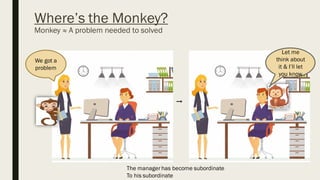
Where’s the Monkey?
Monkey ≈ A problem needed to solved
We got a
problem
→
Let me
think about
it & I’ll let
you know
The manager has become subordinate
To his subordinate
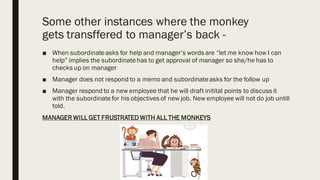
Some other instances where the monkey
gets transffered to manager’s back -
■ When subordinateasks for help and manager’s words are “let me know how I can
help” implies the subordinatehas to get approval of manager so she/he has to
checks up on manager
■ Manager does not respond to a memo and subordinateasks for the follow up
■ Manager respond to a new employee that he will draft initital points to discuss it
with the subordinatefor his objectives of new job. New employee will not do job untill
told.
MANAGER WILL GET FRUSTRATED WITH ALL THE MONKEYS
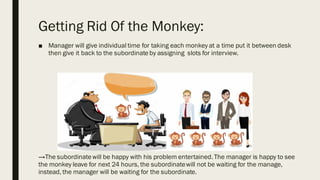
Getting Rid Of the Monkey:
■ Manager will give individual time for taking each monkey at a time put it between desk
then give it back to the subordinateby assigning slots for interview.
→The subordinatewill be happy with his problem entertained. The manager is happy to see
the monkey leave for next 24 hours, the subordinatewill not be waiting for the manage,
instead, the manager will be waiting for the subordinate.
“At no time while I am helping you with this or any other problem will your problembecome
my problem. The instant your problembecomes mine, you no longer have a problem. I
cannot help a person who hasn’t got a problem”
■ The monkey will leave on subordinate’sback.
■ Subordinatescan discusstheir problem at given time by manager.
■ Manager will not make any move alone. They will discussit together only.
The manager will not have to shut his/herdoors, His monkeys are gone. They will return
but by appointment.
GROUND RULES :
5 Degree of Initiative that the manager can exercise in
relation to the boss and to the system:
1. WAIT until told (lowestinitiative);
2. ASK what to do;
3. RECOMMEND, then take resulting action;
4. ACT, but advise at once;
5. ACT ON YOUR OWN, then routinely report (highestinitiative).
■ Outlaw 1st & 2nd points so subordinates can learn and master ‘staff work’.
■ There’s an agreed level of understandingbetween subordinatesand him/her as the
problem leaves his/her office, in addition to an agreed-upon time and place for the
next manager-subordinateconference. The latter should be duly noted on the
manager’s calendar.
CARE & FEEDING OF MONKEYS:
■ Rule 1. Monkeys should be fed or shot. Otherwise, they will starve to death,
and the manager will waste valuable time on postmortems or attempted
resurrections.
■ Rule 2. The monkey population should be kept below the maximum number
the manager has time to feed. Subordinates will find time to work as many
monkeys as he or she finds time to feed, but no more. It shouldn’t take more
than five to 15 minutes to feed a properly maintained monkey.
■ Rule 3. Monkeys should be fed by appointment only. The manager should
not have to hunt down starving monkeys and feed them on a catch-as-catch-
can basis.
■ Rule 4. Monkeys should be fed face-to-face or by telephone, but never by
mail. (Remember – with mail, the next move will be the manager’s.)
Documentation may add to the feeding process, but it cannot take the place
of feeding.
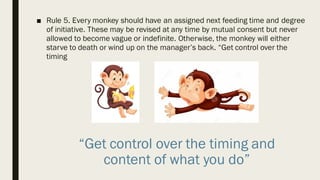
“Get control over the timing and
content of what you do”
■ Rule 5. Every monkey should have an assigned next feeding time and degree
of initiative. These may be revised at any time by mutual consent but never
allowed to become vague or indefinite. Otherwise, the monkey will either
starve to death or wind up on the manager’s back. “Get control over the
timing
■ FIRSTorder of business is for the manager to enlarge his or her discretionarytime by
eliminating subordinatetime.
■ SECONDis for the manager to use a portion of this newfound discretionarytime to see to it
that each subordinateactually has the initiative and applies it.
■ THIRDis for the manager to use another portion of the increased discretionarytime to get
and keep control of the timing and contentof both boss-imposed and system-imposed
time.
All these steps will increase the manager’sleverageand enable the value of
eachhour spent in managing management time to multiply without theoretical
limit.
Made by:
Ibteshan Anam

TEAM1Management Time.pdf

  • 1.
    MANAGEMENT TIME: WHO’S GOTTHE MONKEY? TEAM1 : IBTESHAN ANAM, DHEERAJ, ABBAS ALI By William Oncken, Jr., and Donald L. Wass
  • 2.
    We will knowwhy : 1. MANAGERS are runningout of TIME ? 2. SUBORDINATES are running out of WORK? Three kinds of time management ■ Boss imposed time (work given by boss) – MUST DO - Direct Penalty ■ System imposed time (work from peers) – MUST DO - Lesser Penalty ■ Self imposed time (work you agrees to do) – CHOICE Based - No penaly Self imposed time CAN CONVERTto → SUBORDINATE IMPOSED TIME Rest time for manager‘s own self → DISCRETIONARY TIME Maximize- Discretionary Time Minimize: Subordinate Imposed Time –
  • 3.
    Where’s the Monkey? Monkey≈ A problem needed to solved We got a problem → Let me think about it & I’ll let you know The manager has become subordinate To his subordinate
  • 4.
    Some other instanceswhere the monkey gets transffered to manager’s back - ■ When subordinateasks for help and manager’s words are “let me know how I can help” implies the subordinatehas to get approval of manager so she/he has to checks up on manager ■ Manager does not respond to a memo and subordinateasks for the follow up ■ Manager respond to a new employee that he will draft initital points to discuss it with the subordinatefor his objectives of new job. New employee will not do job untill told. MANAGER WILL GET FRUSTRATED WITH ALL THE MONKEYS
  • 5.
    Getting Rid Ofthe Monkey: ■ Manager will give individual time for taking each monkey at a time put it between desk then give it back to the subordinateby assigning slots for interview. →The subordinatewill be happy with his problem entertained. The manager is happy to see the monkey leave for next 24 hours, the subordinatewill not be waiting for the manage, instead, the manager will be waiting for the subordinate.
  • 6.
    “At no timewhile I am helping you with this or any other problem will your problembecome my problem. The instant your problembecomes mine, you no longer have a problem. I cannot help a person who hasn’t got a problem” ■ The monkey will leave on subordinate’sback. ■ Subordinatescan discusstheir problem at given time by manager. ■ Manager will not make any move alone. They will discussit together only. The manager will not have to shut his/herdoors, His monkeys are gone. They will return but by appointment. GROUND RULES :
  • 7.
    5 Degree ofInitiative that the manager can exercise in relation to the boss and to the system: 1. WAIT until told (lowestinitiative); 2. ASK what to do; 3. RECOMMEND, then take resulting action; 4. ACT, but advise at once; 5. ACT ON YOUR OWN, then routinely report (highestinitiative). ■ Outlaw 1st & 2nd points so subordinates can learn and master ‘staff work’. ■ There’s an agreed level of understandingbetween subordinatesand him/her as the problem leaves his/her office, in addition to an agreed-upon time and place for the next manager-subordinateconference. The latter should be duly noted on the manager’s calendar.
  • 8.
    CARE & FEEDINGOF MONKEYS: ■ Rule 1. Monkeys should be fed or shot. Otherwise, they will starve to death, and the manager will waste valuable time on postmortems or attempted resurrections. ■ Rule 2. The monkey population should be kept below the maximum number the manager has time to feed. Subordinates will find time to work as many monkeys as he or she finds time to feed, but no more. It shouldn’t take more than five to 15 minutes to feed a properly maintained monkey. ■ Rule 3. Monkeys should be fed by appointment only. The manager should not have to hunt down starving monkeys and feed them on a catch-as-catch- can basis. ■ Rule 4. Monkeys should be fed face-to-face or by telephone, but never by mail. (Remember – with mail, the next move will be the manager’s.) Documentation may add to the feeding process, but it cannot take the place of feeding.
  • 9.
    “Get control overthe timing and content of what you do” ■ Rule 5. Every monkey should have an assigned next feeding time and degree of initiative. These may be revised at any time by mutual consent but never allowed to become vague or indefinite. Otherwise, the monkey will either starve to death or wind up on the manager’s back. “Get control over the timing
  • 10.
    ■ FIRSTorder ofbusiness is for the manager to enlarge his or her discretionarytime by eliminating subordinatetime. ■ SECONDis for the manager to use a portion of this newfound discretionarytime to see to it that each subordinateactually has the initiative and applies it. ■ THIRDis for the manager to use another portion of the increased discretionarytime to get and keep control of the timing and contentof both boss-imposed and system-imposed time. All these steps will increase the manager’sleverageand enable the value of eachhour spent in managing management time to multiply without theoretical limit. Made by: Ibteshan Anam