Version 1.0 | Sept 21, 2020 | Author: Jamil Thobani
Team
Performance
Maturity Model
D I S C U S S I O N
G U I D E
Page 2
An assessment tool to provide a view of
where a team measures against the
standard
WHAT IS A TEAM
PERFORMANCE
MATURITY
MODEL
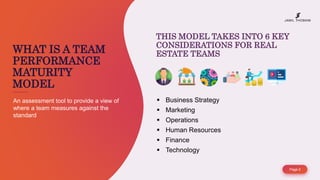
THIS MODEL TAKES INTO 6 KEY
CONSIDERATIONS FOR REAL
ESTATE TEAMS
 Business Strategy
 Marketing
 Operations
 Human Resources
 Finance
 Technology
TEAM PERFORMANCE MATURITY MODEL
Page 3
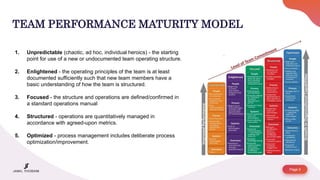
1. Unpredictable (chaotic, ad hoc, individual heroics) - the starting
point for use of a new or undocumented team operating structure.
2. Enlightened - the operating principles of the team is at least
documented sufficiently such that new team members have a
basic understanding of how the team is structured.
3. Focused - the structure and operations are defined/confirmed in
a standard operations manual
4. Structured - operations are quantitatively managed in
accordance with agreed-upon metrics.
5. Optimized - process management includes deliberate process
optimization/improvement.
Team Performance Maturity Model
Page 4
A. The Team Lead’s Vision for
Desired Growth has been clearly
defined with:
BUSINESS
STRATEGY
A 20 Year
Plan
A 10 Year
Plan
A 5 Year
Plan
A 1 Year
Plan
BUSINESS STRATEGY
Page 5
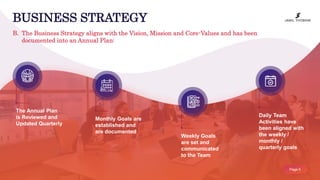
B. The Business Strategy aligns with the Vision, Mission and Core-Values and has been
documented into an Annual Plan:
The Annual Plan
is Reviewed and
Updated Quarterly
Monthly Goals are
established and
are documented
Weekly Goals
are set and
communicated
to the Team
Daily Team
Activities have
been aligned with
the weekly /
monthly /
quarterly goals
Page 6
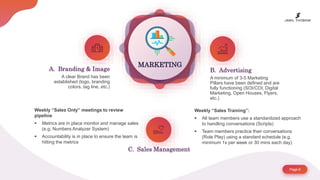
A. Branding & Image
A clear Brand has been
established (logo, branding
colors, tag line, etc.)
B. Advertising
A minimum of 3-5 Marketing
Pillars have been defined and are
fully functioning (SOI/COI, Digital
Marketing, Open Houses, Flyers,
etc.)
MARKETING
C. Sales Management
Weekly “Sales Only” meetings to review
pipeline
 Metrics are in place monitor and manage sales
(e.g. Numbers Analyzer System)
 Accountability is in place to ensure the team is
hitting the metrics
Weekly “Sales Training”:
 All team members use a standardized approach
to handling conversations (Scripts)
 Team members practice their conversations
(Role Play) using a standard schedule (e.g.
minimum 1x per week or 30 mins each day)
Page 7
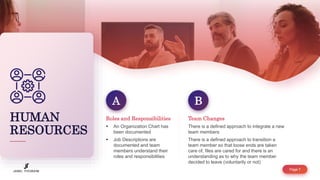
HUMAN
RESOURCES
Roles and Responsibilities
 An Organization Chart has
been documented
 Job Descriptions are
documented and team
members understand their
roles and responsibilities
A
Team Changes
There is a defined approach to integrate a new
team members
There is a defined approach to transition a
team member so that loose ends are taken
care of, files are cared for and there is an
understanding as to why the team member
decided to leave (voluntarily or not)
B
Page 8
HUMAN
RESOURCES
 Annual Targets (GCI) have been set for the
entire team and each team member as
applicable
 Daily Accountability Checklists have been
documented and are always followed
C
 Team members meet with Team Lead on
a quarterly basis to review team and
personal goals
 Capability Analysis (Training) – The
Team Lead has an understanding of
what capabilities are needed within the
organization, what gaps exist and a plan
is in place to close relevant gaps
Performance Management
Page 9
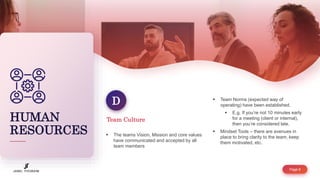
HUMAN
RESOURCES  The teams Vision, Mission and core values
have communicated and accepted by all
team members
D  Team Norms (expected way of
operating) have been established.
 E.g. If you’re not 10 minutes early
for a meeting (client or internal),
then you’re considered late.
 Mindset Tools – there are avenues in
place to bring clarity to the team, keep
them motivated, etc.
Team Culture
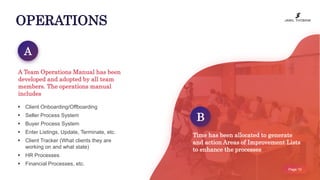
OPERATIONS
Page 10
A
 Client Onboarding/Offboarding
 Seller Process System
 Buyer Process System
 Enter Listings, Update, Terminate, etc.
 Client Tracker (What clients they are
working on and what state)
 HR Processes
 Financial Processes, etc.
A Team Operations Manual has been
developed and adopted by all team
members. The operations manual
includes
B
Time has been allocated to generate
and action Areas of Improvement Lists
to enhance the processes
Page 11
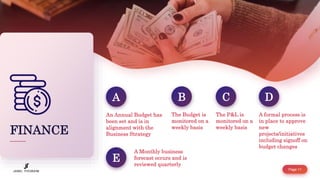
FINANCE
An Annual Budget has
been set and is in
alignment with the
Business Strategy
A
The Budget is
monitored on a
weekly basis
B
The P&L is
monitored on a
weekly basis
C
A formal process is
in place to approve
new
projects/initiatives
including signoff on
budget changes
D
E
A Monthly business
forecast occurs and is
reviewed quarterly
Page 12
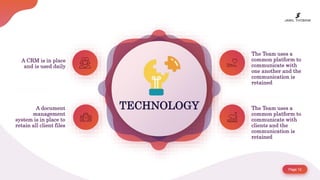
A CRM is in place
and is used daily
A document
management
system is in place to
retain all client files
The Team uses a
common platform to
communicate with
one another and the
communication is
retained
The Team uses a
common platform to
communicate with
clients and the
communication is
retained
TECHNOLOGY
Page 13
NEXT STEPS
Complete the
assessment.
The more honest you
are, the more you’ll gain
clarity.
Review the results
of your current
team maturity
Conduct a Gap Analysis (where you are vs. want to be)
 What initial actions need to be taken to get you where you
want to be
 Create an action plan to get there
Version 1.0 | Sept 21, 2020 | Author: Jamil Thobani
Team
Performance
Maturity Model
D I S C U S S I O N
G U I D E

Team Performance Maturity Model

  • 1.
    Version 1.0 |Sept 21, 2020 | Author: Jamil Thobani Team Performance Maturity Model D I S C U S S I O N G U I D E
  • 2.
    Page 2 An assessmenttool to provide a view of where a team measures against the standard WHAT IS A TEAM PERFORMANCE MATURITY MODEL THIS MODEL TAKES INTO 6 KEY CONSIDERATIONS FOR REAL ESTATE TEAMS  Business Strategy  Marketing  Operations  Human Resources  Finance  Technology
  • 3.
    TEAM PERFORMANCE MATURITYMODEL Page 3 1. Unpredictable (chaotic, ad hoc, individual heroics) - the starting point for use of a new or undocumented team operating structure. 2. Enlightened - the operating principles of the team is at least documented sufficiently such that new team members have a basic understanding of how the team is structured. 3. Focused - the structure and operations are defined/confirmed in a standard operations manual 4. Structured - operations are quantitatively managed in accordance with agreed-upon metrics. 5. Optimized - process management includes deliberate process optimization/improvement.
  • 4.
    Team Performance MaturityModel Page 4 A. The Team Lead’s Vision for Desired Growth has been clearly defined with: BUSINESS STRATEGY A 20 Year Plan A 10 Year Plan A 5 Year Plan A 1 Year Plan
  • 5.
    BUSINESS STRATEGY Page 5 B.The Business Strategy aligns with the Vision, Mission and Core-Values and has been documented into an Annual Plan: The Annual Plan is Reviewed and Updated Quarterly Monthly Goals are established and are documented Weekly Goals are set and communicated to the Team Daily Team Activities have been aligned with the weekly / monthly / quarterly goals
  • 6.
    Page 6 A. Branding& Image A clear Brand has been established (logo, branding colors, tag line, etc.) B. Advertising A minimum of 3-5 Marketing Pillars have been defined and are fully functioning (SOI/COI, Digital Marketing, Open Houses, Flyers, etc.) MARKETING C. Sales Management Weekly “Sales Only” meetings to review pipeline  Metrics are in place monitor and manage sales (e.g. Numbers Analyzer System)  Accountability is in place to ensure the team is hitting the metrics Weekly “Sales Training”:  All team members use a standardized approach to handling conversations (Scripts)  Team members practice their conversations (Role Play) using a standard schedule (e.g. minimum 1x per week or 30 mins each day)
  • 7.
    Page 7 HUMAN RESOURCES Roles andResponsibilities  An Organization Chart has been documented  Job Descriptions are documented and team members understand their roles and responsibilities A Team Changes There is a defined approach to integrate a new team members There is a defined approach to transition a team member so that loose ends are taken care of, files are cared for and there is an understanding as to why the team member decided to leave (voluntarily or not) B
  • 8.
    Page 8 HUMAN RESOURCES  AnnualTargets (GCI) have been set for the entire team and each team member as applicable  Daily Accountability Checklists have been documented and are always followed C  Team members meet with Team Lead on a quarterly basis to review team and personal goals  Capability Analysis (Training) – The Team Lead has an understanding of what capabilities are needed within the organization, what gaps exist and a plan is in place to close relevant gaps Performance Management
  • 9.
    Page 9 HUMAN RESOURCES The teams Vision, Mission and core values have communicated and accepted by all team members D  Team Norms (expected way of operating) have been established.  E.g. If you’re not 10 minutes early for a meeting (client or internal), then you’re considered late.  Mindset Tools – there are avenues in place to bring clarity to the team, keep them motivated, etc. Team Culture
  • 10.
    OPERATIONS Page 10 A  ClientOnboarding/Offboarding  Seller Process System  Buyer Process System  Enter Listings, Update, Terminate, etc.  Client Tracker (What clients they are working on and what state)  HR Processes  Financial Processes, etc. A Team Operations Manual has been developed and adopted by all team members. The operations manual includes B Time has been allocated to generate and action Areas of Improvement Lists to enhance the processes
  • 11.
    Page 11 FINANCE An AnnualBudget has been set and is in alignment with the Business Strategy A The Budget is monitored on a weekly basis B The P&L is monitored on a weekly basis C A formal process is in place to approve new projects/initiatives including signoff on budget changes D E A Monthly business forecast occurs and is reviewed quarterly
  • 12.
    Page 12 A CRMis in place and is used daily A document management system is in place to retain all client files The Team uses a common platform to communicate with one another and the communication is retained The Team uses a common platform to communicate with clients and the communication is retained TECHNOLOGY
  • 13.
    Page 13 NEXT STEPS Completethe assessment. The more honest you are, the more you’ll gain clarity. Review the results of your current team maturity Conduct a Gap Analysis (where you are vs. want to be)  What initial actions need to be taken to get you where you want to be  Create an action plan to get there
  • 14.
    Version 1.0 |Sept 21, 2020 | Author: Jamil Thobani Team Performance Maturity Model D I S C U S S I O N G U I D E