© 2011 SAP AG. All rights reserved. 1
Confidential
Kick Off Presentation - Rules
HOW TO USE THE TEMPLATE
 This kick off presentation template is valid for the scoping workshop for DCM with
in RSLAF project
 It is of utmost importance to point out
 The Collaboration model (SAP FrontOffice / Customer  SAP BackOffice)
 SAP’s Solution Manager incl. Issue Tracking function & Collaboration scenario
 The Assessment character of our services
 Identify Risks / Issues regarding DCM/TC
 Define actions / project plan for risk mitigation and issue resolution within this
area
Scoping Workshop
Data Consistency Management
Kick Off Meeting
SAP Active Global Support
<Kick Off date>
Customer Logo
(if available)
Confidential
© 2011 SAP AG. All rights reserved. 3
Confidential
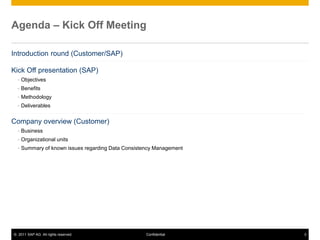
Agenda – Kick Off Meeting
A
Introduction round (Customer/SAP)
Kick Off presentation (SAP)
 Objectives
 Benefits
 Methodology
 Deliverables
Company overview (Customer)
 Business
 Organizational units
 Summary of known issues regarding Data Consistency Management
© 2011 SAP AG. All rights reserved. 4
Confidential
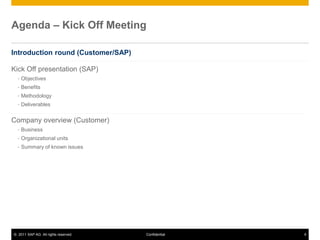
Agenda – Kick Off Meeting
A
Introduction round (Customer/SAP)
Kick Off presentation (SAP)
 Objectives
 Benefits
 Methodology
 Deliverables
Company overview (Customer)
 Business
 Organizational units
 Summary of known issues
© 2011 SAP AG. All rights reserved. 5
Confidential
SAP Team
SAP Technical Quality Manager
<Name>
SAP Team lead
<Name>
SAP experts
<Name> - <Application>
<Name> - <Application> [Back-Office]
© 2011 SAP AG. All rights reserved. 6
Confidential
Agenda – Kick Off Meeting
A
Introduction round (Customer/SAP)
Kick Off presentation (SAP)
 Objectives
 Benefits
 Methodology
 Deliverables
Company overview (Customer)
 Business
 Organizational units
 Additional information
 Summary of known issues
© 2011 SAP AG. All rights reserved. 7
Confidential
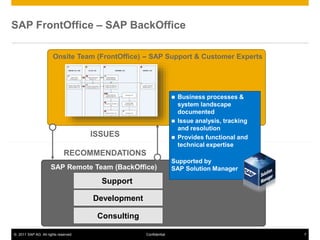
SAP FrontOffice – SAP BackOffice
Onsite Team (FrontOffice) – SAP Support & Customer Experts
SAP Remote Team (BackOffice)
ISSUES
RECOMMENDATIONS
Development
Support
Consulting
 Business processes &
system landscape
documented
 Issue analysis, tracking
and resolution
 Provides functional and
technical expertise
Supported by
SAP Solution Manager
© 2011 SAP AG. All rights reserved. 8
Confidential
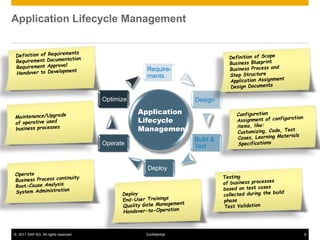
Application Lifecycle Management
SAP Solution Manager Platform
Require-
ments
Design
Deploy
Build &
Test
Optimize
Operate
Application
Lifecycle
Management
Require-
ments
Design
Deploy
Build &
Test
Optimize
Operate
© 2011 SAP AG. All rights reserved. 9
Confidential
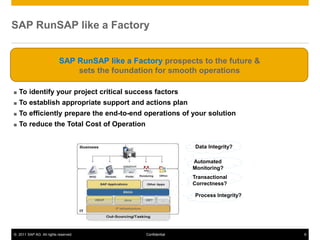
SAP RunSAP like a Factory
■ To identify your project critical success factors
■ To establish appropriate support and actions plan
■ To efficiently prepare the end-to-end operations of your solution
■ To reduce the Total Cost of Operation
Data Integrity?
Automated
Monitoring?
Transactional
Correctness?
Process Integrity?
SAP RunSAP like a Factory prospects to the future &
sets the foundation for smooth operations
© 2011 SAP AG. All rights reserved. 10
Confidential
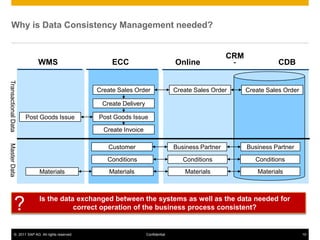
ECC Online - CDB
WMS
Customer Business Partner Business Partner
Conditions Conditions Conditions
Materials Materials Materials
Materials
CRM
Why is Data Consistency Management needed?
Master
Data
Transactional
Data
Create Sales Order Create Sales Order Create Sales Order
Create Delivery
Create Invoice
Post Goods Issue
Post Goods Issue
Is the data exchanged between the systems as well as the data needed for
correct operation of the business process consistent?
?
© 2011 SAP AG. All rights reserved. 11
Confidential
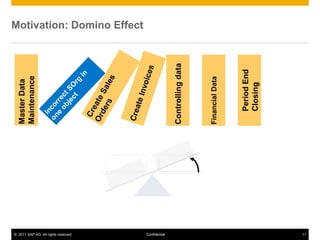
Master
Data
Maintenance
Motivation: Domino Effect
Period
End
Closing
Controlling
data
Financial
Data
© 2011 SAP AG. All rights reserved. 12
Confidential
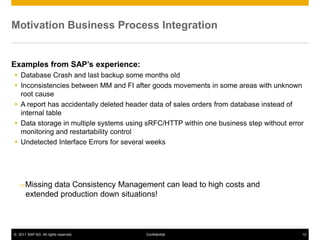
Motivation Business Process Integration
Examples from SAP’s experience:
 Database Crash and last backup some months old
 Inconsistencies between MM and FI after goods movements in some areas with unknown
root cause
 A report has accidentally deleted header data of sales orders from database instead of
internal table
 Data storage in multiple systems using sRFC/HTTP within one business step without error
monitoring and restartability control
 Undetected Interface Errors for several weeks
Missing data Consistency Management can lead to high costs and
extended production down situations!
© 2011 SAP AG. All rights reserved. 13
Confidential
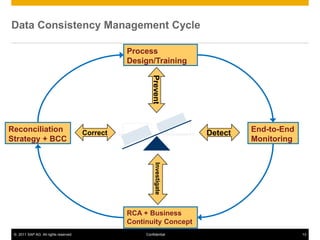
Data Consistency Management Cycle
Detect
Prevent
Investigate
Correct
Reconciliation
Strategy + BCC
End-to-End
Monitoring
RCA + Business
Continuity Concept
Process
Design/Training
© 2011 SAP AG. All rights reserved. 14
Confidential
Benefits of Data Consistency Management
Central overview of consistency state for the complete solution landscape
Stabilized coding leading to less errors
Quicker reaction and issue resolution times
Automated monitoring relieving resources of standard tasks
© 2011 SAP AG. All rights reserved. 15
Confidential
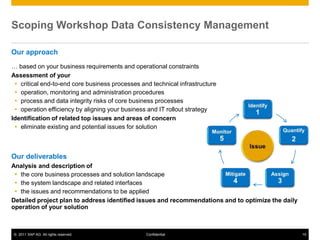
Scoping Workshop Data Consistency Management
Our approach
… based on your business requirements and operational constraints
Assessment of your
 critical end-to-end core business processes and technical infrastructure
 operation, monitoring and administration procedures
 process and data integrity risks of core business processes
 operation efficiency by aligning your business and IT rollout strategy
Identification of related top issues and areas of concern
 eliminate existing and potential issues for solution
Our deliverables
Analysis and description of
 the core business processes and solution landscape
 the system landscape and related interfaces
 the issues and recommendations to be applied
Detailed project plan to address identified issues and recommendations and to optimize the daily
operation of your solution
© 2011 SAP AG. All rights reserved. 16
Confidential
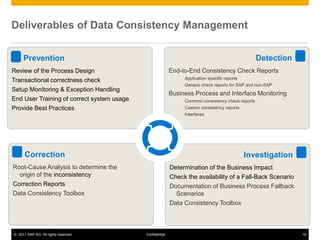
Correction
Root-Cause Analysis to determine the
origin of the inconsistency
Correction Reports
Data Consistency Toolbox
Prevention
Review of the Process Design
Transactional correctness check
Setup Monitoring & Exception Handling
End User Training of correct system usage
Provide Best Practices
Deliverables of Data Consistency Management
Investigation
Determination of the Business Impact
Check the availability of a Fall-Back Scenario
Documentation of Business Process Fallback
Scenarios
Data Consistency Toolbox
Detection
End-to-End Consistency Check Reports
Application specific reports
Generic check reports for SAP and non-SAP
Business Process and Interface Monitoring
Common consistency check reports
Custom consistency reports
Interfaces
© 2011 SAP AG. All rights reserved. 17
Confidential
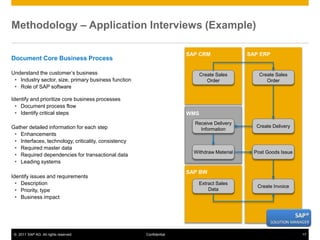
Methodology – Application Interviews (Example)
Document Core Business Process
Understand the customer’s business
 Industry sector, size, primary business function
 Role of SAP software
Identify and prioritize core business processes
 Document process flow
 Identify critical steps
Gather detailed information for each step
 Enhancements
 Interfaces, technology, criticality, consistency
 Required master data
 Required dependencies for transactional data
 Leading systems
Identify issues and requirements
 Description
 Priority, type
 Business impact
SAP CRM
Create Sales
Order
SAP ERP
Create Sales
Order
WMS
Receive Delivery
Information
Extract Sales
Data
Withdraw Material
Create Delivery
Post Goods Issue
Create Invoice
SAP BW
© 2011 SAP AG. All rights reserved. 18
Confidential
RSlaF Deliverables
© 2011 SAP AG. All rights reserved. 19
Confidential
Agenda – Kick Off Meeting
A
Introduction round (Customer/SAP)
Kick Off presentation (SAP)
 Objectives
 Benefits
 Methodology
 Deliverables
Company overview (Customer)
 Business
 Organizational units
 Summary of known issues
Thank You!
< Team Lead Name >
< Contact Data >
SAP Active Global Support

Scoping workshop kickoff template

  • 1.
    © 2011 SAPAG. All rights reserved. 1 Confidential Kick Off Presentation - Rules HOW TO USE THE TEMPLATE  This kick off presentation template is valid for the scoping workshop for DCM with in RSLAF project  It is of utmost importance to point out  The Collaboration model (SAP FrontOffice / Customer  SAP BackOffice)  SAP’s Solution Manager incl. Issue Tracking function & Collaboration scenario  The Assessment character of our services  Identify Risks / Issues regarding DCM/TC  Define actions / project plan for risk mitigation and issue resolution within this area
  • 2.
    Scoping Workshop Data ConsistencyManagement Kick Off Meeting SAP Active Global Support <Kick Off date> Customer Logo (if available) Confidential
  • 3.
    © 2011 SAPAG. All rights reserved. 3 Confidential Agenda – Kick Off Meeting A Introduction round (Customer/SAP) Kick Off presentation (SAP)  Objectives  Benefits  Methodology  Deliverables Company overview (Customer)  Business  Organizational units  Summary of known issues regarding Data Consistency Management
  • 4.
    © 2011 SAPAG. All rights reserved. 4 Confidential Agenda – Kick Off Meeting A Introduction round (Customer/SAP) Kick Off presentation (SAP)  Objectives  Benefits  Methodology  Deliverables Company overview (Customer)  Business  Organizational units  Summary of known issues
  • 5.
    © 2011 SAPAG. All rights reserved. 5 Confidential SAP Team SAP Technical Quality Manager <Name> SAP Team lead <Name> SAP experts <Name> - <Application> <Name> - <Application> [Back-Office]
  • 6.
    © 2011 SAPAG. All rights reserved. 6 Confidential Agenda – Kick Off Meeting A Introduction round (Customer/SAP) Kick Off presentation (SAP)  Objectives  Benefits  Methodology  Deliverables Company overview (Customer)  Business  Organizational units  Additional information  Summary of known issues
  • 7.
    © 2011 SAPAG. All rights reserved. 7 Confidential SAP FrontOffice – SAP BackOffice Onsite Team (FrontOffice) – SAP Support & Customer Experts SAP Remote Team (BackOffice) ISSUES RECOMMENDATIONS Development Support Consulting  Business processes & system landscape documented  Issue analysis, tracking and resolution  Provides functional and technical expertise Supported by SAP Solution Manager
  • 8.
    © 2011 SAPAG. All rights reserved. 8 Confidential Application Lifecycle Management SAP Solution Manager Platform Require- ments Design Deploy Build & Test Optimize Operate Application Lifecycle Management Require- ments Design Deploy Build & Test Optimize Operate
  • 9.
    © 2011 SAPAG. All rights reserved. 9 Confidential SAP RunSAP like a Factory ■ To identify your project critical success factors ■ To establish appropriate support and actions plan ■ To efficiently prepare the end-to-end operations of your solution ■ To reduce the Total Cost of Operation Data Integrity? Automated Monitoring? Transactional Correctness? Process Integrity? SAP RunSAP like a Factory prospects to the future & sets the foundation for smooth operations
  • 10.
    © 2011 SAPAG. All rights reserved. 10 Confidential ECC Online - CDB WMS Customer Business Partner Business Partner Conditions Conditions Conditions Materials Materials Materials Materials CRM Why is Data Consistency Management needed? Master Data Transactional Data Create Sales Order Create Sales Order Create Sales Order Create Delivery Create Invoice Post Goods Issue Post Goods Issue Is the data exchanged between the systems as well as the data needed for correct operation of the business process consistent? ?
  • 11.
    © 2011 SAPAG. All rights reserved. 11 Confidential Master Data Maintenance Motivation: Domino Effect Period End Closing Controlling data Financial Data
  • 12.
    © 2011 SAPAG. All rights reserved. 12 Confidential Motivation Business Process Integration Examples from SAP’s experience:  Database Crash and last backup some months old  Inconsistencies between MM and FI after goods movements in some areas with unknown root cause  A report has accidentally deleted header data of sales orders from database instead of internal table  Data storage in multiple systems using sRFC/HTTP within one business step without error monitoring and restartability control  Undetected Interface Errors for several weeks Missing data Consistency Management can lead to high costs and extended production down situations!
  • 13.
    © 2011 SAPAG. All rights reserved. 13 Confidential Data Consistency Management Cycle Detect Prevent Investigate Correct Reconciliation Strategy + BCC End-to-End Monitoring RCA + Business Continuity Concept Process Design/Training
  • 14.
    © 2011 SAPAG. All rights reserved. 14 Confidential Benefits of Data Consistency Management Central overview of consistency state for the complete solution landscape Stabilized coding leading to less errors Quicker reaction and issue resolution times Automated monitoring relieving resources of standard tasks
  • 15.
    © 2011 SAPAG. All rights reserved. 15 Confidential Scoping Workshop Data Consistency Management Our approach … based on your business requirements and operational constraints Assessment of your  critical end-to-end core business processes and technical infrastructure  operation, monitoring and administration procedures  process and data integrity risks of core business processes  operation efficiency by aligning your business and IT rollout strategy Identification of related top issues and areas of concern  eliminate existing and potential issues for solution Our deliverables Analysis and description of  the core business processes and solution landscape  the system landscape and related interfaces  the issues and recommendations to be applied Detailed project plan to address identified issues and recommendations and to optimize the daily operation of your solution
  • 16.
    © 2011 SAPAG. All rights reserved. 16 Confidential Correction Root-Cause Analysis to determine the origin of the inconsistency Correction Reports Data Consistency Toolbox Prevention Review of the Process Design Transactional correctness check Setup Monitoring & Exception Handling End User Training of correct system usage Provide Best Practices Deliverables of Data Consistency Management Investigation Determination of the Business Impact Check the availability of a Fall-Back Scenario Documentation of Business Process Fallback Scenarios Data Consistency Toolbox Detection End-to-End Consistency Check Reports Application specific reports Generic check reports for SAP and non-SAP Business Process and Interface Monitoring Common consistency check reports Custom consistency reports Interfaces
  • 17.
    © 2011 SAPAG. All rights reserved. 17 Confidential Methodology – Application Interviews (Example) Document Core Business Process Understand the customer’s business  Industry sector, size, primary business function  Role of SAP software Identify and prioritize core business processes  Document process flow  Identify critical steps Gather detailed information for each step  Enhancements  Interfaces, technology, criticality, consistency  Required master data  Required dependencies for transactional data  Leading systems Identify issues and requirements  Description  Priority, type  Business impact SAP CRM Create Sales Order SAP ERP Create Sales Order WMS Receive Delivery Information Extract Sales Data Withdraw Material Create Delivery Post Goods Issue Create Invoice SAP BW
  • 18.
    © 2011 SAPAG. All rights reserved. 18 Confidential RSlaF Deliverables
  • 19.
    © 2011 SAPAG. All rights reserved. 19 Confidential Agenda – Kick Off Meeting A Introduction round (Customer/SAP) Kick Off presentation (SAP)  Objectives  Benefits  Methodology  Deliverables Company overview (Customer)  Business  Organizational units  Summary of known issues
  • 20.
    Thank You! < TeamLead Name > < Contact Data > SAP Active Global Support

Editor's Notes

  • #9 SAP implemented the full scope of ITIL Application Management standard and also incorporated SAP Suite capabilities like upgrades or enhancement package extensions In the Requirement phase you collect and evaluate all functional and non-functional requirements before an improvement or innovation project begins. In the SAP Solution Manager system the process hierarchy as well as Document Management and documentation workflow is of interest. A Requirement Management process based on workflow capabilities can be managed by Change Request Management. In the Design phase, the findings from the requirements phase are used to specify precisely how the future processes are to function and which IT applications should be used to map the processes. Project standards are defined. The scope is defined. Predefined Roadmaps can be used. The future business process structure is defined and mapped to the future solution landscape including the assignment of relevant executable transactions. Document management is used to centrally store all relevant information. Interfaces are documented. During the Build phase the Blueprint is filled with life: The system landscape is set up and the scenarios with its processes get implemented. Customizing, source code, the respective documentation, test cases as well as learning materials are supposed to be created during this development phase and centrally stored in the Solution Manager system. SAP Solution Manager assists you in configuring your systems around your processes. You can navigate directly to the SAP Implementation Guide (IMG) in the different development systems being managed and set up the systems centrally from SAP Solution Manager. Unit tests might also be executed before any integration, performance, regression or acceptance test will take place in the test phase. The Test phase manages the testing of the planned scenarios and processes. SAP Solution Manager supports you in organizing and documenting the results of a range of testing activities, including integration, performance, regression and acceptance tests. Test validation is the prerequisite for starting a deployment phase In the Deploy phase …. -> SEE NOTES OF THE NEXT (HIDDEN) SLIDE
  • #10 SAP Safeguarding extends for the length of the customer’s full implementation cycle – It sets the foundation for smooth operations of the SAP solution. To identify your project critical success factors Business requirements Critical functions Integration Technical & Operational requirements To Safeguard your solution Understand your Core Business Processes and Solution Landscape Check the technical and integration feasibility of the planned solution Identify and prioritize top issues and potential area of concerns Reduce risk factors for your solution Provide best practices To Establish appropriate support / actions plan Establish direct channel between your project team and SAP Back office Intensify our collaboration To reduce the Total Cost of Operation The right SAP expert at right time A tailored service plan The Deliverables Service Report Top Issues / Issues Recommendations Activities to safeguard the future operations and mitigate risks must be included in the implementation project work packages – Defined topics must be considered and addressed already in the early phase of the project…
  • #12 Small inconsistencies may have a serious overall impact. For example a typing error while maintaining some assignment between a company code and a sales organization affects at first only a small customizing table, this incorrect information is handed down to thousands of sales orders and billing documents including dependent data like controlling and financing affecting the complete period end closing in the end. Thus it is very important to consider potential side effects depending on the business processes using the corrupted data when assessing the severity of the issue.
  • #14 Handling of inconsistencies can be divided into 4 phases: Prevention of inconsistencies should be taken into account during the process design and training phase already. Transactional correctness needs to be ensured already during the program design phase, there should be sufficient end user training before Go-Live to enable your end-user to handle even unforeseen exceptions according to defined procedures. Preventing data inconsistencies should also be kept in mind in the business process design phase as well as during the design of customizing and system data change processes. Sufficient interface monitoring and corresponding error handling procedures are a prerequisite for data consistency. By implementing and performing an inconsistency monitoring procedure inconsistencies can be detected at an early stage, so that further harm is prevented. There should be a business continuity concept so that when an inconsistency is detected it can be decided quickly if and to what extent you can continue to work with the system during correction and investigation phase and how to revert back as fast as possible to a normal business operation. Correcting data inconsistencies should include a root cause analysis, so that the root cause is eliminated whenever possible before the data inconsistency is corrected by an appropriate method, as well as defined correction procedures for each important, business critical object.