Organization
Development
Growing Your Future Today
Outline
A. OD and Scope
B. Business Sustainability
C. Strategy Management
D. Business Process Reengineering
E. Performance Management
F. Organization Culture
G. Organization Structure
Outline
I. Innovation and Continuous Improvement Culture
J. Problem Solving and DM
K. Effective Meeting and Facilitation
L. Leadership Development
M. Talent Management and Succession Planning
N. Merger and Acquisition for Cultural Integration
A. DEFINITION AND SCOPE
Definitition
• Organization development (OD) is the study of
successful organizational change and
performance.
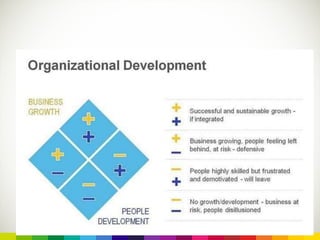
Balanced Growth
Growth
Profit
Productivity
Engagement
Capability
People
Business
Organization development (OD) is the study of successful organizational change
and performance. The growth of the business involved people and business
Dilemma 1: Growing Pains
Dilemma 2
Changes is Focused on Skills and Staff
o
Dilemma 3
Company is Expanding With Roadblock
B. BUSINESS GROWTH
SUSTAIN &
GROWTH
MODEL
SUSTAIN &
GROWTH
MODEL
Strategy
Execution
Culture
Structure
Leadership
Talent
Innovation
M& A
4 Primary Success Factors
 Strategy
 Execution
 Culture
 Structure
Make Your Strategy Clear and
Narrowly Focused
Execute Flawlessly
Build a Performance Based Culture
Make Your Organization Fast and Flat
Self Assessment 1-10
Rank 1 to 4
4 Secondary Success Factors
 Talent
 Leadership
Innovation
M&A
Make Talent Stick Around and Develop
More
Make Your Leaders Committed to Your
Business
Make Industry-Transforming Innovations
Make Growth Happen With Mergers and
Partnerships
Self Assessment 1-10
Rank 1 to 4
Results
 Strategy
 Execution
 Culture
 Structure
 Talent
 Leadership
 Innovation
 M&A
Total Return to Shareholders
943% (Winners) vs 62% (losers)
Sales
413% (Winners) vs 83% (losers)
Operating Income
326% (Winners) vs 22% (losers)
Return on Invested Capital (%)
+5.45% (Winners) vs -8.52% (losers)
Engagement
Talent
Productivity
Profit
C. DIAGNOSTICS AND SOLUTIONS
Diagnostic
SUSTAIN &
GROWTH
MODEL
Strategy
Execution
Culture
Structure
Leadership
Talent
Innovation
M& A
Selection of Criteria
WORK IN PROGRESS
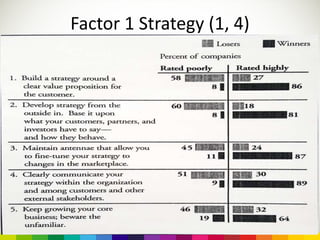
Factor 1 Strategy (1, 4)
Factor 2 Execution (1, 2, 3)
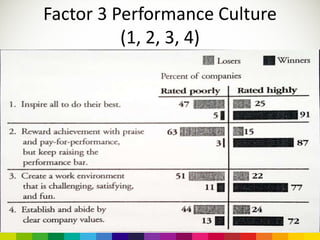
Factor 3 Performance Culture
(1, 2, 3, 4)
Talent 4 Organization (1,2)
Factor 5 Talent (1,2,3,4)
Factor 6 Leadership (1,2,4)
Factor 7 Innovation (1,2)
Factor 8: Merger & Acquisition (2,4)
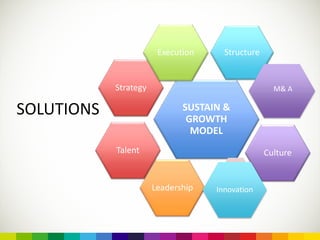
D. SOLUTIONS
SOLUTIONS SUSTAIN &
GROWTH
MODEL
Strategy
Execution
Culture
Structure
Leadership
Talent
Innovation
M& A
Six Needs of OrganizationSustainable Growth Model
Profit and
Productivity
Strategy
Execution
Structure
Merger and Acquisition
People and Culture Performance Culture
Talent
Leadership
Continuous Improvement and
Innovation
PROFIT AND PRODUCTIVITY
Special Feature
Target Growth 1
Strategy
Target Growth 1 Strategy
Objectives
Build a strategies based on customer needs
Communicate and review strategies regularly
Action 1 Strategy Review, Planning and
Communicating for Corporate
Action 2 Department Strategy Management
Action 3 Town Hall Communication and Strategic
Rewards
TARGET GROWTH 2
PRODUCTIVITY
TARGET GROWTH 2
EXECUTION FOR PRODUCTIVITY
Target Growth 2 Execution
Objectives
Deliver Products and Services meeting
customers’ expectations
Improve productivity and eliminate wastes
Action 1 Productivity thru Lean Process
Action 2 Speed thru Supply Chain
Action 3 Job Improvement and Job Training
Action 4 Event and Process Collaboration
Target Growth 3
Structure
Target Growth 3
Performance Culture
Objectives
Reward Achievement
Create a motivated and fun environment
Develop company Values
Module 1 Performance Management
Module 2 Coaching and Feedback Culture
Module 3 Encouragement Culture
Module 4 Sustain Company Culture
Module 5 Employee Engagement
Module 6 CSR
Target Growth 4
Structure
Target Growth 4
Fast and Flat Structure
Module 1 Corporate culture
Module 2 Employee Engagement
Module 3 Team Development
Module 4 Organization Structure Review
Target Growth 5
Talent
Target Growth 5 Talents
Objectives
Build a strategies based on customer needs
Communicate and review strategies regularly
Action 1 Strategy Review, Planning and
Communicating for Corporate
Action 2 Department Strategy Management
Action 3 Town Hall Communication and Strategic
Rewards
TARGET GROWTH 2
PRODUCTIVITY
TARGET GROWTH 6
LEADERS
Target Growth 6 Leaders
Objectives
Deliver Products and Services meeting
customers’ expectations
Improve productivity and eliminate wastes
Action 1 Productivity thru Lean Process
Action 2 Speed thru Supply Chain
Action 3 Job Improvement and Job Training
Action 4 Event and Process Collaboration
Target Growth 7
Innovation
Target Growth 7
Innovation
Objectives
Reward Achievement
Create a motivated and fun environment
Develop company Values
Module 1 Performance Management
Module 2 Coaching and Feedback Culture
Module 3 Encouragement Culture
Module 4 Sustain Company Culture
Module 5 Employee Engagement
Module 6 CSR
Target Growth 8
Merger & Acquisition
Target Growth 8
Merger & Acquisition
Module 1 Corporate culture
Module 2 Employee Engagement
Module 3 Team Development
Module 4 Organization Structure Review
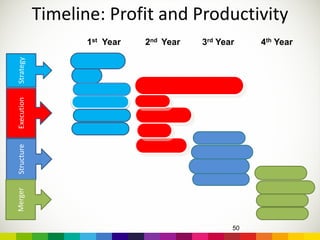
Timeline: Profit and Productivity
50
1st Year 2nd Year 3rd Year 4th Year
ExecutionStrategyStructureMerger
Timline: People and Culture
51
LeadershipTalent
Performan
ceCulture
Innovation
1st Year 2nd Year 3rd Year 4th Year
E. IMPLEMENTATION
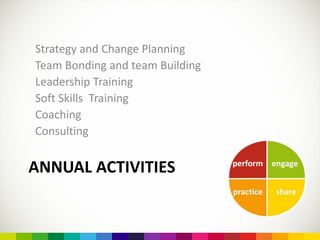
ANNUAL ACTIVITIES
Strategy and Change Planning
Team Bonding and team Building
Leadership Training
Soft Skills Training
Coaching
Consulting
METHODS
Consulting
Coaching
Training
Mentoring
Interview
Survey
Facilitation
Results and Matrix
Strategy
Company and Employee Alignment 100%
Execution
Lean drive 30% productivity
Supply Chain improve 50% speed deliver and reduce 25% cost
Improve 80% work processes
Performance Culture
Create a motivated culture by scoring 80%
Reduction of underperformer 20%
Coaching and contact time 30%
Talent Pipeline
Training Hours – 16 hours
Create Trainer pool 200%
Strengthen Talent pipeline 40% achieve ready in 1 year
Leadership Development
Leadership training hour 16%
Innovation
Increase 20% Work Process Improvement and Innovation annually
IMPACTS
29% 62% 19%
Employee Engagement
Organizations investing in
Modern Development
• 8x greater bench strength than those not
investing in modern Learning and
Development
• 6x improved engagement
• 7x better business results
Team of Experts
Dr Yulin
Asia Pacific Turn Around
Solution
Ramesh Victor
Global Lean Enterprise
and Productivity Solution
Laurence Yap
Asia Pacific OD, People.
Leadership Solution
59
F. NEXT STEP
WIP
63
Training
Consulting
Modules
Target Growth: Profit
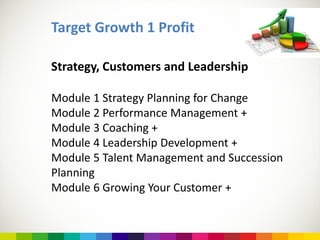
Target Growth 1 Profit
Strategy, Customers and Leadership
Module 1 Strategy Planning for Change
Module 2 Performance Management +
Module 3 Coaching +
Module 4 Leadership Development +
Module 5 Talent Management and Succession
Planning
Module 6 Growing Your Customer +
Strategy Planning for change
Consulting
67
Objectives
 Explore the desirable organization changes
 Blueprint and Challenges
Outline
 The success story
 Next level of development Profit, Productivity, Dev & Engagement
 Possible Action Plan
 Benchmark
 Internal Talent and structure
 Change Process – challenges, communication, partnership,
learning community, Change Council and Reward
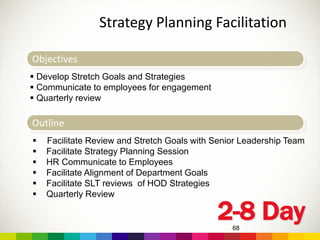
Strategy Planning Facilitation
68
Objectives
 Develop Stretch Goals and Strategies
 Communicate to employees for engagement
 Quarterly review
Outline
 Facilitate Review and Stretch Goals with Senior Leadership Team
 Facilitate Strategy Planning Session
 HR Communicate to Employees
 Facilitate Alignment of Department Goals
 Facilitate SLT reviews of HOD Strategies
 Quarterly Review
2-8 Day
69
Objectives
Understanding Talent Management Process
 Succession Planning for Business Continuity
Leadership Pipeline
Outline
Part I: Introduction to Talent Management
Part II: Performance and Potential Criteria
Part III: Talent Review, Talent Development. Talent Evaluation, Talent
Actions
Part IV: Succession Panning
Part V Leadership Pipeline
Part VI Implementation Consideration
Talent Management and Succession
Planning Consulting
Leadership Management Consulting
70
Objectives
Understanding Leadership Management Process
 Succession Planning for Business Continuity
Leadership Pipeline
Outline
Part I: Senior Leadership
Part II: Performance and Potential Criteria
Part III: Succession Planning
Part IV: Leadership Pipeline
Part V Implementation Consideration
Leadership for Junior Managers
71
Objectives
• Discover your role as a people manager
•Learn to manage yourselves as people manager
•Apply principles and practices to engage, manage and develop your
employees
Outline
Part I: Introduction
Part II: Profiling
Part III: Manage Yourself
Part IV: Manage Others
3 Day
Leadership for Middle Managers
72
Objectives
Building Personal Leadership Capabilities
Strategies to developing and Managing Team
•Sustaining Team Momentum for higher performance
Outline
Part I: Personal Leadership
Part II: Developing Team
Part III: Motivating Team
Part IV: Sustaining Team
3 Day
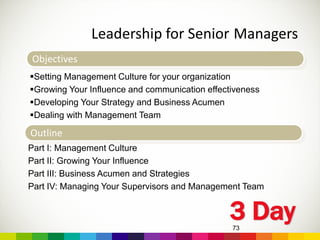
Leadership for Senior Managers
73
Objectives
Setting Management Culture for your organization
Growing Your Influence and communication effectiveness
Developing Your Strategy and Business Acumen
Dealing with Management Team
Outline
Part I: Management Culture
Part II: Growing Your Influence
Part III: Business Acumen and Strategies
Part IV: Managing Your Supervisors and Management Team
3 Day
Six Thinking Hats
74
Objectives
Setting Management Culture for your organization
Growing Your Influence and communication effectiveness
Developing Your Strategy and Business Acumen
Dealing with Management Team
Outline
Part I: Management Culture
Part II: Growing Your Influence
Part III: Business Acumen and Strategies
Part IV: Managing Your Supervisors and Management Team
2 Day
Motivate and Encourage Your Employees
75
Objectives
•Identifying methods of Employee Motivation
•Describing the theories which pertain to Employee Motivation
•Identifying personality types to motivate different employees
•Ways to motivate employees in managing their goals
•Ways to encourage your employees
Outline
2 Day
• Module One: Getting Started
•Module Two: A Psychological Approach
•Module Three: Object-Oriented Theory
•Module Four: Using Reinforcement Theory
•Module Five: Using Expectancy Theory
•Module Six: Personality’s Role in Motivation
•Module Seven: Setting Goals
•Module Eight: Motivation on the Job
•Module Nine: Encouragement Your staff
•Module Ten: Keeping Yourself Motivated
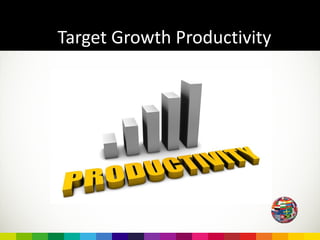
Target Growth Productivity
Target Growth 2
Productivity
Execution and Innovation
Module 1 Work Process Improvement +
Module 2 Lean +
Module 3 Core Business Skills +
Module 4 Managing Events +
Module 5 Project Management+
Work Process Improvement
78
Objectives
 Learning Process Improvement Tools
 Developing Facilitation Skills
 Acquiring Rehearsing and Following Up
Outline
1 Days
 Process Mapping
 Appreciative Work Process
 Performance Consulting
 Facilitate Discussion
 Brainstorming, Creativity and Selection
Managing events
79
Objectives
 Managing Projects and Events with minimum errors
 Engaging and Empowering Team Members
 Facilitating Event
Outline
1 Days
 Vision and Goals
 Beginning of Projects
 Job Function Empowerment
 Time Flow Mapping
 Rehearsal
 Control of Event
 Action Review
Post Mortem
Lean Productivity for Office and Operations
and Suppliers
80
Objectives
 Reduce eight wastes
 Reduce Operating Expense
 Reduce Excess Inventory
 Increase output
Outline
5 Days
Consultant led Approach – 30% productivity improvement
 Diagnosis organization in lean context
 Conduct projects with employees
 Train employees on the jobs
 Report results
6S Consulting and Training
81
Objectives
 Reduce eight wastes
 Reduce Operating Expense
 Reduce Excess Inventory
 Increase output
Outline
Consultant led Approach – 30% productivity improvement
 Diagnosis organization in lean context
 Conduct projects with employees
 Train employees on the jobs
 Report results
Shop Floor Management
82
Objectives
 Reduce eight wastes
 Reduce Operating Expense
 Reduce Excess Inventory
 Increase output
Outline
Consultant led Approach – 30% productivity improvement
 Diagnosis organization in lean context
 Conduct projects with employees
 Train employees on the jobs
 Report results
Account Management
83
Objectives
Differentiate the customer base.
Potential growth of each segment.
Key focus areas that will drive success for each segment.
Develop specific action plan and strategy to enhance business growth.
Outline
Part I: RAD Concept
Part II: Calculation of Potential Growth Vs Target
R = Existing Business
A = Potential Opportunity
D = Establishment of Score Card
Part III: Develop Strategies for Each Segment to Promote Revenue
Growth
Part IV: Establish Key Imperatives
1 Day
Improving Core Business Skills (TWI)
84
Objectives
• Delivering operational process training more effectively.
• Analysing and Improving work processes
• Manging effective employee relations in the shop floor
Outline
Day One: Training Within Industry Job Instructions
Day Two: Training Within Industry Job Instructions
Day Three: Training Within Industry Job Method Improvement
Day Four: Training Within Industry Job Method Improvement
Day Five: Training Within Industry Job Relations
5 Days
Performance Management
85
Objectives
 Managing Corporate and Department Goals
 Able to conduct performance appraisal fairly
 Managing performance of employees
Outline
Part I: Understand of the Concept of Performance Measurement
Part II: Designing the Performance Plan
Part III: Reviewing Draft Performance Plans
Part IV: Tying Performance Appraisal Rating with Merit Increment,
Bonus and / or Other Compensation Packages
Part V: Communicating to Employees on the New Performance
Measurement System
2 Day
Coaching for Performance
86
Objectives
• Understanding the coaching concept
• How to coach and mentor
•Understand their work expectations, beliefs and behaviors.
•Learn how to manage and lead employees
Outline
Part I: Working Phenomena of the 21st Century
Part II Different Generation Cohort Worker in Malaysia
Part III: The Concept of On-The-Job Coaching
Part IV: 8-Unique Steps of Coaching Model
Part V: Managing Performance
2 Day
Target Growth: Development
Target Growth 3
Employee Development
Talent
Module 1 Training and Development
Module 2 Career Development
Module 3 Critical Soft Skills Development +
Module 4 Train the trainers +
89
Objectives
. Identifying currents and long terms needs of competencies
Improving training system
Establishing investment parameter
Outline
Current Needs
Part I. Business Needs Analysis
CEO Needs, Core Business, BSG Model
Part II: Department Needs
Part III: Job Needs
TRAINING AND DEVELOPMENT
CONSULTING
90
Outline
Long Term Needs
Part I: Identify Core Business and Technical Development
Part II: Business continuity: succession, transfer skills, manuals
Part III: Identify Core Values and soft skills development
Part IV Organization Continuity: succession, culture, development
Training System
Part I: Vendor Management
Part II: Internal Training and Trainers
Part III Investment, ROI and ROE
TRAINING AND DEVELOPMENT
CONSULTING (CONT.)
91
Objectives
Differentiate the customer base.
Potential growth of each segment.
Key focus areas that will drive success for each segment.
Develop specific action plan and strategy to enhance business growth.
Outline
Part I: Job Description and Competencies
Part II: Career Development Conversation
Part III: Performance Development Conversation
Part IV: Personal Development Plan
Part V: Development Activities
Part V: Follow Up: Contact, Feedback, Coaching and Mentoring
CAREER DEVELOPMENT CONSULTING
Critical Business Skills
92
Objectives
Developing Seven Critical .Skills as Individual Contributor
Building better relationship with your managers
Applying ways to deal with people
Outline
Part I: Effective Work Habits: Motivation, Thinking and Emotions
Part II: Work Effectiveness: Time, Priorities, Information Management
Part III: Project Management
Part IV: Communication: Feedback, Meeting and Convey info
Part V Critical Thinking and Creative Thinking
Part VI People Skills
Part VII: Working with Your Managers
7 Day
Train the Trainers: Instruction Design
93
Objectives
 Analyzing Training Needs
 Designing Training Programs
 Evaluating Training Programs
 Engaging Internal Customers
Outline
• Part I Instructional Goals
• Part II Researching the Problems: Instructional Analysis
• Part III Designing a Training Program
• Part IV Choosing the appropriate intervention and Media
• Part V Structuring the content for the course
• Part VI Evaluating the content
2 Day
Train the Trainers: Training Delivery
94
Objectives
 Understand Effective Adult Learning and communication styles
 Delivery and facilitating training
 Enhancing training with various tools
 Ending the training with impacts
Outline
Part I Adult Learning Principles
Part II Communication Styles
Part III Creating the learning environment
Part IV Enhancers: Ice Breaker, Games, Music and Videos
Part IV Facilitation and Training
Part V Role Play and Feedback
Part VI Flipchart
Part VII End with Purpose
2 Day
Target Growth: Engagement
Target Growth 4
Engagement
Culture, Structure and M&A
Module 1 Corporate culture
Module 2 Employee Engagement
Module 3 Team Development
Module 4 Organization Structure Review
Module 5 Onboarding
Corporate Culture Consulting
97
Objectives
Understanding Four types Corporate Corporate
 Implementing cultural changes
Outline
Part I: Understand Background of Corporate Culture
Part II: Survey
Part III: Findings
Part IV: Discussion
Part V Implement Changes
Part VI Monitor Progress
Employee Engagement Consulting
98
Objectives
Understanding employee engagement
Implanting employee engagement strategies
Outline
Part I: Employee Engagement WIFI
Part II: Explore Seven Reasons of Disengagement
Part III: Survey
Part IV: Findings
Part V Implement Changes
Part VI Monitor Progress
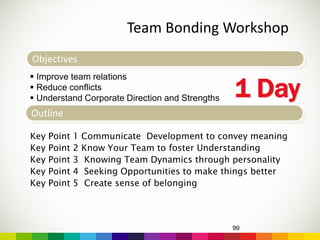
Team Bonding Workshop
99
Objectives
 Improve team relations
 Reduce conflicts
 Understand Corporate Direction and Strengths
Outline
Key Point 1 Communicate Development to convey meaning
Key Point 2 Know Your Team to foster Understanding
Key Point 3 Knowing Team Dynamics through personality
Key Point 4 Seeking Opportunities to make things better
Key Point 5 Create sense of belonging
1 Day
Team Development
100
Objectives
 Understanding Team Process
 Applying Team work principles
 Productive Communication
Outline
• Part I Definition Team
• Part II Team Development
• Part III Team Meeting
•Part IV Team Conflict
• Part V Team Profiling
• Part VI Team Communication
• Part V Team Collaboration
2 Days
Organization structure Consulting
101
Objectives
Understanding employee engagement
 Succession Planning for Business Continuity
Leadership Pipeline
Outline
Part I: Basic Structure Level
Part II: Level of Management
Part III: Span of Control
Part IV: Departmentalization
Part V: Centralization and Decentralization
Part Vi: Delegation
Part V Abnormality
Part VI Cross Function Teams
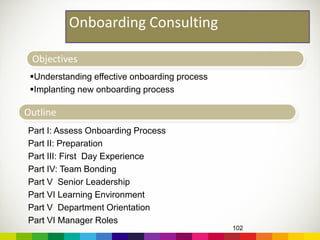
Onboarding Consulting
102
Objectives
Understanding effective onboarding process
Implanting new onboarding process
Outline
Part I: Assess Onboarding Process
Part II: Preparation
Part III: First Day Experience
Part IV: Team Bonding
Part V Senior Leadership
Part VI Learning Environment
Part V Department Orientation
Part VI Manager Roles
103

Retail transformation proposal

  • 1.
  • 2.
    Outline A. OD andScope B. Business Sustainability C. Strategy Management D. Business Process Reengineering E. Performance Management F. Organization Culture G. Organization Structure
  • 3.
    Outline I. Innovation andContinuous Improvement Culture J. Problem Solving and DM K. Effective Meeting and Facilitation L. Leadership Development M. Talent Management and Succession Planning N. Merger and Acquisition for Cultural Integration
  • 4.
  • 5.
    Definitition • Organization development(OD) is the study of successful organizational change and performance.
  • 6.
    Balanced Growth Growth Profit Productivity Engagement Capability People Business Organization development(OD) is the study of successful organizational change and performance. The growth of the business involved people and business
  • 7.
  • 9.
    Dilemma 2 Changes isFocused on Skills and Staff o
  • 10.
    Dilemma 3 Company isExpanding With Roadblock
  • 11.
  • 12.
  • 13.
    4 Primary SuccessFactors  Strategy  Execution  Culture  Structure Make Your Strategy Clear and Narrowly Focused Execute Flawlessly Build a Performance Based Culture Make Your Organization Fast and Flat Self Assessment 1-10 Rank 1 to 4
  • 14.
    4 Secondary SuccessFactors  Talent  Leadership Innovation M&A Make Talent Stick Around and Develop More Make Your Leaders Committed to Your Business Make Industry-Transforming Innovations Make Growth Happen With Mergers and Partnerships Self Assessment 1-10 Rank 1 to 4
  • 15.
    Results  Strategy  Execution Culture  Structure  Talent  Leadership  Innovation  M&A Total Return to Shareholders 943% (Winners) vs 62% (losers) Sales 413% (Winners) vs 83% (losers) Operating Income 326% (Winners) vs 22% (losers) Return on Invested Capital (%) +5.45% (Winners) vs -8.52% (losers) Engagement Talent Productivity Profit
  • 16.
  • 17.
  • 18.
  • 19.
  • 20.
  • 21.
    Factor 3 PerformanceCulture (1, 2, 3, 4)
  • 22.
  • 23.
    Factor 5 Talent(1,2,3,4)
  • 24.
  • 25.
  • 26.
    Factor 8: Merger& Acquisition (2,4)
  • 27.
  • 28.
  • 29.
    Six Needs ofOrganizationSustainable Growth Model Profit and Productivity Strategy Execution Structure Merger and Acquisition People and Culture Performance Culture Talent Leadership Continuous Improvement and Innovation
  • 30.
  • 31.
  • 32.
    Target Growth 1Strategy Objectives Build a strategies based on customer needs Communicate and review strategies regularly Action 1 Strategy Review, Planning and Communicating for Corporate Action 2 Department Strategy Management Action 3 Town Hall Communication and Strategic Rewards
  • 33.
    TARGET GROWTH 2 PRODUCTIVITY TARGETGROWTH 2 EXECUTION FOR PRODUCTIVITY
  • 34.
    Target Growth 2Execution Objectives Deliver Products and Services meeting customers’ expectations Improve productivity and eliminate wastes Action 1 Productivity thru Lean Process Action 2 Speed thru Supply Chain Action 3 Job Improvement and Job Training Action 4 Event and Process Collaboration
  • 35.
  • 36.
    Target Growth 3 PerformanceCulture Objectives Reward Achievement Create a motivated and fun environment Develop company Values Module 1 Performance Management Module 2 Coaching and Feedback Culture Module 3 Encouragement Culture Module 4 Sustain Company Culture Module 5 Employee Engagement Module 6 CSR
  • 37.
  • 38.
    Target Growth 4 Fastand Flat Structure Module 1 Corporate culture Module 2 Employee Engagement Module 3 Team Development Module 4 Organization Structure Review
  • 39.
  • 40.
    Target Growth 5Talents Objectives Build a strategies based on customer needs Communicate and review strategies regularly Action 1 Strategy Review, Planning and Communicating for Corporate Action 2 Department Strategy Management Action 3 Town Hall Communication and Strategic Rewards
  • 41.
  • 42.
    Target Growth 6Leaders Objectives Deliver Products and Services meeting customers’ expectations Improve productivity and eliminate wastes Action 1 Productivity thru Lean Process Action 2 Speed thru Supply Chain Action 3 Job Improvement and Job Training Action 4 Event and Process Collaboration
  • 43.
  • 44.
    Target Growth 7 Innovation Objectives RewardAchievement Create a motivated and fun environment Develop company Values Module 1 Performance Management Module 2 Coaching and Feedback Culture Module 3 Encouragement Culture Module 4 Sustain Company Culture Module 5 Employee Engagement Module 6 CSR
  • 45.
  • 46.
    Target Growth 8 Merger& Acquisition Module 1 Corporate culture Module 2 Employee Engagement Module 3 Team Development Module 4 Organization Structure Review
  • 47.
    Timeline: Profit andProductivity 50 1st Year 2nd Year 3rd Year 4th Year ExecutionStrategyStructureMerger
  • 48.
    Timline: People andCulture 51 LeadershipTalent Performan ceCulture Innovation 1st Year 2nd Year 3rd Year 4th Year
  • 49.
  • 50.
    ANNUAL ACTIVITIES Strategy andChange Planning Team Bonding and team Building Leadership Training Soft Skills Training Coaching Consulting
  • 51.
  • 52.
    Results and Matrix Strategy Companyand Employee Alignment 100% Execution Lean drive 30% productivity Supply Chain improve 50% speed deliver and reduce 25% cost Improve 80% work processes Performance Culture Create a motivated culture by scoring 80% Reduction of underperformer 20% Coaching and contact time 30% Talent Pipeline Training Hours – 16 hours Create Trainer pool 200% Strengthen Talent pipeline 40% achieve ready in 1 year Leadership Development Leadership training hour 16% Innovation Increase 20% Work Process Improvement and Innovation annually
  • 53.
  • 54.
  • 55.
    Organizations investing in ModernDevelopment • 8x greater bench strength than those not investing in modern Learning and Development • 6x improved engagement • 7x better business results
  • 56.
    Team of Experts DrYulin Asia Pacific Turn Around Solution Ramesh Victor Global Lean Enterprise and Productivity Solution Laurence Yap Asia Pacific OD, People. Leadership Solution 59
  • 58.
  • 59.
  • 60.
  • 61.
  • 62.
  • 63.
    Target Growth 1Profit Strategy, Customers and Leadership Module 1 Strategy Planning for Change Module 2 Performance Management + Module 3 Coaching + Module 4 Leadership Development + Module 5 Talent Management and Succession Planning Module 6 Growing Your Customer +
  • 64.
    Strategy Planning forchange Consulting 67 Objectives  Explore the desirable organization changes  Blueprint and Challenges Outline  The success story  Next level of development Profit, Productivity, Dev & Engagement  Possible Action Plan  Benchmark  Internal Talent and structure  Change Process – challenges, communication, partnership, learning community, Change Council and Reward
  • 65.
    Strategy Planning Facilitation 68 Objectives Develop Stretch Goals and Strategies  Communicate to employees for engagement  Quarterly review Outline  Facilitate Review and Stretch Goals with Senior Leadership Team  Facilitate Strategy Planning Session  HR Communicate to Employees  Facilitate Alignment of Department Goals  Facilitate SLT reviews of HOD Strategies  Quarterly Review 2-8 Day
  • 66.
    69 Objectives Understanding Talent ManagementProcess  Succession Planning for Business Continuity Leadership Pipeline Outline Part I: Introduction to Talent Management Part II: Performance and Potential Criteria Part III: Talent Review, Talent Development. Talent Evaluation, Talent Actions Part IV: Succession Panning Part V Leadership Pipeline Part VI Implementation Consideration Talent Management and Succession Planning Consulting
  • 67.
    Leadership Management Consulting 70 Objectives UnderstandingLeadership Management Process  Succession Planning for Business Continuity Leadership Pipeline Outline Part I: Senior Leadership Part II: Performance and Potential Criteria Part III: Succession Planning Part IV: Leadership Pipeline Part V Implementation Consideration
  • 68.
    Leadership for JuniorManagers 71 Objectives • Discover your role as a people manager •Learn to manage yourselves as people manager •Apply principles and practices to engage, manage and develop your employees Outline Part I: Introduction Part II: Profiling Part III: Manage Yourself Part IV: Manage Others 3 Day
  • 69.
    Leadership for MiddleManagers 72 Objectives Building Personal Leadership Capabilities Strategies to developing and Managing Team •Sustaining Team Momentum for higher performance Outline Part I: Personal Leadership Part II: Developing Team Part III: Motivating Team Part IV: Sustaining Team 3 Day
  • 70.
    Leadership for SeniorManagers 73 Objectives Setting Management Culture for your organization Growing Your Influence and communication effectiveness Developing Your Strategy and Business Acumen Dealing with Management Team Outline Part I: Management Culture Part II: Growing Your Influence Part III: Business Acumen and Strategies Part IV: Managing Your Supervisors and Management Team 3 Day
  • 71.
    Six Thinking Hats 74 Objectives SettingManagement Culture for your organization Growing Your Influence and communication effectiveness Developing Your Strategy and Business Acumen Dealing with Management Team Outline Part I: Management Culture Part II: Growing Your Influence Part III: Business Acumen and Strategies Part IV: Managing Your Supervisors and Management Team 2 Day
  • 72.
    Motivate and EncourageYour Employees 75 Objectives •Identifying methods of Employee Motivation •Describing the theories which pertain to Employee Motivation •Identifying personality types to motivate different employees •Ways to motivate employees in managing their goals •Ways to encourage your employees Outline 2 Day • Module One: Getting Started •Module Two: A Psychological Approach •Module Three: Object-Oriented Theory •Module Four: Using Reinforcement Theory •Module Five: Using Expectancy Theory •Module Six: Personality’s Role in Motivation •Module Seven: Setting Goals •Module Eight: Motivation on the Job •Module Nine: Encouragement Your staff •Module Ten: Keeping Yourself Motivated
  • 73.
  • 74.
    Target Growth 2 Productivity Executionand Innovation Module 1 Work Process Improvement + Module 2 Lean + Module 3 Core Business Skills + Module 4 Managing Events + Module 5 Project Management+
  • 75.
    Work Process Improvement 78 Objectives Learning Process Improvement Tools  Developing Facilitation Skills  Acquiring Rehearsing and Following Up Outline 1 Days  Process Mapping  Appreciative Work Process  Performance Consulting  Facilitate Discussion  Brainstorming, Creativity and Selection
  • 76.
    Managing events 79 Objectives  ManagingProjects and Events with minimum errors  Engaging and Empowering Team Members  Facilitating Event Outline 1 Days  Vision and Goals  Beginning of Projects  Job Function Empowerment  Time Flow Mapping  Rehearsal  Control of Event  Action Review Post Mortem
  • 77.
    Lean Productivity forOffice and Operations and Suppliers 80 Objectives  Reduce eight wastes  Reduce Operating Expense  Reduce Excess Inventory  Increase output Outline 5 Days Consultant led Approach – 30% productivity improvement  Diagnosis organization in lean context  Conduct projects with employees  Train employees on the jobs  Report results
  • 78.
    6S Consulting andTraining 81 Objectives  Reduce eight wastes  Reduce Operating Expense  Reduce Excess Inventory  Increase output Outline Consultant led Approach – 30% productivity improvement  Diagnosis organization in lean context  Conduct projects with employees  Train employees on the jobs  Report results
  • 79.
    Shop Floor Management 82 Objectives Reduce eight wastes  Reduce Operating Expense  Reduce Excess Inventory  Increase output Outline Consultant led Approach – 30% productivity improvement  Diagnosis organization in lean context  Conduct projects with employees  Train employees on the jobs  Report results
  • 80.
    Account Management 83 Objectives Differentiate thecustomer base. Potential growth of each segment. Key focus areas that will drive success for each segment. Develop specific action plan and strategy to enhance business growth. Outline Part I: RAD Concept Part II: Calculation of Potential Growth Vs Target R = Existing Business A = Potential Opportunity D = Establishment of Score Card Part III: Develop Strategies for Each Segment to Promote Revenue Growth Part IV: Establish Key Imperatives 1 Day
  • 81.
    Improving Core BusinessSkills (TWI) 84 Objectives • Delivering operational process training more effectively. • Analysing and Improving work processes • Manging effective employee relations in the shop floor Outline Day One: Training Within Industry Job Instructions Day Two: Training Within Industry Job Instructions Day Three: Training Within Industry Job Method Improvement Day Four: Training Within Industry Job Method Improvement Day Five: Training Within Industry Job Relations 5 Days
  • 82.
    Performance Management 85 Objectives  ManagingCorporate and Department Goals  Able to conduct performance appraisal fairly  Managing performance of employees Outline Part I: Understand of the Concept of Performance Measurement Part II: Designing the Performance Plan Part III: Reviewing Draft Performance Plans Part IV: Tying Performance Appraisal Rating with Merit Increment, Bonus and / or Other Compensation Packages Part V: Communicating to Employees on the New Performance Measurement System 2 Day
  • 83.
    Coaching for Performance 86 Objectives •Understanding the coaching concept • How to coach and mentor •Understand their work expectations, beliefs and behaviors. •Learn how to manage and lead employees Outline Part I: Working Phenomena of the 21st Century Part II Different Generation Cohort Worker in Malaysia Part III: The Concept of On-The-Job Coaching Part IV: 8-Unique Steps of Coaching Model Part V: Managing Performance 2 Day
  • 84.
  • 85.
    Target Growth 3 EmployeeDevelopment Talent Module 1 Training and Development Module 2 Career Development Module 3 Critical Soft Skills Development + Module 4 Train the trainers +
  • 86.
    89 Objectives . Identifying currentsand long terms needs of competencies Improving training system Establishing investment parameter Outline Current Needs Part I. Business Needs Analysis CEO Needs, Core Business, BSG Model Part II: Department Needs Part III: Job Needs TRAINING AND DEVELOPMENT CONSULTING
  • 87.
    90 Outline Long Term Needs PartI: Identify Core Business and Technical Development Part II: Business continuity: succession, transfer skills, manuals Part III: Identify Core Values and soft skills development Part IV Organization Continuity: succession, culture, development Training System Part I: Vendor Management Part II: Internal Training and Trainers Part III Investment, ROI and ROE TRAINING AND DEVELOPMENT CONSULTING (CONT.)
  • 88.
    91 Objectives Differentiate the customerbase. Potential growth of each segment. Key focus areas that will drive success for each segment. Develop specific action plan and strategy to enhance business growth. Outline Part I: Job Description and Competencies Part II: Career Development Conversation Part III: Performance Development Conversation Part IV: Personal Development Plan Part V: Development Activities Part V: Follow Up: Contact, Feedback, Coaching and Mentoring CAREER DEVELOPMENT CONSULTING
  • 89.
    Critical Business Skills 92 Objectives DevelopingSeven Critical .Skills as Individual Contributor Building better relationship with your managers Applying ways to deal with people Outline Part I: Effective Work Habits: Motivation, Thinking and Emotions Part II: Work Effectiveness: Time, Priorities, Information Management Part III: Project Management Part IV: Communication: Feedback, Meeting and Convey info Part V Critical Thinking and Creative Thinking Part VI People Skills Part VII: Working with Your Managers 7 Day
  • 90.
    Train the Trainers:Instruction Design 93 Objectives  Analyzing Training Needs  Designing Training Programs  Evaluating Training Programs  Engaging Internal Customers Outline • Part I Instructional Goals • Part II Researching the Problems: Instructional Analysis • Part III Designing a Training Program • Part IV Choosing the appropriate intervention and Media • Part V Structuring the content for the course • Part VI Evaluating the content 2 Day
  • 91.
    Train the Trainers:Training Delivery 94 Objectives  Understand Effective Adult Learning and communication styles  Delivery and facilitating training  Enhancing training with various tools  Ending the training with impacts Outline Part I Adult Learning Principles Part II Communication Styles Part III Creating the learning environment Part IV Enhancers: Ice Breaker, Games, Music and Videos Part IV Facilitation and Training Part V Role Play and Feedback Part VI Flipchart Part VII End with Purpose 2 Day
  • 92.
  • 93.
    Target Growth 4 Engagement Culture,Structure and M&A Module 1 Corporate culture Module 2 Employee Engagement Module 3 Team Development Module 4 Organization Structure Review Module 5 Onboarding
  • 94.
    Corporate Culture Consulting 97 Objectives UnderstandingFour types Corporate Corporate  Implementing cultural changes Outline Part I: Understand Background of Corporate Culture Part II: Survey Part III: Findings Part IV: Discussion Part V Implement Changes Part VI Monitor Progress
  • 95.
    Employee Engagement Consulting 98 Objectives Understandingemployee engagement Implanting employee engagement strategies Outline Part I: Employee Engagement WIFI Part II: Explore Seven Reasons of Disengagement Part III: Survey Part IV: Findings Part V Implement Changes Part VI Monitor Progress
  • 96.
    Team Bonding Workshop 99 Objectives Improve team relations  Reduce conflicts  Understand Corporate Direction and Strengths Outline Key Point 1 Communicate Development to convey meaning Key Point 2 Know Your Team to foster Understanding Key Point 3 Knowing Team Dynamics through personality Key Point 4 Seeking Opportunities to make things better Key Point 5 Create sense of belonging 1 Day
  • 97.
    Team Development 100 Objectives  UnderstandingTeam Process  Applying Team work principles  Productive Communication Outline • Part I Definition Team • Part II Team Development • Part III Team Meeting •Part IV Team Conflict • Part V Team Profiling • Part VI Team Communication • Part V Team Collaboration 2 Days
  • 98.
    Organization structure Consulting 101 Objectives Understandingemployee engagement  Succession Planning for Business Continuity Leadership Pipeline Outline Part I: Basic Structure Level Part II: Level of Management Part III: Span of Control Part IV: Departmentalization Part V: Centralization and Decentralization Part Vi: Delegation Part V Abnormality Part VI Cross Function Teams
  • 99.
    Onboarding Consulting 102 Objectives Understanding effectiveonboarding process Implanting new onboarding process Outline Part I: Assess Onboarding Process Part II: Preparation Part III: First Day Experience Part IV: Team Bonding Part V Senior Leadership Part VI Learning Environment Part V Department Orientation Part VI Manager Roles
  • 100.