ASSIGNMENT
TOPIC 
CONCEPT MAPPING
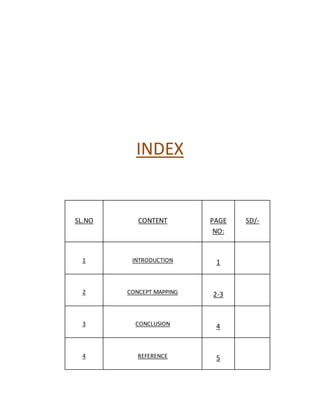
INDEX 
SL.NO 
CONTENT 
PAGE 
NO: 
SD/- 
1 
INTRODUCTION 
1 
2 
CONCEPT MAPPING 
2-3 
3 
CONCLUSION 
4 
4 
REFERENCE 
5
INTRODUCTION 
Concept mapping is the general method that can be used to help any 
individual or group to describe their ideas about some topic in a 
pictorial form. There are several different types of method that all 
currently go by names like “concept Mapping “ , “Mental Mapping” or 
“ Concept webbing”. All of them are similar in that they result in a 
picture of someone’s ideas .But the kind of concept mapping I want to 
describe here is different in a number of important ways. First it is 
primarily a group process and so it is especially well-suited for 
situations where terms or groups stakeholders have to work together. 
The other methods work primarily with individuals. Second, it uses a 
very structured facilitated approach. There are specific steps that are 
followed by a trained facilitator in helping a group to articulate its ideas 
and understand them more clearly. Third, the core of concept mapping 
consist of several –state- of the art multivariate statistical methods 
that analyze the input from all of the individuals and yields an 
aggregate group product .And fourth,the method requires the use of 
specialized computer programs that can handle the data from this type 
of process and accomplish the correct analysis and mapping 
procedures. 
1
CONCEPT MAPPING 
Concept mapping is a technique for visually representing the structure 
of information-how concepts within a domain are interrelated .It 
isbased on theories of meaningful learning which is stress that 
learning new knowledge is dependent on what is already known. 
 Definition of concept mapping 
A concept map is a type of graphic organizer used to help 
students organize and represent knowledge of a subject. Concept 
maps begin with a main idea or concept and then branch out to 
show how that main idea can be broken down into specific 
topics. 
Benefits of concept mapping 
Concept mapping serves several purposes for learners 
1. Helping students brain storm and generate new ideas. 
2.Encouraging students to discover new concepts and the propositions 
that connect them. 
3. Allowing students to more clearly communicate ideas, thoughts and 
information 
4. helping students integrate new concepts with older concepts 
5. Enabling students to gain enhanced knowledge of any topic and 
evaluate the information 
2
Concept mapping as an assessment tool 
Concept mapping is a powerful tool for linking knowledge and could be 
a key to developing strong performance assessments that ought to be 
designed to generate both an assessment of how students are applying 
concept and to assess the deep understanding that students are 
gaining. 
According to Plonick (1997), researches began to 
study the concept-mapping technique in the 1960s based on the 
theories of Ausubel (1968) ,whose stressed the important role of prior 
knowledge in learning about new concepts since then, concept 
mapping has been gaining inroads as a tool to enhance problem solving 
in education. 
3
CONCLUSION 
Concept maps where developed to enhance meaningful learning . A 
well –made concept map grows within a context frame defined by an 
explicit “ focus question”, while a mind map often has only branches 
radiating out from a central picture . Some researches evidence 
suggests that the brain stores knowledge as productions that act on 
declarative memory content. Because concept maps are constructed 
to reflect organization of the declarative memory system, they 
facilitate sense- making and meaningful learning on the part of 
individuals who makes concept maps and those who use them. 
4
REFERENCE 
1. Joseph D Novak and Alberto J. Canas (2006). 
The theory underline concept maps and how to 
construct and use them” , institute for human and machine 
cognition. 
2. Ausubel,D.(1968) – educational psychology 
3.www. google com 
5
Assignment

Assignment

  • 1.
  • 2.
  • 3.
    INDEX SL.NO CONTENT PAGE NO: SD/- 1 INTRODUCTION 1 2 CONCEPT MAPPING 2-3 3 CONCLUSION 4 4 REFERENCE 5
  • 4.
    INTRODUCTION Concept mappingis the general method that can be used to help any individual or group to describe their ideas about some topic in a pictorial form. There are several different types of method that all currently go by names like “concept Mapping “ , “Mental Mapping” or “ Concept webbing”. All of them are similar in that they result in a picture of someone’s ideas .But the kind of concept mapping I want to describe here is different in a number of important ways. First it is primarily a group process and so it is especially well-suited for situations where terms or groups stakeholders have to work together. The other methods work primarily with individuals. Second, it uses a very structured facilitated approach. There are specific steps that are followed by a trained facilitator in helping a group to articulate its ideas and understand them more clearly. Third, the core of concept mapping consist of several –state- of the art multivariate statistical methods that analyze the input from all of the individuals and yields an aggregate group product .And fourth,the method requires the use of specialized computer programs that can handle the data from this type of process and accomplish the correct analysis and mapping procedures. 1
  • 5.
    CONCEPT MAPPING Conceptmapping is a technique for visually representing the structure of information-how concepts within a domain are interrelated .It isbased on theories of meaningful learning which is stress that learning new knowledge is dependent on what is already known.  Definition of concept mapping A concept map is a type of graphic organizer used to help students organize and represent knowledge of a subject. Concept maps begin with a main idea or concept and then branch out to show how that main idea can be broken down into specific topics. Benefits of concept mapping Concept mapping serves several purposes for learners 1. Helping students brain storm and generate new ideas. 2.Encouraging students to discover new concepts and the propositions that connect them. 3. Allowing students to more clearly communicate ideas, thoughts and information 4. helping students integrate new concepts with older concepts 5. Enabling students to gain enhanced knowledge of any topic and evaluate the information 2
  • 6.
    Concept mapping asan assessment tool Concept mapping is a powerful tool for linking knowledge and could be a key to developing strong performance assessments that ought to be designed to generate both an assessment of how students are applying concept and to assess the deep understanding that students are gaining. According to Plonick (1997), researches began to study the concept-mapping technique in the 1960s based on the theories of Ausubel (1968) ,whose stressed the important role of prior knowledge in learning about new concepts since then, concept mapping has been gaining inroads as a tool to enhance problem solving in education. 3
  • 7.
    CONCLUSION Concept mapswhere developed to enhance meaningful learning . A well –made concept map grows within a context frame defined by an explicit “ focus question”, while a mind map often has only branches radiating out from a central picture . Some researches evidence suggests that the brain stores knowledge as productions that act on declarative memory content. Because concept maps are constructed to reflect organization of the declarative memory system, they facilitate sense- making and meaningful learning on the part of individuals who makes concept maps and those who use them. 4
  • 8.
    REFERENCE 1. JosephD Novak and Alberto J. Canas (2006). The theory underline concept maps and how to construct and use them” , institute for human and machine cognition. 2. Ausubel,D.(1968) – educational psychology 3.www. google com 5