Teaching tools for
helping students with
special educational
needs
Lic. Silvia Rovegno
MSD 7, Dickens Institute
Agenda
√ General accommodations
√ Teaching vocabulary
√ Teaching grammar
√ Teaching reading
√ Teaching writing
√ Q and A
Before we start….
General Accommodations
 give more time
 give short, concise, linear instructions,
one task at a time
 give handout of whiteboard work
 materials should be well-structured /
clear / linear with logical, predictable
progression
 involve a minimum of jumping about
(eg backwards and forwards, from box
A to box B etc)
 have sentences on single lines where
possible
 keep new language to a minimum
 provide review and consolidation
 avoid too much contrastive word input (eg
their / there / they’re )
 avoid tasks designed to ‘catch out’ or
‘test’
 be multi-sensory and multi-media where
possible
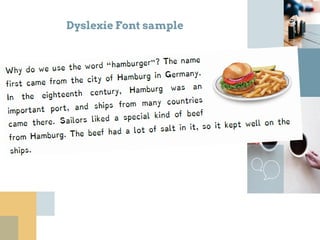
 have larger, dyslexic-friendly font / larger
spacing / darker background:
dyslexiefont.com
Dyslexie Font sample
Teaching
Vocabulary
Basic principles of teaching
vocabulary
 Limit amount of new items per lesson
(5 to 8)
 Contextualised teaching: vocab in text
and topic
 Multisensory presentation and
practice: hear, see, touch
 Extensive practice
 Frequent revision: 3 consecutive
lessons, fornightly revision and
integration
 Words that sound the same introduced
separately
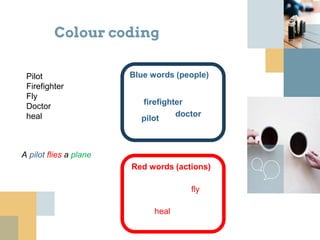
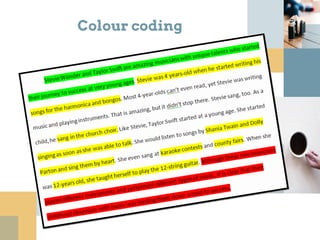
Colour coding
Blue words (people)
Red words (actions)
Pilot
Firefighter
Fly
Doctor
heal pilot
doctor
firefighter
fly
heal
A pilot flies a plane
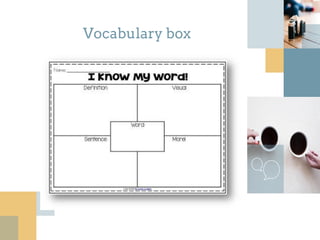
Vocabulary box
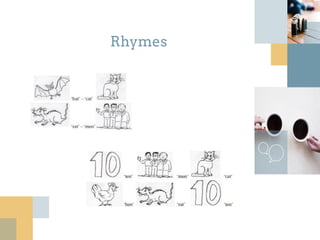
Rhymes
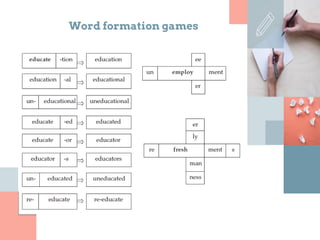
Word formation games
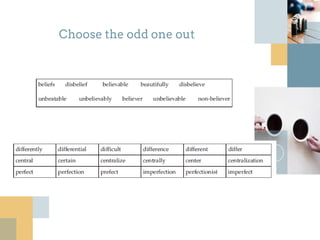
Choose the odd one out
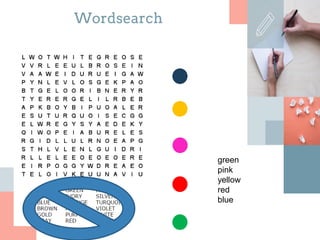
Wordsearch
green
pink
yellow
red
blue
Teaching
Grammar
Principles for teaching
grammar
 Grammar in context: text and topic
 From presentation to practice
 Clear and concise explanations
 Avoid terminology
 Colour coding
 From controlled to freer oral practice
 Avoid tasks that imply choosing
 Use grammar games
PPP with a twist
 Lead-in/warm-up
 Presentation (contextualization)
 Highlighting
 Controlled practice (manipulative
practice)
 Semi controlled practice
 Freer practice
 Recycling
Practising language
■ Orally first, then in writing if necessary
■ Manipulative practice: drills, find somene
who, dominoes, sort out sentences (for
syntax and structures), bingos
(prepositions)
■Semi controlled practice: role plays,
surveys
■Freer practice: problem-solving,
personalization tasks
Grammar games
■http://www.eslgamesworld.com/
■http://www.funenglishgames.com/
■http://www.english-online.org.uk/games
■http://www.funbrain.com/grammar/
Teaching
Reading
Teaching Reading
 Give practice on word recognition
 From sentence to paragraph
 From paragraph to text
 Break text down into smaller units
 Pre-reading phase essential
 Text should contain few unfamiliar
words
 Don’t ask sts to read aloud
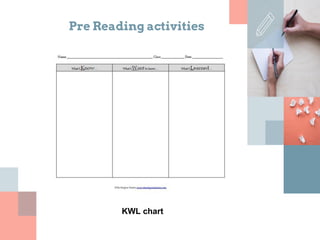
Pre Reading activities
KWL chart
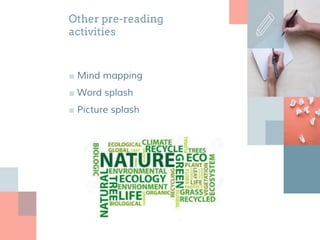
Other pre-reading
activities
■ Mind mapping
■ Word splash
■ Picture splash
Text design and layout
Teaching
Writing
Principles for teaching
writing
 Pre writing phase: key for content
(brainstorming) and organisation
(outline)
 The need to work with model
texts, colourcoding different
features
 Revision of key vocabulary and
structures for each particular text
type
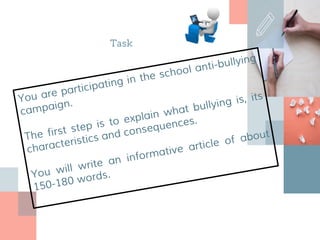
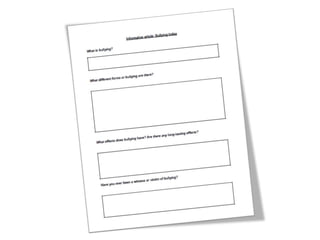
Article: Bullying today
Task
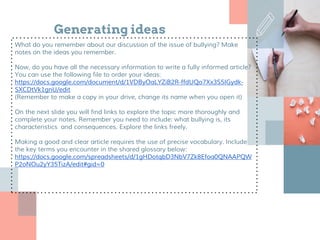
Generating ideas
What do you remember about our discussion of the issue of bullying? Make
notes on the ideas you remember.
Now, do you have all the necessary information to write a fully informed article?
You can use the following file to order your ideas:
https://docs.google.com/document/d/1VDByOaLYZiB2R-ffdUQo7Xx3S5IGydk-
SXCDtVk1gnU/edit
(Remember to make a copy in your drive, change its name when you open it)
On the next slide you will find links to explore the topic more thoroughly and
complete your notes. Remember you need to include: what bullying is, its
characteristics and consequences. Explore the links freely.
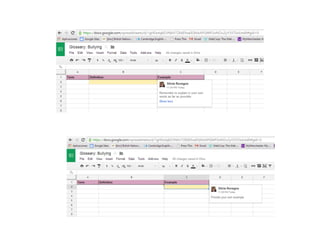
Making a good and clear article requires the use of precise vocabulary. Include
the key terms you encounter in the shared glossary below:
https://docs.google.com/spreadsheets/d/1gHDotqbD3NbV7Zk8Efoa0QNAAPQW
P2oNOu2yY35TizA/edit#gid=0
Check this out
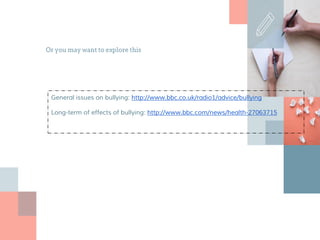
Or you may want to explore this
General issues on bullying: http://www.bbc.co.uk/radio1/advice/bullying
Long-term of effects of bullying: http://www.bbc.com/news/health-27063715
You can also get information from these infographics:
Colour coding
Important to remember
■ Preparation activities are essential to
cope with listening and Reading texts
■ Frequent and varied practice and
periodic revision help learners anchor
language items
■ Multisensory techniques (color coding,
drawing, acting) aid learning
■ Accommodations are essential to help
sts succeed in learning the language
Want big impact?
Use big image.
Q and A
Thank you for your attention!
Silvia

Teaching tools to help sts with SEN

  • 1.
    Teaching tools for helpingstudents with special educational needs Lic. Silvia Rovegno MSD 7, Dickens Institute
  • 2.
    Agenda √ General accommodations √Teaching vocabulary √ Teaching grammar √ Teaching reading √ Teaching writing √ Q and A
  • 3.
  • 4.
    General Accommodations  givemore time  give short, concise, linear instructions, one task at a time  give handout of whiteboard work  materials should be well-structured / clear / linear with logical, predictable progression  involve a minimum of jumping about (eg backwards and forwards, from box A to box B etc)
  • 5.
     have sentenceson single lines where possible  keep new language to a minimum  provide review and consolidation  avoid too much contrastive word input (eg their / there / they’re )  avoid tasks designed to ‘catch out’ or ‘test’  be multi-sensory and multi-media where possible  have larger, dyslexic-friendly font / larger spacing / darker background: dyslexiefont.com
  • 6.
  • 7.
  • 8.
    Basic principles ofteaching vocabulary  Limit amount of new items per lesson (5 to 8)  Contextualised teaching: vocab in text and topic  Multisensory presentation and practice: hear, see, touch  Extensive practice  Frequent revision: 3 consecutive lessons, fornightly revision and integration  Words that sound the same introduced separately
  • 9.
    Colour coding Blue words(people) Red words (actions) Pilot Firefighter Fly Doctor heal pilot doctor firefighter fly heal A pilot flies a plane
  • 10.
  • 11.
  • 12.
  • 13.
  • 14.
  • 15.
  • 16.
    Principles for teaching grammar Grammar in context: text and topic  From presentation to practice  Clear and concise explanations  Avoid terminology  Colour coding  From controlled to freer oral practice  Avoid tasks that imply choosing  Use grammar games
  • 17.
    PPP with atwist  Lead-in/warm-up  Presentation (contextualization)  Highlighting  Controlled practice (manipulative practice)  Semi controlled practice  Freer practice  Recycling
  • 18.
    Practising language ■ Orallyfirst, then in writing if necessary ■ Manipulative practice: drills, find somene who, dominoes, sort out sentences (for syntax and structures), bingos (prepositions) ■Semi controlled practice: role plays, surveys ■Freer practice: problem-solving, personalization tasks
  • 19.
  • 20.
  • 21.
    Teaching Reading  Givepractice on word recognition  From sentence to paragraph  From paragraph to text  Break text down into smaller units  Pre-reading phase essential  Text should contain few unfamiliar words  Don’t ask sts to read aloud
  • 22.
  • 23.
    Other pre-reading activities ■ Mindmapping ■ Word splash ■ Picture splash
  • 24.
  • 25.
  • 26.
    Principles for teaching writing Pre writing phase: key for content (brainstorming) and organisation (outline)  The need to work with model texts, colourcoding different features  Revision of key vocabulary and structures for each particular text type
  • 27.
  • 28.
  • 29.
    Generating ideas What doyou remember about our discussion of the issue of bullying? Make notes on the ideas you remember. Now, do you have all the necessary information to write a fully informed article? You can use the following file to order your ideas: https://docs.google.com/document/d/1VDByOaLYZiB2R-ffdUQo7Xx3S5IGydk- SXCDtVk1gnU/edit (Remember to make a copy in your drive, change its name when you open it) On the next slide you will find links to explore the topic more thoroughly and complete your notes. Remember you need to include: what bullying is, its characteristics and consequences. Explore the links freely. Making a good and clear article requires the use of precise vocabulary. Include the key terms you encounter in the shared glossary below: https://docs.google.com/spreadsheets/d/1gHDotqbD3NbV7Zk8Efoa0QNAAPQW P2oNOu2yY35TizA/edit#gid=0
  • 31.
  • 32.
    Or you maywant to explore this General issues on bullying: http://www.bbc.co.uk/radio1/advice/bullying Long-term of effects of bullying: http://www.bbc.com/news/health-27063715
  • 33.
    You can alsoget information from these infographics:
  • 38.
  • 39.
    Important to remember ■Preparation activities are essential to cope with listening and Reading texts ■ Frequent and varied practice and periodic revision help learners anchor language items ■ Multisensory techniques (color coding, drawing, acting) aid learning ■ Accommodations are essential to help sts succeed in learning the language
  • 40.
    Want big impact? Usebig image. Q and A
  • 41.
    Thank you foryour attention! Silvia