‘Teaching Sheffield’ -
     Dissemination


The University of Sheffield
PGCE English Creative Project
December 2011 – June 2012
Background and Context

•   We offer a secondary PGCE English course
    for 20-25 students at The School of
    Education.
•   We offer approximately two days of college-
    based work on digital and moving image
    literacy within the core English programme.
•   Our access to up to date, digital and ICT
    resources and expertise within college is
    limited.
‘Teaching Sheffield’ - Objectives


   To give our students an opportunity to collaborate on an
    original, creative enterprise
   To explore the use of a range of digital and media resources
    within an English subject focus
   To develop capacity and confidence with a digital
    technology/resources
   To devise, compose, produce and present a digital, still or
    moving image product that has value in its own right and
    potential for the classroom
   To exploit the resources available in and around Sheffield
   To link with and feed into the DeFT Project and to maximise
    the gains made from the partnership work with Rawmarsh
    City Learning Centre (CLC), Rotherham.
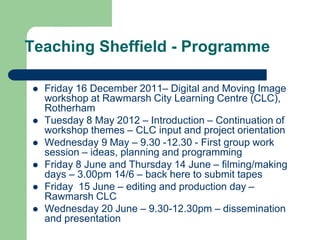
Teaching Sheffield - Programme

   Friday 16 December 2011– Digital and Moving Image
    workshop at Rawmarsh City Learning Centre (CLC),
    Rotherham
   Tuesday 8 May 2012 – Introduction – Continuation of
    workshop themes – CLC input and project orientation
   Wednesday 9 May – 9.30 -12.30 - First group work
    session – ideas, planning and programming
   Friday 8 June and Thursday 14 June – filming/making
    days – 3.00pm 14/6 – back here to submit tapes
   Friday 15 June – editing and production day –
    Rawmarsh CLC
   Wednesday 20 June – 9.30-12.30pm – dissemination
    and presentation
Day 1 – Orientation and Skills
Development

   Poems and Film in Rawmarsh Cemetery
   In small groups the students had to make a
    short still or moving image presentation and
    reading of their chosen poem
   Before filming and recording the students
    were briefed on the camera and the editing
    software (i-movies)
   The afternoon was spent editing to
    presentation standard
Poems

Late Fragment


And did you get what
You wanted from this life, even so?
I did.
And what did you want?
To call myself beloved, to feel myself
Beloved on the earth.

Raymond Carver - A New Path to the Waterfall
Findings/Questions from Day One

   Capability and confidence with digital technologies were
    widespread but variable. Almost all students could operate the
    software, a few were confident and knowledgeable users.
   Some students were much more ‘hands-on’ than others. Was
    there a causal link between capability and confidence?
   Confidence and daring were more influential than technical
    capability. The more daring knew what they wanted and were
    quick to seek technical support. By contrast the more technical
    capable/confident students were able to test alternative/options.
   Were some students apparently inactive because others were
    more capable? Were some students daunted by the creative
    nature of the task rather than the technical demands?
Outcomes from Day 1

•   Students had gained insights into the challenges,
    frustrations and satisfactions of working
    collaboratively
•   They had, in part, overcome their nervousness about
    being ‘creative’
•   All had made some gains in their capability and
    confidence with the digital cameras and editing
    software
•   They had been given an understanding of how
    creative tasks can be used to support close,
    personal and analytical readings of literary texts.
Teaching Sheffield – The Main
Project – Summer 2012

   Students worked in self-chosen groups of four/five.
   One member of the group – the role rotated – served
    as recorder; capturing, reporting and evaluating the
    process
   It was important that all group members shared
    responsibility, opportunity and roles
   Dissemination and presentation had to be a group
    responsibility
   Dissemination should focus on process as well as
    product
Teaching Sheffield –
Topics/Themes

    Here are just a few of the potential topics and
    themes that you might explore:
   Sheffield - History
   Sheffield – Night and Day
   Sheffield – Study/Student experience/PGCE/
   Sheffield – Global city/Communities
   Sheffield – City of Sport/Arts
   Sheffield – Transport and Communication
   Sheffield – Town and Country
   Sheffield – Backdrop for literary resource eg
                GCSE poems
Teaching Sheffield – Student
Outcomes
Assignment should:
 be a short digital still or moving image film/presentation that
  incorporates image and sound and which lasts between two
  and three minutes
 focus on Sheffield or use Sheffield – or surrounding region – as
  setting/backdrop
 be documentary, artistic, personal viewpoint, literary, curricular
 demonstrate exploration and engagement with a range of digital
  media applications and technologies
 be a joint, collaborative enterprise
 have a focus on process and project management
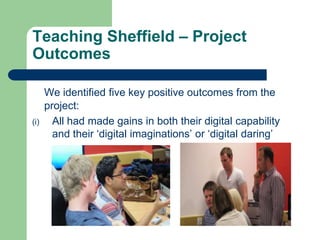
Teaching Sheffield – Project
Outcomes

      We identified five key positive outcomes from the
      project:
(i)     All had made gains in both their digital capability
        and their ‘digital imaginations’ or ‘digital daring’
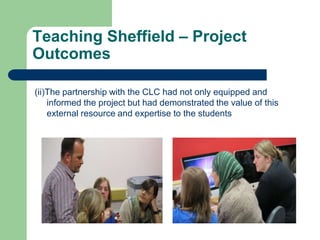
Teaching Sheffield – Project
Outcomes

(ii)The partnership with the CLC had not only equipped and
    informed the project but had demonstrated the value of this
    external resource and expertise to the students
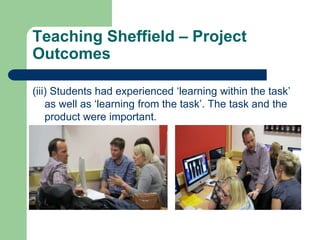
Teaching Sheffield – Project
Outcomes

(iii) Students had experienced ‘learning within the task’
    as well as ‘learning from the task’. The task and the
    product were important.
Teaching Sheffield – Project
Outcomes

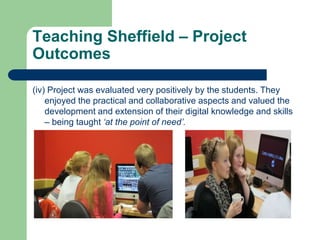
(iv) Project was evaluated very positively by the students. They
    enjoyed the practical and collaborative aspects and valued the
    development and extension of their digital knowledge and skills
    – being taught ‘at the point of need’.
Teaching Sheffield – Project
Outcomes

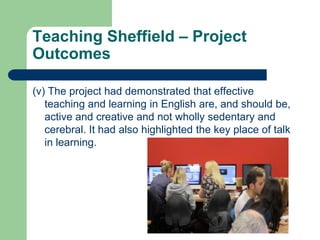
(v) The project had demonstrated that effective
   teaching and learning in English are, and should be,
   active and creative and not wholly sedentary and
   cerebral. It had also highlighted the key place of talk
   in learning.
Final Thoughts and Good
Intentions

   Three of the five groups chose to focus on
    contrasts: north and south, rich and poor, old
    and new. Why was this?
   Less time for filming, more time for editing
   More emphasis on initial, collaborative
    research and planning
   Greater opportunity for students to identify
    and reflect on their achievements and
    learning

Teaching sheffield dissemination event - October 2012 pptx

  • 1.
    ‘Teaching Sheffield’ - Dissemination The University of Sheffield PGCE English Creative Project December 2011 – June 2012
  • 2.
    Background and Context • We offer a secondary PGCE English course for 20-25 students at The School of Education. • We offer approximately two days of college- based work on digital and moving image literacy within the core English programme. • Our access to up to date, digital and ICT resources and expertise within college is limited.
  • 3.
    ‘Teaching Sheffield’ -Objectives  To give our students an opportunity to collaborate on an original, creative enterprise  To explore the use of a range of digital and media resources within an English subject focus  To develop capacity and confidence with a digital technology/resources  To devise, compose, produce and present a digital, still or moving image product that has value in its own right and potential for the classroom  To exploit the resources available in and around Sheffield  To link with and feed into the DeFT Project and to maximise the gains made from the partnership work with Rawmarsh City Learning Centre (CLC), Rotherham.
  • 4.
    Teaching Sheffield -Programme  Friday 16 December 2011– Digital and Moving Image workshop at Rawmarsh City Learning Centre (CLC), Rotherham  Tuesday 8 May 2012 – Introduction – Continuation of workshop themes – CLC input and project orientation  Wednesday 9 May – 9.30 -12.30 - First group work session – ideas, planning and programming  Friday 8 June and Thursday 14 June – filming/making days – 3.00pm 14/6 – back here to submit tapes  Friday 15 June – editing and production day – Rawmarsh CLC  Wednesday 20 June – 9.30-12.30pm – dissemination and presentation
  • 5.
    Day 1 –Orientation and Skills Development  Poems and Film in Rawmarsh Cemetery  In small groups the students had to make a short still or moving image presentation and reading of their chosen poem  Before filming and recording the students were briefed on the camera and the editing software (i-movies)  The afternoon was spent editing to presentation standard
  • 6.
    Poems Late Fragment And didyou get what You wanted from this life, even so? I did. And what did you want? To call myself beloved, to feel myself Beloved on the earth. Raymond Carver - A New Path to the Waterfall
  • 7.
    Findings/Questions from DayOne  Capability and confidence with digital technologies were widespread but variable. Almost all students could operate the software, a few were confident and knowledgeable users.  Some students were much more ‘hands-on’ than others. Was there a causal link between capability and confidence?  Confidence and daring were more influential than technical capability. The more daring knew what they wanted and were quick to seek technical support. By contrast the more technical capable/confident students were able to test alternative/options.  Were some students apparently inactive because others were more capable? Were some students daunted by the creative nature of the task rather than the technical demands?
  • 8.
    Outcomes from Day1 • Students had gained insights into the challenges, frustrations and satisfactions of working collaboratively • They had, in part, overcome their nervousness about being ‘creative’ • All had made some gains in their capability and confidence with the digital cameras and editing software • They had been given an understanding of how creative tasks can be used to support close, personal and analytical readings of literary texts.
  • 9.
    Teaching Sheffield –The Main Project – Summer 2012  Students worked in self-chosen groups of four/five.  One member of the group – the role rotated – served as recorder; capturing, reporting and evaluating the process  It was important that all group members shared responsibility, opportunity and roles  Dissemination and presentation had to be a group responsibility  Dissemination should focus on process as well as product
  • 10.
    Teaching Sheffield – Topics/Themes Here are just a few of the potential topics and themes that you might explore:  Sheffield - History  Sheffield – Night and Day  Sheffield – Study/Student experience/PGCE/  Sheffield – Global city/Communities  Sheffield – City of Sport/Arts  Sheffield – Transport and Communication  Sheffield – Town and Country  Sheffield – Backdrop for literary resource eg GCSE poems
  • 11.
    Teaching Sheffield –Student Outcomes Assignment should:  be a short digital still or moving image film/presentation that incorporates image and sound and which lasts between two and three minutes  focus on Sheffield or use Sheffield – or surrounding region – as setting/backdrop  be documentary, artistic, personal viewpoint, literary, curricular  demonstrate exploration and engagement with a range of digital media applications and technologies  be a joint, collaborative enterprise  have a focus on process and project management
  • 12.
    Teaching Sheffield –Project Outcomes We identified five key positive outcomes from the project: (i) All had made gains in both their digital capability and their ‘digital imaginations’ or ‘digital daring’
  • 13.
    Teaching Sheffield –Project Outcomes (ii)The partnership with the CLC had not only equipped and informed the project but had demonstrated the value of this external resource and expertise to the students
  • 14.
    Teaching Sheffield –Project Outcomes (iii) Students had experienced ‘learning within the task’ as well as ‘learning from the task’. The task and the product were important.
  • 15.
    Teaching Sheffield –Project Outcomes (iv) Project was evaluated very positively by the students. They enjoyed the practical and collaborative aspects and valued the development and extension of their digital knowledge and skills – being taught ‘at the point of need’.
  • 16.
    Teaching Sheffield –Project Outcomes (v) The project had demonstrated that effective teaching and learning in English are, and should be, active and creative and not wholly sedentary and cerebral. It had also highlighted the key place of talk in learning.
  • 17.
    Final Thoughts andGood Intentions  Three of the five groups chose to focus on contrasts: north and south, rich and poor, old and new. Why was this?  Less time for filming, more time for editing  More emphasis on initial, collaborative research and planning  Greater opportunity for students to identify and reflect on their achievements and learning