What limitations are involved when
using digital technology within the
English classroom? The perspective
        of pupil and teacher
Rationale
• I am really interested in how quickly technology moves
  forward, which was what made me focus my research project
  on this area.
• I feel comfortable with using a lot of new technology as I use
  much of it in in my spare time, but I thought that many
  teachers may not feel as confident.
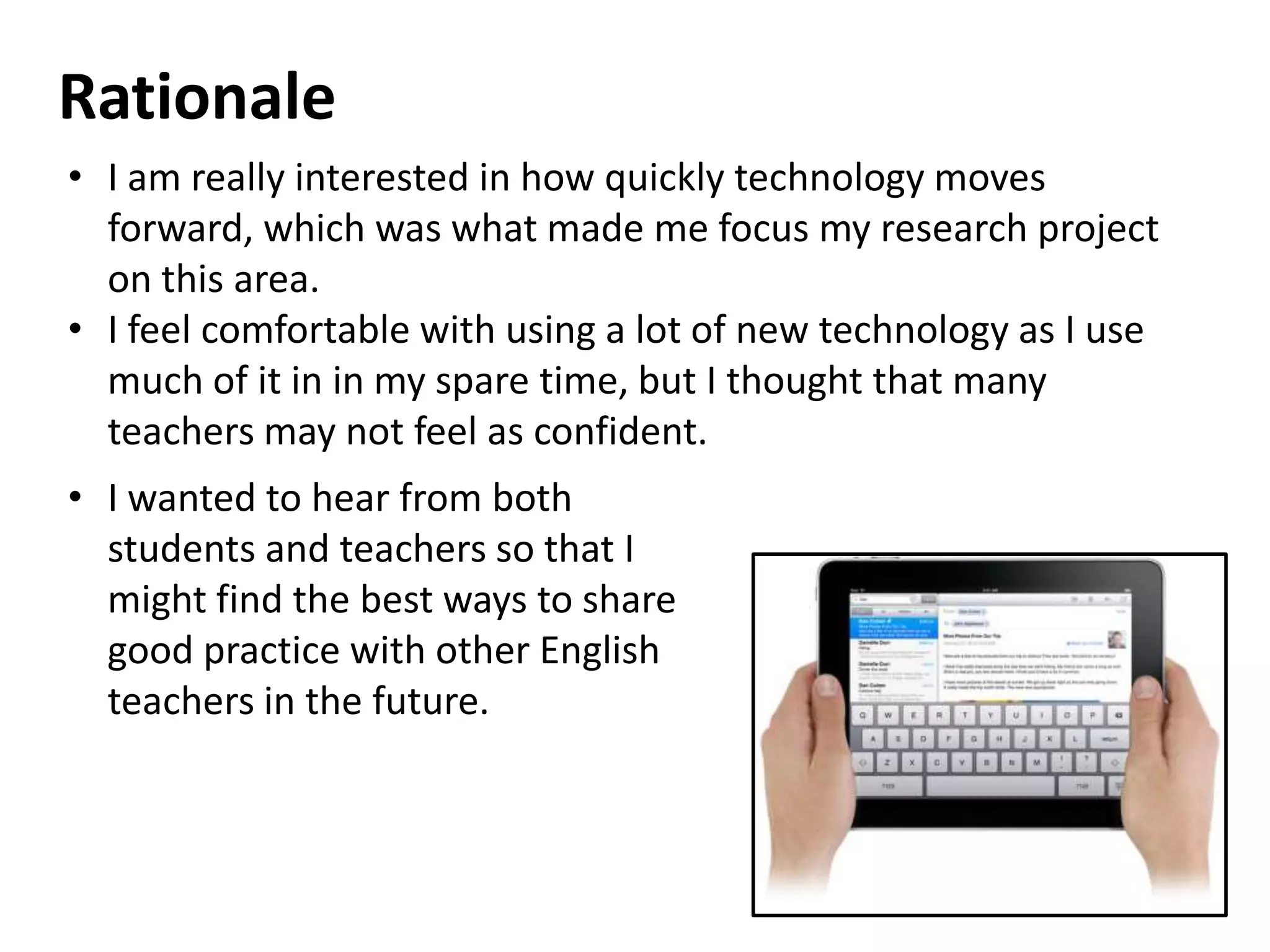
• I wanted to hear from both
  students and teachers so that I
  might find the best ways to share
  good practice with other English
  teachers in the future.
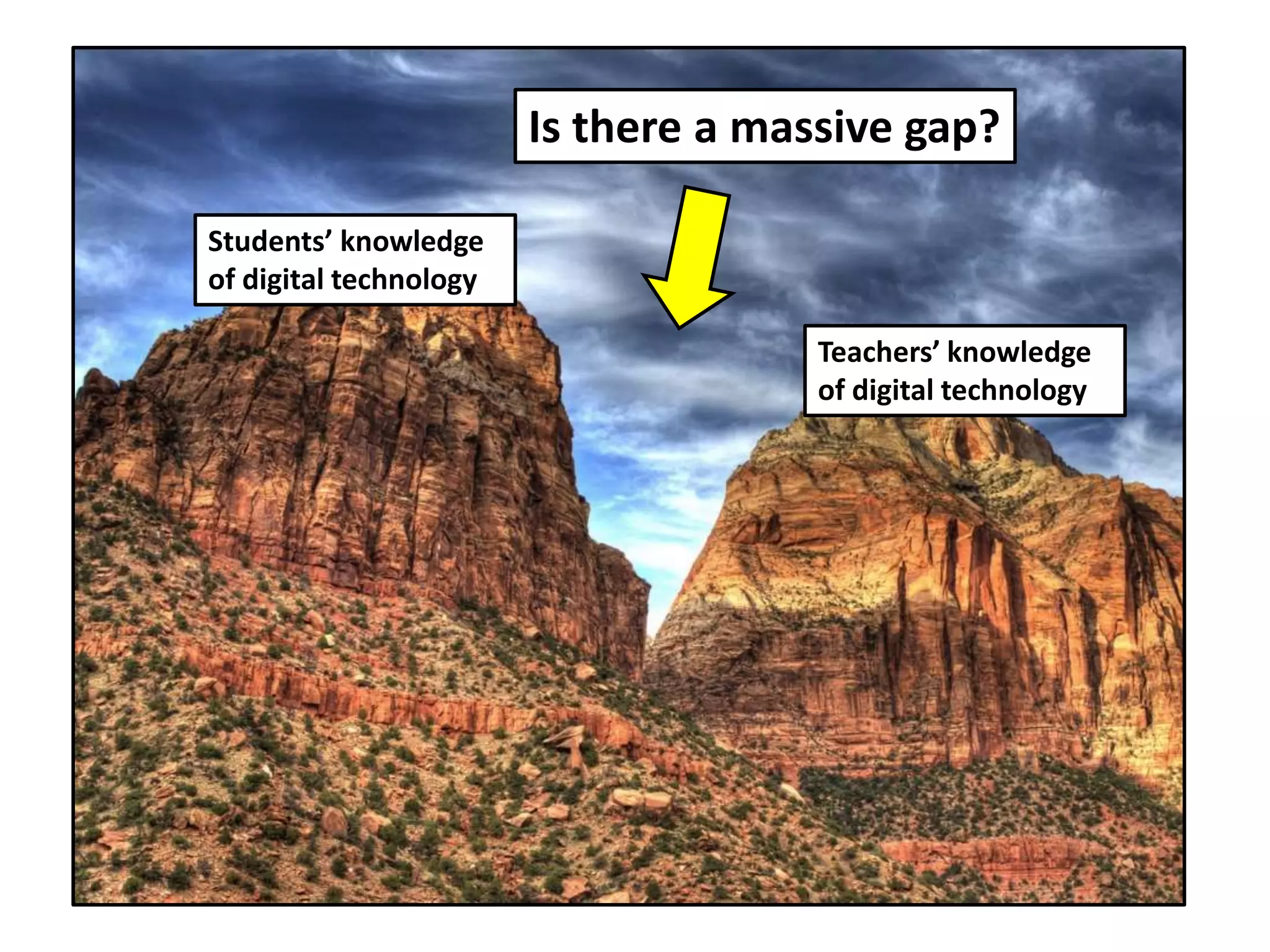
Is there a massive gap?

Students’ knowledge
of digital technology

                                      Teachers’ knowledge
                                      of digital technology
Dronfield Henry Fanshawe School…
• Has over one thousand PCs on
  site.
• Uses the ‘Moodle’ VLE.
• Is trialling ‘Mimeo’ IWB software
  in some classrooms.


 Technology can become outmoded
 or ineffectual after only a few years.

 This must be a huge financial concern
 for schools when deciding which
 technology is invested in.
Literature review
'digital literacy is … much more than a functional matter of learning how to use a
computer and keyboard, or how to do online searches' (Buckingham, 2008)

'sheer diversity of specific accounts of “digital literacy” that exist' (Knobel & Lankshear,
2008)

'teachers need to be digitally literate so that they can empower students with the skills
and knowledge that they will need to be successful in a workplace dominated by
technology’ (Pianfetti, 2001)

‘the older generation of teachers ‘don’t believe their students can learn successfully
while watching TV or listening to music, because they can’t … they didn’t practice this
skill constantly for all of their formative years.’ (Prensky, 2001)
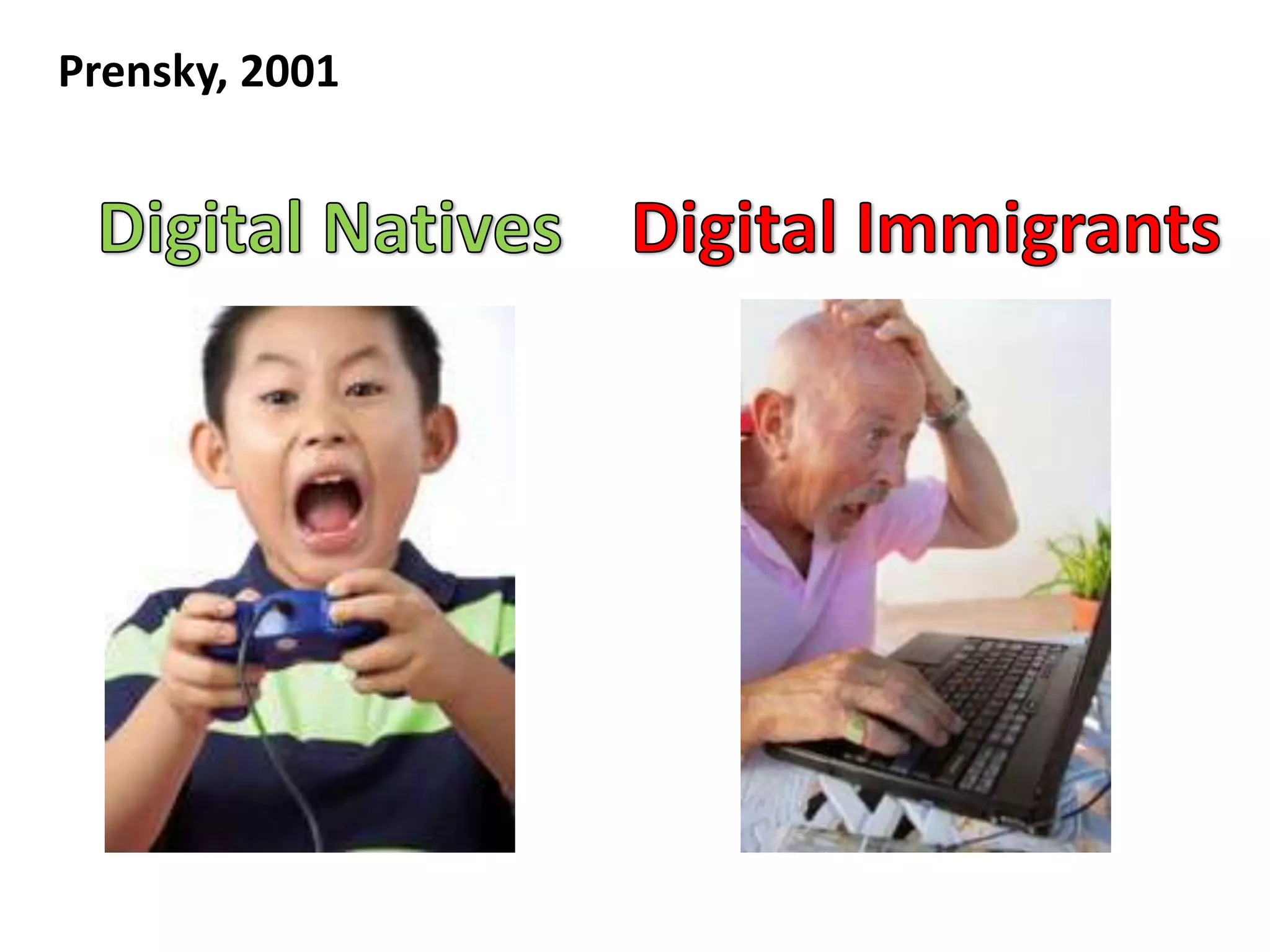
Prensky, 2001
Methodology
• Interviews with members of the English department
  (individually).
• Interviews with year 9 pupils (grouped)
• Interviews with year 12 pupils (grouped)

• Findings organised by issue as it ‘can make comparison across
  respondents more economical (Cohen, 2007: p.467)
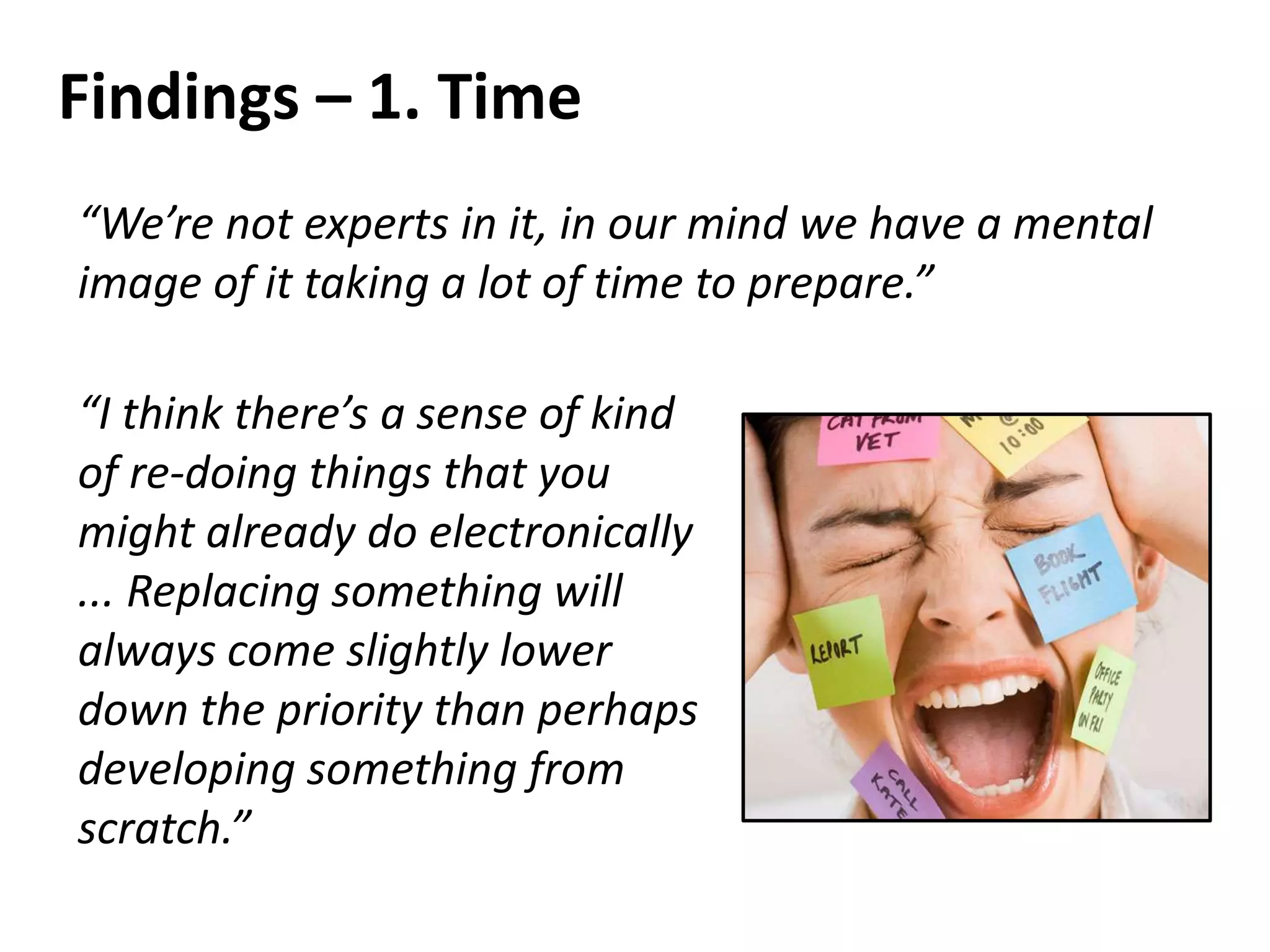
Findings – 1. Time
“We’re not experts in it, in our mind we have a mental
image of it taking a lot of time to prepare.”

“I think there’s a sense of kind
of re-doing things that you
might already do electronically
... Replacing something will
always come slightly lower
down the priority than perhaps
developing something from
scratch.”
Findings – 1. Time
• This feeling wasn’t unsubstantiated – PowerPoint and
Mimio Notebook for example.
• Perhaps showed a reluctance to create digital
resources if the teacher has already expended time and
effort in creating something beforehand.
Findings – 2. Use of PowerPoint
“Most of my lessons do have PowerPoints in them.
Really these days PowerPoints are replacing my lesson
plans.”


This mirrored the findings of Holbrook et al. (2012:
p.219-220), who state that: ‘technological tools
become a means for increasing efficiency.’
Findings – 2. Use of PowerPoint
Year 9 students expressed dissatisfaction with the way
PowerPoint is used in their lessons:
“They put writing on the board and sometimes we have
to copy it out and like you don’t read it properly so you
don’t understand what you’re actually meant to be
doing.”
This could imply that whilst some of the teachers within
the department use PowerPoint to ‘increase efficiency’,
some students view this as counterproductive.
Findings – 2. Use of PowerPoint
Susskind (2004) did a study into student response to
the use of PowerPoint, focusing on HE. It found that
‘students viewed themselves as more effective’ and
that ‘it was easier to understand the lecture and take
notes.’

Is it possible that age matters when using presentation
software?
Findings – 3. ‘Hands-on approach to CPD’
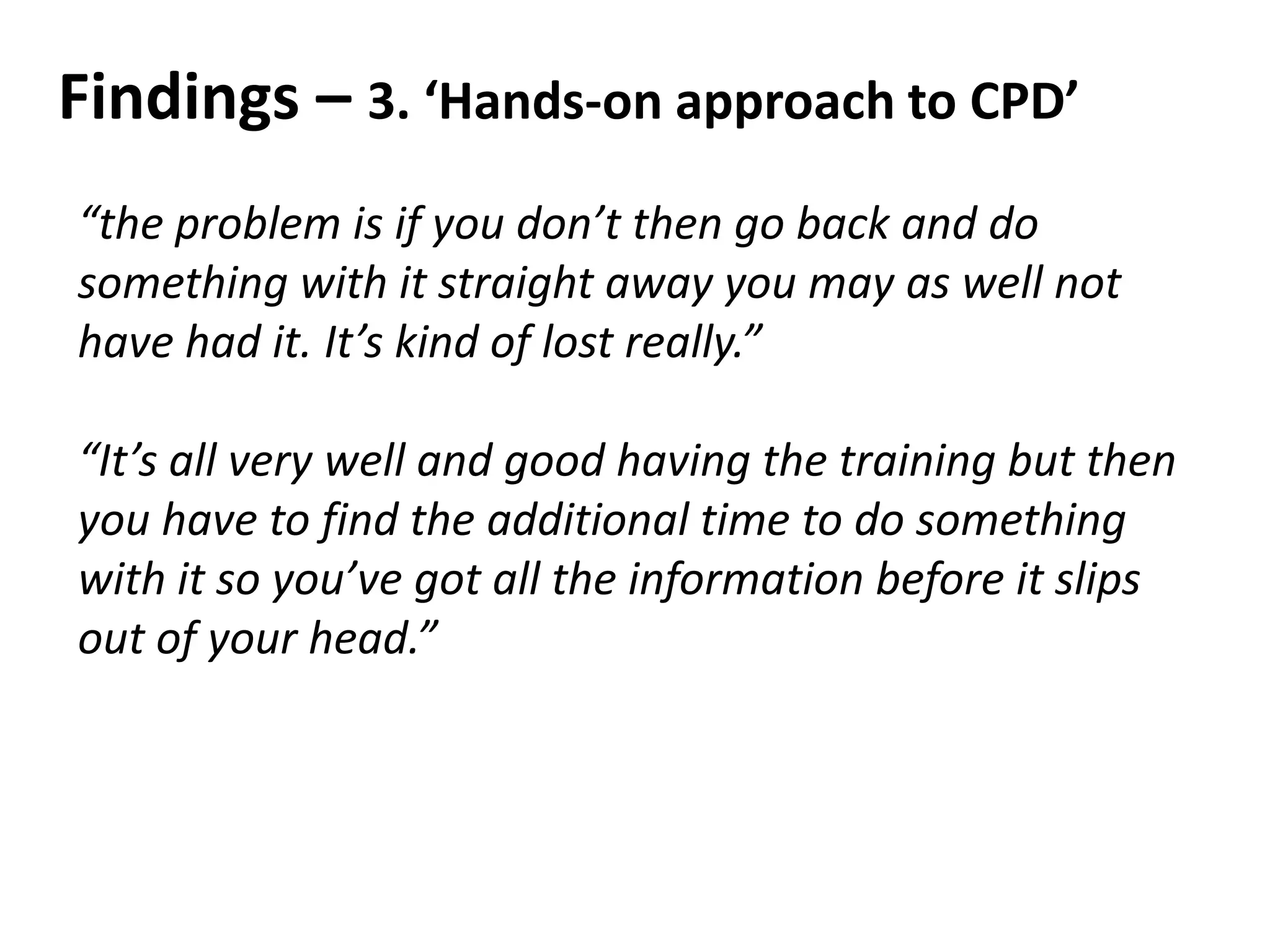
Two thirds of the English staff that I interview stressed
the need for a practical, hands-on approach to training
in digital technology.
Findings – 3. ‘Hands-on approach to CPD’
“There should be times that we are assigned that we
can do some training and ... Have a go at playing with
technology a bit more.”

“If you buy technology at home or you buy a new car,
you tend to learn how all the buttons work kind of as
you’re learning it, rather than by reading the manual or
being trained to use it and maybe teaching doesn’t
really allow you to do that”
Findings – 3. ‘Hands-on approach to CPD’
“the problem is if you don’t then go back and do
something with it straight away you may as well not
have had it. It’s kind of lost really.”

“It’s all very well and good having the training but then
you have to find the additional time to do something
with it so you’ve got all the information before it slips
out of your head.”
Findings – 3. ‘Hands-on approach to CPD’
• From these comments, it felt like there was a real
enthusiasm for digital technology, but a certain amount
of frustration at how CPD sessions and training in
school is spent.

“I don’t learn by watching somebody do things on a
computer, I have to do it myself.”
Findings – 3. ‘Hands-on approach to CPD’
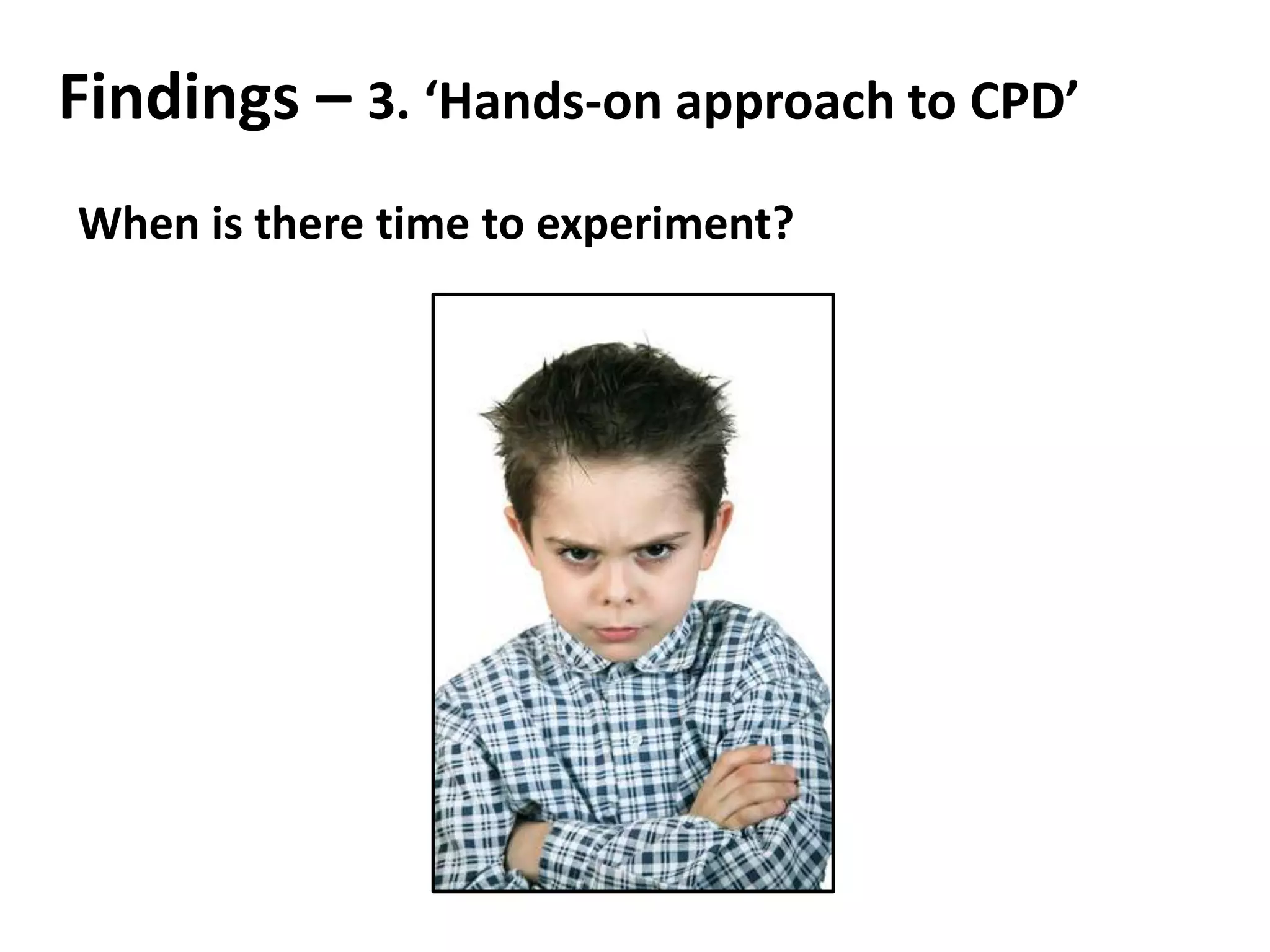
When is there time to experiment?
Findings – 4. Visual
Year 9 students highlighted the use of visual technology
such as film:

“It depends if we’ve like done a play or like read a play
sometimes afterwards we’ll watch the play, gives like a
visual of what it’d be like to see.”

“Like if we read the story or watch the film afterwards
as well I think to like it in action, help understand it
properly as well.”
Findings – 4. Visual
It could be suggested that these students’ views
support Kress’s (2003: p.64) views of ‘visual grammar’:

‘The screen more than the page is now the dominant
site of representation and communication in general ...
The screen is the site of the image, and the logic of the
image dominates the semiotic organisation of the
screen.’
Strengths
- Helped me realise that students like to
be ‘left to go and do stuff’, therefore
taking the onus off teachers to master
as much technology as they possibly
can.
Weaknesses
- Interviews with year 9s were not
particularly strong as it could be argued
that I directed them towards answering
negatively.
This resource was part of assessment for Secondary English PGCE
course at Sheffield Hallam University and is being released with
permission of its author. It accompanies the case studies produced
as part of the "Digital Futures in Teacher Education"; for more
information see www.digitalfutures.org
Except where indicated otherwise, the content produced within
the project is licensed under a Creative Commons Attribution-
Noncommercial-Share Alike 2.0 UK: England & Wales.

What limitations are involved when using digital technology within the English classroom? The perspective of pupil and teacher

  • 1.
    What limitations areinvolved when using digital technology within the English classroom? The perspective of pupil and teacher
  • 2.
    Rationale • I amreally interested in how quickly technology moves forward, which was what made me focus my research project on this area. • I feel comfortable with using a lot of new technology as I use much of it in in my spare time, but I thought that many teachers may not feel as confident. • I wanted to hear from both students and teachers so that I might find the best ways to share good practice with other English teachers in the future.
  • 3.
    Is there amassive gap? Students’ knowledge of digital technology Teachers’ knowledge of digital technology
  • 5.
    Dronfield Henry FanshaweSchool… • Has over one thousand PCs on site. • Uses the ‘Moodle’ VLE. • Is trialling ‘Mimeo’ IWB software in some classrooms. Technology can become outmoded or ineffectual after only a few years. This must be a huge financial concern for schools when deciding which technology is invested in.
  • 6.
    Literature review 'digital literacyis … much more than a functional matter of learning how to use a computer and keyboard, or how to do online searches' (Buckingham, 2008) 'sheer diversity of specific accounts of “digital literacy” that exist' (Knobel & Lankshear, 2008) 'teachers need to be digitally literate so that they can empower students with the skills and knowledge that they will need to be successful in a workplace dominated by technology’ (Pianfetti, 2001) ‘the older generation of teachers ‘don’t believe their students can learn successfully while watching TV or listening to music, because they can’t … they didn’t practice this skill constantly for all of their formative years.’ (Prensky, 2001)
  • 7.
  • 8.
    Methodology • Interviews withmembers of the English department (individually). • Interviews with year 9 pupils (grouped) • Interviews with year 12 pupils (grouped) • Findings organised by issue as it ‘can make comparison across respondents more economical (Cohen, 2007: p.467)
  • 9.
    Findings – 1.Time “We’re not experts in it, in our mind we have a mental image of it taking a lot of time to prepare.” “I think there’s a sense of kind of re-doing things that you might already do electronically ... Replacing something will always come slightly lower down the priority than perhaps developing something from scratch.”
  • 10.
    Findings – 1.Time • This feeling wasn’t unsubstantiated – PowerPoint and Mimio Notebook for example. • Perhaps showed a reluctance to create digital resources if the teacher has already expended time and effort in creating something beforehand.
  • 12.
    Findings – 2.Use of PowerPoint “Most of my lessons do have PowerPoints in them. Really these days PowerPoints are replacing my lesson plans.” This mirrored the findings of Holbrook et al. (2012: p.219-220), who state that: ‘technological tools become a means for increasing efficiency.’
  • 13.
    Findings – 2.Use of PowerPoint Year 9 students expressed dissatisfaction with the way PowerPoint is used in their lessons: “They put writing on the board and sometimes we have to copy it out and like you don’t read it properly so you don’t understand what you’re actually meant to be doing.” This could imply that whilst some of the teachers within the department use PowerPoint to ‘increase efficiency’, some students view this as counterproductive.
  • 14.
    Findings – 2.Use of PowerPoint Susskind (2004) did a study into student response to the use of PowerPoint, focusing on HE. It found that ‘students viewed themselves as more effective’ and that ‘it was easier to understand the lecture and take notes.’ Is it possible that age matters when using presentation software?
  • 15.
    Findings – 3.‘Hands-on approach to CPD’ Two thirds of the English staff that I interview stressed the need for a practical, hands-on approach to training in digital technology.
  • 16.
    Findings – 3.‘Hands-on approach to CPD’ “There should be times that we are assigned that we can do some training and ... Have a go at playing with technology a bit more.” “If you buy technology at home or you buy a new car, you tend to learn how all the buttons work kind of as you’re learning it, rather than by reading the manual or being trained to use it and maybe teaching doesn’t really allow you to do that”
  • 17.
    Findings – 3.‘Hands-on approach to CPD’ “the problem is if you don’t then go back and do something with it straight away you may as well not have had it. It’s kind of lost really.” “It’s all very well and good having the training but then you have to find the additional time to do something with it so you’ve got all the information before it slips out of your head.”
  • 18.
    Findings – 3.‘Hands-on approach to CPD’ • From these comments, it felt like there was a real enthusiasm for digital technology, but a certain amount of frustration at how CPD sessions and training in school is spent. “I don’t learn by watching somebody do things on a computer, I have to do it myself.”
  • 19.
    Findings – 3.‘Hands-on approach to CPD’ When is there time to experiment?
  • 20.
    Findings – 4.Visual Year 9 students highlighted the use of visual technology such as film: “It depends if we’ve like done a play or like read a play sometimes afterwards we’ll watch the play, gives like a visual of what it’d be like to see.” “Like if we read the story or watch the film afterwards as well I think to like it in action, help understand it properly as well.”
  • 21.
    Findings – 4.Visual It could be suggested that these students’ views support Kress’s (2003: p.64) views of ‘visual grammar’: ‘The screen more than the page is now the dominant site of representation and communication in general ... The screen is the site of the image, and the logic of the image dominates the semiotic organisation of the screen.’
  • 22.
    Strengths - Helped merealise that students like to be ‘left to go and do stuff’, therefore taking the onus off teachers to master as much technology as they possibly can.
  • 23.
    Weaknesses - Interviews withyear 9s were not particularly strong as it could be argued that I directed them towards answering negatively.
  • 24.
    This resource waspart of assessment for Secondary English PGCE course at Sheffield Hallam University and is being released with permission of its author. It accompanies the case studies produced as part of the "Digital Futures in Teacher Education"; for more information see www.digitalfutures.org Except where indicated otherwise, the content produced within the project is licensed under a Creative Commons Attribution- Noncommercial-Share Alike 2.0 UK: England & Wales.