
1
Curious Minds
Building the foundations of
learning for life


               2
3
What is the most important
ingredient in a learning experience?

        1                   2
   Teacher Focus       Pupil Focus


                   4
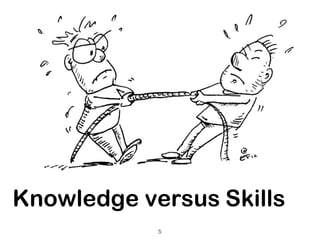
Knowledge versus Skills
            5
6
7
8
‘Life isn’t about finding
 yourself. Life is about
   creating yourself.’

    George Bernard Shaw


             9
10
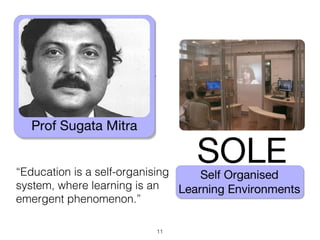
“Education is a self-organising
system, where learning is an
emergent phenomenon.”

                            11
We pride ourselves on creating a curriculum which
grows the gifts in our learners and unearths talents
previously unrecognised.


                         12
Trigger/     Professional     Finale/
Term       Title
                        inspiration       Links        Showcase
                                         Royal
                                       Academy of
 1        Identity    London Tour                     Performance
                                       Dance and
                                        Animator
       People on The                    Handprint      Christmas
 2                   Aboriginal Art
          Move                           Theatre      Performance
                                                      Performance
        Myths and     BRIT School        The Brit
 3                                                     at the BRIT
        Legends       Performance        School
                                                         School
       Freedom and     Museum of       PM:African
 4                                                     Animation
          Rights        London         Drumming

                                        Handprint
 5     City of Culture The Lion King                  Performance
                                         Theatre
                                        Puppeteer
                        The War
                                       and Theatre
        Discoveries   Horse & The
 6                                       director:    Performance
       and Inventions Imperial War
                                          Thierry
                        Museum
                            13           Lawson
“Perform and Create” require the highest form
  of processing and synthesis of concepts.


                     14
What we learned from the pupils in Year 1:

•Assumptions

•Language FAST TRACK

• Passion

• Underestimation

• Inclusion

•Raising expectations

• Empowerment


                           15
‘Normally in this assessment what I would get is
    ‘dog’, ‘cat’, ‘fish’ but this year I also got ‘ lion’,
    ‘warthog’, ‘gnu’ ‘antelope’. I thought, hold on a
    minute what’s this. Not only did pupils have a much
    wider vocabulary but they were using catagorisation
    which is a much higher level skill. The real life
    exposure to this language has led to much more
    complex conversations.’

    Judy Lamprecht Speech and language Therapist St Georges Hospital


Language Fast Track
                       16
Passion


"Young people united in a shared commitment and passion for
creating art can overcome all difficulties of communication to
create theatre of the highest quality."

Simon Stephens
Assistant Director of Theatre - Brit School
                                              17
Experiential learning helps our students
build a better understanding of the world.
                       18
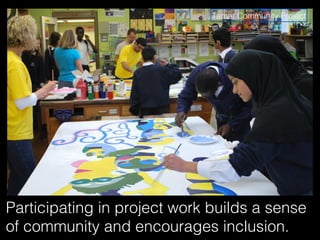
Tamar Community Project


Participating in project work builds a sense
of community and encourages inclusion.
                      19
"Oak Lodge enables its students to access information as directly as possible.
The students express their opinions really clearly, they are engaged. And when
OLS staff work with the students I was really impressed at how they stretch
them and expect only the best."

Jonathan Huxley - Artist              20
'Innovation is the fuel that drives the global
economy and it must be fostered in our
nation's schools'.
'School of tomorrow’ www.mmiweb.org.uk


                                         21
Teachers say that there is now more…..


     Innovation               Learning from professionals


Experimental approaches                  Collaboration


     Active learning               Shared observations

Risk taking          Peer learning             Motivation


                              22
"I feel that because I’m part of the Enquiring
Minds Team….I feel more confident in being
able to apply the “Enquiring Minds” approach to
my own teaching. If I wasn't part of Enquiring
Minds I would never be able to do this. So Thank
you for putting me in Enquiring Minds."
Karthik Vijayanandam (Maths Teacher)
                                   23
Pupils demonstrate.......

   Teamwork                 Spontaneous thinking and learning

     Contextual understanding                Resilience

     Problem solving                   Language application
        Historical and geographical understanding

    Communication             Role play         Collaboration

            Free thinking             Cultural awareness

 Improvisation          Peer Learning       Drama and Music!

                                 24
The considerable breadth and balance of the
curriculum adds significantly to pupils’
experience of school.” (OFSTED 2012)
                        25
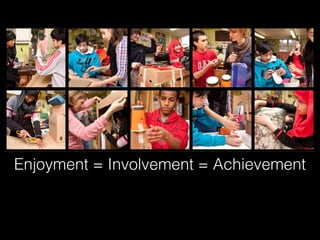
Enjoyment = Involvement = Achievement


                  26
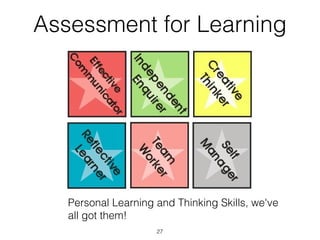
Assessment for Learning


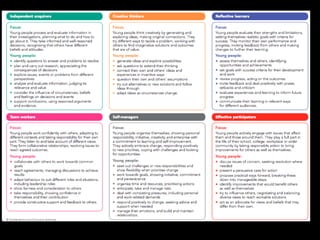
   Personal Learning and Thinking Skills, we've
   all got them!
                     27
28
29
30
31
32
33
34
35
"All were involved in the creative
process. It proved a great source
of inspiration for creative writing
and thinking and was a fantastic
way of extending the pupils'
vocabulary. Students were
extremely motivated and it
improved their self-confidence.
The acting motivated the students
during literacy sessions to read
more Greek stories. They then
planned, created and wrote their
own creative story. The pupils
were empowered in their own
learning."
                                        Let's Create- Brit School collaboration
Ben Turner, English Co-ordinator


                                   36
Working with others allows
ideas to grow in unexpected
   and challenging ways.


            37
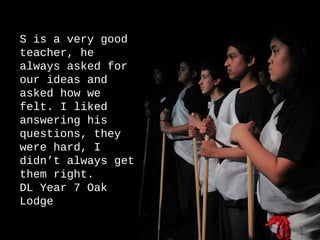
S is a very good
teacher, he
always asked for
our ideas and
asked how we
felt. I liked
answering his
questions, they
were hard, I
didn’t always get
them right.
DL Year 7 Oak
Lodge

                    38
Working thematically provides a springboard for
creative thinking and allows teachers to experience
success in delivering content in new ways.


                         39
Origins and Metamorphosis of the Curriculum
Previously                                         Present
Rigid                                              Flexible and Personalised
Knowledge focused                                  Skills focused
Narrow                                             Broad
Limited choice                                     Choice
Limited external tuition                           Regular professional tutoring

Age dependent                                      Ability led, placing pupils according to potential
Offered limited OOCL opportunties                  Utilises local and national cultural and sports
                                                   opportunities
Met pupils’ learning difficulties                  Meets pupils learning difficulties and abilities
Teacher led learning: Reflected teacher            Pupil led independent learning, reflects pupils
styles and skills                                  learning styles and interests
Limited opportunity to apply skills and knowledge Uses cross curricular learning to develop application of
across different contexts.                        skills and knowledge

Developed language in isolation                    Uses real-life experiences to engage learning
                                                   language

Developed a range of knowledge based subjects      Places pupil numeracy and literacy competency at it’s
in which literacy and numeracy appear              heart.


Was complicit in pupils’ passivity to             Encourages pupils as independent
learning                                          40
                                                  enquirers/learners
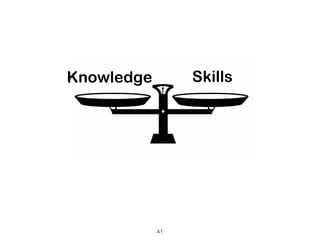
Knowledge        Skills


            41
Ideas to peruse
• Guy Claxtons's 8 Magnificent Qualities for Learning
  from ' What's the Point of School'

• Questioning Skills, teacher and learner. blooms
  Taxonomy see diagram.

• Project based learning( International Primary
  Curriculum, Enquiring Minds from Future Lab, the
  Engaging Schools Program from the Innovation unit,
  The Power of Projects (Guy Claxton)

• The New Primary Curriculum

• TASC Wheel for Planning

• WALT & TIBS               42
If you are going ahead with 'Project Based Learning'

WARNING: Do not proceed into this curriculum without first agreeing on
whole school value and understanding of:
•Collaborative learning
•Assessment for learning
•Team teaching
•Delivering to large groups
•Pupil led enquiry
•Professional Respect

Staff involved should show resilience, ingenuity, initiative, flexibility and a
desire to learn. Give these staff planning time and support them to work
together

•It will also help to start from a great trigger, involve pupils in planning and
record the process

                                         43
•
     Planning process....establish
    Team building, professional respect


•   Curriculum areas(leaders?)


•   Topics


•   Professional link


•   Trigger


•   Showcase


Curriculum objectives/outcomes .....I can & I understand statements


•   Planned facilitation of pupil led learning and target setting.


•   Storage and workbooks or portfolios.


•   Teacher communication.


•   How & Who will document work.
                                                  44
Keep in mind
• Real life experience and application is most
  effective, either as the topic or trigger or
  showcase.

• Ask pupils at first opportunity what they know
  about this topic/ what questions they already
  have/what they might be interested in
  knowing

• Allow pupils to explore their own interests and
  leads within the topic and at times ask them to
  think about their own success criteria for their
  work.                  45
46
Knowledge
  What happened after...?
        How many...?
      Who was it that...?
    Can you name the...?
Describe what happened at...?
      Who spoke to...?
     Can you tell why...?
   Find the meaning of...?
          What is...?
   Which is true or false...?
 http://www.teachers.ash.org.au/researchskills/dalton.ht
                           m
                            47
48
WALT: we are learning to......design
       critical experiments
       critical experiments


                                            TIBS: This is because......critical tests
                                                help us make improvements.


                                       49
50
Achievements


                                                The highest national contextual
                                                value-added score between Key
                                                Stage 2 and GCSE. 


                           Architecture Award

Wandsworth Dragons Den


                                  51
52
References:
‘Building Learning Power: Helping Young People Become Better Learners’ by
Guy Claxton

'The G & T Pocketbook', Barry Hymer

'A Fair Deal for Gifted Children' Carrie Winstanley

'How to change your mindset', Carol Dweck

‘5Minds for the Future’ Howard Gardner

National G&T Resources

‘What’s the Point of School’ Guy Claxton

‘Changing Paradigms’ Ken Robinson

‘The Whole in the Wall’ Sugata Mitra

‘Enquiring Minds’ Future Lab

www.projectict.com                     53

Curious minds 1

  • 1.
  • 2.
    Curious Minds Building thefoundations of learning for life 2
  • 3.
  • 4.
    What is themost important ingredient in a learning experience? 1 2 Teacher Focus Pupil Focus 4
  • 5.
  • 6.
  • 7.
  • 8.
  • 9.
    ‘Life isn’t aboutfinding yourself. Life is about creating yourself.’ George Bernard Shaw 9
  • 10.
  • 11.
    “Education is aself-organising system, where learning is an emergent phenomenon.” 11
  • 12.
    We pride ourselveson creating a curriculum which grows the gifts in our learners and unearths talents previously unrecognised. 12
  • 13.
    Trigger/ Professional Finale/ Term Title inspiration Links Showcase Royal Academy of 1 Identity London Tour Performance Dance and Animator People on The Handprint Christmas 2 Aboriginal Art Move Theatre Performance Performance Myths and BRIT School The Brit 3 at the BRIT Legends Performance School School Freedom and Museum of PM:African 4 Animation Rights London Drumming Handprint 5 City of Culture The Lion King Performance Theatre Puppeteer The War and Theatre Discoveries Horse & The 6 director: Performance and Inventions Imperial War Thierry Museum 13 Lawson
  • 14.
    “Perform and Create”require the highest form of processing and synthesis of concepts. 14
  • 15.
    What we learnedfrom the pupils in Year 1: •Assumptions •Language FAST TRACK • Passion • Underestimation • Inclusion •Raising expectations • Empowerment 15
  • 16.
    ‘Normally in thisassessment what I would get is ‘dog’, ‘cat’, ‘fish’ but this year I also got ‘ lion’, ‘warthog’, ‘gnu’ ‘antelope’. I thought, hold on a minute what’s this. Not only did pupils have a much wider vocabulary but they were using catagorisation which is a much higher level skill. The real life exposure to this language has led to much more complex conversations.’ Judy Lamprecht Speech and language Therapist St Georges Hospital Language Fast Track 16
  • 17.
    Passion "Young people unitedin a shared commitment and passion for creating art can overcome all difficulties of communication to create theatre of the highest quality." Simon Stephens Assistant Director of Theatre - Brit School 17
  • 18.
    Experiential learning helpsour students build a better understanding of the world. 18
  • 19.
    Tamar Community Project Participatingin project work builds a sense of community and encourages inclusion. 19
  • 20.
    "Oak Lodge enablesits students to access information as directly as possible. The students express their opinions really clearly, they are engaged. And when OLS staff work with the students I was really impressed at how they stretch them and expect only the best." Jonathan Huxley - Artist 20
  • 21.
    'Innovation is thefuel that drives the global economy and it must be fostered in our nation's schools'. 'School of tomorrow’ www.mmiweb.org.uk 21
  • 22.
    Teachers say thatthere is now more….. Innovation Learning from professionals Experimental approaches Collaboration Active learning Shared observations Risk taking Peer learning Motivation 22
  • 23.
    "I feel thatbecause I’m part of the Enquiring Minds Team….I feel more confident in being able to apply the “Enquiring Minds” approach to my own teaching. If I wasn't part of Enquiring Minds I would never be able to do this. So Thank you for putting me in Enquiring Minds." Karthik Vijayanandam (Maths Teacher) 23
  • 24.
    Pupils demonstrate....... Teamwork Spontaneous thinking and learning Contextual understanding Resilience Problem solving Language application Historical and geographical understanding Communication Role play Collaboration Free thinking Cultural awareness Improvisation Peer Learning Drama and Music! 24
  • 25.
    The considerable breadthand balance of the curriculum adds significantly to pupils’ experience of school.” (OFSTED 2012) 25
  • 26.
    Enjoyment = Involvement= Achievement 26
  • 27.
    Assessment for Learning Personal Learning and Thinking Skills, we've all got them! 27
  • 28.
  • 29.
  • 30.
  • 31.
  • 32.
  • 33.
  • 34.
  • 35.
  • 36.
    "All were involvedin the creative process. It proved a great source of inspiration for creative writing and thinking and was a fantastic way of extending the pupils' vocabulary. Students were extremely motivated and it improved their self-confidence. The acting motivated the students during literacy sessions to read more Greek stories. They then planned, created and wrote their own creative story. The pupils were empowered in their own learning." Let's Create- Brit School collaboration Ben Turner, English Co-ordinator 36
  • 37.
    Working with othersallows ideas to grow in unexpected and challenging ways. 37
  • 38.
    S is avery good teacher, he always asked for our ideas and asked how we felt. I liked answering his questions, they were hard, I didn’t always get them right. DL Year 7 Oak Lodge 38
  • 39.
    Working thematically providesa springboard for creative thinking and allows teachers to experience success in delivering content in new ways. 39
  • 40.
    Origins and Metamorphosisof the Curriculum Previously Present Rigid Flexible and Personalised Knowledge focused Skills focused Narrow Broad Limited choice Choice Limited external tuition Regular professional tutoring Age dependent Ability led, placing pupils according to potential Offered limited OOCL opportunties Utilises local and national cultural and sports opportunities Met pupils’ learning difficulties Meets pupils learning difficulties and abilities Teacher led learning: Reflected teacher Pupil led independent learning, reflects pupils styles and skills learning styles and interests Limited opportunity to apply skills and knowledge Uses cross curricular learning to develop application of across different contexts. skills and knowledge Developed language in isolation Uses real-life experiences to engage learning language Developed a range of knowledge based subjects Places pupil numeracy and literacy competency at it’s in which literacy and numeracy appear heart. Was complicit in pupils’ passivity to Encourages pupils as independent learning 40 enquirers/learners
  • 41.
    Knowledge Skills 41
  • 42.
    Ideas to peruse •Guy Claxtons's 8 Magnificent Qualities for Learning from ' What's the Point of School' • Questioning Skills, teacher and learner. blooms Taxonomy see diagram. • Project based learning( International Primary Curriculum, Enquiring Minds from Future Lab, the Engaging Schools Program from the Innovation unit, The Power of Projects (Guy Claxton) • The New Primary Curriculum • TASC Wheel for Planning • WALT & TIBS 42
  • 43.
    If you aregoing ahead with 'Project Based Learning' WARNING: Do not proceed into this curriculum without first agreeing on whole school value and understanding of: •Collaborative learning •Assessment for learning •Team teaching •Delivering to large groups •Pupil led enquiry •Professional Respect Staff involved should show resilience, ingenuity, initiative, flexibility and a desire to learn. Give these staff planning time and support them to work together •It will also help to start from a great trigger, involve pupils in planning and record the process 43
  • 44.
    Planning process....establish Team building, professional respect • Curriculum areas(leaders?) • Topics • Professional link • Trigger • Showcase Curriculum objectives/outcomes .....I can & I understand statements • Planned facilitation of pupil led learning and target setting. • Storage and workbooks or portfolios. • Teacher communication. • How & Who will document work. 44
  • 45.
    Keep in mind •Real life experience and application is most effective, either as the topic or trigger or showcase. • Ask pupils at first opportunity what they know about this topic/ what questions they already have/what they might be interested in knowing • Allow pupils to explore their own interests and leads within the topic and at times ask them to think about their own success criteria for their work. 45
  • 46.
  • 47.
    Knowledge Whathappened after...? How many...? Who was it that...? Can you name the...? Describe what happened at...? Who spoke to...? Can you tell why...? Find the meaning of...? What is...? Which is true or false...? http://www.teachers.ash.org.au/researchskills/dalton.ht m 47
  • 48.
  • 49.
    WALT: we arelearning to......design WALT: we are learning to......design critical experiments critical experiments TIBS: This is because......critical tests help us make improvements. 49
  • 50.
  • 51.
    Achievements The highest national contextual value-added score between Key Stage 2 and GCSE.  Architecture Award Wandsworth Dragons Den 51
  • 52.
  • 53.
    References: ‘Building Learning Power:Helping Young People Become Better Learners’ by Guy Claxton 'The G & T Pocketbook', Barry Hymer 'A Fair Deal for Gifted Children' Carrie Winstanley 'How to change your mindset', Carol Dweck ‘5Minds for the Future’ Howard Gardner National G&T Resources ‘What’s the Point of School’ Guy Claxton ‘Changing Paradigms’ Ken Robinson ‘The Whole in the Wall’ Sugata Mitra ‘Enquiring Minds’ Future Lab www.projectict.com 53

Editor's Notes

  • #4 Meet the person directly behind you; what is the most important ingredient in a learning experience? Discuss and decide 2. Number Teacher focus ‘1’ Pupil focus ‘ 2’ Send to end of line.Display
  • #6 Hopefully what we will show you today is a curriculum that has brought balance to both of there priorities
  • #8 Why did we begin ? To address pupil: passivity to learning apathy to English language inability to apply learning across contexts. ( mention roots of this: lack of aspiration, teacher expectations, family expectations, prior educational approaches 'spoon feeding' information, looking. At our own practice but also that of feeder schools, pupil identity and this as a bigger project, training on labelling children, new SEN reports questioning SEN label and what it does to child and teacher psyche. As we unpicked this we got involved in the bigger debates and research
  • #9 ‘ Young people are inveterate and enthusiastic learners. They will work hard to pursue their projects and will spend hours practising......They love the feeling of energy, absorption and satisfaction that such learning delivers (and many are acutely aware of the lifeless quality of much of the learning they are required to do in school.’ Guy Claxton
  • #10 Explain change of mindset, positive labelling workshops (Carrie Winstanley) and underestimation here. Can our pupils learn in other ways?
  • #11 Child Driven Education Sugata Mitra’s experiments have shown that, in the absence of supervision or formal teaching, children can teach themselves and each other, if they’re motivated by curiosity and peer interest.
  • #12 Professor of Educational Technology at Newcastle University
  • #15 The importance of creativity and innovation….performing your creation
  • #16 Assumptions;Music many pupils have an intrinsic passion for Performing Arts, this is a powerful tool through which pupils can explore language, history, culture, politics and spirituality hearing impaired and Deaf pupils enjoy types of Music when it is made accessible to them. pupils want to know the context of the information they are receiving, they want to understand their place in history and the history of the world around them. Pupils can understand and apply PLTS skills to their own and others learning. Pupils actively use these to improve and lead their own learning and encourage the learning of others. pupils respond well to challenges and high expectations, particularly to the challenge of becoming independent enquirers when given the opportunity. Following many discussions the ‘Themes’ Curriculum became ‘Enquiring Minds’ Curriculum in September 2011.
  • #17 Language fast track Pupils, when driven by a real life dynamic inspiring experience, learn language associated with that experience much more quickly. Cross curriculum project work has a strong emphasis on recording learning and experiences through many different medium, this often complements and drives our student’s vocabulary and literacy development.
  • #18 Finding a Passion
  • #19 Context, thirst for knowledge!!!
  • #20 Inclusion
  • #21 High expectations from all
  • #23 Divide this high levels of risk taking in teaching increased motivation in pupils. large groups enabled certain activities Highly Reflective Teaching and Learning Variety of experiences including projects with the BRIT School, Handprint Theatre, Museum of London etc. Cross Curricular learning helps pupils join up their learning Pupils observed as having new skills in : improvisation, contextual understanding, teamwork, communication, role play, spontaneous thinking and problem solving, language, cultural awareness, historical and geographical understanding, free thinking.
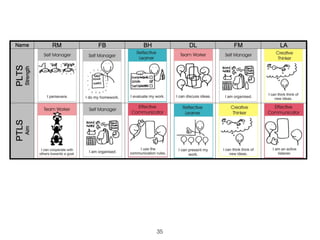
  • #28 Starting Point: We had no data based evidence of pupils passivity to learning. We had an amount of evidence that said our literacy and numeracy pupil progress levels had potential to improve We had no data to record pupils learning skills, in fact no format or language to with which to record data. Tracking pupil Progress now: We have amended PLTS into visual flashcards that link with our in house My Learning . Each subject uses PLTS objectives and tracks pupil progress from My Learning into PLTS. Reward certificates, stickers and self assessments of PLTS used across many subjects (outside Eminds) Pupil Self Set PLTS targets and strentghs across the school Next Steps in using Data: Tracking of Pupils PLTS Data on SIMS Pupil progress data in Numeracy and Literacy levels and compare with previous similar baselines(record observations by staff e.g. SALT and English Revisit 6th Form achievement data and College Leavers tracking of achievement.
  • #38 How do you plan for pupil led learning. The pupils are asked ‘what’s next’. For staff to plan for potential rather than steps ABC takes time and skill and a particular mindset. Teacher skills.
  • #39 Leadership and Responsibility, its link with curriculum development, value of ideas and autonomy through technology.
  • #40 The More you learn, the more you realise what you don’t know. Unconscious incompetent
  • #53 WARNING: Do not proceed into this curriculum without first training staff in collaborative learning Assessment for learning Team teaching Delivering to large groups Pupil led enquiry Professional Respect Staff involved should show resilience, ingenuity, initiative, flexibility and a desire to learn. Give these staff planning time and support them to work together It will also help to start from a great trigger, involve pupils in planning and record the process