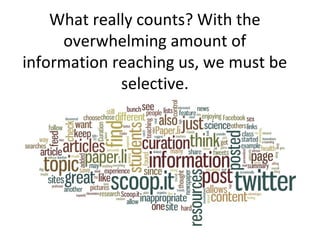
What really counts? With the
     overwhelming amount of
information reaching us, we must be
             selective.
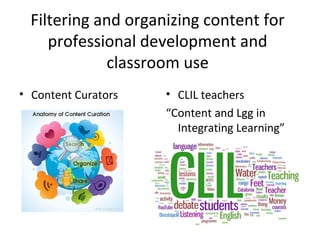
Filtering and organizing content for
     professional development and
             classroom use
• Content Curators   • CLIL teachers
                     “Content and Lgg in
                       Integrating Learning”
What’s CLIL?
What’s Curation?
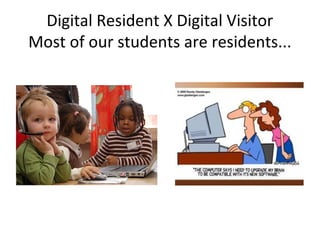
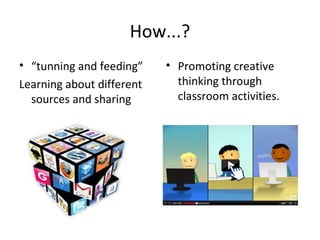
Digital Resident X Digital Visitor
Most of our students are residents...
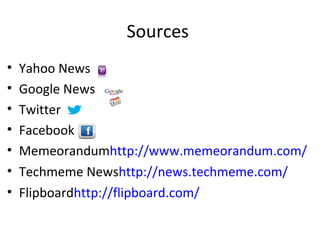
How...?
• “tunning and feeding”    • Promoting creative
Learning about different     thinking through
  sources and sharing        classroom activities.
Sources
•   Yahoo News
•   Google News
•   Twitter
•   Facebook
•   Memeorandumhttp://www.memeorandum.com/
•   Techmeme Newshttp://news.techmeme.com/
•   Flipboardhttp://flipboard.com/
Selecting by themes...
•   Spigot http://spigot.org/
•   Dmlcentral http://dmlcentral.net/
•   Scoopit http://www.scoop.it/
•   Mentormob http://www.mentormob.com/
•   Slideshare
    http://www.slideshare.net/rashmi/meet-
    slideshare
Different ones...
• Diigo http://www.diigo.com/
• Themeefy http://themeefy.com/landing.php?
  http_referrer=
• Flickr http://www.flickr.com/
• Idreambooks http://www.idreambooks.com/
• Pinterest http://pinterest.com/
• Voicethread http://voicethread.com/?
  #q.b409.i848804
Hands on! Let’s have some fun!
         Lame Excuses
Ask Ss to watch the opening
scene of the video and give their
  opinions about the situation.
  Discuss relationships, similar
excuses and the relation with the
              world.
 Show the complete video, work
    with the lyrics, extend it.
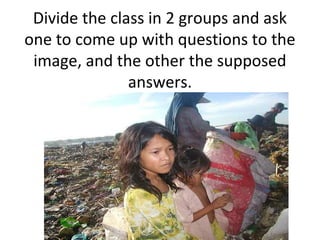
Divide the class in 2 groups and ask
one to come up with questions to the
 image, and the other the supposed
               answers.
Bare in mind that questions like: How
               old is she?
          Where’s she? Etc...
 Are OK, but what you really want is:
    Why does she need to work?
            Is this in Brazil?
   Connect Ss to the world. What
really counts is the awareness of the
 reality. Use unique images. Prompt
        them to think beyond.
Content & Meaning

1. “The door is open”

2. “I feel tired”

3. “What are you looking at?”

4. “How could you do that?”
Divide Ss in pairs and ask them to
  come up with situations for each
              sentence.
        Ask them to act out.
These are sentences from the books
   we use. There are many others.
Good to work with intonation, linking
     words and pronunciation.
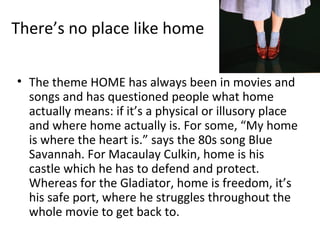
There’s no place like home

• The theme HOME has always been in movies and
  songs and has questioned people what home
  actually means: if it’s a physical or illusory place
  and where home actually is. For some, “My home
  is where the heart is.” says the 80s song Blue
  Savannah. For Macaulay Culkin, home is his
  castle which he has to defend and protect.
  Whereas for the Gladiator, home is freedom, it’s
  his safe port, where he struggles throughout the
  whole movie to get back to.
What does home mean for our
     students? Have they ever thought
         about the idea of ‘home’?
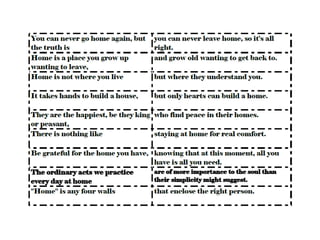
•   1. Write HOME on the board and ask students to brainstorm whatever
    comes to their minds about it.
•   2. Give them slips of paper (Home is… ) with famous quotes about home
    and ask them to match. Get feedback. Ask if they understand each quote
    and if they agree with the quotes. Show them the answers.
•   3. Ask them if they ever came home after a long trip and what this meant
    for them. How did they feel? Was their idea of home the same
    before/after the trip?
•   4. Show the 1min video of the first scene from the movie Love Actually
    which shows the Arrivals Gate at Heathrow airport. Ask them their
    opinion about the scene.
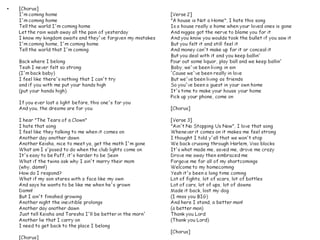
•   5. Give them the lyrics of Didi’song Coming Home. Listen to the song and
    ask students what the song is about. Ask them why they think she is
    coming home and how different she must be after having left home for a
    long time.
•   http://www.youtube.com/watch?v=PMScPVO4rLw&feature=related
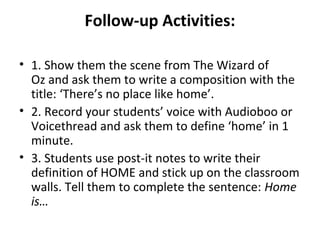
Follow-up Activities:

• 1. Show them the scene from The Wizard of
  Oz and ask them to write a composition with the
  title: ‘There’s no place like home’.
• 2. Record your students’ voice with Audioboo or
  Voicethread and ask them to define ‘home’ in 1
  minute.
• 3. Students use post-it notes to write their
  definition of HOME and stick up on the classroom
  walls. Tell them to complete the sentence: Home
  is…
What if...
    Maybe...
• First describe the
  picture.
• Then, complete one
  of the sentences
  above giving your
  opinion.
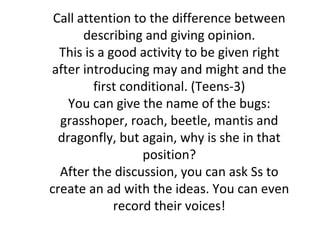
Call attention to the difference between
       describing and giving opinion.
  This is a good activity to be given right
after introducing may and might and the
         first conditional. (Teens-3)
    You can give the name of the bugs:
  grasshoper, roach, beetle, mantis and
  dragonfly, but again, why is she in that
                  position?
  After the discussion, you can ask Ss to
create an ad with the ideas. You can even
             record their voices!
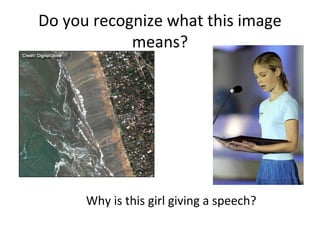
Do you recognize what this image
            means?


      Why is this girl giving a speech?
This is an image of a beach right
          before a Tsunami.
This girl is Tilly Smith, who received
 an award for saving hundreds of
                  people.
      Again, connect, explore,
              personalize.
What is a tsunami? How does it start?
• Ask Ss to search online. Give groups or pairs
  some minutes. Work with real geographical
  terms. (be prepared!)
• Write on board Ss anwers. Go to this
  linkhttp://oceanexplorer.noaa.gov/edu/learni
  ng/player/lesson09/l9la2_a.html and explore.
• Connect to the lesson: The Angel of the Beach
  (TE-3) or Explain a life-changing event
  (Master-2)
Knowledgements
I wish to thank my Braztesol colleagues for
supporting me, sharing ideas and laughs.
Special thanks to Jeremy Harmer, Carla Arena,
Eduardo Santos and Courtney Pahl for the great
Workshops and hints. For this workshop, I’ve
just put together their ideas.

Workshop2012

  • 1.
    What really counts?With the overwhelming amount of information reaching us, we must be selective.
  • 2.
    Filtering and organizingcontent for professional development and classroom use • Content Curators • CLIL teachers “Content and Lgg in Integrating Learning”
  • 3.
  • 4.
  • 5.
    Digital Resident XDigital Visitor Most of our students are residents...
  • 6.
    How...? • “tunning andfeeding” • Promoting creative Learning about different thinking through sources and sharing classroom activities.
  • 7.
    Sources • Yahoo News • Google News • Twitter • Facebook • Memeorandumhttp://www.memeorandum.com/ • Techmeme Newshttp://news.techmeme.com/ • Flipboardhttp://flipboard.com/
  • 8.
    Selecting by themes... • Spigot http://spigot.org/ • Dmlcentral http://dmlcentral.net/ • Scoopit http://www.scoop.it/ • Mentormob http://www.mentormob.com/ • Slideshare http://www.slideshare.net/rashmi/meet- slideshare
  • 9.
    Different ones... • Diigohttp://www.diigo.com/ • Themeefy http://themeefy.com/landing.php? http_referrer= • Flickr http://www.flickr.com/ • Idreambooks http://www.idreambooks.com/ • Pinterest http://pinterest.com/ • Voicethread http://voicethread.com/? #q.b409.i848804
  • 10.
    Hands on! Let’shave some fun! Lame Excuses
  • 11.
    Ask Ss towatch the opening scene of the video and give their opinions about the situation. Discuss relationships, similar excuses and the relation with the world. Show the complete video, work with the lyrics, extend it.
  • 12.
    Divide the classin 2 groups and ask one to come up with questions to the image, and the other the supposed answers.
  • 13.
    Bare in mindthat questions like: How old is she? Where’s she? Etc... Are OK, but what you really want is: Why does she need to work? Is this in Brazil? Connect Ss to the world. What really counts is the awareness of the reality. Use unique images. Prompt them to think beyond.
  • 14.
    Content & Meaning 1.“The door is open” 2. “I feel tired” 3. “What are you looking at?” 4. “How could you do that?”
  • 15.
    Divide Ss inpairs and ask them to come up with situations for each sentence. Ask them to act out. These are sentences from the books we use. There are many others. Good to work with intonation, linking words and pronunciation.
  • 16.
    There’s no placelike home • The theme HOME has always been in movies and songs and has questioned people what home actually means: if it’s a physical or illusory place and where home actually is. For some, “My home is where the heart is.” says the 80s song Blue Savannah. For Macaulay Culkin, home is his castle which he has to defend and protect. Whereas for the Gladiator, home is freedom, it’s his safe port, where he struggles throughout the whole movie to get back to.
  • 17.
    What does homemean for our students? Have they ever thought about the idea of ‘home’? • 1. Write HOME on the board and ask students to brainstorm whatever comes to their minds about it. • 2. Give them slips of paper (Home is… ) with famous quotes about home and ask them to match. Get feedback. Ask if they understand each quote and if they agree with the quotes. Show them the answers. • 3. Ask them if they ever came home after a long trip and what this meant for them. How did they feel? Was their idea of home the same before/after the trip? • 4. Show the 1min video of the first scene from the movie Love Actually which shows the Arrivals Gate at Heathrow airport. Ask them their opinion about the scene. • 5. Give them the lyrics of Didi’song Coming Home. Listen to the song and ask students what the song is about. Ask them why they think she is coming home and how different she must be after having left home for a long time. • http://www.youtube.com/watch?v=PMScPVO4rLw&feature=related
  • 20.
    Follow-up Activities: • 1.Show them the scene from The Wizard of Oz and ask them to write a composition with the title: ‘There’s no place like home’. • 2. Record your students’ voice with Audioboo or Voicethread and ask them to define ‘home’ in 1 minute. • 3. Students use post-it notes to write their definition of HOME and stick up on the classroom walls. Tell them to complete the sentence: Home is…
  • 21.
    What if... Maybe... • First describe the picture. • Then, complete one of the sentences above giving your opinion.
  • 22.
    Call attention tothe difference between describing and giving opinion. This is a good activity to be given right after introducing may and might and the first conditional. (Teens-3) You can give the name of the bugs: grasshoper, roach, beetle, mantis and dragonfly, but again, why is she in that position? After the discussion, you can ask Ss to create an ad with the ideas. You can even record their voices!
  • 23.
    Do you recognizewhat this image means? Why is this girl giving a speech?
  • 24.
    This is animage of a beach right before a Tsunami. This girl is Tilly Smith, who received an award for saving hundreds of people. Again, connect, explore, personalize.
  • 25.
    What is atsunami? How does it start? • Ask Ss to search online. Give groups or pairs some minutes. Work with real geographical terms. (be prepared!) • Write on board Ss anwers. Go to this linkhttp://oceanexplorer.noaa.gov/edu/learni ng/player/lesson09/l9la2_a.html and explore. • Connect to the lesson: The Angel of the Beach (TE-3) or Explain a life-changing event (Master-2)
  • 26.
    Knowledgements I wish tothank my Braztesol colleagues for supporting me, sharing ideas and laughs. Special thanks to Jeremy Harmer, Carla Arena, Eduardo Santos and Courtney Pahl for the great Workshops and hints. For this workshop, I’ve just put together their ideas.

Editor's Notes