EDUC 101 –
Teaching
Methodology 1
Chapter : Teaching Theories
Teaching as Behaviour
Modification
Dr. Marwa Mekni Toujani
Al Yamamah University
Dr. Marwa Mekni-Toujani Teaching as Behaviour Modification
Activity 1
What comes to your mind when
someone asks, ‘What is
teaching?’
Dr. Marwa Mekni-Toujani Teaching as Behaviour Modification
Activity 2
Traditional Classroom vs. Modern
Classroom
Dr. Marwa Mekni-Toujani Teaching as Behaviour Modification
Activity 3
Review: What is Teaching?
Dr. Marwa Mekni-Toujani Teaching as Behaviour Modification
Teaching as Behaviour
Modification
◦ Behaviour is different for different persons.
◦ Behavious could be defined as:
◦ The sum total of all the personality traits or characteristics that an individual
possesses
◦ The observable actions that an individual demonstrates.
◦ The behaviour modification approach to teaching is based on the second belief.
◦ When we change or modify the observable behaviour of a child, we are directly
or indirectly trying to help child to learn.
Dr. Marwa Mekni-Toujani Teaching as Behaviour Modification
Teaching as Behaviour Modification
Types of Observable Behavious
◦ Elicited behaviour
◦ Emitted behaviour
Dr. Marwa Mekni-Toujani Teaching as Behaviour Modification
Teaching as Behaviour Modification
Types of Observable Behavious
◦ Elicited behaviour or Emitted behaviour?
A. we are trying to elicit or draw out the behaviour from the child. For example, when we make
child run by offering a chocolate, we are trying to --------------------------or draw out the ehaviour of
running from the child.
B. On some occasions you might have experienced that an individual without any visible external
cause demonstrates a particular behaviour normally you had not noticed earlier in him/her.
A. ---------------------------- B. -----------------------------------------
Dr. Marwa Mekni-Toujani Teaching as Behaviour Modification
Teaching as Behaviour Modification
Examples of Emitted Behaviours
◦ A little child humming an unknown sweet tune
◦ A student solves a difficult problem in an unusual method
◦ A girl demonstrates a dance pose which was not taught in her dance class
Dr. Marwa Mekni-Toujani Teaching as Behaviour Modification
Teaching as Behaviour Modification
So what is behviour modification?
Dr. Marwa Mekni-Toujani Teaching as Behaviour Modification
Teaching as Behaviour Modification
When a child is made to demonstrate these
two observable behaviours, i.e. elicited and
emitted, as normal occurring behaviours,
then we say that the behaviour modification
has taken place in the child.
Dr. Marwa Mekni-Toujani Teaching as Behaviour Modification
Teaching as Behaviour Modification
“So howdoes BehaviourModification
happen?”
Dr. Marwa Mekni-Toujani Teaching as Behaviour Modification
Teaching as Behaviour Modification
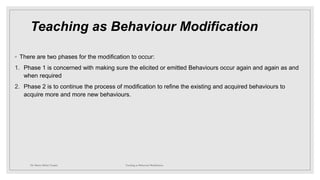
◦ There are two phases for the modification to occur:
1. Phase 1 is concerned with making sure the elicited or emitted Behaviours occur again and again as and
when required
2. Phase 2 is to continue the process of modification to refine the existing and acquired behaviours to
acquire more and more new behaviours.
Dr. Marwa Mekni-Toujani Teaching as Behaviour Modification
Teaching as
Behaviour
Modification
Conditioning
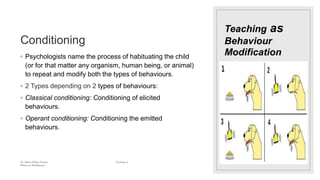
◦ Psychologists name the process of habituating the child
(or for that matter any organism, human being, or animal)
to repeat and modify both the types of behaviours.
◦ 2 Types depending on 2 types of behaviours:
◦ Classical conditioning: Conditioning of elicited
behaviours.
◦ Operant conditioning: Conditioning the emitted
behaviours.
Dr. Marwa Mekni-Toujani Teaching as
Behaviour Modification
Teaching as
Behaviour
Modification
Classical conditioning
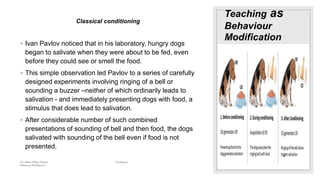
◦ Ivan Pavlov noticed that in his laboratory, hungry dogs
began to salivate when they were about to be fed, even
before they could see or smell the food.
◦ This simple observation led Pavlov to a series of carefully
designed experiments involving ringing of a bell or
sounding a buzzer –neither of which ordinarily leads to
salivation - and immediately presenting dogs with food, a
stimulus that does lead to salivation.
◦ After considerable number of such combined
presentations of sounding of bell and then food, the dogs
salivated with sounding of the bell even if food is not
presented.
Dr. Marwa Mekni-Toujani Teaching as
Behaviour Modification
Teaching as
Behaviour
Modification
Operant conditioning
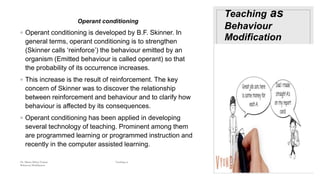
◦ Operant conditioning is developed by B.F. Skinner. In
general terms, operant conditioning is to strengthen
(Skinner calls ‘reinforce’) the behaviour emitted by an
organism (Emitted behaviour is called operant) so that
the probability of its occurrence increases.
◦ This increase is the result of reinforcement. The key
concern of Skinner was to discover the relationship
between reinforcement and behaviour and to clarify how
behaviour is affected by its consequences.
◦ Operant conditioning has been applied in developing
several technology of teaching. Prominent among them
are programmed learning or programmed instruction and
recently in the computer assisted learning.
Dr. Marwa Mekni-Toujani Teaching as
Behaviour Modification
Teaching as Behaviour Modification
Dr. Marwa Mekni-Toujani Teaching as Behaviour Modification
Teaching as
Behaviour
Modification
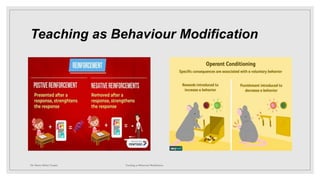
◦ Positive reinforcement (reward): the
presentation of pleasant stimulus
followed by an emitted behaviour which
strengthens the occurrence of the
behaviour.
◦ Examples?
Dr. Marwa Mekni-Toujani Teaching as Behaviour Modification
Teaching as
Behaviour
Modification
◦ Negative reinforcement (Relief) occurs
when removal of an aversive or
unpleasant stimulus following an
emitted behaviour strengthens the
occurrence of the behaviour.
◦ Examples?
Dr. Marwa Mekni-Toujani Teaching as Behaviour Modification
Teaching as
Behaviour
Modification
◦ Punishment is not reinforcement.
Punishment is about either by
presenting a painful stimulus or by
removing a pleasant stimulus which
invariably causes painful feelings, both
physical and emotional, in students.
◦ Examples?
Dr. Marwa Mekni-Toujani Teaching as Behaviour Modification
How Could Behaviour
Modification Be
Applied in Teaching?
Behaviour modification approach has made us
aware of relevance of several common classroom
practices as given below:
◦ Repetition is important for learning follows from
all theories of behaviour modification.
◦ Repetition without reinforcement does not
enhance learning.
◦ Variations in presenting the reinforcers help
modification of behaviour.
◦ Punishment is not very effective for eliminating
undesirable behaviour.
◦ Interest in work and in improvement is
conducive to learning.
Dr. Marwa Mekni-Toujani Teaching as Behaviour Modification
Teaching as
Behaviour
Modification
Group Work
Activity
What do you think is the teacher’s role in the
Behaviour Modification Approach?
Dr. Marwa Mekni-Toujani Teaching as Behaviour Modification
References
Pieces of information mentioned in these slides are
adopted from
https://nios.ac.in/media/documents/dled/Block1_
502.pdf
Dr. Marwa Mekni-Toujani Teaching as Behaviour Modification

Teaching as Behaviour Modification

  • 1.
    EDUC 101 – Teaching Methodology1 Chapter : Teaching Theories Teaching as Behaviour Modification Dr. Marwa Mekni Toujani Al Yamamah University Dr. Marwa Mekni-Toujani Teaching as Behaviour Modification
  • 2.
    Activity 1 What comesto your mind when someone asks, ‘What is teaching?’ Dr. Marwa Mekni-Toujani Teaching as Behaviour Modification
  • 3.
    Activity 2 Traditional Classroomvs. Modern Classroom Dr. Marwa Mekni-Toujani Teaching as Behaviour Modification
  • 4.
    Activity 3 Review: Whatis Teaching? Dr. Marwa Mekni-Toujani Teaching as Behaviour Modification
  • 5.
    Teaching as Behaviour Modification ◦Behaviour is different for different persons. ◦ Behavious could be defined as: ◦ The sum total of all the personality traits or characteristics that an individual possesses ◦ The observable actions that an individual demonstrates. ◦ The behaviour modification approach to teaching is based on the second belief. ◦ When we change or modify the observable behaviour of a child, we are directly or indirectly trying to help child to learn. Dr. Marwa Mekni-Toujani Teaching as Behaviour Modification
  • 6.
    Teaching as BehaviourModification Types of Observable Behavious ◦ Elicited behaviour ◦ Emitted behaviour Dr. Marwa Mekni-Toujani Teaching as Behaviour Modification
  • 7.
    Teaching as BehaviourModification Types of Observable Behavious ◦ Elicited behaviour or Emitted behaviour? A. we are trying to elicit or draw out the behaviour from the child. For example, when we make child run by offering a chocolate, we are trying to --------------------------or draw out the ehaviour of running from the child. B. On some occasions you might have experienced that an individual without any visible external cause demonstrates a particular behaviour normally you had not noticed earlier in him/her. A. ---------------------------- B. ----------------------------------------- Dr. Marwa Mekni-Toujani Teaching as Behaviour Modification
  • 8.
    Teaching as BehaviourModification Examples of Emitted Behaviours ◦ A little child humming an unknown sweet tune ◦ A student solves a difficult problem in an unusual method ◦ A girl demonstrates a dance pose which was not taught in her dance class Dr. Marwa Mekni-Toujani Teaching as Behaviour Modification
  • 9.
    Teaching as BehaviourModification So what is behviour modification? Dr. Marwa Mekni-Toujani Teaching as Behaviour Modification
  • 10.
    Teaching as BehaviourModification When a child is made to demonstrate these two observable behaviours, i.e. elicited and emitted, as normal occurring behaviours, then we say that the behaviour modification has taken place in the child. Dr. Marwa Mekni-Toujani Teaching as Behaviour Modification
  • 11.
    Teaching as BehaviourModification “So howdoes BehaviourModification happen?” Dr. Marwa Mekni-Toujani Teaching as Behaviour Modification
  • 12.
    Teaching as BehaviourModification ◦ There are two phases for the modification to occur: 1. Phase 1 is concerned with making sure the elicited or emitted Behaviours occur again and again as and when required 2. Phase 2 is to continue the process of modification to refine the existing and acquired behaviours to acquire more and more new behaviours. Dr. Marwa Mekni-Toujani Teaching as Behaviour Modification
  • 13.
    Teaching as Behaviour Modification Conditioning ◦ Psychologistsname the process of habituating the child (or for that matter any organism, human being, or animal) to repeat and modify both the types of behaviours. ◦ 2 Types depending on 2 types of behaviours: ◦ Classical conditioning: Conditioning of elicited behaviours. ◦ Operant conditioning: Conditioning the emitted behaviours. Dr. Marwa Mekni-Toujani Teaching as Behaviour Modification
  • 14.
    Teaching as Behaviour Modification Classical conditioning ◦Ivan Pavlov noticed that in his laboratory, hungry dogs began to salivate when they were about to be fed, even before they could see or smell the food. ◦ This simple observation led Pavlov to a series of carefully designed experiments involving ringing of a bell or sounding a buzzer –neither of which ordinarily leads to salivation - and immediately presenting dogs with food, a stimulus that does lead to salivation. ◦ After considerable number of such combined presentations of sounding of bell and then food, the dogs salivated with sounding of the bell even if food is not presented. Dr. Marwa Mekni-Toujani Teaching as Behaviour Modification
  • 15.
    Teaching as Behaviour Modification Operant conditioning ◦Operant conditioning is developed by B.F. Skinner. In general terms, operant conditioning is to strengthen (Skinner calls ‘reinforce’) the behaviour emitted by an organism (Emitted behaviour is called operant) so that the probability of its occurrence increases. ◦ This increase is the result of reinforcement. The key concern of Skinner was to discover the relationship between reinforcement and behaviour and to clarify how behaviour is affected by its consequences. ◦ Operant conditioning has been applied in developing several technology of teaching. Prominent among them are programmed learning or programmed instruction and recently in the computer assisted learning. Dr. Marwa Mekni-Toujani Teaching as Behaviour Modification
  • 16.
    Teaching as BehaviourModification Dr. Marwa Mekni-Toujani Teaching as Behaviour Modification
  • 17.
    Teaching as Behaviour Modification ◦ Positivereinforcement (reward): the presentation of pleasant stimulus followed by an emitted behaviour which strengthens the occurrence of the behaviour. ◦ Examples? Dr. Marwa Mekni-Toujani Teaching as Behaviour Modification
  • 18.
    Teaching as Behaviour Modification ◦ Negativereinforcement (Relief) occurs when removal of an aversive or unpleasant stimulus following an emitted behaviour strengthens the occurrence of the behaviour. ◦ Examples? Dr. Marwa Mekni-Toujani Teaching as Behaviour Modification
  • 19.
    Teaching as Behaviour Modification ◦ Punishmentis not reinforcement. Punishment is about either by presenting a painful stimulus or by removing a pleasant stimulus which invariably causes painful feelings, both physical and emotional, in students. ◦ Examples? Dr. Marwa Mekni-Toujani Teaching as Behaviour Modification
  • 20.
    How Could Behaviour ModificationBe Applied in Teaching? Behaviour modification approach has made us aware of relevance of several common classroom practices as given below: ◦ Repetition is important for learning follows from all theories of behaviour modification. ◦ Repetition without reinforcement does not enhance learning. ◦ Variations in presenting the reinforcers help modification of behaviour. ◦ Punishment is not very effective for eliminating undesirable behaviour. ◦ Interest in work and in improvement is conducive to learning. Dr. Marwa Mekni-Toujani Teaching as Behaviour Modification
  • 21.
    Teaching as Behaviour Modification Group Work Activity Whatdo you think is the teacher’s role in the Behaviour Modification Approach? Dr. Marwa Mekni-Toujani Teaching as Behaviour Modification
  • 22.
    References Pieces of informationmentioned in these slides are adopted from https://nios.ac.in/media/documents/dled/Block1_ 502.pdf Dr. Marwa Mekni-Toujani Teaching as Behaviour Modification