Teaching and Learning Poster: Levers to facilitate learning.pdf
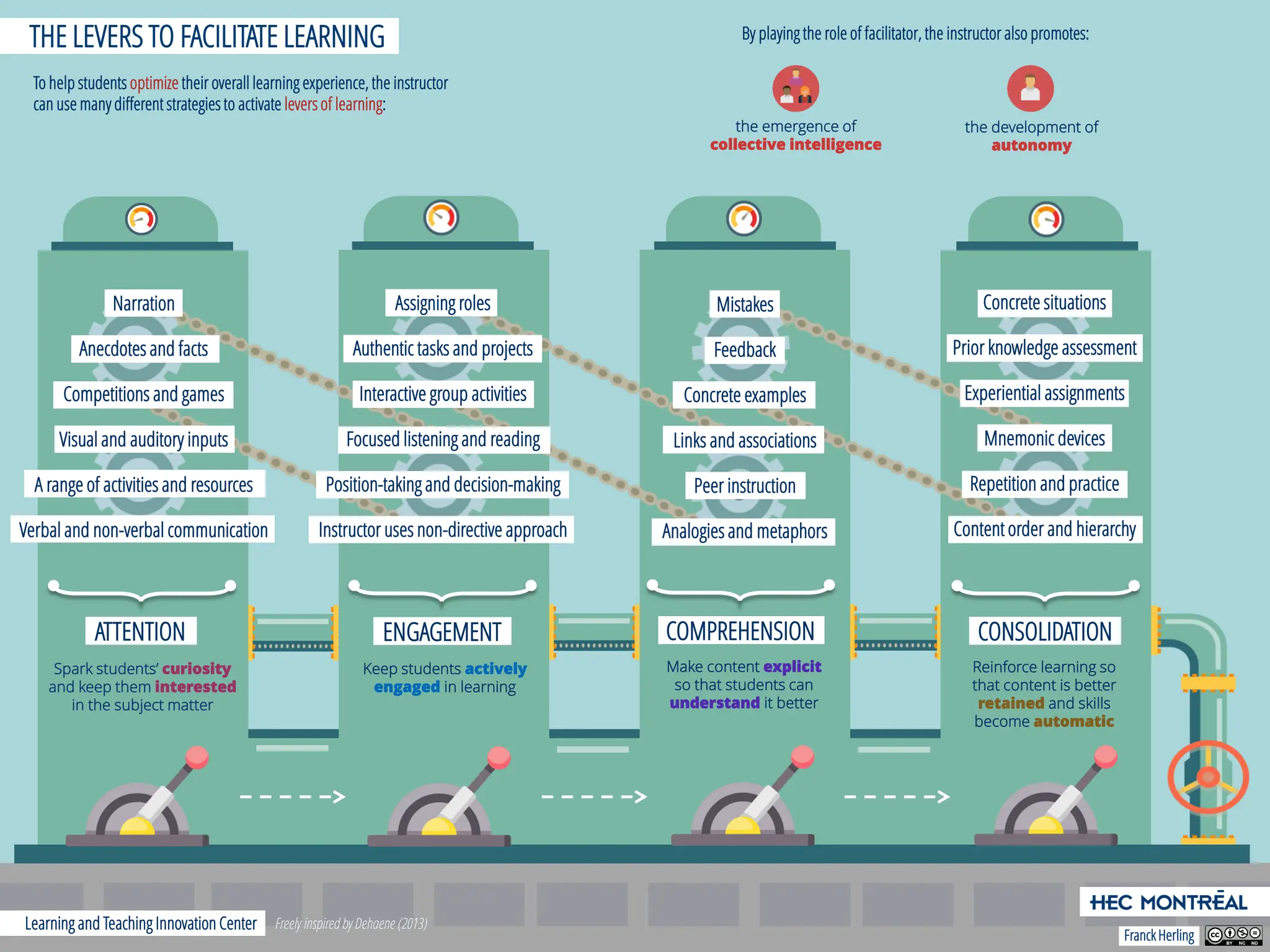
Levers to facilitate learning include strategies that enhance attention, understanding, engagement, and retention by actively involving students in the learning process.
Teaching and Learning Poster: Levers to facilitate learning.pdf
1.
THE LEVERS TOFACILITATE LEARNING
11
Learning and Teaching Innovation Center
To help students optimize their overall learning experience, the instructor
can use many different strategies to activate levers of learning:
CONSOLIDATION
COMPREHENSION
ENGAGEMENT
By playing the role of facilitator, the instructor also promotes:
Spark students’ curiosity
and keep them interested
in the subject matter
Keep students actively
engaged in learning
Make content explicit
so that students can
understand it better
Reinforce learning so
that content is better
retained and skills
become automatic
ATTENTION
the development of
autonomy
Franck Herling
Assigning roles
Authentic tasks and projects
Interactive group activities
Focused listening and reading
Position-taking and decision-making
Instructor uses non-directive approach
Mistakes
Feedback
Concrete examples
Links and associations
Peer instruction
Analogies and metaphors
Concrete situations
Prior knowledge assessment
Experiential assignments
Mnemonic devices
Repetition and practice
Content order and hierarchy
Narration
Anecdotes and facts
Competitions and games
Visual and auditory inputs
A range of activities and resources
Verbal and non-verbal communication
the emergence of
collective intelligence
Freely inspired by Dehaene (2013)