TEACHINGANDEXPLAINING
VOCABULARY
➢ Jenny Arizmendi
➢ María Fernanda Arias
➢ Paula Chiquiza.
LEARNING FROM TEACHING ACTIVITIES
★ What is the learning goal of the activity?
★ What psychological conditions does the activity use to help reach the
learning goal?
★ What are the observable signs that learning might occur?
★ What are the design features of the activity which set up the conditions
for learning?
REPETITION AND LEARNING
• The spacing
repetition
• Types of
repetition
• Noticing
• Retrieval
• generation
• The number
of repetitions
COMMUNICATING MEANINGcCOMMUNICATIVE MEANING
➢Speaking
➢Writing
Skills...
HELPING LEARNERS COMPREHEND AND
LEARN FROM DEFINITIONS
1. Provide clear, simple, brief
explanations of meaning.
2. Draw attention to the
generalizable underlying
meaning of a word.
3. Give repeated attention to
words.
4. Help learners recognise
definitions.
5. Prioritise what should be explained
about particular words.
6. Help learners remember what is
explained.
7. Avoid interference from related words
SPENDING TIME ON WORDS
RICH INSTRUCTION
RICH INSTRUCTION
ARGUMENTS AGAINST RICH INSTRUCTION
❖ Many words to teach.
❖ Learn about each word.
❖ Vocabulary, knowledge.
❖ Other ways of increasing vocabulary.
PROVIDING RICH
INSTRUCTION
SPOKEN FORM & WRITTEN FORM
SPOKEN FORM AND WRITTEN FORM
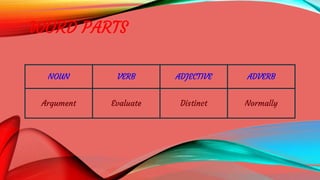
WORD PARTS
NOUN VERB ADJECTIVE ADVERB
Argument Evaluate Distinct Normally
STRENGTHENING THE
FORM – MEANING
CONNECTION
CONCEPT AND REFERENTS
CONCEPTANDREFERENTS
• Associations
• Grammar
• Collocation
• Vocabulary teaching procedures
COMPUTER – ASSISTED
VOCABULARY LEARNING
RESEARCH ON CAVL
REFERENCE
Michael H. Long and Jack C. Richards, 2001,
Learning vocabulary in another language,
I.S.P Nation.

Teaching and explaining vocabulary.pptx