PUT READING FIRST
The Research Building Blocks for
Teaching Children to Read
Kindergarten-3rd
Grade
Second Edition, June 2003
Published by the National Institute for Literacy
Research Criteria
• Achievement data was evident in one or
more reading skills
• Generalizable data over a large population
• Examine the effectiveness of an approach
• High Quality research
5 Areas of Reading Instruction
• Phonemic Awareness
• Phonics
• Fluency
• Vocabulary
• Text Comprehension
PHONEMIC
AWARENESS
Phonemic Awareness Instruction
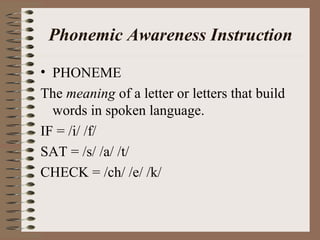
• PHONEME
The meaning of a letter or letters that build
words in spoken language.
IF = /i/ /f/
SAT = /s/ /a/ /t/
CHECK = /ch/ /e/ /k/
Phonemic Awareness Instruction
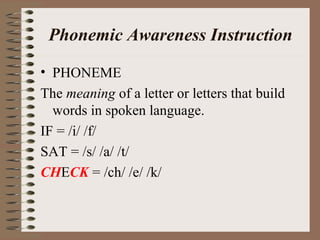
• PHONEME
The meaning of a letter or letters that build
words in spoken language.
IF = /i/ /f/
SAT = /s/ /a/ /t/
CHECK = /ch/ /e/ /k/
Phonemic Awareness Instruction
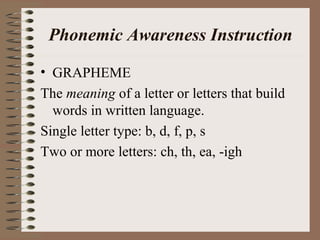
• GRAPHEME
The meaning of a letter or letters that build
words in written language.
Single letter type: b, d, f, p, s
Two or more letters: ch, th, ea, -igh
Phonemic Awareness Instruction
• PHONICS
A predictable relationship between
phonemes and graphemes
Phonemic Awareness Instruction
• PHONEMIC AWARENESS
Ability to hear, identify, and manipulate
the individual sounds in spoken words
Phonemic Awareness Instruction
• PHONOLOGICAL AWARENESS
A broad term that includes phonemic
awareness, rhymes, words, syllables,
onsets, and rimes
Phonemic Awareness Instruction
What has the research taught us about it?
That phonemic awareness can be taught
and learned.
Some examples how …
Phonemic Awareness Instruction
PHONEME ISOLATION
Recognizing the first sound in a word:
Q: “What is the first sound in van?”
A: “The first sound in van is /v/.”
Phonemic Awareness Instruction
PHONEME IDENTITY
Recognizing the same sound in different words:
Q: “What sound is the same in fix, fall, and
flat?”
A: “The first sound /f/ is the same.”
Phonemic Awareness Instruction
PHONEME SEGMENTATION
Breaking words down into separate sounds, then
reading and/or writing them out.
Q: “How many sounds in the word grab?”
A: “Four sounds.”
Q: “Identify the sounds and say them together.”
A: “/g/ /r/ /a/ /b/ … grab.”
Phonemic Awareness Instruction
Other Instructional Strategies:
Phoneme Categorization
Phoneme Blending
Phoneme Deletion
Phoneme Addition
Phonemic Awareness Instruction
What has the research also taught us about
it?
That it helps students to be successful
readers!
That it helps students to be successful
spellers!
Phonemic Awareness Instruction
What has the research also taught us about
it?
It is effective when letters of the alphabet
are used to manipulate phonemes.
It is effective when instruction focuses on
only 1-2 types of phoneme manipulation,
rather than several.
PHONICS
Phonics Instruction
• Graphophonemic relationships
• Letter-sound relationships
• Letter-sound correspondences
• Sound-symbol correspondences
• Sound-spellings
Phonics Instruction
• Critics believe that the inherent
irregularities of the English language
renders phonic instruction ineffective.
Students have to memorize phone for
foan, for example.
Phonics Instruction
• Systematic and explicit instruction vs. non-
systematic and no instruction
Which more effectively ensures student
success?
Systematic and explicit instruction
Phonics Instruction
• Synthetic Phonics
• Analytic Phonics
• Analogy-based Phonics
• Spelling-based Phonics
• Embedded Phonics
• Onset-Rime Phonics
SOME INSTRUCTIONAL APPROACHES
Phonics Instruction
• Improve word recognition and spelling among
K-1 students
• Improve reading comprehension
• Be effective for students of diverse SES
• Be effective for students with present and
possibly future reading difficulties
• Be most effective via early introduction
Research shows that
Systematic and Explicit Instruction can:
Phonics Instruction
The research also shows that Phonics
Instruction should not be the entire
program for teaching students, that a
range of activities and strategies
should be implemented, such as
reading aloud, sustained silent
reading, plus writing letters, words,
messages, and stories.
Characteristics of
Effective Phonics Instruction Programs
• Systematic & explicit
instruction exclusively.
• Students understand the
purpose of connecting
letters and sounds.
• Students apply their new
knowledge of phonics as
they read and write on
their own.
• They can be adapted to
individual student’s needs
based on assessment data
• Includes alphabetic
knowledge, phonemic
awareness, vocabulary
development, and text
reading.
Characteristics of Non-Systematic
Phonics Instruction Programs
• Literature-based programs that emphasize
reading and writing activities.
• Basal reading programs that emphasize whole-
language based activities, with limited letter-
sound instruction.
• Sight-word vocabulary building from a list of 50
to 100 words
FLUENCY
Characteristics of More Fluent Readers
• Instant word recognition while reading
silently or orally.
• Oral reading sounds natural and expressive
• Can better focus attention on making new
connections among the ideas in the text
and their own prior knowledge
Characteristics of Less Fluent Readers
• Must focus their attention on decoding
unfamiliar words
• Text comprehension difficulties
• Lacking in self-confidence
• Oral reading sounds choppy and plodding
What does the research
say about Fluency Instruction?
• Two major approaches investigated
1. Repeated Oral Reading
2. Independent Silent Reading
SSR, DEAR
What does the research
say about Fluency Instruction?
• Repeated Oral Reading improves fluency
and overall reading achievement
• Rereading a text passage four times is
recommended to achieve fluency
• Audiotapes, tutors, peer guidance are
useful aids for oral reading practice
What does the research
say about Fluency Instruction?
• No evidence can confirm that instructional
time spent on independent silent reading
with minimal guidance and supervision
improves fluency and overall reading
performance
• No evidence can confirm that it can’t help
improve fluency and overall reading
performance, either.
How can a teacher help their
students with Fluency Instruction?
• Teacher modeling fluent reading technique
• Have students orally reread the same
passages with guidance
• Reading to students also increases
knowledge
Oral Rereading Strategies
• Student-adult reading
• Choral Reading
• Tape assisted Reading
• Partner Reading
• Readers Theater
Assessing Fluency Instruction
• Calculating rate of words correct per
minute (WCRM)
• Total Words Read minus Errors = WCRM
• Informal Reading Inventory (IRI)
• Miscue Analysis
• Formative assessments (observations,
journals)
VOCABULARY
Vocabulary Instruction
• Two Categories of Vocabulary
– Written--recognized in print
– Oral--recognized by listening
• Vocabulary a building block for effective
reading
• Emerging readers connect words they hear
to words they read in print
• Reading cannot be successful without
vocabulary recognition
Vocabulary Instruction
• Types of Vocabulary
– Listening—words we need to know to
understand what we hear
– Speaking—the words we use when we speak
– Reading—the words we need to know to
understand what we read
– Writing—words we use for writing
What does the research say about
Vocabulary Instruction?
• Most vocabulary is learned
indirectly
• Some vocabulary is learned
directly
What does the research say about
Vocabulary Instruction?
• Students learn indirectly in three ways:
– They engage in oral language
– They listen to adults reading to the them
– They read extensively on their own
What does the research say about
Vocabulary Instruction?
• Students learn directly by:
– Word Learning Strategies—learning the
meanings of words without being told directly
what they mean.
• Use of dictionaries or other reference aids
(Thesaurus, glossaries) to increase knowledge of
word meanings
• Using word parts to figure out meanings of words
in text
• Using context clues to determine word meanings
Examples of Using Vocabulary
Instruction in the Classroom
• Using Word Parts
– Learning most common prefixes
(un-, re-,in-,dis-) and suffixes
(-less, -ful)
• Two thirds of all words in English language
have them
• Latin or Greek etymology
Examples of Using Vocabulary
Instruction in the Classroom
• Using Context Clues
– Common words or phrases (or “clues”) that
surround newer and more difficult words in a
passage, which help emerging readers to
understand their meaning in context
Examples of Using Vocabulary
Instruction in the Classroom
• What type of words should be taught?
– Important Words
– Useful Words
– Difficult Words
• Difficult Meaning Words
– Heteronyms—”sow” and “sow”
– Homonyms—”ray” and “ray”
Examples of Using Vocabulary
Instruction in the Classroom
• Three Levels of Word Recognition
– Unknown—the word is completely unfamiliar
and the definition is unknown
– Acquainted—the word is somewhat familiar
and there is basic idea of its definition
– Established—the word is very familiar and its
definition is immediately known and useable
Examples of Using Vocabulary
Instruction in the Classroom
• Developing “Word Consciousness”
– Student word play activities
• Puns
• Palindromes
• Etymology research
• Everyday Application and Usage
– “Environmental Print”
TEXT COMPREHENSION
Text Comprehension Instruction
• Characteristics of “Good Readers”
– They are purposeful—they read to gather new
information, to expand their thinking, to
enlighten or to entertain themselves
– They are active—they actively think while
they are reading and making connections
between new and prior knowledge. They are
broadening their vocabulary. They know the
strategies to decode unfamiliar words and
sentence structures.
What does the research say about
Text Comprehension Instruction?
• Six Methods to Improve Text
Comprehension
– Metacognition—Includes comprehension
monitoring, a continuous process during
reading, used to control and self-monitor
reading progress, making the reader aware of
what they know and what they don’t know.
They can identify and troubleshoot
comprehension problems as they are reading.
What does the research say about
Text Comprehension Instruction?
• Six Methods to Improve Text
Comprehension
– Graphic or Semantic Organizers—can take
the form of maps, webs, graphs, or charts.
Used to interconnect ideas or concepts.
• Helps students focus on text structure when
reading
• A visual tool to examine and represent
relationships in the text
• Helps in writing detailed summaries of the text
What does the research say about
Text Comprehension Instruction?
• Six Methods to Improve Text
Comprehension
– Answering Questions—Teachers ask their
readers questions about the text that
• Gives them a purpose for reading
• Focuses their attention on what they need to learn
• Encourages them to monitor their comprehension
• Helps readers connect new knowledge to prior
knowledge
• Helps students to think actively as they read
What does the research say about
Text Comprehension Instruction?
• Six Methods to Improve Text
Comprehension
– Generating Questions—Readers ask their
own questions, formed from information
drawn from different parts of the text. They
can then answer their questions if they
understand what they are reading.
• Readers can be taught to ask main idea questions
that relate to important information in the text.
What does the research say about
Text Comprehension Instruction?
• Six Methods to Improve Text
Comprehension
– Recognizing Story Structure—How events
that happen in a story are organized into a plot.
• Readers identify setting, characters, initiating
events, outcomes, and organize into the plot.
• Story maps or graphic organizers can help track
the plot of the story.
• Readers who recognize such elements develop a
greater appreciation for literature.
What does the research say about
Text Comprehension Instruction?
• Six Methods to Improve Text
Comprehension
– Summarizing—A synthesis of main ideas in a text. Its
purpose is to help readers condense information and
determine what’s most important about the text in
their own words. The readers should be able to…
• Identify or generate main ideas of the text
• Connect the main ideas of the text
• Eliminate redundant information
• Recall what they’ve read
What does the research say about
Text Comprehension Instruction?
• Effective comprehension strategy
instruction is explicit or direct.
• Some examples of effective
comprehension strategies that
teachers can use…
What does the research say about
Text Comprehension Instruction?
• Direct Explanation—Explanation as to
why a strategy helps comprehension.
• Modeling—Verbal demonstration of how
to apply the comprehension strategy.
• Guided Practice—Guiding and assisting in
the application of the comprehension
strategy.
• Application—Practicing the strategy until
students can apply it independently.
What does the research say about
Text Comprehension Instruction?
• Effective comprehension strategy instruction can
be implemented via cooperative groups
• Effective instruction helps readers use
comprehension strategies flexibly and in
combination with other strategies
– Asking questions about the text
– Summarizing parts of the text
– Clarifying parts of text that aren’t understood
– Making predictions about what comes next in the
story
What does the research say about
Text Comprehension Instruction?
• Other Effective Strategies
– Making Use of Prior Knowledge
• Connections between new and prior knowledge
helps comprehension.
– Using Mental Imagery
• Good readers visualize the story in their minds as
they read.
What does the research say about
Text Comprehension Instruction?
Teachers …. please note!
Not all comprehension strategies will work
for every type of text. Be sure to be flexible
in your approach if asked by a student to
assist them with even science or math text
comprehension questions.
This PowerPoint presentation was adapted from the publication:
PUT READING FIRST
The Research Building Blocks for
Teaching Children to Read
Kindergarten Through Third Grade
Second Edition, June 2003*
*Originally published by the National Institute for Literacy
WRITERS
Bonnie B. Armbruster, Ph.D.,
University of Illinois at Urbana-Champaign;
Jean Osborn, M. Ed.,
University of Illinois at Urbana-Champaign;
Fran Lehr
EDITOR
C. Ralph Adler,
RMC Research Corporation
The original text can be downloaded from
http://www.nifl.gov/partnershipforreading/publications/PFRbookletBW.pdf
(PDF)
http://www.nifl.gov/partnershipforreading/publications/reading_first1.html
(HTML)
PowerPoint presentation by
Mark A. Hauck
SPED 603: Assessment of Learning and Behavioral Problems
Dr. Katsafanas
Slippery Rock University
July 12, 2009

ReadingFirstv3

  • 1.
    PUT READING FIRST TheResearch Building Blocks for Teaching Children to Read Kindergarten-3rd Grade Second Edition, June 2003 Published by the National Institute for Literacy
  • 2.
    Research Criteria • Achievementdata was evident in one or more reading skills • Generalizable data over a large population • Examine the effectiveness of an approach • High Quality research
  • 3.
    5 Areas ofReading Instruction • Phonemic Awareness • Phonics • Fluency • Vocabulary • Text Comprehension
  • 4.
  • 5.
    Phonemic Awareness Instruction •PHONEME The meaning of a letter or letters that build words in spoken language. IF = /i/ /f/ SAT = /s/ /a/ /t/ CHECK = /ch/ /e/ /k/
  • 6.
    Phonemic Awareness Instruction •PHONEME The meaning of a letter or letters that build words in spoken language. IF = /i/ /f/ SAT = /s/ /a/ /t/ CHECK = /ch/ /e/ /k/
  • 7.
    Phonemic Awareness Instruction •GRAPHEME The meaning of a letter or letters that build words in written language. Single letter type: b, d, f, p, s Two or more letters: ch, th, ea, -igh
  • 8.
    Phonemic Awareness Instruction •PHONICS A predictable relationship between phonemes and graphemes
  • 9.
    Phonemic Awareness Instruction •PHONEMIC AWARENESS Ability to hear, identify, and manipulate the individual sounds in spoken words
  • 10.
    Phonemic Awareness Instruction •PHONOLOGICAL AWARENESS A broad term that includes phonemic awareness, rhymes, words, syllables, onsets, and rimes
  • 11.
    Phonemic Awareness Instruction Whathas the research taught us about it? That phonemic awareness can be taught and learned. Some examples how …
  • 12.
    Phonemic Awareness Instruction PHONEMEISOLATION Recognizing the first sound in a word: Q: “What is the first sound in van?” A: “The first sound in van is /v/.”
  • 13.
    Phonemic Awareness Instruction PHONEMEIDENTITY Recognizing the same sound in different words: Q: “What sound is the same in fix, fall, and flat?” A: “The first sound /f/ is the same.”
  • 14.
    Phonemic Awareness Instruction PHONEMESEGMENTATION Breaking words down into separate sounds, then reading and/or writing them out. Q: “How many sounds in the word grab?” A: “Four sounds.” Q: “Identify the sounds and say them together.” A: “/g/ /r/ /a/ /b/ … grab.”
  • 15.
    Phonemic Awareness Instruction OtherInstructional Strategies: Phoneme Categorization Phoneme Blending Phoneme Deletion Phoneme Addition
  • 16.
    Phonemic Awareness Instruction Whathas the research also taught us about it? That it helps students to be successful readers! That it helps students to be successful spellers!
  • 17.
    Phonemic Awareness Instruction Whathas the research also taught us about it? It is effective when letters of the alphabet are used to manipulate phonemes. It is effective when instruction focuses on only 1-2 types of phoneme manipulation, rather than several.
  • 18.
  • 19.
    Phonics Instruction • Graphophonemicrelationships • Letter-sound relationships • Letter-sound correspondences • Sound-symbol correspondences • Sound-spellings
  • 20.
    Phonics Instruction • Criticsbelieve that the inherent irregularities of the English language renders phonic instruction ineffective. Students have to memorize phone for foan, for example.
  • 21.
    Phonics Instruction • Systematicand explicit instruction vs. non- systematic and no instruction Which more effectively ensures student success? Systematic and explicit instruction
  • 22.
    Phonics Instruction • SyntheticPhonics • Analytic Phonics • Analogy-based Phonics • Spelling-based Phonics • Embedded Phonics • Onset-Rime Phonics SOME INSTRUCTIONAL APPROACHES
  • 23.
    Phonics Instruction • Improveword recognition and spelling among K-1 students • Improve reading comprehension • Be effective for students of diverse SES • Be effective for students with present and possibly future reading difficulties • Be most effective via early introduction Research shows that Systematic and Explicit Instruction can:
  • 24.
    Phonics Instruction The researchalso shows that Phonics Instruction should not be the entire program for teaching students, that a range of activities and strategies should be implemented, such as reading aloud, sustained silent reading, plus writing letters, words, messages, and stories.
  • 25.
    Characteristics of Effective PhonicsInstruction Programs • Systematic & explicit instruction exclusively. • Students understand the purpose of connecting letters and sounds. • Students apply their new knowledge of phonics as they read and write on their own. • They can be adapted to individual student’s needs based on assessment data • Includes alphabetic knowledge, phonemic awareness, vocabulary development, and text reading.
  • 26.
    Characteristics of Non-Systematic PhonicsInstruction Programs • Literature-based programs that emphasize reading and writing activities. • Basal reading programs that emphasize whole- language based activities, with limited letter- sound instruction. • Sight-word vocabulary building from a list of 50 to 100 words
  • 27.
  • 28.
    Characteristics of MoreFluent Readers • Instant word recognition while reading silently or orally. • Oral reading sounds natural and expressive • Can better focus attention on making new connections among the ideas in the text and their own prior knowledge
  • 29.
    Characteristics of LessFluent Readers • Must focus their attention on decoding unfamiliar words • Text comprehension difficulties • Lacking in self-confidence • Oral reading sounds choppy and plodding
  • 30.
    What does theresearch say about Fluency Instruction? • Two major approaches investigated 1. Repeated Oral Reading 2. Independent Silent Reading SSR, DEAR
  • 31.
    What does theresearch say about Fluency Instruction? • Repeated Oral Reading improves fluency and overall reading achievement • Rereading a text passage four times is recommended to achieve fluency • Audiotapes, tutors, peer guidance are useful aids for oral reading practice
  • 32.
    What does theresearch say about Fluency Instruction? • No evidence can confirm that instructional time spent on independent silent reading with minimal guidance and supervision improves fluency and overall reading performance • No evidence can confirm that it can’t help improve fluency and overall reading performance, either.
  • 33.
    How can ateacher help their students with Fluency Instruction? • Teacher modeling fluent reading technique • Have students orally reread the same passages with guidance • Reading to students also increases knowledge
  • 34.
    Oral Rereading Strategies •Student-adult reading • Choral Reading • Tape assisted Reading • Partner Reading • Readers Theater
  • 35.
    Assessing Fluency Instruction •Calculating rate of words correct per minute (WCRM) • Total Words Read minus Errors = WCRM • Informal Reading Inventory (IRI) • Miscue Analysis • Formative assessments (observations, journals)
  • 36.
  • 37.
    Vocabulary Instruction • TwoCategories of Vocabulary – Written--recognized in print – Oral--recognized by listening • Vocabulary a building block for effective reading • Emerging readers connect words they hear to words they read in print • Reading cannot be successful without vocabulary recognition
  • 38.
    Vocabulary Instruction • Typesof Vocabulary – Listening—words we need to know to understand what we hear – Speaking—the words we use when we speak – Reading—the words we need to know to understand what we read – Writing—words we use for writing
  • 39.
    What does theresearch say about Vocabulary Instruction? • Most vocabulary is learned indirectly • Some vocabulary is learned directly
  • 40.
    What does theresearch say about Vocabulary Instruction? • Students learn indirectly in three ways: – They engage in oral language – They listen to adults reading to the them – They read extensively on their own
  • 41.
    What does theresearch say about Vocabulary Instruction? • Students learn directly by: – Word Learning Strategies—learning the meanings of words without being told directly what they mean. • Use of dictionaries or other reference aids (Thesaurus, glossaries) to increase knowledge of word meanings • Using word parts to figure out meanings of words in text • Using context clues to determine word meanings
  • 42.
    Examples of UsingVocabulary Instruction in the Classroom • Using Word Parts – Learning most common prefixes (un-, re-,in-,dis-) and suffixes (-less, -ful) • Two thirds of all words in English language have them • Latin or Greek etymology
  • 43.
    Examples of UsingVocabulary Instruction in the Classroom • Using Context Clues – Common words or phrases (or “clues”) that surround newer and more difficult words in a passage, which help emerging readers to understand their meaning in context
  • 44.
    Examples of UsingVocabulary Instruction in the Classroom • What type of words should be taught? – Important Words – Useful Words – Difficult Words • Difficult Meaning Words – Heteronyms—”sow” and “sow” – Homonyms—”ray” and “ray”
  • 45.
    Examples of UsingVocabulary Instruction in the Classroom • Three Levels of Word Recognition – Unknown—the word is completely unfamiliar and the definition is unknown – Acquainted—the word is somewhat familiar and there is basic idea of its definition – Established—the word is very familiar and its definition is immediately known and useable
  • 46.
    Examples of UsingVocabulary Instruction in the Classroom • Developing “Word Consciousness” – Student word play activities • Puns • Palindromes • Etymology research • Everyday Application and Usage – “Environmental Print”
  • 47.
  • 48.
    Text Comprehension Instruction •Characteristics of “Good Readers” – They are purposeful—they read to gather new information, to expand their thinking, to enlighten or to entertain themselves – They are active—they actively think while they are reading and making connections between new and prior knowledge. They are broadening their vocabulary. They know the strategies to decode unfamiliar words and sentence structures.
  • 49.
    What does theresearch say about Text Comprehension Instruction? • Six Methods to Improve Text Comprehension – Metacognition—Includes comprehension monitoring, a continuous process during reading, used to control and self-monitor reading progress, making the reader aware of what they know and what they don’t know. They can identify and troubleshoot comprehension problems as they are reading.
  • 50.
    What does theresearch say about Text Comprehension Instruction? • Six Methods to Improve Text Comprehension – Graphic or Semantic Organizers—can take the form of maps, webs, graphs, or charts. Used to interconnect ideas or concepts. • Helps students focus on text structure when reading • A visual tool to examine and represent relationships in the text • Helps in writing detailed summaries of the text
  • 51.
    What does theresearch say about Text Comprehension Instruction? • Six Methods to Improve Text Comprehension – Answering Questions—Teachers ask their readers questions about the text that • Gives them a purpose for reading • Focuses their attention on what they need to learn • Encourages them to monitor their comprehension • Helps readers connect new knowledge to prior knowledge • Helps students to think actively as they read
  • 52.
    What does theresearch say about Text Comprehension Instruction? • Six Methods to Improve Text Comprehension – Generating Questions—Readers ask their own questions, formed from information drawn from different parts of the text. They can then answer their questions if they understand what they are reading. • Readers can be taught to ask main idea questions that relate to important information in the text.
  • 53.
    What does theresearch say about Text Comprehension Instruction? • Six Methods to Improve Text Comprehension – Recognizing Story Structure—How events that happen in a story are organized into a plot. • Readers identify setting, characters, initiating events, outcomes, and organize into the plot. • Story maps or graphic organizers can help track the plot of the story. • Readers who recognize such elements develop a greater appreciation for literature.
  • 54.
    What does theresearch say about Text Comprehension Instruction? • Six Methods to Improve Text Comprehension – Summarizing—A synthesis of main ideas in a text. Its purpose is to help readers condense information and determine what’s most important about the text in their own words. The readers should be able to… • Identify or generate main ideas of the text • Connect the main ideas of the text • Eliminate redundant information • Recall what they’ve read
  • 55.
    What does theresearch say about Text Comprehension Instruction? • Effective comprehension strategy instruction is explicit or direct. • Some examples of effective comprehension strategies that teachers can use…
  • 56.
    What does theresearch say about Text Comprehension Instruction? • Direct Explanation—Explanation as to why a strategy helps comprehension. • Modeling—Verbal demonstration of how to apply the comprehension strategy. • Guided Practice—Guiding and assisting in the application of the comprehension strategy. • Application—Practicing the strategy until students can apply it independently.
  • 57.
    What does theresearch say about Text Comprehension Instruction? • Effective comprehension strategy instruction can be implemented via cooperative groups • Effective instruction helps readers use comprehension strategies flexibly and in combination with other strategies – Asking questions about the text – Summarizing parts of the text – Clarifying parts of text that aren’t understood – Making predictions about what comes next in the story
  • 58.
    What does theresearch say about Text Comprehension Instruction? • Other Effective Strategies – Making Use of Prior Knowledge • Connections between new and prior knowledge helps comprehension. – Using Mental Imagery • Good readers visualize the story in their minds as they read.
  • 59.
    What does theresearch say about Text Comprehension Instruction? Teachers …. please note! Not all comprehension strategies will work for every type of text. Be sure to be flexible in your approach if asked by a student to assist them with even science or math text comprehension questions.
  • 60.
    This PowerPoint presentationwas adapted from the publication: PUT READING FIRST The Research Building Blocks for Teaching Children to Read Kindergarten Through Third Grade Second Edition, June 2003* *Originally published by the National Institute for Literacy WRITERS Bonnie B. Armbruster, Ph.D., University of Illinois at Urbana-Champaign; Jean Osborn, M. Ed., University of Illinois at Urbana-Champaign; Fran Lehr EDITOR C. Ralph Adler, RMC Research Corporation
  • 61.
    The original textcan be downloaded from http://www.nifl.gov/partnershipforreading/publications/PFRbookletBW.pdf (PDF) http://www.nifl.gov/partnershipforreading/publications/reading_first1.html (HTML) PowerPoint presentation by Mark A. Hauck SPED 603: Assessment of Learning and Behavioral Problems Dr. Katsafanas Slippery Rock University July 12, 2009

Editor's Notes

  • #2 The purpose of this study, funded by the U.S. Department of Education, is to address the concerns of legislators, school administrators, teachers, and parents by considering the long term consequences of reading failure and its impact on students’ future academic success, self-confidence, and self-motivation. The research focused on students between the key developmental years of kindergarten through third grade, where the foundation of literacy skills is built. This powerpoint presentation will provide an overview of the research conclusions. At the end of this presentation, you will be provided with information on how to access the complete on-line text of the report.
  • #3 Non-peer reviewed books and articles used in studies were exclused from consideration
  • #4 Text comprehension instruction teaches students to think about and understand what they are reading. The next section of this presentation will review each of the five skill areas to provide greater detail about the skill, including effective strategies, and instructional implications.
  • #6 The word CHECK is comprised of three phonemes.
  • #7 Sometimes, a phoneme can be made up of two letters, as in CH and CK in the word CHECK.
  • #8 Grapheme represents the meaning of individual sounds in a written word
  • #10 Phonemic awareness
  • #16 Phoneme addition is the opposite strategy, adding a sound to a previous word, such as adding /s/ to “park” to get “spark.”
  • #17 Phonemic awareness instruction has been scientifically proven to increase students’ ability to spell words by allowing them to break down words into individual sounds and recognizing those sounds. Students see the relationship between the letters and sounds.
  • #18 Phonemic awareness instruction has been scientifically proven to increase students’ ability to spell words by allowing them to break down words into individual sounds and recognizing those sounds. Students see the relationship between the letters and sounds.
  • #20 Phonics is the connection or relationship between phonemes (sounds) of oral language and graphemes (letters) of written language. When students make this connection, they are able to read and write words successfully. Reading teachers can use the following terms to describe this relationship between phonemes and graphemes.
  • #21 However, most of these irregular words contain enough regular sound-letter relationships to make word decoding reasonably successful.
  • #22 According to to the research, systematic and explicit instruction contributes more to student success in reading vs. a curriculum that is non-systematic or entirely absent. A systemic program teaches letter-sound relationships in a clearly defined sequence These programs provide an abundance of materials that students use to reinforce what they’ve learned, such as texts and stories that contain large numbers of words to read and decode.
  • #23 Onset-Rime Phonics teach how to first identify the onsets and rimes that wrap around vowels in monosyllabic words.
  • #24 Again, systemic and explicit instruction works better than non-systemic or no phonics instruction at all, especially among the key age group of kindergarten through first grade, where reading is first taught.
  • #28 Fluency provides the bridge between word recognition and comprehension. With more skilled fluency, a reader does not have to concentrate on decoding unfamiliar words in the text. Less skilled fluent readers struggle with comprehension from spending all their effort decoding. Fluency is not a stage of development where readers are able to read everything at the same level. Even a fluent reader can experience difficulty reading unfamiliar text that has more difficult words that require some extra time to initially decode.
  • #29 Fluency provides the bridge between word recognition and comprehension. With more skilled fluency, a reader does not have to concentrate on decoding unfamiliar words in the text. Less skilled fluent readers struggle with comprehension from spending all their effort decoding.
  • #30 Fluency provides the bridge between word recognition and comprehension. With more skilled fluency, a reader does not have to concentrate on decoding unfamiliar words in the text. Less skilled fluent readers struggle with comprehension from spending all their effort decoding.
  • #31 Independent silent reading encourages students to read and comprehend on their own with minimal supervision. SSR is Silent Sustained Reading. DEAR is Drop Everything and Read, two popular independent reading activities used in the classroom
  • #32 Repeated Oral Reading provides instant teacher feedback and improves word recognition, reading speed, accuracy, and comprehension. It is an effective strategy for readers of all ages.
  • #34 Teachers can read a variety of books on different topics that can also expand knowledge aside from the modeling exercise.
  • #35 Students work in a cooperative group and create a script based on the book the group has read. The script is then performed by the students before an audience of other students. This activity offers another opportunity for students to express themselves with language.
  • #36 Students can maintain a daily journal to record their thoughts and ideas about what they are learning, in addition to being a place for stories to be written.
  • #38 There are two types of vocabulary, written and oral. Written vocabulary is what we recognize in print. Oral vocabulary is what we recognize by listening.
  • #41 The more students read on their own, the more words they will encounter and become familiar with.
  • #42 The more students read on their own, the more words they will encounter and become familiar with.
  • #45 Homonyms- words that are spelled and pronounced the same, but have different meanings “ray” – (r-long a) – an aquatic animal “ray” – (r-long a) – a narrow beam of light “ray” – (r-long a) – a part of a line
  • #47 Environmental print – words found in signs, billboards, advertisements, banners, product packaging, etc