Teacher Leader Development
Framework
Lloyd Yeo
St Gabriel’s Secondary School
25 June 2015
Premise 1: Teachers typically define career satisfaction in terms of their ability to
be of service to others and make a difference in the lives of their students
(McLaughlin & Lee, 1988)
Premise 2: Teachers usually do not subscribe to traditional definitions of
leadership as "higher" or "superior" positions within the organizational hierarchy
(Devaney, 1987).
Premise 3: Instead, teachers view leadership as a collaborative effort, a "banding
together" with other teachers to promote professional development and growth
and the improvement of educational services (Troen & Boles, 1992).
Conclusion: Teacher Leadership are dispositions and skills demonstrated by
teachers who teach students but also have an influence beyond their own
classrooms. It also entails mobilizing and energizing others with the goal of
improving the school’s performance in terms of teaching and learning for the
benefit of student learning. (Lieberman & Miller, 2011)
What is a Teacher Leader?
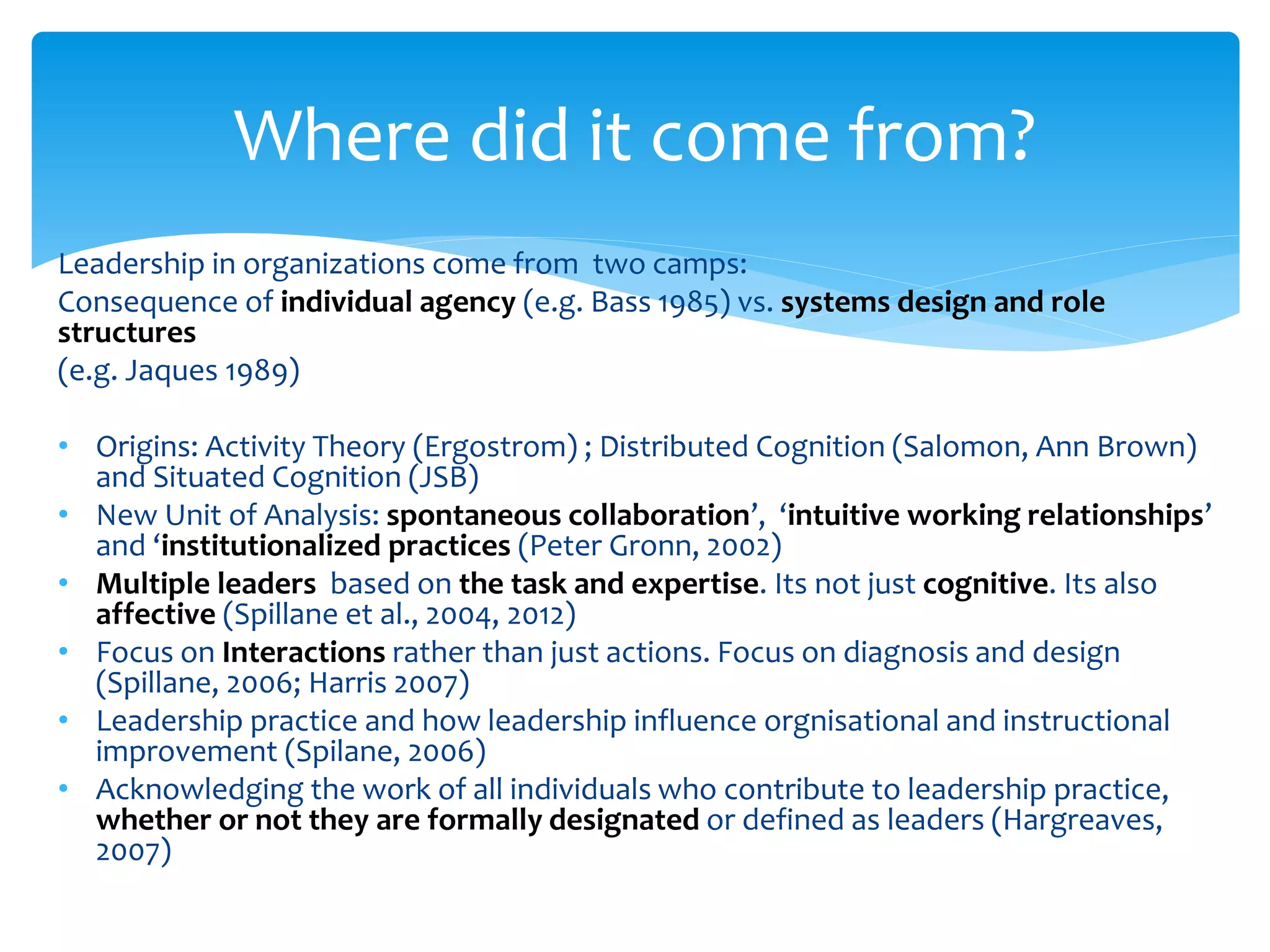
Leadership in organizations come from two camps:
Consequence of individual agency (e.g. Bass 1985) vs. systems design and role
structures
(e.g. Jaques 1989)
• Origins: Activity Theory (Ergostrom) ; Distributed Cognition (Salomon, Ann Brown)
and Situated Cognition (JSB)
• New Unit of Analysis: spontaneous collaboration’, ‘intuitive working relationships’
and ‘institutionalized practices (Peter Gronn, 2002)
• Multiple leaders based on the task and expertise. Its not just cognitive. Its also
affective (Spillane et al., 2004, 2012)
• Focus on Interactions rather than just actions. Focus on diagnosis and design
(Spillane, 2006; Harris 2007)
• Leadership practice and how leadership influence orgnisational and instructional
improvement (Spilane, 2006)
• Acknowledging the work of all individuals who contribute to leadership practice,
whether or not they are formally designated or defined as leaders (Hargreaves,
2007)
Where did it come from?
Methodology: Stage 1. Facilitation and collation of stories
Groups No. of
participan
ts
Stories and Common Threads
Group 1 N=6 1. Spy Story
Group 2 N=14 2. Baptism by Fire
3. My Mentor wasn’t my Mentor
Group 3 N= 11 4. Experienced Teachers need Mentoring too
Group 4 N = 10 5. Don’t Assume we know the Small Things
Group 5 N=12 6. M for Mentoring and ‘Monster Class’.
7. Ka Boom! You Stepped On A Land Mine
Group 6
BTs and UTs
N=11 8. S**t Happens
Group 7
AEDs and Trs
N=7 9. Communication Bug
Group 8
Sch EXCO
N=10 10. Lead through your action and don’t expect results
11. No Chink In Your Armour
N=81
Methodology: Stage 2: Coding for Personnel Quallities and
Dispositions in Teacher Leaders
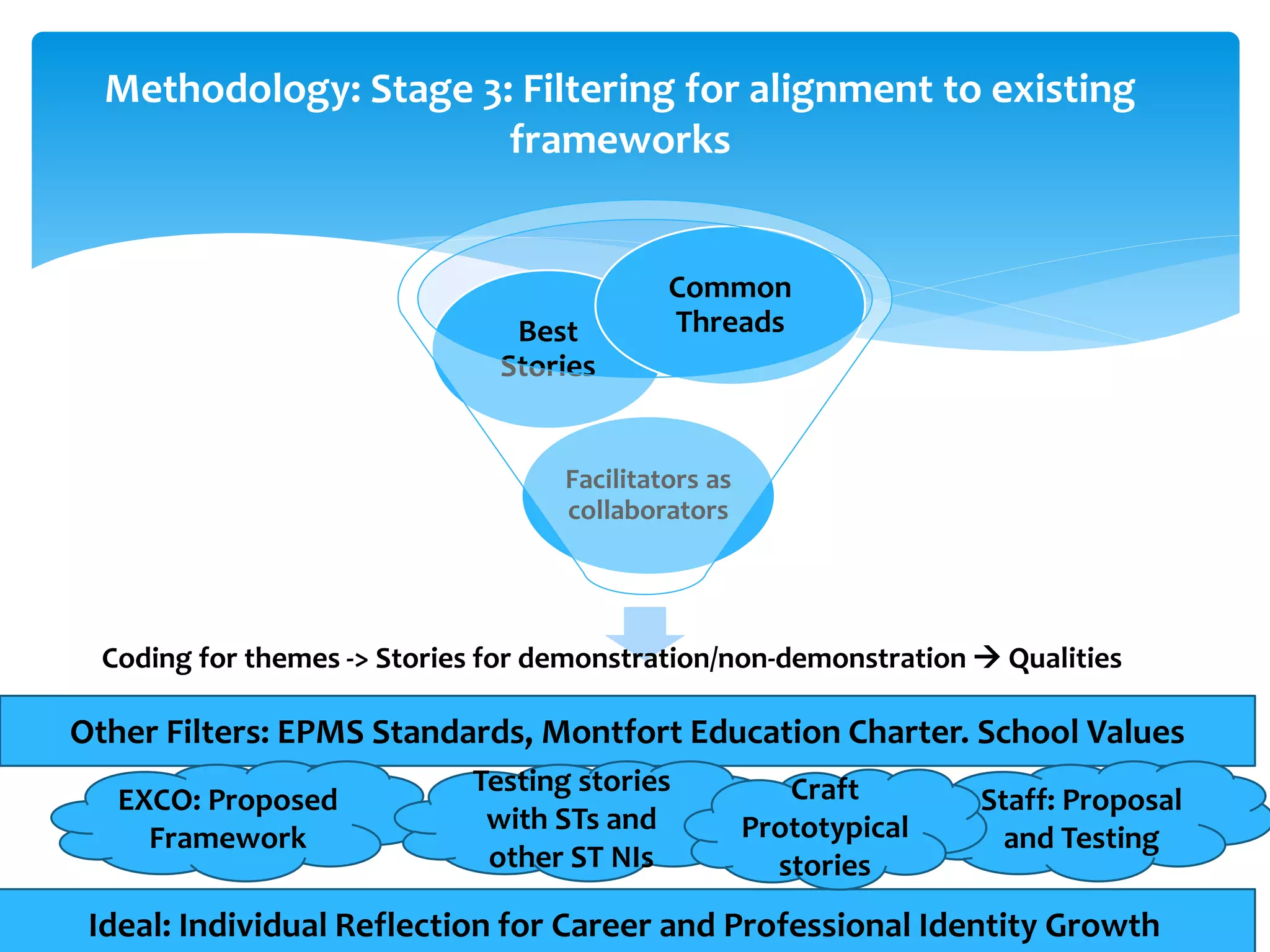
Methodology: Stage 3: Filtering for alignment to existing
frameworks
Coding for themes -> Stories for demonstration/non-demonstration  Qualities
Facilitators as
collaborators
Best
Stories
Common
Threads
Other Filters: EPMS Standards, Montfort Education Charter. School Values
EXCO: Proposed
Framework
Staff: Proposal
and Testing
Testing stories
with STs and
other ST NIs
Ideal: Individual Reflection for Career and Professional Identity Growth
Craft
Prototypical
stories
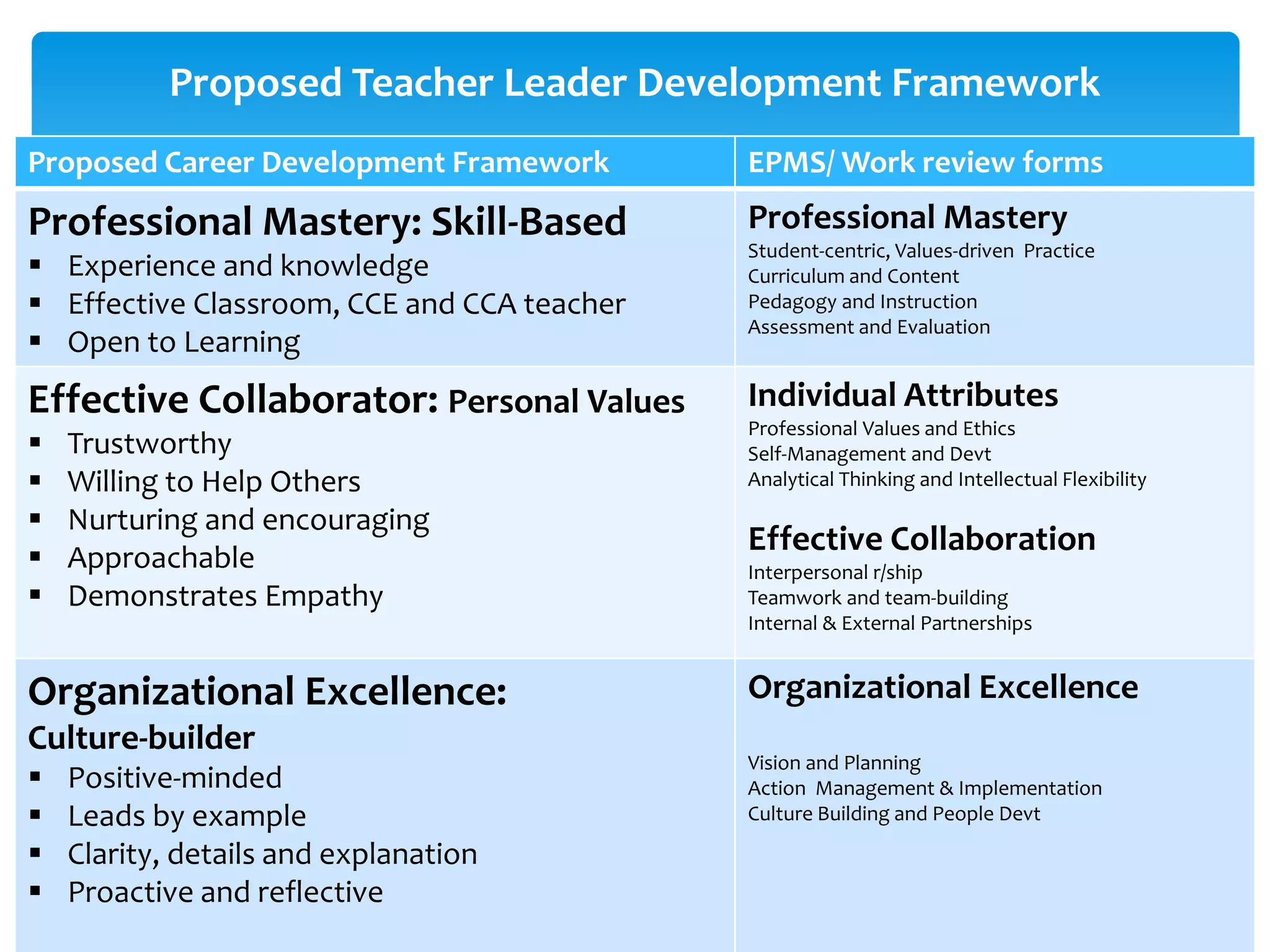
Proposed Teacher Leader Development Framework
Proposed Career Development Framework EPMS/ Work review forms
Professional Mastery: Skill-Based
 Experience and knowledge
 Effective Classroom, CCE and CCA teacher
 Open to Learning
Professional Mastery
Student-centric, Values-driven Practice
Curriculum and Content
Pedagogy and Instruction
Assessment and Evaluation
Effective Collaborator: Personal Values
 Trustworthy
 Willing to Help Others
 Nurturing and encouraging
 Approachable
 Demonstrates Empathy
Individual Attributes
Professional Values and Ethics
Self-Management and Devt
Analytical Thinking and Intellectual Flexibility
Effective Collaboration
Interpersonal r/ship
Teamwork and team-building
Internal & External Partnerships
Organizational Excellence:
Culture-builder
 Positive-minded
 Leads by example
 Clarity, details and explanation
 Proactive and reflective
Organizational Excellence
Vision and Planning
Action Management & Implementation
Culture Building and People Devt
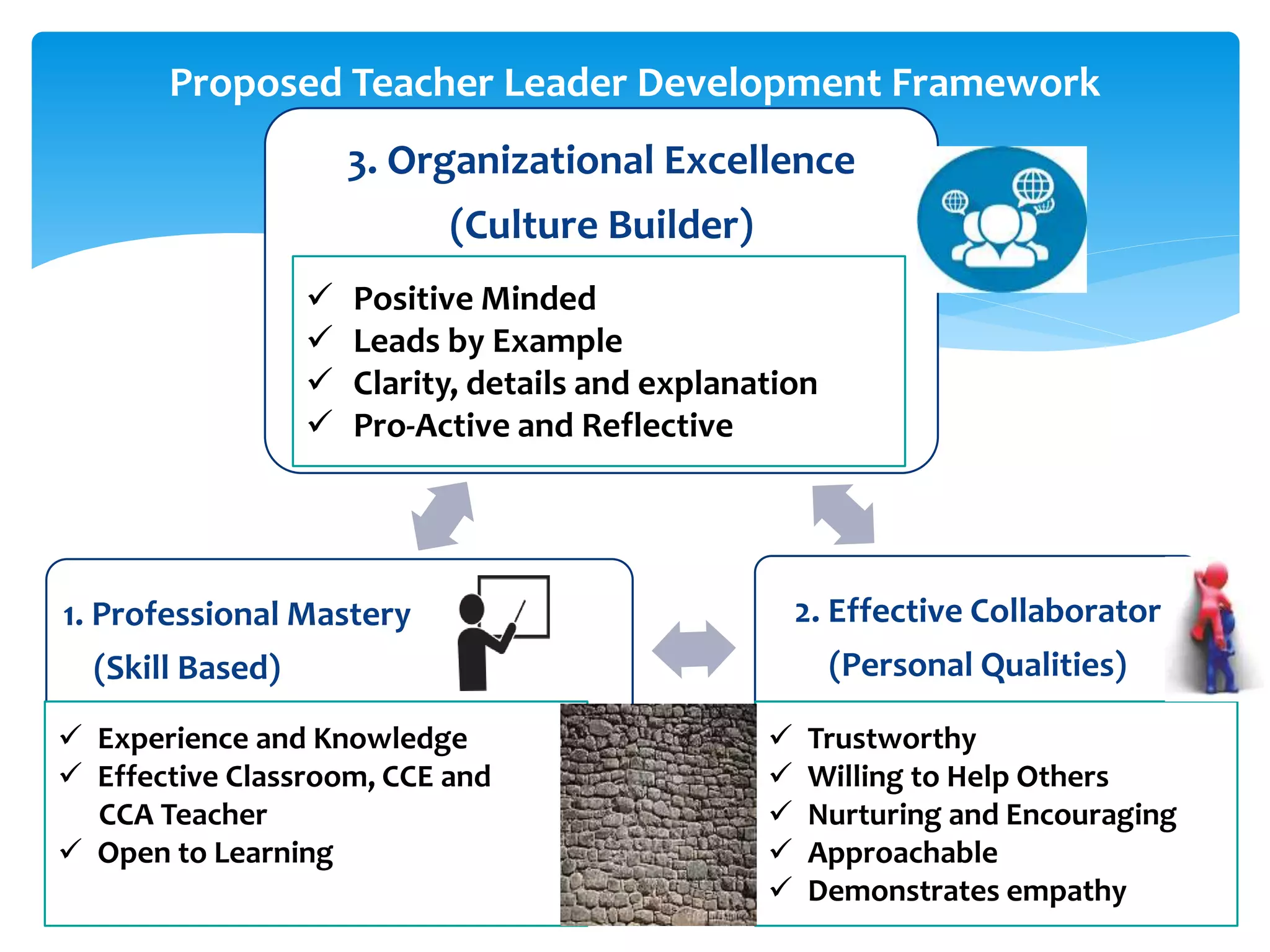
3. Organizational Excellence
(Culture Builder)
2. Effective Collaborator
(Personal Qualities)
1. Professional Mastery
(Skill Based)
:
 Experience and Knowledge
 Effective Classroom, CCE and
CCA Teacher
 Open to Learning
 Trustworthy
 Willing to Help Others
 Nurturing and Encouraging
 Approachable
 Demonstrates empathy
 Positive Minded
 Leads by Example
 Clarity, details and explanation
 Pro-Active and Reflective
Proposed Teacher Leader Development Framework
Three Stories: A Synopsis
Professional Master:
Experienced Teachers Need
Mentoring Too
Effective Collaborator:
Monster Experiences
TP Posted
Organizational Excellence:
Leading by Examples but S**T
happens

Teacher Leader Framework

  • 1.
    Teacher Leader Development Framework LloydYeo St Gabriel’s Secondary School 25 June 2015
  • 2.
    Premise 1: Teacherstypically define career satisfaction in terms of their ability to be of service to others and make a difference in the lives of their students (McLaughlin & Lee, 1988) Premise 2: Teachers usually do not subscribe to traditional definitions of leadership as "higher" or "superior" positions within the organizational hierarchy (Devaney, 1987). Premise 3: Instead, teachers view leadership as a collaborative effort, a "banding together" with other teachers to promote professional development and growth and the improvement of educational services (Troen & Boles, 1992). Conclusion: Teacher Leadership are dispositions and skills demonstrated by teachers who teach students but also have an influence beyond their own classrooms. It also entails mobilizing and energizing others with the goal of improving the school’s performance in terms of teaching and learning for the benefit of student learning. (Lieberman & Miller, 2011) What is a Teacher Leader?
  • 3.
    Leadership in organizationscome from two camps: Consequence of individual agency (e.g. Bass 1985) vs. systems design and role structures (e.g. Jaques 1989) • Origins: Activity Theory (Ergostrom) ; Distributed Cognition (Salomon, Ann Brown) and Situated Cognition (JSB) • New Unit of Analysis: spontaneous collaboration’, ‘intuitive working relationships’ and ‘institutionalized practices (Peter Gronn, 2002) • Multiple leaders based on the task and expertise. Its not just cognitive. Its also affective (Spillane et al., 2004, 2012) • Focus on Interactions rather than just actions. Focus on diagnosis and design (Spillane, 2006; Harris 2007) • Leadership practice and how leadership influence orgnisational and instructional improvement (Spilane, 2006) • Acknowledging the work of all individuals who contribute to leadership practice, whether or not they are formally designated or defined as leaders (Hargreaves, 2007) Where did it come from?
  • 4.
    Methodology: Stage 1.Facilitation and collation of stories Groups No. of participan ts Stories and Common Threads Group 1 N=6 1. Spy Story Group 2 N=14 2. Baptism by Fire 3. My Mentor wasn’t my Mentor Group 3 N= 11 4. Experienced Teachers need Mentoring too Group 4 N = 10 5. Don’t Assume we know the Small Things Group 5 N=12 6. M for Mentoring and ‘Monster Class’. 7. Ka Boom! You Stepped On A Land Mine Group 6 BTs and UTs N=11 8. S**t Happens Group 7 AEDs and Trs N=7 9. Communication Bug Group 8 Sch EXCO N=10 10. Lead through your action and don’t expect results 11. No Chink In Your Armour N=81
  • 5.
    Methodology: Stage 2:Coding for Personnel Quallities and Dispositions in Teacher Leaders
  • 6.
    Methodology: Stage 3:Filtering for alignment to existing frameworks Coding for themes -> Stories for demonstration/non-demonstration  Qualities Facilitators as collaborators Best Stories Common Threads Other Filters: EPMS Standards, Montfort Education Charter. School Values EXCO: Proposed Framework Staff: Proposal and Testing Testing stories with STs and other ST NIs Ideal: Individual Reflection for Career and Professional Identity Growth Craft Prototypical stories
  • 7.
    Proposed Teacher LeaderDevelopment Framework Proposed Career Development Framework EPMS/ Work review forms Professional Mastery: Skill-Based  Experience and knowledge  Effective Classroom, CCE and CCA teacher  Open to Learning Professional Mastery Student-centric, Values-driven Practice Curriculum and Content Pedagogy and Instruction Assessment and Evaluation Effective Collaborator: Personal Values  Trustworthy  Willing to Help Others  Nurturing and encouraging  Approachable  Demonstrates Empathy Individual Attributes Professional Values and Ethics Self-Management and Devt Analytical Thinking and Intellectual Flexibility Effective Collaboration Interpersonal r/ship Teamwork and team-building Internal & External Partnerships Organizational Excellence: Culture-builder  Positive-minded  Leads by example  Clarity, details and explanation  Proactive and reflective Organizational Excellence Vision and Planning Action Management & Implementation Culture Building and People Devt
  • 8.
    3. Organizational Excellence (CultureBuilder) 2. Effective Collaborator (Personal Qualities) 1. Professional Mastery (Skill Based) :  Experience and Knowledge  Effective Classroom, CCE and CCA Teacher  Open to Learning  Trustworthy  Willing to Help Others  Nurturing and Encouraging  Approachable  Demonstrates empathy  Positive Minded  Leads by Example  Clarity, details and explanation  Pro-Active and Reflective Proposed Teacher Leader Development Framework
  • 9.
    Three Stories: ASynopsis Professional Master: Experienced Teachers Need Mentoring Too Effective Collaborator: Monster Experiences TP Posted Organizational Excellence: Leading by Examples but S**T happens

Editor's Notes

  • #7 Theoretical basis for this is that all educational innovation is examined through 3 lenses – technology, cultural and political (McQuillian and House: 1998). Technology refers to issues of time and space, roles and responsibilities, skills and procedure. Culture refers to communication, understanding, values and beliefs, Trust. Political refers to allocations, distributions and dynamics of power, interplay of different interests within educational change.