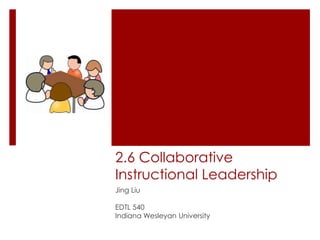
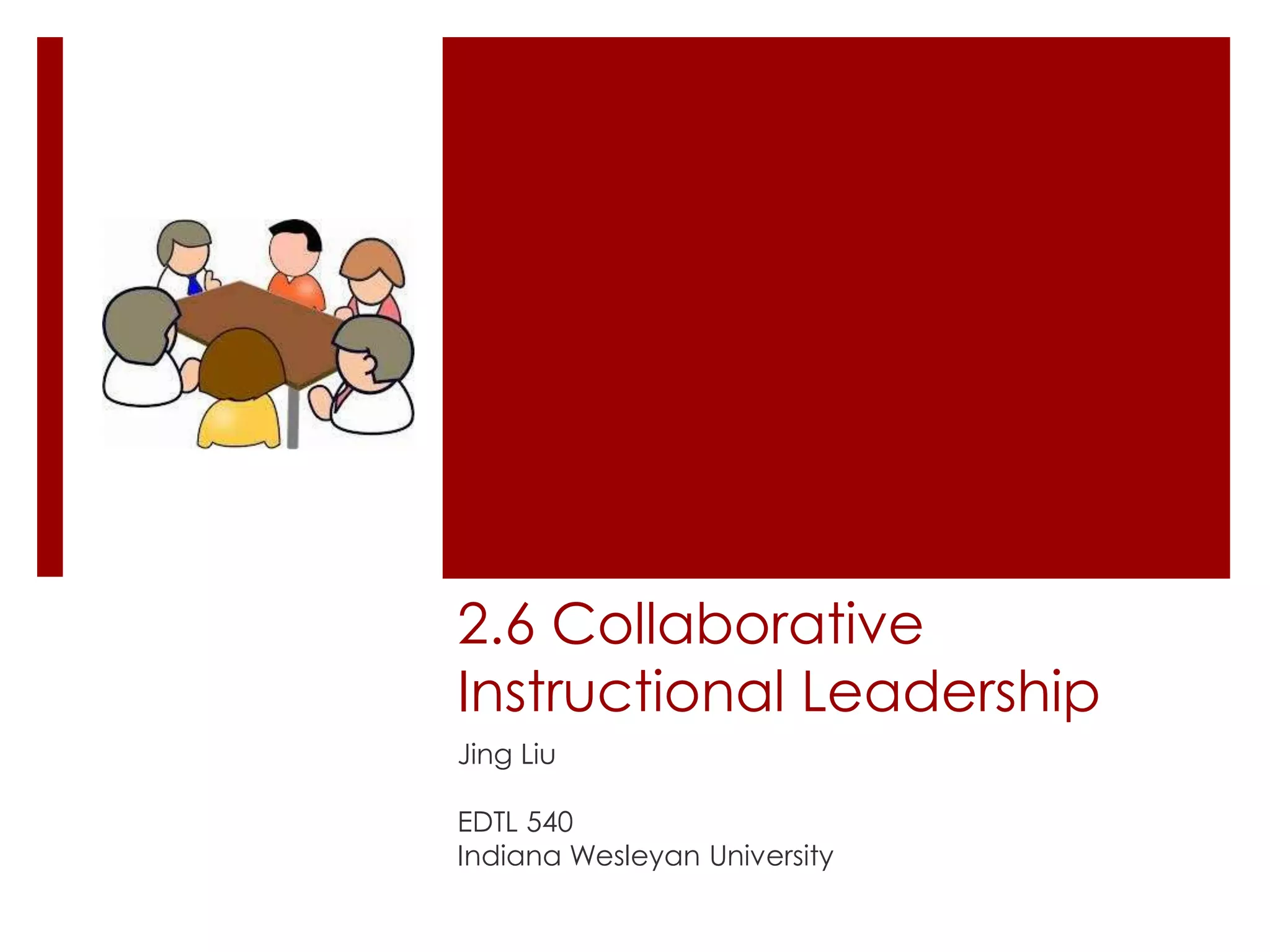
2.6 Collaborative 
Instructional Leadership 
Jing Liu 
EDTL 540 
Indiana Wesleyan University
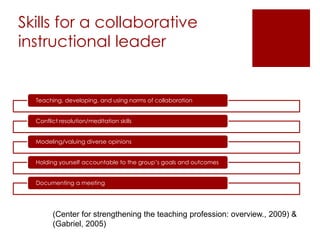
Skills for a collaborative 
instructional leader 
Teaching, developing, and using norms of collaboration 
Conflict resolution/meditation skills 
Modeling/valuing diverse opinions 
Holding yourself accountable to the group’s goals and outcomes 
Documenting a meeting 
(Center for strengthening the teaching profession: overview., 2009) & 
(Gabriel, 2005)
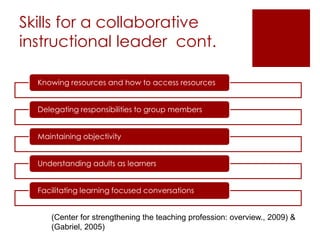
Skills for a collaborative 
instructional leader cont. 
Knowing resources and how to access resources 
Delegating responsibilities to group members 
Maintaining objectivity 
Understanding adults as learners 
Facilitating learning focused conversations 
(Center for strengthening the teaching profession: overview., 2009) & 
(Gabriel, 2005)
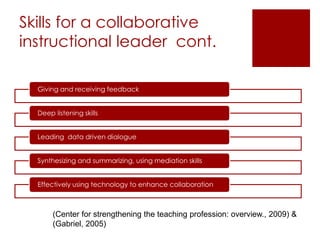
Skills for a collaborative 
instructional leader cont. 
Giving and receiving feedback 
Deep listening skills 
Leading data driven dialogue 
Synthesizing and summarizing, using mediation skills 
Effectively using technology to enhance collaboration 
(Center for strengthening the teaching profession: overview., 2009) & 
(Gabriel, 2005)
Specific behaviors for a 
collaborative instructional 
leader 
• Engaging in team building: It is essential that teacher leader 
implements team-building and trust-building activities. The team 
should embrace diverse thinking and trusting which drives 
everyone journey toward a common goal. (Gabriel, 2005) 
• Creating an atmosphere of mutual trust. Teachers who work in 
trusting environments have a basis for inquiry and reflection into 
their own practice. The trusting environments allow teachers to take 
risks, challenge and critique each other, and collectively solve 
tough problems. (Berry, 2009) 
• Supporting the team: The teachers need to feel supported, and 
they need to believe that they are supported. Teacher leader should 
let them know that they are not in it alone, that the teacher leader 
have their back. (Gabriel, 2005)
Specific behaviors for a 
collaborative instructional 
leader cont. 
• Emphasizing staff development:Teacher leader should provide 
meaningful professional development tailored to school needs as 
well as to individual needs. (Gabriel, 2005) 
• Providing opportunities for peer learning among teachers in 
order to build collective expertise: When teachers learn with and 
from one another, they can focus on what most directly improves 
student learning. (Berry, 2009) 
• Being a Data coach: Teacher leader can lead conversations that 
engage other teachers in analyzing and using data information to 
strengthen instruction. (Harrison & Killion, 2007)
Specific behaviors for a 
collaborative instructional 
leader cont. 
• Aligning collaboration structures for both horizontal and 
vertical collaboration. The horizontal collaboration helps teachers 
coordinate specific organizational needs across the grade level, 
however, the vertical collaboration enables the teachers to see the 
curriculum is aligned up and down the grade levels. (Berry, 2009) 
• Scheduling adequate time for collaboration. Teacher leader 
should make the schedules aligned to allow for common planning 
time. (Berry, 2009) 
• Mediating conflicts: Teacher leader will be handling and 
overcoming problematic situations that arise in the department. 
(Gabriel, 2005)
General Stakeholders for 
Collaborative Inquiry 
• Superintendent of ISC 
• TIS Admin. Team 
• TIS School board 
• TIS admission director 
• TIS PFO(Parent Faulty Organization) 
• Heads of each department
Possible stakeholders 
Question: 
How can instruction at Tianjin International School be improved so 
that overseas Chinese students achieve the best Chinese learning 
in an international school? 
Possible stakeholders: 
• TIS Admin. Team 
• TIS admission director 
• Head of Chinese Department 
• Chinese language teachers 
• Teaching assistant of Chinese department 
• Chinese parents Liaison
Reference 
 Berry, B., Daughtrey, A., Wieder, A., & Center for Teaching, Q. 
(2009). Collaboration: Closing the Effective Teaching Gap. 
Center For Teaching Quality. 
 Center for strengthening the teaching profession: overview. (2009) 
Retrieved from http://cstp-wa.org/cstp2013/wp-content/ 
uploads/2014/06/Teacher-Leadership-Framework.pdf 
 Gabriel, J. G. (2005). How to Thrive As a Teacher Leader. 
Alexandria, Va: Association for Supervision and Curriculum 
Development. 
 Harrison, C., & Killion, J. (2007). Ten Roles for Teacher Leaders. 
Educational Leadership, 65(1), 74-77.

collaborative inquiry

  • 1.
    2.6 Collaborative InstructionalLeadership Jing Liu EDTL 540 Indiana Wesleyan University
  • 2.
    Skills for acollaborative instructional leader Teaching, developing, and using norms of collaboration Conflict resolution/meditation skills Modeling/valuing diverse opinions Holding yourself accountable to the group’s goals and outcomes Documenting a meeting (Center for strengthening the teaching profession: overview., 2009) & (Gabriel, 2005)
  • 3.
    Skills for acollaborative instructional leader cont. Knowing resources and how to access resources Delegating responsibilities to group members Maintaining objectivity Understanding adults as learners Facilitating learning focused conversations (Center for strengthening the teaching profession: overview., 2009) & (Gabriel, 2005)
  • 4.
    Skills for acollaborative instructional leader cont. Giving and receiving feedback Deep listening skills Leading data driven dialogue Synthesizing and summarizing, using mediation skills Effectively using technology to enhance collaboration (Center for strengthening the teaching profession: overview., 2009) & (Gabriel, 2005)
  • 5.
    Specific behaviors fora collaborative instructional leader • Engaging in team building: It is essential that teacher leader implements team-building and trust-building activities. The team should embrace diverse thinking and trusting which drives everyone journey toward a common goal. (Gabriel, 2005) • Creating an atmosphere of mutual trust. Teachers who work in trusting environments have a basis for inquiry and reflection into their own practice. The trusting environments allow teachers to take risks, challenge and critique each other, and collectively solve tough problems. (Berry, 2009) • Supporting the team: The teachers need to feel supported, and they need to believe that they are supported. Teacher leader should let them know that they are not in it alone, that the teacher leader have their back. (Gabriel, 2005)
  • 6.
    Specific behaviors fora collaborative instructional leader cont. • Emphasizing staff development:Teacher leader should provide meaningful professional development tailored to school needs as well as to individual needs. (Gabriel, 2005) • Providing opportunities for peer learning among teachers in order to build collective expertise: When teachers learn with and from one another, they can focus on what most directly improves student learning. (Berry, 2009) • Being a Data coach: Teacher leader can lead conversations that engage other teachers in analyzing and using data information to strengthen instruction. (Harrison & Killion, 2007)
  • 7.
    Specific behaviors fora collaborative instructional leader cont. • Aligning collaboration structures for both horizontal and vertical collaboration. The horizontal collaboration helps teachers coordinate specific organizational needs across the grade level, however, the vertical collaboration enables the teachers to see the curriculum is aligned up and down the grade levels. (Berry, 2009) • Scheduling adequate time for collaboration. Teacher leader should make the schedules aligned to allow for common planning time. (Berry, 2009) • Mediating conflicts: Teacher leader will be handling and overcoming problematic situations that arise in the department. (Gabriel, 2005)
  • 8.
    General Stakeholders for Collaborative Inquiry • Superintendent of ISC • TIS Admin. Team • TIS School board • TIS admission director • TIS PFO(Parent Faulty Organization) • Heads of each department
  • 9.
    Possible stakeholders Question: How can instruction at Tianjin International School be improved so that overseas Chinese students achieve the best Chinese learning in an international school? Possible stakeholders: • TIS Admin. Team • TIS admission director • Head of Chinese Department • Chinese language teachers • Teaching assistant of Chinese department • Chinese parents Liaison
  • 10.
    Reference  Berry,B., Daughtrey, A., Wieder, A., & Center for Teaching, Q. (2009). Collaboration: Closing the Effective Teaching Gap. Center For Teaching Quality.  Center for strengthening the teaching profession: overview. (2009) Retrieved from http://cstp-wa.org/cstp2013/wp-content/ uploads/2014/06/Teacher-Leadership-Framework.pdf  Gabriel, J. G. (2005). How to Thrive As a Teacher Leader. Alexandria, Va: Association for Supervision and Curriculum Development.  Harrison, C., & Killion, J. (2007). Ten Roles for Teacher Leaders. Educational Leadership, 65(1), 74-77.