THE TEN COMMANDMENTSTHE TEN COMMANDMENTS
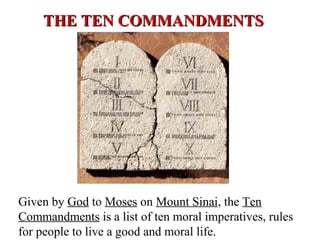
Given by God to Moses on Mount Sinai, the Ten
Commandments is a list of ten moral imperatives, rules
for people to live a good and moral life.
1.acquisition – the act of getting something
2.blasphemy – any act of disrespect against God
or anything sacred, including church, the Bible,
and prayer
3.bribery – giving something valuable to someone
in order to influence them
4.chaste – morally pure and modest
5.covet – to want something that is not yours
TERMS:TERMS:
1. culpable – responsible for a wrong action; deserving
of blame
2. detraction - putting a person down; lowering a
person’s esteem or reputation; saying negative things
about a person’s character
3. discretion – wise judgment; the ability to act
responsibly
4. euthanasia – “mercy killing” – ending a person’s life
because they are sick
5. idolatry – the worship of a false god
11. impure – obscene, offensive, immodest
12. modesty – appropriateness in speech, dress,
and behavior
13. negligence – neglect or carelessness
14. oath – a sacred promise; calling on God as
a witness to a vow
15. perjury – giving false or misleading
testimony; breaking an oath
16. rash – done in haste, without thought
17. reverently - with deep respect and love
18. sacrilege – desecration, misuse, or theft of something
sacred
19. spitefulness – any act that aims to hurt or humiliate
someone
20. superstition – the belief that something unrelated to
an event will change its outcome; turning to something
other than God to guide your actions
Exodus 20:1-17Exodus 20:1-17
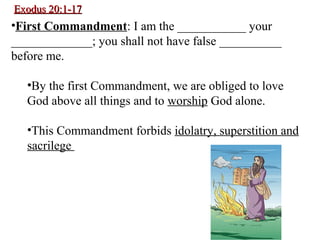
•First Commandment: I am the ___________ your
_____________; you shall not have false __________
before me.
•By the first Commandment, we are obliged to love
God above all things and to worship God alone.
•This Commandment forbids idolatry, superstition and
sacrilege
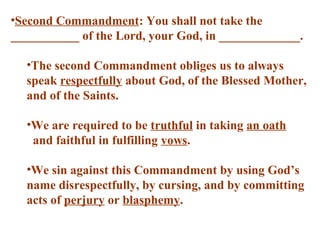
•Second Commandment: You shall not take the
___________ of the Lord, your God, in _____________.
•The second Commandment obliges us to always
speak respectfully about God, of the Blessed Mother,
and of the Saints.
•We are required to be truthful in taking an oath
and faithful in fulfilling vows.
•We sin against this Commandment by using God’s
name disrespectfully, by cursing, and by committing
acts of perjury or blasphemy.
•Third Commandment: Remember to keep
_________ the _________ ________
•We are required to worship God on Sundays and
Holy Days by participating in Mass. Sunday is set
aside as a special day because of a tradition
handed down from the Apostles; it should be a day
of rest and joy.
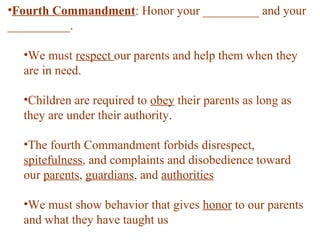
•Fourth Commandment: Honor your _________ and your
__________.
•We must respect our parents and help them when they
are in need.
•Children are required to obey their parents as long as
they are under their authority.
•The fourth Commandment forbids disrespect,
spitefulness, and complaints and disobedience toward
our parents, guardians, and authorities
•We must show behavior that gives honor to our parents
and what they have taught us
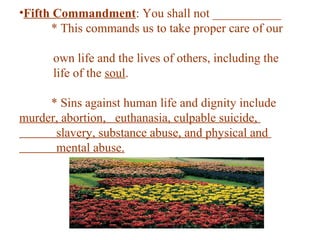
•Fifth Commandment: You shall not ___________
* This commands us to take proper care of our
own life and the lives of others, including the
life of the soul.
* Sins against human life and dignity include
murder, abortion, euthanasia, culpable suicide,
slavery, substance abuse, and physical and
mental abuse.
•Sixth Commandment: You shall not commit
_________________
•The sixth Commandment forbids impure acts.
We are called to live a chaste life, according to
our particular stage of life.
•This means abstaining from sex before
marriage, and for married people to be faithful to
their spouse.
•Seventh Commandment: You shall not
______________
•This Commandment forbids stealing and robbery,
unjust acquisition of goods, and reckless
destruction of things that do not belong to you.
This includes cheating, negligence in work, and
bribery.
•Eighth Commandment: You shall not bear
__________ ___________ against your
_________________.
•We are obliged to be truthful, and to interpret
the actions of others fairly.
•We must avoid rash judgment, suspicions,
lying, detraction and gossip
•Ninth Commandment: You
shall not covet your
_____________ _________
•This Commandment forbids
impure or innapropriate
thoughts and desires.
•We are called to act
appropriately toward others,
to be modest and decent, and
to use discretion.
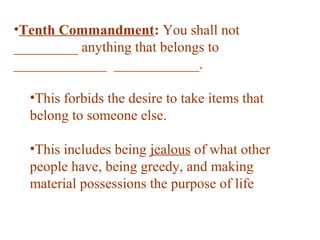
•Tenth Commandment: You shall not
_________ anything that belongs to
_____________ ____________.
•This forbids the desire to take items that
belong to someone else.
•This includes being jealous of what other
people have, being greedy, and making
material possessions the purpose of life

Te ncommandments

  • 1.
    THE TEN COMMANDMENTSTHETEN COMMANDMENTS Given by God to Moses on Mount Sinai, the Ten Commandments is a list of ten moral imperatives, rules for people to live a good and moral life.
  • 2.
    1.acquisition – theact of getting something 2.blasphemy – any act of disrespect against God or anything sacred, including church, the Bible, and prayer 3.bribery – giving something valuable to someone in order to influence them 4.chaste – morally pure and modest 5.covet – to want something that is not yours
  • 3.
    TERMS:TERMS: 1. culpable –responsible for a wrong action; deserving of blame 2. detraction - putting a person down; lowering a person’s esteem or reputation; saying negative things about a person’s character 3. discretion – wise judgment; the ability to act responsibly 4. euthanasia – “mercy killing” – ending a person’s life because they are sick 5. idolatry – the worship of a false god
  • 4.
    11. impure –obscene, offensive, immodest 12. modesty – appropriateness in speech, dress, and behavior 13. negligence – neglect or carelessness 14. oath – a sacred promise; calling on God as a witness to a vow 15. perjury – giving false or misleading testimony; breaking an oath
  • 5.
    16. rash –done in haste, without thought 17. reverently - with deep respect and love 18. sacrilege – desecration, misuse, or theft of something sacred 19. spitefulness – any act that aims to hurt or humiliate someone 20. superstition – the belief that something unrelated to an event will change its outcome; turning to something other than God to guide your actions
  • 6.
    Exodus 20:1-17Exodus 20:1-17 •FirstCommandment: I am the ___________ your _____________; you shall not have false __________ before me. •By the first Commandment, we are obliged to love God above all things and to worship God alone. •This Commandment forbids idolatry, superstition and sacrilege
  • 7.
    •Second Commandment: Youshall not take the ___________ of the Lord, your God, in _____________. •The second Commandment obliges us to always speak respectfully about God, of the Blessed Mother, and of the Saints. •We are required to be truthful in taking an oath and faithful in fulfilling vows. •We sin against this Commandment by using God’s name disrespectfully, by cursing, and by committing acts of perjury or blasphemy.
  • 8.
    •Third Commandment: Rememberto keep _________ the _________ ________ •We are required to worship God on Sundays and Holy Days by participating in Mass. Sunday is set aside as a special day because of a tradition handed down from the Apostles; it should be a day of rest and joy.
  • 9.
    •Fourth Commandment: Honoryour _________ and your __________. •We must respect our parents and help them when they are in need. •Children are required to obey their parents as long as they are under their authority. •The fourth Commandment forbids disrespect, spitefulness, and complaints and disobedience toward our parents, guardians, and authorities •We must show behavior that gives honor to our parents and what they have taught us
  • 10.
    •Fifth Commandment: Youshall not ___________ * This commands us to take proper care of our own life and the lives of others, including the life of the soul. * Sins against human life and dignity include murder, abortion, euthanasia, culpable suicide, slavery, substance abuse, and physical and mental abuse.
  • 11.
    •Sixth Commandment: Youshall not commit _________________ •The sixth Commandment forbids impure acts. We are called to live a chaste life, according to our particular stage of life. •This means abstaining from sex before marriage, and for married people to be faithful to their spouse.
  • 12.
    •Seventh Commandment: Youshall not ______________ •This Commandment forbids stealing and robbery, unjust acquisition of goods, and reckless destruction of things that do not belong to you. This includes cheating, negligence in work, and bribery.
  • 13.
    •Eighth Commandment: Youshall not bear __________ ___________ against your _________________. •We are obliged to be truthful, and to interpret the actions of others fairly. •We must avoid rash judgment, suspicions, lying, detraction and gossip
  • 14.
    •Ninth Commandment: You shallnot covet your _____________ _________ •This Commandment forbids impure or innapropriate thoughts and desires. •We are called to act appropriately toward others, to be modest and decent, and to use discretion.
  • 15.
    •Tenth Commandment: Youshall not _________ anything that belongs to _____________ ____________. •This forbids the desire to take items that belong to someone else. •This includes being jealous of what other people have, being greedy, and making material possessions the purpose of life