GOD GIVES THE TEN
COMMANDMENTS (PT. III)
DANNY SCOTTON JR
ALPHA BAPTIST CHURCH | 10.21.18
REVIEW
• Grace Comes Before Commands
• God graciously freed Israel; Israel should faithfully serve God. The Son of God graciously
freed us from sin; we should faithfully serve the Son of God
• Christ died for us; we should live for Christ (2 Cor 5:15)
• God doesn’t tell us what to do without first telling us what He’s done (Indicative before
Imperative)
• Israel’s Purpose: To be a Kingdom of Priests (Ex 19:5-6)
• Intermediaries & vessels through whom God would bless all nations (Abrahamic covenant Gen
12:2-3)
• In Christ, we are a royal priesthood (1 Pet 2:9, Rev 1:6)
• Commandments in Two Categories
• Love God (Commandments 1-IV): Vertical Relationship (cf. Dt 6:5, Mt 22:37-38)
• Love Others (Commandments V-X): Horizontal Relationship (cf. Lev 19:18, Mt 22:39-40)
To view or download these slides:
www.bit.ly/10Cs-Pt3
THE X COMMANDMENTS
GREEK LETTER Χ = CHI (RHYMES WITH “KEY”)
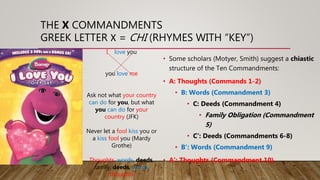
• Some scholars (Motyer, Smith) suggest a chiastic
structure of the Ten Commandments:
• A: Thoughts (Commands 1-2)
• B: Words (Commandment 3)
• C: Deeds (Commandment 4)
• Family Obligation (Commandment
5)
• C’: Deeds (Commandments 6-8)
• B’: Words (Commandment 9)
• A’: Thoughts (Commandment 10)
I love you
you love me
Ask not what your country
can do for you, but what
you can do for your
country (JFK)
Never let a fool kiss you or
a kiss fool you (Mardy
Grothe)
Thoughts, words, deeds,
family, deeds, words,
thoughts
REVIEW: COMMANDMENTS I-III
• Thoughts
• First Commandment: No “god,” no one, no thing should come before God. God wants
undivided, utter devotion – “forsaking all others,” including self
• Second Commandment: We should not think of or treat God like a quid-pro-quo, tit-
for-tat, pagan “god,” which is what some scholars argue is essentially behind the
prohibition making and worshiping all images (Motyer, etc.)
• Words
• Third Commandment: Do not take (up) the LORD’s (YHWH) name in vain
• Swearing (both senses of the word)
• Attaching divine authority to our words
• “Taking up” or bearing the name of the LORD (2 Chron 7:14, 1 Pet 4:16), without acting like a
servant of the LORD – giving God a bad name
REVIEW: THE FOURTH COMMANDMENT
REMEMBER THE SABBATH DAY AND KEEP IT HOLY
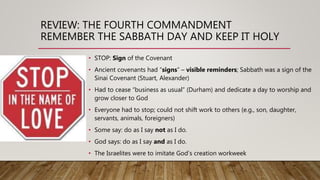
• STOP: Sign of the Covenant
• Ancient covenants had “signs” – visible reminders; Sabbath was a sign of the
Sinai Covenant (Stuart, Alexander)
• Had to cease “business as usual” (Durham) and dedicate a day to worship and
grow closer to God
• Everyone had to stop; could not shift work to others (e.g., son, daughter,
servants, animals, foreigners)
• Some say: do as I say not as I do.
• God says: do as I say and as I do.
• The Israelites were to imitate God’s creation workweek
SHOULD CHRISTIANS KEEP THE SABBATH?
• All of the Ten Commandments are repeated in the New Testament – except the Fourth
Commandment
• 18 When the LORD finished speaking to Moses on Mount Sinai, he gave him the two tablets of the
covenant law, the tablets of stone inscribed by the finger of God (Ex 31:18, NIV, cf. Ex 24:12)
• 31 “The days are coming,” declares the LORD, “when I will make a new covenant with the people of
Israel and with the people of Judah. 32 It will not be like the covenant I made with their ancestors
when I took them by the hand to lead them out of Egypt, because they broke my covenant, though I
was a husband to them,” declares the LORD. 33 “This is the covenant I will make with the people of
Israel after that time,” declares the LORD. “I will put my law in their minds and write it on their hearts.
I will be their God, and they will be my people…" (Jer 31:31-33, NIV)
• 3 You show that you are a letter from Christ, the result of our ministry, written not with ink but with
the Spirit of the living God, not on tablets of stone but on tablets of human hearts. 4 Such
confidence we have through Christ before God. 5 Not that we are competent in ourselves to claim
anything for ourselves, but our competence comes from God. 6 He has made us competent as
ministers of a new covenant—not of the letter but of the Spirit; for the letter kills, but the Spirit gives
life. (2 Cor 3:3-6, NIV)
SHOULD CHRISTIANS KEEP THE SABBATH?
• Paul is referring to the new covenant prophesied by Jeremiah and inaugurated by Christ
(Barnett)
• 25 In the same way, after supper he took the cup, saying, “This cup is the new covenant in my
blood; do this, whenever you drink it, in remembrance of me” (1 Cor 11:25, cf. Lk 22:19).
• “As a result of the new covenant inaugurated by Christ the Sabbath (Saturday) was replaced by
the Lord’s day (Sunday). The strict observance of the Sabbath, like circumcision, is no longer
binding upon Christians” (Alexander)
• Jesus was crucified on Good Friday afternoon (“from noon until three in the afternoon darkness
came over the land” (Mt 27:45, NIV) and was taken for burial as “evening approached” (Mt
27:57, NIV).
• The Empty Tomb was discovered early on the “first day of the week” (Mt 28:1, Mark 16:2; Luke
24:1; John 20:1, NIV) (France).
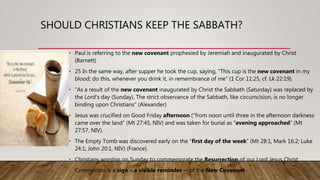
• Christians worship on Sunday to commemorate the Resurrection of our Lord Jesus Christ
• Communion is a sign – a visible reminder -- of the New Covenant
SHOULD CHRISTIANS KEEP THE SABBATH?
NOT AS STRICTLY AS THE JEWS
• Some sects claim that Christians still should be keeping the Sabbath and even observing certain Jewish
festivals.
• 16 Therefore do not let anyone judge you by what you eat or drink, or with regard to a religious
festival, a New Moon celebration or a Sabbath day. 17 These are a shadow of the things that were to
come; the reality, however, is found in Christ (Col 2:16-17, NIV).
• “The observance of the sacred calendar, like the observance of the levitical food laws, was obligatory
on Jews. But Christians are free from obligations of this kind” (Bruce, cf., Gal 4:9-10).
• 5 One person considers one day more sacred than another; another considers every day alike. Each of
them should be fully convinced in their own mind. 6 Whoever regards one day as special does so to
the Lord (Rom 14:5-6. NIV)
• My opinion: we all should still set aside time to cease all other activities and gather together to learn
more about and worship God. Yet, individuals do not necessarily always have to do this on a set day or
time
• “…these are questions to be settled between the individual conscience and God” (Bruce).
THE FIFTH COMMANDMENT:
HONOR THY FATHER AND MOTHER
• 12 “Honor your father and your mother, so that you may live long in the land the LORD
your God is giving you (Ex 20:12, NIV, cf. Lev 19:3 “mother” first).
• Nowadays, one of the most desired qualities is youth (Cole)
• We want to act, look, and/or feel younger
• Much of what’s “cool” in the media (movies, TV shows, music, fashion, etc.) features or targets the young
• Our society puts a lot of weight (i.e., importance) on youth
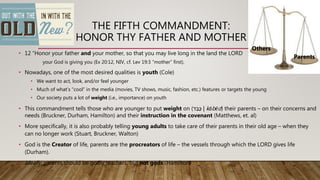
• This commandment tells those who are younger to put weight on (‫ד‬ ֵ‫ָּב‬‫כ‬ | kābēd) their parents – on their concerns and
needs (Bruckner, Durham, Hamilton) and their instruction in the covenant (Matthews, et. al)
• More specifically, it is also probably telling young adults to take care of their parents in their old age – when they
can no longer work (Stuart, Bruckner, Walton)
• God is the Creator of life, parents are the procreators of life – the vessels through which the LORD gives life
(Durham).
• Ideally, parents should be godly teachers, but not gods (Hamilton)
Others
Parents
THE FIFTH COMMANDMENT:
…THAT YOU MAY LIVE LONG…
• Not saying: do whatever your mother and father say or die young!
• If children take care of their parents in their old age, they can set a precedent for
their children to do the same for them (Walton)
• If children do not follow their parents’ godly instruction, the covenant would be in
jeopardy (Matthews, et. al.). This is “vital for the preservation of the social fabric”
(Sarna)
• The covenant was conditional on the Israelites’ obedience (e.g., Ex. 19:5f. “Now if
you obey me full and keep my covenant, then…” NIV).
• This commandment is probably not about individual life spans, but the life span of
God’s people – corporately – in the Promised Land (Stuart, Durham, Enns)
• In the Bible, “you” is often plural
TRANSITIONAL POINT:
• Some scholars (Motyer) suggest a chiastic
structure of the Ten Commandments:
• A: Thoughts (Commands 1-2)
• B: Words (Commandment 3)
• C: Deeds (Commandment 4)
• Family Obligation (Commandment
5)
• C’: Deeds (Commandments 6-8)
• B’: Words (Commandment 9)
• A’: Thoughts (Commandment 10)
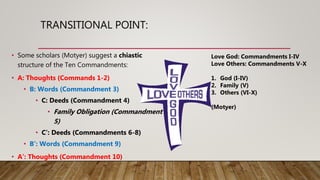
Love God: Commandments I-IV
Love Others: Commandments V-X
1. God (I-IV)
2. Family (V)
3. Others (VI-X)
(Motyer)
THE SIXTH COMMANDMENT:
DO NOT TAKE LIFE IMPROPERLY (DEEDS)
• “Kill” is too general; “murder” is too specific (Bruckner cf. Alexander)
• Two words in Hebrew: don’t [‫ח‬ַ‫צ‬ ָּ‫ר‬ | rāṣaḥ] = “[put] to death improperly…” (Stuart) without proper authorization
(cf. Bruckner)
• rāṣaḥ includes premeditated murder (e.g., Nu 35:16), unintentional manslaughter (e.g., Dt 4:42,19:4, Jos 20:3),
negligent homicide, etc. (Bruckner, etc.) with various punishments. Never used with reference to divine actions
(Sarna)
• “Whoever sheds human blood, by humans shall their blood be shed; for in the image of God has God made
mankind” (Gen 9:6, NIV)
• Only God, the Author of life, has this ultimate authority. The Israelites were not to take life without divine
approval (e.g., war, capital punishment) (Alexander).
• The “eye for eye”(lex talionis) principle was to ensure justice and to prevent “cycles of personal vengeance.”
(Bruckner)
• Unlike in other ancient Near East cultures, it had to be blood for blood, not blood for ransom money
(Num 35:31) (Sarna). The crime was against the Creator, only God could forgive.
THE SEVENTH COMMANDMENT:
DO NOT COMMIT ADULTERY (DEEDS)
• The biblical ideal is monogamy, based on the Genesis creation narrative (Stuart):
• 24 That is why a man leaves his father and mother and is united to his wife, and they
become one flesh (Gen 2:24, NIV).
• 4 “Haven’t you read,” [Jesus] replied, “that at the beginning the Creator ‘made them
male and female,’ v 5 and said, ‘For this reason a man will leave his father and mother
and be united to his wife, and the two will become one flesh’? (Mt 19:4-5, NIV).
• For this reason a man will leave his father and mother and be united to his wife, and
the two will become one flesh (Eph 5:31, NIV).
• Adultery is not just a sin against a person, it is a sin against God (Durham, Sarna)
• No one is greater in this house than I am. My master has withheld nothing from me
except you, because you are his wife. How then could I do such a wicked thing and sin
against God?” (Gen 39:9, NIV)
THE EIGHTH COMMANDMENT:
DO NOT STEAL (DEEDS)
• In God’s covenant community, all theft is prohibited
• This may likely include kidnapping (Cole, Sarna)
• 7 If someone is caught kidnapping a fellow Israelite and treating or selling them as a slave,
the kidnapper must die. You must purge the evil from among you (Dt 24:7, NIV)
(Matthews, et. al.).
• Stealing also includes deceit and cheating (Alexander)
• Stealing robs another Israelite of God’s blessings
THE NINTH COMMANDMENT
DO NOT GIVE FALSE TESTIMONY… (WORDS)
• Many offenses were capital crimes… bearing false witness is essentially murder (Cole)
• The testimony of two or three witnesses was necessary to convict (Dt 19:15, Num 35:30) (Durham)
• Witnesses had to cast the first stone (Cole)
• The hands of the witnesses must be the first in putting that person to death, and then the hands of all the
people. You must purge the evil from among you (Dt 17:7, NIV)
• if the witness proves to be a liar, giving false testimony against a fellow Israelite, 19 then do to the false
witness as that witness intended to do to the other party. You must purge the evil from among you (Dt
19:18b-19, NIV) (Bruckner).
• How could Israel be God’s witnesses to the world if they were false witnesses to each other?
(Durham)
• Like with the other commandments, this is not strictly a matter of personal goodness, it is about
the well-being of the entire covenant community (Enns) – society’s stability (Sarna)
THE TENTH COMMANDMENT:
DO NOT COVET YOUR NEIGHBOR’S…(THOUGHTS)
• 17 “You shall not covet your neighbor’s house. You shall not covet your neighbor’s wife,
or his male or female servant, his ox or donkey, or anything that belongs to your
neighbor” (Ex 20:17, NIV)
• House = household… all that belongs to the neighbor (Durham, Sarna)
• The Israelites are told not to desire or crave anything that rightfully belongs to
someone else (Stuart)
• Desiring what we cannot rightfully have/do is the source (Bruckner) or “first step” of sin
(Durham cf. Alexander)
• I have learned the secret of being content.. whether well fed or hungry, living in plenty or
in want… I can do all this through him who gives me strength (Php 4:12-13)(Hamilton).
• The Ten Commandments begin and end with thoughts. Outward obedience is not
enough, inward trust in God is a must (Alexander).
CONCLUSION
• If Israel kept the covenant, they would be God’s treasured possession (Ex 19:5), a kingdom of priests and a holy
nation (Ex 19:6).
• Through Israel – His priestly intermediaries – God would bless all nations (Gen 12:2-3).
• This required the right thoughts, words, or deeds about God, and the right deeds, words, or thoughts about
others
• The Ten Commandments outline how God’s people are to love God (I-IV) and love others (V-X) (cf. Mt 22:37-
40)
• They outline correct priorities: God 1st (I-IV), Family 2nd(V), Others 3rd (VI-X)
• They concern both outward obedience and inward trust: Trust and Obey
• New Covenant: Christ’s Church is now the royal priesthood, the holy nation, the chosen people of God
• 9 But you are a chosen people, a royal priesthood, a holy nation, God’s special possession, that you may
declare the praises of him who called you out of darkness into his wonderful light. 10 Once you were not a
people, but now you are the people of God; once you had not received mercy, but now you have received
mercy (1 Pet 2:9-10, NIV)
• To him [Jesus] who loves us and has freed us from our sins by his blood, 6 and has made us to be a kingdom
and priests to serve his God and Father—to him be glory and power for ever and ever! Amen (Rev 1:5b-6, NIV)
To view or download these
slides:
www.bit.ly/10Cs-Pt3
BIBLIOGRAPHY
• Alexander, T. Desmond. “Exodus.” In New Bible Commentary: 21st Century Edition, edited by D. A. Carson, R. T. France, J. A. Motyer, and G. J. Wenham, 4th ed., 92–120. Leicester, England; Downers Grove, IL: Inter-Varsity Press, 1994.
• Alexander, T. Desmond. Exodus. Edited by David W. Baker and Gordon J. Wenham. Vol. 2. Apollos Old Testament Commentary. London; Downers Grove, IL: Apollos; InterVarsity Press, 2017.
• Allen, R. Michael. ET101 Law and Gospel: The Basis of Christian Ethics. Logos Mobile Education. Bellingham, WA: Lexham Press, 2016.
• Barnett, Paul. The Second Epistle to the Corinthians. The New International Commentary on the New Testament. Grand Rapids, MI: Wm. B. Eerdmans Publishing Co., 1997.
• Bruckner, James K. Exodus. Edited by W. Ward Gasque, Robert L. Hubbard Jr., and Robert K. Johnston. Understanding the Bible Commentary Series. Grand Rapids, MI: Baker Books, 2012.
• Cole, R. Alan. Exodus: An Introduction and Commentary. Vol. 2. Tyndale Old Testament Commentaries. Downers Grove, IL: InterVarsity Press, 1973.
• Durham, John I. Exodus. Vol. 3. Word Biblical Commentary. Dallas: Word, Incorporated, 1998.
• Elwell, Walter A. Evangelical Commentary on the Bible. Vol. 3. Baker Reference Library. Grand Rapids, MI: Baker Book House, 1995.
• Enns, Peter. Exodus. The NIV Application Commentary. Grand Rapids, MI: Zondervan, 2000.
• Fee, Gordon D., and Robert L. Hubbard Jr., eds. The Eerdmans Companion to the Bible. Grand Rapids, MI; Cambridge, U.K.: William B. Eerdmans Publishing Company, 2011.
• France, R. T. The Gospel of Matthew. The New International Commentary on the New Testament. Grand Rapids, MI: Wm. B. Eerdmans Publication Co., 2007.
• Hamilton, Victor P. Exodus: An Exegetical Commentary. Grand Rapids, MI: Baker Academic, 2011.
• Matthews, Victor Harold, Mark W. Chavalas, and John H. Walton. The IVP Bible Background Commentary: Old Testament. Electronic ed. Downers Grove, IL: InterVarsity Press, 2000.
• Motyer, Alec. The Message of Exodus: The Days of Our Pilgrimage. Edited by Alec Motyer and Derek Tidball. The Bible Speaks Today. Nottingham, England: Inter-Varsity Press, 2005.
• Sarna, Nahum M. Exodus. The JPS Torah Commentary. Philadelphia: Jewish Publication Society, 1991.
• Stuart, Douglas K. Exodus. Vol. 2. The New American Commentary. Nashville: Broadman & Holman Publishers, 2006.
• Walton, John H. Zondervan Illustrated Bible Backgrounds Commentary (Old Testament): Genesis, Exodus, Leviticus, Numbers, Deuteronomy. Vol. 1. Grand Rapids, MI: Zondervan, 2009.

Ten Commandments Sunday School Lesson (Part III)

  • 1.
    GOD GIVES THETEN COMMANDMENTS (PT. III) DANNY SCOTTON JR ALPHA BAPTIST CHURCH | 10.21.18
  • 2.
    REVIEW • Grace ComesBefore Commands • God graciously freed Israel; Israel should faithfully serve God. The Son of God graciously freed us from sin; we should faithfully serve the Son of God • Christ died for us; we should live for Christ (2 Cor 5:15) • God doesn’t tell us what to do without first telling us what He’s done (Indicative before Imperative) • Israel’s Purpose: To be a Kingdom of Priests (Ex 19:5-6) • Intermediaries & vessels through whom God would bless all nations (Abrahamic covenant Gen 12:2-3) • In Christ, we are a royal priesthood (1 Pet 2:9, Rev 1:6) • Commandments in Two Categories • Love God (Commandments 1-IV): Vertical Relationship (cf. Dt 6:5, Mt 22:37-38) • Love Others (Commandments V-X): Horizontal Relationship (cf. Lev 19:18, Mt 22:39-40) To view or download these slides: www.bit.ly/10Cs-Pt3
  • 3.
    THE X COMMANDMENTS GREEKLETTER Χ = CHI (RHYMES WITH “KEY”) • Some scholars (Motyer, Smith) suggest a chiastic structure of the Ten Commandments: • A: Thoughts (Commands 1-2) • B: Words (Commandment 3) • C: Deeds (Commandment 4) • Family Obligation (Commandment 5) • C’: Deeds (Commandments 6-8) • B’: Words (Commandment 9) • A’: Thoughts (Commandment 10) I love you you love me Ask not what your country can do for you, but what you can do for your country (JFK) Never let a fool kiss you or a kiss fool you (Mardy Grothe) Thoughts, words, deeds, family, deeds, words, thoughts
  • 4.
    REVIEW: COMMANDMENTS I-III •Thoughts • First Commandment: No “god,” no one, no thing should come before God. God wants undivided, utter devotion – “forsaking all others,” including self • Second Commandment: We should not think of or treat God like a quid-pro-quo, tit- for-tat, pagan “god,” which is what some scholars argue is essentially behind the prohibition making and worshiping all images (Motyer, etc.) • Words • Third Commandment: Do not take (up) the LORD’s (YHWH) name in vain • Swearing (both senses of the word) • Attaching divine authority to our words • “Taking up” or bearing the name of the LORD (2 Chron 7:14, 1 Pet 4:16), without acting like a servant of the LORD – giving God a bad name
  • 5.
    REVIEW: THE FOURTHCOMMANDMENT REMEMBER THE SABBATH DAY AND KEEP IT HOLY • STOP: Sign of the Covenant • Ancient covenants had “signs” – visible reminders; Sabbath was a sign of the Sinai Covenant (Stuart, Alexander) • Had to cease “business as usual” (Durham) and dedicate a day to worship and grow closer to God • Everyone had to stop; could not shift work to others (e.g., son, daughter, servants, animals, foreigners) • Some say: do as I say not as I do. • God says: do as I say and as I do. • The Israelites were to imitate God’s creation workweek
  • 6.
    SHOULD CHRISTIANS KEEPTHE SABBATH? • All of the Ten Commandments are repeated in the New Testament – except the Fourth Commandment • 18 When the LORD finished speaking to Moses on Mount Sinai, he gave him the two tablets of the covenant law, the tablets of stone inscribed by the finger of God (Ex 31:18, NIV, cf. Ex 24:12) • 31 “The days are coming,” declares the LORD, “when I will make a new covenant with the people of Israel and with the people of Judah. 32 It will not be like the covenant I made with their ancestors when I took them by the hand to lead them out of Egypt, because they broke my covenant, though I was a husband to them,” declares the LORD. 33 “This is the covenant I will make with the people of Israel after that time,” declares the LORD. “I will put my law in their minds and write it on their hearts. I will be their God, and they will be my people…" (Jer 31:31-33, NIV) • 3 You show that you are a letter from Christ, the result of our ministry, written not with ink but with the Spirit of the living God, not on tablets of stone but on tablets of human hearts. 4 Such confidence we have through Christ before God. 5 Not that we are competent in ourselves to claim anything for ourselves, but our competence comes from God. 6 He has made us competent as ministers of a new covenant—not of the letter but of the Spirit; for the letter kills, but the Spirit gives life. (2 Cor 3:3-6, NIV)
  • 7.
    SHOULD CHRISTIANS KEEPTHE SABBATH? • Paul is referring to the new covenant prophesied by Jeremiah and inaugurated by Christ (Barnett) • 25 In the same way, after supper he took the cup, saying, “This cup is the new covenant in my blood; do this, whenever you drink it, in remembrance of me” (1 Cor 11:25, cf. Lk 22:19). • “As a result of the new covenant inaugurated by Christ the Sabbath (Saturday) was replaced by the Lord’s day (Sunday). The strict observance of the Sabbath, like circumcision, is no longer binding upon Christians” (Alexander) • Jesus was crucified on Good Friday afternoon (“from noon until three in the afternoon darkness came over the land” (Mt 27:45, NIV) and was taken for burial as “evening approached” (Mt 27:57, NIV). • The Empty Tomb was discovered early on the “first day of the week” (Mt 28:1, Mark 16:2; Luke 24:1; John 20:1, NIV) (France). • Christians worship on Sunday to commemorate the Resurrection of our Lord Jesus Christ • Communion is a sign – a visible reminder -- of the New Covenant
  • 8.
    SHOULD CHRISTIANS KEEPTHE SABBATH? NOT AS STRICTLY AS THE JEWS • Some sects claim that Christians still should be keeping the Sabbath and even observing certain Jewish festivals. • 16 Therefore do not let anyone judge you by what you eat or drink, or with regard to a religious festival, a New Moon celebration or a Sabbath day. 17 These are a shadow of the things that were to come; the reality, however, is found in Christ (Col 2:16-17, NIV). • “The observance of the sacred calendar, like the observance of the levitical food laws, was obligatory on Jews. But Christians are free from obligations of this kind” (Bruce, cf., Gal 4:9-10). • 5 One person considers one day more sacred than another; another considers every day alike. Each of them should be fully convinced in their own mind. 6 Whoever regards one day as special does so to the Lord (Rom 14:5-6. NIV) • My opinion: we all should still set aside time to cease all other activities and gather together to learn more about and worship God. Yet, individuals do not necessarily always have to do this on a set day or time • “…these are questions to be settled between the individual conscience and God” (Bruce).
  • 9.
    THE FIFTH COMMANDMENT: HONORTHY FATHER AND MOTHER • 12 “Honor your father and your mother, so that you may live long in the land the LORD your God is giving you (Ex 20:12, NIV, cf. Lev 19:3 “mother” first). • Nowadays, one of the most desired qualities is youth (Cole) • We want to act, look, and/or feel younger • Much of what’s “cool” in the media (movies, TV shows, music, fashion, etc.) features or targets the young • Our society puts a lot of weight (i.e., importance) on youth • This commandment tells those who are younger to put weight on (‫ד‬ ֵ‫ָּב‬‫כ‬ | kābēd) their parents – on their concerns and needs (Bruckner, Durham, Hamilton) and their instruction in the covenant (Matthews, et. al) • More specifically, it is also probably telling young adults to take care of their parents in their old age – when they can no longer work (Stuart, Bruckner, Walton) • God is the Creator of life, parents are the procreators of life – the vessels through which the LORD gives life (Durham). • Ideally, parents should be godly teachers, but not gods (Hamilton) Others Parents
  • 10.
    THE FIFTH COMMANDMENT: …THATYOU MAY LIVE LONG… • Not saying: do whatever your mother and father say or die young! • If children take care of their parents in their old age, they can set a precedent for their children to do the same for them (Walton) • If children do not follow their parents’ godly instruction, the covenant would be in jeopardy (Matthews, et. al.). This is “vital for the preservation of the social fabric” (Sarna) • The covenant was conditional on the Israelites’ obedience (e.g., Ex. 19:5f. “Now if you obey me full and keep my covenant, then…” NIV). • This commandment is probably not about individual life spans, but the life span of God’s people – corporately – in the Promised Land (Stuart, Durham, Enns) • In the Bible, “you” is often plural
  • 11.
    TRANSITIONAL POINT: • Somescholars (Motyer) suggest a chiastic structure of the Ten Commandments: • A: Thoughts (Commands 1-2) • B: Words (Commandment 3) • C: Deeds (Commandment 4) • Family Obligation (Commandment 5) • C’: Deeds (Commandments 6-8) • B’: Words (Commandment 9) • A’: Thoughts (Commandment 10) Love God: Commandments I-IV Love Others: Commandments V-X 1. God (I-IV) 2. Family (V) 3. Others (VI-X) (Motyer)
  • 12.
    THE SIXTH COMMANDMENT: DONOT TAKE LIFE IMPROPERLY (DEEDS) • “Kill” is too general; “murder” is too specific (Bruckner cf. Alexander) • Two words in Hebrew: don’t [‫ח‬ַ‫צ‬ ָּ‫ר‬ | rāṣaḥ] = “[put] to death improperly…” (Stuart) without proper authorization (cf. Bruckner) • rāṣaḥ includes premeditated murder (e.g., Nu 35:16), unintentional manslaughter (e.g., Dt 4:42,19:4, Jos 20:3), negligent homicide, etc. (Bruckner, etc.) with various punishments. Never used with reference to divine actions (Sarna) • “Whoever sheds human blood, by humans shall their blood be shed; for in the image of God has God made mankind” (Gen 9:6, NIV) • Only God, the Author of life, has this ultimate authority. The Israelites were not to take life without divine approval (e.g., war, capital punishment) (Alexander). • The “eye for eye”(lex talionis) principle was to ensure justice and to prevent “cycles of personal vengeance.” (Bruckner) • Unlike in other ancient Near East cultures, it had to be blood for blood, not blood for ransom money (Num 35:31) (Sarna). The crime was against the Creator, only God could forgive.
  • 13.
    THE SEVENTH COMMANDMENT: DONOT COMMIT ADULTERY (DEEDS) • The biblical ideal is monogamy, based on the Genesis creation narrative (Stuart): • 24 That is why a man leaves his father and mother and is united to his wife, and they become one flesh (Gen 2:24, NIV). • 4 “Haven’t you read,” [Jesus] replied, “that at the beginning the Creator ‘made them male and female,’ v 5 and said, ‘For this reason a man will leave his father and mother and be united to his wife, and the two will become one flesh’? (Mt 19:4-5, NIV). • For this reason a man will leave his father and mother and be united to his wife, and the two will become one flesh (Eph 5:31, NIV). • Adultery is not just a sin against a person, it is a sin against God (Durham, Sarna) • No one is greater in this house than I am. My master has withheld nothing from me except you, because you are his wife. How then could I do such a wicked thing and sin against God?” (Gen 39:9, NIV)
  • 14.
    THE EIGHTH COMMANDMENT: DONOT STEAL (DEEDS) • In God’s covenant community, all theft is prohibited • This may likely include kidnapping (Cole, Sarna) • 7 If someone is caught kidnapping a fellow Israelite and treating or selling them as a slave, the kidnapper must die. You must purge the evil from among you (Dt 24:7, NIV) (Matthews, et. al.). • Stealing also includes deceit and cheating (Alexander) • Stealing robs another Israelite of God’s blessings
  • 15.
    THE NINTH COMMANDMENT DONOT GIVE FALSE TESTIMONY… (WORDS) • Many offenses were capital crimes… bearing false witness is essentially murder (Cole) • The testimony of two or three witnesses was necessary to convict (Dt 19:15, Num 35:30) (Durham) • Witnesses had to cast the first stone (Cole) • The hands of the witnesses must be the first in putting that person to death, and then the hands of all the people. You must purge the evil from among you (Dt 17:7, NIV) • if the witness proves to be a liar, giving false testimony against a fellow Israelite, 19 then do to the false witness as that witness intended to do to the other party. You must purge the evil from among you (Dt 19:18b-19, NIV) (Bruckner). • How could Israel be God’s witnesses to the world if they were false witnesses to each other? (Durham) • Like with the other commandments, this is not strictly a matter of personal goodness, it is about the well-being of the entire covenant community (Enns) – society’s stability (Sarna)
  • 16.
    THE TENTH COMMANDMENT: DONOT COVET YOUR NEIGHBOR’S…(THOUGHTS) • 17 “You shall not covet your neighbor’s house. You shall not covet your neighbor’s wife, or his male or female servant, his ox or donkey, or anything that belongs to your neighbor” (Ex 20:17, NIV) • House = household… all that belongs to the neighbor (Durham, Sarna) • The Israelites are told not to desire or crave anything that rightfully belongs to someone else (Stuart) • Desiring what we cannot rightfully have/do is the source (Bruckner) or “first step” of sin (Durham cf. Alexander) • I have learned the secret of being content.. whether well fed or hungry, living in plenty or in want… I can do all this through him who gives me strength (Php 4:12-13)(Hamilton). • The Ten Commandments begin and end with thoughts. Outward obedience is not enough, inward trust in God is a must (Alexander).
  • 17.
    CONCLUSION • If Israelkept the covenant, they would be God’s treasured possession (Ex 19:5), a kingdom of priests and a holy nation (Ex 19:6). • Through Israel – His priestly intermediaries – God would bless all nations (Gen 12:2-3). • This required the right thoughts, words, or deeds about God, and the right deeds, words, or thoughts about others • The Ten Commandments outline how God’s people are to love God (I-IV) and love others (V-X) (cf. Mt 22:37- 40) • They outline correct priorities: God 1st (I-IV), Family 2nd(V), Others 3rd (VI-X) • They concern both outward obedience and inward trust: Trust and Obey • New Covenant: Christ’s Church is now the royal priesthood, the holy nation, the chosen people of God • 9 But you are a chosen people, a royal priesthood, a holy nation, God’s special possession, that you may declare the praises of him who called you out of darkness into his wonderful light. 10 Once you were not a people, but now you are the people of God; once you had not received mercy, but now you have received mercy (1 Pet 2:9-10, NIV) • To him [Jesus] who loves us and has freed us from our sins by his blood, 6 and has made us to be a kingdom and priests to serve his God and Father—to him be glory and power for ever and ever! Amen (Rev 1:5b-6, NIV) To view or download these slides: www.bit.ly/10Cs-Pt3
  • 18.
    BIBLIOGRAPHY • Alexander, T.Desmond. “Exodus.” In New Bible Commentary: 21st Century Edition, edited by D. A. Carson, R. T. France, J. A. Motyer, and G. J. Wenham, 4th ed., 92–120. Leicester, England; Downers Grove, IL: Inter-Varsity Press, 1994. • Alexander, T. Desmond. Exodus. Edited by David W. Baker and Gordon J. Wenham. Vol. 2. Apollos Old Testament Commentary. London; Downers Grove, IL: Apollos; InterVarsity Press, 2017. • Allen, R. Michael. ET101 Law and Gospel: The Basis of Christian Ethics. Logos Mobile Education. Bellingham, WA: Lexham Press, 2016. • Barnett, Paul. The Second Epistle to the Corinthians. The New International Commentary on the New Testament. Grand Rapids, MI: Wm. B. Eerdmans Publishing Co., 1997. • Bruckner, James K. Exodus. Edited by W. Ward Gasque, Robert L. Hubbard Jr., and Robert K. Johnston. Understanding the Bible Commentary Series. Grand Rapids, MI: Baker Books, 2012. • Cole, R. Alan. Exodus: An Introduction and Commentary. Vol. 2. Tyndale Old Testament Commentaries. Downers Grove, IL: InterVarsity Press, 1973. • Durham, John I. Exodus. Vol. 3. Word Biblical Commentary. Dallas: Word, Incorporated, 1998. • Elwell, Walter A. Evangelical Commentary on the Bible. Vol. 3. Baker Reference Library. Grand Rapids, MI: Baker Book House, 1995. • Enns, Peter. Exodus. The NIV Application Commentary. Grand Rapids, MI: Zondervan, 2000. • Fee, Gordon D., and Robert L. Hubbard Jr., eds. The Eerdmans Companion to the Bible. Grand Rapids, MI; Cambridge, U.K.: William B. Eerdmans Publishing Company, 2011. • France, R. T. The Gospel of Matthew. The New International Commentary on the New Testament. Grand Rapids, MI: Wm. B. Eerdmans Publication Co., 2007. • Hamilton, Victor P. Exodus: An Exegetical Commentary. Grand Rapids, MI: Baker Academic, 2011. • Matthews, Victor Harold, Mark W. Chavalas, and John H. Walton. The IVP Bible Background Commentary: Old Testament. Electronic ed. Downers Grove, IL: InterVarsity Press, 2000. • Motyer, Alec. The Message of Exodus: The Days of Our Pilgrimage. Edited by Alec Motyer and Derek Tidball. The Bible Speaks Today. Nottingham, England: Inter-Varsity Press, 2005. • Sarna, Nahum M. Exodus. The JPS Torah Commentary. Philadelphia: Jewish Publication Society, 1991. • Stuart, Douglas K. Exodus. Vol. 2. The New American Commentary. Nashville: Broadman & Holman Publishers, 2006. • Walton, John H. Zondervan Illustrated Bible Backgrounds Commentary (Old Testament): Genesis, Exodus, Leviticus, Numbers, Deuteronomy. Vol. 1. Grand Rapids, MI: Zondervan, 2009.

Editor's Notes

  • #4 A1 God a1 Thoughts (commandments 1–2) b1 Words (commandment 3) c1 Deeds (commandment 4) A2 Society c2 Deeds (commandments 6–8) b2 Words (commandment 9) a2 Thoughts (commandment 10) Alec Motyer, , ed. Alec Motyer and Derek Tidball, The Bible Speaks Today (Nottingham, England: Inter-Varsity Press, 2005), 216. Alec Motyer, The Message of Exodus: The Days of Our Pilgrimage, ed. Alec Motyer and Derek Tidball, The Bible Speaks Today (Nottingham, England: Inter-Varsity Press, 2005), 216. L. Smith, “Original Sin as ‘Envy’: The Structure of the Biblical Decalogue,” Dialog 30 (1991): 227–30. Smith considers the structure of the Decalog to be essentially chiastic, with the first commandment (against idolatry) and the tenth commandment (against covetousness) as the anchors, with the other commandments correspondingly paired (two and nine, three and eight) and the centerpiece to be the commandment against murder Douglas K. Stuart, , vol. 2, The New American Commentary (Nashville: Broadman & Holman Publishers, 2006). Douglas K. Stuart, Exodus, vol. 2, The New American Commentary (Nashville: Broadman & Holman Publishers, 2006).
  • #7 These references, which are traceable to Jesus at the Last Supper, represent his affirmation that “in [his] blood” the “new covenant” prophesied by Jeremiah had been inaugurated. The prophet had written: Paul Barnett, , The New International Commentary on the New Testament (Grand Rapids, MI: Wm. B. Eerdmans Publishing Co., 1997), 175. Paul Barnett, The Second Epistle to the Corinthians, The New International Commentary on the New Testament (Grand Rapids, MI: Wm. B. Eerdmans Publishing Co., 1997), 175.
  • #8 It seems most likely however that, oddly as he has expressed it, Matthew refers, as the other three evangelists clearly do in different ways (Mark 16:2; Luke 24:1; John 20:1) to early on Sunday morning, as it was getting light. R. T. France, , The New International Commentary on the New Testament (Grand Rapids, MI: Wm. B. Eerdmans Publication Co., 2007), 1099. R. T. France, The Gospel of Matthew, The New International Commentary on the New Testament (Grand Rapids, MI: Wm. B. Eerdmans Publication Co., 2007), 1099.
  • #9  F. F. Bruce, , The New International Commentary on the New Testament (Grand Rapids, MI: Wm. B. Eerdmans Publishing Co., 1984), 114. F. F. Bruce, The Epistles to the Colossians, to Philemon, and to the Ephesians, The New International Commentary on the New Testament (Grand Rapids, MI: Wm. B. Eerdmans Publishing Co., 1984), 114.
  • #10  This is not a popular doctrine in our modern world, where youth is worshipped, and old age dreaded or despised. The result is the folly by which men or women strive to remain eternally youthful, only to find it an impossible task R. Alan Cole, , vol. 2, Tyndale Old Testament Commentaries (Downers Grove, IL: InterVarsity Press, 1973), 166. R. Alan Cole, Exodus: An Introduction and Commentary, vol. 2, Tyndale Old Testament Commentaries (Downers Grove, IL: InterVarsity Press, 1973), 166. To “give honor” to father and mother means more than to be subject to them, or respectful of their wishes: they are to be given precedence by the recognition of the importance which is theirs by right, esteemed for their priority, and loved for it as well. As Yahweh is honored for his priority to all life, so father and mother must be honored for their priority, as Yahweh’s instruments, to the lives of their children John I. Durham, , vol. 3, Word Biblical Commentary (Dallas: Word, Incorporated, 1998), 291. John I. Durham, Exodus, vol. 3, Word Biblical Commentary (Dallas: Word, Incorporated, 1998), 291. Respect for parents is deemed to be vital for the preservation of the social fabric; dishonoring parents imperils the well-being of society Nahum M. Sarna, , The JPS Torah Commentary (Philadelphia: Jewish Publication Society, 1991), 113. Nahum M. Sarna, Exodus, The JPS Torah Commentary (Philadelphia: Jewish Publication Society, 1991), 113. Honoring and respecting parents consists of respecting their instruction in the covenant. This assumes that a religious heritage is being passed on. The home was seen as an important and necessary link for the covenant instruction of each successive generation. Honor Victor Harold Matthews, Mark W. Chavalas, and John H. Walton, , electronic ed. (Downers Grove, IL: InterVarsity Press, 2000), Ex 20:12. Victor Harold Matthews, Mark W. Chavalas, and John H. Walton, The IVP Bible Background Commentary: Old Testament, electronic ed. (Downers Grove, IL: InterVarsity Press, 2000), Ex 20:12.
  • #11 There is not promise here of individually long life spans. Rather the promise refers to God’s protection of his covenant people if and as long as they keep his covenant Douglas K. Stuart, , vol. 2, The New American Commentary (Nashville: Broadman & Holman Publishers, 2006), 462. Douglas K. Stuart, Exodus, vol. 2, The New American Commentary (Nashville: Broadman & Holman Publishers, 2006), 462. Nahum M. Sarna, , The JPS Torah Commentary (Philadelphia: Jewish Publication Society, 1991), 113. Nahum M. Sarna, Exodus, The JPS Torah Commentary (Philadelphia: Jewish Publication Society, 1991), 113. By breaking God’s commands, the people will jeopardize their possession of the land God has given them. This “promise” is not personal blessing, but a blessing for a people to possess a land under God’s rule and thus become a light to the nations. Peter Enns, , The NIV Application Commentary (Grand Rapids, MI: Zondervan, 2000), 421. Peter Enns, Exodus, The NIV Application Commentary (Grand Rapids, MI: Zondervan, 2000), 421.
  • #13 “Born in 1825, [Randolph] McCoy began his bitter feud with the Hatfields in 1878 when he accused Floyd Hatfield of stealing one of his hogs. In 1882, three of McCoy's sons killed a Hatfield in a fight, and they, in turn, were shot to death by some Hatfields in revenge. [Randolph] McCoy nearly died in 1888 when a group of Hatfields attacked his home. In all, he lost five of his children in the feud. McCoy died in 1914.” (https://www.biography.com/people/randall-mccoy-20824891) “In 1878 Randolph McCoy accused Floyd Hatfield, a cousin of Devil Anse, of stealing one of his pigs, a valuable commodity in the poor region. Floyd Hatfields’s trial took place in McCoy territory but was presided over by a cousin of Devil Anse. It hinged on the testimony of star witness Bill Staton, a McCoy relative married to a Hatfield. Staton testified in Floyd Hatfield’s favor, and the McCoys were infuriated when Floyd was cleared of the charges against him. Two years later, Staton was violently killed in a fracas with Sam and Paris McCoy, nephews of Randolph. Sam stood trial for the murder but was acquitted for self-defense reasons”. (https://www.history.com/shows/hatfields-and-mccoys/articles/the-hatfield-mccoy-feud) The use of such a specialized term in the specific context of the Decalogue leaves the way open for the killing of the Yahweh-war or capital punishment, both of which are of course permitted by the OT, and also sets apart other uses of רצח by relating them inevitably to the obligations of the covenant with Yahweh. John I. Durham, , vol. 3, Word Biblical Commentary (Dallas: Word, Incorporated, 1998), 293. John I. Durham, Exodus, vol. 3, Word Biblical Commentary (Dallas: Word, Incorporated, 1998), 293. The Hebrew stem r-ts-ḥ, as noted by Rashbam and Bekhor Shor, applies only to illegal killing and, unlike other verbs for the taking of life, is never used in the administration of justice or for killing in war Nahum M. Sarna, , The JPS Torah Commentary (Philadelphia: Jewish Publication Society, 1991), 113. Nahum M. Sarna, Exodus, The JPS Torah Commentary (Philadelphia: Jewish Publication Society, 1991), 113. Also, it is never employed when the subject of the action is God or an angel. Nahum M. Sarna, , The JPS Torah Commentary (Philadelphia: Jewish Publication Society, 1991), 113. Nahum M. Sarna, Exodus, The JPS Torah Commentary (Philadelphia: Jewish Publication Society, 1991), 113. or as Domeris writes, ‘the prohibition may be defined more narrowly as the taking of a life outside of the parameters … laid down by God’ (1996: 1189) T. Desmond Alexander, , ed. David W. Baker and Gordon J. Wenham, vol. 2, Apollos Old Testament Commentary (London; Downers Grove, IL: Apollos; InterVarsity Press, 2017), 416. T. Desmond Alexander, Exodus, ed. David W. Baker and Gordon J. Wenham, vol. 2, Apollos Old Testament Commentary (London; Downers Grove, IL: Apollos; InterVarsity Press, 2017), 416.
  • #14 27 “You have heard that it was said, ‘You shall not commit adultery.’ j 28 But I tell you that anyone who looks at a woman lustfully has already committed adultery with her in his heart. (Grand Rapids, MI: Zondervan, 2011), Mt 5:2728. In spite of occasional modern claims to the contrary, at no point does the OT endorse polygyny (Hugenberger 1994: 313–338; Davidson 2007: 177–212). As already indicated, almost every reference to a man having more than one wife reveals a family situation fraught with difficulties. While social conventions throughout the period of the OT usually permitted polygyny or concubinage, we should not assume that the authors of the biblical books accepted this uncritically. In almost all the narratives that engage with this issue, problems are associated with having several wives. This is clearly so with the patriarchs Abraham and Jacob, as their marriage partners struggle with one another. Esau’s marriage to two women is a source of grief to his parents (Gen. 26:34–35). Further evidence concerning dysfunctional families due to multiple wives comes in the cases of Gideon and David, when siblings from different mothers are hostile towards their half-brothers (a feature also of the Joseph story). Tensions between wives are evident in some narratives and possibly reflected in the legislation of Deut. 21:15, although in this instance it is possible that one of the wives is already dead; the primary focus is on the inheritance problems raised by having children from more than one wife. Although it is sometimes cited as an example of a man having more than one wife, Exod. 21:10 is irrelevant: it addresses the case of a maidservant who has been acquired, somewhat like a slave, with the intention of being married either to her master or his son. The legislation addresses her treatment prior to being married (see comment on 21:7–11). T. Desmond Alexander, , ed. David W. Baker and Gordon J. Wenham, vol. 2, Apollos Old Testament Commentary (London; Downers Grove, IL: Apollos; InterVarsity Press, 2017), 418. T. Desmond Alexander, Exodus, ed. David W. Baker and Gordon J. Wenham, vol. 2, Apollos Old Testament Commentary (London; Downers Grove, IL: Apollos; InterVarsity Press, 2017), 418. The Bible has much to say about sexual ethics – much of which is at odds with our current culture The New International Version (Grand Rapids, MI: Zondervan, 2011), Mt 5:27–28.
  • #15 A person steals not only when he robs a man’s strong box or his pocket, but also when he takes advantage of his neighbor at the market, in a grocery shop, butcher stall, wine and beer cellar, workshop, and, in short, wherever business is transacted and money is exchanged for goods or labor. (1976: 39) T. Desmond Alexander, , ed. David W. Baker and Gordon J. Wenham, vol. 2, Apollos Old Testament Commentary (London; Downers Grove, IL: Apollos; InterVarsity Press, 2017), 421. T. Desmond Alexander, Exodus, ed. David W. Baker and Gordon J. Wenham, vol. 2, Apollos Old Testament Commentary (London; Downers Grove, IL: Apollos; InterVarsity Press, 2017), 421.
  • #18 After all, if Israelites cannot behave properly toward their God and cannot treat each other as “special people,” as God treats them, how can they ever be a light to the Gentiles? How can they ever be a kingdom of priests in a world that does not know the true God? Peter Enns, , The NIV Application Commentary (Grand Rapids, MI: Zondervan, 2000), 425. Peter Enns, Exodus, The NIV Application Commentary (Grand Rapids, MI: Zondervan, 2000), 425.