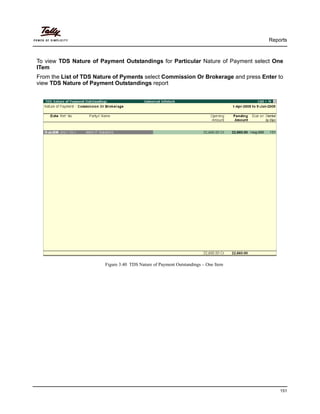
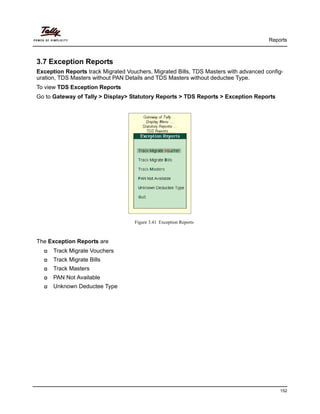
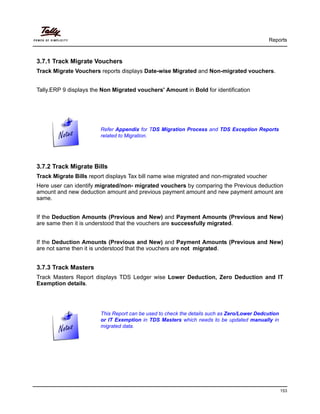
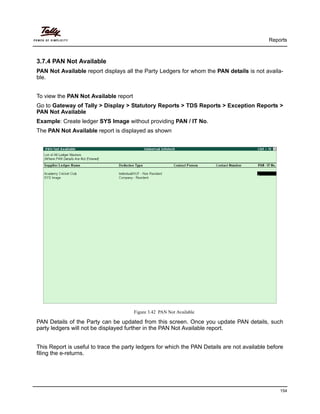
Implementation
of
TDS in Tally.ERP 9
The information contained in this document is current as of the date of publication and subject to change. Because Tally must respond
to changing market conditions, it should not be interpreted to be a commitment on the part of Tally, and Tally cannot guarantee the
accuracy of any information presented after the date of publication. The information provided herein is general, not according to
individual circumstances, and is not intended to substitute for informed professional advice.
This document is for informational purposes only. TALLY MAKES NO WARRANTIES, EXPRESS OR IMPLIED, IN THIS
DOCUMENT AND SHALL NOT BE LIABLE FOR LOSS OR DAMAGE OF WHATEVER NATURE, ARISING OUT OF, OR IN
CONNECTION WITH THE USE OF OR INABILITY TO USE THE CONTENT OF THIS PUBLICATION, AND/OR ANY
CONDUCT UNDERTAKEN BY PLACING RELIANCE ON THE CONTENTS OF THIS PUBLICATION.
Complying with all applicable copyright and other intellectual property laws is the responsibility of the user. All rights including
copyrights, rights of translation, etc., are vested exclusively with TALLY SOLUTIONS PRIVATE LIMITED. No part of this document
may be reproduced, translated, revised, stored in, or introduced into a retrieval system, or transmitted in any form, by any means
(electronic, mechanical, photocopying, recording, or otherwise), or for any purpose, without the express written permission of Tally
Solutions Pvt. Ltd.
Tally may have patents, patent applications, trademarks, copyrights, or other intellectual property rights covering subject matter in this
document. Except as expressly provided in any written licence agreement from Tally, the furnishing of this document does not give you
any licence to these patents, trademarks, copyrights, or other intellectual property.
© 2009 Tally Solutions Pvt. Ltd. All rights reserved.
Tally, Tally 9, Tally9, Tally.ERP, Tally.ERP 9, Shoper, Shoper 9, Shoper POS, Shoper HO, Shoper 9 POS, Shoper 9 HO,
TallyDeveloper, Tally Developer, Tally.Developer 9, Tally.NET, Tally Development Environment, Tally Extender, Tally Integrator,
Tally Integrated Network, Tally Service Partner, TallyAcademy & Power of Simplicity are either registered trademarks or trademarks of
Tally Solutions Pvt. Ltd. in India and/or other countries. All other trademarks are properties of their respective owners.
Version: Implementation of TDS in Tally.ERP 9/1.0/June 2009
Contents
i
Contents
Introduction
Scope & Applicability ..............................................................................................................................1
TDS Process ..............................................................................................................................................4
Time & Mode of TDS Payment ................................................................................................................5
Issue of TDS certificate ............................................................................................................................5
e-TDS Returns ..........................................................................................................................................6
Returns & Timelines .................................................................................................................................7
TDS Features in Tally.ERP 9 ................................................................................................................... 7
Lesson 1: Enabling TDS in Tally.ERP 9
1.1 Enabling TDS in Tally.ERP 9........................................................................................................... 9
Lesson 2: Transactions
2.1 Transactions Involving TDS ...........................................................................................................16
2.1.1 TDS on Expenses (Journal Voucher) .......................................................................................................16
2.2 Payment to Party .............................................................................................................................30
2.3 Payment of TDS ..............................................................................................................................32
2.3.1 Payment of TDS (Using TDS Helper) ......................................................................................................32
2.3.2 Generating TDS Challan (ITNS 281) ......................................................................................................36
2.4 Transactions Involving TDS ...........................................................................................................41
2.4.1 Expenses Partly Subject to TDS (Journal Voucher) ................................................................................41
2.4.2 Accounting of Expenses and Deducting TDS Later ................................................................................52
2.4.3 Accounting Multiple Expenses and Deducting TDS Later ..................................................................... 61
2.4.4 TDS on Advances .....................................................................................................................................67
2.4.5 TDS on Expenses @ Lower Rate .............................................................................................................73
2.4.6 TDS on Expenses @ Zero Rate ................................................................................................................82
2.4.7 Surcharge Calculation on Prior Period Expenses ..................................................................................88
2.4.8 Surcharge Calculation on Expenses ........................................................................................................95
2.5 Adjustments in TDS ......................................................................................................................100
2.5.1 Reversal Of Expenses and TDS .............................................................................................................100
2.6 Accounting Changes in TDS percentage ......................................................................................105
2.7 Accounting TDS on Payments made to Non Residents ...............................................................105
2.8 Payment of TDS ............................................................................................................................111
2.8.1 Payment of TDS (Using TDS Helper) ....................................................................................................111
2.8.2 Generating TDS Challan (ITNS 281) ....................................................................................................115
Lesson 3: Reports
3.1 TDS Reports .................................................................................................................................116
3.2 Computation ..................................................................................................................................117
3.2.1 TDS Computation – Expenses Wise .......................................................................................................118
Contents
ii
3.2.2 TDS Computation – TDS Paid ...............................................................................................................121
3.2.3 TDS Computation – TDS Payable .........................................................................................................122
3.3 Challan Reconciliation ..................................................................................................................123
3.4 Return ............................................................................................................................................125
3.4.1 Print Form 16A ......................................................................................................................................125
3.4.2 Form 26Q ...............................................................................................................................................127
3.4.3 Annexure to 26Q ....................................................................................................................................130
3.4.4 Form 27 Q ..............................................................................................................................................131
3.4.5 Annexure to 27Q ....................................................................................................................................132
3.4.6 Form 26 .................................................................................................................................................134
3.4.7 Annexure to Form 26 .............................................................................................................................136
3.4.8 Form 27 .................................................................................................................................................137
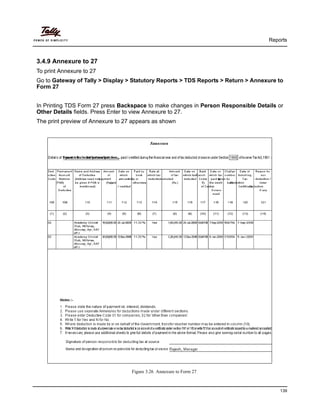
3.4.9 Annexure to 27 .......................................................................................................................................138
3.5 E–Returns ......................................................................................................................................139
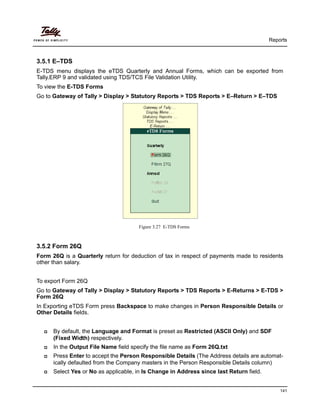
3.5.1 E–TDS ....................................................................................................................................................140
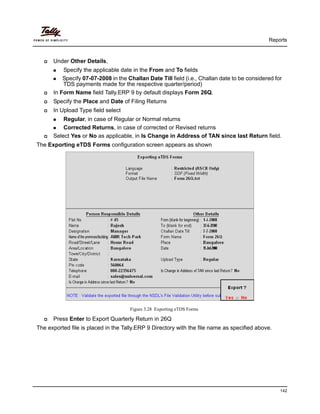
3.5.2 Form 26Q ...............................................................................................................................................140
3.5.3 Print Form 27A ......................................................................................................................................143
3.5.4 Form 27Q ...............................................................................................................................................145
3.6 Outstandings .................................................................................................................................146
3.6.1 TDS payable ...........................................................................................................................................146
3.6.2 Ledger ....................................................................................................................................................147
3.6.3 Nature of Payment .................................................................................................................................149
3.7 Exception Reports .........................................................................................................................151
3.7.1 Track Migrate Vouchers ........................................................................................................................152
3.7.2 Track Migrate Bills................................................................................................................................ 152
3.7.3 Track Masters ........................................................................................................................................152
3.7.4 PAN Not Available .................................................................................................................................153
3.7.5 Unknown Deductee Type .......................................................................................................................154
Appendix 148
A.i Migrating TDS Data ......................................................................................................................148
A.i.i Pre Migration .........................................................................................................................................148
A.i.ii Vouchers considered for TDS Migration ...............................................................................................148
A.i.iii Migration Flow .....................................................................................................................................148
A.i.iv Data Errors ...........................................................................................................................................148
A.i.v Assessable Value & TDS Calculation .................................................................................................... 150
A.i.vi TDS Migration in different scenarios ....................................................................................................151
A.i.vii Post Migration .....................................................................................................................................152
A.ii TDS Rates..................................................................................................................................... 153
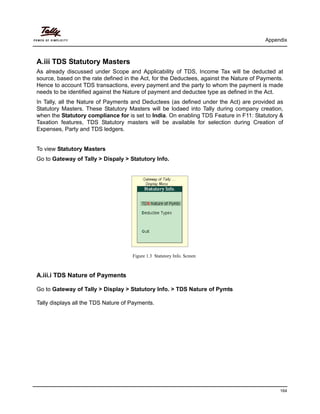
A.iii TDS Statutory Masters ................................................................................................................156
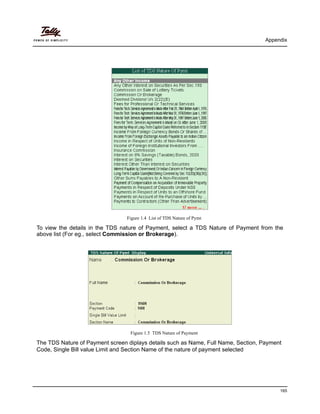
A.iii.i TDS Nature of Payments .......................................................................................................................156
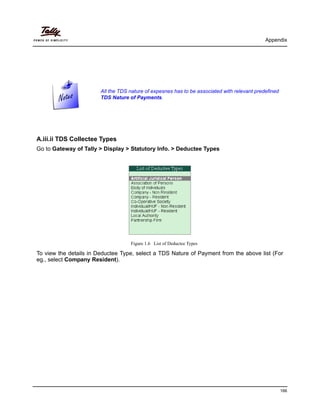
A.iii.ii TDS Collectee Types ............................................................................................................................158
1
Introduction
TDS means Tax Deducted at Source. The concept of TDS was introduced in the Income Tax Act,
1961, with the objective of deducting the tax on an income, at the source of income. It is one of
the methods of collecting Income Tax, which ensures regular flow of income to the Government.
Example: Universal Infotech is making the payment towards Rent to the owner of the building, it
is required to deduct the tax on the income (i.e. before payment to the owner), at the source of
income.
Scope & Applicability
Scope
Tax deduction at source means the tax required to be paid by the assessee, is deducted by the
person paying the income to him. Thus, the tax is deducted at the source of income itself. The
income tax act enjoins on the payer of such income to deduct the given percentage of income as
income tax and pay the balance amount to the recipient of such income. The tax so deducted at
source by the payer is to be deposited in the income tax department account. The tax so
deducted from the income of the recipient is deemed payment of income tax by the recipient at
the time of his assessment.
For example: Person responsible for paying any income which is chargeable to tax under the
head 'Salaries' is required to compute the tax liability in respect of such income and deduct tax at
source at the time of payment. If the employee has any other income, he needs to inform the
employer so that employer can take that income into consideration while computing his tax liability
but he will not take into account losses except loss from house property.
Similarly, person responsible for paying any income by way of 'interest on securities' or any other
interests are required to deduct tax at source at the prescribed rates at the time of credit of such
income to the account of the payee or at the time of payment, whichever is earlier.
Introduction
2
Applicability
Tax will be deducted at source based on the rate defined in the Act, only on the fulfilment of the
below mentioned conditions.
1. The Assessees (includes individual & HUF as covered U/S 44AB) carrying on business is
deducting the tax at the Time of Payment or Credit, (whichever is earlier) against following type
of Recipient (Deductee)
Individual
Hindu undivided Family (HUF)
Body of Individual (BOI)
Association of person (AOP)
Co-Operative society
Local Authority
Partnership firm
Domestic company (Indian company)
Foreign company
Artificial Judicial Person
2. The nature of payment belongs to any one of following list
Nature of Payment Nature of Payment
Salaries Interest on Securities
Dividend Interest other than securities
Winnings from lottery or crossword puzzles or
card game or other game
Winnings from horse races
Payment to sub-contractors Insurance commission
Payments to Contractors (Advertisement Con-
tractors)
Payments to Contractors (Other than
Advertisement)
Payment to Non–Resident sportsman or sports
association
Payment in respect of deposits under
NSS
Payment on account of repurchase of units of
MF or UTI
Commission on sale of lottery tickets
Commission or brokerage Rent of Land, Building or Furniture
Rent of Plant, Machinery or Equipment Fees for professional or technical serv-
ices
Payment of compensation on acquisition of cer-
tain immovable property
Payment of Any other income to a non-
resident
Income from units to an offshore fund Income of foreign institutional investors
from securities
Introduction
3
As per Sec 44AB, Individual and HUF is also considered as assessee
under Income Tax Act, if such Individual and HUF
Carrying on Business, where the total sales, turnover or gross receipts
from the business exceeds Rs. 40 lakhs in any Previous Year
Carrying on Profession, where the total receipts exceeds Rs. 10 lakhs
in any previous year
3. The payment exceeds the TDS Exemption Limit specified in the Income Tax Act.
Fees for Tech. Services Agreement is made
after Feb. 29, 1964 before April 1, 1976
Fees for Tech. Services Agreement is made
after Mar 31, 1976 before June 1, 1997
Fees for Tech. Services Agreement is made
after May 31, 1997 before June 1, 2005
Fees for Tech. Services Agreement is made
on or after June 1, 2005
Income by way of Long-Term Capital Gains Income from Foreign Currency Bonds or
Global Depository Receipts (GDR)
Income from Foreign Exchange Assets paya-
ble
Interest payable by Government or Indian
concern in Foreign Currency
Long–Term Capital Gains Royalty(f) Agreement is made after May 31,
1997 before June 1, 2005
Royalty(f) Agreement is made before June 1,
1997
Royalty(f) Agreement is made on or after
June 1, 2005
Royalty(g) Agreement is made after March 31,
1961 before April 1, 1976
Royalty(g) Agreement is made after March
31, 1976 before June 1, 1997
Royalty(g) Agreement is made after March 31,
1997 before June 1, 2005
Royalty(g) Agreement is made on or after
June 1, 2005
Short–Term Capital Gains
Introduction
4
TDS Process
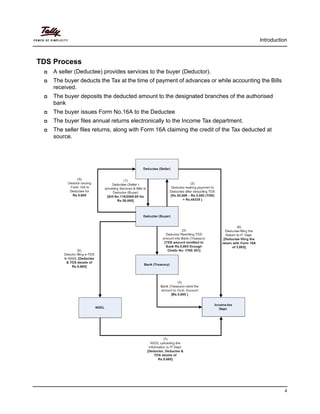
A seller (Deductee) provides services to the buyer (Deductor).
The buyer deducts the Tax at the time of payment of advances or while accounting the Bills
received.
The buyer deposits the deducted amount to the designated branches of the authorised
bank
The buyer issues Form No.16A to the Deductee
The buyer files annual returns electronically to the Income Tax department.
The seller files returns, along with Form 16A claiming the credit of the Tax deducted at
source.
Introduction
5
Time & Mode of TDS Payment
All the Tax deducted during a month are to be paid to the credit of Government on or before
7th of the next month. In case 7th of the month happens to be a sunday or a bank holiday
payment can be made on the next working day
TDS amount shall be paid to the government account through any designated branches of
the authorised banks, along with Income Tax Challan No.281.
In case of collections made by or on behalf of the Government, the amount shall be cred-
ited within the time and in the manner aforesaid without the production of a challan.
Issue of TDS certificate
TDS certificate is a proof that deductor has deducted the tax and paid the same to the govern-
ment. This proof is essential to the deductee to claim the credit of tax in his Income Tax returns.
U/s 203 of Income Tax Act, any person deducting the tax as per the provisions of
*Section 192 (Salary) shall furnish a certificate of Deduction of tax in Form 16 or Form
16AA within one month from the close of Financial year in which such deduction was
made.
Example: For the Financial Year 2007-2008, the TDS certificate must be issued on or
before 30th April, 2008
*Section 193, 194, 194A, 194B, 194BB, 194C, 194D,194E, 194EE,194F, 194G, 194-I,
194J, 194K, 194LA, 195, 196A, 196B, 196C and 196D shall furnish a certificate of Deduc-
tion of tax in Form 16A with in one month from the end of the month during which the credit
has been given or the payment has been made, as the case may be.
Example: For deductions in May 2008, TDS certificate must be issued on or before 30th
June, 2008
In case of deductee to whom more than one TDS certificate was issued for the deduc-
tions made during the year, may on request from such deductee, a consolidated cer-
tificate in Form 16A may be issued wihtin a period of one month from the close of
such financial year.
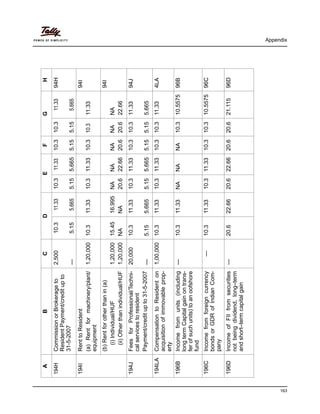
Refer Appendix for details on the *Sections mentioned above.
Introduction
6
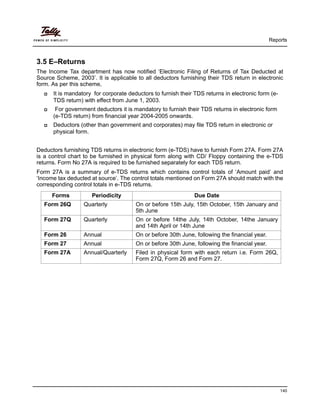
e-TDS Returns
The Income Tax department has now notified ‘Electronic Filing of Returns of Tax Deducted at
Source Scheme, 2003’. It is applicable to all deductors furnishing their TDS return in electronic
form. As per this scheme,
It is mandatory for corporate deductors to furnish their TDS returns in electronic form (e-
TDS return) with effect from June 1, 2003.
For government deductors it is mandatory to furnish their TDS returns in electronic form
(e-TDS return) from financial year 2004-2005 onwards.
Deductors (other than government and corporates) may file TDS return in electronic or
physical form.
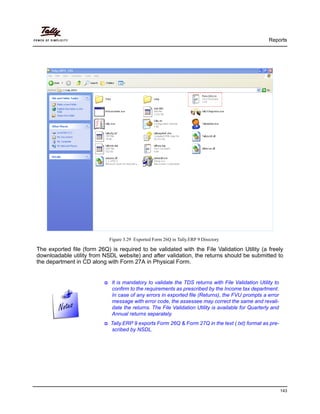
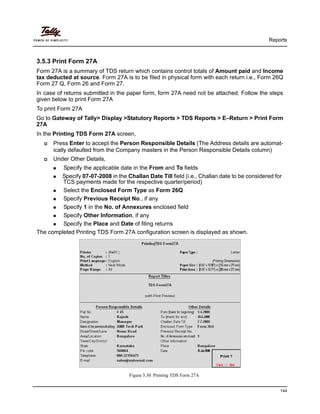
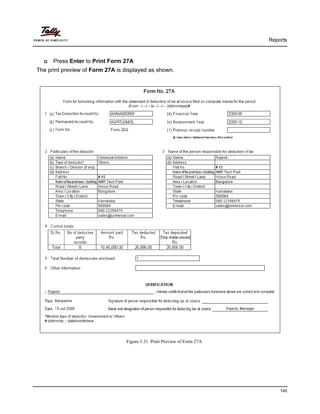
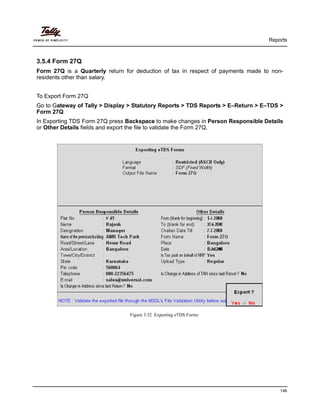
Deductors furnishing TDS returns in electronic form (e-TDS) have to furnish Form 27A. Form 27A
is a control chart to be furnished in physical form along with CD/ Floppy containing the e-TDS
returns. Form No 27A is required to be furnished separately for each TDS return.
Form 27A is a summary of e-TDS returns which contains control totals of ‘Amount paid‘ and
‘Income tax deducted at source’. The control totals mentioned on Form 27A should match with the
corresponding control totals in e-TDS returns.
Electronic Filing of Returns of Tax Deducted at Source (e-TDS), is explained
in detail in Reports chapter.
Introduction
7
Returns & Timelines
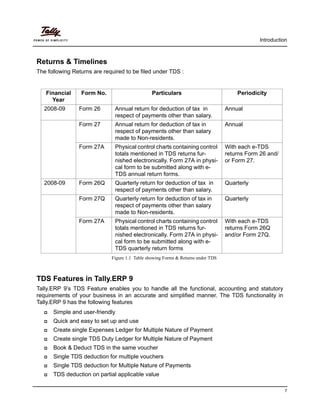
The following Returns are required to be filed under TDS :
Figure 1.1 Table showing Forms & Returns under TDS
TDS Features in Tally.ERP 9
Tally.ERP 9’s TDS Feature enables you to handle all the functional, accounting and statutory
requirements of your business in an accurate and simplified manner. The TDS functionality in
Tally.ERP 9 has the following features
Simple and user-friendly
Quick and easy to set up and use
Create single Expenses Ledger for Multiple Nature of Payment
Create single TDS Duty Ledger for Multiple Nature of Payment
Book & Deduct TDS in the same voucher
Single TDS deduction for multiple vouchers
Single TDS deduction for Multiple Nature of Payments
TDS deduction on partial applicable value
Financial
Year
Form No. Particulars Periodicity
2008-09 Form 26 Annual return for deduction of tax in
respect of payments other than salary.
Annual
Form 27 Annual return for deduction of tax in
respect of payments other than salary
made to Non-residents.
Annual
Form 27A Physical control charts containing control
totals mentioned in TDS returns fur-
nished electronically. Form 27A in physi-
cal form to be submitted along with e-
TDS annual return forms.
With each e-TDS
returns Form 26 and/
or Form 27.
2008-09 Form 26Q Quarterly return for deduction of tax in
respect of payments other than salary.
Quarterly
Form 27Q Quarterly return for deduction of tax in
respect of payments other than salary
made to Non-residents.
Quarterly
Form 27A Physical control charts containing control
totals mentioned in TDS returns fur-
nished electronically. Form 27A in physi-
cal form to be submitted along with e-
TDS quarterly return forms
With each e-TDS
returns Form 26Q
and/or Form 27Q.
Introduction
8
Retrospective Surcharge Deduction
Party wise configuration for Lower / Zero rate
Party wise configuration to Ignore IT / Surcharge exemption Limit
Deduction of TDS on advance payments
TDS deduction on Non-Resident (Sec.195) payments
Reversal of TDS
Print TDS Challan (ITNS 281)
Print Form 16A
Generate E-TDS Returns
Print Form 27A
Print Form 26, 26Q, 27, 27Q with Annexure(s)
TDS Computation Report
Generate TDS Outstanding and TDS Exception Reports
9
Lesson 1: Enabling TDS in Tally.ERP 9
Lesson Objectives
On completion of this lesson, you will learn to
Create Company in Tally.ERP 9
Enable TDS in F11: Features
1.1 Enabling TDS in Tally.ERP 9
It takes a one-time configuration in Tally.ERP 9 for TDS features to be activated. Follow the steps
given below to enable TDS in Tally.ERP 9 for a new company, M/s. Universal Infotech.
1. Create Company
2. Enable TDS
M/s. Universal Infotech, is a Company – Resident, which is engaged in Software Develop-
ment.
Step 1 : Create Company
Go to Gateway of Tally > Alt + F3: Company Info. > Create Company
In the Company Creation screen,
Specify Universal Infotech as the Company Name and Address details
Select India in the Statutory Compliance for field
Specify the State, Pin code & Accounts with Inventory details
To enable TDS for Companys’ which are already created in Tally.ERP 9,
follow the instruction provided under the head Enable TDS.
Enabling TDS in Tally.ERP 9
10
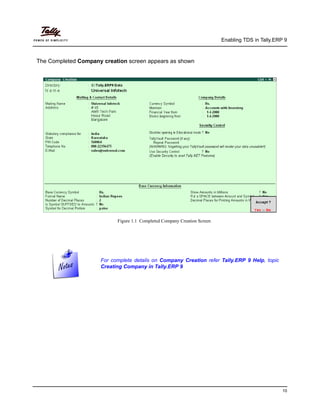
The Completed Company creation screen appears as shown
Figure 1.1 Completed Company Creation Screen
For complete details on Company Creation refer Tally.ERP 9 Help, topic
Creating Company in Tally.ERP 9
Enabling TDS in Tally.ERP 9
11
Step 2 : Enable TDS
To enable TDS Feature, for a company
1. Activate TDS Feature
2. Enable Set/Alter TDS Details
3. Specify the Company TDS Deductor Details
4. Enter Company’s PAN / Income – Tax No
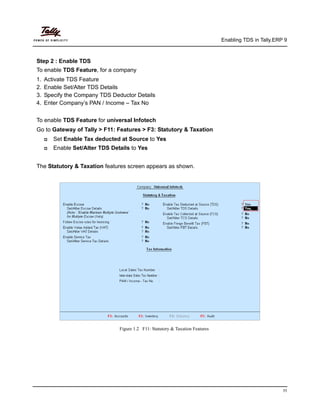
To enable TDS Feature for universal Infotech
Go to Gateway of Tally > F11: Features > F3: Statutory & Taxation
Set Enable Tax deducted at Source to Yes
Enable Set/Alter TDS Details to Yes
The Statutory & Taxation features screen appears as shown.
Figure 1.2 F11: Statutory & Taxation Features
Enabling TDS in Tally.ERP 9
12
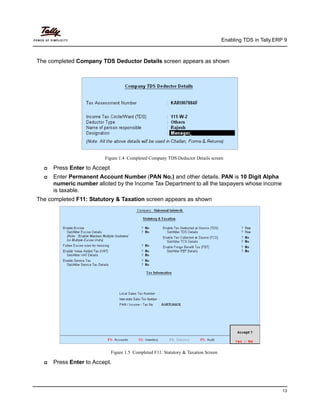
Press Enter, the Company TDS Deductor Details screen displays
Figure 1.3 Company TDS Deductor Details Screen
In the Company TDS deductor Details, enter the TDS Deductor Details such as:
Tax Assessment Number (TAN) : TAN is a TEN digit alphanumeric number Issued by the
Income Tax Department (ITD) to the deductor, which must be quoted on all Challans, Pay-
ment for TDS, Certificates issued in Form 16/16A, Returns and in all documents and other
correspondence with ITD.
Income Tax Circle /Ward (TDS) : Income Tax Circle/Ward, in which the deductors are
assessed for Income-Tax (TDS) with TAN of each person.
Deductor Type: According to the nature of the organisation Deductor type will be selected.
In case of Government, the option Government will be selected as the Deductor Type and
if the deductor is Non-Government body, Others will be selected.
Name of the person responsible: Person responsible means the person who is author-
ised to file the TDS returns of the company.
Designation: Mention the designation of the authorised person filing TDS returns.
The Format of TAN is AAAA*55555A, Where A* is the first character of the
name of the Organisation.
Example: TAN of Universal Infotech is KARU07884F
Enabling TDS in Tally.ERP 9
13
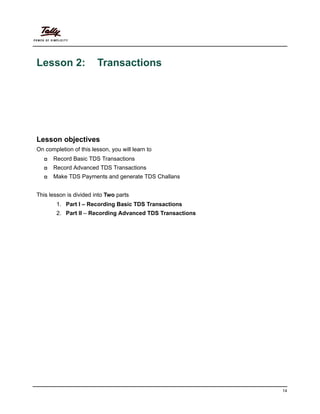
The completed Company TDS Deductor Details screen appears as shown
Figure 1.4 Completed Company TDS Deductor Details screen
Press Enter to Accept
Enter Permanent Account Number (PAN No.) and other details. PAN is 10 Digit Alpha
numeric number alloted by the Income Tax Department to all the taxpayers whose income
is taxable.
The completed F11: Statutory & Taxation screen appears as shown
Figure 1.5 Completed F11: Statutory & Taxation Screen
Press Enter to Accept.
14
Lesson 2: Transactions
Lesson objectives
On completion of this lesson, you will learn to
Record Basic TDS Transactions
Record Advanced TDS Transactions
Make TDS Payments and generate TDS Challans
This lesson is divided into Two parts
1. Part I – Recording Basic TDS Transactions
2. Part II – Recording Advanced TDS Transactions
Part – I
Transactions
16
Recording Basic TDS Transactions
In this section we shall emphasis on understanding how Tally.ERP 9’s TDS feature can be effec-
tively used to record basic TDS transactions to generate TDS Challan.
Let us take the example of Universal Infotech (Created and TDS enabled, as discussed in the
earlier chapter) to record TDS transactions such as
TDS on Expenses
Payment to Party
Payment of TDS
Generating ITNS 281 Challan
In Tally.ERP 9, you can account for expenses implying TDS with the help of Payment Voucher,
Journal Voucher or Purchase Voucher, as required.
2.1 Transactions Involving TDS
2.1.1 TDS on Expenses (Journal Voucher)
Under this, we will learn to Account expenses and deduct tax at source to arrive at the Net
balance payable to the party.
Example 1:
On 1st April, 2008 Universal Infotech received a Bill (vide No. 001) from Pheonix Agencies for Rs.
5,00,000 towards the Advertisement services rendered.
To account the above transaction follow the steps given below
1. Create Masters
i. Expense Ledger
ii. Party Ledger
iii. Tax Ledger
iv. Bank Ledger
2. Record the Transaction in Journal Voucher
Transactions
17
1. Create Masters
i. Expenses Ledger
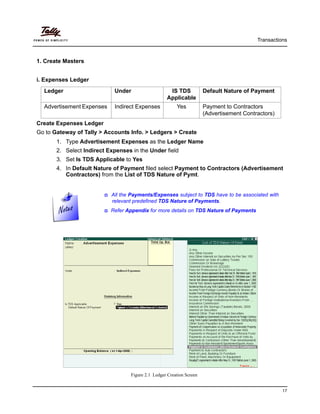
Create Expenses Ledger
Go to Gateway of Tally > Accounts Info. > Ledgers > Create
1. Type Advertisement Expenses as the Ledger Name
2. Select Indirect Expenses in the Under field
3. Set Is TDS Applicable to Yes
4. In Default Nature of Payment filed select Payment to Contractors (Advertisement
Contractors) from the List of TDS Nature of Pymt.
All the Payments/Expenses subject to TDS have to be associated with
relevant predefined TDS Nature of Payments.
Refer Appendix for more details on TDS Nature of Payments
Figure 2.1 Ledger Creation Screen
Ledger Under IS TDS
Applicable
Default Nature of Payment
Advertisement Expenses Indirect Expenses Yes Payment to Contractors
(Advertisement Contractors)
Transactions
18
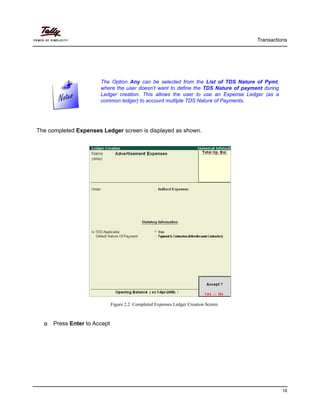
The completed Expenses Ledger screen is displayed as shown.
Figure 2.2 Completed Expenses Ledger Creation Screen
Press Enter to Accept
The Option Any can be selected from the List of TDS Nature of Pymt,
where the user doesn’t want to define the TDS Nature of payment during
Ledger creation. This allows the user to use an Expense Ledger (as a
common ledger) to account multiple TDS Nature of Payments.
Transactions
19
ii. Party Ledger
Create Party Ledger
Go to Gateway of Tally > Accounts Info. > Ledgers > Create
Setup:
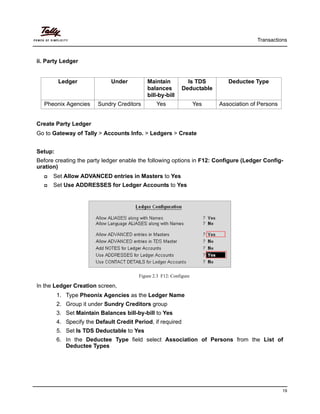
Before creating the party ledger enable the following options in F12: Configure (Ledger Config-
uration)
Set Allow ADVANCED entries in Masters to Yes
Set Use ADDRESSES for Ledger Accounts to Yes
Figure 2.3 F12: Configure
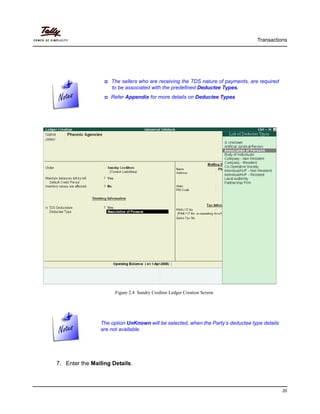
In the Ledger Creation screen,
1. Type Pheonix Agencies as the Ledger Name
2. Group it under Sundry Creditors group
3. Set Maintain Balances bill-by-bill to Yes
4. Specify the Default Credit Period, if required
5. Set Is TDS Deductable to Yes
6. In the Deductee Type field select Association of Persons from the List of
Deductee Types
Ledger Under Maintain
balances
bill-by-bill
Is TDS
Deductable
Deductee Type
Pheonix Agencies Sundry Creditors Yes Yes Association of Persons
Transactions
20
Figure 2.4 Sundry Creditor Ledger Creation Screen
7. Enter the Mailing Details.
The sellers who are receiving the TDS nature of payments, are required
to be associated with the predefined Deductee Types.
Refer Appendix for more details on Deductee Types
The option UnKnown will be selected, when the Party’s deductee type details
are not available.
Transactions
21
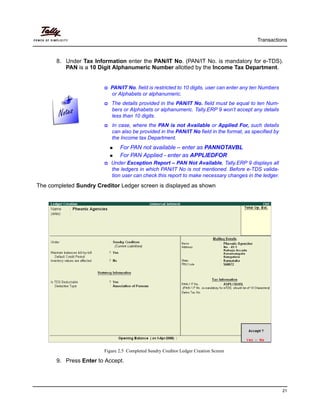
8. Under Tax Information enter the PAN/IT No. (PAN/IT No. is mandatory for e-TDS).
PAN is a 10 Digit Alphanumeric Number allotted by the Income Tax Department.
The completed Sundry Creditor Ledger screen is displayed as shown
Figure 2.5 Completed Sundry Creditor Ledger Creation Screen
9. Press Enter to Accept.
PAN/IT No. field is restricted to 10 digits, user can enter any ten Numbers
or Alphabets or alphanumeric.
The details provided in the PAN/IT No. field must be equal to ten Num-
bers or Alphabets or alphanumeric. Tally.ERP 9 won’t accept any details
less than 10 digits.
In case, where the PAN is not Available or Applied For, such details
can also be provided in the PAN/IT No field in the format, as specified by
the Income tax Department.
For PAN not available – enter as PANNOTAVBL
For PAN Applied - enter as APPLIEDFOR
Under Exception Report – PAN Not Available, Tally.ERP 9 displays all
the ledgers in which PAN/IT No is not mentioned. Before e-TDS valida-
tion user can check this report to make necessary changes in the ledger.
Transactions
22
iii. Tax Ledger
Create Tax Ledger
Go to Gateway of Tally > Accounts Info. > Ledgers > Create
In the Ledger Creation screen,
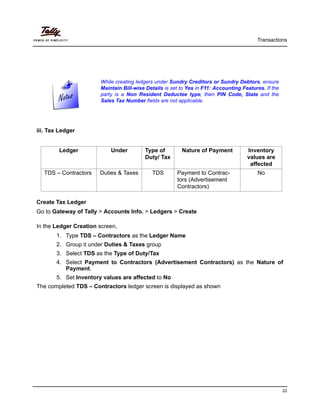
1. Type TDS – Contractors as the Ledger Name
2. Group it under Duties & Taxes group
3. Select TDS as the Type of Duty/Tax
4. Select Payment to Contractors (Advertisement Contractors) as the Nature of
Payment.
5. Set Inventory values are affected to No
The completed TDS – Contractors ledger screen is displayed as shown
While creating ledgers under Sundry Creditors or Sundry Debtors, ensure
Maintain Bill-wise Details is set to Yes in F11: Accounting Features. If the
party is a Non Resident Deductee type, then PIN Code, State and the
Sales Tax Number fields are not applicable.
Ledger Under Type of
Duty/ Tax
Nature of Payment Inventory
values are
affected
TDS – Contractors Duties & Taxes TDS Payment to Contrac-
tors (Advertisement
Contractors)
No
Transactions
23
Figure 2.6 Completed TDS Ledger Creation Screen
6. Press Enter to Accept.
It is recommended that separate TDS ledgers be created with appropriate
TDS nature of Payments. However, Tally.ERP 9 provides you with the flexi-
bility to use a common Duty ledger for different TDS Nature of Payments by
selecting the Nature of Payments as Any.
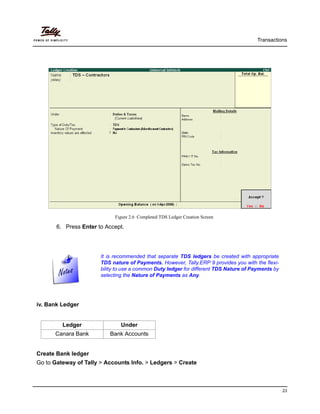
iv. Bank Ledger
Create Bank ledger
Go to Gateway of Tally > Accounts Info. > Ledgers > Create
Ledger Under
Canara Bank Bank Accounts
Transactions
24
In the Ledger Creation screen,
1. Type Canara Bank as the Ledger Name
2. Group it under Bank Accounts group
3. Under Mailing Details
In Address field enter the Bank Branch Address.
Select appropriate state in State field.
In Pin Code field enter the pincode of the City
In Account Number field enter the account number as 00758978
In Branch Name field, enter M.G.Road.
Enter the Bank’s BSR Code as 0240130. BSR Code is a 7 digit Number allotted by
Reserve Bank of India (RBI) to Bank Branch.
Enter Rs. 50,00,000 in Opening Balance field
The Completed Canara Bank ledger screen is displayed as shown
Figure 2.7 Completed Bank Ledger Creation Screen
4. Press Enter to Accept.
Transactions
25
2. Record the Transaction in Journal Voucher
Go to Gateway of Tally > Accounting Vouchers > Press F7: Journal
1. Press F2 and change the date to 01-04-2008
2. Select Advertisement Expenses in the Debit field and press Enter
3. Enter 5,00,000 in the Amount field.
4. Select Pheonix Agencies in the Credit field and press Enter.
The TDS Details screen is displayed as shown
Figure 2.8 TDS Details Screen
In the TDS Details screen provide the following details
Type of Ref.: Select New Ref from the method of Adjustment. Tally.ERP 9 displays Two
Methods of Adj viz., Agst Ref and New Ref. New Ref is selected for new Financial Trans-
actions Where as, Agst Ref is selected to set off payment against the previously entered
invoice.
Name: This filed display the Reference Number for the TDS Deducted. The default Refer-
ence Number displayed, is a combination of abbreviation of Journal, Voucher Number and
Line Number. Example :Jrnl / 1-1 which can be changed by the user. TDS payments are
tracked with these Reference Numbers.
Nature of Payment: Select Payments to Contractors (advertisement Contractors) in
Nature of Payment field. The List of Nature of payments displays only that Nature of Pay-
ments which is specific to the Expenses Ledgers, selected in the transaction.
Transactions
26
Example: For the above transaction List of Nature of payments displays only Payments to
Contractors (advertisement Contractors), as the nature of payment applicable to the Party
against which TDS will be deducted.
Figure 2.9 TDS Details – Nature of Payment Selection
TDS Duty Ledger: Select TDS – Contractors from the list of TDS Duty Ledgers. List of
TDS Duty Ledgers displays, ledgers created with specific nature of payment as well as the
ledger created with the option Any.
Assessable Amount: Tally.ERP 9 defaults the amount specified against the expenses
ledger and skips the field.
Deduct now: This field will be set to Yes or No depending on the tax deduction. Set this
field to Yes to deduct the Tax in the same voucher.
TDS Amount: This field displays the Tax amount deducted at source
Payable Amount: This field displays the amount (after TDS) payable to the Party.
Transactions
27
The completed TDS Details screen is displayed as shown
Figure 2.10 Completed TDS Details Screen
5. Press Enter to accept TDS Details
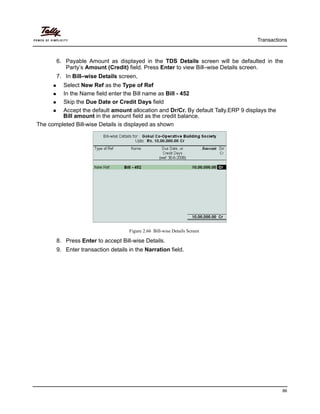
6. Payable Amount as calculated in the TDS Details screen will be defaulted in the
Party’s Amount (Credit) field. Press Enter to view Bill–wise Details screen.
7. In Bill–wise Details screen,
Select New Ref as the Type of Ref
In the Name field enter the Bill name as Bill - 001
Skip the Due Date or Credit Days field
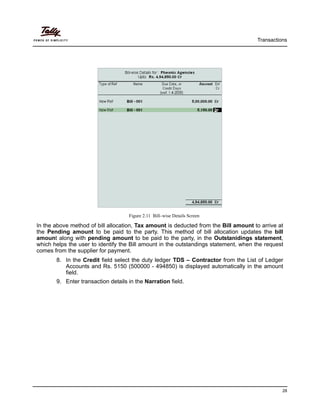
Accept the default amount allocation and Dr/Cr. By default Tally.ERP 9 displays the
Bill amount in the amount field as the credit balance.
Press Enter, select New Ref as Type of Ref and Enter Bill name as Bill -001
Skip the Due Date or Credit Days field and accept the default amount allocation and
Dr/Cr. By default Tally.ERP 9 displays the Tax amount in the amount field as the debit
balance.
The Completed Bill–wise Details screen is displayed as shown
Transactions
28
Figure 2.11 Bill–wise Details Screen
In the above method of bill allocation, Tax amount is deducted from the Bill amount to arrive at
the Pending amount to be paid to the party. This method of bill allocation updates the bill
amount along with pending amount to be paid to the party, in the Outstanidings statement,
which helps the user to identify the Bill amount in the outstandings statement, when the request
comes from the supplier for payment.
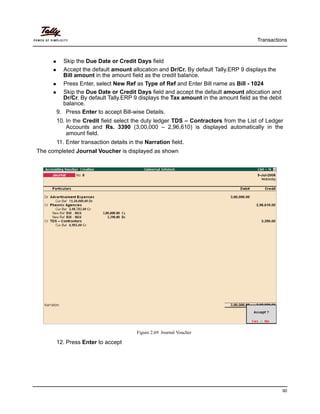
8. In the Credit field select the duty ledger TDS – Contractor from the List of Ledger
Accounts and Rs. 5150 (500000 - 494850) is displayed automatically in the amount
field.
9. Enter transaction details in the Narration field.
Transactions
29
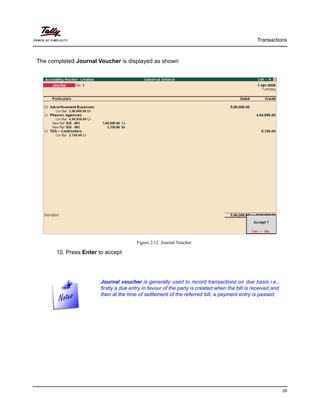
The completed Journal Voucher is displayed as shown
Figure 2.12 Journal Voucher
10. Press Enter to accept
Journal voucher is generally used to record transactions on due basis i.e.,
firstly a due entry in favour of the party is created when the bill is received and
then at the time of settlement of the referred bill, a payment entry is passed.
Transactions
30
2.2 Payment to Party
Example 2:
On April 8, 2008, payment of Rs. 494850 is made towards bill no. Bill-001 to Pheonix Agencies for
the purchase of Advertisement services, vide cheque no. 254781
The same is accounted as follows
Record the transaction in Payment Voucher
Go to Gateway of Tally > Accounting Vouchers > Press F5: Payment
1. Press F2 and change date to 08/04/2008
2. In Debit field select Pheonix Agencies from the List of Ledger Accounts
3. Enter Rs. 494850 in Amount field and press enter to view Bill-wise Details screen
4. In Bill-wise Details screen
Select Agst Ref in the Type of Ref
Select Bill-001 from the List of Pending Bills in Name field, Amount is defaulted
automatically.
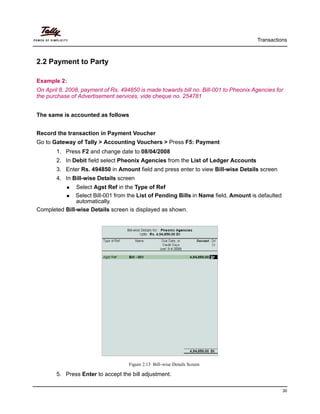
Completed Bill-wise Details screen is displayed as shown.
Figure 2.13 Bill–wise Details Screen
5. Press Enter to accept the bill adjustment.
Transactions
31
6. In Credit field select Canara Bank from the List of Ledger Accounts, Amount is
defaulted automatically
7. Enter Cheque No. 254781 in Narration field.
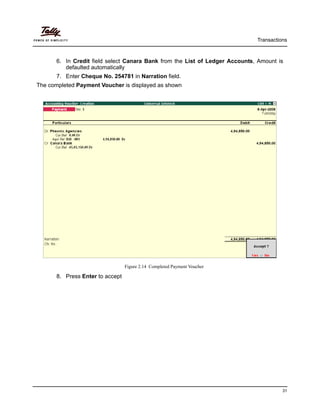
The completed Payment Voucher is displayed as shown
Figure 2.14 Completed Payment Voucher
8. Press Enter to accept
Transactions
32
2.3 Payment of TDS
2.3.1 Payment of TDS (Using TDS Helper)
All the Tax deducted during a month is to be paid to the credit of Government on or before 7th of
the next month. In case 7th of the month happens to be a sunday or a bank holiday payment can
be made on the next working day
TDS amount shall be paid to the government account through any designated branches of the
authorised banks, along with Income Tax Challan No.281.
Example 3:
On May 6, 2008, Universal Infotech, paid TDS of Rs. 5150 towards Advertisement Expenses, vide
cheque no. 056330 for the month of April, 2008.
The same is accounted as follows
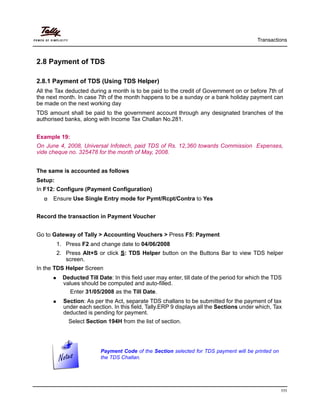
Setup:
In F12: Configure (Payment Configuration)
Set Use Single Entry mode for Pymt/Rcpt/Contra to Yes
Record the transaction in Payment Voucher
Go to Gateway of Tally > Accounting Vouchers > Press F5: Payment
1. Press F2 and change date to 06/05/2008
2. Press Alt+S or click S: TDS Helper button on the Buttons Bar to view TDS helper
screen.
In the TDS Helper Screen
Deducted Till Date: In this field user may enter, till date of the period for which the TDS
values should be computed and auto-filled.
Enter 30/04/2008 as the Till Date.
Section: As per the Act, separate TDS challans to be submitted for the payment of tax
under each section. In this field, Tally.ERP 9 displays all the Sections under which, Tax
deducted is pending for payment.
Select Section 194C from the list of section.
Payment Code of the Section selected for TDS payment will be printed on
the TDS Challan.
Transactions
33
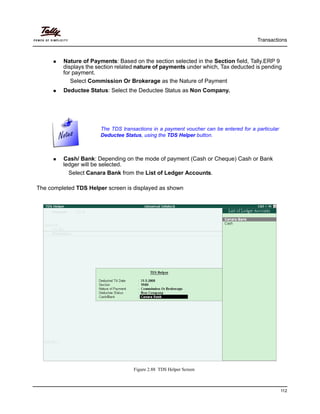
Nature of Payments: Based on the section selected in the Section field, Tally.ERP 9
displays the section related nature of payments under which, Tax deducted is pending
for payment.
Select Payment to Contractors (Advertisement Contractors) as the Nature of
Payment
Deductee Status: Select the Deductee Status as Non Company.
Cash/ Bank: Depending on the mode of payment (Cash or Cheque) Cash or Bank
ledger will be selected.
Select Canara Bank from the List of Ledger Accounts.
The completed TDS Helper screen is displayed as shown
Figure 2.15 TDS Helper Screen
The TDS transactions in a payment voucher can be entered for a particular
Deductee Status, using the TDS Helper button.
Transactions
34
3. Press Enter to accept the TDS helper
4. The Bank Name through which the payment is made and TDS payable amount (with
the respective bill details) will be auto-filled.
5. Set the option Provide Details to Yes to enter TDS payment details
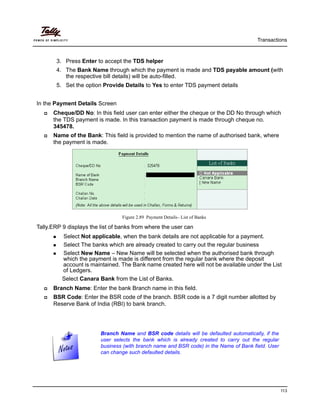
In the Payment Details Screen
From Date: In this field enter the From date of the period for which the payment is made
To Date: In this field enter the To date of the period for which the payment is made
Cheque/DD No: In this field user can enter either the cheque or the DD No through which
the TDS payment is made. In this transaction payment is made through cheque no.
056330.
Name of the Bank: This field is provided to mention the name of authorised bank, where
the payment is made.
Figure 2.16 Payment Details– List of Banks
Tally.ERP 9 displays the list of banks from where the user can
Select Not applicable, when the bank details are not applicable for a payment.
Select The banks which are already created to carry out the regular business
Select New Name – New Name will be selected when the authorised bank through
which the payment is made is different from the regular bank where the deposit
account is maintained. The Bank name created here will not be available under the List
of Ledgers.
Select Canara Bank from the List of Banks.
Branch Name: Enter the bank Branch name in this field.
BSR Code: Enter the BSR code of the branch. BSR code is a 7 digit number allotted by
Reserve Bank of India (RBI) to bank branch.
Transactions
35
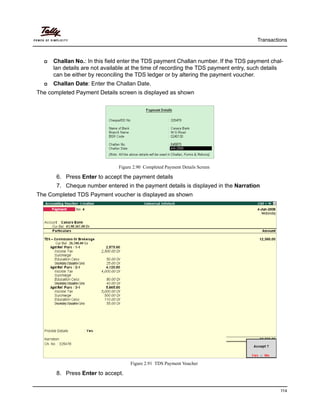
Challan No.: In this field enter the TDS payment Challan number. If the TDS payment chal-
lan details are not available at the time of recording the TDS payment entry, such details
can be either by reconciling the TDS ledger or by altering the payment voucher.
Challan Date: Enter the Challan Date.
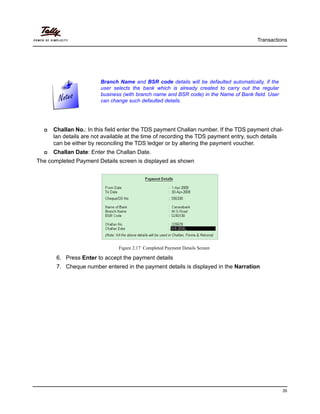
The completed Payment Details screen is displayed as shown
Figure 2.17 Completed Payment Details Screen
6. Press Enter to accept the payment details
7. Cheque number entered in the payment details is displayed in the Narration
Branch Name and BSR code details will be defaulted automatically, if the
user selects the bank which is already created to carry out the regular
business (with branch name and BSR code) in the Name of Bank field. User
can change such defaulted details.
Transactions
36
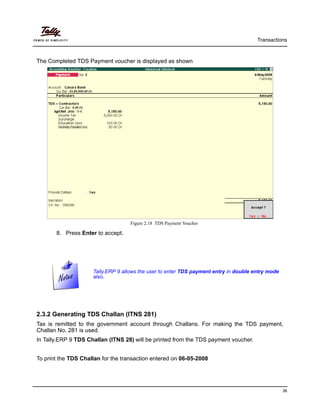
The Completed TDS Payment voucher is displayed as shown
Figure 2.18 TDS Payment Voucher
8. Press Enter to accept.
2.3.2 Generating TDS Challan (ITNS 281)
Tax is remitted to the government account through Challans. For making the TDS payment,
Challan No. 281 is used.
In Tally.ERP 9 TDS Challan (ITNS 28) will be printed from the TDS payment voucher.
To print the TDS Challan for the transaction entered on 06-05-2008
Tally.ERP 9 allows the user to enter TDS payment entry in double entry mode
also.
1. Press PageUp to go back to payment voucher entry
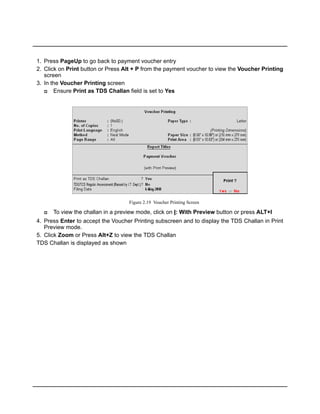
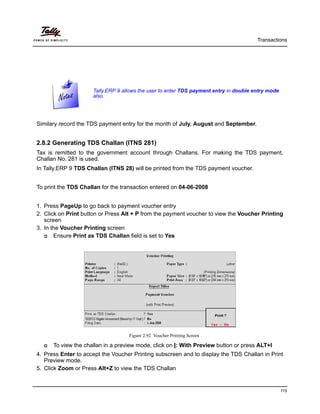
2. Click on Print button or Press Alt + P from the payment voucher to view the Voucher Printing
screen
3. In the Voucher Printing screen
Ensure Print as TDS Challan field is set to Yes
Figure 2.19 Voucher Printing Screen
To view the challan in a preview mode, click on I: With Preview button or press ALT+I
4. Press Enter to accept the Voucher Printing subscreen and to display the TDS Challan in Print
Preview mode.
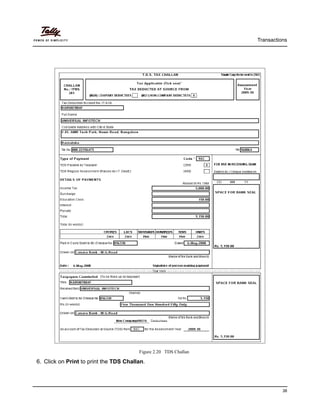
5. Click Zoom or Press Alt+Z to view the TDS Challan
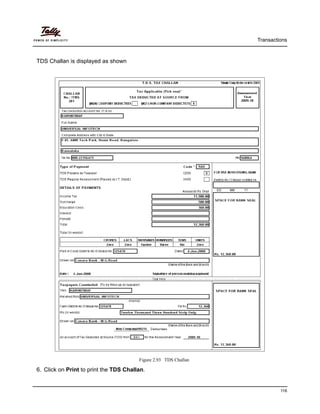
TDS Challan is displayed as shown
Transactions
38
Figure 2.20 TDS Challan
6. Click on Print to print the TDS Challan.
Transactions
39
Part - II
Transactions
40
Recording Advanced TDS Transactions
In this section we shall understand how Tally.ERP 9’s TDS feature can be used to process
advanced TDS transactions.
We shall learn to record advanced TDS transactions such as
Expenses partly Subject to TDS
Accounting of expenses and deducting TDS later
Accounting multiple expenses and deducting TDS later
TDS on Advances
TDS on expenses @ lower rate
TDS on expenses @ zero rate
Reversal of expenses with TDS and Reversal of TDS
Accounting changes in TDS percentage
Accounting TDS on payments made to non–residents
Payment of TDS
Record all the transactions in the books of Universal Infotech.
Transactions
41
2.4 Transactions Involving TDS
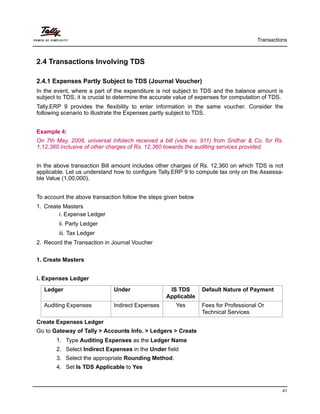
2.4.1 Expenses Partly Subject to TDS (Journal Voucher)
In the event, where a part of the expenditure is not subject to TDS and the balance amount is
subject to TDS, it is crucial to determine the accurate value of expenses for computation of TDS.
Tally.ERP 9 provides the flexibility to enter information in the same voucher. Consider the
following scenario to illustrate the Expenses partly subject to TDS.
Example 4:
On 7th May, 2008, universal Infotech received a bill (vide no. 911) from Sridhar & Co. for Rs.
1,12,360 inclusive of other charges of Rs. 12,360 towards the auditing services provided.
In the above transaction Bill amount includes other charges of Rs. 12,360 on which TDS is not
applicable. Let us understand how to configure Tally.ERP 9 to compute tax only on the Assessa-
ble Value (1,00,000).
To account the above transaction follow the steps given below
1. Create Masters
i. Expense Ledger
ii. Party Ledger
iii. Tax Ledger
2. Record the Transaction in Journal Voucher
1. Create Masters
i. Expenses Ledger
Create Expenses Ledger
Go to Gateway of Tally > Accounts Info. > Ledgers > Create
1. Type Auditing Expenses as the Ledger Name
2. Select Indirect Expenses in the Under field
3. Select the appropriate Rounding Method.
4. Set Is TDS Applicable to Yes
Ledger Under IS TDS
Applicable
Default Nature of Payment
Auditing Expenses Indirect Expenses Yes Fees for Professional Or
Technical Services
Transactions
42
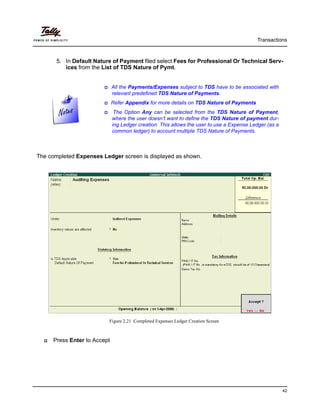
5. In Default Nature of Payment filed select Fees for Professional Or Technical Serv-
ices from the List of TDS Nature of Pymt.
The completed Expenses Ledger screen is displayed as shown.
Figure 2.21 Completed Expenses Ledger Creation Screen
Press Enter to Accept
All the Payments/Expenses subject to TDS have to be associated with
relevant predefined TDS Nature of Payments.
Refer Appendix for more details on TDS Nature of Payments
The Option Any can be selected from the TDS Nature of Payment,
where the user doesn’t want to define the TDS Nature of payment dur-
ing Ledger creation. This allows the user to use a Expense Ledger (as a
common ledger) to account multiple TDS Nature of Payments.
Transactions
43
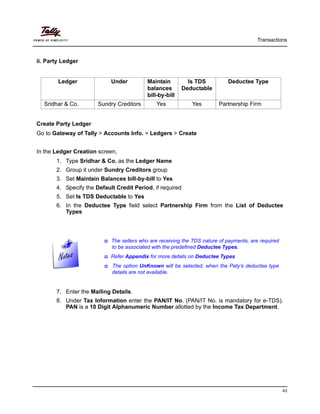
ii. Party Ledger
Create Party Ledger
Go to Gateway of Tally > Accounts Info. > Ledgers > Create
In the Ledger Creation screen,
1. Type Sridhar & Co. as the Ledger Name
2. Group it under Sundry Creditors group
3. Set Maintain Balances bill-by-bill to Yes
4. Specify the Default Credit Period, if required
5. Set Is TDS Deductable to Yes
6. In the Deductee Type field select Partnership Firm from the List of Deductee
Types
7. Enter the Mailing Details.
8. Under Tax Information enter the PAN/IT No. (PAN/IT No. is mandatory for e-TDS).
PAN is a 10 Digit Alphanumeric Number allotted by the Income Tax Department.
Ledger Under Maintain
balances
bill-by-bill
Is TDS
Deductable
Deductee Type
Sridhar & Co. Sundry Creditors Yes Yes Partnership Firm
The sellers who are receiving the TDS nature of payments, are required
to be associated with the predefined Deductee Types.
Refer Appendix for more details on Deductee Types
The option UnKnown will be selected, when the Paty’s deductee type
details are not available.
Transactions
44
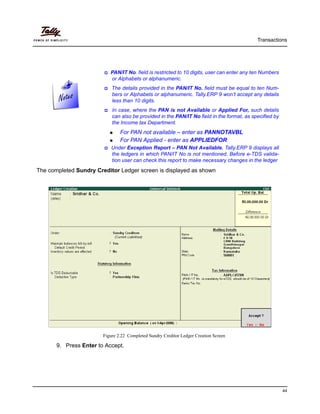
The completed Sundry Creditor Ledger screen is displayed as shown
Figure 2.22 Completed Sundry Creditor Ledger Creation Screen
9. Press Enter to Accept.
PAN/IT No. field is restricted to 10 digits, user can enter any ten Numbers
or Alphabets or alphanumeric.
The details provided in the PAN/IT No. field must be equal to ten Num-
bers or Alphabets or alphanumeric. Tally.ERP 9 won’t accept any details
less than 10 digits.
In case, where the PAN is not Available or Applied For, such details
can also be provided in the PAN/IT No field in the format, as specified by
the Income tax Department.
For PAN not available – enter as PANNOTAVBL
For PAN Applied - enter as APPLIEDFOR
Under Exception Report – PAN Not Available, Tally.ERP 9 displays all
the ledgers in which PAN/IT No is not mentioned. Before e-TDS valida-
tion user can check this report to make necessary changes in the ledger
Transactions
45
iii. Tax Ledger
Create Tax Ledger
Go to Gateway of Tally > Accounts Info. > Ledgers > Create
In the Ledger Creation screen,
1. Type TDS - Professional or Technical Services as the Ledger Name
2. Group it under Duties & Taxes group
3. Select TDS as the Type of Duty/Tax
4. Select Fees for Professional or Technical Services as the Nature of Payment.
5. Set Inventory values are affected to No
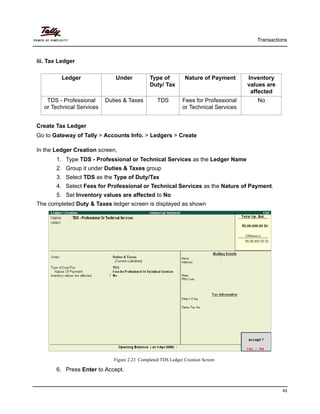
The completed Duty & Taxes ledger screen is displayed as shown
Figure 2.23 Completed TDS Ledger Creation Screen
6. Press Enter to Accept.
Ledger Under Type of
Duty/ Tax
Nature of Payment Inventory
values are
affected
TDS - Professional
or Technical Services
Duties & Taxes TDS Fees for Professional
or Technical Services
No
Transactions
46
2. Record the Transaction in Journal Voucher
Set Up:
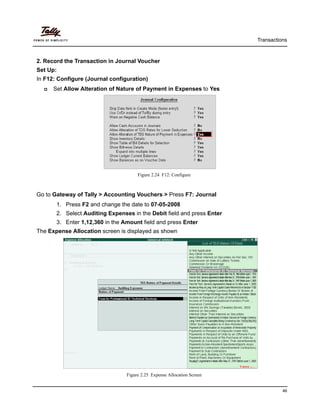
In F12: Configure (Journal configuration)
Set Allow Alteration of Nature of Payment in Expenses to Yes
Figure 2.24 F12: Configure
Go to Gateway of Tally > Accounting Vouchers > Press F7: Journal
1. Press F2 and change the date to 07-05-2008
2. Select Auditing Expenses in the Debit field and press Enter
3. Enter 1,12,360 in the Amount field and press Enter
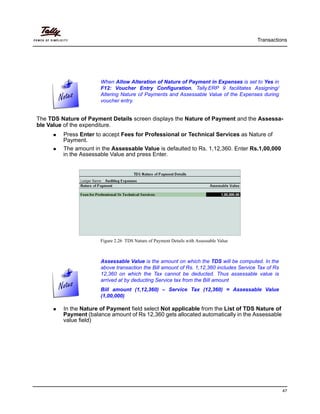
The Expense Allocation screen is displayed as shown
Figure 2.25 Expense Allocation Screen
Transactions
47
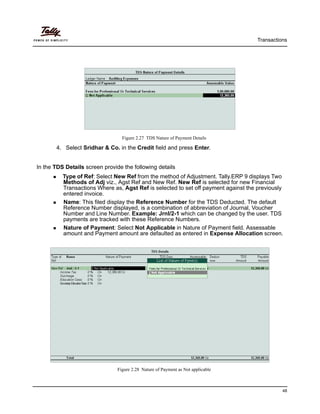
The TDS Nature of Payment Details screen displays the Nature of Payment and the Assessa-
ble Value of the expenditure.
Press Enter to accept Fees for Professional or Technical Services as Nature of
Payment.
The amount in the Assessable Value is defaulted to Rs. 1,12,360. Enter Rs.1,00,000
in the Assessable Value and press Enter.
Figure 2.26 TDS Nature of Payment Details with Assessable Value
In the Nature of Payment field select Not applicable from the List of TDS Nature of
Payment (balance amount of Rs 12,360 gets allocated automatically in the Assessable
value field)
When Allow Alteration of Nature of Payment in Expenses is set to Yes in
F12: Voucher Entry Configuration, Tally.ERP 9 facilitates Assigning/
Altering Nature of Payments and Assessable Value of the Expenses during
voucher entry.
Assessable Value is the amount on which the TDS will be computed. In the
above transaction the Bill amount of Rs. 1,12,360 includes Service Tax of Rs
12,360 on which the Tax cannot be deducted. Thus assessable value is
arrived at by deducting Service tax from the Bill amount
Bill amount (1,12,360) – Service Tax (12,360) = Assessable Value
(1,00,000)
Transactions
48
Figure 2.27 TDS Nature of Payment Details
4. Select Sridhar & Co. in the Credit field and press Enter.
In the TDS Details screen provide the following details
Type of Ref: Select New Ref from the method of Adjustment. Tally.ERP 9 displays Two
Methods of Adj viz., Agst Ref and New Ref. New Ref is selected for new Financial
Transactions Where as, Agst Ref is selected to set off payment against the previously
entered invoice.
Name: This filed display the Reference Number for the TDS Deducted. The default
Reference Number displayed, is a combination of abbreviation of Journal, Voucher
Number and Line Number. Example: Jrnl/2-1 which can be changed by the user. TDS
payments are tracked with these Reference Numbers.
Nature of Payment: Select Not Applicable in Nature of Payment field. Assessable
amount and Payment amount are defaulted as entered in Expense Allocation screen.
Figure 2.28 Nature of Payment as Not applicable
Transactions
49
Type of Ref: Select New Ref from the method of Adjustment.
Name: This filed display the Reference Number for the TDS Deducted. The default
Reference Number displayed, is a combination of abbreviation of Journal, Voucher
Number and Line Number. Example: Jrnl/2-2 which can be changed by the user. TDS
payments are tracked with these Reference Numbers.
Nature of Payment: Select Fees for Professional or Technical Services in Nature of
Payment field. Assessable amount and Payment amount are defaulted as entered in
Expense Allocation screen.
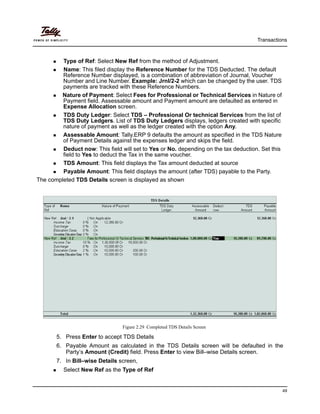
TDS Duty Ledger: Select TDS – Professional Or technical Services from the list of
TDS Duty Ledgers. List of TDS Duty Ledgers displays, ledgers created with specific
nature of payment as well as the ledger created with the option Any.
Assessable Amount: Tally.ERP 9 defaults the amount as specified in the TDS Nature
of Payment Details against the expenses ledger and skips the field.
Deduct now: This field will set to Yes or No. depending on the tax deduction. Set this
field to Yes to deduct the Tax in the same voucher.
TDS Amount: This field displays the Tax amount deducted at source
Payable Amount: This field displays the amount (after TDS) payable to the Party.
The completed TDS Details screen is displayed as shown
Figure 2.29 Completed TDS Details Screen
5. Press Enter to accept TDS Details
6. Payable Amount as calculated in the TDS Details screen will be defaulted in the
Party’s Amount (Credit) field. Press Enter to view Bill–wise Details screen.
7. In Bill–wise Details screen,
Select New Ref as the Type of Ref
Transactions
50
In the Name field enter the Bill name as Bill - 911
Skip the Due Date or Credit Days field
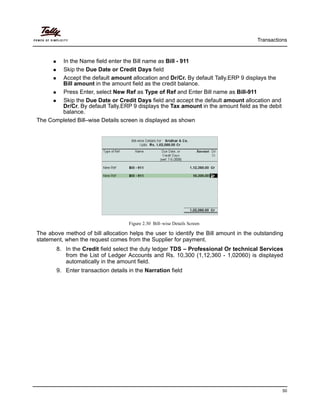
Accept the default amount allocation and Dr/Cr. By default Tally.ERP 9 displays the
Bill amount in the amount field as the credit balance.
Press Enter, select New Ref as Type of Ref and Enter Bill name as Bill-911
Skip the Due Date or Credit Days field and accept the default amount allocation and
Dr/Cr. By default Tally.ERP 9 displays the Tax amount in the amount field as the debit
balance.
The Completed Bill–wise Details screen is displayed as shown
Figure 2.30 Bill–wise Details Screen
The above method of bill allocation helps the user to identify the Bill amount in the outstanding
statement, when the request comes from the Supplier for payment.
8. In the Credit field select the duty ledger TDS – Professional Or technical Services
from the List of Ledger Accounts and Rs. 10,300 (1,12,360 - 1,02060) is displayed
automatically in the amount field.
9. Enter transaction details in the Narration field
Transactions
51
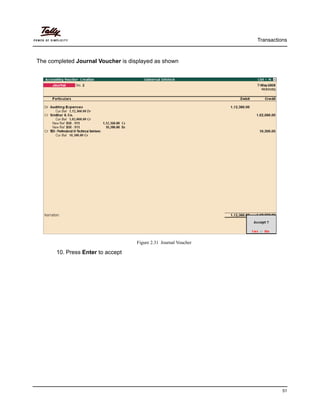
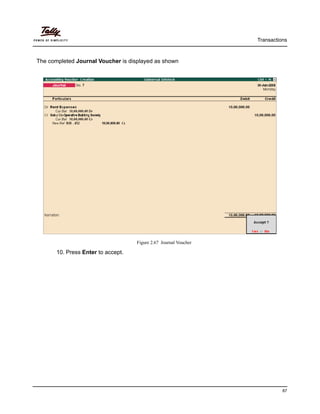
The completed Journal Voucher is displayed as shown
Figure 2.31 Journal Voucher
10. Press Enter to accept
Transactions
52
2.4.2 Accounting of Expenses and Deducting TDS Later
It is always expected that, the deductor should deduct the tax in the same invoice in which the
expenses are accounted. But in some cases, deductor may follow the procedure of accounting
only expenses on the receipt of bills and later, deduct applicable tax on all such accounted
expenses in one invoice.
Tally.ERP 9 provides the flexibility to account expenses and later deduct tax on such expenses.
Consider the following scenario to illustrate Accounting of Expenses and deducting TDS later.
1. Accounting of Expenses
Example 5:
On 8th May, 2008 Universal Infotech received a bill (vide No. 689) from Digitech Computers for
Rs. 25,000 towards commission charges.
The following example illustrates TDS transaction using a Purchase Voucher. Before recoprding
the above transaction, create the following required ledgers.
To account the above transaction follow the steps given below
1. Create Masters
i. Expense Ledger
ii. Party Ledger
iii. Tax Ledger
2. Record the Transaction in Purchase Voucher
1. Create Masters
As per the given information create masters.
i. Expense Ledger
Ledger Under IS TDS
Applicable
Default Nature of Payment
Commission Expenses Indirect Expenses Yes Commission or Brokerage
Inventory values are affected: No
Transactions
53
ii.Party Ledger
iii. Tax Ledger
2. Record the Transaction in Purchase Voucher (Acct Invoice Mode)
Set Up:
In F12: Configure (Puchase Invoice Configuration)
Set Use Common Ledger A/c for Item Allocation to No
Set Use Defaults for Bill Allocations to No
Go to Gateway of Tally > Accounting Vouchers > Press F9: Purchase
1. Press Alt + I for Account Invoice mode
2. Press F2 and change the date to 08-05-2008
3. In Party’s A/c Name field select Digitech Computers from the List of Ledger
Accounts
4. Under Particulars select Commission Expenses and press Enter
5. Enter Rs. 25000 in the Amount field
6. Press Enter to view TDS Nature of Payment Details screen and accept the default
details in the screen.
7. Press Enter twice to view TDS details screen.
Ledger Under Maintain
balances
bill-by-bill
Is TDS
Deductable
Deductee Type
Digitech Computers Sundry Creditors Yes Yes Individual/HUF – Resident
In Mailing Details:
Address: No-81/1, 8th main, Basaveshwaranagar, Bangalore.
State: karnataka
PIN Code: 560079
In Tax Information: PAN / IT No.: APRCL0497F
Ledger Under Type of
Duty/ Tax
Nature of Payment Inventory
values are
affected
TDS – Commission
or Brokerage
Duties & Taxes TDS Commission or Brokerage No
Transactions
54
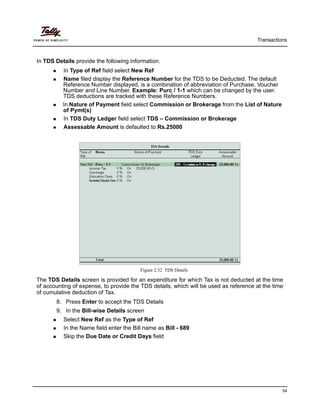
In TDS Details provide the following information.
In Type of Ref field select New Ref
Name filed display the Reference Number for the TDS to be Deducted. The default
Reference Number displayed, is a combination of abbreviation of Purchase, Voucher
Number and Line Number. Example: Purc / 1-1 which can be changed by the user.
TDS deductions are tracked with these Reference Numbers.
In Nature of Payment field select Commission or Brokerage from the List of Nature
of Pymt(s)
In TDS Duty Ledger field select TDS – Commission or Brokerage
Assessable Amount is defaulted to Rs.25000
Figure 2.32 TDS Details
The TDS Details screen is provided for an expenditure for which Tax is not deducted at the time
of accounting of expense, to provide the TDS details, which will be used as reference at the time
of cumulative deduction of Tax.
8. Press Enter to accept the TDS Details
9. In the Bill-wise Details screen
Select New Ref as the Type of Ref
In the Name field enter the Bill name as Bill - 689
Skip the Due Date or Credit Days field
Transactions
55
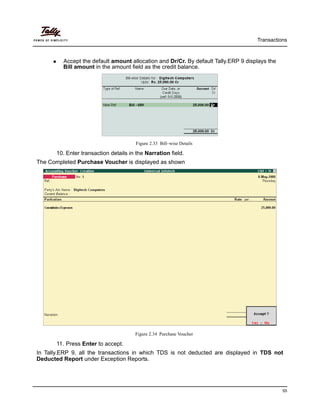
Accept the default amount allocation and Dr/Cr. By default Tally.ERP 9 displays the
Bill amount in the amount field as the credit balance.
Figure 2.33 Bill–wise Details
10. Enter transaction details in the Narration field.
The Completed Purchase Voucher is displayed as shown
Figure 2.34 Purchase Voucher
11. Press Enter to accept.
In Tally.ERP 9, all the transactions in which TDS is not deducted are displayed in TDS not
Deducted Report under Exception Reports.
The above transaction can also be accounted using Journal Voucher.
For more details on TDS Not Deducted report refer Reports Chapter.
Transactions
56
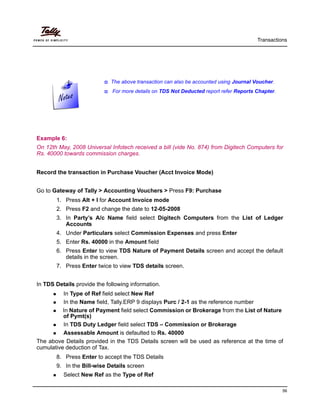
Example 6:
On 12th May, 2008 Universal Infotech received a bill (vide No. 874) from Digitech Computers for
Rs. 40000 towards commission charges.
Record the transaction in Purchase Voucher (Acct Invoice Mode)
Go to Gateway of Tally > Accounting Vouchers > Press F9: Purchase
1. Press Alt + I for Account Invoice mode
2. Press F2 and change the date to 12-05-2008
3. In Party’s A/c Name field select Digitech Computers from the List of Ledger
Accounts
4. Under Particulars select Commission Expenses and press Enter
5. Enter Rs. 40000 in the Amount field
6. Press Enter to view TDS Nature of Payment Details screen and accept the default
details in the screen.
7. Press Enter twice to view TDS details screen.
In TDS Details provide the following information.
In Type of Ref field select New Ref
In the Name field, Tally.ERP 9 displays Purc / 2-1 as the reference number
In Nature of Payment field select Commission or Brokerage from the List of Nature
of Pymt(s)
In TDS Duty Ledger field select TDS – Commission or Brokerage
Assessable Amount is defaulted to Rs. 40000
The above Details provided in the TDS Details screen will be used as reference at the time of
cumulative deduction of Tax.
8. Press Enter to accept the TDS Details
9. In the Bill-wise Details screen
Select New Ref as the Type of Ref
Transactions
57
In the Name field enter the Bill name as Bill - 874
Skip the Due Date or Credit Days field
Accept the default amount allocation and Dr/Cr. By default Tally.ERP 9 displays the
Bill amount in the amount field as the credit balance.
10. Enter transaction details in the Narration field.
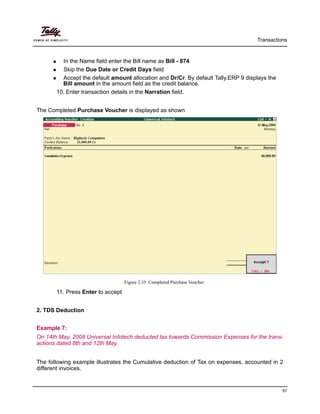
The Completed Purchase Voucher is displayed as shown
Figure 2.35 Completed Purchase Voucher
11. Press Enter to accept
2. TDS Deduction
Example 7:
On 14th May, 2008 Universal Infotech deducted tax towards Commission Expenses for the trans-
actions dated 8th and 12th May.
The following example illustrates the Cumulative deduction of Tax on expenses, accounted in 2
different invoices.
Transactions
58
Record the transaction in Journal Voucher
Go to Gateway of Tally > Accounting Vouchers > Press F7: Journal
1. Press F2 and change the date to 14-05-2008
2. Press Alt +S or click on S: TDS Deduction button on the buttons bar to view TDS
Deductions screen.
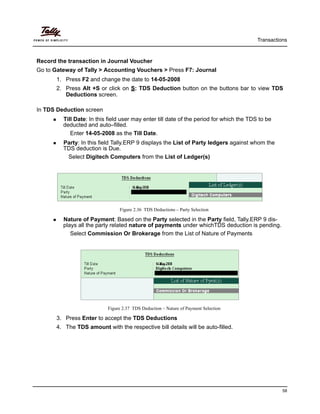
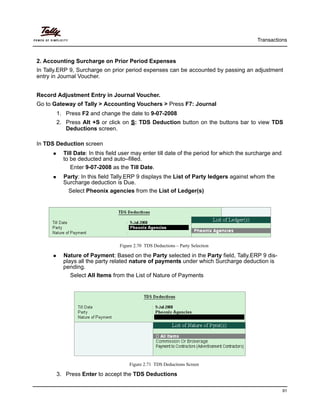
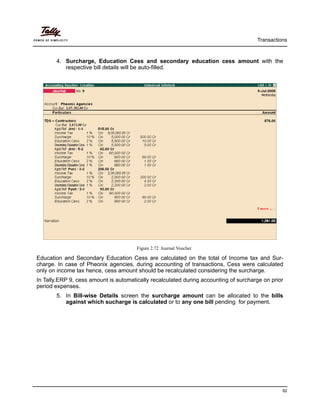
In TDS Deduction screen
Till Date: In this field user may enter till date of the period for which the TDS to be
deducted and auto–filled.
Enter 14-05-2008 as the Till Date.
Party: In this field Tally.ERP 9 displays the List of Party ledgers against whom the
TDS deduction is Due.
Select Digitech Computers from the List of Ledger(s)
Figure 2.36 TDS Deductions – Party Selection
Nature of Payment: Based on the Party selected in the Party field, Tally.ERP 9 dis-
plays all the party related nature of payments under whichTDS deduction is pending.
Select Commission Or Brokerage from the List of Nature of Payments
Figure 2.37 TDS Deduction – Nature of Payment Selection
3. Press Enter to accept the TDS Deductions
4. The TDS amount with the respective bill details will be auto-filled.
Transactions
59
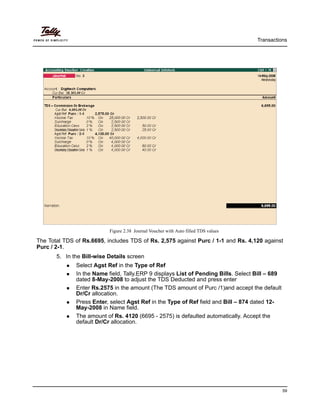
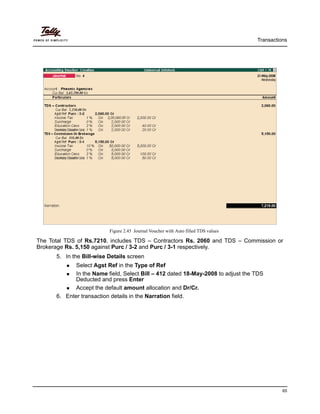
Figure 2.38 Journal Voucher with Auto filled TDS values
The Total TDS of Rs.6695, includes TDS of Rs. 2,575 against Purc / 1-1 and Rs. 4,120 against
Purc / 2-1.
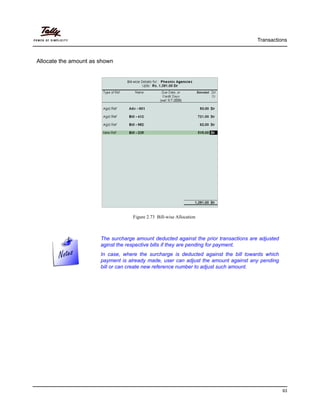
5. In the Bill-wise Details screen
Select Agst Ref in the Type of Ref
In the Name field, Tally.ERP 9 displays List of Pending Bills. Select Bill – 689
dated 8-May-2008 to adjust the TDS Deducted and press enter
Enter Rs.2575 in the amount (The TDS amount of Purc /1)and accept the default
Dr/Cr allocation.
Press Enter, select Agst Ref in the Type of Ref field and Bill – 874 dated 12-
May-2008 in Name field.
The amount of Rs. 4120 (6695 - 2575) is defaulted automatically. Accept the
default Dr/Cr allocation.
Transactions
60
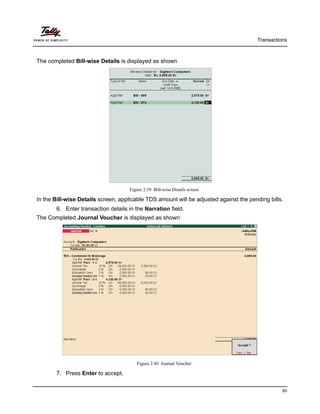
The completed Bill-wise Details is displayed as shown
Figure 2.39 Bill-wise Details screen
In the Bill-wise Details screen, applicable TDS amount will be adjusted against the pending bills.
6. Enter transaction details in the Narration field.
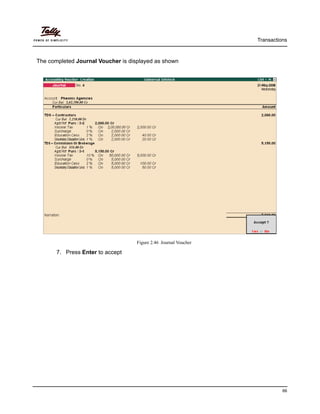
The Completed Journal Voucher is displayed as shown
Figure 2.40 Journal Voucher
7. Press Enter to accept.
Transactions
61
2.4.3 Accounting Multiple Expenses and Deducting TDS Later
Under this, we will understand the accounting of multiple expenses (in the same voucher) and
deducting TDS later.
Consider the following scenario to illustrate accounting of multiple expenses and deducting TDS
later.
1. Accounting of Expenses
Example 8:
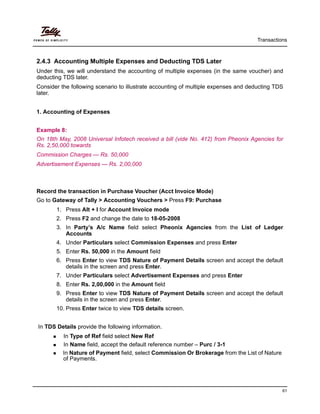
On 18th May, 2008 Universal Infotech received a bill (vide No. 412) from Pheonix Agencies for
Rs. 2,50,000 towards
Commission Charges — Rs. 50,000
Advertisement Expenses — Rs. 2,00,000
Record the transaction in Purchase Voucher (Acct Invoice Mode)
Go to Gateway of Tally > Accounting Vouchers > Press F9: Purchase
1. Press Alt + I for Account Invoice mode
2. Press F2 and change the date to 18-05-2008
3. In Party’s A/c Name field select Pheonix Agencies from the List of Ledger
Accounts
4. Under Particulars select Commission Expenses and press Enter
5. Enter Rs. 50,000 in the Amount field
6. Press Enter to view TDS Nature of Payment Details screen and accept the default
details in the screen and press Enter.
7. Under Particulars select Advertisement Expenses and press Enter
8. Enter Rs. 2,00,000 in the Amount field
9. Press Enter to view TDS Nature of Payment Details screen and accept the default
details in the screen and press Enter.
10. Press Enter twice to view TDS details screen.
In TDS Details provide the following information.
In Type of Ref field select New Ref
In Name field, accept the default reference number – Purc / 3-1
In Nature of Payment field, select Commission Or Brokerage from the List of Nature
of Payments.
Transactions
62
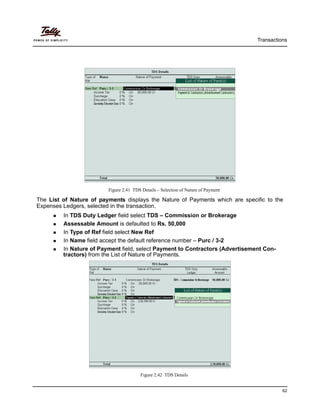
Figure 2.41 TDS Details – Selection of Nature of Payment
The List of Nature of payments displays the Nature of Payments which are specific to the
Expenses Ledgers, selected in the transaction.
In TDS Duty Ledger field select TDS – Commission or Brokerage
Assessable Amount is defaulted to Rs. 50,000
In Type of Ref field select New Ref
In Name field accept the default reference number – Purc / 3-2
In Nature of Payment field, select Payment to Contractors (Advertisement Con-
tractors) from the List of Nature of Payments.
Figure 2.42 TDS Details
Transactions
63
Here, the List of Nature of Payments displays only those nature of payments which are pending
for selection.
In TDS Duty Ledger field select TDS – Contractors
Assessable Amount is defaulted to Rs. 2,00,000
11. Press Enter to accept the TDS Details
12. In the Bill-wise Details screen
Select New Ref as the Type of Ref
In the Name field enter the Bill name as Bill - 412
Skip the Due Date or Credit Days field
Accept the default amount allocation and Dr/Cr. By default Tally.ERP 9 displays the
Bill amount in the amount field as the credit balance.
13. Enter transaction details in the Narration field.
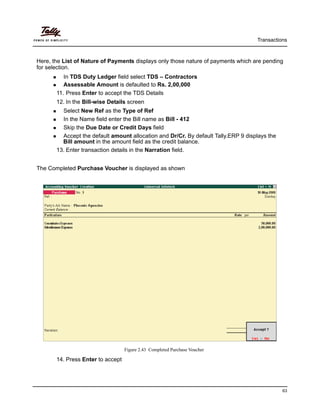
The Completed Purchase Voucher is displayed as shown
Figure 2.43 Completed Purchase Voucher
14. Press Enter to accept
Transactions
64
2. TDS Deduction
Example 9:
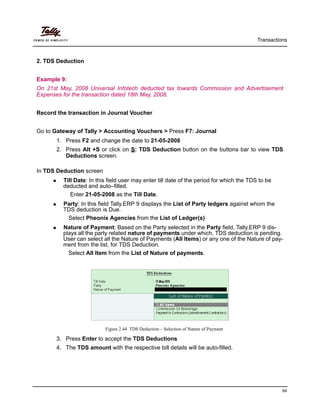
On 21st May, 2008 Universal Infotech deducted tax towards Commission and Advertisement
Expenses for the transaction dated 18th May, 2008.
Record the transaction in Journal Voucher
Go to Gateway of Tally > Accounting Vouchers > Press F7: Journal
1. Press F2 and change the date to 21-05-2008
2. Press Alt +S or click on S: TDS Deduction button on the buttons bar to view TDS
Deductions screen.
In TDS Deduction screen
Till Date: In this field user may enter till date of the period for which the TDS to be
deducted and auto–filled.
Enter 21-05-2008 as the Till Date.
Party: In this field Tally.ERP 9 displays the List of Party ledgers against whom the
TDS deduction is Due.
Select Pheonix Agencies from the List of Ledger(s)
Nature of Payment: Based on the Party selected in the Party field, Tally.ERP 9 dis-
plays all the party related nature of payments under which, TDS deduction is pending.
User can select all the Nature of Payments (All Items) or any one of the Nature of pay-
ment from the list, for TDS Deduction.
Select All Item from the List of Nature of payments.
Figure 2.44 TDS Deduction – Selection of Nature of Payment
3. Press Enter to accept the TDS Deductions
4. The TDS amount with the respective bill details will be auto-filled.
Transactions
65
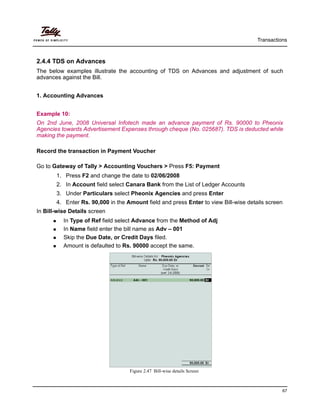
Figure 2.45 Journal Voucher with Auto filled TDS values
The Total TDS of Rs.7210, includes TDS – Contractors Rs. 2060 and TDS – Commission or
Brokerage Rs. 5,150 against Purc / 3-2 and Purc / 3-1 respectively.
5. In the Bill-wise Details screen
Select Agst Ref in the Type of Ref
In the Name field, Select Bill – 412 dated 18-May-2008 to adjust the TDS
Deducted and press Enter
Accept the default amount allocation and Dr/Cr.
6. Enter transaction details in the Narration field.
Transactions
66
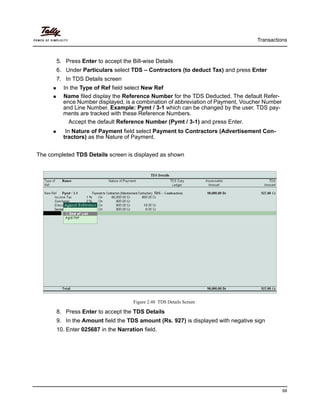
The completed Journal Voucher is displayed as shown
Figure 2.46 Journal Voucher
7. Press Enter to accept
Transactions
67
2.4.4 TDS on Advances
The below examples illustrate the accounting of TDS on Advances and adjustment of such
advances against the Bill.
1. Accounting Advances
Example 10:
On 2nd June, 2008 Universal Infotech made an advance payment of Rs. 90000 to Pheonix
Agencies towards Advertisement Expenses through cheque (No. 025687). TDS is deducted while
making the payment.
Record the transaction in Payment Voucher
Go to Gateway of Tally > Accounting Vouchers > Press F5: Payment
1. Press F2 and change the date to 02/06/2008
2. In Account field select Canara Bank from the List of Ledger Accounts
3. Under Particulars select Pheonix Agencies and press Enter
4. Enter Rs. 90,000 in the Amount field and press Enter to view Bill-wise details screen
In Bill-wise Details screen
In Type of Ref field select Advance from the Method of Adj
In Name field enter the bill name as Adv – 001
Skip the Due Date, or Credit Days filed.
Amount is defaulted to Rs. 90000 accept the same.
Figure 2.47 Bill-wise details Screen
Transactions
68
5. Press Enter to accept the Bill-wise Details
6. Under Particulars select TDS – Contractors (to deduct Tax) and press Enter
7. In TDS Details screen
In the Type of Ref field select New Ref
Name filed display the Reference Number for the TDS Deducted. The default Refer-
ence Number displayed, is a combination of abbreviation of Payment, Voucher Number
and Line Number. Example: Pymt / 3-1 which can be changed by the user. TDS pay-
ments are tracked with these Reference Numbers.
Accept the default Reference Number (Pymt / 3-1) and press Enter.
In Nature of Payment field select Payment to Contractors (Advertisement Con-
tractors) as the Nature of Payment.
The completed TDS Details screen is displayed as shown
Figure 2.48 TDS Details Screen
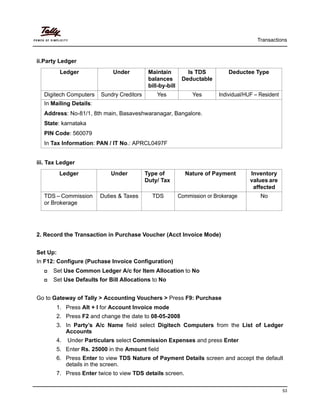
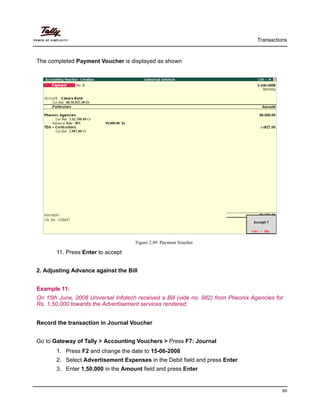
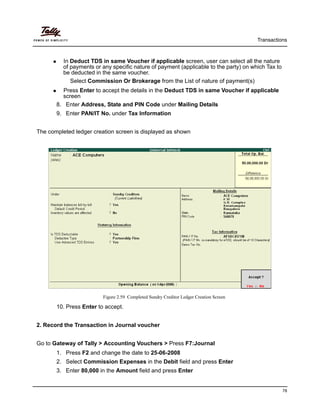
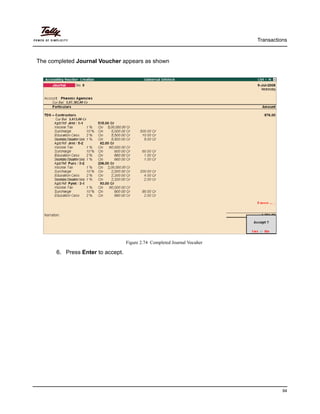
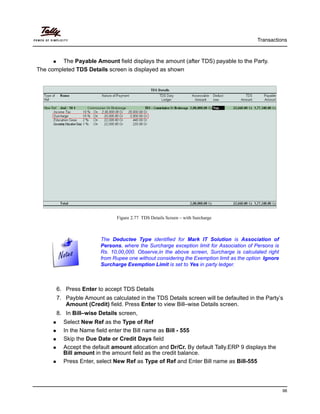
8. Press Enter to accept the TDS Details
9. In the Amount field the TDS amount (Rs. 927) is displayed with negative sign
10. Enter 025687 in the Narration field.
Transactions
69
The completed Payment Voucher is displayed as shown
Figure 2.49 Payment Voucher
11. Press Enter to accept
2. Adjusting Advance against the Bill
Example 11:
On 15th June, 2008 Universal Infotech received a Bill (vide no. 982) from Pheonix Agencies for
Rs. 1,50,000 towards the Advertisement services rendered.
Record the transaction in Journal Voucher
Go to Gateway of Tally > Accounting Vouchers > Press F7: Journal
1. Press F2 and change the date to 15-06-2008
2. Select Advertisement Expenses in the Debit field and press Enter
3. Enter 1,50,000 in the Amount field and press Enter
Transactions
70
4. In the TDS Nature of Payment Details, accept the default details.
5. Select Pheonix Agencies in the Credit field and press Enter.
In the TDS Details screen provide the following details
In Type of Ref select Agst Ref from the method of Adjustment, to adjust the advance
(on which TDS is deducted) against the Bill amount.
In the Name field Tally.ERP 9 displays the party related Pending Tax bills for selection.
Select Pymt / 3-1 from the List.
Based on the Tax Bill selected, the details in the Nature of Payment, TDS Duty
Ledger, Assessable Amount and Payable Amount field will be defaulted automati-
cally.
In Type of Ref select New Ref to account the Balance Amount (60,000 = 1,50,000 -
90,000) payable to the party, to deduct the TDS.
In the Name field accept the default TDS reference number – Jrnl / 5-2
In Nature of Payment field select Payment to Contractors (Advertisement Contrac-
tors) from the List of nature of Payment(s)
Select TDS – Contractors in the TDS Duty Ledger field.
Set Deduct now field to Yes to deduct the Tax in the same voucher.
The TDS Amount field displays the Tax amount deducted at source
The Payable Amount field displays the amount (after TDS) payable to the Party.
The completed TDS Details screen is displayed as shown
Figure 2.50 TDS Details Screen
Transactions
71
6. Press Enter to accept the TDS details
7. Payable Amount as calculated in the TDS Details screen will be defaulted in the
Party’s Amount (Credit) field. Press Enter to view Bill–wise Details screen.
8. In Bill–wise Details screen,
Select Agst Ref in Type of Ref, to adjust the Advance against the Bill amount.
In the Name field select Adv - 001 from the Pending Bills
In the Amount field, Tally.ERP 9 displays Rs. 90,000, accept the default allocation and
press Enter.
Select New Ref in the Type of Ref field to adjust the Balance amount payable to the
party.
In the Name field enter the Bill name as Bill - 982
Skip the Due Date or Credit Days field
Accept the default amount allocation and Dr/Cr. By default Tally.ERP 9 displays the
Balance Bill amount [1,50,000 – Advance (90,000)] in the amount field as the credit
balance.
Press Enter, select New Ref as Type of Ref and enter Bill name as Bill -982
Skip the Due Date or Credit Days field and accept the default amount allocation and
Dr/Cr. By default Tally.ERP 9 displays the Tax amount in the amount field as the debit
balance.
The completed Bill-wise Details is displayed as shown
Figure 2.51 Bill-wise Details Screen
Transactions
72
9. Press Enter to accept Bill-wise Details.
10. In the Credit field select the duty ledger TDS – Contractor from the List of Ledger
Accounts and Rs. 618 (1,50,000 - 1,49,382) is displayed automatically in the amount
field.
11. Enter transaction details in the Narration field.
The completed Journal Voucher is displayed as shown
Figure 2.52 Journal Voucher
12. Press Enter to accept.
Transactions
73
2.4.5 TDS on Expenses @ Lower Rate
Assessing Officer shall issue a certificate for deduction of Tax at Lower rate than the relevant rate
specified under the section, Where the assessing officer is satisfied that the total income of the
recipient (Assessee) justifies the deduction of income tax at any lower rates than the rate
specified under sections specified under the Act and has received an application in Form 13 from
the assessee under sub-section (1) of section 197.
The certificate granted shall be valid for the assessment year specified and is valid only for the
person named therein.
In Tally.ERP 9, the user can record and compute TDS on transactions, on which lower rate of
deduction is applicable. Consider the following example.
Example 12:
On 25th June, 2008 Universal Infotech received a Bill (vide No. 260) from ACE Computers for Rs.
80,000 towards commission charges.
ACE Computers has a certificate for deduction of Income tax at Lower rate @ 5%, on Commis-
sion.
To account the above transaction
1. Create Masters
i. Party Ledger
2. Record the Transaction in Journal voucher
1. Create Masters
i Party Ledger
Create Party Ledger
Go to Gateway of Tally > Accounts Info. > Ledgers > Create
Setup:
Before creating the party ledger enable the following Configurations in F12: Configure (Ledger
Configuration)
Ledger Under Maintain
balances
bill-by-bill
Is TDS
Deductable
Deductee Type
ACE Computers Sundry Creditors Yes Yes Partnership Firm
Transactions
74
Set Allow Advanced entries in TDS Masters to Yes.
Figure 2.53 F12: Configure
In the Ledger Creation screen,
1. Type ACE Computers as the Ledger Name
2. Group it under Sundry Creditors group
3. Set Maintain Balances bill-by-bill to Yes
4. Specify the Default Credit Period, if required
5. Set Is TDS Deductable to Yes
6. In the Deductee Type field select Partnership Firm from the List of Deductee
Types
7. Set Use Advanced TDS Entries to Yes and press Enter
Figure 2.54 Ledger Creation – Enabling Advanced TDS Entries
Transactions
75
The Advanced TDS Entries screen is displayed as shown
Figure 2.55 Advanced TDS Entries Screen
In the Advanced TDS Entries screen
Set Zero / Lower Deduction: This field will be enabled when the Deductee has a certifi-
cate issued by the assessing officer to Deduct Income tax at Lower Rate.
Enable Set Zero / Lower Deduction to Yes (ACE Computer has submitted the Certificate
to deduct income tax at Lower rate) and press Enter
Use Advanced TDS Entries field will be enabled in the ledger creation
screen only When Allow Advanced entries in TDS Masters is set to Yes in
F12: Voucher Entry Configuration.
Transactions
76
The Zero / Lower Deduction Details screen is displayed as shown
Figure 2.56 Zero / Lower Deduction Details Screen
In the Zero / Lower Deduction Details provide the following details
Nature of Payment: In this field, select the Nature of payment for which the lower rate
of income tax is allowed.
Select Commission Or Brokerage from the List of Nature of Payment(s)
Section Number: In this field, Tally.ERP 9 displays the Sections, under which an appli-
cation for lower rate or Zero rate are approved.
Select 197 as the Section Number
Certificate No./ Date: In this field, enter certificate number and the date of issue.
Enter ADIT-17(1)/2008-09 in certificate No./ Date field.
Applicable From: In this field, mention the date (as per the certificate) from when the
lower rate is approved.
Enter 12-05-2008 in Applicable From field
Applicable To: In this field mention the date till when the certificate of Lower rate will
remain in force.
Enter 31-3-2009 in Applicable To field
TDS: In this field mention the Rate of Income Tax
Enter 5% in the TDS field.
Transactions
77
Details in Surcharge, Ed Cess and Sec Ed Cess fields are defaulted automatically.
Figure 2.57 Completed Zero / Lower Deduction Details Screen
Press Enter to accept Zero/Lower Deduction Details.
Under Advanced TDS Entries, set Deduct TDS in Same Voucher if applicable to Yes.
Deduct TDS in Same Voucher if applicable is enabled only when, the income tax will be
deducted in the same voucher where the Due/ Payment is accounted for the party.
The Deduct TDS in Same Voucher if applicable screen is displayed as shown
Figure 2.58 Deduct TDS in Same Voucher if applicable
Transactions
78
In Deduct TDS in same Voucher if applicable screen, user can select all the nature
of payments or any specific nature of payment (applicable to the party) on which Tax to
be deducted in the same voucher.
Select Commission Or Brokerage from the List of nature of payment(s)
Press Enter to accept the details in the Deduct TDS in same Voucher if applicable
screen
8. Enter Address, State and PIN Code under Mailing Details
9. Enter PAN/IT No. under Tax Information
The completed ledger creation screen is displayed as shown
Figure 2.59 Completed Sundry Creditor Ledger Creation Screen
10. Press Enter to accept.
2. Record the Transaction in Journal voucher
Go to Gateway of Tally > Accounting Vouchers > Press F7:Journal
1. Press F2 and change the date to 25-06-2008
2. Select Commission Expenses in the Debit field and press Enter
3. Enter 80,000 in the Amount field and press Enter
Transactions
79
4. In the TDS Nature of Payment Details, accept the default details.
5. Select ACE Computers in the Credit field and press Enter.
In the TDS Details screen provide the following details
In Type of Ref select New Ref
In the Name field accept the default TDS reference number – Jrnl / 6-1
In Nature of Payment field select Commission Or Brokerage from the List of nature
of Payment(s)
In Is Zero / Lower Rate, Tally.ERP 9 displays the Sections, under which an application
for lower rate or Zero rate are approved. Select 197 from the List.
Select TDS – Commission Or Brokerage in the TDS Duty Ledger field.
Deduct now field will be defaulted to Yes and Tally.ERP 9 won’t allow the user to alter
the setting.
Deduct now filed will be defaulted to Yes, when the option Deduct TDS in
Same Voucher if applicable is enabled in the Party Ledger for the Nature of
Payment (selected in the transaction).
The TDS Amount field displays the Tax amount deducted at source
The Payable Amount field displays the amount (after TDS) payable to the Party.
The completed TDS Details screen is displayed as shown
Figure 2.60 TDS Details Screen
Transactions
80
6. Press Enter to accept the TDS details
7. Payable Amount as calculated in the TDS Details screen will be defaulted in the
Party’s Amount (Credit) field. Press Enter to view Bill–wise Details screen.
8. In Bill–wise Details screen,
Select New Ref as the Type of Ref
In the Name field enter the Bill name as Bill - 260
Skip the Due Date or Credit Days field
Accept the default amount allocation and Dr/Cr. By default Tally.ERP 9 displays the
Bill amount in the amount field as the credit balance.
Press Enter, select New Ref as Type of Ref and Enter Bill name as Bill - 260
Skip the Due Date or Credit Days field and accept the default amount allocation and
Dr/Cr. By default Tally.ERP 9 displays the Tax amount in the amount field as the debit
balance.
The completed Bill-wise Details is displayed as shown
Figure 2.61 Bill-wise Details Screen
9. Press Enter to accept Bill-wise Details.
10. In the Credit field select the duty ledger TDS – Commission Or Brokerage from the
List of Ledger Accounts and Rs. 4120 (80,000 – 75,880) is displayed automatically in
the amount field.
11. Enter transaction details in the Narration field.
Transactions
81
The completed Journal Voucher is displayed as shown
Figure 2.62 Journal Voucher
12. Press Enter to accept
Transactions
82
2.4.6 TDS on Expenses @ Zero Rate
A Deductee (other than Company or Firm) can submit a declaration in Form 15G under sub
section (1) of section 197A, for TDS deduction at Zero Rate. Declarations can be given only by
those deductees whose income is below the taxable limit and the income falls under section 193,
194, 194A, 194EE and 194K.
The certificate granted shall be valid for the assessment year specified and is valid only for the
person named therein.
Example 13:
On 30th June, 2008 Universal Infotech received a Bill (Vide No. 452) from Gokul Co-operative
Building Society for Rs. 10,00,000 towards Rent on Building and Furniture.
Gokul Co-operative Building Society has a certificate for non-deduction (zero rate) of Income tax
on Rent.
To account the above transaction
1. Create Masters
i. Expense Ledger
ii. Party Ledger
2. Record the transaction in Journal Voucher
1. Create Masters
i. Expense Ledger
As per the given information, create the above ledger
iii. Party Ledger
Ledger Under IS TDS
Applicable
Default Nature of Payment
Rent Expenses Indirect Expenses Yes Rent of Land, Building Or
Furniture
Set Inventory values are affected to No
Ledger Under Maintain
balances
bill-by-bill
Is TDS
Deductable
Deductee Type
Gokul Co-operative
Building Society
Sundry Creditors Yes Yes Co–Operative Society
Transactions
83
Create Party Ledger
Go to Gateway of Tally > Accounts Info. > Ledgers > Create
In the Ledger Creation screen,
1. Type Gokul Co-operative Building Society as the Ledger Name
2. Group it under Sundry Creditors group
3. Set Maintain Balances bill-by-bill to Yes
4. Specify the Default Credit Period, if required
5. Set Is TDS Deductable to Yes
6. In the Deductee Type field select Co–Operative Society from the List of Deductee
Types
7. Set Use Advanced TDS Entries to Yes and press Enter
In the Advanced TDS Entries screen
Set Zero / Lower Deduction to Yes (Gokul Co-operative Building Society has submit-
ted the Certificate for non-deduction (zero rate) of income tax) and press Enter
In the Zero / Lower Deduction Details provide the following details
In Nature of Payment field select Rent of Land, Building Or Furniture from the List
of Nature of Payment(s)
Section Number: In this field, Tally.ERP 9 displays the Sections, under which an appli-
cation for lower rate or Zero rate are approved.
Select 197A as the Section Number
Enter ADIT-2(5)/20008-09 in certificate No./ Date field.
Enter 01-06- 2008 in Applicable From field
Enter 31-12-2009 in Applicable To field
TDS, Surcharge, Ed Cess and Sec Ed Cess fields will be defaulted to 0%.
Figure 2.63 Completed Zero / Lower Deduction Details Screen
Transactions
84
Press Enter to accept Zero/Lower Deduction Details.
Deduct TDS in Same Voucher if applicable is enabled, when the income tax will be
deducted in the same voucher where the Due/ Payment is accounted for the party.
Set Deduct TDS in Same Voucher if applicable to Yes and Press Enter
In Deduct TDS in same Voucher if applicable screen, select Rent of Land, Building
Or Furniture from the List of nature of payment(s)
Press Enter to accept the details in the Deduct TDS in same Voucher if applicable
screen
8. Enter Address, State and PIN Code under Mailing Details
9. Enter PAN/IT No. under Tax Information
The completed Ledger Creation screen is displayed as shown
Figure 2.64 Completed Sundry Creditor Ledger Creation Screen
10. Press Enter to accept.
Transactions
85
2. Record the Transaction in Journal voucher
Go to Gateway of Tally > Accounting Vouchers > Press F7:Journal
1. Press F2 and change the date to 30-06-2008
2. Select Rent Expenses in the Debit field and press Enter
3. Enter 10,00,000 in the Amount field and press Enter
4. In the TDS Nature of Payment Details, accept the default details.
5. Select Gokul Co-operative Building Society in the Credit field and press Enter.
In the TDS Details screen provide the following details
In Type of Ref select New Ref
In the Name field accept the default TDS reference number – Jrnl / 7-1
In Nature of Payment field select Rent of Land, Building Or Furniture from the List
of nature of Payment(s)
In Is Zero / Lower Rate, Tally.ERP 9 displays the Sections, under which an application
for lower rate or Zero rate are approved. Select 197A from the List.
The completed TDS Details screen is displayed as shown
Figure 2.65 TDS Details Screen
In TDS Details screen, Tally.ERP 9 won’t prompt the user to select the TDS
Duty ledger or to deduct the tax in the same voucher, as the section (197A)
selected indicates the Non deduction (Zero Rate) of Income tax
Transactions
86
6. Payable Amount as displayed in the TDS Details screen will be defaulted in the
Party’s Amount (Credit) field. Press Enter to view Bill–wise Details screen.
7. In Bill–wise Details screen,
Select New Ref as the Type of Ref
In the Name field enter the Bill name as Bill - 452
Skip the Due Date or Credit Days field
Accept the default amount allocation and Dr/Cr. By default Tally.ERP 9 displays the
Bill amount in the amount field as the credit balance.
The completed Bill-wise Details is displayed as shown
Figure 2.66 Bill-wise Details Screen
8. Press Enter to accept Bill-wise Details.
9. Enter transaction details in the Narration field.
Transactions
87
The completed Journal Voucher is displayed as shown
Figure 2.67 Journal Voucher
10. Press Enter to accept.
Transactions
88
2.4.7 Surcharge Calculation on Prior Period Expenses
As per Income Tax Act, Surcharge on TDS is applicable for the payment(s) exceeding Rs.10 lakhs
(for Individual, HUF and Association of Persons) and Rs 1 Crore (for Companies, Artificial Judicial
Person and Partnership Firm). However it is not applicable deducteeTypes such as Co-Operative
Society and Local Authority.
In TDS, when the payment exceeds the Surcharge exemption Limit, Surcharge is applicable on
the entire amount right from the first transaction.
However, the transactions recorded until the deductee reached the surcharge exemption limit
were not charged to surcharge, in such cases surcharge is to be calculated on the entire amount.
Tally.ERP 9 automatically calculates the surcharge on the prior transactions.
Consider the following example to account surcharge calculation on prior period Expenses.
Example 14:
On 9th July, 2008 Universal Infotech received a Bill (vide No. 1024) from Pheonix Agencies for
Rs. 3,00,000 towards the Advertisement services rendered.
To account the above transaction follow the steps given below
1. Accounting Expenses in Journal Voucher (surcharge is calculated)
2. Accounting Surcharge on prior period Expenses in Journal voucher
1. Accounting Expenses
Record the transaction in Journal Voucher
Go to Gateway of Tally > Accounting Vouchers > Press F7:Journal
1. Press F2 and change the date to 09-07-2008
2. Select Advertisement Expenses in the Debit field and press Enter
3. Enter 3,00,000 in the Amount field and press Enter
4. In the TDS Nature of Payment Details screen, accept the default details.
5. Select Pheonix Agencies in the Credit field and press Enter.
In TDS Details screen provide the following details
In Type of Ref field, select New Ref
In the Name field accept the default TDS reference number – Jrnl / 8-1
In Nature of Payment field select Payment to Contractors (Advertisement Contrac-
tors) from the List of nature of Payment(s)
Transactions
89
Select TDS – Contractors in the TDS Duty Ledger field
Set Deduct Now to Yes to deduct the income tax in the same voucher.
The TDS Amount field displays the Tax amount deducted at source
The Payable Amount field displays the amount (after TDS) payable to the Party.
The completed TDS Details screen is displayed as shown
Figure 2.68 TDS Details Screen – with Surcharge
6. Press Enter to accept the TDS details
7. Payable Amount as calculated in the TDS Details screen will be defaulted in the
Party’s Amount (Credit) field. Press Enter to view Bill–wise Details screen.
8. In Bill–wise Details screen,
Select New Ref as the Type of Ref
In the Name field enter the Bill name as Bill - 1024
TDS amount in the above screen includes surcharge on the payment,
as the total payment to the party exceeds the Surcharge exemption
limit of Rs.10,00,000 (Rs.5,00,000 + Rs 2.50,000 + Rs. 1,50,000 + Rs.
3,00,000). (The Deductee Type identified for Pheonix Agencies is
Association of Persons, where the Surcharge exception limit for Asso-
ciation of Persons is Rs. 10,00,000)
Here Surcharge is calculated only on Rs. 3,00,000 (present Bill amount).
Surcharge on prior period expenses are accounted separately by record-
ing a Journal voucher.
Transactions
90
Skip the Due Date or Credit Days field
Accept the default amount allocation and Dr/Cr. By default Tally.ERP 9 displays the
Bill amount in the amount field as the credit balance.
Press Enter, select New Ref as Type of Ref and Enter Bill name as Bill - 1024
Skip the Due Date or Credit Days field and accept the default amount allocation and
Dr/Cr. By default Tally.ERP 9 displays the Tax amount in the amount field as the debit
balance.
9. Press Enter to accept Bill-wise Details.
10. In the Credit field select the duty ledger TDS – Contractors from the List of Ledger
Accounts and Rs. 3390 (3,00,000 – 2,96,610) is displayed automatically in the
amount field.
11. Enter transaction details in the Narration field.
The completed Journal Voucher is displayed as shown
Figure 2.69 Journal Voucher
12. Press Enter to accept
Transactions
91
2. Accounting Surcharge on Prior Period Expenses
In Tally.ERP 9, Surcharge on prior period expenses can be accounted by passing an adjustment
entry in Journal Voucher.
Record Adjustment Entry in Journal Voucher.
Go to Gateway of Tally > Accounting Vouchers > Press F7: Journal
1. Press F2 and change the date to 9-07-2008
2. Press Alt +S or click on S: TDS Deduction button on the buttons bar to view TDS
Deductions screen.
In TDS Deduction screen
Till Date: In this field user may enter till date of the period for which the surcharge and
to be deducted and auto–filled.
Enter 9-07-2008 as the Till Date.
Party: In this field Tally.ERP 9 displays the List of Party ledgers against whom the
Surcharge deduction is Due.
Select Pheonix agencies from the List of Ledger(s)
Figure 2.70 TDS Deductions – Party Selection
Nature of Payment: Based on the Party selected in the Party field, Tally.ERP 9 dis-
plays all the party related nature of payments under which Surcharge deduction is
pending.
Select All Items from the List of Nature of Payments
Figure 2.71 TDS Deductions Screen
3. Press Enter to accept the TDS Deductions
Transactions
92
4. Surcharge, Education Cess and secondary education cess amount with the
respective bill details will be auto-filled.
Figure 2.72 Journal Voucher
Education and Secondary Education Cess are calculated on the total of Income tax and Sur-
charge. In case of Pheonix agencies, during accounting of transactions, Cess were calculated
only on income tax hence, cess amount should be recalculated considering the surcharge.
In Tally.ERP 9, cess amount is automatically recalculated during accounting of surcharge on prior
period expenses.
5. In Bill-wise Details screen the surcharge amount can be allocated to the bills
against which sucharge is calculated or to any one bill pending for payment.
Transactions
93
Allocate the amount as shown
Figure 2.73 Bill-wise Allocation
The surcharge amount deducted against the prior transactions are adjusted
aginst the respective bills if they are pending for payment.
In case, where the surcharge is deducted against the bill towards which
payment is already made, user can adjust the amount against any pending
bill or can create new reference number to adjust such amount.
Transactions
94
The completed Journal Voucher appears as shown
Figure 2.74 Completed Journal Vocuher
6. Press Enter to accept.
Transactions
95
2.4.8 Surcharge Calculation on Expenses
As per Income Tax Act, Surcharge on TDS is applicable for the payment(s) exceeding Rs.10 lakhs
(for Individual, HUF and Association of Persons) and Rs 1 Crore (for Companies, Artificial Judicial
Person and Partnership Firm). However it is not applicable for Deductee Types such as Co-
Operative Society and Local Authority.
In TDS, when the payment exceeds the Surcharge exemption Limit, Surcharge is applicable on
the entire amount right from the first transaction and such past transactions will have to be shown
in the e-TDS statements.
In this scenario it is always suggested that a realistic estimation of total amount to be made right
in the beginning and deductor should deduct TDS without considering the Surcharge Exemption
Limit.
Consider the following example to account surcharge right from the first transaction.
Example 15:
On 15th July, 2008 Universal Infotech received a Bill (vide No. 555) from Mark IT Solutions for Rs.
2,00,000 towards the commission charges.
To account the above transaction follow the steps given below
1. Create Masters
i. Party Ledger
2. Record the Transaction in Journal Voucher
1. Create Masters
i. Party Ledger
Ledger Under Maintain
balances
bill-by-bill
Is TDS
Deductable
Deductee Type
Mark IT Solutions Sundry Creditors Yes Yes Association of Persons
Transactions
96
Create Party Ledger
Go to Gateway of Tally > Accounts Info. > Ledgers > Create
In the Ledger Creation screen,
1. Type Mark IT Solutions as the Ledger Name
2. Group it under Sundry Creditors group
3. Set Maintain Balances bill-by-bill to Yes
4. Specify the Default Credit Period, if required
5. Set Is TDS Deductable to Yes
6. In the Deductee Type field select Association of Persons from the List of
Deductee Types
7. Set Use Advanced TDS Entries to Yes and press Enter
8. In Advanced TDS Entries screen
Set Ignore Surcharge Exemption Limit to Yes
Figure 2.75 Advanced TDS Entries Screen
9. Enter the Mailing Details.
10. Under Tax Information enter the PAN/IT No.
Universal Infotech is deducting surcharge for Mark IT Solutions from the first
transaction (without considering the surcharge exemption limit) as he is a
regular party and the estimation of his transactions revealed that the
total payment will exceed the surcharge exemption limit
Set the option Ignore Surcharge Exemption Limit to Yes in Party’s Ledger
to deduct the surcharge without considering the exemption limit.
Transactions
97
The Completed Ledger Creation screen is displayed as shown
Figure 2.76 Ledger Creation Screen
2. Record the Transaction in Journal Voucher
Go to Gateway of Tally > Accounting Vouchers > Press F7:Journal
1. Press F2 and change the date to 15-07-2008
2. Select Commission Expenses in the Debit field and press Enter
3. Enter 2,00,000 in the Amount field and press Enter
4. In the TDS Nature of Payment Details, accept the default details.
5. Select Mark IT Solutions in the Credit field and press Enter.
In the TDS Details screen provide the following details
In Type of Ref select New Ref
In the Name field accept the default TDS reference number – Jrnl / 10-1
In Nature of Payment field select Commission Or Brokerage from the List of nature
of Payment(s)
Select TDS – Commission Or Brokerage in the TDS Duty Ledger field
Set Deduct Now to Yes to deduct the income tax in the same voucher.
The TDS Amount field displays the Tax amount deducted at source
Transactions
98
The Payable Amount field displays the amount (after TDS) payable to the Party.
The completed TDS Details screen is displayed as shown
Figure 2.77 TDS Details Screen – with Surcharge
6. Press Enter to accept TDS Details
7. Payble Amount as calculated in the TDS Details screen will be defaulted in the Party’s
Amount (Credit) field. Press Enter to view Bill–wise Details screen.
8. In Bill–wise Details screen,
Select New Ref as the Type of Ref
In the Name field enter the Bill name as Bill - 555
Skip the Due Date or Credit Days field
Accept the default amount allocation and Dr/Cr. By default Tally.ERP 9 displays the
Bill amount in the amount field as the credit balance.
Press Enter, select New Ref as Type of Ref and Enter Bill name as Bill-555
The Deductee Type identified for Mark IT Solution is Association of
Persons, where the Surcharge exception limit for Association of Persons is
Rs. 10,00,000. Observe,in the above screen, Surcharge is calculated right
from Rupee one without considering the Exemption limit as the option Ignore
Surcharge Exemption Limit is set to Yes in party ledger.
Transactions
99
Skip the Due Date or Credit Days field and accep the default amount allocation and
Dr/Cr. By default Tally.ERP 9 displays the Tax amount in the amount field as the debit
balance.
Press Enter to accept Bill-wise Details
9. In the Credit field select the duty ledger TDS – commission Or Brokerage from the
List of Ledger Accounts and Rs. 22,660 (2,00,000 - 1,77,340) is displayed automati-
cally in the amount field.
10. Enter transaction details in the Narration field.
The completed Journal Voucher is dispalyed as shown
Figure 2.78 Journal Voucher
11. Press Enter to accept.
Transactions
100
2.5 Adjustments in TDS
2.5.1 Reversal Of Expenses and TDS
In case of Cancellation of transaction(s), the expenses and TDS deducted needs to be reversed.
In Tally.ERP 9, such reversal of expenses and TDS is possible only when the cancellation is made
before the payment of TDS to the Government.
Tally.ERP 9 provides the flexibility to account expenses and later reverse the expenses and TDS
on cancelled transaction(s). In Tally.ERP 9, you can account the reversal of expenses and TDS
using Debit Note.
1. Accounting Expenses
2. Reversal of Expenses and TDS
Consider the following scenario to illustrate the Reversal of Expesnes and TDS
1. Accounting Expenses
Example 16:
On 18th July, 2008 Universal Infotech received a bill (vide No. 631) from Pheonix Agencies for Rs.
80,000 towards advertisement services.
Record the Transaction in Journal voucher
Go to Gateway of Tally > Accounting Vouchers > Press F7:Journal
1. Press F2 and change the date to 18-07-2008
2. Select Advertisement Expenses in the Debit field and press Enter
3. Enter 80,000 in the Amount field and press Enter
4. In the TDS Nature of Payment Details, accept the default details.
5. Select Pheonix Agencies in the Credit field and press Enter.
In the TDS Details screen provide the following details
In Type of Ref select New Ref
In the Name field accpet the default TDS reference number – Jrnl / 11-1
In Nature of Payment field select Payment to Contractors (Advertisement Contrac-
tors) from the List of nature of Payment(s)
Select TDS – Contractors in the TDS Duty Ledger field.
Set Deduct Now to Yes to deduct the income tax in the same voucher.
The TDS Amount field dispalys the Tax amount deducted at source
The Payable Amount field dispalys the amount (after TDS) payable to the Party.
Transactions
101
6. Press Enter to accept the TDS details
7. Payble Amount as calculated in the TDS Details screen will be defaulted in the Party’s
Amount (Credit) field. Press Enter to view Bill–wise Details screen.
8. In Bill–wise Details screen,
Select New Ref as the Type of Ref
In the Name field enter the Bill name as Bill - 631
Skip the Due Date or Credit Days field
Accept the default amount allocation and Dr/Cr. By default Tally.ERP 9 displays the
Bill amount in the amount field as the credit balance.
Press Enter, select New Ref as Type of Ref and Enter Bill name as Bill - 631
Skip the Due Date or Credit Days field and accept the default amount allocation and
Dr/Cr. By default Tally.ERP 9 displays the Tax amount in the amount field as the debit
balance.
9. Press Enter to accept Bill-wise Details.
10. In the Credit field select the duty ledger TDS – Contractors from the List of Ledger
Accounts and Rs. 907 (80,000 – 79,093) is displayed automatically in the amount
field.
11. Enter transaction details in the Narration field.
Figure 2.79 Completed Journal Voucher
12. Press Enter to accept
Transactions
102
2. Reversal of expenses and TDS
Example 17:
On 25th July, 2008 Pheonix agencies cancelled the transaction dated 18th July, 2008 for Rs.
80,000 (bill – 631) because of the non-availability of resources to carry out the contract.
Set Up:
In F11: Features (Accounting Features)
Set Use Debit/Credit Notes to Yes
Set Use Invocie mode for Debit Notes to Yes
Figure 2.80 F11:Features — Accounting Features
Record the transaction in Debit Note (Acct Invoice Mode)
Go to Gateway of Tally > Accountig Vouchers > Press Ctrl + F9: Debit Note
1. Press Alt + I for Account Invoice mode
2. Press F2 and change the date to 25-07-2008
3. In Party’s A/c Name field select Pheonix Agencies from the List of Ledger
Accounts
4. Under Particulars select Advertisement Expenses and press Enter
5. Enter Rs. 80,000 in the Amount field
Transactions
103
6. Press Enter to view TDS Nature of Payment Details screen and accept the default
details in the screen and press Enter.
7. Under Particulars select TDS – Contractors and press Enter to view TDS Details
screen.
In the TDS Details screen provide the following details
In Type of Ref select Agst Ref
In Name field, Tally.ERP 9 displays the Tax Details, based on the party and the nature
of payment selected in teh transaction. From Tax Details select the Tax Reference
Number against which the TDS to be reversed.
Select Jurl /11-1 from the Tax details
In Nature of Payment field select Payment to Contractors (Advertisement Con-
tractors) from the List of nature of Payment(s)
Based on the tax reference number selected,Tally.ERP 9 defaults the details in TDS
Duty Ledger, Assessable Amount and TDS Amount fields.
Figure 2.81 TDS Details
8. Press Enter to accept the TDS Details
9. TDS Amount as displayed in the TDS Details screen will be defaulted in the tax
ledger Amount field with negative sign. Press Enter to view Bill–wise Details
screen.
10. In Bill–wise Details screen,
Select Agst Ref as the Type of Ref
In the Name field select Bill - 631 from the Pending Bills to reverse the expenses.
Skip the Due Date or Credit Days field
Accept the default amount allocation and Dr/Cr.
Transactions
104
The completed Bill–wise Details screen is displayed as shown
Figure 2.82 Bill–wise Details
11. Press Enter to accept Bill-wise Details.
12. Enter transaction details in the Narration field.
The completed Debit Note is dispalyed as shown
Figure 2.83 Debit Note
13. Press Enter to accept
Transactions
105
2.6 Accounting Changes in TDS percentage
Whenever a Cess is made applicable or Tax rate is changed, the same is affected through finance
Bill. Finance Bill will be presented on 28th February and is generally passed and becomes Act
around mid May.
Example: In the Finance Bill, rate of income tax on Fees for Professional and Technical services
is changed from 5% to 10%. Before the finance bill is passed, the deductor accounted the trans-
actions in April month against professional fees and deducted tax at 5%. Then the finance bill is
passed in the month of May and the effective date for the change in rate of income tax on Fees for
Professional and Technical services is mentioned as 1st April. In this case deductor has deducted
the tax at a lower rate on the transactions booked before the Finance act and is expected to
deduct the difference.
Changes in the TDS Percentages are updated in the Deductee Type statutory masters.
In Tally.ERP 9 such difference Income Tax amount can be deducted for all the transactions
booked (at lower rate) before the change in the TDS rates by recording an adjustment entry in
Journal Voucher (using TDS Deduction).
Note: To account Changes in TDS Percentage user can follow the procedure as explained under
the head Surcharge calculation on Prior Period Expenses (record a adjustment entry in Journal
using S:TDS Deduction)
2.7 Accounting TDS on Payments made to Non Residents
Example 18:
On 26th July, 2008 Universal Infotech received a Bill (Vide No – ACC/01457) from Academy
Cricket Club for 15,00,000 towards Coach Fees.
To account the above transaction follow the steps given below
1. Create Masters
To account Changes in TDS Percentage user can follow the procedure as
explained under the head Surcharge calculation on Prior Period Expenses
(record a adjustment entry in Journal using S: TDS Deduction.
Transactions
106
i. Expense Ledger
ii. Tax Ledger
iii. Party Ledger
2. Record the transaction in Journal Voucher
1. Create Masters
i. Expense Ledger
ii. Tax Ledger
As per the given information, create the above ledgers.
iii. Party Ledger
Create Party ledger
Go to Gateway of Tally > Accounts Info. > Ledgers > Create
1. Type Academy Cricket Club as the Ledger Name
2. Group it under Sundry Creditors group
3. Set Maintain Balances bill-by-bill to Yes
4. Specify the Default Credit Period, if required
5. Set Is TDS Deductable to Yes
Ledger Under IS TDS
Applicable
Default Nature of Payment
Sports Expenses Indirect Expenses Yes Payments to Non–Resident
Sportsmen/Sports Association
Set Inventory values are affected to No
Ledger Under Type of
Duty/
Tax
Nature of Payment Inventory
valuesare
affected
TDS – Payments
to Non–Residents
Duties & Taxes TDS Payments to Non–Resident
Sportsmen/Sports Association
No
Ledger Under Maintain
balances
bill-by-bill
Is TDS
Deductable
Deductee Type
Academy
Cricket Club
Sundry Creditors Yes Yes Individual/HUF – Non
Resident
Transactions
107
6. In the Deductee Type field select Individual/HUF – Non Resident from the List of
Deductee Types
7. Set Use Advanced TDS Entries to No
8. Under Mailing Details, enter the address.
The completed Ledger Creation screen is displayed as shown
Figure 2.84 Ledger Creation Screen
9. Press Enter to accept
2. Record the transaction in Journal Voucher
Go to Gateway of Tally > Accounting Vouchers > Press F7:Journal
1. Press F2 and change the date to 26-07-2008
2. Select Sports Expenses in the Debit field and press Enter
3. Enter 15,00,000 in the Amount field and press Enter
4. In the TDS Nature of Payment Details, accept the default details.
5. Select Academy Cricket Club in the Credit field and press Enter.
In the TDS Details screen provide the following details
In Type of Ref select New Ref
In the Name field accept the default TDS reference number – Jrnl / 13-1
In Nature of Payment field select Payment to Non–Resident Sportsmen/ Sports
Association from the List of nature of Payment(s)
Transactions
108
Select TDS – Payments to Non–Residents in the TDS Duty Ledger field
Set Deduct Now to Yes to deduct the income tax in the same voucher.
The TDS Amount field displays the Tax amount deducted at source
The Payable Amount field displays the amount (after TDS) payable to the Party.
The completed TDS Details screen is displayed as shown
Figure 2.85 TDS Details
6. Press Enter to accept the TDS Details
7. Payable Amount as calculated in the TDS Details screen will be defaulted in the
Party’s Amount (Credit) field. Press Enter to view Bill–wise Details screen.
8. In Bill–wise Details screen,
Select New Ref as the Type of Ref
In the Name field enter the Bill name as ACC/01457
Skip the Due Date or Credit Days field
Accept the default amount allocation and Dr/Cr. By default Tally.ERP 9 displays the
Bill amount in the amount field as the credit balance.
Press Enter, select New Ref as Type of Ref and Enter Bill name as ACC/01457
Skip the Due Date or Credit Days field and accept the default amount allocation and
Dr/Cr. By default Tally.ERP 9 displays the Tax amount in the amount field as the debit
balance.
Transactions
109
Figure 2.86 Bill–wise Details Screen
9. Press Enter to accept Bill-wise Details.
10. In the Credit field select the duty ledger TDS – Payment to Non–Residents from the
List of Ledger Accounts and Rs. 1,69,950 (15,00,000 – 13,30,050) is displayed auto-
matically in the amount field.
11. Enter transaction details in the Narration field.
Transactions
110
The completed Journal Voucher is dispalyed as shown
Figure 2.87 Completed Journal Voucher
12. Press Enter to accept
Transactions
111
2.8 Payment of TDS
2.8.1 Payment of TDS (Using TDS Helper)
All the Tax deducted during a month is to be paid to the credit of Government on or before 7th of
the next month. In case 7th of the month happens to be a sunday or a bank holiday payment can
be made on the next working day
TDS amount shall be paid to the government account through any designated branches of the
authorised banks, along with Income Tax Challan No.281.
Example 19:
On June 4, 2008, Universal Infotech, paid TDS of Rs. 12,360 towards Commission Expenses,
vide cheque no. 325478 for the month of May, 2008.
The same is accounted as follows
Setup:
In F12: Configure (Payment Configuration)
Ensure Use Single Entry mode for Pymt/Rcpt/Contra to Yes
Record the transaction in Payment Voucher
Go to Gateway of Tally > Accounting Vouchers > Press F5: Payment
1. Press F2 and change date to 04/06/2008
2. Press Alt+S or click S: TDS Helper button on the Buttons Bar to view TDS helper
screen.
In the TDS Helper Screen
Deducted Till Date: In this field user may enter, till date of the period for which the TDS
values should be computed and auto-filled.
Enter 31/05/2008 as the Till Date.
Section: As per the Act, separate TDS challans to be submitted for the payment of tax
under each section. In this field, Tally.ERP 9 displays all the Sections under which, Tax
deducted is pending for payment.
Select Section 194H from the list of section.
Payment Code of the Section selected for TDS payment will be printed on
the TDS Challan.
Transactions
112
Nature of Payments: Based on the section selected in the Section field, Tally.ERP 9
displays the section related nature of payments under which, Tax deducted is pending
for payment.
Select Commission Or Brokerage as the Nature of Payment
Deductee Status: Select the Deductee Status as Non Company.
Cash/ Bank: Depending on the mode of payment (Cash or Cheque) Cash or Bank
ledger will be selected.
Select Canara Bank from the List of Ledger Accounts.
The completed TDS Helper screen is displayed as shown
Figure 2.88 TDS Helper Screen
The TDS transactions in a payment voucher can be entered for a particular
Deductee Status, using the TDS Helper button.
Transactions
113
3. Press Enter to accept the TDS helper
4. The Bank Name through which the payment is made and TDS payable amount (with
the respective bill details) will be auto-filled.
5. Set the option Provide Details to Yes to enter TDS payment details
In the Payment Details Screen
Cheque/DD No: In this field user can enter either the cheque or the DD No through which
the TDS payment is made. In this transaction payment is made through cheque no.
345478.
Name of the Bank: This field is provided to mention the name of authorised bank, where
the payment is made.
Figure 2.89 Payment Details– List of Banks
Tally.ERP 9 displays the list of banks from where the user can
Select Not applicable, when the bank details are not applicable for a payment.
Select The banks which are already created to carry out the regular business
Select New Name – New Name will be selected when the authorised bank through
which the payment is made is different from the regular bank where the deposit
account is maintained. The Bank name created here will not be available under the List
of Ledgers.
Select Canara Bank from the List of Banks.
Branch Name: Enter the bank Branch name in this field.
BSR Code: Enter the BSR code of the branch. BSR code is a 7 digit number allotted by
Reserve Bank of India (RBI) to bank branch.
Branch Name and BSR code details will be defaulted automatically, if the
user selects the bank which is already created to carry out the regular
business (with branch name and BSR code) in the Name of Bank field. User
can change such defaulted details.
Transactions
114
Challan No.: In this field enter the TDS payment Challan number. If the TDS payment chal-
lan details are not available at the time of recording the TDS payment entry, such details
can be either by reconciling the TDS ledger or by altering the payment voucher.
Challan Date: Enter the Challan Date.
The completed Payment Details screen is displayed as shown
Figure 2.90 Completed Payment Details Screen
6. Press Enter to accept the payment details
7. Cheque number entered in the payment details is displayed in the Narration
The Completed TDS Payment voucher is displayed as shown
Figure 2.91 TDS Payment Voucher
8. Press Enter to accept.
Transactions
115
Similary record the TDS payment entry for the month of July, August and September.
2.8.2 Generating TDS Challan (ITNS 281)
Tax is remitted to the government account through Challans. For making the TDS payment,
Challan No. 281 is used.
In Tally.ERP 9 TDS Challan (ITNS 28) will be printed from the TDS payment voucher.
To print the TDS Challan for the transaction entered on 04-06-2008
1. Press PageUp to go back to payment voucher entry
2. Click on Print button or Press Alt + P from the payment voucher to view the Voucher Printing
screen
3. In the Voucher Printing screen
Ensure Print as TDS Challan field is set to Yes
Figure 2.92 Voucher Printing Screen
To view the challan in a preview mode, click on I: With Preview button or press ALT+I
4. Press Enter to accept the Voucher Printing subscreen and to display the TDS Challan in Print
Preview mode.
5. Click Zoom or Press Alt+Z to view the TDS Challan
Tally.ERP 9 allows the user to enter TDS payment entry in double entry mode
also.
Transactions
116
TDS Challan is displayed as shown
Figure 2.93 TDS Challan
6. Click on Print to print the TDS Challan.
117
Lesson 3: Reports
Lesson Objectives
On completion of this lesson, you will learn to
View TDS Computation
Reconcile TDS Challans
Generate TDS Forms & Certificates
View TDS Outstandings
View Exception Reports
3.1 TDS Reports
Tally.ERP 9 helps the user to generate the TDS Computation Report, TDS Challan, Statutory
Returns and other related reports at the end of a month, quarter or year, as prescribed under the
Act.
To view the TDS Reports
Go to Gateway of Tally > Display > Statutory Reports > TDS Reports
Figure 3.1 TDS Reports
Reports
118
3.2 Computation
TDS Computation report displays information about TDS transactions. It includes information
about the total expenses and advances on which TDS is applicable, TDS amount deducted,
balance TDS amount deductible, TDS amount paid and TDS amount pending for payment.
To view TDS Computation report
Go to Gateway of Tally > Display > Statutory Reports > TDS Reports > Computation
Figure 3.2 TDS Computation
TDS Computation report is divided into 2 sections
1. Deduction Details: This section displays the details of Expenses & Advances, TDS
Deducted and the Balance Deductible.
Expenses & Advances: This displays the total expenses amount and total tax amount of
all the TDS applicable expenses and advances made to parties.
TDS Not Applicable: This filed displays the total amount of Expenses on which TDS is
not applicable
Under Exemption Limit: This field displays the total amount of Expenses which have
not crossed the TDS Exemption Limit.
Zero Rated: This field displays the total amount of expenses on which TDS is deducted
at Zero Rate
Reports
119
Taxable Expenses & Advances: This field displays the total amount of taxable
expenses and total tax amount
Deducted: This section displays the total amount of tax deducted at normal rate or at lower
rate till Date.
Balance Deductable: This section displays the balance tax amount to be deducted either
at normal rate or at lower rate.
2. Payment Details: This section displays the details of tax paid and tax Payable.
Paid: This section displays the details of total tax paid in the previous month(s) and current
month
Balance Payable: This section displays the details of total tax payable in the previous
month(s) and current month
3.2.1 TDS Computation – Expenses Wise
To view Expense wise - TDS Computation press Enter on any particular Deduction Details to
drill down to a report that displays all the expenses marked with respective deduction details.
Select Expenses & Advances to drill down to Expenses Wise report
Figure 3.3 TDS Computation – Expenses Wise
Reports
120
You can configure the Expenses wise report using F12: Configure
The options Show Tax Deductible, Show Balance to be deducted and Show Balance Payable
to Government are by default set to Yes
Figure 3.4 F12: Configure
In F12: Configuration
Set the option Show Tax Deducted to Yes
Set Show Tax Deductable Break-up to Yes
Ensure all other options are set to No
Figure 3.5 F12: Configure
If the option Show Tax Deductible Break-up is set Yes the Expenses wise report displays the
complete break up (Tax, Surcharge, Education Cess, Secondary and Higher Education
Cess) of tax deducted.
Reports
121
The TDS Computation – Expenses Wise report displays the details as shown
Figure 3.6 TDS Computation – Expenses Wise
Reports
122
3.2.2 TDS Computation – TDS Paid
TDS Paid report displays the details of transaction wise details such as Date, Ref No. Nature of
Payment and Paid Amount.
To view TDS Paid - TDS Computation press Enter on any particular Paid details to drill down to
TDS Paid report. Select Paid
The TDS Paid report is displayed as shown
Figure 3.7 TDS Paid Report
Reports
123
3.2.3 TDS Computation – TDS Payable
To view TDS Payable report from TDS Computation press Enter on any particular Balance
Payable details. Select Balance Payable
The TDS Payable report is displayed as shown
Figure 3.8 TDS Payable Report
Reports
124
3.3 Challan Reconciliation
Reconciliation of Challan Payments made to Bank for TDS accounts is done in Challan reconcili-
ation.
Go to Gateway of Tally > Display > Statutory Reports > TDS Reports > Challan Reconcilia-
tion > Select TDS – Commission Or Brokerage Ledger
The Challan Reconciliation report is displayed as shown
Figure 3.9 Challan Reconciliation
TDS Challan Reconcilation screen displays all the vouchers related to the TDS Ledger selected.
Challan reconcilation is done only for those vouchers for which the payment detaisl are not
provided during voucher entry.
TDS Challans can be reconciled either by updating the Cheque/DD No., Name of Bank, Branch
Name, BSR Code, Challan No., and Challan Date in the reconcilation screen OR by using Set
Challan Details (Alt +S) button from the Buttons Bar to reconcile challans.
Reports
125
Click on S: Set Challan Details button to fill the challan details. Enter the details as shown.
Figure 3.10 Challan Details
Press Enter to accept the Challn Details.
In the Challan Reconcilaition screen enter the Checque/DD No. and accept to save.
Figure 3.11 Challan Reconciliation Screen
Reports
126
3.4 Return
Tally.ERP 9 allows the user to print Form 16 A and all the Quarterly and Annual TDS Return
Forms and Annexures.
3.4.1 Print Form 16A
Form 16A is a certificate of proof that deductor has deducted the tax and paid the same to the
government. This proof is essential to the deductee to claim the credit of tax in his Income Tax
returns.
To print Form 16A
Go to Gateway of Tally > Display > Statutory Reports > TDS Reports > Return > Print Form
16A
In Select Item screen
Select the party – Pheonix Agencies from the List of TDS Party Ledgers
Figure 3.12 Select Item Screen
In the Printing TDS Form 16A screen enter the details as shown
Figure 3.13 Printing TDS Form 16A screen
Reports
127
The print preview of Form 16A is displayed as shown
Figure 3.14 Form 16A
Reports
128
3.4.2 Form 26Q
Form 26Q is a Quarterly return for deduction of tax in respect of payments made to residents
other than salary.
To print Form 26Q
Go to Gateway of Tally > Display > Statutory Reports > TDS Reports > Return > Form 26Q
In Printing TDS Form 26Q press Backspace to make changes in Person Responsible Details
or Other Details fields.
In the Output File Name field enter the Export File Name as
Figure 3.15 Printing TDS Form 26Q
Reports
129
The print preview of Form 26Q is displayed as shown
Figure 3.16 Form No. 26Q – Page 1
Reports
130
Figure 3.17 Form No. 26Q – Page 2
Reports
131
3.4.3 Annexure to 26Q
Annexure to Form 26 Q gives the deductee wise break-up of TDS.
To print Annexure to Form 26 Q
Go to Gateway of Tally > Display > Statutory Reports > TDS Reports > Return > Annexure to
Form 26Q
In Printing TDS Form 26Q press Backspace to make changes in Person Responsible Details or
Other Details fields.
Press Enter to view the print preview of Annexure to Form 26 Q
Figure 3.18 Annexure to 26Q
As per requirement of the IT department for each type of payment separate
annexure will be printed in the prescribed Proforma.
Tally.ERP 9 prints separate annexure for each type of payment
Reports
132
3.4.4 Form 27 Q
Form 27Q is a Quarterly return for deduction of tax in respect of payments made to non-residents
other than salary.
To print Form 27Q
Go to Gateway of Tally > Display > Statutory Reports > TDS Reports > Return > Form 27Q
In Printing TDS Form 27Q press Backspace to make changes in Person Responsible Details or
Other Details fields.
The Print preview of Form 27Q appears as shown
Figure 3.19 Form 27Q – Page 1
Reports
133
Figure 3.20 Form 27Q – Page 2
3.4.5 Annexure to 27Q
Annexure to Form 27 Q gives the deductee wise break-up of TDS.
To Print Annexure to Form 27 Q
Go to Gateway of Tally > Display > Statutory Reports > TDS Reports > Return > Annexure to
Form 27Q
In Printing TDS Form 27Q press Backspace to make changes in Person Responsible Details or
Other Details fields.
Reports
134
Press Enter to view the print preview of Annexure to Form 27 Q
Figure 3.21 Annexure to 27Q
Reports
135
3.4.6 Form 26
Form 26 is an Annual return for deduction of tax in respect of payments made to residents other
than salary.
To print Form 26
Go to Gateway of Tally > Display > Statutory Reports > TDS Reports > Return > Form 26
In Printing TDS Form 26 press Backspace to make changes in Person Responsible
Details or Other Details fields.
Figure 3.22 Printing TDS Form 26
Press enter to view print preview of Form 26
Reports
136
The print preview of Form 26 appears as shown
Figure 3.23 Form 26
Reports
137
3.4.7 Annexure to Form 26
To Print Annexure to Form 26
Go to Gateway of Tally > Display > Statutory Reports > TDS Reports > Return > Annexure to
Form 26
In Printing TDS Form 26 press Backspace to make changes in Person Responsible Details or
Other Details fields.
Figure 3.24 Annexure to Form 26
As per requirement of the IT department for each type of payment separate
annexure will be printed in the prescribed Proforma.
Tally.ERP 9 prints separate annexure for each type of payment
Reports
138
3.4.8 Form 27
Form 27 is an annual return for deduction of tax in respect of payments other than salary made to
Non-residents.
To print Form 27
Go to Gateway of Tally > Display > Statutory Reports > TDS Reports > Return > Form 27
In Printing TDS Form 27 press Backspace to make changes in Person Responsible Details or
Other Details fields. Press enter to view print preview of Form 27
The print preview of Form 27 appears as shown
Figure 3.25 Form 27
Reports
139
3.4.9 Annexure to 27
To print Annexure to 27
Go to Gateway of Tally > Display > Statutory Reports > TDS Reports > Return > Annexure to
Form 27
In Printing TDS Form 27 press Backspace to make changes in Person Responsible Details or
Other Details fields. Press Enter to view Annexure to 27.
The print preview of Annexure to 27 appears as shown
Figure 3.26 Annexure to Form 27
Reports
140
3.5 E–Returns
The Income Tax department has now notified ‘Electronic Filing of Returns of Tax Deducted at
Source Scheme, 2003’. It is applicable to all deductors furnishing their TDS return in electronic
form. As per this scheme,
It is mandatory for corporate deductors to furnish their TDS returns in electronic form (e-
TDS return) with effect from June 1, 2003.
For government deductors it is mandatory to furnish their TDS returns in electronic form
(e-TDS return) from financial year 2004-2005 onwards.
Deductors (other than government and corporates) may file TDS return in electronic or
physical form.
Deductors furnishing TDS returns in electronic form (e-TDS) have to furnish Form 27A. Form 27A
is a control chart to be furnished in physical form along with CD/ Floppy containing the e-TDS
returns. Form No 27A is required to be furnished separately for each TDS return.
Form 27A is a summary of e-TDS returns which contains control totals of ‘Amount paid‘ and
‘Income tax deducted at source’. The control totals mentioned on Form 27A should match with the
corresponding control totals in e-TDS returns.
Forms Periodicity Due Date
Form 26Q Quarterly On or before 15th July, 15th October, 15th January and
5th June
Form 27Q Quarterly On or before 14the July, 14th October, 14the January
and 14th April or 14th June
Form 26 Annual On or before 30th June, following the financial year.
Form 27 Annual On or before 30th June, following the financial year.
Form 27A Annual/Quarterly Filed in physical form with each return i.e. Form 26Q,
Form 27Q, Form 26 and Form 27.
Reports
141
3.5.1 E–TDS
E-TDS menu displays the eTDS Quarterly and Annual Forms, which can be exported from
Tally.ERP 9 and validated using TDS/TCS File Validation Utility.
To view the E-TDS Forms
Go to Gateway of Tally > Display > Statutory Reports > TDS Reports > E–Return > E–TDS
Figure 3.27 E-TDS Forms
3.5.2 Form 26Q
Form 26Q is a Quarterly return for deduction of tax in respect of payments made to residents
other than salary.
To export Form 26Q
Go to Gateway of Tally > Display > Statutory Reports > TDS Reports > E-Returns > E-TDS >
Form 26Q
In Exporting eTDS Form press Backspace to make changes in Person Responsible Details or
Other Details fields.
By default, the Language and Format is preset as Restricted (ASCII Only) and SDF
(Fixed Width) respectively.
In the Output File Name field specify the file name as Form 26Q.txt
Press Enter to accept the Person Responsible Details (The Address details are automat-
ically defaulted from the Company masters in the Person Responsible Details column)
Select Yes or No as applicable, in Is Change in Address since last Return field.
Reports
142
Under Other Details,
Specify the applicable date in the From and To fields
Specify 07-07-2008 in the Challan Date Till field (i.e., Challan date to be considered for
TDS payments made for the respective quarter/period)
In Form Name field Tally.ERP 9 by default displays Form 26Q.
Specify the Place and Date of Filing Returns
In Upload Type field select
Regular, in case of Regular or Normal returns
Corrected Returns, in case of corrected or Revised returns
Select Yes or No as applicable, in Is Change in Address of TAN since last Return field.
The Exporting eTDS Forms configuration screen appears as shown
Figure 3.28 Exporting eTDS Forms
Press Enter to Export Quarterly Return in 26Q
The exported file is placed in the Tally.ERP 9 Directory with the file name as specified above.
Reports
143
Figure 3.29 Exported Form 26Q in Tally.ERP 9 Directory
The exported file (form 26Q) is required to be validated with the File Validation Utility (a freely
downloadable utility from NSDL website) and after validation, the returns should be submitted to
the department in CD along with Form 27A in Physical Form.
It is mandatory to validate the TDS returns with File Validation Utility to
confirm to the requirements as prescribed by the Income tax department.
In case of any errors in exported file (Returns), the FVU prompts a error
message with error code, the assessee may correct the same and revali-
date the returns. The File Validation Utility is available for Quarterly and
Annual returns separately.
Tally.ERP 9 exports Form 26Q & Form 27Q in the text (.txt) format as pre-
scribed by NSDL.
Reports
144
3.5.3 Print Form 27A
Form 27A is a summary of TDS return which contains control totals of Amount paid and Income
tax deducted at source. Form 27A is to be filed in physical form with each return i.e., Form 26Q
Form 27 Q, Form 26 and Form 27.
In case of returns submitted in the paper form, form 27A need not be attached. Follow the steps
given below to print Form 27A
To print Form 27A
Go to Gateway of Tally> Display >Statutory Reports > TDS Reports > E–Return > Print Form
27A
In the Printing TDS Form 27A screen,
Press Enter to accept the Person Responsible Details (The Address details are automat-
ically defaulted from the Company masters in the Person Responsible Details column)
Under Other Details,
Specify the applicable date in the From and To fields
Specify 07-07-2008 in the Challan Date Till field (i.e., Challan date to be considered for
TCS payments made for the respective quarter/period)
Select the Enclosed Form Type as Form 26Q
Specify Previous Receipt No., if any
Specify 1 in the No. of Annexures enclosed field
Specify Other Information, if any
Specify the Place and Date of filing returns
The completed Printing TDS Form 27A configuration screen is displayed as shown.
Figure 3.30 Printing TDS Form 27A
Reports
145
Press Enter to Print Form 27A
The print preview of Form 27A is displayed as shown.
Figure 3.31 Print Preview of Form 27A
Reports
146
3.5.4 Form 27Q
Form 27Q is a Quarterly return for deduction of tax in respect of payments made to non-
residents other than salary.
To Export Form 27Q
Go to Gateway of Tally > Display > Statutory Reports > TDS Reports > E–Return > E–TDS >
Form 27Q
In Exporting TDS Form 27Q press Backspace to make changes in Person Responsible Details
or Other Details fields and export the file to validate the Form 27Q.
Figure 3.32 Exporting eTDS Forms
Reports
147
3.6 Outstandings
3.6.1 TDS payable
TDS Payable report gives you information on the status of TDS payable (pending) to Govern-
ment amounts for a particular Nature of Payment.
To view TDS Payable report
Go to Gateway of Tally > Display > Statements of Accounts > TDS Outstanding > TDS
Payables
Figure 3.33 TDS Payable Report
Press Alt+F1 or click on F1: Detailed to view the details of the transactions
Printing TDS Payable Report
Click on the Print button or use ALT+P to print the TDS Payable report. In the Printing TDS Out-
standing screen, you can customise the Condensed or Detailed appearance of the TDS Payable
by using the Backspace key to navigate to the fields.
Accept the sub form to view the report in print preview mode.
Reports
148
Figure 3.34 Print Preview – TDS Payable Report
3.6.2 Ledger
TDS Ledger Outstandings report displays ledger wise TDS outstandings. This report can be
viewed for all the ledgers or for one ledger.
Figure 3.35 Ledger
To view Ledger Outstandings for all the ledgers select All Items
Reports
149
The TDS Ledger Outstandings report appears as shown
Figure 3.36 TDS Ledger Outstandings – All Item
To view TDS Ledger Outstandings for particular ledger select One ITem
From the List of TDS Party Ledgers select Mark IT Solutions and press Enter to view TDS
Ledger Outstandings report.
Figure 3.37 TDS Ledger Outstandings – One Item
Reports
150
3.6.3 Nature of Payment
TDS Nature of Payment Outstandings report displays Nature of Payment wise TDS outstand-
ings. This report can be viewed for all the Nature of Payment or for one Nature of Payments.
Figure 3.38 Nature of Payment
To view Nature of Payment Outstandings for all the Nature of Payment select All Items
The TDS Nature of Payment Outstandings report is dispayed as shown
Figure 3.39 TDS Nature of Payment Outstandings – All Item
Reports
151
To view TDS Nature of Payment Outstandings for Particular Nature of Payment select One
ITem
From the List of TDS Nature of Pyments select Commission Or Brokerage and press Enter to
view TDS Nature of Payment Outstandings report
Figure 3.40 TDS Nature of Payment Outstandings – One Item
Reports
152
3.7 Exception Reports
Exception Reports track Migrated Vouchers, Migrated Bills, TDS Masters with advanced config-
uration, TDS Masters without PAN Details and TDS Masters without deductee Type.
To view TDS Exception Reports
Go to Gateway of Tally > Display> Statutory Reports > TDS Reports > Exception Reports
Figure 3.41 Exception Reports
The Exception Reports are
Track Migrate Vouchers
Track Migrate Bills
Track Masters
PAN Not Available
Unknown Deductee Type
Reports
153
3.7.1 Track Migrate Vouchers
Track Migrate Vouchers reports displays Date-wise Migrated and Non-migrated vouchers.
Tally.ERP 9 displays the Non Migrated vouchers' Amount in Bold for identification
3.7.2 Track Migrate Bills
Track Migrate Bills report displays Tax bill name wise migrated and non-migrated voucher
Here user can identify migrated/non- migrated vouchers by comparing the Previous deduction
amount and new deduction amount and previous payment amount and new payment amount are
same.
If the Deduction Amounts (Previous and New) and Payment Amounts (Previous and New)
are same then it is understood that the vouchers are successfully migrated.
If the Deduction Amounts (Previous and New) and Payment Amounts (Previous and New)
are not same then it is understood that the vouchers are not migrated.
3.7.3 Track Masters
Track Masters Report displays TDS Ledger wise Lower Deduction, Zero Deduction and IT
Exemption details.
Refer Appendix for TDS Migration Process and TDS Exception Reports
related to Migration.
This Report can be used to check the details such as Zero/Lower Dedcution
or IT Exemption in TDS Masters which needs to be updated manually in
migrated data.
Reports
154
3.7.4 PAN Not Available
PAN Not Available report displays all the Party Ledgers for whom the PAN details is not availa-
ble.
To view the PAN Not Available report
Go to Gateway of Tally > Display > Statutory Reports > TDS Reports > Exception Reports >
PAN Not Available
Example: Create ledger SYS Image without providing PAN / IT No.
The PAN Not Available report is displayed as shown
Figure 3.42 PAN Not Available
PAN Details of the Party can be updated from this screen. Once you update PAN details, such
party ledgers will not be displayed further in the PAN Not Available report.
This Report is useful to trace the party ledgers for which the PAN Details are not available before
filing the e-returns.
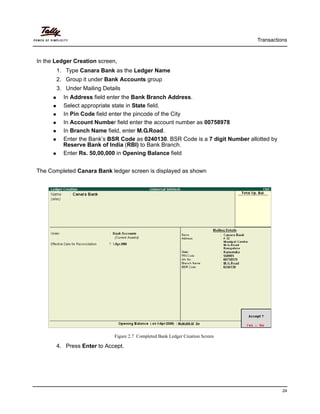
Reports
155
3.7.5 Unknown Deductee Type
Unknown Deductee Type report displays all the Party Ledgers for whom the Deductee Type is
not defined.
To view the Unknown Deductee Type report
Go to Gateway of Tally > Display > Statutory Reports > TDS Reports> Exception Reports >
Unknown Deductee Type
Example: Create ledger Attra Infotech without selecting Deductee Type
Figure 3.43 Unknown Deductee Type
Deductee Type Details of the Party can be updated from this screen. Once you update Deductee
Type details, such party ledgers will not be displayed further in the Unknown Deductee Type
report.
This Report is useful to trace the party ledgers for which the Deductee Type Details are not
available before filing the e-returns.
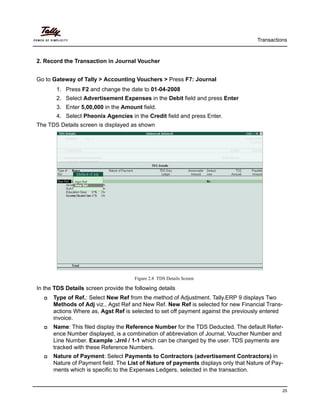
156
Appendix
A.i Migrating TDS Data
A.i.i Pre Migration
Before migrating the data to Tally.ERP 9 TDS, deduct TDS for all pending Bills of all Parties even
though they have not crossed the exemption limit. You can ignore the exemption limit by configu-
ration at the master level.
A.i.ii Vouchers considered for TDS Migration
The TDS migration will happen only for
TDS Deduction Voucher
Advance payment voucher where TDS is deducted in the same voucher
A.i.iii Migration Flow
Migration will happen based on the supplier Ledger. Before the actual migration Tally checks for
the validity of all transactions for a supplier and if any error is found it skips that supplier or skips
the transaction depending upon the type of data error.
A.i.iv Data Errors
Data Errors in TDS Migration can be categorized as follows:
1. TDS Process Flow Error: This type of error not only affects the particular transaction in which
it is identified but also the subsequent transactions. When this type of an error is identified in a
transaction, all the transactions for that supplier will not be migrated.
Reasons for Non-migration
Gross amount is empty
Gross amount is equal or less than the previous deduction's gross amount
Appendix
157
How to find non-migrated vouchers?
In Tally.ERP 9 the non-migrated vouchers can be tracked from
Go to Gateway of Tally > Statutory reports > TDS Reports > Exception Report >Track
Migrated Vouchers.
Example: We have migrated ABC Company data to Tally.ERP 9.
The Track Migrated Vouchers report appears as shown
Figure 1.1 Track TDS Vouchers
To find the non-migrated vouchers based on bill details
Go to Gateway of Tally > Statutory Reports > TDS Reports > Exception Report > Track
Migrated Bills
The Track Migrated Bills report appears as shown
Appendix
158
Figure 1.2 Track Migrate Bills
2. Transaction Error: This type of error affects only the particular transaction in which it is identi-
fied. When this type of an error is identified in a transaction, the particular transaction will not
be migrated.
Reasons for Non-migration:
Multiple duty ledger or supplier selected in a deduction voucher
Multiple party bill adjustment done in a single deduction transaction
In party bill adjustment, normal bill is adjusted instead of corresponding TDS liability bill
However in both the above cases, you can correct the data and re-migrate by pressing Ctrl+Alt+M
from Gateway of Tally.
A.i.v Assessable Value & TDS Calculation
In old TDS there was no concept of Assessable value (Gross Value concept was used) which is
required for TDS statutory reports at each Nature of Payment level of a transaction. Tally.ERP 9
supports assessable value concept in new TDS. To calculate Assessable Value for old TDS data
while migrating, Tally sorts the supplier vouchers based on the sequence of entry and identifies
the Assessable value from the deduction voucher by applying the following formula:
Appendix
159
Assessable Value for the Deduction = (Current Deduction's Gross Amount –Previous Deduc-
tion's Gross Amount)
Tally re-calculates the tax amount by applying the stored percentages. If there is a difference
between Calculated Tax and Actual Tax stored in the deduction voucher, the difference will be
treated as below:
1. In case the difference amount less than or equal to Rs. 3/- (plus or minus), it is considered as
rounding-off issue and adjusted in Income Tax
2. In case the amount is more than Rs.3 (plus or minus):
if it is negative, it will be treated as Surcharge Reversal and adjusted in Surcharge
if it is positive difference, it will be treated as extra Surcharge Deduction and adjusted in
Surcharge
A.i.vi TDS Migration in different scenarios
1. Single liability booked with multiple deductions – this case will be true only in case if the
Surcharge got activated in between either by crossing the limit or ignoring at the master level.
In any case, it will create only one tax reference in the liability voucher provided the same bill is
adjusted in both the deduction voucher in old TDS.
2. Multiple liability but single deduction – Tally.ERP 9 will update only one liability voucher
which is got adjusted in deduction voucher
For Example:
There are 3 liabilities booking vouchers b001, b002 and b003 booked for rent amounting Rs
100000 each respectively. Single deduction voucher is passed for all the 3 vouchers and adjusted
against only with 3rd bill (b003)
How Tally.ERP 9 will handle the migration for the above example
First two vouchers will never get migrated
It will migrate only the third voucher since it is adjusted in the deduction voucher for the
entire assessable value of Rs.3,00,000/-
3. Liability booked but deduction is not done – In this scenario, we will not be able migrate
only liability vouchers since it does not have any deduction information. Need to follow the first
step mentioned in Prerequisite before migration.
4. If the same TDS tax reference is used for two different deduction vouchers of the same or dif-
ferent party for same nature of payment. And a single TDS payment is made for that TDS tax
reference.
Tally.ERP 9 will not migrate the second deduction voucher. However you can correct reference of
second deduction voucher and re-migrate by pressing Ctrl+Alt+M from Gateway of Tally.
And for TDS payment you have to manual correct the reference by going in alteration screen.
Appendix
160
A.i.vii Post Migration
1. If zero rates are applicable for a transaction, that transaction will not get migrated since it does
not have any deduction for it. The same effect has to be manually given in new TDS by altering
the voucher for the assessable value. Other wise, the same will not be considered for exemp-
tion limit calculation.
2. Lower deduction details will not be migrated since earlier it was configured at the supplier level
and applicable for all nature of payments.
In Tally.ERP 9, the same can be configured for each nature of payment. Because of which the
same has to be configured once after the migration.
3. The configuration of ignoring IT exemption limit was set in duty ledger and applied across all
the suppliers in previous TDS.
However in Tally.ERP 9 the same can be configured for each supplier and for each nature of
payment. Because of which it requires one time manual configuration after the migration.
If this is not set and any TDS deduction is found without crossing the exemption limit (due to
previous configuration in the old TDS), will be shown in negative in computation report.
Appendix
161
A.iiTDSRates
TDSRatesfortheAssessmentYear2008-09(in%)
H
Pay-
ment
Code
193
193
193
194
*AfterconsideringdeductionunderclauseVIA–Male:Rs.1,00,000;Female:Rs.1,45,000;SeniorCitizen:Rs.
G
Company
Pay-
ment
exceed1
Crore
N.A.
22.66
22.66
22.66
22.66
Pay-
ment
doesnot
exceed
1Crore
N.A.
20.6
20.6
20.6
20.6
F
Co-op.
Society,
Local
Authority
N.A.
10.3
10.3
20.6
20.6
E
Firm
Pay-
ment
exceed1
Crore
N.A.
11.33
11.33
22.66
22.66
Pay-
ment
doesnot
exceed1
Crore
N.A.
10.3
10.3
20.6
20.6
D
Individual,HUF,
BOI,AOP
Pay-
ments
more
thanRs.
10lakh
Normal
Rate
11.33
11.33
22.66
22.66
Pay-
ments
lessthan
Rs.10
lakh
Normal
Rate
10.3
10.3
20.6
20.6
C
Thresh
old
Limit
(inRs.)
*
2,500
10,00
0
—
2,500
B
NatureofPay-
ment
Salary
Intereston
Securities
(i)Intereston
debenturesor
Securities
(ii)Intereston
8%Savings
(Taxable)
(iii)Anyother
interestonsecu-
rities(Unlisted)
Dividendother
thandividend
coveredbysec-
tion115–O
A
Section
192
193
194
Appendix
162
H
94A
94A
94A
94A
94B
4BB
94C
94D
94E
4EE
94F
94G
*IfconsolidatedamountduringtheyearexceedsRs.50,000
G
22.66
22.66
22.66
22.66
33.99
31.6725
33.99
1.133
2.266
1.133
22.66
22.66
10.5575
NA
NA
11.33
10.5575
20.6
20.6
20.6
20.6
30.9
30.9
30.9
1.03
2.06
1.03
20.6
20.6
—
NA
NA
10.3
10.3
F
10.3
10.3
10.3
10.3
30.9
—
30.9
1.03
2.06
1.03
10.3
10.3
—
NA
NA
10.3
—
E
11.33
11.33
11.33
11.33
33.99
—
33.99
1.133
2.266
1.133
11.33
11.33
—
NA
NA
11.33
—
10.3
10.3
10.3
10.3
30.9
—
30.9
1.03
2.06
1.03
10.3
10.3
—
NA
NA
10.3
—
D
11.33
11.33
11.33
11.33
33.99
—
33.99
1.133
2.266
1.133
11.33
11.33
—
22.66
22.66
11.33
—
10.3
10.3
10.3
10.3
30.9
—
30.9
1.03
2.06
1.03
10.3
10.3
—
20.6
20.6
10.3
—
C
5,000
10,000
10,000
10,000
5,000
—
2,500
20,000*
20,000*
20,000*
5,000
—
—
2,500
—
1,000
—
B
Interestotherthanintereston
securities(casesotherthan
below)
Wherethepayeris
(i)BankingCompany
(ii)Co-Operativesociety
engaggedinbankingbusiness
(iii)PostOfficeunderadeposit
schemeframedbyCG
WinningfromLotteries
Non-domesticCo.
WinningFromhorseRaces
PaymentincaseofContractors
(i)IncaseofAdvertising
(ii)OtherContracts
(iii)SubContracts
InsuranceCommission
Non-ResidentSportsman/sports
association
Non–DomesticCompany
DepositsunderNSStoResident/
Non–Resident
RepurchaseofunitsofMF/UTI
fromResident/Non–Resident
Commissiononsaleoflotterytick-
etstoresident/Non–Resident
Non–domesticCo.
A
194A
194B
194BB
194C
194D
194E
194EE
194F
194G
Appendix
163
H
94H
94I
94I
94J
4LA
96B
96C
96D
G
11.33
5.665
11.33
NA
22.66
11.33
5.665
11.33
10.5575
10.5575
21.115
10.3
5.15
10.3
NA
20.6
10.3
5.15
10.3
10.3
10.3
20.6
F
10.3
5.15
10.3
NA
20.6
10.3
5.15
10.3
NA
10.3
20.6
E
11.33
5.665
11.33
NA
22.66
11.33
5.665
11.33
NA
11.33
22.66
10.3
5.15
10.3
NA
20.6
10.3
5.15
10.3
NA
10.3
20.6
D
11.33
5.665
11.33
16.995
NA
11.33
5.665
11.33
11.33
11.33
22.66
10.3
5.15
10.3
15.45
NA
10.3
5.15
10.3
10.3
10.3
20.6
C
2,500
—
1,20,000
1,20,000
1,20,000
20,000
—
1,00,000
—
—
—
B
CommissionorBrokerageto
ResidentPayment/creditupto
31-5-2007
RenttoResident
(a)Rentformachinery/plant/
equipment
(b)Rentforotherthanin(a)
(i)Individual/HUF
(ii)Otherthanindividual/HUF
FeesforProfessional/Techni-
calservicestoresident
Payment/creditupto31-5-2007
CompensationtoResidenton
acquisitionofimmovableprop-
erty
Incomefromunits(including
longtermCapitalgainontrans-
ferofsuchunits)toanoofshore
fund
Incomefromforeigncurrency
bondsorGDRofIndianCom-
pany
IncomeofFIIfromsecurities
notbeingdividend,long–term
andshort–termcapitalgain
A
194H
194I
194J
194LA
196B
196C
196D
Appendix
164
A.iii TDS Statutory Masters
As already discussed under Scope and Applicability of TDS, Income Tax will be deducted at
source, based on the rate defined in the Act, for the Deductees, against the Nature of Payments.
Hence to account TDS transactions, every payment and the party to whom the payment is made
needs to be identified against the Nature of payment and deductee type as defined in the Act.
In Tally, all the Nature of Payments and Deductees (as defined under the Act) are provided as
Statutory Masters. These Statutory Masters will be lodaed into Tally during company creation,
when the Statutory compliance for is set to India. On enabling TDS Feature in F11: Statutory &
Taxation features, TDS Statutory masters will be available for selection during Creation of
Expenses, Party and TDS ledgers.
To view Statutory Masters
Go to Gateway of Tally > Dispaly > Statutory Info.
Figure 1.3 Statutory Info. Screen
A.iii.i TDS Nature of Payments
Go to Gateway of Tally > Display > Statutory Info. > TDS Nature of Pymts
Tally displays all the TDS Nature of Payments.
Appendix
165
Figure 1.4 List of TDS Nature of Pymt
To view the details in the TDS nature of Payment, select a TDS Nature of Payment from the
above list (For eg., select Commission or Brokerage).
Figure 1.5 TDS Nature of Payment
The TDS Nature of Payment screen diplays details such as Name, Full Name, Section, Payment
Code, Single Bill value Limit and Section Name of the nature of payment selected
Appendix
166
A.iii.ii TDS Collectee Types
Go to Gateway of Tally > Display > Statutory Info. > Deductee Types
Figure 1.6 List of Deductee Types
To view the details in Deductee Type, select a TDS Nature of Payment from the above list (For
eg., select Company Resident).
All the TDS nature of expesnes has to be associated with relevant predefined
TDS Nature of Payments.
Appendix
167
Figure 1.7 Deductee Type
Deductee Type screen displays details such as
1. Name: In this field Name of the deductee Type is displayed
2. Residential Status: This field displays the Residential Status of the Deductee, i.e.
whether the deductee is a Resident or a non Resident .
3. Deductee Status: This field displays the deductee status of the Deductee i.e, whether
the deductee is a Company or Non Company.
4. Deductee TDS Details: This section displays details such as
Nature of Payment: This field dispalys all the nature of payments applicable for the
Deductee.
Applicable From: This field dispalys the dates from when the prescibed rate of income
tax is applicable for the Nature of Payments.
TDS: This field displays the TDS Rate and TDS Exemption amount applicable for the
nature of payments.
Surcharge: This field displays the Surcharge Rate and Surcharge Exemption
amount applicable for the deductee.
Ed Cess & Sec Ed Cess: This fields dispaly the applicable Rate of Cess and Sec Ed
Cess.

TDS In Tally Erp 9

  • 1.
  • 2.
    The information containedin this document is current as of the date of publication and subject to change. Because Tally must respond to changing market conditions, it should not be interpreted to be a commitment on the part of Tally, and Tally cannot guarantee the accuracy of any information presented after the date of publication. The information provided herein is general, not according to individual circumstances, and is not intended to substitute for informed professional advice. This document is for informational purposes only. TALLY MAKES NO WARRANTIES, EXPRESS OR IMPLIED, IN THIS DOCUMENT AND SHALL NOT BE LIABLE FOR LOSS OR DAMAGE OF WHATEVER NATURE, ARISING OUT OF, OR IN CONNECTION WITH THE USE OF OR INABILITY TO USE THE CONTENT OF THIS PUBLICATION, AND/OR ANY CONDUCT UNDERTAKEN BY PLACING RELIANCE ON THE CONTENTS OF THIS PUBLICATION. Complying with all applicable copyright and other intellectual property laws is the responsibility of the user. All rights including copyrights, rights of translation, etc., are vested exclusively with TALLY SOLUTIONS PRIVATE LIMITED. No part of this document may be reproduced, translated, revised, stored in, or introduced into a retrieval system, or transmitted in any form, by any means (electronic, mechanical, photocopying, recording, or otherwise), or for any purpose, without the express written permission of Tally Solutions Pvt. Ltd. Tally may have patents, patent applications, trademarks, copyrights, or other intellectual property rights covering subject matter in this document. Except as expressly provided in any written licence agreement from Tally, the furnishing of this document does not give you any licence to these patents, trademarks, copyrights, or other intellectual property. © 2009 Tally Solutions Pvt. Ltd. All rights reserved. Tally, Tally 9, Tally9, Tally.ERP, Tally.ERP 9, Shoper, Shoper 9, Shoper POS, Shoper HO, Shoper 9 POS, Shoper 9 HO, TallyDeveloper, Tally Developer, Tally.Developer 9, Tally.NET, Tally Development Environment, Tally Extender, Tally Integrator, Tally Integrated Network, Tally Service Partner, TallyAcademy & Power of Simplicity are either registered trademarks or trademarks of Tally Solutions Pvt. Ltd. in India and/or other countries. All other trademarks are properties of their respective owners. Version: Implementation of TDS in Tally.ERP 9/1.0/June 2009
  • 3.
    Contents i Contents Introduction Scope & Applicability..............................................................................................................................1 TDS Process ..............................................................................................................................................4 Time & Mode of TDS Payment ................................................................................................................5 Issue of TDS certificate ............................................................................................................................5 e-TDS Returns ..........................................................................................................................................6 Returns & Timelines .................................................................................................................................7 TDS Features in Tally.ERP 9 ................................................................................................................... 7 Lesson 1: Enabling TDS in Tally.ERP 9 1.1 Enabling TDS in Tally.ERP 9........................................................................................................... 9 Lesson 2: Transactions 2.1 Transactions Involving TDS ...........................................................................................................16 2.1.1 TDS on Expenses (Journal Voucher) .......................................................................................................16 2.2 Payment to Party .............................................................................................................................30 2.3 Payment of TDS ..............................................................................................................................32 2.3.1 Payment of TDS (Using TDS Helper) ......................................................................................................32 2.3.2 Generating TDS Challan (ITNS 281) ......................................................................................................36 2.4 Transactions Involving TDS ...........................................................................................................41 2.4.1 Expenses Partly Subject to TDS (Journal Voucher) ................................................................................41 2.4.2 Accounting of Expenses and Deducting TDS Later ................................................................................52 2.4.3 Accounting Multiple Expenses and Deducting TDS Later ..................................................................... 61 2.4.4 TDS on Advances .....................................................................................................................................67 2.4.5 TDS on Expenses @ Lower Rate .............................................................................................................73 2.4.6 TDS on Expenses @ Zero Rate ................................................................................................................82 2.4.7 Surcharge Calculation on Prior Period Expenses ..................................................................................88 2.4.8 Surcharge Calculation on Expenses ........................................................................................................95 2.5 Adjustments in TDS ......................................................................................................................100 2.5.1 Reversal Of Expenses and TDS .............................................................................................................100 2.6 Accounting Changes in TDS percentage ......................................................................................105 2.7 Accounting TDS on Payments made to Non Residents ...............................................................105 2.8 Payment of TDS ............................................................................................................................111 2.8.1 Payment of TDS (Using TDS Helper) ....................................................................................................111 2.8.2 Generating TDS Challan (ITNS 281) ....................................................................................................115 Lesson 3: Reports 3.1 TDS Reports .................................................................................................................................116 3.2 Computation ..................................................................................................................................117 3.2.1 TDS Computation – Expenses Wise .......................................................................................................118
  • 4.
    Contents ii 3.2.2 TDS Computation– TDS Paid ...............................................................................................................121 3.2.3 TDS Computation – TDS Payable .........................................................................................................122 3.3 Challan Reconciliation ..................................................................................................................123 3.4 Return ............................................................................................................................................125 3.4.1 Print Form 16A ......................................................................................................................................125 3.4.2 Form 26Q ...............................................................................................................................................127 3.4.3 Annexure to 26Q ....................................................................................................................................130 3.4.4 Form 27 Q ..............................................................................................................................................131 3.4.5 Annexure to 27Q ....................................................................................................................................132 3.4.6 Form 26 .................................................................................................................................................134 3.4.7 Annexure to Form 26 .............................................................................................................................136 3.4.8 Form 27 .................................................................................................................................................137 3.4.9 Annexure to 27 .......................................................................................................................................138 3.5 E–Returns ......................................................................................................................................139 3.5.1 E–TDS ....................................................................................................................................................140 3.5.2 Form 26Q ...............................................................................................................................................140 3.5.3 Print Form 27A ......................................................................................................................................143 3.5.4 Form 27Q ...............................................................................................................................................145 3.6 Outstandings .................................................................................................................................146 3.6.1 TDS payable ...........................................................................................................................................146 3.6.2 Ledger ....................................................................................................................................................147 3.6.3 Nature of Payment .................................................................................................................................149 3.7 Exception Reports .........................................................................................................................151 3.7.1 Track Migrate Vouchers ........................................................................................................................152 3.7.2 Track Migrate Bills................................................................................................................................ 152 3.7.3 Track Masters ........................................................................................................................................152 3.7.4 PAN Not Available .................................................................................................................................153 3.7.5 Unknown Deductee Type .......................................................................................................................154 Appendix 148 A.i Migrating TDS Data ......................................................................................................................148 A.i.i Pre Migration .........................................................................................................................................148 A.i.ii Vouchers considered for TDS Migration ...............................................................................................148 A.i.iii Migration Flow .....................................................................................................................................148 A.i.iv Data Errors ...........................................................................................................................................148 A.i.v Assessable Value & TDS Calculation .................................................................................................... 150 A.i.vi TDS Migration in different scenarios ....................................................................................................151 A.i.vii Post Migration .....................................................................................................................................152 A.ii TDS Rates..................................................................................................................................... 153 A.iii TDS Statutory Masters ................................................................................................................156 A.iii.i TDS Nature of Payments .......................................................................................................................156 A.iii.ii TDS Collectee Types ............................................................................................................................158
  • 5.
    1 Introduction TDS means TaxDeducted at Source. The concept of TDS was introduced in the Income Tax Act, 1961, with the objective of deducting the tax on an income, at the source of income. It is one of the methods of collecting Income Tax, which ensures regular flow of income to the Government. Example: Universal Infotech is making the payment towards Rent to the owner of the building, it is required to deduct the tax on the income (i.e. before payment to the owner), at the source of income. Scope & Applicability Scope Tax deduction at source means the tax required to be paid by the assessee, is deducted by the person paying the income to him. Thus, the tax is deducted at the source of income itself. The income tax act enjoins on the payer of such income to deduct the given percentage of income as income tax and pay the balance amount to the recipient of such income. The tax so deducted at source by the payer is to be deposited in the income tax department account. The tax so deducted from the income of the recipient is deemed payment of income tax by the recipient at the time of his assessment. For example: Person responsible for paying any income which is chargeable to tax under the head 'Salaries' is required to compute the tax liability in respect of such income and deduct tax at source at the time of payment. If the employee has any other income, he needs to inform the employer so that employer can take that income into consideration while computing his tax liability but he will not take into account losses except loss from house property. Similarly, person responsible for paying any income by way of 'interest on securities' or any other interests are required to deduct tax at source at the prescribed rates at the time of credit of such income to the account of the payee or at the time of payment, whichever is earlier.
  • 6.
    Introduction 2 Applicability Tax will bededucted at source based on the rate defined in the Act, only on the fulfilment of the below mentioned conditions. 1. The Assessees (includes individual & HUF as covered U/S 44AB) carrying on business is deducting the tax at the Time of Payment or Credit, (whichever is earlier) against following type of Recipient (Deductee) Individual Hindu undivided Family (HUF) Body of Individual (BOI) Association of person (AOP) Co-Operative society Local Authority Partnership firm Domestic company (Indian company) Foreign company Artificial Judicial Person 2. The nature of payment belongs to any one of following list Nature of Payment Nature of Payment Salaries Interest on Securities Dividend Interest other than securities Winnings from lottery or crossword puzzles or card game or other game Winnings from horse races Payment to sub-contractors Insurance commission Payments to Contractors (Advertisement Con- tractors) Payments to Contractors (Other than Advertisement) Payment to Non–Resident sportsman or sports association Payment in respect of deposits under NSS Payment on account of repurchase of units of MF or UTI Commission on sale of lottery tickets Commission or brokerage Rent of Land, Building or Furniture Rent of Plant, Machinery or Equipment Fees for professional or technical serv- ices Payment of compensation on acquisition of cer- tain immovable property Payment of Any other income to a non- resident Income from units to an offshore fund Income of foreign institutional investors from securities
  • 7.
    Introduction 3 As per Sec44AB, Individual and HUF is also considered as assessee under Income Tax Act, if such Individual and HUF Carrying on Business, where the total sales, turnover or gross receipts from the business exceeds Rs. 40 lakhs in any Previous Year Carrying on Profession, where the total receipts exceeds Rs. 10 lakhs in any previous year 3. The payment exceeds the TDS Exemption Limit specified in the Income Tax Act. Fees for Tech. Services Agreement is made after Feb. 29, 1964 before April 1, 1976 Fees for Tech. Services Agreement is made after Mar 31, 1976 before June 1, 1997 Fees for Tech. Services Agreement is made after May 31, 1997 before June 1, 2005 Fees for Tech. Services Agreement is made on or after June 1, 2005 Income by way of Long-Term Capital Gains Income from Foreign Currency Bonds or Global Depository Receipts (GDR) Income from Foreign Exchange Assets paya- ble Interest payable by Government or Indian concern in Foreign Currency Long–Term Capital Gains Royalty(f) Agreement is made after May 31, 1997 before June 1, 2005 Royalty(f) Agreement is made before June 1, 1997 Royalty(f) Agreement is made on or after June 1, 2005 Royalty(g) Agreement is made after March 31, 1961 before April 1, 1976 Royalty(g) Agreement is made after March 31, 1976 before June 1, 1997 Royalty(g) Agreement is made after March 31, 1997 before June 1, 2005 Royalty(g) Agreement is made on or after June 1, 2005 Short–Term Capital Gains
  • 8.
    Introduction 4 TDS Process A seller(Deductee) provides services to the buyer (Deductor). The buyer deducts the Tax at the time of payment of advances or while accounting the Bills received. The buyer deposits the deducted amount to the designated branches of the authorised bank The buyer issues Form No.16A to the Deductee The buyer files annual returns electronically to the Income Tax department. The seller files returns, along with Form 16A claiming the credit of the Tax deducted at source.
  • 9.
    Introduction 5 Time & Modeof TDS Payment All the Tax deducted during a month are to be paid to the credit of Government on or before 7th of the next month. In case 7th of the month happens to be a sunday or a bank holiday payment can be made on the next working day TDS amount shall be paid to the government account through any designated branches of the authorised banks, along with Income Tax Challan No.281. In case of collections made by or on behalf of the Government, the amount shall be cred- ited within the time and in the manner aforesaid without the production of a challan. Issue of TDS certificate TDS certificate is a proof that deductor has deducted the tax and paid the same to the govern- ment. This proof is essential to the deductee to claim the credit of tax in his Income Tax returns. U/s 203 of Income Tax Act, any person deducting the tax as per the provisions of *Section 192 (Salary) shall furnish a certificate of Deduction of tax in Form 16 or Form 16AA within one month from the close of Financial year in which such deduction was made. Example: For the Financial Year 2007-2008, the TDS certificate must be issued on or before 30th April, 2008 *Section 193, 194, 194A, 194B, 194BB, 194C, 194D,194E, 194EE,194F, 194G, 194-I, 194J, 194K, 194LA, 195, 196A, 196B, 196C and 196D shall furnish a certificate of Deduc- tion of tax in Form 16A with in one month from the end of the month during which the credit has been given or the payment has been made, as the case may be. Example: For deductions in May 2008, TDS certificate must be issued on or before 30th June, 2008 In case of deductee to whom more than one TDS certificate was issued for the deduc- tions made during the year, may on request from such deductee, a consolidated cer- tificate in Form 16A may be issued wihtin a period of one month from the close of such financial year. Refer Appendix for details on the *Sections mentioned above.
  • 10.
    Introduction 6 e-TDS Returns The IncomeTax department has now notified ‘Electronic Filing of Returns of Tax Deducted at Source Scheme, 2003’. It is applicable to all deductors furnishing their TDS return in electronic form. As per this scheme, It is mandatory for corporate deductors to furnish their TDS returns in electronic form (e- TDS return) with effect from June 1, 2003. For government deductors it is mandatory to furnish their TDS returns in electronic form (e-TDS return) from financial year 2004-2005 onwards. Deductors (other than government and corporates) may file TDS return in electronic or physical form. Deductors furnishing TDS returns in electronic form (e-TDS) have to furnish Form 27A. Form 27A is a control chart to be furnished in physical form along with CD/ Floppy containing the e-TDS returns. Form No 27A is required to be furnished separately for each TDS return. Form 27A is a summary of e-TDS returns which contains control totals of ‘Amount paid‘ and ‘Income tax deducted at source’. The control totals mentioned on Form 27A should match with the corresponding control totals in e-TDS returns. Electronic Filing of Returns of Tax Deducted at Source (e-TDS), is explained in detail in Reports chapter.
  • 11.
    Introduction 7 Returns & Timelines Thefollowing Returns are required to be filed under TDS : Figure 1.1 Table showing Forms & Returns under TDS TDS Features in Tally.ERP 9 Tally.ERP 9’s TDS Feature enables you to handle all the functional, accounting and statutory requirements of your business in an accurate and simplified manner. The TDS functionality in Tally.ERP 9 has the following features Simple and user-friendly Quick and easy to set up and use Create single Expenses Ledger for Multiple Nature of Payment Create single TDS Duty Ledger for Multiple Nature of Payment Book & Deduct TDS in the same voucher Single TDS deduction for multiple vouchers Single TDS deduction for Multiple Nature of Payments TDS deduction on partial applicable value Financial Year Form No. Particulars Periodicity 2008-09 Form 26 Annual return for deduction of tax in respect of payments other than salary. Annual Form 27 Annual return for deduction of tax in respect of payments other than salary made to Non-residents. Annual Form 27A Physical control charts containing control totals mentioned in TDS returns fur- nished electronically. Form 27A in physi- cal form to be submitted along with e- TDS annual return forms. With each e-TDS returns Form 26 and/ or Form 27. 2008-09 Form 26Q Quarterly return for deduction of tax in respect of payments other than salary. Quarterly Form 27Q Quarterly return for deduction of tax in respect of payments other than salary made to Non-residents. Quarterly Form 27A Physical control charts containing control totals mentioned in TDS returns fur- nished electronically. Form 27A in physi- cal form to be submitted along with e- TDS quarterly return forms With each e-TDS returns Form 26Q and/or Form 27Q.
  • 12.
    Introduction 8 Retrospective Surcharge Deduction Partywise configuration for Lower / Zero rate Party wise configuration to Ignore IT / Surcharge exemption Limit Deduction of TDS on advance payments TDS deduction on Non-Resident (Sec.195) payments Reversal of TDS Print TDS Challan (ITNS 281) Print Form 16A Generate E-TDS Returns Print Form 27A Print Form 26, 26Q, 27, 27Q with Annexure(s) TDS Computation Report Generate TDS Outstanding and TDS Exception Reports
  • 13.
    9 Lesson 1: EnablingTDS in Tally.ERP 9 Lesson Objectives On completion of this lesson, you will learn to Create Company in Tally.ERP 9 Enable TDS in F11: Features 1.1 Enabling TDS in Tally.ERP 9 It takes a one-time configuration in Tally.ERP 9 for TDS features to be activated. Follow the steps given below to enable TDS in Tally.ERP 9 for a new company, M/s. Universal Infotech. 1. Create Company 2. Enable TDS M/s. Universal Infotech, is a Company – Resident, which is engaged in Software Develop- ment. Step 1 : Create Company Go to Gateway of Tally > Alt + F3: Company Info. > Create Company In the Company Creation screen, Specify Universal Infotech as the Company Name and Address details Select India in the Statutory Compliance for field Specify the State, Pin code & Accounts with Inventory details To enable TDS for Companys’ which are already created in Tally.ERP 9, follow the instruction provided under the head Enable TDS.
  • 14.
    Enabling TDS inTally.ERP 9 10 The Completed Company creation screen appears as shown Figure 1.1 Completed Company Creation Screen For complete details on Company Creation refer Tally.ERP 9 Help, topic Creating Company in Tally.ERP 9
  • 15.
    Enabling TDS inTally.ERP 9 11 Step 2 : Enable TDS To enable TDS Feature, for a company 1. Activate TDS Feature 2. Enable Set/Alter TDS Details 3. Specify the Company TDS Deductor Details 4. Enter Company’s PAN / Income – Tax No To enable TDS Feature for universal Infotech Go to Gateway of Tally > F11: Features > F3: Statutory & Taxation Set Enable Tax deducted at Source to Yes Enable Set/Alter TDS Details to Yes The Statutory & Taxation features screen appears as shown. Figure 1.2 F11: Statutory & Taxation Features
  • 16.
    Enabling TDS inTally.ERP 9 12 Press Enter, the Company TDS Deductor Details screen displays Figure 1.3 Company TDS Deductor Details Screen In the Company TDS deductor Details, enter the TDS Deductor Details such as: Tax Assessment Number (TAN) : TAN is a TEN digit alphanumeric number Issued by the Income Tax Department (ITD) to the deductor, which must be quoted on all Challans, Pay- ment for TDS, Certificates issued in Form 16/16A, Returns and in all documents and other correspondence with ITD. Income Tax Circle /Ward (TDS) : Income Tax Circle/Ward, in which the deductors are assessed for Income-Tax (TDS) with TAN of each person. Deductor Type: According to the nature of the organisation Deductor type will be selected. In case of Government, the option Government will be selected as the Deductor Type and if the deductor is Non-Government body, Others will be selected. Name of the person responsible: Person responsible means the person who is author- ised to file the TDS returns of the company. Designation: Mention the designation of the authorised person filing TDS returns. The Format of TAN is AAAA*55555A, Where A* is the first character of the name of the Organisation. Example: TAN of Universal Infotech is KARU07884F
  • 17.
    Enabling TDS inTally.ERP 9 13 The completed Company TDS Deductor Details screen appears as shown Figure 1.4 Completed Company TDS Deductor Details screen Press Enter to Accept Enter Permanent Account Number (PAN No.) and other details. PAN is 10 Digit Alpha numeric number alloted by the Income Tax Department to all the taxpayers whose income is taxable. The completed F11: Statutory & Taxation screen appears as shown Figure 1.5 Completed F11: Statutory & Taxation Screen Press Enter to Accept.
  • 18.
    14 Lesson 2: Transactions Lessonobjectives On completion of this lesson, you will learn to Record Basic TDS Transactions Record Advanced TDS Transactions Make TDS Payments and generate TDS Challans This lesson is divided into Two parts 1. Part I – Recording Basic TDS Transactions 2. Part II – Recording Advanced TDS Transactions
  • 19.
  • 20.
    Transactions 16 Recording Basic TDSTransactions In this section we shall emphasis on understanding how Tally.ERP 9’s TDS feature can be effec- tively used to record basic TDS transactions to generate TDS Challan. Let us take the example of Universal Infotech (Created and TDS enabled, as discussed in the earlier chapter) to record TDS transactions such as TDS on Expenses Payment to Party Payment of TDS Generating ITNS 281 Challan In Tally.ERP 9, you can account for expenses implying TDS with the help of Payment Voucher, Journal Voucher or Purchase Voucher, as required. 2.1 Transactions Involving TDS 2.1.1 TDS on Expenses (Journal Voucher) Under this, we will learn to Account expenses and deduct tax at source to arrive at the Net balance payable to the party. Example 1: On 1st April, 2008 Universal Infotech received a Bill (vide No. 001) from Pheonix Agencies for Rs. 5,00,000 towards the Advertisement services rendered. To account the above transaction follow the steps given below 1. Create Masters i. Expense Ledger ii. Party Ledger iii. Tax Ledger iv. Bank Ledger 2. Record the Transaction in Journal Voucher
  • 21.
    Transactions 17 1. Create Masters i.Expenses Ledger Create Expenses Ledger Go to Gateway of Tally > Accounts Info. > Ledgers > Create 1. Type Advertisement Expenses as the Ledger Name 2. Select Indirect Expenses in the Under field 3. Set Is TDS Applicable to Yes 4. In Default Nature of Payment filed select Payment to Contractors (Advertisement Contractors) from the List of TDS Nature of Pymt. All the Payments/Expenses subject to TDS have to be associated with relevant predefined TDS Nature of Payments. Refer Appendix for more details on TDS Nature of Payments Figure 2.1 Ledger Creation Screen Ledger Under IS TDS Applicable Default Nature of Payment Advertisement Expenses Indirect Expenses Yes Payment to Contractors (Advertisement Contractors)
  • 22.
    Transactions 18 The completed ExpensesLedger screen is displayed as shown. Figure 2.2 Completed Expenses Ledger Creation Screen Press Enter to Accept The Option Any can be selected from the List of TDS Nature of Pymt, where the user doesn’t want to define the TDS Nature of payment during Ledger creation. This allows the user to use an Expense Ledger (as a common ledger) to account multiple TDS Nature of Payments.
  • 23.
    Transactions 19 ii. Party Ledger CreateParty Ledger Go to Gateway of Tally > Accounts Info. > Ledgers > Create Setup: Before creating the party ledger enable the following options in F12: Configure (Ledger Config- uration) Set Allow ADVANCED entries in Masters to Yes Set Use ADDRESSES for Ledger Accounts to Yes Figure 2.3 F12: Configure In the Ledger Creation screen, 1. Type Pheonix Agencies as the Ledger Name 2. Group it under Sundry Creditors group 3. Set Maintain Balances bill-by-bill to Yes 4. Specify the Default Credit Period, if required 5. Set Is TDS Deductable to Yes 6. In the Deductee Type field select Association of Persons from the List of Deductee Types Ledger Under Maintain balances bill-by-bill Is TDS Deductable Deductee Type Pheonix Agencies Sundry Creditors Yes Yes Association of Persons
  • 24.
    Transactions 20 Figure 2.4 SundryCreditor Ledger Creation Screen 7. Enter the Mailing Details. The sellers who are receiving the TDS nature of payments, are required to be associated with the predefined Deductee Types. Refer Appendix for more details on Deductee Types The option UnKnown will be selected, when the Party’s deductee type details are not available.
  • 25.
    Transactions 21 8. Under TaxInformation enter the PAN/IT No. (PAN/IT No. is mandatory for e-TDS). PAN is a 10 Digit Alphanumeric Number allotted by the Income Tax Department. The completed Sundry Creditor Ledger screen is displayed as shown Figure 2.5 Completed Sundry Creditor Ledger Creation Screen 9. Press Enter to Accept. PAN/IT No. field is restricted to 10 digits, user can enter any ten Numbers or Alphabets or alphanumeric. The details provided in the PAN/IT No. field must be equal to ten Num- bers or Alphabets or alphanumeric. Tally.ERP 9 won’t accept any details less than 10 digits. In case, where the PAN is not Available or Applied For, such details can also be provided in the PAN/IT No field in the format, as specified by the Income tax Department. For PAN not available – enter as PANNOTAVBL For PAN Applied - enter as APPLIEDFOR Under Exception Report – PAN Not Available, Tally.ERP 9 displays all the ledgers in which PAN/IT No is not mentioned. Before e-TDS valida- tion user can check this report to make necessary changes in the ledger.
  • 26.
    Transactions 22 iii. Tax Ledger CreateTax Ledger Go to Gateway of Tally > Accounts Info. > Ledgers > Create In the Ledger Creation screen, 1. Type TDS – Contractors as the Ledger Name 2. Group it under Duties & Taxes group 3. Select TDS as the Type of Duty/Tax 4. Select Payment to Contractors (Advertisement Contractors) as the Nature of Payment. 5. Set Inventory values are affected to No The completed TDS – Contractors ledger screen is displayed as shown While creating ledgers under Sundry Creditors or Sundry Debtors, ensure Maintain Bill-wise Details is set to Yes in F11: Accounting Features. If the party is a Non Resident Deductee type, then PIN Code, State and the Sales Tax Number fields are not applicable. Ledger Under Type of Duty/ Tax Nature of Payment Inventory values are affected TDS – Contractors Duties & Taxes TDS Payment to Contrac- tors (Advertisement Contractors) No
  • 27.
    Transactions 23 Figure 2.6 CompletedTDS Ledger Creation Screen 6. Press Enter to Accept. It is recommended that separate TDS ledgers be created with appropriate TDS nature of Payments. However, Tally.ERP 9 provides you with the flexi- bility to use a common Duty ledger for different TDS Nature of Payments by selecting the Nature of Payments as Any. iv. Bank Ledger Create Bank ledger Go to Gateway of Tally > Accounts Info. > Ledgers > Create Ledger Under Canara Bank Bank Accounts
  • 28.
    Transactions 24 In the LedgerCreation screen, 1. Type Canara Bank as the Ledger Name 2. Group it under Bank Accounts group 3. Under Mailing Details In Address field enter the Bank Branch Address. Select appropriate state in State field. In Pin Code field enter the pincode of the City In Account Number field enter the account number as 00758978 In Branch Name field, enter M.G.Road. Enter the Bank’s BSR Code as 0240130. BSR Code is a 7 digit Number allotted by Reserve Bank of India (RBI) to Bank Branch. Enter Rs. 50,00,000 in Opening Balance field The Completed Canara Bank ledger screen is displayed as shown Figure 2.7 Completed Bank Ledger Creation Screen 4. Press Enter to Accept.
  • 29.
    Transactions 25 2. Record theTransaction in Journal Voucher Go to Gateway of Tally > Accounting Vouchers > Press F7: Journal 1. Press F2 and change the date to 01-04-2008 2. Select Advertisement Expenses in the Debit field and press Enter 3. Enter 5,00,000 in the Amount field. 4. Select Pheonix Agencies in the Credit field and press Enter. The TDS Details screen is displayed as shown Figure 2.8 TDS Details Screen In the TDS Details screen provide the following details Type of Ref.: Select New Ref from the method of Adjustment. Tally.ERP 9 displays Two Methods of Adj viz., Agst Ref and New Ref. New Ref is selected for new Financial Trans- actions Where as, Agst Ref is selected to set off payment against the previously entered invoice. Name: This filed display the Reference Number for the TDS Deducted. The default Refer- ence Number displayed, is a combination of abbreviation of Journal, Voucher Number and Line Number. Example :Jrnl / 1-1 which can be changed by the user. TDS payments are tracked with these Reference Numbers. Nature of Payment: Select Payments to Contractors (advertisement Contractors) in Nature of Payment field. The List of Nature of payments displays only that Nature of Pay- ments which is specific to the Expenses Ledgers, selected in the transaction.
  • 30.
    Transactions 26 Example: For theabove transaction List of Nature of payments displays only Payments to Contractors (advertisement Contractors), as the nature of payment applicable to the Party against which TDS will be deducted. Figure 2.9 TDS Details – Nature of Payment Selection TDS Duty Ledger: Select TDS – Contractors from the list of TDS Duty Ledgers. List of TDS Duty Ledgers displays, ledgers created with specific nature of payment as well as the ledger created with the option Any. Assessable Amount: Tally.ERP 9 defaults the amount specified against the expenses ledger and skips the field. Deduct now: This field will be set to Yes or No depending on the tax deduction. Set this field to Yes to deduct the Tax in the same voucher. TDS Amount: This field displays the Tax amount deducted at source Payable Amount: This field displays the amount (after TDS) payable to the Party.
  • 31.
    Transactions 27 The completed TDSDetails screen is displayed as shown Figure 2.10 Completed TDS Details Screen 5. Press Enter to accept TDS Details 6. Payable Amount as calculated in the TDS Details screen will be defaulted in the Party’s Amount (Credit) field. Press Enter to view Bill–wise Details screen. 7. In Bill–wise Details screen, Select New Ref as the Type of Ref In the Name field enter the Bill name as Bill - 001 Skip the Due Date or Credit Days field Accept the default amount allocation and Dr/Cr. By default Tally.ERP 9 displays the Bill amount in the amount field as the credit balance. Press Enter, select New Ref as Type of Ref and Enter Bill name as Bill -001 Skip the Due Date or Credit Days field and accept the default amount allocation and Dr/Cr. By default Tally.ERP 9 displays the Tax amount in the amount field as the debit balance. The Completed Bill–wise Details screen is displayed as shown
  • 32.
    Transactions 28 Figure 2.11 Bill–wiseDetails Screen In the above method of bill allocation, Tax amount is deducted from the Bill amount to arrive at the Pending amount to be paid to the party. This method of bill allocation updates the bill amount along with pending amount to be paid to the party, in the Outstanidings statement, which helps the user to identify the Bill amount in the outstandings statement, when the request comes from the supplier for payment. 8. In the Credit field select the duty ledger TDS – Contractor from the List of Ledger Accounts and Rs. 5150 (500000 - 494850) is displayed automatically in the amount field. 9. Enter transaction details in the Narration field.
  • 33.
    Transactions 29 The completed JournalVoucher is displayed as shown Figure 2.12 Journal Voucher 10. Press Enter to accept Journal voucher is generally used to record transactions on due basis i.e., firstly a due entry in favour of the party is created when the bill is received and then at the time of settlement of the referred bill, a payment entry is passed.
  • 34.
    Transactions 30 2.2 Payment toParty Example 2: On April 8, 2008, payment of Rs. 494850 is made towards bill no. Bill-001 to Pheonix Agencies for the purchase of Advertisement services, vide cheque no. 254781 The same is accounted as follows Record the transaction in Payment Voucher Go to Gateway of Tally > Accounting Vouchers > Press F5: Payment 1. Press F2 and change date to 08/04/2008 2. In Debit field select Pheonix Agencies from the List of Ledger Accounts 3. Enter Rs. 494850 in Amount field and press enter to view Bill-wise Details screen 4. In Bill-wise Details screen Select Agst Ref in the Type of Ref Select Bill-001 from the List of Pending Bills in Name field, Amount is defaulted automatically. Completed Bill-wise Details screen is displayed as shown. Figure 2.13 Bill–wise Details Screen 5. Press Enter to accept the bill adjustment.
  • 35.
    Transactions 31 6. In Creditfield select Canara Bank from the List of Ledger Accounts, Amount is defaulted automatically 7. Enter Cheque No. 254781 in Narration field. The completed Payment Voucher is displayed as shown Figure 2.14 Completed Payment Voucher 8. Press Enter to accept
  • 36.
    Transactions 32 2.3 Payment ofTDS 2.3.1 Payment of TDS (Using TDS Helper) All the Tax deducted during a month is to be paid to the credit of Government on or before 7th of the next month. In case 7th of the month happens to be a sunday or a bank holiday payment can be made on the next working day TDS amount shall be paid to the government account through any designated branches of the authorised banks, along with Income Tax Challan No.281. Example 3: On May 6, 2008, Universal Infotech, paid TDS of Rs. 5150 towards Advertisement Expenses, vide cheque no. 056330 for the month of April, 2008. The same is accounted as follows Setup: In F12: Configure (Payment Configuration) Set Use Single Entry mode for Pymt/Rcpt/Contra to Yes Record the transaction in Payment Voucher Go to Gateway of Tally > Accounting Vouchers > Press F5: Payment 1. Press F2 and change date to 06/05/2008 2. Press Alt+S or click S: TDS Helper button on the Buttons Bar to view TDS helper screen. In the TDS Helper Screen Deducted Till Date: In this field user may enter, till date of the period for which the TDS values should be computed and auto-filled. Enter 30/04/2008 as the Till Date. Section: As per the Act, separate TDS challans to be submitted for the payment of tax under each section. In this field, Tally.ERP 9 displays all the Sections under which, Tax deducted is pending for payment. Select Section 194C from the list of section. Payment Code of the Section selected for TDS payment will be printed on the TDS Challan.
  • 37.
    Transactions 33 Nature of Payments:Based on the section selected in the Section field, Tally.ERP 9 displays the section related nature of payments under which, Tax deducted is pending for payment. Select Payment to Contractors (Advertisement Contractors) as the Nature of Payment Deductee Status: Select the Deductee Status as Non Company. Cash/ Bank: Depending on the mode of payment (Cash or Cheque) Cash or Bank ledger will be selected. Select Canara Bank from the List of Ledger Accounts. The completed TDS Helper screen is displayed as shown Figure 2.15 TDS Helper Screen The TDS transactions in a payment voucher can be entered for a particular Deductee Status, using the TDS Helper button.
  • 38.
    Transactions 34 3. Press Enterto accept the TDS helper 4. The Bank Name through which the payment is made and TDS payable amount (with the respective bill details) will be auto-filled. 5. Set the option Provide Details to Yes to enter TDS payment details In the Payment Details Screen From Date: In this field enter the From date of the period for which the payment is made To Date: In this field enter the To date of the period for which the payment is made Cheque/DD No: In this field user can enter either the cheque or the DD No through which the TDS payment is made. In this transaction payment is made through cheque no. 056330. Name of the Bank: This field is provided to mention the name of authorised bank, where the payment is made. Figure 2.16 Payment Details– List of Banks Tally.ERP 9 displays the list of banks from where the user can Select Not applicable, when the bank details are not applicable for a payment. Select The banks which are already created to carry out the regular business Select New Name – New Name will be selected when the authorised bank through which the payment is made is different from the regular bank where the deposit account is maintained. The Bank name created here will not be available under the List of Ledgers. Select Canara Bank from the List of Banks. Branch Name: Enter the bank Branch name in this field. BSR Code: Enter the BSR code of the branch. BSR code is a 7 digit number allotted by Reserve Bank of India (RBI) to bank branch.
  • 39.
    Transactions 35 Challan No.: Inthis field enter the TDS payment Challan number. If the TDS payment chal- lan details are not available at the time of recording the TDS payment entry, such details can be either by reconciling the TDS ledger or by altering the payment voucher. Challan Date: Enter the Challan Date. The completed Payment Details screen is displayed as shown Figure 2.17 Completed Payment Details Screen 6. Press Enter to accept the payment details 7. Cheque number entered in the payment details is displayed in the Narration Branch Name and BSR code details will be defaulted automatically, if the user selects the bank which is already created to carry out the regular business (with branch name and BSR code) in the Name of Bank field. User can change such defaulted details.
  • 40.
    Transactions 36 The Completed TDSPayment voucher is displayed as shown Figure 2.18 TDS Payment Voucher 8. Press Enter to accept. 2.3.2 Generating TDS Challan (ITNS 281) Tax is remitted to the government account through Challans. For making the TDS payment, Challan No. 281 is used. In Tally.ERP 9 TDS Challan (ITNS 28) will be printed from the TDS payment voucher. To print the TDS Challan for the transaction entered on 06-05-2008 Tally.ERP 9 allows the user to enter TDS payment entry in double entry mode also.
  • 41.
    1. Press PageUpto go back to payment voucher entry 2. Click on Print button or Press Alt + P from the payment voucher to view the Voucher Printing screen 3. In the Voucher Printing screen Ensure Print as TDS Challan field is set to Yes Figure 2.19 Voucher Printing Screen To view the challan in a preview mode, click on I: With Preview button or press ALT+I 4. Press Enter to accept the Voucher Printing subscreen and to display the TDS Challan in Print Preview mode. 5. Click Zoom or Press Alt+Z to view the TDS Challan TDS Challan is displayed as shown
  • 42.
    Transactions 38 Figure 2.20 TDSChallan 6. Click on Print to print the TDS Challan.
  • 43.
  • 44.
    Transactions 40 Recording Advanced TDSTransactions In this section we shall understand how Tally.ERP 9’s TDS feature can be used to process advanced TDS transactions. We shall learn to record advanced TDS transactions such as Expenses partly Subject to TDS Accounting of expenses and deducting TDS later Accounting multiple expenses and deducting TDS later TDS on Advances TDS on expenses @ lower rate TDS on expenses @ zero rate Reversal of expenses with TDS and Reversal of TDS Accounting changes in TDS percentage Accounting TDS on payments made to non–residents Payment of TDS Record all the transactions in the books of Universal Infotech.
  • 45.
    Transactions 41 2.4 Transactions InvolvingTDS 2.4.1 Expenses Partly Subject to TDS (Journal Voucher) In the event, where a part of the expenditure is not subject to TDS and the balance amount is subject to TDS, it is crucial to determine the accurate value of expenses for computation of TDS. Tally.ERP 9 provides the flexibility to enter information in the same voucher. Consider the following scenario to illustrate the Expenses partly subject to TDS. Example 4: On 7th May, 2008, universal Infotech received a bill (vide no. 911) from Sridhar & Co. for Rs. 1,12,360 inclusive of other charges of Rs. 12,360 towards the auditing services provided. In the above transaction Bill amount includes other charges of Rs. 12,360 on which TDS is not applicable. Let us understand how to configure Tally.ERP 9 to compute tax only on the Assessa- ble Value (1,00,000). To account the above transaction follow the steps given below 1. Create Masters i. Expense Ledger ii. Party Ledger iii. Tax Ledger 2. Record the Transaction in Journal Voucher 1. Create Masters i. Expenses Ledger Create Expenses Ledger Go to Gateway of Tally > Accounts Info. > Ledgers > Create 1. Type Auditing Expenses as the Ledger Name 2. Select Indirect Expenses in the Under field 3. Select the appropriate Rounding Method. 4. Set Is TDS Applicable to Yes Ledger Under IS TDS Applicable Default Nature of Payment Auditing Expenses Indirect Expenses Yes Fees for Professional Or Technical Services
  • 46.
    Transactions 42 5. In DefaultNature of Payment filed select Fees for Professional Or Technical Serv- ices from the List of TDS Nature of Pymt. The completed Expenses Ledger screen is displayed as shown. Figure 2.21 Completed Expenses Ledger Creation Screen Press Enter to Accept All the Payments/Expenses subject to TDS have to be associated with relevant predefined TDS Nature of Payments. Refer Appendix for more details on TDS Nature of Payments The Option Any can be selected from the TDS Nature of Payment, where the user doesn’t want to define the TDS Nature of payment dur- ing Ledger creation. This allows the user to use a Expense Ledger (as a common ledger) to account multiple TDS Nature of Payments.
  • 47.
    Transactions 43 ii. Party Ledger CreateParty Ledger Go to Gateway of Tally > Accounts Info. > Ledgers > Create In the Ledger Creation screen, 1. Type Sridhar & Co. as the Ledger Name 2. Group it under Sundry Creditors group 3. Set Maintain Balances bill-by-bill to Yes 4. Specify the Default Credit Period, if required 5. Set Is TDS Deductable to Yes 6. In the Deductee Type field select Partnership Firm from the List of Deductee Types 7. Enter the Mailing Details. 8. Under Tax Information enter the PAN/IT No. (PAN/IT No. is mandatory for e-TDS). PAN is a 10 Digit Alphanumeric Number allotted by the Income Tax Department. Ledger Under Maintain balances bill-by-bill Is TDS Deductable Deductee Type Sridhar & Co. Sundry Creditors Yes Yes Partnership Firm The sellers who are receiving the TDS nature of payments, are required to be associated with the predefined Deductee Types. Refer Appendix for more details on Deductee Types The option UnKnown will be selected, when the Paty’s deductee type details are not available.
  • 48.
    Transactions 44 The completed SundryCreditor Ledger screen is displayed as shown Figure 2.22 Completed Sundry Creditor Ledger Creation Screen 9. Press Enter to Accept. PAN/IT No. field is restricted to 10 digits, user can enter any ten Numbers or Alphabets or alphanumeric. The details provided in the PAN/IT No. field must be equal to ten Num- bers or Alphabets or alphanumeric. Tally.ERP 9 won’t accept any details less than 10 digits. In case, where the PAN is not Available or Applied For, such details can also be provided in the PAN/IT No field in the format, as specified by the Income tax Department. For PAN not available – enter as PANNOTAVBL For PAN Applied - enter as APPLIEDFOR Under Exception Report – PAN Not Available, Tally.ERP 9 displays all the ledgers in which PAN/IT No is not mentioned. Before e-TDS valida- tion user can check this report to make necessary changes in the ledger
  • 49.
    Transactions 45 iii. Tax Ledger CreateTax Ledger Go to Gateway of Tally > Accounts Info. > Ledgers > Create In the Ledger Creation screen, 1. Type TDS - Professional or Technical Services as the Ledger Name 2. Group it under Duties & Taxes group 3. Select TDS as the Type of Duty/Tax 4. Select Fees for Professional or Technical Services as the Nature of Payment. 5. Set Inventory values are affected to No The completed Duty & Taxes ledger screen is displayed as shown Figure 2.23 Completed TDS Ledger Creation Screen 6. Press Enter to Accept. Ledger Under Type of Duty/ Tax Nature of Payment Inventory values are affected TDS - Professional or Technical Services Duties & Taxes TDS Fees for Professional or Technical Services No
  • 50.
    Transactions 46 2. Record theTransaction in Journal Voucher Set Up: In F12: Configure (Journal configuration) Set Allow Alteration of Nature of Payment in Expenses to Yes Figure 2.24 F12: Configure Go to Gateway of Tally > Accounting Vouchers > Press F7: Journal 1. Press F2 and change the date to 07-05-2008 2. Select Auditing Expenses in the Debit field and press Enter 3. Enter 1,12,360 in the Amount field and press Enter The Expense Allocation screen is displayed as shown Figure 2.25 Expense Allocation Screen
  • 51.
    Transactions 47 The TDS Natureof Payment Details screen displays the Nature of Payment and the Assessa- ble Value of the expenditure. Press Enter to accept Fees for Professional or Technical Services as Nature of Payment. The amount in the Assessable Value is defaulted to Rs. 1,12,360. Enter Rs.1,00,000 in the Assessable Value and press Enter. Figure 2.26 TDS Nature of Payment Details with Assessable Value In the Nature of Payment field select Not applicable from the List of TDS Nature of Payment (balance amount of Rs 12,360 gets allocated automatically in the Assessable value field) When Allow Alteration of Nature of Payment in Expenses is set to Yes in F12: Voucher Entry Configuration, Tally.ERP 9 facilitates Assigning/ Altering Nature of Payments and Assessable Value of the Expenses during voucher entry. Assessable Value is the amount on which the TDS will be computed. In the above transaction the Bill amount of Rs. 1,12,360 includes Service Tax of Rs 12,360 on which the Tax cannot be deducted. Thus assessable value is arrived at by deducting Service tax from the Bill amount Bill amount (1,12,360) – Service Tax (12,360) = Assessable Value (1,00,000)
  • 52.
    Transactions 48 Figure 2.27 TDSNature of Payment Details 4. Select Sridhar & Co. in the Credit field and press Enter. In the TDS Details screen provide the following details Type of Ref: Select New Ref from the method of Adjustment. Tally.ERP 9 displays Two Methods of Adj viz., Agst Ref and New Ref. New Ref is selected for new Financial Transactions Where as, Agst Ref is selected to set off payment against the previously entered invoice. Name: This filed display the Reference Number for the TDS Deducted. The default Reference Number displayed, is a combination of abbreviation of Journal, Voucher Number and Line Number. Example: Jrnl/2-1 which can be changed by the user. TDS payments are tracked with these Reference Numbers. Nature of Payment: Select Not Applicable in Nature of Payment field. Assessable amount and Payment amount are defaulted as entered in Expense Allocation screen. Figure 2.28 Nature of Payment as Not applicable
  • 53.
    Transactions 49 Type of Ref:Select New Ref from the method of Adjustment. Name: This filed display the Reference Number for the TDS Deducted. The default Reference Number displayed, is a combination of abbreviation of Journal, Voucher Number and Line Number. Example: Jrnl/2-2 which can be changed by the user. TDS payments are tracked with these Reference Numbers. Nature of Payment: Select Fees for Professional or Technical Services in Nature of Payment field. Assessable amount and Payment amount are defaulted as entered in Expense Allocation screen. TDS Duty Ledger: Select TDS – Professional Or technical Services from the list of TDS Duty Ledgers. List of TDS Duty Ledgers displays, ledgers created with specific nature of payment as well as the ledger created with the option Any. Assessable Amount: Tally.ERP 9 defaults the amount as specified in the TDS Nature of Payment Details against the expenses ledger and skips the field. Deduct now: This field will set to Yes or No. depending on the tax deduction. Set this field to Yes to deduct the Tax in the same voucher. TDS Amount: This field displays the Tax amount deducted at source Payable Amount: This field displays the amount (after TDS) payable to the Party. The completed TDS Details screen is displayed as shown Figure 2.29 Completed TDS Details Screen 5. Press Enter to accept TDS Details 6. Payable Amount as calculated in the TDS Details screen will be defaulted in the Party’s Amount (Credit) field. Press Enter to view Bill–wise Details screen. 7. In Bill–wise Details screen, Select New Ref as the Type of Ref
  • 54.
    Transactions 50 In the Namefield enter the Bill name as Bill - 911 Skip the Due Date or Credit Days field Accept the default amount allocation and Dr/Cr. By default Tally.ERP 9 displays the Bill amount in the amount field as the credit balance. Press Enter, select New Ref as Type of Ref and Enter Bill name as Bill-911 Skip the Due Date or Credit Days field and accept the default amount allocation and Dr/Cr. By default Tally.ERP 9 displays the Tax amount in the amount field as the debit balance. The Completed Bill–wise Details screen is displayed as shown Figure 2.30 Bill–wise Details Screen The above method of bill allocation helps the user to identify the Bill amount in the outstanding statement, when the request comes from the Supplier for payment. 8. In the Credit field select the duty ledger TDS – Professional Or technical Services from the List of Ledger Accounts and Rs. 10,300 (1,12,360 - 1,02060) is displayed automatically in the amount field. 9. Enter transaction details in the Narration field
  • 55.
    Transactions 51 The completed JournalVoucher is displayed as shown Figure 2.31 Journal Voucher 10. Press Enter to accept
  • 56.
    Transactions 52 2.4.2 Accounting ofExpenses and Deducting TDS Later It is always expected that, the deductor should deduct the tax in the same invoice in which the expenses are accounted. But in some cases, deductor may follow the procedure of accounting only expenses on the receipt of bills and later, deduct applicable tax on all such accounted expenses in one invoice. Tally.ERP 9 provides the flexibility to account expenses and later deduct tax on such expenses. Consider the following scenario to illustrate Accounting of Expenses and deducting TDS later. 1. Accounting of Expenses Example 5: On 8th May, 2008 Universal Infotech received a bill (vide No. 689) from Digitech Computers for Rs. 25,000 towards commission charges. The following example illustrates TDS transaction using a Purchase Voucher. Before recoprding the above transaction, create the following required ledgers. To account the above transaction follow the steps given below 1. Create Masters i. Expense Ledger ii. Party Ledger iii. Tax Ledger 2. Record the Transaction in Purchase Voucher 1. Create Masters As per the given information create masters. i. Expense Ledger Ledger Under IS TDS Applicable Default Nature of Payment Commission Expenses Indirect Expenses Yes Commission or Brokerage Inventory values are affected: No
  • 57.
    Transactions 53 ii.Party Ledger iii. TaxLedger 2. Record the Transaction in Purchase Voucher (Acct Invoice Mode) Set Up: In F12: Configure (Puchase Invoice Configuration) Set Use Common Ledger A/c for Item Allocation to No Set Use Defaults for Bill Allocations to No Go to Gateway of Tally > Accounting Vouchers > Press F9: Purchase 1. Press Alt + I for Account Invoice mode 2. Press F2 and change the date to 08-05-2008 3. In Party’s A/c Name field select Digitech Computers from the List of Ledger Accounts 4. Under Particulars select Commission Expenses and press Enter 5. Enter Rs. 25000 in the Amount field 6. Press Enter to view TDS Nature of Payment Details screen and accept the default details in the screen. 7. Press Enter twice to view TDS details screen. Ledger Under Maintain balances bill-by-bill Is TDS Deductable Deductee Type Digitech Computers Sundry Creditors Yes Yes Individual/HUF – Resident In Mailing Details: Address: No-81/1, 8th main, Basaveshwaranagar, Bangalore. State: karnataka PIN Code: 560079 In Tax Information: PAN / IT No.: APRCL0497F Ledger Under Type of Duty/ Tax Nature of Payment Inventory values are affected TDS – Commission or Brokerage Duties & Taxes TDS Commission or Brokerage No
  • 58.
    Transactions 54 In TDS Detailsprovide the following information. In Type of Ref field select New Ref Name filed display the Reference Number for the TDS to be Deducted. The default Reference Number displayed, is a combination of abbreviation of Purchase, Voucher Number and Line Number. Example: Purc / 1-1 which can be changed by the user. TDS deductions are tracked with these Reference Numbers. In Nature of Payment field select Commission or Brokerage from the List of Nature of Pymt(s) In TDS Duty Ledger field select TDS – Commission or Brokerage Assessable Amount is defaulted to Rs.25000 Figure 2.32 TDS Details The TDS Details screen is provided for an expenditure for which Tax is not deducted at the time of accounting of expense, to provide the TDS details, which will be used as reference at the time of cumulative deduction of Tax. 8. Press Enter to accept the TDS Details 9. In the Bill-wise Details screen Select New Ref as the Type of Ref In the Name field enter the Bill name as Bill - 689 Skip the Due Date or Credit Days field
  • 59.
    Transactions 55 Accept the defaultamount allocation and Dr/Cr. By default Tally.ERP 9 displays the Bill amount in the amount field as the credit balance. Figure 2.33 Bill–wise Details 10. Enter transaction details in the Narration field. The Completed Purchase Voucher is displayed as shown Figure 2.34 Purchase Voucher 11. Press Enter to accept. In Tally.ERP 9, all the transactions in which TDS is not deducted are displayed in TDS not Deducted Report under Exception Reports.
  • 60.
    The above transactioncan also be accounted using Journal Voucher. For more details on TDS Not Deducted report refer Reports Chapter. Transactions 56 Example 6: On 12th May, 2008 Universal Infotech received a bill (vide No. 874) from Digitech Computers for Rs. 40000 towards commission charges. Record the transaction in Purchase Voucher (Acct Invoice Mode) Go to Gateway of Tally > Accounting Vouchers > Press F9: Purchase 1. Press Alt + I for Account Invoice mode 2. Press F2 and change the date to 12-05-2008 3. In Party’s A/c Name field select Digitech Computers from the List of Ledger Accounts 4. Under Particulars select Commission Expenses and press Enter 5. Enter Rs. 40000 in the Amount field 6. Press Enter to view TDS Nature of Payment Details screen and accept the default details in the screen. 7. Press Enter twice to view TDS details screen. In TDS Details provide the following information. In Type of Ref field select New Ref In the Name field, Tally.ERP 9 displays Purc / 2-1 as the reference number In Nature of Payment field select Commission or Brokerage from the List of Nature of Pymt(s) In TDS Duty Ledger field select TDS – Commission or Brokerage Assessable Amount is defaulted to Rs. 40000 The above Details provided in the TDS Details screen will be used as reference at the time of cumulative deduction of Tax. 8. Press Enter to accept the TDS Details 9. In the Bill-wise Details screen Select New Ref as the Type of Ref
  • 61.
    Transactions 57 In the Namefield enter the Bill name as Bill - 874 Skip the Due Date or Credit Days field Accept the default amount allocation and Dr/Cr. By default Tally.ERP 9 displays the Bill amount in the amount field as the credit balance. 10. Enter transaction details in the Narration field. The Completed Purchase Voucher is displayed as shown Figure 2.35 Completed Purchase Voucher 11. Press Enter to accept 2. TDS Deduction Example 7: On 14th May, 2008 Universal Infotech deducted tax towards Commission Expenses for the trans- actions dated 8th and 12th May. The following example illustrates the Cumulative deduction of Tax on expenses, accounted in 2 different invoices.
  • 62.
    Transactions 58 Record the transactionin Journal Voucher Go to Gateway of Tally > Accounting Vouchers > Press F7: Journal 1. Press F2 and change the date to 14-05-2008 2. Press Alt +S or click on S: TDS Deduction button on the buttons bar to view TDS Deductions screen. In TDS Deduction screen Till Date: In this field user may enter till date of the period for which the TDS to be deducted and auto–filled. Enter 14-05-2008 as the Till Date. Party: In this field Tally.ERP 9 displays the List of Party ledgers against whom the TDS deduction is Due. Select Digitech Computers from the List of Ledger(s) Figure 2.36 TDS Deductions – Party Selection Nature of Payment: Based on the Party selected in the Party field, Tally.ERP 9 dis- plays all the party related nature of payments under whichTDS deduction is pending. Select Commission Or Brokerage from the List of Nature of Payments Figure 2.37 TDS Deduction – Nature of Payment Selection 3. Press Enter to accept the TDS Deductions 4. The TDS amount with the respective bill details will be auto-filled.
  • 63.
    Transactions 59 Figure 2.38 JournalVoucher with Auto filled TDS values The Total TDS of Rs.6695, includes TDS of Rs. 2,575 against Purc / 1-1 and Rs. 4,120 against Purc / 2-1. 5. In the Bill-wise Details screen Select Agst Ref in the Type of Ref In the Name field, Tally.ERP 9 displays List of Pending Bills. Select Bill – 689 dated 8-May-2008 to adjust the TDS Deducted and press enter Enter Rs.2575 in the amount (The TDS amount of Purc /1)and accept the default Dr/Cr allocation. Press Enter, select Agst Ref in the Type of Ref field and Bill – 874 dated 12- May-2008 in Name field. The amount of Rs. 4120 (6695 - 2575) is defaulted automatically. Accept the default Dr/Cr allocation.
  • 64.
    Transactions 60 The completed Bill-wiseDetails is displayed as shown Figure 2.39 Bill-wise Details screen In the Bill-wise Details screen, applicable TDS amount will be adjusted against the pending bills. 6. Enter transaction details in the Narration field. The Completed Journal Voucher is displayed as shown Figure 2.40 Journal Voucher 7. Press Enter to accept.
  • 65.
    Transactions 61 2.4.3 Accounting MultipleExpenses and Deducting TDS Later Under this, we will understand the accounting of multiple expenses (in the same voucher) and deducting TDS later. Consider the following scenario to illustrate accounting of multiple expenses and deducting TDS later. 1. Accounting of Expenses Example 8: On 18th May, 2008 Universal Infotech received a bill (vide No. 412) from Pheonix Agencies for Rs. 2,50,000 towards Commission Charges — Rs. 50,000 Advertisement Expenses — Rs. 2,00,000 Record the transaction in Purchase Voucher (Acct Invoice Mode) Go to Gateway of Tally > Accounting Vouchers > Press F9: Purchase 1. Press Alt + I for Account Invoice mode 2. Press F2 and change the date to 18-05-2008 3. In Party’s A/c Name field select Pheonix Agencies from the List of Ledger Accounts 4. Under Particulars select Commission Expenses and press Enter 5. Enter Rs. 50,000 in the Amount field 6. Press Enter to view TDS Nature of Payment Details screen and accept the default details in the screen and press Enter. 7. Under Particulars select Advertisement Expenses and press Enter 8. Enter Rs. 2,00,000 in the Amount field 9. Press Enter to view TDS Nature of Payment Details screen and accept the default details in the screen and press Enter. 10. Press Enter twice to view TDS details screen. In TDS Details provide the following information. In Type of Ref field select New Ref In Name field, accept the default reference number – Purc / 3-1 In Nature of Payment field, select Commission Or Brokerage from the List of Nature of Payments.
  • 66.
    Transactions 62 Figure 2.41 TDSDetails – Selection of Nature of Payment The List of Nature of payments displays the Nature of Payments which are specific to the Expenses Ledgers, selected in the transaction. In TDS Duty Ledger field select TDS – Commission or Brokerage Assessable Amount is defaulted to Rs. 50,000 In Type of Ref field select New Ref In Name field accept the default reference number – Purc / 3-2 In Nature of Payment field, select Payment to Contractors (Advertisement Con- tractors) from the List of Nature of Payments. Figure 2.42 TDS Details
  • 67.
    Transactions 63 Here, the Listof Nature of Payments displays only those nature of payments which are pending for selection. In TDS Duty Ledger field select TDS – Contractors Assessable Amount is defaulted to Rs. 2,00,000 11. Press Enter to accept the TDS Details 12. In the Bill-wise Details screen Select New Ref as the Type of Ref In the Name field enter the Bill name as Bill - 412 Skip the Due Date or Credit Days field Accept the default amount allocation and Dr/Cr. By default Tally.ERP 9 displays the Bill amount in the amount field as the credit balance. 13. Enter transaction details in the Narration field. The Completed Purchase Voucher is displayed as shown Figure 2.43 Completed Purchase Voucher 14. Press Enter to accept
  • 68.
    Transactions 64 2. TDS Deduction Example9: On 21st May, 2008 Universal Infotech deducted tax towards Commission and Advertisement Expenses for the transaction dated 18th May, 2008. Record the transaction in Journal Voucher Go to Gateway of Tally > Accounting Vouchers > Press F7: Journal 1. Press F2 and change the date to 21-05-2008 2. Press Alt +S or click on S: TDS Deduction button on the buttons bar to view TDS Deductions screen. In TDS Deduction screen Till Date: In this field user may enter till date of the period for which the TDS to be deducted and auto–filled. Enter 21-05-2008 as the Till Date. Party: In this field Tally.ERP 9 displays the List of Party ledgers against whom the TDS deduction is Due. Select Pheonix Agencies from the List of Ledger(s) Nature of Payment: Based on the Party selected in the Party field, Tally.ERP 9 dis- plays all the party related nature of payments under which, TDS deduction is pending. User can select all the Nature of Payments (All Items) or any one of the Nature of pay- ment from the list, for TDS Deduction. Select All Item from the List of Nature of payments. Figure 2.44 TDS Deduction – Selection of Nature of Payment 3. Press Enter to accept the TDS Deductions 4. The TDS amount with the respective bill details will be auto-filled.
  • 69.
    Transactions 65 Figure 2.45 JournalVoucher with Auto filled TDS values The Total TDS of Rs.7210, includes TDS – Contractors Rs. 2060 and TDS – Commission or Brokerage Rs. 5,150 against Purc / 3-2 and Purc / 3-1 respectively. 5. In the Bill-wise Details screen Select Agst Ref in the Type of Ref In the Name field, Select Bill – 412 dated 18-May-2008 to adjust the TDS Deducted and press Enter Accept the default amount allocation and Dr/Cr. 6. Enter transaction details in the Narration field.
  • 70.
    Transactions 66 The completed JournalVoucher is displayed as shown Figure 2.46 Journal Voucher 7. Press Enter to accept
  • 71.
    Transactions 67 2.4.4 TDS onAdvances The below examples illustrate the accounting of TDS on Advances and adjustment of such advances against the Bill. 1. Accounting Advances Example 10: On 2nd June, 2008 Universal Infotech made an advance payment of Rs. 90000 to Pheonix Agencies towards Advertisement Expenses through cheque (No. 025687). TDS is deducted while making the payment. Record the transaction in Payment Voucher Go to Gateway of Tally > Accounting Vouchers > Press F5: Payment 1. Press F2 and change the date to 02/06/2008 2. In Account field select Canara Bank from the List of Ledger Accounts 3. Under Particulars select Pheonix Agencies and press Enter 4. Enter Rs. 90,000 in the Amount field and press Enter to view Bill-wise details screen In Bill-wise Details screen In Type of Ref field select Advance from the Method of Adj In Name field enter the bill name as Adv – 001 Skip the Due Date, or Credit Days filed. Amount is defaulted to Rs. 90000 accept the same. Figure 2.47 Bill-wise details Screen
  • 72.
    Transactions 68 5. Press Enterto accept the Bill-wise Details 6. Under Particulars select TDS – Contractors (to deduct Tax) and press Enter 7. In TDS Details screen In the Type of Ref field select New Ref Name filed display the Reference Number for the TDS Deducted. The default Refer- ence Number displayed, is a combination of abbreviation of Payment, Voucher Number and Line Number. Example: Pymt / 3-1 which can be changed by the user. TDS pay- ments are tracked with these Reference Numbers. Accept the default Reference Number (Pymt / 3-1) and press Enter. In Nature of Payment field select Payment to Contractors (Advertisement Con- tractors) as the Nature of Payment. The completed TDS Details screen is displayed as shown Figure 2.48 TDS Details Screen 8. Press Enter to accept the TDS Details 9. In the Amount field the TDS amount (Rs. 927) is displayed with negative sign 10. Enter 025687 in the Narration field.
  • 73.
    Transactions 69 The completed PaymentVoucher is displayed as shown Figure 2.49 Payment Voucher 11. Press Enter to accept 2. Adjusting Advance against the Bill Example 11: On 15th June, 2008 Universal Infotech received a Bill (vide no. 982) from Pheonix Agencies for Rs. 1,50,000 towards the Advertisement services rendered. Record the transaction in Journal Voucher Go to Gateway of Tally > Accounting Vouchers > Press F7: Journal 1. Press F2 and change the date to 15-06-2008 2. Select Advertisement Expenses in the Debit field and press Enter 3. Enter 1,50,000 in the Amount field and press Enter
  • 74.
    Transactions 70 4. In theTDS Nature of Payment Details, accept the default details. 5. Select Pheonix Agencies in the Credit field and press Enter. In the TDS Details screen provide the following details In Type of Ref select Agst Ref from the method of Adjustment, to adjust the advance (on which TDS is deducted) against the Bill amount. In the Name field Tally.ERP 9 displays the party related Pending Tax bills for selection. Select Pymt / 3-1 from the List. Based on the Tax Bill selected, the details in the Nature of Payment, TDS Duty Ledger, Assessable Amount and Payable Amount field will be defaulted automati- cally. In Type of Ref select New Ref to account the Balance Amount (60,000 = 1,50,000 - 90,000) payable to the party, to deduct the TDS. In the Name field accept the default TDS reference number – Jrnl / 5-2 In Nature of Payment field select Payment to Contractors (Advertisement Contrac- tors) from the List of nature of Payment(s) Select TDS – Contractors in the TDS Duty Ledger field. Set Deduct now field to Yes to deduct the Tax in the same voucher. The TDS Amount field displays the Tax amount deducted at source The Payable Amount field displays the amount (after TDS) payable to the Party. The completed TDS Details screen is displayed as shown Figure 2.50 TDS Details Screen
  • 75.
    Transactions 71 6. Press Enterto accept the TDS details 7. Payable Amount as calculated in the TDS Details screen will be defaulted in the Party’s Amount (Credit) field. Press Enter to view Bill–wise Details screen. 8. In Bill–wise Details screen, Select Agst Ref in Type of Ref, to adjust the Advance against the Bill amount. In the Name field select Adv - 001 from the Pending Bills In the Amount field, Tally.ERP 9 displays Rs. 90,000, accept the default allocation and press Enter. Select New Ref in the Type of Ref field to adjust the Balance amount payable to the party. In the Name field enter the Bill name as Bill - 982 Skip the Due Date or Credit Days field Accept the default amount allocation and Dr/Cr. By default Tally.ERP 9 displays the Balance Bill amount [1,50,000 – Advance (90,000)] in the amount field as the credit balance. Press Enter, select New Ref as Type of Ref and enter Bill name as Bill -982 Skip the Due Date or Credit Days field and accept the default amount allocation and Dr/Cr. By default Tally.ERP 9 displays the Tax amount in the amount field as the debit balance. The completed Bill-wise Details is displayed as shown Figure 2.51 Bill-wise Details Screen
  • 76.
    Transactions 72 9. Press Enterto accept Bill-wise Details. 10. In the Credit field select the duty ledger TDS – Contractor from the List of Ledger Accounts and Rs. 618 (1,50,000 - 1,49,382) is displayed automatically in the amount field. 11. Enter transaction details in the Narration field. The completed Journal Voucher is displayed as shown Figure 2.52 Journal Voucher 12. Press Enter to accept.
  • 77.
    Transactions 73 2.4.5 TDS onExpenses @ Lower Rate Assessing Officer shall issue a certificate for deduction of Tax at Lower rate than the relevant rate specified under the section, Where the assessing officer is satisfied that the total income of the recipient (Assessee) justifies the deduction of income tax at any lower rates than the rate specified under sections specified under the Act and has received an application in Form 13 from the assessee under sub-section (1) of section 197. The certificate granted shall be valid for the assessment year specified and is valid only for the person named therein. In Tally.ERP 9, the user can record and compute TDS on transactions, on which lower rate of deduction is applicable. Consider the following example. Example 12: On 25th June, 2008 Universal Infotech received a Bill (vide No. 260) from ACE Computers for Rs. 80,000 towards commission charges. ACE Computers has a certificate for deduction of Income tax at Lower rate @ 5%, on Commis- sion. To account the above transaction 1. Create Masters i. Party Ledger 2. Record the Transaction in Journal voucher 1. Create Masters i Party Ledger Create Party Ledger Go to Gateway of Tally > Accounts Info. > Ledgers > Create Setup: Before creating the party ledger enable the following Configurations in F12: Configure (Ledger Configuration) Ledger Under Maintain balances bill-by-bill Is TDS Deductable Deductee Type ACE Computers Sundry Creditors Yes Yes Partnership Firm
  • 78.
    Transactions 74 Set Allow Advancedentries in TDS Masters to Yes. Figure 2.53 F12: Configure In the Ledger Creation screen, 1. Type ACE Computers as the Ledger Name 2. Group it under Sundry Creditors group 3. Set Maintain Balances bill-by-bill to Yes 4. Specify the Default Credit Period, if required 5. Set Is TDS Deductable to Yes 6. In the Deductee Type field select Partnership Firm from the List of Deductee Types 7. Set Use Advanced TDS Entries to Yes and press Enter Figure 2.54 Ledger Creation – Enabling Advanced TDS Entries
  • 79.
    Transactions 75 The Advanced TDSEntries screen is displayed as shown Figure 2.55 Advanced TDS Entries Screen In the Advanced TDS Entries screen Set Zero / Lower Deduction: This field will be enabled when the Deductee has a certifi- cate issued by the assessing officer to Deduct Income tax at Lower Rate. Enable Set Zero / Lower Deduction to Yes (ACE Computer has submitted the Certificate to deduct income tax at Lower rate) and press Enter Use Advanced TDS Entries field will be enabled in the ledger creation screen only When Allow Advanced entries in TDS Masters is set to Yes in F12: Voucher Entry Configuration.
  • 80.
    Transactions 76 The Zero /Lower Deduction Details screen is displayed as shown Figure 2.56 Zero / Lower Deduction Details Screen In the Zero / Lower Deduction Details provide the following details Nature of Payment: In this field, select the Nature of payment for which the lower rate of income tax is allowed. Select Commission Or Brokerage from the List of Nature of Payment(s) Section Number: In this field, Tally.ERP 9 displays the Sections, under which an appli- cation for lower rate or Zero rate are approved. Select 197 as the Section Number Certificate No./ Date: In this field, enter certificate number and the date of issue. Enter ADIT-17(1)/2008-09 in certificate No./ Date field. Applicable From: In this field, mention the date (as per the certificate) from when the lower rate is approved. Enter 12-05-2008 in Applicable From field Applicable To: In this field mention the date till when the certificate of Lower rate will remain in force. Enter 31-3-2009 in Applicable To field TDS: In this field mention the Rate of Income Tax Enter 5% in the TDS field.
  • 81.
    Transactions 77 Details in Surcharge,Ed Cess and Sec Ed Cess fields are defaulted automatically. Figure 2.57 Completed Zero / Lower Deduction Details Screen Press Enter to accept Zero/Lower Deduction Details. Under Advanced TDS Entries, set Deduct TDS in Same Voucher if applicable to Yes. Deduct TDS in Same Voucher if applicable is enabled only when, the income tax will be deducted in the same voucher where the Due/ Payment is accounted for the party. The Deduct TDS in Same Voucher if applicable screen is displayed as shown Figure 2.58 Deduct TDS in Same Voucher if applicable
  • 82.
    Transactions 78 In Deduct TDSin same Voucher if applicable screen, user can select all the nature of payments or any specific nature of payment (applicable to the party) on which Tax to be deducted in the same voucher. Select Commission Or Brokerage from the List of nature of payment(s) Press Enter to accept the details in the Deduct TDS in same Voucher if applicable screen 8. Enter Address, State and PIN Code under Mailing Details 9. Enter PAN/IT No. under Tax Information The completed ledger creation screen is displayed as shown Figure 2.59 Completed Sundry Creditor Ledger Creation Screen 10. Press Enter to accept. 2. Record the Transaction in Journal voucher Go to Gateway of Tally > Accounting Vouchers > Press F7:Journal 1. Press F2 and change the date to 25-06-2008 2. Select Commission Expenses in the Debit field and press Enter 3. Enter 80,000 in the Amount field and press Enter
  • 83.
    Transactions 79 4. In theTDS Nature of Payment Details, accept the default details. 5. Select ACE Computers in the Credit field and press Enter. In the TDS Details screen provide the following details In Type of Ref select New Ref In the Name field accept the default TDS reference number – Jrnl / 6-1 In Nature of Payment field select Commission Or Brokerage from the List of nature of Payment(s) In Is Zero / Lower Rate, Tally.ERP 9 displays the Sections, under which an application for lower rate or Zero rate are approved. Select 197 from the List. Select TDS – Commission Or Brokerage in the TDS Duty Ledger field. Deduct now field will be defaulted to Yes and Tally.ERP 9 won’t allow the user to alter the setting. Deduct now filed will be defaulted to Yes, when the option Deduct TDS in Same Voucher if applicable is enabled in the Party Ledger for the Nature of Payment (selected in the transaction). The TDS Amount field displays the Tax amount deducted at source The Payable Amount field displays the amount (after TDS) payable to the Party. The completed TDS Details screen is displayed as shown Figure 2.60 TDS Details Screen
  • 84.
    Transactions 80 6. Press Enterto accept the TDS details 7. Payable Amount as calculated in the TDS Details screen will be defaulted in the Party’s Amount (Credit) field. Press Enter to view Bill–wise Details screen. 8. In Bill–wise Details screen, Select New Ref as the Type of Ref In the Name field enter the Bill name as Bill - 260 Skip the Due Date or Credit Days field Accept the default amount allocation and Dr/Cr. By default Tally.ERP 9 displays the Bill amount in the amount field as the credit balance. Press Enter, select New Ref as Type of Ref and Enter Bill name as Bill - 260 Skip the Due Date or Credit Days field and accept the default amount allocation and Dr/Cr. By default Tally.ERP 9 displays the Tax amount in the amount field as the debit balance. The completed Bill-wise Details is displayed as shown Figure 2.61 Bill-wise Details Screen 9. Press Enter to accept Bill-wise Details. 10. In the Credit field select the duty ledger TDS – Commission Or Brokerage from the List of Ledger Accounts and Rs. 4120 (80,000 – 75,880) is displayed automatically in the amount field. 11. Enter transaction details in the Narration field.
  • 85.
    Transactions 81 The completed JournalVoucher is displayed as shown Figure 2.62 Journal Voucher 12. Press Enter to accept
  • 86.
    Transactions 82 2.4.6 TDS onExpenses @ Zero Rate A Deductee (other than Company or Firm) can submit a declaration in Form 15G under sub section (1) of section 197A, for TDS deduction at Zero Rate. Declarations can be given only by those deductees whose income is below the taxable limit and the income falls under section 193, 194, 194A, 194EE and 194K. The certificate granted shall be valid for the assessment year specified and is valid only for the person named therein. Example 13: On 30th June, 2008 Universal Infotech received a Bill (Vide No. 452) from Gokul Co-operative Building Society for Rs. 10,00,000 towards Rent on Building and Furniture. Gokul Co-operative Building Society has a certificate for non-deduction (zero rate) of Income tax on Rent. To account the above transaction 1. Create Masters i. Expense Ledger ii. Party Ledger 2. Record the transaction in Journal Voucher 1. Create Masters i. Expense Ledger As per the given information, create the above ledger iii. Party Ledger Ledger Under IS TDS Applicable Default Nature of Payment Rent Expenses Indirect Expenses Yes Rent of Land, Building Or Furniture Set Inventory values are affected to No Ledger Under Maintain balances bill-by-bill Is TDS Deductable Deductee Type Gokul Co-operative Building Society Sundry Creditors Yes Yes Co–Operative Society
  • 87.
    Transactions 83 Create Party Ledger Goto Gateway of Tally > Accounts Info. > Ledgers > Create In the Ledger Creation screen, 1. Type Gokul Co-operative Building Society as the Ledger Name 2. Group it under Sundry Creditors group 3. Set Maintain Balances bill-by-bill to Yes 4. Specify the Default Credit Period, if required 5. Set Is TDS Deductable to Yes 6. In the Deductee Type field select Co–Operative Society from the List of Deductee Types 7. Set Use Advanced TDS Entries to Yes and press Enter In the Advanced TDS Entries screen Set Zero / Lower Deduction to Yes (Gokul Co-operative Building Society has submit- ted the Certificate for non-deduction (zero rate) of income tax) and press Enter In the Zero / Lower Deduction Details provide the following details In Nature of Payment field select Rent of Land, Building Or Furniture from the List of Nature of Payment(s) Section Number: In this field, Tally.ERP 9 displays the Sections, under which an appli- cation for lower rate or Zero rate are approved. Select 197A as the Section Number Enter ADIT-2(5)/20008-09 in certificate No./ Date field. Enter 01-06- 2008 in Applicable From field Enter 31-12-2009 in Applicable To field TDS, Surcharge, Ed Cess and Sec Ed Cess fields will be defaulted to 0%. Figure 2.63 Completed Zero / Lower Deduction Details Screen
  • 88.
    Transactions 84 Press Enter toaccept Zero/Lower Deduction Details. Deduct TDS in Same Voucher if applicable is enabled, when the income tax will be deducted in the same voucher where the Due/ Payment is accounted for the party. Set Deduct TDS in Same Voucher if applicable to Yes and Press Enter In Deduct TDS in same Voucher if applicable screen, select Rent of Land, Building Or Furniture from the List of nature of payment(s) Press Enter to accept the details in the Deduct TDS in same Voucher if applicable screen 8. Enter Address, State and PIN Code under Mailing Details 9. Enter PAN/IT No. under Tax Information The completed Ledger Creation screen is displayed as shown Figure 2.64 Completed Sundry Creditor Ledger Creation Screen 10. Press Enter to accept.
  • 89.
    Transactions 85 2. Record theTransaction in Journal voucher Go to Gateway of Tally > Accounting Vouchers > Press F7:Journal 1. Press F2 and change the date to 30-06-2008 2. Select Rent Expenses in the Debit field and press Enter 3. Enter 10,00,000 in the Amount field and press Enter 4. In the TDS Nature of Payment Details, accept the default details. 5. Select Gokul Co-operative Building Society in the Credit field and press Enter. In the TDS Details screen provide the following details In Type of Ref select New Ref In the Name field accept the default TDS reference number – Jrnl / 7-1 In Nature of Payment field select Rent of Land, Building Or Furniture from the List of nature of Payment(s) In Is Zero / Lower Rate, Tally.ERP 9 displays the Sections, under which an application for lower rate or Zero rate are approved. Select 197A from the List. The completed TDS Details screen is displayed as shown Figure 2.65 TDS Details Screen In TDS Details screen, Tally.ERP 9 won’t prompt the user to select the TDS Duty ledger or to deduct the tax in the same voucher, as the section (197A) selected indicates the Non deduction (Zero Rate) of Income tax
  • 90.
    Transactions 86 6. Payable Amountas displayed in the TDS Details screen will be defaulted in the Party’s Amount (Credit) field. Press Enter to view Bill–wise Details screen. 7. In Bill–wise Details screen, Select New Ref as the Type of Ref In the Name field enter the Bill name as Bill - 452 Skip the Due Date or Credit Days field Accept the default amount allocation and Dr/Cr. By default Tally.ERP 9 displays the Bill amount in the amount field as the credit balance. The completed Bill-wise Details is displayed as shown Figure 2.66 Bill-wise Details Screen 8. Press Enter to accept Bill-wise Details. 9. Enter transaction details in the Narration field.
  • 91.
    Transactions 87 The completed JournalVoucher is displayed as shown Figure 2.67 Journal Voucher 10. Press Enter to accept.
  • 92.
    Transactions 88 2.4.7 Surcharge Calculationon Prior Period Expenses As per Income Tax Act, Surcharge on TDS is applicable for the payment(s) exceeding Rs.10 lakhs (for Individual, HUF and Association of Persons) and Rs 1 Crore (for Companies, Artificial Judicial Person and Partnership Firm). However it is not applicable deducteeTypes such as Co-Operative Society and Local Authority. In TDS, when the payment exceeds the Surcharge exemption Limit, Surcharge is applicable on the entire amount right from the first transaction. However, the transactions recorded until the deductee reached the surcharge exemption limit were not charged to surcharge, in such cases surcharge is to be calculated on the entire amount. Tally.ERP 9 automatically calculates the surcharge on the prior transactions. Consider the following example to account surcharge calculation on prior period Expenses. Example 14: On 9th July, 2008 Universal Infotech received a Bill (vide No. 1024) from Pheonix Agencies for Rs. 3,00,000 towards the Advertisement services rendered. To account the above transaction follow the steps given below 1. Accounting Expenses in Journal Voucher (surcharge is calculated) 2. Accounting Surcharge on prior period Expenses in Journal voucher 1. Accounting Expenses Record the transaction in Journal Voucher Go to Gateway of Tally > Accounting Vouchers > Press F7:Journal 1. Press F2 and change the date to 09-07-2008 2. Select Advertisement Expenses in the Debit field and press Enter 3. Enter 3,00,000 in the Amount field and press Enter 4. In the TDS Nature of Payment Details screen, accept the default details. 5. Select Pheonix Agencies in the Credit field and press Enter. In TDS Details screen provide the following details In Type of Ref field, select New Ref In the Name field accept the default TDS reference number – Jrnl / 8-1 In Nature of Payment field select Payment to Contractors (Advertisement Contrac- tors) from the List of nature of Payment(s)
  • 93.
    Transactions 89 Select TDS –Contractors in the TDS Duty Ledger field Set Deduct Now to Yes to deduct the income tax in the same voucher. The TDS Amount field displays the Tax amount deducted at source The Payable Amount field displays the amount (after TDS) payable to the Party. The completed TDS Details screen is displayed as shown Figure 2.68 TDS Details Screen – with Surcharge 6. Press Enter to accept the TDS details 7. Payable Amount as calculated in the TDS Details screen will be defaulted in the Party’s Amount (Credit) field. Press Enter to view Bill–wise Details screen. 8. In Bill–wise Details screen, Select New Ref as the Type of Ref In the Name field enter the Bill name as Bill - 1024 TDS amount in the above screen includes surcharge on the payment, as the total payment to the party exceeds the Surcharge exemption limit of Rs.10,00,000 (Rs.5,00,000 + Rs 2.50,000 + Rs. 1,50,000 + Rs. 3,00,000). (The Deductee Type identified for Pheonix Agencies is Association of Persons, where the Surcharge exception limit for Asso- ciation of Persons is Rs. 10,00,000) Here Surcharge is calculated only on Rs. 3,00,000 (present Bill amount). Surcharge on prior period expenses are accounted separately by record- ing a Journal voucher.
  • 94.
    Transactions 90 Skip the DueDate or Credit Days field Accept the default amount allocation and Dr/Cr. By default Tally.ERP 9 displays the Bill amount in the amount field as the credit balance. Press Enter, select New Ref as Type of Ref and Enter Bill name as Bill - 1024 Skip the Due Date or Credit Days field and accept the default amount allocation and Dr/Cr. By default Tally.ERP 9 displays the Tax amount in the amount field as the debit balance. 9. Press Enter to accept Bill-wise Details. 10. In the Credit field select the duty ledger TDS – Contractors from the List of Ledger Accounts and Rs. 3390 (3,00,000 – 2,96,610) is displayed automatically in the amount field. 11. Enter transaction details in the Narration field. The completed Journal Voucher is displayed as shown Figure 2.69 Journal Voucher 12. Press Enter to accept
  • 95.
    Transactions 91 2. Accounting Surchargeon Prior Period Expenses In Tally.ERP 9, Surcharge on prior period expenses can be accounted by passing an adjustment entry in Journal Voucher. Record Adjustment Entry in Journal Voucher. Go to Gateway of Tally > Accounting Vouchers > Press F7: Journal 1. Press F2 and change the date to 9-07-2008 2. Press Alt +S or click on S: TDS Deduction button on the buttons bar to view TDS Deductions screen. In TDS Deduction screen Till Date: In this field user may enter till date of the period for which the surcharge and to be deducted and auto–filled. Enter 9-07-2008 as the Till Date. Party: In this field Tally.ERP 9 displays the List of Party ledgers against whom the Surcharge deduction is Due. Select Pheonix agencies from the List of Ledger(s) Figure 2.70 TDS Deductions – Party Selection Nature of Payment: Based on the Party selected in the Party field, Tally.ERP 9 dis- plays all the party related nature of payments under which Surcharge deduction is pending. Select All Items from the List of Nature of Payments Figure 2.71 TDS Deductions Screen 3. Press Enter to accept the TDS Deductions
  • 96.
    Transactions 92 4. Surcharge, EducationCess and secondary education cess amount with the respective bill details will be auto-filled. Figure 2.72 Journal Voucher Education and Secondary Education Cess are calculated on the total of Income tax and Sur- charge. In case of Pheonix agencies, during accounting of transactions, Cess were calculated only on income tax hence, cess amount should be recalculated considering the surcharge. In Tally.ERP 9, cess amount is automatically recalculated during accounting of surcharge on prior period expenses. 5. In Bill-wise Details screen the surcharge amount can be allocated to the bills against which sucharge is calculated or to any one bill pending for payment.
  • 97.
    Transactions 93 Allocate the amountas shown Figure 2.73 Bill-wise Allocation The surcharge amount deducted against the prior transactions are adjusted aginst the respective bills if they are pending for payment. In case, where the surcharge is deducted against the bill towards which payment is already made, user can adjust the amount against any pending bill or can create new reference number to adjust such amount.
  • 98.
    Transactions 94 The completed JournalVoucher appears as shown Figure 2.74 Completed Journal Vocuher 6. Press Enter to accept.
  • 99.
    Transactions 95 2.4.8 Surcharge Calculationon Expenses As per Income Tax Act, Surcharge on TDS is applicable for the payment(s) exceeding Rs.10 lakhs (for Individual, HUF and Association of Persons) and Rs 1 Crore (for Companies, Artificial Judicial Person and Partnership Firm). However it is not applicable for Deductee Types such as Co- Operative Society and Local Authority. In TDS, when the payment exceeds the Surcharge exemption Limit, Surcharge is applicable on the entire amount right from the first transaction and such past transactions will have to be shown in the e-TDS statements. In this scenario it is always suggested that a realistic estimation of total amount to be made right in the beginning and deductor should deduct TDS without considering the Surcharge Exemption Limit. Consider the following example to account surcharge right from the first transaction. Example 15: On 15th July, 2008 Universal Infotech received a Bill (vide No. 555) from Mark IT Solutions for Rs. 2,00,000 towards the commission charges. To account the above transaction follow the steps given below 1. Create Masters i. Party Ledger 2. Record the Transaction in Journal Voucher 1. Create Masters i. Party Ledger Ledger Under Maintain balances bill-by-bill Is TDS Deductable Deductee Type Mark IT Solutions Sundry Creditors Yes Yes Association of Persons
  • 100.
    Transactions 96 Create Party Ledger Goto Gateway of Tally > Accounts Info. > Ledgers > Create In the Ledger Creation screen, 1. Type Mark IT Solutions as the Ledger Name 2. Group it under Sundry Creditors group 3. Set Maintain Balances bill-by-bill to Yes 4. Specify the Default Credit Period, if required 5. Set Is TDS Deductable to Yes 6. In the Deductee Type field select Association of Persons from the List of Deductee Types 7. Set Use Advanced TDS Entries to Yes and press Enter 8. In Advanced TDS Entries screen Set Ignore Surcharge Exemption Limit to Yes Figure 2.75 Advanced TDS Entries Screen 9. Enter the Mailing Details. 10. Under Tax Information enter the PAN/IT No. Universal Infotech is deducting surcharge for Mark IT Solutions from the first transaction (without considering the surcharge exemption limit) as he is a regular party and the estimation of his transactions revealed that the total payment will exceed the surcharge exemption limit Set the option Ignore Surcharge Exemption Limit to Yes in Party’s Ledger to deduct the surcharge without considering the exemption limit.
  • 101.
    Transactions 97 The Completed LedgerCreation screen is displayed as shown Figure 2.76 Ledger Creation Screen 2. Record the Transaction in Journal Voucher Go to Gateway of Tally > Accounting Vouchers > Press F7:Journal 1. Press F2 and change the date to 15-07-2008 2. Select Commission Expenses in the Debit field and press Enter 3. Enter 2,00,000 in the Amount field and press Enter 4. In the TDS Nature of Payment Details, accept the default details. 5. Select Mark IT Solutions in the Credit field and press Enter. In the TDS Details screen provide the following details In Type of Ref select New Ref In the Name field accept the default TDS reference number – Jrnl / 10-1 In Nature of Payment field select Commission Or Brokerage from the List of nature of Payment(s) Select TDS – Commission Or Brokerage in the TDS Duty Ledger field Set Deduct Now to Yes to deduct the income tax in the same voucher. The TDS Amount field displays the Tax amount deducted at source
  • 102.
    Transactions 98 The Payable Amountfield displays the amount (after TDS) payable to the Party. The completed TDS Details screen is displayed as shown Figure 2.77 TDS Details Screen – with Surcharge 6. Press Enter to accept TDS Details 7. Payble Amount as calculated in the TDS Details screen will be defaulted in the Party’s Amount (Credit) field. Press Enter to view Bill–wise Details screen. 8. In Bill–wise Details screen, Select New Ref as the Type of Ref In the Name field enter the Bill name as Bill - 555 Skip the Due Date or Credit Days field Accept the default amount allocation and Dr/Cr. By default Tally.ERP 9 displays the Bill amount in the amount field as the credit balance. Press Enter, select New Ref as Type of Ref and Enter Bill name as Bill-555 The Deductee Type identified for Mark IT Solution is Association of Persons, where the Surcharge exception limit for Association of Persons is Rs. 10,00,000. Observe,in the above screen, Surcharge is calculated right from Rupee one without considering the Exemption limit as the option Ignore Surcharge Exemption Limit is set to Yes in party ledger.
  • 103.
    Transactions 99 Skip the DueDate or Credit Days field and accep the default amount allocation and Dr/Cr. By default Tally.ERP 9 displays the Tax amount in the amount field as the debit balance. Press Enter to accept Bill-wise Details 9. In the Credit field select the duty ledger TDS – commission Or Brokerage from the List of Ledger Accounts and Rs. 22,660 (2,00,000 - 1,77,340) is displayed automati- cally in the amount field. 10. Enter transaction details in the Narration field. The completed Journal Voucher is dispalyed as shown Figure 2.78 Journal Voucher 11. Press Enter to accept.
  • 104.
    Transactions 100 2.5 Adjustments inTDS 2.5.1 Reversal Of Expenses and TDS In case of Cancellation of transaction(s), the expenses and TDS deducted needs to be reversed. In Tally.ERP 9, such reversal of expenses and TDS is possible only when the cancellation is made before the payment of TDS to the Government. Tally.ERP 9 provides the flexibility to account expenses and later reverse the expenses and TDS on cancelled transaction(s). In Tally.ERP 9, you can account the reversal of expenses and TDS using Debit Note. 1. Accounting Expenses 2. Reversal of Expenses and TDS Consider the following scenario to illustrate the Reversal of Expesnes and TDS 1. Accounting Expenses Example 16: On 18th July, 2008 Universal Infotech received a bill (vide No. 631) from Pheonix Agencies for Rs. 80,000 towards advertisement services. Record the Transaction in Journal voucher Go to Gateway of Tally > Accounting Vouchers > Press F7:Journal 1. Press F2 and change the date to 18-07-2008 2. Select Advertisement Expenses in the Debit field and press Enter 3. Enter 80,000 in the Amount field and press Enter 4. In the TDS Nature of Payment Details, accept the default details. 5. Select Pheonix Agencies in the Credit field and press Enter. In the TDS Details screen provide the following details In Type of Ref select New Ref In the Name field accpet the default TDS reference number – Jrnl / 11-1 In Nature of Payment field select Payment to Contractors (Advertisement Contrac- tors) from the List of nature of Payment(s) Select TDS – Contractors in the TDS Duty Ledger field. Set Deduct Now to Yes to deduct the income tax in the same voucher. The TDS Amount field dispalys the Tax amount deducted at source The Payable Amount field dispalys the amount (after TDS) payable to the Party.
  • 105.
    Transactions 101 6. Press Enterto accept the TDS details 7. Payble Amount as calculated in the TDS Details screen will be defaulted in the Party’s Amount (Credit) field. Press Enter to view Bill–wise Details screen. 8. In Bill–wise Details screen, Select New Ref as the Type of Ref In the Name field enter the Bill name as Bill - 631 Skip the Due Date or Credit Days field Accept the default amount allocation and Dr/Cr. By default Tally.ERP 9 displays the Bill amount in the amount field as the credit balance. Press Enter, select New Ref as Type of Ref and Enter Bill name as Bill - 631 Skip the Due Date or Credit Days field and accept the default amount allocation and Dr/Cr. By default Tally.ERP 9 displays the Tax amount in the amount field as the debit balance. 9. Press Enter to accept Bill-wise Details. 10. In the Credit field select the duty ledger TDS – Contractors from the List of Ledger Accounts and Rs. 907 (80,000 – 79,093) is displayed automatically in the amount field. 11. Enter transaction details in the Narration field. Figure 2.79 Completed Journal Voucher 12. Press Enter to accept
  • 106.
    Transactions 102 2. Reversal ofexpenses and TDS Example 17: On 25th July, 2008 Pheonix agencies cancelled the transaction dated 18th July, 2008 for Rs. 80,000 (bill – 631) because of the non-availability of resources to carry out the contract. Set Up: In F11: Features (Accounting Features) Set Use Debit/Credit Notes to Yes Set Use Invocie mode for Debit Notes to Yes Figure 2.80 F11:Features — Accounting Features Record the transaction in Debit Note (Acct Invoice Mode) Go to Gateway of Tally > Accountig Vouchers > Press Ctrl + F9: Debit Note 1. Press Alt + I for Account Invoice mode 2. Press F2 and change the date to 25-07-2008 3. In Party’s A/c Name field select Pheonix Agencies from the List of Ledger Accounts 4. Under Particulars select Advertisement Expenses and press Enter 5. Enter Rs. 80,000 in the Amount field
  • 107.
    Transactions 103 6. Press Enterto view TDS Nature of Payment Details screen and accept the default details in the screen and press Enter. 7. Under Particulars select TDS – Contractors and press Enter to view TDS Details screen. In the TDS Details screen provide the following details In Type of Ref select Agst Ref In Name field, Tally.ERP 9 displays the Tax Details, based on the party and the nature of payment selected in teh transaction. From Tax Details select the Tax Reference Number against which the TDS to be reversed. Select Jurl /11-1 from the Tax details In Nature of Payment field select Payment to Contractors (Advertisement Con- tractors) from the List of nature of Payment(s) Based on the tax reference number selected,Tally.ERP 9 defaults the details in TDS Duty Ledger, Assessable Amount and TDS Amount fields. Figure 2.81 TDS Details 8. Press Enter to accept the TDS Details 9. TDS Amount as displayed in the TDS Details screen will be defaulted in the tax ledger Amount field with negative sign. Press Enter to view Bill–wise Details screen. 10. In Bill–wise Details screen, Select Agst Ref as the Type of Ref In the Name field select Bill - 631 from the Pending Bills to reverse the expenses. Skip the Due Date or Credit Days field Accept the default amount allocation and Dr/Cr.
  • 108.
    Transactions 104 The completed Bill–wiseDetails screen is displayed as shown Figure 2.82 Bill–wise Details 11. Press Enter to accept Bill-wise Details. 12. Enter transaction details in the Narration field. The completed Debit Note is dispalyed as shown Figure 2.83 Debit Note 13. Press Enter to accept
  • 109.
    Transactions 105 2.6 Accounting Changesin TDS percentage Whenever a Cess is made applicable or Tax rate is changed, the same is affected through finance Bill. Finance Bill will be presented on 28th February and is generally passed and becomes Act around mid May. Example: In the Finance Bill, rate of income tax on Fees for Professional and Technical services is changed from 5% to 10%. Before the finance bill is passed, the deductor accounted the trans- actions in April month against professional fees and deducted tax at 5%. Then the finance bill is passed in the month of May and the effective date for the change in rate of income tax on Fees for Professional and Technical services is mentioned as 1st April. In this case deductor has deducted the tax at a lower rate on the transactions booked before the Finance act and is expected to deduct the difference. Changes in the TDS Percentages are updated in the Deductee Type statutory masters. In Tally.ERP 9 such difference Income Tax amount can be deducted for all the transactions booked (at lower rate) before the change in the TDS rates by recording an adjustment entry in Journal Voucher (using TDS Deduction). Note: To account Changes in TDS Percentage user can follow the procedure as explained under the head Surcharge calculation on Prior Period Expenses (record a adjustment entry in Journal using S:TDS Deduction) 2.7 Accounting TDS on Payments made to Non Residents Example 18: On 26th July, 2008 Universal Infotech received a Bill (Vide No – ACC/01457) from Academy Cricket Club for 15,00,000 towards Coach Fees. To account the above transaction follow the steps given below 1. Create Masters To account Changes in TDS Percentage user can follow the procedure as explained under the head Surcharge calculation on Prior Period Expenses (record a adjustment entry in Journal using S: TDS Deduction.
  • 110.
    Transactions 106 i. Expense Ledger ii.Tax Ledger iii. Party Ledger 2. Record the transaction in Journal Voucher 1. Create Masters i. Expense Ledger ii. Tax Ledger As per the given information, create the above ledgers. iii. Party Ledger Create Party ledger Go to Gateway of Tally > Accounts Info. > Ledgers > Create 1. Type Academy Cricket Club as the Ledger Name 2. Group it under Sundry Creditors group 3. Set Maintain Balances bill-by-bill to Yes 4. Specify the Default Credit Period, if required 5. Set Is TDS Deductable to Yes Ledger Under IS TDS Applicable Default Nature of Payment Sports Expenses Indirect Expenses Yes Payments to Non–Resident Sportsmen/Sports Association Set Inventory values are affected to No Ledger Under Type of Duty/ Tax Nature of Payment Inventory valuesare affected TDS – Payments to Non–Residents Duties & Taxes TDS Payments to Non–Resident Sportsmen/Sports Association No Ledger Under Maintain balances bill-by-bill Is TDS Deductable Deductee Type Academy Cricket Club Sundry Creditors Yes Yes Individual/HUF – Non Resident
  • 111.
    Transactions 107 6. In theDeductee Type field select Individual/HUF – Non Resident from the List of Deductee Types 7. Set Use Advanced TDS Entries to No 8. Under Mailing Details, enter the address. The completed Ledger Creation screen is displayed as shown Figure 2.84 Ledger Creation Screen 9. Press Enter to accept 2. Record the transaction in Journal Voucher Go to Gateway of Tally > Accounting Vouchers > Press F7:Journal 1. Press F2 and change the date to 26-07-2008 2. Select Sports Expenses in the Debit field and press Enter 3. Enter 15,00,000 in the Amount field and press Enter 4. In the TDS Nature of Payment Details, accept the default details. 5. Select Academy Cricket Club in the Credit field and press Enter. In the TDS Details screen provide the following details In Type of Ref select New Ref In the Name field accept the default TDS reference number – Jrnl / 13-1 In Nature of Payment field select Payment to Non–Resident Sportsmen/ Sports Association from the List of nature of Payment(s)
  • 112.
    Transactions 108 Select TDS –Payments to Non–Residents in the TDS Duty Ledger field Set Deduct Now to Yes to deduct the income tax in the same voucher. The TDS Amount field displays the Tax amount deducted at source The Payable Amount field displays the amount (after TDS) payable to the Party. The completed TDS Details screen is displayed as shown Figure 2.85 TDS Details 6. Press Enter to accept the TDS Details 7. Payable Amount as calculated in the TDS Details screen will be defaulted in the Party’s Amount (Credit) field. Press Enter to view Bill–wise Details screen. 8. In Bill–wise Details screen, Select New Ref as the Type of Ref In the Name field enter the Bill name as ACC/01457 Skip the Due Date or Credit Days field Accept the default amount allocation and Dr/Cr. By default Tally.ERP 9 displays the Bill amount in the amount field as the credit balance. Press Enter, select New Ref as Type of Ref and Enter Bill name as ACC/01457 Skip the Due Date or Credit Days field and accept the default amount allocation and Dr/Cr. By default Tally.ERP 9 displays the Tax amount in the amount field as the debit balance.
  • 113.
    Transactions 109 Figure 2.86 Bill–wiseDetails Screen 9. Press Enter to accept Bill-wise Details. 10. In the Credit field select the duty ledger TDS – Payment to Non–Residents from the List of Ledger Accounts and Rs. 1,69,950 (15,00,000 – 13,30,050) is displayed auto- matically in the amount field. 11. Enter transaction details in the Narration field.
  • 114.
    Transactions 110 The completed JournalVoucher is dispalyed as shown Figure 2.87 Completed Journal Voucher 12. Press Enter to accept
  • 115.
    Transactions 111 2.8 Payment ofTDS 2.8.1 Payment of TDS (Using TDS Helper) All the Tax deducted during a month is to be paid to the credit of Government on or before 7th of the next month. In case 7th of the month happens to be a sunday or a bank holiday payment can be made on the next working day TDS amount shall be paid to the government account through any designated branches of the authorised banks, along with Income Tax Challan No.281. Example 19: On June 4, 2008, Universal Infotech, paid TDS of Rs. 12,360 towards Commission Expenses, vide cheque no. 325478 for the month of May, 2008. The same is accounted as follows Setup: In F12: Configure (Payment Configuration) Ensure Use Single Entry mode for Pymt/Rcpt/Contra to Yes Record the transaction in Payment Voucher Go to Gateway of Tally > Accounting Vouchers > Press F5: Payment 1. Press F2 and change date to 04/06/2008 2. Press Alt+S or click S: TDS Helper button on the Buttons Bar to view TDS helper screen. In the TDS Helper Screen Deducted Till Date: In this field user may enter, till date of the period for which the TDS values should be computed and auto-filled. Enter 31/05/2008 as the Till Date. Section: As per the Act, separate TDS challans to be submitted for the payment of tax under each section. In this field, Tally.ERP 9 displays all the Sections under which, Tax deducted is pending for payment. Select Section 194H from the list of section. Payment Code of the Section selected for TDS payment will be printed on the TDS Challan.
  • 116.
    Transactions 112 Nature of Payments:Based on the section selected in the Section field, Tally.ERP 9 displays the section related nature of payments under which, Tax deducted is pending for payment. Select Commission Or Brokerage as the Nature of Payment Deductee Status: Select the Deductee Status as Non Company. Cash/ Bank: Depending on the mode of payment (Cash or Cheque) Cash or Bank ledger will be selected. Select Canara Bank from the List of Ledger Accounts. The completed TDS Helper screen is displayed as shown Figure 2.88 TDS Helper Screen The TDS transactions in a payment voucher can be entered for a particular Deductee Status, using the TDS Helper button.
  • 117.
    Transactions 113 3. Press Enterto accept the TDS helper 4. The Bank Name through which the payment is made and TDS payable amount (with the respective bill details) will be auto-filled. 5. Set the option Provide Details to Yes to enter TDS payment details In the Payment Details Screen Cheque/DD No: In this field user can enter either the cheque or the DD No through which the TDS payment is made. In this transaction payment is made through cheque no. 345478. Name of the Bank: This field is provided to mention the name of authorised bank, where the payment is made. Figure 2.89 Payment Details– List of Banks Tally.ERP 9 displays the list of banks from where the user can Select Not applicable, when the bank details are not applicable for a payment. Select The banks which are already created to carry out the regular business Select New Name – New Name will be selected when the authorised bank through which the payment is made is different from the regular bank where the deposit account is maintained. The Bank name created here will not be available under the List of Ledgers. Select Canara Bank from the List of Banks. Branch Name: Enter the bank Branch name in this field. BSR Code: Enter the BSR code of the branch. BSR code is a 7 digit number allotted by Reserve Bank of India (RBI) to bank branch. Branch Name and BSR code details will be defaulted automatically, if the user selects the bank which is already created to carry out the regular business (with branch name and BSR code) in the Name of Bank field. User can change such defaulted details.
  • 118.
    Transactions 114 Challan No.: Inthis field enter the TDS payment Challan number. If the TDS payment chal- lan details are not available at the time of recording the TDS payment entry, such details can be either by reconciling the TDS ledger or by altering the payment voucher. Challan Date: Enter the Challan Date. The completed Payment Details screen is displayed as shown Figure 2.90 Completed Payment Details Screen 6. Press Enter to accept the payment details 7. Cheque number entered in the payment details is displayed in the Narration The Completed TDS Payment voucher is displayed as shown Figure 2.91 TDS Payment Voucher 8. Press Enter to accept.
  • 119.
    Transactions 115 Similary record theTDS payment entry for the month of July, August and September. 2.8.2 Generating TDS Challan (ITNS 281) Tax is remitted to the government account through Challans. For making the TDS payment, Challan No. 281 is used. In Tally.ERP 9 TDS Challan (ITNS 28) will be printed from the TDS payment voucher. To print the TDS Challan for the transaction entered on 04-06-2008 1. Press PageUp to go back to payment voucher entry 2. Click on Print button or Press Alt + P from the payment voucher to view the Voucher Printing screen 3. In the Voucher Printing screen Ensure Print as TDS Challan field is set to Yes Figure 2.92 Voucher Printing Screen To view the challan in a preview mode, click on I: With Preview button or press ALT+I 4. Press Enter to accept the Voucher Printing subscreen and to display the TDS Challan in Print Preview mode. 5. Click Zoom or Press Alt+Z to view the TDS Challan Tally.ERP 9 allows the user to enter TDS payment entry in double entry mode also.
  • 120.
    Transactions 116 TDS Challan isdisplayed as shown Figure 2.93 TDS Challan 6. Click on Print to print the TDS Challan.
  • 121.
    117 Lesson 3: Reports LessonObjectives On completion of this lesson, you will learn to View TDS Computation Reconcile TDS Challans Generate TDS Forms & Certificates View TDS Outstandings View Exception Reports 3.1 TDS Reports Tally.ERP 9 helps the user to generate the TDS Computation Report, TDS Challan, Statutory Returns and other related reports at the end of a month, quarter or year, as prescribed under the Act. To view the TDS Reports Go to Gateway of Tally > Display > Statutory Reports > TDS Reports Figure 3.1 TDS Reports
  • 122.
    Reports 118 3.2 Computation TDS Computationreport displays information about TDS transactions. It includes information about the total expenses and advances on which TDS is applicable, TDS amount deducted, balance TDS amount deductible, TDS amount paid and TDS amount pending for payment. To view TDS Computation report Go to Gateway of Tally > Display > Statutory Reports > TDS Reports > Computation Figure 3.2 TDS Computation TDS Computation report is divided into 2 sections 1. Deduction Details: This section displays the details of Expenses & Advances, TDS Deducted and the Balance Deductible. Expenses & Advances: This displays the total expenses amount and total tax amount of all the TDS applicable expenses and advances made to parties. TDS Not Applicable: This filed displays the total amount of Expenses on which TDS is not applicable Under Exemption Limit: This field displays the total amount of Expenses which have not crossed the TDS Exemption Limit. Zero Rated: This field displays the total amount of expenses on which TDS is deducted at Zero Rate
  • 123.
    Reports 119 Taxable Expenses &Advances: This field displays the total amount of taxable expenses and total tax amount Deducted: This section displays the total amount of tax deducted at normal rate or at lower rate till Date. Balance Deductable: This section displays the balance tax amount to be deducted either at normal rate or at lower rate. 2. Payment Details: This section displays the details of tax paid and tax Payable. Paid: This section displays the details of total tax paid in the previous month(s) and current month Balance Payable: This section displays the details of total tax payable in the previous month(s) and current month 3.2.1 TDS Computation – Expenses Wise To view Expense wise - TDS Computation press Enter on any particular Deduction Details to drill down to a report that displays all the expenses marked with respective deduction details. Select Expenses & Advances to drill down to Expenses Wise report Figure 3.3 TDS Computation – Expenses Wise
  • 124.
    Reports 120 You can configurethe Expenses wise report using F12: Configure The options Show Tax Deductible, Show Balance to be deducted and Show Balance Payable to Government are by default set to Yes Figure 3.4 F12: Configure In F12: Configuration Set the option Show Tax Deducted to Yes Set Show Tax Deductable Break-up to Yes Ensure all other options are set to No Figure 3.5 F12: Configure If the option Show Tax Deductible Break-up is set Yes the Expenses wise report displays the complete break up (Tax, Surcharge, Education Cess, Secondary and Higher Education Cess) of tax deducted.
  • 125.
    Reports 121 The TDS Computation– Expenses Wise report displays the details as shown Figure 3.6 TDS Computation – Expenses Wise
  • 126.
    Reports 122 3.2.2 TDS Computation– TDS Paid TDS Paid report displays the details of transaction wise details such as Date, Ref No. Nature of Payment and Paid Amount. To view TDS Paid - TDS Computation press Enter on any particular Paid details to drill down to TDS Paid report. Select Paid The TDS Paid report is displayed as shown Figure 3.7 TDS Paid Report
  • 127.
    Reports 123 3.2.3 TDS Computation– TDS Payable To view TDS Payable report from TDS Computation press Enter on any particular Balance Payable details. Select Balance Payable The TDS Payable report is displayed as shown Figure 3.8 TDS Payable Report
  • 128.
    Reports 124 3.3 Challan Reconciliation Reconciliationof Challan Payments made to Bank for TDS accounts is done in Challan reconcili- ation. Go to Gateway of Tally > Display > Statutory Reports > TDS Reports > Challan Reconcilia- tion > Select TDS – Commission Or Brokerage Ledger The Challan Reconciliation report is displayed as shown Figure 3.9 Challan Reconciliation TDS Challan Reconcilation screen displays all the vouchers related to the TDS Ledger selected. Challan reconcilation is done only for those vouchers for which the payment detaisl are not provided during voucher entry. TDS Challans can be reconciled either by updating the Cheque/DD No., Name of Bank, Branch Name, BSR Code, Challan No., and Challan Date in the reconcilation screen OR by using Set Challan Details (Alt +S) button from the Buttons Bar to reconcile challans.
  • 129.
    Reports 125 Click on S:Set Challan Details button to fill the challan details. Enter the details as shown. Figure 3.10 Challan Details Press Enter to accept the Challn Details. In the Challan Reconcilaition screen enter the Checque/DD No. and accept to save. Figure 3.11 Challan Reconciliation Screen
  • 130.
    Reports 126 3.4 Return Tally.ERP 9allows the user to print Form 16 A and all the Quarterly and Annual TDS Return Forms and Annexures. 3.4.1 Print Form 16A Form 16A is a certificate of proof that deductor has deducted the tax and paid the same to the government. This proof is essential to the deductee to claim the credit of tax in his Income Tax returns. To print Form 16A Go to Gateway of Tally > Display > Statutory Reports > TDS Reports > Return > Print Form 16A In Select Item screen Select the party – Pheonix Agencies from the List of TDS Party Ledgers Figure 3.12 Select Item Screen In the Printing TDS Form 16A screen enter the details as shown Figure 3.13 Printing TDS Form 16A screen
  • 131.
    Reports 127 The print previewof Form 16A is displayed as shown Figure 3.14 Form 16A
  • 132.
    Reports 128 3.4.2 Form 26Q Form26Q is a Quarterly return for deduction of tax in respect of payments made to residents other than salary. To print Form 26Q Go to Gateway of Tally > Display > Statutory Reports > TDS Reports > Return > Form 26Q In Printing TDS Form 26Q press Backspace to make changes in Person Responsible Details or Other Details fields. In the Output File Name field enter the Export File Name as Figure 3.15 Printing TDS Form 26Q
  • 133.
    Reports 129 The print previewof Form 26Q is displayed as shown Figure 3.16 Form No. 26Q – Page 1
  • 134.
    Reports 130 Figure 3.17 FormNo. 26Q – Page 2
  • 135.
    Reports 131 3.4.3 Annexure to26Q Annexure to Form 26 Q gives the deductee wise break-up of TDS. To print Annexure to Form 26 Q Go to Gateway of Tally > Display > Statutory Reports > TDS Reports > Return > Annexure to Form 26Q In Printing TDS Form 26Q press Backspace to make changes in Person Responsible Details or Other Details fields. Press Enter to view the print preview of Annexure to Form 26 Q Figure 3.18 Annexure to 26Q As per requirement of the IT department for each type of payment separate annexure will be printed in the prescribed Proforma. Tally.ERP 9 prints separate annexure for each type of payment
  • 136.
    Reports 132 3.4.4 Form 27Q Form 27Q is a Quarterly return for deduction of tax in respect of payments made to non-residents other than salary. To print Form 27Q Go to Gateway of Tally > Display > Statutory Reports > TDS Reports > Return > Form 27Q In Printing TDS Form 27Q press Backspace to make changes in Person Responsible Details or Other Details fields. The Print preview of Form 27Q appears as shown Figure 3.19 Form 27Q – Page 1
  • 137.
    Reports 133 Figure 3.20 Form27Q – Page 2 3.4.5 Annexure to 27Q Annexure to Form 27 Q gives the deductee wise break-up of TDS. To Print Annexure to Form 27 Q Go to Gateway of Tally > Display > Statutory Reports > TDS Reports > Return > Annexure to Form 27Q In Printing TDS Form 27Q press Backspace to make changes in Person Responsible Details or Other Details fields.
  • 138.
    Reports 134 Press Enter toview the print preview of Annexure to Form 27 Q Figure 3.21 Annexure to 27Q
  • 139.
    Reports 135 3.4.6 Form 26 Form26 is an Annual return for deduction of tax in respect of payments made to residents other than salary. To print Form 26 Go to Gateway of Tally > Display > Statutory Reports > TDS Reports > Return > Form 26 In Printing TDS Form 26 press Backspace to make changes in Person Responsible Details or Other Details fields. Figure 3.22 Printing TDS Form 26 Press enter to view print preview of Form 26
  • 140.
    Reports 136 The print previewof Form 26 appears as shown Figure 3.23 Form 26
  • 141.
    Reports 137 3.4.7 Annexure toForm 26 To Print Annexure to Form 26 Go to Gateway of Tally > Display > Statutory Reports > TDS Reports > Return > Annexure to Form 26 In Printing TDS Form 26 press Backspace to make changes in Person Responsible Details or Other Details fields. Figure 3.24 Annexure to Form 26 As per requirement of the IT department for each type of payment separate annexure will be printed in the prescribed Proforma. Tally.ERP 9 prints separate annexure for each type of payment
  • 142.
    Reports 138 3.4.8 Form 27 Form27 is an annual return for deduction of tax in respect of payments other than salary made to Non-residents. To print Form 27 Go to Gateway of Tally > Display > Statutory Reports > TDS Reports > Return > Form 27 In Printing TDS Form 27 press Backspace to make changes in Person Responsible Details or Other Details fields. Press enter to view print preview of Form 27 The print preview of Form 27 appears as shown Figure 3.25 Form 27
  • 143.
    Reports 139 3.4.9 Annexure to27 To print Annexure to 27 Go to Gateway of Tally > Display > Statutory Reports > TDS Reports > Return > Annexure to Form 27 In Printing TDS Form 27 press Backspace to make changes in Person Responsible Details or Other Details fields. Press Enter to view Annexure to 27. The print preview of Annexure to 27 appears as shown Figure 3.26 Annexure to Form 27
  • 144.
    Reports 140 3.5 E–Returns The IncomeTax department has now notified ‘Electronic Filing of Returns of Tax Deducted at Source Scheme, 2003’. It is applicable to all deductors furnishing their TDS return in electronic form. As per this scheme, It is mandatory for corporate deductors to furnish their TDS returns in electronic form (e- TDS return) with effect from June 1, 2003. For government deductors it is mandatory to furnish their TDS returns in electronic form (e-TDS return) from financial year 2004-2005 onwards. Deductors (other than government and corporates) may file TDS return in electronic or physical form. Deductors furnishing TDS returns in electronic form (e-TDS) have to furnish Form 27A. Form 27A is a control chart to be furnished in physical form along with CD/ Floppy containing the e-TDS returns. Form No 27A is required to be furnished separately for each TDS return. Form 27A is a summary of e-TDS returns which contains control totals of ‘Amount paid‘ and ‘Income tax deducted at source’. The control totals mentioned on Form 27A should match with the corresponding control totals in e-TDS returns. Forms Periodicity Due Date Form 26Q Quarterly On or before 15th July, 15th October, 15th January and 5th June Form 27Q Quarterly On or before 14the July, 14th October, 14the January and 14th April or 14th June Form 26 Annual On or before 30th June, following the financial year. Form 27 Annual On or before 30th June, following the financial year. Form 27A Annual/Quarterly Filed in physical form with each return i.e. Form 26Q, Form 27Q, Form 26 and Form 27.
  • 145.
    Reports 141 3.5.1 E–TDS E-TDS menudisplays the eTDS Quarterly and Annual Forms, which can be exported from Tally.ERP 9 and validated using TDS/TCS File Validation Utility. To view the E-TDS Forms Go to Gateway of Tally > Display > Statutory Reports > TDS Reports > E–Return > E–TDS Figure 3.27 E-TDS Forms 3.5.2 Form 26Q Form 26Q is a Quarterly return for deduction of tax in respect of payments made to residents other than salary. To export Form 26Q Go to Gateway of Tally > Display > Statutory Reports > TDS Reports > E-Returns > E-TDS > Form 26Q In Exporting eTDS Form press Backspace to make changes in Person Responsible Details or Other Details fields. By default, the Language and Format is preset as Restricted (ASCII Only) and SDF (Fixed Width) respectively. In the Output File Name field specify the file name as Form 26Q.txt Press Enter to accept the Person Responsible Details (The Address details are automat- ically defaulted from the Company masters in the Person Responsible Details column) Select Yes or No as applicable, in Is Change in Address since last Return field.
  • 146.
    Reports 142 Under Other Details, Specifythe applicable date in the From and To fields Specify 07-07-2008 in the Challan Date Till field (i.e., Challan date to be considered for TDS payments made for the respective quarter/period) In Form Name field Tally.ERP 9 by default displays Form 26Q. Specify the Place and Date of Filing Returns In Upload Type field select Regular, in case of Regular or Normal returns Corrected Returns, in case of corrected or Revised returns Select Yes or No as applicable, in Is Change in Address of TAN since last Return field. The Exporting eTDS Forms configuration screen appears as shown Figure 3.28 Exporting eTDS Forms Press Enter to Export Quarterly Return in 26Q The exported file is placed in the Tally.ERP 9 Directory with the file name as specified above.
  • 147.
    Reports 143 Figure 3.29 ExportedForm 26Q in Tally.ERP 9 Directory The exported file (form 26Q) is required to be validated with the File Validation Utility (a freely downloadable utility from NSDL website) and after validation, the returns should be submitted to the department in CD along with Form 27A in Physical Form. It is mandatory to validate the TDS returns with File Validation Utility to confirm to the requirements as prescribed by the Income tax department. In case of any errors in exported file (Returns), the FVU prompts a error message with error code, the assessee may correct the same and revali- date the returns. The File Validation Utility is available for Quarterly and Annual returns separately. Tally.ERP 9 exports Form 26Q & Form 27Q in the text (.txt) format as pre- scribed by NSDL.
  • 148.
    Reports 144 3.5.3 Print Form27A Form 27A is a summary of TDS return which contains control totals of Amount paid and Income tax deducted at source. Form 27A is to be filed in physical form with each return i.e., Form 26Q Form 27 Q, Form 26 and Form 27. In case of returns submitted in the paper form, form 27A need not be attached. Follow the steps given below to print Form 27A To print Form 27A Go to Gateway of Tally> Display >Statutory Reports > TDS Reports > E–Return > Print Form 27A In the Printing TDS Form 27A screen, Press Enter to accept the Person Responsible Details (The Address details are automat- ically defaulted from the Company masters in the Person Responsible Details column) Under Other Details, Specify the applicable date in the From and To fields Specify 07-07-2008 in the Challan Date Till field (i.e., Challan date to be considered for TCS payments made for the respective quarter/period) Select the Enclosed Form Type as Form 26Q Specify Previous Receipt No., if any Specify 1 in the No. of Annexures enclosed field Specify Other Information, if any Specify the Place and Date of filing returns The completed Printing TDS Form 27A configuration screen is displayed as shown. Figure 3.30 Printing TDS Form 27A
  • 149.
    Reports 145 Press Enter toPrint Form 27A The print preview of Form 27A is displayed as shown. Figure 3.31 Print Preview of Form 27A
  • 150.
    Reports 146 3.5.4 Form 27Q Form27Q is a Quarterly return for deduction of tax in respect of payments made to non- residents other than salary. To Export Form 27Q Go to Gateway of Tally > Display > Statutory Reports > TDS Reports > E–Return > E–TDS > Form 27Q In Exporting TDS Form 27Q press Backspace to make changes in Person Responsible Details or Other Details fields and export the file to validate the Form 27Q. Figure 3.32 Exporting eTDS Forms
  • 151.
    Reports 147 3.6 Outstandings 3.6.1 TDSpayable TDS Payable report gives you information on the status of TDS payable (pending) to Govern- ment amounts for a particular Nature of Payment. To view TDS Payable report Go to Gateway of Tally > Display > Statements of Accounts > TDS Outstanding > TDS Payables Figure 3.33 TDS Payable Report Press Alt+F1 or click on F1: Detailed to view the details of the transactions Printing TDS Payable Report Click on the Print button or use ALT+P to print the TDS Payable report. In the Printing TDS Out- standing screen, you can customise the Condensed or Detailed appearance of the TDS Payable by using the Backspace key to navigate to the fields. Accept the sub form to view the report in print preview mode.
  • 152.
    Reports 148 Figure 3.34 PrintPreview – TDS Payable Report 3.6.2 Ledger TDS Ledger Outstandings report displays ledger wise TDS outstandings. This report can be viewed for all the ledgers or for one ledger. Figure 3.35 Ledger To view Ledger Outstandings for all the ledgers select All Items
  • 153.
    Reports 149 The TDS LedgerOutstandings report appears as shown Figure 3.36 TDS Ledger Outstandings – All Item To view TDS Ledger Outstandings for particular ledger select One ITem From the List of TDS Party Ledgers select Mark IT Solutions and press Enter to view TDS Ledger Outstandings report. Figure 3.37 TDS Ledger Outstandings – One Item
  • 154.
    Reports 150 3.6.3 Nature ofPayment TDS Nature of Payment Outstandings report displays Nature of Payment wise TDS outstand- ings. This report can be viewed for all the Nature of Payment or for one Nature of Payments. Figure 3.38 Nature of Payment To view Nature of Payment Outstandings for all the Nature of Payment select All Items The TDS Nature of Payment Outstandings report is dispayed as shown Figure 3.39 TDS Nature of Payment Outstandings – All Item
  • 155.
    Reports 151 To view TDSNature of Payment Outstandings for Particular Nature of Payment select One ITem From the List of TDS Nature of Pyments select Commission Or Brokerage and press Enter to view TDS Nature of Payment Outstandings report Figure 3.40 TDS Nature of Payment Outstandings – One Item
  • 156.
    Reports 152 3.7 Exception Reports ExceptionReports track Migrated Vouchers, Migrated Bills, TDS Masters with advanced config- uration, TDS Masters without PAN Details and TDS Masters without deductee Type. To view TDS Exception Reports Go to Gateway of Tally > Display> Statutory Reports > TDS Reports > Exception Reports Figure 3.41 Exception Reports The Exception Reports are Track Migrate Vouchers Track Migrate Bills Track Masters PAN Not Available Unknown Deductee Type
  • 157.
    Reports 153 3.7.1 Track MigrateVouchers Track Migrate Vouchers reports displays Date-wise Migrated and Non-migrated vouchers. Tally.ERP 9 displays the Non Migrated vouchers' Amount in Bold for identification 3.7.2 Track Migrate Bills Track Migrate Bills report displays Tax bill name wise migrated and non-migrated voucher Here user can identify migrated/non- migrated vouchers by comparing the Previous deduction amount and new deduction amount and previous payment amount and new payment amount are same. If the Deduction Amounts (Previous and New) and Payment Amounts (Previous and New) are same then it is understood that the vouchers are successfully migrated. If the Deduction Amounts (Previous and New) and Payment Amounts (Previous and New) are not same then it is understood that the vouchers are not migrated. 3.7.3 Track Masters Track Masters Report displays TDS Ledger wise Lower Deduction, Zero Deduction and IT Exemption details. Refer Appendix for TDS Migration Process and TDS Exception Reports related to Migration. This Report can be used to check the details such as Zero/Lower Dedcution or IT Exemption in TDS Masters which needs to be updated manually in migrated data.
  • 158.
    Reports 154 3.7.4 PAN NotAvailable PAN Not Available report displays all the Party Ledgers for whom the PAN details is not availa- ble. To view the PAN Not Available report Go to Gateway of Tally > Display > Statutory Reports > TDS Reports > Exception Reports > PAN Not Available Example: Create ledger SYS Image without providing PAN / IT No. The PAN Not Available report is displayed as shown Figure 3.42 PAN Not Available PAN Details of the Party can be updated from this screen. Once you update PAN details, such party ledgers will not be displayed further in the PAN Not Available report. This Report is useful to trace the party ledgers for which the PAN Details are not available before filing the e-returns.
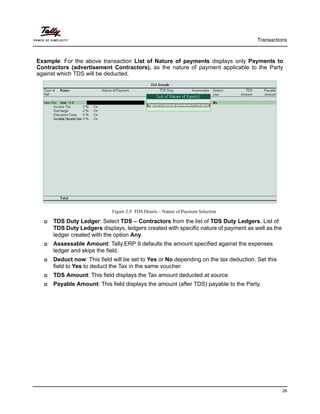
  • 159.
    Reports 155 3.7.5 Unknown DeducteeType Unknown Deductee Type report displays all the Party Ledgers for whom the Deductee Type is not defined. To view the Unknown Deductee Type report Go to Gateway of Tally > Display > Statutory Reports > TDS Reports> Exception Reports > Unknown Deductee Type Example: Create ledger Attra Infotech without selecting Deductee Type Figure 3.43 Unknown Deductee Type Deductee Type Details of the Party can be updated from this screen. Once you update Deductee Type details, such party ledgers will not be displayed further in the Unknown Deductee Type report. This Report is useful to trace the party ledgers for which the Deductee Type Details are not available before filing the e-returns.
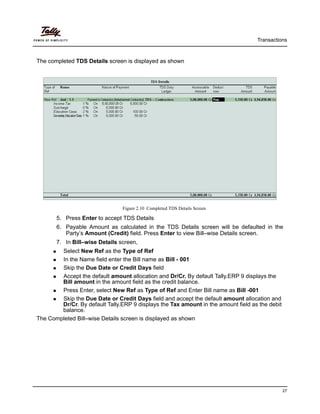
  • 160.
    156 Appendix A.i Migrating TDSData A.i.i Pre Migration Before migrating the data to Tally.ERP 9 TDS, deduct TDS for all pending Bills of all Parties even though they have not crossed the exemption limit. You can ignore the exemption limit by configu- ration at the master level. A.i.ii Vouchers considered for TDS Migration The TDS migration will happen only for TDS Deduction Voucher Advance payment voucher where TDS is deducted in the same voucher A.i.iii Migration Flow Migration will happen based on the supplier Ledger. Before the actual migration Tally checks for the validity of all transactions for a supplier and if any error is found it skips that supplier or skips the transaction depending upon the type of data error. A.i.iv Data Errors Data Errors in TDS Migration can be categorized as follows: 1. TDS Process Flow Error: This type of error not only affects the particular transaction in which it is identified but also the subsequent transactions. When this type of an error is identified in a transaction, all the transactions for that supplier will not be migrated. Reasons for Non-migration Gross amount is empty Gross amount is equal or less than the previous deduction's gross amount
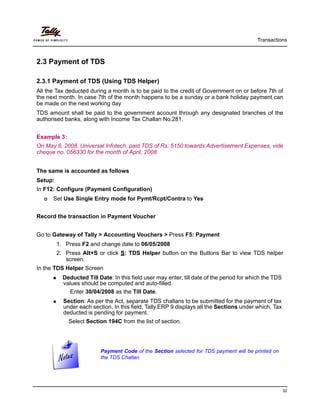
  • 161.
    Appendix 157 How to findnon-migrated vouchers? In Tally.ERP 9 the non-migrated vouchers can be tracked from Go to Gateway of Tally > Statutory reports > TDS Reports > Exception Report >Track Migrated Vouchers. Example: We have migrated ABC Company data to Tally.ERP 9. The Track Migrated Vouchers report appears as shown Figure 1.1 Track TDS Vouchers To find the non-migrated vouchers based on bill details Go to Gateway of Tally > Statutory Reports > TDS Reports > Exception Report > Track Migrated Bills The Track Migrated Bills report appears as shown
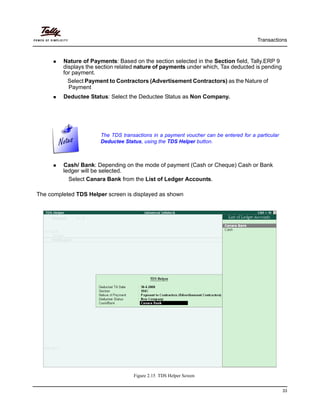
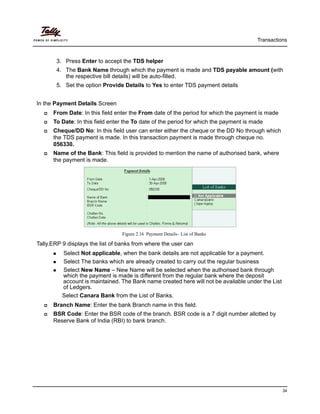
  • 162.
    Appendix 158 Figure 1.2 TrackMigrate Bills 2. Transaction Error: This type of error affects only the particular transaction in which it is identi- fied. When this type of an error is identified in a transaction, the particular transaction will not be migrated. Reasons for Non-migration: Multiple duty ledger or supplier selected in a deduction voucher Multiple party bill adjustment done in a single deduction transaction In party bill adjustment, normal bill is adjusted instead of corresponding TDS liability bill However in both the above cases, you can correct the data and re-migrate by pressing Ctrl+Alt+M from Gateway of Tally. A.i.v Assessable Value & TDS Calculation In old TDS there was no concept of Assessable value (Gross Value concept was used) which is required for TDS statutory reports at each Nature of Payment level of a transaction. Tally.ERP 9 supports assessable value concept in new TDS. To calculate Assessable Value for old TDS data while migrating, Tally sorts the supplier vouchers based on the sequence of entry and identifies the Assessable value from the deduction voucher by applying the following formula:
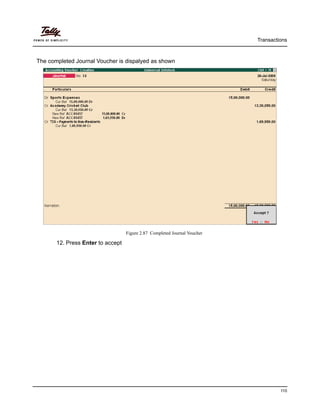
  • 163.
    Appendix 159 Assessable Value forthe Deduction = (Current Deduction's Gross Amount –Previous Deduc- tion's Gross Amount) Tally re-calculates the tax amount by applying the stored percentages. If there is a difference between Calculated Tax and Actual Tax stored in the deduction voucher, the difference will be treated as below: 1. In case the difference amount less than or equal to Rs. 3/- (plus or minus), it is considered as rounding-off issue and adjusted in Income Tax 2. In case the amount is more than Rs.3 (plus or minus): if it is negative, it will be treated as Surcharge Reversal and adjusted in Surcharge if it is positive difference, it will be treated as extra Surcharge Deduction and adjusted in Surcharge A.i.vi TDS Migration in different scenarios 1. Single liability booked with multiple deductions – this case will be true only in case if the Surcharge got activated in between either by crossing the limit or ignoring at the master level. In any case, it will create only one tax reference in the liability voucher provided the same bill is adjusted in both the deduction voucher in old TDS. 2. Multiple liability but single deduction – Tally.ERP 9 will update only one liability voucher which is got adjusted in deduction voucher For Example: There are 3 liabilities booking vouchers b001, b002 and b003 booked for rent amounting Rs 100000 each respectively. Single deduction voucher is passed for all the 3 vouchers and adjusted against only with 3rd bill (b003) How Tally.ERP 9 will handle the migration for the above example First two vouchers will never get migrated It will migrate only the third voucher since it is adjusted in the deduction voucher for the entire assessable value of Rs.3,00,000/- 3. Liability booked but deduction is not done – In this scenario, we will not be able migrate only liability vouchers since it does not have any deduction information. Need to follow the first step mentioned in Prerequisite before migration. 4. If the same TDS tax reference is used for two different deduction vouchers of the same or dif- ferent party for same nature of payment. And a single TDS payment is made for that TDS tax reference. Tally.ERP 9 will not migrate the second deduction voucher. However you can correct reference of second deduction voucher and re-migrate by pressing Ctrl+Alt+M from Gateway of Tally. And for TDS payment you have to manual correct the reference by going in alteration screen.
  • 164.
    Appendix 160 A.i.vii Post Migration 1.If zero rates are applicable for a transaction, that transaction will not get migrated since it does not have any deduction for it. The same effect has to be manually given in new TDS by altering the voucher for the assessable value. Other wise, the same will not be considered for exemp- tion limit calculation. 2. Lower deduction details will not be migrated since earlier it was configured at the supplier level and applicable for all nature of payments. In Tally.ERP 9, the same can be configured for each nature of payment. Because of which the same has to be configured once after the migration. 3. The configuration of ignoring IT exemption limit was set in duty ledger and applied across all the suppliers in previous TDS. However in Tally.ERP 9 the same can be configured for each supplier and for each nature of payment. Because of which it requires one time manual configuration after the migration. If this is not set and any TDS deduction is found without crossing the exemption limit (due to previous configuration in the old TDS), will be shown in negative in computation report.
  • 165.
    Appendix 161 A.iiTDSRates TDSRatesfortheAssessmentYear2008-09(in%) H Pay- ment Code 193 193 193 194 *AfterconsideringdeductionunderclauseVIA–Male:Rs.1,00,000;Female:Rs.1,45,000;SeniorCitizen:Rs. G Company Pay- ment exceed1 Crore N.A. 22.66 22.66 22.66 22.66 Pay- ment doesnot exceed 1Crore N.A. 20.6 20.6 20.6 20.6 F Co-op. Society, Local Authority N.A. 10.3 10.3 20.6 20.6 E Firm Pay- ment exceed1 Crore N.A. 11.33 11.33 22.66 22.66 Pay- ment doesnot exceed1 Crore N.A. 10.3 10.3 20.6 20.6 D Individual,HUF, BOI,AOP Pay- ments more thanRs. 10lakh Normal Rate 11.33 11.33 22.66 22.66 Pay- ments lessthan Rs.10 lakh Normal Rate 10.3 10.3 20.6 20.6 C Thresh old Limit (inRs.) * 2,500 10,00 0 — 2,500 B NatureofPay- ment Salary Intereston Securities (i)Intereston debenturesor Securities (ii)Intereston 8%Savings (Taxable) (iii)Anyother interestonsecu- rities(Unlisted) Dividendother thandividend coveredbysec- tion115–O A Section 192 193 194
  • 166.
    Appendix 162 H 94A 94A 94A 94A 94B 4BB 94C 94D 94E 4EE 94F 94G *IfconsolidatedamountduringtheyearexceedsRs.50,000 G 22.66 22.66 22.66 22.66 33.99 31.6725 33.99 1.133 2.266 1.133 22.66 22.66 10.5575 NA NA 11.33 10.5575 20.6 20.6 20.6 20.6 30.9 30.9 30.9 1.03 2.06 1.03 20.6 20.6 — NA NA 10.3 10.3 F 10.3 10.3 10.3 10.3 30.9 — 30.9 1.03 2.06 1.03 10.3 10.3 — NA NA 10.3 — E 11.33 11.33 11.33 11.33 33.99 — 33.99 1.133 2.266 1.133 11.33 11.33 — NA NA 11.33 — 10.3 10.3 10.3 10.3 30.9 — 30.9 1.03 2.06 1.03 10.3 10.3 — NA NA 10.3 — D 11.33 11.33 11.33 11.33 33.99 — 33.99 1.133 2.266 1.133 11.33 11.33 — 22.66 22.66 11.33 — 10.3 10.3 10.3 10.3 30.9 — 30.9 1.03 2.06 1.03 10.3 10.3 — 20.6 20.6 10.3 — C 5,000 10,000 10,000 10,000 5,000 — 2,500 20,000* 20,000* 20,000* 5,000 — — 2,500 — 1,000 — B Interestotherthanintereston securities(casesotherthan below) Wherethepayeris (i)BankingCompany (ii)Co-Operativesociety engaggedinbankingbusiness (iii)PostOfficeunderadeposit schemeframedbyCG WinningfromLotteries Non-domesticCo. WinningFromhorseRaces PaymentincaseofContractors (i)IncaseofAdvertising (ii)OtherContracts (iii)SubContracts InsuranceCommission Non-ResidentSportsman/sports association Non–DomesticCompany DepositsunderNSStoResident/ Non–Resident RepurchaseofunitsofMF/UTI fromResident/Non–Resident Commissiononsaleoflotterytick- etstoresident/Non–Resident Non–domesticCo. A 194A 194B 194BB 194C 194D 194E 194EE 194F 194G
  • 167.
    Appendix 163 H 94H 94I 94I 94J 4LA 96B 96C 96D G 11.33 5.665 11.33 NA 22.66 11.33 5.665 11.33 10.5575 10.5575 21.115 10.3 5.15 10.3 NA 20.6 10.3 5.15 10.3 10.3 10.3 20.6 F 10.3 5.15 10.3 NA 20.6 10.3 5.15 10.3 NA 10.3 20.6 E 11.33 5.665 11.33 NA 22.66 11.33 5.665 11.33 NA 11.33 22.66 10.3 5.15 10.3 NA 20.6 10.3 5.15 10.3 NA 10.3 20.6 D 11.33 5.665 11.33 16.995 NA 11.33 5.665 11.33 11.33 11.33 22.66 10.3 5.15 10.3 15.45 NA 10.3 5.15 10.3 10.3 10.3 20.6 C 2,500 — 1,20,000 1,20,000 1,20,000 20,000 — 1,00,000 — — — B CommissionorBrokerageto ResidentPayment/creditupto 31-5-2007 RenttoResident (a)Rentformachinery/plant/ equipment (b)Rentforotherthanin(a) (i)Individual/HUF (ii)Otherthanindividual/HUF FeesforProfessional/Techni- calservicestoresident Payment/creditupto31-5-2007 CompensationtoResidenton acquisitionofimmovableprop- erty Incomefromunits(including longtermCapitalgainontrans- ferofsuchunits)toanoofshore fund Incomefromforeigncurrency bondsorGDRofIndianCom- pany IncomeofFIIfromsecurities notbeingdividend,long–term andshort–termcapitalgain A 194H 194I 194J 194LA 196B 196C 196D
  • 168.
    Appendix 164 A.iii TDS StatutoryMasters As already discussed under Scope and Applicability of TDS, Income Tax will be deducted at source, based on the rate defined in the Act, for the Deductees, against the Nature of Payments. Hence to account TDS transactions, every payment and the party to whom the payment is made needs to be identified against the Nature of payment and deductee type as defined in the Act. In Tally, all the Nature of Payments and Deductees (as defined under the Act) are provided as Statutory Masters. These Statutory Masters will be lodaed into Tally during company creation, when the Statutory compliance for is set to India. On enabling TDS Feature in F11: Statutory & Taxation features, TDS Statutory masters will be available for selection during Creation of Expenses, Party and TDS ledgers. To view Statutory Masters Go to Gateway of Tally > Dispaly > Statutory Info. Figure 1.3 Statutory Info. Screen A.iii.i TDS Nature of Payments Go to Gateway of Tally > Display > Statutory Info. > TDS Nature of Pymts Tally displays all the TDS Nature of Payments.
  • 169.
    Appendix 165 Figure 1.4 Listof TDS Nature of Pymt To view the details in the TDS nature of Payment, select a TDS Nature of Payment from the above list (For eg., select Commission or Brokerage). Figure 1.5 TDS Nature of Payment The TDS Nature of Payment screen diplays details such as Name, Full Name, Section, Payment Code, Single Bill value Limit and Section Name of the nature of payment selected
  • 170.
    Appendix 166 A.iii.ii TDS CollecteeTypes Go to Gateway of Tally > Display > Statutory Info. > Deductee Types Figure 1.6 List of Deductee Types To view the details in Deductee Type, select a TDS Nature of Payment from the above list (For eg., select Company Resident). All the TDS nature of expesnes has to be associated with relevant predefined TDS Nature of Payments.
  • 171.
    Appendix 167 Figure 1.7 DeducteeType Deductee Type screen displays details such as 1. Name: In this field Name of the deductee Type is displayed 2. Residential Status: This field displays the Residential Status of the Deductee, i.e. whether the deductee is a Resident or a non Resident . 3. Deductee Status: This field displays the deductee status of the Deductee i.e, whether the deductee is a Company or Non Company. 4. Deductee TDS Details: This section displays details such as Nature of Payment: This field dispalys all the nature of payments applicable for the Deductee. Applicable From: This field dispalys the dates from when the prescibed rate of income tax is applicable for the Nature of Payments. TDS: This field displays the TDS Rate and TDS Exemption amount applicable for the nature of payments. Surcharge: This field displays the Surcharge Rate and Surcharge Exemption amount applicable for the deductee. Ed Cess & Sec Ed Cess: This fields dispaly the applicable Rate of Cess and Sec Ed Cess.