

Tax Deduction at Source
Learn the basics of TDS


Overview of TDS
TDS is one of the modes of collection of taxes, by which a certain
percentage of amounts are deducted by a person at the time of
making/crediting certain specific nature of payment to the other
person and deducted amount is remitted to the Government
account. It is similar to "pay as you earn" scheme also known as
Withholding Tax in many other countries, one of the countries is
USA. The concept of TDS envisages the principle of "pay as you
earn". It facilitates sharing of responsibility of tax collection
between the deductor and the tax administration. It ensures
regular inflow of cash resources to the Government. It acts as a
powerful instrument to prevent tax evasion as well as expands
the tax net.

Who shall deduct tax at source?
Every person responsible for making payment of nature covered
by TDS provisions of Income Tax Act shall be responsible to
deduct tax.

However in case of payments made under sec. 194A, 194C,
194H, 194I and 194J in respect of individual and HUF, only if the
turnover or professional receipt exceeds sum of Rs. 40 lakh or
Rs. 10 lakh respectively (the limits will be Rs.60 Lakh or Rs. 15
Lakh respectively w.e.f. 01.07.2010) in previous year, he is
required to deduct tax at source.

These persons are mainly:

     - Principal Officer of a company for TDS purpose including
     the employer in case of private employment or an employee
     making payment on behalf of the employer.

     - DDO (Drawing & Disbursing Officer), In case of Govt.
     Office any officer designated as such.
- In the case of "interest on securities" other than payments
    made by or on behalf of the Central govt. or the State
    Government, it is the local authority, corporation or
    company, including the Principal Officer thereof.

Such person is called Deductor while the person from whom the
tax is deducted is called Deductee.

Tax must be deducted at the time of payment in cash or cheque
or credit to the payee's account whichever is earlier. Credit to
payable account or suspense account is also considered to be
credit to payee's account and TDS must be made at the time of
such credit.


What a deductor must do?
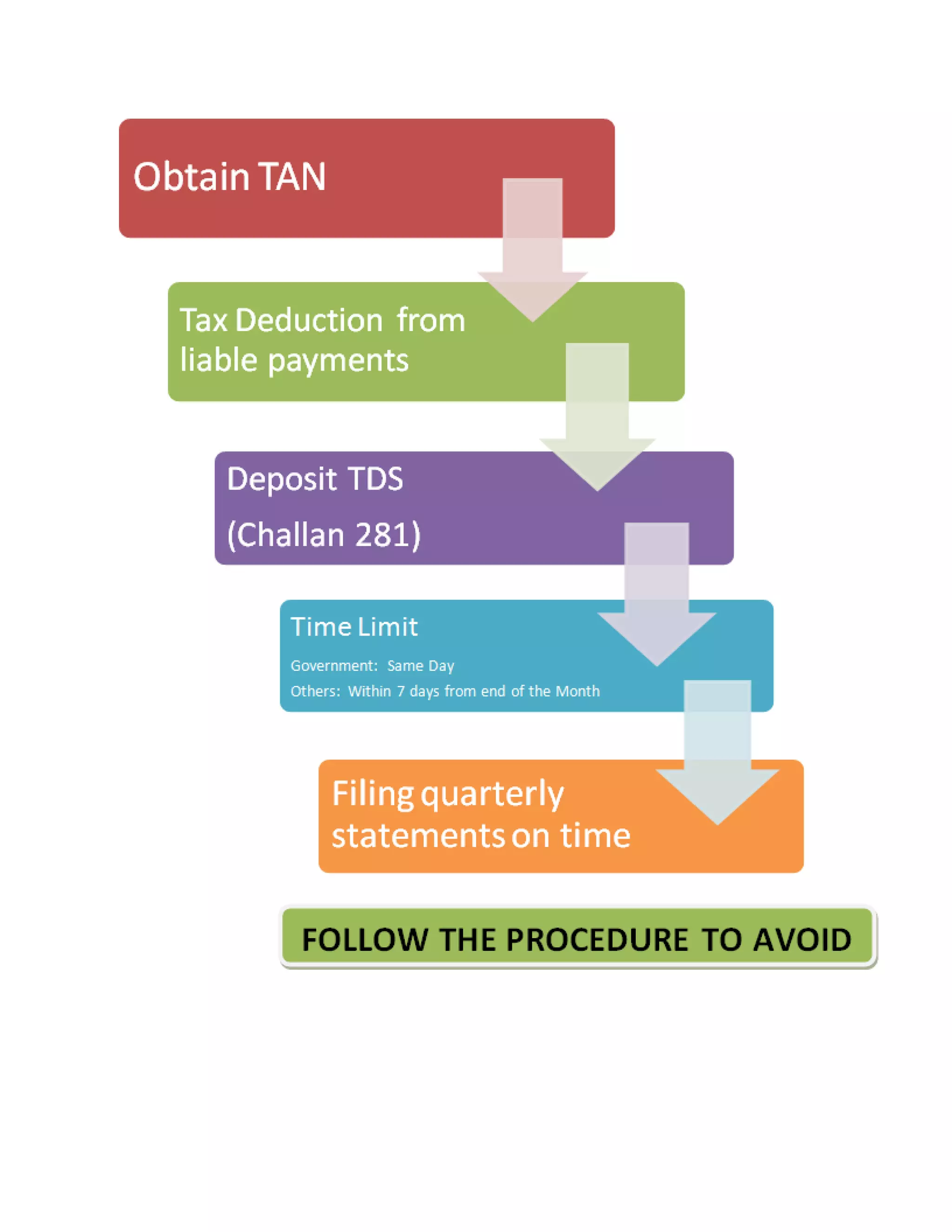
1. Obtain TAN

Every deductor is required to obtain a unique identification
number called TAN (Tax Deduction Account Number) which is a
ten digit alpha numeric number e.g.DELH90468K.

This number has to be quoted by the deductor in every
correspondence related to Income Tax matters concerning TDS.

2. He/She should obtain PAN of the deductee.

3. He/She should deduct the tax at correct rate.

4. The tax deducted has to be deposited in the designated
banks within specified time. (Govt. deductors shall transfer
the tax deducted through book entry in Government
account).This is detailed below:

    ▬ By or on behalf of the Government : on the same day,

    ▬ By or on behalf of any other person : before the 7th of
    the following month.
However, if the amount is credited in the books on 31st March
then the tax should be remitted by 31st May.

Note: w.e.f., 01.04.2008 electronic payment of tax has to be
done by all corporate assesses and all persons whose cases
are auditable under section 44B.

5. Use challan no. 281 for depositing TDS amount.

6. File statements of tax deduction in the prescribed time.

  The due dates for filing of TDS/TCS statement are :

    15th of July for Quarter 1,

    15th of October for Quarter 2,

    15th of January for Quarter 3 and

    15th June for last Quarter however for TCS statements
    the due date is 30th April.

7. Use correct form to file TDS/TCS Returns. They are:

    Form 24Q        for salaries

    Form 26Q        for non salaries

    Form 27EQ       for TCS

    Form 27A/27B Control sheet for electronic TDS/TCS

  It may be noted that the following persons have to
  compulsorily file e-TDS /e-TCS statements

     All government offices/Departments
     All companies /corporations
     All persons whose cases are auditable
     All persons whose TDS statements contain more than 50
     deductees.

Dos & Dont's for filing TDS Returns
  Dos
Ensure that TDS return is filed with same TAN against
     which TDS payment has been made & TDS certificate is
     issued.
     Ensure that correct challan particulars including CIN and
     amount is mentioned.
     Correct PAN of the deductee is mentioned.
     Correct section is quoted against each deductee record.
     Correct rate is quoted against each deductee record.
     File correction statement as soon as discrepancy is noticed
     Retain the original FVU file to enable future corrections
     Make use of free of charge RPU provided through TIN-
     NSDL.com
     Download details of challan from challan status enquiry
     (TAN based view) from TIN-NSDL.com
     Registration for TAN enables you to avail additional
     facilities from Tax Information System.
     Always verify status of TDS returns from Tin NSDL to
     ascertain the discrepancy, if any, and/or whether your TDS
     return stands accepted or rejected by the system.

  Dont's

     Don't file late returns as it affects deductee tax credit
     Don't quote incorrect TAN vis-à-vis TDS payments

     The process of filing of e-TDS /e-TCS returns is
    available in detail at following websites
    www.incometaxindia.gov.in or http://tin-nsdl.com.

8. Issue TDS certificates as per existing procedure and within
the time prescribed as stated below:

  The certificate should be issued within one month from the
  end of the month in which the income is credited however for
  credit entries made on 31st March, due date is 7th
  June, except in the case of salary where the certificate has to
  be issued by 30th of April of the following financial year in
  which the income was credited.

9. File e-TBAF (In case of Govt. DDO's where TDS is credited in
Central Govt. account through book adjustments)
Procedure:
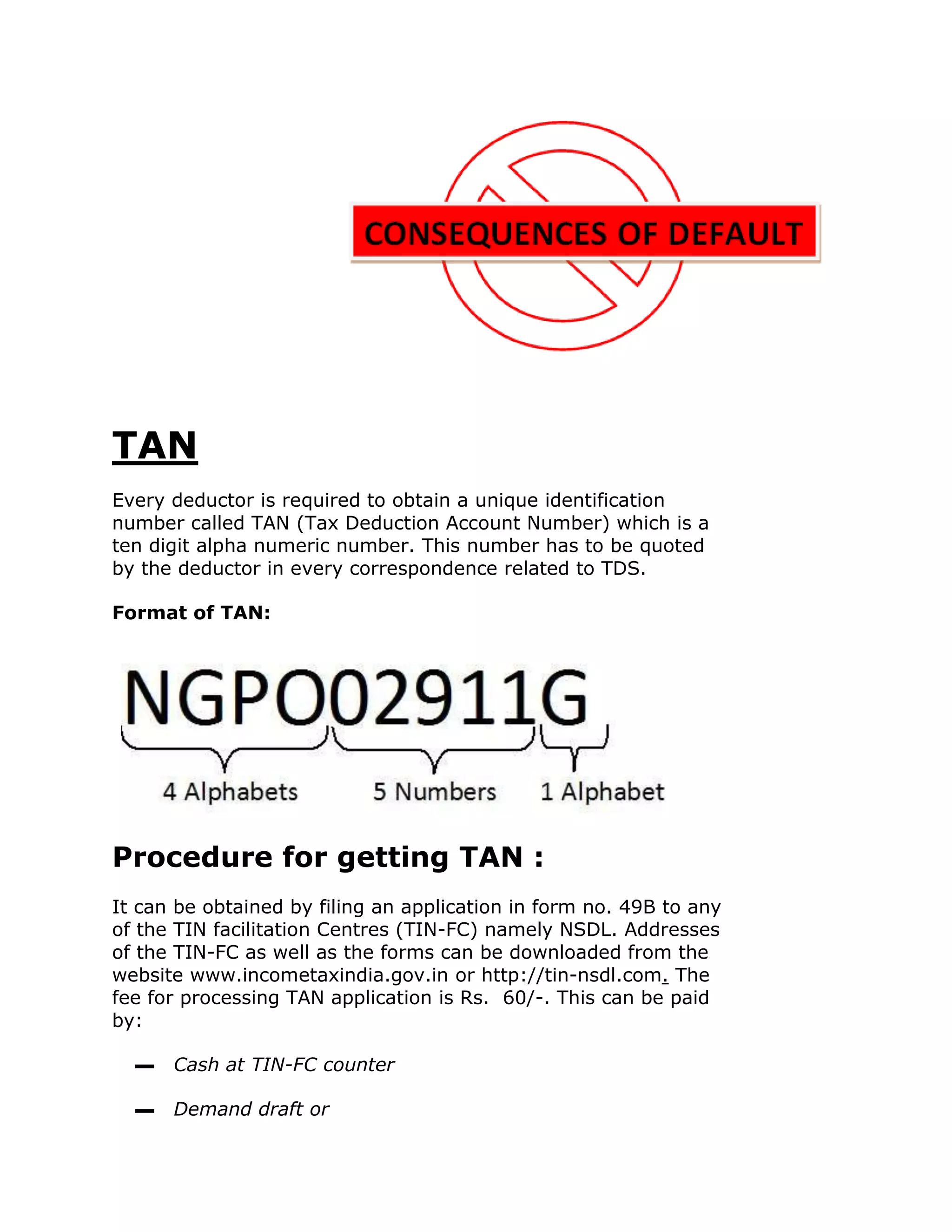
TAN
Every deductor is required to obtain a unique identification
number called TAN (Tax Deduction Account Number) which is a
ten digit alpha numeric number. This number has to be quoted
by the deductor in every correspondence related to TDS.

Format of TAN:


Procedure for getting TAN :
It can be obtained by filing an application in form no. 49B to any
of the TIN facilitation Centres (TIN-FC) namely NSDL. Addresses
of the TIN-FC as well as the forms can be downloaded from the
website www.incometaxindia.gov.in or http://tin-nsdl.com. The
fee for processing TAN application is Rs. 60/-. This can be paid
by:

  ▬   Cash at TIN-FC counter

  ▬   Demand draft or
▬    Cheque or

  ▬    Credit card

      The demand draft/ cheque shall be in favour of 'NSDL-
      TIN'.

TAN number will be communicated to the deductor by NSDL.


Nature of payments
attracting TDS and rates
thereon:
Salary

DDOs must calculate the tax payable by an employee for the
year and start deducting tax at average rate. The term salary
includes wages, any annuity or pension, gratuity, any fees,
commission, perquisites or profits in lieu of or in addition to any
salary or wages. (These payments are covered under sec. 192 of
the Income Tax Act 1961). The income from salaries is required
to be computed on estimated basis at the beginning of each
financial year, taking into account salaries or remuneration paid
or allowed. Income Tax payable on the basis of such estimated
salary income should be deducted at the rate applicable to the
corresponding slab of income every month in equal instalments
subject to adjustments depending upon tax saving investments
made by the deductee.

When an employee is working with more than one employer
simultaneously or has changed employment from one employer
to another during the relevant financial year, the employer will
deduct tax on considering the aggregate salary from all sources
and tax deducted thereon, if any.
Interest on securities/Dividends/Interest/Insurance
commission-

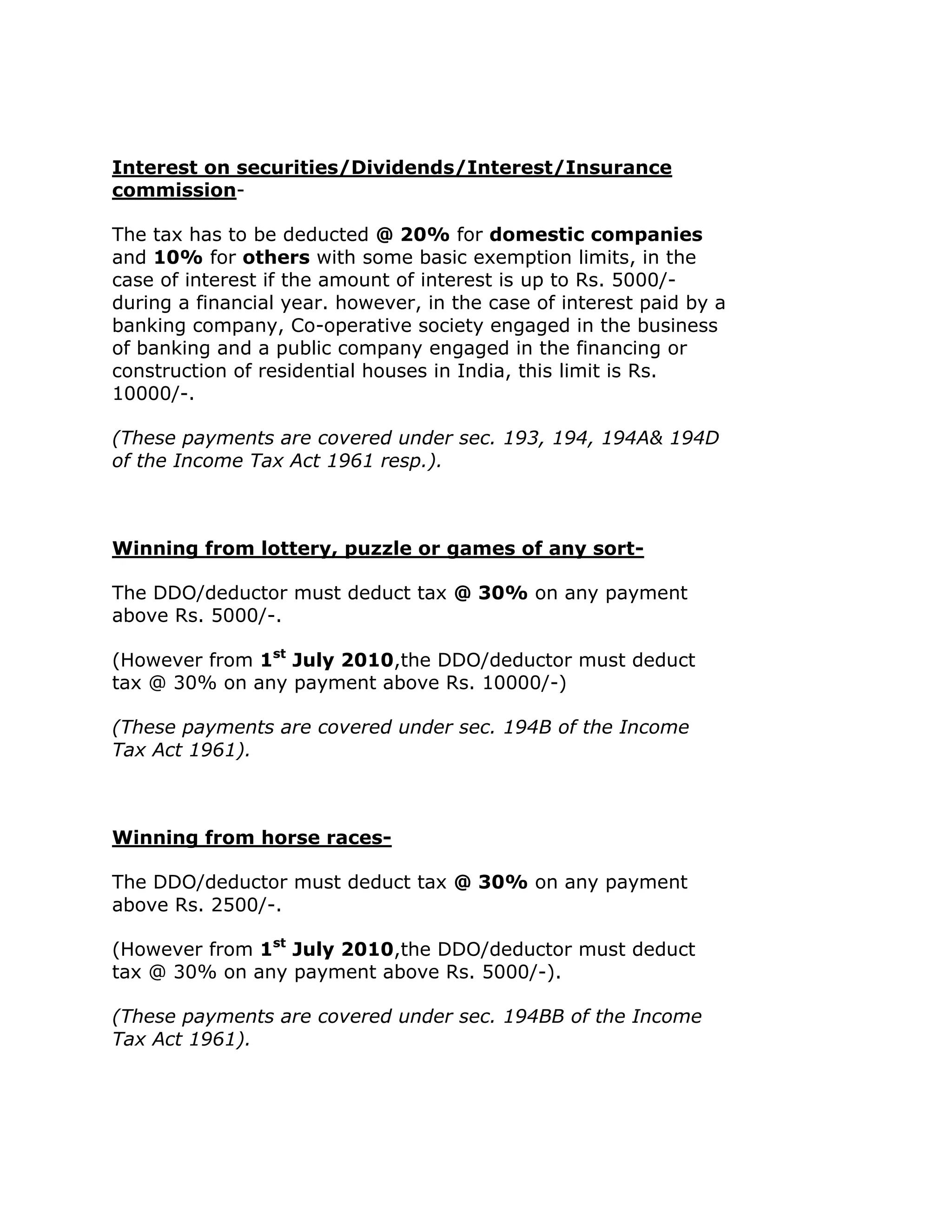
The tax has to be deducted @ 20% for domestic companies
and 10% for others with some basic exemption limits, in the
case of interest if the amount of interest is up to Rs. 5000/-
during a financial year. however, in the case of interest paid by a
banking company, Co-operative society engaged in the business
of banking and a public company engaged in the financing or
construction of residential houses in India, this limit is Rs.
10000/-.

(These payments are covered under sec. 193, 194, 194A& 194D
of the Income Tax Act 1961 resp.).


Winning from lottery, puzzle or games of any sort-

The DDO/deductor must deduct tax @ 30% on any payment
above Rs. 5000/-.

(However from 1st July 2010,the DDO/deductor must deduct
tax @ 30% on any payment above Rs. 10000/-)

(These payments are covered under sec. 194B of the Income
Tax Act 1961).


Winning from horse races-

The DDO/deductor must deduct tax @ 30% on any payment
above Rs. 2500/-.

(However from 1st July 2010,the DDO/deductor must deduct
tax @ 30% on any payment above Rs. 5000/-).

(These payments are covered under sec. 194BB of the Income
Tax Act 1961).
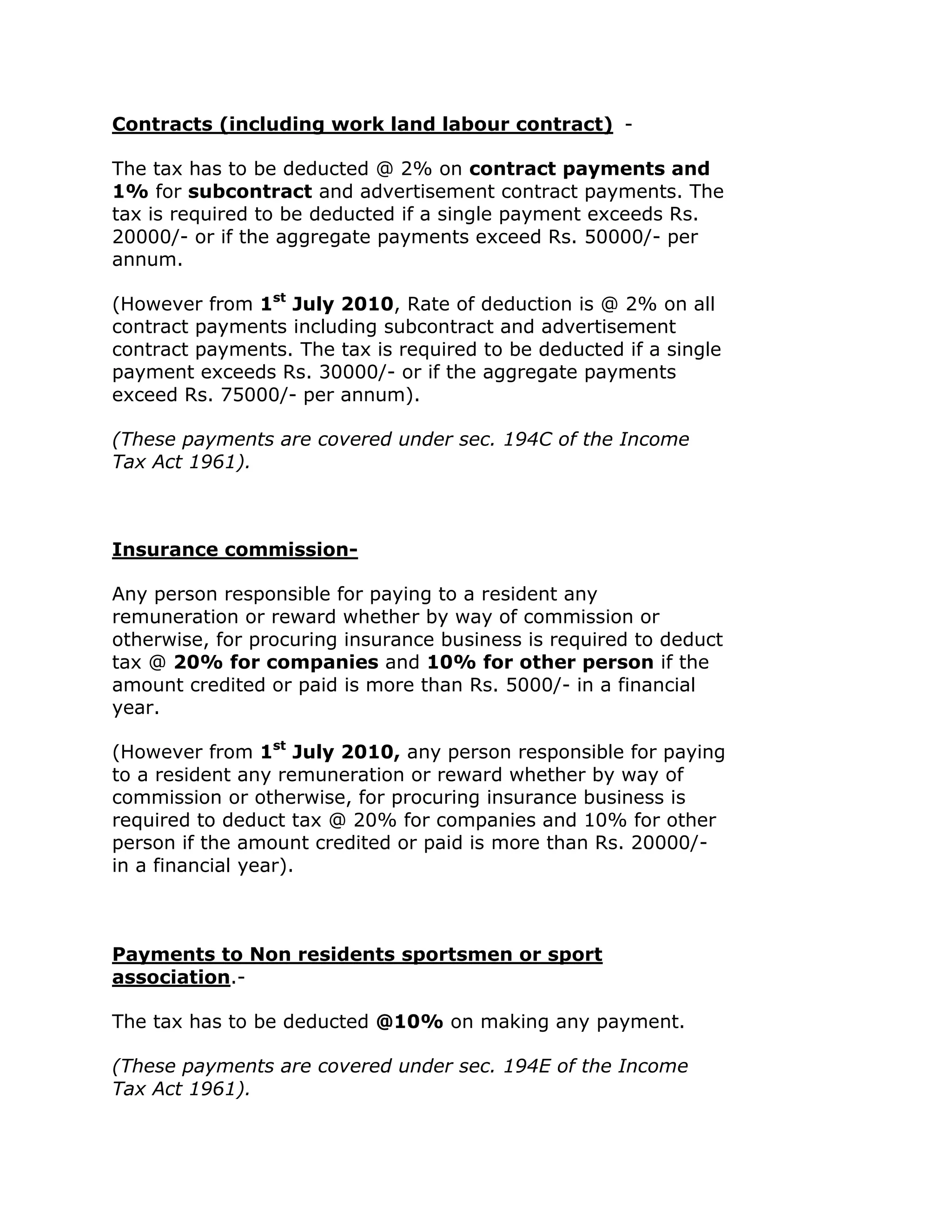
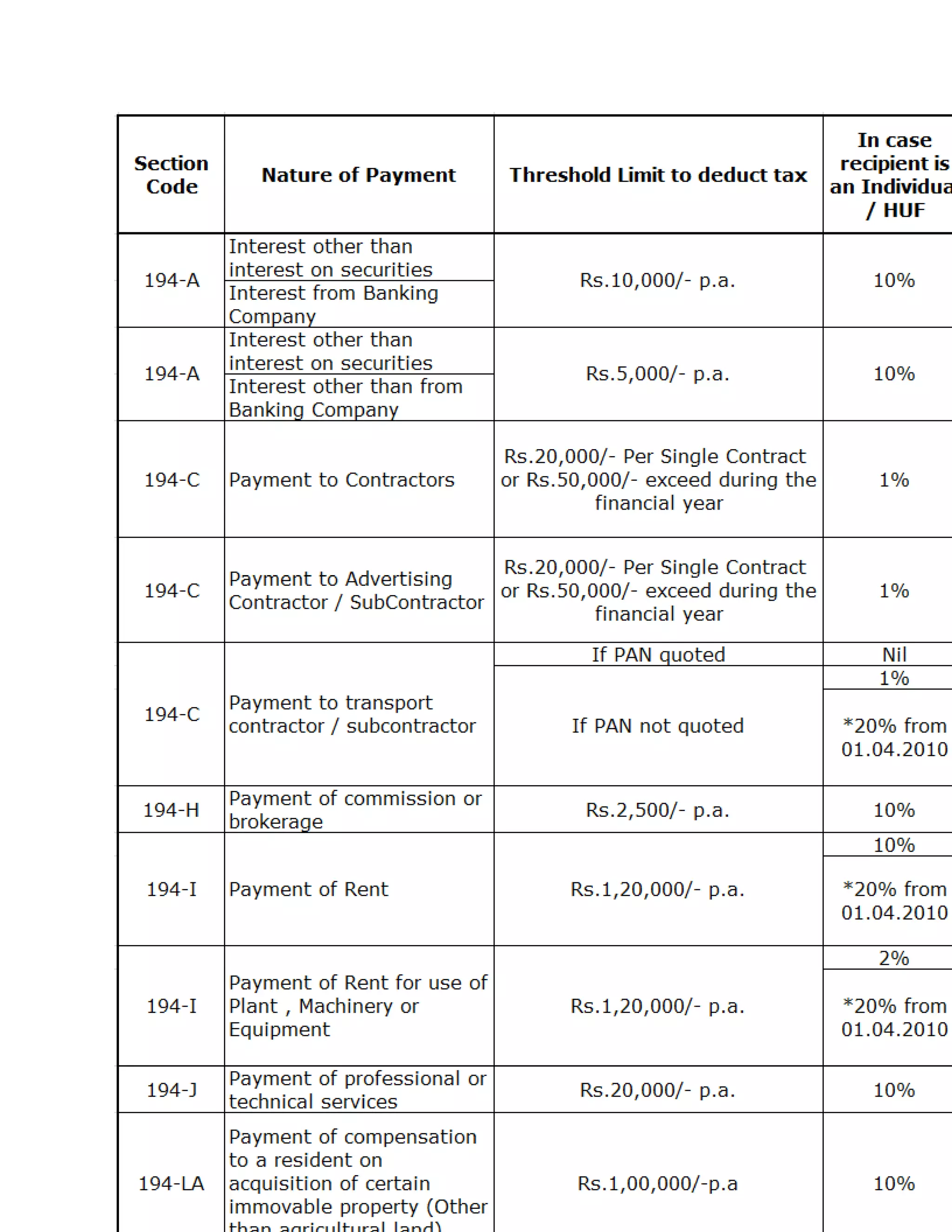
Contracts (including work land labour contract) -

The tax has to be deducted @ 2% on contract payments and
1% for subcontract and advertisement contract payments. The
tax is required to be deducted if a single payment exceeds Rs.
20000/- or if the aggregate payments exceed Rs. 50000/- per
annum.

(However from 1st July 2010, Rate of deduction is @ 2% on all
contract payments including subcontract and advertisement
contract payments. The tax is required to be deducted if a single
payment exceeds Rs. 30000/- or if the aggregate payments
exceed Rs. 75000/- per annum).

(These payments are covered under sec. 194C of the Income
Tax Act 1961).


Insurance commission-

Any person responsible for paying to a resident any
remuneration or reward whether by way of commission or
otherwise, for procuring insurance business is required to deduct
tax @ 20% for companies and 10% for other person if the
amount credited or paid is more than Rs. 5000/- in a financial
year.

(However from 1st July 2010, any person responsible for paying
to a resident any remuneration or reward whether by way of
commission or otherwise, for procuring insurance business is
required to deduct tax @ 20% for companies and 10% for other
person if the amount credited or paid is more than Rs. 20000/-
in a financial year).


Payments to Non residents sportsmen or sport
association.-

The tax has to be deducted @10% on making any payment.

(These payments are covered under sec. 194E of the Income
Tax Act 1961).
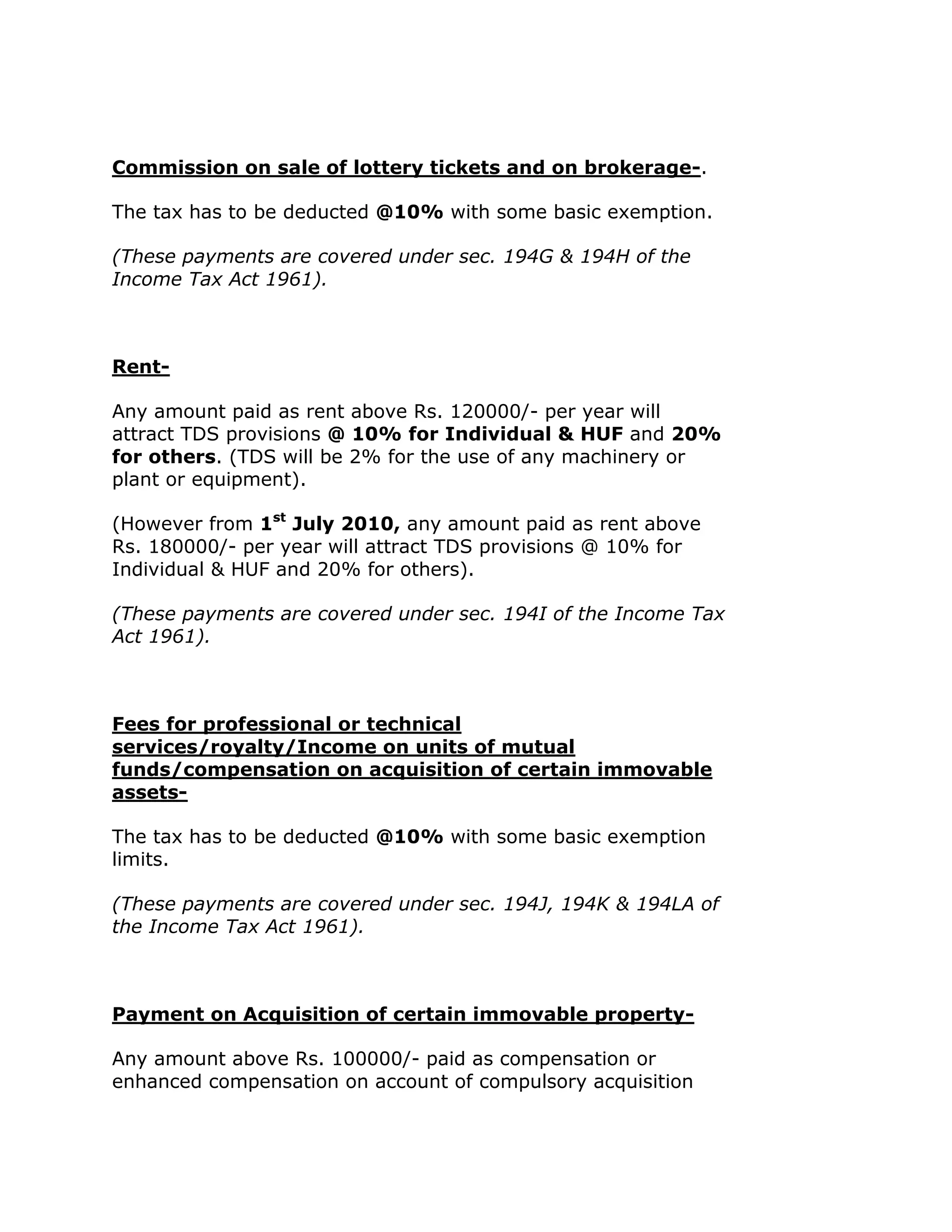
Commission on sale of lottery tickets and on brokerage-.

The tax has to be deducted @10% with some basic exemption.

(These payments are covered under sec. 194G & 194H of the
Income Tax Act 1961).


Rent-

Any amount paid as rent above Rs. 120000/- per year will
attract TDS provisions @ 10% for Individual & HUF and 20%
for others. (TDS will be 2% for the use of any machinery or
plant or equipment).

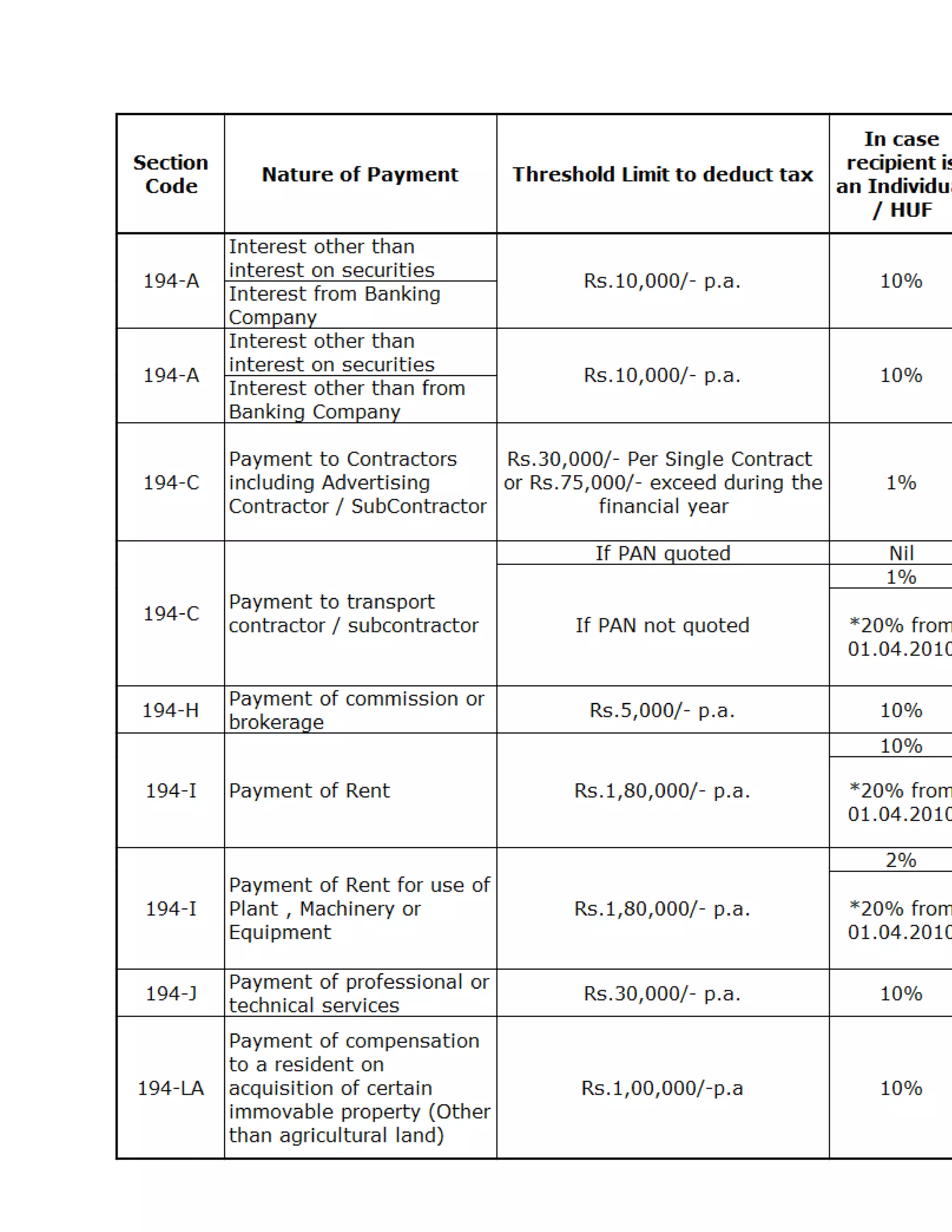
(However from 1st July 2010, any amount paid as rent above
Rs. 180000/- per year will attract TDS provisions @ 10% for
Individual & HUF and 20% for others).

(These payments are covered under sec. 194I of the Income Tax
Act 1961).


Fees for professional or technical
services/royalty/Income on units of mutual
funds/compensation on acquisition of certain immovable
assets-

The tax has to be deducted @10% with some basic exemption
limits.

(These payments are covered under sec. 194J, 194K & 194LA of
the Income Tax Act 1961).


Payment on Acquisition of certain immovable property-

Any amount above Rs. 100000/- paid as compensation or
enhanced compensation on account of compulsory acquisition
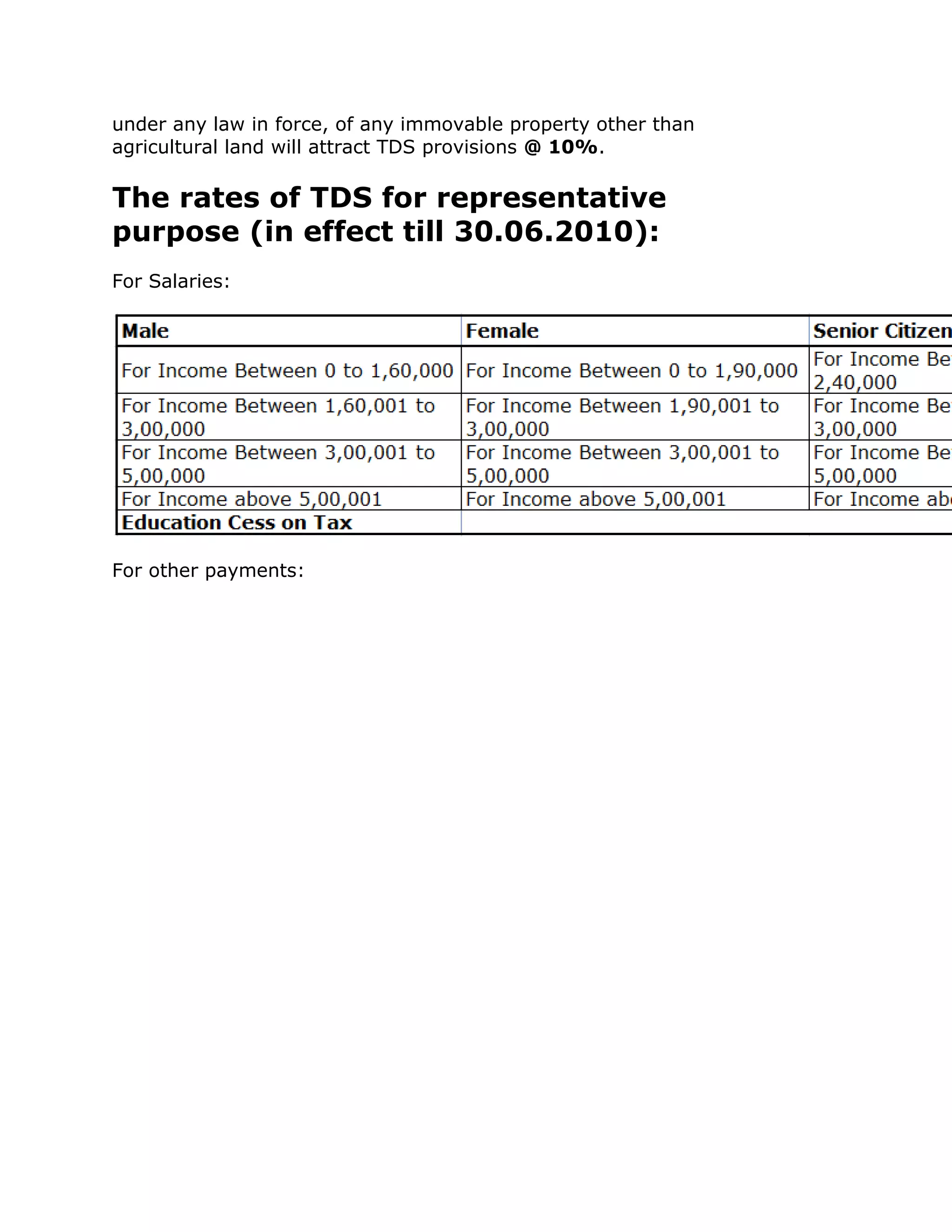
under any law in force, of any immovable property other than
agricultural land will attract TDS provisions @ 10%.

The rates of TDS for representative
purpose (in effect till 30.06.2010):
For Salaries:


For other payments:
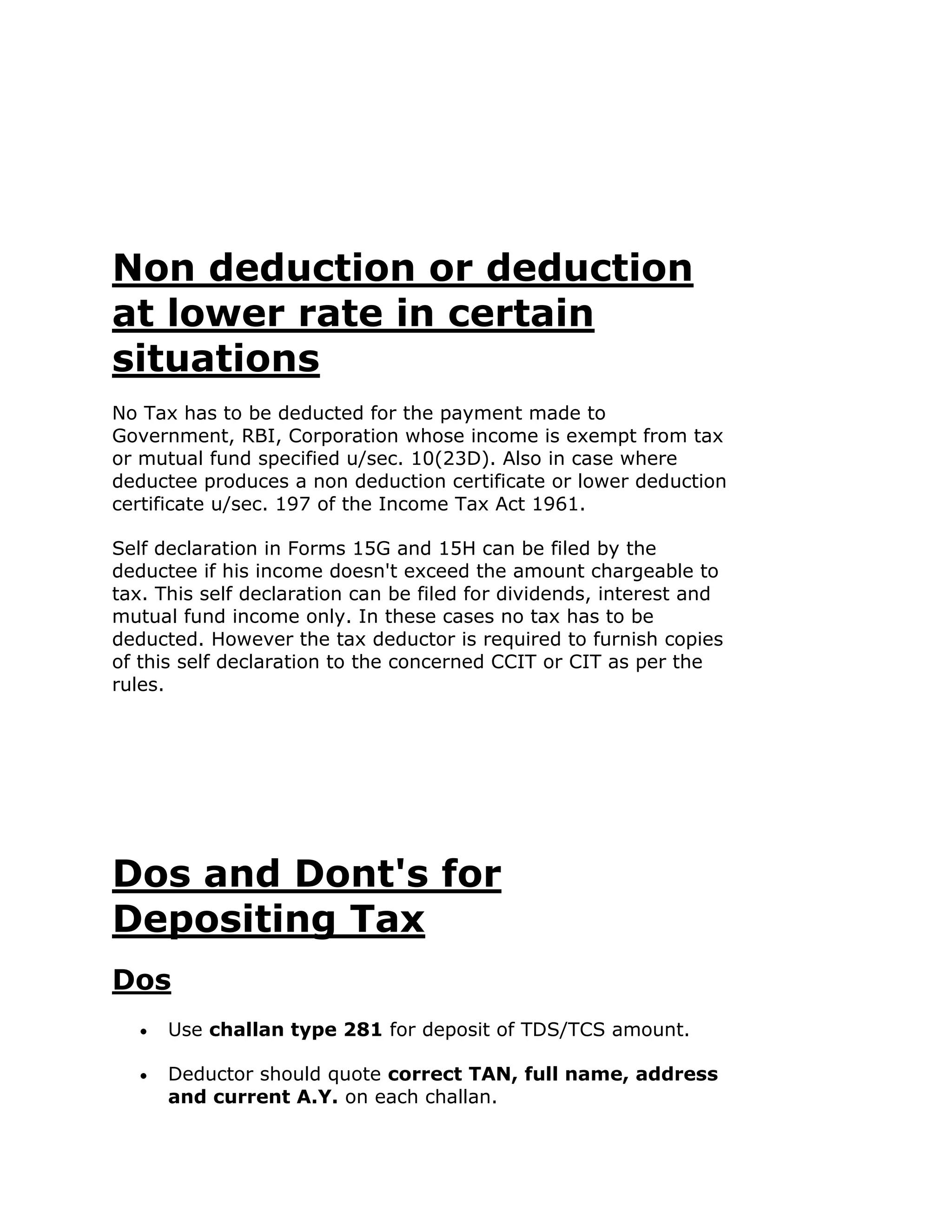
Non deduction or deduction
at lower rate in certain
situations
No Tax has to be deducted for the payment made to
Government, RBI, Corporation whose income is exempt from tax
or mutual fund specified u/sec. 10(23D). Also in case where
deductee produces a non deduction certificate or lower deduction
certificate u/sec. 197 of the Income Tax Act 1961.

Self declaration in Forms 15G and 15H can be filed by the
deductee if his income doesn't exceed the amount chargeable to
tax. This self declaration can be filed for dividends, interest and
mutual fund income only. In these cases no tax has to be
deducted. However the tax deductor is required to furnish copies
of this self declaration to the concerned CCIT or CIT as per the
rules.


Dos and Dont's for
Depositing Tax
Dos
      Use challan type 281 for deposit of TDS/TCS amount.

      Deductor should quote correct TAN, full name, address
      and current A.Y. on each challan.
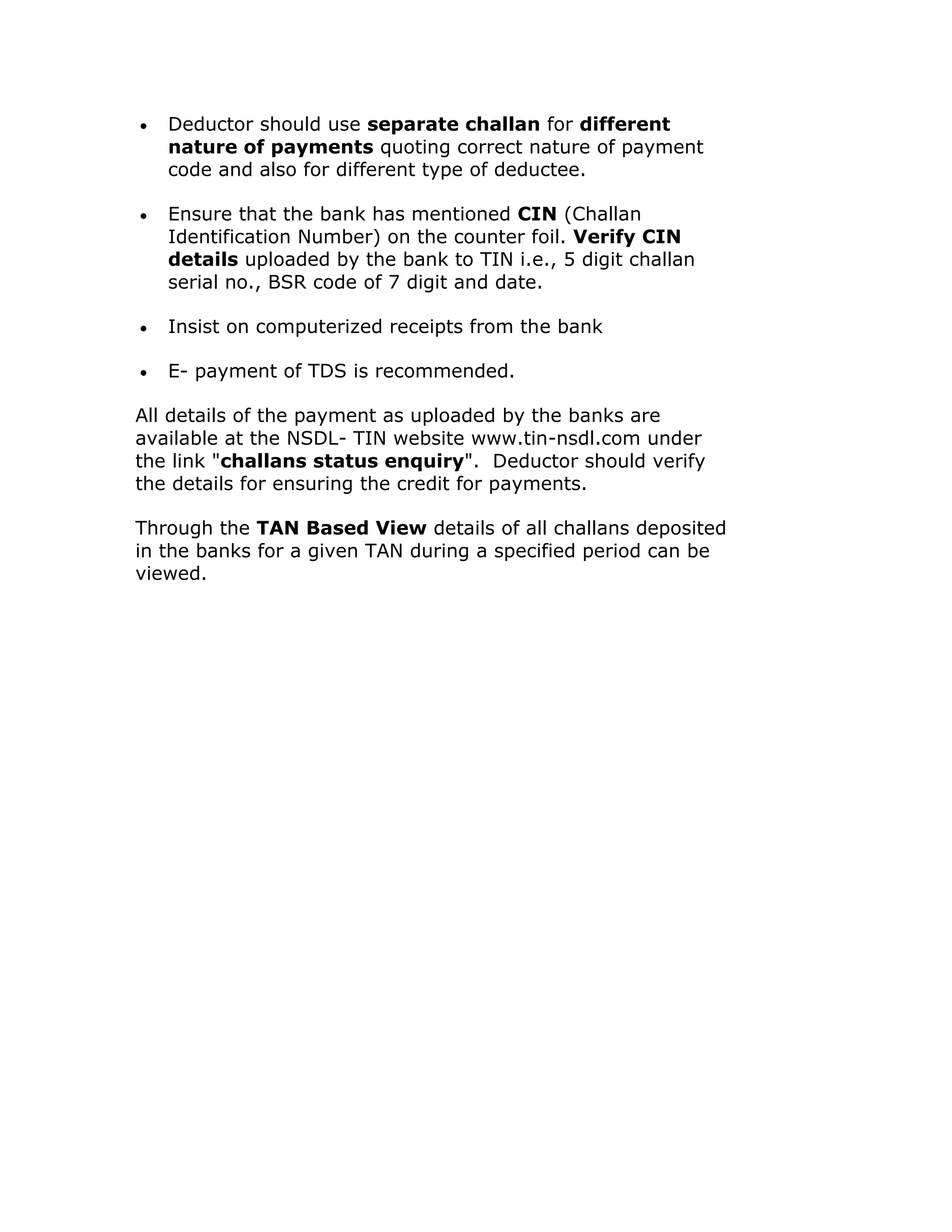
Deductor should use separate challan for different
   nature of payments quoting correct nature of payment
   code and also for different type of deductee.

   Ensure that the bank has mentioned CIN (Challan
   Identification Number) on the counter foil. Verify CIN
   details uploaded by the bank to TIN i.e., 5 digit challan
   serial no., BSR code of 7 digit and date.

   Insist on computerized receipts from the bank

   E- payment of TDS is recommended.

All details of the payment as uploaded by the banks are
available at the NSDL- TIN website www.tin-nsdl.com under
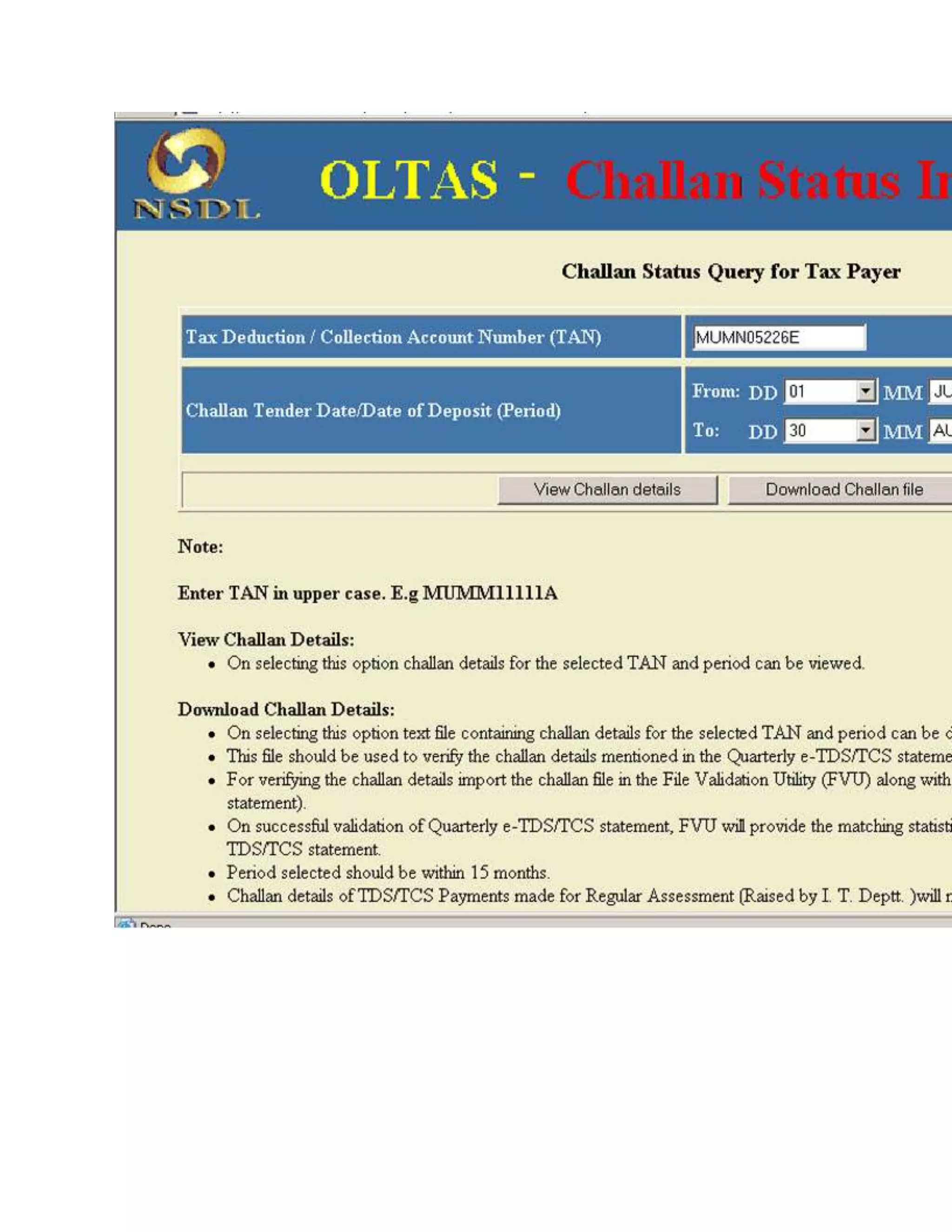
the link "challans status enquiry". Deductor should verify
the details for ensuring the credit for payments.

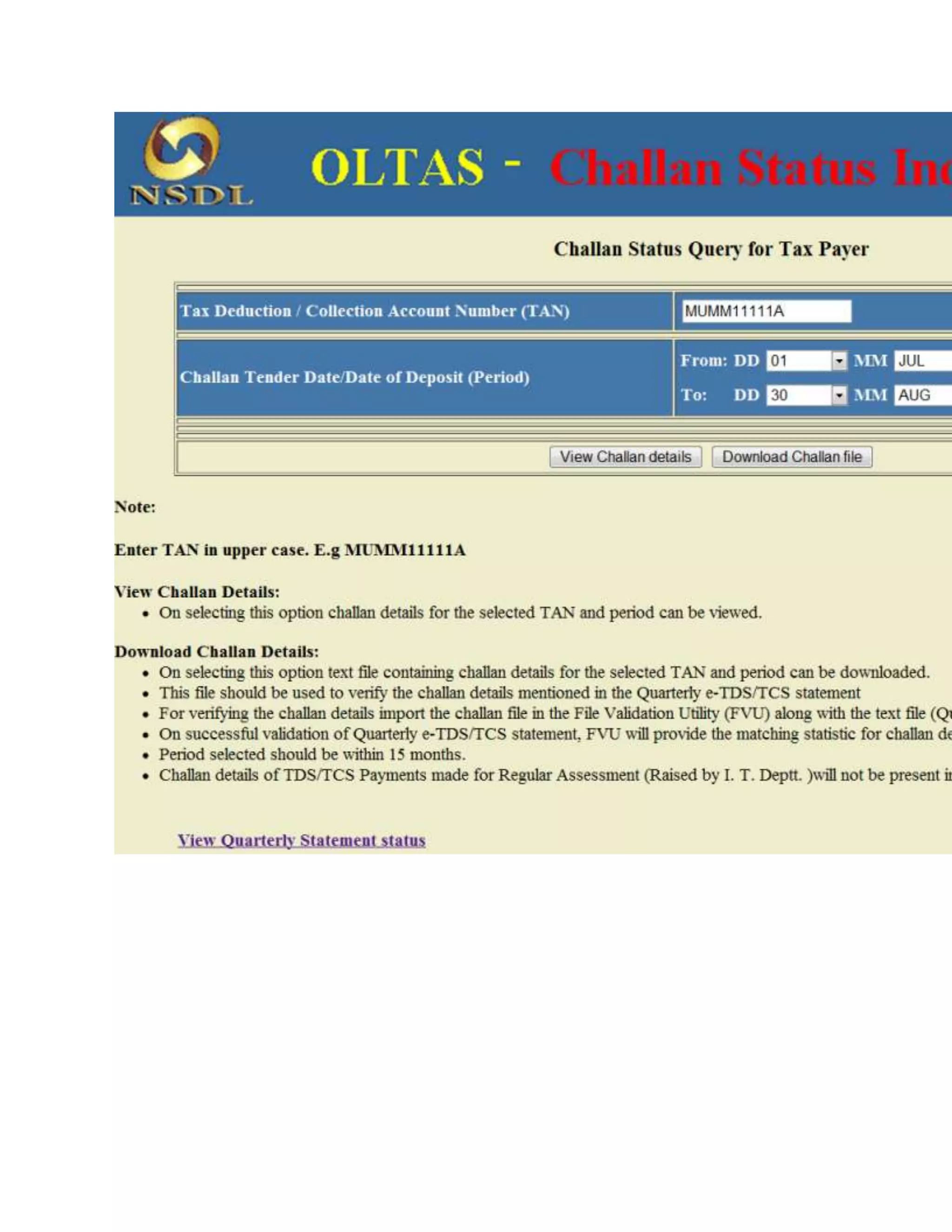
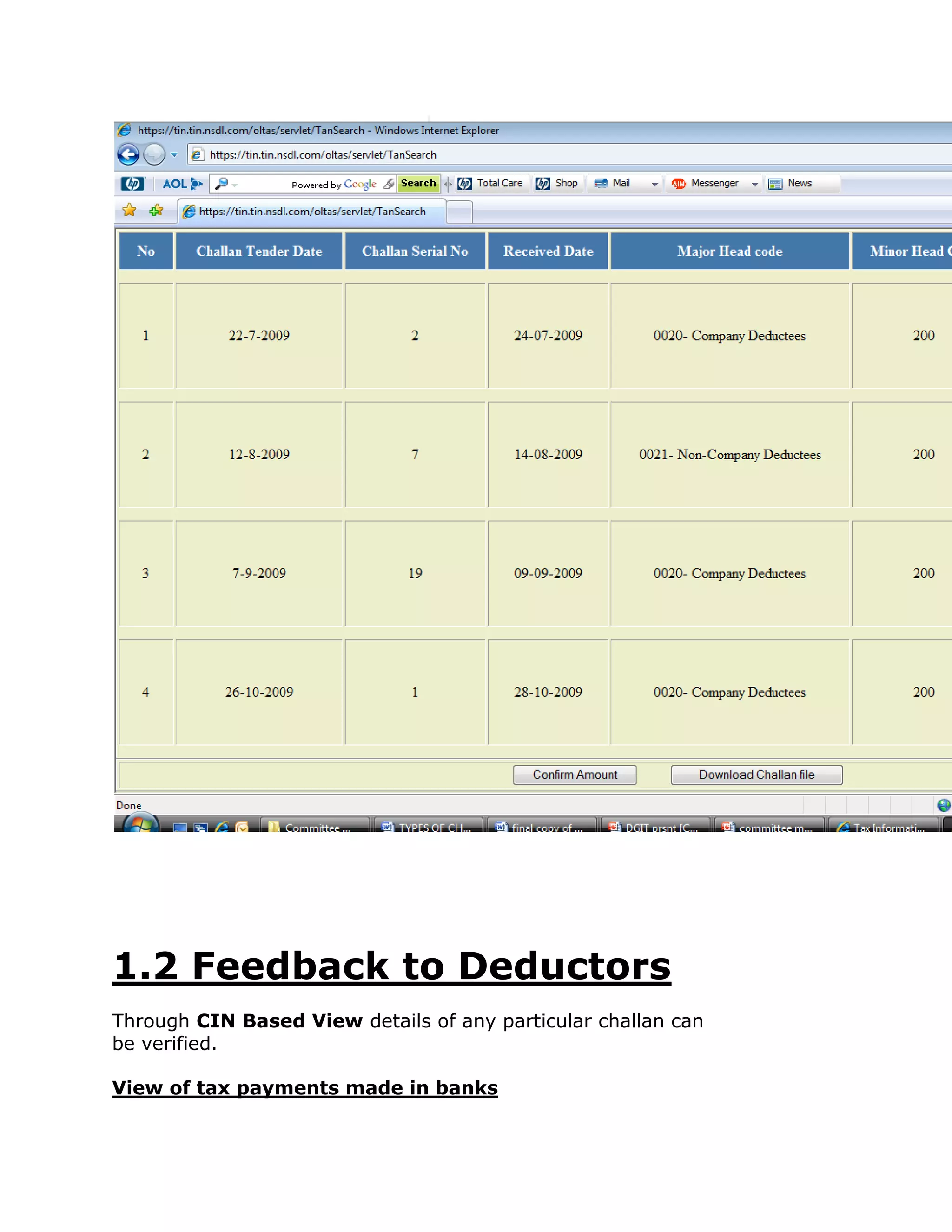
Through the TAN Based View details of all challans deposited
in the banks for a given TAN during a specified period can be
viewed.
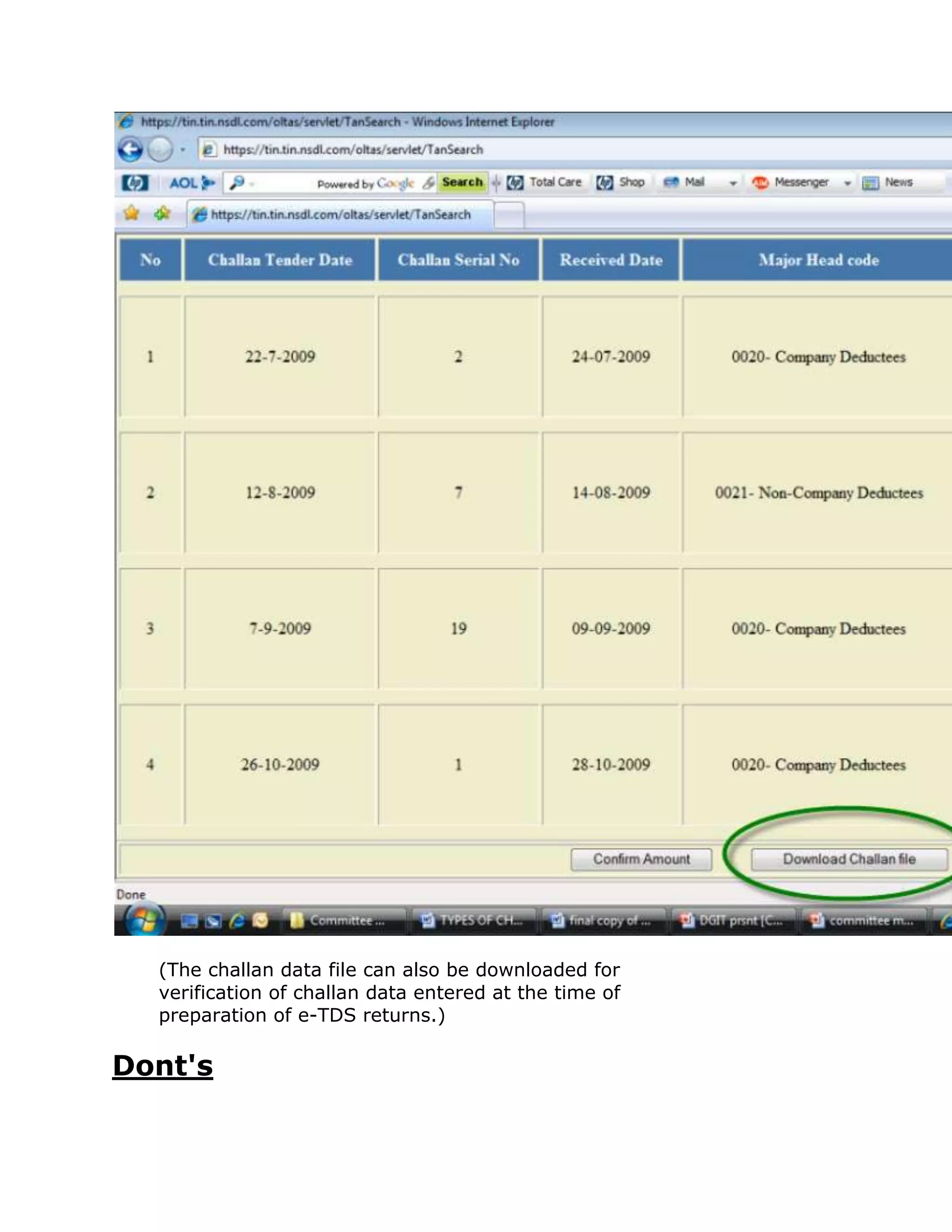
(The challan data file can also be downloaded for
  verification of challan data entered at the time of
  preparation of e-TDS returns.)

Dont's
Don't use incorrect type of challan

    Don't quote wrong TAN/PAN or use PAN in place of TAN
    or vice versa.

    Don't use a single challan for corporate and non-
    corporate deductees.

    If one has multiple TANs, use one TAN only consistently
    and surrender the others.

    Don't use preprinted challans without verifying
    TAN/PAN.

    Each branch/division of an entity will have a separate TAN
    if it is filing separate TDS/TCS returns. However, there will
    be only one PAN for a legal entity.

    Do not make mistake in indicating the Assessment Year
    in the challan.


TDS defaults
 Failure to deduct the whole or part of the Tax at source (non-
 deduction, short deduction or delay in deduction)

   1. Failure to deposit whole or part of the TDS (non-
   deposit, short deposit or late deposit)

   2. Failure to apply for TAN within the prescribed time
   limit or failure to quote TAN on allotment as required
   under section 203A.

   3. Failure to furnish, in due time, TDS returns or TDS
   certificates or to deliver or cause to be delivered a
   copy of declaration in form no. 15H/15G/27C/copy of
   quarterly statement.
4. Failure to mention the PAN of the deductee in all
   quarterly statements as well as in all certificates
   furnished.


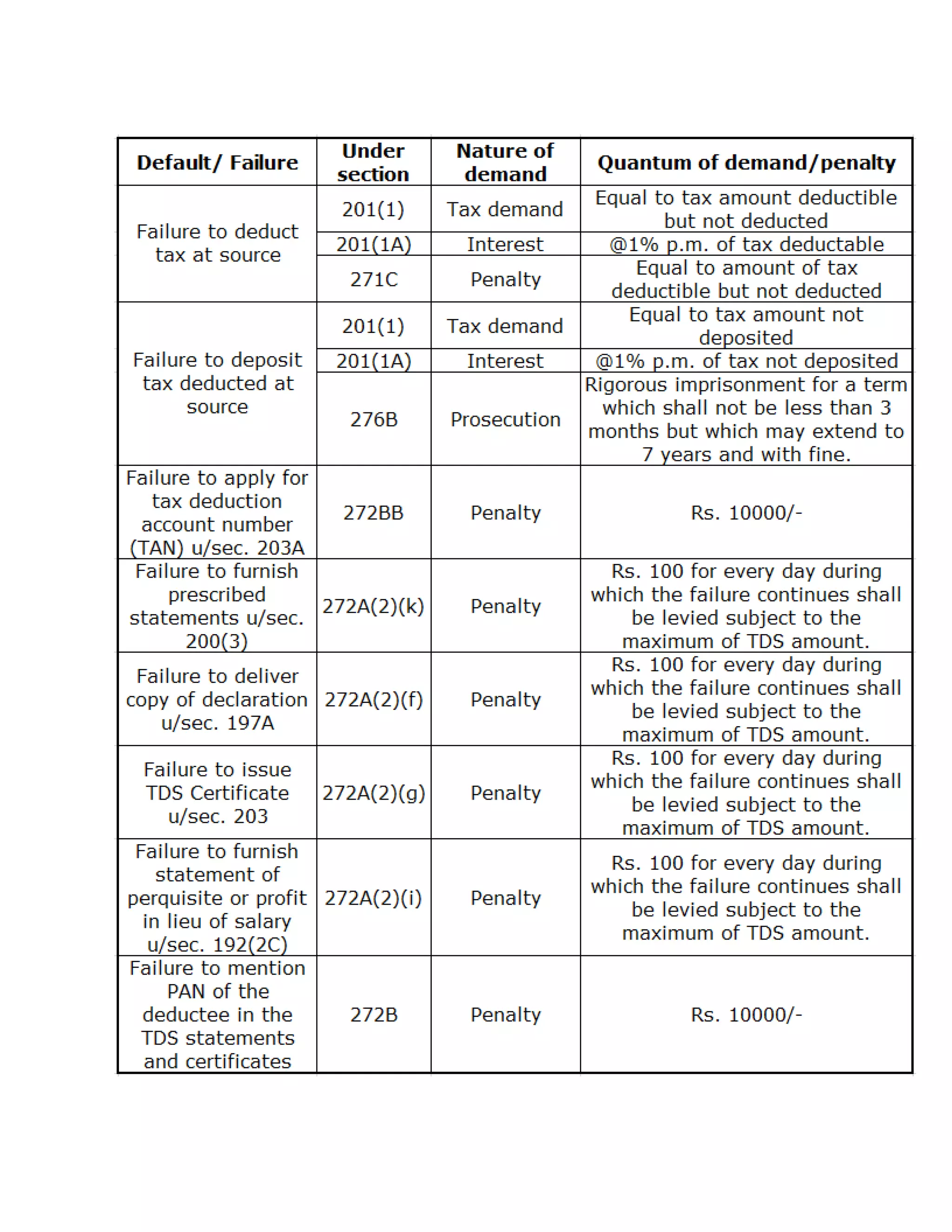
Consequences of Defaults
 The following chart indicates the nature of default and its
 consequences which range from penal interest, penalty to
 prosecution:
In addition to the above, there are other consequences in
  certain cases, as enumerated below;

    ▬ Disallowance of specified expenditure (while computing
    the income of the deductor) if TDS is not deducted from the
    payment. (Section 40a(ia)).

    ▬ Where the tax has not been paid after its deduction it
    shall be charge on the asset of the defaulter to recover the
    amount of TDS. (section 201(2)).


TAX COLLECTED AT SOURCE
(TCS)
What is TCS?
The seller has to collect tax from the payer who has purchased
the following items :

     Alcoholic liquor for human consumption
     Tendu leaves
     Timber obtained under a forest lease
     Timber obtained by any mode other than under a forest
     lease
     Any other forest produce not being timber or tendu leaves
     Scrap
     Parking lot
     Toll plaza
     Mining and quarrying

The TCS on the above mentioned items vary from 1% to 5%

Deposit of TCS amount- within seven days of the following
month.
Issue of TCS certificate- within in one month of collection
/debit(form 27D)

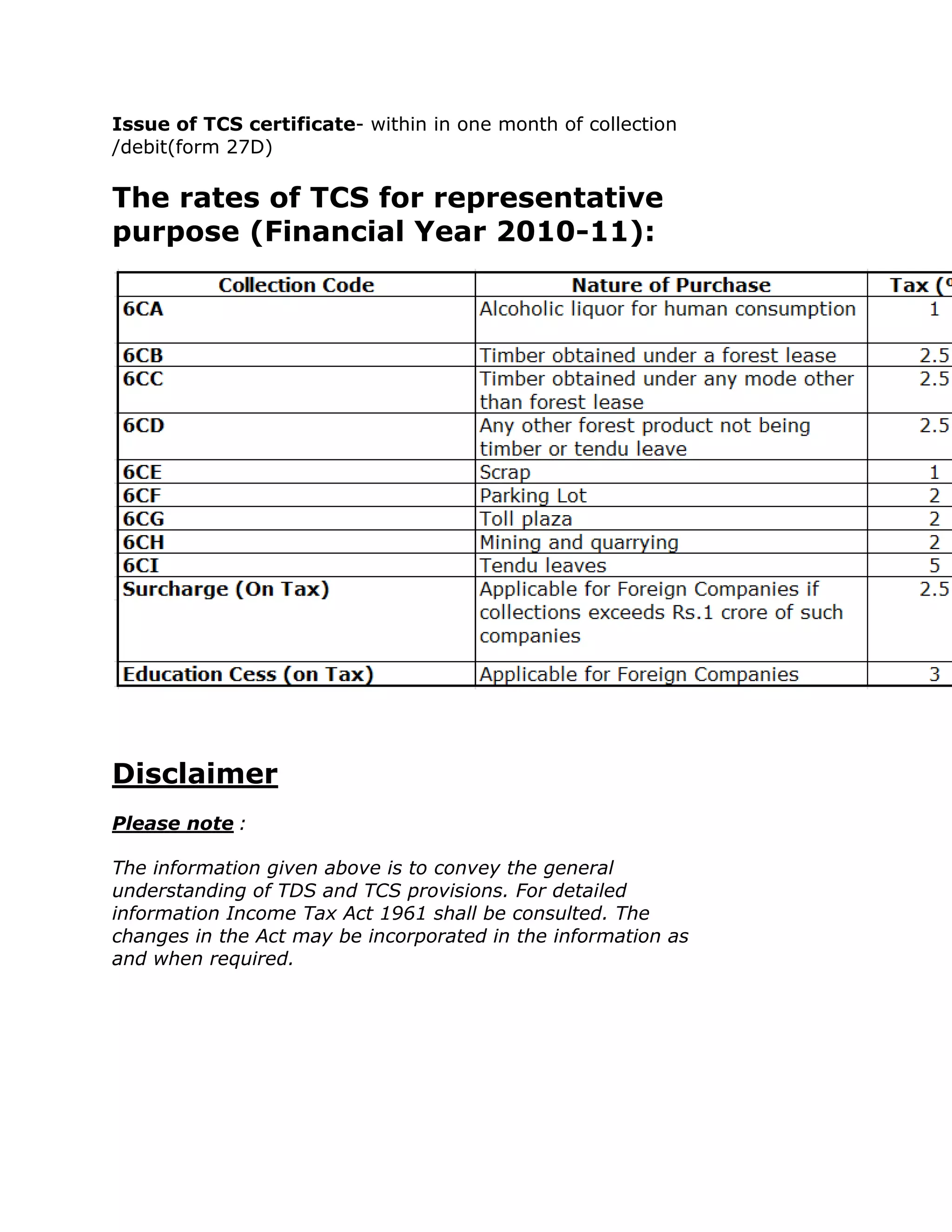
The rates of TCS for representative
purpose (Financial Year 2010-11):


Disclaimer
Please note :

The information given above is to convey the general
understanding of TDS and TCS provisions. For detailed
information Income Tax Act 1961 shall be consulted. The
changes in the Act may be incorporated in the information as
and when required.
Various Online Services of
Income Tax Department
The Income Tax Department (ITD) as a part of its citizen centric
activities is providing a host of online services to the taxpayers
services through various websites so that a taxpayer can fulfil
his routine tax obligations.

Following services are being provided:

    (i) Dissemination of tax related information through websites

    (ii) Dissemination of taxpayer specific information

    (iii) PAN and TAN related services

    (iv) e-filing of returns of income

    (v) e-payment of taxes

    (vi) e-filing of TDS returns


·    E-Tutorials available at www.incometaxindiapr.gov.in
PAN /TAN ONLINE SERVICES
PAN related services

Applications for allotment of PAN or for changes in PAN data can
be made to NSDL or UTIISL who have set up facilities in over
500 cities for receiving PAN applications.

Filing
applications
online

PAN applications
can be filed on line
at www.tin-
nsdl.com and
http://utiisl.co.in


                Tracking PAN applications

                Status of PAN applications
                can be tracked respectively at
                www.tin-nsdl.com and
                www.utiisl.co.in.
Online application
for new PAN
cards or
corrections in
PAN

Applications for new
PAN cards can be
filed on line at
www.tin-nsdl.com
and www.utiisl.co.in

                Know your PAN

                Facilitates verification of PAN allotted to
                taxpayer. Available at
                https://incometaxindiaefiling.gov.in


TAN related services

Applications for allotment of TAN or for changes in TAN data can
be made to NSDL who have set up TIN Facilitation Centres in
over 500 cities for receiving TAN applications.


Filing TAN
applications
online

TAN
applications
can be filed
on line at
www.tin-
nsdl.com
Tracking TAN
                          applications

                          Status of TAN
                          applications/application
                          for changes in TAN
                          data can be tracked at
                          www.tin-nsdl.com.


                  'Know your TAN'

                  The deductor can know the TAN
                  allotted to him
                  at https://incometaxindiaefiling.gov.in

Online application
for corrections in
TAN data

Applications for
correction in TAN data
can be filed on line at
www.tin-nsdl.com

Grievance handling with Call Centre support for PAN/TAN
related services:

      Aaykar Sampark Kendra (ASK): 0124-2438000
      TIN Call Centre: 020-27218080


Digital Signature
What is a Digital Signature?

A digital signature authenticates electronic documents in a
similar manner a handwritten signature authenticates printed
documents. This signature cannot be forged and it asserts that a
named person wrote or otherwise agreed to the document to
which the signature is attached. The recipient of a digitally
signed message can verify that the message originated from the
person whose signature is attached to the document and that
the message has not been altered either intentionally or
accidentally since it was signed. Also, the signer of a document
cannot later disown it by claiming that the signature was forged.
In other words, digital signatures enable the "authentication"
and "non-repudiation" of digital messages, assuring the recipient
of a digital message of both the identity of the sender and the
integrity of the message.

For more information on digital signature visit:

https://incometaxindiaefiling.gov.in/portal/faq_signature.do


ONLINE TAX ACCOUNTING
SYSTEM
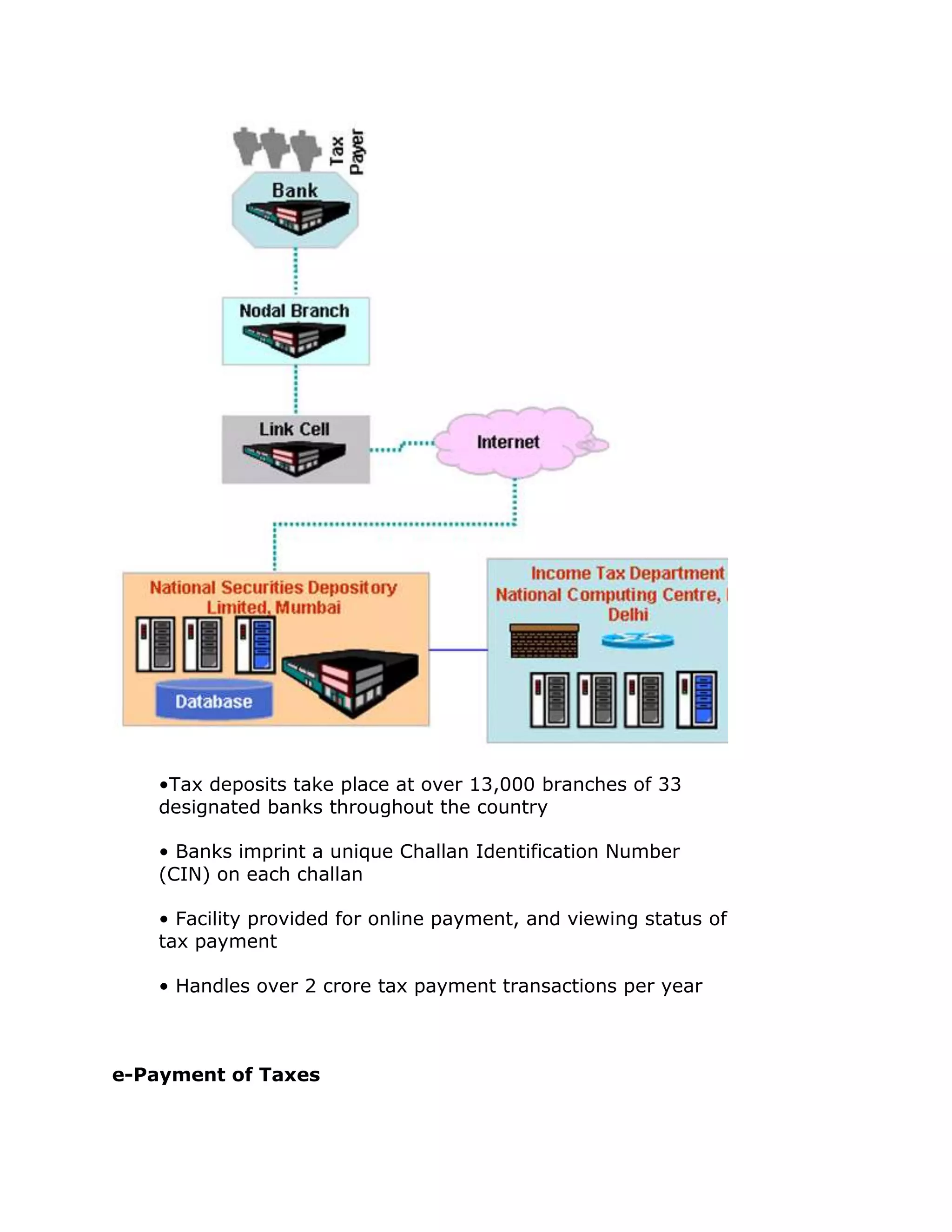
•Tax deposits take place at over 13,000 branches of 33
    designated banks throughout the country

    • Banks imprint a unique Challan Identification Number
    (CIN) on each challan

    • Facility provided for online payment, and viewing status of
    tax payment

    • Handles over 2 crore tax payment transactions per year


e-Payment of Taxes
Anytime anywhere payment of taxes
  Easy and fast.
  No lengthy queues
  No last minute rush
  Fewer mistakes
  Instant generation of CIN- eliminates possibilities of mis-
  match in CIN particulars
  Available at www.incometaxindia.gov.in and www.tin-
  nsdl.com .


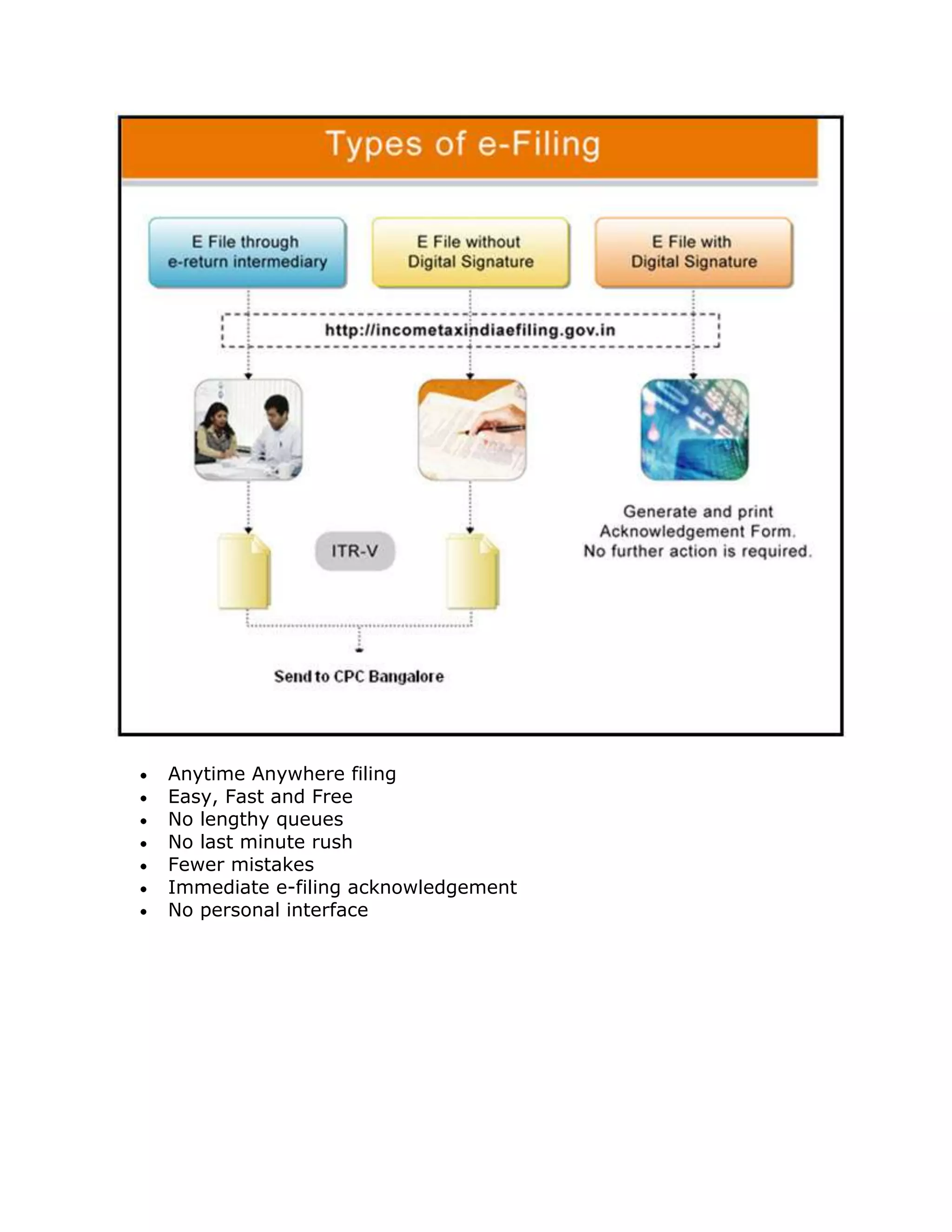
e-FILING OF INCOME TAX
RETURNS
Anytime Anywhere filing
Easy, Fast and Free
No lengthy queues
No last minute rush
Fewer mistakes
Immediate e-filing acknowledgement
No personal interface
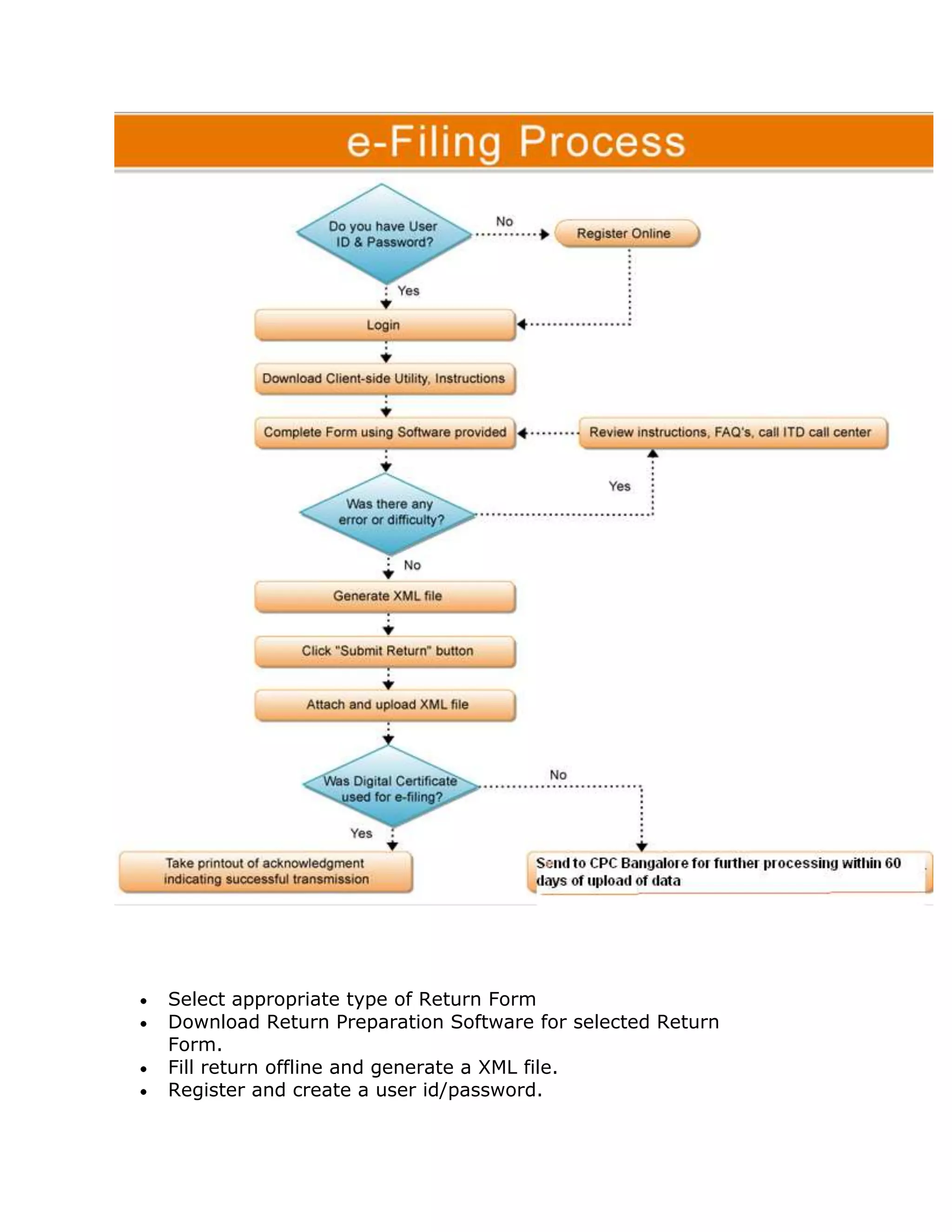
Select appropriate type of Return Form
Download Return Preparation Software for selected Return
Form.
Fill return offline and generate a XML file.
Register and create a user id/password.
Login and click on relevant form on left panel and select
     "Submit Return".
     Browse to select XML file and click on "Upload" button.
     On successful upload acknowledgement details would be
     displayed. Click on "Print" to generate printout of
     acknowledgement/ITR-V Form.
     Available at https://incometaxindiaefiling.gov.in.


e-filing of TAX DEDUCTION
AT SOURCE


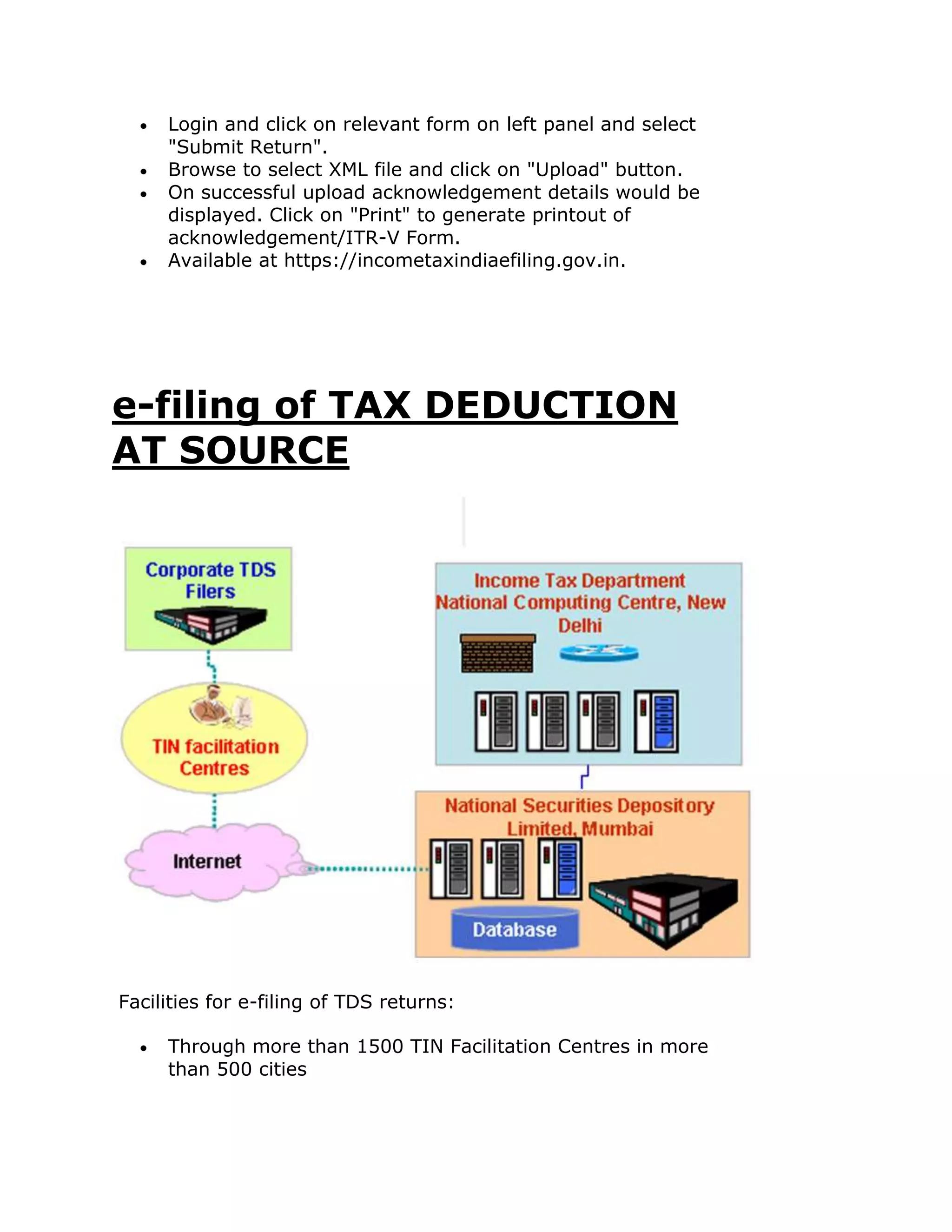
Facilities for e-filing of TDS returns:

     Through more than 1500 TIN Facilitation Centres in more
     than 500 cities
Direct online upload at www.tin-nsdl.com under Digital
     Signature
     Free Return Preparation software
     Free File Validation Utility
     Free Deductor Manual
     Helpdesk for deductors (020-27218080)
     Internet based feedback to Deductors and Deductees
     All persons can e-file the TDS.

TAN Registration

    I.TAN Registration available at www.tin-nsdl.com.

    II.Authenticated deductors-

       i.View of the status of all statements filed;

       ii.Download of consolidated quarterly e-TDS / TCS
       statement for preparation of correction statement; and

       iii.Special functionalities related to quarterly TDS /TCS
       statement.

    III.   Registration is free.


1.1 Feedback to Deductors
I. Through the TAN Based View details of all challans deposited
in the banks for a given TAN during a specified period can be
viewed.
1.2 Feedback to Deductors
Through CIN Based View details of any particular challan can
be verified.

View of tax payments made in banks
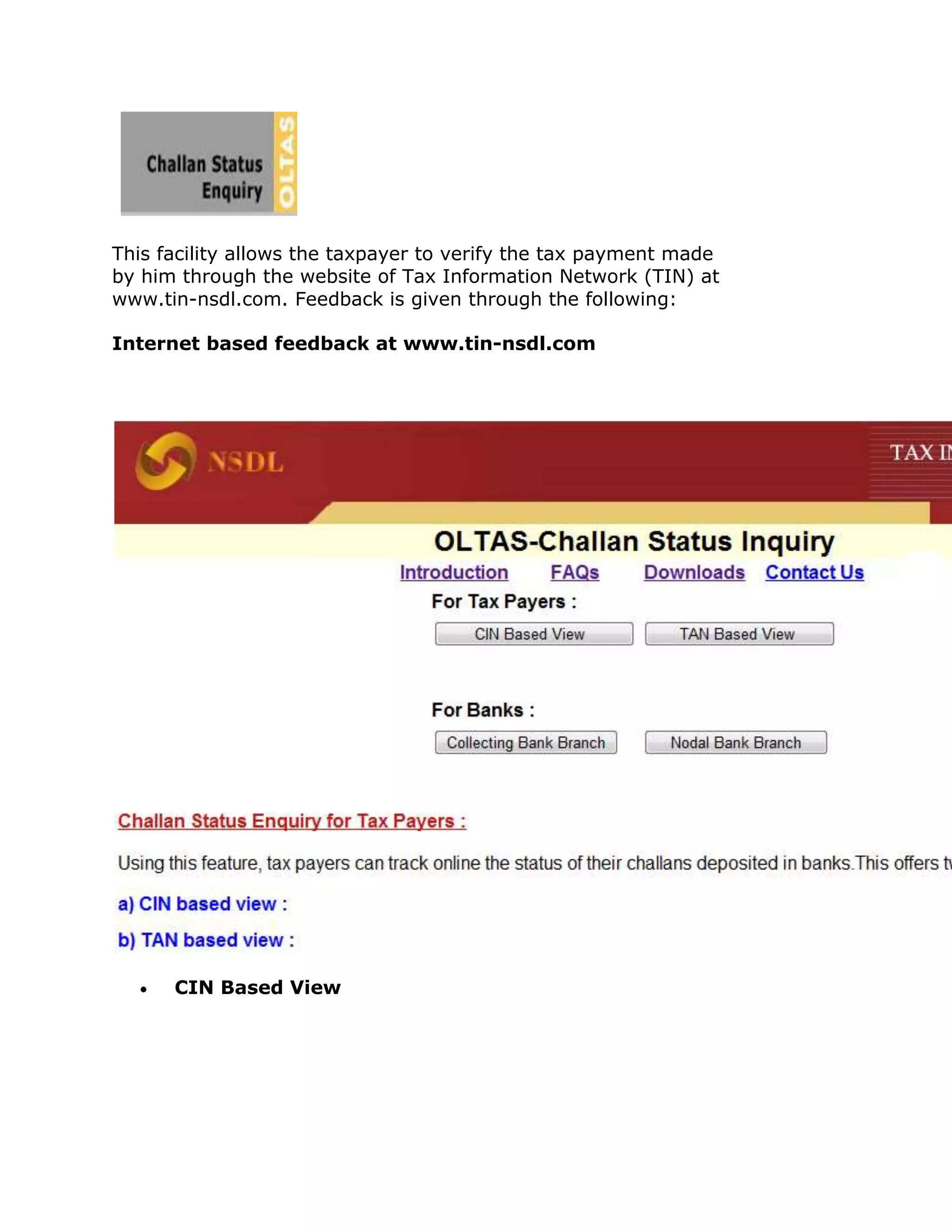
This facility allows the taxpayer to verify the tax payment made
by him through the website of Tax Information Network (TIN) at
www.tin-nsdl.com. Feedback is given through the following:

Internet based feedback at www.tin-nsdl.com


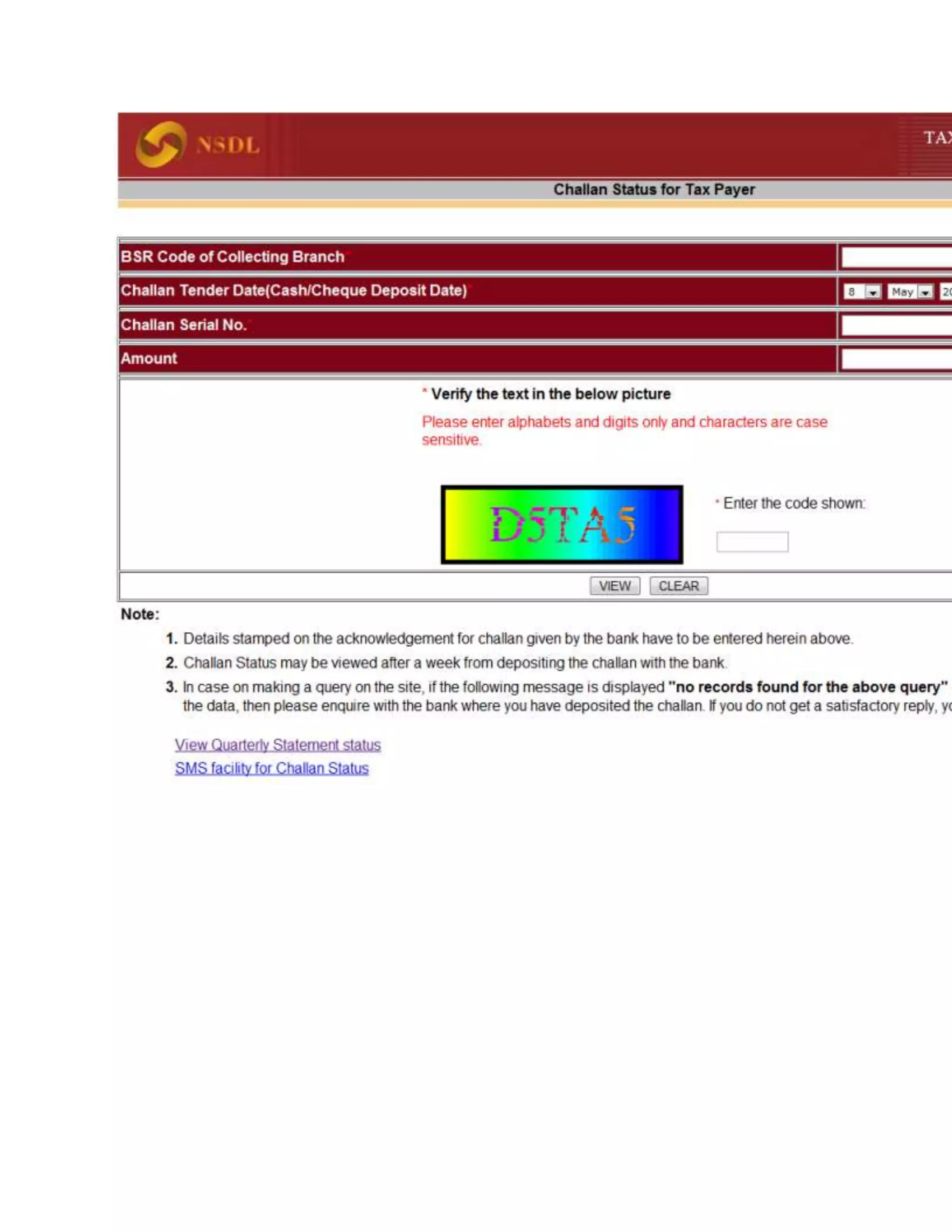
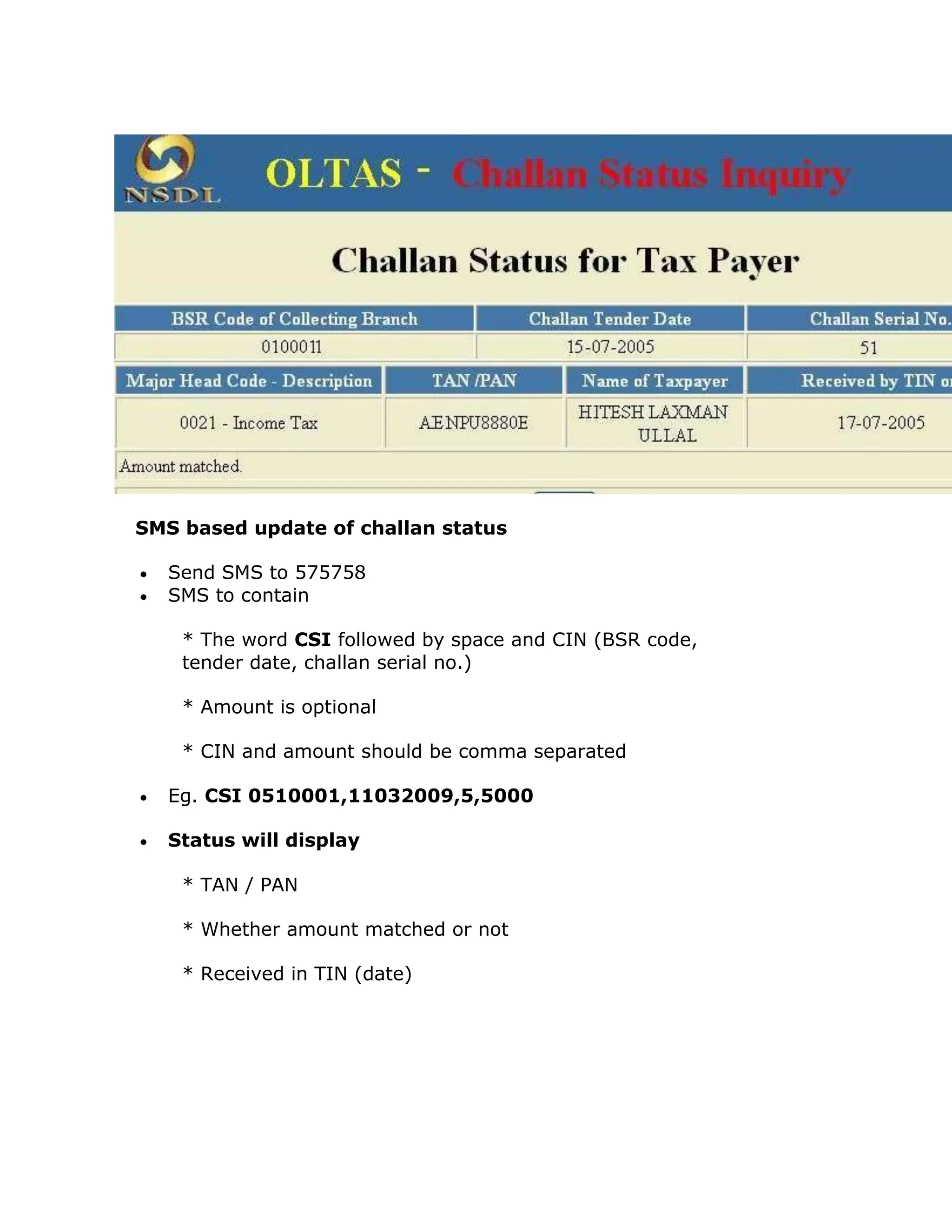
      CIN Based View
SMS based update of challan status

  Send SMS to 575758
  SMS to contain

    * The word CSI followed by space and CIN (BSR code,
    tender date, challan serial no.)

    * Amount is optional

    * CIN and amount should be comma separated

  Eg. CSI 0510001,11032009,5,5000

  Status will display

    * TAN / PAN

    * Whether amount matched or not

    * Received in TIN (date)
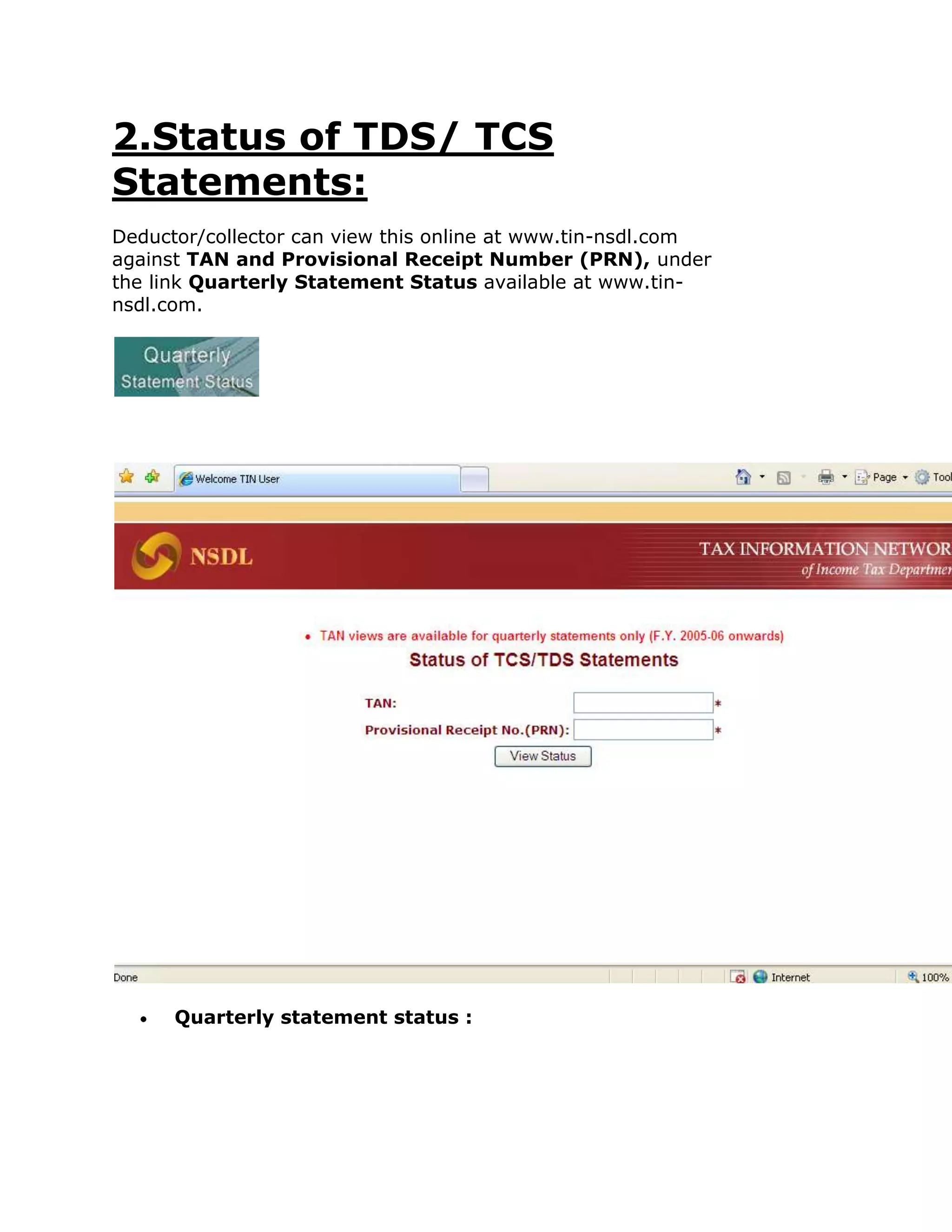
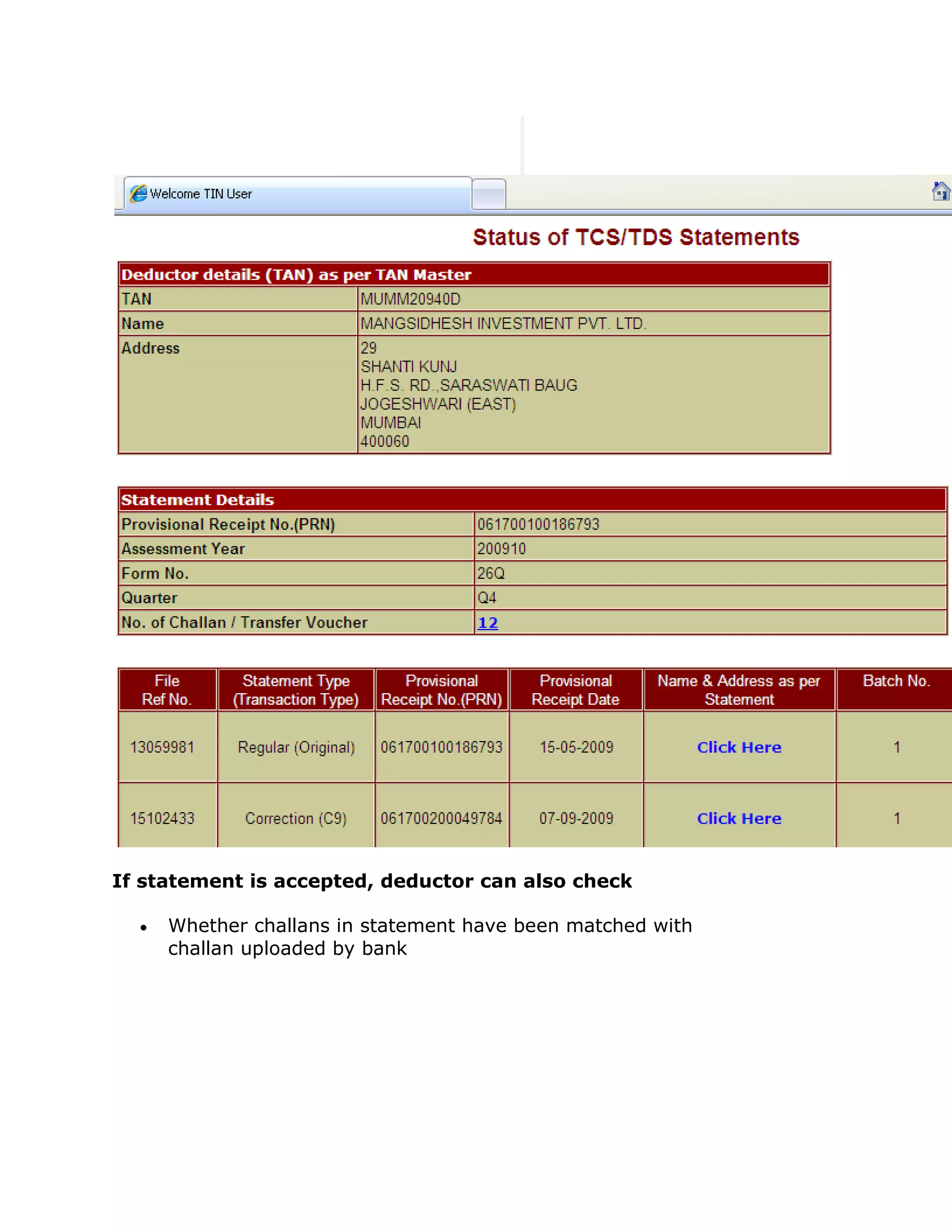
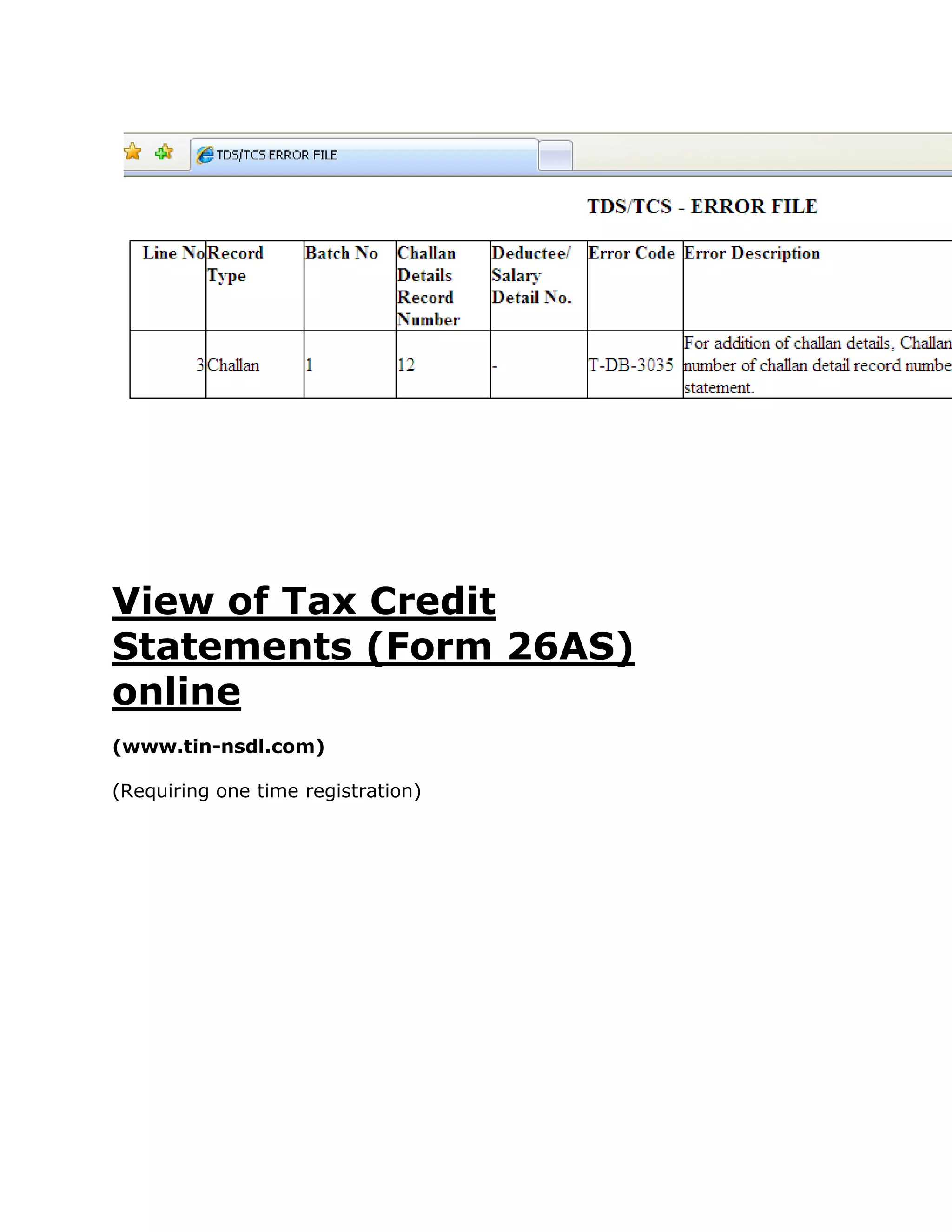
2.Status of TDS/ TCS
Statements:
Deductor/collector can view this online at www.tin-nsdl.com
against TAN and Provisional Receipt Number (PRN), under
the link Quarterly Statement Status available at www.tin-
nsdl.com.


      Quarterly statement status :
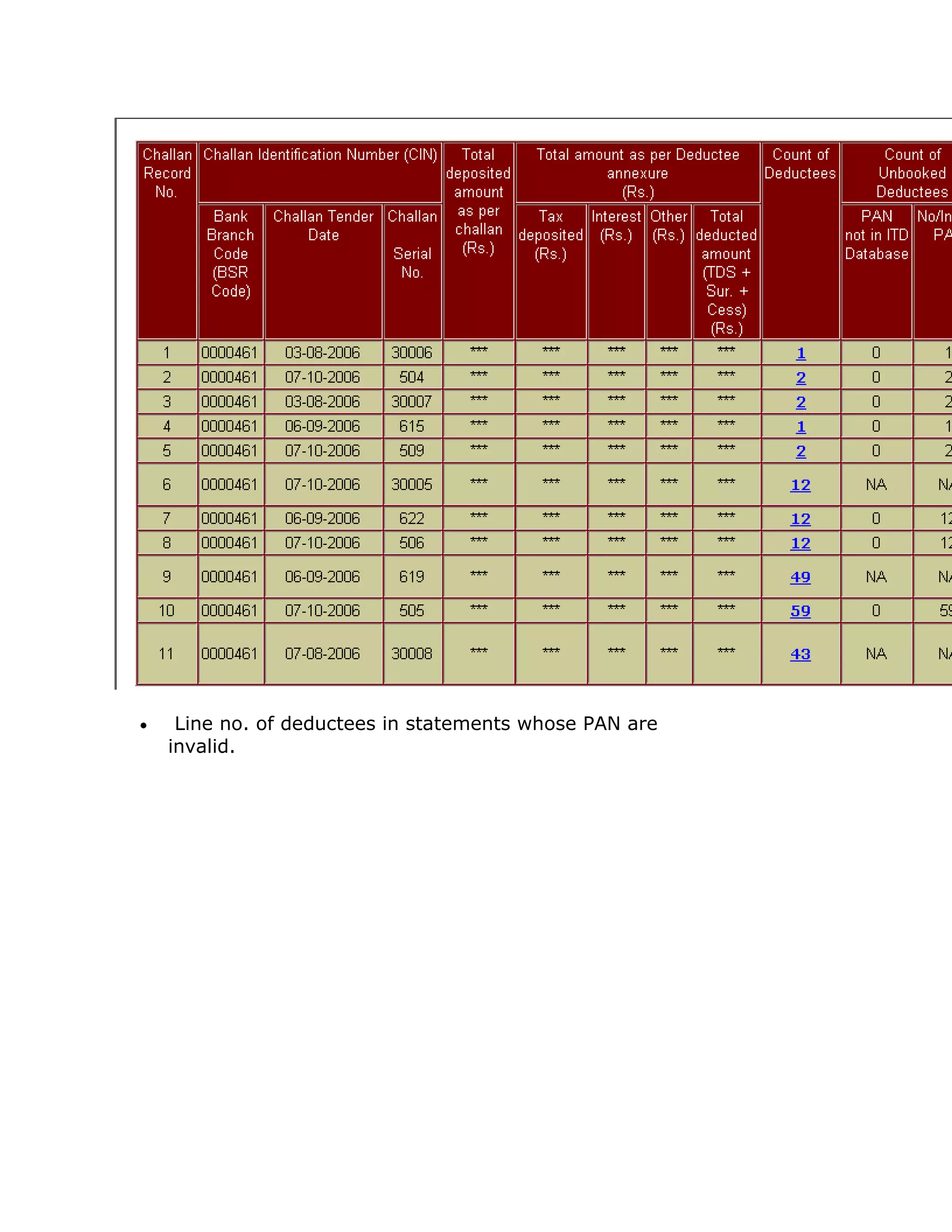
If statement is accepted, deductor can also check

     Whether challans in statement have been matched with
     challan uploaded by bank
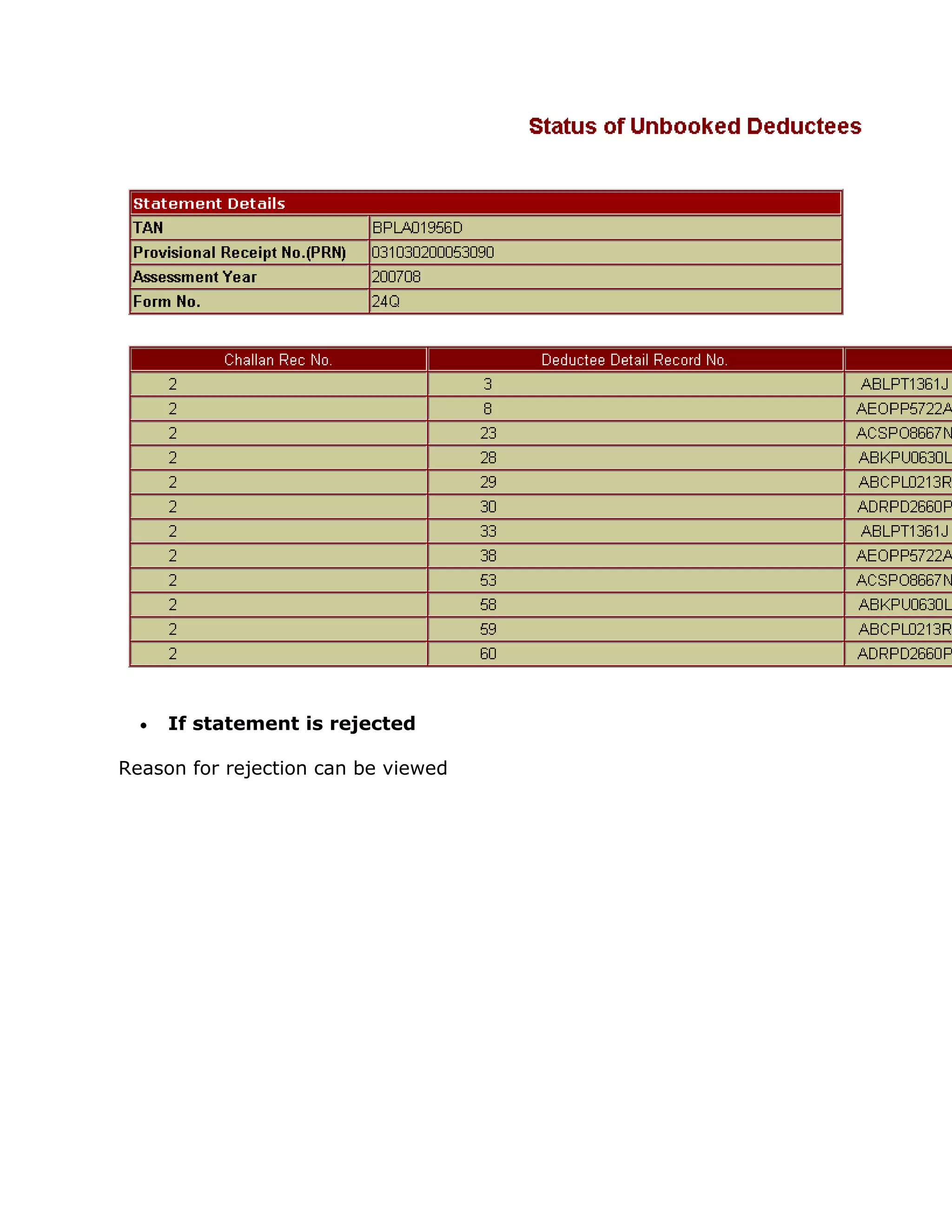
Line no. of deductees in statements whose PAN are
invalid.
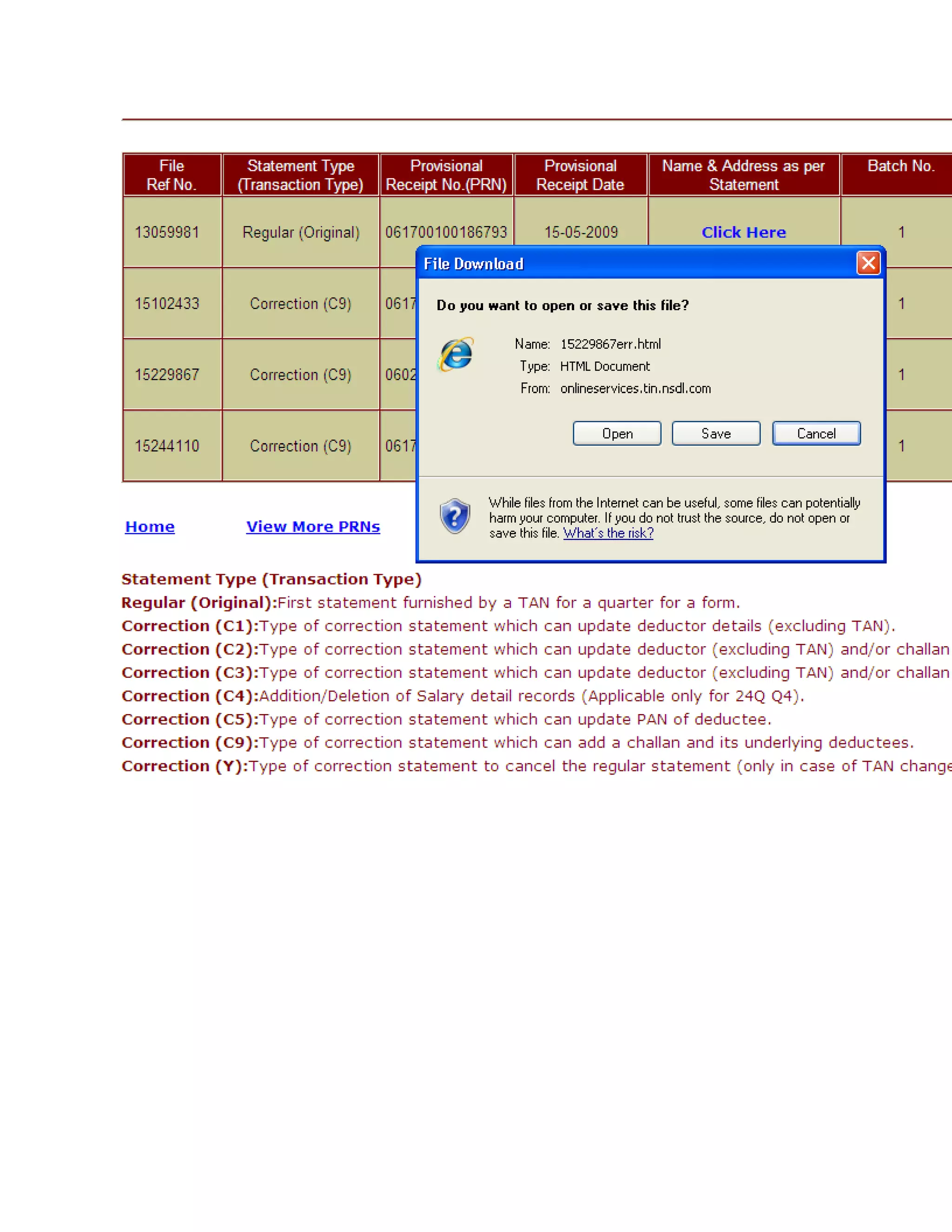
If statement is rejected

Reason for rejection can be viewed
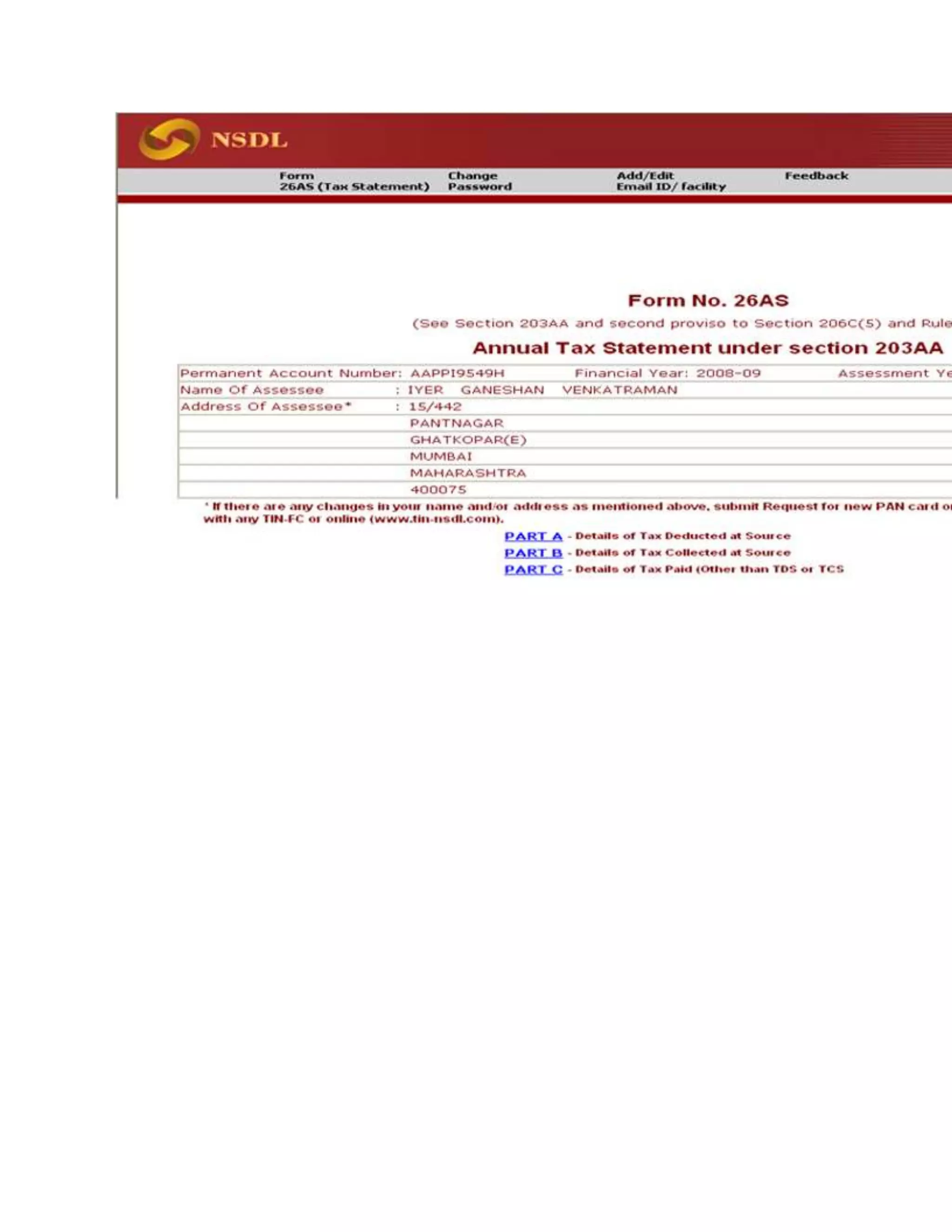
View of Tax Credit
Statements (Form 26AS)
online
(www.tin-nsdl.com)

(Requiring one time registration)
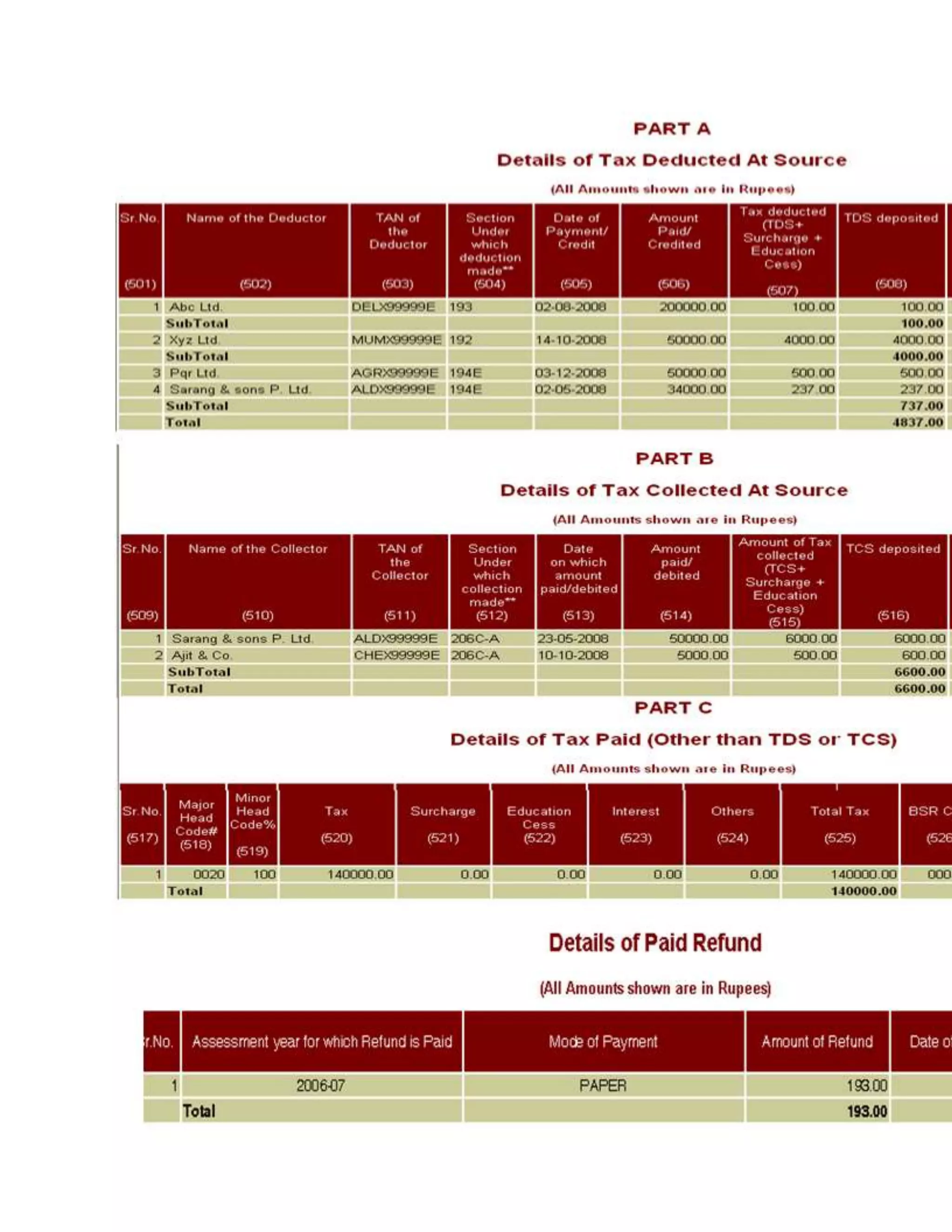
What can be seen:

  Tax Credit Statement view offers:

    Details of tax deducted/collected at source by deductors
    /collectors.
    Advance tax / Self Assessment tax / Regular Assessment
    tax, etc.
    Details of "Paid Refunds" from Financial Year 2009-10
    onwards.

  Benefits of Form 26AS

    Once tax credit is reflected in the statement, no need for
    TDS certificates.
    Enables view of all financial transactions involving
    TDS/TCS during the relevant Financial Year at one place.
    Helps in claim of tax credits and computation of income at
    the time of filing of return of income.
    Seamless processing of Income Tax Return and speedy
    credit of refunds
    Verification of Refunds encashed during the Financial Year.
    Verification of CIN in non-TDS payments.


Circulars
  1. Circular No.1 on TDS on Salary-2010


Format of Forms (PDF)
      1. Form 24Q

      2. Form 26Q
3. Form 27EQ

       4. Form 49B (TAN)

       5. Form 15G

       6. Form 15H


    Challan
       Challan 281


Frequently Asked Questions:
1.What is TDS?

  TDS means Tax Deducted at Source. It is the amount withheld
  from payments of various kinds such as salary, contract
  payment, commission etc. This withheld amount can be
  adjusted against your tax due.


2.In case the deductee comes back stating that the
original TDS certificate is lost, whether a duplicate
certificate can be issued?

  Yes. The deductor will have to issue the certificate in a plain
  paper giving necessary details of deduction and remittance.


3.I have made some deposits with a bank on which
annual interest is around Rs.15000. My income is below
taxable limit. The banker wants to deduct tax. What do I
do?

  You can file a self-declaration to the banker in form 15H
  stating that your income is below taxable limit. The form is
available with your banker, the local Income-Tax office and
  can be downloaded from the website
  http://www.incometaxindia.gov.in/. This form should be filed
  before the interests begin to accrue in the fixed deposit
  account, since the declaration has no retrospective effect.


4.I have let out a property for Rs.20,000 per month. The
tenant is deducting tax that is more than my tax liability.
What can I do under this circumstance?

  If you compute your tax liability and find it to be lower than
  the tax being deducted, you may approach your assessing
  officer by filing Form 13. He will issue a certificate directing
  the tenant to make TDS at a lesser rate. This form is available
  with the local Income tax office or can be downloaded from
  the website www.incometaxindia.gov.in.


5.I have deducted tax from payments disbursed but used
the same for some urgent financial needs. What are the
consequences?

  It is an offence to misuse the tax deducted at source. It
  should have been remitted to government account within the
  time allowed. The failure attracts tax, interest, penalty and
  also rigorous imprisonment up to seven years


6.What can I do if I am unable to get the TDS certificate
[form-16 or 16A]?

  It is the duty of every person deducting tax to issue TDS
  certificate. In spite of your asking if you are denied the
  certificate then there is a chance that the tax deducted has
  not been deposited by the deductor to the government
  account. Please inform the department [PRO or TDS section]
  which will then do the needful.
7.I have not received TDS certificate from my employer.
Can I claim TDS deducted from my salary?

  Yes. The claim can be made in your return. Department
  however will raise a demand which will not be enforced on you
  but on your employer.


8.If the employer does not deduct tax and employee also
does not pay his due tax, who will be held responsible for
tax payment?

  The ultimate responsibility to pay tax rests on the person who
  has earned income. If the employee deposits such tax then
  the employer will be liable for interest and penalty for failure
  to deduct tax.


9.I am buying a property from a person residing in USA.
Should I deduct tax while making payment?

  Yes u/s 195. In case you have any doubt regarding the
  amount on which TDS is to be made, you may file an
  application with the officer handling non-resident taxation who
  will pass an order determining the TDS to be made.
  Alternatively, if the recipient feels that the TDS is more he
  may file an application with his Assessing officer for non-
  deduction.


10.Can I use PAN to pay the TDS deducted into
government account?

  No. You are required to take a separate Tax Deduction
  Account Number [TAN] by making an application in form 49B
  with the Tin facilitation centre of NSDL.

11.How to surrender the duplicate TAN or the TAN which
is not being used?
Application along with relevant support documents has to be
  made to concerned AO.


Disclaimer
Note:

The information given in this web portal is to convey the general
understanding of TDS and TCS provisions. For detailed
information Income Tax Act 1961 shall be consulted. The
changes in the Act may be incorporated in the information as
and when required.

Tax deducted at source

  • 1.
    Tax Deduction atSource Learn the basics of TDS Overview of TDS TDS is one of the modes of collection of taxes, by which a certain percentage of amounts are deducted by a person at the time of making/crediting certain specific nature of payment to the other person and deducted amount is remitted to the Government account. It is similar to "pay as you earn" scheme also known as Withholding Tax in many other countries, one of the countries is USA. The concept of TDS envisages the principle of "pay as you earn". It facilitates sharing of responsibility of tax collection between the deductor and the tax administration. It ensures regular inflow of cash resources to the Government. It acts as a powerful instrument to prevent tax evasion as well as expands the tax net. Who shall deduct tax at source? Every person responsible for making payment of nature covered by TDS provisions of Income Tax Act shall be responsible to deduct tax. However in case of payments made under sec. 194A, 194C, 194H, 194I and 194J in respect of individual and HUF, only if the turnover or professional receipt exceeds sum of Rs. 40 lakh or Rs. 10 lakh respectively (the limits will be Rs.60 Lakh or Rs. 15 Lakh respectively w.e.f. 01.07.2010) in previous year, he is required to deduct tax at source. These persons are mainly: - Principal Officer of a company for TDS purpose including the employer in case of private employment or an employee making payment on behalf of the employer. - DDO (Drawing & Disbursing Officer), In case of Govt. Office any officer designated as such.
  • 2.
    - In thecase of "interest on securities" other than payments made by or on behalf of the Central govt. or the State Government, it is the local authority, corporation or company, including the Principal Officer thereof. Such person is called Deductor while the person from whom the tax is deducted is called Deductee. Tax must be deducted at the time of payment in cash or cheque or credit to the payee's account whichever is earlier. Credit to payable account or suspense account is also considered to be credit to payee's account and TDS must be made at the time of such credit. What a deductor must do? 1. Obtain TAN Every deductor is required to obtain a unique identification number called TAN (Tax Deduction Account Number) which is a ten digit alpha numeric number e.g.DELH90468K. This number has to be quoted by the deductor in every correspondence related to Income Tax matters concerning TDS. 2. He/She should obtain PAN of the deductee. 3. He/She should deduct the tax at correct rate. 4. The tax deducted has to be deposited in the designated banks within specified time. (Govt. deductors shall transfer the tax deducted through book entry in Government account).This is detailed below: ▬ By or on behalf of the Government : on the same day, ▬ By or on behalf of any other person : before the 7th of the following month.
  • 3.
    However, if theamount is credited in the books on 31st March then the tax should be remitted by 31st May. Note: w.e.f., 01.04.2008 electronic payment of tax has to be done by all corporate assesses and all persons whose cases are auditable under section 44B. 5. Use challan no. 281 for depositing TDS amount. 6. File statements of tax deduction in the prescribed time. The due dates for filing of TDS/TCS statement are : 15th of July for Quarter 1, 15th of October for Quarter 2, 15th of January for Quarter 3 and 15th June for last Quarter however for TCS statements the due date is 30th April. 7. Use correct form to file TDS/TCS Returns. They are: Form 24Q for salaries Form 26Q for non salaries Form 27EQ for TCS Form 27A/27B Control sheet for electronic TDS/TCS It may be noted that the following persons have to compulsorily file e-TDS /e-TCS statements All government offices/Departments All companies /corporations All persons whose cases are auditable All persons whose TDS statements contain more than 50 deductees. Dos & Dont's for filing TDS Returns Dos
  • 4.
    Ensure that TDSreturn is filed with same TAN against which TDS payment has been made & TDS certificate is issued. Ensure that correct challan particulars including CIN and amount is mentioned. Correct PAN of the deductee is mentioned. Correct section is quoted against each deductee record. Correct rate is quoted against each deductee record. File correction statement as soon as discrepancy is noticed Retain the original FVU file to enable future corrections Make use of free of charge RPU provided through TIN- NSDL.com Download details of challan from challan status enquiry (TAN based view) from TIN-NSDL.com Registration for TAN enables you to avail additional facilities from Tax Information System. Always verify status of TDS returns from Tin NSDL to ascertain the discrepancy, if any, and/or whether your TDS return stands accepted or rejected by the system. Dont's Don't file late returns as it affects deductee tax credit Don't quote incorrect TAN vis-à-vis TDS payments The process of filing of e-TDS /e-TCS returns is available in detail at following websites www.incometaxindia.gov.in or http://tin-nsdl.com. 8. Issue TDS certificates as per existing procedure and within the time prescribed as stated below: The certificate should be issued within one month from the end of the month in which the income is credited however for credit entries made on 31st March, due date is 7th June, except in the case of salary where the certificate has to be issued by 30th of April of the following financial year in which the income was credited. 9. File e-TBAF (In case of Govt. DDO's where TDS is credited in Central Govt. account through book adjustments)
  • 5.
  • 7.
    TAN Every deductor isrequired to obtain a unique identification number called TAN (Tax Deduction Account Number) which is a ten digit alpha numeric number. This number has to be quoted by the deductor in every correspondence related to TDS. Format of TAN: Procedure for getting TAN : It can be obtained by filing an application in form no. 49B to any of the TIN facilitation Centres (TIN-FC) namely NSDL. Addresses of the TIN-FC as well as the forms can be downloaded from the website www.incometaxindia.gov.in or http://tin-nsdl.com. The fee for processing TAN application is Rs. 60/-. This can be paid by: ▬ Cash at TIN-FC counter ▬ Demand draft or
  • 8.
    Cheque or ▬ Credit card The demand draft/ cheque shall be in favour of 'NSDL- TIN'. TAN number will be communicated to the deductor by NSDL. Nature of payments attracting TDS and rates thereon: Salary DDOs must calculate the tax payable by an employee for the year and start deducting tax at average rate. The term salary includes wages, any annuity or pension, gratuity, any fees, commission, perquisites or profits in lieu of or in addition to any salary or wages. (These payments are covered under sec. 192 of the Income Tax Act 1961). The income from salaries is required to be computed on estimated basis at the beginning of each financial year, taking into account salaries or remuneration paid or allowed. Income Tax payable on the basis of such estimated salary income should be deducted at the rate applicable to the corresponding slab of income every month in equal instalments subject to adjustments depending upon tax saving investments made by the deductee. When an employee is working with more than one employer simultaneously or has changed employment from one employer to another during the relevant financial year, the employer will deduct tax on considering the aggregate salary from all sources and tax deducted thereon, if any.
  • 9.
    Interest on securities/Dividends/Interest/Insurance commission- Thetax has to be deducted @ 20% for domestic companies and 10% for others with some basic exemption limits, in the case of interest if the amount of interest is up to Rs. 5000/- during a financial year. however, in the case of interest paid by a banking company, Co-operative society engaged in the business of banking and a public company engaged in the financing or construction of residential houses in India, this limit is Rs. 10000/-. (These payments are covered under sec. 193, 194, 194A& 194D of the Income Tax Act 1961 resp.). Winning from lottery, puzzle or games of any sort- The DDO/deductor must deduct tax @ 30% on any payment above Rs. 5000/-. (However from 1st July 2010,the DDO/deductor must deduct tax @ 30% on any payment above Rs. 10000/-) (These payments are covered under sec. 194B of the Income Tax Act 1961). Winning from horse races- The DDO/deductor must deduct tax @ 30% on any payment above Rs. 2500/-. (However from 1st July 2010,the DDO/deductor must deduct tax @ 30% on any payment above Rs. 5000/-). (These payments are covered under sec. 194BB of the Income Tax Act 1961).
  • 10.
    Contracts (including workland labour contract) - The tax has to be deducted @ 2% on contract payments and 1% for subcontract and advertisement contract payments. The tax is required to be deducted if a single payment exceeds Rs. 20000/- or if the aggregate payments exceed Rs. 50000/- per annum. (However from 1st July 2010, Rate of deduction is @ 2% on all contract payments including subcontract and advertisement contract payments. The tax is required to be deducted if a single payment exceeds Rs. 30000/- or if the aggregate payments exceed Rs. 75000/- per annum). (These payments are covered under sec. 194C of the Income Tax Act 1961). Insurance commission- Any person responsible for paying to a resident any remuneration or reward whether by way of commission or otherwise, for procuring insurance business is required to deduct tax @ 20% for companies and 10% for other person if the amount credited or paid is more than Rs. 5000/- in a financial year. (However from 1st July 2010, any person responsible for paying to a resident any remuneration or reward whether by way of commission or otherwise, for procuring insurance business is required to deduct tax @ 20% for companies and 10% for other person if the amount credited or paid is more than Rs. 20000/- in a financial year). Payments to Non residents sportsmen or sport association.- The tax has to be deducted @10% on making any payment. (These payments are covered under sec. 194E of the Income Tax Act 1961).
  • 11.
    Commission on saleof lottery tickets and on brokerage-. The tax has to be deducted @10% with some basic exemption. (These payments are covered under sec. 194G & 194H of the Income Tax Act 1961). Rent- Any amount paid as rent above Rs. 120000/- per year will attract TDS provisions @ 10% for Individual & HUF and 20% for others. (TDS will be 2% for the use of any machinery or plant or equipment). (However from 1st July 2010, any amount paid as rent above Rs. 180000/- per year will attract TDS provisions @ 10% for Individual & HUF and 20% for others). (These payments are covered under sec. 194I of the Income Tax Act 1961). Fees for professional or technical services/royalty/Income on units of mutual funds/compensation on acquisition of certain immovable assets- The tax has to be deducted @10% with some basic exemption limits. (These payments are covered under sec. 194J, 194K & 194LA of the Income Tax Act 1961). Payment on Acquisition of certain immovable property- Any amount above Rs. 100000/- paid as compensation or enhanced compensation on account of compulsory acquisition
  • 12.
    under any lawin force, of any immovable property other than agricultural land will attract TDS provisions @ 10%. The rates of TDS for representative purpose (in effect till 30.06.2010): For Salaries: For other payments:
  • 16.
    Non deduction ordeduction at lower rate in certain situations No Tax has to be deducted for the payment made to Government, RBI, Corporation whose income is exempt from tax or mutual fund specified u/sec. 10(23D). Also in case where deductee produces a non deduction certificate or lower deduction certificate u/sec. 197 of the Income Tax Act 1961. Self declaration in Forms 15G and 15H can be filed by the deductee if his income doesn't exceed the amount chargeable to tax. This self declaration can be filed for dividends, interest and mutual fund income only. In these cases no tax has to be deducted. However the tax deductor is required to furnish copies of this self declaration to the concerned CCIT or CIT as per the rules. Dos and Dont's for Depositing Tax Dos Use challan type 281 for deposit of TDS/TCS amount. Deductor should quote correct TAN, full name, address and current A.Y. on each challan.
  • 17.
    Deductor should useseparate challan for different nature of payments quoting correct nature of payment code and also for different type of deductee. Ensure that the bank has mentioned CIN (Challan Identification Number) on the counter foil. Verify CIN details uploaded by the bank to TIN i.e., 5 digit challan serial no., BSR code of 7 digit and date. Insist on computerized receipts from the bank E- payment of TDS is recommended. All details of the payment as uploaded by the banks are available at the NSDL- TIN website www.tin-nsdl.com under the link "challans status enquiry". Deductor should verify the details for ensuring the credit for payments. Through the TAN Based View details of all challans deposited in the banks for a given TAN during a specified period can be viewed.
  • 19.
    (The challan datafile can also be downloaded for verification of challan data entered at the time of preparation of e-TDS returns.) Dont's
  • 20.
    Don't use incorrecttype of challan Don't quote wrong TAN/PAN or use PAN in place of TAN or vice versa. Don't use a single challan for corporate and non- corporate deductees. If one has multiple TANs, use one TAN only consistently and surrender the others. Don't use preprinted challans without verifying TAN/PAN. Each branch/division of an entity will have a separate TAN if it is filing separate TDS/TCS returns. However, there will be only one PAN for a legal entity. Do not make mistake in indicating the Assessment Year in the challan. TDS defaults Failure to deduct the whole or part of the Tax at source (non- deduction, short deduction or delay in deduction) 1. Failure to deposit whole or part of the TDS (non- deposit, short deposit or late deposit) 2. Failure to apply for TAN within the prescribed time limit or failure to quote TAN on allotment as required under section 203A. 3. Failure to furnish, in due time, TDS returns or TDS certificates or to deliver or cause to be delivered a copy of declaration in form no. 15H/15G/27C/copy of quarterly statement.
  • 21.
    4. Failure tomention the PAN of the deductee in all quarterly statements as well as in all certificates furnished. Consequences of Defaults The following chart indicates the nature of default and its consequences which range from penal interest, penalty to prosecution:
  • 23.
    In addition tothe above, there are other consequences in certain cases, as enumerated below; ▬ Disallowance of specified expenditure (while computing the income of the deductor) if TDS is not deducted from the payment. (Section 40a(ia)). ▬ Where the tax has not been paid after its deduction it shall be charge on the asset of the defaulter to recover the amount of TDS. (section 201(2)). TAX COLLECTED AT SOURCE (TCS) What is TCS? The seller has to collect tax from the payer who has purchased the following items : Alcoholic liquor for human consumption Tendu leaves Timber obtained under a forest lease Timber obtained by any mode other than under a forest lease Any other forest produce not being timber or tendu leaves Scrap Parking lot Toll plaza Mining and quarrying The TCS on the above mentioned items vary from 1% to 5% Deposit of TCS amount- within seven days of the following month.
  • 24.
    Issue of TCScertificate- within in one month of collection /debit(form 27D) The rates of TCS for representative purpose (Financial Year 2010-11): Disclaimer Please note : The information given above is to convey the general understanding of TDS and TCS provisions. For detailed information Income Tax Act 1961 shall be consulted. The changes in the Act may be incorporated in the information as and when required.
  • 25.
    Various Online Servicesof Income Tax Department The Income Tax Department (ITD) as a part of its citizen centric activities is providing a host of online services to the taxpayers services through various websites so that a taxpayer can fulfil his routine tax obligations. Following services are being provided: (i) Dissemination of tax related information through websites (ii) Dissemination of taxpayer specific information (iii) PAN and TAN related services (iv) e-filing of returns of income (v) e-payment of taxes (vi) e-filing of TDS returns · E-Tutorials available at www.incometaxindiapr.gov.in
  • 26.
    PAN /TAN ONLINESERVICES PAN related services Applications for allotment of PAN or for changes in PAN data can be made to NSDL or UTIISL who have set up facilities in over 500 cities for receiving PAN applications. Filing applications online PAN applications can be filed on line at www.tin- nsdl.com and http://utiisl.co.in Tracking PAN applications Status of PAN applications can be tracked respectively at www.tin-nsdl.com and www.utiisl.co.in.
  • 27.
    Online application for newPAN cards or corrections in PAN Applications for new PAN cards can be filed on line at www.tin-nsdl.com and www.utiisl.co.in Know your PAN Facilitates verification of PAN allotted to taxpayer. Available at https://incometaxindiaefiling.gov.in TAN related services Applications for allotment of TAN or for changes in TAN data can be made to NSDL who have set up TIN Facilitation Centres in over 500 cities for receiving TAN applications. Filing TAN applications online TAN applications can be filed on line at www.tin- nsdl.com
  • 28.
    Tracking TAN applications Status of TAN applications/application for changes in TAN data can be tracked at www.tin-nsdl.com. 'Know your TAN' The deductor can know the TAN allotted to him at https://incometaxindiaefiling.gov.in Online application for corrections in TAN data Applications for correction in TAN data can be filed on line at www.tin-nsdl.com Grievance handling with Call Centre support for PAN/TAN related services: Aaykar Sampark Kendra (ASK): 0124-2438000 TIN Call Centre: 020-27218080 Digital Signature What is a Digital Signature? A digital signature authenticates electronic documents in a similar manner a handwritten signature authenticates printed documents. This signature cannot be forged and it asserts that a named person wrote or otherwise agreed to the document to which the signature is attached. The recipient of a digitally
  • 29.
    signed message canverify that the message originated from the person whose signature is attached to the document and that the message has not been altered either intentionally or accidentally since it was signed. Also, the signer of a document cannot later disown it by claiming that the signature was forged. In other words, digital signatures enable the "authentication" and "non-repudiation" of digital messages, assuring the recipient of a digital message of both the identity of the sender and the integrity of the message. For more information on digital signature visit: https://incometaxindiaefiling.gov.in/portal/faq_signature.do ONLINE TAX ACCOUNTING SYSTEM
  • 30.
    •Tax deposits takeplace at over 13,000 branches of 33 designated banks throughout the country • Banks imprint a unique Challan Identification Number (CIN) on each challan • Facility provided for online payment, and viewing status of tax payment • Handles over 2 crore tax payment transactions per year e-Payment of Taxes
  • 31.
    Anytime anywhere paymentof taxes Easy and fast. No lengthy queues No last minute rush Fewer mistakes Instant generation of CIN- eliminates possibilities of mis- match in CIN particulars Available at www.incometaxindia.gov.in and www.tin- nsdl.com . e-FILING OF INCOME TAX RETURNS
  • 32.
    Anytime Anywhere filing Easy,Fast and Free No lengthy queues No last minute rush Fewer mistakes Immediate e-filing acknowledgement No personal interface
  • 33.
    Select appropriate typeof Return Form Download Return Preparation Software for selected Return Form. Fill return offline and generate a XML file. Register and create a user id/password.
  • 34.
    Login and clickon relevant form on left panel and select "Submit Return". Browse to select XML file and click on "Upload" button. On successful upload acknowledgement details would be displayed. Click on "Print" to generate printout of acknowledgement/ITR-V Form. Available at https://incometaxindiaefiling.gov.in. e-filing of TAX DEDUCTION AT SOURCE Facilities for e-filing of TDS returns: Through more than 1500 TIN Facilitation Centres in more than 500 cities
  • 35.
    Direct online uploadat www.tin-nsdl.com under Digital Signature Free Return Preparation software Free File Validation Utility Free Deductor Manual Helpdesk for deductors (020-27218080) Internet based feedback to Deductors and Deductees All persons can e-file the TDS. TAN Registration I.TAN Registration available at www.tin-nsdl.com. II.Authenticated deductors- i.View of the status of all statements filed; ii.Download of consolidated quarterly e-TDS / TCS statement for preparation of correction statement; and iii.Special functionalities related to quarterly TDS /TCS statement. III. Registration is free. 1.1 Feedback to Deductors I. Through the TAN Based View details of all challans deposited in the banks for a given TAN during a specified period can be viewed.
  • 37.
    1.2 Feedback toDeductors Through CIN Based View details of any particular challan can be verified. View of tax payments made in banks
  • 38.
    This facility allowsthe taxpayer to verify the tax payment made by him through the website of Tax Information Network (TIN) at www.tin-nsdl.com. Feedback is given through the following: Internet based feedback at www.tin-nsdl.com CIN Based View
  • 40.
    SMS based updateof challan status Send SMS to 575758 SMS to contain * The word CSI followed by space and CIN (BSR code, tender date, challan serial no.) * Amount is optional * CIN and amount should be comma separated Eg. CSI 0510001,11032009,5,5000 Status will display * TAN / PAN * Whether amount matched or not * Received in TIN (date)
  • 41.
    2.Status of TDS/TCS Statements: Deductor/collector can view this online at www.tin-nsdl.com against TAN and Provisional Receipt Number (PRN), under the link Quarterly Statement Status available at www.tin- nsdl.com. Quarterly statement status :
  • 42.
    If statement isaccepted, deductor can also check Whether challans in statement have been matched with challan uploaded by bank
  • 43.
    Line no. ofdeductees in statements whose PAN are invalid.
  • 44.
    If statement isrejected Reason for rejection can be viewed
  • 46.
    View of TaxCredit Statements (Form 26AS) online (www.tin-nsdl.com) (Requiring one time registration)
  • 49.
    What can beseen: Tax Credit Statement view offers: Details of tax deducted/collected at source by deductors /collectors. Advance tax / Self Assessment tax / Regular Assessment tax, etc. Details of "Paid Refunds" from Financial Year 2009-10 onwards. Benefits of Form 26AS Once tax credit is reflected in the statement, no need for TDS certificates. Enables view of all financial transactions involving TDS/TCS during the relevant Financial Year at one place. Helps in claim of tax credits and computation of income at the time of filing of return of income. Seamless processing of Income Tax Return and speedy credit of refunds Verification of Refunds encashed during the Financial Year. Verification of CIN in non-TDS payments. Circulars 1. Circular No.1 on TDS on Salary-2010 Format of Forms (PDF) 1. Form 24Q 2. Form 26Q
  • 50.
    3. Form 27EQ 4. Form 49B (TAN) 5. Form 15G 6. Form 15H Challan Challan 281 Frequently Asked Questions: 1.What is TDS? TDS means Tax Deducted at Source. It is the amount withheld from payments of various kinds such as salary, contract payment, commission etc. This withheld amount can be adjusted against your tax due. 2.In case the deductee comes back stating that the original TDS certificate is lost, whether a duplicate certificate can be issued? Yes. The deductor will have to issue the certificate in a plain paper giving necessary details of deduction and remittance. 3.I have made some deposits with a bank on which annual interest is around Rs.15000. My income is below taxable limit. The banker wants to deduct tax. What do I do? You can file a self-declaration to the banker in form 15H stating that your income is below taxable limit. The form is
  • 51.
    available with yourbanker, the local Income-Tax office and can be downloaded from the website http://www.incometaxindia.gov.in/. This form should be filed before the interests begin to accrue in the fixed deposit account, since the declaration has no retrospective effect. 4.I have let out a property for Rs.20,000 per month. The tenant is deducting tax that is more than my tax liability. What can I do under this circumstance? If you compute your tax liability and find it to be lower than the tax being deducted, you may approach your assessing officer by filing Form 13. He will issue a certificate directing the tenant to make TDS at a lesser rate. This form is available with the local Income tax office or can be downloaded from the website www.incometaxindia.gov.in. 5.I have deducted tax from payments disbursed but used the same for some urgent financial needs. What are the consequences? It is an offence to misuse the tax deducted at source. It should have been remitted to government account within the time allowed. The failure attracts tax, interest, penalty and also rigorous imprisonment up to seven years 6.What can I do if I am unable to get the TDS certificate [form-16 or 16A]? It is the duty of every person deducting tax to issue TDS certificate. In spite of your asking if you are denied the certificate then there is a chance that the tax deducted has not been deposited by the deductor to the government account. Please inform the department [PRO or TDS section] which will then do the needful.
  • 52.
    7.I have notreceived TDS certificate from my employer. Can I claim TDS deducted from my salary? Yes. The claim can be made in your return. Department however will raise a demand which will not be enforced on you but on your employer. 8.If the employer does not deduct tax and employee also does not pay his due tax, who will be held responsible for tax payment? The ultimate responsibility to pay tax rests on the person who has earned income. If the employee deposits such tax then the employer will be liable for interest and penalty for failure to deduct tax. 9.I am buying a property from a person residing in USA. Should I deduct tax while making payment? Yes u/s 195. In case you have any doubt regarding the amount on which TDS is to be made, you may file an application with the officer handling non-resident taxation who will pass an order determining the TDS to be made. Alternatively, if the recipient feels that the TDS is more he may file an application with his Assessing officer for non- deduction. 10.Can I use PAN to pay the TDS deducted into government account? No. You are required to take a separate Tax Deduction Account Number [TAN] by making an application in form 49B with the Tin facilitation centre of NSDL. 11.How to surrender the duplicate TAN or the TAN which is not being used?
  • 53.
    Application along withrelevant support documents has to be made to concerned AO. Disclaimer Note: The information given in this web portal is to convey the general understanding of TDS and TCS provisions. For detailed information Income Tax Act 1961 shall be consulted. The changes in the Act may be incorporated in the information as and when required.