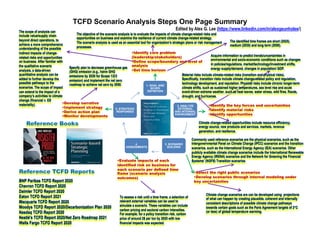
TCFD Scenario Analysis Steps One Page Summary
Edited by Alex G. Lee (https://www.linkedin.com/in/alexgeunholee/)
1. GOAL AND
SCOPE
DEFINITION
2. ANALYZE
EXTERNAL
AND INTERNAL
ENVIRONMENT
3. SCENARIO
BUILDING
4.
ASSESSMENTS
5. STRATEGIC
RESPONSES
•Identify core problem
(leadership/stakeholders)
•Define scope/boundary and level of
analysis
•Set time horizon
The objective of the scenario analysis is to evaluate the impacts of climate change-related risks and
opportunities on business and examine the resilience of current climate change-related strategy.
The scenario analysis is used as an essential tool for organization’s strategic plans or risk management
processes.
The scope of analysis can
include value/supply chain
beyond direct operations, to
achieve a more comprehensive
understanding of the possible
indirect impacts of change-
related risks and opportunities
on business. After familiar with
the qualitative scenario
analysis, a data-driven
quantitative analysis can be
added to further develop the
possible pathways to the
scenarios. The scope of impact
can extend to the impact of a
company’s activities to climate
change (financial v. ES
materiality).
The identified time frames are short (2025),
medium (2035) and long term (2050).
•Identify the key forces and uncertainties
•Identify material risks
•Identify opportunities
Acquire information to predict trends/uncertainties in
environmental and socio-economic conditions such as changes
in policies/regulations, market/technology/investment shifts,
energy supply/demand, changes in population/ GDP.
Material risks include climate-related risks (transition and physical risks).
Specifically, transition risks include climate change-related policy and regulation,
technology development, and reputation. Physical risks include chronic longer-term
climate shifts, such as sustained higher temperatures, sea level rise and acute
event-driven extreme weather, such as heat waves, water stress, wild fires, floods,
drought, and hurricanes.
Climate change-related opportunities include resource efficiency,
energy source, new products and services, markets, revenue
generation, and resilience.
•Select the right public scenarios
•Develop scenarios through internal modeling under
key uncertainties
Commonly used reference scenarios are the physical scenarios, such as the
Intergovernmental Panel on Climate Change (IPCC) scenarios and the transition
scenarios, such as the International Energy Agency (IEA) scenarios. Other
publicly available climate change scenarios include the International Renewable
Energy Agency (IRENA) scenarios and the Network for Greening the Financial
Systems’ (NGFS) Transition scenarios.
Climate change scenarios are can be developed using projections
of what can happen by creating plausible, coherent and internally
consistent descriptions of possible climate change pathways
towards certain goals such as the Paris Agreement targets of 2°C
(or less) of global temperature warming.
•Evaluate impacts of each
identified risk on business for
each scenario per defined time
flame (scenario analysis
outcomes)
To assess a risk until a time frame, a selection of
relevant external variables can be used to
simulate a scenario. These variables can include
carbon pricing and sectoral carbon intensities.
For example, for a policy transition risk, carbon
price of around 2$ per ton by 2025 with low
financial impacts was expected.
•Develop narrative
•Implement strategy
•Derive action plan
•Monitor developments
Specify plan to decrease greenhouse gas
(GHG) emission (e.g., halve GHG
emissions by 2030 for Scope 1/2/3
emission) and implement the net zero
roadmap to achieve net zero by 2050.
Reference Books
Reference TCFD Reports
BNP Paribas TCFD Report 2020
Chevron TCFD Report 2020
Daimler TCFD Report 2020
Eaton TCFD Report 2021
Macquarie TCFD Report 2020
Moodys TCFD Report 2020/Decarbonization Plan 2020
Nasdaq TCFD Report 2020
Nestlé's TCFD Report 2020/Net Zero Roadmap 2021
Wells Fargo TCFD Report 2020

TCFD Scenario Analysis Steps One Page Summary

  • 1.
    TCFD Scenario AnalysisSteps One Page Summary Edited by Alex G. Lee (https://www.linkedin.com/in/alexgeunholee/) 1. GOAL AND SCOPE DEFINITION 2. ANALYZE EXTERNAL AND INTERNAL ENVIRONMENT 3. SCENARIO BUILDING 4. ASSESSMENTS 5. STRATEGIC RESPONSES •Identify core problem (leadership/stakeholders) •Define scope/boundary and level of analysis •Set time horizon The objective of the scenario analysis is to evaluate the impacts of climate change-related risks and opportunities on business and examine the resilience of current climate change-related strategy. The scenario analysis is used as an essential tool for organization’s strategic plans or risk management processes. The scope of analysis can include value/supply chain beyond direct operations, to achieve a more comprehensive understanding of the possible indirect impacts of change- related risks and opportunities on business. After familiar with the qualitative scenario analysis, a data-driven quantitative analysis can be added to further develop the possible pathways to the scenarios. The scope of impact can extend to the impact of a company’s activities to climate change (financial v. ES materiality). The identified time frames are short (2025), medium (2035) and long term (2050). •Identify the key forces and uncertainties •Identify material risks •Identify opportunities Acquire information to predict trends/uncertainties in environmental and socio-economic conditions such as changes in policies/regulations, market/technology/investment shifts, energy supply/demand, changes in population/ GDP. Material risks include climate-related risks (transition and physical risks). Specifically, transition risks include climate change-related policy and regulation, technology development, and reputation. Physical risks include chronic longer-term climate shifts, such as sustained higher temperatures, sea level rise and acute event-driven extreme weather, such as heat waves, water stress, wild fires, floods, drought, and hurricanes. Climate change-related opportunities include resource efficiency, energy source, new products and services, markets, revenue generation, and resilience. •Select the right public scenarios •Develop scenarios through internal modeling under key uncertainties Commonly used reference scenarios are the physical scenarios, such as the Intergovernmental Panel on Climate Change (IPCC) scenarios and the transition scenarios, such as the International Energy Agency (IEA) scenarios. Other publicly available climate change scenarios include the International Renewable Energy Agency (IRENA) scenarios and the Network for Greening the Financial Systems’ (NGFS) Transition scenarios. Climate change scenarios are can be developed using projections of what can happen by creating plausible, coherent and internally consistent descriptions of possible climate change pathways towards certain goals such as the Paris Agreement targets of 2°C (or less) of global temperature warming. •Evaluate impacts of each identified risk on business for each scenario per defined time flame (scenario analysis outcomes) To assess a risk until a time frame, a selection of relevant external variables can be used to simulate a scenario. These variables can include carbon pricing and sectoral carbon intensities. For example, for a policy transition risk, carbon price of around 2$ per ton by 2025 with low financial impacts was expected. •Develop narrative •Implement strategy •Derive action plan •Monitor developments Specify plan to decrease greenhouse gas (GHG) emission (e.g., halve GHG emissions by 2030 for Scope 1/2/3 emission) and implement the net zero roadmap to achieve net zero by 2050. Reference Books Reference TCFD Reports BNP Paribas TCFD Report 2020 Chevron TCFD Report 2020 Daimler TCFD Report 2020 Eaton TCFD Report 2021 Macquarie TCFD Report 2020 Moodys TCFD Report 2020/Decarbonization Plan 2020 Nasdaq TCFD Report 2020 Nestlé's TCFD Report 2020/Net Zero Roadmap 2021 Wells Fargo TCFD Report 2020