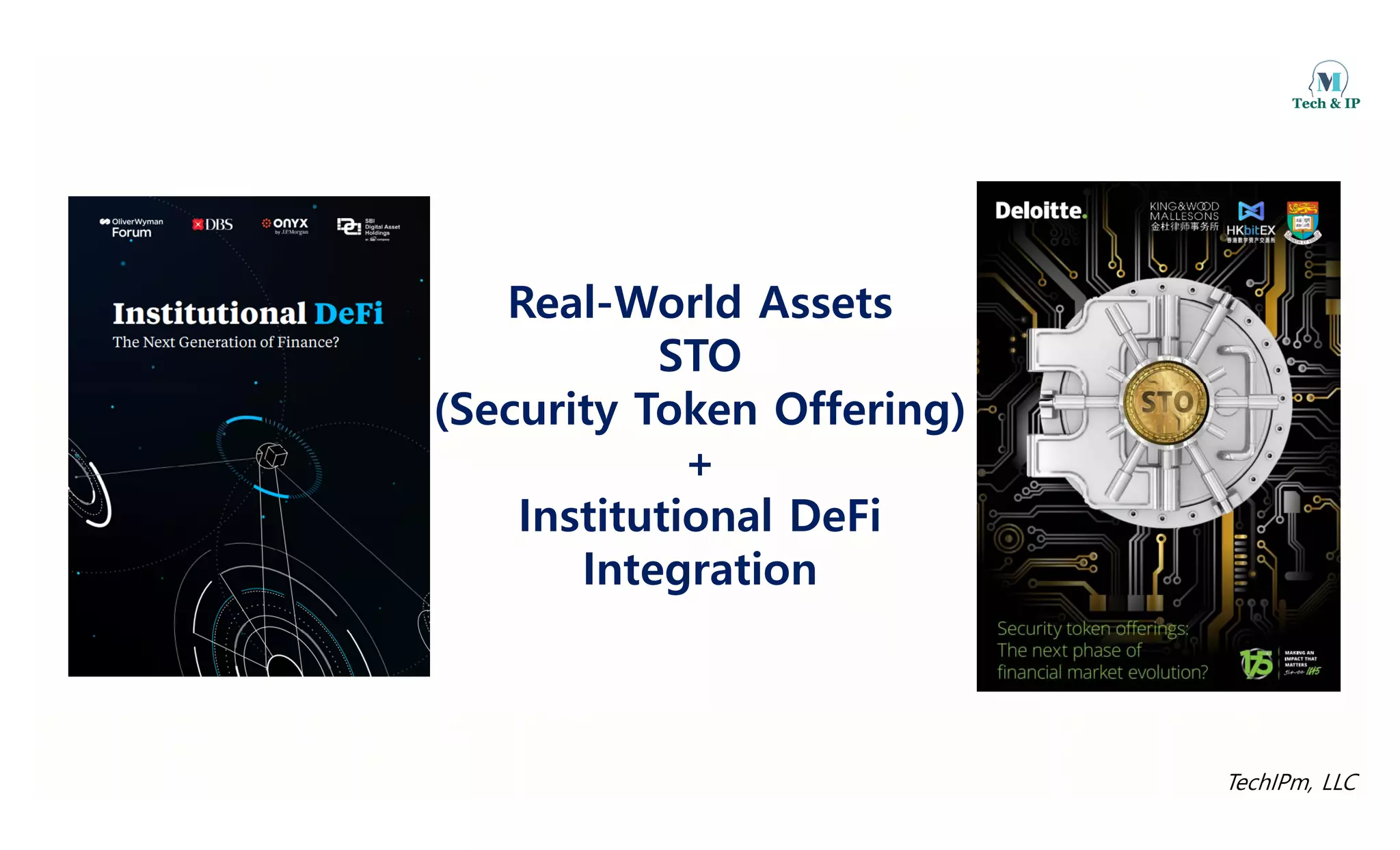
Real World Assets
Real-World Assets
STO
(Security Token Offering)
+
+
Institutional DeFi
Integration
TechIPm, LLC
Institutional DeFi Definition
DeFi (decentralized finance) protocols provide services on a blockchain settlement layer such as lending, trading,
investments, insurance, and asset management. These protocols can be used to create new financial products and
services that can benefit investors and companies alike.
However, appropriate safeguards are necessary to ensure investor protection and financial stability. This includes
controls and security standards such as AML/KYC risk controls, data privacy protections, strong cybersecurity
measures, mature governance and conduct models, proper recourse mechanisms, and legal clarity around smart
contract-based business activity.
Institutional DeFi refers to tokenize real-world assets with regulatory compliance and institutional-level controls for
consumer protection. One of the main benefits of Institutional DeFi is the potential to transform the traditional
financial system by making it more transparent, efficient, and accessible while maintaining the necessary safeguards
f d f l b l h l d d d d f l
for investor protection and financial stability. This can lead to new products, cost reduction, and faster settlement
times for financial institutions.
TechIPm, LLC
Integration of Real-world Assets STO and Institutional DeFi
STO (Security Token Offering) of real-world assets involves the issuance of security tokens that represent ownership of a real-world
asset, such as a share of stock, bond, or real estate property. The tokenization and securitization process is carried out by an issuer
g
who follows the necessary regulatory requirements. These security tokens can be listed, distributed, and traded on Institutional DeFi
applications to automate various processes such as trading, settlement, and custody. This allows for greater security, efficiency,
transparency and liquidity
transparency, and liquidity.
STO issuers can use DeFi lending protocols to distribute their tokens in the primary market. Investors can lend to the issuer in
exchange for STO tokens, which can then be traded on the DEX. This can provide a new avenue for STO issuers to raise funds and
distribute their tokens to a wider pool of investors. DeFi lending can provide liquidity to STO investors who may need to liquidate their
f f
holdings quickly. Lenders can provide liquidity to borrowers who put up collateral in the form of STO tokens, allowing investors to
access liquidity without needing to sell their tokens on the secondary market. This can also help stabilize token prices by reducing
volatility caused by sudden sell-offs.
volatility caused by sudden sell offs.
A DEX allows for peer-to-peer trading of the security tokens without the need for intermediaries such as traditional exchanges or
broker-dealers. This can significantly reduce transaction costs and increase the speed of secondary market trading. Additionally, a DEX
can provide more transparency and security since all transactions are recorded on the blockchain.
TechIPm, LLC
Platform Requirements for Integration of Real-world Assets STO and Institutional DeFi
The platform must have the ability to verify the ownership of the asset and ensure that it is legally transferable. The
platform should also support the fractional ownership of assets to enable investors to buy and sell small portions of
q g
the asset.
The platform should also enable the integration of real-world assets with DeFi protocols. This includes the ability to
use smart contracts to automate the negotiation and execution of transactions related to the real-world assets. The
platform should also support the trading of tokenized real-world assets on decentralized exchanges and provide
liquidity for investors.
The platform must ensure that the tokenization and trading of real-world assets comply with securities regulations,
including KYC and AML requirements. The platform should also provide adequate transparency and auditability to
regulators and investors, including the provision of financial reports and regulatory filings.
The platform should ensure that investor and user data is secure and confidential, protect against cyber threats and
tt k dh t f i l t d d d b t ti d id i t ith f ki d i
TechIPm, LLC
attacks, adhere to professional standards and best practices, and provide investors with a means of seeking redress in
the event of disputes or losses.
Legal/Regulatory Compliance for Integration of Real-world Assets STO and Institutional DeFi
Securities law compliance: STOs are subject to US securities laws, which require compliance with registration or
exemption requirements (e.g., Reg D/A/A+/S). The Securities and Exchange Commission (SEC) has issued guidance on
g g y p g
the application of securities laws to digital assets, including STOs. It is important to ensure that the STO complies
with the relevant securities laws and regulations, including the registration requirements of the Securities Act of 1933,
the reporting requirements of the Securities Exchange Act of 1934, and the anti-fraud provisions of both acts.
Banking law compliance: Institutional DeFi may involve handling of funds or other assets, which can trigger banking
law compliance requirements. This may include compliance with anti-money laundering (AML) and know-your-
customer (KYC) regulations under the Bank Secrecy Act, as well as state-level money transmitter laws.
Jurisdictional considerations: It is important to consider the regulatory landscape in each jurisdiction where the STO
and Institutional DeFi activities will take place. Different countries and states may have different securities and
b k l h h ff h l l d l l f h
banking laws, which can affect the legal and regulatory compliance requirements for the project.
TechIPm, LLC
TechIPm, LLC

Real-World Assets STO + Institutional DeFi Integration

  • 1.
    Real World Assets Real-WorldAssets STO (Security Token Offering) + + Institutional DeFi Integration TechIPm, LLC
  • 2.
    Institutional DeFi Definition DeFi(decentralized finance) protocols provide services on a blockchain settlement layer such as lending, trading, investments, insurance, and asset management. These protocols can be used to create new financial products and services that can benefit investors and companies alike. However, appropriate safeguards are necessary to ensure investor protection and financial stability. This includes controls and security standards such as AML/KYC risk controls, data privacy protections, strong cybersecurity measures, mature governance and conduct models, proper recourse mechanisms, and legal clarity around smart contract-based business activity. Institutional DeFi refers to tokenize real-world assets with regulatory compliance and institutional-level controls for consumer protection. One of the main benefits of Institutional DeFi is the potential to transform the traditional financial system by making it more transparent, efficient, and accessible while maintaining the necessary safeguards f d f l b l h l d d d d f l for investor protection and financial stability. This can lead to new products, cost reduction, and faster settlement times for financial institutions. TechIPm, LLC
  • 3.
    Integration of Real-worldAssets STO and Institutional DeFi STO (Security Token Offering) of real-world assets involves the issuance of security tokens that represent ownership of a real-world asset, such as a share of stock, bond, or real estate property. The tokenization and securitization process is carried out by an issuer g who follows the necessary regulatory requirements. These security tokens can be listed, distributed, and traded on Institutional DeFi applications to automate various processes such as trading, settlement, and custody. This allows for greater security, efficiency, transparency and liquidity transparency, and liquidity. STO issuers can use DeFi lending protocols to distribute their tokens in the primary market. Investors can lend to the issuer in exchange for STO tokens, which can then be traded on the DEX. This can provide a new avenue for STO issuers to raise funds and distribute their tokens to a wider pool of investors. DeFi lending can provide liquidity to STO investors who may need to liquidate their f f holdings quickly. Lenders can provide liquidity to borrowers who put up collateral in the form of STO tokens, allowing investors to access liquidity without needing to sell their tokens on the secondary market. This can also help stabilize token prices by reducing volatility caused by sudden sell-offs. volatility caused by sudden sell offs. A DEX allows for peer-to-peer trading of the security tokens without the need for intermediaries such as traditional exchanges or broker-dealers. This can significantly reduce transaction costs and increase the speed of secondary market trading. Additionally, a DEX can provide more transparency and security since all transactions are recorded on the blockchain. TechIPm, LLC
  • 4.
    Platform Requirements forIntegration of Real-world Assets STO and Institutional DeFi The platform must have the ability to verify the ownership of the asset and ensure that it is legally transferable. The platform should also support the fractional ownership of assets to enable investors to buy and sell small portions of q g the asset. The platform should also enable the integration of real-world assets with DeFi protocols. This includes the ability to use smart contracts to automate the negotiation and execution of transactions related to the real-world assets. The platform should also support the trading of tokenized real-world assets on decentralized exchanges and provide liquidity for investors. The platform must ensure that the tokenization and trading of real-world assets comply with securities regulations, including KYC and AML requirements. The platform should also provide adequate transparency and auditability to regulators and investors, including the provision of financial reports and regulatory filings. The platform should ensure that investor and user data is secure and confidential, protect against cyber threats and tt k dh t f i l t d d d b t ti d id i t ith f ki d i TechIPm, LLC attacks, adhere to professional standards and best practices, and provide investors with a means of seeking redress in the event of disputes or losses.
  • 5.
    Legal/Regulatory Compliance forIntegration of Real-world Assets STO and Institutional DeFi Securities law compliance: STOs are subject to US securities laws, which require compliance with registration or exemption requirements (e.g., Reg D/A/A+/S). The Securities and Exchange Commission (SEC) has issued guidance on g g y p g the application of securities laws to digital assets, including STOs. It is important to ensure that the STO complies with the relevant securities laws and regulations, including the registration requirements of the Securities Act of 1933, the reporting requirements of the Securities Exchange Act of 1934, and the anti-fraud provisions of both acts. Banking law compliance: Institutional DeFi may involve handling of funds or other assets, which can trigger banking law compliance requirements. This may include compliance with anti-money laundering (AML) and know-your- customer (KYC) regulations under the Bank Secrecy Act, as well as state-level money transmitter laws. Jurisdictional considerations: It is important to consider the regulatory landscape in each jurisdiction where the STO and Institutional DeFi activities will take place. Different countries and states may have different securities and b k l h h ff h l l d l l f h banking laws, which can affect the legal and regulatory compliance requirements for the project. TechIPm, LLC
  • 6.