Task Force on Climate-related
Financial Disclosures
Overview of Report
and Implementation Guidance
December 2016
2
The Financial Stability Board (FSB) established the
Task Force on Climate-related Financial Disclosures
(TCFD) on December 4, 2015 to develop
recommendations for more efficient and effective
climate-related disclosures that:
‒ could “promote more informed investment,
credit, and insurance underwriting
decisions” and,
‒ in turn, “would enable stakeholders to
understand better the concentrations of
BACKGROUND
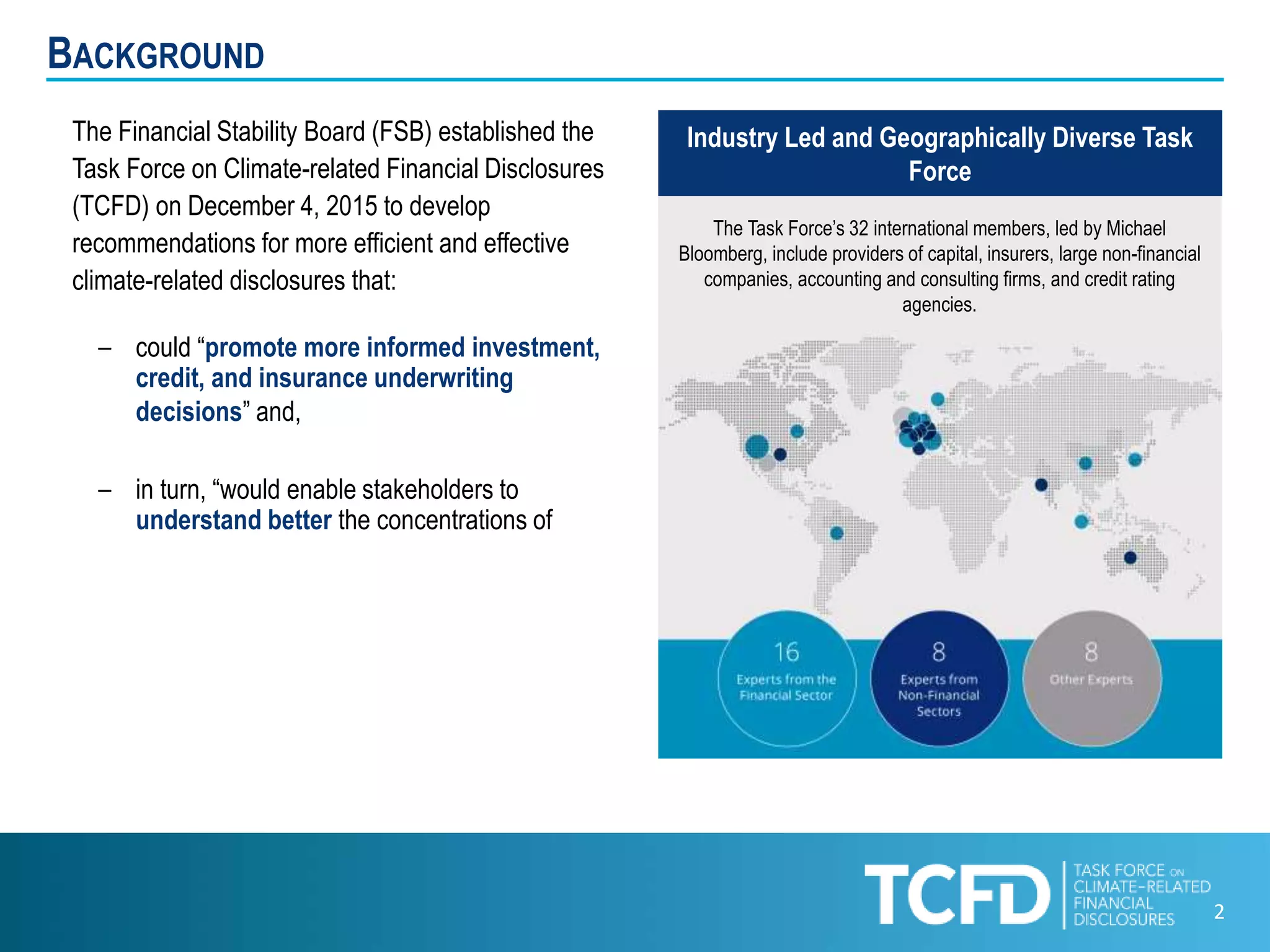
The Task Force’s 32 international members, led by Michael
Bloomberg, include providers of capital, insurers, large non-financial
companies, accounting and consulting firms, and credit rating
agencies.
Industry Led and Geographically Diverse Task
Force
3
THREE PROBLEMS: ONE SOLUTION
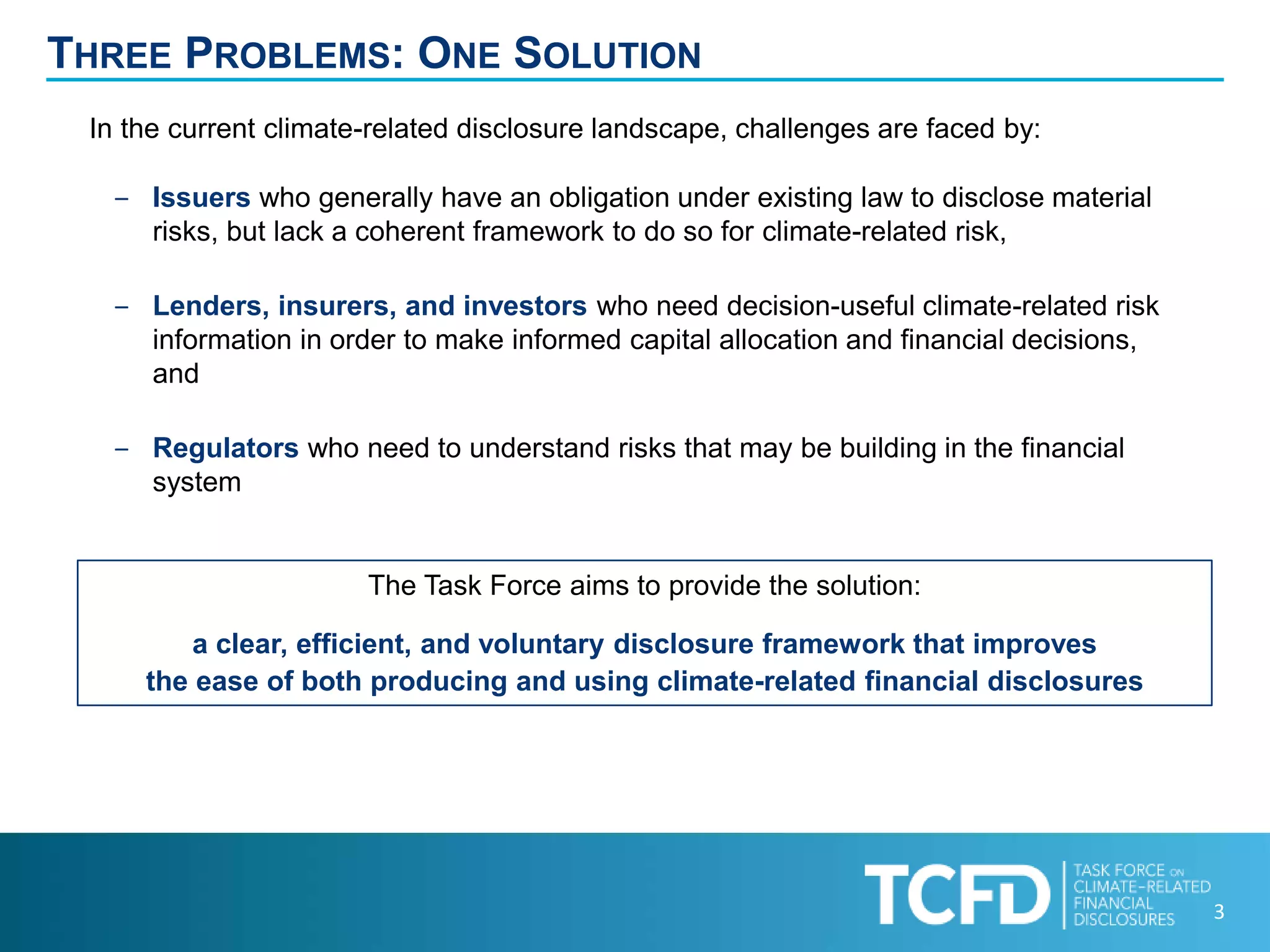
The Task Force aims to provide the solution:
a clear, efficient, and voluntary disclosure framework that improves
the ease of both producing and using climate-related financial disclosures
In the current climate-related disclosure landscape, challenges are faced by:
‒ Issuers who generally have an obligation under existing law to disclose material
risks, but lack a coherent framework to do so for climate-related risk,
‒ Lenders, insurers, and investors who need decision-useful climate-related risk
information in order to make informed capital allocation and financial decisions,
and
‒ Regulators who need to understand risks that may be building in the financial
system
4
KEY INNOVATIONS
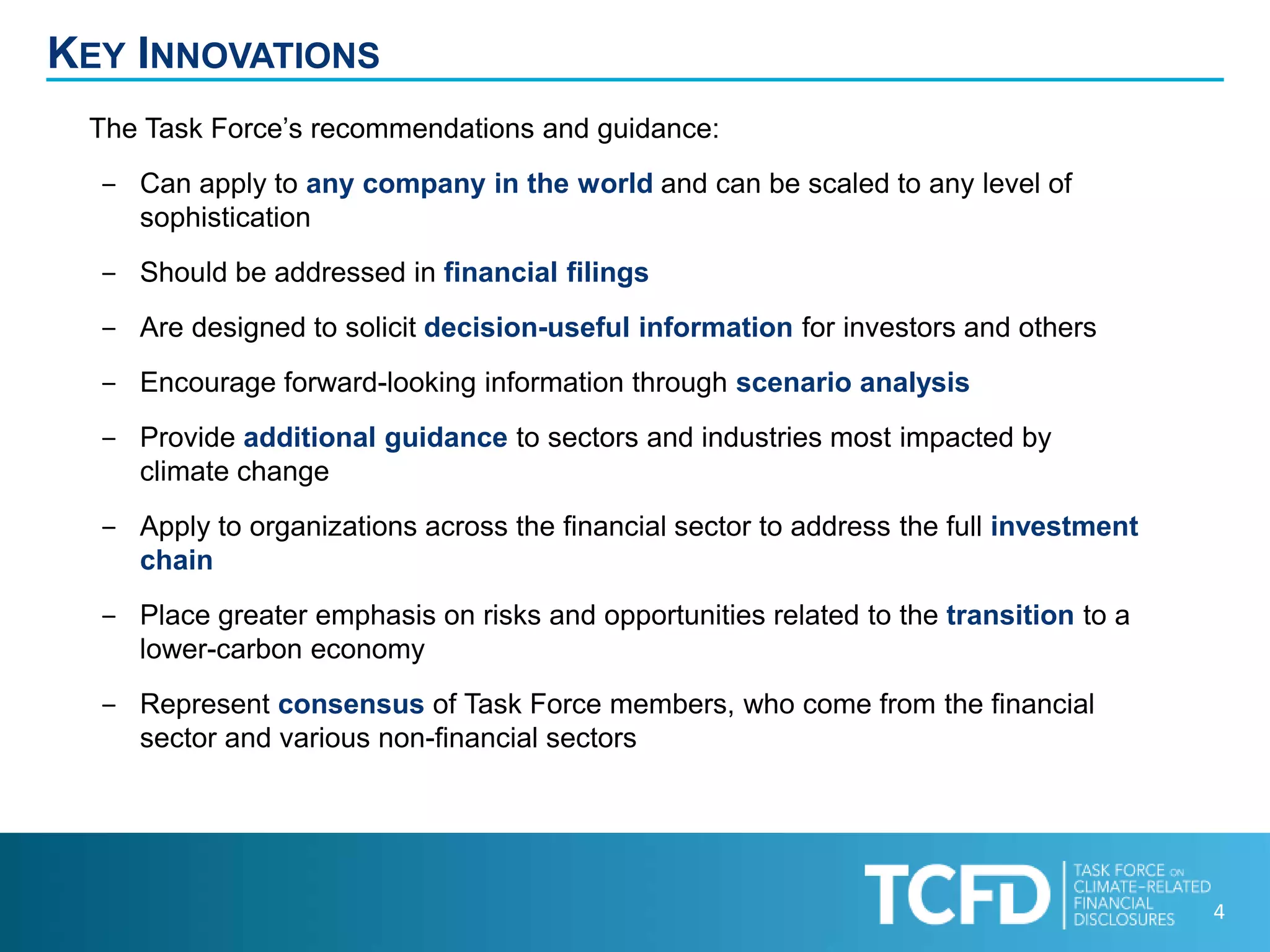
The Task Force’s recommendations and guidance:
‒ Can apply to any company in the world and can be scaled to any level of
sophistication
‒ Should be addressed in financial filings
‒ Are designed to solicit decision-useful information for investors and others
‒ Encourage forward-looking information through scenario analysis
‒ Provide additional guidance to sectors and industries most impacted by
climate change
‒ Apply to organizations across the financial sector to address the full investment
chain
‒ Place greater emphasis on risks and opportunities related to the transition to a
lower-carbon economy
‒ Represent consensus of Task Force members, who come from the financial
sector and various non-financial sectors
5
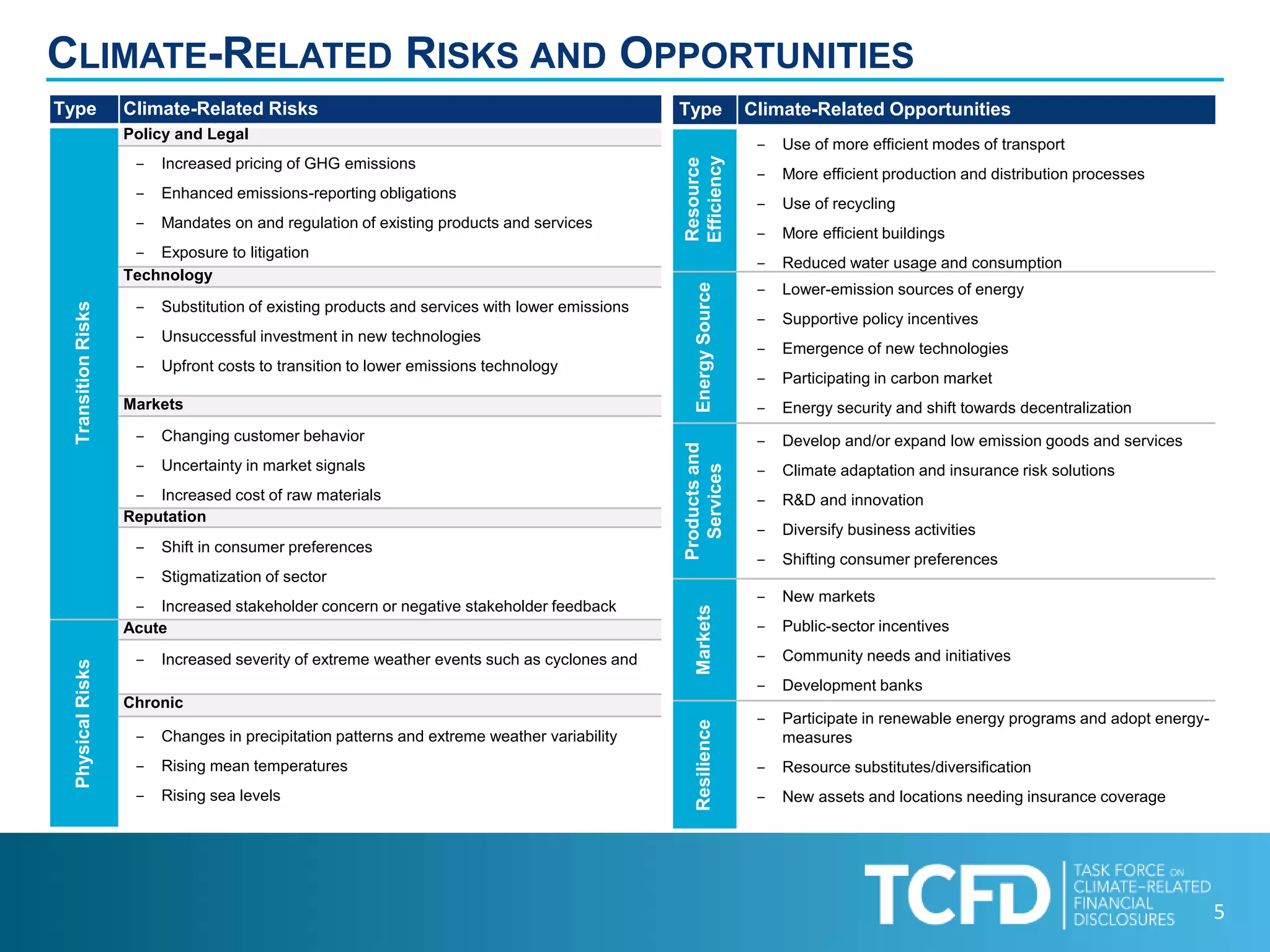
CLIMATE-RELATED RISKS AND OPPORTUNITIES
Type Climate-Related Risks
TransitionRisks
Policy and Legal
‒ Increased pricing of GHG emissions
‒ Enhanced emissions-reporting obligations
‒ Mandates on and regulation of existing products and services
‒ Exposure to litigation
Technology
‒ Substitution of existing products and services with lower emissions
‒ Unsuccessful investment in new technologies
‒ Upfront costs to transition to lower emissions technology
Markets
‒ Changing customer behavior
‒ Uncertainty in market signals
‒ Increased cost of raw materials
Reputation
‒ Shift in consumer preferences
‒ Stigmatization of sector
‒ Increased stakeholder concern or negative stakeholder feedback
PhysicalRisks
Acute
‒ Increased severity of extreme weather events such as cyclones and
Chronic
‒ Changes in precipitation patterns and extreme weather variability
‒ Rising mean temperatures
‒ Rising sea levels
Type Climate-Related Opportunities
Resource
Efficiency
‒ Use of more efficient modes of transport
‒ More efficient production and distribution processes
‒ Use of recycling
‒ More efficient buildings
‒ Reduced water usage and consumption
EnergySource
‒ Lower-emission sources of energy
‒ Supportive policy incentives
‒ Emergence of new technologies
‒ Participating in carbon market
‒ Energy security and shift towards decentralization
Productsand
Services
‒ Develop and/or expand low emission goods and services
‒ Climate adaptation and insurance risk solutions
‒ R&D and innovation
‒ Diversify business activities
‒ Shifting consumer preferences
Markets
‒ New markets
‒ Public-sector incentives
‒ Community needs and initiatives
‒ Development banks
Resilience
‒ Participate in renewable energy programs and adopt energy-
measures
‒ Resource substitutes/diversification
‒ New assets and locations needing insurance coverage
6
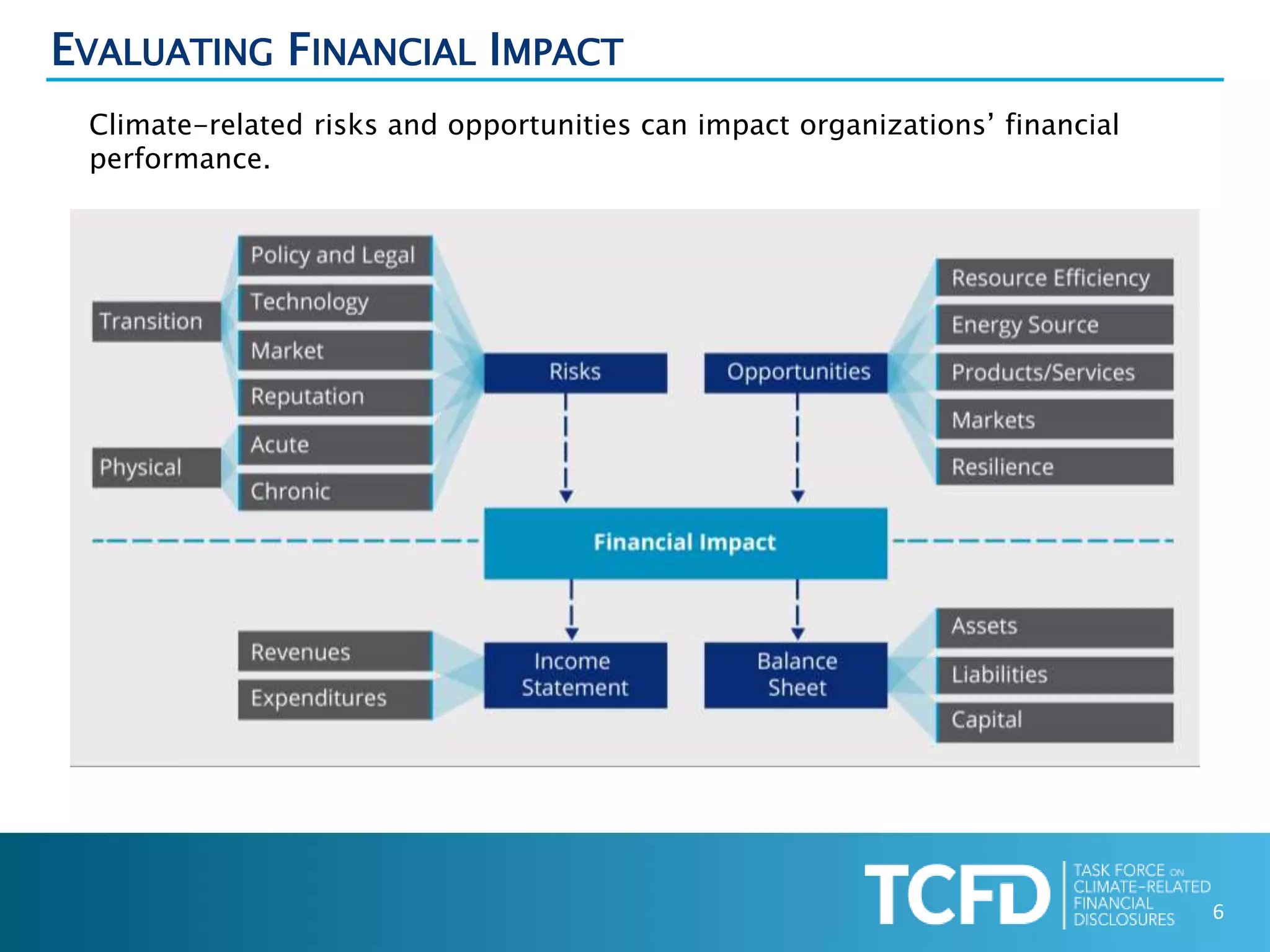
EVALUATING FINANCIAL IMPACT
Climate-related risks and opportunities can impact organizations’ financial
performance.
7
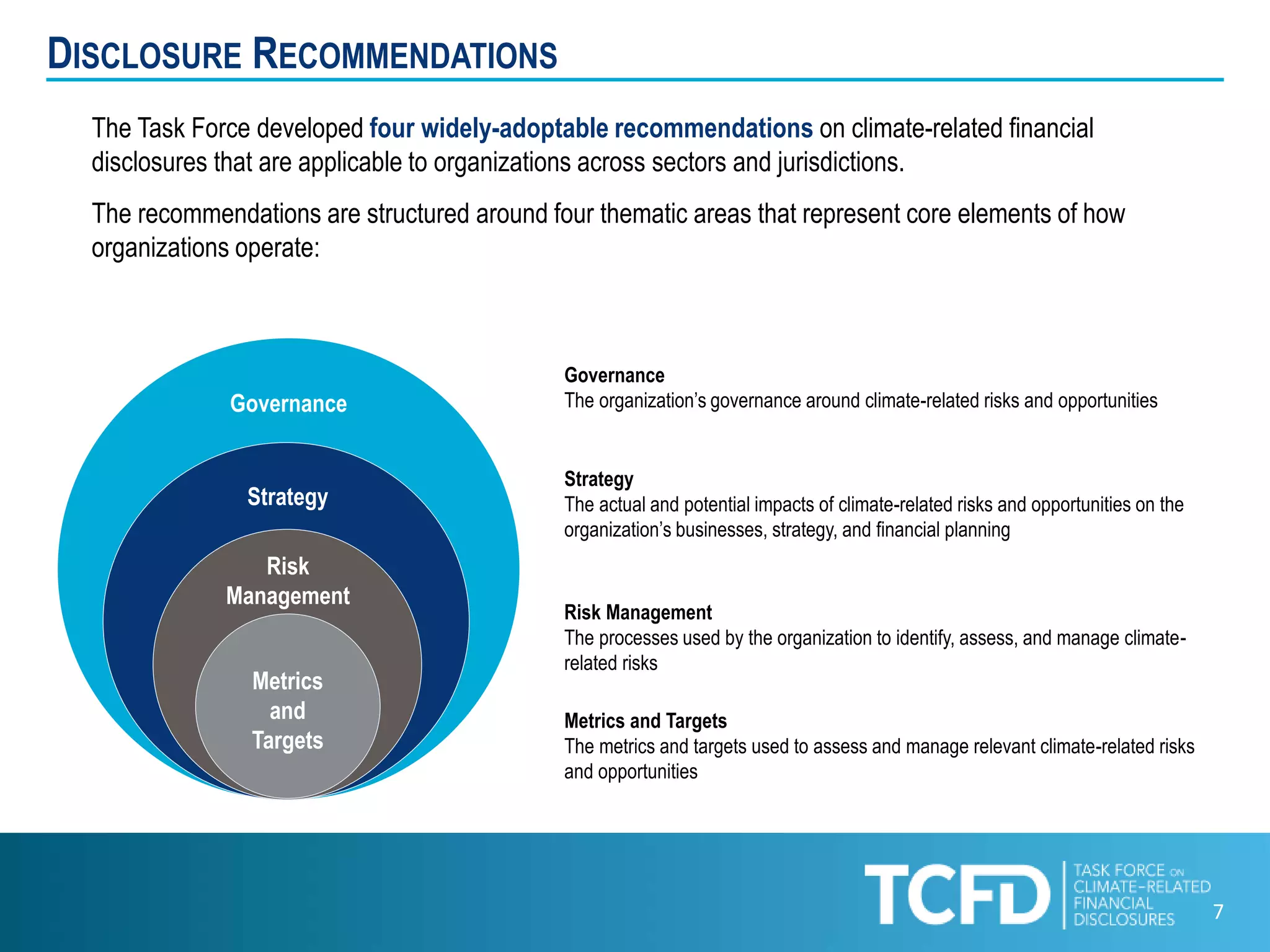
The Task Force developed four widely-adoptable recommendations on climate-related financial
disclosures that are applicable to organizations across sectors and jurisdictions.
The recommendations are structured around four thematic areas that represent core elements of how
organizations operate:
DISCLOSURE RECOMMENDATIONS
Strategy
The actual and potential impacts of climate-related risks and opportunities on the
organization’s businesses, strategy, and financial planning
Risk Management
The processes used by the organization to identify, assess, and manage climate-
related risks
Metrics and Targets
The metrics and targets used to assess and manage relevant climate-related risks
and opportunities
Governance
The organization’s governance around climate-related risks and opportunitiesGovernance
Strategy
Risk
Management
Metrics
and
Targets
8
Governance Strategy Risk Management Metrics and Targets
Disclose the organization’s governance
around climate-related risks and
opportunities.
Disclose the actual and potential impacts of
climate-related risks and opportunities on the
organization’s businesses, strategy, and
financial planning.
Disclose how the organization identifies,
assesses, and manages climate-related
risks.
Disclose the metrics and targets used to
assess and manage relevant climate-related
risks and opportunities.
Recommended Disclosures Recommended Disclosures Recommended Disclosures Recommended Disclosures
a) Describe the board’s oversight of climate-
related risks and opportunities.
a) Describe the climate-related risks and
opportunities the organization has
identified over the short, medium, and
long term.
a) Describe the organization’s processes for
identifying and assessing climate-related
risks.
a) Disclose the metrics used by the
organization to assess climate-related
risks and opportunities in line with its
strategy and risk management process.
b) Describe management’s role in assessing
and managing climate-related risks and
opportunities.
b) Describe the impact of climate-related
risks and opportunities on the
organization’s businesses, strategy, and
financial planning.
b) Describe the organization’s processes for
managing climate-related risks.
b) Disclose Scope 1, Scope 2, and, if
appropriate, Scope 3 greenhouse gas
(GHG) emissions, and the related risks.
c) Describe the potential impact of different
scenarios, including a 2° c scenario, on
the organization’s businesses, strategy,
and financial planning.
c) Describe how processes for identifying,
assessing, and managing climate-related
risks are integrated into the organization’s
overall risk management.
c) Describe the targets used by the
organization to manage climate-related
risks and opportunities and performance
against targets.
DISCLOSURE RECOMMENDATIONS (CONTINUED)
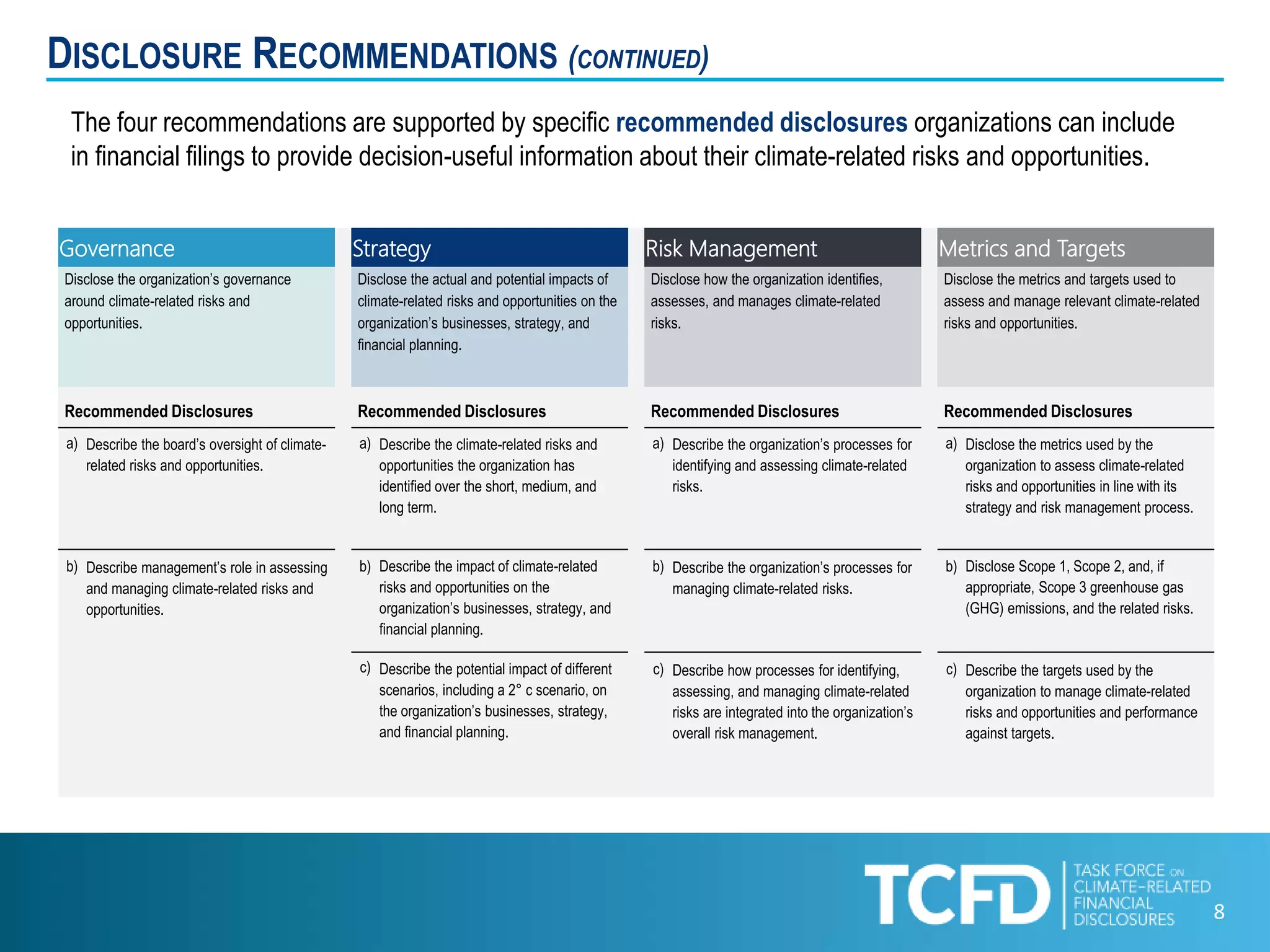
The four recommendations are supported by specific recommended disclosures organizations can include
in financial filings to provide decision-useful information about their climate-related risks and opportunities.
9
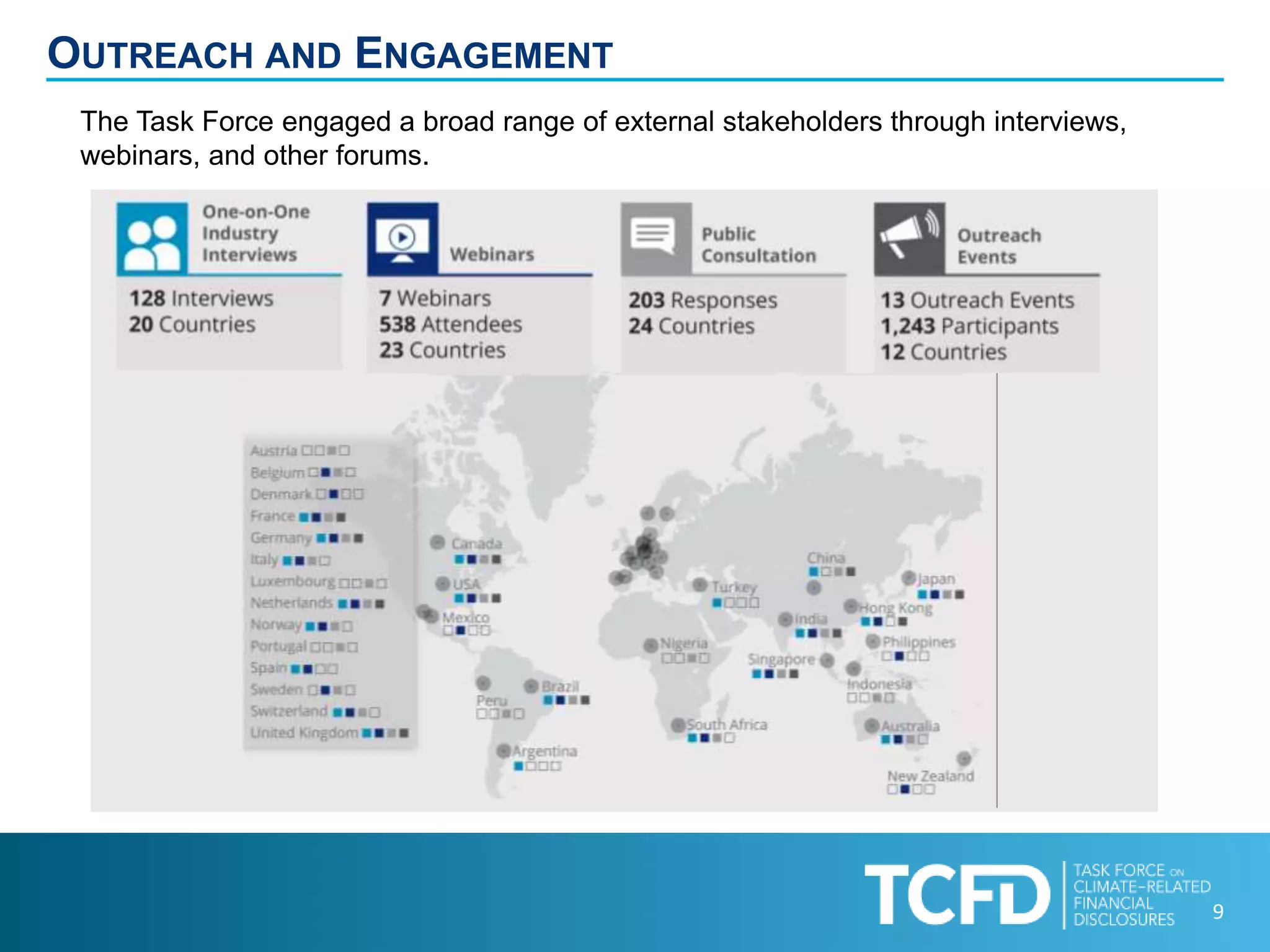
OUTREACH AND ENGAGEMENT
The Task Force engaged a broad range of external stakeholders through interviews,
webinars, and other forums.
10
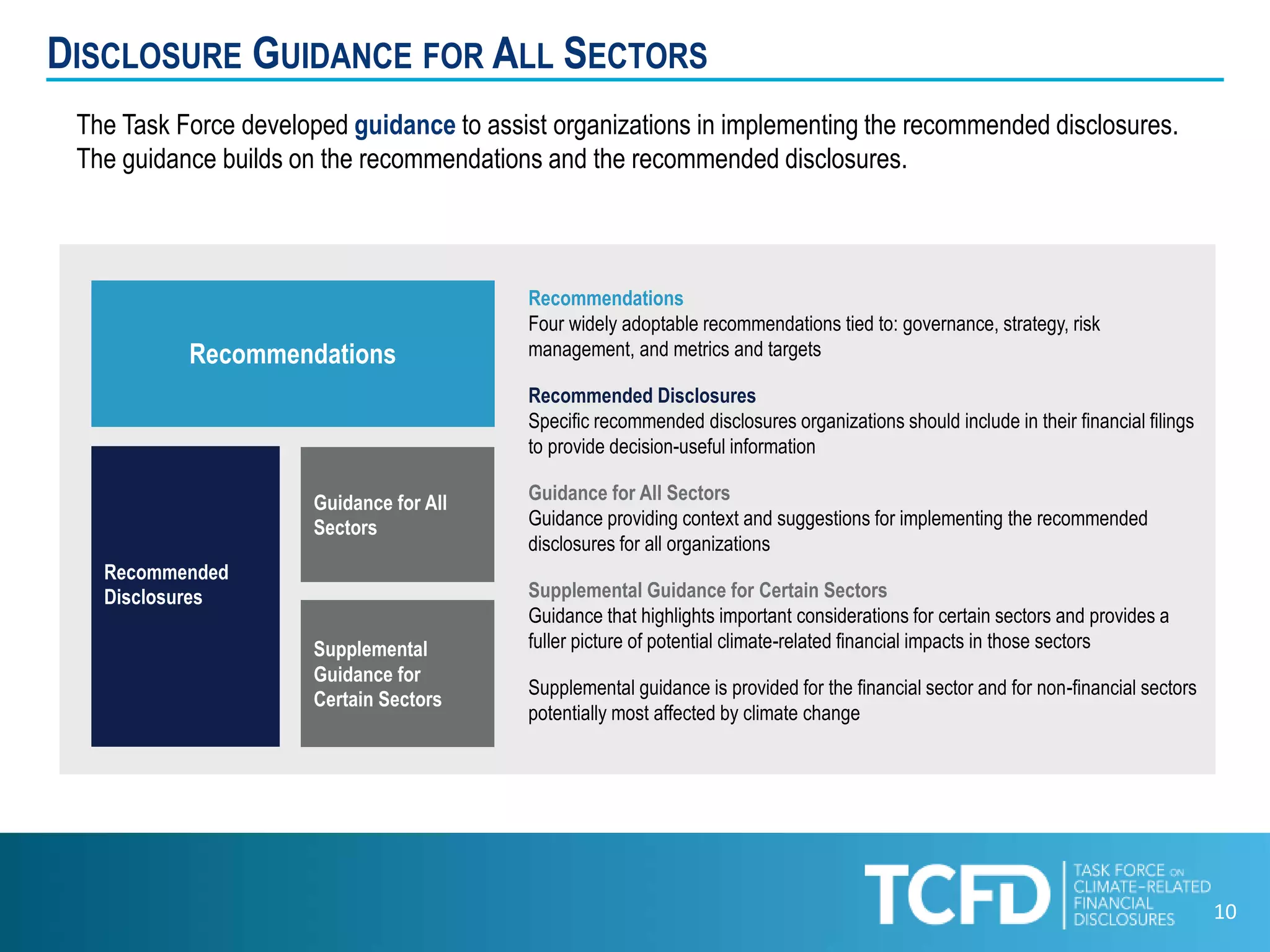
The Task Force developed guidance to assist organizations in implementing the recommended disclosures.
The guidance builds on the recommendations and the recommended disclosures.
DISCLOSURE GUIDANCE FOR ALL SECTORS
Recommendations
Four widely adoptable recommendations tied to: governance, strategy, risk
management, and metrics and targets
Recommended Disclosures
Specific recommended disclosures organizations should include in their financial filings
to provide decision-useful information
Guidance for All Sectors
Guidance providing context and suggestions for implementing the recommended
disclosures for all organizations
Supplemental Guidance for Certain Sectors
Guidance that highlights important considerations for certain sectors and provides a
fuller picture of potential climate-related financial impacts in those sectors
Supplemental guidance is provided for the financial sector and for non-financial sectors
potentially most affected by climate change
Recommendations
Recommended
Disclosures
Guidance for All
Sectors
Supplemental
Guidance for
Certain Sectors
11
SUPPLEMENTAL GUIDANCE FOR CERTAIN SECTORS
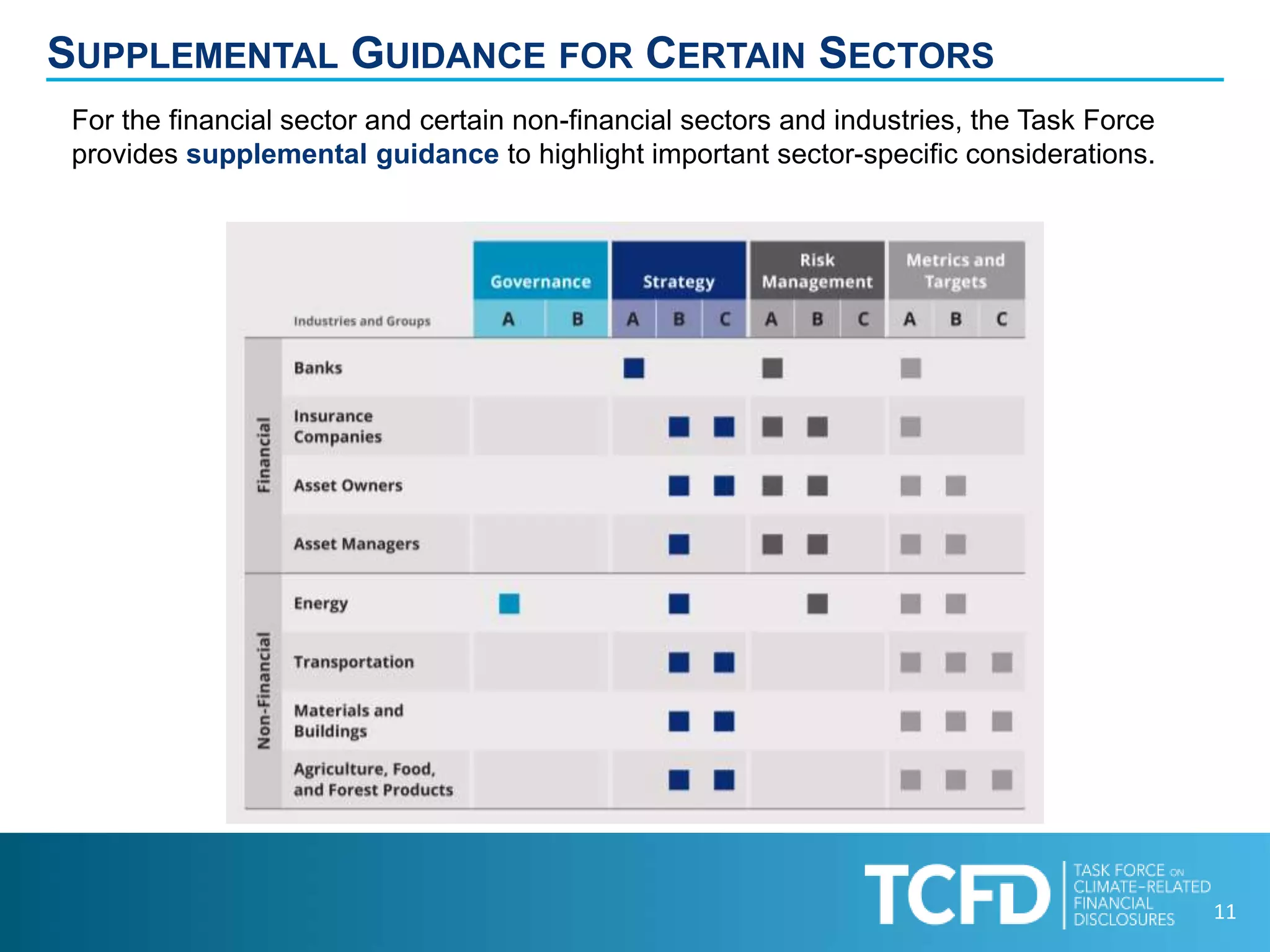
For the financial sector and certain non-financial sectors and industries, the Task Force
provides supplemental guidance to highlight important sector-specific considerations.
12
SCENARIO ANALYSIS
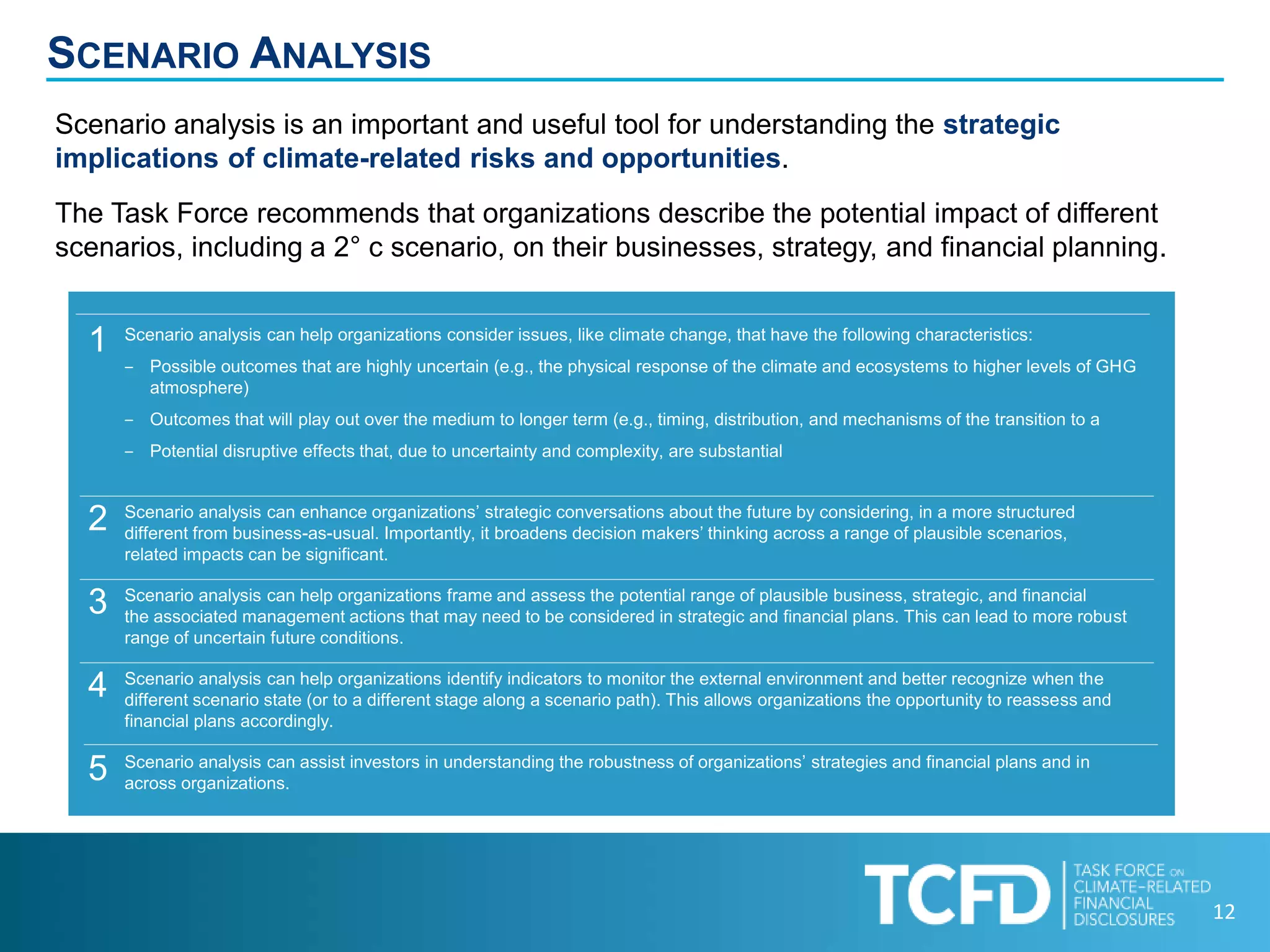
Scenario analysis is an important and useful tool for understanding the strategic
implications of climate-related risks and opportunities.
The Task Force recommends that organizations describe the potential impact of different
scenarios, including a 2° c scenario, on their businesses, strategy, and financial planning.
1 Scenario analysis can help organizations consider issues, like climate change, that have the following characteristics:
‒ Possible outcomes that are highly uncertain (e.g., the physical response of the climate and ecosystems to higher levels of GHG
atmosphere)
‒ Outcomes that will play out over the medium to longer term (e.g., timing, distribution, and mechanisms of the transition to a
‒ Potential disruptive effects that, due to uncertainty and complexity, are substantial
2 Scenario analysis can enhance organizations’ strategic conversations about the future by considering, in a more structured
different from business-as-usual. Importantly, it broadens decision makers’ thinking across a range of plausible scenarios,
related impacts can be significant.
3 Scenario analysis can help organizations frame and assess the potential range of plausible business, strategic, and financial
the associated management actions that may need to be considered in strategic and financial plans. This can lead to more robust
range of uncertain future conditions.
4 Scenario analysis can help organizations identify indicators to monitor the external environment and better recognize when the
different scenario state (or to a different stage along a scenario path). This allows organizations the opportunity to reassess and
financial plans accordingly.
5 Scenario analysis can assist investors in understanding the robustness of organizations’ strategies and financial plans and in
across organizations.
13
EXAMPLES OF AREAS FOR FURTHER WORK
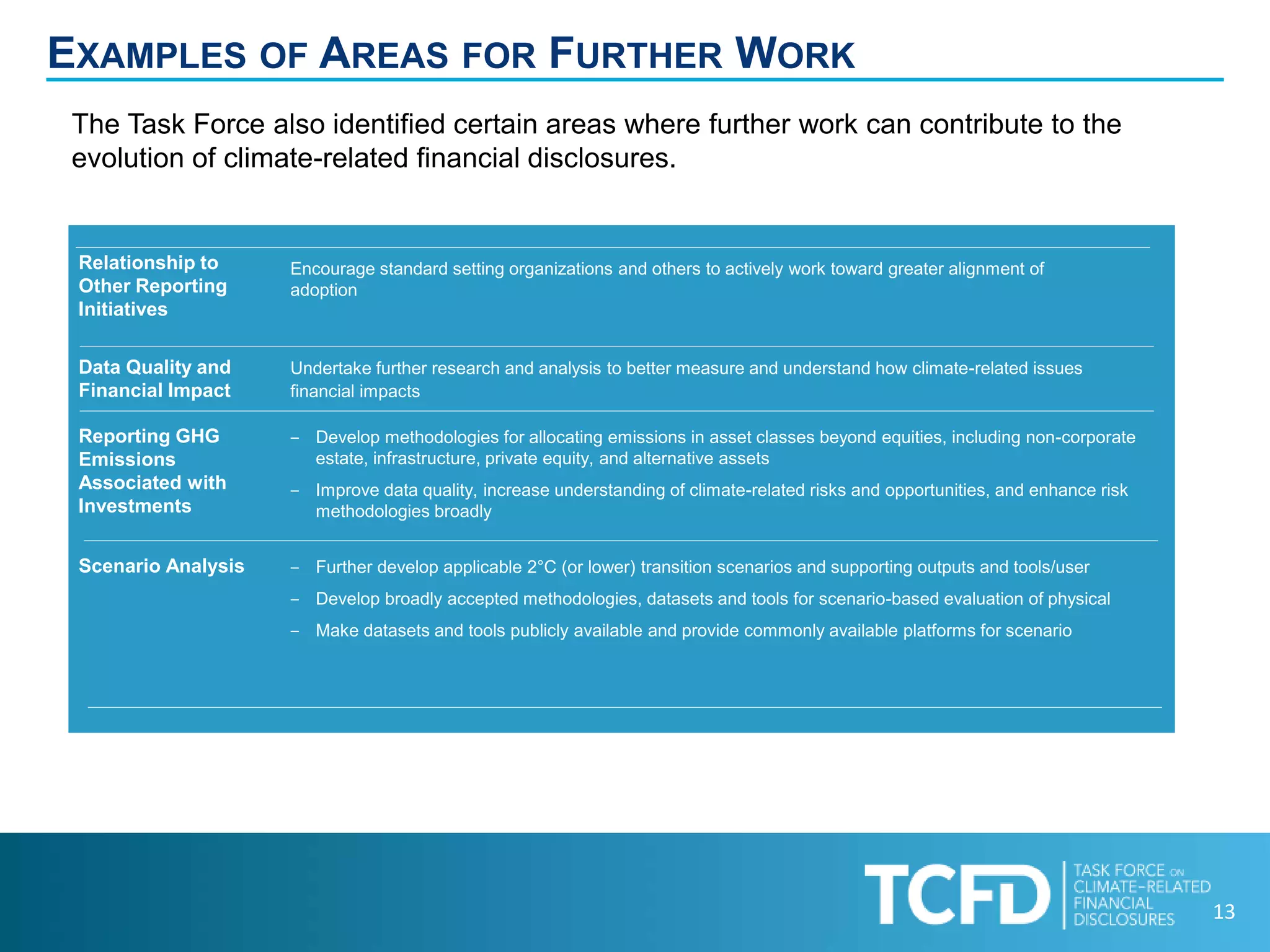
The Task Force also identified certain areas where further work can contribute to the
evolution of climate-related financial disclosures.
Relationship to
Other Reporting
Initiatives
Encourage standard setting organizations and others to actively work toward greater alignment of
adoption
Data Quality and
Financial Impact
Undertake further research and analysis to better measure and understand how climate-related issues
financial impacts
Reporting GHG
Emissions
Associated with
Investments
‒ Develop methodologies for allocating emissions in asset classes beyond equities, including non-corporate
estate, infrastructure, private equity, and alternative assets
‒ Improve data quality, increase understanding of climate-related risks and opportunities, and enhance risk
methodologies broadly
Scenario Analysis ‒ Further develop applicable 2°C (or lower) transition scenarios and supporting outputs and tools/user
‒ Develop broadly accepted methodologies, datasets and tools for scenario-based evaluation of physical
‒ Make datasets and tools publicly available and provide commonly available platforms for scenario
14
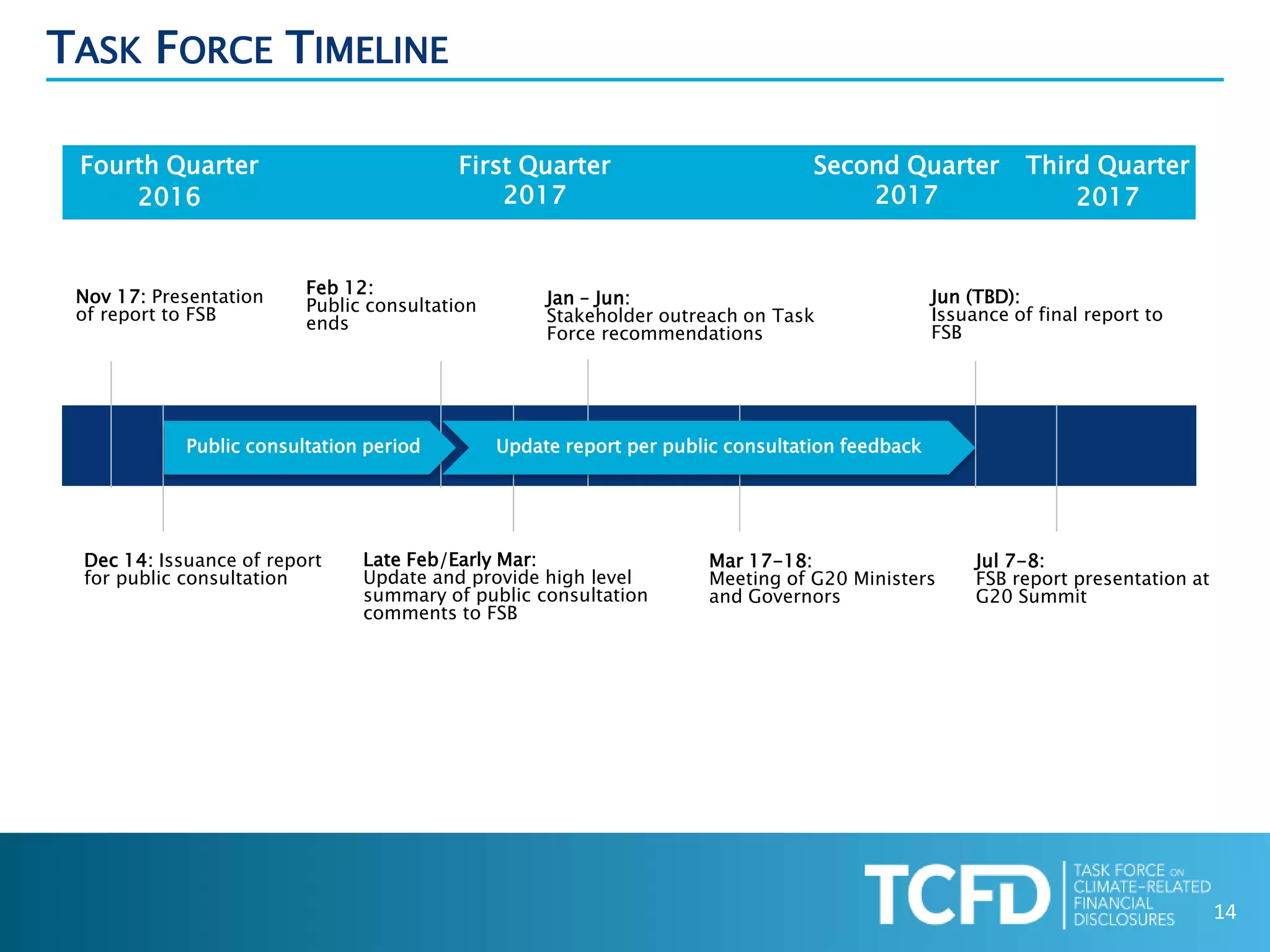
Fourth Quarter
2016
First Quarter
2017
Second Quarter
2017
Third Quarter
2017
Feb 12:
Public consultation
ends
Jun (TBD):
Issuance of final report to
FSB
Nov 17: Presentation
of report to FSB
Dec 14: Issuance of report
for public consultation
Late Feb/Early Mar:
Update and provide high level
summary of public consultation
comments to FSB
Mar 17-18:
Meeting of G20 Ministers
and Governors
Jul 7-8:
FSB report presentation at
G20 Summit
Jan – Jun:
Stakeholder outreach on Task
Force recommendations
TASK FORCE TIMELINE
Public consultation period Update report per public consultation feedback
15
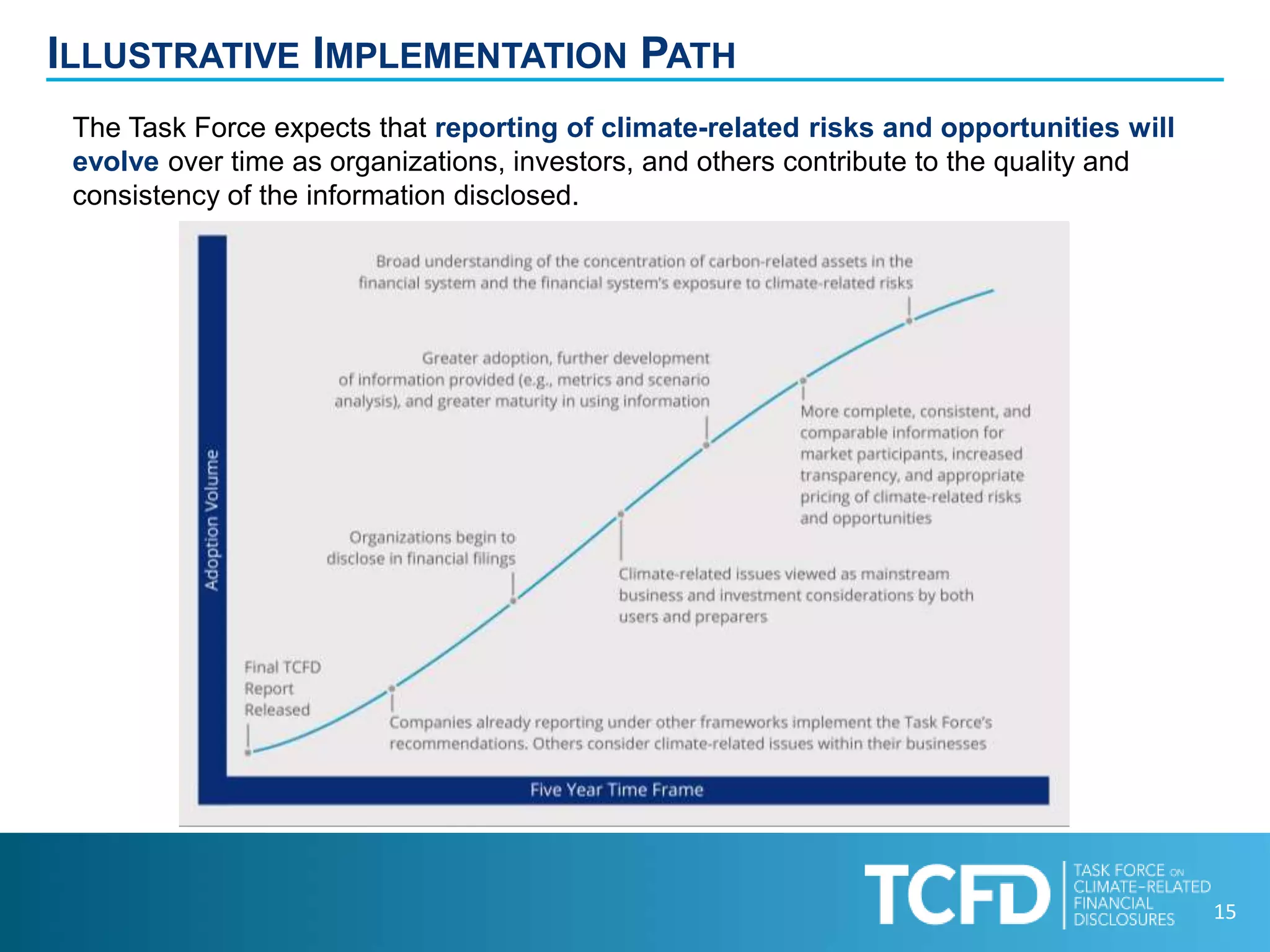
ILLUSTRATIVE IMPLEMENTATION PATH
The Task Force expects that reporting of climate-related risks and opportunities will
evolve over time as organizations, investors, and others contribute to the quality and
consistency of the information disclosed.
16
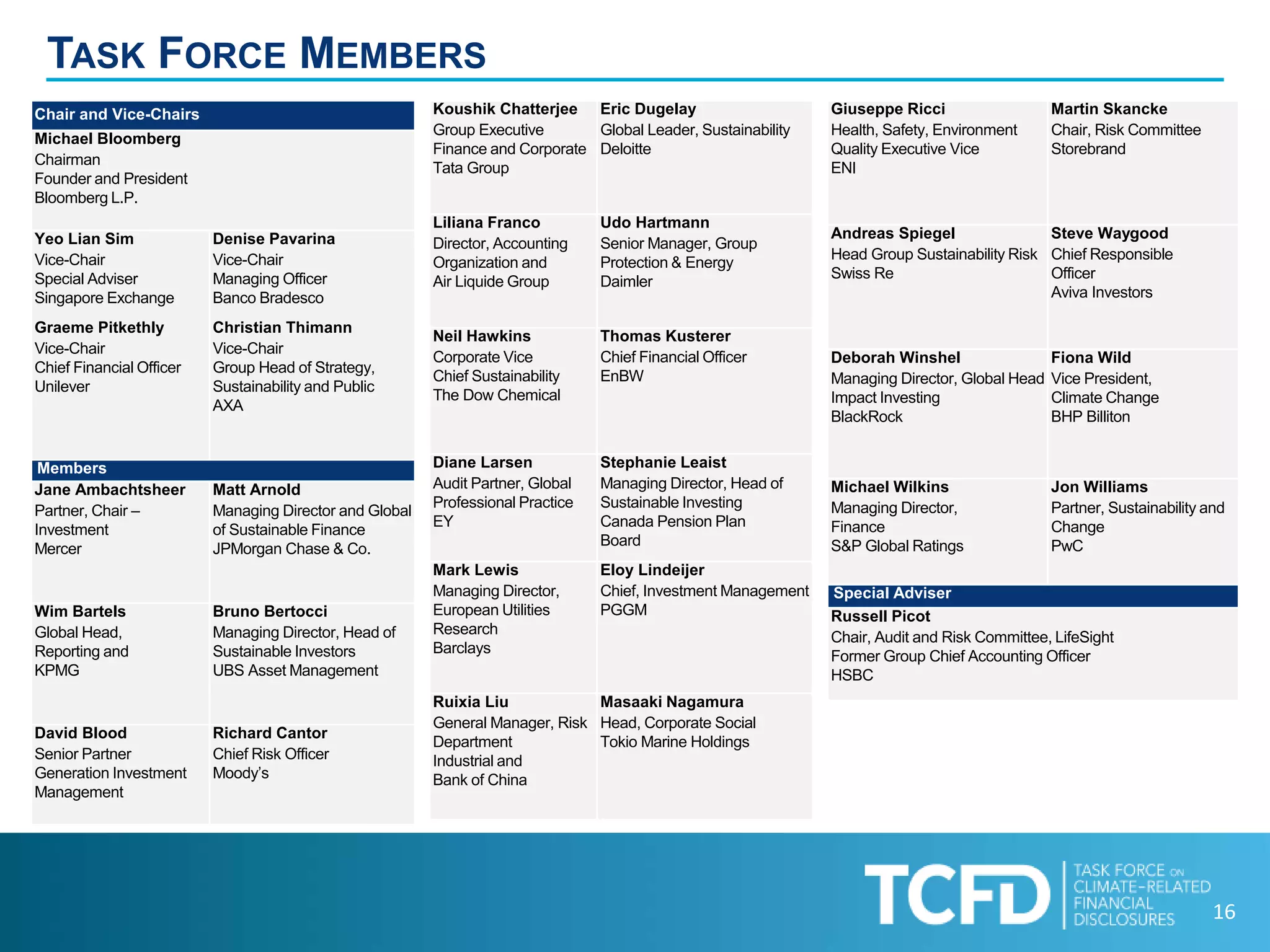
TASK FORCE MEMBERS
Chair and Vice-Chairs
Michael Bloomberg
Chairman
Founder and President
Bloomberg L.P.
Yeo Lian Sim
Vice-Chair
Special Adviser
Singapore Exchange
Graeme Pitkethly
Vice-Chair
Chief Financial Officer
Unilever
Denise Pavarina
Vice-Chair
Managing Officer
Banco Bradesco
Christian Thimann
Vice-Chair
Group Head of Strategy,
Sustainability and Public
AXA
Members
Jane Ambachtsheer
Partner, Chair –
Investment
Mercer
Matt Arnold
Managing Director and Global
of Sustainable Finance
JPMorgan Chase & Co.
Wim Bartels
Global Head,
Reporting and
KPMG
Bruno Bertocci
Managing Director, Head of
Sustainable Investors
UBS Asset Management
David Blood
Senior Partner
Generation Investment
Management
Richard Cantor
Chief Risk Officer
Moody’s
Giuseppe Ricci
Health, Safety, Environment
Quality Executive Vice
ENI
Martin Skancke
Chair, Risk Committee
Storebrand
Andreas Spiegel
Head Group Sustainability Risk
Swiss Re
Steve Waygood
Chief Responsible
Officer
Aviva Investors
Deborah Winshel
Managing Director, Global Head
Impact Investing
BlackRock
Fiona Wild
Vice President,
Climate Change
BHP Billiton
Michael Wilkins
Managing Director,
Finance
S&P Global Ratings
Jon Williams
Partner, Sustainability and
Change
PwC
Special Adviser
Russell Picot
Chair, Audit and Risk Committee, LifeSight
Former Group Chief Accounting Officer
HSBC
Koushik Chatterjee
Group Executive
Finance and Corporate
Tata Group
Eric Dugelay
Global Leader, Sustainability
Deloitte
Liliana Franco
Director, Accounting
Organization and
Air Liquide Group
Udo Hartmann
Senior Manager, Group
Protection & Energy
Daimler
Neil Hawkins
Corporate Vice
Chief Sustainability
The Dow Chemical
Thomas Kusterer
Chief Financial Officer
EnBW
Diane Larsen
Audit Partner, Global
Professional Practice
EY
Stephanie Leaist
Managing Director, Head of
Sustainable Investing
Canada Pension Plan
Board
Mark Lewis
Managing Director,
European Utilities
Research
Barclays
Eloy Lindeijer
Chief, Investment Management
PGGM
Ruixia Liu
General Manager, Risk
Department
Industrial and
Bank of China
Masaaki Nagamura
Head, Corporate Social
Tokio Marine Holdings

Tcfd report-overview-dec.-2016

  • 1.
    Task Force onClimate-related Financial Disclosures Overview of Report and Implementation Guidance December 2016
  • 2.
    2 The Financial StabilityBoard (FSB) established the Task Force on Climate-related Financial Disclosures (TCFD) on December 4, 2015 to develop recommendations for more efficient and effective climate-related disclosures that: ‒ could “promote more informed investment, credit, and insurance underwriting decisions” and, ‒ in turn, “would enable stakeholders to understand better the concentrations of BACKGROUND The Task Force’s 32 international members, led by Michael Bloomberg, include providers of capital, insurers, large non-financial companies, accounting and consulting firms, and credit rating agencies. Industry Led and Geographically Diverse Task Force
  • 3.
    3 THREE PROBLEMS: ONESOLUTION The Task Force aims to provide the solution: a clear, efficient, and voluntary disclosure framework that improves the ease of both producing and using climate-related financial disclosures In the current climate-related disclosure landscape, challenges are faced by: ‒ Issuers who generally have an obligation under existing law to disclose material risks, but lack a coherent framework to do so for climate-related risk, ‒ Lenders, insurers, and investors who need decision-useful climate-related risk information in order to make informed capital allocation and financial decisions, and ‒ Regulators who need to understand risks that may be building in the financial system
  • 4.
    4 KEY INNOVATIONS The TaskForce’s recommendations and guidance: ‒ Can apply to any company in the world and can be scaled to any level of sophistication ‒ Should be addressed in financial filings ‒ Are designed to solicit decision-useful information for investors and others ‒ Encourage forward-looking information through scenario analysis ‒ Provide additional guidance to sectors and industries most impacted by climate change ‒ Apply to organizations across the financial sector to address the full investment chain ‒ Place greater emphasis on risks and opportunities related to the transition to a lower-carbon economy ‒ Represent consensus of Task Force members, who come from the financial sector and various non-financial sectors
  • 5.
    5 CLIMATE-RELATED RISKS ANDOPPORTUNITIES Type Climate-Related Risks TransitionRisks Policy and Legal ‒ Increased pricing of GHG emissions ‒ Enhanced emissions-reporting obligations ‒ Mandates on and regulation of existing products and services ‒ Exposure to litigation Technology ‒ Substitution of existing products and services with lower emissions ‒ Unsuccessful investment in new technologies ‒ Upfront costs to transition to lower emissions technology Markets ‒ Changing customer behavior ‒ Uncertainty in market signals ‒ Increased cost of raw materials Reputation ‒ Shift in consumer preferences ‒ Stigmatization of sector ‒ Increased stakeholder concern or negative stakeholder feedback PhysicalRisks Acute ‒ Increased severity of extreme weather events such as cyclones and Chronic ‒ Changes in precipitation patterns and extreme weather variability ‒ Rising mean temperatures ‒ Rising sea levels Type Climate-Related Opportunities Resource Efficiency ‒ Use of more efficient modes of transport ‒ More efficient production and distribution processes ‒ Use of recycling ‒ More efficient buildings ‒ Reduced water usage and consumption EnergySource ‒ Lower-emission sources of energy ‒ Supportive policy incentives ‒ Emergence of new technologies ‒ Participating in carbon market ‒ Energy security and shift towards decentralization Productsand Services ‒ Develop and/or expand low emission goods and services ‒ Climate adaptation and insurance risk solutions ‒ R&D and innovation ‒ Diversify business activities ‒ Shifting consumer preferences Markets ‒ New markets ‒ Public-sector incentives ‒ Community needs and initiatives ‒ Development banks Resilience ‒ Participate in renewable energy programs and adopt energy- measures ‒ Resource substitutes/diversification ‒ New assets and locations needing insurance coverage
  • 6.
    6 EVALUATING FINANCIAL IMPACT Climate-relatedrisks and opportunities can impact organizations’ financial performance.
  • 7.
    7 The Task Forcedeveloped four widely-adoptable recommendations on climate-related financial disclosures that are applicable to organizations across sectors and jurisdictions. The recommendations are structured around four thematic areas that represent core elements of how organizations operate: DISCLOSURE RECOMMENDATIONS Strategy The actual and potential impacts of climate-related risks and opportunities on the organization’s businesses, strategy, and financial planning Risk Management The processes used by the organization to identify, assess, and manage climate- related risks Metrics and Targets The metrics and targets used to assess and manage relevant climate-related risks and opportunities Governance The organization’s governance around climate-related risks and opportunitiesGovernance Strategy Risk Management Metrics and Targets
  • 8.
    8 Governance Strategy RiskManagement Metrics and Targets Disclose the organization’s governance around climate-related risks and opportunities. Disclose the actual and potential impacts of climate-related risks and opportunities on the organization’s businesses, strategy, and financial planning. Disclose how the organization identifies, assesses, and manages climate-related risks. Disclose the metrics and targets used to assess and manage relevant climate-related risks and opportunities. Recommended Disclosures Recommended Disclosures Recommended Disclosures Recommended Disclosures a) Describe the board’s oversight of climate- related risks and opportunities. a) Describe the climate-related risks and opportunities the organization has identified over the short, medium, and long term. a) Describe the organization’s processes for identifying and assessing climate-related risks. a) Disclose the metrics used by the organization to assess climate-related risks and opportunities in line with its strategy and risk management process. b) Describe management’s role in assessing and managing climate-related risks and opportunities. b) Describe the impact of climate-related risks and opportunities on the organization’s businesses, strategy, and financial planning. b) Describe the organization’s processes for managing climate-related risks. b) Disclose Scope 1, Scope 2, and, if appropriate, Scope 3 greenhouse gas (GHG) emissions, and the related risks. c) Describe the potential impact of different scenarios, including a 2° c scenario, on the organization’s businesses, strategy, and financial planning. c) Describe how processes for identifying, assessing, and managing climate-related risks are integrated into the organization’s overall risk management. c) Describe the targets used by the organization to manage climate-related risks and opportunities and performance against targets. DISCLOSURE RECOMMENDATIONS (CONTINUED) The four recommendations are supported by specific recommended disclosures organizations can include in financial filings to provide decision-useful information about their climate-related risks and opportunities.
  • 9.
    9 OUTREACH AND ENGAGEMENT TheTask Force engaged a broad range of external stakeholders through interviews, webinars, and other forums.
  • 10.
    10 The Task Forcedeveloped guidance to assist organizations in implementing the recommended disclosures. The guidance builds on the recommendations and the recommended disclosures. DISCLOSURE GUIDANCE FOR ALL SECTORS Recommendations Four widely adoptable recommendations tied to: governance, strategy, risk management, and metrics and targets Recommended Disclosures Specific recommended disclosures organizations should include in their financial filings to provide decision-useful information Guidance for All Sectors Guidance providing context and suggestions for implementing the recommended disclosures for all organizations Supplemental Guidance for Certain Sectors Guidance that highlights important considerations for certain sectors and provides a fuller picture of potential climate-related financial impacts in those sectors Supplemental guidance is provided for the financial sector and for non-financial sectors potentially most affected by climate change Recommendations Recommended Disclosures Guidance for All Sectors Supplemental Guidance for Certain Sectors
  • 11.
    11 SUPPLEMENTAL GUIDANCE FORCERTAIN SECTORS For the financial sector and certain non-financial sectors and industries, the Task Force provides supplemental guidance to highlight important sector-specific considerations.
  • 12.
    12 SCENARIO ANALYSIS Scenario analysisis an important and useful tool for understanding the strategic implications of climate-related risks and opportunities. The Task Force recommends that organizations describe the potential impact of different scenarios, including a 2° c scenario, on their businesses, strategy, and financial planning. 1 Scenario analysis can help organizations consider issues, like climate change, that have the following characteristics: ‒ Possible outcomes that are highly uncertain (e.g., the physical response of the climate and ecosystems to higher levels of GHG atmosphere) ‒ Outcomes that will play out over the medium to longer term (e.g., timing, distribution, and mechanisms of the transition to a ‒ Potential disruptive effects that, due to uncertainty and complexity, are substantial 2 Scenario analysis can enhance organizations’ strategic conversations about the future by considering, in a more structured different from business-as-usual. Importantly, it broadens decision makers’ thinking across a range of plausible scenarios, related impacts can be significant. 3 Scenario analysis can help organizations frame and assess the potential range of plausible business, strategic, and financial the associated management actions that may need to be considered in strategic and financial plans. This can lead to more robust range of uncertain future conditions. 4 Scenario analysis can help organizations identify indicators to monitor the external environment and better recognize when the different scenario state (or to a different stage along a scenario path). This allows organizations the opportunity to reassess and financial plans accordingly. 5 Scenario analysis can assist investors in understanding the robustness of organizations’ strategies and financial plans and in across organizations.
  • 13.
    13 EXAMPLES OF AREASFOR FURTHER WORK The Task Force also identified certain areas where further work can contribute to the evolution of climate-related financial disclosures. Relationship to Other Reporting Initiatives Encourage standard setting organizations and others to actively work toward greater alignment of adoption Data Quality and Financial Impact Undertake further research and analysis to better measure and understand how climate-related issues financial impacts Reporting GHG Emissions Associated with Investments ‒ Develop methodologies for allocating emissions in asset classes beyond equities, including non-corporate estate, infrastructure, private equity, and alternative assets ‒ Improve data quality, increase understanding of climate-related risks and opportunities, and enhance risk methodologies broadly Scenario Analysis ‒ Further develop applicable 2°C (or lower) transition scenarios and supporting outputs and tools/user ‒ Develop broadly accepted methodologies, datasets and tools for scenario-based evaluation of physical ‒ Make datasets and tools publicly available and provide commonly available platforms for scenario
  • 14.
    14 Fourth Quarter 2016 First Quarter 2017 SecondQuarter 2017 Third Quarter 2017 Feb 12: Public consultation ends Jun (TBD): Issuance of final report to FSB Nov 17: Presentation of report to FSB Dec 14: Issuance of report for public consultation Late Feb/Early Mar: Update and provide high level summary of public consultation comments to FSB Mar 17-18: Meeting of G20 Ministers and Governors Jul 7-8: FSB report presentation at G20 Summit Jan – Jun: Stakeholder outreach on Task Force recommendations TASK FORCE TIMELINE Public consultation period Update report per public consultation feedback
  • 15.
    15 ILLUSTRATIVE IMPLEMENTATION PATH TheTask Force expects that reporting of climate-related risks and opportunities will evolve over time as organizations, investors, and others contribute to the quality and consistency of the information disclosed.
  • 16.
    16 TASK FORCE MEMBERS Chairand Vice-Chairs Michael Bloomberg Chairman Founder and President Bloomberg L.P. Yeo Lian Sim Vice-Chair Special Adviser Singapore Exchange Graeme Pitkethly Vice-Chair Chief Financial Officer Unilever Denise Pavarina Vice-Chair Managing Officer Banco Bradesco Christian Thimann Vice-Chair Group Head of Strategy, Sustainability and Public AXA Members Jane Ambachtsheer Partner, Chair – Investment Mercer Matt Arnold Managing Director and Global of Sustainable Finance JPMorgan Chase & Co. Wim Bartels Global Head, Reporting and KPMG Bruno Bertocci Managing Director, Head of Sustainable Investors UBS Asset Management David Blood Senior Partner Generation Investment Management Richard Cantor Chief Risk Officer Moody’s Giuseppe Ricci Health, Safety, Environment Quality Executive Vice ENI Martin Skancke Chair, Risk Committee Storebrand Andreas Spiegel Head Group Sustainability Risk Swiss Re Steve Waygood Chief Responsible Officer Aviva Investors Deborah Winshel Managing Director, Global Head Impact Investing BlackRock Fiona Wild Vice President, Climate Change BHP Billiton Michael Wilkins Managing Director, Finance S&P Global Ratings Jon Williams Partner, Sustainability and Change PwC Special Adviser Russell Picot Chair, Audit and Risk Committee, LifeSight Former Group Chief Accounting Officer HSBC Koushik Chatterjee Group Executive Finance and Corporate Tata Group Eric Dugelay Global Leader, Sustainability Deloitte Liliana Franco Director, Accounting Organization and Air Liquide Group Udo Hartmann Senior Manager, Group Protection & Energy Daimler Neil Hawkins Corporate Vice Chief Sustainability The Dow Chemical Thomas Kusterer Chief Financial Officer EnBW Diane Larsen Audit Partner, Global Professional Practice EY Stephanie Leaist Managing Director, Head of Sustainable Investing Canada Pension Plan Board Mark Lewis Managing Director, European Utilities Research Barclays Eloy Lindeijer Chief, Investment Management PGGM Ruixia Liu General Manager, Risk Department Industrial and Bank of China Masaaki Nagamura Head, Corporate Social Tokio Marine Holdings