BUILDING THE FOUNDATION FOR THE
DIGITALLY ENABLED SCHOOL
2019 – 2022
INFORMATION & TECHNOLOGY STRATEGIC PLAN
2
STEVE CAMACHO
CHIEF INFORMATION OFFICER
INTRODUCTION
RORY MCGUCKIN
DIRECTOR OF EDUCATION
Now, more than ever, our community of students, parents and Catholic supporters is engaging the education system
through the lens of the digital world. To maximize our effectiveness as the largest Catholic school system, and to
support our students in achieving their full potential, the Toronto Catholic District School Board (TCDSB) needs to
leverage technology and the associated best practices that drive success. To achieve this, we have set a bold new vision
to enable the digital future of our schools.
The future TCDSB school is completely enabled by seamless technology and data to deliver high-quality,
personalized, and efficient educational services to students and parents. It supports employees in adopting modern
tools and teaching methods; uses technology to adapt to the individual learning needs of students while ensuring
their well-being; allows parents to engage effortlessly in the education system; and fosters a nurturing and strong
Catholic community.
This long-term vision will not be achieved by simple words on paper or by individual decisions. It requires action and
focus. It requires faith and perseverance. It requires cooperation and collaboration. All of this needs to be accomplished
within the context of current fiscal challenges. To make this vision a reality we have developed a plan that will be
delivered in three phases over the coming years. BUILD. UNITE. ACCELERATE.
BUILD - Our 2019 to 2022 Information and Technology Strategic Plan takes the first steps toward our long-term
digital vision by building the foundation for digitally enabled schools. We are taking a realistic set of actions on
improving core technologies and practices across our system. Our 3-years plan will respond and prepare us for the
changing world of education, improve our process and administrative practices, enable stronger connections with our
parents and students, and enhance our ability to protect students in a digitally connected world. We will do this while
balancing the pace of change with our fiscal reality.
We are proud to take these first steps toward improving the use of technology across the system and encourage
everyone to join us as we step into a bold new future.
PLAN DEVELOPMENT
3
In November 2018 we embarked on an almost year long journey
to develop our new Information and Technology (I&T) Strategic
Plan. Driven by the Chief Information Officer and working in
collaboration with system leaders we engaged in a number of
discussions and activities to understand our current environment
and plan for our digital future. These activities included:
• Reviewing educational technology trends
• Benchmarking ourselves against other educational service
providers with data from Gartner
• Deep dive focus groups on key strategic topics
• Analyzing our strengths, weakness, opportunities, and threats
(SWOT) from a digital perspective
• Completing a cybersecurity assessment and threat scenario exercise
• A board-wide classroom technology asset audit
• Reviewing past and current Parent Voice surveys
• Understanding external priorities through a review of the
Government’s Line-by-line spending report and the Auditor General’s
report on school board information technology (IT)
• Understanding and aligning our technology objectives with our
Multi-Year Strategic Plan
In addition to these robust input activities, we sought feedback to our
draft plan from a number of groups to ensure we were on the right
track. These consultations included:
• Union partners to understand the impact on staff
• Principals to understand how this plan will impact our schools
• The Catholic Parent Involvement Committee to gain a parent’s
perspective
• Audit Committee to seek input from our elected Trustees and externals
committee members.
4
STRATEGIC CONTEXT
Benchmarking
To understand our current context, we benchmarked ourselves against several financial and operational metrics. Our
analysis revealed a significant gap in IT spending and an equally significant gap in IT process maturity. We believe that
the lack of IT investment over many years has led
to underdeveloped technological capabilities for
the organization that need to be addressed with
a strong focus on the foundations. While these
findings are cause for discussion, we believe the
information is important to share in order to have
a deeper understanding of challenges we face.
Through this understanding we can develop a plan that is realistic yet aspirational enough to have a meaningful and
positive impact on parents, students, and other stakeholders. Our benchmarking work compared TCDSB’s IT metrics
against world-wide educational sector data maintained by Gartner Inc., a well known technology advisor. This industry
average includes data from both K-12 and Higher
Education institutions collected in 2018. The
data does not include other school boards in
Ontario because such data does not currently
exist. However, given school boards in Ontario
are all funded using the same funding formula, we
believe this situation is not unique to the TCDSB.
Nevertheless, we believe we can do better with
resources we have and our plan focuses on
maximizing that opportunity now and into the
future.
% of total budget spent on IT 2.1% 5.7%
% of IT employees vs total 0.8% 4.9%
% of IT budget spent on “Run” 93.0% 75.0%
TCDSB
Fig. 1 • *data from Gartner Inc.
EDU AVG*
Applications 1.9 2.0
Data and Analytics 2.0 2.2
Architecture and Innovation 1.9 2.2
Infastructure and Operations 1.9 2.3
Program and Portfolio 1.6 2.6
Information Security 2.2 2.7
Privacy 2.5 2.5
IT Strategy and Execution 1.6 2.3
TCDSB EDU AVG
Fig. 2 • data from Gartner Inc. out of max score of 5.0
5
STRATEGIC CONTEXT
Government Priorities
In the fall of 2018, the Government of Ontario hired Ernest and Young (E&Y) to complete a line-by-line review
of the past 15 years of provincial spending. While the report was broad in nature, it did suggest a number of
“ideas” the TCDSB can consider for better alignment with Government priorities. The specific technology based
recommendation in the report included:	
• Digital First - A digital approach to improve the services delivered to citizens	
• Back Office Efficiencies - Increasing the efficiency of services from cost per unit perspective	
• Process Optimization - Reduce the self-imposed administrative burden	
• Workforce Optimization and Rostering - increase the flexibility of the workforce
Auditor General’s Report
In December 2018, Ontario’s Auditor General released a report on school board technology practices. While the
TCDSB was not directly audited, the report revealed key findings that are relevant to the TCDSB. These include
students’ access to technology and the varied age of IT equipment across schools.	
• Not all boards provide formal security awareness training or have cybersecurity policies.	
• School boards were inconsistent in their ability to keep track of IT assets such as laptops.	
• Most school boards do not have formal business continuity or a disaster recovery plan.	
• There is no single common centralized student information system at the provincial level.	
• The Ministry’s system that boards and schools use to submit student data to the Ministry is inefficient.
Educational Sector Technology Trends
The TCDSB worked with experts
from Gartner Inc. to understand and
rationalize some of the most important
technology trends affecting the education
sector world-wide. The analysis revealed
several broad trends in business and
technology that could impact the TCDSB
in the coming years. The most noteworthy
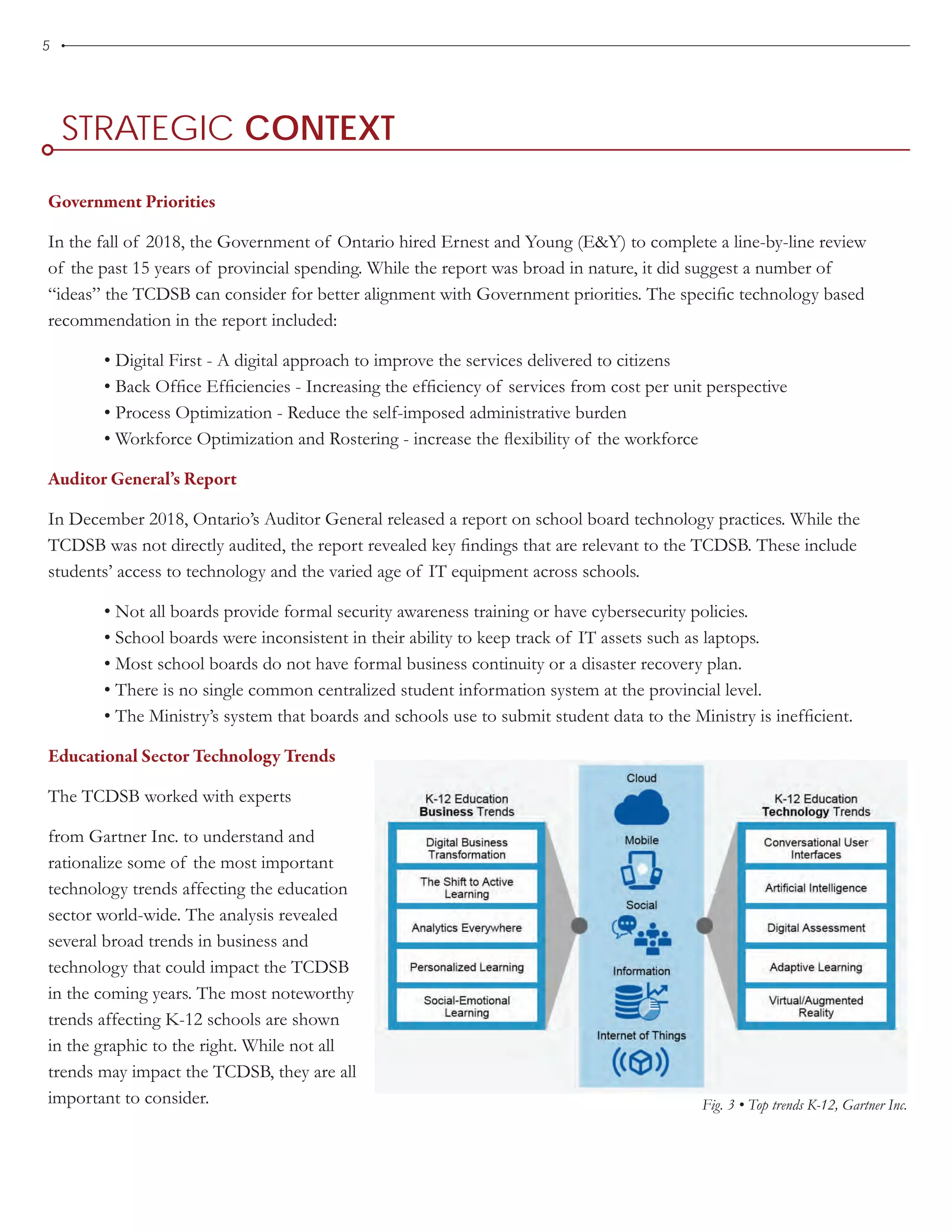
trends affecting K-12 schools are shown
in the graphic to the right. While not all
trends may impact the TCDSB, they are all
important to consider. Fig. 3 • Top trends K-12, Gartner Inc.
6
STRATEGIC CONTEXT
Digital SWOT Analysis
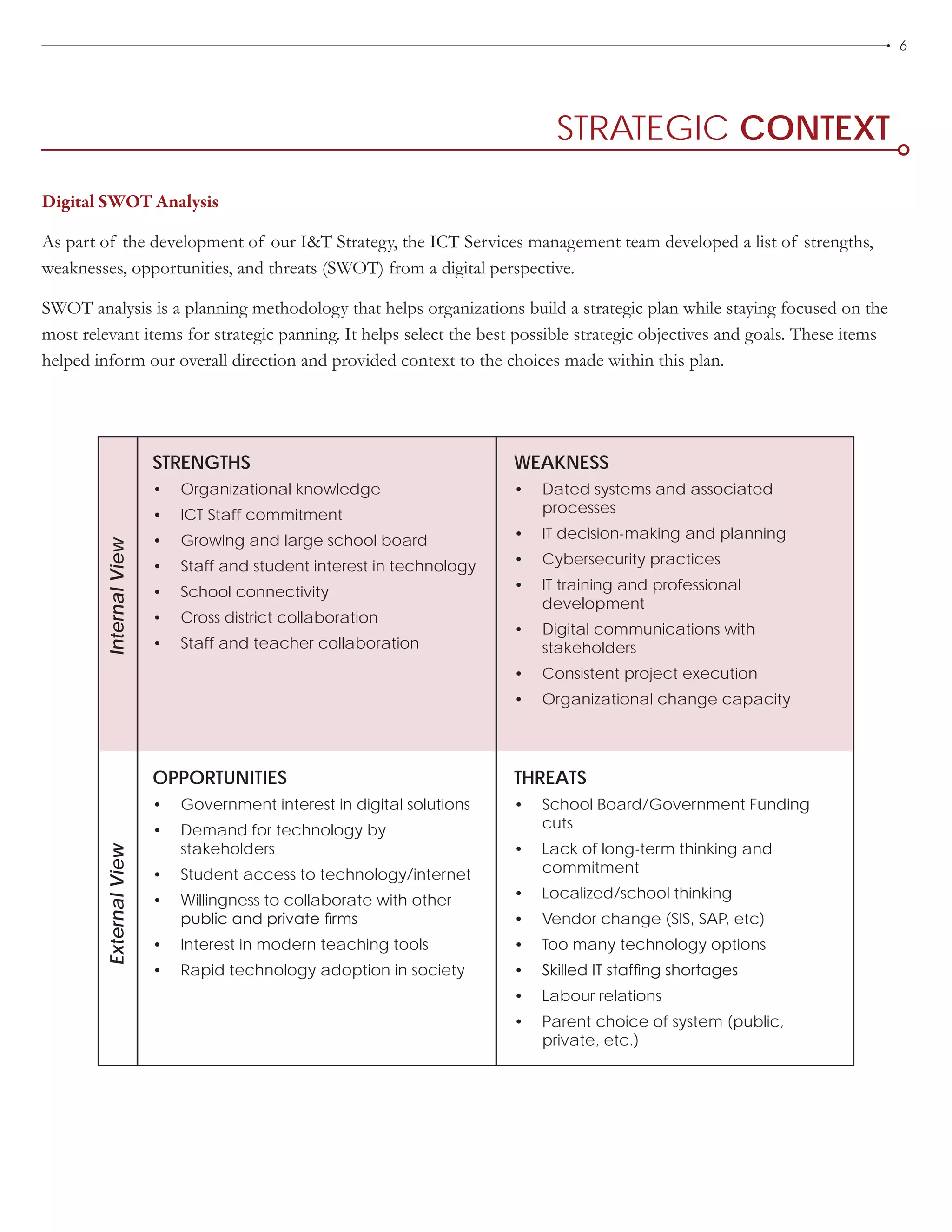
As part of the development of our I&T Strategy, the ICT Services management team developed a list of strengths,
weaknesses, opportunities, and threats (SWOT) from a digital perspective.
SWOT analysis is a planning methodology that helps organizations build a strategic plan while staying focused on the
most relevant items for strategic panning. It helps select the best possible strategic objectives and goals. These items
helped inform our overall direction and provided context to the choices made within this plan.
STRENGTHS
•	 Organizational knowledge
•	 ICT Staff commitment
•	 Growing and large school board
•	 Staff and student interest in technology
•	 School connectivity
•	 Cross district collaboration
•	 Staff and teacher collaboration
InternalViewExternalView
OPPORTUNITIES
•	 Government interest in digital solutions
•	 Demand for technology by
stakeholders
•	 Student access to technology/internet
•	 Willingness to collaborate with other
public and private firms
•	 Interest in modern teaching tools
•	 Rapid technology adoption in society
WEAKNESS
•	 Dated systems and associated
processes
•	 IT decision-making and planning
•	 Cybersecurity practices
•	 IT training and professional
development
•	 Digital communications with
stakeholders
•	 Consistent project execution
•	 Organizational change capacity
THREATS
•	 School Board/Government Funding
cuts
•	 Lack of long-term thinking and
commitment
•	 Localized/school thinking
•	 Vendor change (SIS, SAP, etc)
•	 Too many technology options
•	 Skilled IT staffing shortages
•	 Labour relations
•	 Parent choice of system (public,
private, etc.)
7
VISION FOR A DIGITALLY ENABLED SCHOOL
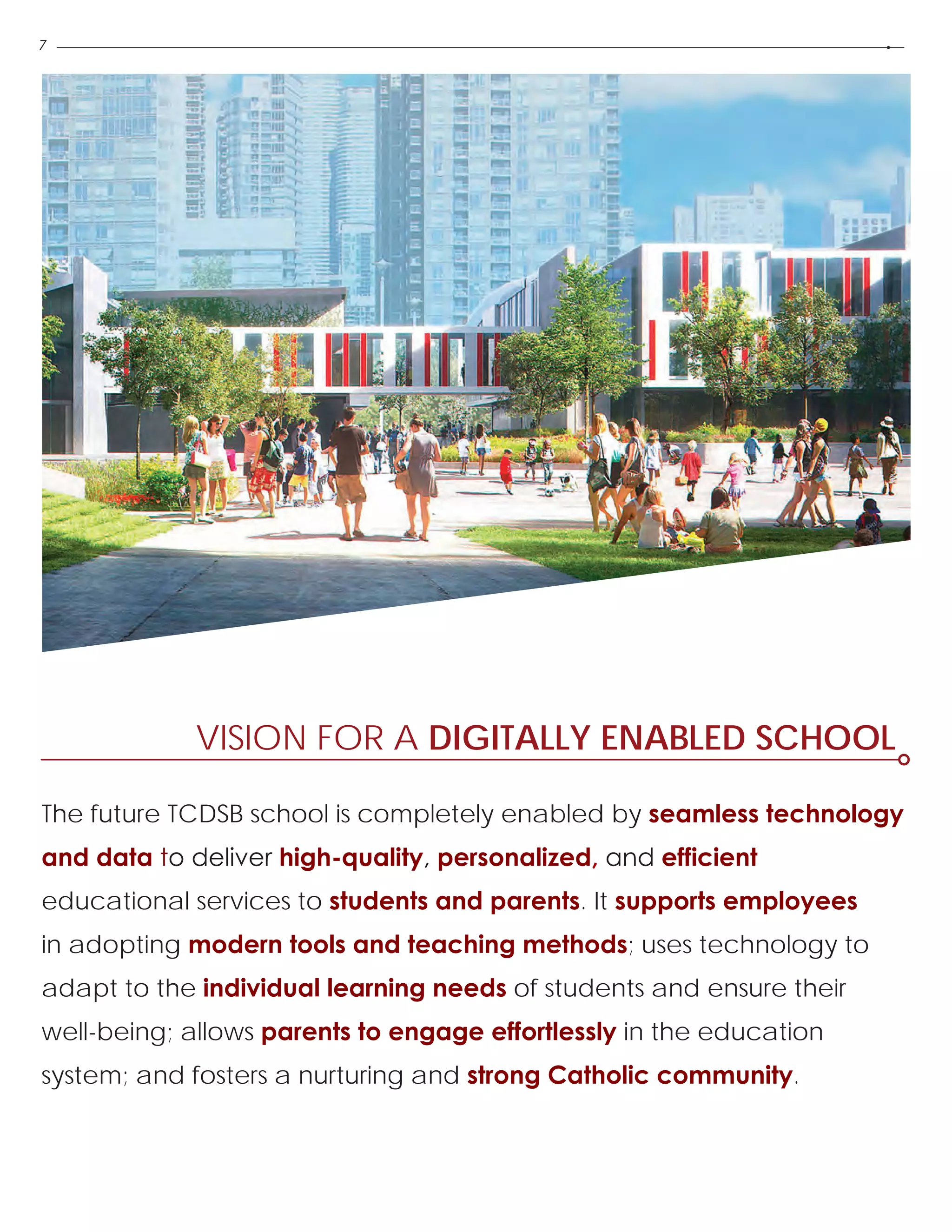
The future TCDSB school is completely enabled by seamless technology
and data to deliver high-quality, personalized, and efficient
educational services to students and parents. It supports employees
in adopting modern tools and teaching methods; uses technology to
adapt to the individual learning needs of students and ensure their
well-being; allows parents to engage effortlessly in the education
system; and fosters a nurturing and strong Catholic community.
8
Maximize
limited
Technology
Funding
to improve
student
and staff
experiences
DIGITALLY ENABLED SCHOOL
Seamless, Data-driven, Personal, Efficient
FEEDBACK
FUTURE OBJECTIVES
Adopt modern
workplace
tools
to free
employee
time for high
value work
Increase
digital
communications
to improve
parent and
student
engagment
Double our
use of online
communications
50% of
employees will
use modern
workplace
technology
weekly
Improve
our cyber-
security
maturity
score to 2.7
Deploy and
adopt at
least 2 major
enterprise
systems
Improve
both our IT
operations
and PPM
score to 2.5
Deploy
Foundational
Enterprise
systems
to drive
efficiency and
prepare for
the future
Enhance
cyber-
security
to safeguard
student
and family
privacy
•	 Data and Analytics
•	 IoT & Smart Buildings
•	 Personalized Learning
•	 Artificial Intelligence
GOALGOAL GOALGOAL GOAL
BUILD THE FOUNDATION FOR THE DIGITALLY ENABLED SCHOOL
2019 - 2022 Mission
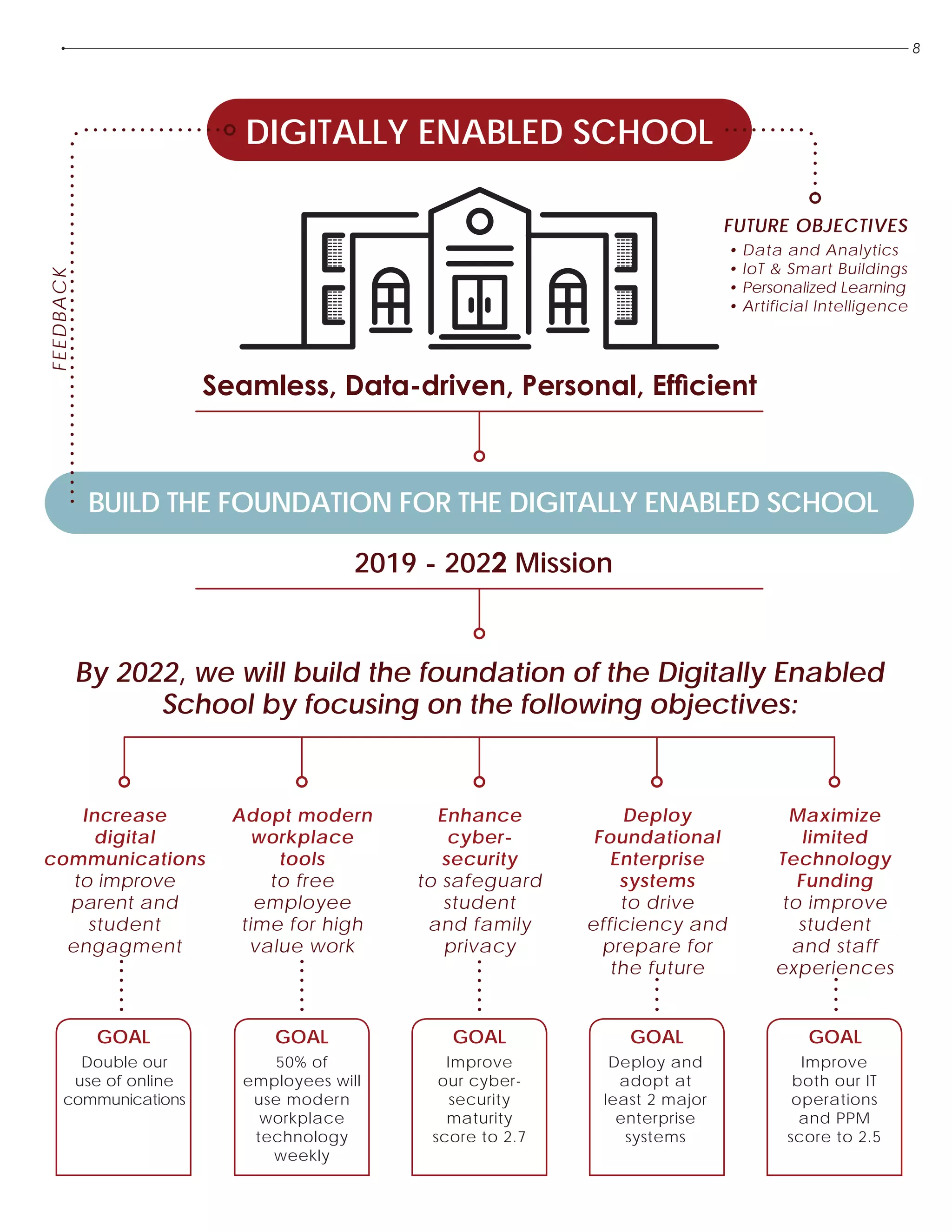
By 2022, we will build the foundation of the Digitally Enabled
School by focusing on the following objectives:
9
OBJECTIVEIncrease digital communications
to improve parent and student engagement
•	 Deploy a new, modern public website
•	 Digitize school and Trustee newsletters
•	 Deploy a digital portal for parents and students
•	 Offer IT supports to parents and students
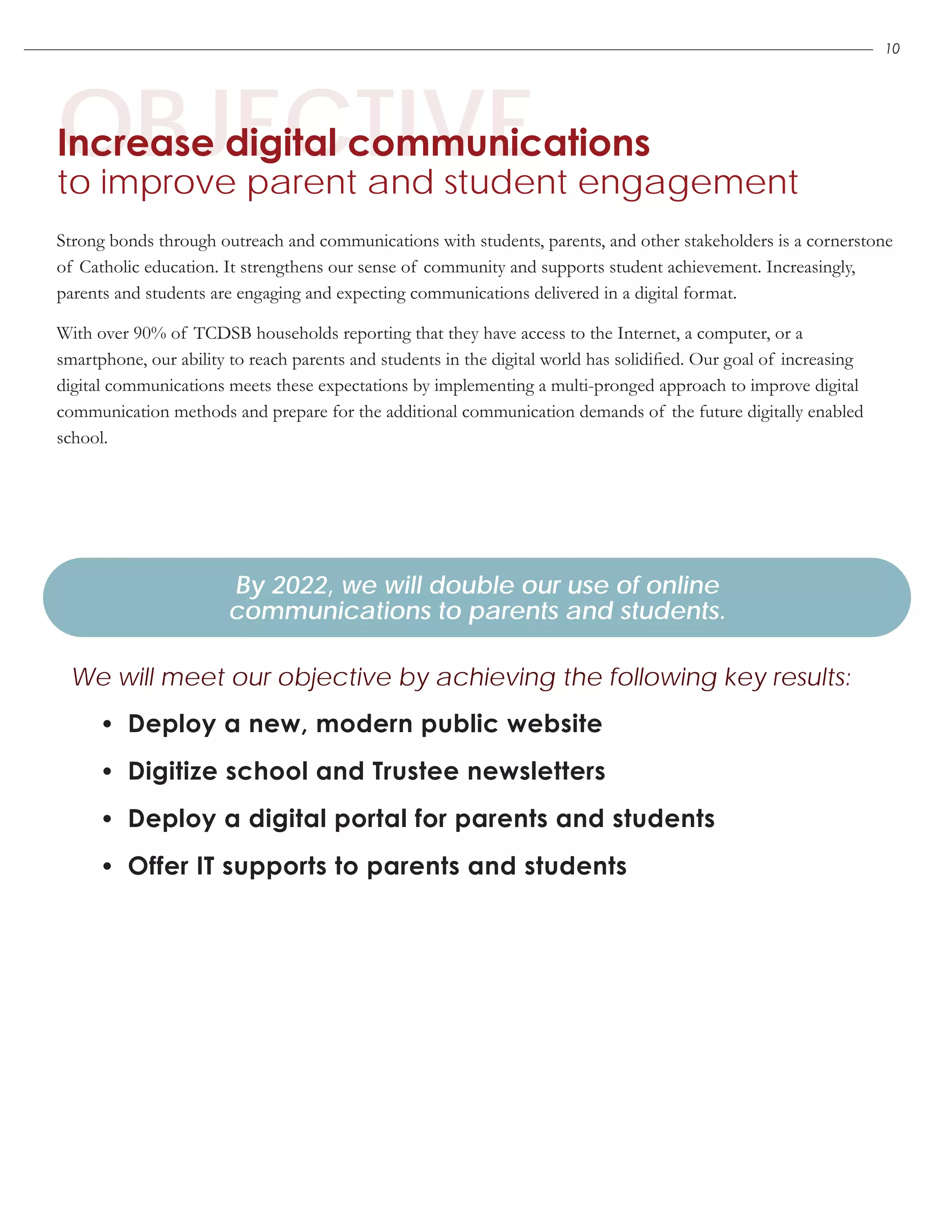
By 2022, we will double our use of online
communications to parents and students.
We will meet our objective by achieving the following key results:
Strong bonds through outreach and communications with students, parents, and other stakeholders is a cornerstone
of Catholic education. It strengthens our sense of community and supports student achievement. Increasingly,
parents and students are engaging and expecting communications delivered in a digital format.
With over 90% of TCDSB households reporting that they have access to the Internet, a computer, or a
smartphone, our ability to reach parents and students in the digital world has solidified. Our goal of increasing
digital communications meets these expectations by implementing a multi-pronged approach to improve digital
communication methods and prepare for the additional communication demands of the future digitally enabled
school.
10
11
OBJECTIVEAdapt modern workplace tools
to free employee time for high value work
•	 Replace our office systems with cloud-based solutions
•	 Deploy web meeting technology
•	 Deliver a robust training plan for workplace tools
•	 Ensure all employees have access to appropriate devices
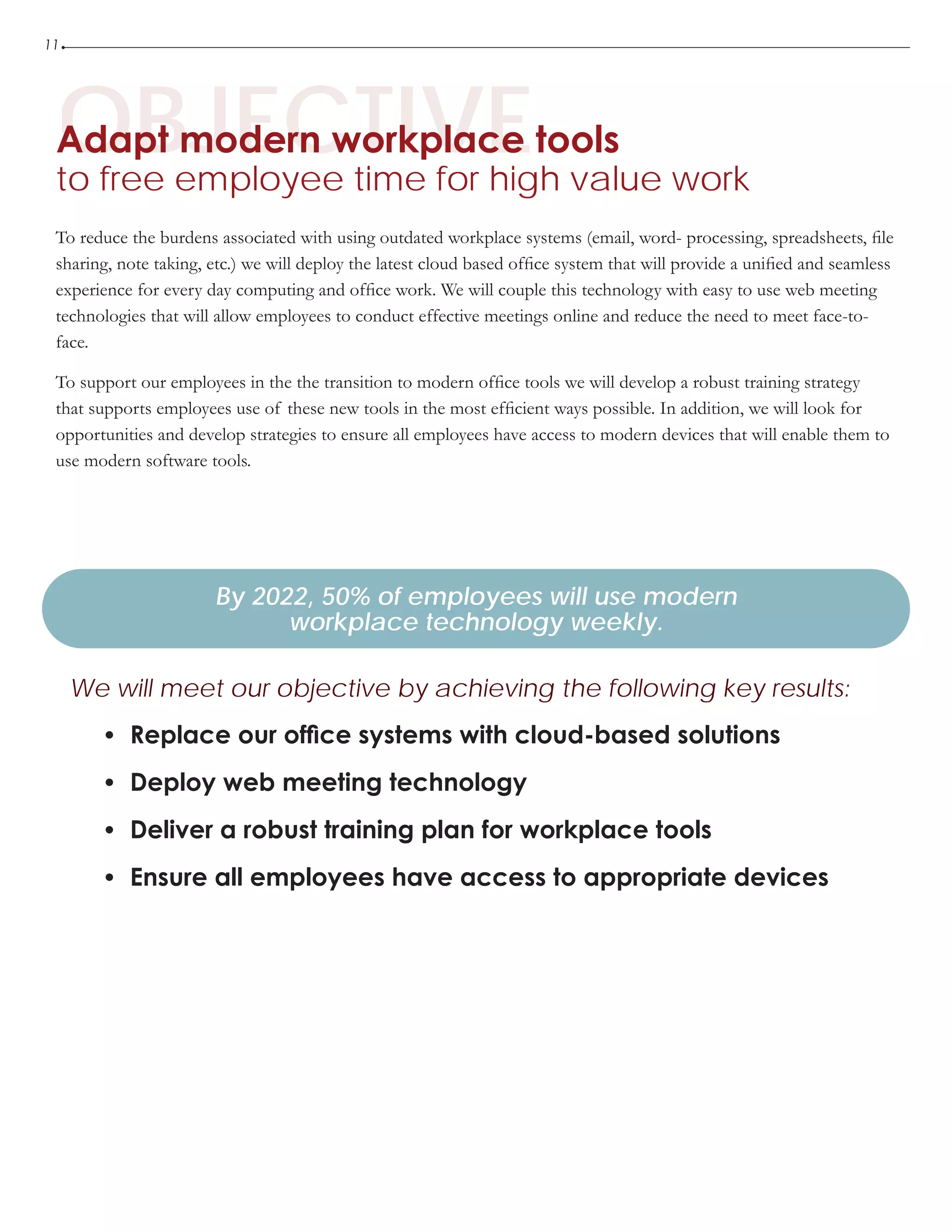
By 2022, 50% of employees will use modern
workplace technology weekly.
We will meet our objective by achieving the following key results:
To reduce the burdens associated with using outdated workplace systems (email, word- processing, spreadsheets, file
sharing, note taking, etc.) we will deploy the latest cloud based office system that will provide a unified and seamless
experience for every day computing and office work. We will couple this technology with easy to use web meeting
technologies that will allow employees to conduct effective meetings online and reduce the need to meet face-to-
face.
To support our employees in the the transition to modern office tools we will develop a robust training strategy
that supports employees use of these new tools in the most efficient ways possible. In addition, we will look for
opportunities and develop strategies to ensure all employees have access to modern devices that will enable them to
use modern software tools.
12
OBJECTIVEEnhance cybersecurity
to safeguard student and family privacy
•	 Create a dedicated IT security team
•	 Develop a formal and ongoing security awareness program
•	 Develop a robust IT security policy
•	 Formalize organization-wide IT security incident response plan
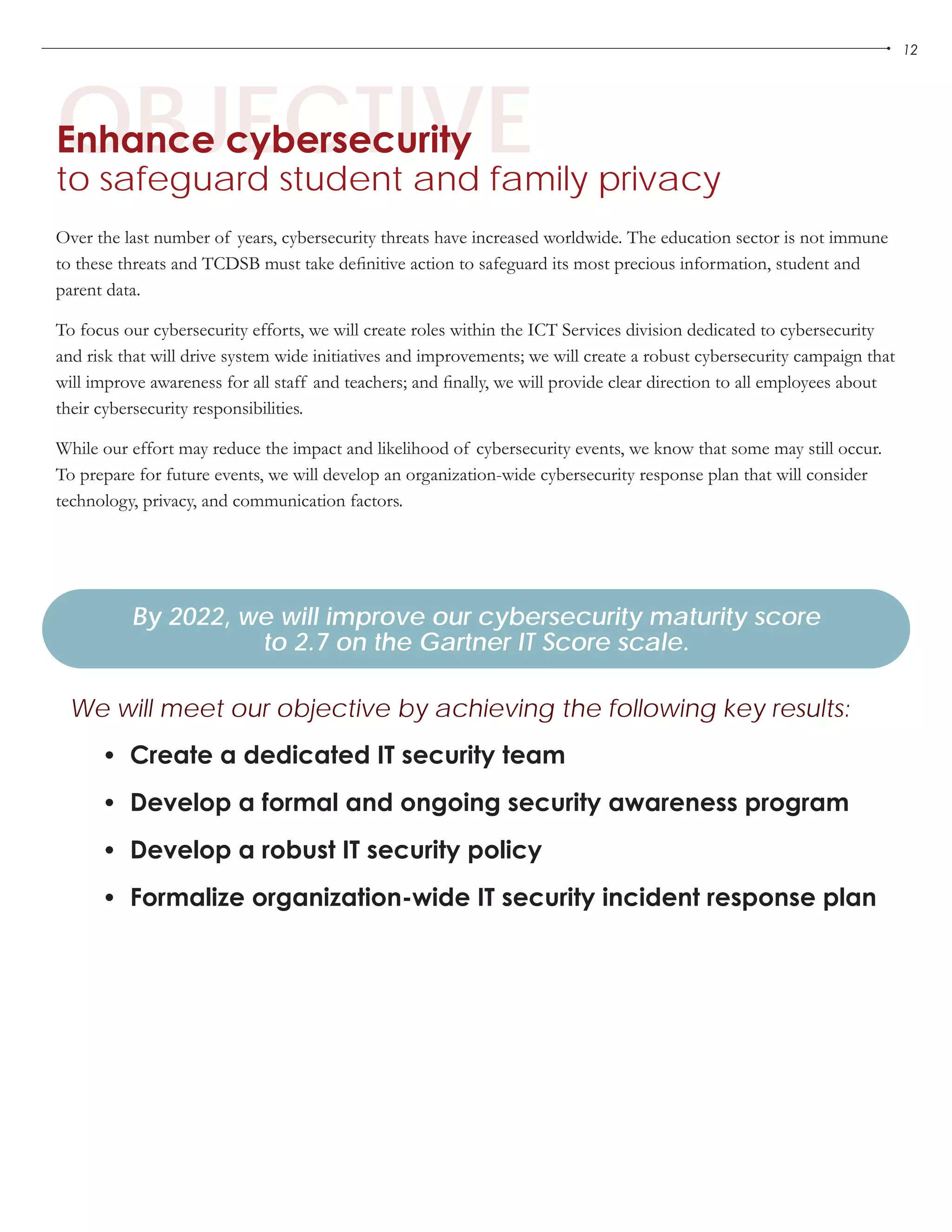
By 2022, we will improve our cybersecurity maturity score
to 2.7 on the Gartner IT Score scale.
We will meet our objective by achieving the following key results:
Over the last number of years, cybersecurity threats have increased worldwide. The education sector is not immune
to these threats and TCDSB must take definitive action to safeguard its most precious information, student and
parent data.
To focus our cybersecurity efforts, we will create roles within the ICT Services division dedicated to cybersecurity
and risk that will drive system wide initiatives and improvements; we will create a robust cybersecurity campaign that
will improve awareness for all staff and teachers; and finally, we will provide clear direction to all employees about
their cybersecurity responsibilities.
While our effort may reduce the impact and likelihood of cybersecurity events, we know that some may still occur.
To prepare for future events, we will develop an organization-wide cybersecurity response plan that will consider
technology, privacy, and communication factors.
13
OBJECTIVEDeploy foundational enterprise systems
to drive efficiency and prepare for the future
•	 Create dedicated implementation teams
•	 Implement a new cloud-based Student Information System
•	 Implement a new cloud-based HR recruitment system
•	 Rationalize and reduce the need for the development of
custom software
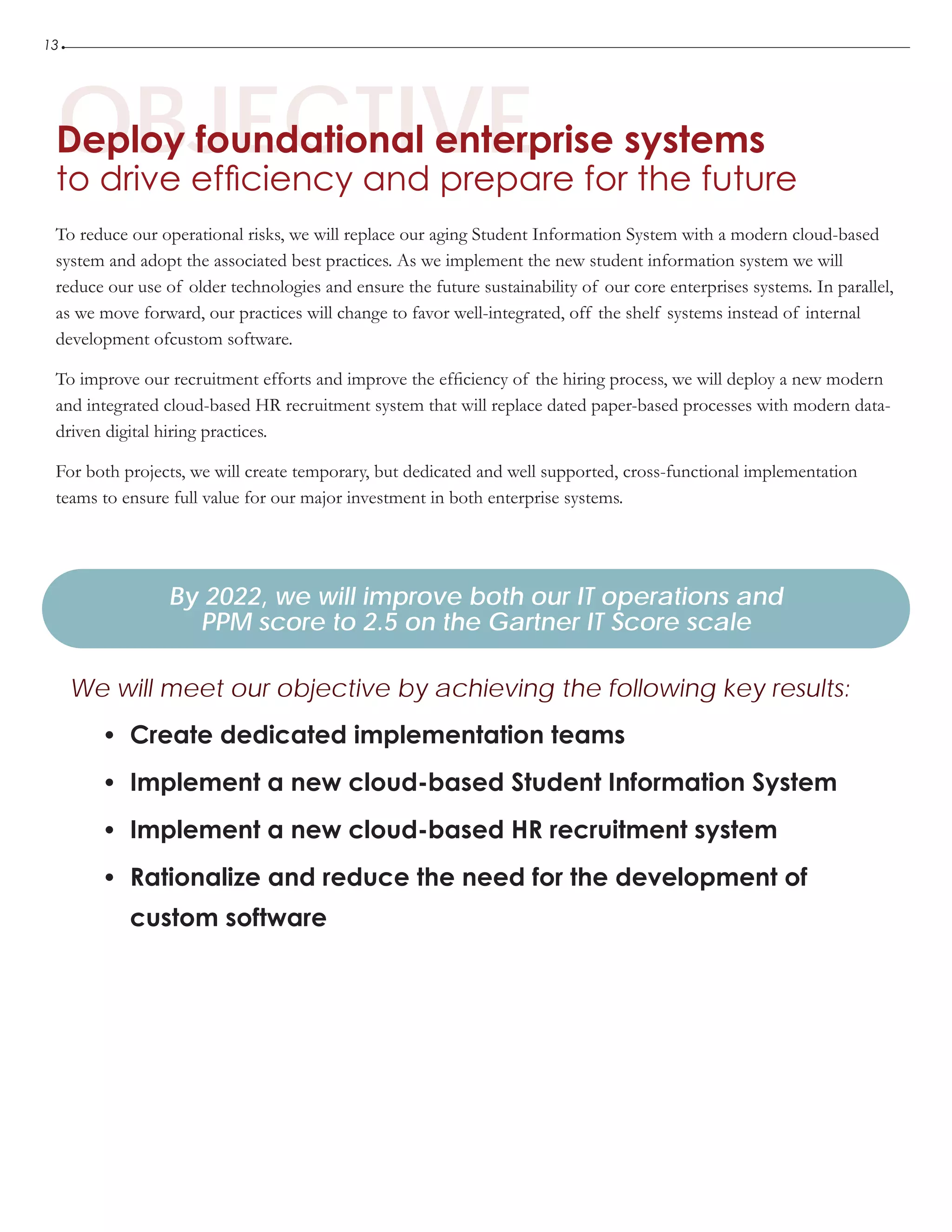
By 2022, we will improve both our IT operations and
PPM score to 2.5 on the Gartner IT Score scale
We will meet our objective by achieving the following key results:
To reduce our operational risks, we will replace our aging Student Information System with a modern cloud-based
system and adopt the associated best practices. As we implement the new student information system we will
reduce our use of older technologies and ensure the future sustainability of our core enterprises systems. In parallel,
as we move forward, our practices will change to favor well-integrated, off the shelf systems instead of internal
development ofcustom software.
To improve our recruitment efforts and improve the efficiency of the hiring process, we will deploy a new modern
and integrated cloud-based HR recruitment system that will replace dated paper-based processes with modern data-
driven digital hiring practices.
For both projects, we will create temporary, but dedicated and well supported, cross-functional implementation
teams to ensure full value for our major investment in both enterprise systems.
14
OBJECTIVEMaximize limited technology funding
to improve student and staff experiences
•	 Develop a formal IT governance structure
•	 Reorganize the IT department for efficiency
•	 Set up a formal PPM practice and team
•	 Standardize core IT operations, metrics & targets
•	 Develop a sustainable technology refresh plan for
classrooms
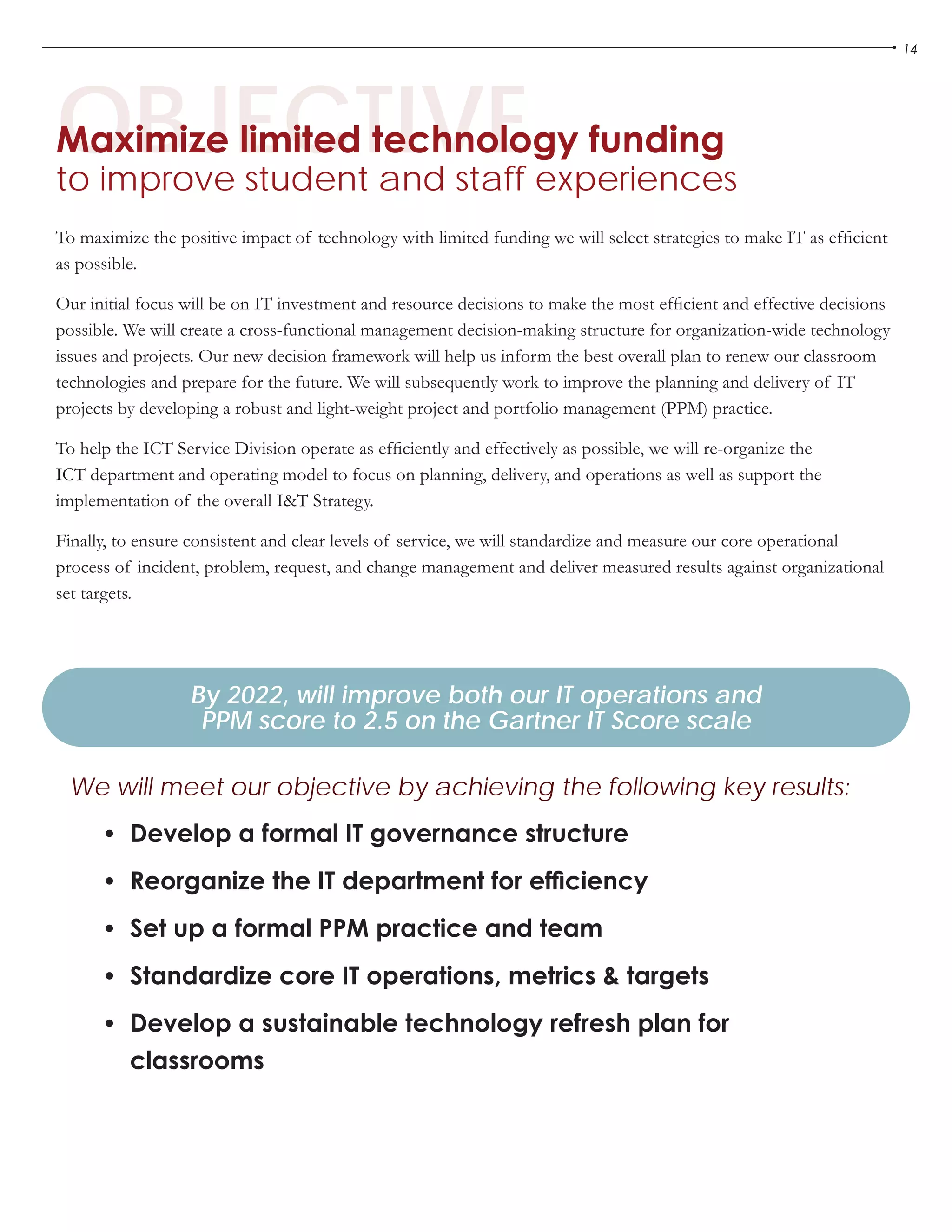
By 2022, will improve both our IT operations and
PPM score to 2.5 on the Gartner IT Score scale
We will meet our objective by achieving the following key results:
To maximize the positive impact of technology with limited funding we will select strategies to make IT as efficient
as possible.
Our initial focus will be on IT investment and resource decisions to make the most efficient and effective decisions
possible. We will create a cross-functional management decision-making structure for organization-wide technology
issues and projects. Our new decision framework will help us inform the best overall plan to renew our classroom
technologies and prepare for the future. We will subsequently work to improve the planning and delivery of IT
projects by developing a robust and light-weight project and portfolio management (PPM) practice.
To help the ICT Service Division operate as efficiently and effectively as possible, we will re-organize the
ICT department and operating model to focus on planning, delivery, and operations as well as support the
implementation of the overall I&T Strategy.
Finally, to ensure consistent and clear levels of service, we will standardize and measure our core operational
process of incident, problem, request, and change management and deliver measured results against organizational
set targets.
15
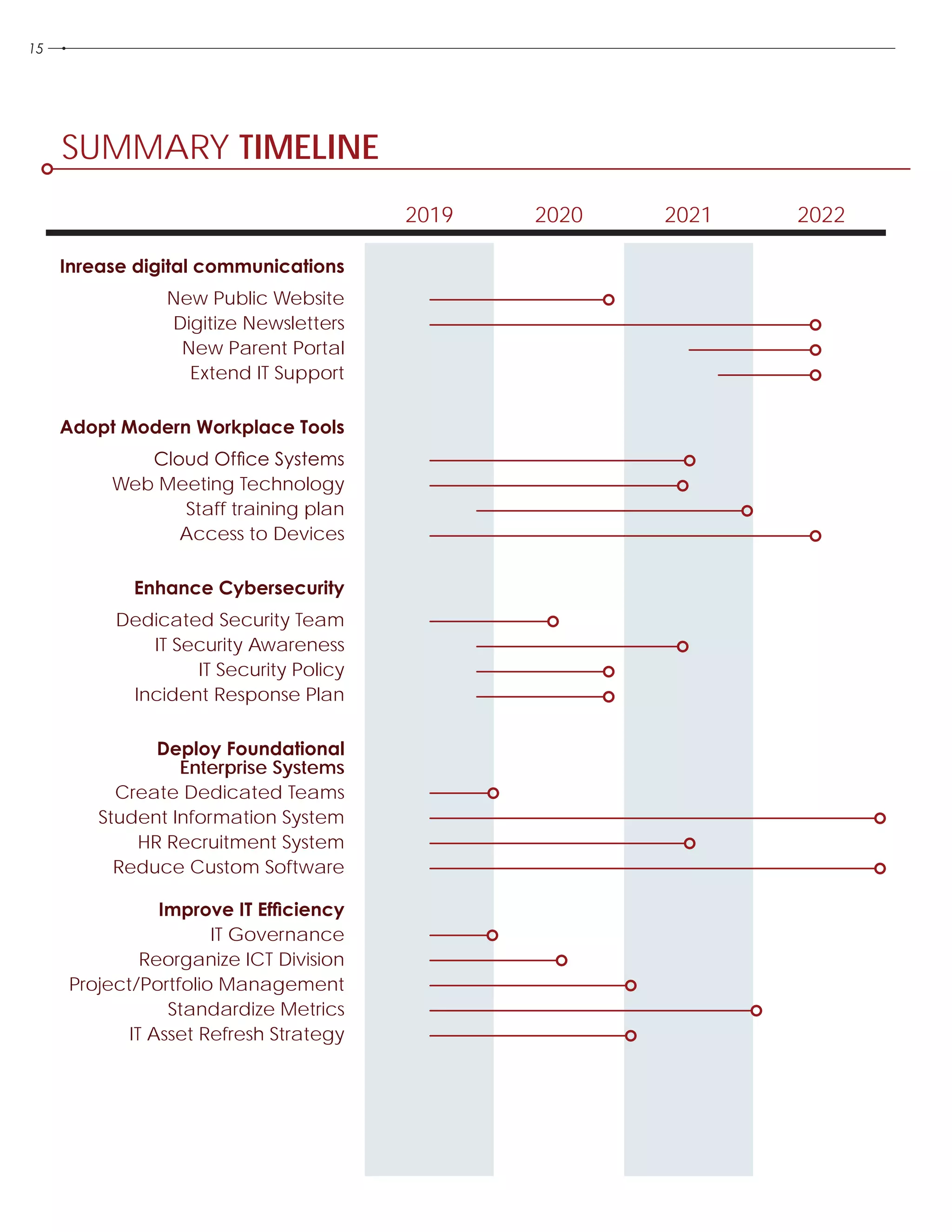
2019
Inrease digital communications	
New Public Website	
Digitize Newsletters	
New Parent Portal	
Extend IT Support
Adopt Modern Workplace Tools	
Cloud Office Systems	
Web Meeting Technology 	
Staff training plan	
Access to Devices
Enhance Cybersecurity	
Dedicated Security Team	
IT Security Awareness	
IT Security Policy	
Incident Response Plan
Deploy Foundational
Enterprise Systems
Create Dedicated Teams	
Student Information System
HR Recruitment System
Reduce Custom Software
Improve IT Efficiency
IT Governance
Reorganize ICT Division
Project/Portfolio Management
Standardize Metrics
IT Asset Refresh Strategy
202220212020
SUMMARY TIMELINE
16
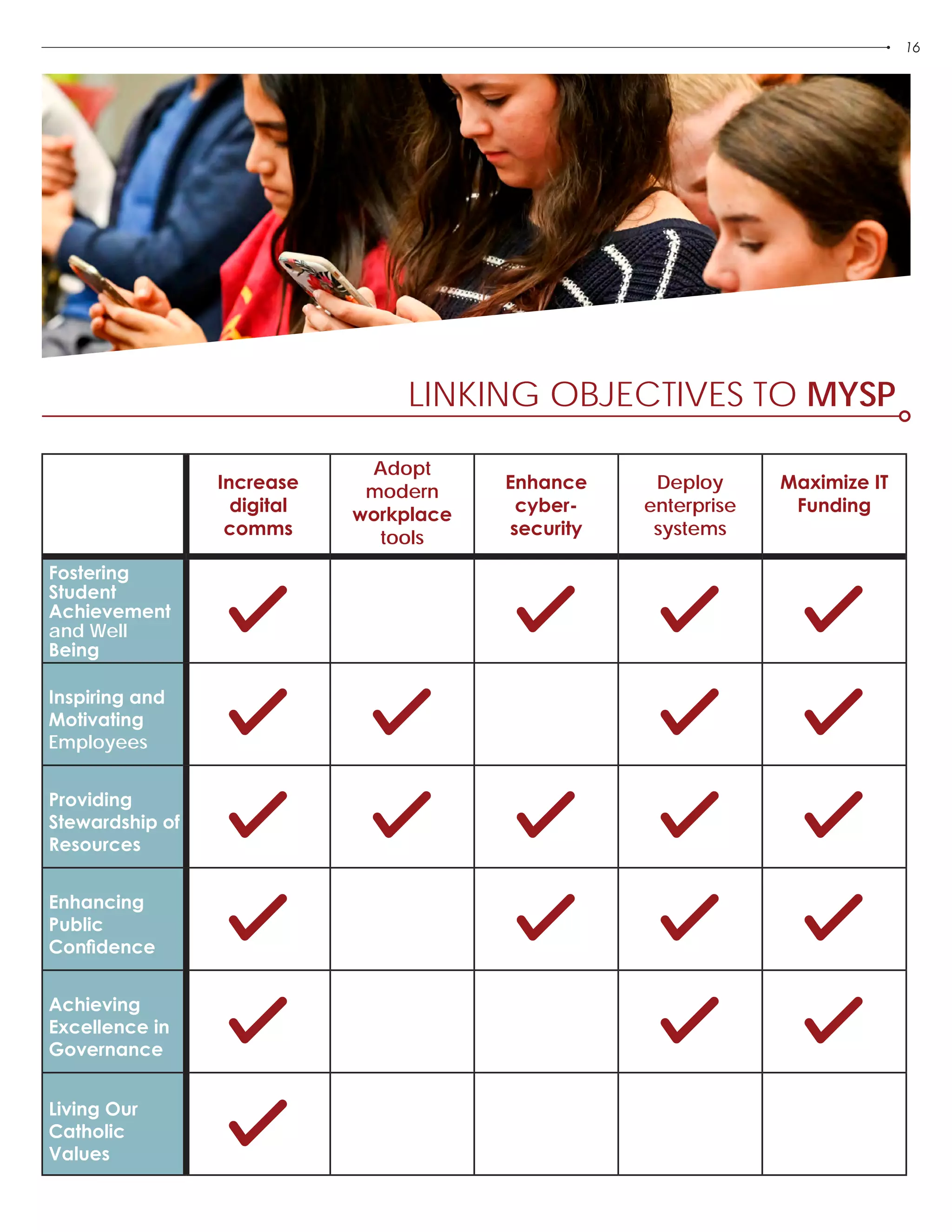
LINKING OBJECTIVES TO MYSP
Increase
digital
comms
Adopt
modern
workplace
tools
Enhance
cyber-
security
Deploy
enterprise
systems
Maximize IT
Funding
Fostering
Student
Achievement
and Well
Being
Inspiring and
Motivating
Employees
Providing
Stewardship of
Resources
Enhancing
Public
Confidence
Achieving
Excellence in
Governance
Living Our
Catholic
Values
17
TCDSB Information and Technology Strategy

TCDSB Information and Technology Strategy

  • 1.
    BUILDING THE FOUNDATIONFOR THE DIGITALLY ENABLED SCHOOL 2019 – 2022 INFORMATION & TECHNOLOGY STRATEGIC PLAN
  • 3.
    2 STEVE CAMACHO CHIEF INFORMATIONOFFICER INTRODUCTION RORY MCGUCKIN DIRECTOR OF EDUCATION Now, more than ever, our community of students, parents and Catholic supporters is engaging the education system through the lens of the digital world. To maximize our effectiveness as the largest Catholic school system, and to support our students in achieving their full potential, the Toronto Catholic District School Board (TCDSB) needs to leverage technology and the associated best practices that drive success. To achieve this, we have set a bold new vision to enable the digital future of our schools. The future TCDSB school is completely enabled by seamless technology and data to deliver high-quality, personalized, and efficient educational services to students and parents. It supports employees in adopting modern tools and teaching methods; uses technology to adapt to the individual learning needs of students while ensuring their well-being; allows parents to engage effortlessly in the education system; and fosters a nurturing and strong Catholic community. This long-term vision will not be achieved by simple words on paper or by individual decisions. It requires action and focus. It requires faith and perseverance. It requires cooperation and collaboration. All of this needs to be accomplished within the context of current fiscal challenges. To make this vision a reality we have developed a plan that will be delivered in three phases over the coming years. BUILD. UNITE. ACCELERATE. BUILD - Our 2019 to 2022 Information and Technology Strategic Plan takes the first steps toward our long-term digital vision by building the foundation for digitally enabled schools. We are taking a realistic set of actions on improving core technologies and practices across our system. Our 3-years plan will respond and prepare us for the changing world of education, improve our process and administrative practices, enable stronger connections with our parents and students, and enhance our ability to protect students in a digitally connected world. We will do this while balancing the pace of change with our fiscal reality. We are proud to take these first steps toward improving the use of technology across the system and encourage everyone to join us as we step into a bold new future.
  • 4.
    PLAN DEVELOPMENT 3 In November2018 we embarked on an almost year long journey to develop our new Information and Technology (I&T) Strategic Plan. Driven by the Chief Information Officer and working in collaboration with system leaders we engaged in a number of discussions and activities to understand our current environment and plan for our digital future. These activities included: • Reviewing educational technology trends • Benchmarking ourselves against other educational service providers with data from Gartner • Deep dive focus groups on key strategic topics • Analyzing our strengths, weakness, opportunities, and threats (SWOT) from a digital perspective • Completing a cybersecurity assessment and threat scenario exercise • A board-wide classroom technology asset audit • Reviewing past and current Parent Voice surveys • Understanding external priorities through a review of the Government’s Line-by-line spending report and the Auditor General’s report on school board information technology (IT) • Understanding and aligning our technology objectives with our Multi-Year Strategic Plan In addition to these robust input activities, we sought feedback to our draft plan from a number of groups to ensure we were on the right track. These consultations included: • Union partners to understand the impact on staff • Principals to understand how this plan will impact our schools • The Catholic Parent Involvement Committee to gain a parent’s perspective • Audit Committee to seek input from our elected Trustees and externals committee members.
  • 5.
    4 STRATEGIC CONTEXT Benchmarking To understandour current context, we benchmarked ourselves against several financial and operational metrics. Our analysis revealed a significant gap in IT spending and an equally significant gap in IT process maturity. We believe that the lack of IT investment over many years has led to underdeveloped technological capabilities for the organization that need to be addressed with a strong focus on the foundations. While these findings are cause for discussion, we believe the information is important to share in order to have a deeper understanding of challenges we face. Through this understanding we can develop a plan that is realistic yet aspirational enough to have a meaningful and positive impact on parents, students, and other stakeholders. Our benchmarking work compared TCDSB’s IT metrics against world-wide educational sector data maintained by Gartner Inc., a well known technology advisor. This industry average includes data from both K-12 and Higher Education institutions collected in 2018. The data does not include other school boards in Ontario because such data does not currently exist. However, given school boards in Ontario are all funded using the same funding formula, we believe this situation is not unique to the TCDSB. Nevertheless, we believe we can do better with resources we have and our plan focuses on maximizing that opportunity now and into the future. % of total budget spent on IT 2.1% 5.7% % of IT employees vs total 0.8% 4.9% % of IT budget spent on “Run” 93.0% 75.0% TCDSB Fig. 1 • *data from Gartner Inc. EDU AVG* Applications 1.9 2.0 Data and Analytics 2.0 2.2 Architecture and Innovation 1.9 2.2 Infastructure and Operations 1.9 2.3 Program and Portfolio 1.6 2.6 Information Security 2.2 2.7 Privacy 2.5 2.5 IT Strategy and Execution 1.6 2.3 TCDSB EDU AVG Fig. 2 • data from Gartner Inc. out of max score of 5.0
  • 6.
    5 STRATEGIC CONTEXT Government Priorities Inthe fall of 2018, the Government of Ontario hired Ernest and Young (E&Y) to complete a line-by-line review of the past 15 years of provincial spending. While the report was broad in nature, it did suggest a number of “ideas” the TCDSB can consider for better alignment with Government priorities. The specific technology based recommendation in the report included: • Digital First - A digital approach to improve the services delivered to citizens • Back Office Efficiencies - Increasing the efficiency of services from cost per unit perspective • Process Optimization - Reduce the self-imposed administrative burden • Workforce Optimization and Rostering - increase the flexibility of the workforce Auditor General’s Report In December 2018, Ontario’s Auditor General released a report on school board technology practices. While the TCDSB was not directly audited, the report revealed key findings that are relevant to the TCDSB. These include students’ access to technology and the varied age of IT equipment across schools. • Not all boards provide formal security awareness training or have cybersecurity policies. • School boards were inconsistent in their ability to keep track of IT assets such as laptops. • Most school boards do not have formal business continuity or a disaster recovery plan. • There is no single common centralized student information system at the provincial level. • The Ministry’s system that boards and schools use to submit student data to the Ministry is inefficient. Educational Sector Technology Trends The TCDSB worked with experts from Gartner Inc. to understand and rationalize some of the most important technology trends affecting the education sector world-wide. The analysis revealed several broad trends in business and technology that could impact the TCDSB in the coming years. The most noteworthy trends affecting K-12 schools are shown in the graphic to the right. While not all trends may impact the TCDSB, they are all important to consider. Fig. 3 • Top trends K-12, Gartner Inc.
  • 7.
    6 STRATEGIC CONTEXT Digital SWOTAnalysis As part of the development of our I&T Strategy, the ICT Services management team developed a list of strengths, weaknesses, opportunities, and threats (SWOT) from a digital perspective. SWOT analysis is a planning methodology that helps organizations build a strategic plan while staying focused on the most relevant items for strategic panning. It helps select the best possible strategic objectives and goals. These items helped inform our overall direction and provided context to the choices made within this plan. STRENGTHS • Organizational knowledge • ICT Staff commitment • Growing and large school board • Staff and student interest in technology • School connectivity • Cross district collaboration • Staff and teacher collaboration InternalViewExternalView OPPORTUNITIES • Government interest in digital solutions • Demand for technology by stakeholders • Student access to technology/internet • Willingness to collaborate with other public and private firms • Interest in modern teaching tools • Rapid technology adoption in society WEAKNESS • Dated systems and associated processes • IT decision-making and planning • Cybersecurity practices • IT training and professional development • Digital communications with stakeholders • Consistent project execution • Organizational change capacity THREATS • School Board/Government Funding cuts • Lack of long-term thinking and commitment • Localized/school thinking • Vendor change (SIS, SAP, etc) • Too many technology options • Skilled IT staffing shortages • Labour relations • Parent choice of system (public, private, etc.)
  • 8.
    7 VISION FOR ADIGITALLY ENABLED SCHOOL The future TCDSB school is completely enabled by seamless technology and data to deliver high-quality, personalized, and efficient educational services to students and parents. It supports employees in adopting modern tools and teaching methods; uses technology to adapt to the individual learning needs of students and ensure their well-being; allows parents to engage effortlessly in the education system; and fosters a nurturing and strong Catholic community.
  • 9.
    8 Maximize limited Technology Funding to improve student and staff experiences DIGITALLYENABLED SCHOOL Seamless, Data-driven, Personal, Efficient FEEDBACK FUTURE OBJECTIVES Adopt modern workplace tools to free employee time for high value work Increase digital communications to improve parent and student engagment Double our use of online communications 50% of employees will use modern workplace technology weekly Improve our cyber- security maturity score to 2.7 Deploy and adopt at least 2 major enterprise systems Improve both our IT operations and PPM score to 2.5 Deploy Foundational Enterprise systems to drive efficiency and prepare for the future Enhance cyber- security to safeguard student and family privacy • Data and Analytics • IoT & Smart Buildings • Personalized Learning • Artificial Intelligence GOALGOAL GOALGOAL GOAL BUILD THE FOUNDATION FOR THE DIGITALLY ENABLED SCHOOL 2019 - 2022 Mission By 2022, we will build the foundation of the Digitally Enabled School by focusing on the following objectives:
  • 10.
  • 11.
    OBJECTIVEIncrease digital communications toimprove parent and student engagement • Deploy a new, modern public website • Digitize school and Trustee newsletters • Deploy a digital portal for parents and students • Offer IT supports to parents and students By 2022, we will double our use of online communications to parents and students. We will meet our objective by achieving the following key results: Strong bonds through outreach and communications with students, parents, and other stakeholders is a cornerstone of Catholic education. It strengthens our sense of community and supports student achievement. Increasingly, parents and students are engaging and expecting communications delivered in a digital format. With over 90% of TCDSB households reporting that they have access to the Internet, a computer, or a smartphone, our ability to reach parents and students in the digital world has solidified. Our goal of increasing digital communications meets these expectations by implementing a multi-pronged approach to improve digital communication methods and prepare for the additional communication demands of the future digitally enabled school. 10
  • 12.
    11 OBJECTIVEAdapt modern workplacetools to free employee time for high value work • Replace our office systems with cloud-based solutions • Deploy web meeting technology • Deliver a robust training plan for workplace tools • Ensure all employees have access to appropriate devices By 2022, 50% of employees will use modern workplace technology weekly. We will meet our objective by achieving the following key results: To reduce the burdens associated with using outdated workplace systems (email, word- processing, spreadsheets, file sharing, note taking, etc.) we will deploy the latest cloud based office system that will provide a unified and seamless experience for every day computing and office work. We will couple this technology with easy to use web meeting technologies that will allow employees to conduct effective meetings online and reduce the need to meet face-to- face. To support our employees in the the transition to modern office tools we will develop a robust training strategy that supports employees use of these new tools in the most efficient ways possible. In addition, we will look for opportunities and develop strategies to ensure all employees have access to modern devices that will enable them to use modern software tools.
  • 13.
    12 OBJECTIVEEnhance cybersecurity to safeguardstudent and family privacy • Create a dedicated IT security team • Develop a formal and ongoing security awareness program • Develop a robust IT security policy • Formalize organization-wide IT security incident response plan By 2022, we will improve our cybersecurity maturity score to 2.7 on the Gartner IT Score scale. We will meet our objective by achieving the following key results: Over the last number of years, cybersecurity threats have increased worldwide. The education sector is not immune to these threats and TCDSB must take definitive action to safeguard its most precious information, student and parent data. To focus our cybersecurity efforts, we will create roles within the ICT Services division dedicated to cybersecurity and risk that will drive system wide initiatives and improvements; we will create a robust cybersecurity campaign that will improve awareness for all staff and teachers; and finally, we will provide clear direction to all employees about their cybersecurity responsibilities. While our effort may reduce the impact and likelihood of cybersecurity events, we know that some may still occur. To prepare for future events, we will develop an organization-wide cybersecurity response plan that will consider technology, privacy, and communication factors.
  • 14.
    13 OBJECTIVEDeploy foundational enterprisesystems to drive efficiency and prepare for the future • Create dedicated implementation teams • Implement a new cloud-based Student Information System • Implement a new cloud-based HR recruitment system • Rationalize and reduce the need for the development of custom software By 2022, we will improve both our IT operations and PPM score to 2.5 on the Gartner IT Score scale We will meet our objective by achieving the following key results: To reduce our operational risks, we will replace our aging Student Information System with a modern cloud-based system and adopt the associated best practices. As we implement the new student information system we will reduce our use of older technologies and ensure the future sustainability of our core enterprises systems. In parallel, as we move forward, our practices will change to favor well-integrated, off the shelf systems instead of internal development ofcustom software. To improve our recruitment efforts and improve the efficiency of the hiring process, we will deploy a new modern and integrated cloud-based HR recruitment system that will replace dated paper-based processes with modern data- driven digital hiring practices. For both projects, we will create temporary, but dedicated and well supported, cross-functional implementation teams to ensure full value for our major investment in both enterprise systems.
  • 15.
    14 OBJECTIVEMaximize limited technologyfunding to improve student and staff experiences • Develop a formal IT governance structure • Reorganize the IT department for efficiency • Set up a formal PPM practice and team • Standardize core IT operations, metrics & targets • Develop a sustainable technology refresh plan for classrooms By 2022, will improve both our IT operations and PPM score to 2.5 on the Gartner IT Score scale We will meet our objective by achieving the following key results: To maximize the positive impact of technology with limited funding we will select strategies to make IT as efficient as possible. Our initial focus will be on IT investment and resource decisions to make the most efficient and effective decisions possible. We will create a cross-functional management decision-making structure for organization-wide technology issues and projects. Our new decision framework will help us inform the best overall plan to renew our classroom technologies and prepare for the future. We will subsequently work to improve the planning and delivery of IT projects by developing a robust and light-weight project and portfolio management (PPM) practice. To help the ICT Service Division operate as efficiently and effectively as possible, we will re-organize the ICT department and operating model to focus on planning, delivery, and operations as well as support the implementation of the overall I&T Strategy. Finally, to ensure consistent and clear levels of service, we will standardize and measure our core operational process of incident, problem, request, and change management and deliver measured results against organizational set targets.
  • 16.
    15 2019 Inrease digital communications NewPublic Website Digitize Newsletters New Parent Portal Extend IT Support Adopt Modern Workplace Tools Cloud Office Systems Web Meeting Technology Staff training plan Access to Devices Enhance Cybersecurity Dedicated Security Team IT Security Awareness IT Security Policy Incident Response Plan Deploy Foundational Enterprise Systems Create Dedicated Teams Student Information System HR Recruitment System Reduce Custom Software Improve IT Efficiency IT Governance Reorganize ICT Division Project/Portfolio Management Standardize Metrics IT Asset Refresh Strategy 202220212020 SUMMARY TIMELINE
  • 17.
    16 LINKING OBJECTIVES TOMYSP Increase digital comms Adopt modern workplace tools Enhance cyber- security Deploy enterprise systems Maximize IT Funding Fostering Student Achievement and Well Being Inspiring and Motivating Employees Providing Stewardship of Resources Enhancing Public Confidence Achieving Excellence in Governance Living Our Catholic Values
  • 18.