Framing well-being policies for our students:
results from our Digital Toolkit research
Debbie Holley and David Biggins, Bournemouth University, Marketa Supa,
Charles University, Prague.
“Some teaching staff kind of cover that
[digital identity and wellbeing] in their
sessions because they deal with things
like safe guarding. (…) Also raising
awareness of some of the problems
(…) the students are left on their own
to deal with.”
Methodological approach
4 key
themes
and a
model
Review of EU
digicomp
frameworks &
JISC framework
31 survey
respondents
7 interviews
TEL toolkits are the ‘new’ norm
Students receivers/staff as providers
transmissions models
image theatlantic.com /
‘Role of the educator’ remains unchanged
Image: Bath University
Staff are hindered by archaic structures
Audience participation time!
In 20 seconds write down your
favourite ‘archaic’ structure gripe
and swop with your neighbour!
Staff and students: a schism between
‘now’ and ‘future
Our findings
point to a
polarisation of
processes within
which digital
literacies are being
‘delivered’
The desire for
lifelong learning
and digital
wellbeing is not
being addressed
Ground up: wellbeing and
digital identify acknowledges
students digital & lived lives
Strategic down:
Institutional approaches to
student wellbeing hardly or
never discussed
“Wellbeing is something that obviously
the university is concerned about but
not in terms of a digital capability”
So what is ‘out there’?
• Courses, Apps, self help, links to mental health, pages and pages and
pages of ‘student ‘wellbeing’ at University websites for staff and students
• Whole units on learning ‘digital stuff’
• Lack of institutional wide and joined up thinking
Google DigitalGarage
It seems ‘easy’ to get fixed
Futurelearn: digital wellbeing
EU project underway
classification of tools by genre, nothing on
student stress
Audience participation time!
In 20 seconds list a resource on
digital wellbeing for sharing on the
JISC padlet/ textwall later…
What might the solution look like?
Remarkably like the JISC model !
A maturity model for self-assessment and benchmarking
Theme Dimension Level 0 Level 1 Level 2 Level 3 Level 4 Level 5
1a Institutional
strategy
(JISC
benchmark)
Digital learning
is not part of
the
organisational
strategy
The strategy
acknowledges
digital learning
The strategy
mentions digital
learning
Digital
learning is a
component of
the
institutional
strategy
Digital
learning
underpins
institutional
strategy.
Organisations
have a
defined digital
strategy.
Digital
learning
strongly
informs
institutional
strategy
1b Organisational
culture of
digital learning
and innovation
There is no
culture of
digital
learning.
Innovation is
not expected
of staff and
students
The learning
culture is
individual not
institutional.
Innovation is
not shared.
Learning
cultures and
innovation are
emergent at
department
levels
Learning has
equal
importance to
other cultures
eg research.
Innovation is
encouraged.
Innovation is
encouraged of
staff and
students
Learning is
the dominant
culture.
Culture
development
is actively
supported.
Innovation is
recorded,
celebrated
and
promulgated
Staff and
students
completely
buy-in to the
learning
culture.
Innovation is
core to the
learning
culture
1c Technical
infrastructure
There is no
defined
technical
infrastructure
Technical
considerations
dominate eg
availability and
security,
hardware
The
infrastructure
supports and
also inhibits
digital learning
The
infrastructure
supports
digital
learning
The
infrastructure
encouraged
digital
learning
Digital
learning
drives the
technical
infrastructure
Conceptualising a digital maturity model
Starting with
JISC of course!
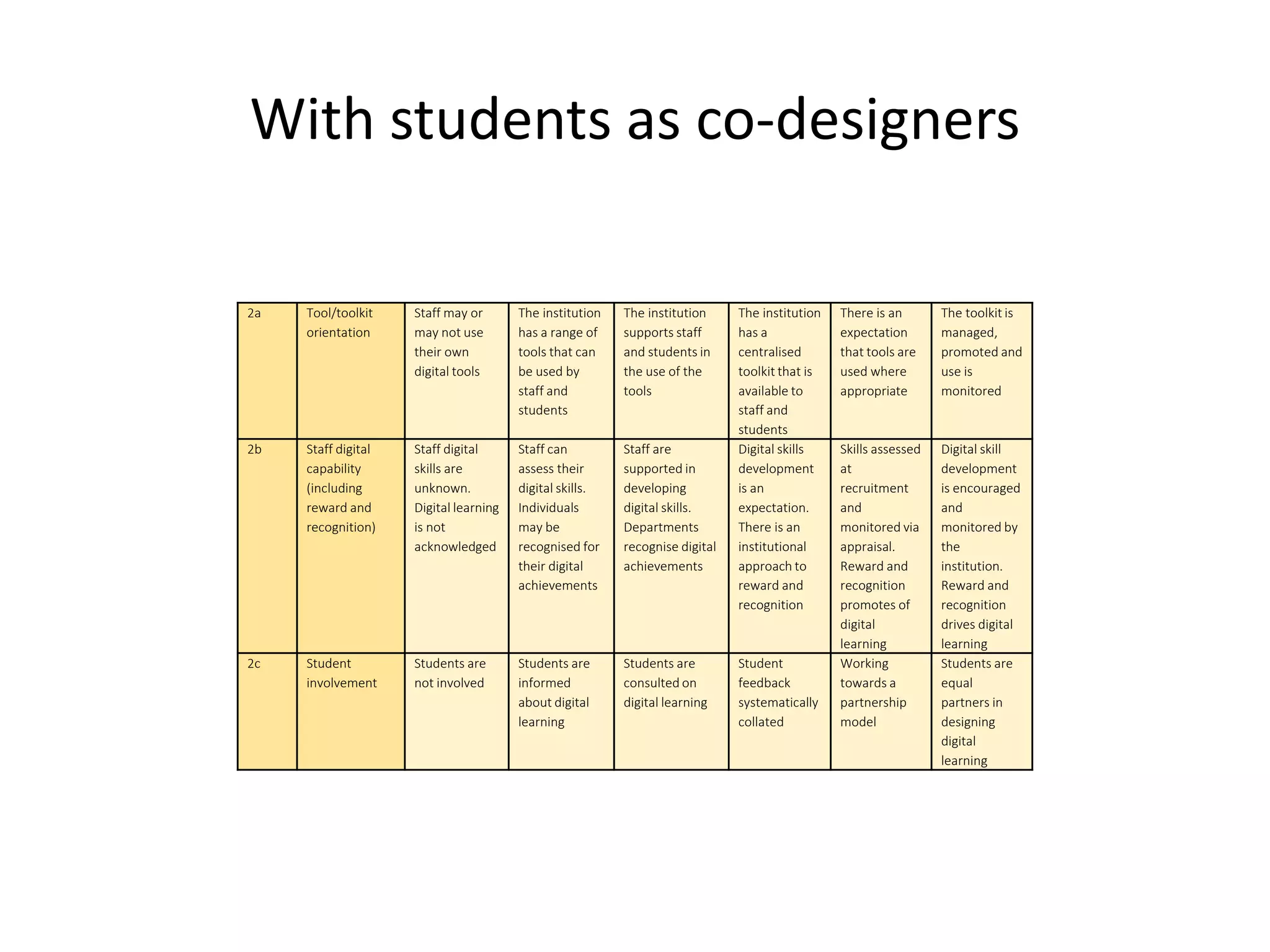
2a Tool/toolkit
orientation
Staff may or
may not use
their own
digital tools
The institution
has a range of
tools that can
be used by
staff and
students
The institution
supports staff
and students in
the use of the
tools
The institution
has a
centralised
toolkit that is
available to
staff and
students
There is an
expectation
that tools are
used where
appropriate
The toolkit is
managed,
promoted and
use is
monitored
2b Staff digital
capability
(including
reward and
recognition)
Staff digital
skills are
unknown.
Digital learning
is not
acknowledged
Staff can
assess their
digital skills.
Individuals
may be
recognised for
their digital
achievements
Staff are
supported in
developing
digital skills.
Departments
recognise digital
achievements
Digital skills
development
is an
expectation.
There is an
institutional
approach to
reward and
recognition
Skills assessed
at
recruitment
and
monitored via
appraisal.
Reward and
recognition
promotes of
digital
learning
Digital skill
development
is encouraged
and
monitored by
the
institution.
Reward and
recognition
drives digital
learning
2c Student
involvement
Students are
not involved
Students are
informed
about digital
learning
Students are
consulted on
digital learning
Student
feedback
systematically
collated
Working
towards a
partnership
model
Students are
equal
partners in
designing
digital
learning
With students as co-designers
Wellbeing and institutional compassion
3a Future
orientation
How digital
learning
affects future
employability
is not
understood
The
understanding
of future
employability
needs is
embryonic
Departments
are aware of the
link between
future
employment
and digital skills
An
institutional
bottom –up
and top down
approach
Future needs
influence
digital
learning
Future needs
drive digital
learning
3b Lifelong
learning
The institution
has no policy
for lifelong
learning
Evidence of
lifelong
learning and
outcomes is
anecdotal
Departments
monitor lifelong
learning and
outcomes
There is an
institutional
approach to
monitoring of
lifelong
learning and
outcomes
Feedback on
outcomes is
used to
inform digital
learning
Lifelong
learning and
outcomes
drive digital
learning
3c Wellbeing and
Institutional
compassion
There is no
consideration
of
staff/student
wellbeing
Some staff give
consideration
to
staff/student
needs
Tools are chosen
based on their
wellbeing
impact
Those
involved are
asked for their
response to
digital
learning
Staff/student
feedback
informs digital
learning
Staff/student
feedback
drives digital
learning
Wellbeing
joined up
policy!
“We have in the last couple of years a
proliferation about a more wellbeing, (…) but
it doesn’t speak to specific skills based
activity like you know, the digital literacy side
of things. (…) I would say the only thing in the
UK that’s really driving digital skills of staff (…)
is the accreditation with higher education
association.”
I leave you with three quotations to read as we
share our (digital) anarchic gripes!
“I think [wellbeing is] in fact getting people
[teachers] to think about things and not
being scared of it, but also helping people
to feel that they have got some control
over things. (…) You know the students can
(…) do lots of things in lots of (…) places
offline and online. You don’t necessarily
have to be in all those places. It’s like
having those kind of touch points where
you are and for that to be explicit.”
“Wellbeing [is] definitely about
raising staff confidence and
capability. (…) When some
people hear ‘learning
technologist’ they hear
‘technology’ and (…) they are
scared of it.”

Framing well-being policies for our students

  • 1.
    Framing well-being policiesfor our students: results from our Digital Toolkit research Debbie Holley and David Biggins, Bournemouth University, Marketa Supa, Charles University, Prague.
  • 2.
    “Some teaching staffkind of cover that [digital identity and wellbeing] in their sessions because they deal with things like safe guarding. (…) Also raising awareness of some of the problems (…) the students are left on their own to deal with.”
  • 3.
    Methodological approach 4 key themes anda model Review of EU digicomp frameworks & JISC framework 31 survey respondents 7 interviews
  • 4.
    TEL toolkits arethe ‘new’ norm
  • 5.
    Students receivers/staff asproviders transmissions models image theatlantic.com /
  • 6.
    ‘Role of theeducator’ remains unchanged Image: Bath University
  • 7.
    Staff are hinderedby archaic structures
  • 8.
    Audience participation time! In20 seconds write down your favourite ‘archaic’ structure gripe and swop with your neighbour!
  • 9.
    Staff and students:a schism between ‘now’ and ‘future Our findings point to a polarisation of processes within which digital literacies are being ‘delivered’ The desire for lifelong learning and digital wellbeing is not being addressed
  • 10.
    Ground up: wellbeingand digital identify acknowledges students digital & lived lives Strategic down: Institutional approaches to student wellbeing hardly or never discussed
  • 11.
    “Wellbeing is somethingthat obviously the university is concerned about but not in terms of a digital capability”
  • 12.
    So what is‘out there’? • Courses, Apps, self help, links to mental health, pages and pages and pages of ‘student ‘wellbeing’ at University websites for staff and students • Whole units on learning ‘digital stuff’ • Lack of institutional wide and joined up thinking Google DigitalGarage It seems ‘easy’ to get fixed Futurelearn: digital wellbeing EU project underway classification of tools by genre, nothing on student stress
  • 13.
    Audience participation time! In20 seconds list a resource on digital wellbeing for sharing on the JISC padlet/ textwall later…
  • 14.
    What might thesolution look like? Remarkably like the JISC model ! A maturity model for self-assessment and benchmarking
  • 15.
    Theme Dimension Level0 Level 1 Level 2 Level 3 Level 4 Level 5 1a Institutional strategy (JISC benchmark) Digital learning is not part of the organisational strategy The strategy acknowledges digital learning The strategy mentions digital learning Digital learning is a component of the institutional strategy Digital learning underpins institutional strategy. Organisations have a defined digital strategy. Digital learning strongly informs institutional strategy 1b Organisational culture of digital learning and innovation There is no culture of digital learning. Innovation is not expected of staff and students The learning culture is individual not institutional. Innovation is not shared. Learning cultures and innovation are emergent at department levels Learning has equal importance to other cultures eg research. Innovation is encouraged. Innovation is encouraged of staff and students Learning is the dominant culture. Culture development is actively supported. Innovation is recorded, celebrated and promulgated Staff and students completely buy-in to the learning culture. Innovation is core to the learning culture 1c Technical infrastructure There is no defined technical infrastructure Technical considerations dominate eg availability and security, hardware The infrastructure supports and also inhibits digital learning The infrastructure supports digital learning The infrastructure encouraged digital learning Digital learning drives the technical infrastructure Conceptualising a digital maturity model Starting with JISC of course!
  • 16.
    2a Tool/toolkit orientation Staff mayor may not use their own digital tools The institution has a range of tools that can be used by staff and students The institution supports staff and students in the use of the tools The institution has a centralised toolkit that is available to staff and students There is an expectation that tools are used where appropriate The toolkit is managed, promoted and use is monitored 2b Staff digital capability (including reward and recognition) Staff digital skills are unknown. Digital learning is not acknowledged Staff can assess their digital skills. Individuals may be recognised for their digital achievements Staff are supported in developing digital skills. Departments recognise digital achievements Digital skills development is an expectation. There is an institutional approach to reward and recognition Skills assessed at recruitment and monitored via appraisal. Reward and recognition promotes of digital learning Digital skill development is encouraged and monitored by the institution. Reward and recognition drives digital learning 2c Student involvement Students are not involved Students are informed about digital learning Students are consulted on digital learning Student feedback systematically collated Working towards a partnership model Students are equal partners in designing digital learning With students as co-designers
  • 17.
    Wellbeing and institutionalcompassion 3a Future orientation How digital learning affects future employability is not understood The understanding of future employability needs is embryonic Departments are aware of the link between future employment and digital skills An institutional bottom –up and top down approach Future needs influence digital learning Future needs drive digital learning 3b Lifelong learning The institution has no policy for lifelong learning Evidence of lifelong learning and outcomes is anecdotal Departments monitor lifelong learning and outcomes There is an institutional approach to monitoring of lifelong learning and outcomes Feedback on outcomes is used to inform digital learning Lifelong learning and outcomes drive digital learning 3c Wellbeing and Institutional compassion There is no consideration of staff/student wellbeing Some staff give consideration to staff/student needs Tools are chosen based on their wellbeing impact Those involved are asked for their response to digital learning Staff/student feedback informs digital learning Staff/student feedback drives digital learning Wellbeing joined up policy!
  • 18.
    “We have inthe last couple of years a proliferation about a more wellbeing, (…) but it doesn’t speak to specific skills based activity like you know, the digital literacy side of things. (…) I would say the only thing in the UK that’s really driving digital skills of staff (…) is the accreditation with higher education association.” I leave you with three quotations to read as we share our (digital) anarchic gripes!
  • 19.
    “I think [wellbeingis] in fact getting people [teachers] to think about things and not being scared of it, but also helping people to feel that they have got some control over things. (…) You know the students can (…) do lots of things in lots of (…) places offline and online. You don’t necessarily have to be in all those places. It’s like having those kind of touch points where you are and for that to be explicit.”
  • 20.
    “Wellbeing [is] definitelyabout raising staff confidence and capability. (…) When some people hear ‘learning technologist’ they hear ‘technology’ and (…) they are scared of it.”