CORPORATE SOCIAL
RESPONSIBILITY
SUBMITTED TO: SUBMITTED BY:
MR. RAJIV SIR SAHIL JAIN
BBA-3 SEM,2306
Corporate social responsibility(CSR)
Corporate social responsibility (CSR, also called corporate conscience, corporate citizenship or
responsible business) is a form of corporate self-regulation integrated into a business model.
CSR policy functions as a self-regulatory mechanism whereby a business monitors and ensures
its active compliance with the spirit of the law, ethical standards and national or international
norms. With some models, a firm's implementation of CSR goes beyond compliance and
engages in "actions that appear to further some social good, beyond the interests of the firm
and that which is required by law." CSR aims to embrace responsibility for corporate actions and
to encourage a positive impact on the environment and stakeholders including consumers,
employees, investors, communities, and others.
DEFINITION
Business dictionary defines CSR as "A company’s sense of responsibility towards the community
and environment both ecological and social. In which it operates. Companies express this
citizenship (1) through their waste and pollution reduction processes, (2) by contributing
educational and social programs and (3) by earning adequate returns on the employed
resources.“
A broader definition expands from a focus on stakeholders to include philanthropy and
volunteering.
CONSUMER PERSPECTIVES
Most consumers and agree that while achieving business targets, companies should do CSR at
and the same time. Most consumers believe companies doing and charity will receive a positive
response. Somerville also found that and consumers are loyal and willing to spend more on
retailers that support charity. Consumers also believe that retailers selling local products will
gain and loyalty. Smith (2013)shares the belief that marketing local products and will gain
consumer trust. However, environmental efforts are receiving and negative views given the
belief that this would affect customer and service. Oppewal et al. (2006) found and that not all
CSR activities are attractive to consumers. They recommended that retailers focus on one
activity. Becker-Olsen (2006) found that if the social initiative done by the company is not
aligned with other company goals it will have a negative impact. Mohr et al.(2001) and Groza et
al. (2011) also emphasize the importance of reaching the consumer.
APPROACHES
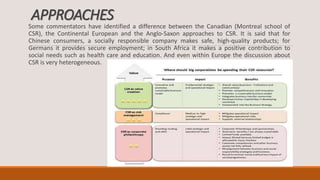
Some commentators have identified a difference between the Canadian (Montreal school of
CSR), the Continental European and the Anglo-Saxon approaches to CSR. It is said that for
Chinese consumers, a socially responsible company makes safe, high-quality products; for
Germans it provides secure employment; in South Africa it makes a positive contribution to
social needs such as health care and education. And even within Europe the discussion about
CSR is very heterogeneous.
Cost-benefit analysis
In competitive markets cost-benefit analysis of CSR initiatives, can be examined using a
resource-based view (RBV). According to Barney (1990) "formulation of the RBV, sustainable
competitive advantage requires that resources be valuable (V), rare (R), inimitable (I) and non-
substitutable (S)." A firm introducing a CSR-based strategy might only sustain high returns on
their investment if their CSR-based strategy could not be copied (I). However, should
competitors imitate such a strategy, that might increase overall social benefits. Firms that
choose CSR for strategic financial gain are also acting responsibly.
Scope
Initially, CSR emphasized the official behavior of individual firms. Later, it expanded to include
supplier behavior and the uses to which products were put and how they were disposed of after
they lost value.
Supply chain:
Incidents like the 2013 Savar building collapse pushed companies to consider how the behavior
of their suppliers impacted their overall impact on society. Irresponsible behavior reflected on
both the misbehaving firm, but also on its corporate customers. Supply chain management
expanded to consider the CSR context. Wieland and Hand field (2013) suggested that companies
need to include social responsibility in their reviews of component quality. They highlighted the
use of technology in improving visibility across the supply chain.
Potential business benefits
A large body of literature exhorts business to adopt measures non-financial measures of success
(e.g., Deming's Fourteen Points, balanced scorecards). While CSR benefits are hard to quantify,
Orlitzky, Schmidt and Ryne's. found a correlation between social/environmental performance
and financial performance.
Negative impact of corporate
psychopathy
As corporate psychopaths have little or no
conscience or care or empathy, it follows
logically that they are not driven by any notion
of social responsibility or commitment to
employees or to the wider public
Stakeholder influence
One motivation for corporations to adopt CSR is to satisfy stakeholders.
Branco and Rodrigues (2007) describe the stakeholder perspective of CSR as the set of views of
corporate responsibility held by all groups or constituents with a relationship to the firm. In their
normative model the company accepts these views as long as they do not hinder the
organization. The stakeholder perspective fails to acknowledge the complexity of network
interactions that can occur in cross-sector partnerships. It relegates communication to a
maintenance function, similar to the exchange perspective
Geography
Corporations that employ CSR behaviors do not always behave consistently in all parts of the
world. Conversely, a single behavior may not be considered ethical in all jurisdictions. E.g., some
jurisdictions forbid women from driving, while others require women to be treated equally in
employment decisions.
Corporate social responsibility

Corporate social responsibility

  • 1.
    CORPORATE SOCIAL RESPONSIBILITY SUBMITTED TO:SUBMITTED BY: MR. RAJIV SIR SAHIL JAIN BBA-3 SEM,2306
  • 2.
    Corporate social responsibility(CSR) Corporatesocial responsibility (CSR, also called corporate conscience, corporate citizenship or responsible business) is a form of corporate self-regulation integrated into a business model. CSR policy functions as a self-regulatory mechanism whereby a business monitors and ensures its active compliance with the spirit of the law, ethical standards and national or international norms. With some models, a firm's implementation of CSR goes beyond compliance and engages in "actions that appear to further some social good, beyond the interests of the firm and that which is required by law." CSR aims to embrace responsibility for corporate actions and to encourage a positive impact on the environment and stakeholders including consumers, employees, investors, communities, and others.
  • 3.
    DEFINITION Business dictionary definesCSR as "A company’s sense of responsibility towards the community and environment both ecological and social. In which it operates. Companies express this citizenship (1) through their waste and pollution reduction processes, (2) by contributing educational and social programs and (3) by earning adequate returns on the employed resources.“ A broader definition expands from a focus on stakeholders to include philanthropy and volunteering.
  • 4.
    CONSUMER PERSPECTIVES Most consumersand agree that while achieving business targets, companies should do CSR at and the same time. Most consumers believe companies doing and charity will receive a positive response. Somerville also found that and consumers are loyal and willing to spend more on retailers that support charity. Consumers also believe that retailers selling local products will gain and loyalty. Smith (2013)shares the belief that marketing local products and will gain consumer trust. However, environmental efforts are receiving and negative views given the belief that this would affect customer and service. Oppewal et al. (2006) found and that not all CSR activities are attractive to consumers. They recommended that retailers focus on one activity. Becker-Olsen (2006) found that if the social initiative done by the company is not aligned with other company goals it will have a negative impact. Mohr et al.(2001) and Groza et al. (2011) also emphasize the importance of reaching the consumer.
  • 5.
    APPROACHES Some commentators haveidentified a difference between the Canadian (Montreal school of CSR), the Continental European and the Anglo-Saxon approaches to CSR. It is said that for Chinese consumers, a socially responsible company makes safe, high-quality products; for Germans it provides secure employment; in South Africa it makes a positive contribution to social needs such as health care and education. And even within Europe the discussion about CSR is very heterogeneous.
  • 6.
    Cost-benefit analysis In competitivemarkets cost-benefit analysis of CSR initiatives, can be examined using a resource-based view (RBV). According to Barney (1990) "formulation of the RBV, sustainable competitive advantage requires that resources be valuable (V), rare (R), inimitable (I) and non- substitutable (S)." A firm introducing a CSR-based strategy might only sustain high returns on their investment if their CSR-based strategy could not be copied (I). However, should competitors imitate such a strategy, that might increase overall social benefits. Firms that choose CSR for strategic financial gain are also acting responsibly.
  • 7.
    Scope Initially, CSR emphasizedthe official behavior of individual firms. Later, it expanded to include supplier behavior and the uses to which products were put and how they were disposed of after they lost value. Supply chain: Incidents like the 2013 Savar building collapse pushed companies to consider how the behavior of their suppliers impacted their overall impact on society. Irresponsible behavior reflected on both the misbehaving firm, but also on its corporate customers. Supply chain management expanded to consider the CSR context. Wieland and Hand field (2013) suggested that companies need to include social responsibility in their reviews of component quality. They highlighted the use of technology in improving visibility across the supply chain.
  • 8.
    Potential business benefits Alarge body of literature exhorts business to adopt measures non-financial measures of success (e.g., Deming's Fourteen Points, balanced scorecards). While CSR benefits are hard to quantify, Orlitzky, Schmidt and Ryne's. found a correlation between social/environmental performance and financial performance.
  • 9.
    Negative impact ofcorporate psychopathy As corporate psychopaths have little or no conscience or care or empathy, it follows logically that they are not driven by any notion of social responsibility or commitment to employees or to the wider public
  • 10.
    Stakeholder influence One motivationfor corporations to adopt CSR is to satisfy stakeholders. Branco and Rodrigues (2007) describe the stakeholder perspective of CSR as the set of views of corporate responsibility held by all groups or constituents with a relationship to the firm. In their normative model the company accepts these views as long as they do not hinder the organization. The stakeholder perspective fails to acknowledge the complexity of network interactions that can occur in cross-sector partnerships. It relegates communication to a maintenance function, similar to the exchange perspective
  • 11.
    Geography Corporations that employCSR behaviors do not always behave consistently in all parts of the world. Conversely, a single behavior may not be considered ethical in all jurisdictions. E.g., some jurisdictions forbid women from driving, while others require women to be treated equally in employment decisions.