MERGERS & ACQUISITION
By Hemanth S.J Harleen Singh Gorani Dhaval Gayathri Diana Ritu
Mergers- A  merger  is a combination of two  companies  into one larger company, which involves  stock swap  or cash payment to the target. Acquisition - When one company takes over another and clearly established itself as the new owner, the purchase is called an acquisition.  From a legal point of view, the  target company ceases to exist, the buyer "swallows" the business and the buyer's stock continues to be traded .
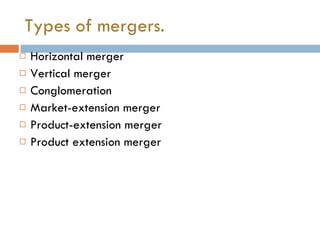
Types of mergers. Horizontal merger Vertical merger Conglomeration Market-extension merger  Product-extension merger Product extension merger
WHY? Gain market share Economies of scale Enter new markets Acquire technology Utilization of surplus funds Managerial Effectiveness Strategic Objective Vertical integration
Why not? Grasping for a company simply because its on the market , or because a competitor wants to buy it. Overpayment or misguided purchase. Inability to integrate well Diverse Business ;Unmanageable. Leaping without looking at the value.
xxxxxxx
 
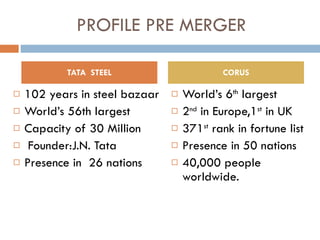
PROFILE PRE MERGER 102 years in steel bazaar World’s 56th largest  Capacity of 30 Million Founder:J.N. Tata Presence in  26 nations World’s 6 th  largest 2 nd  in Europe,1 st  in UK 371 st  rank in fortune list Presence in 50 nations 40,000 people worldwide. TATA  STEEL CORUS
Major Acquisitions – Big Deals Target Buyer Value($bn) Year Arcelor Mittal Steel 31 2006 NKK Corp Kawasaki Steel  14.1 2001 LNM Holdings Ispat Intl 13.3 2004 Tata Corus 12 2006 Krupp AG Thyssen 8.0 1997 Dofasco Arcelor 5.2 2005 Intl Steel Mittal Steel 4.8 2005
Acquisition Structure Asset Purchase Business Purchase Share Purchase A Mixture Apportionment of Risk No Hidden matters Remedy – warranty Indemnity
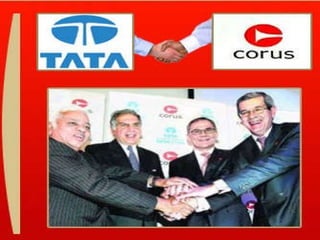
Acquisition TATA-CORUS Tata acquired Corus, which is four times larger than its size and the largest steel producer in the U.K. The deal, which creates the world's fifth-largest steelmaker, is India's largest ever foreign takeover and follows Mittal Steel's $31 billion acquisition of rival Arcelor in the same year. Tata acquired Corus on the 2nd of April 2007 for a price of $12 billion. The price per share was 608 pence(rs 484), which is 33.6% higher than the first offer which was 455 pence.
Acquisition Process Particulars Corus  Currency: Rupee Millions TATA Steel Ltd Currency: Rupee Millions Year 2006 2005 2004 2006 2005 2004 ASSETS 582750.00  533925.00  467775.00  205,450.70  177,033.10  147,988.70  DEBTS 98100.00 105525.00 96000.00 45,932.70 42,073.10 39,982.90 LIABILITIES 231300.00 178425.00 155475.00 30492.10 33146.80 32665.90 REVENUE 760500.00 699900.00 596475.00 202,444.30   159,986.10  111,294.40  NET INCOME 33900.00  33450.00  -22875.00  37,346.20  36,032.60  17,887.80
Process of Acquisition Finding A Target Business Appointing Advisers Negotiating terms Due Diligence Exchange of Contracts Completion
Finding A Target Business Synergy of Operations Help the Organizations to Achieve Strategic Objectives Enter new markets Vertical Integration
Appointing Advisers The Right Chemistry The Right Experience Size is not Everything Talk Your Language CORUS TATA J P MORGAN ABN AMRO CAZENOVE DEUTSCHE BANK HSBC STANDARD CHARTERED
Negotiating Terms The nature of the fit  Commonality of client base Financial strength Strategic intent Sharing of resources Applicable Benefits
Negotiation By Tata September 20, 2006  :  Corus Steel has decided to acquire a strategic partnership with a Company that is a low cost producer October 5, 2006  :  The Indian steel giant, Tata Steel wants to fulfill its ambition to Expand its business further. October 6, 2006  :  The initial offer from Tata Steel is considered to be too low both by Corus and analysts. October 17, 2006  :  Tata Steel has kept its offer to 455p per share. October 18, 2006  :  Tata still doesn’t react to Corus and its bid price remains the same. October 20, 2006  :  Corus accepts terms of £ 4.3 billion takeover bid from Tata Steel October 23, 2006  :  The Brazilian Steel Group CSN recruits a leading investment bank to offer advice on possible counter-offer to Tata Steel’s bid.
October 27, 2006  :  Corus is criticized by the chairman of JCB, Sir Anthony Bamford, for its decision to accept an offer from Tata. November 3, 2006  :  The Russian steel giant Severstal announces officially that it will not make a bid for Corus November 18, 2006  :  The battle over Corus intensifies when Brazilian group CSN approached the board of the company with a bid of 475p per share December 18, 2006  :  Within hours of Tata Steel increasing its original bid for Corus to 500 pence per share, Brazil's CSN made its formal counter bid for Corus at 515 pence per share in cash, 3% more than Tata Steel's Offer. January 31, 2007  :  Britain's Takeover Panel announces in an e-mailed statement that after an auction Tata Steel had agreed to offer Corus investors 608 pence per share in cash April 2, 2007  :  Tata Steel manages to win the acquisition to CSN and has the full voting support from Corus’ shareholders
Taxation and Accountancy Considerations Tension between Acquisition / sale of shares or assets. Due Diligence Tricky areas Accounting issues Accounting policies of the Target Accounting for Goodwill Fair value accounting Earnings per share Other Matters
Legal Documentation Share sale Agreement The shares being sold The Price Restrictive Agreements Warranties Conditions to the Deal Transferring tangible assets Transferring Intangible assets Transferring Liabilities Transferring Employees
Legal Documentation The Tax Deed The Disclosure Letter
Financing the Deal TATA- CORUS Deal  - $12 billion Equity Contribution from Tata Steel- $3.88 billion Credit Suisse leaded, joined by ABN AMRO and Deutsche Bank in the consortium.  Of the $ 8.12 billion of financing , Credit Suisse  provided 45% and ABN AMRO and Deutsche provided 27.5% each.
WHY CASH DEAL? Tata Steel's security credit rating was investment grade whereas Tata Steel UK had a lower security credit rating.  'share swap' deal less attractive to the Corus shareholders. 'share swap' would have diluted Tata Steel's equity base.
DEVELOPING A POST-ACQUISITION STRATEGY: The first 100 days In-house systems synergy
First 100 Days: Conflict Points Time Factor Leadership style differences Who’s in charge? (Who won?) Organic vs. bureaucratic cultures Open vs. closed communication Decision making speed & style Structures that don’t match
In-house systems synergy Operational Excellence (low cost producer) Product Leadership (best product) Customer Intimacy (best total solution)
Strategy: Disciplines, Priorities Operational Excellence Competitive price Error free, reliable Fast (on demand) Simple Responsive Consistent information for all 'Once and Done' Product Leadership New products or services Risk takers Meet volatile customer needs Never satisfied - obsolete own and competitors' products Learning organization Customer Intimacy Easy to do business with Have it your way (customization) Market segments of one Proactive, flexible Relationship and consultative selling Cross selling
Culture M&A Strategy Resources Business  Objective Structure Leadership Person
Global Steel Ranking:  (Ranking of Tata steel before deal- 55) Company Capacity (in million tonnes) Arcelor - Mittal  110.0 Nippon Steel  32.0 Posco  30.5 JEF Steel  30.0 Tata Steel - Corus  27.7 Bao Steel China  23.0 US Steel  19.0 Nucor  18.5 Riva 17.5 Thyssen Krupp 16.5
Rationale of the Corus deal augmented its crude steel capacity to 27 mtpa the combined entity forms the 6th largest Steel company The merged entity has brought Tata Steel to the world platform Provided Tata Steel access to new markets and presence across the steel value chain Much broader distribution network
Conclusion With Corus in its fold, Tata Steel can confidently target becoming one of the top-3 steel makers globally by 2015. The company would have an aggregate capacity of close to 56 million tones per annum, if all the planned Greenfield capacities go on stream by then. We can conclude that if the acquisitions well planned , Executed and the necessary precautions taken for the deal a company can achieve its strategic objectives and thus ensure its growth through Acquisition.
THANK YOU

tata corus merger

  • 1.
  • 2.
  • 3.
    By Hemanth S.JHarleen Singh Gorani Dhaval Gayathri Diana Ritu
  • 4.
    Mergers- A merger is a combination of two companies into one larger company, which involves stock swap or cash payment to the target. Acquisition - When one company takes over another and clearly established itself as the new owner, the purchase is called an acquisition. From a legal point of view, the target company ceases to exist, the buyer "swallows" the business and the buyer's stock continues to be traded .
  • 5.
    Types of mergers.Horizontal merger Vertical merger Conglomeration Market-extension merger Product-extension merger Product extension merger
  • 6.
    WHY? Gain marketshare Economies of scale Enter new markets Acquire technology Utilization of surplus funds Managerial Effectiveness Strategic Objective Vertical integration
  • 7.
    Why not? Graspingfor a company simply because its on the market , or because a competitor wants to buy it. Overpayment or misguided purchase. Inability to integrate well Diverse Business ;Unmanageable. Leaping without looking at the value.
  • 8.
  • 9.
  • 10.
    PROFILE PRE MERGER102 years in steel bazaar World’s 56th largest Capacity of 30 Million Founder:J.N. Tata Presence in 26 nations World’s 6 th largest 2 nd in Europe,1 st in UK 371 st rank in fortune list Presence in 50 nations 40,000 people worldwide. TATA STEEL CORUS
  • 11.
    Major Acquisitions –Big Deals Target Buyer Value($bn) Year Arcelor Mittal Steel 31 2006 NKK Corp Kawasaki Steel 14.1 2001 LNM Holdings Ispat Intl 13.3 2004 Tata Corus 12 2006 Krupp AG Thyssen 8.0 1997 Dofasco Arcelor 5.2 2005 Intl Steel Mittal Steel 4.8 2005
  • 12.
    Acquisition Structure AssetPurchase Business Purchase Share Purchase A Mixture Apportionment of Risk No Hidden matters Remedy – warranty Indemnity
  • 13.
    Acquisition TATA-CORUS Tataacquired Corus, which is four times larger than its size and the largest steel producer in the U.K. The deal, which creates the world's fifth-largest steelmaker, is India's largest ever foreign takeover and follows Mittal Steel's $31 billion acquisition of rival Arcelor in the same year. Tata acquired Corus on the 2nd of April 2007 for a price of $12 billion. The price per share was 608 pence(rs 484), which is 33.6% higher than the first offer which was 455 pence.
  • 14.
    Acquisition Process ParticularsCorus Currency: Rupee Millions TATA Steel Ltd Currency: Rupee Millions Year 2006 2005 2004 2006 2005 2004 ASSETS 582750.00 533925.00 467775.00 205,450.70 177,033.10 147,988.70 DEBTS 98100.00 105525.00 96000.00 45,932.70 42,073.10 39,982.90 LIABILITIES 231300.00 178425.00 155475.00 30492.10 33146.80 32665.90 REVENUE 760500.00 699900.00 596475.00 202,444.30 159,986.10 111,294.40 NET INCOME 33900.00 33450.00 -22875.00 37,346.20 36,032.60 17,887.80
  • 15.
    Process of AcquisitionFinding A Target Business Appointing Advisers Negotiating terms Due Diligence Exchange of Contracts Completion
  • 16.
    Finding A TargetBusiness Synergy of Operations Help the Organizations to Achieve Strategic Objectives Enter new markets Vertical Integration
  • 17.
    Appointing Advisers TheRight Chemistry The Right Experience Size is not Everything Talk Your Language CORUS TATA J P MORGAN ABN AMRO CAZENOVE DEUTSCHE BANK HSBC STANDARD CHARTERED
  • 18.
    Negotiating Terms Thenature of the fit Commonality of client base Financial strength Strategic intent Sharing of resources Applicable Benefits
  • 19.
    Negotiation By TataSeptember 20, 2006 : Corus Steel has decided to acquire a strategic partnership with a Company that is a low cost producer October 5, 2006 : The Indian steel giant, Tata Steel wants to fulfill its ambition to Expand its business further. October 6, 2006 : The initial offer from Tata Steel is considered to be too low both by Corus and analysts. October 17, 2006 : Tata Steel has kept its offer to 455p per share. October 18, 2006 : Tata still doesn’t react to Corus and its bid price remains the same. October 20, 2006 : Corus accepts terms of £ 4.3 billion takeover bid from Tata Steel October 23, 2006 : The Brazilian Steel Group CSN recruits a leading investment bank to offer advice on possible counter-offer to Tata Steel’s bid.
  • 20.
    October 27, 2006 : Corus is criticized by the chairman of JCB, Sir Anthony Bamford, for its decision to accept an offer from Tata. November 3, 2006 : The Russian steel giant Severstal announces officially that it will not make a bid for Corus November 18, 2006 : The battle over Corus intensifies when Brazilian group CSN approached the board of the company with a bid of 475p per share December 18, 2006 : Within hours of Tata Steel increasing its original bid for Corus to 500 pence per share, Brazil's CSN made its formal counter bid for Corus at 515 pence per share in cash, 3% more than Tata Steel's Offer. January 31, 2007 : Britain's Takeover Panel announces in an e-mailed statement that after an auction Tata Steel had agreed to offer Corus investors 608 pence per share in cash April 2, 2007 : Tata Steel manages to win the acquisition to CSN and has the full voting support from Corus’ shareholders
  • 21.
    Taxation and AccountancyConsiderations Tension between Acquisition / sale of shares or assets. Due Diligence Tricky areas Accounting issues Accounting policies of the Target Accounting for Goodwill Fair value accounting Earnings per share Other Matters
  • 22.
    Legal Documentation Sharesale Agreement The shares being sold The Price Restrictive Agreements Warranties Conditions to the Deal Transferring tangible assets Transferring Intangible assets Transferring Liabilities Transferring Employees
  • 23.
    Legal Documentation TheTax Deed The Disclosure Letter
  • 24.
    Financing the DealTATA- CORUS Deal - $12 billion Equity Contribution from Tata Steel- $3.88 billion Credit Suisse leaded, joined by ABN AMRO and Deutsche Bank in the consortium. Of the $ 8.12 billion of financing , Credit Suisse provided 45% and ABN AMRO and Deutsche provided 27.5% each.
  • 25.
    WHY CASH DEAL?Tata Steel's security credit rating was investment grade whereas Tata Steel UK had a lower security credit rating. 'share swap' deal less attractive to the Corus shareholders. 'share swap' would have diluted Tata Steel's equity base.
  • 26.
    DEVELOPING A POST-ACQUISITIONSTRATEGY: The first 100 days In-house systems synergy
  • 27.
    First 100 Days:Conflict Points Time Factor Leadership style differences Who’s in charge? (Who won?) Organic vs. bureaucratic cultures Open vs. closed communication Decision making speed & style Structures that don’t match
  • 28.
    In-house systems synergyOperational Excellence (low cost producer) Product Leadership (best product) Customer Intimacy (best total solution)
  • 29.
    Strategy: Disciplines, PrioritiesOperational Excellence Competitive price Error free, reliable Fast (on demand) Simple Responsive Consistent information for all 'Once and Done' Product Leadership New products or services Risk takers Meet volatile customer needs Never satisfied - obsolete own and competitors' products Learning organization Customer Intimacy Easy to do business with Have it your way (customization) Market segments of one Proactive, flexible Relationship and consultative selling Cross selling
  • 30.
    Culture M&A StrategyResources Business Objective Structure Leadership Person
  • 31.
    Global Steel Ranking: (Ranking of Tata steel before deal- 55) Company Capacity (in million tonnes) Arcelor - Mittal 110.0 Nippon Steel 32.0 Posco 30.5 JEF Steel 30.0 Tata Steel - Corus 27.7 Bao Steel China 23.0 US Steel 19.0 Nucor 18.5 Riva 17.5 Thyssen Krupp 16.5
  • 32.
    Rationale of theCorus deal augmented its crude steel capacity to 27 mtpa the combined entity forms the 6th largest Steel company The merged entity has brought Tata Steel to the world platform Provided Tata Steel access to new markets and presence across the steel value chain Much broader distribution network
  • 33.
    Conclusion With Corusin its fold, Tata Steel can confidently target becoming one of the top-3 steel makers globally by 2015. The company would have an aggregate capacity of close to 56 million tones per annum, if all the planned Greenfield capacities go on stream by then. We can conclude that if the acquisitions well planned , Executed and the necessary precautions taken for the deal a company can achieve its strategic objectives and thus ensure its growth through Acquisition.
  • 34.