
Presented By: 
Anand Jha
Company Profile 
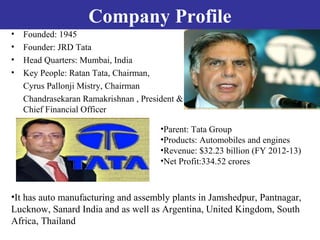
• Founded: 1945 
• Founder: JRD Tata 
• Head Quarters: Mumbai, India 
• Key People: Ratan Tata, Chairman, 
Cyrus Pallonji Mistry, Chairman 
Chandrasekaran Ramakrishnan , President & 
Chief Financial Officer 
•Parent: Tata Group 
•Products: Automobiles and engines 
•Revenue: $32.23 billion (FY 2012-13) 
•Net Profit:334.52 crores 
•It has auto manufacturing and assembly plants in Jamshedpur, Pantnagar, 
Lucknow, Sanard India and as well as Argentina, United Kingdom, South 
Africa, Thailand
Bangladesh * 
Nepal, Sri Lanka 
Malaysia* 
Thailand 
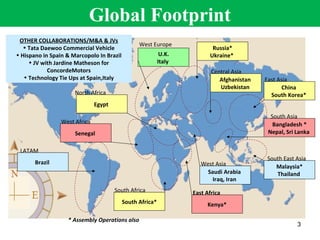
Global Footprint 
Russia* 
U.K. Ukraine* 
Italy 
Kenya* 
OTHER COLLABORATIONS/M&A & JVs 
• Tata Daewoo Commercial Vehicle 
• Hispano in Spain & Marcopolo In Brazil 
• JV with Jardine Matheson for 
ConcordeMotors 
• Technology Tie Ups at Spain,Italy 
North Africa 
Senegal 
Afghanistan 
Uzbekistan 
Brazil 
South Africa* 
Egypt 
Saudi Arabia 
Iraq, Iran 
China 
South Korea* 
LATAM 
West Africa 
West Europe 
Central Asia 
East Asia 
South Asia 
South East Asia 
West Asia 
South Africa East Africa 
* Assembly Operations also 
3
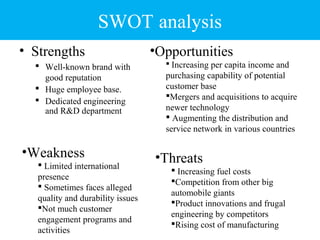
SWOT analysis 
• Strengths 
 Well-known brand with 
good reputation 
 Huge employee base. 
 Dedicated engineering 
and R&D department 
•Opportunities 
 Increasing per capita income and 
purchasing capability of potential 
customer base 
Mergers and acquisitions to acquire 
newer technology 
 Augmenting the distribution and 
service network in various countries 
•Weakness 
 Limited international 
presence 
 Sometimes faces alleged 
quality and durability issues 
Not much customer 
engagement programs and 
activities 
•Threats 
 Increasing fuel costs 
Competition from other big 
automobile giants 
Product innovations and frugal 
engineering by competitors 
Rising cost of manufacturing
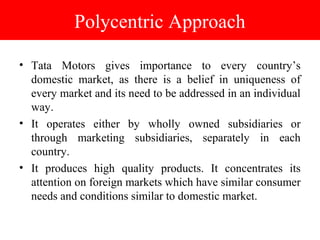
Polycentric Approach 
• Tata Motors gives importance to every country’s 
domestic market, as there is a belief in uniqueness of 
every market and its need to be addressed in an individual 
way. 
• It operates either by wholly owned subsidiaries or 
through marketing subsidiaries, separately in each 
country. 
• It produces high quality products. It concentrates its 
attention on foreign markets which have similar consumer 
needs and conditions similar to domestic market.
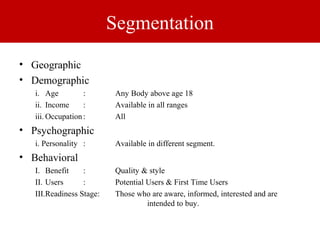
Segmentation 
• Geographic 
• Demographic 
i. Age : Any Body above age 18 
ii. Income : Available in all ranges 
iii.Occupation : All 
• Psychographic 
i. Personality : Available in different segment. 
• Behavioral 
I. Benefit : Quality & style 
II. Users : Potential Users & First Time Users 
III.Readiness Stage: Those who are aware, informed, interested and are 
intended to buy.
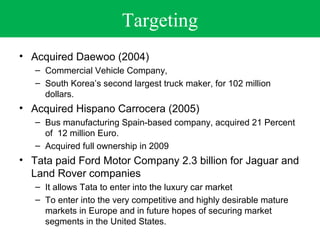
Targeting 
• Acquired Daewoo (2004) 
– Commercial Vehicle Company, 
– South Korea’s second largest truck maker, for 102 million 
dollars. 
• Acquired Hispano Carrocera (2005) 
– Bus manufacturing Spain-based company, acquired 21 Percent 
of 12 million Euro. 
– Acquired full ownership in 2009 
• Tata paid Ford Motor Company 2.3 billion for Jaguar and 
Land Rover companies 
– It allows Tata to enter into the luxury car market 
– To enter into the very competitive and highly desirable mature 
markets in Europe and in future hopes of securing market 
segments in the United States.
Continued.. 
• Bangladesh car market- launched the Manza and Vista hatchback 
model. 
• China- Sold approximately 26,000 units making it 3rd largest market 
for Jaguar and Land Rover. 
• South Africa- Opened assembly plant for targeting the operations 
and presence of Tata group in South Africa. 
• Tata Electric Car- Planning for launch in North America 
• Tata and Samsung deal in for car infotainment systems targeting 
Indian customers. 
• Sri-Lanka & Malaysia for installing sales process system and face to 
face customer meets
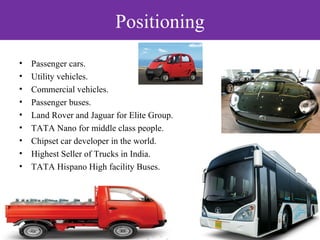
Positioning 
• Passenger cars. 
• Utility vehicles. 
• Commercial vehicles. 
• Passenger buses. 
• Land Rover and Jaguar for Elite Group. 
• TATA Nano for middle class people. 
• Chipset car developer in the world. 
• Highest Seller of Trucks in India. 
• TATA Hispano High facility Buses.
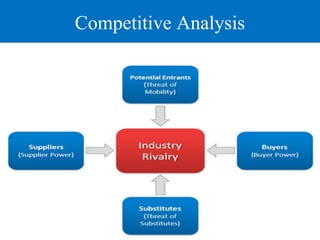
Competitive Analysis
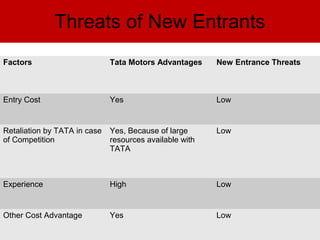
Threats of New Entrants 
Factors Tata Motors Advantages New Entrance Threats 
Entry Cost Yes Low 
Retaliation by TATA in case 
of Competition 
Yes, Because of large 
resources available with 
TATA 
Low 
Experience High Low 
Other Cost Advantage Yes Low
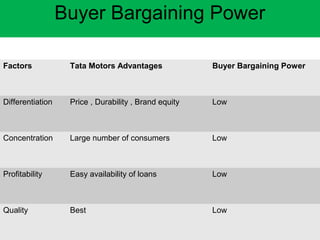
Buyer Bargaining Power 
Factors Tata Motors Advantages Buyer Bargaining Power 
Differentiation Price , Durability , Brand equity Low 
Concentration Large number of consumers Low 
Profitability Easy availability of loans Low 
Quality Best Low
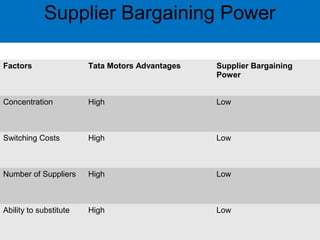
Supplier Bargaining Power 
Factors Tata Motors Advantages Supplier Bargaining 
Power 
Concentration High Low 
Switching Costs High Low 
Number of Suppliers High Low 
Ability to substitute High Low
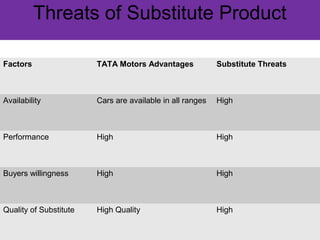
Threats of Substitute Product 
Factors TATA Motors Advantages Substitute Threats 
Availability Cars are available in all ranges High 
Performance High High 
Buyers willingness High High 
Quality of Substitute High Quality High
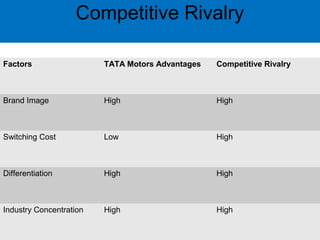
Competitive Rivalry 
Factors TATA Motors Advantages Competitive Rivalry 
Brand Image High High 
Switching Cost Low High 
Differentiation High High 
Industry Concentration High High
Tata Motors

Tata Motors

  • 1.
  • 2.
    Company Profile •Founded: 1945 • Founder: JRD Tata • Head Quarters: Mumbai, India • Key People: Ratan Tata, Chairman, Cyrus Pallonji Mistry, Chairman Chandrasekaran Ramakrishnan , President & Chief Financial Officer •Parent: Tata Group •Products: Automobiles and engines •Revenue: $32.23 billion (FY 2012-13) •Net Profit:334.52 crores •It has auto manufacturing and assembly plants in Jamshedpur, Pantnagar, Lucknow, Sanard India and as well as Argentina, United Kingdom, South Africa, Thailand
  • 3.
    Bangladesh * Nepal,Sri Lanka Malaysia* Thailand Global Footprint Russia* U.K. Ukraine* Italy Kenya* OTHER COLLABORATIONS/M&A & JVs • Tata Daewoo Commercial Vehicle • Hispano in Spain & Marcopolo In Brazil • JV with Jardine Matheson for ConcordeMotors • Technology Tie Ups at Spain,Italy North Africa Senegal Afghanistan Uzbekistan Brazil South Africa* Egypt Saudi Arabia Iraq, Iran China South Korea* LATAM West Africa West Europe Central Asia East Asia South Asia South East Asia West Asia South Africa East Africa * Assembly Operations also 3
  • 4.
    SWOT analysis •Strengths  Well-known brand with good reputation  Huge employee base.  Dedicated engineering and R&D department •Opportunities  Increasing per capita income and purchasing capability of potential customer base Mergers and acquisitions to acquire newer technology  Augmenting the distribution and service network in various countries •Weakness  Limited international presence  Sometimes faces alleged quality and durability issues Not much customer engagement programs and activities •Threats  Increasing fuel costs Competition from other big automobile giants Product innovations and frugal engineering by competitors Rising cost of manufacturing
  • 5.
    Polycentric Approach •Tata Motors gives importance to every country’s domestic market, as there is a belief in uniqueness of every market and its need to be addressed in an individual way. • It operates either by wholly owned subsidiaries or through marketing subsidiaries, separately in each country. • It produces high quality products. It concentrates its attention on foreign markets which have similar consumer needs and conditions similar to domestic market.
  • 6.
    Segmentation • Geographic • Demographic i. Age : Any Body above age 18 ii. Income : Available in all ranges iii.Occupation : All • Psychographic i. Personality : Available in different segment. • Behavioral I. Benefit : Quality & style II. Users : Potential Users & First Time Users III.Readiness Stage: Those who are aware, informed, interested and are intended to buy.
  • 7.
    Targeting • AcquiredDaewoo (2004) – Commercial Vehicle Company, – South Korea’s second largest truck maker, for 102 million dollars. • Acquired Hispano Carrocera (2005) – Bus manufacturing Spain-based company, acquired 21 Percent of 12 million Euro. – Acquired full ownership in 2009 • Tata paid Ford Motor Company 2.3 billion for Jaguar and Land Rover companies – It allows Tata to enter into the luxury car market – To enter into the very competitive and highly desirable mature markets in Europe and in future hopes of securing market segments in the United States.
  • 8.
    Continued.. • Bangladeshcar market- launched the Manza and Vista hatchback model. • China- Sold approximately 26,000 units making it 3rd largest market for Jaguar and Land Rover. • South Africa- Opened assembly plant for targeting the operations and presence of Tata group in South Africa. • Tata Electric Car- Planning for launch in North America • Tata and Samsung deal in for car infotainment systems targeting Indian customers. • Sri-Lanka & Malaysia for installing sales process system and face to face customer meets
  • 9.
    Positioning • Passengercars. • Utility vehicles. • Commercial vehicles. • Passenger buses. • Land Rover and Jaguar for Elite Group. • TATA Nano for middle class people. • Chipset car developer in the world. • Highest Seller of Trucks in India. • TATA Hispano High facility Buses.
  • 10.
  • 11.
    Threats of NewEntrants Factors Tata Motors Advantages New Entrance Threats Entry Cost Yes Low Retaliation by TATA in case of Competition Yes, Because of large resources available with TATA Low Experience High Low Other Cost Advantage Yes Low
  • 12.
    Buyer Bargaining Power Factors Tata Motors Advantages Buyer Bargaining Power Differentiation Price , Durability , Brand equity Low Concentration Large number of consumers Low Profitability Easy availability of loans Low Quality Best Low
  • 13.
    Supplier Bargaining Power Factors Tata Motors Advantages Supplier Bargaining Power Concentration High Low Switching Costs High Low Number of Suppliers High Low Ability to substitute High Low
  • 14.
    Threats of SubstituteProduct Factors TATA Motors Advantages Substitute Threats Availability Cars are available in all ranges High Performance High High Buyers willingness High High Quality of Substitute High Quality High
  • 15.
    Competitive Rivalry FactorsTATA Motors Advantages Competitive Rivalry Brand Image High High Switching Cost Low High Differentiation High High Industry Concentration High High

Editor's Notes

  • #3 It is 18th largest motor vehicle manufacturing company in world by volume. It was formerly known as TELCO(tata engg and locomotive company). Its products include passenger cars, trucks, vans and coaches.
  • #8 Tata Motors acquired 100 percent of the Korean based Daewoo Commercial Vehicle Company, Korea’s second largest truck maker, for 102 million dollars. Rather than using de-culturation or assimilating Daewoo, Tata took an integrated approach, and continued building and marketing Daewoo’s current models as well as introducing a few new models globally just as it had been done under Korean management. In February 2005, they acquired 21 Percent of Hispano Carrocera, Spain-based company, for 12 million Euro. In April 2005, Tata Motors Limited merged with Tata Finance, and lastly in March 2008 Tata paid Ford Motor Company 2.3 billion for Jaguar and Land Rover companies (Tata.com). These acquisitions and mergers allow Tata Motors to break into foreign markets and develop a much larger share of the automotive industry. It also helps them attain the knowledge, technology, and programs that allow them to succeed in that particular sector of the automotive industry or in a particular region or culture. For instance, the purchase of Jaguar and Land Rover allows Tata to enter into the luxury car market without having to research the market, build the technology, among other important aspects of getting into a new market segment. It further helps them enter into the very competitive and highly desirable mature markets in Europe and in future hopes of securing market segments in the United States. Tata Motors is currently in a growth stage as stated on their website: “Tata Motors Ltd is in a mega expansion mode. The investments would be in product development, capital expenditure in capacity enhancement, domestic and international acquisitions and mergers” (Tata.com). It allows Tata to enter into the luxury car market without having to research the market, build the technology It further helps them enter into the very competitive and highly desirable mature markets in Europe and in future hopes of securing market segments in the United States.