Business School
University ofSaint Thomas Mozambique.
Barchelor’s Degree in Computer Science.
GRAPHICAL USER INTERFACE
Topic:Geometric Modeling in Graphics and Visual Computing.
Authors:Erick .P.Wasonga,Daniel Darsamo,Scovia Kainza &
Lucia Pedro.
Lecturer: Marciano Ombe.
1
2.
Geometric Modeling in
Graphicsand Visual
Computing
Modeling is fundamental to graphics and visual computing, enabling the
representation and manipulation of visual content in 2D and 3D
environments. This report focuses on geometric modeling, a critical
component that involves processing geometric objects, organizing space,
and implementing mathematical transformations.
This study reviews theoretical concepts detailing various spaces and
primitive objects. It explores the mathematical framework, highlighting
points, scalars, and vectors. A case study illustrates the application of these
theories, developing a modeling application using computer graphics
techniques. Insights from this study provide a foundation for further
research in graphics and visual computing.
2
3.
Geometric Modeling: TheFoundation of
Computer Graphics
Digital Sculpting
Geometric modeling acts as the digital equivalent of
sculpting tools, allowing the creation of virtual objects and
environments. This process relies on mathematical
principles to ensure accuracy and realism.
Historical Evolution
Geometric modeling evolved from simple 2D wireframes in
the 1960s to today’s complex 3D renders, driven by
advancements in hardware and algorithms. Understanding
this field is essential for various applications.
3
4.
2D and 3DPrimitives: Building Blocks of
Models
2D Primitives
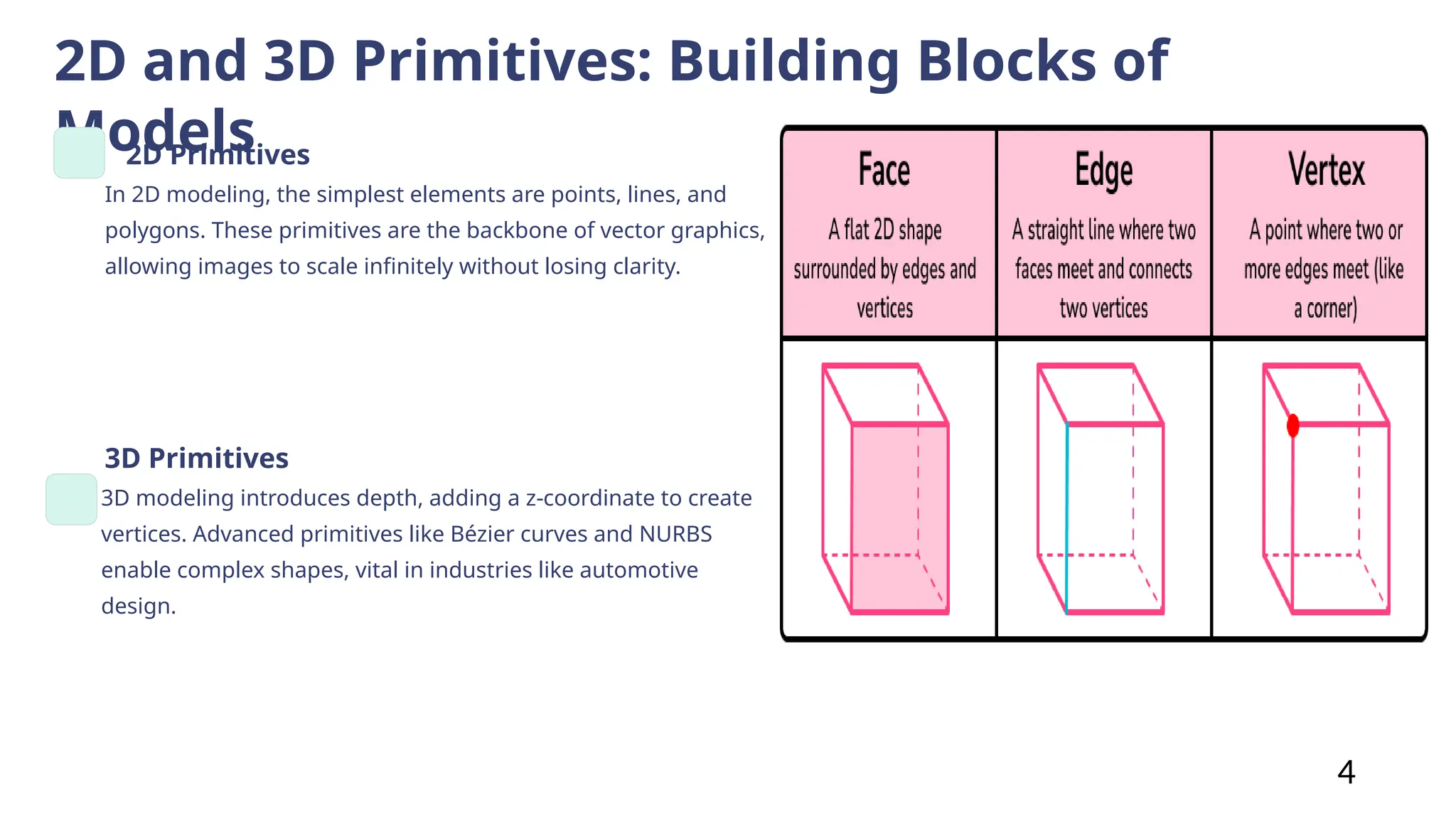
In 2D modeling, the simplest elements are points, lines, and
polygons. These primitives are the backbone of vector graphics,
allowing images to scale infinitely without losing clarity.
3D Primitives
3D modeling introduces depth, adding a z-coordinate to create
vertices. Advanced primitives like Bézier curves and NURBS
enable complex shapes, vital in industries like automotive
design.
4
5.
Mathematical Spaces: Where
GeometryLives
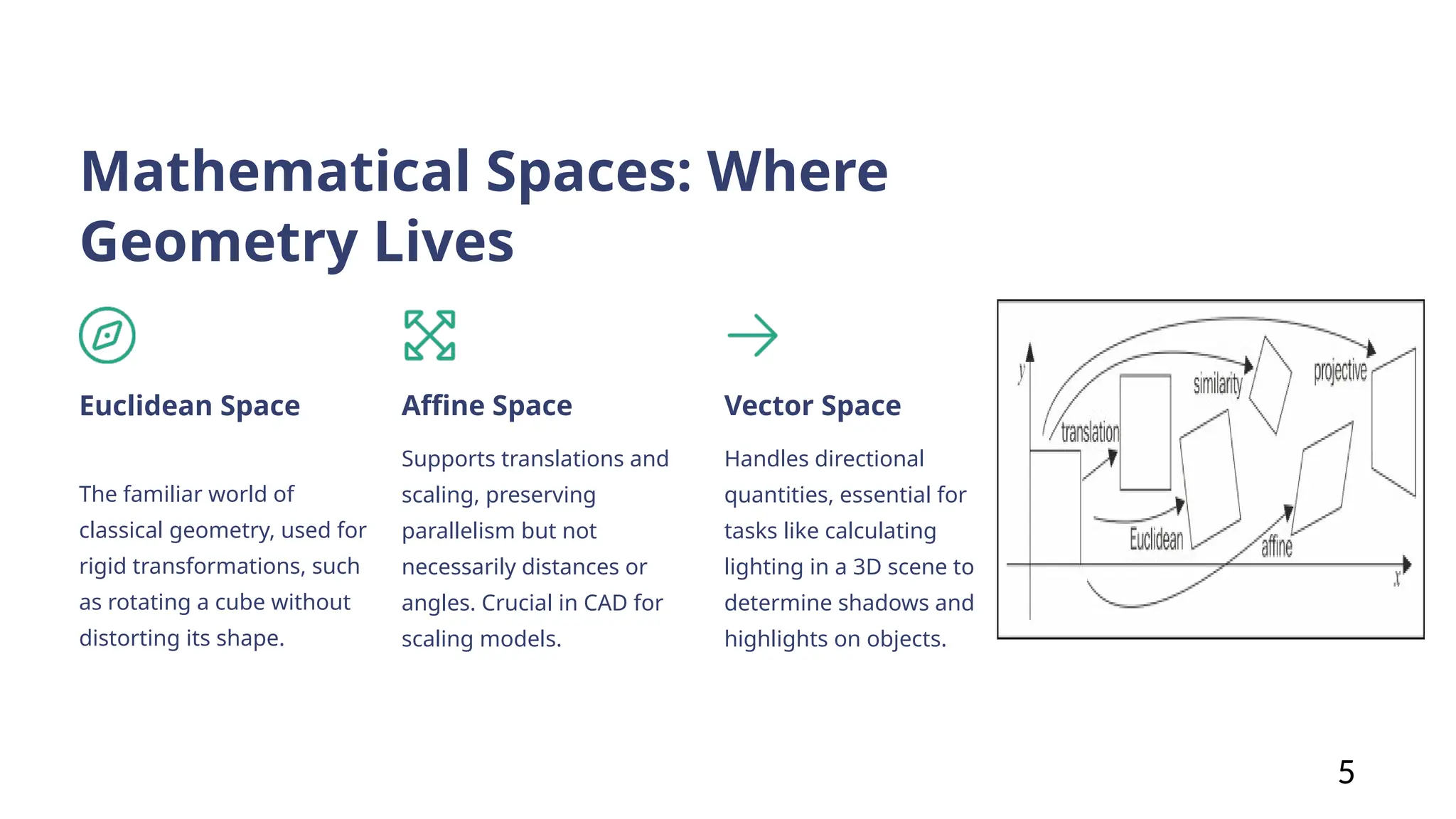
Euclidean Space
The familiar world of
classical geometry, used for
rigid transformations, such
as rotating a cube without
distorting its shape.
Affine Space
Supports translations and
scaling, preserving
parallelism but not
necessarily distances or
angles. Crucial in CAD for
scaling models.
Vector Space
Handles directional
quantities, essential for
tasks like calculating
lighting in a 3D scene to
determine shadows and
highlights on objects.
5
6.
Transformations: Moving andReshaping Objects
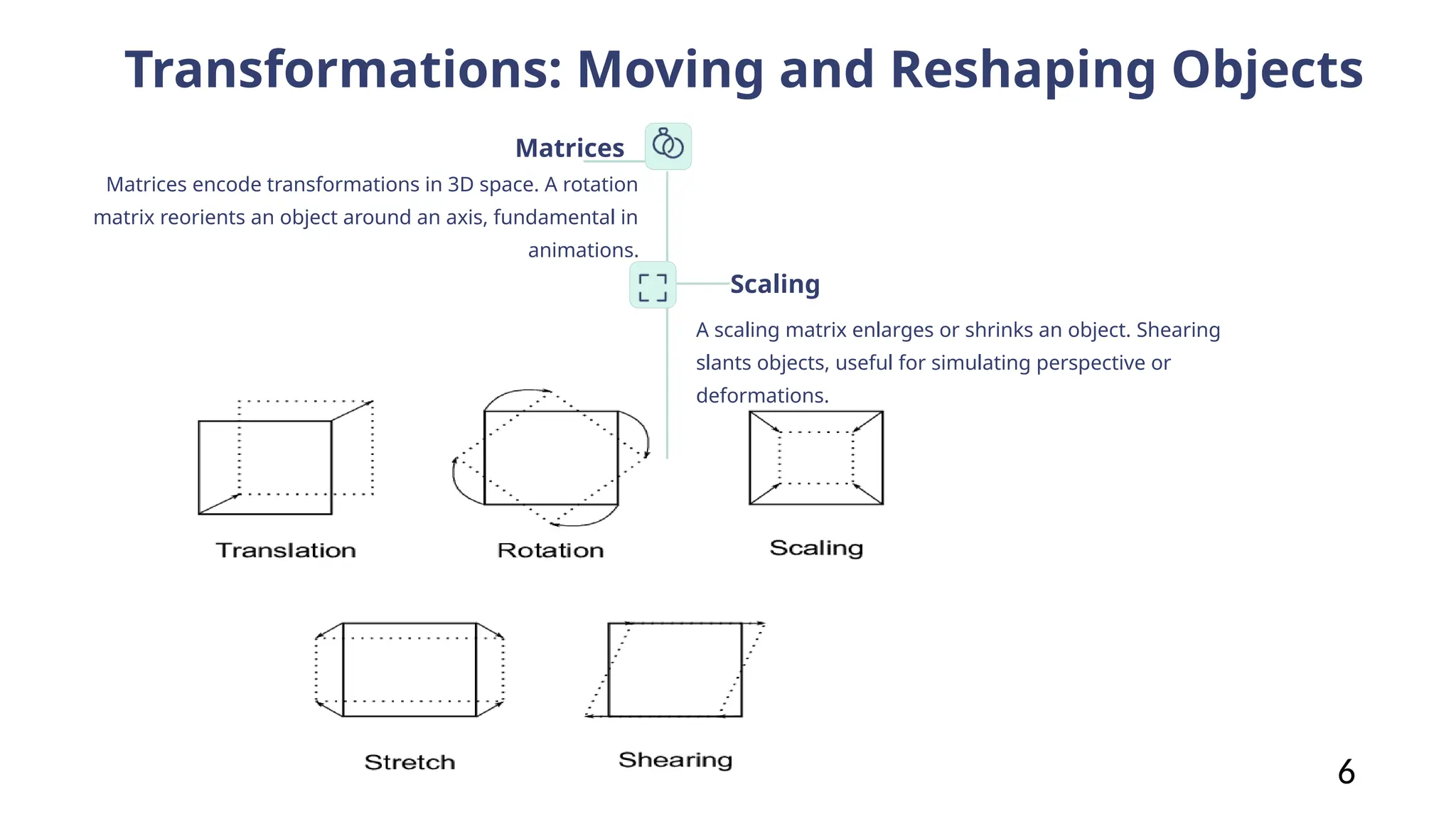
Matrices
Matrices encode transformations in 3D space. A rotation
matrix reorients an object around an axis, fundamental in
animations.
Scaling
A scaling matrix enlarges or shrinks an object. Shearing
slants objects, useful for simulating perspective or
deformations.
6
7.
Spatial Relationships: Position,Lengths, and
Angles
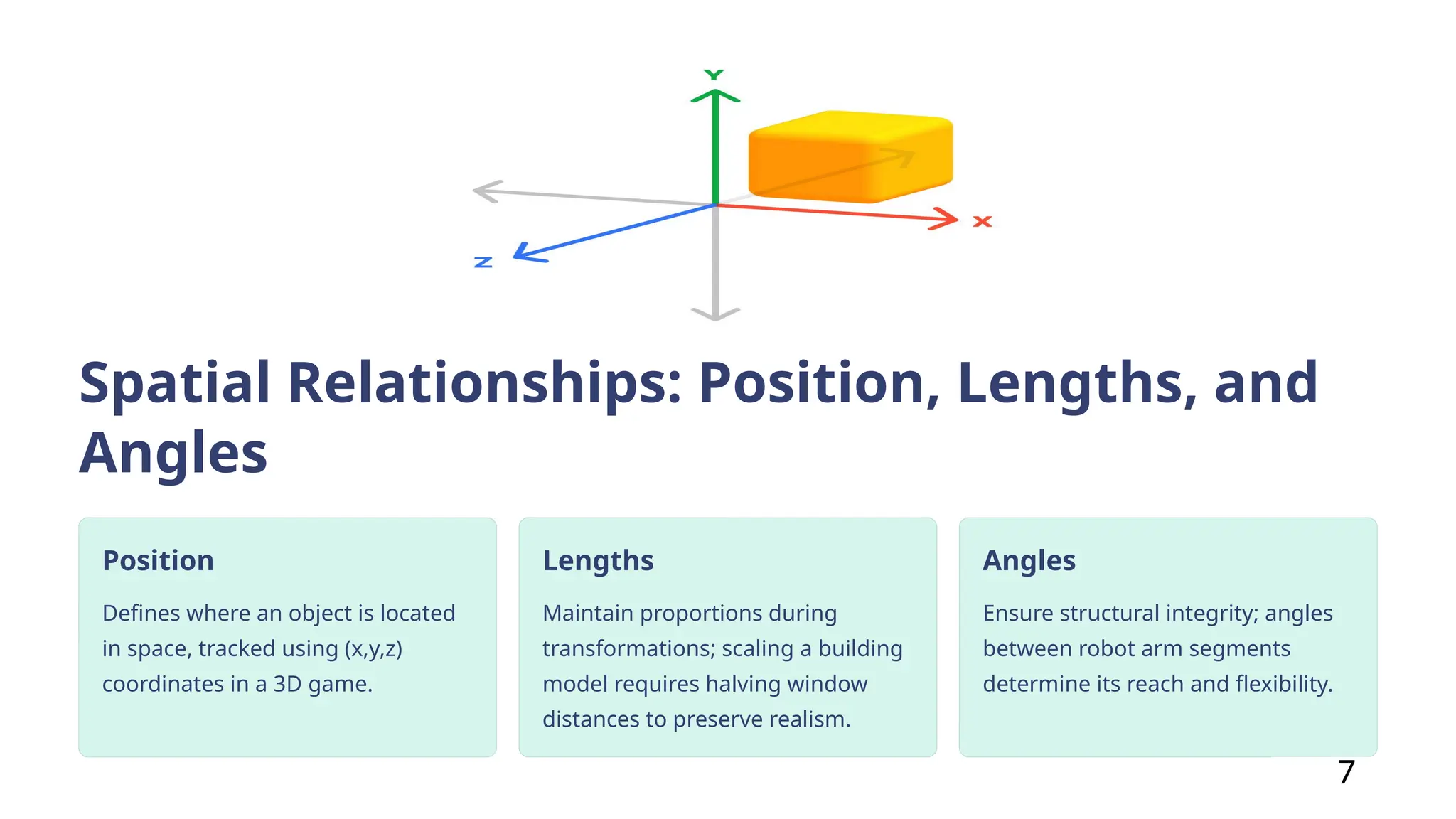
Position
Defines where an object is located
in space, tracked using (x,y,z)
coordinates in a 3D game.
Lengths
Maintain proportions during
transformations; scaling a building
model requires halving window
distances to preserve realism.
Angles
Ensure structural integrity; angles
between robot arm segments
determine its reach and flexibility.
7
8.
Fundamental Data Typesand Computational
Power
Data Types
• Points anchor objects in space.
• Scalars are single values.
• Vectors combine magnitude and direction.
Computational Power
Modern GPUs accelerate matrix operations, enabling real-
time rendering. Parallel processing allows simultaneous
transformations, lighting, and shading, creating seamless
visuals.
8
9.
Cutting-Edge Innovations: AIand
Automation
Machine Learning
Automates tedious tasks; neural networks optimize 3D meshes by reducing
polygon counts without losing detail.
Generative Networks
GANs create 3D models from 2D sketches, streamlining workflows for
artists by generating models with proper proportions and textures.
9
10.
Cutting-Edge Innovations: AIand
Automation
Video Gaming
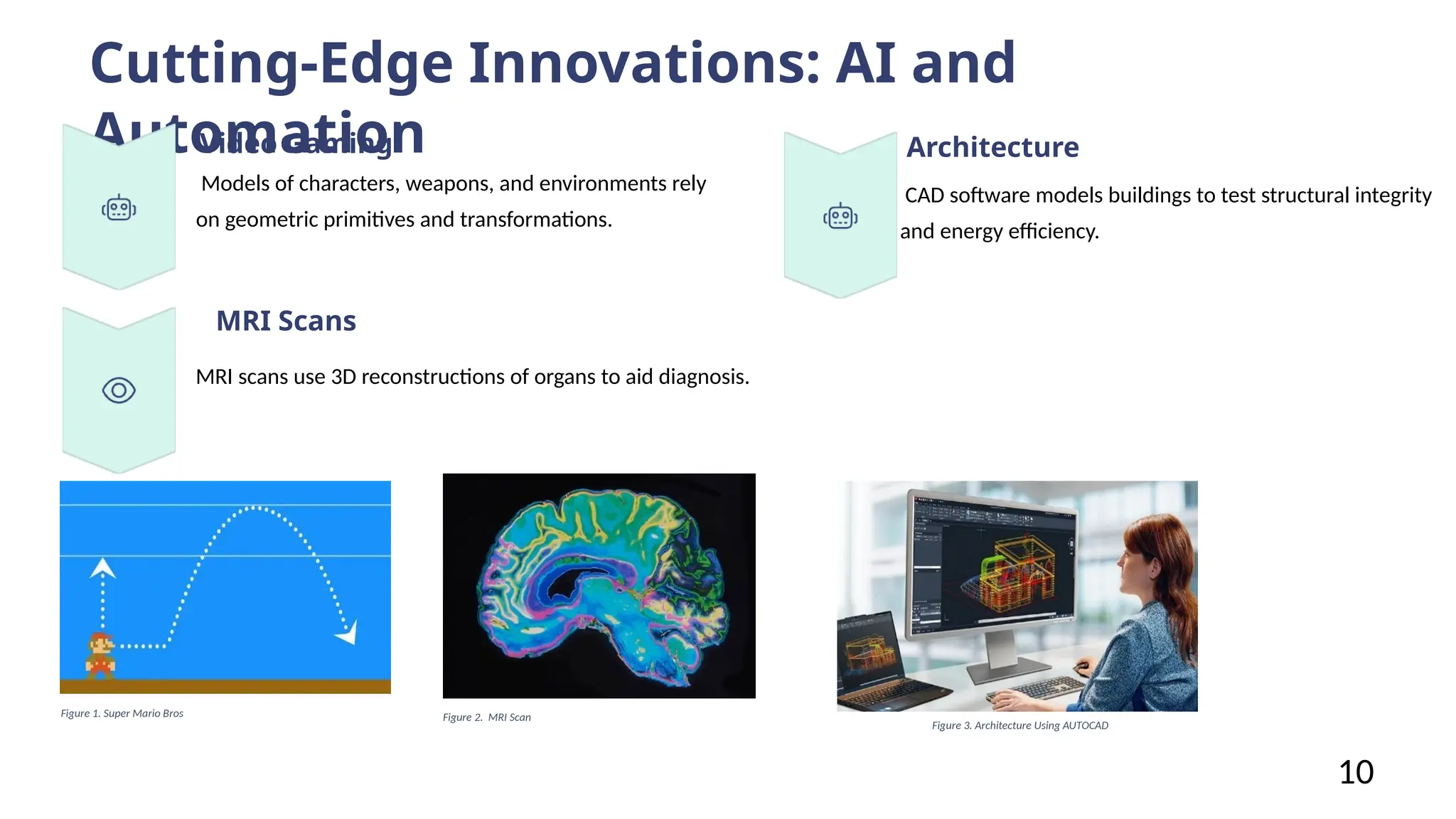
Models of characters, weapons, and environments rely
on geometric primitives and transformations.
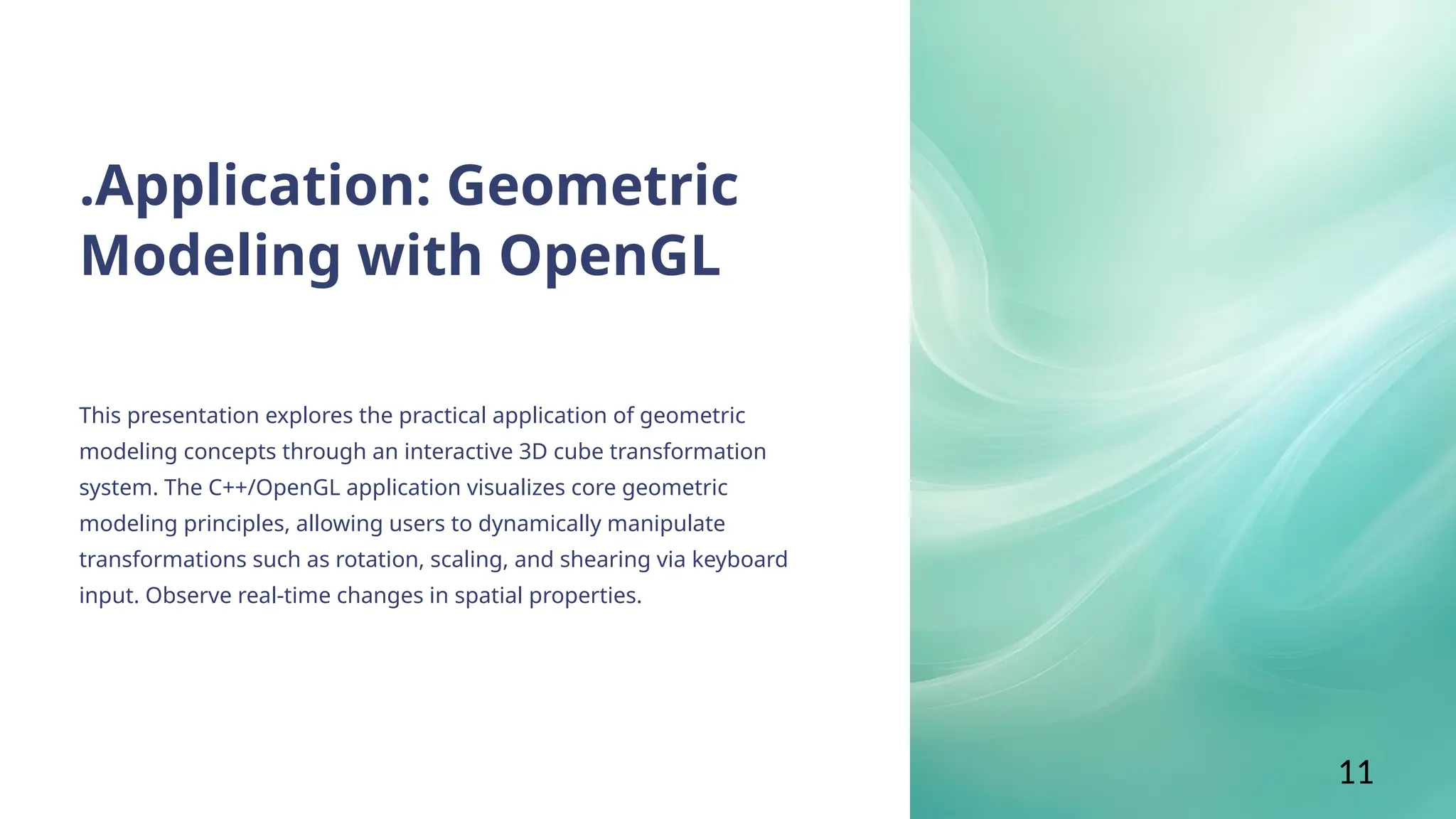
MRI Scans
MRI scans use 3D reconstructions of organs to aid diagnosis.
10
Figure 1. Super Mario Bros Figure 2. MRI Scan
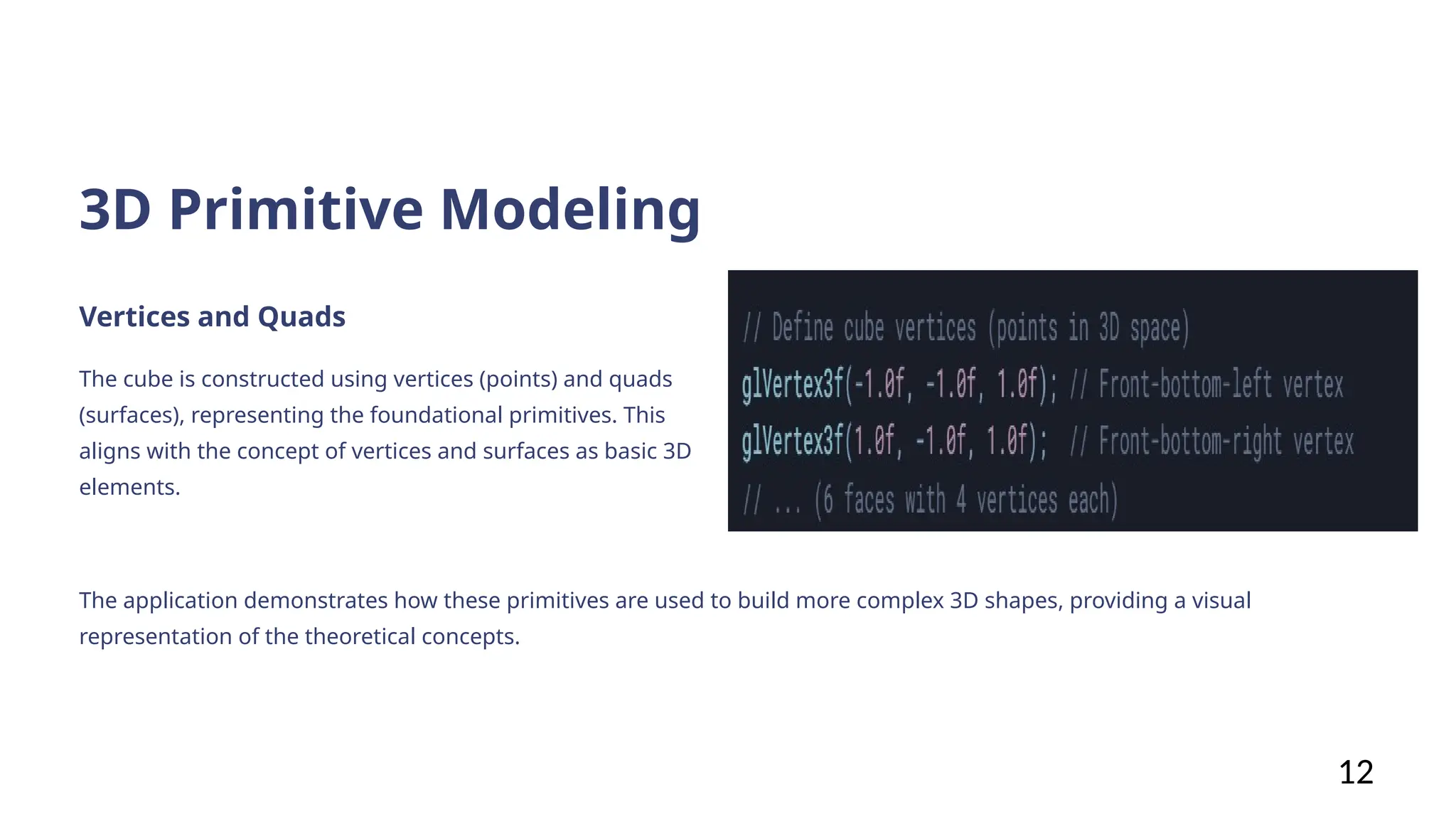
Figure 3. Architecture Using AUTOCAD
CAD software models buildings to test structural integrity
and energy efficiency.
Architecture
11.
.Application: Geometric
Modeling withOpenGL
This presentation explores the practical application of geometric
modeling concepts through an interactive 3D cube transformation
system. The C++/OpenGL application visualizes core geometric
modeling principles, allowing users to dynamically manipulate
transformations such as rotation, scaling, and shearing via keyboard
input. Observe real-time changes in spatial properties.
11
12.
3D Primitive Modeling
Verticesand Quads
The cube is constructed using vertices (points) and quads
(surfaces), representing the foundational primitives. This
aligns with the concept of vertices and surfaces as basic 3D
elements.
The application demonstrates how these primitives are used to build more complex 3D shapes, providing a visual
representation of the theoretical concepts.
12
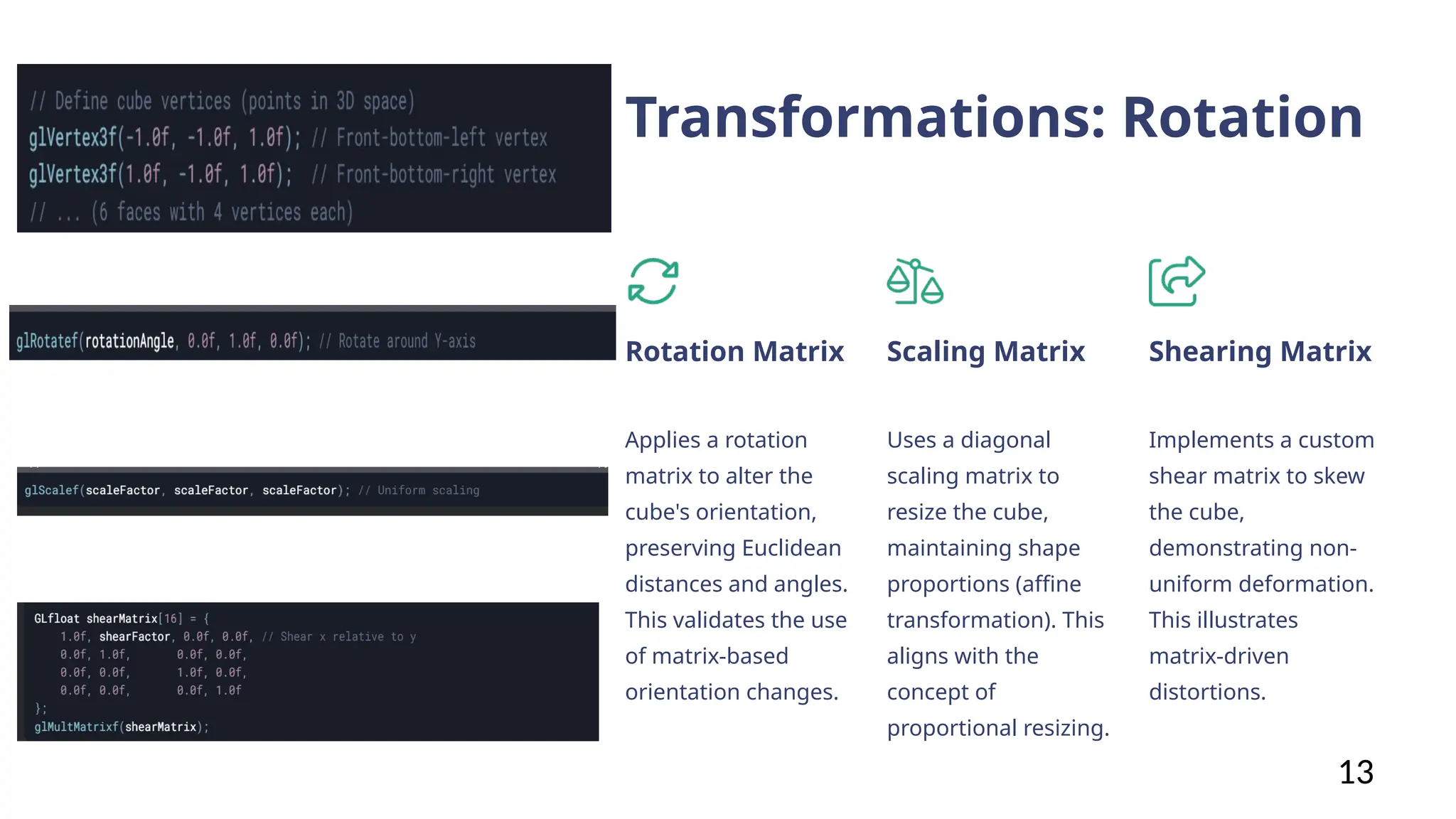
13.
Transformations: Rotation
Rotation Matrix
Appliesa rotation
matrix to alter the
cube's orientation,
preserving Euclidean
distances and angles.
This validates the use
of matrix-based
orientation changes.
Scaling Matrix
Uses a diagonal
scaling matrix to
resize the cube,
maintaining shape
proportions (affine
transformation). This
aligns with the
concept of
proportional resizing.
Shearing Matrix
Implements a custom
shear matrix to skew
the cube,
demonstrating non-
uniform deformation.
This illustrates
matrix-driven
distortions.
13
14.
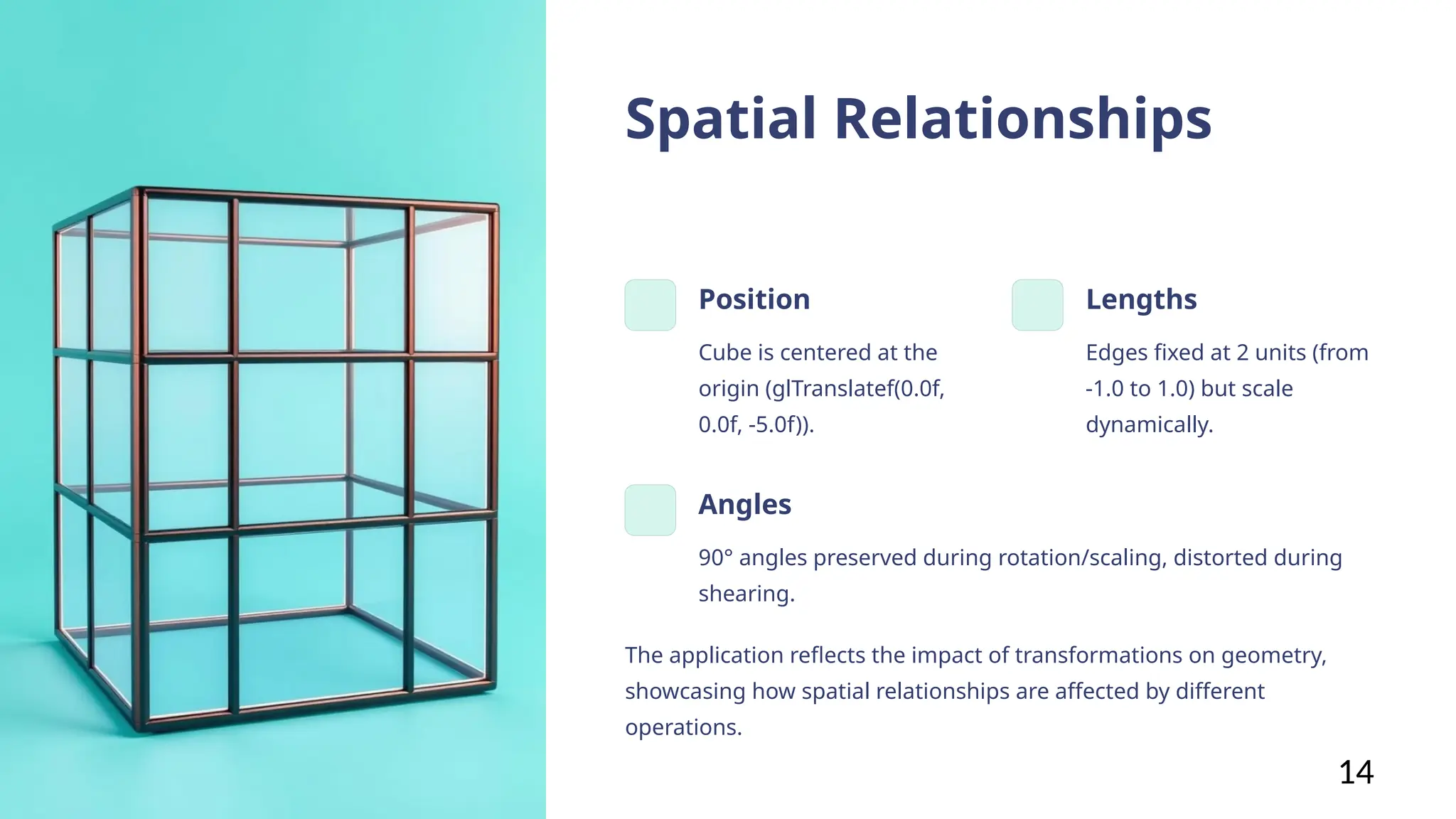
Spatial Relationships
Position
Cube iscentered at the
origin (glTranslatef(0.0f,
0.0f, -5.0f)).
Lengths
Edges fixed at 2 units (from
-1.0 to 1.0) but scale
dynamically.
Angles
90° angles preserved during rotation/scaling, distorted during
shearing.
The application reflects the impact of transformations on geometry,
showcasing how spatial relationships are affected by different
operations.
14
15.
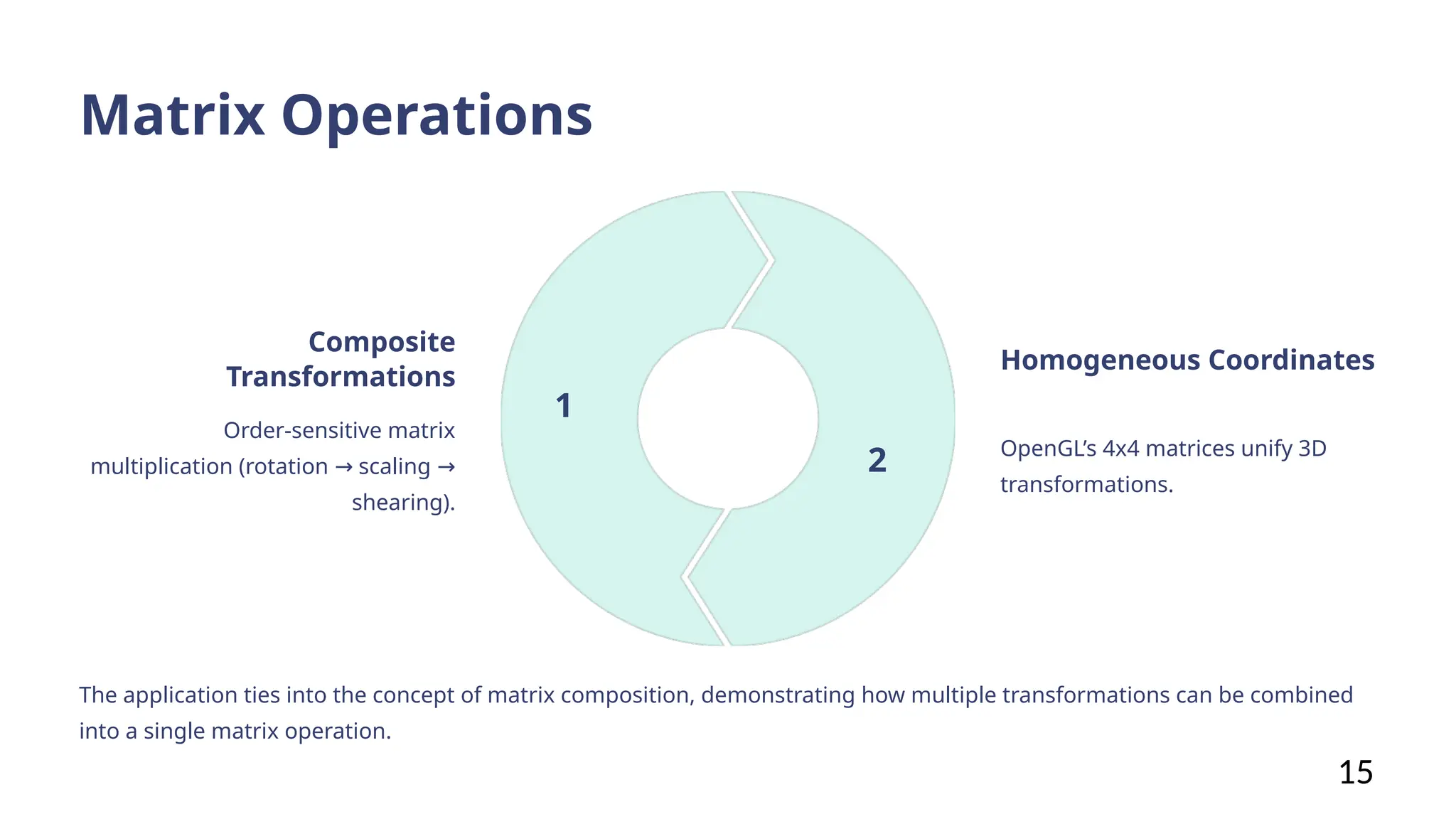
Matrix Operations
Composite
Transformations
Order-sensitive matrix
multiplication(rotation scaling
→ →
shearing).
1
Homogeneous Coordinates
OpenGL’s 4x4 matrices unify 3D
transformations.
2
The application ties into the concept of matrix composition, demonstrating how multiple transformations can be combined
into a single matrix operation.
15
16.
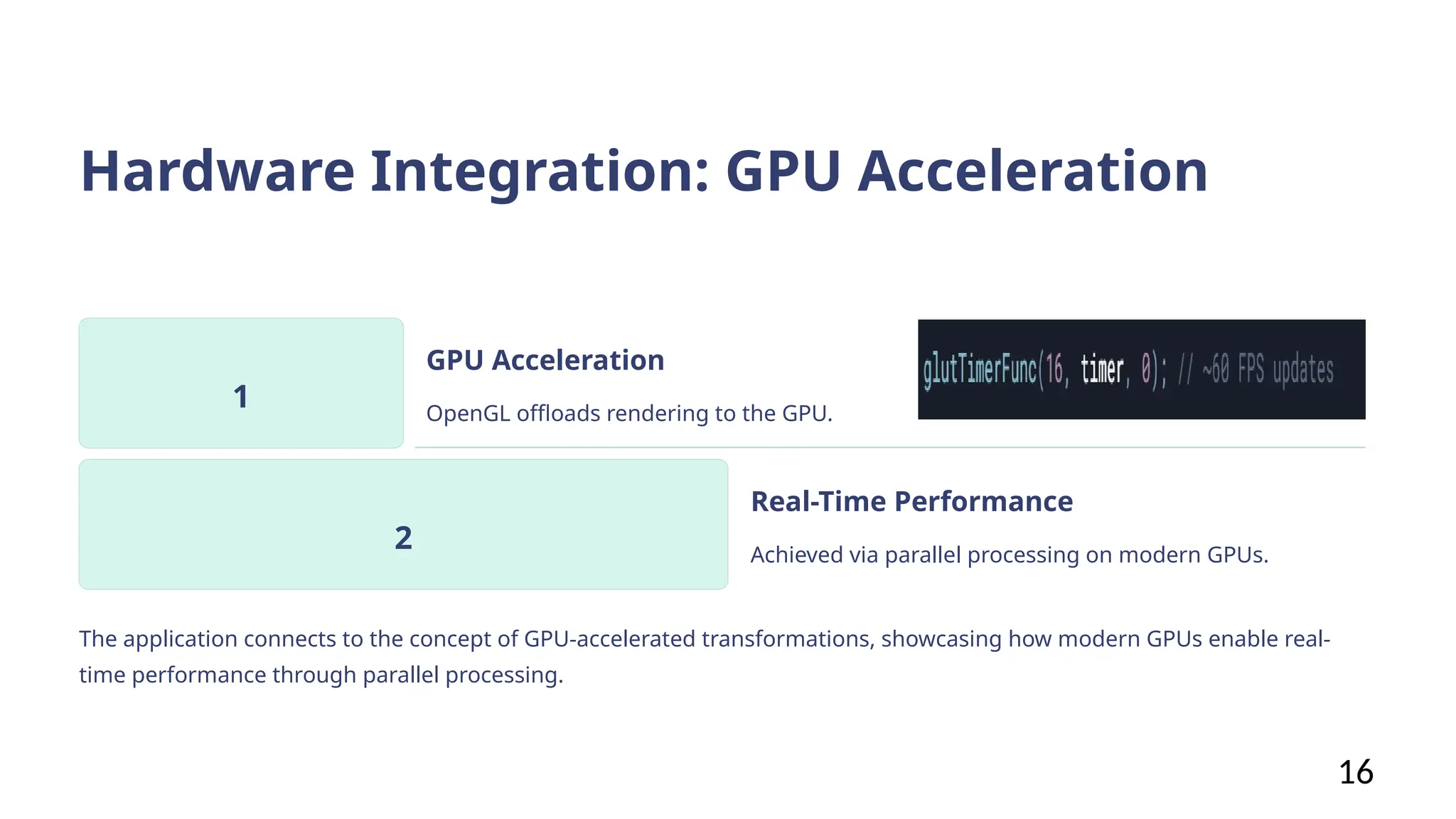
Hardware Integration: GPUAcceleration
1
GPU Acceleration
OpenGL offloads rendering to the GPU.
2
Real-Time Performance
Achieved via parallel processing on modern GPUs.
The application connects to the concept of GPU-accelerated transformations, showcasing how modern GPUs enable real-
time performance through parallel processing.
16
17.
User Interaction
Key ActionTheoretical
Concept
W/S Adjust scaling
factor
Affine
transformations
A/D Modify shear factor Non-uniform
deformations
ESC Exit program -
The application demonstrates interactive parameter control, allowing
users to explore the effects of different transformations in real-time.
17
18.
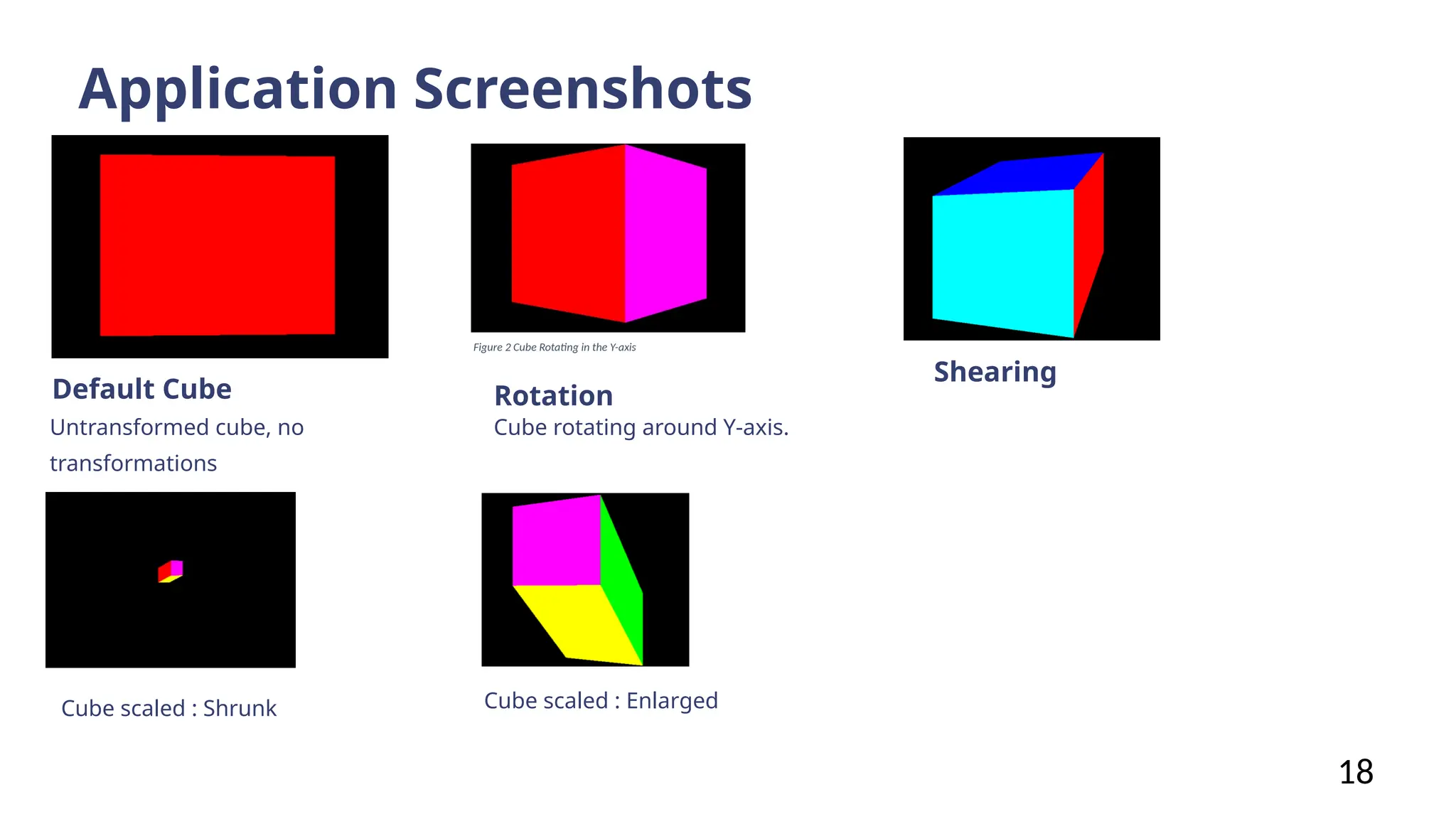
Application Screenshots
Default Cube
Untransformedcube, no
transformations
Rotation
Cube rotating around Y-axis.
Shearing
18
Figure 2 Cube Rotating in the Y-axis
Cube scaled : Enlarged
Cube scaled : Shrunk
19.
Conclusion: The Futureof
Geometric Modeling
The integration of geometric objects, spaces, and transformation
operations is crucial for creating realistic and interactive digital
representations. Precise mathematical frameworks ensure accurate
spatial relationships. The case study reinforces these insights by
demonstrating a modeling application.
Future work should explore machine learning to automate
transformation pipelines and expand applications to support non-linear
transformations and advanced rendering techniques. The fusion of
robust theoretical models with innovative computational strategies will
advance the field.
19