Task 10
Hayley Roberts
Social and Cultural Awareness
We are influenced and persuaded by the articles we read in newspapers and magazines and when we read an article we trust the words of
the journalists and they give the power to influence us. We are told about an event which has happened and we trust what the
journalist is saying about that event as we weren’t there at that time so when we read about it we expect a reliable and unbiased
piece about this event which has happened. But even though they are telling us the story and we trust what is being said, sometimes
they might exaggerate a story or event to try and engage the readers but with it being factual writing they have to keep the facts
100% honest and true and they have to also think about the social, legal and ethical responsibilities. There are guidelines in place and
this is for journalists to read and make sure they meet the guidelines that are set because if they don’t stick to them then it can cause
anger or upset for certain groups of people. When they are writing about a story, some of them can involve certain groups of people
and when writing about these groups they need to think of the emotional side of writing about them and how it could affect the
audience if they read about the groups of people. They need to make sure they are writing truthful about these groups and don’t
make it bias or unhelpful about these groups as this could give the group a bad representation and this then penalises the group and
makes the audience feel a bad way about the group. This could then cause hatred towards a certain group and everyone has the same
opinion about this group. For example, recently in the news there was a woman who was claiming she was too ill to walk and was
claiming benefits for this, was filmed in Australia surfing and was filmed swimming with dolphins. They had claimed altogether
£200,000 and were jailed for 30 months for the crime they committed. Overall, this story is really bad and they were in the wrong for
doing this and there are people out there who are fraudsters when it comes to benefits but from the article, the journalist needs to
make sure that they apply the facts from the article and don’t go into detail about judging the whole ‘group’ of people on benefits as
this then would start to suggest that all people on benefits claim them when they don’t need them and they do it for money because
they don’t want to work. But if you look further into the group of people on benefits, it involves people who are pensioners as they
are getting money and they do it because some are too old to work and earned the right to have a pension. It also involves parents
with children who are still in education as they get child tax credits which is extra money but only because their children are in
education. It doesn’t just involve the people who are fraudsters and throughout the article they have kept it factual and haven’t made
it as if they are referring to the whole group of people on benefits and this gives the audience the freedom to judge how they want to
without the journalist putting bias information into the article. Another example is there was another story quite recently about 15
people who were suspected to be illegal immigrants and they were hiding in the back of a lorry. A German national had been arrested
on suspicion of facilitating the unlawful entry of people into the UK as at this point it was unsure if they were supposed to be there or
not but they were wanting to go to a place in the South West and the lorry company didn’t explain where the lorry was heading to
and had set off from. They again in this story needed to make sure that they don’t penalise the group of immigrants as there can be
legal immigrants who are categorised into the category of immigrants so they need to make sure that the journalists stick to the
guidelines set. This then wouldn’t give the whole group a hatred and a bad name and even though in these stories they have suck to
the guidelines, some can get really stuck in and create horrendous headlines which can cause hatred towards a group straight away.
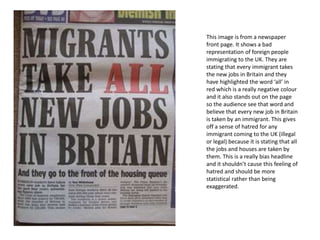
This image is from a newspaper
front page. It shows a bad
representation of foreign people
immigrating to the UK. They are
stating that every immigrant takes
the new jobs in Britain and they
have highlighted the word ‘all’ in
red which is a really negative colour
and it also stands out on the page
so the audience see that word and
believe that every new job in Britain
is taken by an immigrant. This gives
off a sense of hatred for any
immigrant coming to the UK (illegal
or legal) because it is stating that all
the jobs and houses are taken by
them. This is a really bias headline
and it shouldn’t cause this feeling of
hatred and should be more
statistical rather than being
exaggerated.
NUJ Guidelines
To try and stop journalists from representing groups in a bad way in the media, The National Union of Journalists have set up a set of guidelines that
explains a range of ethical guidance and this then leans them towards being more cautious when writing about certain groups and keeps them
from being unbiased. The list of NUJ isn’t a legal union (it was set by a group of people that decided to show journalists their way of writing and
how things should be written) and the guidelines don’t have to be stuck to as the examples show in the last slide and some journalists can still be
bias with their stories but the NUJ try to persuade all journalists to write in the style they are trying to present. The list of groups that the
guidelines are set up for are; terrorism, race, HIV, asylum and immigration, age, disability and suicide. This list is all very sensitive subjects and
groups and so the journalists need to make sure they write sensitively about the groups and that’s why the NUJ group has been put in place
because this group believe that they should be written about with care. If a journalist is unsure about how to write with a sensitive topic then they
can ring up the NUJ’s ethic hotline so then they will get some advice on how to write about a certain group and not what to say about them. The
NUJ also have a code of conduct which again isn’t legal and doesn’t have to be stuck to but the code has 12 rules that the members of the union
should stick to and they are expected to abide by the rules. If they don’t then they will be thrown out of the union or if it becomes a regular
occurrence then they will be thrown out of the union. The 12 rules are;
• At all times upholds and defends the principle of media freedom, the right of freedom of expression and the right of the public to be informed.
• Strives to ensure that information disseminated is honestly conveyed, accurate and fair.
• Does her/his utmost to correct harmful inaccuracies.
• Differentiates between fact and opinion.
• Obtains material by honest, straightforward and open means, with the exception of investigations that are both overwhelmingly in the public
interest and which involve evidence that cannot be obtained by straightforward means.
• Does nothing to intrude into anybody’s private life, grief or distress unless justified by overriding consideration of the public interest.
• Protects the identity of sources who supply information in confidence and material gathered in the course of her/his work.
• Resists threats or any other inducements to influence, distort or suppress information and takes no unfair personal advantage of information
gained in the course of her/his duties before the information is public knowledge.
• Produces no material likely to lead to hatred or discrimination on the grounds of a person’s age, gender, race, colour, creed, legal status, disability,
marital status, or sexual orientation.
• Does not by way of statement, voice or appearance endorse by advertisement any commercial product or service save for the promotion of
her/his own work or of the medium by which she/he is employed.
• A journalist shall normally seek the consent of an appropriate adult when interviewing or photographing a child for a story about her/his welfare.
• Avoids plagiarism.
These should all be stuck to in the union and this helps them talk about groups and ethnic situations really well. The NUJ union also has a ‘conscience
clause’ so if one of the journalists is given a topic and it’s about disabled people and benefits and they are told to either be bias about the article and to
make sure it’s bad and would cause hatred, the journalist can be given support by their union if they refuse to work in the way they have been told to
and this then shows they aren’t going to disobey the rules of the NUJ. The example in the last slide shows where the journalist hasn’t seen the NUJ’s
rules and probably isn’t part of their union but is speaking quite bias and is causing hatred towards a certain group and if they were part of the union
then this would have been stopped. It disobeys the rule number 2 as it’s not an honest, accurate or fair headline as it isn’t statistical and is exaggerated
to make it sound as if there are no new jobs left to the British and are taken by immigrants when realistically it isn’t so this causes it to be inaccurate.
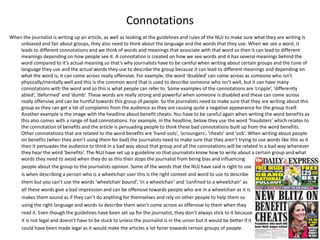
Connotations
When the journalist is writing up an article, as well as looking at the guidelines and rules of the NUJ to make sure what they are writing is
unbiased and fair about groups, they also need to think about the language and the words that they use. When we see a word, it
leads to different connotations and we think of words and meanings that associate with that word so then it can lead to different
meanings depending on how people see it. A connotation is created on how we see words and it has several meanings behind the
word compared to it’s actual meaning so that’s why journalists have to be careful when writing about certain groups and the tone of
language they use and the actual words they use to describe the group because it can lead to different meanings and depending on
what the word is, it can come across really offensive. For example, the word ‘disabled’ can come across as someone who isn’t
physically/mentally well and this is the common word that is used to describe someone who isn’t well, but it can have many
connotations with the word and so this is what people can refer to. Some examples of the connotations are ‘cripple’, ‘differently
abled’, ‘deformed’ and ‘dumb’. These words are really strong and powerful when someone is disabled and these can come across
really offensive and can be hurtful towards this group of people. So the journalists need to make sure that they are writing about this
group as they can get a lot of complaints from the audience as they are causing quite a negative appearance for the group itself.
Another example is the image with the headline about benefit cheats. You have to be careful again when writing the word benefits as
this also comes with a range of bad connotations. For example, in the headline, below they use the word ‘fraudsters’ which relates to
the connotation of benefits and the article is persuading people to think these bad connotations built up from the word benefits.
Other connotations that are related to the word benefits are ‘hand-outs’, ‘scroungers’, ‘cheats’ and ‘sick’. When writing about people
on benefits (when they aren’t using them for bad) the journalists need to make sure that they aren’t trying to use words like this as it
then it persuades the audience to think in a bad way about that group and all the connotations will be related in a bad way whenever
they hear the word ‘benefits’. The NUJ have set up a guideline so that journalists know how to write about a certain group and what
words they need to avoid when they do as this then stops the journalist from being bias and influencing
people about the group to the journalists opinion. Some of the words that the NUJ have said is right to use
is when describing a person who is a wheelchair user this is the right context and word to use to describe
them but you can’t use the words ‘wheelchair bound’, ‘in a wheelchair’ and ‘confined to a wheelchair’ as
all these words give a bad impression and can be offensive towards people who are in a wheelchair as it is
makes them sound as if they can’t do anything for themselves and rely on other people to help them so
using the right language and words to describe them won’t come across as offensive to them when they
read it. Even though the guidelines have been set up for the journalist, they don’t always stick to it because
it is not legal and doesn’t have to be stuck to unless the journalist is in the union but it would be better if it
could have been made legal as it would make the articles a lot fairer towards certain groups of people.
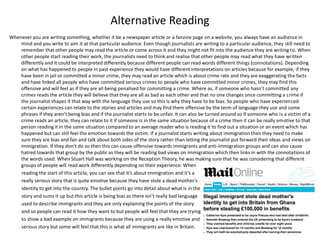
Alternative Reading
Whenever you are writing something, whether it be a newspaper article or a fanzine page on a website, you always have an audience in
mind and you write to aim it at that particular audience. Even though journalists are writing to a particular audience, they still need to
remember that other people may read the article or come across it and they might not fit into the audience they are writing to. When
other people start reading their work, the journalists need to think and realise that other people may read what they have written
differently and it could be interpreted differently because different people can read words different things (connotations). Depending
on what has happened to people in past experience they would have different interpretations on articles because for example, if they
have been in jail or committed a minor crime, they may read an article which is about crime rate and they are exaggerating the facts
and have linked all people who have committed serious crimes to people who have committed minor crimes, they may find this
offensive and will feel as if they are all being penalised for committing a crime. Where as, if someone who hasn’t committed any
crimes reads the article they will believe that they are all as bad as each other and that no one changes once committing a crime if
the journalist shapes it that way with the language they use so this is why they have to be bias. So people who have experienced
certain experiences can relate to the stories and articles and may find them offensive by the term of language they use and some
phrases if they aren’t being bias and if the journalist starts to be unfair. It can also be turned around so if someone who is a victim of a
crime reads an article, they can relate to it if someone is in the same situation because of a crime then it can be really emotive to that
person reading it in the same situation compared to an average reader who is reading it to find out a situation or an event which has
happened but can still feel the emotion towards the victim. If a journalist starts writing about immigration then they need to make
sure they are bias and fair and talk about both sides of the story rather than letting the journalist put forward their ideas and views on
immigration. If they don’t do so then this can cause offensive towards immigrants and anti-immigration groups and can also cause
hatred towards that group by the public as they will be reading bad views on immigration which then links in with the connotations of
the words used. When Stuart Hall was working on the Reception Theory, he was making sure that he was considering that different
groups of people will read work differently depending on their experience. When
reading the start of this article, you can see that it’s about immigration and it’s a
really serious story that is quite emotive because they have stole a dead mother’s
identity to get into the country. The bullet points go into detail about what is in the
story and sums it up but this article is being bias as there isn’t really bad language
used to describe immigrants and they are only explaining the points of the story
and so people can read it how they want to but people will feel that they are trying
to show a bad example on immigrants because they are using a really emotive and
serious story but some will feel that this is what all immigrants are like in Britain.
Objective
When being a journalist, you need to be objective, accurate, truthful, fair & balanced and these need to be stuck to for a journalist to be
credible. They also need to write a story without being unbiased or impartial because they are writing on a factual story so their
opinions or beliefs shouldn’t be manipulated into the story to persuade the audience to think the same. A story always has two sides
so the journalist will look for evidence which supports their ideas and they will discard the evidence which doesn’t support their idea
as this then puts their influence onto the article. This then makes the event heavily influenced by their ideas and then the audience
doesn’t get a fair and balanced view of the story and what has happened because the journalists views take over and this isn’t a
credible thing. It’s similar to when they are writing about certain groups in the media, they have to be unbiased as they have to not
put their ideas forward and write factual. If a journalist isn’t any of these things in an article, they can lose the value of the story that
they are reporting on and this will lose the interest of the audience if they are reading something that isn’t true. An example of when
they are being biased is when a journalist is writing about a certain political party. A newspaper generally has their own opinion and
views on political parties and they all lean either left or right towards different political agendas which makes them look for more
evidence to make an article better or worse about certain political parties. For example, The Guardian is more towards the left wing,
so they believe in taxation to redistribute opportunity and wealth and they believe in equality over the freedom to fail whereas The
Sun is more towards the right wing which means they believe that all business shouldn’t be regulated and believe in freedom to
succeed over equality. These two newspapers will write entirely different stories about a political agenda to each other to make their
preferred political agenda stand out and give more pleasing evidence to persuade the audience to be more towards the newspapers
preferred party.
Accurate
When a journalist is writing an article about an event which has happened, they need to be accurate with the statistics and facts. They need
to write the dates, times, names and quotes accurately so the reader knows what is happening in the event and knows to trust what
the journalist is writing about and these will support the article that they are writing about. The facts in the story need to be correct
and if they do not do so, it could damage their public profile as the audience won’t believe anything they write again due to false
information. If the story has to be dealt in a sensitive manner and the information isn’t correct, it can cause distress to the audience
and the victims in the story and so they need to be thought about when presenting the information without causing harm to the
viewers. The PCC (Press Complaints Commission) have the right to investigate a story if someone believes that it is inaccurate and the
information is false. If this is the case, they can force the publication to print a correction as it can damage somebody’s reputation
who has been accused with false information in a story. A Scottish daily newspaper (The Herald) failed to print accurate information
about a rape case as it published a series of reports between 2001 and 2013 about a man who was charged with a rape allegation.
The court case was still deciding whether the complainer had given consent to sexual intercourse and whether the accused actually
used the force of rape. Meanwhile, the Glasgow-based newspaper was implying that he had definitely raped her even though the jury
was still undecided. This caused Edward Watt (the accused) to write a complaint to the PCC under Clause One of the Editor’s Code Of
Practice, which covers accuracy. His complaint concerned a reader’s letter from 2001, which suggested he had “escaped conviction”
for the offence, two 2007 articles reporting on proposals for changes to the law of rape, and two 2013 stories reporting comments by
his accuser on the issue of corroboration in rape cases.
Legal
Truthful
A journalist is credible when they are being truthful when writing about a story. This is the most important aspect of being a journalist
because they should be truthful and factual and this needs to be stuck to when writing stories and the journalist shouldn’t exaggerate
the point. Sometimes when a journalist wants to make a story more interesting or exciting, they might twist some statistics or facts
and once they start twisting a story and making it their own, it becomes more fiction rather than a report. It can become really
serious when journalists are not being truthful and it can have legal and ethical consequences due to this. When they are writing
about their political agenda especially, it can be really twisted and the rules can be broken just to make their political agenda stand
out and make the rest look weak. Celebrities can be wrote about in a completely different light and this can be done to make readers
more interested in a story as a lot of people look up to celebrities and when they are wrote about in a bad light, it can put the
audience off them and this isn’t credible of a journalist. In the latest Gallup Poll, it showed that 60% of Americans have little or no
trust in what the media and journalists write about. Many journalists have been dishonest when writing about some stories just to
grab the attention of the audience and this can cause a lot of issues and distress to the audience if a story is dishonest in the facts that
they are presenting. There has been a lot of dishonest reports and stories in the news about Muslim because the journalists have
been trying to add their opinion into the stories rather than making it unbiased. Mehdi Hasan (a political journalist) has spoken out to
say that there should be sanctions in place for ‘dishonesty’ when writing about Muslims. He had said in a statement that the press has
proven “singularly unable or unwilling to change the discourse, the tone or the approach towards Muslims, immigrants and asylum
seekers.” This gives a bad press on the groups and causes the audience to believe what has been wrote and they all think the same
way the journalists do and believe what has been said.
Fair & Balanced
Journalists should be writing fair and balanced and not basing the article around their opinion. They should be presenting the facts how
they are and the statistics must be correct. They can’t change them to make it unbalanced or unfair and there is always two sides to a
story so both sides should be shown fairly. The NUJ code of ethics mentions that the journalists shouldn’t produce work that leads to
hatred and discrimination. When talking about certain ethnic groups they need to be presented with facts and not based on the
journalists experience with that particular group or just how they feel towards them to show them in a bad way this can cause the
audience to go with the journalists view rather than them making their own mind up and can cause a lot of hatred towards a certain
groups if they are presented in a bad way. Their writing should be open minded so that the audience are just presented with the facts
so that the audience can base their decision on this and have their own view without being persuaded. If a journalists presents it this
way they are credible and stick to the NUJ’s guidelines. But not all journalists stick to being fair and balanced and can twist stories to
make them unfair on people and show them in a bad light. They try and change the story so it suits the audience and they try to make
it more emotive and interesting by being unfair. JK Rowling has recently sued the Daily Mail as they had printed and posted on their
website a story about how JK Rowling is struggling as a single mum. They used the title “How JK Rowling's sob story about her past as
a single mother has left the churchgoers who cared for her upset and bewildered” and she argues that they have provided false
information and misrepresented her parenting years. She also said the article was “unfair and misleading” and posted on her website
“I would say to any single parent currently feeling the weight of stereotype or stigmatization that I am prouder of my years as a single
mother than of any other part of my life”. The Daily Mail had taken the story off their website but still printed the article out for their
print edition.
Defamation
Defamation is when a statement is said about somebody’s private or public life, financial status. morals or reputation. When it has been
printed it is classed as libel and when it’s said orally it’s called slander. It must be proven that the statement that was printed was false
and it goes against being fair and truthful as a journalist which doesn’t make them a credible journalist. When the false statement is
published about the person, it can damage their reputation and people may judge them by what has been said it can also harm their
career. There are a lot of cases about defamation and many involve journalists twisting statements between celebrities and celebrities
are a common target in the media when it comes to defamation cases. Dr. Luke Gottwald is one of the most successful contemporary
pop music producers and he is suing the Bellamy Brothers for defaming him. They suggested that his song for Britney Spears (Hold It
Against Me) was plagiarised. In 2012 there was a cheerleader who tried to sue a gossip website and the owner of it for defamation
because of the content posted on the website (from a third party). It was about her sexual history and she had claimed that it was
false information and she suffered mental anguish and embarrassment because of it. They are now questioning whether the website
should be held liable for posts by third parties, which normally they can’t and the law actually says that the websites are not
responsible for comments by others and therefore they were immune to lawsuits. This is why online defamation cases grab the
attention of anyone putting content and it surprised a lot of people when the judge ruled the website was not immune and allowed
the lawsuit to go further. The cheerleader in the end won the trial and was awarded $338,000. The jury said that the posts were false
and found that the publisher had acted with malice or reckless disregard. It was posted anonymously, which is where most of the
content comes from on the site and this is where the site’s owner picks what to post. It was then recently overturned by the 6th Circuit
Court of Appeals which said that the cheerleader had no case. The website then got immunity and people are now questioning
whether he is hiding behind the laws and getting others to submit the defamatory material he posts.
Copyright
When anybody creates any bit of work, they are entitled to copyright which covers the ownership of their work so that when somebody
tries to produce work with their work or take images as their own without permission, they can get sued over this. When a journalist
is writing a story they need to make sure that they stick to the law and don’t break it by producing work which isn’t theirs without
permission because this could get the company sued a lot for it and they also can’t plagiarise the work of others. Plagiarise can be
them writing up somebody’s quote that they had said without referencing who has actually said the quote and if they don’t do this it
can lead to copyright infringement and again the company can be sued a lot for this. There is a lot of examples of journalists breaking
the law for plagiarism as many journalists feel they can get away with it. An example of one is Mike Barnicle (Boston Globe columnist)
was forced to resign because there was allegations that his Globe column dated August 2nd, 1998 contained 10 passages lifted from
Brain Droppings (a book published in 1997 by George Carlin). Another example is Jayson Blair (a New York Time reporter) plagiarised
articles and manipulated quotations in stories, including stories related to Jessica Lynch and the Beltway sniper attacks. He and a few
other editors from the newspaper resigned in June 2003 because of this. Ben Domenech was hired to write a blog for the Washington
Post in 2006, he was found to have plagiarised a number of his columns and articles that he wrote for his college newspaper and the
National Review Online. He was getting the passages from a variety of sources ranging from amateur film critics to well-known
pundits and soon after Ben apologised and resigned. All the examples show that not all journalists stick to the copyright law which
ruins a journalist reputation and causes them to resign if this does happen and in some serious cases can be sued for what they have
done.
Children and Young Persons
When journalists write about a young person or a child, they need to consider the Editors Code of Practice which highlights how to handle a
story that involves a young person/child. It has four points which are; “Young people should be free to complete their time at school
without unnecessary intrusion”. The second one is “A child under 16 must not be interviewed or photographed on issues involving
their own or another child’s welfare unless a custodial or similarity responsible adult consent”. The third point is “Pupils must not be
approached or photographed at school without the permission of the school authorities” and the final point is ‘Minors must not be
paid for material involving children’s welfare, nor parents or guardians for material about their children or wards, unless it is clearly in
the child’s interest”. The journalists are dealing with a sensitive age range and so they need to be careful when writing about them
and to make sure they do not go against the Editors Code of Practice with such a vulnerable age range. For example, when Ann
Maguire was stabbed by a 15 year old he was not to be named in the media because he was under 16. When he was off on trial, he
was now 16 and when they gave the verdict they named him because the judge felt it was right in this situation now he had turned
16. Reporters made sure they didn’t name him until it got to the point where he was 16 and the judge allowed him to be named in
the media.
Confidentiality
A journalist will sometimes write up a story which is a documentary piece and it can involve people in it who they have spoken to and they
may have broken the law in some way or may be part of illegal events depending on what the story is they are reporting on. This
means that if the journalists want to, they can be protected from having to reveal who has told the information they have been given
or reveal who they have spoken to on events. They don’t have to stick to this if they don’t want to and they could reveal who has
given them this information but in any story like this, they have the right not to say anything that they don’t want to. The Editors Code
of Practice states that “Journalists have a moral obligation to protect confidential sources and information. This helps back up that
they don’t have to be forced into revealing information or people in the stories if they don’t want to and it is by law that they don’t
have to if they don’t want to.
Official Secrets
When a journalist has been employed for so long, they will have to sign the official secrets act which involves the access to secrets. There is
the Official Secrets Act which is a law that has been set up to protect state secrets and national security and if somebody wants a
journalist to reveal their sources because of the national security, the law allows them to do so and it has been used previously to do
this. An example of this is when the Metropolitan police ordered a court order under the Official Secrets Act to make the Guardian
reporters give information on their phone hacking scandal. The Guardians editor said “We shall resist this extraordinary demand to
the upmost” as they didn’t want to give away their information. The NUJ general secretary was disgusted by the threat from the
police and felt that journalists should be congratulated for what they did and by telling everything the truth from the hacking story
and they shouldn’t be using the Official Secrets Act against them as this is a serious matter. One of the police officers was being
investigated because of the allegation and this was for breaching the Official Secrets act as well as alleged misconduct in the public
office which could be a prison sentence of life imprisonment, if found guilty of this.
Ethical
Codes of Practice
Journalists when writing need to consider the different codes of practice that are in place to help give them guidance on how to write and
structure their work as well as conducting it. When writing about certain groups of people or a very emotive subject, the journalists
need to make sure they write with care and in a considering matter and so having the IPSO, NUJ and the Editors Code of Practice in
place helps set guidelines for the journalists. If somebody feels as if a journalist or newspaper has acted against the codes of practice
or has acted inappropriately, that’s when the ISPO comes into place (Independent Press Standards Organisation) and they deal with
issues like that. There was the PCC (Press Complaints Commission) which was set up before the IPSO as this organisation has taken
over the PCC this year. It was a voluntary regulatory body which was funded by the annual levy it charges newspapers and it was set
up for British newspapers and magazines. There was no legal power editors and journalists didn’t have to stick to the guidelines set
up, it was there for newspapers to join voluntary and they had to contribute to the costs and adhere to the rulings of the commission.
This then made the PCC self-regulating and this is what the IPSO is now as well. The PCC was taken over by the IPSO on the 8th
September 2014 and there was plans being announced in 2011 of a new independent regulator taking over. In 2009 the PCC issued 69
complaints from people and from doing this and handling the complaints, they have helped people who may not have been able to
handle the attention from the press. Most of the people who contacted them were related to victims in tragedies and none of them
had the means to make their concerns clear to the media on a whole. An example of one of the complaints they received was from a
family of a young girl who had committed suicide and they had gone to the PCC twice. They went the first time to make sure the
editors were clear that they didn’t wish to be contacted for comment in the immediate aftermath of the death. They then went a
second time to as to be left alone while the inquest was going on and the girl’s school also went to the PCC to limit the presence of
journalists outside the gates because of the impact it will have on other pupils and their parents. Another example is the elderly
parents of a mother and daughter who had taken their own lives. They felt really distressed by all the contact from the journalists and
the broadcasters and wanted to be left alone by them all. The NUJ is a trade union for journalists which was founded in 1907. If a
journalist doesn’t know how to write about a certain group of people or about a situation they can look at the guidelines that the NUJ
have set up as they explain how to write in certain situations. The NUJ is for journalists to look up to and be a member of but it isn’t a
law that journalists have to stick to and so if people don’t stick to the guidelines then it isn’t illegal but it can cause consequences for
the newspapers and magazines if they don't try and stick to writing about certain groups reasonably and not judgmentally. The Editors
Code of Practice has 16 elements to their code of practice and they are all to do with really emotive and sensitive stories and to do
with being an accurate and reliable journalist. The 16 elements are; accuracy, opportunity to reply, privacy, harassment, intrusion in to
shock or grief, children, children in sex cases, hospitals, reporting to crime, clandestine devices and subterfuge, victims of sexual
assault, discrimination, financial journalism, confidential sources witness payments in criminal trials and payment to criminals. All of
these relate to sensitive subjects and when writing about them need to be handled with care and this is why the Editors Code of
Practice is in place because it gives the opportunity for journalists to write in a way that will approve with the public and not come
across as insensitive and it’s all to do with being a credible journalist.
Privacy
A journalist has to remember whenever writing a story, they need to respect the privacy of people and the families that are related to a
victim in crime. When a journalist is investigating a story, they will normally write it for the public interest but many journalists cross
the line between writing for the public interest and the interest of the public. They have to respect peoples private life and make sure
they don’t ‘intrude into anybody’s private life, grief or distress unless justified by overriding consideration of the public interest’ and
that is from the NUJ’s code of conduct. Privacy is one of the sections in the Editors Code of Practice and it states that everyone is
entitled to respect their private life and their family life. They can also respect the health and correspondence including digital
communications and so journalists need to respect peoples private life and not to cross the line when investigating a story to make
them feel uncomfortable. It is known that journalists do sometimes cross the line and end up disrupting somebody’s privacy but in
this case the editor of the newspaper or magazine needs to prove that disrupting someone’s privacy is in the public interest and not
the interest of the public.
Intrusion
Journalists sometimes will need to report on stories which can be sensitive and personal to some people and when there is a case that
involves personal grief or shock, enquires and approaches they need to be reported with sympathy and discretion and it all needs to
be handled sensitively. The NUJ and the Editors Code of Practice cover intrusion and how to handle it without it upsetting or harming
the public or the people in the story itself and the Editors Code of Practice states that journalists must not intrude in to grief or shock.
Journalists normally try to stick to this and try not to intrude into anybody’s private life but sometimes it can be broken and people
end up complaining to the PCC if they feel like the journalists are intruding into their private life. There are a lot of celebrities who feel
as if journalists intrude into their private life. One example is the author JK Rowling who felt that a journalist had overstepped the
mark by putting a letter into her daughters lunch box. A mother of a child who went to the school was asked by the journalist to put
the letter in JK Rowling’s daughters lunch box and so JK Rowling would read the letter when her daughter came home. When this
incident happened JK Rowling had stated how she felt she had been invaded into her personal life and how she was angry that her
daughter was being targeted for this. A journalist needs to make sure they are not intruding into somebody’s life unless justified by
overriding consideration of the public interest and in this situation, it was a forceful intrusion into her private life.
Harassment
Journalists are not meant to harass, intimidate or persistently pursuit people and when asked to stop photographing or contacting
somebody, they must do so after the first ask and if they carry on, it is harassment. Harassment is part of the Editors Code of Practice
and they state clearly what harassment is when being a journalist and when they overstep the mark. If there is a clear public interest,
this is when a journalist can breach the Clause of the code. If somebody feels as if a journalist is harassing them they can complain to
the PCC by getting the name of the journalist and what they have done to harass the person. For example, in 2007, the PCC worked
with Cheshire Police to help a family of a man who was murdered outside his house in Warrington. The family of Gary Newlove was
concerned about the media attention and the run up the trial of 5 young teenagers accused of the murder. The PCC issued a
statement from the family to the editors and lawyers as they asked the media not to contact them in any way, either in the run-up to
the trial or during it or afterwards. The family then explained that previous contact with journalists had been intrusive and made them
feel as if they were being harassed and this is why they repeatedly asked them to stop this.

Task 10

  • 1.
  • 2.
    Social and CulturalAwareness We are influenced and persuaded by the articles we read in newspapers and magazines and when we read an article we trust the words of the journalists and they give the power to influence us. We are told about an event which has happened and we trust what the journalist is saying about that event as we weren’t there at that time so when we read about it we expect a reliable and unbiased piece about this event which has happened. But even though they are telling us the story and we trust what is being said, sometimes they might exaggerate a story or event to try and engage the readers but with it being factual writing they have to keep the facts 100% honest and true and they have to also think about the social, legal and ethical responsibilities. There are guidelines in place and this is for journalists to read and make sure they meet the guidelines that are set because if they don’t stick to them then it can cause anger or upset for certain groups of people. When they are writing about a story, some of them can involve certain groups of people and when writing about these groups they need to think of the emotional side of writing about them and how it could affect the audience if they read about the groups of people. They need to make sure they are writing truthful about these groups and don’t make it bias or unhelpful about these groups as this could give the group a bad representation and this then penalises the group and makes the audience feel a bad way about the group. This could then cause hatred towards a certain group and everyone has the same opinion about this group. For example, recently in the news there was a woman who was claiming she was too ill to walk and was claiming benefits for this, was filmed in Australia surfing and was filmed swimming with dolphins. They had claimed altogether £200,000 and were jailed for 30 months for the crime they committed. Overall, this story is really bad and they were in the wrong for doing this and there are people out there who are fraudsters when it comes to benefits but from the article, the journalist needs to make sure that they apply the facts from the article and don’t go into detail about judging the whole ‘group’ of people on benefits as this then would start to suggest that all people on benefits claim them when they don’t need them and they do it for money because they don’t want to work. But if you look further into the group of people on benefits, it involves people who are pensioners as they are getting money and they do it because some are too old to work and earned the right to have a pension. It also involves parents with children who are still in education as they get child tax credits which is extra money but only because their children are in education. It doesn’t just involve the people who are fraudsters and throughout the article they have kept it factual and haven’t made it as if they are referring to the whole group of people on benefits and this gives the audience the freedom to judge how they want to without the journalist putting bias information into the article. Another example is there was another story quite recently about 15 people who were suspected to be illegal immigrants and they were hiding in the back of a lorry. A German national had been arrested on suspicion of facilitating the unlawful entry of people into the UK as at this point it was unsure if they were supposed to be there or not but they were wanting to go to a place in the South West and the lorry company didn’t explain where the lorry was heading to and had set off from. They again in this story needed to make sure that they don’t penalise the group of immigrants as there can be legal immigrants who are categorised into the category of immigrants so they need to make sure that the journalists stick to the guidelines set. This then wouldn’t give the whole group a hatred and a bad name and even though in these stories they have suck to the guidelines, some can get really stuck in and create horrendous headlines which can cause hatred towards a group straight away.
  • 3.
    This image isfrom a newspaper front page. It shows a bad representation of foreign people immigrating to the UK. They are stating that every immigrant takes the new jobs in Britain and they have highlighted the word ‘all’ in red which is a really negative colour and it also stands out on the page so the audience see that word and believe that every new job in Britain is taken by an immigrant. This gives off a sense of hatred for any immigrant coming to the UK (illegal or legal) because it is stating that all the jobs and houses are taken by them. This is a really bias headline and it shouldn’t cause this feeling of hatred and should be more statistical rather than being exaggerated.
  • 4.
    NUJ Guidelines To tryand stop journalists from representing groups in a bad way in the media, The National Union of Journalists have set up a set of guidelines that explains a range of ethical guidance and this then leans them towards being more cautious when writing about certain groups and keeps them from being unbiased. The list of NUJ isn’t a legal union (it was set by a group of people that decided to show journalists their way of writing and how things should be written) and the guidelines don’t have to be stuck to as the examples show in the last slide and some journalists can still be bias with their stories but the NUJ try to persuade all journalists to write in the style they are trying to present. The list of groups that the guidelines are set up for are; terrorism, race, HIV, asylum and immigration, age, disability and suicide. This list is all very sensitive subjects and groups and so the journalists need to make sure they write sensitively about the groups and that’s why the NUJ group has been put in place because this group believe that they should be written about with care. If a journalist is unsure about how to write with a sensitive topic then they can ring up the NUJ’s ethic hotline so then they will get some advice on how to write about a certain group and not what to say about them. The NUJ also have a code of conduct which again isn’t legal and doesn’t have to be stuck to but the code has 12 rules that the members of the union should stick to and they are expected to abide by the rules. If they don’t then they will be thrown out of the union or if it becomes a regular occurrence then they will be thrown out of the union. The 12 rules are; • At all times upholds and defends the principle of media freedom, the right of freedom of expression and the right of the public to be informed. • Strives to ensure that information disseminated is honestly conveyed, accurate and fair. • Does her/his utmost to correct harmful inaccuracies. • Differentiates between fact and opinion. • Obtains material by honest, straightforward and open means, with the exception of investigations that are both overwhelmingly in the public interest and which involve evidence that cannot be obtained by straightforward means. • Does nothing to intrude into anybody’s private life, grief or distress unless justified by overriding consideration of the public interest. • Protects the identity of sources who supply information in confidence and material gathered in the course of her/his work. • Resists threats or any other inducements to influence, distort or suppress information and takes no unfair personal advantage of information gained in the course of her/his duties before the information is public knowledge. • Produces no material likely to lead to hatred or discrimination on the grounds of a person’s age, gender, race, colour, creed, legal status, disability, marital status, or sexual orientation. • Does not by way of statement, voice or appearance endorse by advertisement any commercial product or service save for the promotion of her/his own work or of the medium by which she/he is employed. • A journalist shall normally seek the consent of an appropriate adult when interviewing or photographing a child for a story about her/his welfare. • Avoids plagiarism. These should all be stuck to in the union and this helps them talk about groups and ethnic situations really well. The NUJ union also has a ‘conscience clause’ so if one of the journalists is given a topic and it’s about disabled people and benefits and they are told to either be bias about the article and to make sure it’s bad and would cause hatred, the journalist can be given support by their union if they refuse to work in the way they have been told to and this then shows they aren’t going to disobey the rules of the NUJ. The example in the last slide shows where the journalist hasn’t seen the NUJ’s rules and probably isn’t part of their union but is speaking quite bias and is causing hatred towards a certain group and if they were part of the union then this would have been stopped. It disobeys the rule number 2 as it’s not an honest, accurate or fair headline as it isn’t statistical and is exaggerated to make it sound as if there are no new jobs left to the British and are taken by immigrants when realistically it isn’t so this causes it to be inaccurate.
  • 5.
    Connotations When the journalistis writing up an article, as well as looking at the guidelines and rules of the NUJ to make sure what they are writing is unbiased and fair about groups, they also need to think about the language and the words that they use. When we see a word, it leads to different connotations and we think of words and meanings that associate with that word so then it can lead to different meanings depending on how people see it. A connotation is created on how we see words and it has several meanings behind the word compared to it’s actual meaning so that’s why journalists have to be careful when writing about certain groups and the tone of language they use and the actual words they use to describe the group because it can lead to different meanings and depending on what the word is, it can come across really offensive. For example, the word ‘disabled’ can come across as someone who isn’t physically/mentally well and this is the common word that is used to describe someone who isn’t well, but it can have many connotations with the word and so this is what people can refer to. Some examples of the connotations are ‘cripple’, ‘differently abled’, ‘deformed’ and ‘dumb’. These words are really strong and powerful when someone is disabled and these can come across really offensive and can be hurtful towards this group of people. So the journalists need to make sure that they are writing about this group as they can get a lot of complaints from the audience as they are causing quite a negative appearance for the group itself. Another example is the image with the headline about benefit cheats. You have to be careful again when writing the word benefits as this also comes with a range of bad connotations. For example, in the headline, below they use the word ‘fraudsters’ which relates to the connotation of benefits and the article is persuading people to think these bad connotations built up from the word benefits. Other connotations that are related to the word benefits are ‘hand-outs’, ‘scroungers’, ‘cheats’ and ‘sick’. When writing about people on benefits (when they aren’t using them for bad) the journalists need to make sure that they aren’t trying to use words like this as it then it persuades the audience to think in a bad way about that group and all the connotations will be related in a bad way whenever they hear the word ‘benefits’. The NUJ have set up a guideline so that journalists know how to write about a certain group and what words they need to avoid when they do as this then stops the journalist from being bias and influencing people about the group to the journalists opinion. Some of the words that the NUJ have said is right to use is when describing a person who is a wheelchair user this is the right context and word to use to describe them but you can’t use the words ‘wheelchair bound’, ‘in a wheelchair’ and ‘confined to a wheelchair’ as all these words give a bad impression and can be offensive towards people who are in a wheelchair as it is makes them sound as if they can’t do anything for themselves and rely on other people to help them so using the right language and words to describe them won’t come across as offensive to them when they read it. Even though the guidelines have been set up for the journalist, they don’t always stick to it because it is not legal and doesn’t have to be stuck to unless the journalist is in the union but it would be better if it could have been made legal as it would make the articles a lot fairer towards certain groups of people.
  • 6.
    Alternative Reading Whenever youare writing something, whether it be a newspaper article or a fanzine page on a website, you always have an audience in mind and you write to aim it at that particular audience. Even though journalists are writing to a particular audience, they still need to remember that other people may read the article or come across it and they might not fit into the audience they are writing to. When other people start reading their work, the journalists need to think and realise that other people may read what they have written differently and it could be interpreted differently because different people can read words different things (connotations). Depending on what has happened to people in past experience they would have different interpretations on articles because for example, if they have been in jail or committed a minor crime, they may read an article which is about crime rate and they are exaggerating the facts and have linked all people who have committed serious crimes to people who have committed minor crimes, they may find this offensive and will feel as if they are all being penalised for committing a crime. Where as, if someone who hasn’t committed any crimes reads the article they will believe that they are all as bad as each other and that no one changes once committing a crime if the journalist shapes it that way with the language they use so this is why they have to be bias. So people who have experienced certain experiences can relate to the stories and articles and may find them offensive by the term of language they use and some phrases if they aren’t being bias and if the journalist starts to be unfair. It can also be turned around so if someone who is a victim of a crime reads an article, they can relate to it if someone is in the same situation because of a crime then it can be really emotive to that person reading it in the same situation compared to an average reader who is reading it to find out a situation or an event which has happened but can still feel the emotion towards the victim. If a journalist starts writing about immigration then they need to make sure they are bias and fair and talk about both sides of the story rather than letting the journalist put forward their ideas and views on immigration. If they don’t do so then this can cause offensive towards immigrants and anti-immigration groups and can also cause hatred towards that group by the public as they will be reading bad views on immigration which then links in with the connotations of the words used. When Stuart Hall was working on the Reception Theory, he was making sure that he was considering that different groups of people will read work differently depending on their experience. When reading the start of this article, you can see that it’s about immigration and it’s a really serious story that is quite emotive because they have stole a dead mother’s identity to get into the country. The bullet points go into detail about what is in the story and sums it up but this article is being bias as there isn’t really bad language used to describe immigrants and they are only explaining the points of the story and so people can read it how they want to but people will feel that they are trying to show a bad example on immigrants because they are using a really emotive and serious story but some will feel that this is what all immigrants are like in Britain.
  • 7.
    Objective When being ajournalist, you need to be objective, accurate, truthful, fair & balanced and these need to be stuck to for a journalist to be credible. They also need to write a story without being unbiased or impartial because they are writing on a factual story so their opinions or beliefs shouldn’t be manipulated into the story to persuade the audience to think the same. A story always has two sides so the journalist will look for evidence which supports their ideas and they will discard the evidence which doesn’t support their idea as this then puts their influence onto the article. This then makes the event heavily influenced by their ideas and then the audience doesn’t get a fair and balanced view of the story and what has happened because the journalists views take over and this isn’t a credible thing. It’s similar to when they are writing about certain groups in the media, they have to be unbiased as they have to not put their ideas forward and write factual. If a journalist isn’t any of these things in an article, they can lose the value of the story that they are reporting on and this will lose the interest of the audience if they are reading something that isn’t true. An example of when they are being biased is when a journalist is writing about a certain political party. A newspaper generally has their own opinion and views on political parties and they all lean either left or right towards different political agendas which makes them look for more evidence to make an article better or worse about certain political parties. For example, The Guardian is more towards the left wing, so they believe in taxation to redistribute opportunity and wealth and they believe in equality over the freedom to fail whereas The Sun is more towards the right wing which means they believe that all business shouldn’t be regulated and believe in freedom to succeed over equality. These two newspapers will write entirely different stories about a political agenda to each other to make their preferred political agenda stand out and give more pleasing evidence to persuade the audience to be more towards the newspapers preferred party. Accurate When a journalist is writing an article about an event which has happened, they need to be accurate with the statistics and facts. They need to write the dates, times, names and quotes accurately so the reader knows what is happening in the event and knows to trust what the journalist is writing about and these will support the article that they are writing about. The facts in the story need to be correct and if they do not do so, it could damage their public profile as the audience won’t believe anything they write again due to false information. If the story has to be dealt in a sensitive manner and the information isn’t correct, it can cause distress to the audience and the victims in the story and so they need to be thought about when presenting the information without causing harm to the viewers. The PCC (Press Complaints Commission) have the right to investigate a story if someone believes that it is inaccurate and the information is false. If this is the case, they can force the publication to print a correction as it can damage somebody’s reputation who has been accused with false information in a story. A Scottish daily newspaper (The Herald) failed to print accurate information about a rape case as it published a series of reports between 2001 and 2013 about a man who was charged with a rape allegation. The court case was still deciding whether the complainer had given consent to sexual intercourse and whether the accused actually used the force of rape. Meanwhile, the Glasgow-based newspaper was implying that he had definitely raped her even though the jury was still undecided. This caused Edward Watt (the accused) to write a complaint to the PCC under Clause One of the Editor’s Code Of Practice, which covers accuracy. His complaint concerned a reader’s letter from 2001, which suggested he had “escaped conviction” for the offence, two 2007 articles reporting on proposals for changes to the law of rape, and two 2013 stories reporting comments by his accuser on the issue of corroboration in rape cases.
  • 8.
  • 9.
    Truthful A journalist iscredible when they are being truthful when writing about a story. This is the most important aspect of being a journalist because they should be truthful and factual and this needs to be stuck to when writing stories and the journalist shouldn’t exaggerate the point. Sometimes when a journalist wants to make a story more interesting or exciting, they might twist some statistics or facts and once they start twisting a story and making it their own, it becomes more fiction rather than a report. It can become really serious when journalists are not being truthful and it can have legal and ethical consequences due to this. When they are writing about their political agenda especially, it can be really twisted and the rules can be broken just to make their political agenda stand out and make the rest look weak. Celebrities can be wrote about in a completely different light and this can be done to make readers more interested in a story as a lot of people look up to celebrities and when they are wrote about in a bad light, it can put the audience off them and this isn’t credible of a journalist. In the latest Gallup Poll, it showed that 60% of Americans have little or no trust in what the media and journalists write about. Many journalists have been dishonest when writing about some stories just to grab the attention of the audience and this can cause a lot of issues and distress to the audience if a story is dishonest in the facts that they are presenting. There has been a lot of dishonest reports and stories in the news about Muslim because the journalists have been trying to add their opinion into the stories rather than making it unbiased. Mehdi Hasan (a political journalist) has spoken out to say that there should be sanctions in place for ‘dishonesty’ when writing about Muslims. He had said in a statement that the press has proven “singularly unable or unwilling to change the discourse, the tone or the approach towards Muslims, immigrants and asylum seekers.” This gives a bad press on the groups and causes the audience to believe what has been wrote and they all think the same way the journalists do and believe what has been said. Fair & Balanced Journalists should be writing fair and balanced and not basing the article around their opinion. They should be presenting the facts how they are and the statistics must be correct. They can’t change them to make it unbalanced or unfair and there is always two sides to a story so both sides should be shown fairly. The NUJ code of ethics mentions that the journalists shouldn’t produce work that leads to hatred and discrimination. When talking about certain ethnic groups they need to be presented with facts and not based on the journalists experience with that particular group or just how they feel towards them to show them in a bad way this can cause the audience to go with the journalists view rather than them making their own mind up and can cause a lot of hatred towards a certain groups if they are presented in a bad way. Their writing should be open minded so that the audience are just presented with the facts so that the audience can base their decision on this and have their own view without being persuaded. If a journalists presents it this way they are credible and stick to the NUJ’s guidelines. But not all journalists stick to being fair and balanced and can twist stories to make them unfair on people and show them in a bad light. They try and change the story so it suits the audience and they try to make it more emotive and interesting by being unfair. JK Rowling has recently sued the Daily Mail as they had printed and posted on their website a story about how JK Rowling is struggling as a single mum. They used the title “How JK Rowling's sob story about her past as a single mother has left the churchgoers who cared for her upset and bewildered” and she argues that they have provided false information and misrepresented her parenting years. She also said the article was “unfair and misleading” and posted on her website “I would say to any single parent currently feeling the weight of stereotype or stigmatization that I am prouder of my years as a single mother than of any other part of my life”. The Daily Mail had taken the story off their website but still printed the article out for their print edition.
  • 10.
    Defamation Defamation is whena statement is said about somebody’s private or public life, financial status. morals or reputation. When it has been printed it is classed as libel and when it’s said orally it’s called slander. It must be proven that the statement that was printed was false and it goes against being fair and truthful as a journalist which doesn’t make them a credible journalist. When the false statement is published about the person, it can damage their reputation and people may judge them by what has been said it can also harm their career. There are a lot of cases about defamation and many involve journalists twisting statements between celebrities and celebrities are a common target in the media when it comes to defamation cases. Dr. Luke Gottwald is one of the most successful contemporary pop music producers and he is suing the Bellamy Brothers for defaming him. They suggested that his song for Britney Spears (Hold It Against Me) was plagiarised. In 2012 there was a cheerleader who tried to sue a gossip website and the owner of it for defamation because of the content posted on the website (from a third party). It was about her sexual history and she had claimed that it was false information and she suffered mental anguish and embarrassment because of it. They are now questioning whether the website should be held liable for posts by third parties, which normally they can’t and the law actually says that the websites are not responsible for comments by others and therefore they were immune to lawsuits. This is why online defamation cases grab the attention of anyone putting content and it surprised a lot of people when the judge ruled the website was not immune and allowed the lawsuit to go further. The cheerleader in the end won the trial and was awarded $338,000. The jury said that the posts were false and found that the publisher had acted with malice or reckless disregard. It was posted anonymously, which is where most of the content comes from on the site and this is where the site’s owner picks what to post. It was then recently overturned by the 6th Circuit Court of Appeals which said that the cheerleader had no case. The website then got immunity and people are now questioning whether he is hiding behind the laws and getting others to submit the defamatory material he posts. Copyright When anybody creates any bit of work, they are entitled to copyright which covers the ownership of their work so that when somebody tries to produce work with their work or take images as their own without permission, they can get sued over this. When a journalist is writing a story they need to make sure that they stick to the law and don’t break it by producing work which isn’t theirs without permission because this could get the company sued a lot for it and they also can’t plagiarise the work of others. Plagiarise can be them writing up somebody’s quote that they had said without referencing who has actually said the quote and if they don’t do this it can lead to copyright infringement and again the company can be sued a lot for this. There is a lot of examples of journalists breaking the law for plagiarism as many journalists feel they can get away with it. An example of one is Mike Barnicle (Boston Globe columnist) was forced to resign because there was allegations that his Globe column dated August 2nd, 1998 contained 10 passages lifted from Brain Droppings (a book published in 1997 by George Carlin). Another example is Jayson Blair (a New York Time reporter) plagiarised articles and manipulated quotations in stories, including stories related to Jessica Lynch and the Beltway sniper attacks. He and a few other editors from the newspaper resigned in June 2003 because of this. Ben Domenech was hired to write a blog for the Washington Post in 2006, he was found to have plagiarised a number of his columns and articles that he wrote for his college newspaper and the National Review Online. He was getting the passages from a variety of sources ranging from amateur film critics to well-known pundits and soon after Ben apologised and resigned. All the examples show that not all journalists stick to the copyright law which ruins a journalist reputation and causes them to resign if this does happen and in some serious cases can be sued for what they have done.
  • 11.
    Children and YoungPersons When journalists write about a young person or a child, they need to consider the Editors Code of Practice which highlights how to handle a story that involves a young person/child. It has four points which are; “Young people should be free to complete their time at school without unnecessary intrusion”. The second one is “A child under 16 must not be interviewed or photographed on issues involving their own or another child’s welfare unless a custodial or similarity responsible adult consent”. The third point is “Pupils must not be approached or photographed at school without the permission of the school authorities” and the final point is ‘Minors must not be paid for material involving children’s welfare, nor parents or guardians for material about their children or wards, unless it is clearly in the child’s interest”. The journalists are dealing with a sensitive age range and so they need to be careful when writing about them and to make sure they do not go against the Editors Code of Practice with such a vulnerable age range. For example, when Ann Maguire was stabbed by a 15 year old he was not to be named in the media because he was under 16. When he was off on trial, he was now 16 and when they gave the verdict they named him because the judge felt it was right in this situation now he had turned 16. Reporters made sure they didn’t name him until it got to the point where he was 16 and the judge allowed him to be named in the media. Confidentiality A journalist will sometimes write up a story which is a documentary piece and it can involve people in it who they have spoken to and they may have broken the law in some way or may be part of illegal events depending on what the story is they are reporting on. This means that if the journalists want to, they can be protected from having to reveal who has told the information they have been given or reveal who they have spoken to on events. They don’t have to stick to this if they don’t want to and they could reveal who has given them this information but in any story like this, they have the right not to say anything that they don’t want to. The Editors Code of Practice states that “Journalists have a moral obligation to protect confidential sources and information. This helps back up that they don’t have to be forced into revealing information or people in the stories if they don’t want to and it is by law that they don’t have to if they don’t want to. Official Secrets When a journalist has been employed for so long, they will have to sign the official secrets act which involves the access to secrets. There is the Official Secrets Act which is a law that has been set up to protect state secrets and national security and if somebody wants a journalist to reveal their sources because of the national security, the law allows them to do so and it has been used previously to do this. An example of this is when the Metropolitan police ordered a court order under the Official Secrets Act to make the Guardian reporters give information on their phone hacking scandal. The Guardians editor said “We shall resist this extraordinary demand to the upmost” as they didn’t want to give away their information. The NUJ general secretary was disgusted by the threat from the police and felt that journalists should be congratulated for what they did and by telling everything the truth from the hacking story and they shouldn’t be using the Official Secrets Act against them as this is a serious matter. One of the police officers was being investigated because of the allegation and this was for breaching the Official Secrets act as well as alleged misconduct in the public office which could be a prison sentence of life imprisonment, if found guilty of this.
  • 12.
  • 13.
    Codes of Practice Journalistswhen writing need to consider the different codes of practice that are in place to help give them guidance on how to write and structure their work as well as conducting it. When writing about certain groups of people or a very emotive subject, the journalists need to make sure they write with care and in a considering matter and so having the IPSO, NUJ and the Editors Code of Practice in place helps set guidelines for the journalists. If somebody feels as if a journalist or newspaper has acted against the codes of practice or has acted inappropriately, that’s when the ISPO comes into place (Independent Press Standards Organisation) and they deal with issues like that. There was the PCC (Press Complaints Commission) which was set up before the IPSO as this organisation has taken over the PCC this year. It was a voluntary regulatory body which was funded by the annual levy it charges newspapers and it was set up for British newspapers and magazines. There was no legal power editors and journalists didn’t have to stick to the guidelines set up, it was there for newspapers to join voluntary and they had to contribute to the costs and adhere to the rulings of the commission. This then made the PCC self-regulating and this is what the IPSO is now as well. The PCC was taken over by the IPSO on the 8th September 2014 and there was plans being announced in 2011 of a new independent regulator taking over. In 2009 the PCC issued 69 complaints from people and from doing this and handling the complaints, they have helped people who may not have been able to handle the attention from the press. Most of the people who contacted them were related to victims in tragedies and none of them had the means to make their concerns clear to the media on a whole. An example of one of the complaints they received was from a family of a young girl who had committed suicide and they had gone to the PCC twice. They went the first time to make sure the editors were clear that they didn’t wish to be contacted for comment in the immediate aftermath of the death. They then went a second time to as to be left alone while the inquest was going on and the girl’s school also went to the PCC to limit the presence of journalists outside the gates because of the impact it will have on other pupils and their parents. Another example is the elderly parents of a mother and daughter who had taken their own lives. They felt really distressed by all the contact from the journalists and the broadcasters and wanted to be left alone by them all. The NUJ is a trade union for journalists which was founded in 1907. If a journalist doesn’t know how to write about a certain group of people or about a situation they can look at the guidelines that the NUJ have set up as they explain how to write in certain situations. The NUJ is for journalists to look up to and be a member of but it isn’t a law that journalists have to stick to and so if people don’t stick to the guidelines then it isn’t illegal but it can cause consequences for the newspapers and magazines if they don't try and stick to writing about certain groups reasonably and not judgmentally. The Editors Code of Practice has 16 elements to their code of practice and they are all to do with really emotive and sensitive stories and to do with being an accurate and reliable journalist. The 16 elements are; accuracy, opportunity to reply, privacy, harassment, intrusion in to shock or grief, children, children in sex cases, hospitals, reporting to crime, clandestine devices and subterfuge, victims of sexual assault, discrimination, financial journalism, confidential sources witness payments in criminal trials and payment to criminals. All of these relate to sensitive subjects and when writing about them need to be handled with care and this is why the Editors Code of Practice is in place because it gives the opportunity for journalists to write in a way that will approve with the public and not come across as insensitive and it’s all to do with being a credible journalist.
  • 14.
    Privacy A journalist hasto remember whenever writing a story, they need to respect the privacy of people and the families that are related to a victim in crime. When a journalist is investigating a story, they will normally write it for the public interest but many journalists cross the line between writing for the public interest and the interest of the public. They have to respect peoples private life and make sure they don’t ‘intrude into anybody’s private life, grief or distress unless justified by overriding consideration of the public interest’ and that is from the NUJ’s code of conduct. Privacy is one of the sections in the Editors Code of Practice and it states that everyone is entitled to respect their private life and their family life. They can also respect the health and correspondence including digital communications and so journalists need to respect peoples private life and not to cross the line when investigating a story to make them feel uncomfortable. It is known that journalists do sometimes cross the line and end up disrupting somebody’s privacy but in this case the editor of the newspaper or magazine needs to prove that disrupting someone’s privacy is in the public interest and not the interest of the public. Intrusion Journalists sometimes will need to report on stories which can be sensitive and personal to some people and when there is a case that involves personal grief or shock, enquires and approaches they need to be reported with sympathy and discretion and it all needs to be handled sensitively. The NUJ and the Editors Code of Practice cover intrusion and how to handle it without it upsetting or harming the public or the people in the story itself and the Editors Code of Practice states that journalists must not intrude in to grief or shock. Journalists normally try to stick to this and try not to intrude into anybody’s private life but sometimes it can be broken and people end up complaining to the PCC if they feel like the journalists are intruding into their private life. There are a lot of celebrities who feel as if journalists intrude into their private life. One example is the author JK Rowling who felt that a journalist had overstepped the mark by putting a letter into her daughters lunch box. A mother of a child who went to the school was asked by the journalist to put the letter in JK Rowling’s daughters lunch box and so JK Rowling would read the letter when her daughter came home. When this incident happened JK Rowling had stated how she felt she had been invaded into her personal life and how she was angry that her daughter was being targeted for this. A journalist needs to make sure they are not intruding into somebody’s life unless justified by overriding consideration of the public interest and in this situation, it was a forceful intrusion into her private life. Harassment Journalists are not meant to harass, intimidate or persistently pursuit people and when asked to stop photographing or contacting somebody, they must do so after the first ask and if they carry on, it is harassment. Harassment is part of the Editors Code of Practice and they state clearly what harassment is when being a journalist and when they overstep the mark. If there is a clear public interest, this is when a journalist can breach the Clause of the code. If somebody feels as if a journalist is harassing them they can complain to the PCC by getting the name of the journalist and what they have done to harass the person. For example, in 2007, the PCC worked with Cheshire Police to help a family of a man who was murdered outside his house in Warrington. The family of Gary Newlove was concerned about the media attention and the run up the trial of 5 young teenagers accused of the murder. The PCC issued a statement from the family to the editors and lawyers as they asked the media not to contact them in any way, either in the run-up to the trial or during it or afterwards. The family then explained that previous contact with journalists had been intrusive and made them feel as if they were being harassed and this is why they repeatedly asked them to stop this.