My argument is in two
pieces; firstly, without
requiring voters to use
a legal state or federal
identification to fill out
a ballot, we are making
our society vulnerable to
voting fraud.
Secondly, it is an
outlandish claim to say
that voters should not
have to show any legal
identification after a short
analysis of what the same
nonvoters have to show ID
for anyway.
This misconception
brought to light, that this
ID requirement is a large-
scaleploytooppresscertain
demographics from voting
privileges, is possibly just a
misunderstanding of what
rights we have as citizens,
and lack of knowledge
pertaining to the
importance of protecting
the integrity of our ballot
submissions.
The Constitution does
not guarantee a citizen the
right to vote.
Seneca Falls, marching
in Selma, and other
various rights movement
demonstrations rightfully
fought to fix the injustice
of suppressing basic
freedoms, like that of
voting, for those who did
not have it.
But, to argue that
somebody who has no
legal means of identifying
themselves should be able
to walk in and vote, is
absurd.
Not including
unidentified citizens is
not oppression of freedom
(or of rights, as noted
that it is a privilege, not
a constitutional right), it
is a reasonable action to
protect the integrity of our
democracy.
The main question is,
what is wrong with this
requirement?
It is not a racist, or age
based discriminatory
action; nor is it aimed at
hindering inclusion of the
impoverished.
In fact, requiring
identification is so far
from this, those who argue
that it’s a corrupt action
conveniently forget that
you need a form of ID to
apply for food stamps,
welfare, and to file for
unemployment.
Yes, I fully expect the
man filing for welfare
to bring his same legal
identification to the poll
with him.
For these reasons, it is
an illegitimate argument
to say that requiring voter
identification is an action
to oppress any minority’s
ability to vote, and it
protects our democratic
privileges.
There’s a man living in
Sibley. Why? Because his
state ID says female.
Transgender visibility
is becoming a pretty
big topic today, with
celebrities like Caitlin
Jenner and local
individuals like Lila
Perry coming out, and
so it’s time to realize that
there are trans people at
Lindenwood.
Transgender is the
word for anyone who
does not identify with
the gender they were
assigned at birth.
Myself and several
others identify as
genderqueer.
Although we don’t
consider ourselves as
being inside of the
male-female binary,
Lindenwood is quite
insistent on pushing us
into it.
I live in Sibley, even
though I don’t consider
myself a female, and
when I visit my friends
in Guffey, I have to
provide my ID and be
out by midnight because
I’m not a guy.
Everywhere I go I
am reminded that the
world perceives me as a
woman.
The trans male in
Sibley would rather live
with the guys in Guffey,
and I know at least one
person living in Guffey
who’d rather live in
Sibley.
Within the past
year, the University of
Missouri at Columbia
implemented gender-
neutral housing in
addition to their
traditional male and
female housing. I’d like
to see Lindenwood go
the same direction.
Perhaps one of the
small dorms like Warner
or Stumberg could be
converted into neutral
housing. This would give
a safe space for anyone
under the trans umbrella
to live.
It’s hard being
reminded every day
that people don’t see
you for who you are;
Lindenwood would do
well to accommodate
the needs of its students
who are so frequently
ignored.
It’s going to take
time, I know that.
Change doesn’t happen
overnight. But change
needs to start today.
I have a message for
Lindenwood: We’re
here, we’re queer, and we
would really appreciate if
you would stop ignoring
our existence.
Which is more
disturbing: A university’s
staff refusing press
interviews until they can
put a positive spin on it, or
the staff telling its students
that they may not speak to
the newspaper?
As a journalism student
learning and practicing
information gathering, I
view the first as problematic
for our academic program.
As a student with opinions
and civil freedoms, I view
the second as nothing short
of atrocious for our campus
community.
While we are grateful
for the staff members who
help us to get the details we
need, there are others who
still shut us out.
A few weeks ago,
Reporter Lontreal Farmer
attended a meeting of
resident directors to ask if
anyone would talk about
how keys unlock multiple
doors on campus. Before
anyone could respond,
Michelle Giessman said
“absolutely not.”
She said Farmer should
speak to Ryan Guffey or
Terry Russell, but he could
not speak to the RDs.
The reporter backed off,
and ended up dropping the
story entirely for fear of
losing his RA position.
Giessman later
apologized to Farmer, but
many of the RDs who were
present became afraid to
say anything to the student
newspaper.
When News Editor
Viktoria Muench began
writing the story, one of
her intended sources asked
if she was sure she wanted
to publish it; housing had
told the residential staff not
to speak to the Legacy.
I sent an email to
Giessman and Guffey,
and copied Russell
and President Michael
Shonrock, speaking out
against the apparent effort
to stop students from
voicing their concerns.
Russell responded by
stating that he had given
an honest interview to
Muench, Giessman never
replied, and Guffey came
by the Legacy adviser’s
office to apologize, which I
appreciate wholeheartedly.
Guffey said the students
had been told not to speak
to the student newspaper,
and this wasn’t acceptable.
Guffey also said nobody
would lose his or her job for
talking to the newspaper,
and said he would be sure
the residential staff knows
that moving forward.
After getting
permission from the
housing department,
Muench’s sources felt
more comfortable being
interviewed, but one RA
said he is still worried. He
said there is a chance he
would not be rehired, even
if he is not fired.
Students are paranoid
when speaking to the
student newspaper — an
organization of peers—
about their concerns.
I will not stand for this
culture of fear.
I will not stand for
an administration that
instructs us to write a
feel-good story, as Russell
requested in an email.
Rather than waiting until
an issue has been resolved
to give interviews, the staff
of this university ought to
provide the information
when it is first sought.
Guffey said that after a
Legacy reporter brought
this issue to the attention of
the administration, it was
fixed. And only then did
he encourage the Legacy to
pursue this story.
This forced delay was
also seen last semester
when a reporter
attempted to write about
Lindenwood’s vaccination
policy. When the reporter
contacted Guffey in
March, she was refused an
interview.
Guffey said he “would
be happy to facilitate your
interest any time after
August,” a full five months
later. He still has not
answered our questions.
When administrators do
not provide information
untilthatinformationlooks
good for the university,
the student newspaper is
unable to relay the details of
what is actually happening
on campus.
As Shonrock stated
earlier this semester,
“students need forums to
voice their complaints, and
the student newspaper is
one place for that.”
So moving forward,
will certain administrators
allow their students to
think critically about
the university as Guffey
promised, or will they
continue to keep them
living in fear?
Page 7Nov. 3, 2015
opinions
The Legacy / Lindenlink.com
Spellmann Center 3095 / 3100
209 S. Kingshighway
St. Charles, Mo. 63301
Telephone: 636-949-4336
Email: lulegacy@lindenwood.edu
Staff:
Editor-in-Chief: Emily Adair
Lindenlink Managing Editor: Phil Brahm
Legacy Managing Editor: Phil Scherer
News Editor: Viktoria Muench
Culture Editor: Jason Wiese
Sports Editor: Brayden Parker
Opinions Editor: Tyler Tousley
Page Designer: Kelby Lorenz
Photo Editor: Romane Donadini
Head Illustrator: Rachel Schuldt
Business Manager: Jennifer Nickerson
Paper Girl: Abby Lambert
Faculty advisers: Susan Weich, Neil Ralston
The views expressed herein are not necessarily
the views of the university.
The Legacy is proud to provide an open forum for
a variety of opinions.
The views expressed herein are the positions
of the individuals who write them. They are not
necessarily the views of the entire publication or
any other individual member of the staff.
To share your perspectives, please send a Letter
to the Editor to LULegacy@lindenwood.edu. Letters
maynotexceed350words,shouldavoidobscenities
and must include the writer’s full name.
Letter to the Editor Policy:
LU tries to silence students
opinions
Jenn Mullen
Reader
Transgender folks
need place to live
With the presidential
election approaching, laws
requiring voters to present
a photo ID when they vote
are creating controversy.
These laws are being
pushed and passed
primarily by Republican
politicians to help prevent
voter fraud.
Although Missouri does
not require a photo ID to
vote currently, 32 states
do. So who knows? Maybe
Missouri will be next.
What the promoters
probably won’t tell you is
that since 2000, only 28
people have been convicted
for voter fraud, according
to Arizona State University.
In fact, most voter fraud
occurs through absentee
ballots that can be mailed in
by pretty much anyone and
do not require a photo ID.
So why are these new
laws being endorsed so
heavily?
Those who are pushing
the laws are making an
attempt to prevent certain
demographics from voting.
According to both the
Public Broadcasting Service
and the Washington Post,
African-Americans and
Hispanics—groups that
tend to vote Democrat—
are less likely to have the
identification required.
This is in part because
these groups tend to be less
wealthy than your average
white Republican.
It costs money to get a
photo ID, and it often can
cost money to acquire the
documents needed to get
that photo ID.
The lower class is also a
target for these laws.
The Brennan Center did
a study which found, “that
eligible voters who would
need the free identification
cards were less likely to
have access to a vehicle and
live farther from where the
IDs are issued.”
People with lower
economic standings often
live in crowded city spaces
where they have never
needed a car, and therefore,
never needed a driver’s
license.
Without a car, many rely
on public transportation,
which limits access to the
route of the bus.
This can create an issue
when it comes to getting to
the places that issue these
IDs.
Voter fraud is nowhere
near a big enough issue to
be putting these laws into
effect.
Politicians are
supporting these laws with
a hope to sway the vote in
their direction. I’m not
supporting them to help
everybody have an equal
chance to cast their vote.
Samuel Horstmeier
Reporter
Tyler Tousley	
Opinions Editor
ArenewvoterIDlawsdiscriminating?
YES NO
Some administrators control the news with intimidation
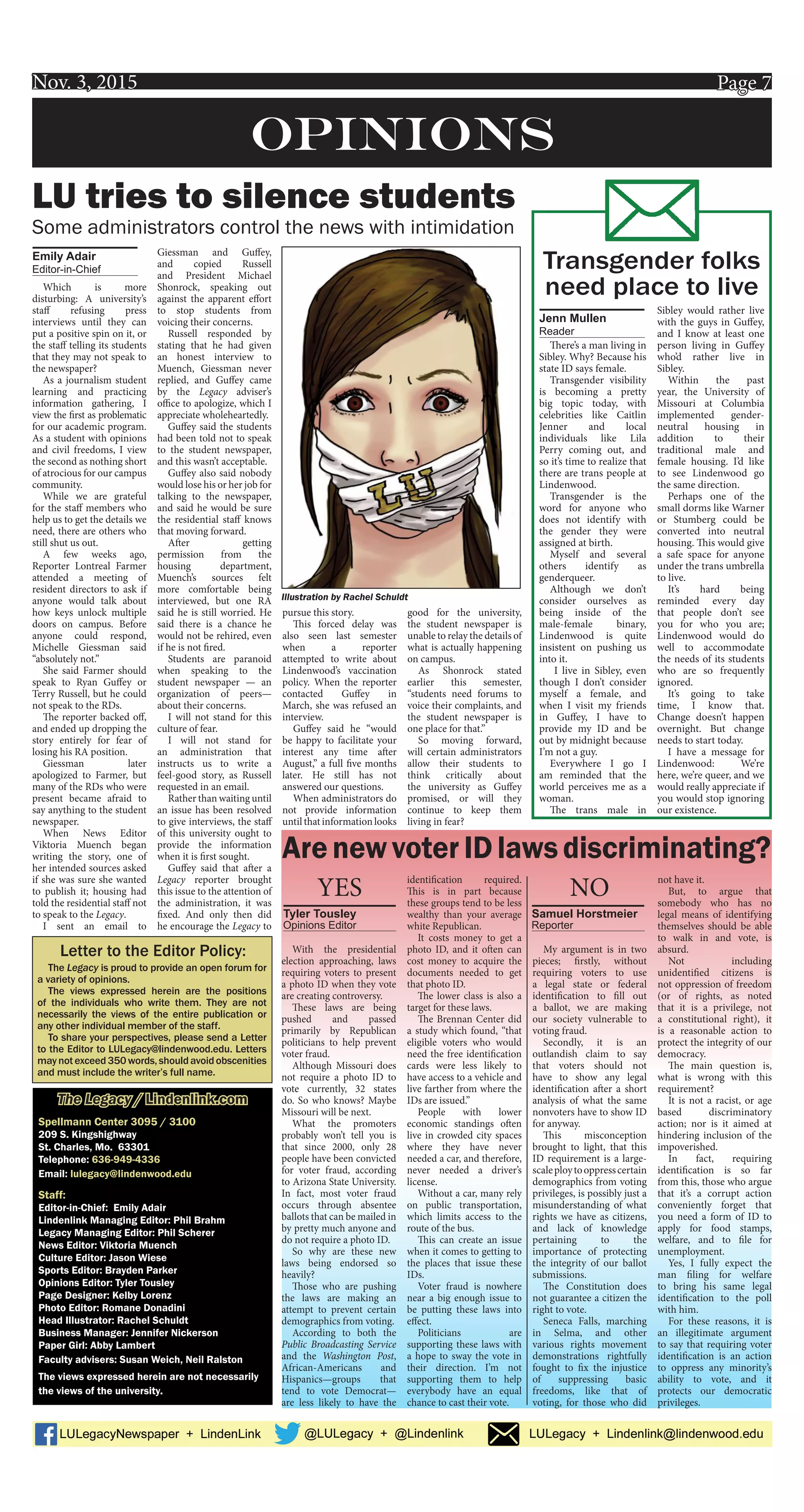
Illustration by Rachel Schuldt
Emily Adair
Editor-in-Chief

B3--11-3-2015

  • 1.
    My argument isin two pieces; firstly, without requiring voters to use a legal state or federal identification to fill out a ballot, we are making our society vulnerable to voting fraud. Secondly, it is an outlandish claim to say that voters should not have to show any legal identification after a short analysis of what the same nonvoters have to show ID for anyway. This misconception brought to light, that this ID requirement is a large- scaleploytooppresscertain demographics from voting privileges, is possibly just a misunderstanding of what rights we have as citizens, and lack of knowledge pertaining to the importance of protecting the integrity of our ballot submissions. The Constitution does not guarantee a citizen the right to vote. Seneca Falls, marching in Selma, and other various rights movement demonstrations rightfully fought to fix the injustice of suppressing basic freedoms, like that of voting, for those who did not have it. But, to argue that somebody who has no legal means of identifying themselves should be able to walk in and vote, is absurd. Not including unidentified citizens is not oppression of freedom (or of rights, as noted that it is a privilege, not a constitutional right), it is a reasonable action to protect the integrity of our democracy. The main question is, what is wrong with this requirement? It is not a racist, or age based discriminatory action; nor is it aimed at hindering inclusion of the impoverished. In fact, requiring identification is so far from this, those who argue that it’s a corrupt action conveniently forget that you need a form of ID to apply for food stamps, welfare, and to file for unemployment. Yes, I fully expect the man filing for welfare to bring his same legal identification to the poll with him. For these reasons, it is an illegitimate argument to say that requiring voter identification is an action to oppress any minority’s ability to vote, and it protects our democratic privileges. There’s a man living in Sibley. Why? Because his state ID says female. Transgender visibility is becoming a pretty big topic today, with celebrities like Caitlin Jenner and local individuals like Lila Perry coming out, and so it’s time to realize that there are trans people at Lindenwood. Transgender is the word for anyone who does not identify with the gender they were assigned at birth. Myself and several others identify as genderqueer. Although we don’t consider ourselves as being inside of the male-female binary, Lindenwood is quite insistent on pushing us into it. I live in Sibley, even though I don’t consider myself a female, and when I visit my friends in Guffey, I have to provide my ID and be out by midnight because I’m not a guy. Everywhere I go I am reminded that the world perceives me as a woman. The trans male in Sibley would rather live with the guys in Guffey, and I know at least one person living in Guffey who’d rather live in Sibley. Within the past year, the University of Missouri at Columbia implemented gender- neutral housing in addition to their traditional male and female housing. I’d like to see Lindenwood go the same direction. Perhaps one of the small dorms like Warner or Stumberg could be converted into neutral housing. This would give a safe space for anyone under the trans umbrella to live. It’s hard being reminded every day that people don’t see you for who you are; Lindenwood would do well to accommodate the needs of its students who are so frequently ignored. It’s going to take time, I know that. Change doesn’t happen overnight. But change needs to start today. I have a message for Lindenwood: We’re here, we’re queer, and we would really appreciate if you would stop ignoring our existence. Which is more disturbing: A university’s staff refusing press interviews until they can put a positive spin on it, or the staff telling its students that they may not speak to the newspaper? As a journalism student learning and practicing information gathering, I view the first as problematic for our academic program. As a student with opinions and civil freedoms, I view the second as nothing short of atrocious for our campus community. While we are grateful for the staff members who help us to get the details we need, there are others who still shut us out. A few weeks ago, Reporter Lontreal Farmer attended a meeting of resident directors to ask if anyone would talk about how keys unlock multiple doors on campus. Before anyone could respond, Michelle Giessman said “absolutely not.” She said Farmer should speak to Ryan Guffey or Terry Russell, but he could not speak to the RDs. The reporter backed off, and ended up dropping the story entirely for fear of losing his RA position. Giessman later apologized to Farmer, but many of the RDs who were present became afraid to say anything to the student newspaper. When News Editor Viktoria Muench began writing the story, one of her intended sources asked if she was sure she wanted to publish it; housing had told the residential staff not to speak to the Legacy. I sent an email to Giessman and Guffey, and copied Russell and President Michael Shonrock, speaking out against the apparent effort to stop students from voicing their concerns. Russell responded by stating that he had given an honest interview to Muench, Giessman never replied, and Guffey came by the Legacy adviser’s office to apologize, which I appreciate wholeheartedly. Guffey said the students had been told not to speak to the student newspaper, and this wasn’t acceptable. Guffey also said nobody would lose his or her job for talking to the newspaper, and said he would be sure the residential staff knows that moving forward. After getting permission from the housing department, Muench’s sources felt more comfortable being interviewed, but one RA said he is still worried. He said there is a chance he would not be rehired, even if he is not fired. Students are paranoid when speaking to the student newspaper — an organization of peers— about their concerns. I will not stand for this culture of fear. I will not stand for an administration that instructs us to write a feel-good story, as Russell requested in an email. Rather than waiting until an issue has been resolved to give interviews, the staff of this university ought to provide the information when it is first sought. Guffey said that after a Legacy reporter brought this issue to the attention of the administration, it was fixed. And only then did he encourage the Legacy to pursue this story. This forced delay was also seen last semester when a reporter attempted to write about Lindenwood’s vaccination policy. When the reporter contacted Guffey in March, she was refused an interview. Guffey said he “would be happy to facilitate your interest any time after August,” a full five months later. He still has not answered our questions. When administrators do not provide information untilthatinformationlooks good for the university, the student newspaper is unable to relay the details of what is actually happening on campus. As Shonrock stated earlier this semester, “students need forums to voice their complaints, and the student newspaper is one place for that.” So moving forward, will certain administrators allow their students to think critically about the university as Guffey promised, or will they continue to keep them living in fear? Page 7Nov. 3, 2015 opinions The Legacy / Lindenlink.com Spellmann Center 3095 / 3100 209 S. Kingshighway St. Charles, Mo. 63301 Telephone: 636-949-4336 Email: lulegacy@lindenwood.edu Staff: Editor-in-Chief: Emily Adair Lindenlink Managing Editor: Phil Brahm Legacy Managing Editor: Phil Scherer News Editor: Viktoria Muench Culture Editor: Jason Wiese Sports Editor: Brayden Parker Opinions Editor: Tyler Tousley Page Designer: Kelby Lorenz Photo Editor: Romane Donadini Head Illustrator: Rachel Schuldt Business Manager: Jennifer Nickerson Paper Girl: Abby Lambert Faculty advisers: Susan Weich, Neil Ralston The views expressed herein are not necessarily the views of the university. The Legacy is proud to provide an open forum for a variety of opinions. The views expressed herein are the positions of the individuals who write them. They are not necessarily the views of the entire publication or any other individual member of the staff. To share your perspectives, please send a Letter to the Editor to LULegacy@lindenwood.edu. Letters maynotexceed350words,shouldavoidobscenities and must include the writer’s full name. Letter to the Editor Policy: LU tries to silence students opinions Jenn Mullen Reader Transgender folks need place to live With the presidential election approaching, laws requiring voters to present a photo ID when they vote are creating controversy. These laws are being pushed and passed primarily by Republican politicians to help prevent voter fraud. Although Missouri does not require a photo ID to vote currently, 32 states do. So who knows? Maybe Missouri will be next. What the promoters probably won’t tell you is that since 2000, only 28 people have been convicted for voter fraud, according to Arizona State University. In fact, most voter fraud occurs through absentee ballots that can be mailed in by pretty much anyone and do not require a photo ID. So why are these new laws being endorsed so heavily? Those who are pushing the laws are making an attempt to prevent certain demographics from voting. According to both the Public Broadcasting Service and the Washington Post, African-Americans and Hispanics—groups that tend to vote Democrat— are less likely to have the identification required. This is in part because these groups tend to be less wealthy than your average white Republican. It costs money to get a photo ID, and it often can cost money to acquire the documents needed to get that photo ID. The lower class is also a target for these laws. The Brennan Center did a study which found, “that eligible voters who would need the free identification cards were less likely to have access to a vehicle and live farther from where the IDs are issued.” People with lower economic standings often live in crowded city spaces where they have never needed a car, and therefore, never needed a driver’s license. Without a car, many rely on public transportation, which limits access to the route of the bus. This can create an issue when it comes to getting to the places that issue these IDs. Voter fraud is nowhere near a big enough issue to be putting these laws into effect. Politicians are supporting these laws with a hope to sway the vote in their direction. I’m not supporting them to help everybody have an equal chance to cast their vote. Samuel Horstmeier Reporter Tyler Tousley Opinions Editor ArenewvoterIDlawsdiscriminating? YES NO Some administrators control the news with intimidation Illustration by Rachel Schuldt Emily Adair Editor-in-Chief