






Research Training at the University of Portsmouth
Allergies
Professor Tara Dean
Café Scientifiq​ue I.O.W.
10th June 2013
Allergic diseases include
• Asthma
• Atopic dermatitis (eczema)
• Urticaria
• Occupational allergy
• Allergic conjunctivitis
• Allergic rhinitis (hay fever)
• Insect/sting allergy
• Drug allergy
• Food allergy
Atopic individuals are more at risk of developing allergies.
Atopy is a state (hereditary disposition) that makes a person
more likely to develop allergic reactions of any type
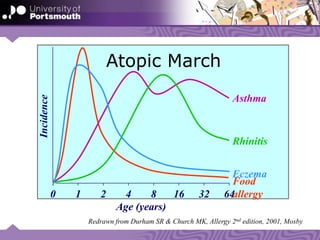
64321680 1 2 4
Incidence
Age (years)
Asthma
Rhinitis
Eczema
Food
allergy
Atopic March
Redrawn from Durham SR & Church MK, Allergy 2nd edition, 2001, Mosby
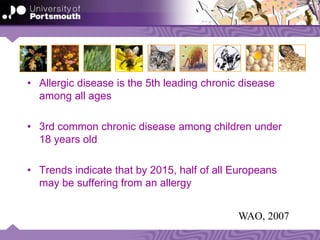
• Allergic disease is the 5th leading chronic disease
among all ages
• 3rd common chronic disease among children under
18 years old
• Trends indicate that by 2015, half of all Europeans
may be suffering from an allergy
WAO, 2007
Allergic diseases
• Some allergies may be fatal
• Impose significant burdens on societies
• Are becoming more important from a financial and
healthcare perspective
• Seriously compromise the quality of life
Allergic diseases
• 3 million GP consultations pa
– £210-£311 million
• 70,000 admissions pa
– £56-£83 million
• 72.6 million prescriptions
– £900 million
– 11% of NHS drug budget
• Only 10% of GPs ,17% of practice nurses have
had allergy training
Allergic diseases include
• Asthma
• Atopic dermatitis (eczema)
• Urticaria
• Occupational allergy
• Allergic conjunctivitis
• Allergic rhinitis (hay fever)
• Insect/sting allergy
• Drug allergy
• Food allergy
Atopic individuals are more at risk of developing allergies.
Atopy is a state (hereditary disposition) that makes a person
more likely to develop allergic reactions of any type
What is Asthma?
• Chronic disease of the airways that may cause
• Wheezing
• Breathlessness
• Chest tightness
• Nighttime or early morning coughing
• Episodes are usually associated with
widespread, but variable, airflow obstruction
within the lung that is often reversible either
spontaneously or with treatment.
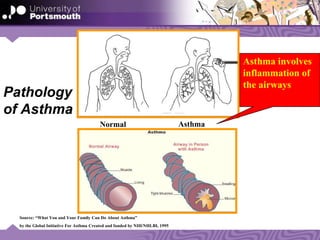
Pathology
of Asthma
Source: “What You and Your Family Can Do About Asthma”
by the Global Initiative For Asthma Created and funded by NIH/NHLBI, 1995
Normal Asthma
Asthma involves
inflammation of
the airways
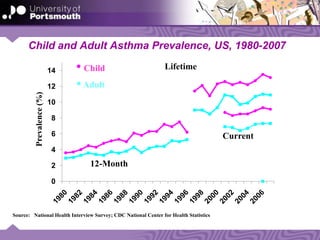
Child and Adult Asthma Prevalence, US, 1980-2007
0
2
4
6
8
10
12
14
Prevalence(%)
Year
12-Month
Lifetime• Child
 Adult
Source: National Health Interview Survey; CDC National Center for Health Statistics
Current
Risk Factors for Developing Asthma
• Genetic characteristics
• Occupational exposures
• Environmental exposures
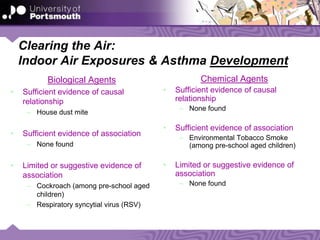
Clearing the Air:
Indoor Air Exposures & Asthma Development
Biological Agents
• Sufficient evidence of causal
relationship
– House dust mite
• Sufficient evidence of association
– None found
• Limited or suggestive evidence of
association
– Cockroach (among pre-school aged
children)
– Respiratory syncytial virus (RSV)
Chemical Agents
• Sufficient evidence of causal
relationship
– None found
• Sufficient evidence of association
– Environmental Tobacco Smoke
(among pre-school aged children)
• Limited or suggestive evidence of
association
– None found
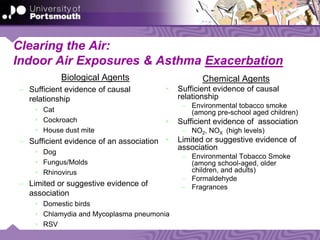
Clearing the Air:
Indoor Air Exposures & Asthma Exacerbation
Biological Agents
– Sufficient evidence of causal
relationship
• Cat
• Cockroach
• House dust mite
– Sufficient evidence of an association
• Dog
• Fungus/Molds
• Rhinovirus
– Limited or suggestive evidence of
association
• Domestic birds
• Chlamydia and Mycoplasma pneumonia
• RSV
Chemical Agents
• Sufficient evidence of causal
relationship
– Environmental tobacco smoke
(among pre-school aged children)
• Sufficient evidence of association
– NO2, NOX (high levels)
• Limited or suggestive evidence of
association
– Environmental Tobacco Smoke
(among school-aged, older
children, and adults)
– Formaldehyde
– Fragrances
• In general, higher rates
in developed countries
• Some hypotheses
• “Hygiene hypothesis”
• Environmental exposures
• Diet
• Physical activity/lifestyle
ISAAC (1998), Lancet 351:1225-32.
Between-population disparities
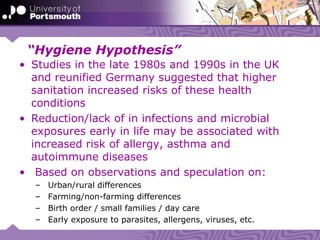
“Hygiene Hypothesis”
• Studies in the late 1980s and 1990s in the UK
and reunified Germany suggested that higher
sanitation increased risks of these health
conditions
• Reduction/lack of in infections and microbial
exposures early in life may be associated with
increased risk of allergy, asthma and
autoimmune diseases
• Based on observations and speculation on:
– Urban/rural differences
– Farming/non-farming differences
– Birth order / small families / day care
– Early exposure to parasites, allergens, viruses, etc.
Allergic disease
(Th2)
Helminth Infection
(Th2)
Microbial Infection
(Th1)
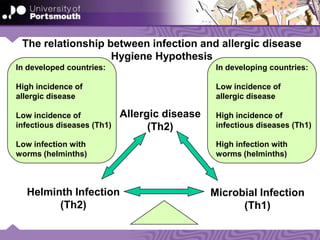
The relationship between infection and allergic disease
Hygiene Hypothesis
In developed countries:
High incidence of
allergic disease
Low incidence of
infectious diseases (Th1)
Low infection with
worms (helminths)
In developing countries:
Low incidence of
allergic disease
High incidence of
infectious diseases (Th1)
High infection with
worms (helminths)
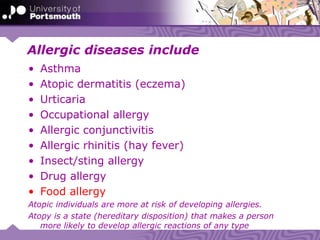
Allergic diseases include
• Asthma
• Atopic dermatitis (eczema)
• Urticaria
• Occupational allergy
• Allergic conjunctivitis
• Allergic rhinitis (hay fever)
• Insect/sting allergy
• Drug allergy
• Food allergy
Atopic individuals are more at risk of developing allergies.
Atopy is a state (hereditary disposition) that makes a person
more likely to develop allergic reactions of any type
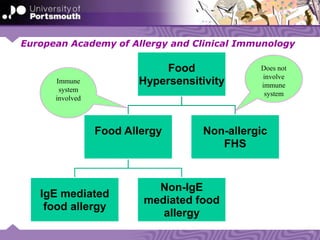
European Academy of Allergy and Clinical Immunology
Food
Hypersensitivity
Food Allergy
IgE mediated
food allergy
Non-IgE
mediated food
allergy
Non-allergic
FHS
1
8
Immune
system
involved
Does not
involve
immune
system
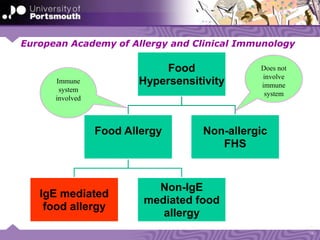
European Academy of Allergy and Clinical Immunology
Food
Hypersensitivity
Food Allergy
IgE mediated
food allergy
Non-IgE
mediated food
allergy
Non-allergic
FHS
1
9
Immune
system
involved
Does not
involve
immune
system
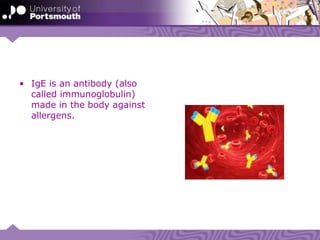
• IgE is an antibody (also
called immunoglobulin)
made in the body against
allergens.
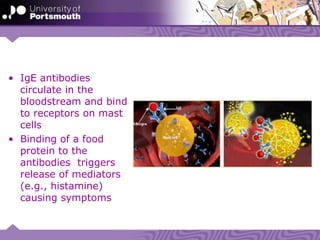
• IgE antibodies
circulate in the
bloodstream and bind
to receptors on mast
cells
• Binding of a food
protein to the
antibodies triggers
release of mediators
(e.g., histamine)
causing symptoms
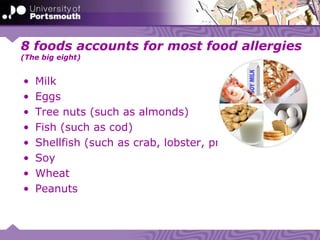
8 foods accounts for most food allergies
(The big eight)
• Milk
• Eggs
• Tree nuts (such as almonds)
• Fish (such as cod)
• Shellfish (such as crab, lobster, prawns)
• Soy
• Wheat
• Peanuts
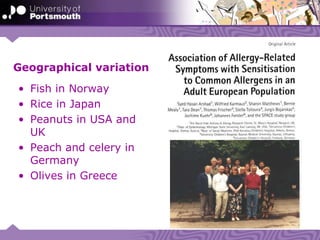
Geographical variation
• Fish in Norway
• Rice in Japan
• Peanuts in USA and
UK
• Peach and celery in
Germany
• Olives in Greece
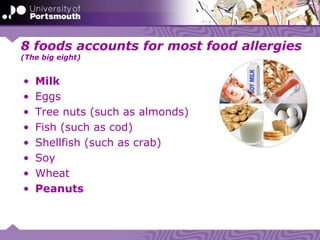
8 foods accounts for most food allergies
(The big eight)
• Milk
• Eggs
• Tree nuts (such as almonds)
• Fish (such as cod)
• Shellfish (such as crab)
• Soy
• Wheat
• Peanuts
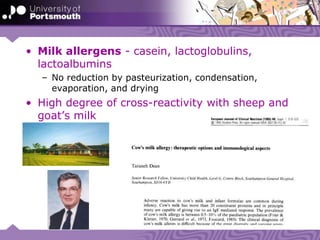
• Milk allergens - casein, lactoglobulins,
lactoalbumins
– No reduction by pasteurization, condensation,
evaporation, and drying
• High degree of cross-reactivity with sheep and
goat’s milk
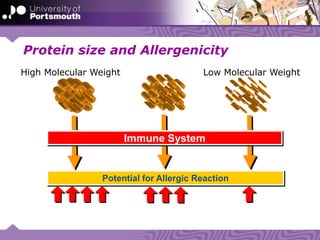
Potential for Allergic Reaction
Immune System
Protein size and Allergenicity
High Molecular Weight Low Molecular Weight
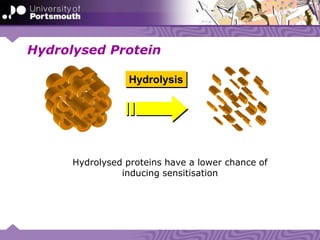
Hydrolysed Protein
Hydrolysis
Hydrolysed proteins have a lower chance of
inducing sensitisation
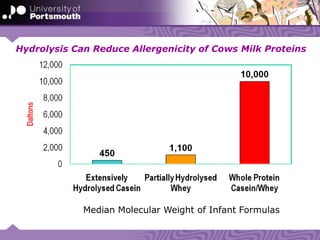
Hydrolysis Can Reduce Allergenicity of Cows Milk Proteins
Median Molecular Weight of Infant Formulas
The case of peanuts
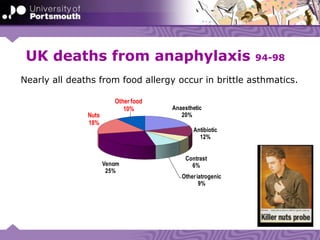
Anaesthetic
20%
Antibiotic
12%
Contrast
6%
Otheriatrogenic
9%
Venom
25%
Nuts
18%
Other food
10%
Nearly all deaths from food allergy occur in brittle asthmatics.
UK deaths from anaphylaxis 94-98
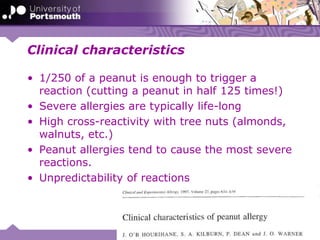
Clinical characteristics
• 1/250 of a peanut is enough to trigger a
reaction (cutting a peanut in half 125 times!)
• Severe allergies are typically life-long
• High cross-reactivity with tree nuts (almonds,
walnuts, etc.)
• Peanut allergies tend to cause the most severe
reactions.
• Unpredictability of reactions
Prognosis
• Resolve: Cow’s milk, Egg, Soya, Wheat
– By 5 years age, tolerance in
• 85% of CMA children
• 66% of egg allergic children
• Persist: Peanut, Tree nut, Fish & Shellfish
– However, around 20% of PA will resolve
• Youngest patients
• Low specific IgE
• Mild reaction at presentation
• About 25% of allergic children develop
respiratory allergies
Symptoms of a Food-Allergic Reaction
• Allergy to food is not a stand alone
disease
• Multi organ systems
• Multiple symptoms
Symptoms of a Food-Allergic Reaction
Respiratory tract:
Mild:
Itchy, watery eyes, running or stuffy nose,
sneezing, cough, itching or swelling of the lips,
wheezing
Severe:
shortness of breath, difficulty swallowing, chest
tightness, tingling of the mouth, itching or
swelling of the throat,
Symptoms of a Food-Allergic Reaction
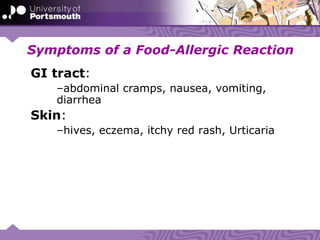
GI tract:
–abdominal cramps, nausea, vomiting,
diarrhea
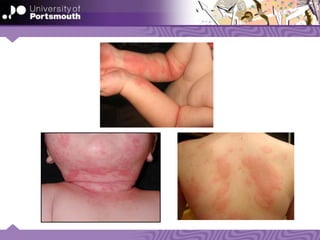
Skin:
–hives, eczema, itchy red rash, Urticaria
Symptoms of a Food-Allergic Reaction
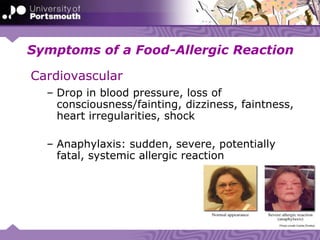
Cardiovascular
– Drop in blood pressure, loss of
consciousness/fainting, dizziness, faintness,
heart irregularities, shock
– Anaphylaxis: sudden, severe, potentially
fatal, systemic allergic reaction
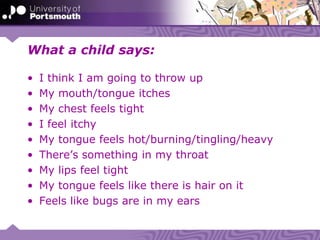
What a child says:
• I think I am going to throw up
• My mouth/tongue itches
• My chest feels tight
• I feel itchy
• My tongue feels hot/burning/tingling/heavy
• There’s something in my throat
• My lips feel tight
• My tongue feels like there is hair on it
• Feels like bugs are in my ears
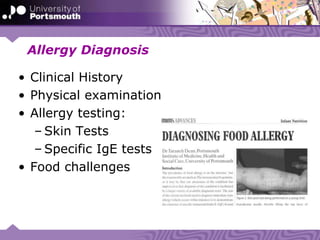
Allergy Diagnosis
• Clinical History
• Physical examination
• Allergy testing:
– Skin Tests
– Specific IgE tests
• Food challenges
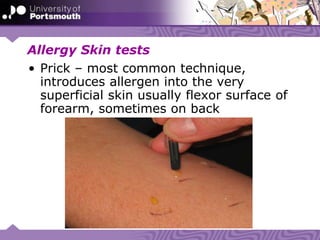
Allergy Skin tests
• Prick – most common technique,
introduces allergen into the very
superficial skin usually flexor surface of
forearm, sometimes on back
Skin prick testing
Histamine HazelMilk
PeanutAlmondSaline
Soya
Brazil
Management of food allergy
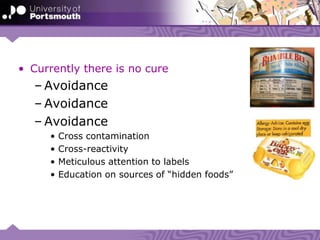
• Currently there is no cure
– Avoidance
– Avoidance
– Avoidance
• Cross contamination
• Cross-reactivity
• Meticulous attention to labels
• Education on sources of “hidden foods”
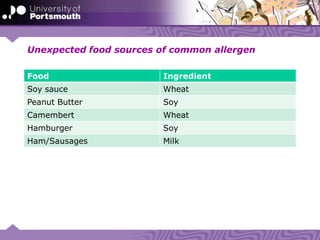
Unexpected food sources of common allergen
Food Ingredient
Soy sauce Wheat
Peanut Butter Soy
Camembert Wheat
Hamburger Soy
Ham/Sausages Milk
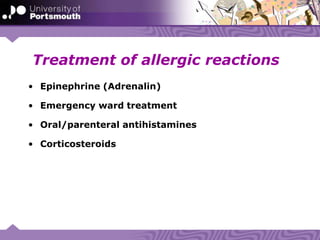
Treatment of allergic reactions
• Epinephrine (Adrenalin)
• Emergency ward treatment
• Oral/parenteral antihistamines
• Corticosteroids
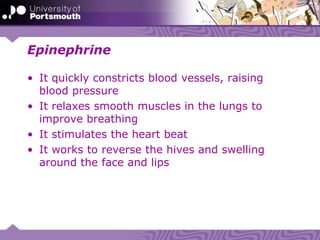
Epinephrine
• It quickly constricts blood vessels, raising
blood pressure
• It relaxes smooth muscles in the lungs to
improve breathing
• It stimulates the heart beat
• It works to reverse the hives and swelling
around the face and lips
• Epinephrine is available in an auto injector
called an EpiPen
• The EpiPen is administered into the large outer
thigh muscles
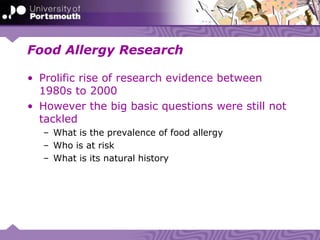
Food Allergy Research
• Prolific rise of research evidence between
1980s to 2000
• However the big basic questions were still not
tackled
– What is the prevalence of food allergy
– Who is at risk
– What is its natural history
FSA’s research requirement (2001-2002)
identified the need for better prevalence
and incidence data in UK
• One population based study: Young et al, Lancet, 1994: 1127
• Population prevalence rate: 1.4-1.8%
• Screening phase included adult and children
• Food challenges used a mixture of processed food
• No children at challenge stage!!!
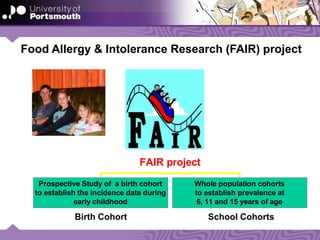
Food Allergy & Intolerance Research (FAIR) project
FAIR project
Prospective Study of a birth cohort
to establish the incidence data during
early childhood
Whole population cohorts
to establish prevalence at
6, 11 and 15 years of age
Birth Cohort School Cohorts
FAIR study
Detailed history regarding food related problems were obtained
All children were clinically examined and skin prick tested
Those with a positive skin prick test that had never knowingly had the
food or large amounts of the food previously, and those who indicated
a previous adverse reaction to foods (regardless of their SPT data)
were invited for food challenges
Challenges were performed following an algorithm adhering to the
history in terms of dose and timing when available
All foods for challenges were freshly prepared for each individual
child, taking into consideration the range of food each infant would
prefer
Total number of children approached was 5647, of which 3221
(57.0%) were recruited into the study
3 year olds: 891 (m=499)
6 yr olds: 798 children (M=403)
11 yr olds: 775 children (M=388)
15 yr olds: 757 children (M=379)
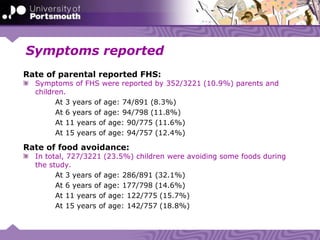
Symptoms reported
Rate of parental reported FHS:
Symptoms of FHS were reported by 352/3221 (10.9%) parents and
children.
At 3 years of age: 74/891 (8.3%)
At 6 years of age: 94/798 (11.8%)
At 11 years of age: 90/775 (11.6%)
At 15 years of age: 94/757 (12.4%)
Rate of food avoidance:
In total, 727/3221 (23.5%) children were avoiding some foods during
the study.
At 3 years of age: 286/891 (32.1%)
At 6 years of age: 177/798 (14.6%)
At 11 years of age: 122/775 (15.7%)
At 15 years of age: 142/757 (18.8%)
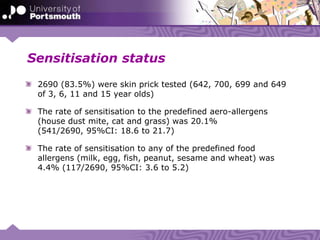
Sensitisation status
2690 (83.5%) were skin prick tested (642, 700, 699 and 649
of 3, 6, 11 and 15 year olds)
The rate of sensitisation to the predefined aero-allergens
(house dust mite, cat and grass) was 20.1%
(541/2690, 95%CI: 18.6 to 21.7)
The rate of sensitisation to any of the predefined food
allergens (milk, egg, fish, peanut, sesame and wheat) was
4.4% (117/2690, 95%CI: 3.6 to 5.2)
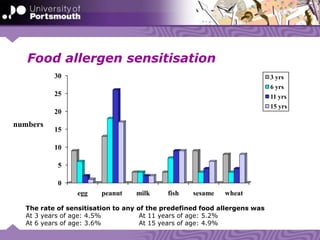
Food allergen sensitisation
0
5
10
15
20
25
30
egg peanut milk fish sesame wheat
3 yrs
6 yrs
11 yrs
15 yrs
numbers
The rate of sensitisation to any of the predefined food allergens was
At 3 years of age: 4.5% At 11 years of age: 5.2%
At 6 years of age: 3.6% At 15 years of age: 4.9%
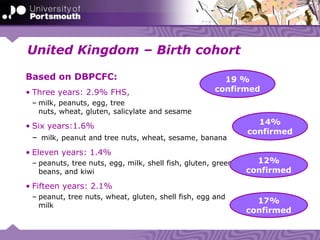
United Kingdom – Birth cohort
Based on DBPCFC:
• Three years: 2.9% FHS,
– milk, peanuts, egg, tree
nuts, wheat, gluten, salicylate and sesame
• Six years:1.6%
– milk, peanut and tree nuts, wheat, sesame, banana
• Eleven years: 1.4%
– peanuts, tree nuts, egg, milk, shell fish, gluten, green
beans, and kiwi
• Fifteen years: 2.1%
– peanut, tree nuts, wheat, gluten, shell fish, egg and
milk
19 %
confirmed
14%
confirmed
12%
confirmed
17%
confirmed

Prof. Tara Dean on allergies - Cafe Scientifique Isle of Wight

  • 1.
    Research Training atthe University of Portsmouth Allergies Professor Tara Dean Café Scientifiq​ue I.O.W. 10th June 2013
  • 2.
    Allergic diseases include •Asthma • Atopic dermatitis (eczema) • Urticaria • Occupational allergy • Allergic conjunctivitis • Allergic rhinitis (hay fever) • Insect/sting allergy • Drug allergy • Food allergy Atopic individuals are more at risk of developing allergies. Atopy is a state (hereditary disposition) that makes a person more likely to develop allergic reactions of any type
  • 3.
    64321680 1 24 Incidence Age (years) Asthma Rhinitis Eczema Food allergy Atopic March Redrawn from Durham SR & Church MK, Allergy 2nd edition, 2001, Mosby
  • 4.
    • Allergic diseaseis the 5th leading chronic disease among all ages • 3rd common chronic disease among children under 18 years old • Trends indicate that by 2015, half of all Europeans may be suffering from an allergy WAO, 2007
  • 5.
    Allergic diseases • Someallergies may be fatal • Impose significant burdens on societies • Are becoming more important from a financial and healthcare perspective • Seriously compromise the quality of life
  • 6.
    Allergic diseases • 3million GP consultations pa – £210-£311 million • 70,000 admissions pa – £56-£83 million • 72.6 million prescriptions – £900 million – 11% of NHS drug budget • Only 10% of GPs ,17% of practice nurses have had allergy training
  • 7.
    Allergic diseases include •Asthma • Atopic dermatitis (eczema) • Urticaria • Occupational allergy • Allergic conjunctivitis • Allergic rhinitis (hay fever) • Insect/sting allergy • Drug allergy • Food allergy Atopic individuals are more at risk of developing allergies. Atopy is a state (hereditary disposition) that makes a person more likely to develop allergic reactions of any type
  • 8.
    What is Asthma? •Chronic disease of the airways that may cause • Wheezing • Breathlessness • Chest tightness • Nighttime or early morning coughing • Episodes are usually associated with widespread, but variable, airflow obstruction within the lung that is often reversible either spontaneously or with treatment.
  • 9.
    Pathology of Asthma Source: “WhatYou and Your Family Can Do About Asthma” by the Global Initiative For Asthma Created and funded by NIH/NHLBI, 1995 Normal Asthma Asthma involves inflammation of the airways
  • 10.
    Child and AdultAsthma Prevalence, US, 1980-2007 0 2 4 6 8 10 12 14 Prevalence(%) Year 12-Month Lifetime• Child  Adult Source: National Health Interview Survey; CDC National Center for Health Statistics Current
  • 11.
    Risk Factors forDeveloping Asthma • Genetic characteristics • Occupational exposures • Environmental exposures
  • 12.
    Clearing the Air: IndoorAir Exposures & Asthma Development Biological Agents • Sufficient evidence of causal relationship – House dust mite • Sufficient evidence of association – None found • Limited or suggestive evidence of association – Cockroach (among pre-school aged children) – Respiratory syncytial virus (RSV) Chemical Agents • Sufficient evidence of causal relationship – None found • Sufficient evidence of association – Environmental Tobacco Smoke (among pre-school aged children) • Limited or suggestive evidence of association – None found
  • 13.
    Clearing the Air: IndoorAir Exposures & Asthma Exacerbation Biological Agents – Sufficient evidence of causal relationship • Cat • Cockroach • House dust mite – Sufficient evidence of an association • Dog • Fungus/Molds • Rhinovirus – Limited or suggestive evidence of association • Domestic birds • Chlamydia and Mycoplasma pneumonia • RSV Chemical Agents • Sufficient evidence of causal relationship – Environmental tobacco smoke (among pre-school aged children) • Sufficient evidence of association – NO2, NOX (high levels) • Limited or suggestive evidence of association – Environmental Tobacco Smoke (among school-aged, older children, and adults) – Formaldehyde – Fragrances
  • 14.
    • In general,higher rates in developed countries • Some hypotheses • “Hygiene hypothesis” • Environmental exposures • Diet • Physical activity/lifestyle ISAAC (1998), Lancet 351:1225-32. Between-population disparities
  • 15.
    “Hygiene Hypothesis” • Studiesin the late 1980s and 1990s in the UK and reunified Germany suggested that higher sanitation increased risks of these health conditions • Reduction/lack of in infections and microbial exposures early in life may be associated with increased risk of allergy, asthma and autoimmune diseases • Based on observations and speculation on: – Urban/rural differences – Farming/non-farming differences – Birth order / small families / day care – Early exposure to parasites, allergens, viruses, etc.
  • 16.
    Allergic disease (Th2) Helminth Infection (Th2) MicrobialInfection (Th1) The relationship between infection and allergic disease Hygiene Hypothesis In developed countries: High incidence of allergic disease Low incidence of infectious diseases (Th1) Low infection with worms (helminths) In developing countries: Low incidence of allergic disease High incidence of infectious diseases (Th1) High infection with worms (helminths)
  • 17.
    Allergic diseases include •Asthma • Atopic dermatitis (eczema) • Urticaria • Occupational allergy • Allergic conjunctivitis • Allergic rhinitis (hay fever) • Insect/sting allergy • Drug allergy • Food allergy Atopic individuals are more at risk of developing allergies. Atopy is a state (hereditary disposition) that makes a person more likely to develop allergic reactions of any type
  • 18.
    European Academy ofAllergy and Clinical Immunology Food Hypersensitivity Food Allergy IgE mediated food allergy Non-IgE mediated food allergy Non-allergic FHS 1 8 Immune system involved Does not involve immune system
  • 19.
    European Academy ofAllergy and Clinical Immunology Food Hypersensitivity Food Allergy IgE mediated food allergy Non-IgE mediated food allergy Non-allergic FHS 1 9 Immune system involved Does not involve immune system
  • 21.
    • IgE isan antibody (also called immunoglobulin) made in the body against allergens.
  • 22.
    • IgE antibodies circulatein the bloodstream and bind to receptors on mast cells • Binding of a food protein to the antibodies triggers release of mediators (e.g., histamine) causing symptoms
  • 23.
    8 foods accountsfor most food allergies (The big eight) • Milk • Eggs • Tree nuts (such as almonds) • Fish (such as cod) • Shellfish (such as crab, lobster, prawns) • Soy • Wheat • Peanuts
  • 24.
    Geographical variation • Fishin Norway • Rice in Japan • Peanuts in USA and UK • Peach and celery in Germany • Olives in Greece
  • 25.
    8 foods accountsfor most food allergies (The big eight) • Milk • Eggs • Tree nuts (such as almonds) • Fish (such as cod) • Shellfish (such as crab) • Soy • Wheat • Peanuts
  • 26.
    • Milk allergens- casein, lactoglobulins, lactoalbumins – No reduction by pasteurization, condensation, evaporation, and drying • High degree of cross-reactivity with sheep and goat’s milk
  • 27.
    Potential for AllergicReaction Immune System Protein size and Allergenicity High Molecular Weight Low Molecular Weight
  • 28.
    Hydrolysed Protein Hydrolysis Hydrolysed proteinshave a lower chance of inducing sensitisation
  • 29.
    Hydrolysis Can ReduceAllergenicity of Cows Milk Proteins Median Molecular Weight of Infant Formulas
  • 30.
    The case ofpeanuts
  • 31.
    Anaesthetic 20% Antibiotic 12% Contrast 6% Otheriatrogenic 9% Venom 25% Nuts 18% Other food 10% Nearly alldeaths from food allergy occur in brittle asthmatics. UK deaths from anaphylaxis 94-98
  • 32.
    Clinical characteristics • 1/250of a peanut is enough to trigger a reaction (cutting a peanut in half 125 times!) • Severe allergies are typically life-long • High cross-reactivity with tree nuts (almonds, walnuts, etc.) • Peanut allergies tend to cause the most severe reactions. • Unpredictability of reactions
  • 33.
    Prognosis • Resolve: Cow’smilk, Egg, Soya, Wheat – By 5 years age, tolerance in • 85% of CMA children • 66% of egg allergic children • Persist: Peanut, Tree nut, Fish & Shellfish – However, around 20% of PA will resolve • Youngest patients • Low specific IgE • Mild reaction at presentation • About 25% of allergic children develop respiratory allergies
  • 34.
    Symptoms of aFood-Allergic Reaction • Allergy to food is not a stand alone disease • Multi organ systems • Multiple symptoms
  • 35.
    Symptoms of aFood-Allergic Reaction Respiratory tract: Mild: Itchy, watery eyes, running or stuffy nose, sneezing, cough, itching or swelling of the lips, wheezing Severe: shortness of breath, difficulty swallowing, chest tightness, tingling of the mouth, itching or swelling of the throat,
  • 37.
    Symptoms of aFood-Allergic Reaction GI tract: –abdominal cramps, nausea, vomiting, diarrhea Skin: –hives, eczema, itchy red rash, Urticaria
  • 39.
    Symptoms of aFood-Allergic Reaction Cardiovascular – Drop in blood pressure, loss of consciousness/fainting, dizziness, faintness, heart irregularities, shock – Anaphylaxis: sudden, severe, potentially fatal, systemic allergic reaction
  • 40.
    What a childsays: • I think I am going to throw up • My mouth/tongue itches • My chest feels tight • I feel itchy • My tongue feels hot/burning/tingling/heavy • There’s something in my throat • My lips feel tight • My tongue feels like there is hair on it • Feels like bugs are in my ears
  • 41.
    Allergy Diagnosis • ClinicalHistory • Physical examination • Allergy testing: – Skin Tests – Specific IgE tests • Food challenges
  • 42.
    Allergy Skin tests •Prick – most common technique, introduces allergen into the very superficial skin usually flexor surface of forearm, sometimes on back
  • 43.
    Skin prick testing HistamineHazelMilk PeanutAlmondSaline Soya Brazil
  • 44.
  • 45.
    • Currently thereis no cure – Avoidance – Avoidance – Avoidance • Cross contamination • Cross-reactivity • Meticulous attention to labels • Education on sources of “hidden foods”
  • 46.
    Unexpected food sourcesof common allergen Food Ingredient Soy sauce Wheat Peanut Butter Soy Camembert Wheat Hamburger Soy Ham/Sausages Milk
  • 47.
    Treatment of allergicreactions • Epinephrine (Adrenalin) • Emergency ward treatment • Oral/parenteral antihistamines • Corticosteroids
  • 48.
    Epinephrine • It quicklyconstricts blood vessels, raising blood pressure • It relaxes smooth muscles in the lungs to improve breathing • It stimulates the heart beat • It works to reverse the hives and swelling around the face and lips
  • 49.
    • Epinephrine isavailable in an auto injector called an EpiPen • The EpiPen is administered into the large outer thigh muscles
  • 50.
    Food Allergy Research •Prolific rise of research evidence between 1980s to 2000 • However the big basic questions were still not tackled – What is the prevalence of food allergy – Who is at risk – What is its natural history
  • 51.
    FSA’s research requirement(2001-2002) identified the need for better prevalence and incidence data in UK • One population based study: Young et al, Lancet, 1994: 1127 • Population prevalence rate: 1.4-1.8% • Screening phase included adult and children • Food challenges used a mixture of processed food • No children at challenge stage!!!
  • 52.
    Food Allergy &Intolerance Research (FAIR) project FAIR project Prospective Study of a birth cohort to establish the incidence data during early childhood Whole population cohorts to establish prevalence at 6, 11 and 15 years of age Birth Cohort School Cohorts
  • 53.
    FAIR study Detailed historyregarding food related problems were obtained All children were clinically examined and skin prick tested Those with a positive skin prick test that had never knowingly had the food or large amounts of the food previously, and those who indicated a previous adverse reaction to foods (regardless of their SPT data) were invited for food challenges Challenges were performed following an algorithm adhering to the history in terms of dose and timing when available All foods for challenges were freshly prepared for each individual child, taking into consideration the range of food each infant would prefer
  • 55.
    Total number ofchildren approached was 5647, of which 3221 (57.0%) were recruited into the study 3 year olds: 891 (m=499) 6 yr olds: 798 children (M=403) 11 yr olds: 775 children (M=388) 15 yr olds: 757 children (M=379)
  • 56.
    Symptoms reported Rate ofparental reported FHS: Symptoms of FHS were reported by 352/3221 (10.9%) parents and children. At 3 years of age: 74/891 (8.3%) At 6 years of age: 94/798 (11.8%) At 11 years of age: 90/775 (11.6%) At 15 years of age: 94/757 (12.4%) Rate of food avoidance: In total, 727/3221 (23.5%) children were avoiding some foods during the study. At 3 years of age: 286/891 (32.1%) At 6 years of age: 177/798 (14.6%) At 11 years of age: 122/775 (15.7%) At 15 years of age: 142/757 (18.8%)
  • 57.
    Sensitisation status 2690 (83.5%)were skin prick tested (642, 700, 699 and 649 of 3, 6, 11 and 15 year olds) The rate of sensitisation to the predefined aero-allergens (house dust mite, cat and grass) was 20.1% (541/2690, 95%CI: 18.6 to 21.7) The rate of sensitisation to any of the predefined food allergens (milk, egg, fish, peanut, sesame and wheat) was 4.4% (117/2690, 95%CI: 3.6 to 5.2)
  • 58.
    Food allergen sensitisation 0 5 10 15 20 25 30 eggpeanut milk fish sesame wheat 3 yrs 6 yrs 11 yrs 15 yrs numbers The rate of sensitisation to any of the predefined food allergens was At 3 years of age: 4.5% At 11 years of age: 5.2% At 6 years of age: 3.6% At 15 years of age: 4.9%
  • 59.
    United Kingdom –Birth cohort Based on DBPCFC: • Three years: 2.9% FHS, – milk, peanuts, egg, tree nuts, wheat, gluten, salicylate and sesame • Six years:1.6% – milk, peanut and tree nuts, wheat, sesame, banana • Eleven years: 1.4% – peanuts, tree nuts, egg, milk, shell fish, gluten, green beans, and kiwi • Fifteen years: 2.1% – peanut, tree nuts, wheat, gluten, shell fish, egg and milk 19 % confirmed 14% confirmed 12% confirmed 17% confirmed