
Neil Kao, M.D., F.A.C.P. Clinical Assistant Professor University of South Carolina School of Medicine http://kaoallergyasthma.blogspot.com
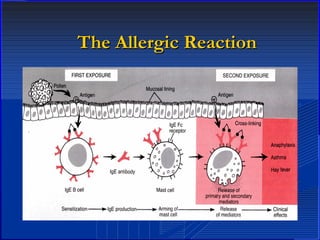
Definition of Food Allergies A group of disorders characterized by immunologic responses to specific food proteins Any food can cause an allergic reaction IgE-mediated reaction: rapid symtoms/signs 0-2 hours NOT the same as adverse reactions = very large category.  Onset hours-days
Prevalence of Food Allergies Highest in the first few years of life Declines over the first decade Never reaches zero People with other atopic diseases (allergic rhinitis [hay fever], atopic dermatitis [eczema], asthma) are MORE likely to have food allergies also 35% more likely in moderate to severe eczema
 
Gastrointestinal Tract Functions Absorb water and nutrients necessary for life Protect body from harmful substances in diet Use mucus, immunoglobulins, enzymes, pH changes, cytokines to achieve both goals Glycoproteins cause food allergy (allergens) Allergens are resistent to food processing and digestion Allergens are found in multiple food sources
Cause of 90% of Food Allergies In children: Milk Hen’s egg Peanuts Wheat Soy Tree Nuts In adults: Peanuts Tree nuts Fish Shellfish
Some Food Allergies may be “outgrown” Sometimes “outgrown” Hen’s egg Milk Soy Usually not “outgrown” Peanuts Tree nuts Fish Shellfish
Cow’s Milk Allergy Prevalence 2.0-2.5% worldwide Proteins: Caseins 80% + 20% Whey Several allergens have been described Major: casein and beta-lactoglobulin Minor: whey High degree of cross-reactivity between cow, sheep, goat’s milk
Hen’s Egg Allergy Composed of egg white and egg yolk Both have multiple allergens Egg white has more allergens than egg yolk Ovomucoid (major) Ovalbumin, lysozyme (minor) Cross-reactive with other birds, like duck
Fish Allergy Higher prevalence in fish-eating countries E.g. cod in scandinavian countries - common  Parvalbumin in cod is major allergen Heat-resistent, from white meat Cross-reactivity with other fish
Crustaceans Shrimp is most studied Tropomyosins major allergens Heat-resistent allergens Present in multiple crustaceans
Peanuts Family Leguminosae Children increasingly exposed at young age Multiple allergens described (Ara h 1, Ara h 2) Responsible for most of food-induced anaphylaxis cases
                                                                                                                               
History is King! What, where, when, prior exposure, quantity eaten, time sequence of symptoms Symptoms and signs Personal and family history of allergic diseases
Allergic Signs and Symptoms Skin: hives, angioedema, eczema, itching, flushing, Nose: congestion, itch/sneeze, runny mucus Throat : tightness, closing, tongue swelling, can’t speak Chest : shortness of breath, wheeze, tightness, coughing GI: nausea, vomiting, cramps, diarrhea Systemic : low blood pressure, fainting
Physical Examination Allergic shiner, Dennie Morgan line Eczema (allergy, celiac), hives, angioedema Allergic crease, congested nasal breathing, sniffling Allergic salute, mouth breathing Nasal mucosa may appear normal or pale bluish, swollen with watery secretions Asthma Monitor height, weight, BMI (for failure to thrive)
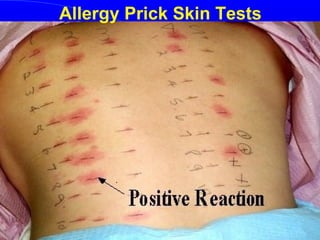
Allergy Prick Skin Tests                                                                                                      
Diagnostic Testing Skin Prick Test (in vivo) is better than serum RAST (in vitro), as in more accurate, quicker.  Recommended by A.C.P. unless ST can not be done.  Can’t test for additives. Blood: CBC/diff, IgE levels (poor screening tests) Double-blind, placebo-controlled food challenge is gold standard, unless patient had anaphylactic or life-threatening reactions to foods Elimination diet
Allergic Reactions to Foods Classic food allergy Oral allergy syndrome Allergic eosinophilic gastroenteritis Celiac disease
Differential Diagnosis Food-induced enterocolitis Infection from virus, bacteria, parasites Irritable bowel disease Other G.I. diseases with dysfunction such malabsorption, gallbladder, GERD Lactase deficiency and intolerance (#1) Vasoactive effects from dietary contaminants or excess
                                                                                                                                                      
Food Allergy Therapy Hope, compassion, empowerment Education Avoidance of triggers and maintain good nutrition Medications for reactions Allergy Immunotherapy (shots) do not work
Educational Resources American Academy of Allergy, Asthma, and Immunology -- http://www.aaaai.org American College of Allergy, Asthma, and Immunology –   http://www.acaai.org Asthma & Allergy Foundation of America -- http://www.aafa.org Food Allergy Network -- http://www.foodallergy.org My website   has links to all of the above, pollen counts, articles on food allergies and more --  http://kaoallergyasthma.blogspot.com
Treatment Patients MUST read labels Patients MUST take responsibility for everything that they eat Stress avoidance is the ONLY proven therapy Have an action plan ready at all times For life-threatening reactions, give anti-histamine and epinephrine ASAP Seek further care
Anti-Histamine Medications Act by preventing histamine from binding to its receptors Primarily helpful in controlling itching 1 st  generation anti-histamines (short half-life, sedating, older): chlorpheniramine (OTC), diphenhydramine (OTC) (Benedryl) 2 nd  generation anti-histamines (long half-life, no or lower sedating, newer, mildly higher cost, preferred): cetirizine (OTC) (Zyrtec), fexofenadine (Allegra), loratadine (OTC) (Alavert, Claritin), desloratadine (Clarinex),  levocetirizine (Xyzal) Do not use to prevent food allergies
Epinephrine Auto-injectors Fast acting, will reverse some symptoms of life-threatening reactions Get demo DVD to learn how to use Practice, practice
Questions of Clinical Relevance What is wrong with the patient? What can I do for the patient? What will the outcome be? What will it cost? What, specifically, must I do to behave in the best traditions of our profession? J SC Med Assoc 1995; 91: 243-4.
Reasons for Referral to Allergist Diagnostic assessment for patients with: Complications, severe, coexisting allergic diseases Identify causative factors Targeted elimination diets Open, single-blind challenge Specials cases double-blind challenge Test interpretation
Food Allergies: Summary Specific IgE antibody mediated immunologic reaction to proteins in foods Any food can cause Not to be confused with adverse reactions Identifying cause(s) is important Treatment is avoidance + good nutrition
Let us,then, be up and doing, With a heart for any fate; Still achieving, still pursuing, Learn to labor and to wait. Henry Wadsworth Longfellow
                                                                                                            
True Milk Allergy? Is there any documentation of the facts or any test results?  When no history is available, consider diagnostic testing, perhaps if safe, followed by an open-label challenge. Is it necessary to do this?  Lactose tolerance information: http://www.nlm.nih.gov/medlineplus/ency/article/003500.htm
What preservatives or chemicals in restaurant foods that can cause abdominal distress? Untestable Substances in Foods causing Adverse Reactions: food dyes (carmine, annatto, tartrazine, saffron), preservatives (sulphites, benzoates, nitrates, parabens), antioxidants BHA and BHT), flavor enhancers (artificial flavoring, MSG, aspartame, spices),  excipients (an umbrella term for supposedly inactive substances that aid in preparation of the active substance, for example the coating of a capsule or the fibers used to hold powdery chemicals together in pills),  outside chemicals (insecticides and/or vitamins C is commonly sprayed on meat and produce),  contaminants from preparation of food (restaurants use the same utensils and grill for most customers). Listed on http://kaoallergyasthma.blogspot.com
FDA Regulations Food and Drug Administration (FDA) regulations for packaged food require that protein-containing ingredients derived from the top eight allergens (milk, egg, wheat, peanut, soy, tree nut, fish, and crustacean shellfish) be identified by their common or usual name in parenthesis, next to their scientific name. Such ingredients must be listed even if they are present in colors, flavors, or spice blends. Additionally, manufacturers must list the specific nut or seafood that is used (e.g., almond, walnut, cashew; or tuna, salmon, shrimp, or lobster). The law makes an exception for highly refined oils, such as peanut oil and soybean oil. Highly refined oils are not labeled as allergens.  No promises so avoid! Warnings such as “May contain…” or “Manufactured in a facility…” are  voluntarily used by some food manufacturers. There are no regulations for the use of these statements. However, the intent of the messages is to alert you to a risk. Avoid products with these warnings. Source: http://www.cfsan.fda.gov/~dms/alrgqa.html
Celiac disease Immunologic disease where body reacts to gluten in our diets. Common, can be confused with food allergy. Diagnosis: blood test, small intestine biopsy Only treatment: avoidance of BROW Not related to autism, but can help.  No one likes having itchy rashes, bloating, diarrhea.
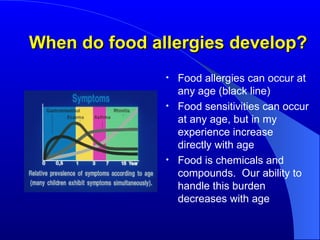
When do food allergies develop? Food allergies can occur at any age (black line) Food sensitivities can occur at any age, but in my experience increase directly with age Food is chemicals and compounds.  Our ability to handle this burden decreases with age
What is "Leaky Gut" Syndrome? Hypothesis: 1) substances damage the intestine walls and allow other harmful substances into the body, then 1a) which damage the body, or 1b) which causes an auto-immune reaction, that also damages the body. Popular in alternative medicine only - controversial.  Not a proven disease.  No diagnostic test available. Treatments: investigate for traditional causes and treat, food diary, avoidance, treatment benefits should exceed risks
What is "Live Blood Analysis"? Looking at a blood sample under high power microscope for RBC and WBC size, shape and aggregation. This is supposed to give details about your health status.  Frequent diagnoses: vitamin or mineral deficiency, “toxins” in body Frequent recommendations: detoxification diets, sold vitamin/mineral supplements, books, more expensive testing.  Branch of alternative medicine.  No proof.

Food Allergy

  • 1.
  • 2.
    Neil Kao, M.D.,F.A.C.P. Clinical Assistant Professor University of South Carolina School of Medicine http://kaoallergyasthma.blogspot.com
  • 3.
    Definition of FoodAllergies A group of disorders characterized by immunologic responses to specific food proteins Any food can cause an allergic reaction IgE-mediated reaction: rapid symtoms/signs 0-2 hours NOT the same as adverse reactions = very large category. Onset hours-days
  • 4.
    Prevalence of FoodAllergies Highest in the first few years of life Declines over the first decade Never reaches zero People with other atopic diseases (allergic rhinitis [hay fever], atopic dermatitis [eczema], asthma) are MORE likely to have food allergies also 35% more likely in moderate to severe eczema
  • 5.
  • 6.
    Gastrointestinal Tract FunctionsAbsorb water and nutrients necessary for life Protect body from harmful substances in diet Use mucus, immunoglobulins, enzymes, pH changes, cytokines to achieve both goals Glycoproteins cause food allergy (allergens) Allergens are resistent to food processing and digestion Allergens are found in multiple food sources
  • 7.
    Cause of 90%of Food Allergies In children: Milk Hen’s egg Peanuts Wheat Soy Tree Nuts In adults: Peanuts Tree nuts Fish Shellfish
  • 8.
    Some Food Allergiesmay be “outgrown” Sometimes “outgrown” Hen’s egg Milk Soy Usually not “outgrown” Peanuts Tree nuts Fish Shellfish
  • 9.
    Cow’s Milk AllergyPrevalence 2.0-2.5% worldwide Proteins: Caseins 80% + 20% Whey Several allergens have been described Major: casein and beta-lactoglobulin Minor: whey High degree of cross-reactivity between cow, sheep, goat’s milk
  • 10.
    Hen’s Egg AllergyComposed of egg white and egg yolk Both have multiple allergens Egg white has more allergens than egg yolk Ovomucoid (major) Ovalbumin, lysozyme (minor) Cross-reactive with other birds, like duck
  • 11.
    Fish Allergy Higherprevalence in fish-eating countries E.g. cod in scandinavian countries - common Parvalbumin in cod is major allergen Heat-resistent, from white meat Cross-reactivity with other fish
  • 12.
    Crustaceans Shrimp ismost studied Tropomyosins major allergens Heat-resistent allergens Present in multiple crustaceans
  • 13.
    Peanuts Family LeguminosaeChildren increasingly exposed at young age Multiple allergens described (Ara h 1, Ara h 2) Responsible for most of food-induced anaphylaxis cases
  • 14.
  • 15.
    History is King!What, where, when, prior exposure, quantity eaten, time sequence of symptoms Symptoms and signs Personal and family history of allergic diseases
  • 16.
    Allergic Signs andSymptoms Skin: hives, angioedema, eczema, itching, flushing, Nose: congestion, itch/sneeze, runny mucus Throat : tightness, closing, tongue swelling, can’t speak Chest : shortness of breath, wheeze, tightness, coughing GI: nausea, vomiting, cramps, diarrhea Systemic : low blood pressure, fainting
  • 17.
    Physical Examination Allergicshiner, Dennie Morgan line Eczema (allergy, celiac), hives, angioedema Allergic crease, congested nasal breathing, sniffling Allergic salute, mouth breathing Nasal mucosa may appear normal or pale bluish, swollen with watery secretions Asthma Monitor height, weight, BMI (for failure to thrive)
  • 18.
    Allergy Prick SkinTests                                                                                                      
  • 19.
    Diagnostic Testing SkinPrick Test (in vivo) is better than serum RAST (in vitro), as in more accurate, quicker. Recommended by A.C.P. unless ST can not be done. Can’t test for additives. Blood: CBC/diff, IgE levels (poor screening tests) Double-blind, placebo-controlled food challenge is gold standard, unless patient had anaphylactic or life-threatening reactions to foods Elimination diet
  • 20.
    Allergic Reactions toFoods Classic food allergy Oral allergy syndrome Allergic eosinophilic gastroenteritis Celiac disease
  • 21.
    Differential Diagnosis Food-inducedenterocolitis Infection from virus, bacteria, parasites Irritable bowel disease Other G.I. diseases with dysfunction such malabsorption, gallbladder, GERD Lactase deficiency and intolerance (#1) Vasoactive effects from dietary contaminants or excess
  • 22.
  • 23.
    Food Allergy TherapyHope, compassion, empowerment Education Avoidance of triggers and maintain good nutrition Medications for reactions Allergy Immunotherapy (shots) do not work
  • 24.
    Educational Resources AmericanAcademy of Allergy, Asthma, and Immunology -- http://www.aaaai.org American College of Allergy, Asthma, and Immunology – http://www.acaai.org Asthma & Allergy Foundation of America -- http://www.aafa.org Food Allergy Network -- http://www.foodallergy.org My website has links to all of the above, pollen counts, articles on food allergies and more -- http://kaoallergyasthma.blogspot.com
  • 25.
    Treatment Patients MUSTread labels Patients MUST take responsibility for everything that they eat Stress avoidance is the ONLY proven therapy Have an action plan ready at all times For life-threatening reactions, give anti-histamine and epinephrine ASAP Seek further care
  • 26.
    Anti-Histamine Medications Actby preventing histamine from binding to its receptors Primarily helpful in controlling itching 1 st generation anti-histamines (short half-life, sedating, older): chlorpheniramine (OTC), diphenhydramine (OTC) (Benedryl) 2 nd generation anti-histamines (long half-life, no or lower sedating, newer, mildly higher cost, preferred): cetirizine (OTC) (Zyrtec), fexofenadine (Allegra), loratadine (OTC) (Alavert, Claritin), desloratadine (Clarinex), levocetirizine (Xyzal) Do not use to prevent food allergies
  • 27.
    Epinephrine Auto-injectors Fastacting, will reverse some symptoms of life-threatening reactions Get demo DVD to learn how to use Practice, practice
  • 28.
    Questions of ClinicalRelevance What is wrong with the patient? What can I do for the patient? What will the outcome be? What will it cost? What, specifically, must I do to behave in the best traditions of our profession? J SC Med Assoc 1995; 91: 243-4.
  • 29.
    Reasons for Referralto Allergist Diagnostic assessment for patients with: Complications, severe, coexisting allergic diseases Identify causative factors Targeted elimination diets Open, single-blind challenge Specials cases double-blind challenge Test interpretation
  • 30.
    Food Allergies: SummarySpecific IgE antibody mediated immunologic reaction to proteins in foods Any food can cause Not to be confused with adverse reactions Identifying cause(s) is important Treatment is avoidance + good nutrition
  • 31.
    Let us,then, beup and doing, With a heart for any fate; Still achieving, still pursuing, Learn to labor and to wait. Henry Wadsworth Longfellow
  • 32.
  • 33.
    True Milk Allergy?Is there any documentation of the facts or any test results? When no history is available, consider diagnostic testing, perhaps if safe, followed by an open-label challenge. Is it necessary to do this? Lactose tolerance information: http://www.nlm.nih.gov/medlineplus/ency/article/003500.htm
  • 34.
    What preservatives orchemicals in restaurant foods that can cause abdominal distress? Untestable Substances in Foods causing Adverse Reactions: food dyes (carmine, annatto, tartrazine, saffron), preservatives (sulphites, benzoates, nitrates, parabens), antioxidants BHA and BHT), flavor enhancers (artificial flavoring, MSG, aspartame, spices), excipients (an umbrella term for supposedly inactive substances that aid in preparation of the active substance, for example the coating of a capsule or the fibers used to hold powdery chemicals together in pills), outside chemicals (insecticides and/or vitamins C is commonly sprayed on meat and produce), contaminants from preparation of food (restaurants use the same utensils and grill for most customers). Listed on http://kaoallergyasthma.blogspot.com
  • 35.
    FDA Regulations Foodand Drug Administration (FDA) regulations for packaged food require that protein-containing ingredients derived from the top eight allergens (milk, egg, wheat, peanut, soy, tree nut, fish, and crustacean shellfish) be identified by their common or usual name in parenthesis, next to their scientific name. Such ingredients must be listed even if they are present in colors, flavors, or spice blends. Additionally, manufacturers must list the specific nut or seafood that is used (e.g., almond, walnut, cashew; or tuna, salmon, shrimp, or lobster). The law makes an exception for highly refined oils, such as peanut oil and soybean oil. Highly refined oils are not labeled as allergens. No promises so avoid! Warnings such as “May contain…” or “Manufactured in a facility…” are voluntarily used by some food manufacturers. There are no regulations for the use of these statements. However, the intent of the messages is to alert you to a risk. Avoid products with these warnings. Source: http://www.cfsan.fda.gov/~dms/alrgqa.html
  • 36.
    Celiac disease Immunologicdisease where body reacts to gluten in our diets. Common, can be confused with food allergy. Diagnosis: blood test, small intestine biopsy Only treatment: avoidance of BROW Not related to autism, but can help. No one likes having itchy rashes, bloating, diarrhea.
  • 37.
    When do foodallergies develop? Food allergies can occur at any age (black line) Food sensitivities can occur at any age, but in my experience increase directly with age Food is chemicals and compounds. Our ability to handle this burden decreases with age
  • 38.
    What is "LeakyGut" Syndrome? Hypothesis: 1) substances damage the intestine walls and allow other harmful substances into the body, then 1a) which damage the body, or 1b) which causes an auto-immune reaction, that also damages the body. Popular in alternative medicine only - controversial. Not a proven disease. No diagnostic test available. Treatments: investigate for traditional causes and treat, food diary, avoidance, treatment benefits should exceed risks
  • 39.
    What is "LiveBlood Analysis"? Looking at a blood sample under high power microscope for RBC and WBC size, shape and aggregation. This is supposed to give details about your health status. Frequent diagnoses: vitamin or mineral deficiency, “toxins” in body Frequent recommendations: detoxification diets, sold vitamin/mineral supplements, books, more expensive testing. Branch of alternative medicine. No proof.

Editor's Notes

  • #2 When was it built? By whom? Why? Art appreciation like in JAMA. The Taj Mahal is a mausoleum located in Agra , India , that was built under Mughal Emperor Shah Jahan in memory of his favorite wife, Mumtaz Mahal . The Taj Mahal is considered the finest example of Mughal architecture , a style that combines elements from Persian , Turkish , Indian , and Islamic architectural styles. Taj Mahal is an integrated symmetric complex of structures that was completed around 1648.