TALES OF

(GOOD TEAMS')

FAILURES
Case Studies, Root Causes and Recommendations.
ABOUT

About the article
This article is a collection of short case studies where teams failed to meet the
expected results. The underlying companies were of different sizes, culture and
industries. The only thing common across the board was the quality of the  people – all
the  teams had bright individuals that had a track record of success.

About the Author
Rajeev Kumar is a senior partner at Mirketa Inc. Rajeev specializes in managing large
business and IT programs, lean processes and governance. He has over 18 years of
experience working in executive, middle management and individual contributor roles
at startups and fortune 500 companies from different industries and countries. Prior to
Mirketa, Rajeev founded 2  startups in the  financial planning and event management space.
ONE

UNPREPARED
BACKGROUND
A successful pre-IPO company bought cloud based solution to manage a process. The company was
already using the best in class cloud solutions for Sales, Services and Accounting.
The chosen product was not a good fit. The company had to make significant changes to their
process and overall business model to align with the capabilities of the new software.
The company couldn’t keep their market commitments for the new product/services launch.
Ended up making significant customization, as out of the box integration didn't help.
The solution is partially integrated and team is looking for a different long term solutions.
The integration consultants played a  waiting game on company's money while major business and
architectural decisions were being made.
ONE

What went wrong?

How to avoid it?

Started the project prematurely.

Identify the core business needs and see
if a cloud solution makes sense before
committing to one.

The product team didn't define their core
needs upfront and did not evaluate the
tools' capabilities with respect to their
needs before signing up for the tool.
Made external commitments for new
product releases without knowing what
they were getting into.

Factor in the time for integration and
customization as most cloud solutions
require that. Make commitments after
going through some level of release
planning.
Have a solution architect who can lay out
high level business and technology
solutions before getting the full delivery
team onboard.
TWO

BLIND LEADING
THE BLIND
BACKGROUND
In the  late 90s a large company started a project to transition from legacy systems to a web based solution.
Outsourced their product vision, strategy and the development of the new system to a technology
strategy company. The strategy company in turn hired a large offshore development vendor to develop
the application.
Actual time and cost were order of magnitude higher than the estimates.
The new product had design flaws that created serious performance and scalability issues. Some of the
critical functionality could not be deployed due to performance issues.
The product had some serious usability issues.
TWO

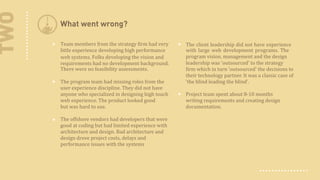
What went wrong?
Team members from the strategy firm had very
little experience developing high performance
web systems. Folks developing the vision and
requirements had no development background.
There were no feasibility assessments.
The program team had missing roles from the
user experience discipline. They did not have
anyone who specialized in designing high touch
web experience. The product looked  good
but was hard to use.
The offshore vendors had developers that were
good at coding but had limited experience with
architecture and design. Bad architecture and
design drove project costs, delays and
performance issues with the systems

The client leadership did not have experience
with large web development programs. The
program vision, management and the design
leadership was 'outsourced' to the strategy
firm which in turn 'outsourced' the decisions to
their technology partner. It was a classic case of
'the blind leading the blind'.
Project team spent  about 8-10 months
writing requirements and creating design
documentation.
TWO

How to avoid it?
Team up product manager with seasoned
technical lead, architect and an interactive
designer. Check feasibility and usability of all
roduct modules before passing it on to the
developers.
Hire FTEs with good hands on experience with
the technology for development and delivery
lead roles. Have them create/review
architecture, design specs and the code from
the vendor teams.
Hire a seasoned program manager as FTE to
manage the overall program and hire FTEs or
independent contractors to manage different
project teams. This puts the ownership of the
program and accountability for success onto
the employees who have vested interest in
the project.

Screen the key team members from
vendors' teams
Follow Agile development practices.
THREE

OVER-ENGINEERED
SOLUTIONS
BACKGROUND
Two very large companies tried rolling out Rational Unified Process (RUP) as defined by the book
Pretty much everything went wrong – productivity went down for a long period of time and the
teams were utterly confused and frustrated with the process as most people found it way too
difficult and/or cumbersome.
There was visible hostility and/or strained relationships among the team members from different
disciplines – developers always blamed requirements, BA blamed product managers & product
managers, testers blamed everyone for humongous documentation needs from every project etc.
THREE

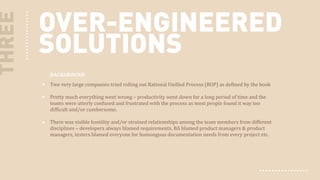
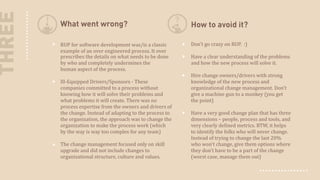
What went wrong?

How to avoid it?

RUP for software development was/is a classic
example of an over engineered process. It over
prescribes the details on what needs to be done
by who and completely undermines the
human aspect  of the process.

Don't go crazy on RUP. :)

Ill-Equipped Drivers/Sponsors - These
companies committed to a process without
knowing how it will solve their problems and
what problems it will create. There was no
process expertise from the owners and drivers of
the change. Instead of adapting to the process to
the organization, the approach was to change the
organization to make the process work (which
by the way is way too complex for any team)
The change management focused only on skill
upgrade and did not include changes to
organizational structure, culture and values.

Have a clear understanding of the problems
and how the new process will solve it.
Hire change owners/drivers with strong
knowledge of the new process and
organizational change management. Don't
give a machine gun to a monkey (you get
the point)
Have a very good change plan that has three
dimensions – people, process and tools, and
very clearly defined metrics. BTW, it helps
to identify the folks who will never change.
Instead of trying to change the last 20%
who won't change, give them options where
they don't have to be a part of the change
(worst case, manage them out)
FOUR

NOT A LEAN
START-UP
BACKGROUND
Company: myTafi.com – This was my first attempt to build a product company. MyTafi.com is a
personal financial planning application designed to help people make better financial decisions.
Developed great set of product features but could not drive user adoption and could not convert
strong interest from large banks and investment management firms into sales.
FOUR

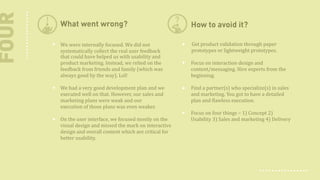
What went wrong?

How to avoid it?

We were internally focused. We did not
systematically collect
real user feedback
that could have helped us with usability and
product marketing. Instead, we relied on the
feedback from friends and family (which was
always good by the way).  Lol!

Get product validation through paper
prototypes or lightweight prototypes.

We had a very good development plan and we
executed well on that. However, our sales and
marketing plans were weak and our
execution of those plans was even weaker.
On the user interface, we focused mostly on the
visual design and missed the mark on interactive
design and overall content which are critical for
better usability.

Focus on interaction design and
content/messaging. Hire experts from the
beginning.
Find a partner(s) who specialize(s) in sales
and marketing. You got to have a detailed
plan and flawless execution.
Focus on four things – 1) Concept 2)
Usability 3) Sales and marketing 4) Delivery
FIVE

TOO MANY
"TOP" PRIORITIES
BACKGROUND
I have seen many good teams struggle with too many top priorities or shifting priorities. The
examples that I have in mind are from the times where the top leaders were exceptionally
sharp and ambitious.
Teams worked on too many things at the same time and couldn't complete anything with
exceptional quality.
Highly dissatisfied internal customers/business partners.
Top leaders always talked about fixing priorities but their actions never showed it
Team members were mostly tired, frustrated and intolerant.
FIVE

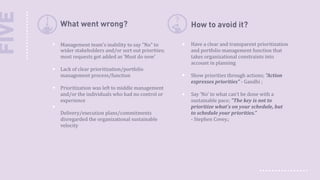
What went wrong?

How to avoid it?

Management team's inability say "No" to
wider stakeholders and/or sort out priorities;
most requests got added as 'Must do now'

Have a clear and transparent prioritization
and portfolio management function that
takes organizational constraints into
account in planning

Lack of clear prioritization/portfolio
management process/function
Prioritization was left to middle management
and/or the individuals who had no control or
experience
Delivery/execution plans/commitments
disregarded the organizational sustainable
velocity

Show priorities through actions; "Action
expresses priorities" - Gandhi ;
Say 'No' to what can't be done with a
sustainable pace; "The key is not to
prioritize what's on your schedule, but
to schedule your priorities."
- Stephen Covey.;
INTERESTED IN
LEARNING MORE?
Contact Rajeev Kumar to learn more about these case studies and how
Mirketa Inc can partner with you to design and rollout business solutions.

www.mirketa.com
1-855-Mirketa

info (at) mirketa.com

Tales of {Good Teams'} Failures - Case Studies, Root Causes & Recommendations

  • 1.
    TALES OF (GOOD TEAMS') FAILURES CaseStudies, Root Causes and Recommendations.
  • 2.
    ABOUT About the article Thisarticle is a collection of short case studies where teams failed to meet the expected results. The underlying companies were of different sizes, culture and industries. The only thing common across the board was the quality of the  people – all the  teams had bright individuals that had a track record of success. About the Author Rajeev Kumar is a senior partner at Mirketa Inc. Rajeev specializes in managing large business and IT programs, lean processes and governance. He has over 18 years of experience working in executive, middle management and individual contributor roles at startups and fortune 500 companies from different industries and countries. Prior to Mirketa, Rajeev founded 2  startups in the  financial planning and event management space.
  • 3.
    ONE UNPREPARED BACKGROUND A successful pre-IPOcompany bought cloud based solution to manage a process. The company was already using the best in class cloud solutions for Sales, Services and Accounting. The chosen product was not a good fit. The company had to make significant changes to their process and overall business model to align with the capabilities of the new software. The company couldn’t keep their market commitments for the new product/services launch. Ended up making significant customization, as out of the box integration didn't help. The solution is partially integrated and team is looking for a different long term solutions. The integration consultants played a  waiting game on company's money while major business and architectural decisions were being made.
  • 4.
    ONE What went wrong? Howto avoid it? Started the project prematurely. Identify the core business needs and see if a cloud solution makes sense before committing to one. The product team didn't define their core needs upfront and did not evaluate the tools' capabilities with respect to their needs before signing up for the tool. Made external commitments for new product releases without knowing what they were getting into. Factor in the time for integration and customization as most cloud solutions require that. Make commitments after going through some level of release planning. Have a solution architect who can lay out high level business and technology solutions before getting the full delivery team onboard.
  • 5.
    TWO BLIND LEADING THE BLIND BACKGROUND Inthe  late 90s a large company started a project to transition from legacy systems to a web based solution. Outsourced their product vision, strategy and the development of the new system to a technology strategy company. The strategy company in turn hired a large offshore development vendor to develop the application. Actual time and cost were order of magnitude higher than the estimates. The new product had design flaws that created serious performance and scalability issues. Some of the critical functionality could not be deployed due to performance issues. The product had some serious usability issues.
  • 6.
    TWO What went wrong? Teammembers from the strategy firm had very little experience developing high performance web systems. Folks developing the vision and requirements had no development background. There were no feasibility assessments. The program team had missing roles from the user experience discipline. They did not have anyone who specialized in designing high touch web experience. The product looked  good but was hard to use. The offshore vendors had developers that were good at coding but had limited experience with architecture and design. Bad architecture and design drove project costs, delays and performance issues with the systems The client leadership did not have experience with large web development programs. The program vision, management and the design leadership was 'outsourced' to the strategy firm which in turn 'outsourced' the decisions to their technology partner. It was a classic case of 'the blind leading the blind'. Project team spent  about 8-10 months writing requirements and creating design documentation.
  • 7.
    TWO How to avoidit? Team up product manager with seasoned technical lead, architect and an interactive designer. Check feasibility and usability of all roduct modules before passing it on to the developers. Hire FTEs with good hands on experience with the technology for development and delivery lead roles. Have them create/review architecture, design specs and the code from the vendor teams. Hire a seasoned program manager as FTE to manage the overall program and hire FTEs or independent contractors to manage different project teams. This puts the ownership of the program and accountability for success onto the employees who have vested interest in the project. Screen the key team members from vendors' teams Follow Agile development practices.
  • 8.
    THREE OVER-ENGINEERED SOLUTIONS BACKGROUND Two very largecompanies tried rolling out Rational Unified Process (RUP) as defined by the book Pretty much everything went wrong – productivity went down for a long period of time and the teams were utterly confused and frustrated with the process as most people found it way too difficult and/or cumbersome. There was visible hostility and/or strained relationships among the team members from different disciplines – developers always blamed requirements, BA blamed product managers & product managers, testers blamed everyone for humongous documentation needs from every project etc.
  • 9.
    THREE What went wrong? Howto avoid it? RUP for software development was/is a classic example of an over engineered process. It over prescribes the details on what needs to be done by who and completely undermines the human aspect  of the process. Don't go crazy on RUP. :) Ill-Equipped Drivers/Sponsors - These companies committed to a process without knowing how it will solve their problems and what problems it will create. There was no process expertise from the owners and drivers of the change. Instead of adapting to the process to the organization, the approach was to change the organization to make the process work (which by the way is way too complex for any team) The change management focused only on skill upgrade and did not include changes to organizational structure, culture and values. Have a clear understanding of the problems and how the new process will solve it. Hire change owners/drivers with strong knowledge of the new process and organizational change management. Don't give a machine gun to a monkey (you get the point) Have a very good change plan that has three dimensions – people, process and tools, and very clearly defined metrics. BTW, it helps to identify the folks who will never change. Instead of trying to change the last 20% who won't change, give them options where they don't have to be a part of the change (worst case, manage them out)
  • 10.
    FOUR NOT A LEAN START-UP BACKGROUND Company:myTafi.com – This was my first attempt to build a product company. MyTafi.com is a personal financial planning application designed to help people make better financial decisions. Developed great set of product features but could not drive user adoption and could not convert strong interest from large banks and investment management firms into sales.
  • 11.
    FOUR What went wrong? Howto avoid it? We were internally focused. We did not systematically collect real user feedback that could have helped us with usability and product marketing. Instead, we relied on the feedback from friends and family (which was always good by the way).  Lol! Get product validation through paper prototypes or lightweight prototypes. We had a very good development plan and we executed well on that. However, our sales and marketing plans were weak and our execution of those plans was even weaker. On the user interface, we focused mostly on the visual design and missed the mark on interactive design and overall content which are critical for better usability. Focus on interaction design and content/messaging. Hire experts from the beginning. Find a partner(s) who specialize(s) in sales and marketing. You got to have a detailed plan and flawless execution. Focus on four things – 1) Concept 2) Usability 3) Sales and marketing 4) Delivery
  • 12.
    FIVE TOO MANY "TOP" PRIORITIES BACKGROUND Ihave seen many good teams struggle with too many top priorities or shifting priorities. The examples that I have in mind are from the times where the top leaders were exceptionally sharp and ambitious. Teams worked on too many things at the same time and couldn't complete anything with exceptional quality. Highly dissatisfied internal customers/business partners. Top leaders always talked about fixing priorities but their actions never showed it Team members were mostly tired, frustrated and intolerant.
  • 13.
    FIVE What went wrong? Howto avoid it? Management team's inability say "No" to wider stakeholders and/or sort out priorities; most requests got added as 'Must do now' Have a clear and transparent prioritization and portfolio management function that takes organizational constraints into account in planning Lack of clear prioritization/portfolio management process/function Prioritization was left to middle management and/or the individuals who had no control or experience Delivery/execution plans/commitments disregarded the organizational sustainable velocity Show priorities through actions; "Action expresses priorities" - Gandhi ; Say 'No' to what can't be done with a sustainable pace; "The key is not to prioritize what's on your schedule, but to schedule your priorities." - Stephen Covey.;
  • 14.
    INTERESTED IN LEARNING MORE? ContactRajeev Kumar to learn more about these case studies and how Mirketa Inc can partner with you to design and rollout business solutions. www.mirketa.com 1-855-Mirketa info (at) mirketa.com