Talent Management
A High Performance Process
Organization
Strategy
Talent
Management
Process
High
Performing
Workforce
High
Performing
Organization
Lance A. Berger & Assoc. Based on The
Talent Management Handbook third
edition 2018 Copyright McGraw-Hill
The Talent Management Process
Talent
Blueprint
Organization Creed
Talent Strategy
Building
Blocks
Competency
Assessment
Performance
Appraisal
Potential Forecast
System
Four Core H. R.
Programs
Unified Talent Plan
Lance A. Berger & Assoc. Based on The
Talent Management Handbook third
edition 2018 Copyright McGraw-Hill
Talent Blueprint
Creed
Core Principles
Values
Mutual Expectations
Brand
Talent Strategy
Cultivate the Superkeeper
Retain Key Position Backups
Allocate dollar resources based
on contribution
Foster All Role Models
Lance A. Berger & Assoc. Based on The
Talent Management Handbook third
edition 2018 Copyright McGraw-Hill
Talent Management Process
Building Blocks
Competency
Assessment
Organizational
Functional
Job
Leadership
Performance
Appraisal
Trait
Behavior
Knowledge/Skill
Results Based
Potential
Forecast
Performance Appraisals
Competencies
Training and Development
Needs
Career Preferences
Career Opportunities
Lance A. Berger & Assoc. Based on The
Talent Management Handbook third
edition 2018 Copyright McGraw-Hill
Talent Management Process
System
Four Core Human Resources
Programs
Positioning
Enhancement
Mobility
Compensation
Unified Talent Plan
Succession/Career Planning
Key Position Backups
Turnover Potential
Talent Acquisition Needs
Problem Employee Problems
Lance A. Berger & Assoc. Based on The
Talent Management Handbook third
edition 2018 Copyright McGraw-Hill
Talent Management Process
Talent Management
A High Performance Process
Organization
Strategy
Talent
Management
Process
High
Performing
Workforce
High
Performing
Organization
Lance A. Berger & Assoc. Based on The
Talent Management Handbook third
edition 2018 Copyright McGraw-Hill
The Talent Management Process
Talent Blueprint Building Blocks System
• Organization Creed
• Talent Strategy
• Competency Assessment
• Performance Appraisal
• Potential Forecast
• Four Core H.R. Programs
• Unified Talent Plan
Lance A. Berger & Assoc. Based on The
Talent Management Handbook third
edition 2018 Copyright McGraw-Hill

Talent Management: It's THE PROCESS

  • 1.
    Talent Management A HighPerformance Process Organization Strategy Talent Management Process High Performing Workforce High Performing Organization Lance A. Berger & Assoc. Based on The Talent Management Handbook third edition 2018 Copyright McGraw-Hill
  • 2.
    The Talent ManagementProcess Talent Blueprint Organization Creed Talent Strategy Building Blocks Competency Assessment Performance Appraisal Potential Forecast System Four Core H. R. Programs Unified Talent Plan Lance A. Berger & Assoc. Based on The Talent Management Handbook third edition 2018 Copyright McGraw-Hill
  • 3.
    Talent Blueprint Creed Core Principles Values MutualExpectations Brand Talent Strategy Cultivate the Superkeeper Retain Key Position Backups Allocate dollar resources based on contribution Foster All Role Models Lance A. Berger & Assoc. Based on The Talent Management Handbook third edition 2018 Copyright McGraw-Hill Talent Management Process
  • 4.
    Building Blocks Competency Assessment Organizational Functional Job Leadership Performance Appraisal Trait Behavior Knowledge/Skill Results Based Potential Forecast PerformanceAppraisals Competencies Training and Development Needs Career Preferences Career Opportunities Lance A. Berger & Assoc. Based on The Talent Management Handbook third edition 2018 Copyright McGraw-Hill Talent Management Process
  • 5.
    System Four Core HumanResources Programs Positioning Enhancement Mobility Compensation Unified Talent Plan Succession/Career Planning Key Position Backups Turnover Potential Talent Acquisition Needs Problem Employee Problems Lance A. Berger & Assoc. Based on The Talent Management Handbook third edition 2018 Copyright McGraw-Hill Talent Management Process
  • 6.
    Talent Management A HighPerformance Process Organization Strategy Talent Management Process High Performing Workforce High Performing Organization Lance A. Berger & Assoc. Based on The Talent Management Handbook third edition 2018 Copyright McGraw-Hill
  • 7.
    The Talent ManagementProcess Talent Blueprint Building Blocks System • Organization Creed • Talent Strategy • Competency Assessment • Performance Appraisal • Potential Forecast • Four Core H.R. Programs • Unified Talent Plan Lance A. Berger & Assoc. Based on The Talent Management Handbook third edition 2018 Copyright McGraw-Hill

Editor's Notes

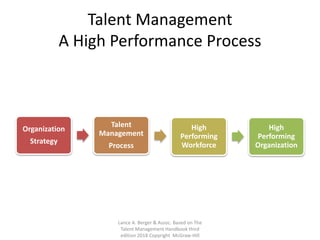
  • #2 Talent management is a human resources process focused on building and sustaining a high performance workforce. It is the bridge between organization strategy and workforce performance. The process consists of three iterative components and seven elements.
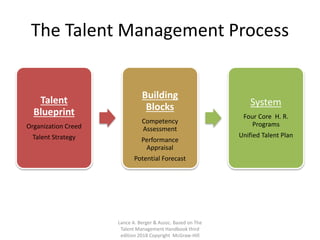
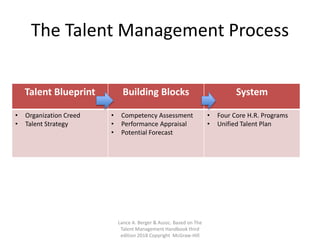
  • #3 Successful organizations systematically design, integrate, and proactively implement programs that build and sustain a high-performance workforce. These programs focus on acquiring, cultivating, positioning, and rewarding employees who can best achieve their goals while remaining true to stated values. When their approach to building a high-performing workforce is fully integrated and codified, it is labeled “talent management.” Although there are a variety of approaches to talent management, our recent experience and research indicate that the type of integrated and codified approach typically used by high-performing organizations consists of three iterative components: a blueprint, a set of building blocks, and a system that effectively integrates the human resource programs cited above. The components and elements of the process are presented here.
  • #4 Creed A talent management creed is composed of a widely publicized set of core principles, values, and mutual expectations that guide the behavior of an institution and its people. Collectively, these stated doctrines depict the type of culture an organization strives to create to achieve its unique portrait of success. The principles of the creed are embedded in both its talent management strategy and in its talent management processes by incorporating its doctrines into selection criteria, competency definitions, performance criteria, and internal selection, compensation, and development processes. Talent Strategy A talent management strategy views a workforce as a portfolio of human resource assets that are differentiated based on an assessment of each person’s current and potential contribution to organization success. The types of people who will receive different types of investment are rooted in the organization’s talent creed. For the purpose of this discussion, we have classified the workforce into the following groups: • Superkeepers: Those employees who greatly exceed expectations now and who are projected to continue to do so in the future (3 percent). • Keepers: Those employees who exceed expectations now and who are projected to continue to do so in the future (20 percent). • Solid citizens: Those employees who meet expectations (75 percent). • Less-solid citizens: Those employees who are below expectations (2 percent). Employees are placed in this category when they are either weak performers or lack the competencies for doing their job. In this classification system superkeepers and keepers are the primary role models that shape the high-performance culture. We have found that, regardless of the content of an organization’s creed, the talent strategies of most high-performing organizations contain the following three directives: • Cultivate the superkeeper. • Retain key position backups. • Appropriately allocate dollar resources based on actual and potential contribution
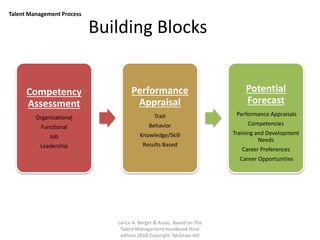
  • #5 Talent Management Handbook #3 (Lacy Lowe) identifies four types of competencies. They are: • Organizational competencies (also called core or core value competencies) are identified during the strategic planning process and usually stay fairly static. These competencies should be closely tied to the creed. • Functional competencies cascade from core competencies and describe specific skills and standards of performance needed by an individual working in a particular industry and are associated with specific work functions or business units. • Job competencies (also called occupational competencies) cascade from core and functional competencies and are anchored directly to the specific behaviors, skills, and knowledge required for exceptional performance in a specific job. • Leadership competencies describe the factors that lead to success for all supervisors, managers and leaders, senior staff, executives, and others who occupy management and leadership roles. They define what a strong leader “looks” like in line with the organization’s culture and are used to guide the development of organizational leadership development programs and evaluate managers’ and leaders’ readiness to take on leadership roles. Performance Appraisal A performance appraisal is a measurement of actual results achieved within those areas for which the employee is held accountable and/or the competencies deemed critical to job and organization success. There are only a relatively small number of ways organizations measure employee performance. Dick Grote in Talent Management Handbook #3 describes a cogent view of performance appraisal. His model envisions performance appraisals consisting of organization competencies, job family competencies, key job responsibilities, and goals and major projects. .Martin Wolf, in the second edition of th Talent Management Handbook classifies performance appraisal systems as being based on one or more of the following: • Trait based: Assumes that certain traits drive performance; measures personal characteristics of the position incumbent. • Behavior based: Assumes that certain behaviors drive performance. • Knowledge/skill based: Assumes that certain knowledge/skills drive performance; measures what the position incumbent knows/applies. • Results based: Assumes that achievement of objectives equals performance; measures what the position incumbent achieves. Potential Forecast A potential forecast is a prediction of how many levels (organization/ job) an employee can progress within an organization based on his or her past or current performance appraisals, training and development needs, career preferences, and actual and projected competency levels and positions that represent realistic future job opportunities. Like any forecast, an individual’s potential is subject to periodic evaluation. It is heavily influenced by the quality of the input provided by different assessors and by a variety of situational factors associated with job conditions at different times. Potential forecasts are dynamic and could change with the nature of assessments and assessors over time.
  • #6 System Once an organization has established its own unique set of talent management building blocks it must then deploy an integrative system to implement its talent management strategy. A talent management system consists of two components: • Four core human resources programs. • A process for integrating the four core programs Four Core Programs The four core programs discussed below incorporate the three building blocks (competency assessment, performance appraisal, and potential forecast). These programs become the vehicles that implement the talent management strategy which is necessary to build a high-performance workforce. • Positioning: Programs that manage all internal employee mobility actions. It includes replacement planning, career planning, and all internal assignments. • Enhancement: Programs that utilize employee building block assessments to facilitate employee coaching, training, education, and development actions. • Mobility: Programs originating from the positioning plan. They involve the identification, attraction, recruitment, and on-boarding of new employees who meet the requirements of the talent strategy. • Compensation: Programs that cover all pay actions necessary to attract, retain, incentivize, and reward people based on their classification within the stated talent management strategy. Unified Talent Plan The bench strength summary. It is an example of an integrative approach that centers on positioning and related actions that can be taken to address talent management issues. It merges: • Succession planning: In the broadest sense, the process that seeks to identify replacement candidates for current incumbents, and potential future job openings, and to assess the time frames in which they can move to these positions. • Career planning: This process identifies potential next steps in an employee’s career and his or her readiness for movement to new positions. Career planning merges the organization’s assessment of employee growth readiness (succession plan), employee’s career preferences, and the likelihood that positions in a career path will become available. • Key position backup designation: The insurance policies that ensure organization continuity. Every key position should have at least one backup at the keeper (exceed job expectations) level. • Potential turnover identification: The organization needs to be aware of the potential for increased turnover resulting from surpluses and blockages. Surpluses are positions with more than one replacement for an incumbent. While ostensibly a positive result of the talent management process, it can be a potential source of turnover and morale problems if the replacements are blocked by a non-promotable incumbent and/or there is no realistic way most of the replacements can advance. Blockages are non-promotable incumbents standing in the path of one or more high-potential or promotable employees. • Opportunities for talent acquisition: Voids are positions without a qualified backup. Once voids are identified, it is appropriate to initiate plans to recruit externally. • Upgrading or termination of problem employees: Those not meeting job expectations (measured achievement or competency proficiency) should be given the opportunity to improve, receive remedial action, or be terminated.
  • #7 Talent management is a human resources process focused on building and sustaining a high performance workforce. It is the bridge between organization strategy and workforce performance.
  • #8 Talent management is a human resources process focused on building and sustaining a high performance workforce. It is the bridge between organization strategy and workforce performance.