Winning Compensation
Strategies for Organizational
Sustainability
Dorothy R. Berger
Partner, Lance A. Berger & Associates, Ltd.
Based on Chapter 4 sixth edition of the Compensation Handbook
Copyright © 2015 by McGraw-Hill Education
Sustainability Definition
Ongoing success resulting from timely
and effective adaptations to changes
in the competitive environment
Adaptive Compensation Strategy
Elements
 Vigilantly monitor pay markets
 Rationalize competitive pay levels
 Link mix of pay to stage of growth and culture risk
tolerance
 Allocate pay based on employee contribution,
recruitment, retention and engagement
Vigilantly Monitor Pay Markets
 Identify/monitor current and future sources of recruitment
 Identify/monitor destination organizations of employees
who leave
 Acquire/develop high quality surveys that match pay
markets (see above)
 Implement multiple salary structures based on distinctive
pay markets
Rationalize Competitive Pay
Levels
 Assess level of competitiveness for people in each pay
market based on recruitment needs, upward mobility
and turnover potential
 Assign competitive level of total compensation based
on talent competition (see above) for each pay market
salary structure
Link Mix of Pay to Growth Rate
 Determine rate of growth of each business unit
 Apply higher leverage (more variable pay) to
faster growing units within selected pay markets
at predetermined total compensation competitive
level
 Increase leverage in compensation mix at a pace
tolerable by unit culture (more risk oriented
cultures will accept leverage more easily)
Allocate pay based on employee
contribution, recruitment, retention and
engagement
 Install salary administration system that
regularly adjusts all base salaries based on
pay market change
 Introduce non-fixed annual achievement
awards to replace merit pay (for all
employees) for 20% of employees
 Introduce special awards for exceptional
contribution
 Ensure that pay packages involved in the
selection, advancement and retention of key
employees accelerate faster, and with higher
competitive levels, than most employees
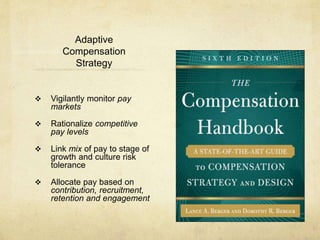
Adaptive
Compensation
Strategy
 Vigilantly monitor pay
markets
 Rationalize competitive
pay levels
 Link mix of pay to stage of
growth and culture risk
tolerance
 Allocate pay based on
contribution, recruitment,
retention and engagement

Adaptive compensation.presentation comp. handbook 6 chapter 4

  • 1.
    Winning Compensation Strategies forOrganizational Sustainability Dorothy R. Berger Partner, Lance A. Berger & Associates, Ltd. Based on Chapter 4 sixth edition of the Compensation Handbook Copyright © 2015 by McGraw-Hill Education
  • 2.
    Sustainability Definition Ongoing successresulting from timely and effective adaptations to changes in the competitive environment
  • 3.
    Adaptive Compensation Strategy Elements Vigilantly monitor pay markets  Rationalize competitive pay levels  Link mix of pay to stage of growth and culture risk tolerance  Allocate pay based on employee contribution, recruitment, retention and engagement
  • 4.
    Vigilantly Monitor PayMarkets  Identify/monitor current and future sources of recruitment  Identify/monitor destination organizations of employees who leave  Acquire/develop high quality surveys that match pay markets (see above)  Implement multiple salary structures based on distinctive pay markets
  • 5.
    Rationalize Competitive Pay Levels Assess level of competitiveness for people in each pay market based on recruitment needs, upward mobility and turnover potential  Assign competitive level of total compensation based on talent competition (see above) for each pay market salary structure
  • 6.
    Link Mix ofPay to Growth Rate  Determine rate of growth of each business unit  Apply higher leverage (more variable pay) to faster growing units within selected pay markets at predetermined total compensation competitive level  Increase leverage in compensation mix at a pace tolerable by unit culture (more risk oriented cultures will accept leverage more easily)
  • 7.
    Allocate pay basedon employee contribution, recruitment, retention and engagement  Install salary administration system that regularly adjusts all base salaries based on pay market change  Introduce non-fixed annual achievement awards to replace merit pay (for all employees) for 20% of employees  Introduce special awards for exceptional contribution  Ensure that pay packages involved in the selection, advancement and retention of key employees accelerate faster, and with higher competitive levels, than most employees
  • 8.
    Adaptive Compensation Strategy  Vigilantly monitorpay markets  Rationalize competitive pay levels  Link mix of pay to stage of growth and culture risk tolerance  Allocate pay based on contribution, recruitment, retention and engagement