Earth Day
2014
New York Times
17 April 2014
UN Intergovernmental Panel
on Climate Change
 Still pretty grim assessment
 But, economic impact to
change is no longer what it
was – won’t cost as much
 Technological Revolution
 Does economic growth equal
more pollution?
What’s needed…
 Drastic actions to limit greenhouse
gases
 Innovation can cope with limiting
factors
 Fuel efficient cars – TESLA?
 Insulation
 Renewable Enerby
 Example: Solar panel cost is down 75%
since 2008
 Decarbonizing electricity is now
realistic goal
What we do because of habit...
 Things we eat??
 Things we buy??
 Things we believe??
 Things we accept as true??
 Have you ever asked why?
 Have you ever tried to change?
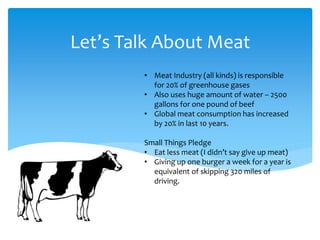
Let’s Talk About Meat
• Meat Industry (all kinds) is responsible
for 20% of greenhouse gases
• Also uses huge amount of water – 2500
gallons for one pound of beef
• Global meat consumption has increased
by 20% in last 10 years.
Small Things Pledge
• Eat less meat (I didn’t say give up meat)
• Giving up one burger a week for a year is
equivalent of skipping 320 miles of
driving.
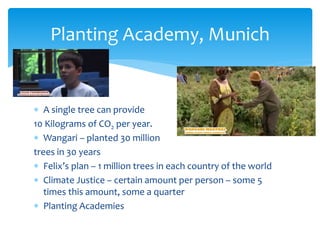
 A single tree can provide
10 Kilograms of CO2 per year.
 Wangari – planted 30 million
trees in 30 years
 Felix’s plan – 1 million trees in each country of the world
 Climate Justice – certain amount per person – some 5
times this amount, some a quarter
 Planting Academies
Planting Academy, Munich
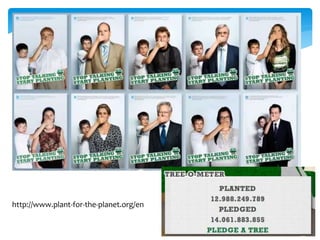
http://www.plant-for-the-planet.org/en
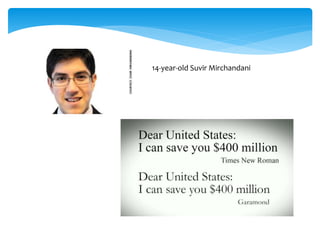
14-year-old Suvir Mirchandani
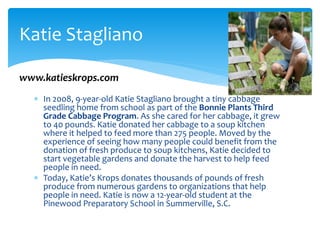
 In 2008, 9-year-old Katie Stagliano brought a tiny cabbage
seedling home from school as part of the Bonnie Plants Third
Grade Cabbage Program. As she cared for her cabbage, it grew
to 40 pounds. Katie donated her cabbage to a soup kitchen
where it helped to feed more than 275 people. Moved by the
experience of seeing how many people could benefit from the
donation of fresh produce to soup kitchens, Katie decided to
start vegetable gardens and donate the harvest to help feed
people in need.
 Today, Katie’s Krops donates thousands of pounds of fresh
produce from numerous gardens to organizations that help
people in need. Katie is now a 12-year-old student at the
Pinewood Preparatory School in Summerville, S.C.
Katie Stagliano
www.katieskrops.com
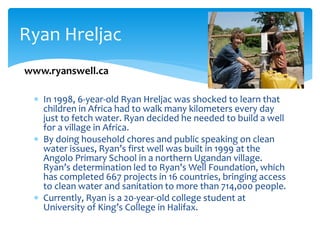
 In 1998, 6-year-old Ryan Hreljac was shocked to learn that
children in Africa had to walk many kilometers every day
just to fetch water. Ryan decided he needed to build a well
for a village in Africa.
 By doing household chores and public speaking on clean
water issues, Ryan’s first well was built in 1999 at the
Angolo Primary School in a northern Ugandan village.
Ryan’s determination led to Ryan’s Well Foundation, which
has completed 667 projects in 16 countries, bringing access
to clean water and sanitation to more than 714,000 people.
 Currently, Ryan is a 20-year-old college student at
University of King’s College in Halifax.
Ryan Hreljac
www.ryanswell.ca
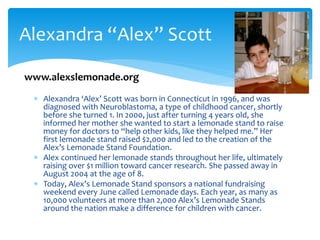
 Alexandra ‘Alex’ Scott was born in Connecticut in 1996, and was
diagnosed with Neuroblastoma, a type of childhood cancer, shortly
before she turned 1. In 2000, just after turning 4 years old, she
informed her mother she wanted to start a lemonade stand to raise
money for doctors to “help other kids, like they helped me.” Her
first lemonade stand raised $2,000 and led to the creation of the
Alex’s Lemonade Stand Foundation.
 Alex continued her lemonade stands throughout her life, ultimately
raising over $1 million toward cancer research. She passed away in
August 2004 at the age of 8.
 Today, Alex’s Lemonade Stand sponsors a national fundraising
weekend every June called Lemonade days. Each year, as many as
10,000 volunteers at more than 2,000 Alex’s Lemonade Stands
around the nation make a difference for children with cancer.
Alexandra “Alex” Scott
www.alexslemonade.org
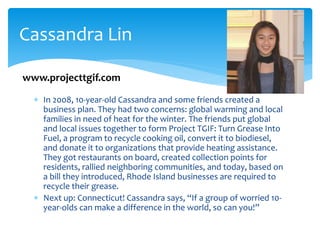
 In 2008, 10-year-old Cassandra and some friends created a
business plan. They had two concerns: global warming and local
families in need of heat for the winter. The friends put global
and local issues together to form Project TGIF: Turn Grease Into
Fuel, a program to recycle cooking oil, convert it to biodiesel,
and donate it to organizations that provide heating assistance.
They got restaurants on board, created collection points for
residents, rallied neighboring communities, and today, based on
a bill they introduced, Rhode Island businesses are required to
recycle their grease.
 Next up: Connecticut! Cassandra says, “If a group of worried 10-
year-olds can make a difference in the world, so can you!”
Cassandra Lin
www.projecttgif.com
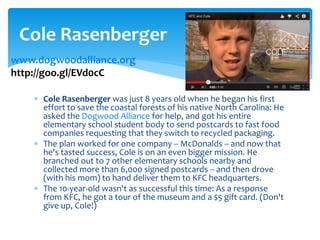
 Cole Rasenberger was just 8 years old when he began his first
effort to save the coastal forests of his native North Carolina: He
asked the Dogwood Alliance for help, and got his entire
elementary school student body to send postcards to fast food
companies requesting that they switch to recycled packaging.
 The plan worked for one company -- McDonalds -- and now that
he's tasted success, Cole is on an even bigger mission. He
branched out to 7 other elementary schools nearby and
collected more than 6,000 signed postcards -- and then drove
(with his mom) to hand deliver them to KFC headquarters.
 The 10-year-old wasn't as successful this time: As a response
from KFC, he got a tour of the museum and a $5 gift card. (Don't
give up, Cole!)
Cole Rasenberger
www.dogwoodalliance.org
http://goo.gl/EVd0cC
“All that stands in the way of
saving the planet is a combination
of ignorance, prejudice, and
vested interests.
So, what are you going to do?

Earth day2014

  • 1.
  • 3.
    New York Times 17April 2014 UN Intergovernmental Panel on Climate Change  Still pretty grim assessment  But, economic impact to change is no longer what it was – won’t cost as much  Technological Revolution  Does economic growth equal more pollution? What’s needed…  Drastic actions to limit greenhouse gases  Innovation can cope with limiting factors  Fuel efficient cars – TESLA?  Insulation  Renewable Enerby  Example: Solar panel cost is down 75% since 2008  Decarbonizing electricity is now realistic goal
  • 4.
    What we dobecause of habit...  Things we eat??  Things we buy??  Things we believe??  Things we accept as true??  Have you ever asked why?  Have you ever tried to change?
  • 5.
    Let’s Talk AboutMeat • Meat Industry (all kinds) is responsible for 20% of greenhouse gases • Also uses huge amount of water – 2500 gallons for one pound of beef • Global meat consumption has increased by 20% in last 10 years. Small Things Pledge • Eat less meat (I didn’t say give up meat) • Giving up one burger a week for a year is equivalent of skipping 320 miles of driving.
  • 6.
     A singletree can provide 10 Kilograms of CO2 per year.  Wangari – planted 30 million trees in 30 years  Felix’s plan – 1 million trees in each country of the world  Climate Justice – certain amount per person – some 5 times this amount, some a quarter  Planting Academies Planting Academy, Munich
  • 7.
  • 8.
  • 9.
     In 2008,9-year-old Katie Stagliano brought a tiny cabbage seedling home from school as part of the Bonnie Plants Third Grade Cabbage Program. As she cared for her cabbage, it grew to 40 pounds. Katie donated her cabbage to a soup kitchen where it helped to feed more than 275 people. Moved by the experience of seeing how many people could benefit from the donation of fresh produce to soup kitchens, Katie decided to start vegetable gardens and donate the harvest to help feed people in need.  Today, Katie’s Krops donates thousands of pounds of fresh produce from numerous gardens to organizations that help people in need. Katie is now a 12-year-old student at the Pinewood Preparatory School in Summerville, S.C. Katie Stagliano www.katieskrops.com
  • 10.
     In 1998,6-year-old Ryan Hreljac was shocked to learn that children in Africa had to walk many kilometers every day just to fetch water. Ryan decided he needed to build a well for a village in Africa.  By doing household chores and public speaking on clean water issues, Ryan’s first well was built in 1999 at the Angolo Primary School in a northern Ugandan village. Ryan’s determination led to Ryan’s Well Foundation, which has completed 667 projects in 16 countries, bringing access to clean water and sanitation to more than 714,000 people.  Currently, Ryan is a 20-year-old college student at University of King’s College in Halifax. Ryan Hreljac www.ryanswell.ca
  • 11.
     Alexandra ‘Alex’Scott was born in Connecticut in 1996, and was diagnosed with Neuroblastoma, a type of childhood cancer, shortly before she turned 1. In 2000, just after turning 4 years old, she informed her mother she wanted to start a lemonade stand to raise money for doctors to “help other kids, like they helped me.” Her first lemonade stand raised $2,000 and led to the creation of the Alex’s Lemonade Stand Foundation.  Alex continued her lemonade stands throughout her life, ultimately raising over $1 million toward cancer research. She passed away in August 2004 at the age of 8.  Today, Alex’s Lemonade Stand sponsors a national fundraising weekend every June called Lemonade days. Each year, as many as 10,000 volunteers at more than 2,000 Alex’s Lemonade Stands around the nation make a difference for children with cancer. Alexandra “Alex” Scott www.alexslemonade.org
  • 12.
     In 2008,10-year-old Cassandra and some friends created a business plan. They had two concerns: global warming and local families in need of heat for the winter. The friends put global and local issues together to form Project TGIF: Turn Grease Into Fuel, a program to recycle cooking oil, convert it to biodiesel, and donate it to organizations that provide heating assistance. They got restaurants on board, created collection points for residents, rallied neighboring communities, and today, based on a bill they introduced, Rhode Island businesses are required to recycle their grease.  Next up: Connecticut! Cassandra says, “If a group of worried 10- year-olds can make a difference in the world, so can you!” Cassandra Lin www.projecttgif.com
  • 13.
     Cole Rasenbergerwas just 8 years old when he began his first effort to save the coastal forests of his native North Carolina: He asked the Dogwood Alliance for help, and got his entire elementary school student body to send postcards to fast food companies requesting that they switch to recycled packaging.  The plan worked for one company -- McDonalds -- and now that he's tasted success, Cole is on an even bigger mission. He branched out to 7 other elementary schools nearby and collected more than 6,000 signed postcards -- and then drove (with his mom) to hand deliver them to KFC headquarters.  The 10-year-old wasn't as successful this time: As a response from KFC, he got a tour of the museum and a $5 gift card. (Don't give up, Cole!) Cole Rasenberger www.dogwoodalliance.org http://goo.gl/EVd0cC
  • 14.
    “All that standsin the way of saving the planet is a combination of ignorance, prejudice, and vested interests.
  • 15.
    So, what areyou going to do?