TAKING LEARNING
BEYOND THE
SCHOOL GATE Kim Flintoff
presented at EDUTECH 2022
Melbourne, Australia
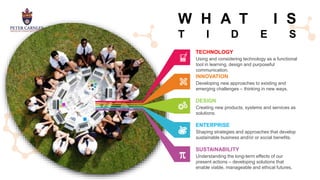
Understanding the long-term effects of our
present actions – developing solutions that
enable viable, manageable and ethical futures.
SUSTAINABILITY
Using and considering technology as a functional
tool in learning, design and purposeful
communication.
TECHNOLOGY
Developing new approaches to existing and
emerging challenges – thinking in new ways.
INNOVATION
Creating new products, systems and services as
solutions.
DESIGN
Shaping strategies and approaches that develop
sustainable business and/or or social benefits.
ENTERPRISE
W H A T I S
T I D E S
LEARNING AIMS
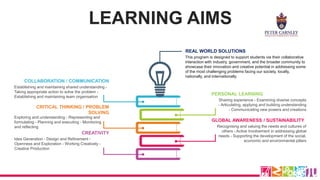
Sharing experience - Examining diverse concepts
- Articulating, applying and building understanding
- Communicating new powers and creations
PERSONAL LEARNING
Recognising and valuing the needs and cultures of
others - Active Involvement in addressing global
needs - Supporting the development of the social,
economic and environmental pillars
GLOBAL AWARENESS / SUSTAINABILITY
Exploring and understanding - Representing and
formulating - Planning and executing - Monitoring
and reflecting
CRITICAL THINKING / PROBLEM
SOLVING
Idea Generation - Design and Refinement -
Openness and Exploration - Working Creatively -
Creative Production
CREATIVITY
Establishing and maintaining shared understanding -
Taking appropriate action to solve the problem -
Establishing and maintaining team organisation
COLLABORATION / COMMUNICATION
This program is designed to support students via their collaborative
interaction with industry, government, and the broader community to
showcase their innovation and creative potential in addressing some
of the most challenging problems facing our society, locally,
nationally, and internationally.
REAL WORLD SOLUTIONS
CHALLENGE-BASED LEARNING
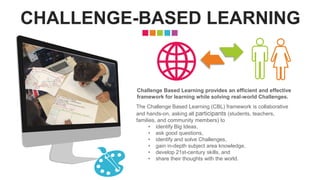
The Challenge Based Learning (CBL) framework is collaborative
and hands-on, asking all participants (students, teachers,
families, and community members) to
• identify Big Ideas,
• ask good questions,
• identify and solve Challenges,
• gain in-depth subject area knowledge,
• develop 21st-century skills, and
• share their thoughts with the world.
Challenge Based Learning provides an efficient and effective
framework for learning while solving real-world Challenges.
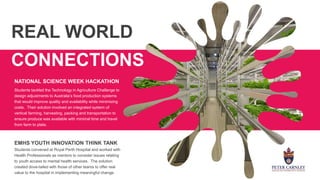
REAL WORLD
CONNECTIONS
Students tackled the Technology in Agriculture Challenge to
design adjustments to Australia’s food production systems
that would improve quality and availability while minimizing
costs. Their solution involved an integrated system of
vertical farming, harvesting, packing and transportation to
ensure produce was available with minimal time and travel
from farm to plate.
EMHS YOUTH INNOVATION THINK TANK
Students convened at Royal Perth Hospital and worked with
Health Professionals as mentors to consider issues relating
to youth access to mental health services. The solution
created dove-tailed with those of other teams to offer real
value to the hospital in implementing meaningful change.
NATIONAL SCIENCE WEEK HACKATHON
REAL WORLD
CONNECTIONS
Studnets have worked on two Health and Wellbeing Challenges – the Hospital
Immersion Challenge aiming to assist Professor Fiona Wood with viable
solutions for improved COVID-19 management technologies, systems and
practices within her operating theatre environment at Fiona Stanley Hospital.
The current challenge is offered by a team of Upper Gastrointestinal surgeons to
develop long-term educational solutions to the increasing incidence of lifestayle
related health conditions in Australia. https://www.stem4innovation.org/
WATER CORPORATION THINK TANK
Students contributed solutions to the WA Water Corporation in response to
challenges around excessive domestic water consumption.
STEM4INNOVATION
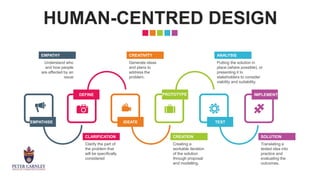
HUMAN-CENTRED DESIGN
EMPATHISE TEST
IDEATE
DEFINE PROTOTYPE
CLARIFICATION
Clarify the part of
the problem that
will be specifically
considered
CREATION
Creating a
workable iteration
of the solution
through proposal
and modelling.
EMPATHY
Understand who
and how people
are affected by an
issue
CREATIVITY
Generate ideas
and plans to
address the
problem.
ANALYSIS
Putting the solution in
place (where possible), or
presenting it to
stakeholders to consider
viability and suitability.
IMPLEMENT
SOLUTION
Translating a
tested idea into
practice and
evaluating the
outcomes.
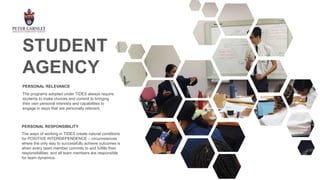
The programs adopted under TIDES always require
students to make choices and commit to bringing
their own personal interests and capabilities to
engage in ways that are personally relevant.
PERSONAL RELEVANCE
The ways of working in TIDES create natural conditions
for POSITIVE INTERDEPENDENCE – circumstances
where the only way to successfully achieve outcomes is
when every team member commits to and fulfills their
responsibilities; and all team members are responsible
for team dynamics.
PERSONAL RESPONSIBILITY
STUDENT
AGENCY
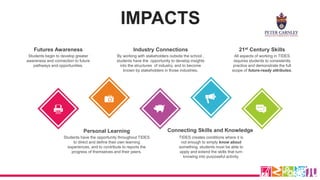
IMPACTS
Students have the opportunity throughout TIDES
to direct and define their own learning
experiences, and to contribute to reports the
progress of themselves and their peers.
Personal Learning
TIDES creates conditions where it is
not enough to simply know about
something, students must be able to
apply and extend the skills that turn
knowing into purposeful activity.
Connecting Skills and Knowledge
Students begin to develop greater
awareness and connection to future
pathways and opportunities.
Futures Awareness
By working with stakeholders outside the school ,
students have the opportunity to develop insights
into the structures of industry, and to become
known by stakeholders in those industries.
Industry Connections
All aspects of working in TIDES
requires students to consistently
practice and demonstrate the full
scope of future-ready attributes.
21st Century Skills
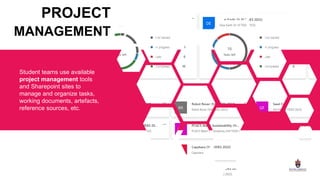
Student teams use available
project management tools
and Sharepoint sites to
manage and organize tasks,
working documents, artefacts,
reference sources, etc.
PROJECT
MANAGEMENT
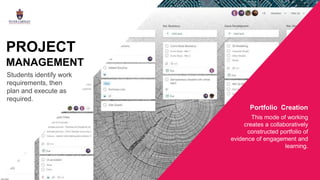
Students identify work
requirements, then
plan and execute as
required.
Portfolio Creation
This mode of working
creates a collaboratively
constructed portfolio of
evidence of engagement and
learning.
PROJECT
MANAGEMENT
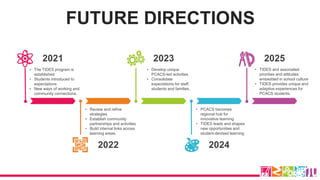
• The TIDES program is
established
• Students introduced to
expectations
• New ways of working and
community connections.
FUTURE DIRECTIONS
2021
2022
2023
2024
2025
• Review and refine
strategies
• Establish community
partnerships and activities
• Build internal links across
learning areas.
• PCACS becomes
regional hub for
innovative learning
• TIDES leads and shapes
new opportunities and
student-devised learning
• Develop unique
PCACS-led activities
• Consolidate
expectations for staff,
students and families.
• TIDES and associated
priorities and attitudes
embedded in school culture
• TIDES provides unique and
adaptive experiences for
PCACS students.
S c i e n c e T e c h n o l o g y E n g i n e e r i n g A r t s M a t h e m a t i c s
TIDES COORDINATOR
Kim Flintoff
TIDES Coordinator
kflintoff@pcacs.wa.edu.au
https://www.linkedin.com/in/kimflintoff/

Taking Learning Beyond the School Gate

  • 1.
    TAKING LEARNING BEYOND THE SCHOOLGATE Kim Flintoff presented at EDUTECH 2022 Melbourne, Australia
  • 2.
    Understanding the long-termeffects of our present actions – developing solutions that enable viable, manageable and ethical futures. SUSTAINABILITY Using and considering technology as a functional tool in learning, design and purposeful communication. TECHNOLOGY Developing new approaches to existing and emerging challenges – thinking in new ways. INNOVATION Creating new products, systems and services as solutions. DESIGN Shaping strategies and approaches that develop sustainable business and/or or social benefits. ENTERPRISE W H A T I S T I D E S
  • 3.
    LEARNING AIMS Sharing experience- Examining diverse concepts - Articulating, applying and building understanding - Communicating new powers and creations PERSONAL LEARNING Recognising and valuing the needs and cultures of others - Active Involvement in addressing global needs - Supporting the development of the social, economic and environmental pillars GLOBAL AWARENESS / SUSTAINABILITY Exploring and understanding - Representing and formulating - Planning and executing - Monitoring and reflecting CRITICAL THINKING / PROBLEM SOLVING Idea Generation - Design and Refinement - Openness and Exploration - Working Creatively - Creative Production CREATIVITY Establishing and maintaining shared understanding - Taking appropriate action to solve the problem - Establishing and maintaining team organisation COLLABORATION / COMMUNICATION This program is designed to support students via their collaborative interaction with industry, government, and the broader community to showcase their innovation and creative potential in addressing some of the most challenging problems facing our society, locally, nationally, and internationally. REAL WORLD SOLUTIONS
  • 4.
    CHALLENGE-BASED LEARNING The ChallengeBased Learning (CBL) framework is collaborative and hands-on, asking all participants (students, teachers, families, and community members) to • identify Big Ideas, • ask good questions, • identify and solve Challenges, • gain in-depth subject area knowledge, • develop 21st-century skills, and • share their thoughts with the world. Challenge Based Learning provides an efficient and effective framework for learning while solving real-world Challenges.
  • 5.
    REAL WORLD CONNECTIONS Students tackledthe Technology in Agriculture Challenge to design adjustments to Australia’s food production systems that would improve quality and availability while minimizing costs. Their solution involved an integrated system of vertical farming, harvesting, packing and transportation to ensure produce was available with minimal time and travel from farm to plate. EMHS YOUTH INNOVATION THINK TANK Students convened at Royal Perth Hospital and worked with Health Professionals as mentors to consider issues relating to youth access to mental health services. The solution created dove-tailed with those of other teams to offer real value to the hospital in implementing meaningful change. NATIONAL SCIENCE WEEK HACKATHON
  • 6.
    REAL WORLD CONNECTIONS Studnets haveworked on two Health and Wellbeing Challenges – the Hospital Immersion Challenge aiming to assist Professor Fiona Wood with viable solutions for improved COVID-19 management technologies, systems and practices within her operating theatre environment at Fiona Stanley Hospital. The current challenge is offered by a team of Upper Gastrointestinal surgeons to develop long-term educational solutions to the increasing incidence of lifestayle related health conditions in Australia. https://www.stem4innovation.org/ WATER CORPORATION THINK TANK Students contributed solutions to the WA Water Corporation in response to challenges around excessive domestic water consumption. STEM4INNOVATION
  • 7.
    HUMAN-CENTRED DESIGN EMPATHISE TEST IDEATE DEFINEPROTOTYPE CLARIFICATION Clarify the part of the problem that will be specifically considered CREATION Creating a workable iteration of the solution through proposal and modelling. EMPATHY Understand who and how people are affected by an issue CREATIVITY Generate ideas and plans to address the problem. ANALYSIS Putting the solution in place (where possible), or presenting it to stakeholders to consider viability and suitability. IMPLEMENT SOLUTION Translating a tested idea into practice and evaluating the outcomes.
  • 8.
    The programs adoptedunder TIDES always require students to make choices and commit to bringing their own personal interests and capabilities to engage in ways that are personally relevant. PERSONAL RELEVANCE The ways of working in TIDES create natural conditions for POSITIVE INTERDEPENDENCE – circumstances where the only way to successfully achieve outcomes is when every team member commits to and fulfills their responsibilities; and all team members are responsible for team dynamics. PERSONAL RESPONSIBILITY STUDENT AGENCY
  • 9.
    IMPACTS Students have theopportunity throughout TIDES to direct and define their own learning experiences, and to contribute to reports the progress of themselves and their peers. Personal Learning TIDES creates conditions where it is not enough to simply know about something, students must be able to apply and extend the skills that turn knowing into purposeful activity. Connecting Skills and Knowledge Students begin to develop greater awareness and connection to future pathways and opportunities. Futures Awareness By working with stakeholders outside the school , students have the opportunity to develop insights into the structures of industry, and to become known by stakeholders in those industries. Industry Connections All aspects of working in TIDES requires students to consistently practice and demonstrate the full scope of future-ready attributes. 21st Century Skills
  • 10.
    Student teams useavailable project management tools and Sharepoint sites to manage and organize tasks, working documents, artefacts, reference sources, etc. PROJECT MANAGEMENT
  • 11.
    Students identify work requirements,then plan and execute as required. Portfolio Creation This mode of working creates a collaboratively constructed portfolio of evidence of engagement and learning. PROJECT MANAGEMENT
  • 12.
    • The TIDESprogram is established • Students introduced to expectations • New ways of working and community connections. FUTURE DIRECTIONS 2021 2022 2023 2024 2025 • Review and refine strategies • Establish community partnerships and activities • Build internal links across learning areas. • PCACS becomes regional hub for innovative learning • TIDES leads and shapes new opportunities and student-devised learning • Develop unique PCACS-led activities • Consolidate expectations for staff, students and families. • TIDES and associated priorities and attitudes embedded in school culture • TIDES provides unique and adaptive experiences for PCACS students.
  • 13.
    S c ie n c e T e c h n o l o g y E n g i n e e r i n g A r t s M a t h e m a t i c s TIDES COORDINATOR Kim Flintoff TIDES Coordinator kflintoff@pcacs.wa.edu.au https://www.linkedin.com/in/kimflintoff/