Managing your manager
Making your manager a better leader for you
Things you only learn after you fail as a manager
10 things only good managers know
10 things only those who have had not so good managers know
Practical tips for taking charge of your own growth
Some very personal and biased views on
taking charge of your own growth (for early
career professionals)
Rachit Kinger
@rachitkinger
15th October 2020
Caveats
There is no substitute for hard work and compassion
Bad managers ≠ Bad people; just less-experienced managers who are
trying to become good managers …
you can help them in their journey
to becoming good managers
Photo by Jon Tyson on Unsplash
Performance e.g. hitting targets, achieving stated goals
Pay rise
Conflict management
Learning new skills e.g. financial modelling, coding, statistics, negotiation
Personal growth e.g. confidence, setting personal goals, career goals
Motivation at work
Motivation at home
Managing your emotions 😥😡🥶🥵🤗😶
Working effectively with others e.g. team, superiors, colleagues, suppliers
Support when you are struggling with personal problems
Parental support e.g. support new parents, support your care roles
Photo by Neil Thomas on Unsplash
None
The only privilege that your manager has is
given by you; the privilege to facilitate your
career.
We own our problems and our managers can
help us find the solutions that work for us. In
that sense we also own the solution.
Problem identification in itself is a big task. A
good manager can help us identify problems
and isolate them. Great managers can motivate
us to solve them.
Meeting with our managers is generally a scary prospect, it shouldn’t be
Most of this talk is about communication.
Most of that communication is going to happen in 1-on-1s.
Most of it will be about you
Photo by Pavan Trikutam on Unsplash
🤔
Cartoons & script source Julia Evans’
@b0rk zine called ‘Help! I have a manager’
It takes time to get going and feeling comfortable
talking about these things with your manager, so be
patient
● Use whatever you can to make them fun
○ Flashcards
○ Quiz
○ Which TV character you feel like?
Be mostly constructive but remember to talk about
problems early
1-on-1 is not the time to discuss your project reviews
and work. That is a project review meeting! A 1-on-1 is
for you to talk about yourself.
🚀
Opportunity to take charge of your performance review
Ask for feedback
Be specific, but how 🤔
Examples:
● Am I prioritizing correctly?
● I am spending nearly all my time on project X, which means I will have no
time to work on project Y this month. Is that okay?
But also, be generic 🙃
● Example, is there anything else we should be talking about?
Some areas to check on performance:
● Goals & results: Is the project going as expected? What if we improve
performance by only 10%, will that still be a good result?
● Risks
● Be a team player: is there any gap in the team where you think I can help?
CartoonssourceJuliaEvans@b0rk
🧙Pay rise & promotions
These conversations can be very stressful. But really, pay rise and promotions are just a
normal thing we can have a conversation about
Step 1: Talk early
Step 2: Don’t be defensive! You deserve this. Provide good reasons
Here’s a great question to talk about promotions:
“Can we walk through the expectation for the next level to make sure that I understand
them?”
And a great follow-up: “What areas do you think I should focus on?”
And don’t forget to close the loop: “If I accomplish XYZ, do you think that would be enough
to get promoted?”
🌳 Growth and learning
There is nothing you own more than your own growth and learning. There is nothing more pleasing for a
manager to see that their team members are learning new skills.
Technical skills based roadmap? Try this with your manager →
● What type of projects do you have visibility of?
● What type of skills do you think the team is in need of?
Soft skills? Try this approach →
● Find people you admire and ask people who work regularly with them, what is the most striking quality of
this person?
● Then ask your manager (and others you trust) to observe that quality in you and seek feedback.
Not sure? Try these → You can ask your manager to give you as many different types of opportunities as
possible (Remember: not knowing what you want does NOT mean lack of ambition)
Make sure you do this → Dedicate at least 5 minutes in a 1-on-1 to talk about what new things you have learnt
or are learning?
Photo by Ian Schneider on Unsplash
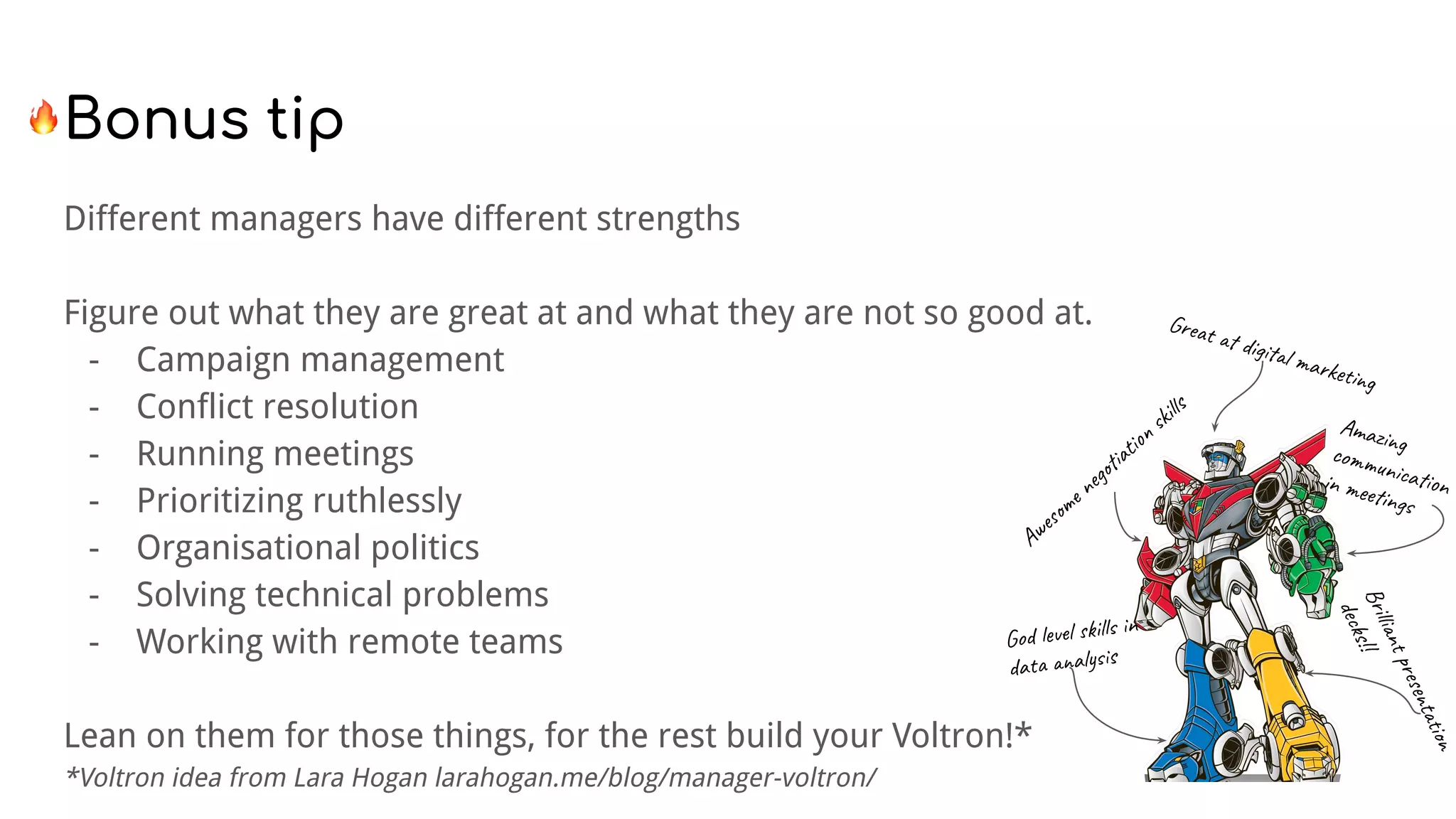
Different managers have different strengths
Figure out what they are great at and what they are not so good at.
- Campaign management
- Conflict resolution
- Running meetings
- Prioritizing ruthlessly
- Organisational politics
- Solving technical problems
- Working with remote teams
Lean on them for those things, for the rest build your Voltron!*
*Voltron idea from Lara Hogan larahogan.me/blog/manager-voltron/
Awesome negotiation skills
Great at digital marketing
Amazingcommunicationin meetings
God level skills in
data analysis
Brilliantpresentation
decks!!
This presentation is a patchwork of great
ideas from:
- Camille Fournier
- Lara Hogan
- Julia Evans
Photo by Andrey Svistunov on Unsplash

Taking charge of your growth

  • 1.
    Managing your manager Makingyour manager a better leader for you Things you only learn after you fail as a manager 10 things only good managers know 10 things only those who have had not so good managers know Practical tips for taking charge of your own growth Some very personal and biased views on taking charge of your own growth (for early career professionals) Rachit Kinger @rachitkinger 15th October 2020
  • 2.
    Caveats There is nosubstitute for hard work and compassion Bad managers ≠ Bad people; just less-experienced managers who are trying to become good managers … you can help them in their journey to becoming good managers Photo by Jon Tyson on Unsplash
  • 3.
    Performance e.g. hittingtargets, achieving stated goals Pay rise Conflict management Learning new skills e.g. financial modelling, coding, statistics, negotiation Personal growth e.g. confidence, setting personal goals, career goals Motivation at work Motivation at home Managing your emotions 😥😡🥶🥵🤗😶 Working effectively with others e.g. team, superiors, colleagues, suppliers Support when you are struggling with personal problems Parental support e.g. support new parents, support your care roles Photo by Neil Thomas on Unsplash
  • 4.
    None The only privilegethat your manager has is given by you; the privilege to facilitate your career. We own our problems and our managers can help us find the solutions that work for us. In that sense we also own the solution. Problem identification in itself is a big task. A good manager can help us identify problems and isolate them. Great managers can motivate us to solve them.
  • 5.
    Meeting with ourmanagers is generally a scary prospect, it shouldn’t be Most of this talk is about communication. Most of that communication is going to happen in 1-on-1s. Most of it will be about you Photo by Pavan Trikutam on Unsplash
  • 6.
    🤔 Cartoons & scriptsource Julia Evans’ @b0rk zine called ‘Help! I have a manager’ It takes time to get going and feeling comfortable talking about these things with your manager, so be patient ● Use whatever you can to make them fun ○ Flashcards ○ Quiz ○ Which TV character you feel like? Be mostly constructive but remember to talk about problems early 1-on-1 is not the time to discuss your project reviews and work. That is a project review meeting! A 1-on-1 is for you to talk about yourself.
  • 7.
    🚀 Opportunity to takecharge of your performance review Ask for feedback Be specific, but how 🤔 Examples: ● Am I prioritizing correctly? ● I am spending nearly all my time on project X, which means I will have no time to work on project Y this month. Is that okay? But also, be generic 🙃 ● Example, is there anything else we should be talking about? Some areas to check on performance: ● Goals & results: Is the project going as expected? What if we improve performance by only 10%, will that still be a good result? ● Risks ● Be a team player: is there any gap in the team where you think I can help? CartoonssourceJuliaEvans@b0rk
  • 8.
    🧙Pay rise &promotions These conversations can be very stressful. But really, pay rise and promotions are just a normal thing we can have a conversation about Step 1: Talk early Step 2: Don’t be defensive! You deserve this. Provide good reasons Here’s a great question to talk about promotions: “Can we walk through the expectation for the next level to make sure that I understand them?” And a great follow-up: “What areas do you think I should focus on?” And don’t forget to close the loop: “If I accomplish XYZ, do you think that would be enough to get promoted?”
  • 9.
    🌳 Growth andlearning There is nothing you own more than your own growth and learning. There is nothing more pleasing for a manager to see that their team members are learning new skills. Technical skills based roadmap? Try this with your manager → ● What type of projects do you have visibility of? ● What type of skills do you think the team is in need of? Soft skills? Try this approach → ● Find people you admire and ask people who work regularly with them, what is the most striking quality of this person? ● Then ask your manager (and others you trust) to observe that quality in you and seek feedback. Not sure? Try these → You can ask your manager to give you as many different types of opportunities as possible (Remember: not knowing what you want does NOT mean lack of ambition) Make sure you do this → Dedicate at least 5 minutes in a 1-on-1 to talk about what new things you have learnt or are learning? Photo by Ian Schneider on Unsplash
  • 10.
    Different managers havedifferent strengths Figure out what they are great at and what they are not so good at. - Campaign management - Conflict resolution - Running meetings - Prioritizing ruthlessly - Organisational politics - Solving technical problems - Working with remote teams Lean on them for those things, for the rest build your Voltron!* *Voltron idea from Lara Hogan larahogan.me/blog/manager-voltron/ Awesome negotiation skills Great at digital marketing Amazingcommunicationin meetings God level skills in data analysis Brilliantpresentation decks!!
  • 11.
    This presentation isa patchwork of great ideas from: - Camille Fournier - Lara Hogan - Julia Evans Photo by Andrey Svistunov on Unsplash