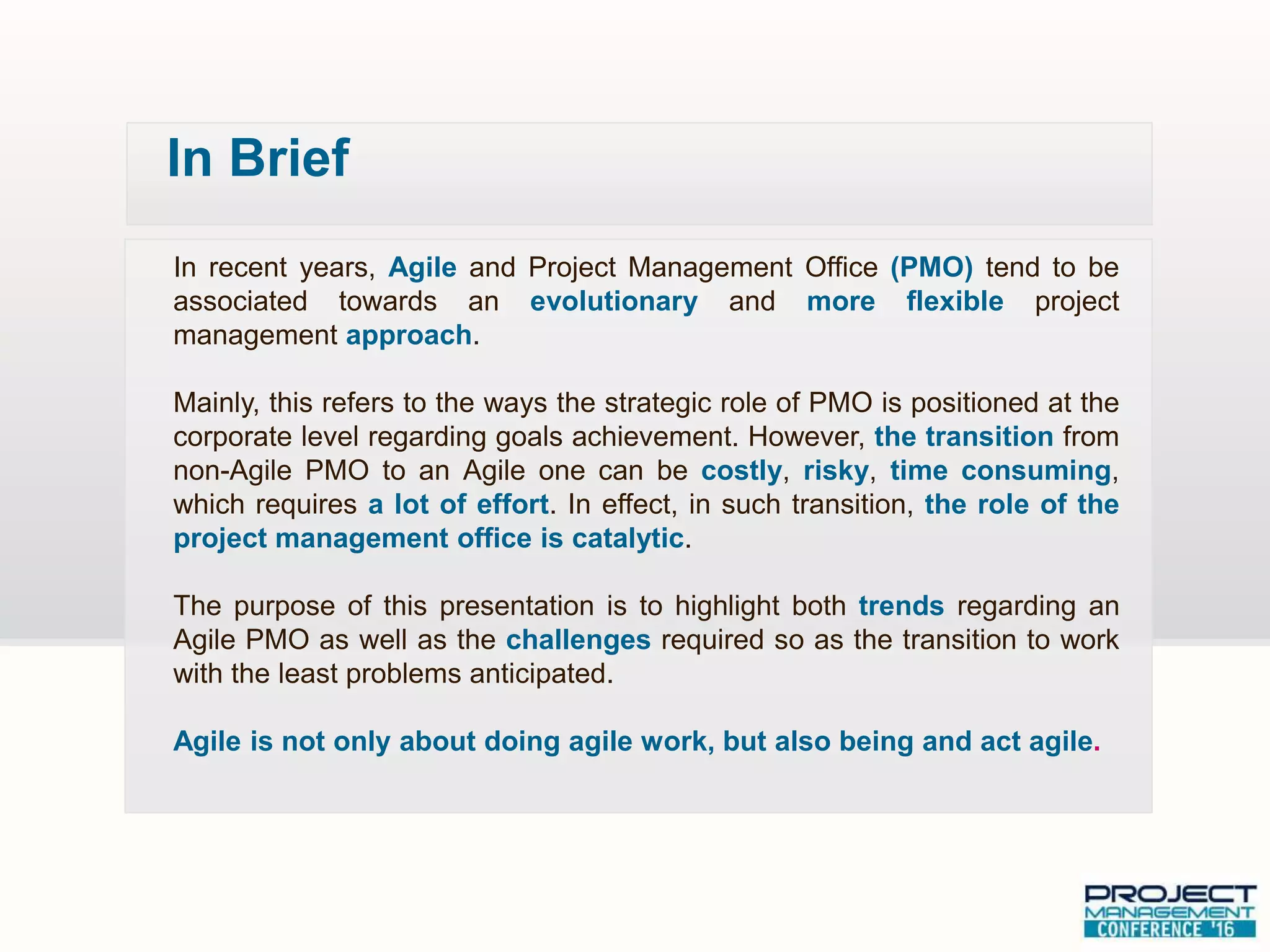
Taking a step forward. Agile PMO: Trends and Challenges
Project Management Conference '16
Dr Harris Apostolopoulos EMBA, PMP
Director, Strategy Management Office, Performance Leaders Consulting
harris.apostolopoulos@gmail.com 12 Jul 2016
Performance Leaders Consulting (PLC) is a strategy consulting firm aiming to be the
preferred strategy partner for a select number of leading businesses, governments, and
social institutions to whom we can devote our full attention and bring the desired result.
We advise our clients on their key strategic issues, leveraging our deep strategy and
industry expertise and using analytical rigor to help them make informed decisions more
quickly and solve their toughest and most critical problems.
PLC provides a comprehensive range of customizable strategy services covering the full
strategy lifecycle to suit the various requirements of our clients. We seek to translate
strategies and strategic insights into actions and results – for our clients, our people, and
our society.
Our strategy services include strategy consulting, strategy workshops facilitation,
strategy quality assurance, and strategy capability building and they utilise our
comprehensive strategy capabilities, including Corporate Strategy, Business Strategy,
Public Level Strategy, Innovation Strategy, strategy execution, and Strategy Control.
About PLC
Transforming insights into tangible results
In recent years, Agile and Project Management Office (PMO) tend to be
associated towards an evolutionary and more flexible project
management approach.
Mainly, this refers to the ways the strategic role of PMO is positioned at the
corporate level regarding goals achievement. However, the transition from
non-Agile PMO to an Agile one can be costly, risky, time consuming,
which requires a lot of effort. In effect, in such transition, the role of the
project management office is catalytic.
The purpose of this presentation is to highlight both trends regarding an
Agile PMO as well as the challenges required so as the transition to work
with the least problems anticipated.
Agile is not only about doing agile work, but also being and act agile.
In Brief
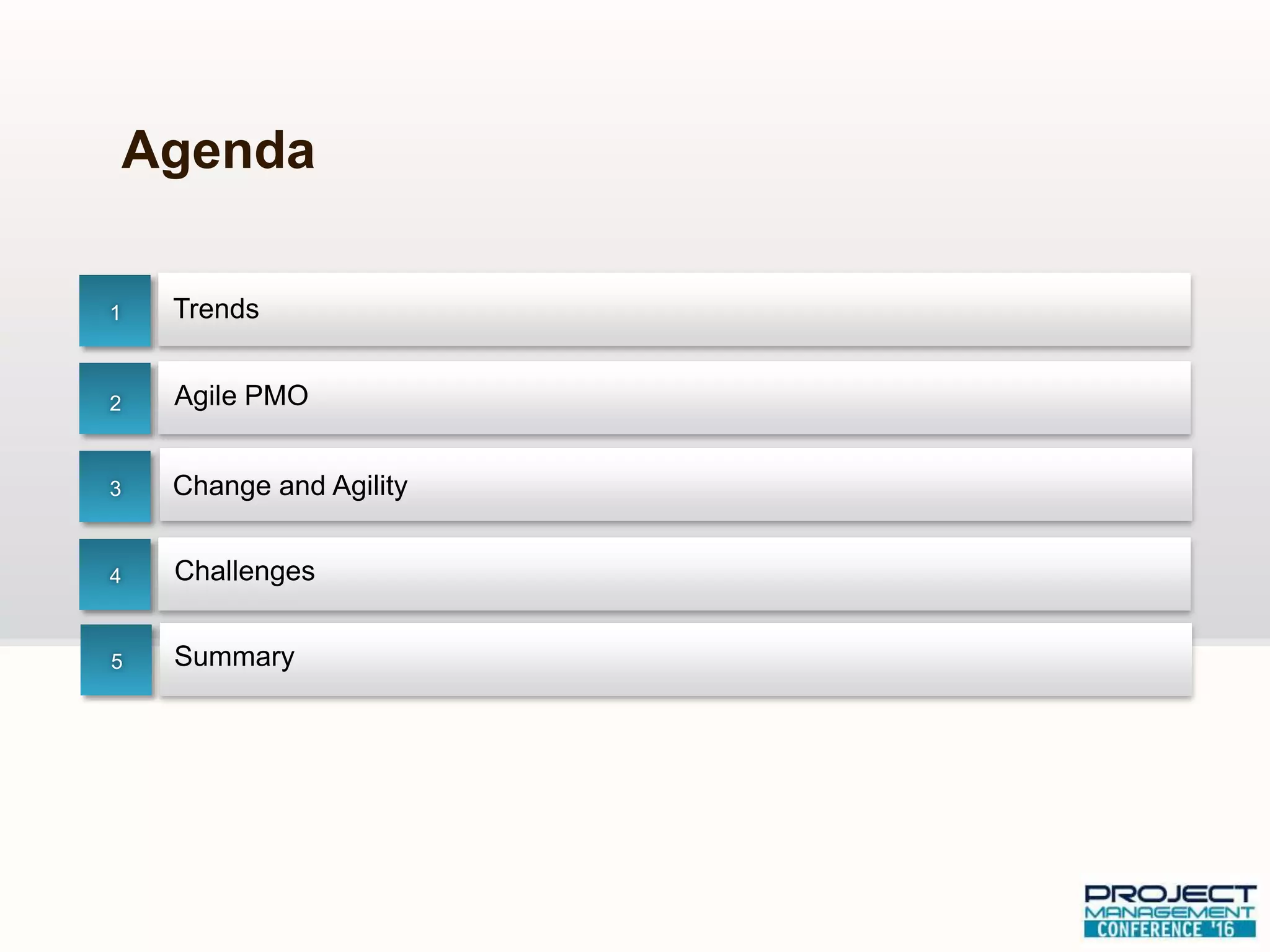
Trends
Agenda
1
2
3
4
Agile PMO
Challenges
Change and Agility
Summary5
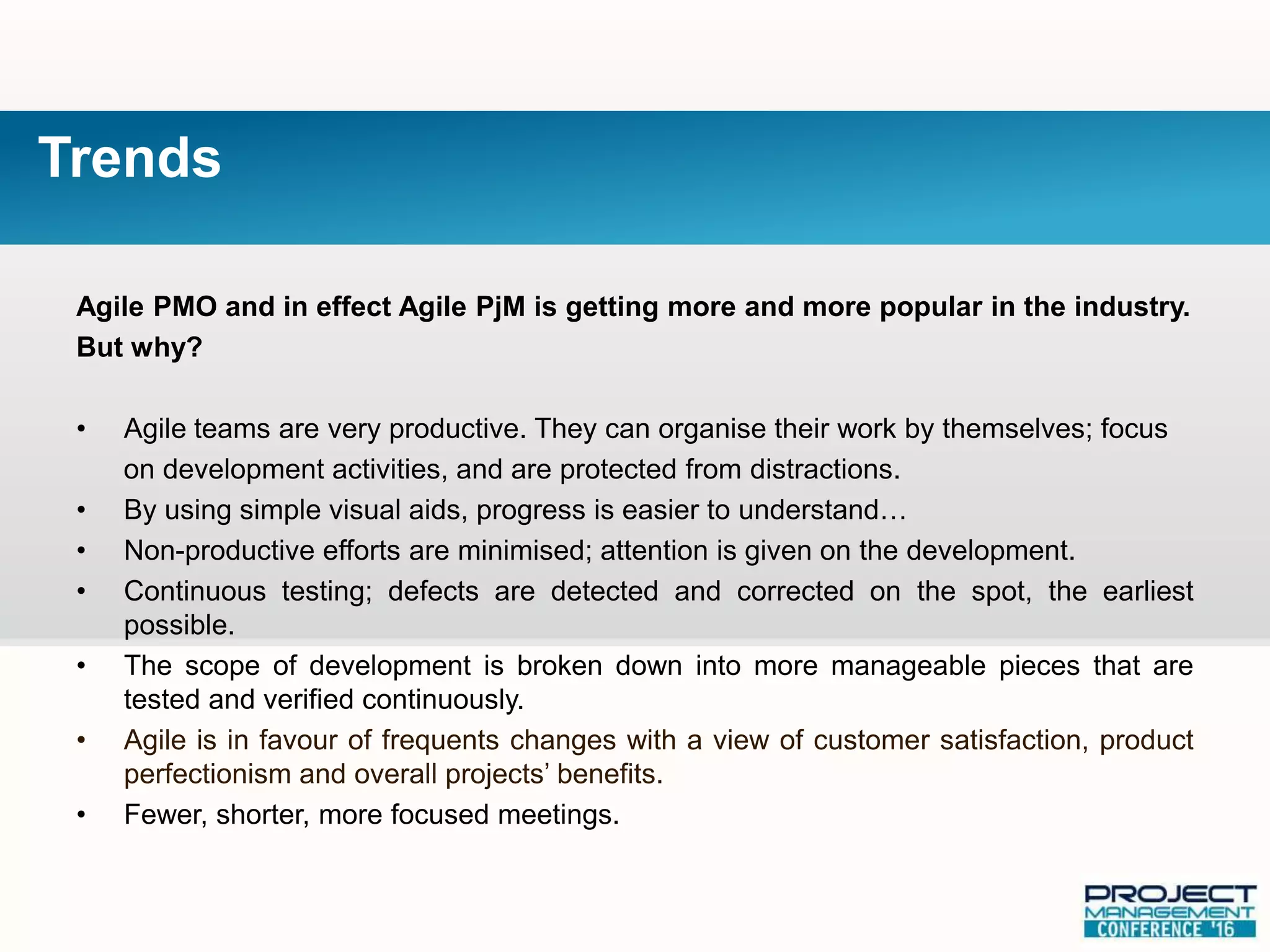
Agile PMO and in effect Agile PjM is getting more and more popular in the industry.
But why?
• Agile teams are very productive. They can organise their work by themselves; focus
on development activities, and are protected from distractions.
• By using simple visual aids, progress is easier to understand…
• Non-productive efforts are minimised; attention is given on the development.
• Continuous testing; defects are detected and corrected on the spot, the earliest
possible.
• The scope of development is broken down into more manageable pieces that are
tested and verified continuously.
• Agile is in favour of frequents changes with a view of customer satisfaction, product
perfectionism and overall projects’ benefits.
• Fewer, shorter, more focused meetings.
Trends
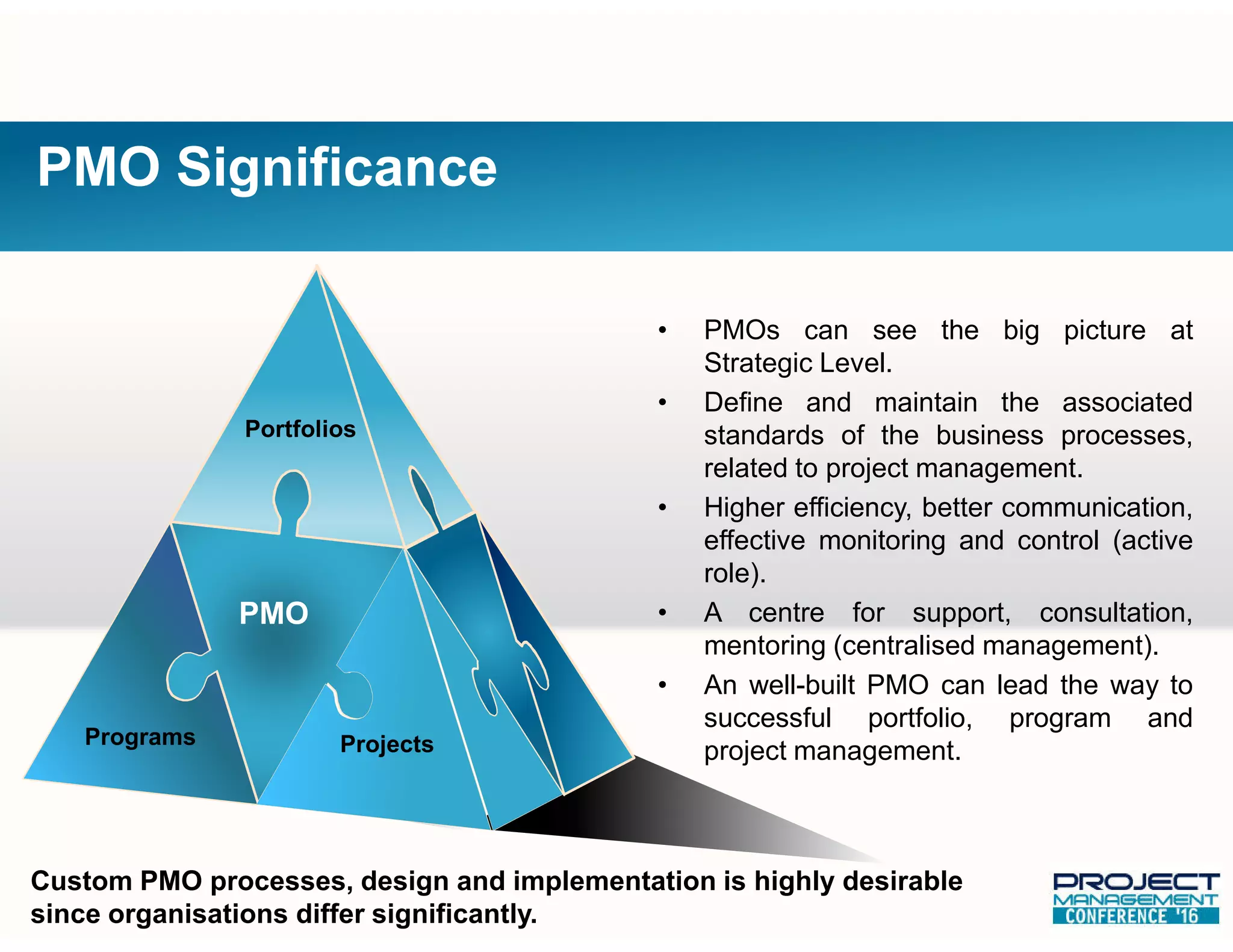
Portfolios
PMO Significance
• PMOs can see the big picture at
Strategic Level.
• Define and maintain the associated
standards of the business processes,
related to project management.
Programs
PMO
Projects
related to project management.
• Higher efficiency, better communication,
effective monitoring and control (active
role).
• A centre for support, consultation,
mentoring (centralised management).
• An well-built PMO can lead the way to
successful portfolio, program and
project management.
Custom PMO processes, design and implementation is highly desirable
since organisations differ significantly.
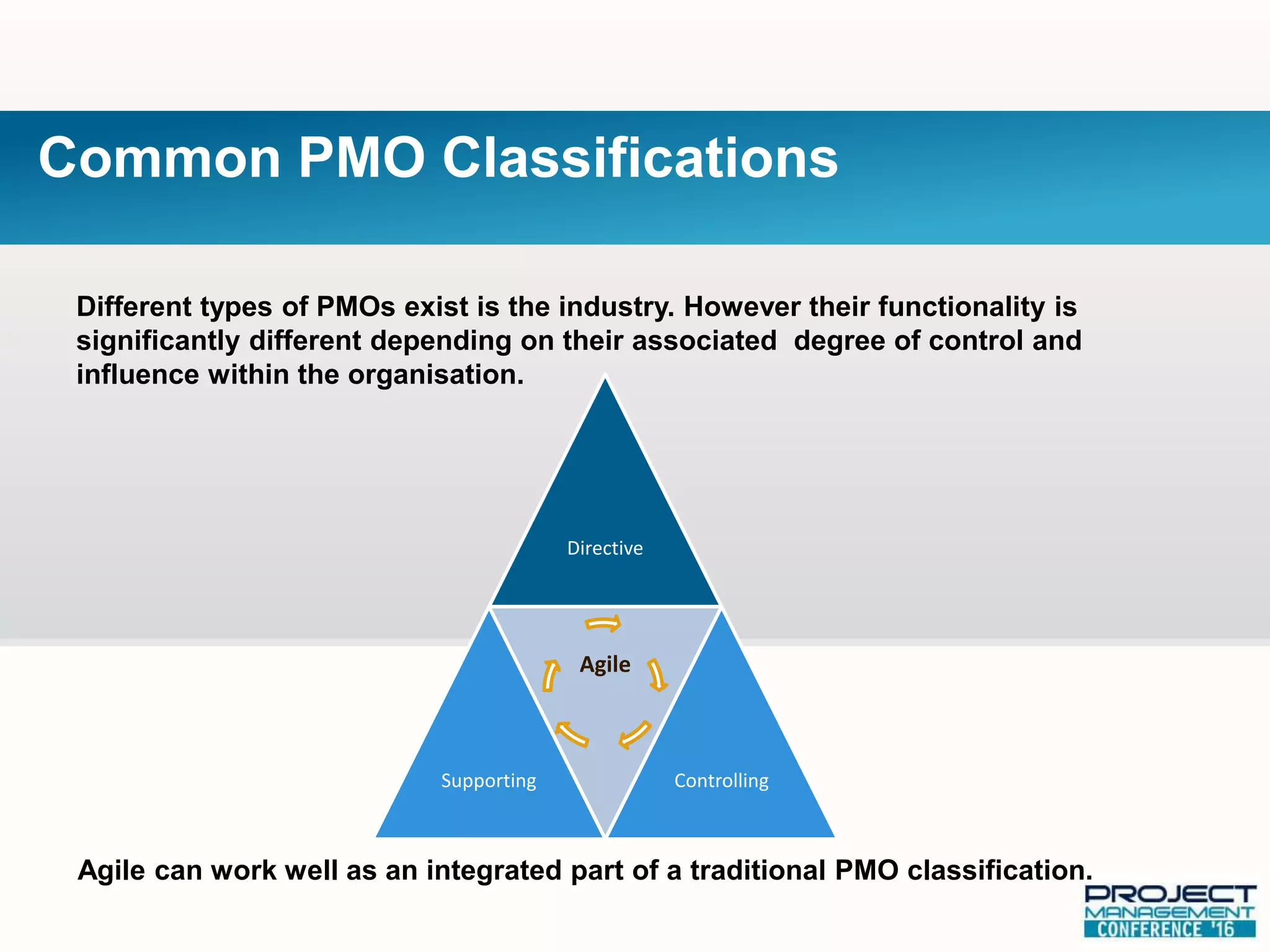
Different types of PMOs exist is the industry. However their functionality is
significantly different depending on their associated degree of control and
influence within the organisation.
Directive
Supporting
Agile
Controlling
Agile can work well as an integrated part of a traditional PMO classification.
Common PMO Classifications
Some Statistics
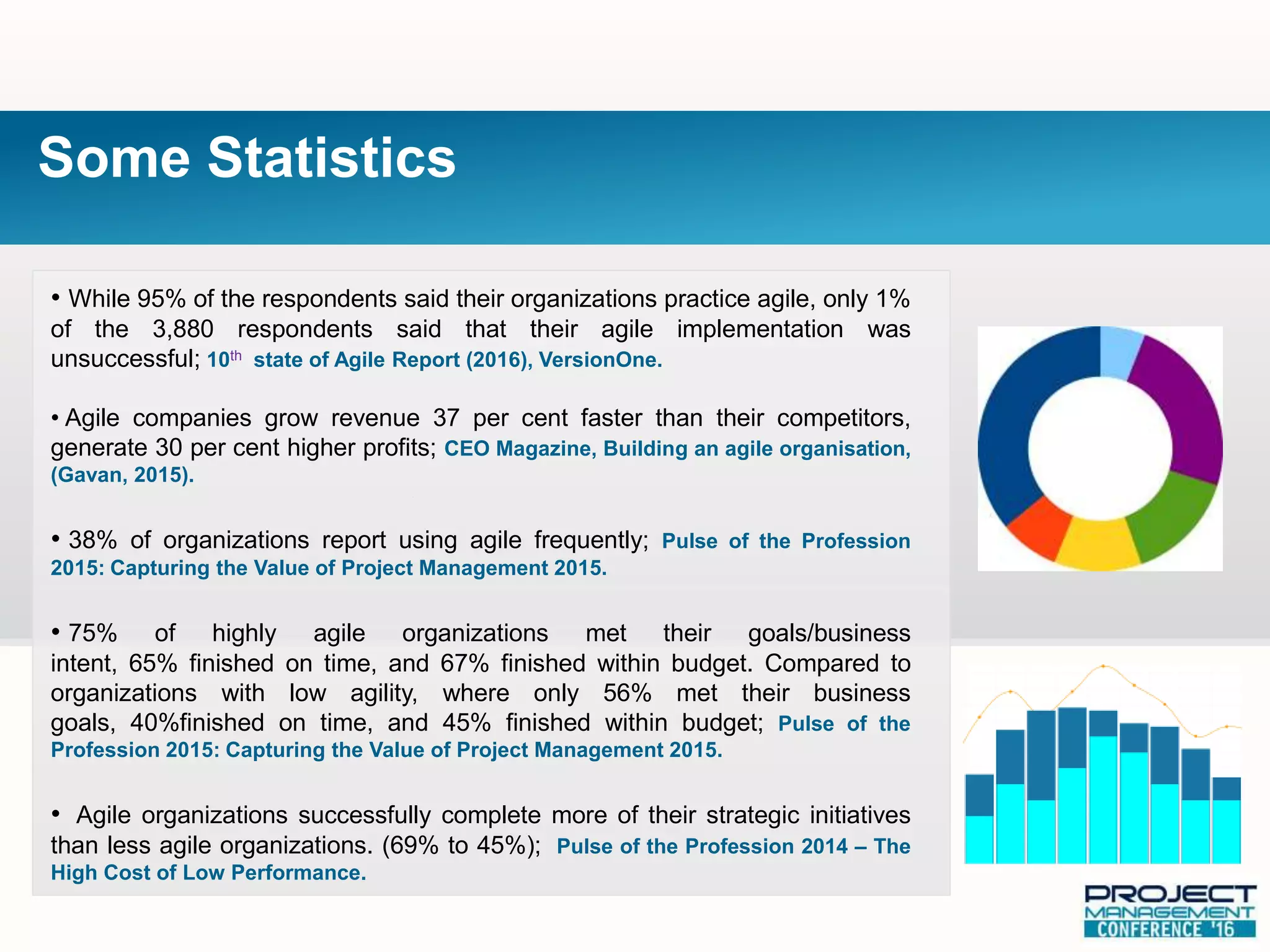
• While 95% of the respondents said their organizations practice agile, only 1%
of the 3,880 respondents said that their agile implementation was
unsuccessful; 10th state of Agile Report (2016), VersionOne.
• Agile companies grow revenue 37 per cent faster than their competitors,
generate 30 per cent higher profits; CEO Magazine, Building an agile organisation,
(Gavan, 2015).
• 38% of organizations report using agile frequently; Pulse of the Profession
2015: Capturing the Value of Project Management 2015.
• 75% of highly agile organizations met their goals/business
intent, 65% finished on time, and 67% finished within budget. Compared to
organizations with low agility, where only 56% met their business
goals, 40%finished on time, and 45% finished within budget; Pulse of the
Profession 2015: Capturing the Value of Project Management 2015.
• Agile organizations successfully complete more of their strategic initiatives
than less agile organizations. (69% to 45%); Pulse of the Profession 2014 – The
High Cost of Low Performance.
An Agile PMO has fundamental differences compared to a traditional one.
• Moving towards an Agile PMO means that the role of the PMO becomes more
advisory centric compared to the traditional consulting / controlling approach.
• In terms of functionalities, focus is given to the selection and allocation of well-trained
people coupled with the right credentials so as processes are more effective and
efficient ; well-aligned with the company’s business role.
• Regarding projects, there is a shift towards the business value rather than just
managing.
• The advisory functions of the Agile PMO entail commitment of people to project
teams which work in a more self-organizing culture.
• Even though, the strategic goals and targets are set; the actual plan on how to
accomplish them will be adjusted at a later stage.
• Agile PMO prioritises work based on resources not on number of projects. More work
is done as team members are getting more experienced working together.
Agile PMO
An Agile PMO requires a dynamic and adaptive approach based on specific
characteristics.
• Traditional PMO structures are fundamentally incompatible with agile ones (1 to 1
match) because they are based on an different foundation.
• Key goals for both traditional and agile PMOs is to ensure deliverables at the
maximum value possible on time within budget (no waste), minimising risk exposure
AND quickly adapting to changing business requirements.
• Easier to work in project management mature organisations with standardised
traditional project management framework.
• Not all Agile principles and values would fit in an organisation’s PMO. As a
walkthrough, the suggestion is to incorporate those Agile values and principles which
will bring the desired RESULT.
Agile PMO (cont.)
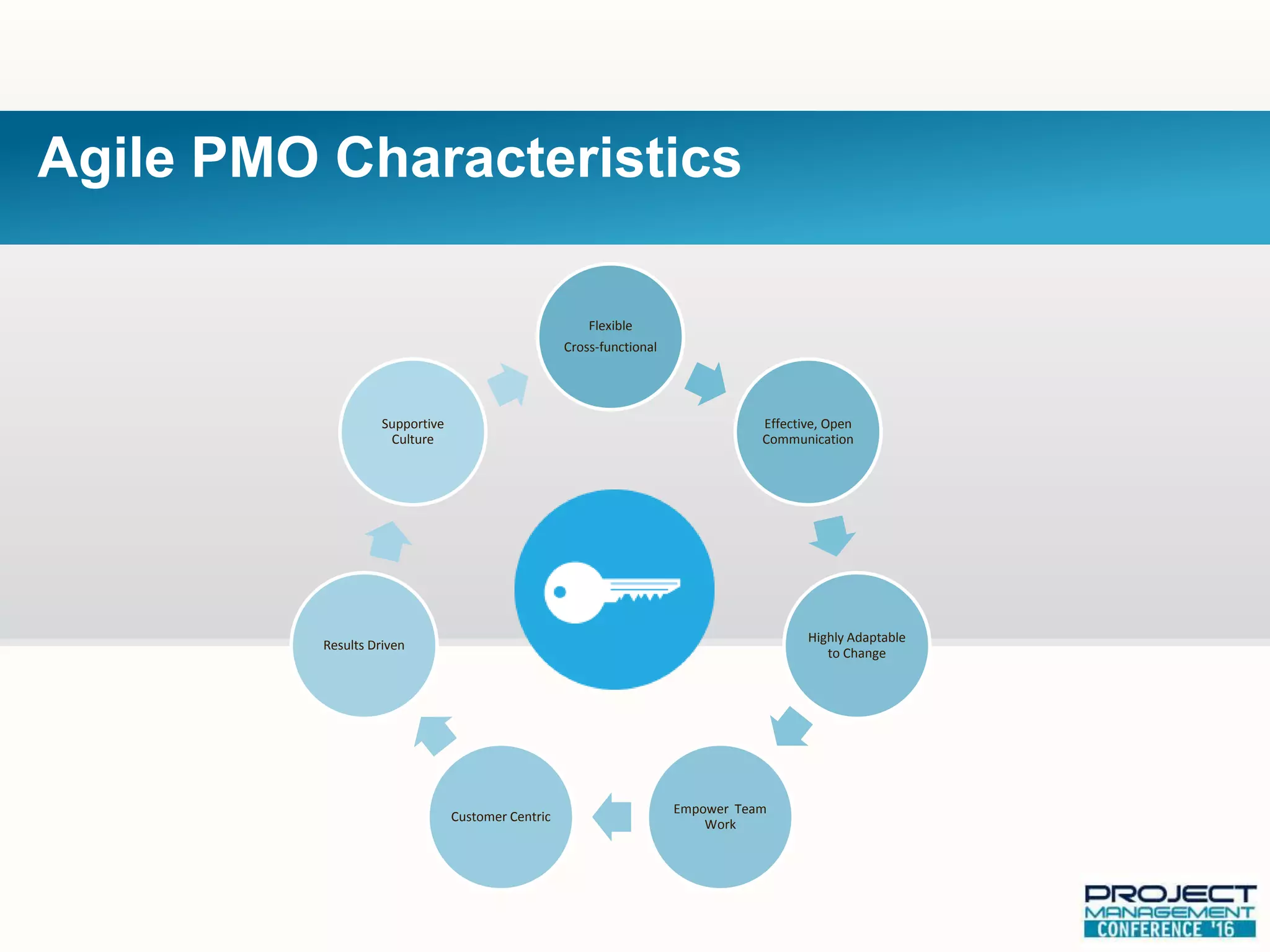
Agile PMO Characteristics
Flexible
Cross-functional
Effective, Open
Communication
Highly Adaptable
to Change
Empower Team
Work
Customer Centric
Results Driven
Supportive
Culture
Agile processes handle project and product change(s) in beneficial ways.
• Changes are incorporated into subsequent iterations routinely and smoothly.
• One of the goals is to handle change(s) with a view on increased customer
satisfaction.
• Stakeholders can provide feedback about required changes which in turn are
incorporated into the actual project.
• Agile PMO views change as a positive and constructive way to improve a product as
the project progresses.
• Late changes in the project, are the most valuable ones.
• The transformation of the PMO to an Agile environment may force a lot of pressure to
the team.
• Change management is an inherent part of agile processes.
• An Agile environment is highly adaptable to shifting business requirements; get
prepared to rethink and revaluate the basic assumptions of management.
Change and Agility
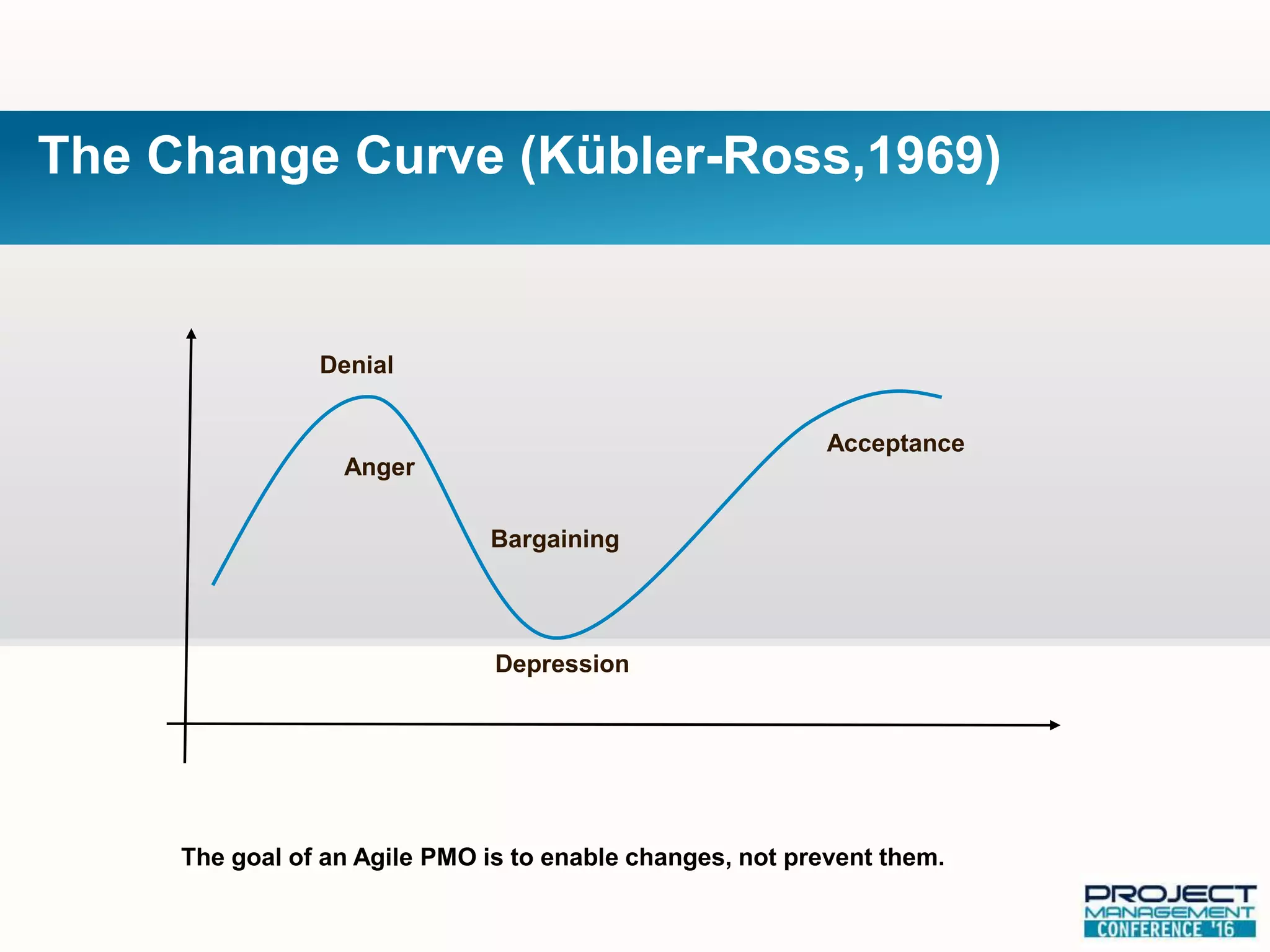
The Change Curve (Kübler-Ross,1969)
Denial
Anger
Bargaining
Acceptance
Depression
The goal of an Agile PMO is to enable changes, not prevent them.
Agile approaches can reveal that the PMO needs to change.
• Don’t try to reinvent the wheel. If something works well, enforce it.
• A culture of learning that supports both personal development and project
improvement (servant - leader approach; find solutions rather than assign tasks).
• Creating the right environment for the stakeholders to operate; e.g an environment
where ideally the team can work in close physical proximity (collocation); remove
distractions, be respectful, encourage openness, etc.
• Ideally, people are assigned to one project for the duration of the project.
• Cross-functional, self-organizing teams.
• Everyone is involved in the process, understands and can contribute to the
development of the product.
• Asks the questions: What can PMO do to contribute today (next step)? How can
PMO’s contribution be expanded in the future (development)?
• Often, Project management leaders see agile processes as a threat.
PMO Challenges in an Agile environment
In order to move from traditional PMO to an Agile one, commitment by both the
organisation and individuals is required. There is no, one size fits all.
• Move to an Agile environment if it's necessary and foresee specific benefits.
• Proper environment creation; build foundations on an Agile corporate culture.
• Invest in training is a MUST.
• Don’t fall back to the tradiational approach if things don’t work out with the first try.
• Priotitise and remove obstacles.
• See change with a constructive mindset.
• Have faith in a team spirit approach.
• Tailor Agile values and princliples to your organisation’s PMO.
Keys to a successful Agile PMO Transition
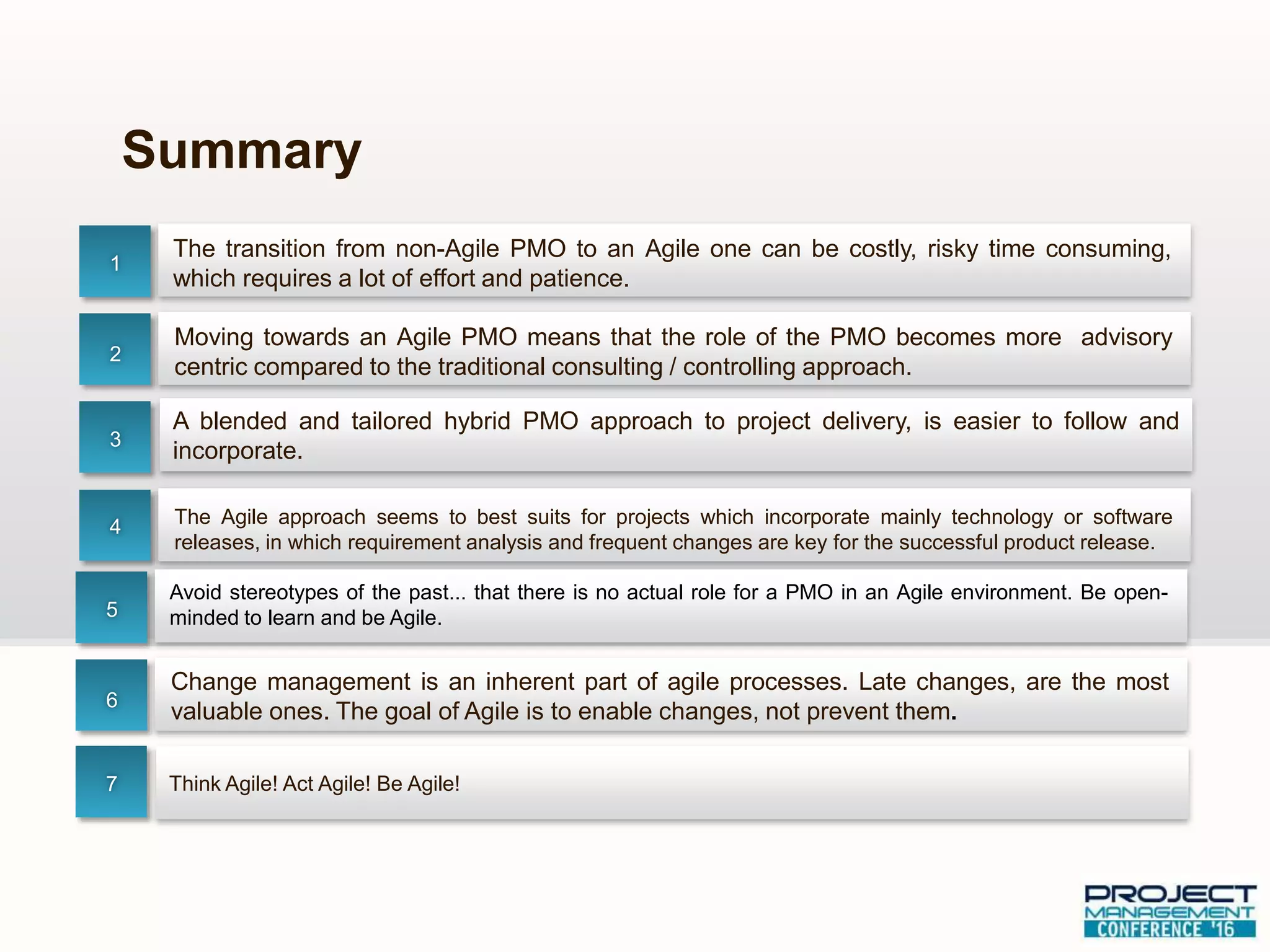
The transition from non-Agile PMO to an Agile one can be costly, risky time consuming,
which requires a lot of effort and patience.
Summary
1
2
3
4
Moving towards an Agile PMO means that the role of the PMO becomes more advisory
centric compared to the traditional consulting / controlling approach.
The Agile approach seems to best suits for projects which incorporate mainly technology or software
releases, in which requirement analysis and frequent changes are key for the successful product release.
A blended and tailored hybrid PMO approach to project delivery, is easier to follow and
incorporate.
Avoid stereotypes of the past... that there is no actual role for a PMO in an Agile environment. Be open-
minded to learn and be Agile.5
6
Change management is an inherent part of agile processes. Late changes, are the most
valuable ones. The goal of Agile is to enable changes, not prevent them.
7 Think Agile! Act Agile! Be Agile!
Questions?
Thank You!
info@performanceleadersconsulting.com
Taking a step forward. Agile PMO: Trends and
Challenges

Taking a step forward: Agile PMO: Trends and Challenges

  • 1.
    Taking a stepforward. Agile PMO: Trends and Challenges Project Management Conference '16 Dr Harris Apostolopoulos EMBA, PMP Director, Strategy Management Office, Performance Leaders Consulting harris.apostolopoulos@gmail.com 12 Jul 2016
  • 2.
    Performance Leaders Consulting(PLC) is a strategy consulting firm aiming to be the preferred strategy partner for a select number of leading businesses, governments, and social institutions to whom we can devote our full attention and bring the desired result. We advise our clients on their key strategic issues, leveraging our deep strategy and industry expertise and using analytical rigor to help them make informed decisions more quickly and solve their toughest and most critical problems. PLC provides a comprehensive range of customizable strategy services covering the full strategy lifecycle to suit the various requirements of our clients. We seek to translate strategies and strategic insights into actions and results – for our clients, our people, and our society. Our strategy services include strategy consulting, strategy workshops facilitation, strategy quality assurance, and strategy capability building and they utilise our comprehensive strategy capabilities, including Corporate Strategy, Business Strategy, Public Level Strategy, Innovation Strategy, strategy execution, and Strategy Control. About PLC Transforming insights into tangible results
  • 3.
    In recent years,Agile and Project Management Office (PMO) tend to be associated towards an evolutionary and more flexible project management approach. Mainly, this refers to the ways the strategic role of PMO is positioned at the corporate level regarding goals achievement. However, the transition from non-Agile PMO to an Agile one can be costly, risky, time consuming, which requires a lot of effort. In effect, in such transition, the role of the project management office is catalytic. The purpose of this presentation is to highlight both trends regarding an Agile PMO as well as the challenges required so as the transition to work with the least problems anticipated. Agile is not only about doing agile work, but also being and act agile. In Brief
  • 4.
  • 5.
    Agile PMO andin effect Agile PjM is getting more and more popular in the industry. But why? • Agile teams are very productive. They can organise their work by themselves; focus on development activities, and are protected from distractions. • By using simple visual aids, progress is easier to understand… • Non-productive efforts are minimised; attention is given on the development. • Continuous testing; defects are detected and corrected on the spot, the earliest possible. • The scope of development is broken down into more manageable pieces that are tested and verified continuously. • Agile is in favour of frequents changes with a view of customer satisfaction, product perfectionism and overall projects’ benefits. • Fewer, shorter, more focused meetings. Trends
  • 6.
    Portfolios PMO Significance • PMOscan see the big picture at Strategic Level. • Define and maintain the associated standards of the business processes, related to project management. Programs PMO Projects related to project management. • Higher efficiency, better communication, effective monitoring and control (active role). • A centre for support, consultation, mentoring (centralised management). • An well-built PMO can lead the way to successful portfolio, program and project management. Custom PMO processes, design and implementation is highly desirable since organisations differ significantly.
  • 7.
    Different types ofPMOs exist is the industry. However their functionality is significantly different depending on their associated degree of control and influence within the organisation. Directive Supporting Agile Controlling Agile can work well as an integrated part of a traditional PMO classification. Common PMO Classifications
  • 8.
    Some Statistics • While95% of the respondents said their organizations practice agile, only 1% of the 3,880 respondents said that their agile implementation was unsuccessful; 10th state of Agile Report (2016), VersionOne. • Agile companies grow revenue 37 per cent faster than their competitors, generate 30 per cent higher profits; CEO Magazine, Building an agile organisation, (Gavan, 2015). • 38% of organizations report using agile frequently; Pulse of the Profession 2015: Capturing the Value of Project Management 2015. • 75% of highly agile organizations met their goals/business intent, 65% finished on time, and 67% finished within budget. Compared to organizations with low agility, where only 56% met their business goals, 40%finished on time, and 45% finished within budget; Pulse of the Profession 2015: Capturing the Value of Project Management 2015. • Agile organizations successfully complete more of their strategic initiatives than less agile organizations. (69% to 45%); Pulse of the Profession 2014 – The High Cost of Low Performance.
  • 9.
    An Agile PMOhas fundamental differences compared to a traditional one. • Moving towards an Agile PMO means that the role of the PMO becomes more advisory centric compared to the traditional consulting / controlling approach. • In terms of functionalities, focus is given to the selection and allocation of well-trained people coupled with the right credentials so as processes are more effective and efficient ; well-aligned with the company’s business role. • Regarding projects, there is a shift towards the business value rather than just managing. • The advisory functions of the Agile PMO entail commitment of people to project teams which work in a more self-organizing culture. • Even though, the strategic goals and targets are set; the actual plan on how to accomplish them will be adjusted at a later stage. • Agile PMO prioritises work based on resources not on number of projects. More work is done as team members are getting more experienced working together. Agile PMO
  • 10.
    An Agile PMOrequires a dynamic and adaptive approach based on specific characteristics. • Traditional PMO structures are fundamentally incompatible with agile ones (1 to 1 match) because they are based on an different foundation. • Key goals for both traditional and agile PMOs is to ensure deliverables at the maximum value possible on time within budget (no waste), minimising risk exposure AND quickly adapting to changing business requirements. • Easier to work in project management mature organisations with standardised traditional project management framework. • Not all Agile principles and values would fit in an organisation’s PMO. As a walkthrough, the suggestion is to incorporate those Agile values and principles which will bring the desired RESULT. Agile PMO (cont.)
  • 11.
    Agile PMO Characteristics Flexible Cross-functional Effective,Open Communication Highly Adaptable to Change Empower Team Work Customer Centric Results Driven Supportive Culture
  • 12.
    Agile processes handleproject and product change(s) in beneficial ways. • Changes are incorporated into subsequent iterations routinely and smoothly. • One of the goals is to handle change(s) with a view on increased customer satisfaction. • Stakeholders can provide feedback about required changes which in turn are incorporated into the actual project. • Agile PMO views change as a positive and constructive way to improve a product as the project progresses. • Late changes in the project, are the most valuable ones. • The transformation of the PMO to an Agile environment may force a lot of pressure to the team. • Change management is an inherent part of agile processes. • An Agile environment is highly adaptable to shifting business requirements; get prepared to rethink and revaluate the basic assumptions of management. Change and Agility
  • 13.
    The Change Curve(Kübler-Ross,1969) Denial Anger Bargaining Acceptance Depression The goal of an Agile PMO is to enable changes, not prevent them.
  • 14.
    Agile approaches canreveal that the PMO needs to change. • Don’t try to reinvent the wheel. If something works well, enforce it. • A culture of learning that supports both personal development and project improvement (servant - leader approach; find solutions rather than assign tasks). • Creating the right environment for the stakeholders to operate; e.g an environment where ideally the team can work in close physical proximity (collocation); remove distractions, be respectful, encourage openness, etc. • Ideally, people are assigned to one project for the duration of the project. • Cross-functional, self-organizing teams. • Everyone is involved in the process, understands and can contribute to the development of the product. • Asks the questions: What can PMO do to contribute today (next step)? How can PMO’s contribution be expanded in the future (development)? • Often, Project management leaders see agile processes as a threat. PMO Challenges in an Agile environment
  • 15.
    In order tomove from traditional PMO to an Agile one, commitment by both the organisation and individuals is required. There is no, one size fits all. • Move to an Agile environment if it's necessary and foresee specific benefits. • Proper environment creation; build foundations on an Agile corporate culture. • Invest in training is a MUST. • Don’t fall back to the tradiational approach if things don’t work out with the first try. • Priotitise and remove obstacles. • See change with a constructive mindset. • Have faith in a team spirit approach. • Tailor Agile values and princliples to your organisation’s PMO. Keys to a successful Agile PMO Transition
  • 16.
    The transition fromnon-Agile PMO to an Agile one can be costly, risky time consuming, which requires a lot of effort and patience. Summary 1 2 3 4 Moving towards an Agile PMO means that the role of the PMO becomes more advisory centric compared to the traditional consulting / controlling approach. The Agile approach seems to best suits for projects which incorporate mainly technology or software releases, in which requirement analysis and frequent changes are key for the successful product release. A blended and tailored hybrid PMO approach to project delivery, is easier to follow and incorporate. Avoid stereotypes of the past... that there is no actual role for a PMO in an Agile environment. Be open- minded to learn and be Agile.5 6 Change management is an inherent part of agile processes. Late changes, are the most valuable ones. The goal of Agile is to enable changes, not prevent them. 7 Think Agile! Act Agile! Be Agile!
  • 17.
    Questions? Thank You! info@performanceleadersconsulting.com Taking astep forward. Agile PMO: Trends and Challenges