Change ManagementChange Management
• Focus on building internal
capabilities
• Cloud – based change tools
• Time – based strategy
• Dedicated to results not just
reports
OMNI
Partners
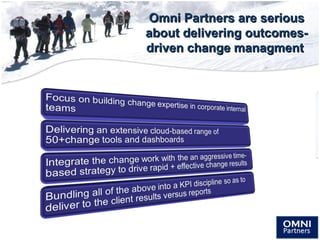
Omni Partners are seriousOmni Partners are serious
about delivering outcomes-about delivering outcomes-
driven change managmentdriven change managment
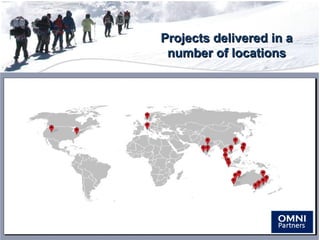
Projects delivered in aProjects delivered in a
number of locationsnumber of locations
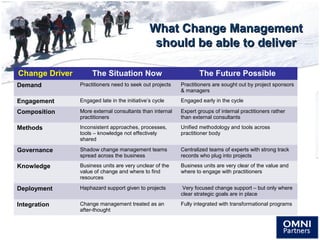
What Change ManagementWhat Change Management
should be able to delivershould be able to deliver
Change Driver The Situation Now The Future Possible
Demand Practitioners need to seek out projects Practitioners are sought out by project sponsors
& managers
Engagement Engaged late in the initiative’s cycle Engaged early in the cycle
Composition More external consultants than internal
practitioners
Expert groups of internal practitioners rather
than external consultants
Methods Inconsistent approaches, processes,
tools – knowledge not effectively
shared
Unified methodology and tools across
practitioner body
Governance Shadow change management teams
spread across the business
Centralized teams of experts with strong track
records who plug into projects
Knowledge Business units are very unclear of the
value of change and where to find
resources
Business units are very clear of the value and
where to engage with practitioners
Deployment Haphazard support given to projects Very focused change support – but only where
clear strategic goals are in place
Integration Change management treated as an
after-thought
Fully integrated with transformational programs
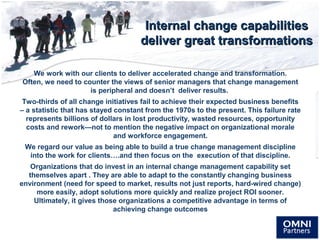
Internal change capabilitiesInternal change capabilities
deliver great transformationsdeliver great transformations
We work with our clients to deliver accelerated change and transformation.
Often, we need to counter the views of senior managers that change management
is peripheral and doesn’t deliver results.
Two-thirds of all change initiatives fail to achieve their expected business benefits
– a statistic that has stayed constant from the 1970s to the present. This failure rate
represents billions of dollars in lost productivity, wasted resources, opportunity
costs and rework—not to mention the negative impact on organizational morale
and workforce engagement.
We regard our value as being able to build a true change management discipline
into the work for clients….and then focus on the execution of that discipline.
Organizations that do invest in an internal change management capability set
themselves apart . They are able to adapt to the constantly changing business
environment (need for speed to market, results not just reports, hard-wired change)
more easily, adopt solutions more quickly and realize project ROI sooner.
Ultimately, it gives those organizations a competitive advantage in terms of
achieving change outcomes
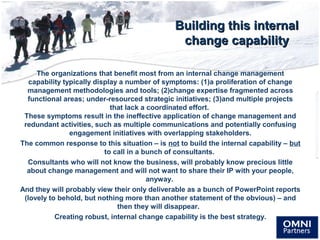
Building this internalBuilding this internal
change capabilitychange capability
The organizations that benefit most from an internal change management
capability typically display a number of symptoms: (1)a proliferation of change
management methodologies and tools; (2)change expertise fragmented across
functional areas; under-resourced strategic initiatives; (3)and multiple projects
that lack a coordinated effort.
These symptoms result in the ineffective application of change management and
redundant activities, such as multiple communications and potentially confusing
engagement initiatives with overlapping stakeholders.
The common response to this situation – is not to build the internal capability – but
to call in a bunch of consultants.
Consultants who will not know the business, will probably know precious little
about change management and will not want to share their IP with your people,
anyway.
And they will probably view their only deliverable as a bunch of PowerPoint reports
(lovely to behold, but nothing more than another statement of the obvious) – and
then they will disappear.
Creating robust, internal change capability is the best strategy.
Change capabilitiesChange capabilities
delivered in the clouddelivered in the cloud
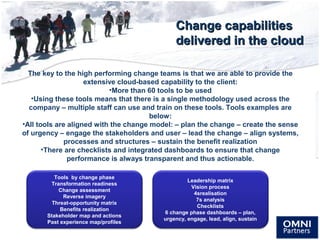
The key to the high performing change teams is that we are able to provide the
extensive cloud-based capability to the client:
•More than 60 tools to be used
•Using these tools means that there is a single methodology used across the
company – multiple staff can use and train on these tools. Tools examples are
below:
•All tools are aligned with the change model: – plan the change – create the sense
of urgency – engage the stakeholders and user – lead the change – align systems,
processes and structures – sustain the benefit realization
•There are checklists and integrated dashboards to ensure that change
performance is always transparent and thus actionable.
Tools by change phase
Transformation readiness
Change assessment
Reverse imagery
Threat-opportunity matrix
Benefits realization
Stakeholder map and actions
Past experience map/profiles
Leadership matrix
Vision process
4srealisation
7s analysis
Checklists
6 change phase dashboards – plan,
urgency, engage, lead, align, sustain
Time-based Change ManagementTime-based Change Management
The transformation projects, which link to change management, are needing to
happen faster than ever. If they are IT – driven, then cloud solutions mean more
and smaller projects and if they are market –related, then competitive advantage
does not stay in place for very long.
Therefore, the new approach to change managment is to build in time-based
measures. In a time–based approach, the actual change team involvement is often
closer to 60-80 days. And the start and exit schedule is closely defined and
managed.
So with an internal team, they can work on the project when they are needed – and
then perhaps shift to another project until deadlines require them back. External
consultants are more likely to want to stretch out their involvement regardless of
the cost and detriment to the change effectiveness.
The integration of the cloud-based tools and dashboards with specific deadlines
make for an easy and fully transparent view of the work completed and the rapid
time schedule to be met.
“We keep speed in mind with each new product we release…. And we continue to work
on making it all go even faster…. We’re always looking for new places where we can make
a difference.” Google
Results-driven Change ManagementResults-driven Change Management
Change Management is often criticized for either having no focus on outcomes, or
too much focus on process alone. The criticsm is probably well founded.
However, it is not an acceptable approach if change is to be a contributor to actual
transformative business projects.
Our approach is straightforward. In each project, we work with the client to build
the value driver tree for all the change elements to be applied:
•KPI’s (defined as both the ratio’d measure and the actual numerical result sought) are
established for each of the 6 meta level factors – plan, level of urgency, leadership,
engagement, alignment & sustainability
•Then the value driver tree is built to involve all the 60+ change tools – and define the
contributing KPI’s.
•In this manner, each and every tool will have definable KPI’s which need to be used when
reporting overall progress in the separate 6 factor dashboards.
•Every member of the internal change team will now be directly accountable for 1 or more
tools/actions and the successful results of their work. Emphasis on results/outcomes
•Absolutely none of this performance would ever be achieveable with external consultants
“What gets measured , gets done - what gets measured relentlessly, tends to be done
perfectly” Peter Drucker
If you farm, you get to learn a lot about good business. At work, we can
talk about transformation and strategic advantage etc………then achieve
nothing and blame it on the lack of funding, market conditions, the
consultants or even our customers.
But if you have cows, you can’t fool the cows. You need to actually do the
milking, twice a day, every day. And by doing this you can transform hard
work into a profitable venture. Talk is cheap and results speak for
themselves. Thank you.
Paul Kell
Omni Partners
Level 8, 350 Collins St
Melbourne 3000
(+614)12926532

Change in the cloud

  • 1.
    Change ManagementChange Management •Focus on building internal capabilities • Cloud – based change tools • Time – based strategy • Dedicated to results not just reports OMNI Partners
  • 2.
    Omni Partners areseriousOmni Partners are serious about delivering outcomes-about delivering outcomes- driven change managmentdriven change managment
  • 3.
    Projects delivered inaProjects delivered in a number of locationsnumber of locations
  • 4.
    What Change ManagementWhatChange Management should be able to delivershould be able to deliver Change Driver The Situation Now The Future Possible Demand Practitioners need to seek out projects Practitioners are sought out by project sponsors & managers Engagement Engaged late in the initiative’s cycle Engaged early in the cycle Composition More external consultants than internal practitioners Expert groups of internal practitioners rather than external consultants Methods Inconsistent approaches, processes, tools – knowledge not effectively shared Unified methodology and tools across practitioner body Governance Shadow change management teams spread across the business Centralized teams of experts with strong track records who plug into projects Knowledge Business units are very unclear of the value of change and where to find resources Business units are very clear of the value and where to engage with practitioners Deployment Haphazard support given to projects Very focused change support – but only where clear strategic goals are in place Integration Change management treated as an after-thought Fully integrated with transformational programs
  • 5.
    Internal change capabilitiesInternalchange capabilities deliver great transformationsdeliver great transformations We work with our clients to deliver accelerated change and transformation. Often, we need to counter the views of senior managers that change management is peripheral and doesn’t deliver results. Two-thirds of all change initiatives fail to achieve their expected business benefits – a statistic that has stayed constant from the 1970s to the present. This failure rate represents billions of dollars in lost productivity, wasted resources, opportunity costs and rework—not to mention the negative impact on organizational morale and workforce engagement. We regard our value as being able to build a true change management discipline into the work for clients….and then focus on the execution of that discipline. Organizations that do invest in an internal change management capability set themselves apart . They are able to adapt to the constantly changing business environment (need for speed to market, results not just reports, hard-wired change) more easily, adopt solutions more quickly and realize project ROI sooner. Ultimately, it gives those organizations a competitive advantage in terms of achieving change outcomes
  • 6.
    Building this internalBuildingthis internal change capabilitychange capability The organizations that benefit most from an internal change management capability typically display a number of symptoms: (1)a proliferation of change management methodologies and tools; (2)change expertise fragmented across functional areas; under-resourced strategic initiatives; (3)and multiple projects that lack a coordinated effort. These symptoms result in the ineffective application of change management and redundant activities, such as multiple communications and potentially confusing engagement initiatives with overlapping stakeholders. The common response to this situation – is not to build the internal capability – but to call in a bunch of consultants. Consultants who will not know the business, will probably know precious little about change management and will not want to share their IP with your people, anyway. And they will probably view their only deliverable as a bunch of PowerPoint reports (lovely to behold, but nothing more than another statement of the obvious) – and then they will disappear. Creating robust, internal change capability is the best strategy.
  • 7.
    Change capabilitiesChange capabilities deliveredin the clouddelivered in the cloud The key to the high performing change teams is that we are able to provide the extensive cloud-based capability to the client: •More than 60 tools to be used •Using these tools means that there is a single methodology used across the company – multiple staff can use and train on these tools. Tools examples are below: •All tools are aligned with the change model: – plan the change – create the sense of urgency – engage the stakeholders and user – lead the change – align systems, processes and structures – sustain the benefit realization •There are checklists and integrated dashboards to ensure that change performance is always transparent and thus actionable. Tools by change phase Transformation readiness Change assessment Reverse imagery Threat-opportunity matrix Benefits realization Stakeholder map and actions Past experience map/profiles Leadership matrix Vision process 4srealisation 7s analysis Checklists 6 change phase dashboards – plan, urgency, engage, lead, align, sustain
  • 8.
    Time-based Change ManagementTime-basedChange Management The transformation projects, which link to change management, are needing to happen faster than ever. If they are IT – driven, then cloud solutions mean more and smaller projects and if they are market –related, then competitive advantage does not stay in place for very long. Therefore, the new approach to change managment is to build in time-based measures. In a time–based approach, the actual change team involvement is often closer to 60-80 days. And the start and exit schedule is closely defined and managed. So with an internal team, they can work on the project when they are needed – and then perhaps shift to another project until deadlines require them back. External consultants are more likely to want to stretch out their involvement regardless of the cost and detriment to the change effectiveness. The integration of the cloud-based tools and dashboards with specific deadlines make for an easy and fully transparent view of the work completed and the rapid time schedule to be met. “We keep speed in mind with each new product we release…. And we continue to work on making it all go even faster…. We’re always looking for new places where we can make a difference.” Google
  • 9.
    Results-driven Change ManagementResults-drivenChange Management Change Management is often criticized for either having no focus on outcomes, or too much focus on process alone. The criticsm is probably well founded. However, it is not an acceptable approach if change is to be a contributor to actual transformative business projects. Our approach is straightforward. In each project, we work with the client to build the value driver tree for all the change elements to be applied: •KPI’s (defined as both the ratio’d measure and the actual numerical result sought) are established for each of the 6 meta level factors – plan, level of urgency, leadership, engagement, alignment & sustainability •Then the value driver tree is built to involve all the 60+ change tools – and define the contributing KPI’s. •In this manner, each and every tool will have definable KPI’s which need to be used when reporting overall progress in the separate 6 factor dashboards. •Every member of the internal change team will now be directly accountable for 1 or more tools/actions and the successful results of their work. Emphasis on results/outcomes •Absolutely none of this performance would ever be achieveable with external consultants “What gets measured , gets done - what gets measured relentlessly, tends to be done perfectly” Peter Drucker
  • 10.
    If you farm,you get to learn a lot about good business. At work, we can talk about transformation and strategic advantage etc………then achieve nothing and blame it on the lack of funding, market conditions, the consultants or even our customers. But if you have cows, you can’t fool the cows. You need to actually do the milking, twice a day, every day. And by doing this you can transform hard work into a profitable venture. Talk is cheap and results speak for themselves. Thank you. Paul Kell Omni Partners Level 8, 350 Collins St Melbourne 3000 (+614)12926532