
By
Rajesh Rachakonda
Wilmington University
 Taj Mahal -----> The Symbol Of Eternal Love!
 As everyone know, Taj Mahal made to the list of New
Seven Wonders earlier.
 This marble marvel remains one of the most loved
tourist spots in the world.
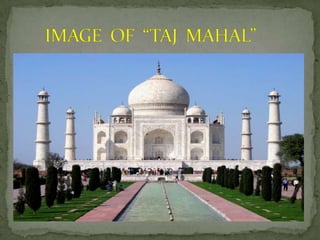
 The Taj Mahal, located in Agra, Uttar Pradesh,
India, was actually built as a tomb by Mogul ruler
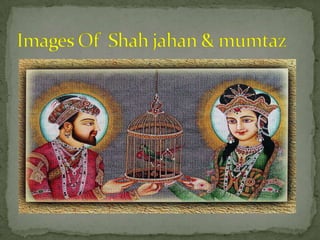
Shah jahan for his wife, Arjuman Banu Begum.
She was born in April, 1593 in Agra, India.
 Shah Jahan had been married to Arjuman Banu Begum at
age of 36 and ascended
 the peacock throne of India in
1628.
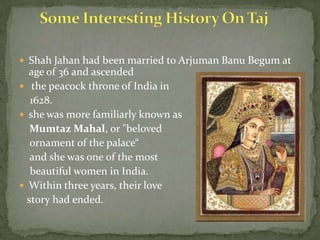
 she was more familiarly known as
Mumtaz Mahal, or "beloved
ornament of the palace“
and she was one of the most
beautiful women in India.
 Within three years, their love
story had ended.
 Mumtaz died on June 17, 1631 AD while accompanying
Shah during a battle campaign in Burhanpur in the
Deccan (now in Madhya Pradesh) giving birth to her
fourteenth child.
 Whether it is true that Arjuman asked on her
deathbed for a symbol of their love, nobody seems to
know. But the Shah went ahead and erected an
immortal tribute in the form of the most magnificent
tomb in the world.
 It would take 22 years to be completed.
 Taj Mahal actually contains many separate areas inside, as
well as outer buildings and extensive gardens.
 The name is said to have been derived from his wife's
nickname, Mumtaz Mahal.
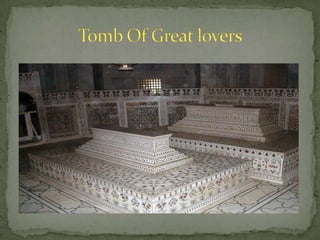
 Her empty tomb, rests in the exact middle of the main
chamber, keeping the symmetrical design of the entire
structure.
 Four years after the tomb was completed, the Shah was
deposed and imprisoned by his son.
 When he died on 22 January 1666 (aged 74), his son had a
cenotaph created beside that of his wife, upsetting the
balance of the chamber.
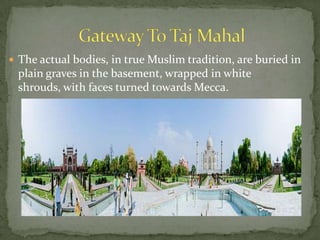
 The actual bodies, in true Muslim tradition, are buried in
plain graves in the basement, wrapped in white
shrouds, with faces turned towards Mecca.
 A labour force of about twenty thousand workers was
recruited from across the Northern India.
 Sculptors from Bukhara, calligraphers from Syria and
Persia, inlayers from southern India, stone cutters
from Baluchistan, a specialist in building turrets,
another who carved only marble flowers were part of
the thirty-seven men who formed the creative unit.
 The Taj Mahal was constructed using materials from
all over India and Asia and over 1,000 elephants were
used to transport building materials.
 The translucent white marble was brought from
Makrana, Rajasthan, the jasper from Punjab, jade and
crystal from China.
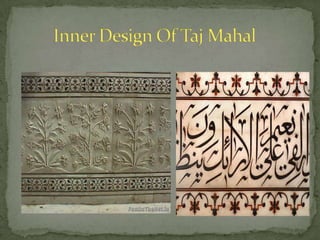
 In all, twenty eight types of precious and semi-precious
stones were inlaid into the white marble.
 The main finial was originally made of gold but was
replaced by a copy made of gilded bronze in the early 19th
century.
 This feature provides a clear example of integration of
traditional Persian and Hindu decorative elements.
 The finial is topped by a moon, a typical Islamic motif
whose horns point heavenward.
 In 1942, the government erected a temporary structure
in anticipation of an air attack by German and later by
Japanese Air Force.
 During the India-Pakistan wars of 1965 and
1971, temporary structure was again erected to mislead
bomber pilots.
 More recent threats have come from environmental
pollutions
Taj mahal (1)

Taj mahal (1)

  • 1.
  • 3.
     Taj Mahal-----> The Symbol Of Eternal Love!  As everyone know, Taj Mahal made to the list of New Seven Wonders earlier.  This marble marvel remains one of the most loved tourist spots in the world.  The Taj Mahal, located in Agra, Uttar Pradesh, India, was actually built as a tomb by Mogul ruler Shah jahan for his wife, Arjuman Banu Begum. She was born in April, 1593 in Agra, India.
  • 5.
     Shah Jahanhad been married to Arjuman Banu Begum at age of 36 and ascended  the peacock throne of India in 1628.  she was more familiarly known as Mumtaz Mahal, or "beloved ornament of the palace“ and she was one of the most beautiful women in India.  Within three years, their love story had ended.
  • 7.
     Mumtaz diedon June 17, 1631 AD while accompanying Shah during a battle campaign in Burhanpur in the Deccan (now in Madhya Pradesh) giving birth to her fourteenth child.  Whether it is true that Arjuman asked on her deathbed for a symbol of their love, nobody seems to know. But the Shah went ahead and erected an immortal tribute in the form of the most magnificent tomb in the world.  It would take 22 years to be completed.
  • 8.
     Taj Mahalactually contains many separate areas inside, as well as outer buildings and extensive gardens.  The name is said to have been derived from his wife's nickname, Mumtaz Mahal.  Her empty tomb, rests in the exact middle of the main chamber, keeping the symmetrical design of the entire structure.  Four years after the tomb was completed, the Shah was deposed and imprisoned by his son.  When he died on 22 January 1666 (aged 74), his son had a cenotaph created beside that of his wife, upsetting the balance of the chamber.
  • 10.
     The actualbodies, in true Muslim tradition, are buried in plain graves in the basement, wrapped in white shrouds, with faces turned towards Mecca.
  • 11.
     A labourforce of about twenty thousand workers was recruited from across the Northern India.  Sculptors from Bukhara, calligraphers from Syria and Persia, inlayers from southern India, stone cutters from Baluchistan, a specialist in building turrets, another who carved only marble flowers were part of the thirty-seven men who formed the creative unit.  The Taj Mahal was constructed using materials from all over India and Asia and over 1,000 elephants were used to transport building materials.
  • 12.
     The translucentwhite marble was brought from Makrana, Rajasthan, the jasper from Punjab, jade and crystal from China.  In all, twenty eight types of precious and semi-precious stones were inlaid into the white marble.  The main finial was originally made of gold but was replaced by a copy made of gilded bronze in the early 19th century.  This feature provides a clear example of integration of traditional Persian and Hindu decorative elements.  The finial is topped by a moon, a typical Islamic motif whose horns point heavenward.
  • 14.
     In 1942,the government erected a temporary structure in anticipation of an air attack by German and later by Japanese Air Force.  During the India-Pakistan wars of 1965 and 1971, temporary structure was again erected to mislead bomber pilots.  More recent threats have come from environmental pollutions