‱ “Ismail Khan” designed the Taj Mahal’s main dome.
‱ “Puru” from Benarus, Persia for supervising the architect.
‱ “Chiranjilal” is the head sculptor .
‱ “Amanat Khan” from Shiraz, Iran for calligraphy.
‱ “Mir Abdul Karim” and “Mukkarimat Khan” of Shiraz, Iran
(Persia)
were responsible for managing the finances and daily production.
‱ “Ustad Isa” of Iran, designed the Taj Mahal.
Location: Agra, India
Coordinates: 27.174799°N & 78.042111°E
Elevation: 171 m (561 ft)
Built: 1632–1653
Architect: Ustad Ahmad Lahauri
Architectural style: Mughal
Type: Cultural
Cost of Construction: 32crore rupees
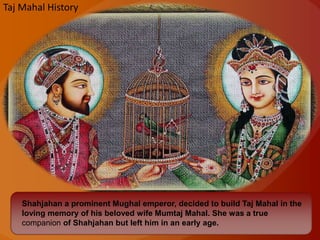
‱ It was built by Mughal emperor Shah Jahan in memory of his third
wife, Mumtaz Mahal.
‱ The Taj Mahal is widely recognized as “The Jewel of Muslim art in
India”.
‱ Taj Mahal is the finest example of Mughal architecture, a style that
combines elements from Persian, Turkish and Indian architectural
styles.
‱ In 1983, the Taj Mahal became a UNESCO(United Nations
Educational, Scientific and Cultural Organization) World Heritage Site.
‱ The construction began around 1632 and was completed around
1653, employing thousands of artisans and craftsmen.
Shahjahan a prominent Mughal emperor, decided to build Taj Mahal in the
loving memory of his beloved wife Mumtaj Mahal. She was a true
companion of Shahjahan but left him in an early age.
Taj Mahal History
‱ Taj Mahal was constructed using materials from all over India
and Asia.
‱ Over 1,000 elephants were used to transport building materials
during
the construction.
‱ The following Marbles/Stones are used in the construction:
‱ Sculptors from Bukhara, calligraphers from Syria and Persia,
inlayers from southern India, stonecutters from
Baluchistan,specialist in building turrets, another who carved only
marble flowers were part of the thirty- seven men who formed the
creative unit.
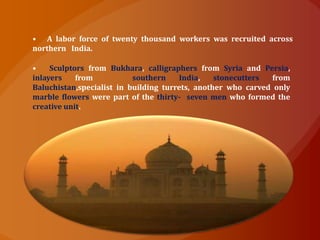
‱ A labor force of twenty thousand workers was recruited across
northern India.
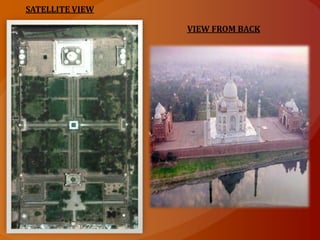
SATELLITE VIEW
VIEW FROM BACK
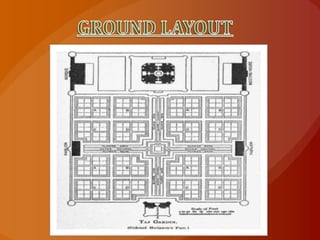
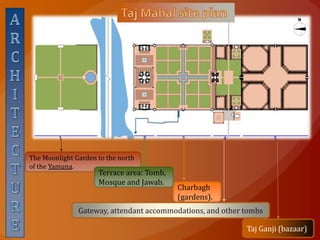
Charbagh
(gardens).
Gateway, attendant accommodations, and other tombs
The Moonlight Garden to the north
of the Yamuna.
Taj Ganji (bazaar)
Terrace area: Tomb,
Mosque and Jawab.
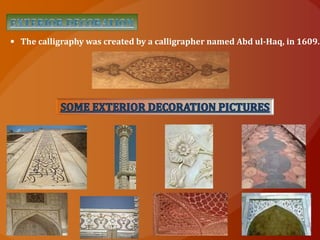
‱ The calligraphy was created by a calligrapher named Abd ul-Haq, in 1609.
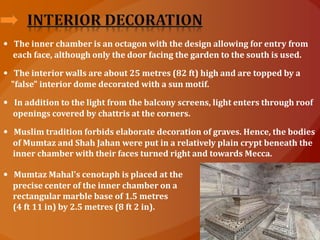
‱ The inner chamber is an octagon with the design allowing for entry from
each face, although only the door facing the garden to the south is used.
‱ The interior walls are about 25 metres (82 ft) high and are topped by a
"false" interior dome decorated with a sun motif.
‱ In addition to the light from the balcony screens, light enters through roof
openings covered by chattris at the corners.
‱ Muslim tradition forbids elaborate decoration of graves. Hence, the bodies
of Mumtaz and Shah Jahan were put in a relatively plain crypt beneath the
inner chamber with their faces turned right and towards Mecca.
‱ Mumtaz Mahal's cenotaph is placed at the
precise center of the inner chamber on a
rectangular marble base of 1.5 metres
(4 ft 11 in) by 2.5 metres (8 ft 2 in).
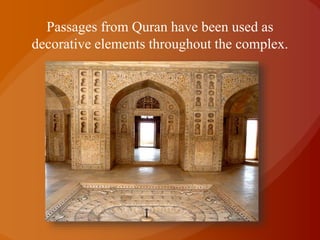
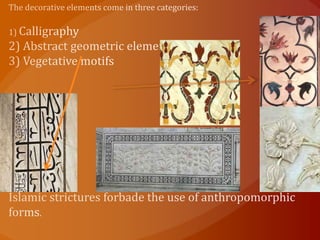
Passages from Quran have been used as
decorative elements throughout the complex.
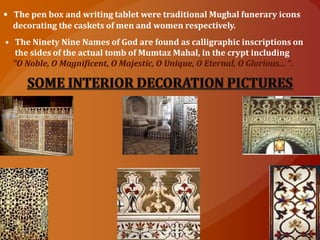
‱ The pen box and writing tablet were traditional Mughal funerary icons
decorating the caskets of men and women respectively.
‱ The Ninety Nine Names of God are found as calligraphic inscriptions on
the sides of the actual tomb of Mumtaz Mahal, in the crypt including
"O Noble, O Magnificent, O Majestic, O Unique, O Eternal, O Glorious... ".
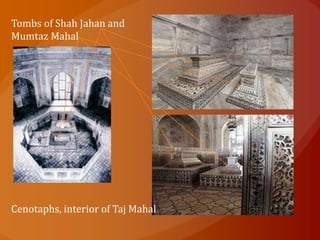
Tombs of Shah Jahan and
Mumtaz Mahal
Cenotaphs, interior of Taj Mahal
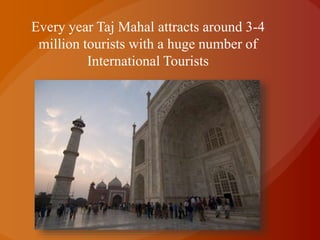
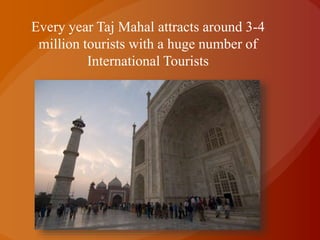
Every year Taj Mahal attracts around 3-4
million tourists with a huge number of
International Tourists
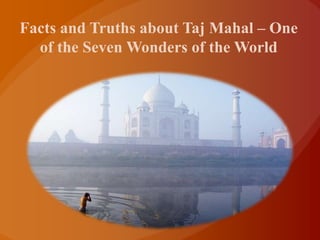
Facts and Truths about Taj Mahal – One
of the Seven Wonders of the World
‱ Before his accession to the throne, Shah Jahan was popularly known as
Prince Khurram.
‱ Shah Jahan fell in love with the beautiful Arjumand Bano Begum and
married her, making her his third wife.
‱ Arjumand Bano Begum was christened by Shah Jahan as Mumtaz Mahal.
‱ Shah Jahan lost Mumtaz Mahal, when she is giving birth to their 14h child.
‱ For the transportation of the construction materials, more than 1,000
elephants were employed.
‱ As many as 28 different varieties of semi-precious and precious stones
were used to adorn the Taj with exquisite inlay work.
‱ On the sides of the actual tomb of Mumtaz Mahal, 99 names of Allah
can be found as calligraphic inscriptions.
Every year Taj Mahal attracts around 3-4
million tourists with a huge number of
International Tourists
Tajmahal
Tajmahal

Tajmahal

  • 2.
    ‱ “Ismail Khan”designed the Taj Mahal’s main dome. ‱ “Puru” from Benarus, Persia for supervising the architect. ‱ “Chiranjilal” is the head sculptor . ‱ “Amanat Khan” from Shiraz, Iran for calligraphy. ‱ “Mir Abdul Karim” and “Mukkarimat Khan” of Shiraz, Iran (Persia) were responsible for managing the finances and daily production. ‱ “Ustad Isa” of Iran, designed the Taj Mahal.
  • 3.
    Location: Agra, India Coordinates:27.174799°N & 78.042111°E Elevation: 171 m (561 ft) Built: 1632–1653 Architect: Ustad Ahmad Lahauri Architectural style: Mughal Type: Cultural Cost of Construction: 32crore rupees
  • 5.
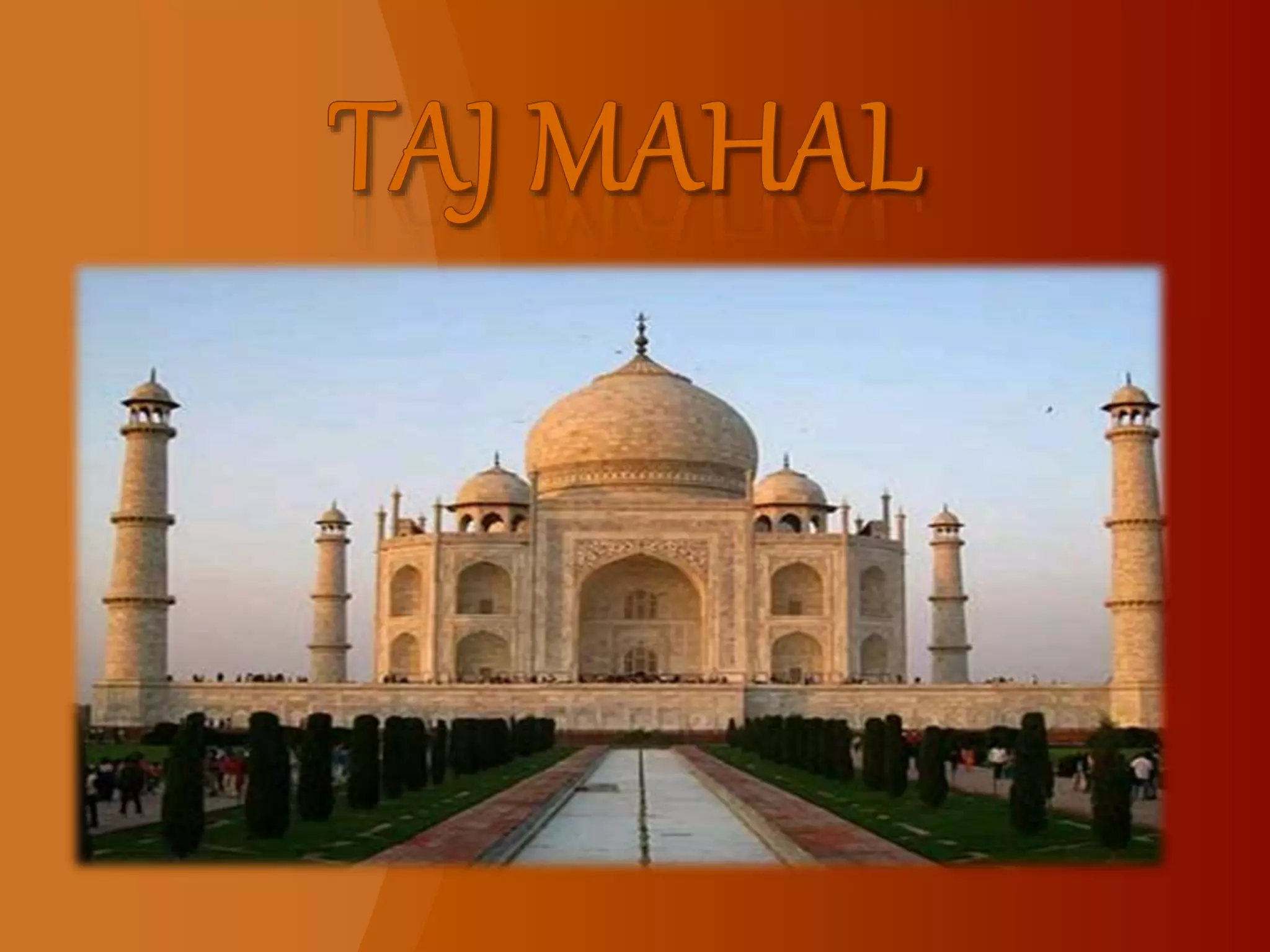
    ‱ It wasbuilt by Mughal emperor Shah Jahan in memory of his third wife, Mumtaz Mahal. ‱ The Taj Mahal is widely recognized as “The Jewel of Muslim art in India”. ‱ Taj Mahal is the finest example of Mughal architecture, a style that combines elements from Persian, Turkish and Indian architectural styles. ‱ In 1983, the Taj Mahal became a UNESCO(United Nations Educational, Scientific and Cultural Organization) World Heritage Site. ‱ The construction began around 1632 and was completed around 1653, employing thousands of artisans and craftsmen.
  • 6.
    Shahjahan a prominentMughal emperor, decided to build Taj Mahal in the loving memory of his beloved wife Mumtaj Mahal. She was a true companion of Shahjahan but left him in an early age. Taj Mahal History
  • 7.
    ‱ Taj Mahalwas constructed using materials from all over India and Asia. ‱ Over 1,000 elephants were used to transport building materials during the construction. ‱ The following Marbles/Stones are used in the construction:
  • 8.
    ‱ Sculptors fromBukhara, calligraphers from Syria and Persia, inlayers from southern India, stonecutters from Baluchistan,specialist in building turrets, another who carved only marble flowers were part of the thirty- seven men who formed the creative unit. ‱ A labor force of twenty thousand workers was recruited across northern India.
  • 10.
  • 11.
    Charbagh (gardens). Gateway, attendant accommodations,and other tombs The Moonlight Garden to the north of the Yamuna. Taj Ganji (bazaar) Terrace area: Tomb, Mosque and Jawab.
  • 12.
    ‱ The calligraphywas created by a calligrapher named Abd ul-Haq, in 1609.
  • 13.
    ‱ The innerchamber is an octagon with the design allowing for entry from each face, although only the door facing the garden to the south is used. ‱ The interior walls are about 25 metres (82 ft) high and are topped by a "false" interior dome decorated with a sun motif. ‱ In addition to the light from the balcony screens, light enters through roof openings covered by chattris at the corners. ‱ Muslim tradition forbids elaborate decoration of graves. Hence, the bodies of Mumtaz and Shah Jahan were put in a relatively plain crypt beneath the inner chamber with their faces turned right and towards Mecca. ‱ Mumtaz Mahal's cenotaph is placed at the precise center of the inner chamber on a rectangular marble base of 1.5 metres (4 ft 11 in) by 2.5 metres (8 ft 2 in).
  • 14.
    Passages from Quranhave been used as decorative elements throughout the complex.
  • 16.
    ‱ The penbox and writing tablet were traditional Mughal funerary icons decorating the caskets of men and women respectively. ‱ The Ninety Nine Names of God are found as calligraphic inscriptions on the sides of the actual tomb of Mumtaz Mahal, in the crypt including "O Noble, O Magnificent, O Majestic, O Unique, O Eternal, O Glorious... ".
  • 17.
    Tombs of ShahJahan and Mumtaz Mahal Cenotaphs, interior of Taj Mahal
  • 18.
    Every year TajMahal attracts around 3-4 million tourists with a huge number of International Tourists
  • 19.
    Facts and Truthsabout Taj Mahal – One of the Seven Wonders of the World
  • 20.
    ‱ Before hisaccession to the throne, Shah Jahan was popularly known as Prince Khurram. ‱ Shah Jahan fell in love with the beautiful Arjumand Bano Begum and married her, making her his third wife. ‱ Arjumand Bano Begum was christened by Shah Jahan as Mumtaz Mahal. ‱ Shah Jahan lost Mumtaz Mahal, when she is giving birth to their 14h child. ‱ For the transportation of the construction materials, more than 1,000 elephants were employed. ‱ As many as 28 different varieties of semi-precious and precious stones were used to adorn the Taj with exquisite inlay work. ‱ On the sides of the actual tomb of Mumtaz Mahal, 99 names of Allah can be found as calligraphic inscriptions.
  • 21.
    Every year TajMahal attracts around 3-4 million tourists with a huge number of International Tourists