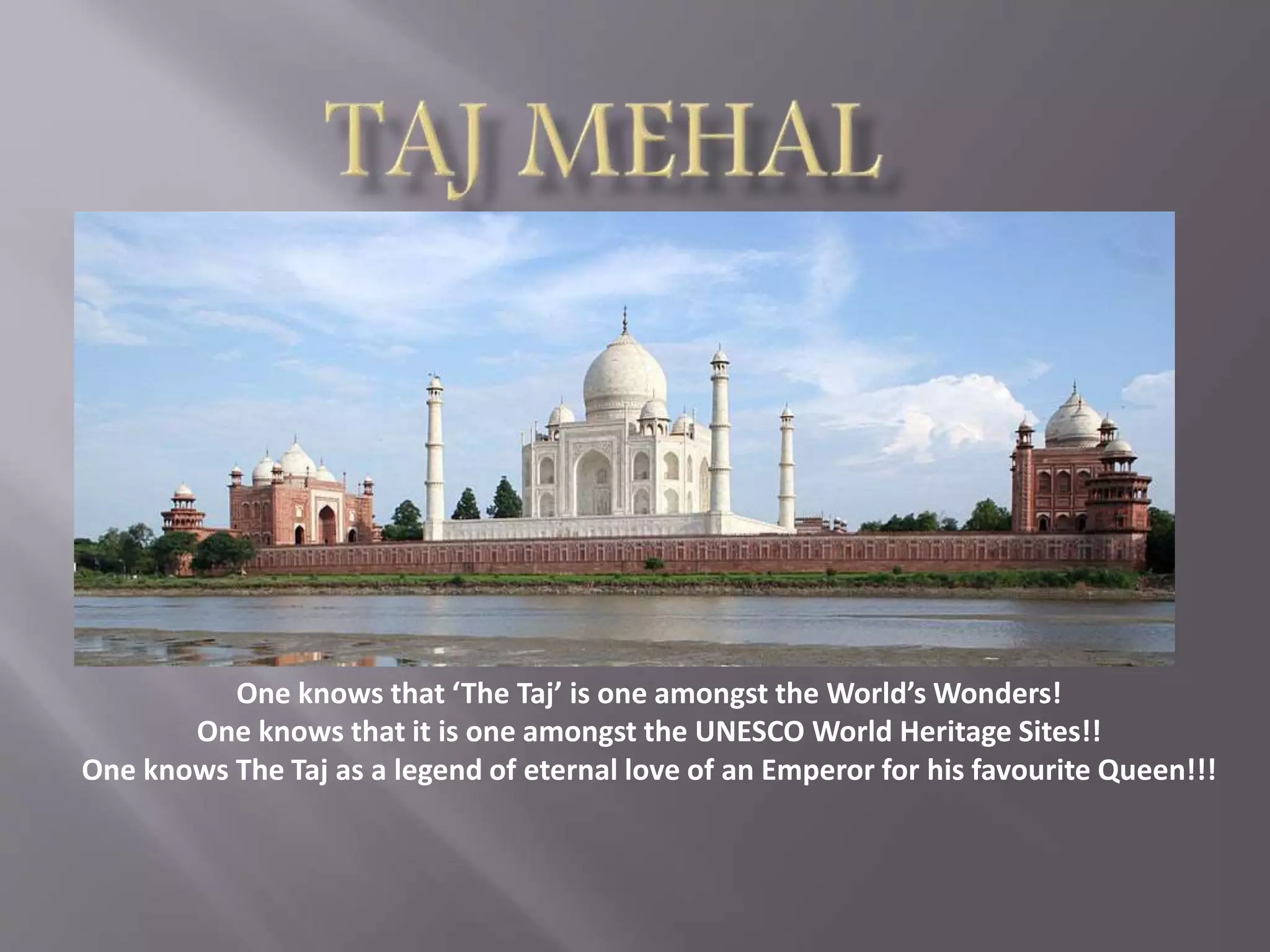
One knows that ‘The Taj’ is one amongst the World’s Wonders!
One knows that it is one amongst the UNESCO World Heritage Sites!!
One knows The Taj as a legend of eternal love of an Emperor for his favourite Queen!!!
 The Taj Mahal of Agra is one of the Seven Wonders of the World,
for reasons more than just looking magnificent. It's the history of
Taj Mahal that adds a soul to its magnificence: a soul that is filled
with love, loss, remorse, and love again. Because if it was not for
love, the world would have been robbed of a fine example upon
which people base their relationships. An example of how deeply
a man loved his wife, that even after she remained but a memory,
he made sure that this memory would never fade away. This man
was the Mughal Emperor Shah Jahan, who was head-over-heels in
love with Mumtaz Mahal, his dear wife. She was a Muslim
Persian princess (her name Arjumand Banu Begum before
marriage) and he was the son of the Mughal Emperor Jehangir
and grandson of Akbar the Great. It was at the age of 14 that he
met Mumtaz and fell in love with her. Five years later in the year
1612, they got married. , it made use of the services of 22,000
laborers and 1,000 elephants. The monument was built entirely
out of white marble, which was brought in from all over India and
central Asia. After an expenditure of approximately 32 million
rupees, Taj Mahal was finally completed in the year 1653.
 In 1607 (AH 1025) the Mughal Prince Khurrum (later to become
Shah Jahan) was betrothed to Arjumand Banu Begum, the grand
daughter of a Persian noble. She would become the unquestioned
love of his life. They were married five years later in 1612. After
their wedding celebrations, Khurram "finding her in appearance
and character elect among all the women of the time," gave her the
title Mumtaz Mahal (Jewel of the Palace).
 The intervening years had seen Khurrum take two other wives
known as Akbarabadi Mahal and Kandahari Mahal, but according
to the official court chronicler Qazwini, the relationship with his
other wives "had little more than the status of marriage. The
intimacy, deep affection, attention and favour which His Majesty
had for the Cradle of Excellence [Mumtaz] lacked by a thousand
times what he felt for any other."The epitome of chaste Muslim love
- Majnun, going mad in the wilderness.
 Mumtaz died in Burhanpur on 17 June 1631, after complications
with the birth of their fourteenth child, a daughter named Gauhara
Begum.
 The 'Taj Mahal' represents the finest and most sophisticated
example of Mughal architecture. Its origins lie in the moving
circumstances of its commission and the culture and history of an
Islamic Mughal empire's rule of large parts of India. The distraught
Mughal Emperor Shah Jahan commissioned the mausoleum upon
the death of his favorite wife Mumtaz Mahal.
 Today it is one of the most famous and recognisable buildings in
the world and while the tanish colored enormous building in sight,
domed marble mausoleum is the most familiar part of the
monument, the Taj Mahal is an extensive complex of buildings and
gardens that extends over 22.44 hectares (55.5 acres)[note 1][1] and
includes subsidiary tombs, waterworks infrastructure, the small
town of 'Taj Ganji' to the south and a 'moonlight garden' to the
north of the river. Construction began in 1632 AD, (1041 AH), on
the south bank of the River Yamuna in Agra, and was substantially
complete by 1648 AD (1058 AH). The design was conceived as both
an earthly replica of the house of Mumtaz in paradise and an
instrument of propaganda for the emperor.
 6 Architects and craftsmen
 6.1 Calligraphy and decoration
 7 Dimensional organisation
 8 Components of the complex
 8.1 Mausoleum (Rauza-i
munauwara)
 8.2 Riverfront terrace (Chameli
Farsh)
 8.3 Garden (Charbagh)
 8.4 Great gate (Darwaza-i rauza)
 8.5 Forecourt (Jilaukhana)
 8.6 Bazaar and caravanserai (Taj
Ganji)
 8.7 Perimeter walls and ancillary
buildings
 8.8 Waterworks
 8.9 Moonlight garden (Mahtab
Bagh)
 9 References
 10 External links
 1 Mumtaz and Shah Jahan
 2 Site
 2.1 16th–17th century Agra
 2.2 Interactive plan
 3 Precedents
 3.1 Mughal tombs
 3.2 Paradise gardens
 3.3 Mausolea
 3.4 Minarets
 4 Concepts, symbolism and
interpretations
 4.1 Symmetry and hierarchy
 4.2 Throne of God
 4.3 Symbol of love
 5 Construction and interment
 5.1 Foundations
 5.2 Dating
 5.3 Materials
 5.4 Cost
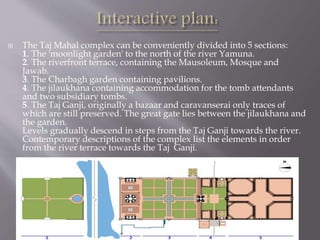
 The Taj Mahal complex can be conveniently divided into 5 sections:
1. The 'moonlight garden' to the north of the river Yamuna.
2. The riverfront terrace, containing the Mausoleum, Mosque and
Jawab.
3. The Charbagh garden containing pavilions.
4. The jilaukhana containing accommodation for the tomb attendants
and two subsidiary tombs.
5. The Taj Ganji, originally a bazaar and caravanserai only traces of
which are still preserved. The great gate lies between the jilaukhana and
the garden.
Levels gradually descend in steps from the Taj Ganji towards the river.
Contemporary descriptions of the complex list the elements in order
from the river terrace towards the Taj Ganji.
 A site was chosen on the banks of the Yamuna River
on the southern edge of Agra and purchased from
Raja Jai Singh in exchange for four mansions in the
city. The site, "from the point of view of loftiness and
pleasantness appeared to be worthy of the burial of that
one who dwells in paradise".In January 1632 AD (1041
AH), Mumtaz's body was moved with great
ceremony from Burhanpur to Agra while food,
drink and coins were distributed amongst the poor
and deserving along the way. Work had already
begun on the foundations of the river terrace when
the body arrived.A small domed building was
erected over her body, thought to have been sited,
and now marked, by an enclosure in the western
garden near the riverfront terrace.
 Initial estimates for the cost of the works of
4,000,000 rupees had risen to 5,000,000 by
completion.A waqf (trust) was established for
the perpetual upkeep of the mausoleum with
an income of 300,000 Rupees.
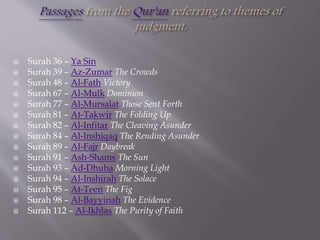
 In the complex, passages from the Qur'an are
used as decorative elements. Recent
scholarship suggests that the passages were
chosen by a Persian calligrapher Abd ul-Haq,
who came to India from Shiraz, Iran, in 1609.
As a reward for his "dazzling virtuosity", Shah
Jahan gave him the title of "Amanat Khan".This
is supported by an inscription near the lines
from the Qur'an at the base of the interior
dome that reads "Written by the insignificant
being, Amanat Khan Shirazi.
 Surah 36 – Ya Sin
 Surah 39 – Az-Zumar The Crowds
 Surah 48 – Al-Fath Victory
 Surah 67 – Al-Mulk Dominion
 Surah 77 – Al-Mursalat Those Sent Forth
 Surah 81 – At-Takwir The Folding Up
 Surah 82 – Al-Infitar The Cleaving Asunder
 Surah 84 – Al-Inshiqaq The Rending Asunder
 Surah 89 – Al-Fajr Daybreak
 Surah 91 – Ash-Shams The Sun
 Surah 93 – Ad-Dhuha Morning Light
 Surah 94 – Al-Inshirah The Solace
 Surah 95 – At-Teen The Fig
 Surah 98 – Al-Bayyinah The Evidence
 Surah 112 – Al-Ikhlas The Purity of Faith
Sohail Rafique Abu-Bakkar

Taj mehal

  • 1.
    One knows that‘The Taj’ is one amongst the World’s Wonders! One knows that it is one amongst the UNESCO World Heritage Sites!! One knows The Taj as a legend of eternal love of an Emperor for his favourite Queen!!!
  • 2.
     The TajMahal of Agra is one of the Seven Wonders of the World, for reasons more than just looking magnificent. It's the history of Taj Mahal that adds a soul to its magnificence: a soul that is filled with love, loss, remorse, and love again. Because if it was not for love, the world would have been robbed of a fine example upon which people base their relationships. An example of how deeply a man loved his wife, that even after she remained but a memory, he made sure that this memory would never fade away. This man was the Mughal Emperor Shah Jahan, who was head-over-heels in love with Mumtaz Mahal, his dear wife. She was a Muslim Persian princess (her name Arjumand Banu Begum before marriage) and he was the son of the Mughal Emperor Jehangir and grandson of Akbar the Great. It was at the age of 14 that he met Mumtaz and fell in love with her. Five years later in the year 1612, they got married. , it made use of the services of 22,000 laborers and 1,000 elephants. The monument was built entirely out of white marble, which was brought in from all over India and central Asia. After an expenditure of approximately 32 million rupees, Taj Mahal was finally completed in the year 1653.
  • 3.
     In 1607(AH 1025) the Mughal Prince Khurrum (later to become Shah Jahan) was betrothed to Arjumand Banu Begum, the grand daughter of a Persian noble. She would become the unquestioned love of his life. They were married five years later in 1612. After their wedding celebrations, Khurram "finding her in appearance and character elect among all the women of the time," gave her the title Mumtaz Mahal (Jewel of the Palace).  The intervening years had seen Khurrum take two other wives known as Akbarabadi Mahal and Kandahari Mahal, but according to the official court chronicler Qazwini, the relationship with his other wives "had little more than the status of marriage. The intimacy, deep affection, attention and favour which His Majesty had for the Cradle of Excellence [Mumtaz] lacked by a thousand times what he felt for any other."The epitome of chaste Muslim love - Majnun, going mad in the wilderness.  Mumtaz died in Burhanpur on 17 June 1631, after complications with the birth of their fourteenth child, a daughter named Gauhara Begum.
  • 4.
     The 'TajMahal' represents the finest and most sophisticated example of Mughal architecture. Its origins lie in the moving circumstances of its commission and the culture and history of an Islamic Mughal empire's rule of large parts of India. The distraught Mughal Emperor Shah Jahan commissioned the mausoleum upon the death of his favorite wife Mumtaz Mahal.  Today it is one of the most famous and recognisable buildings in the world and while the tanish colored enormous building in sight, domed marble mausoleum is the most familiar part of the monument, the Taj Mahal is an extensive complex of buildings and gardens that extends over 22.44 hectares (55.5 acres)[note 1][1] and includes subsidiary tombs, waterworks infrastructure, the small town of 'Taj Ganji' to the south and a 'moonlight garden' to the north of the river. Construction began in 1632 AD, (1041 AH), on the south bank of the River Yamuna in Agra, and was substantially complete by 1648 AD (1058 AH). The design was conceived as both an earthly replica of the house of Mumtaz in paradise and an instrument of propaganda for the emperor.
  • 6.
     6 Architectsand craftsmen  6.1 Calligraphy and decoration  7 Dimensional organisation  8 Components of the complex  8.1 Mausoleum (Rauza-i munauwara)  8.2 Riverfront terrace (Chameli Farsh)  8.3 Garden (Charbagh)  8.4 Great gate (Darwaza-i rauza)  8.5 Forecourt (Jilaukhana)  8.6 Bazaar and caravanserai (Taj Ganji)  8.7 Perimeter walls and ancillary buildings  8.8 Waterworks  8.9 Moonlight garden (Mahtab Bagh)  9 References  10 External links  1 Mumtaz and Shah Jahan  2 Site  2.1 16th–17th century Agra  2.2 Interactive plan  3 Precedents  3.1 Mughal tombs  3.2 Paradise gardens  3.3 Mausolea  3.4 Minarets  4 Concepts, symbolism and interpretations  4.1 Symmetry and hierarchy  4.2 Throne of God  4.3 Symbol of love  5 Construction and interment  5.1 Foundations  5.2 Dating  5.3 Materials  5.4 Cost
  • 7.
     The TajMahal complex can be conveniently divided into 5 sections: 1. The 'moonlight garden' to the north of the river Yamuna. 2. The riverfront terrace, containing the Mausoleum, Mosque and Jawab. 3. The Charbagh garden containing pavilions. 4. The jilaukhana containing accommodation for the tomb attendants and two subsidiary tombs. 5. The Taj Ganji, originally a bazaar and caravanserai only traces of which are still preserved. The great gate lies between the jilaukhana and the garden. Levels gradually descend in steps from the Taj Ganji towards the river. Contemporary descriptions of the complex list the elements in order from the river terrace towards the Taj Ganji.
  • 8.
     A sitewas chosen on the banks of the Yamuna River on the southern edge of Agra and purchased from Raja Jai Singh in exchange for four mansions in the city. The site, "from the point of view of loftiness and pleasantness appeared to be worthy of the burial of that one who dwells in paradise".In January 1632 AD (1041 AH), Mumtaz's body was moved with great ceremony from Burhanpur to Agra while food, drink and coins were distributed amongst the poor and deserving along the way. Work had already begun on the foundations of the river terrace when the body arrived.A small domed building was erected over her body, thought to have been sited, and now marked, by an enclosure in the western garden near the riverfront terrace.
  • 9.
     Initial estimatesfor the cost of the works of 4,000,000 rupees had risen to 5,000,000 by completion.A waqf (trust) was established for the perpetual upkeep of the mausoleum with an income of 300,000 Rupees.
  • 10.
     In thecomplex, passages from the Qur'an are used as decorative elements. Recent scholarship suggests that the passages were chosen by a Persian calligrapher Abd ul-Haq, who came to India from Shiraz, Iran, in 1609. As a reward for his "dazzling virtuosity", Shah Jahan gave him the title of "Amanat Khan".This is supported by an inscription near the lines from the Qur'an at the base of the interior dome that reads "Written by the insignificant being, Amanat Khan Shirazi.
  • 11.
     Surah 36– Ya Sin  Surah 39 – Az-Zumar The Crowds  Surah 48 – Al-Fath Victory  Surah 67 – Al-Mulk Dominion  Surah 77 – Al-Mursalat Those Sent Forth  Surah 81 – At-Takwir The Folding Up  Surah 82 – Al-Infitar The Cleaving Asunder  Surah 84 – Al-Inshiqaq The Rending Asunder  Surah 89 – Al-Fajr Daybreak  Surah 91 – Ash-Shams The Sun  Surah 93 – Ad-Dhuha Morning Light  Surah 94 – Al-Inshirah The Solace  Surah 95 – At-Teen The Fig  Surah 98 – Al-Bayyinah The Evidence  Surah 112 – Al-Ikhlas The Purity of Faith
  • 13.