https://pixabay.com/photos/books-bookstore-book-reading-1204029/shared under CC0
1
Tag Questions
Lunch&Learn
(CLB5+)
https://pixabay.com/photos/books-bookstore-book-reading-1204029/shared under CC0
2
Welcome to the English Online community!
Our Equity, Diversity, and Inclusion Acknowledgment
This community welcomes, appreciates, and respects everyone –
it doesn’t matter what country you’re from or who you are!
Discrimination of any kind, however, (including political, religious, nationality, or gender-based)
is NOT WELCOME.
If you are uncomfortable attending this class (or any other at EO), you are free to leave and
email us at info@myenglishonline.ca
What is a Tag Question?
A tag question is a small question that is
attached , or "tagged", to the end of a
sentence.
Tag questions are used by a speaker to make
sure their information is correct, or to ask for
agreement.
3
Tag Questions: Some examples
You came by train, didn’t you?
It’s very windy today, isn’t it?
You can meet me at the station, can’t you?
You couldn’t give me a ride, could you?
4
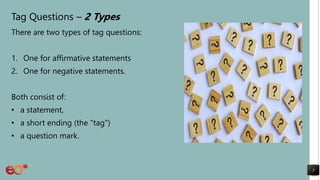
Tag Questions – 2 Types
There are two types of tag questions:
1. One for affirmative statements
2. One for negative statements.
Both consist of:
• a statement,
• a short ending (the "tag")
• a question mark.
5
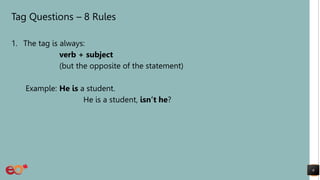
Tag Questions – 8 Rules
1. The tag is always:
verb + subject
(but the opposite of the statement)
Example: He is a student.
He is a student, isn’t he?
6
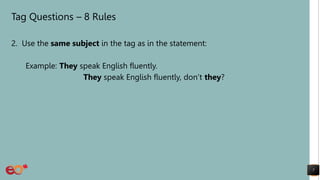
Tag Questions – 8 Rules
2. Use the same subject in the tag as in the statement:
Example: They speak English fluently.
They speak English fluently, don’t they?
7
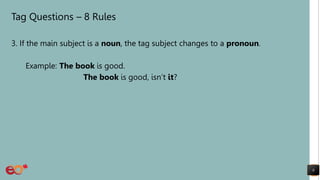
Tag Questions – 8 Rules
3. If the main subject is a noun, the tag subject changes to a pronoun.
Example: The book is good.
The book is good, isn’t it?
8
Tag Questions – 8 Rules
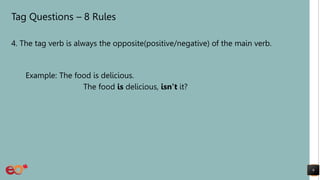
4. The tag verb is always the opposite(positive/negative) of the main verb.
Example: The food is delicious.
The food is delicious, isn’t it?
9
Tag Questions – 8 Rules
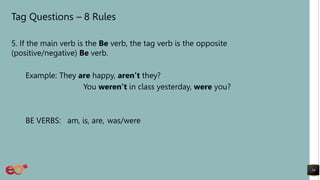
5. If the main verb is the Be verb, the tag verb is the opposite
(positive/negative) Be verb.
Example: They are happy, aren’t they?
You weren’t in class yesterday, were you?
BE VERBS: am, is, are, was/were
10
Tag Questions – 8 Rules
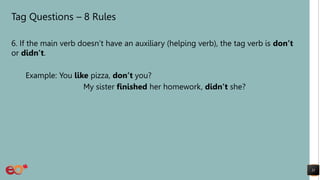
6. If the main verb doesn’t have an auxiliary (helping verb), the tag verb is don’t
or didn’t.
Example: You like pizza, don’t you?
My sister finished her homework, didn’t she?
11
Tag Questions – 8 Rules
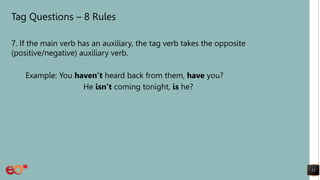
7. If the main verb has an auxiliary, the tag verb takes the opposite
(positive/negative) auxiliary verb.
Example: You haven’t heard back from them, have you?
He isn’t coming tonight, is he?
12
Tag Questions – 8 Rules
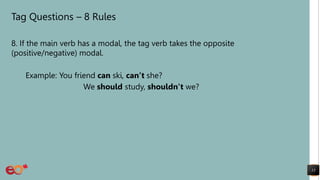
8. If the main verb has a modal, the tag verb takes the opposite
(positive/negative) modal.
Example: You friend can ski, can’t she?
We should study, shouldn’t we?
13
https://pixabay.com/photos/books-bookstore-book-reading-shop-1204038/ shared under CC0
Let’spractice!
https://pixabay.com/photos/books-bookstore-book-reading-shop-1204038/ shared under CC0
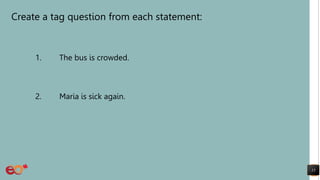
Create a tag question from each statement:
1. The bus is crowded.
2. Maria is sick again.
15
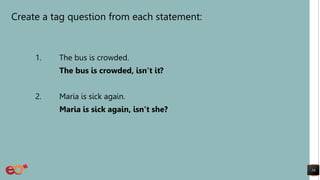
Create a tag question from each statement:
1. The bus is crowded.
The bus is crowded, isn’t it?
2. Maria is sick again.
Maria is sick again, isn’t she?
16
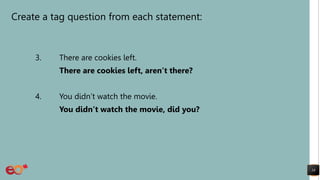
Create a tag question from each statement:
3. There are cookies left.
4. You didn’t watch the movie.
17
Create a tag question from each statement:
3. There are cookies left.
There are cookies left, aren’t there?
4. You didn’t watch the movie.
You didn’t watch the movie, did you?
18
Create a tag question from each statement:
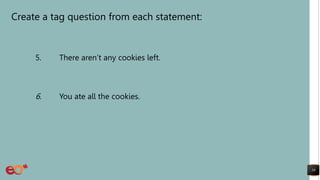
5. There aren’t any cookies left.
6. You ate all the cookies.
19
Create a tag question from each statement:
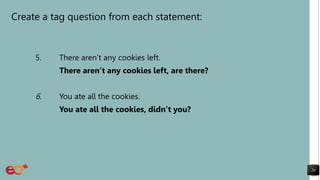
5. There aren’t any cookies left.
There aren’t any cookies left, are there?
6. You ate all the cookies.
You ate all the cookies, didn’t you?
20
Create a tag question from each statement:
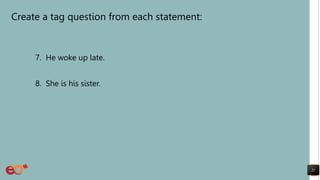
7. He woke up late.
8. She is his sister.
21
Create a tag question from each statement:
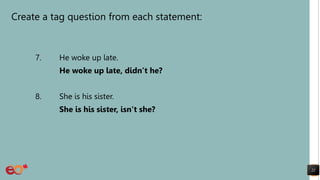
7. He woke up late.
He woke up late, didn’t he?
8. She is his sister.
She is his sister, isn’t she?
22
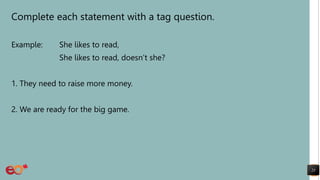
Complete each statement with a tag question.
Example: She likes to read,
She likes to read, doesn’t she?
1. They need to raise more money.
2. We are ready for the big game.
23
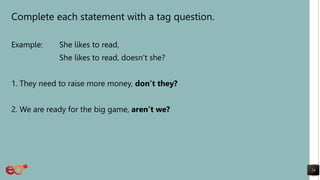
Complete each statement with a tag question.
Example: She likes to read,
She likes to read, doesn’t she?
1. They need to raise more money, don’t they?
2. We are ready for the big game, aren’t we?
24
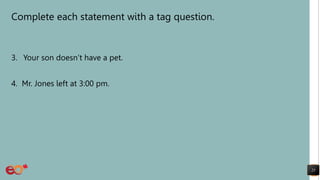
Complete each statement with a tag question.
3. Your son doesn’t have a pet.
4. Mr. Jones left at 3:00 pm.
25
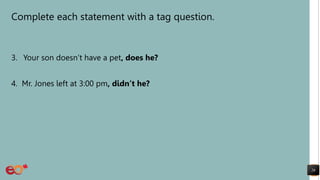
Complete each statement with a tag question.
3. Your son doesn’t have a pet, does he?
4. Mr. Jones left at 3:00 pm, didn’t he?
26
Complete each statement with a tag question.
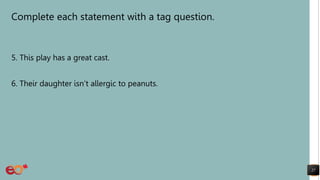
5. This play has a great cast.
6. Their daughter isn’t allergic to peanuts.
27
Complete each statement with a tag question.
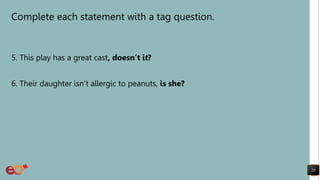
5. This play has a great cast, doesn’t it?
6. Their daughter isn’t allergic to peanuts, is she?
28
Complete each statement with a tag question.
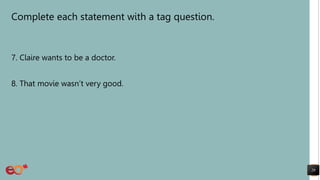
7. Claire wants to be a doctor.
8. That movie wasn’t very good.
29
Complete each statement with a tag question.
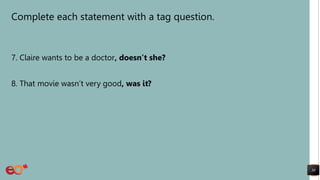
7. Claire wants to be a doctor, doesn’t she?
8. That movie wasn’t very good, was it?
30
Complete each statement with a tag question.
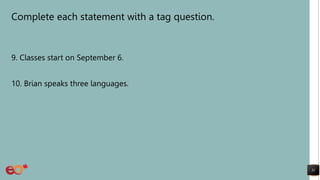
9. Classes start on September 6.
10. Brian speaks three languages.
31
Complete each statement with a tag question.
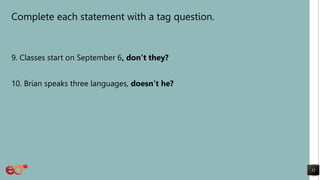
9. Classes start on September 6, don’t they?
10. Brian speaks three languages, doesn’t he?
32
Complete each statement with a tag question.
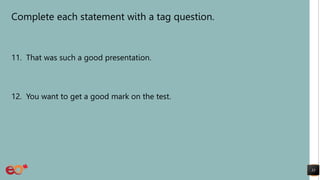
11. That was such a good presentation.
12. You want to get a good mark on the test.
33
Complete each statement with a tag question.
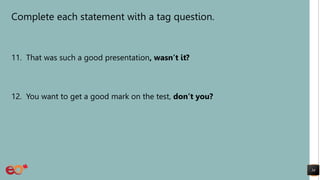
11. That was such a good presentation, wasn’t it?
12. You want to get a good mark on the test, don’t you?
34
Complete each statement with a tag question.
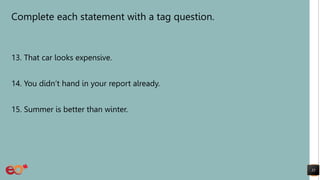
13. That car looks expensive.
14. You didn’t hand in your report already.
15. Summer is better than winter.
35
Complete each statement with a tag question.
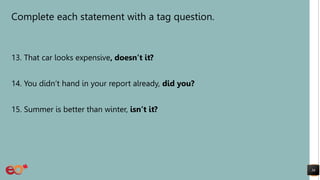
13. That car looks expensive, doesn’t it?
14. You didn’t hand in your report already, did you?
15. Summer is better than winter, isn’t it?
36
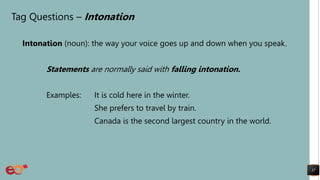
Tag Questions – Intonation
Intonation (noun): the way your voice goes up and down when you speak.
Statements are normally said with falling intonation.
Examples: It is cold here in the winter.
She prefers to travel by train.
Canada is the second largest country in the world.
37
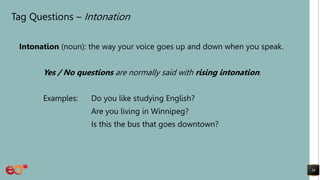
Tag Questions – Intonation
Intonation (noun): the way your voice goes up and down when you speak.
Yes / No questions are normally said with rising intonation.
Examples: Do you like studying English?
Are you living in Winnipeg?
Is this the bus that goes downtown?
38
Tag Questions – Intonation
The intonation of tag endings is different from both of these.
In tag questions, the tag endings (isn't he?, is he?,hadn't they?, can he?) have
two different intonations:
• falling intonation
• rising intonation
The falling or rising intonation of the tag endings communicates
different information.
39
Tag Questions – Falling Intonation
Falling intonation:
When someone asks a tag question and the question tag has falling intonation,
the person who asks the questions is quite sure that the statement before the
tag ending is correct. This tag question sounds like a statement.
Example: “Question 4 is difficult, isn’t it?”
(I think a question is difficult and want to know if you feel the
same way).
40
Tag Questions – Falling Intonation
Rising intonation:
When someone asks a tag question and the tag has rising intonation, the person
who asks the question is much less sure that the statement before the tag
ending is correct.
Example: “Question 4 isn’t difficult, is it?”
(I think a question is not difficult and want to know if you feel
the same way).
41
Unusual tag endings:
Right?
Normally, tag questions end with BE or an auxiliary verb and a subject pronoun
or “there”. Sometimes other endings are used.
The most common one is “right?”. It can be used with both affirmative and
negative sentences and has rising intonation:
Examples: He's a nice person, right?
She’s not coming with us, right?
42
Unusual tag endings:
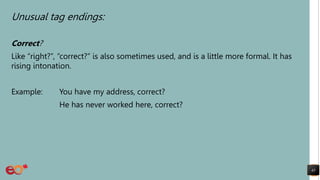
Correct?
Like “right?”, “correct?” is also sometimes used, and is a little more formal. It has
rising intonation.
Example: You have my address, correct?
He has never worked here, correct?
43
https://pixabay.com/photos/books-bookstore-book-reading-shop-1204038/ shared under CC0
Let’spractice!
https://pixabay.com/photos/books-bookstore-book-reading-shop-1204038/ shared under CC0
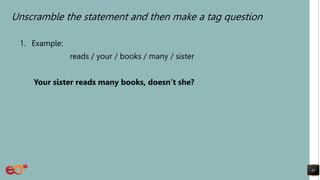
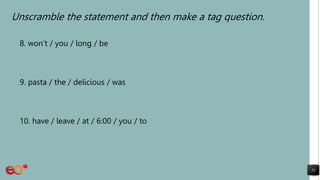
Unscramble the statement and then make a tag question
1. Example:
reads / your / books / many / sister
Your sister reads many books, doesn’t she?
45
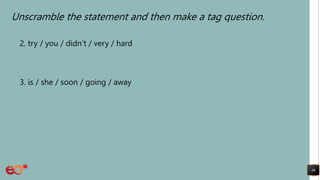
Unscramble the statement and then make a tag question.
2. try / you / didn’t / very / hard
3. is / she / soon / going / away
46
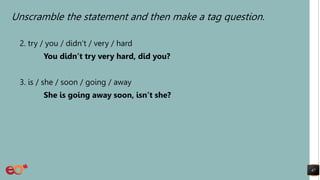
Unscramble the statement and then make a tag question.
2. try / you / didn’t / very / hard
You didn’t try very hard, did you?
3. is / she / soon / going / away
She is going away soon, isn’t she?
47
Unscramble the statement and then make a tag question.
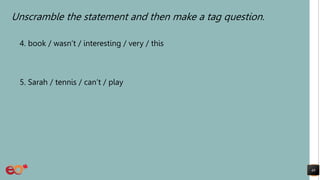
4. book / wasn’t / interesting / very / this
5. Sarah / tennis / can’t / play
48
Unscramble the statement and then make a tag question.
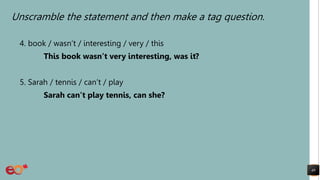
4. book / wasn’t / interesting / very / this
This book wasn’t very interesting, was it?
5. Sarah / tennis / can’t / play
Sarah can’t play tennis, can she?
49
Unscramble the statement and then make a tag question.
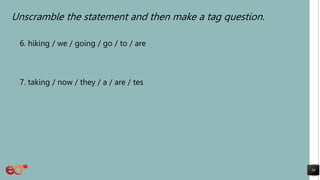
6. hiking / we / going / go / to / are
7. taking / now / they / a / are / tes
50
Unscramble the statement and then make a tag question.
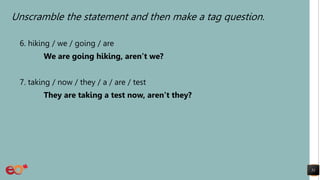
6. hiking / we / going / are
We are going hiking, aren’t we?
7. taking / now / they / a / are / test
They are taking a test now, aren’t they?
51
Unscramble the statement and then make a tag question.
8. won’t / you / long / be
9. pasta / the / delicious / was
10. have / leave / at / 6:00 / you / to
52
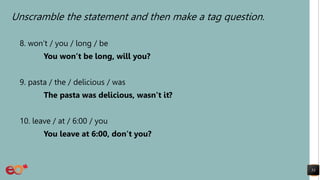
Unscramble the statement and then make a tag question.
8. won’t / you / long / be
You won’t be long, will you?
9. pasta / the / delicious / was
The pasta was delicious, wasn’t it?
10. leave / at / 6:00 / you
You leave at 6:00, don’t you?
53
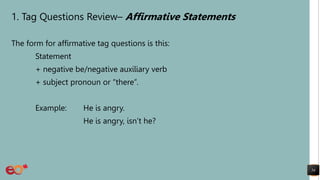
1. Tag Questions Review– Affirmative Statements
The form for affirmative tag questions is this:
Statement
+ negative be/negative auxiliary verb
+ subject pronoun or “there”.
Example: He is angry.
He is angry, isn’t he?
54
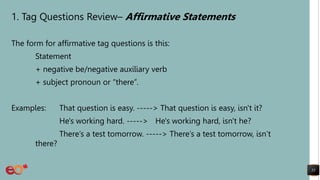
1. Tag Questions Review– Affirmative Statements
The form for affirmative tag questions is this:
Statement
+ negative be/negative auxiliary verb
+ subject pronoun or “there”.
Examples: That question is easy. -----> That question is easy, isn't it?
He's working hard. -----> He's working hard, isn't he?
There’s a test tomorrow. -----> There’s a test tomorrow, isn’t
there?
55
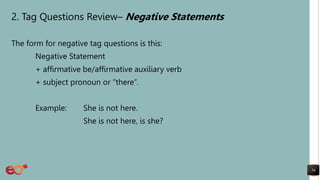
2. Tag Questions Review– Negative Statements
The form for negative tag questions is this:
Negative Statement
+ affirmative be/affirmative auxiliary verb
+ subject pronoun or “there”.
Example: She is not here.
She is not here, is she?
56
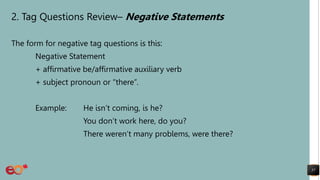
2. Tag Questions Review– Negative Statements
The form for negative tag questions is this:
Negative Statement
+ affirmative be/affirmative auxiliary verb
+ subject pronoun or “there”.
Example: He isn’t coming, is he?
You don’t work here, do you?
There weren’t many problems, were there?
57
Questions?
58
https://pixabay.com/photos/cup-of-coffee-laptop-office-macbook-1280537/ shared under CC0
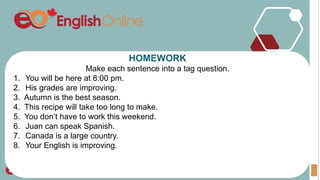
HOMEWORK
Make each sentence into a tag question.
1. You will be here at 8:00 pm.
2. His grades are improving.
3. Autumn is the best season.
4. This recipe will take too long to make.
5. You don’t have to work this weekend.
6. Juan can speak Spanish.
7. Canada is a large country.
8. Your English is improving.
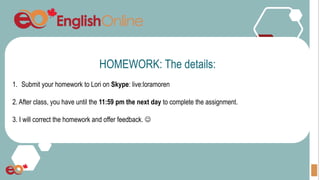
HOMEWORK: The details:
1. Submit your homework to Lori on Skype: live:loramoren
2. After class, you have until the 11:59 pm the next day to complete the assignment.
3. I will correct the homework and offer feedback. 
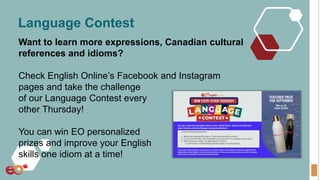
Language Contest
Want to learn more expressions, Canadian cultural
references and idioms?
Check English Online’s Facebook and Instagram
pages and take the challenge
of our Language Contest every
other Thursday!
You can win EO personalized
prizes and improve your English
skills one idiom at a time!
Sources:
https://continuingstudies.uvic.ca/elc/studyzone/410/grammar/410-tag-questions/
https://www.eslcafe.com/resources/grammar-lessons/tag-questions/understanding-and-using-tag-
questions-1
https://app.ellii.com/lesson/2376-tag-questions
Thankyou!
Lori Morency
Skype: live:loramoren
livelearn.ca
Thankyou!
Blaine
broberts@myenglishonline.ca
livelearn.ca
1-204-946-5140
Website:
livelearn.ca
Email:
info@myenglishonline.ca

TagQuestionsEnglishOnlineLunch&Learn.pptx

  • 1.
    https://pixabay.com/photos/books-bookstore-book-reading-1204029/shared under CC0 1 TagQuestions Lunch&Learn (CLB5+) https://pixabay.com/photos/books-bookstore-book-reading-1204029/shared under CC0
  • 2.
    2 Welcome to theEnglish Online community! Our Equity, Diversity, and Inclusion Acknowledgment This community welcomes, appreciates, and respects everyone – it doesn’t matter what country you’re from or who you are! Discrimination of any kind, however, (including political, religious, nationality, or gender-based) is NOT WELCOME. If you are uncomfortable attending this class (or any other at EO), you are free to leave and email us at info@myenglishonline.ca
  • 3.
    What is aTag Question? A tag question is a small question that is attached , or "tagged", to the end of a sentence. Tag questions are used by a speaker to make sure their information is correct, or to ask for agreement. 3
  • 4.
    Tag Questions: Someexamples You came by train, didn’t you? It’s very windy today, isn’t it? You can meet me at the station, can’t you? You couldn’t give me a ride, could you? 4
  • 5.
    Tag Questions –2 Types There are two types of tag questions: 1. One for affirmative statements 2. One for negative statements. Both consist of: • a statement, • a short ending (the "tag") • a question mark. 5
  • 6.
    Tag Questions –8 Rules 1. The tag is always: verb + subject (but the opposite of the statement) Example: He is a student. He is a student, isn’t he? 6
  • 7.
    Tag Questions –8 Rules 2. Use the same subject in the tag as in the statement: Example: They speak English fluently. They speak English fluently, don’t they? 7
  • 8.
    Tag Questions –8 Rules 3. If the main subject is a noun, the tag subject changes to a pronoun. Example: The book is good. The book is good, isn’t it? 8
  • 9.
    Tag Questions –8 Rules 4. The tag verb is always the opposite(positive/negative) of the main verb. Example: The food is delicious. The food is delicious, isn’t it? 9
  • 10.
    Tag Questions –8 Rules 5. If the main verb is the Be verb, the tag verb is the opposite (positive/negative) Be verb. Example: They are happy, aren’t they? You weren’t in class yesterday, were you? BE VERBS: am, is, are, was/were 10
  • 11.
    Tag Questions –8 Rules 6. If the main verb doesn’t have an auxiliary (helping verb), the tag verb is don’t or didn’t. Example: You like pizza, don’t you? My sister finished her homework, didn’t she? 11
  • 12.
    Tag Questions –8 Rules 7. If the main verb has an auxiliary, the tag verb takes the opposite (positive/negative) auxiliary verb. Example: You haven’t heard back from them, have you? He isn’t coming tonight, is he? 12
  • 13.
    Tag Questions –8 Rules 8. If the main verb has a modal, the tag verb takes the opposite (positive/negative) modal. Example: You friend can ski, can’t she? We should study, shouldn’t we? 13
  • 14.
    https://pixabay.com/photos/books-bookstore-book-reading-shop-1204038/ shared underCC0 Let’spractice! https://pixabay.com/photos/books-bookstore-book-reading-shop-1204038/ shared under CC0
  • 15.
    Create a tagquestion from each statement: 1. The bus is crowded. 2. Maria is sick again. 15
  • 16.
    Create a tagquestion from each statement: 1. The bus is crowded. The bus is crowded, isn’t it? 2. Maria is sick again. Maria is sick again, isn’t she? 16
  • 17.
    Create a tagquestion from each statement: 3. There are cookies left. 4. You didn’t watch the movie. 17
  • 18.
    Create a tagquestion from each statement: 3. There are cookies left. There are cookies left, aren’t there? 4. You didn’t watch the movie. You didn’t watch the movie, did you? 18
  • 19.
    Create a tagquestion from each statement: 5. There aren’t any cookies left. 6. You ate all the cookies. 19
  • 20.
    Create a tagquestion from each statement: 5. There aren’t any cookies left. There aren’t any cookies left, are there? 6. You ate all the cookies. You ate all the cookies, didn’t you? 20
  • 21.
    Create a tagquestion from each statement: 7. He woke up late. 8. She is his sister. 21
  • 22.
    Create a tagquestion from each statement: 7. He woke up late. He woke up late, didn’t he? 8. She is his sister. She is his sister, isn’t she? 22
  • 23.
    Complete each statementwith a tag question. Example: She likes to read, She likes to read, doesn’t she? 1. They need to raise more money. 2. We are ready for the big game. 23
  • 24.
    Complete each statementwith a tag question. Example: She likes to read, She likes to read, doesn’t she? 1. They need to raise more money, don’t they? 2. We are ready for the big game, aren’t we? 24
  • 25.
    Complete each statementwith a tag question. 3. Your son doesn’t have a pet. 4. Mr. Jones left at 3:00 pm. 25
  • 26.
    Complete each statementwith a tag question. 3. Your son doesn’t have a pet, does he? 4. Mr. Jones left at 3:00 pm, didn’t he? 26
  • 27.
    Complete each statementwith a tag question. 5. This play has a great cast. 6. Their daughter isn’t allergic to peanuts. 27
  • 28.
    Complete each statementwith a tag question. 5. This play has a great cast, doesn’t it? 6. Their daughter isn’t allergic to peanuts, is she? 28
  • 29.
    Complete each statementwith a tag question. 7. Claire wants to be a doctor. 8. That movie wasn’t very good. 29
  • 30.
    Complete each statementwith a tag question. 7. Claire wants to be a doctor, doesn’t she? 8. That movie wasn’t very good, was it? 30
  • 31.
    Complete each statementwith a tag question. 9. Classes start on September 6. 10. Brian speaks three languages. 31
  • 32.
    Complete each statementwith a tag question. 9. Classes start on September 6, don’t they? 10. Brian speaks three languages, doesn’t he? 32
  • 33.
    Complete each statementwith a tag question. 11. That was such a good presentation. 12. You want to get a good mark on the test. 33
  • 34.
    Complete each statementwith a tag question. 11. That was such a good presentation, wasn’t it? 12. You want to get a good mark on the test, don’t you? 34
  • 35.
    Complete each statementwith a tag question. 13. That car looks expensive. 14. You didn’t hand in your report already. 15. Summer is better than winter. 35
  • 36.
    Complete each statementwith a tag question. 13. That car looks expensive, doesn’t it? 14. You didn’t hand in your report already, did you? 15. Summer is better than winter, isn’t it? 36
  • 37.
    Tag Questions –Intonation Intonation (noun): the way your voice goes up and down when you speak. Statements are normally said with falling intonation. Examples: It is cold here in the winter. She prefers to travel by train. Canada is the second largest country in the world. 37
  • 38.
    Tag Questions –Intonation Intonation (noun): the way your voice goes up and down when you speak. Yes / No questions are normally said with rising intonation. Examples: Do you like studying English? Are you living in Winnipeg? Is this the bus that goes downtown? 38
  • 39.
    Tag Questions –Intonation The intonation of tag endings is different from both of these. In tag questions, the tag endings (isn't he?, is he?,hadn't they?, can he?) have two different intonations: • falling intonation • rising intonation The falling or rising intonation of the tag endings communicates different information. 39
  • 40.
    Tag Questions –Falling Intonation Falling intonation: When someone asks a tag question and the question tag has falling intonation, the person who asks the questions is quite sure that the statement before the tag ending is correct. This tag question sounds like a statement. Example: “Question 4 is difficult, isn’t it?” (I think a question is difficult and want to know if you feel the same way). 40
  • 41.
    Tag Questions –Falling Intonation Rising intonation: When someone asks a tag question and the tag has rising intonation, the person who asks the question is much less sure that the statement before the tag ending is correct. Example: “Question 4 isn’t difficult, is it?” (I think a question is not difficult and want to know if you feel the same way). 41
  • 42.
    Unusual tag endings: Right? Normally,tag questions end with BE or an auxiliary verb and a subject pronoun or “there”. Sometimes other endings are used. The most common one is “right?”. It can be used with both affirmative and negative sentences and has rising intonation: Examples: He's a nice person, right? She’s not coming with us, right? 42
  • 43.
    Unusual tag endings: Correct? Like“right?”, “correct?” is also sometimes used, and is a little more formal. It has rising intonation. Example: You have my address, correct? He has never worked here, correct? 43
  • 44.
    https://pixabay.com/photos/books-bookstore-book-reading-shop-1204038/ shared underCC0 Let’spractice! https://pixabay.com/photos/books-bookstore-book-reading-shop-1204038/ shared under CC0
  • 45.
    Unscramble the statementand then make a tag question 1. Example: reads / your / books / many / sister Your sister reads many books, doesn’t she? 45
  • 46.
    Unscramble the statementand then make a tag question. 2. try / you / didn’t / very / hard 3. is / she / soon / going / away 46
  • 47.
    Unscramble the statementand then make a tag question. 2. try / you / didn’t / very / hard You didn’t try very hard, did you? 3. is / she / soon / going / away She is going away soon, isn’t she? 47
  • 48.
    Unscramble the statementand then make a tag question. 4. book / wasn’t / interesting / very / this 5. Sarah / tennis / can’t / play 48
  • 49.
    Unscramble the statementand then make a tag question. 4. book / wasn’t / interesting / very / this This book wasn’t very interesting, was it? 5. Sarah / tennis / can’t / play Sarah can’t play tennis, can she? 49
  • 50.
    Unscramble the statementand then make a tag question. 6. hiking / we / going / go / to / are 7. taking / now / they / a / are / tes 50
  • 51.
    Unscramble the statementand then make a tag question. 6. hiking / we / going / are We are going hiking, aren’t we? 7. taking / now / they / a / are / test They are taking a test now, aren’t they? 51
  • 52.
    Unscramble the statementand then make a tag question. 8. won’t / you / long / be 9. pasta / the / delicious / was 10. have / leave / at / 6:00 / you / to 52
  • 53.
    Unscramble the statementand then make a tag question. 8. won’t / you / long / be You won’t be long, will you? 9. pasta / the / delicious / was The pasta was delicious, wasn’t it? 10. leave / at / 6:00 / you You leave at 6:00, don’t you? 53
  • 54.
    1. Tag QuestionsReview– Affirmative Statements The form for affirmative tag questions is this: Statement + negative be/negative auxiliary verb + subject pronoun or “there”. Example: He is angry. He is angry, isn’t he? 54
  • 55.
    1. Tag QuestionsReview– Affirmative Statements The form for affirmative tag questions is this: Statement + negative be/negative auxiliary verb + subject pronoun or “there”. Examples: That question is easy. -----> That question is easy, isn't it? He's working hard. -----> He's working hard, isn't he? There’s a test tomorrow. -----> There’s a test tomorrow, isn’t there? 55
  • 56.
    2. Tag QuestionsReview– Negative Statements The form for negative tag questions is this: Negative Statement + affirmative be/affirmative auxiliary verb + subject pronoun or “there”. Example: She is not here. She is not here, is she? 56
  • 57.
    2. Tag QuestionsReview– Negative Statements The form for negative tag questions is this: Negative Statement + affirmative be/affirmative auxiliary verb + subject pronoun or “there”. Example: He isn’t coming, is he? You don’t work here, do you? There weren’t many problems, were there? 57
  • 58.
  • 59.
    HOMEWORK Make each sentenceinto a tag question. 1. You will be here at 8:00 pm. 2. His grades are improving. 3. Autumn is the best season. 4. This recipe will take too long to make. 5. You don’t have to work this weekend. 6. Juan can speak Spanish. 7. Canada is a large country. 8. Your English is improving.
  • 60.
    HOMEWORK: The details: 1.Submit your homework to Lori on Skype: live:loramoren 2. After class, you have until the 11:59 pm the next day to complete the assignment. 3. I will correct the homework and offer feedback. 
  • 61.
    Language Contest Want tolearn more expressions, Canadian cultural references and idioms? Check English Online’s Facebook and Instagram pages and take the challenge of our Language Contest every other Thursday! You can win EO personalized prizes and improve your English skills one idiom at a time!
  • 62.
  • 63.
  • 64.