
Developing Networks of Care: 
through 
Long Term Conditions Year of Care Commissioning 
& 
Long Term Conditions Improvement Programmes 
Bev Matthews 
Programme Lead for Long Term Conditions 
29th October 2014
Drivers for Improvement: 
2008 – Polysystems & Person Centred Care 
2009 – Risk Stratification 
2010 – Integrated data 
2011 – LTC management, & The Year of Care 
2012 – Integrated Case Management 
2013 – Rapid Response & Community Treatment Teams 
2014 – Complex Primary Care Practice 
2015 – 5 Year Forward View
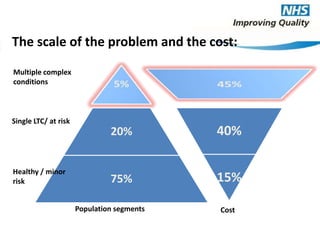
The scale of the problem and the cost: 
20% 
75% 
40% 
15% 
Multiple complex 
conditions 
Single LTC/ at risk 
Healthy / minor 
risk 
Population segments Cost
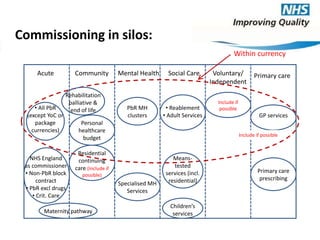
Commissioning in silos: 
Acute Community Mental Health Social Care Voluntary/ 
• All PbR 
(except YoC or 
package 
currencies) 
Independent 
Primary care 
Primary care 
prescribing 
NHS England 
as commissioner 
• Non-PbR block 
contract 
• PbR excl drugs 
• Crit. Care 
Personal 
healthcare 
budget 
Specialised MH 
Services 
Means-tested 
services (incl. 
residential) 
Within currency 
Rehabilitation 
palliative & 
end of life 
Maternity pathway 
• Reablement 
• Adult Services 
PbR MH 
clusters 
Children’s 
services 
GP services 
Include if possible 
Residential 
continuing 
care (Include if 
possible) 
Include if 
possible
Identifying patients: 
• Risk stratification tool applied 
• LTC codes applied (18 in total - QoF) 
• List segmented by LTC currency (Bands B – E applied - B=2,C=3-5,D=6- 
8,E=9), 
• Risk Score over time mapped (looking for rise in risk score in 
last 6 mths – 4 of 6 show an increase) or 
• Rapid Riser in last 3 mths (mthly increase in risk score over 
past 3 mths and overall increase of >15pts). 
• Kent – 80 GP practices, Band B = 2197, Band C= 3506, Band D 
=261, Band E= 5 Total 6369 of 729, 275 
• Now driving increased engagement in risk stratification
LTC Year of Care Commissioning 
Implementation Guide
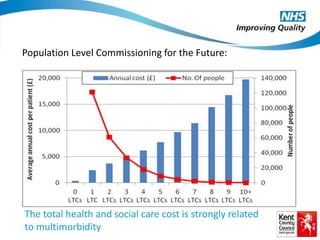
Population Level Commissioning for the Future: 
Over 30% of people over 75 years have multimorbidity
Population Level Commissioning for the Future:
Population Level Commissioning for the Future: 
The total health and social care cost is strongly related 
to multimorbidity
Population Level Commissioning for the Future: 
The main contributors to total health & social care cost 
are acute non-elective admissions
Population Level Commissioning for the Future: 
People with complex health & social care needs appear 
to demonstrate a ‘crisis curve’
Population Level Commissioning for the Future: 
More community, mental health and social care services 
are delivered to people following a ‘crisis’ than before 
the ‘crisis’
Some indications that an integrated care plan changes the pattern of services 
delivered to people
LTC Year of Care Commissioning Model 
Implementation Guide
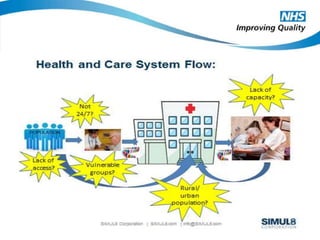
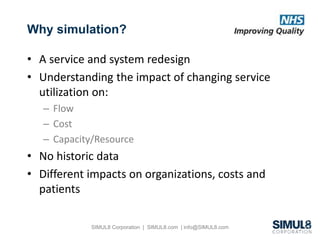
Why simulation? 
• A service and system redesign 
• Understanding the impact of changing service 
utilization on: 
– Flow 
– Cost 
– Capacity/Resource 
• No historic data 
• Different impacts on organizations, costs and 
patients 
SIMUL8 Corporation | SIMUL8.com | info@SIMUL8.com
LTC Year of Care Simulation Model 
SIMUL8 Corporation | SIMUL8.com | info@SIMUL8.com 
• Use local 
data to test 
assumptions 
• Ability to 
update and 
review
How it works: 
• Patients in each “state” have 
– A likelihood of accessing certain types of service, including 
accessing services more than once 
• Acute, 
• Community, 
• Mental Health, 
• Social Care), 
• Costs associated with those services 
SIMUL8 Corporation | SIMUL8.com | info@SIMUL8.com
SIMUL8 Corporation | SIMUL8.com | info@SIMUL8.com 
Results: 
• Cost by each area of service/organisation
• Costs by state per year 
• Average cost per patient 
• Comparison with tariff 
SIMUL8 Corporation | SIMUL8.com | info@SIMUL8.com 
Results:
LTC Year of Care Commissioning Model 
Implementation Guide 
Next Chapter: 
RRR Clinical Audit: 
• Report 
• Simulation Model, 
• How to Guide
Long Term Conditions House of Care: 
• The 15 million people in 
England with long term 
conditions have the greatest 
needs of the population 
• People living with long term 
conditions report that they 
require person centred coordinated 
care. 
• The House of Care provides 
framework for this to be 
delivered
The House of Care: value to the person 
This House supports National Voices ‘I’ statements: 
My goals/outcomes e.g. 
• All my needs as a person were 
assessed and taken into 
account. 
Communication e.g. 
• I always knew who was the 
main person in charge of 
my care. 
Information e.g. 
• I could see my health and 
care records at any time to 
check what was going on 
Decision-making e.g. 
• I was as involved in 
discussions and decisions 
about my care and treatment 
as I wanted to be. Care planning e.g. 
• I had regular reviews of my care 
and treatment, and of my care 
plan. 
Emergencies e.g. 
• I had systems in place so that 
I could get help at an early 
stage to avoid a crisis. 
Transitions e.g. 
• When I went to a new 
service, they knew who I 
was, and about my own 
views, preferences and 
circumstances.
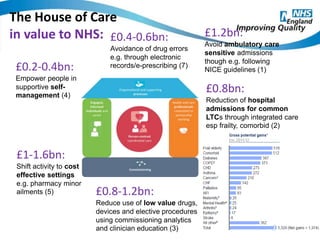
The House of Care 
in value to NHS: £1.2bn: 
Avoid ambulatory care 
sensitive admissions 
though e.g. following 
NICE guidelines (1) 
£0.8bn: 
Reduction of hospital 
admissions for common 
LTCs through integrated care 
esp frailty, comorbid (2) 
£0.8-1.2bn: 
Reduce use of low value drugs, 
devices and elective procedures 
using commissioning analytics 
and clinician education (3) 
£0.2-0.4bn: 
Empower people in 
supportive self-management 
(4) 
£1-1.6bn: 
Shift activity to cost 
effective settings 
e.g. pharmacy minor 
ailments (5) 
£0.4-0.6bn: 
Avoidance of drug errors 
e.g. through electronic 
records/e-prescribing (7)
@NHSIQ 
@bev_j_matthews ICASE LTC Community 
LTC Year of Care Community

Tackling long term conditions

  • 1.
    Developing Networks ofCare: through Long Term Conditions Year of Care Commissioning & Long Term Conditions Improvement Programmes Bev Matthews Programme Lead for Long Term Conditions 29th October 2014
  • 2.
    Drivers for Improvement: 2008 – Polysystems & Person Centred Care 2009 – Risk Stratification 2010 – Integrated data 2011 – LTC management, & The Year of Care 2012 – Integrated Case Management 2013 – Rapid Response & Community Treatment Teams 2014 – Complex Primary Care Practice 2015 – 5 Year Forward View
  • 3.
    The scale ofthe problem and the cost: 20% 75% 40% 15% Multiple complex conditions Single LTC/ at risk Healthy / minor risk Population segments Cost
  • 4.
    Commissioning in silos: Acute Community Mental Health Social Care Voluntary/ • All PbR (except YoC or package currencies) Independent Primary care Primary care prescribing NHS England as commissioner • Non-PbR block contract • PbR excl drugs • Crit. Care Personal healthcare budget Specialised MH Services Means-tested services (incl. residential) Within currency Rehabilitation palliative & end of life Maternity pathway • Reablement • Adult Services PbR MH clusters Children’s services GP services Include if possible Residential continuing care (Include if possible) Include if possible
  • 5.
    Identifying patients: •Risk stratification tool applied • LTC codes applied (18 in total - QoF) • List segmented by LTC currency (Bands B – E applied - B=2,C=3-5,D=6- 8,E=9), • Risk Score over time mapped (looking for rise in risk score in last 6 mths – 4 of 6 show an increase) or • Rapid Riser in last 3 mths (mthly increase in risk score over past 3 mths and overall increase of >15pts). • Kent – 80 GP practices, Band B = 2197, Band C= 3506, Band D =261, Band E= 5 Total 6369 of 729, 275 • Now driving increased engagement in risk stratification
  • 6.
    LTC Year ofCare Commissioning Implementation Guide
  • 7.
    Population Level Commissioningfor the Future: Over 30% of people over 75 years have multimorbidity
  • 8.
  • 9.
    Population Level Commissioningfor the Future: The total health and social care cost is strongly related to multimorbidity
  • 10.
    Population Level Commissioningfor the Future: The main contributors to total health & social care cost are acute non-elective admissions
  • 11.
    Population Level Commissioningfor the Future: People with complex health & social care needs appear to demonstrate a ‘crisis curve’
  • 12.
    Population Level Commissioningfor the Future: More community, mental health and social care services are delivered to people following a ‘crisis’ than before the ‘crisis’
  • 13.
    Some indications thatan integrated care plan changes the pattern of services delivered to people
  • 14.
    LTC Year ofCare Commissioning Model Implementation Guide
  • 16.
    Why simulation? •A service and system redesign • Understanding the impact of changing service utilization on: – Flow – Cost – Capacity/Resource • No historic data • Different impacts on organizations, costs and patients SIMUL8 Corporation | SIMUL8.com | info@SIMUL8.com
  • 17.
    LTC Year ofCare Simulation Model SIMUL8 Corporation | SIMUL8.com | info@SIMUL8.com • Use local data to test assumptions • Ability to update and review
  • 18.
    How it works: • Patients in each “state” have – A likelihood of accessing certain types of service, including accessing services more than once • Acute, • Community, • Mental Health, • Social Care), • Costs associated with those services SIMUL8 Corporation | SIMUL8.com | info@SIMUL8.com
  • 19.
    SIMUL8 Corporation |SIMUL8.com | info@SIMUL8.com Results: • Cost by each area of service/organisation
  • 20.
    • Costs bystate per year • Average cost per patient • Comparison with tariff SIMUL8 Corporation | SIMUL8.com | info@SIMUL8.com Results:
  • 21.
    LTC Year ofCare Commissioning Model Implementation Guide Next Chapter: RRR Clinical Audit: • Report • Simulation Model, • How to Guide
  • 22.
    Long Term ConditionsHouse of Care: • The 15 million people in England with long term conditions have the greatest needs of the population • People living with long term conditions report that they require person centred coordinated care. • The House of Care provides framework for this to be delivered
  • 23.
    The House ofCare: value to the person This House supports National Voices ‘I’ statements: My goals/outcomes e.g. • All my needs as a person were assessed and taken into account. Communication e.g. • I always knew who was the main person in charge of my care. Information e.g. • I could see my health and care records at any time to check what was going on Decision-making e.g. • I was as involved in discussions and decisions about my care and treatment as I wanted to be. Care planning e.g. • I had regular reviews of my care and treatment, and of my care plan. Emergencies e.g. • I had systems in place so that I could get help at an early stage to avoid a crisis. Transitions e.g. • When I went to a new service, they knew who I was, and about my own views, preferences and circumstances.
  • 24.
    The House ofCare in value to NHS: £1.2bn: Avoid ambulatory care sensitive admissions though e.g. following NICE guidelines (1) £0.8bn: Reduction of hospital admissions for common LTCs through integrated care esp frailty, comorbid (2) £0.8-1.2bn: Reduce use of low value drugs, devices and elective procedures using commissioning analytics and clinician education (3) £0.2-0.4bn: Empower people in supportive self-management (4) £1-1.6bn: Shift activity to cost effective settings e.g. pharmacy minor ailments (5) £0.4-0.6bn: Avoidance of drug errors e.g. through electronic records/e-prescribing (7)
  • 27.
    @NHSIQ @bev_j_matthews ICASELTC Community LTC Year of Care Community

Editor's Notes

  • #4 Multiple data flows between provider, CCG and CSU, Public Health – no systematisation improving data quality and data completeness Complex organisation set up in Kent – commissioning at various levels Starting with top 5% of population who utilise the largest proportion of spend. Looking to commission for this population only. One thing we do really well is care pathways for people with single conditions.
  • #5 Moving from programme/service focused commissioning to system commissioning. To achieve this we need to develop a new currency. Traditionally commission vertically looking to commission horizontally that accurately describes a patient journey for defined cohort rather than individual services. In order to commission in this way we need to develop new currencies and tariffs that reflect journey of integrated care for defined cohort.
  • #28 Thank you and questions