www.england.nhs.uk
Testing integrated
care service models
for patients with
complex care needs
using simulation
modelling
Jacquie White,
Deputy Director for LTC
&
Bev Matthews
Programme Delivery Lead
NHS England
20th November 2015
www.england.nhs.uk
Person centred co-ordinated
care
“My care is planned with people who work
together to understand me and my carer(s),
put me in control, co-ordinate and deliver
services to achieve my best outcomes.”
Goal:
Improve quality of life and experience of end
of life care for people with long term
conditions and their carers through:
www.england.nhs.uk
LTC Strategy for Person Centred Care:
3
Care & Support
Planning
Embedding personalised
care and support planning
as the core component
Evidence
Improving evidence and
implementation of it to
commission better care
Engagement
Raising professional and
public awareness of and
engagement with PCC
Models of Care
Increasing co-ordination and
continuity of care though
development and testing of
new models
Enablers
Strengthening the enablers
that drive change including
data and incentives
Inequalities
Focussing on areas of
inequality – care homes,
Neuro, MSK, palliative care
for non-cancer conditions
www.england.nhs.uk
Long Term Conditions Year of Care
Commissioning Programme
• Launched by Department of Health (Sir John Oldham),
commissioned and delivered by NHS England
• In the final year of a four year programme
• Patients receive care that is better managed, delivered
seamlessly across different care settings focused on patient needs using different
commissioning and funding approaches
• Currently five early implementer health and social economy teams with 22 fast
follower teams
Rationale:
 Multi morbidity is common
 Patients with multi morbidity have complex care needs and would
benefit from personalised integrated care
 An integrated payment would encourage integration of services and
cost efficiency
www.england.nhs.uk
Multi Morbidity is Common:
www.england.nhs.uk
The total health and social care cost is strongly
related to multi morbidity:
www.england.nhs.uk
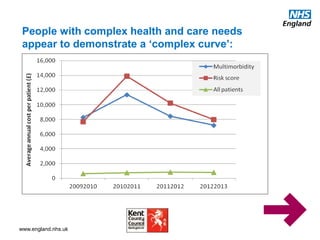
People with complex health and care needs
appear to demonstrate a ‘complex curve’:
www.england.nhs.uk
Mental
health care
Acute
care
Voluntary
care
Primary
care
Social Care
What the future looks like
Community
care
Self
care
Change is difficult. It requires time and effort. Simulation modelling
can help to advise, influence and maximise efforts and resources
to achieving integrated care that works around the patient.
www.england.nhs.uk
Early Implementer Sites:
www.england.nhs.uk
Long Term Conditions Year of Care
Currency:
www.england.nhs.uk
Tested Benefits of multi morbidity
• Decision support tool
for NHS continuing
care
• Risk stratification
• Multi morbidity
• Simple method
• Identifies patients with long term conditions
• Can identify patients with acute and mental
health morbidities
• Multi morbidity is common
• Potential for early identification of patient
with complex care needs
• Cost is related to complexity
Selecting Patient for Inclusion:
www.england.nhs.uk
Common to all teams Differs between teams
• Multi morbidity for selecting patients
for referral
• Single point of access/assessment
• Shared care record
• Need to change funding flows
• Outcome-based measurement
• Services (providers)
included
• Contracting model and
financial governance
• Palliative / end of life
• Service specific (e.g. cancer or musculoskeletal)
• Integrated care for older persons / frail elderly /
complex care
Experience from Early Implementer Sites:
www.england.nhs.uk
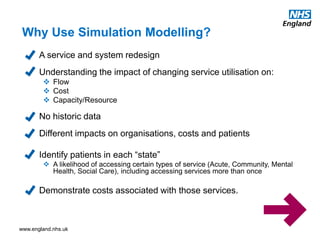
 A service and system redesign
 Understanding the impact of changing service utilisation on:
 Flow
 Cost
 Capacity/Resource
 No historic data
 Different impacts on organisations, costs and patients
 Identify patients in each “state”
 A likelihood of accessing certain types of service (Acute, Community, Mental
Health, Social Care), including accessing services more than once
 Demonstrate costs associated with those services.
Why Use Simulation Modelling?
www.england.nhs.uk
Dataset Requirements:
 Whole population activity and cost dataset, including acute,
community, mental health and GP practice activity data
 Risk population segmentation (Commonwealth Fund Segmenting
Populations to tailor services, Improve Care, 2015)
SIMUL8 simulation model parameters:
 Distributions for activity and costs, for each cohort and activity type
 Set access rate and staff FTE resource, for each cohort and activity
type
 Rate of movement of patients into cohorts, between cohorts and
death
 Compare current service model with new service model
Preparing for Simulation:
www.england.nhs.uk
www.england.nhs.uk
Select
patients for
referral
Assessment
of patient
need
MDT –
develop and
share care
plan
Deliver
services to
patients
Assign to
patient
cohort
Patient
dies or
leaves area
Change to
patient
cohort
Review
contract
and
budget
Set
contract
and
budget
Perform
and
quality
Payment
Patient pathway
Payment
cycle
Generalised patient pathway and the
payment cycle for complex care patients
www.england.nhs.uk
The Simulation Model
Simulation model
www.england.nhs.uk
Simulation Model Results
www.england.nhs.uk
Simulation Model Results:
Estimated staff shift (FTE)
Acute Community
Mental
Health
Primary
Care
Total -83.5 53.8 3.1 68.4
Patients Mean annual cost per
patient (£)
Potential capitated
budget (£ mill.)
Current New Current New
31,987 £5,881 £5,830 £188.1 £186.5
www.england.nhs.uk
• National and local co-production
• Agreed vision, case for change, definition and narrative
• Permissive framework with national guidance, enablers,
resources, case studies: local implementation irrespective of
starting point
• Local partnerships, strategy, action plan, metrics and
milestones: flexible and adaptable
• Build on learning – own and others (translate into local
system)
• Use improvement methodology to manage change (and offer
support)
• Culture eats strategy – engagement, engagement,
engagement to gain ownership
• Keep focussed on the aim: person centred co-ordinated care
for all by understanding “what matters most”
20
Summary – creating the conditions for
change:
www.england.nhs.uk Simulation model
Unbundling recovery simulation model
LTC Resources and Tools:
www.england.nhs.uk 22
Jacquie White Bev Matthews
@jaqwhite1
#A4PCC
@bev_j_matthews
#LTCyearofcare #a4pcc
jacquie.white@nhs.net Beverley.matthews@nhsiq.nhs.uk
www.england.nhs.uk/resources/reso
urces-for-ccgs/out-frwrk/dom-2/
www.nhsiq.nhs.uk
Please do contact us:
Thank you

Testing service models using simulation modelling

  • 1.
    www.england.nhs.uk Testing integrated care servicemodels for patients with complex care needs using simulation modelling Jacquie White, Deputy Director for LTC & Bev Matthews Programme Delivery Lead NHS England 20th November 2015
  • 2.
    www.england.nhs.uk Person centred co-ordinated care “Mycare is planned with people who work together to understand me and my carer(s), put me in control, co-ordinate and deliver services to achieve my best outcomes.” Goal: Improve quality of life and experience of end of life care for people with long term conditions and their carers through:
  • 3.
    www.england.nhs.uk LTC Strategy forPerson Centred Care: 3 Care & Support Planning Embedding personalised care and support planning as the core component Evidence Improving evidence and implementation of it to commission better care Engagement Raising professional and public awareness of and engagement with PCC Models of Care Increasing co-ordination and continuity of care though development and testing of new models Enablers Strengthening the enablers that drive change including data and incentives Inequalities Focussing on areas of inequality – care homes, Neuro, MSK, palliative care for non-cancer conditions
  • 4.
    www.england.nhs.uk Long Term ConditionsYear of Care Commissioning Programme • Launched by Department of Health (Sir John Oldham), commissioned and delivered by NHS England • In the final year of a four year programme • Patients receive care that is better managed, delivered seamlessly across different care settings focused on patient needs using different commissioning and funding approaches • Currently five early implementer health and social economy teams with 22 fast follower teams Rationale:  Multi morbidity is common  Patients with multi morbidity have complex care needs and would benefit from personalised integrated care  An integrated payment would encourage integration of services and cost efficiency
  • 5.
  • 6.
    www.england.nhs.uk The total healthand social care cost is strongly related to multi morbidity:
  • 7.
    www.england.nhs.uk People with complexhealth and care needs appear to demonstrate a ‘complex curve’:
  • 8.
    www.england.nhs.uk Mental health care Acute care Voluntary care Primary care Social Care Whatthe future looks like Community care Self care Change is difficult. It requires time and effort. Simulation modelling can help to advise, influence and maximise efforts and resources to achieving integrated care that works around the patient.
  • 9.
  • 10.
  • 11.
    www.england.nhs.uk Tested Benefits ofmulti morbidity • Decision support tool for NHS continuing care • Risk stratification • Multi morbidity • Simple method • Identifies patients with long term conditions • Can identify patients with acute and mental health morbidities • Multi morbidity is common • Potential for early identification of patient with complex care needs • Cost is related to complexity Selecting Patient for Inclusion:
  • 12.
    www.england.nhs.uk Common to allteams Differs between teams • Multi morbidity for selecting patients for referral • Single point of access/assessment • Shared care record • Need to change funding flows • Outcome-based measurement • Services (providers) included • Contracting model and financial governance • Palliative / end of life • Service specific (e.g. cancer or musculoskeletal) • Integrated care for older persons / frail elderly / complex care Experience from Early Implementer Sites:
  • 13.
    www.england.nhs.uk  A serviceand system redesign  Understanding the impact of changing service utilisation on:  Flow  Cost  Capacity/Resource  No historic data  Different impacts on organisations, costs and patients  Identify patients in each “state”  A likelihood of accessing certain types of service (Acute, Community, Mental Health, Social Care), including accessing services more than once  Demonstrate costs associated with those services. Why Use Simulation Modelling?
  • 14.
    www.england.nhs.uk Dataset Requirements:  Wholepopulation activity and cost dataset, including acute, community, mental health and GP practice activity data  Risk population segmentation (Commonwealth Fund Segmenting Populations to tailor services, Improve Care, 2015) SIMUL8 simulation model parameters:  Distributions for activity and costs, for each cohort and activity type  Set access rate and staff FTE resource, for each cohort and activity type  Rate of movement of patients into cohorts, between cohorts and death  Compare current service model with new service model Preparing for Simulation:
  • 15.
  • 16.
    www.england.nhs.uk Select patients for referral Assessment of patient need MDT– develop and share care plan Deliver services to patients Assign to patient cohort Patient dies or leaves area Change to patient cohort Review contract and budget Set contract and budget Perform and quality Payment Patient pathway Payment cycle Generalised patient pathway and the payment cycle for complex care patients
  • 17.
  • 18.
  • 19.
    www.england.nhs.uk Simulation Model Results: Estimatedstaff shift (FTE) Acute Community Mental Health Primary Care Total -83.5 53.8 3.1 68.4 Patients Mean annual cost per patient (£) Potential capitated budget (£ mill.) Current New Current New 31,987 £5,881 £5,830 £188.1 £186.5
  • 20.
    www.england.nhs.uk • National andlocal co-production • Agreed vision, case for change, definition and narrative • Permissive framework with national guidance, enablers, resources, case studies: local implementation irrespective of starting point • Local partnerships, strategy, action plan, metrics and milestones: flexible and adaptable • Build on learning – own and others (translate into local system) • Use improvement methodology to manage change (and offer support) • Culture eats strategy – engagement, engagement, engagement to gain ownership • Keep focussed on the aim: person centred co-ordinated care for all by understanding “what matters most” 20 Summary – creating the conditions for change:
  • 21.
    www.england.nhs.uk Simulation model Unbundlingrecovery simulation model LTC Resources and Tools:
  • 22.
    www.england.nhs.uk 22 Jacquie WhiteBev Matthews @jaqwhite1 #A4PCC @bev_j_matthews #LTCyearofcare #a4pcc jacquie.white@nhs.net Beverley.matthews@nhsiq.nhs.uk www.england.nhs.uk/resources/reso urces-for-ccgs/out-frwrk/dom-2/ www.nhsiq.nhs.uk Please do contact us: Thank you