{
Tablets
presented By:
Group-ASH1803049-53
Group member:-
ASH1803049-Jakaria;
ASH1803050-Dipto;
ASH1803051-Monna;
ASH1803052-Jibon;
ASH1803053-Marjan.
Department of pharmacy , NSTU.
INTRODUCTION
DEFINITION OF TABLETS
CLASSIFICATION/TYPES
EXCIPIENT
TABLET INGRADIENTS
ADVANTAGES
DISADVANTAGES
CONTENT…..
INTRODUCTUION
A tablet is a pharmaceutical solid dosage form . It
comprises mixture of active substance and
excipients.
EX:- PARACETAMOL 500mg + excipient.
The excipients can include diluents , blinder,
or granulating agent, glidants ,and lubricants.
What is tablet?
API EXCIPIENT
TABLET
SUITABLE
FORM
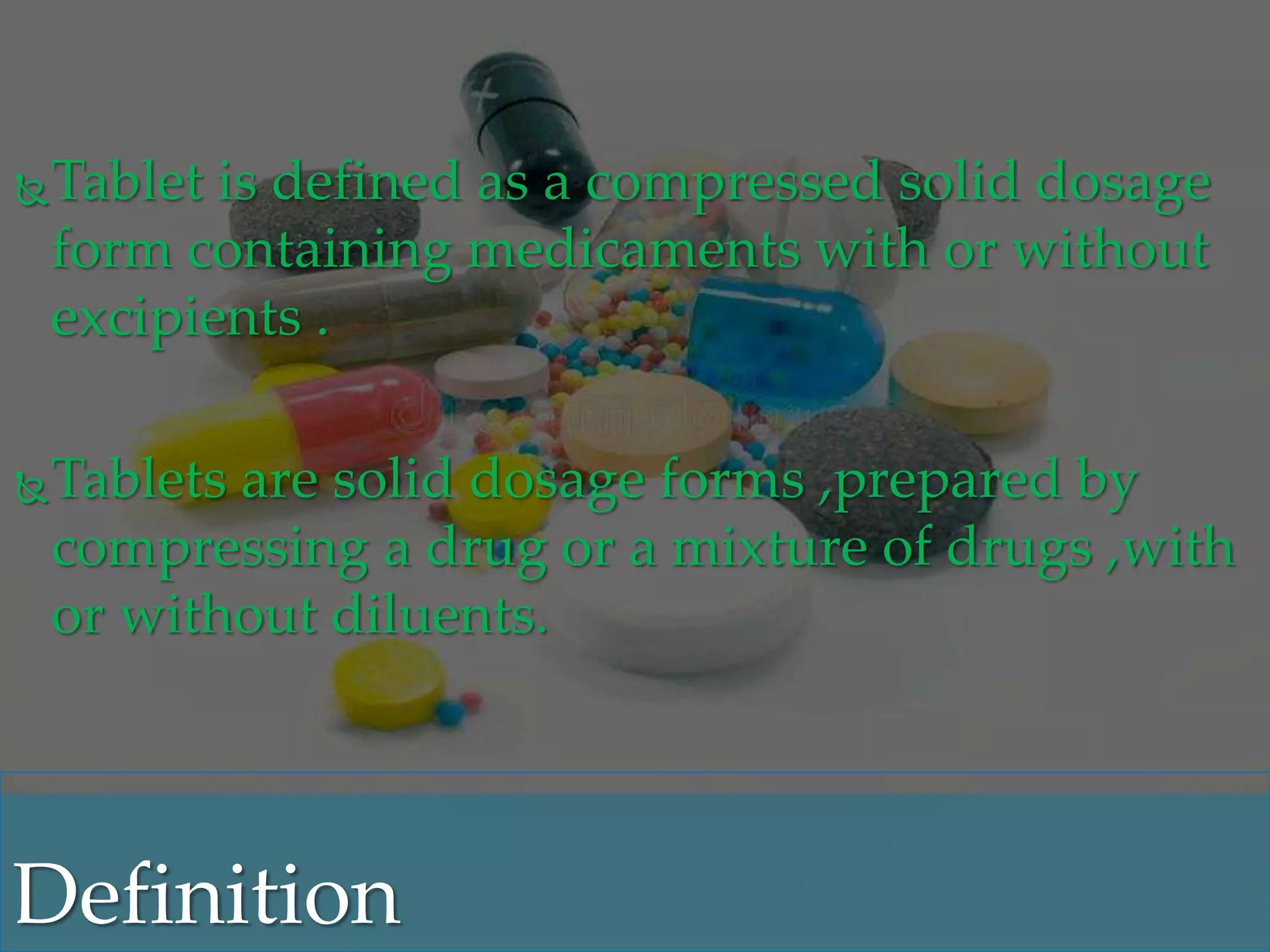
Tablet is defined as a compressed solid dosage
form containing medicaments with or without
excipients .
Tablets are solid dosage forms ,prepared by
compressing a drug or a mixture of drugs ,with
or without diluents.
Definition
{
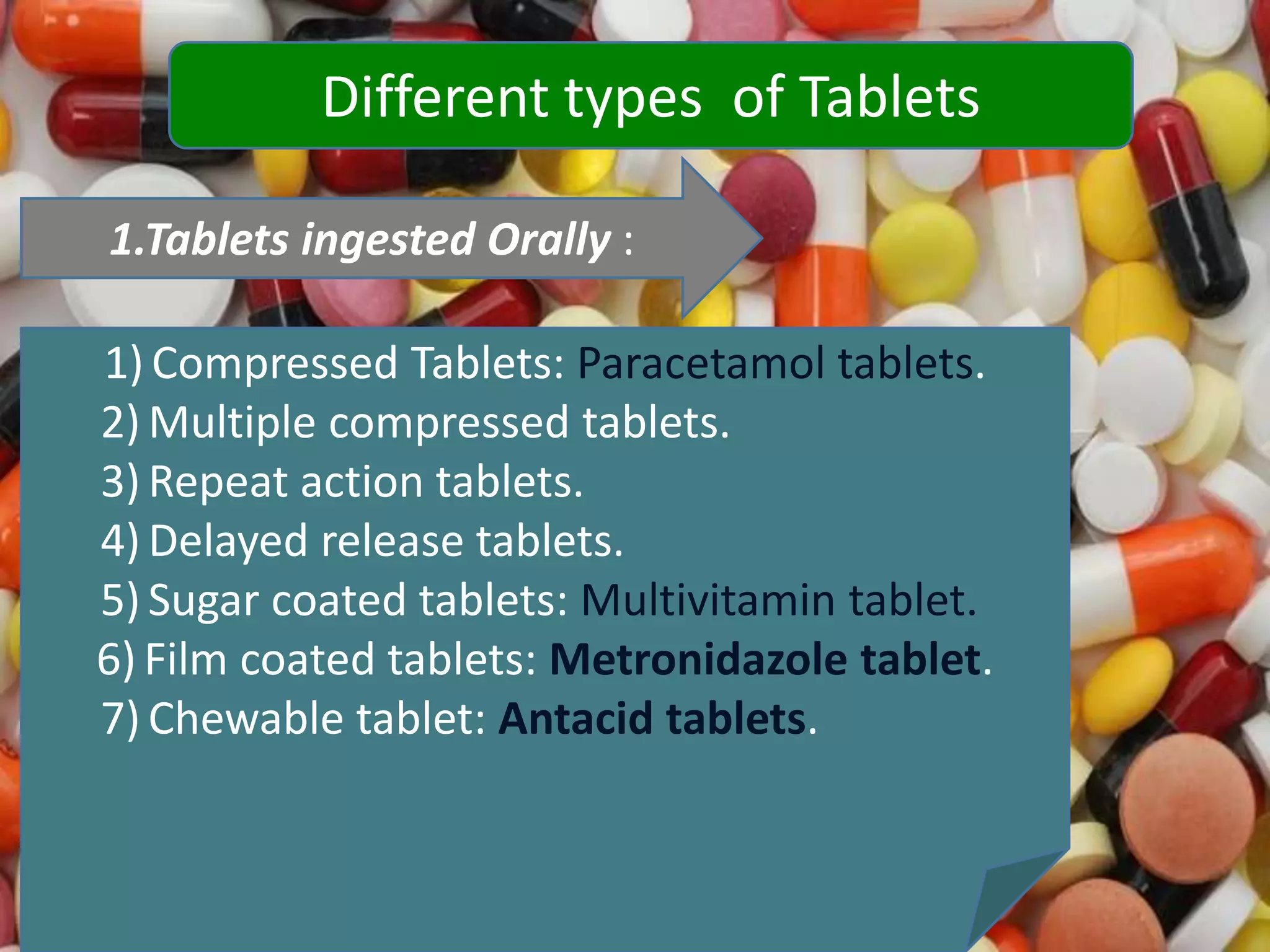
Different types of Tablets
1.Tablets ingested Orally :
1) Compressed Tablets: Paracetamol tablets.
2) Multiple compressed tablets.
3) Repeat action tablets.
4) Delayed release tablets.
5) Sugar coated tablets: Multivitamin tablet.
6) Film coated tablets: Metronidazole tablet.
7) Chewable tablet: Antacid tablets.
Different types of tablets
2: Tablets used in oral cavity
3: tablet administered by
other route
1) Buccal tablets : Vitamin – c tablet.
2) Sublingual tablet.
3) Troches or lozenges.
4) Dental cone.
1) Implantation tablets.
2) Vaginal tablets: Clotrimazole tablets.
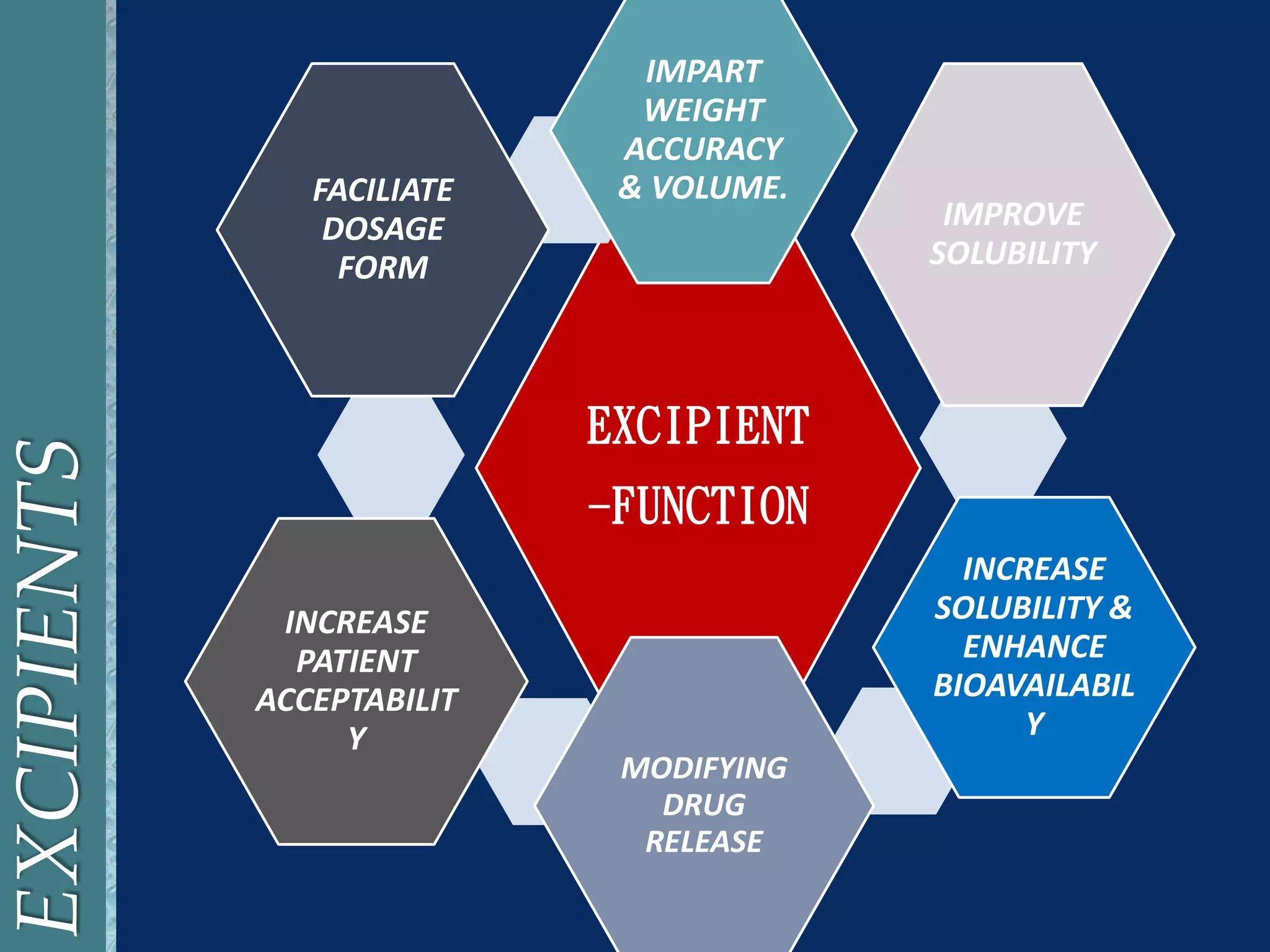
EXCIPIENTS
EXCIPIENT
-FUNCTION
IMPART
WEIGHT
ACCURACY
& VOLUME.
IMPROVE
SOLUBILITY
INCREASE
SOLUBILITY &
ENHANCE
BIOAVAILABIL
Y
MODIFYING
DRUG
RELEASE
INCREASE
PATIENT
ACCEPTABILIT
Y
FACILIATE
DOSAGE
FORM
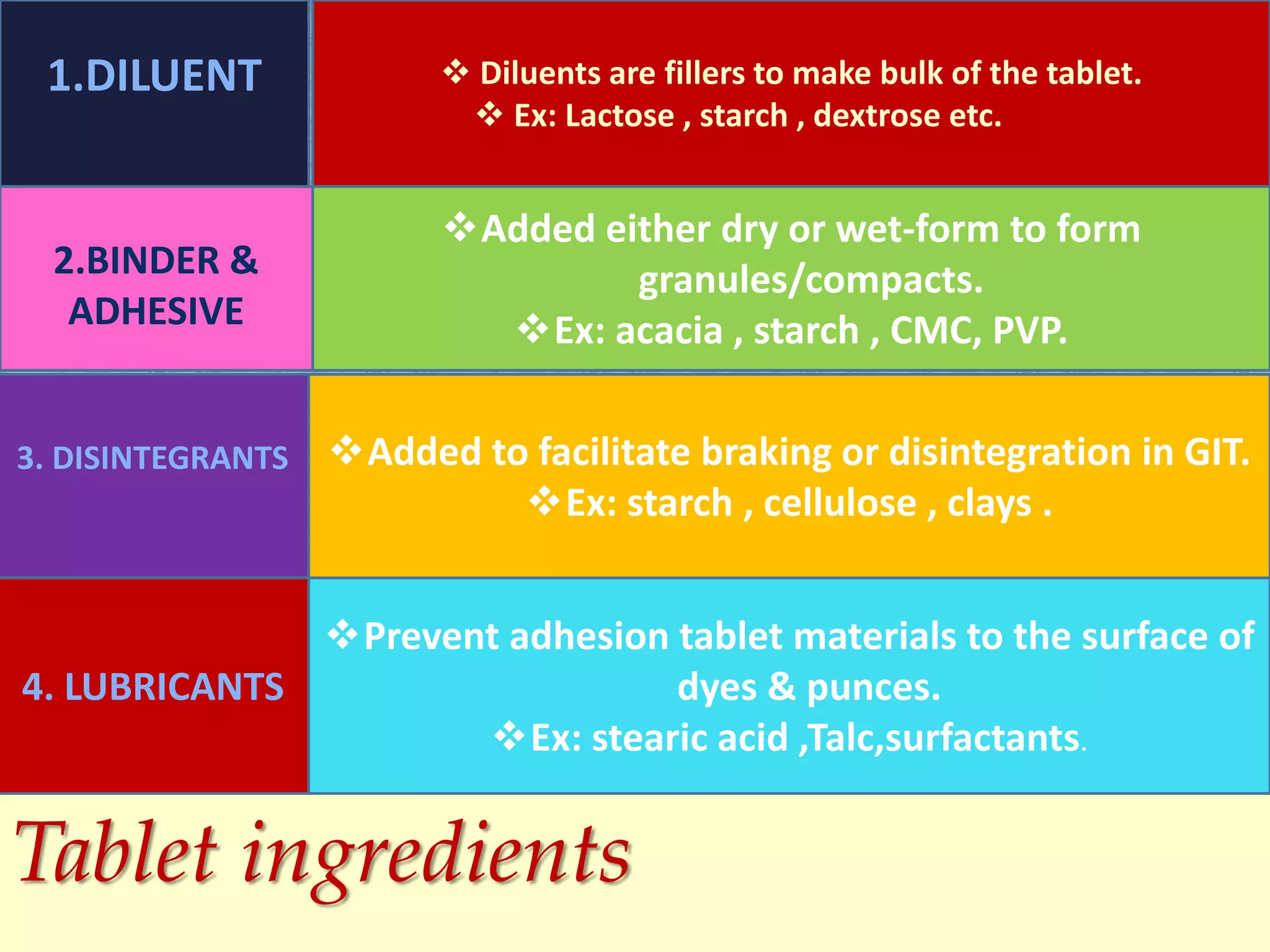
Tablet ingredients
1.DILUENT  Diluents are fillers to make bulk of the tablet.
 Ex: Lactose , starch , dextrose etc.
2.BINDER &
ADHESIVE
Added either dry or wet-form to form
granules/compacts.
Ex: acacia , starch , CMC, PVP.
3. DISINTEGRANTS Added to facilitate braking or disintegration in GIT.
Ex: starch , cellulose , clays .
4. LUBRICANTS
Prevent adhesion tablet materials to the surface of
dyes & punces.
Ex: stearic acid ,Talc,surfactants.
Tablet ingredients
5. GLIDANT
To promote flow of granules or powder material by
reducing their friction .
Ex : Corn starch, Talc.
6. Colouring
agent
7. Flavouring
agent
8. Sweetening
agent
Production of more elegant product.
Ex : erythrosine, indigoten.
To impart flavour or odour..
Ex : Menthol, Venilla , clove oil.
To mask the bitter taste of drugs.
Ex : mannitol, Lactose, Aspartame.
Cost is lowest of all oral dosage forms.
Light & compact.
Easiest & cheapest to package and strip.
No risk in choking.
Overcome unacceptable of drug .
Quick disintegration and dissolution of dosage
form.
Improved bioavailability can be achieved.
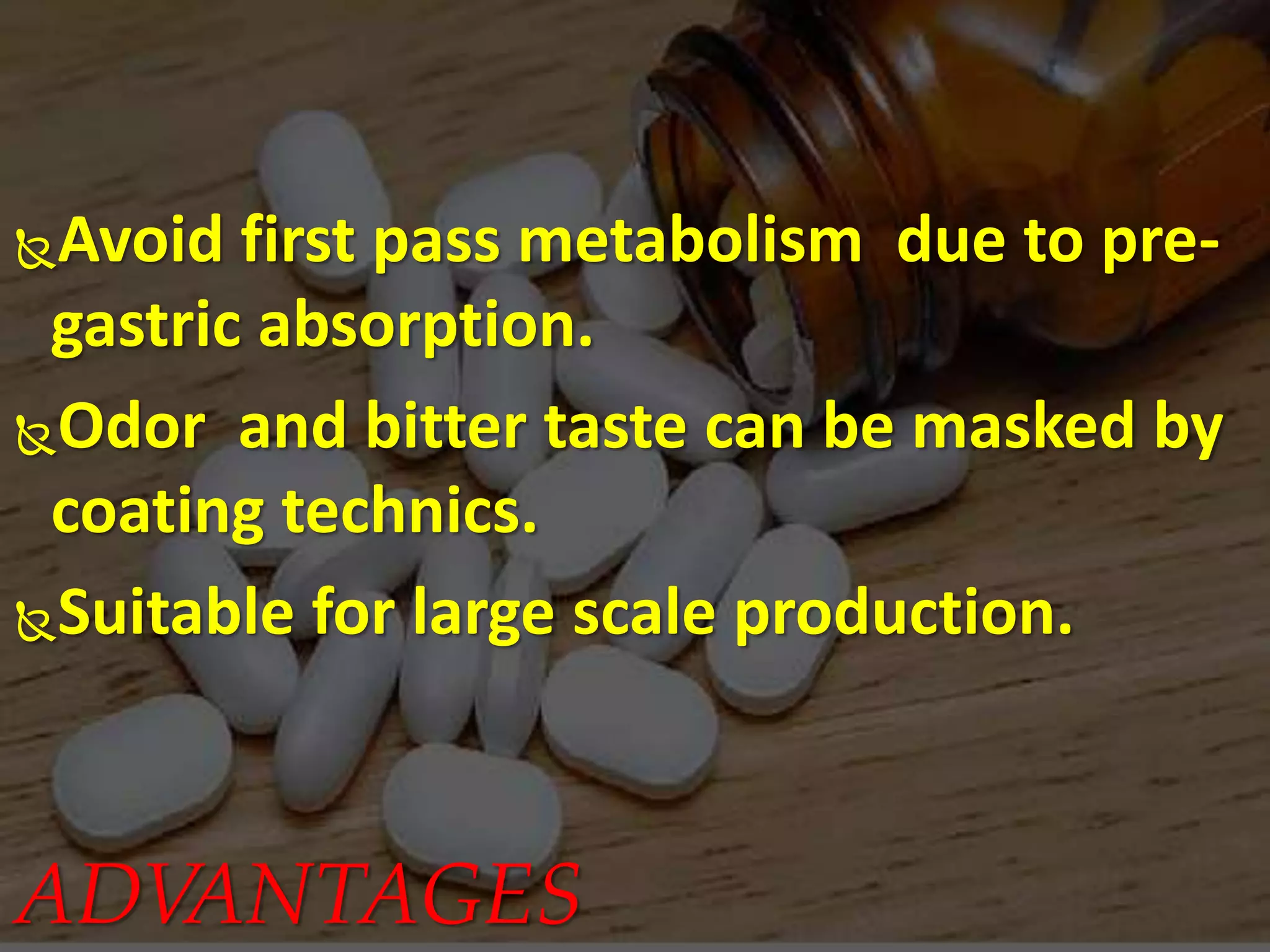
ADVANTAGES
Avoid first pass metabolism due to pre-
gastric absorption.
Odor and bitter taste can be masked by
coating technics.
Suitable for large scale production.
ADVANTAGES
Difficult to swallow in case of children and
unconscious patients.
Some drug resist compression into dense compacts
,owing to amorphous nature ,low density
characters.
Drugs with poor wetting ,slow dissolution
properties.
Bitter tasting drugs,drugs within an objectionable
odour or drugs that are sensitive to oxygen may
require encapsulation or coating.
DISADVANTAGES
THANK YOU

Tablets group presentation

  • 1.
  • 2.
  • 3.
    INTRODUCTUION A tablet isa pharmaceutical solid dosage form . It comprises mixture of active substance and excipients. EX:- PARACETAMOL 500mg + excipient. The excipients can include diluents , blinder, or granulating agent, glidants ,and lubricants. What is tablet? API EXCIPIENT TABLET SUITABLE FORM
  • 4.
    Tablet is definedas a compressed solid dosage form containing medicaments with or without excipients . Tablets are solid dosage forms ,prepared by compressing a drug or a mixture of drugs ,with or without diluents. Definition
  • 5.
    { Different types ofTablets 1.Tablets ingested Orally : 1) Compressed Tablets: Paracetamol tablets. 2) Multiple compressed tablets. 3) Repeat action tablets. 4) Delayed release tablets. 5) Sugar coated tablets: Multivitamin tablet. 6) Film coated tablets: Metronidazole tablet. 7) Chewable tablet: Antacid tablets.
  • 6.
    Different types oftablets 2: Tablets used in oral cavity 3: tablet administered by other route 1) Buccal tablets : Vitamin – c tablet. 2) Sublingual tablet. 3) Troches or lozenges. 4) Dental cone. 1) Implantation tablets. 2) Vaginal tablets: Clotrimazole tablets.
  • 7.
  • 8.
    Tablet ingredients 1.DILUENT Diluents are fillers to make bulk of the tablet.  Ex: Lactose , starch , dextrose etc. 2.BINDER & ADHESIVE Added either dry or wet-form to form granules/compacts. Ex: acacia , starch , CMC, PVP. 3. DISINTEGRANTS Added to facilitate braking or disintegration in GIT. Ex: starch , cellulose , clays . 4. LUBRICANTS Prevent adhesion tablet materials to the surface of dyes & punces. Ex: stearic acid ,Talc,surfactants.
  • 9.
    Tablet ingredients 5. GLIDANT Topromote flow of granules or powder material by reducing their friction . Ex : Corn starch, Talc. 6. Colouring agent 7. Flavouring agent 8. Sweetening agent Production of more elegant product. Ex : erythrosine, indigoten. To impart flavour or odour.. Ex : Menthol, Venilla , clove oil. To mask the bitter taste of drugs. Ex : mannitol, Lactose, Aspartame.
  • 10.
    Cost is lowestof all oral dosage forms. Light & compact. Easiest & cheapest to package and strip. No risk in choking. Overcome unacceptable of drug . Quick disintegration and dissolution of dosage form. Improved bioavailability can be achieved. ADVANTAGES
  • 11.
    Avoid first passmetabolism due to pre- gastric absorption. Odor and bitter taste can be masked by coating technics. Suitable for large scale production. ADVANTAGES
  • 12.
    Difficult to swallowin case of children and unconscious patients. Some drug resist compression into dense compacts ,owing to amorphous nature ,low density characters. Drugs with poor wetting ,slow dissolution properties. Bitter tasting drugs,drugs within an objectionable odour or drugs that are sensitive to oxygen may require encapsulation or coating. DISADVANTAGES
  • 13.